Introduction
Understanding the regulation of insects in changing environments is fundamental to better control species that are agricultural or forest pests (Berryman and Stark Reference Berryman and Stark1985; Berryman et al. Reference Berryman, Barbosa and Schultz1987) or vectors of medical and veterinary important pathogens (Chaves et al. Reference Chaves, Morrison, Kitron and Scott2012, Reference Chaves, Scott, Morrison and Takada2014). Of special interest is understanding whether their population dynamics are under density dependence, i.e., whether population fluctuations are kept in check (Turchin Reference Turchin2003) despite the impacts of a changing environment on their abundance (Levins Reference Levins1968). A simple way to test for density dependence in insects is by fitting the Ricker model to abundance time series (Yang et al. Reference Yang, Bradshaw, Whelan and Brook2008; Hoshi et al. Reference Hoshi, Higa and Chaves2014; Chaves et al. Reference Chaves, Imanishi and Hoshi2015). The Ricker model is described by the following equation:
 $$N_{{t{\rm {\plus}1}}} {\equals}\lambda _{0} N_{t} exp\left( {bN_{t} } \right)$$
where the parameter b, is interpreted as a density dependence coefficient that implies regulation when its value is below 0 (Turchin Reference Turchin2003). The Ricker model is also very useful to understand if cycles in populations are endogenously generated, i.e., independent of weather or environmental changes, as the parameter λ 0, the intrinsic rate of population growth, can be used to predict if population growth is stable, i.e., tends to reach a population size that does not cycle in a regular fashion. More specifically, with the Ricker model when ln(λ 0)<2, the population is stable, meaning that any fluctuations are likely due to perturbations derived from environmental changes (Mangel Reference Mangel2006).
Several studies have been focussed on the bamboo mosquito, Tripteroides bambusa (Yamada) (Diptera: Culicidae), larval ecology (Sunahara and Mogi Reference Sunahara and Mogi1997a, Reference Sunahara and Mogi1998) but little attention has been given to the ecology of its adults or to patterns in time series of its abundance. As suggested by its vernacular name, the natural habitat of the bamboo mosquito during its larval stage are bamboo stumps (Kurihara Reference Kurihara1958; Kurashige Reference Kurashige1961, Reference Kurashige1963), but it is also able to colonise other tree holes (Sakakibara Reference Sakakibara1960; Tsuda et al. Reference Tsuda, Takagi and Wada1994) and artificial containers in areas with abundant natural vegetation (Zea Iriarte et al. Reference Zea Iriarte, Tsuda, Wada and Takagi1991; Sota et al. Reference Sota, Mogi and Hayamizu1994; Sunahara and Mogi Reference Sunahara and Mogi1997a; Kosuge et al. Reference Kosuge, Yamada, Endo, Kakegawa, Mori and Ito2013). This mosquito is known to preferentially oviposit in dark containers (Toma and Miyagi Reference Toma and Miyagi1983) and to have a generalist bloodfeeding nature, being able to engorge on reptiles, mammals, and birds (Miyagi Reference Miyagi1972). This mosquito overwinters as larvae and eggs (Kurashige Reference Kurashige1963; Makiya Reference Makiya1968; Sunahara and Mogi Reference Sunahara and Mogi1997b). The bamboo mosquito has been frequently reported as co-occurring with medically and veterinary important species, especially the Asian tiger mosquito, Aedes albopictus (Skuse), and the Asian bush mosquito, Aedes japonicus (Theobald) (Zea Iriarte et al. Reference Zea Iriarte, Tsuda, Wada and Takagi1991). Here, we study a biweekly time series of the bamboo mosquito adult abundance from a season-long study carried out in Nagasaki, Japan during 2014. For data management we used the Open Data Kit (Sharif et al. Reference Sharif, Lundin, Morgan, Hall, Dhadda and Mann2016). We specifically fit an adult bamboo mosquito time series to the Ricker model in order to test whether the abundance of adults from this mosquito species was under density dependence regulation, and to also quantify any potential impacts of the changing environment on its abundance.
Materials and methods
Data
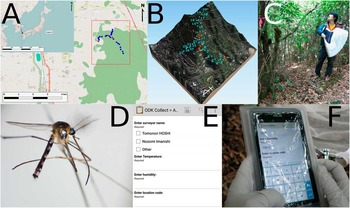
We sampled mosquitoes in Nagasaki City, Japan (Fig. 1A) around 27 fixed points, i.e., trees, in a secondary forest habitat at Mount Konpira (32°46′N, 129°53′E; Fig. 1B) (Chaves et al. Reference Chaves, Imanishi and Hoshi2015). Adult mosquito sampling was performed using a sweep net (Fig. 1C) 36 cm in diameter (Shiga Insect, Tokyo, Japan). The sampling started at sunrise, randomising each time the order of the sampling locations in order to diminish the likelihood of a biased sampling. We standardised the net sweeping by sweeping for two minutes after arriving to a focal tree, resting for one minute, then sweeping for two additional minutes (Chaves et al. Reference Chaves, Imanishi and Hoshi2015). We chose this technique because it has been previously used in Mount Konpira, and the collected mosquito taxa are very similar to those collected with light traps deployed at 1.5 m above the ground (Zea Iriarte et al. Reference Zea Iriarte, Tsuda, Wada and Takagi1991; Tsuda et al. Reference Tsuda, Maekawa, Saita, Hasegawa and Takagi2003). Our sampling was biweekly from 19 May to 15 November 2014, after which we were unable to catch any adult mosquitoes. The biweekly sampling frequency was chosen trying to approximate the average developmental time for mosquitoes, in order to fulfill the assumptions of the Ricker model (Turchin Reference Turchin2003). We chose the sampling dates based on the previous observations on the phenology of the bamboo mosquito, which recorded mid-May as the time when the emergence of adults started in Saga prefecture, at approximately the same latitude of Nagasaki (Sunahara and Mogi Reference Sunahara and Mogi1997b). Preliminary mosquito identification was performed in the field, following an audit of all samples in the laboratory using a dissection scope. Mosquito vouchers were deposited in the Entomological Collection at Nagasaki University Institute of Tropical Medicine (Nagasaki, Japan) (Fig. 1D). Results for mosquito species with medical importance collected with T. bambusa during our study period have been already reported elsewhere (Chaves et al. Reference Chaves, Imanishi and Hoshi2015; Chaves Reference Chaves2016). Each mosquito sampling session we recorded the local temperature and relative humidity during the sampling of the mosquitoes. We used a portable O–230 thermohygrometer (Dretec, Saitama, Japan). For the subsequent analyses we averaged the temperature and relative humidity measurements over all the sampled sites, in the case of the temperature also estimating its standard deviation. Daily rainfall data were obtained from the meteorological station of Nagasaki City, available at the Japanese Meteorological Agency. These meteorological variables were chosen based on their known impact on mosquito natural history, e.g., oviposition, movement, development, and adult recruitment, among others (see Chaves et al. Reference Chaves, Morrison, Kitron and Scott2012). For the subsequent analysis, mosquito abundance was summed across all sampling sites for each sampling session, rainfall records were accumulated for the 14 days before the mosquito sampling day. For mapping the sampling locations, we used QGIS (version 2.14.3; Open Source Geospatial Foundation Project, Beaverton, Oregon, United States of America, available at http://www.qgis.org/) and the OpenLayers plugin (available at https://github.com/sourcepole/qgis-openlayers-plugin). The Qgis2threejs plugin (available at https://github.com/minorua/Qgis2threejs) was used to create a 3D map. The Nagasaki City direction of Green Areas (“Midori no ka” in Japanese) kindly provided all relevant permits to perform the study.
Study site, sampling and data management with Open Data Kit, ODK. (A) Study site in relation to Japan and Nagasaki City (OpenStreetMap); (B) 3D image of sampling points in Mount Konpira, Nagasaki, Japan, blue indicates presence of Tripteroides bambusa and red indicates absence (Google Map); (C) net sweeping around a focal tree. Note the focal tree is a landmark for systematic collection, as net movements are made around both the body and surrounding ground of the person sampling; (D) voucher of adult male T. bambusa; (E) snapshot of a data entry form with an Android device; (F) data collection in the field.

Data management
For data collection and management, we used Open Data Kit (ODK; available at https://opendatakit.org). The ODK is a suite of open source software that allows the design of forms for data input, using Android based mobile devices, and data management before analysis. Specifically, we designed a form for data collection with Microsoft Excel (Microsoft Corporation, Redmond, Washington, United States of America), which was then converted into the ODK format using the XLSForm Offline (available at https://gumroad.com/l/xlsform-offline). The converted form (Fig. 1E) was uploaded to a Linux data server running ODK Aggregate, the ODK programme that aggregates data collected with mobile devices. We collected data with a Nexus 7 and a Zenfone 5 (ASUSTeK Computer, Taipei, Taiwan), where the application ODK Collect was pre-installed to download digital forms for data collection (Fig. 1F). Once data were collected in the field, we submitted the forms to our data server at Nagasaki University. The environmental data and the total number of field collected mosquitoes, for each sampling location and session, were then exported as a comma separate file (csv format). After species identification in the laboratory, the exported csv file was audited and corrected before the statistical analysis.
Time series modelling
The biweekly time series with the number of bamboo mosquitoes (N t ) was analysed using standard techniques for time series analysis. A preliminary analysis showed that the time series had no significant autocorrelation structure, i.e., consecutive observations in the time series were not significantly autocorrelated (Shumway and Stoffer Reference Shumway and Stoffer2011). We therefore estimated the cross-correlation functions (Shumway and Stoffer Reference Shumway and Stoffer2011) of mosquito abundance with up to three time lags with rainfall, relative humidity, temperature, and the standard deviation of the temperature. After choosing the variables, and lags, that were significantly associated with the abundance of bamboo mosquito adults, we fitted a full Ricker model that included the significant climatic covariates. This full Ricker model is described by the following equation:
 $$M_{{t{\rm {\plus}1}}} {\equals}\lambda _{0} M_{t} exp\left( {bM_{t} {\plus}g{\rm Cov}_{{t{\rm {\minus}}\tau }} } \right)$$
where M t is a normalised version of the original time series. M t is normalised by adding 1 in order to avoid the presence of zero abundance, i.e., M t =N t +1, rendering feasible the fitting of the Ricker model (Turchin Reference Turchin2003). As already stated in the introduction, λ 0 is the intrinsic rate of population growth, b the density dependence coefficient. To account for weather impacts g is a linear coefficient for a weather covariate (Cov) at time t with a time lag τ. When fitting the model, we assumed that abundance counts had a Poisson distribution. Models with and without weather covariates were fitted using maximum likelihood methods (Bolker Reference Bolker2008). The best model was selected based on the minimisation of the Akaike Information Criterion (AIC) a measure of model goodness of fit that aims to reduces the number of parameters (Shumway and Stoffer Reference Shumway and Stoffer2011). The code and data used for the maximum likelihood fitting the best model, using the statistical package R, is presented as a supplemental online only material (Supplementary Appendix 1).
Results
The ODK allowed us to skip the traditional data entry process from paper into a digital format for data analysis. This method simplified the audit of errors by checking details about the collection time and coordinates of the places where data were collected, verification that is commonly skipped when doing fieldwork. For example, this process allowed us to correct a trap misidentification, which was discovered when auditing the data found duplicate records for one trap and a missing observation for another trap. The error was corrected by looking at the time and coordinates when the samples were collected.
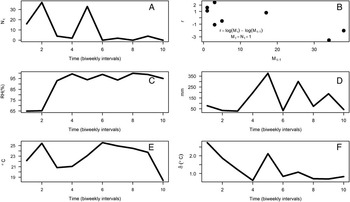
The time series of bamboo mosquito abundance is shown in Figure 2A. The mosquito was caught only until mid-September. For this reason, data for only 10 of the 14 biweekly samples are shown. During the study period we collected a total of 98 bamboo mosquitoes. There were 10 males and 88 females. The mean abundance (±standard deviation) was 9.8±14.1 bamboo mosquitoes per sampling session, when considering only the first 10 biweekly samples. The abundance range over the sampling sessions was 0–37 individuals, and the maximum number of individuals found at any single sampling location, during a single sampling session, was 13, while the mean number (±standard deviation) of mosquitoes biweekly sampled by location was 0.363±0.697 individuals (see Supplementary Table S1 for detailed biweekly estimates). The dispersed distribution was reflected in Figure 2A, where the standard deviation was larger than the mean abundance, as the abundance considerably fluctuated during the study period. The per capita growth rate (r=log(M
t
)−log(M
t−1)) as function of the transformed mosquito population abundance by sampling session (M
t
) is shown in Figure 2B. Despite the fluctuations in Figure 2A, the decrease in r as function of M
t
suggests that the bamboo mosquito was under density-dependent regulation (Turchin Reference Turchin2003). The rest of the panels in Figure 2 show biweekly time series of weather variables that could be associated with the fluctuations in the abundance of the bamboo mosquito. Specifically, Figure 2C shows relative humidity, Figure 2D rainfall, Figure 2E mean temperature, and Figure 2F the standard deviation of the temperature. As suggested by Figure 2C, abundance of the bamboo mosquito (Fig. 2A) was negatively correlated at lag 0, i.e., without a time delay, with relative humidity (
 $\widehat{{{\rm cor}}}{\equals}{\minus}0.66$
, P<0.05). By contrast bamboo mosquito abundance (Fig. 2A) was positively correlated with the standard deviation of the temperature (Fig. 2F), also at lag 0 (
 $\widehat{{{\rm cor}}}{\equals}{\rm 0}{\rm .74}$
, P<0.05). No significant correlation was observed with rainfall nor temperature, and these covariates, therefore, were not considered when fitting the model presented in equation [2].
Biweekly time series (A) bamboo mosquito, Tripteroides bambusa, abundance, N t , between 19 May and 15 October 2014; (B) population growth rate (r) as function of population size; (C) relative humidity; (D) rainfall; (E) temperature; (F) standard deviation of the temperature.

The information about the association between the bamboo mosquito abundance and relative humidity and the standard deviation was considered when fitting the full Ricker model presented in equation [2]. Parameter estimates for the best model, which considered the standard deviation of temperature (without a time lag, i.e., τ=0) as covariate, are presented in Table 1. The AIC of this model (
 $\widehat{{{\rm AIC}}}{\equals} 44.22$
) was smaller than that of a model that considered relative humidity (τ=0) as covariate (
 $$\widehat{{{\rm AIC}}}{\equals} 88.96$$
) and a model without covariates (
 $\widehat{{{\rm AIC}}}{\equals} 117.46$
). All parameters in the best model (Table 1) were statistically significant (P<0.05).
Parameter estimates for the Ricker model with the best fit to the bamboo mosquito, Tripteroides bambusa, season long biweekly time series.

Notes: In the analysis, the standard deviation of the temperature time series was standardised by removing its mean used a covariate (Cov in equation [2] in the Materials and methods section).
***Statistically significant (P<0.001).
Discussion
We found that ODK use significantly improved the process of data management. There are some limitations that are worth mentioning, such as the potential to run out of batteries, hindering data collection, or the lack of flexibility to correct errors in the ODK aggregate server. On the other hand, the ability to audit data errors are very convenient when compared with the use of paper based surveys, as already reported for epidemiological studies (Sharif et al. Reference Sharif, Lundin, Morgan, Hall, Dhadda and Mann2016).
Our results indicate that population dynamics of the bamboo mosquito are subject to density dependence. The population growth parameter rate estimated for the Ricker model suggests that adult bamboo mosquitoes have a stable population dynamics (Mangel Reference Mangel2006), as the condition for stability holds, i.e.,
 $( {{\rm ln}( {\widehat{{\lambda _{0} }}} ){\equals}{\rm ln} ( {3.098} ){\equals}1.131\,\lt\,2} )$
. This result is similar to what has been observed for adults of Armigeres subalbatus (Coquillett), Aedes albopictus (Skuse), Aedes japonicus japonicus (Theobald), and Aedes flavopictus Yamada at Mount Konpira during the same study season (Chaves et al. Reference Chaves, Imanishi and Hoshi2015; Chaves Reference Chaves2016). Similar patterns have been observed for other mosquitoes in Japan (Hoshi et al. Reference Hoshi, Higa and Chaves2014) and elsewhere (Yang et al. Reference Yang, Bradshaw, Whelan and Brook2008; Chaves et al. Reference Chaves, Higa, Lee, Jeong, Heo and Kim2013). The carrying capacity for the sampling effort in our study setting, which is equal to
 $1\!/\:\hat{b}$
, is around 10 individuals, which is similar to the mean of biweekly abundance that was observed in the time series.
The fluctuations observed in the time series of the bamboo mosquito were associated with the relative humidity and the standard deviation of the temperature, but the process of model selection suggested that only the latter was important when both variables were compared through model selection. The positive association with the standard deviation of temperature might be related with the dispersal of the bamboo mosquito, as insects are likely to move in the presence of temperature gradients (Levins Reference Levins1968). Interestingly, the association with the standard deviation of the temperature was unique to this mosquito species, as the abundance of other tree-hole mosquito species of Armigeres Theobald and Aedes Meigen. in the adult stage at the same studied setting was positively associated with rainfall (Chaves et al. Reference Chaves, Imanishi and Hoshi2015; Chaves Reference Chaves2016), indicating a diversity in the type of factors that could be associated with mosquito abundance fluctuations in the same habitat.
Finally, our results provide further evidence about the density dependence regulation of mosquitoes. Nevertheless, our scope is limited as ideally similar tests should be performed on time series for the immature stages of the bamboo mosquito. It is highly likely that the density dependence observed in the adult stage of the bamboo mosquito is an expression of ecological processes affecting the immature aquatic stages of this mosquito species (Sunahara and Mogi Reference Sunahara and Mogi1997a, Reference Sunahara and Mogi1997b), but for that more comprehensive longitudinal studies in this mosquito species are necessary.
Acknowledgements
This study was funded by Sumitomo Foundation grant 153107 to L.F.C. Mr. Chikayuki Moji provided valuable support during data collection in the field. Ms. Junko Sakemoto provided valuable administrative support at Nagasaki University.
Supplementary material
To view supplementary material for this article, please visit https://doi.org/10.4039/tce.2016.64