Introduction
There is increasing evidence that during the course of Alzheimer Disease (AD) neuropathological changes occur years before distinct clinical symptoms appear (Dubois et al., Reference Dubois2016). Support comes from findings that syndromes, such as subjective cognitive decline (SCD) (Jessen et al., Reference Jessen2014) and mild cognitive impairment (MCI) (Petersen et al., Reference Petersen, Smith, Waring, Ivnik, Tangalos and Kokmen1999) are associated with increased risk for future cognitive decline and AD. This so-called prodromal (MCI) or preclinical (SCD) stages can be correlated with biomarkers, including brain region volumes, brain atrophy, and amyloid burden, which is consistent with earlier neuropathological reports (Jack et al., Reference Jack2014). Patients with SCD report cognitive decline, however, do not present cognitive deficits in neurocognitive testing, whereas MCI requires impairment in one or more cognitive domains, which do not meet criteria for dementia and usually is categorized into amnestic mild cognitive impairment (aMCI) and non-amnestic mild cognitive impairment (naMCI) (Pusswald et al., Reference Pusswald2013).
Decline of episodic memory is a major hallmark of AD (Coutinho et al., Reference Coutinho, Drummond, de Oliveira-Souza, Moll, Tovar-Moll and Mattos2015; Tromp et al., Reference Tromp, Dufour, Lithfous, Pebayle and Despres2015). However, decline of semantic knowledge is also common during the course of AD (Patterson et al., Reference Patterson, Nestor and Rogers2007). Semantic memory, also called conceptual knowledge, corresponds to general knowledge of objects, word meanings, facts, and people, without connections to particular times and places. Conceptual knowledge is mostly shared across individuals in a given culture, although its precise scope depends on the individuals’ experience (Tulving, Reference Tulving, Tulving and Donaldson1972). Deficiencies in semantic memory are often assessed by tests measuring object naming, word definition generation, word–picture and picture-picture matching, and the generation of exemplars on category fluency tasks (Greene and Hodges, Reference Greene and Hodges1996b).
Decline of person-related semantic knowledge, such as remembering names or identifying faces, can also be found in the course of AD (Werheid and Clare, Reference Werheid and Clare2007). Impaired semantic knowledge often manifests as word-finding difficulties in daily life. In fact, anomia for names of persons may be a socially disturbing and embarrassing deficit. It is well-known that access to semantic knowledge about famous people is a task sensitive to brain damage and patients with AD show impairment in recalling and recognizing the names of famous people from photographs (Becker et al., Reference Becker, Lopez and Boller1995; Greene and Hodges, Reference Greene and Hodges1996a; Reference Greene and Hodges1996b; Delazer et al., Reference Delazer, Semenza, Reiner, Hofer and Benke2003). Indeed, there is evidence to suggest that person-related semantic knowledge is disproportionately affected in MCI and AD. A higher degree of impairment of specific semantic knowledge compared to general semantic knowledge has been shown in a few studies (Greene and Hodges, Reference Greene and Hodges1996b; Thompson et al., Reference Thompson, Graham, Patterson, Sahakian and Hodges2002; Joubert et al., Reference Joubert2010; Clague et al., Reference Clague, Graham, Thompson and Hodges2011). As Werheid and Clare (Reference Werheid and Clare2007) pointed out, naming tasks appeared to be the most difficult in very early forms of neurodegenerative processes like MCI. Another study focused on impairment distributions of different semantic memory tests, including naming of famous faces among patients of preclinical AD. The authors concluded that since subtle changes of semantic memory are present prior to clinical diagnosis of AD, famous faces tests may be more sensitive to the earliest phases of AD than tests in which naming of objects is required (Vogel et al., Reference Vogel, Gade, Stokholm and Waldemar2005).
Naming common objects appears to be much easier than retrieving the names of celebrities by looking at photos of their faces. Proper names are arbitrary and unique so it is possible that neural connectivity may be weaker than with concrete nouns, which usually refer to a whole class of objects (Werheid and Clare, Reference Werheid and Clare2007). A recent study demonstrated that naming photographs of famous people and famous buildings was significantly more impaired than naming line drawings of common objects in aMCI individuals. The authors suggested that semantic knowledge about unique entities such as famous people and buildings may be more vulnerable to damage than more general knowledge about common objects (Ahmed et al., Reference Ahmed, Arnold, Thompson, Graham and Hodges2008). These findings suggest that confrontation naming tests in which pictures of objects are required to be named may be less sensitive diagnostic measures of anomia in aMCI and AD than tests that require naming famous faces (Joubert et al., Reference Joubert2010). A further study found naming and semantic knowledge of famous people to be more impaired than naming and semantic knowledge of objects in patients with MCI. Additionally, proper nouns showed accelerated deterioration in the course of AD (Clague et al., Reference Clague, Graham, Thompson and Hodges2011). Hypothesizing a possible explanation, they assumed that knowledge regarding unique items is “less robust” than more generic knowledge. Objects may rely to a much greater extent upon their sensory and functional properties and thus be more frequently rehearsed throughout one's lifetime. Knowledge of famous people instead, may be more unique and idiosyncratic, thus leading to greater sensitivity for semantic degradation (Joubert et al., Reference Joubert2010).
Semantic memory impairments are frequently present in preclinical AD. A growing body of literature has shown that the clinical investigation of semantic memory may be helpful in predicting the risk of developing AD. For instance, the first measureable decline in cognitive performance began as early as 12 years before the development of dementia and was observed on a category fluency task, which is strongly associated with semantic knowledge (Amieva et al., Reference Amieva2008). Using experimental measures, a recent study with preclinical AD patients showed that impaired naming of famous faces was more predictive of future conversion to AD than object naming (Estevez-Gonzalez et al., Reference Estevez-Gonzalez2004), indicating that face naming abilities are sensitive predictors of future conversion to AD (Thompson et al., Reference Thompson, Graham, Patterson, Sahakian and Hodges2002; Vogel et al., Reference Vogel, Gade, Stokholm and Waldemar2005).
The issue of separating the contributions of retrieval and storage to semantic memory impairment has been a matter of controversy. One explanation claims that semantic deficits are due to difficulties in accessing or retrieving information stored in semantic long-term memory (i.e. the degraded access view). A second hypothesis highlights loss of semantic information and it is assumed that semantic representations in memory decline gradually across time (i.e. the degraded store view). There is evidence that semantic deficiency is accounted for by an impairment regarding accessing/retrieving semantic information. One study argued that there might exist important differences in task demands, for example, conscious and effortful recall of semantic knowledge (such as verbal fluency or picture naming tasks) versus automatic and non-effortful activation of semantic knowledge (such as various priming tasks and identification tasks) (Nebes et al., Reference Nebes, Martin and Horn1984). In aMCI there is evidence that impairment of effortful processes explains to some extent semantic deficits and suggests that intentional access to semantic memory is impaired before automatic access (Duong et al., Reference Duong, Whitehead, Hanratty and Chertkow2006). However, there is also evidence to support the interpretation of a breakdown in the structure of semantic memory rather than a defect of access (Dopkins et al., Reference Dopkins, Kovner, Rich and Brandt1997). Additional findings suggest that semantic impairment displayed during the course of AD is due to loss of information rather than problems in accessing semantic information (Mardh et al., Reference Mardh, Nagga and Samuelsson2013). The primary deficit is therefore not one of name access, but a loss of stored information presumably due to temporal lobe dysfunction (Estevez-Gonzalez et al., Reference Estevez-Gonzalez2004; Joubert et al., Reference Joubert2010). Current evidence suggests that the anterior temporal lobe is a key region for the neural basis of semantic memory (Patterson et al., Reference Patterson, Nestor and Rogers2007; Brambati et al., Reference Brambati, Benoit, Monetta, Belleville and Joubert2010; Joubert et al., Reference Joubert2010; Hirni et al., Reference Hirni, Kivisaari, Monsch and Taylor2013).
The presence of depressive symptoms (DS) is a major source of heterogeneity within SCD and MCI syndromes as up to 30–50% of individuals with SCD and MCI present such symptoms (Vogel et al., Reference Vogel, Gade, Stokholm and Waldemar2005; Lehrner et al., Reference Lehrner2014; Stogmann et al., Reference Stogmann2016; Ismail et al., Reference Ismail2017). Recently it has been shown that the presence of DS modulated the presentation of semantic deficits in aMCI (Brunet et al., Reference Brunet2011). This finding has been corroborated by another study, which showed that the presence of DS in aMCI is specifically associated with object-based semantic memory impairment (Callahan et al., Reference Callahan2015).
We performed the present study to investigate differences regarding semantic memory in SCD, MCI, and AD patient groups. To the best of our knowledge there is hitherto no information available concerning semantic memory impairment in SCD. Tests addressing unique and arbitrary knowledge may be more sensitive to early AD than tasks addressing common knowledge. Thus, the current study investigated whether semantic impairment is specific to people or whether it extends to other proper names based information, such as world capitals and word vocabulary.
No study, as far as we know, has yet investigated the relationship between DS and semantic memory performance in a sample of SCD, MCI, and AD patient groups, which will help gain a better understanding of the moderating influence of DS. Thus, a further purpose of the study was to investigate if semantic memory impairment in SCD, MCI, and AD patient groups is modulated according to the presence or absence of DS.
If a common semantic system is disrupted during the course of AD, there should be significant concordance between person specific semantic knowledge and general knowledge. Additionally, using tasks that minimize effortful processes should help differentiating questions concerning retrieval versus storage problems. We hypothesized that knowledge of famous people is not related to semantic knowledge for capital cities and vocabulary words and to general semantic memory, such as category fluency and object naming.
Methods
Study sample
The current data are part of a larger research project, the Vienna Conversion to Dementia Study (VCD-Study). The VCD is a prospective cohort study encompassing consecutive, community-dwelling patients complaining of cognitive problems who come to the memory outpatient clinic for assessment of a possible cognitive disorder. The study protocol has been approved by the Ethical Committee of the Medical University of Vienna, and written informed patient consent to perform this study has been received.
All patients received a complete neurological examination, standard laboratory blood tests and psychometric testing. In most cases, a magnetic resonance imaging (MRI) scan of the brain was obtained. In determining significant cerebrovascular disease, both neuroimaging and clinical patient features were used. Inclusion and exclusion criteria were similar to other studies. Patients were excluded from the study if any of the following conditions applied: (i) evidence of stroke as determined by neuroradiologic and clinical examination, (ii) history of severe head injury, (iii) current psychiatric diagnosis according to ICD-10 however, patients with DS were included because DS often occur in elderly patients, (iv) any medical condition that leads to severe cognitive deterioration, including renal, respiratory, cardiac, and hepatic disease.
All participants were subjected to the Neuropsychological Test Battery Vienna (NTBV) that included attention, executive functioning, language, and memory domains with corresponding domain z-scores (Lehrner et al., Reference Lehrner, Maly, Gleiß, Auff and Dal-Bianco2007; Pusswald et al., Reference Pusswald2013). The Alters–Konzentrations Test (AKT) (Gatterer, Reference Gatterer2008), a geriatric cancellation test, the digit symbol subtest of the German WAIS-R (Tewes, Reference Tewes1994), the symbol counting task from the cerebral insufficiency test (C.I.) (Lehrl, Reference Lehrl1978), the Trail Making Test B (Reitan, Reference Reitan1979), and the score difference of the Trail Making Test A and B (Reitan, Reference Reitan1979) were applied to assess attention. Executive functions were investigated using the Trail Making Test A (Reitan, Reference Reitan1979), the Five-Point Test (Regard et al., Reference Regard, Strauss and Knapp1982), the Maze Test from the NAI Test Battery (Oswald and Fleischmann, Reference Oswald and Fleischmann1997), the Stroop Test from the NAI Test Battery (Oswald and Fleischmann, Reference Oswald and Fleischmann1997), and the interference test from the C.I. (Lehrl and Fischer, Reference Lehrl and Fischer1997). Naming as many words beginning with the letters b, f, and l that came to mind within one minute for each task was used to tap lexical verbal fluency. In order to test language functions, we used verbal fluency tasks and a confrontation naming task (Goodglass, Reference Goodglass and Kaplan1983). Naming as many animals, supermarket items, and tools that came to mind within one minute for each task was used to tap semantic verbal fluency. The modified Boston Naming Test (mBNT) (Morris et al., Reference Morris1989) was used for assessing naming capabilities. Episodic memory was tested using the Verbal Selective Reminding Test (VSRT) with the subtests of immediate recall, total recall, delayed recall, and recognition (Lehrner et al., Reference Lehrner, Gleiß, Maly, Auff and Dal-Bianco2006).
After the completion of the evaluation, the cognitive status was determined according to established criteria (Petersen and Morris, Reference Petersen and Morris2005; Jessen et al., Reference Jessen2014) and the cut-off score used was 1.5 standard deviations below age and education corrected norms using a normative sample of cognitively healthy controls. For this purpose, the flexible Generalized Additive Models for Location, Scale and Shape (GAMLSS) model class was used (Pusswald et al., Reference Pusswald2013). The minimum mode of MCI classification was used and patients were divided into three groups of patients based on cognitive features as follows: SCD patients (z-scores of each single test were greater than −1.5 SD), aMCI patients (the z-score of at least one-memory test was below −1.5 SD), naMCI patients (there is at least one domain other than the memory domain where the minimum of the z-scores within this domain was below −1.5 SD), respectively. AD was diagnosed according to the NINCDS-ADRDA (McKhann et al., Reference Mckhann, Drachman, Folstein, Katzman, Price and Stadlan1984) and DSM-IV criteria (Saß et al., Reference Saß, Wittchen, Zaudig and Houben2003).
Patients
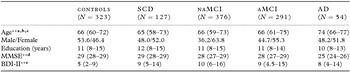
Eight-hundred-forty-eight consecutive patients complaining about memory problems, who came to the memory outpatient clinic for assessment of a possible cognitive disorder and fulfilled the inclusion criteria, were included in the study. Patients were either referred by physicians or were self-referrals. See Table 1 for details.
Participants characteristics – number of patients (N), medians with quartiles (given in parenthesis) for age, education, MMSE, and percentages for male/female

**Significant differences between five groups (p ≤ 0.001).
a Cont versus AD (adjusted p ≤ 0.05).
b SCD versus AD (adjusted p ≤ 0.05).
c naMCI versus AD (adjusted p ≤ 0.05).
d Group differences between all groups except Cont versus SCD (adjusted p ≤ 0.05).
e Group differences only for control group versus all other groups (adjusted p ≤ 0.05).
Cognitively healthy control participants
Three-hundred-twenty-three cognitively healthy control participants were included in the study. Great care was taken enrolling a sufficient number of cognitively healthy control participants living independently at home. Control participants were recruited by means of advertisements. They underwent a rigorous screening evaluation using a standardized clinical interview and cognitive screening. They were assessed as being in good physical health. Cognitive status was given special attention and cognitively healthy control participants were screened for intact cognition. They were required to have an MMSE score (Folstein et al., Reference Folstein, Folstein and Mchugh1975) greater than or equal to 27 and a MOCA Score (Nasreddine et al., Reference Nasreddine2005) greater than or equal to 26 adjusted for education. See Table 1 for details.
Semantic memory assessment
Semantic memory was assessed using tests for famous people, world capitals, and word vocabulary. Two multiple choice, matching to sample tests for assessing semantic memory for famous faces and world capitals were used in this study. The FACE test (Lehrner, Reference Lehrner2016b), involving celebrity name-to-face matching and the CITY test (Lehrner, Reference Lehrner2016a) involving capital-to-country matching. In both tests, items are answered in a multiple choice format (one out of four options; guessing probability 25%). For the FACE test, participants were provided with 16 items showing the face of a former or current celebrity. The portrait photo shots on the cards represent common celebrities. Faces depicted on the cards belong to actors or musicians, who produced songs or films in the last century. For the CITY test, participants were provided with 16 capital names. Participants were instructed to choose one out of four possibilities by guessing whenever they did not know the correct answer in either test. Every correct answer was scored with one point in both tests. A minimum of 0 and a maximum of 16 points could be achieved. Patients were allowed to review and correct already discarded items whenever they wanted during the test procedure. Test duration for both tests was about 5–10 minutes. There was no time limit for either test. Cronbach's α for the FACE was 0.86 and Cronbach's α for the CITY was 0.80, thus showing good internal reliability. Retest reliability after four years was 0.77 for the FACE test and 0.82 for the CITY test (Doblinger, Reference Doblinger2013).
For assessing vocabulary knowledge participants completed the Wortschatztest (WST), which is a widely used Rasch calibrated standardized vocabulary test measure of crystallized intelligence in German language. In 42 items, participants have to indicate one meaningful word in presence of five distractor words. The WST showed excellent internal reliability (Cronbach's α = 0.94) and no correlation to age (r = 0.08) but a significant correlation to formal schooling (r = 0.60) (Schmidt and Metzler, Reference Schmidt and Metzler1992). This task has a significant advantage in comparison to tests in which the participant is required to explain the meaning of the word due to be less dependent from expressive language skills.
Assessment of depressive symptoms (DS)
The Beck Depression Inventory (BDI-II), a 21-item instrument to detect DS in adults was used. It asks about how often one felt certain ways within the past two weeks, rated on a four-point scale. The total score takes values from 0 to 63. A score above 13 is indicative of clinically relevant DS. The internal consistency (Cronbach's α) ranges between 0.89 and 0.93. The test–retest reliability was reported to be 0.78 (Hautzinger et al., Reference Hautzinger, Keller and Kühner2006).
Statistical methods
Demographic variables, FACE, CITY, WST, and BDI-II scores are described as median and quartiles due to the skewed distribution of most of these variables. Z-scores of the neuropsychological test variables are described by means and standard deviations.
For the purpose of this study the raw scores of the FACE, CITY, and WST were also transformed into age, sex, and education specific z-scores using a normative sample and the flexible GAMLSS model class (Stasinopoulus and Rigby, Reference Stasinopoulus and Rigby2007). We defined participants with a z-score below −1.5 as having a considerable degree of semantic memory impairment.
Kruskal–Wallis tests were used to compare variables between groups. Post hoc tests were performed using the Dwass–Steel–Critchlow–Fligner method to correct for multiple comparisons.
The association of the proportion of FACE, CITY, WST z-scores below −1.5 (FACE z score< –1.5 and CITY z score< –1.5, WST z score< –1.5, respectively) on diagnostic group was investigated using logistic regression models with adjustment for DS. A test on the interaction of the group indicators with DS was used to investigate if the group differences differ between depressed and non-depressed individuals.
Associations between FACE, CITY, WST and demographic variables, MMSE score, BDI-II score, and all neuropsychological z-scores are quantified using Spearman's correlation coefficients (due to mostly non-linear associations).
We also performed three separate Proportions of Explained Variation (PEV) analyses in order to investigate the percentage of variability explained by MMSE, BDI-II, and neuropsychological variables.
The reported p values are the result of two-sided tests. P values ≤ 0.05 were considered to be statistically significant. All computations were performed using SAS software Version 9.4 (SAS Institute Inc., Cary, NC, USA, 2002–2012), except GAMLSS estimation, which was done using R 3.0.3.
Results
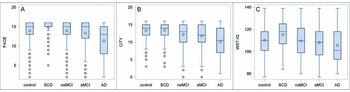
Demographic variables of study participants and the direction of the differences are shown in Table 1. Performance of groups in terms of FACE, CITY, and WST are depicted in Figure 1.
FACE, CITY, and WST scores across groups (control group, SCD group, naMCI group, aMCI group, AD group) shown as boxplots.

A Kruskal–Wallis test revealed a statistically significant difference for age between the five groups (p < 0.001). Post hoc testing revealed significant group differences for control group versus AD group, SCD group versus AD group, and naMCI group versus AD group, respectively. A Kruskal–Wallis test revealed no statistically significant difference for education (years) between the five groups (p > 0.3). A Kruskal–Wallis test revealed a statistically significant difference for BDI-II between the five groups (p < 0.001). Post hoc testing revealed significant group differences only for control group versus all other groups. See Table 1.
We performed three separate logistic regression models with the factors cognitive group status (controls, SCD group, naMCI group, aMCI group, AD group) and depressive status (BDI-II score ≤13 vs. BDI-II score>13) and semantic memory score (z-score < −1.5, here defined as having a considerable degree of semantic memory impairment) for FACE, CITY, and WST as dependent variables.
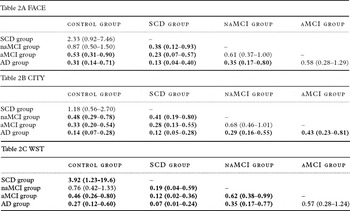
Using FACE z-score below −1.5 as dependent variable, the independent variable cognitive group status was significant (p = 0.001), whereas the independent variable depressive status (BDI-II score ≤13 vs. BDI-II score>13) (p = 0.338) and the interaction was not (p = 0.808). The odds ratio estimate for the group with DS was OR=0.79 (CI 0.49–1.27). The control group performed significantly better than all other groups except SCD group. 8.1% of the control group, 3.2% of the SCD group, 9.1% of the naMCI group, 13.5% of the aMCI group, and 22.5% of the AD group showed impaired performance (FACE z-score below −1.5). For specific group comparisons, see the odds ratio estimates in Table 2A.
A, 2B, and 2C: Odds-ratio estimates with 95% confidence limits for pairwise group comparisons (column patient group vs. row patient group) with respect to WST z-score, FACE z-score, and CITY z scores below −1.5, defined as considerable degree of sematic memory impairment, adjusted for depressive symptoms (BDI ≤13 vs. >13). Bold numbers indicate significant group differences (not accounting for multiple testing)

Nagelkerke's Max-rescaled R 2 = 0.038.
p = 0.0011 for total effect of all five groups.
p = 0.3381 for depressive symptoms.
BDI Odds Ratio = 0.793 (95% Confidence Limits 0.494–1.274).
Nagelkerke's Max-rescaled R 2 = 0.090.
p = 0.0001 for total effect of all five groups.
p = 0.0024 for depressive symptoms.
BDI Odds Ratio = 1.719 (95% Confidence Limits 1.212–2.437).
Nagelkerke's Max-rescaled R 2 = 0.068.
p = 0.0001 for total effect of all five groups.
p = 0.0128 for depressive symptoms.
BDI Odds Ratio = 1.713 (95% Confidence Limits 1.121–2.618).
Using CITY z-score below −1.5 as dependent variable, the independent variable cognitive group status was significant (p = 0.001) and the independent variable depressive status (BDI-II score ≤13 vs. BDI-II score>13) was significant (p = 0.002) whereas the interaction was not (p = 0.596). The odds ratio estimate for the group with DS was OR=1.72 (CI 1.21–2.44) indicating 72% higher odds to be impaired compared to healthy controls. The control group performed significantly better than all other groups except SCD group. 7.7% of the control group, 7.1% of the SCD group, 17.0% of the naMCI group, 22.7% of the aMCI group, and 39.9% of the AD group showed impaired performance (CITY z-score below −1.5). For specific group comparisons, see the odds ratio estimates in Table 2B.
Using WST z-score below −1.5 as dependent variable, the independent variable cognitive group status was significant (p = 0.001) and the independent variable depressive status (BDI-II score ≤13 vs. BDI-II score>13) was significant (p = 0.013) whereas their interaction was not (p = 0.947). The odds ratio estimate for the group with DS was OR=1.71 (CI 1.12–2.62) indicating 71% higher odds to be impaired compared to healthy controls. The SCD group performed significantly better than all other groups and the control group performed significantly better than all other groups except SCD group and naMCI group. 6.5% of the control group, 1.6% of the SCD group, 9.6% of the naMCI group, 15.0% of the aMCI group, and 22.6% of the AD group showed impaired performance (FACE z-score below −1.5). For specific group comparisons, see the odds ratio estimates in Table 2C.
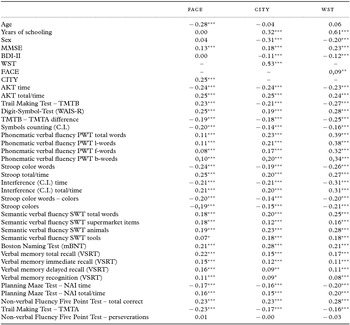
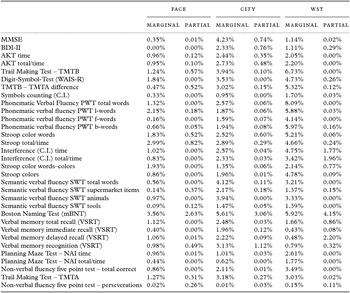
We performed correlation analyses (partialized for diagnostic groups) for the total group (N = 1095) between FACE, CITY, and WST raw scores and demographic variables, MMSE, BDI-II scores, and neuropsychological subtest scores, which revealed only low correlation coefficients (below 0.5), except for WST and education (years) (r = 0.61) and CITY and WST (r = 0.53). See Table 3 for details.
We also performed three separate PEV analyses for measures of semantic memory (FACE, CITY, WST z-score below −1.5) in order to investigate the percentage of variability explained by MMSE, BDI-II score, and neuropsychological test scores. We found that BNT scores were the most important for FACE, CITY, and WST, respectively. See Table 4 for details.
Spearman correlation coefficients for the total group partialized for the five diagnostic groups, between WST, FACE, CITY, demographic variables, MMSE, BDI-II score, and neuropsychological test scores

Abbreviations: AKT, Alters–Konzentrations test; WAIS-R, Wechsler adult intelligence scale – revised; TMTA, trail making test version A; TMTB, Trail Making Test version B; NAI, Nürnberger Alters Inventar; C.I., cerebral insufficiency test; VSRT, Verbal Selective Reminding Test; mBNT, modified Boston Naming Test.
*p < 0.05; **p < 0.01; ***p < 0.001.
Proportions of explained variation (PEV) analyses for measures of semantic memory (WST, FACE, CITY) and MMSE, BDI-II score and neuropsychological test scores in order to investigate the percentage of variability explained (outcome: z-score of WST, FACE, CITY below −1.5)

Abbreviations: AKT, Alters–Konzentrations test; WAIS-R, Wechsler adult intelligence scale – revised; TMTA, trail making test version A; TMTB, trail making test version B; NAI, nürnberger alters inventar; C.I., cerebral insufficiency test; VSRT, Verbal Selective Reminding Test; mBNT, modified Boston Naming Test.
Discussion
The goal of the present study was to investigate semantic memory functions in cognitive healthy elderly controls, SCD, MCI, and AD groups. Specifically, we were interested whether semantic memory impairment is specific to famous people knowledge or whether it extends to other proper name based information, such as world capitals and word vocabulary. Moreover, we were interested whether DS modulate semantic memory performance. We further examined whether there is an association between semantic memory and factors such as demographic variables and other neurocognitive functions.
As hypothesized, we found a significant difference in semantic memory for famous faces in MCI and manifest dementia (AD). The aMCI group had 47% higher odds and the AD group 69% higher odds to show impaired semantic memory performance for famous faces compared to healthy controls. This finding corroborates prior studies for famous faces (Greene and Hodges, Reference Greene and Hodges1996a; Reference Greene and Hodges1996b; Thompson et al., Reference Thompson, Graham, Patterson, Sahakian and Hodges2002; Delazer et al., Reference Delazer, Semenza, Reiner, Hofer and Benke2003; Joubert et al., Reference Joubert2010; Clague et al., Reference Clague, Graham, Thompson and Hodges2011).
Additionally, our study provides novel evidence regarding semantic memory for world capital knowledge and word vocabulary knowledge. Both world capital knowledge and word vocabulary knowledge were impaired in MCI patients and AD patients. In particular, when looking at the CITY test we found that there was a significant difference for semantic knowledge regarding capital cities. The aMCI group had 52% higher odds and the AD group 86% higher odds to show impaired semantic memory performance for capital cities compared to healthy controls. When looking at WST, we found an inverse u-shaped function across study groups with a significant difference in MCI and AD patient groups indicating significant group differences for semantic vocabulary knowledge. The aMCI group had 54% higher odds and the AD group 63% higher odds to show impaired semantic memory performance for vocabulary words compared to healthy controls. A prior study has found impaired knowledge for famous buildings in MCI (Ahmed et al., Reference Ahmed, Arnold, Thompson, Graham and Hodges2008). Taken together this suggests that semantic memory for faces, for famous buildings and world capitals is impaired.
Compared to famous people knowledge and word vocabulary knowledge, knowledge for world capitals was disproportionally disturbed. We found approximately twice as much impairment across all patient groups for knowledge regarding world capitals compared to famous people knowledge indicating that world capital identification, when compared to famous faces identification, may be more sensitive for AD dementia and its preceding states. From a clinical perspective, the semantic memory task for world capitals may contribute to early detection of prodromal and initial stages of AD. Unlike, episodic memory skills, semantic memory abilities remain relatively intact with normal aging and they might seem easier and less frustrating for older participants to complete than episodic tasks. This might occur because low performance on the traditional episodic memory tests may be understood by the patient as lack of ability to acquire new information whereas semantic memory tests may associate to a feeling of “unknowing” (i.e. something that the patient has never learned). In general, episodic memory tests show whether the difficulties are due to encoding, retention abilities or retrieval problems, which may encompass a number of cognitive functions that may include attention, executive functions as well as motivational variables to perform the test. Semantic memory tests may have less confounding factors. Further, advantage arises from the high ecological validity of world capital recognition. Together with the very good psychometric criteria of the CITY test, these advantages render the CITY test valuable for clinical assessment in early AD.
Few studies have reported how frequent semantic memory impairments are in SCD, MCI, and AD. Identification of famous faces was reported to be impaired in 14% of predementia AD patients and 39% in AD patients in an earlier study (Vogel et al., Reference Vogel, Gade, Stokholm and Waldemar2005). In a subsequent study of the same group identification of famous faces was reported to be impaired in 33% of naMCI patients, in 43% of aMCI patients, and 43% of AD patients, respectively (Vogel et al., Reference Vogel, Johannsen, Stokholm and Jorgensen2014). These numbers are similar to the present results.
To our knowledge, this was the first study to investigate semantic memory functions in SCD. We found no statistical significant difference for sematic knowledge for famous faces, capital cities, and vocabulary words for the SCD group compared to the elderly control group, indicating that semantic memory functions are not compromised in SCD. On the contrary, the SCD group outperformed the control group significantly on the WST. For the FACE and CITY test, we found no significant differences probably due to ceiling effects. Our findings indicate that the current construct of SCD may benefit from this finding and may be modified in the future such as that semantic memory impairment is not a part of SCD.
DS have just recently been found to exert a negative influence on semantic memory for patients with MCI (Brunet et al., Reference Brunet2011; Callahan et al., Reference Callahan2015). When taking DS as a moderator variable into account, we found that DS had a statistical significant effect on semantic memory for vocabulary knowledge and knowledge for capital cities whereas there was no effect on famous faces knowledge. Patients with DS had on average 71% higher odds to show impaired semantic vocabulary knowledge and 72% higher odds to show impaired semantic knowledge for capital cities compared to healthy controls. This finding is particularly interesting because DS are a major confounder in studies dealing with SCD and MCI with roughly 30–50% of the patients showing DS (Lehrner et al., Reference Lehrner2014; Ismail et al., Reference Ismail2016; Stogmann et al., Reference Stogmann2016). The reason why DS were moderating performance for vocabulary knowledge and knowledge for capital cities there was no effect on famous faces is presently not clear. As vocabulary knowledge and knowledge for capital cities were significantly related to formal schooling and famous faces was not one may speculate that the effect is associated with educational processes.
Perhaps DS impair acquiring knowledge for vocabulary and for capital cities during the learning process. This would imply that learning occurred during depressive symptomatology and patients have these symptoms since adolescence or adulthood. The newly published ISTAART-AA diagnostic criteria for Mild Behavioral Impairment (Ismail et al., Reference Ismail2016) suggest that DS (along with other neuropsychiatric symptoms) may be early manifestations of neurodegeneration, in advance of functional decline and obvious cognitive impairment. From our findings it appears that knowledge of famous faces is different than knowledge of cities or vocabulary, based on different effects of depressive symptomatology. So, one may speculate that if DS are in fact a manifestation of neurodegeneration, they may differentially impact semantic knowledge subtypes, suggesting that impairment in the circuitry of cities and vocabulary is more connected to DS than is the circuitry for famous faces. Future studies should clarify these assumptions.
In a recent study, aMCI and early AD patients were found to be similarly affected in terms of their ability to name faces and provide semantic knowledge about famous people, when compared to healthy participants. In addition, item analyses showed that proper name anomia was associated with underlying loss of semantic knowledge (Joubert et al., Reference Joubert2010). As there is continuing debate whether impaired semantic memory reflects loss of retrieval problems our experimental paradigm may shed some light on that debate (Nebes et al., Reference Nebes, Martin and Horn1984). Thus, the semantic tasks used in the current study were designed such as to provide maximum contextual information for participants to carry out semantic judgments without requiring effortful retrieval processes. Because, we used a multiple choice recognition paradigm retrieval problems should not have occurred in our participants. Thus, our data support the hypothesis that loss of information is the cause of the semantic memory impairment.
We were interested in whether performances of our measures of semantic memory correlate with other semantic memory tasks. Our correlation analyses (partialized for diagnostic groups) revealed only low correlation coefficients indicating low associations between performance on a famous face task, capital cities, and vocabulary words with semantic memory tasks. There is evidence in the literature for the independence of general and person-specific semantic knowledge. Several reports indicate that performance on identification of famous faces was not correlated to semantic memory such as category fluency and picture naming in AD (Greene and Hodges, Reference Greene and Hodges1996a and Reference Greene and Hodges1996b).
We also found low associations between semantic memory tasks and episodic memory tasks supporting prior studies indicating no relation between semantic and episodic components (Dudas et al., Reference Dudas, Clague, Thompson, Graham and Hodges2005). A lack of correlation clearly implies that episodic memory and general knowledge may dissociate and thus presumably have separate neural bases.
PEV analyses showed that the present measures of semantic memory were strongly related to the semantic memory measure BNT. Thus, our data provide evidence and thus support the hypothesis that a common semantic system for semantic knowledge is disrupted in patients with cognitive impairment. Similar results have been found for narrative deficits in aMCI and AD (Drummond et al., Reference Drummond2015).
Preclinical and early-stage AD offers a rare opportunity to observe the impact of gradual neurodegeneration on semantic deterioration during the course of the disease. Semantic tests may help discriminate pathological from normal aging. Current data supports the idea that semantic knowledge, based on proper names, may have predictive value for conversion to AD. Our study supports evidence that tests of semantic knowledge can be used for early diagnosis of AD (Greene and Hodges, Reference Greene and Hodges1996b; Thompson et al., Reference Thompson, Graham, Patterson, Sahakian and Hodges2002; Semenza et al., Reference Semenza, Mondini, Borgo, Pasini and Sgaramella2003; Dudas et al., Reference Dudas, Clague, Thompson, Graham and Hodges2005; Joubert et al., Reference Joubert2010; Clague et al., Reference Clague, Graham, Thompson and Hodges2011). Furthermore, our results suggest that these tasks provide novel opportunities for clinical test assessment. The predictive power of CITY, FACE, and WST should be investigated in future studies. The CITY test seems more promising in diagnosing early signs of dementia than FACE and WST. A longitudinal study tackling this question is currently under way at our institution.
Like all studies, the present study has some limitations. Age in the different cognitive subgroups was similar, except that the AD group was significantly older. Since participants for this study were taken from a clinical population, external validity may be high. In return, the quasi-experimental design did not allow for randomization and control of group size. The setting in which SCD patients were recruited in our study was a medical-help-seeking rather than a population-based sample, which might have biased selection of patients in the direction of over reporting of cognitive impairment. As our study population stems from a memory clinical the obtained results might not be representative of the general population. This assumption might be underlined by the observation that SCD patients seemed to perform, on average, even better than healthy controls in neuropsychological subtests. We do not really know whether depression causes semantic memory impairment or whether depression results from semantic memory impairment (or whether there are third variables causing the association), such causative questions can only be answered in longitudinal studies. Again, a longitudinal study tackling this question is currently under way at our institution.
In conclusion, we found impaired semantic knowledge in MCI patients and mild AD patients whereas no impairment was found in SCD. Performance in semantic knowledge was moderated by DS. Two of the three semantic tests (world capitals and word vocabulary) showed a significant association with DS. Furthermore, our study provides evidence that the loss of semantic knowledge is a problem of storage rather than retrieval. Our results support the notion that impairment in semantic knowledge might be a useful predictor of future development of dementia.
Conflict of interest
None.
Description of authors’ roles
Dr Lehrner designed the study, supervised the data collection, and wrote the paper. Dr Coutinho assisted discussing and writing the paper. Dr Mattos assisted discussing and writing the paper. Dr Moser collected the data and assisted with writing the paper. Dr Pflüger collected the data and assisted with writing the paper. Dr Gleiß was responsible for the statistical design of the study and for carrying out the statistical analysis. Dr Auff designed the study and assisted with writing the paper. Dr Dal-Bianco collected the data and assisted with writing the paper. Dr Pusswald collected the data and assisted with writing the paper. Dr Stögmann collected the data and assisted with writing the paper.