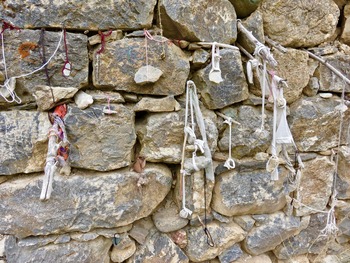
“We have slaughtered this rooster as a sacrifice, may God accept our prayers and the prayers of all Muslims. May the Lord bring healing,” a middle-aged woman prayed aloud in Kurdish while her companions, a disparate group of six pilgrims, echoed her, murmuring, “May God accept this.” We were standing in front of a half-ruined stone wall covered with countless small ribbons and pieces of cloth and string that had been tied to the crumbling stones over decades by visitors who made a wish at that spot, some little more than threadbare shreds after years of exposure to sun and rain. Moments earlier, a young woman had lifted a black rooster, its wings and legs bound, out of a blue plastic bag and laid it on a flat stone in front of the dilapidated wall. A young man drew a small knife from his pocket and slit the throat of the rooster, prompting the older woman to begin her supplication. The young woman lifted the expiring rooster by its bound feet, dabbed her fingers in its blood and marked her forehead. She then gestured for me, and the other younger woman present, to come forward and anointed our foreheads as well.
Ritual sacrifices like this—of roosters, sheep, or goats—to request good health from the Almighty, or to give thanks for healing or other blessings, are not uncommon in the majority-Kurdish region of southeastern Turkey, where this event was taking place. Such sacrifices are often performed at the tombs of Muslim saints and other holy sites across the region. The location of this ritual, however, was unusual because it was not a Muslim holy site. Instead, the crumbling wall at which we were gathered was the remnant of a stone chapel that was part of the ruined Christian Armenian monastery complex known locally in Kurdish as Dêr Meryem.
The imposing ruins of the expansive monastery of Dêr Meryem sit in a remote corner of a mountainous region south of Lake Van in the southeastern corner of present-day Turkey. Like the hundreds of other Armenian churches and monasteries that were active spiritual centers of the Ottoman Armenian community a century ago, Dêr Meryem was left abandoned after the Genocide of 1915 in which the Armenian community was destroyed. The main structure of the monastery is now largely ruined, and its crumbling light brown and yellow stones blend in with the grasses and brush, already dry when we visited in mid-November of 2015.
One hundred years ago in the region of Van, along with much of the former Ottoman Empire, the Christian Armenian community of roughly two million people was annihilated by a historical atrocity in which local Kurds played a critical role. During the Genocide of 1915, Kurdish militias collaborated with the Ottoman government in the deportation and massacre of Ottoman Armenians and in the dispossession and subsequent appropriation of their land, properties, and possessions. Among many of the properties summarily seized by Ottoman authorities and local Muslims during and after the Genocide were hundreds of buildings and lands owned by the Armenian patriarchate, including monasteries, chapels, and churches, like the now-ruined monastery of Dêr Meryem (Biner Reference Biner2020; Parla and Özgül Reference Parla and Özgül2016; Üngör and Polatel Reference Üngör and Polatel2011).
Other than myself, an Armenian-American anthropologist, the rest of the party present for the sacrifice at Dêr Meryem were all Muslim Kurds who resided in Van city. How did we come to this place? Why was a group of Kurds sacrificing a rooster and praying in the ruins of an abandoned Armenian monastery a century after a genocide in which their ancestors may have been complicit and which wiped out the Armenian community that had built and worshipped in that space? This article seeks to address the historical conjunctures that produced the space of Dêr Meryem as a ruined and abandoned sanctuary, and the political and social significance of the contemporary rituals performed there. I ask, what afterlives do such ruined spaces take on in a post-genocide landscape that is continually reshaped by ongoing cycles of violence, and how do contemporary inhabitants of that scarred territory imagine such spaces in relation to not only past violence but also present politics and future possibilities?
Across eastern Anatolia, the remains of centuries-old Armenian churches and monasteries dot the landscape and remind locals and visitors alike of the now-absent Armenians who made up a large portion of the population a century ago. The ruins of these churches in eastern Anatolia represent what Yael Navaro outlines as remnants of state violence, “residues of territory […] unassimilable to nationalizing processes,” that “remained and survived in spite of all efforts to eliminate, bury, curb, and control” (Reference Navaro2017: n.p.). Such remnants of Armenian sanctuaries are especially visible in the Van region, which was the Ottoman province with the highest percentage of Armenian inhabitants relative to the total population prior to the Genocide (Hovannisian Reference Hovannisian2000). Before 1915, the Van region held hundreds of functioning Armenian churches, monasteries, and chapels (Thierry Reference Thierry1989). After the destruction of the Armenian community, these structures remained on the landscape and took on various afterlives as they became part of the new environments and communities that evolved around them.
All around the Van Lake, the remnants of Armenian sacred structures dot the countryside, whether a small, one-room chapel in a village or an imposing, domed monastery on the top of a hill. Some of these buildings were repurposed as houses, mosques, schools, storage sheds, or barns. Others were destroyed over the years, their walls dismantled, and their stones pilfered and reused for building houses and stables, or abandoned to slowly deteriorate after years of neglect. Many others drew the interest of treasure hunters, who dug up the floors and foundations in search of buried gold that, according to local legend, Armenians left behind as they were fleeing the massacres of 1915 (Biner Reference Biner2020; von Bieberstein Reference Von Bieberstein2017). Today, nestled among the other stones making up the wall of a house or a barn in villages across the region, one can see stones carved with the enigmatic letters of centuries-old Armenian inscriptions and intricate crosses that were formerly part of a church façade or a gravestone in a cemetery.
The ruins of these sacred spaces play a role in the everyday lives of the people who live among them and shape their historical understandings and relationship with the local history and geography. In this article, I interrogate the afterlife of one abandoned sanctuary to examine how local Kurds imagine, narrate, and enact the politics of the past through sites of ruins. The monastery of Dêr Meryem is both representative and unique because it highlights how past violence, present politics, and future aspiration converge in a space of material ruin and are activated by the memories and narratives of those whose lives intersect with that space. This example, though specific to how local Kurds today interact with the history of the Armenian Genocide, gives voice to broader dynamics of memory and materiality across diverse landscapes marked by histories of violence.
Dêr Meryem speaks to the larger question of how people interact with a material world that is populated with the remnants of the built environment of an absent community destroyed by past violence. The site is singular not only due to its unique history and location but also because of the relationships in which it is enmeshed and the practices through which it is given contemporary meaning. During my fieldwork, I explored over fifty sites of ruins in the Van region, and among all of the now-defunct Armenian churches and monasteries that I visited, Dêr Meryem was singular in its fame and renown and the only such site that was a contemporary pilgrimage destination for local Muslim Kurds.
Through this example, I demonstrate that the history of the Armenian Genocide and continuing violence against the Kurdish community are intricately linked and highlight the cyclical nature of violence over the past century and the repositioning of the Kurdish community of eastern Anatolia from perpetrators to victims of state violence and dispossession. I illustrate how spaces of ruin destabilize nationalist conceptions of history that exclude the experiences of minoritized and marginalized communities who have been subject to repeating cycles of state violence. I argue that these histories of violence coalesce in spaces of destruction and ruination, but that these are not simply sites of melancholia or negative spaces that represent “scenes of a crime” or “documents to damage” (Stoler Reference Stoler2013: 28). Rather, building on Ann Stoler’s formulation of “imperial ruins” (ibid.), I illuminate how these sites are also nodes around which lives are lived and stories are narrated in the present, and I suggest that they create new possibilities for alternative understandings of the past and new imaginations for the future.
Ruins, History, Memory, Time
“The past haunts the present; but the latter denies it with good reason. For on the surface, nothing remains the same.” Thus writes Susan Buck-Morss in her exegesis of Walter Benjamin’s monumental work on the Paris arcades (Reference Buck-Morss1991: 293). Inspired by Benjamin’s insights, in recent years anthropologists have begun exploring the meaning of material ruins in relation to imperial histories and processes of capitalist extraction (Dawdy Reference Dawdy2010; Gordillo Reference Gordillo2014; Stoler Reference Stoler2013). Work by scholars such as Ann Stoler has transformed a focus on ruins as romantic reflections of a bygone age to a critical investigation of “ruination as an ongoing corrosive process that weighs on the future” (Reference Akkum2013: 9). Gaston Gordillo, writing on the destruction of space in northern Argentina, further problematizes the romanticization of ruins by distinguishing between “ruins” and “rubble” (Reference Gordillo2014). Rather than approaching a ruin as an intrinsically meaningful object, he investigates the afterlife of constellations of material which illuminates ruination as a political process and histories of violence materialized in layers of ruined landscapes. Yael Navaro contributes to the investigation of material afterlives of violent histories through her notion of “remnants,” which she describes as “shards accidentally left behind in the aftermath of cataclysmic violence, discarded as rubbish, serendipitously found and valued as a memory object or incorporated in the new material order of things by being reconfigured, transfigured, or amalgamated” (Reference Navaro2017: n.p.). Further studies by Navaro and Valentina Napolitano pose the methodological query of how anthropologists can study violence through the absences and traces left behind (Napolitano Reference Napolitano2015; Navaro Reference Navaro2020).
Focusing on how past, present, and future intersect in spaces of material ruination, I elucidate how historical and contemporary violence are reimagined as an emancipatory project by the descendants of past perpetrators who have become victims of state violence in the present. Rather than explore how the destruction of material spaces is simply a testament to histories of genocide, I interrogate how these spaces of ruination undermine state attempts to create a national historical imaginary. It is in such liminal spaces, where disparate temporalities converge, that the material and lived continuity between past and present processes of ruination serves to destabilize national histories that are imposed by state authorities, and which deny and silence ongoing violence.
These ruins are not only melancholic spaces, representing a now-absent community, but places through which palimpsests of violent histories can be unearthed, exposed, questioned, and critiqued, by both scholars and locals through their everyday practices. Benjamin approached ruins through a method he termed “montage” with the objective of deconstructing mythical bourgeois history. By presenting ruins of capitalism as a dialectical image, he sought to create a flash of recognition that would awaken the dreaming masses and to thus unsettle notions of linear progress and teleological capitalist development (Reference Benjamin, Tiedemann, Eiland and McLaughlin2002). Building on Benjamin, I suggest that the ruins produced through genocidal violence similarly serve to dissolve the mythical foundations of nationalist histories, and thus enable the deconstruction of official and exclusionary notions of past, present, and future.
My interlocuters in this instance were Muslim Kurdish residents of Van who carried out a ritual sacrifice in a ruined monastery built by the Christian Armenian community destroyed in the 1915 Genocide. Many Kurds in southeastern Turkey today are descendants of perpetrators who participated in the destruction of the Armenian community a century ago, but in the ensuing decades the Kurdish community itself became the victim of recurring state violence. Over the past century, the history and geography of southeastern Anatolia have been defined by the cyclical nature of violence against the minority communities inhabiting that territory and by the transformation of Kurdish communities from perpetrators into victims. My interlocuters’ narratives reflect and express a visceral understanding of the repeating cycles of violence that are inscribed onto both the landscape and the bodies of the inhabitants of the region.
These narratives reveal a specific conception of time and retribution, shaped by both memories and contemporary experiences of state violence, and allow a further conceptualization of the relationship between materiality, temporality, and violence. For a marginalized community inhabiting a geography haunted by historical violence and marked by ongoing destruction, the violent ruination of the past is understood to be cyclically repeating in the present and shapes the imagination of the future. Past violence against the Armenian community has been compounded by subsequent violence against the Kurdish community, and these layers of recurring violence are sedimented onto the landscape. Southeastern Anatolia has been shaped by the “intertwined histories and overlapping territories” (Al-Rustom Reference Al-Rustom and Altorki2015: 470) of the Kurdish and Armenian communities that are “fatally tied together” (Leupold Reference Leupold2019: 390). Now, many Kurds who continue to live in that geography interpret their contemporary experiences of violence not only through the lens of the present, but also through an understanding of the inextricable links with past episodes of violence—against both their own community as well as the Armenian community. It is these overlapping, sequential episodes of destruction that I conceive of as palimpsests of violence.
Palimpsest originally referred to a medieval manuscript page that was reused for later manuscripts by writing over the original text. In such manuscripts, the earlier text or image was visible underneath and through the later text or image. Here, I use the term palimpsest to denote not layers of text, but the layers of material remnants of violence on the landscape, which sediment one upon the other and constitute enmeshed histories. The layers in this landscape have been forged through histories of violence over the past century, beginning with the mass killing of the Ottoman Armenian community in the last years of the Ottoman Empire and continuing with ongoing state violence against the Kurdish community. Considering these two periods of 1915 and the present, a century apart, as two layers in the palimpsest, I ask how they inform each other. How are these two periods of violence embodied and sedimented in the landscape? How are those material remnants manipulated, remembered, and forgotten? How are those histories narrated or silenced? How do Kurdish and Armenian histories and peoples, past and present, converge in spaces of ruin?
These palimpsests of violence bring together the intertwined pasts and presents of Kurdish and Armenian communities, marked by overlapping histories of displacement, dispossession, and material destruction embodied in layers of ruins on the landscape. In much of the historiography, the stories of Armenian and Kurdish communities, which shared a geography for centuries, are narrated as if separate and opposed.Footnote 1 Through exploring the constellations of intercommunal interactions through material spaces and narrative, I challenge the tendency to focus on individual communities in isolation from the multi-ethnic landscapes in which they exist. Here, I read together the histories and contemporary worlds of Kurdish and Armenian communities and spaces to deconstruct naturalized ways of seeing these communities as oppositional and instead reconstruct their pasts and presents as an interconnected story told through the material world. Through exploring the afterlives of ruins as spaces in which these histories of violence intersect, I bring together the histories of the Armenian and Kurdish communities that diverged a century ago.
Echoes of Genocide
In contexts where mass violence has shaped both local memory and landscape, history and the material world take on new political valences and social significance in the present (Apter and Derby Reference Apter and Derby2010; Navaro-Yashin Reference Navaro-Yashin2012; Slyomovics Reference Slyomovics1998). Van province (vilayet) was one of the centers of the Armenian community historically, the site of medieval Armenian kingdoms, and in the late Ottoman period, the only province in the empire where Christian Armenians made up a plurality, or possibly even a majority, of the population (Derderian Reference Derderian and Tachjian2014; Suny Reference Suny2015). Scholars writing on the history of Van and its Armenian community emphasize the centrality of Van in the development of Armenian art, architecture, and political and cultural institutions, some even designating Van as the cradle of Armenian civilization.Footnote 2
In the tenth and eleventh centuries, the Van region became a separate kingdom known as Vaspurakan, meaning the “noble land” or “land of princes.” Historian Richard Hovannisian depicts how the decentralized nature of the Armenian political structure in the area “made possible a broad geographic distribution of architectural monuments and intellectual and spiritual centers with scriptoria and schools of illuminated miniature painting in monasteries” (Reference Hovannisian2000: 2). Following this period of Armenian dynastic rule, the Van region fell under the control of a series of conquering forces beginning with the Seljuk Turks in 1071. In the mid-sixteenth century, after being contested during the Ottoman-Persian wars, Van was finally incorporated as a province into the Ottoman Empire (Kevorkian and Paboudjian Reference Kevorkian, Paboudjian and Saris2012).
In the eighteenth and nineteenth centuries, a vibrant Armenian community flourished in the walled city of Van and the adjacent garden district known in Armenian as Aygestan. At the end of the nineteenth century, Armenians made up a plurality of the population of Van province and were a majority in the district around the city of Van, living alongside Assyrian and Nestorian Christians; Muslim Kurds and Turks; Yezidis; and Jews.Footnote 3 The city had a church in each Armenian-populated neighborhood, a marketplace, schools, foreign consulates, and missionary stations. In this urban environment, prosperous Armenian merchants, craftsmen, and artisans were visible as a local bourgeoisie (Suny Reference Suny2015).
On the eve of the First World War, the region of Van held over three hundred churches and monasteries and four hundred Armenian-populated villages (Hovannisian Reference Hovannisian2000). The large number of Armenian holy sites relative to other Ottoman provinces was due to a number of factors. First, Van province housed the most concentrated Armenian population. Second, Van-Vaspurakan had been the historical seat of Armenian kingdoms, whose rulers and clerical elite built magnificent monuments to demonstrate their strength and piety. Finally, despite periodic wars and conquest, the province had enjoyed relatively long periods of peace and prosperity (Tatoyan Reference Tatoyan and Beugekian2018).
Outside of Van city, most Armenians in the province lived as villagers in the rural and mountainous environs, alongside the Kurdish communities that made up the vast majority of the Muslim population of the region, and who lived largely as nomadic or semi-nomadic herders organized in tribes. In the latter part of the nineteenth century, Armenian peasants in the countryside routinely suffered at the hands of repressive Kurdish chieftains who stole land and extorted labor, as well as from armed Kurdish tribesmen who plundered their resources and attacked villagers without penalty from Ottoman authorities (Hovannisian Reference Hovannisian2000).
This intercommunal strife stemmed from the disruption in the local balance of power that occurred in the mid-nineteenth century (Suny Reference Suny2015). Previously, the region of Van was under nominal control of the Ottoman government but was locally ruled by Kurdish chieftains, who taxed Muslim Kurdish and Christian Armenian peasants alike and maintained a degree of intercommunal equilibrium. In the 1850s, however, this balance was upended when the Ottoman state attempted to modernize the empire’s administrative system and consolidate power in the central authority in Istanbul. The result was that Armenian peasants in the eastern reaches of the empire were taxed doubly, both by the central government as well as by Kurdish chieftains. Armenians protested this untenable situation, and eventually, Sultan Abdülhamid II (r. 1876–1909) allied with Kurdish tribes and resorted to repressive measures to put down what he saw as rebellious Armenians in the eastern borderlands (Kevorkian and Paboudjian Reference Kevorkian, Paboudjian and Saris2012).
In 1890, Abdülhamid II created the Hamidiye Light Cavalry Regiments (Hamidiye Hafif Süvari Alayları), an irregular militia made up of select Kurdish tribes that was given free rein to usurp the land of Armenian peasants. This policy achieved a three-fold goal of the central state. First, it resulted in the dispossession and weakening of the regional Armenian community, which the government viewed as suspect. Second, it encouraged nomadic Muslim Kurdish tribes to settle, which brough them under state suzerainty. Third, it strengthened the loyalty of the Kurdish tribes to the sultan, framed in terms of their shared religious affiliation (Klein Reference Klein2016). During the years 1894–1897, Abdülhamid II employed the Hamidiye troops along with the regular army in widespread massacres of Armenian peasantry in response to perceived sedition (Deringil Reference Deringil2009; Suny Reference Suny2018).
Two decades after the Hamidian Massacres, the outbreak of the First World War again signaled tragedy for the Armenians of the Ottoman Empire. The years 1914–1918 brought massive upheavals to the region, including the attempted annihilation of the Ottoman Armenian and Assyrian population by the ruling Committee of Union and Progress, or CUP, also known as “the Young Turks.” This state-orchestrated program of massacre, deportation, forced assimilation, and expropriation of property would later come to be known as the Armenian Genocide of 1915.Footnote 4 While Ottoman army officials and soldiers were instrumental in organizing and executing the Genocide, due to a shortage of regular troops and the specificities of the geography and terrain, in the eastern reaches of the empire much of the actual work of killing and looting was carried out by the local Kurdish irregular cavalry (Suny Reference Suny2015). In the aftermath of the Genocide and World War I, many Kurdish families settled in the now-empty Armenian villages, taking over the land and houses of those who had been murdered and driven away (Biner Reference Biner2010). In a contemporaneous process of appropriation, the state confiscated many of the Armenian churches, monasteries, and other valuable properties left behind (Harootunian Reference Harootunian2019; Kurt Reference Kurt2021; Üngör and Polatel Reference Üngör and Polatel2011).
An Unburied Past Weighing on the Future
Many accounts of the Genocide highlight Kurdish participation in the acts of killing and appropriation and emphasize that not only the Ottoman state and army officials, but also local Kurds played an active role in carrying out this historic atrocity (Hovannisian Reference Hovannisian2000; Panossian Reference Panossian2006). While these accounts are essential to understanding late Ottoman history and the unfolding of the destruction of Ottoman Armenians, the narratives end at the conclusion of the First World War and thus elide the continuation of violence and the dramatic transformation of Kurdish communities in eastern Anatolia from collaborators and perpetrators of state violence and dispossession into the primary victims of state violence and displacement in contemporary Turkey.
During the latter years of the Ottoman Empire there was an uneasy relationship between Kurdish groups and the central government, with the attendant power plays that arose between the court in Istanbul and powerful local notables in the periphery of the empire. However, Kurds were still considered, at least in name, to be the Muslim brethren of the ruling Turkish nobility (Klein Reference Klein2016). The position of the Kurdish community changed drastically following the Turkish War of Independence between 1919 and 1923 and the establishment of the Republic of Turkey in 1923. Under the leadership of Mustafa Kemal (1881–1938), later named “Atatürk” (Father of the Turks), the Kurdish population of the nascent republic came to be seen as a dangerous and seditious ethnic group by the new elite, who were guided by the Turkish-nationalist principles of Kemalism (Biner Reference Biner2020; Galip Reference Galip2016; Jongerden Reference Jongerden2007). Thus, with the violent closure of the “Armenian Question,” which had plagued the Ottoman government for the second half of the nineteenth and early twentieth centuries, the “Kurdish Question” was born—the paramount domestic issue with which Turkey has struggled over the past century and which continues to torment the country today (Cheterian Reference Cheterian2015; De Waal Reference De Waal2015).
Beginning just two years after the founding of the new Republic in 1923, the Sheikh Said rebellion of 1925—an uprising against the central government—would be the first of many insurrections in the Kurdish regions against the new order that “afforded no place for ‘Kurdishness’” (Galip Reference Galip2016: 463). Each new uprising was met with overwhelming force against militants, massacres of civilians, and forced relocations of Kurdish communities. In the following years, the Ararat Rebellion of 1930 and the Dersim massacres of 1938 resulted in the deaths and forced migration of thousands of Kurdish civilians and the destruction of their villages and properties (Bruinessen Reference Bruinessen1992).
The genealogy of sporadic Kurdish rebellions in Turkey culminated in the 1970s with the founding of the PKK (Kurdistan Workers’ Party, Kurdish: Partiya Karkerên Kurdistanê), the Kurdish armed leftist organization that has been waging a guerilla war against the Turkish armed forces for nearly four decades (McDowall Reference McDowall2004). This most recent iteration of Kurdish armed resistance against the Turkish state reached its height in the 1990s, when, to root out the militants, the Turkish army forcibly evacuated and burned thousands of Kurdish villages, prompting destitute Kurdish villagers to flood the regional cities and metropolitan centers of western Turkey (Biner Reference Biner2020; Darıcı Reference Darıcı2011; Gambetti and Jongerden Reference Gambetti and Jongerden2011). After on-and-off ceasefires, the fighting was reignited most recently in July 2015, followed by a period of intense urban warfare between state and guerilla forces in cities across the southeast. To crush the resistance, the Turkish security forces carried out a brutal campaign of siege and destruction in a dozen Kurdish-majority cities, shelling the urban landscape indiscriminately and leaving little more than smoldering rubble in its wake (Worth Reference Worth2016).
It was in the violent context of this renewed fighting that I carried out my fieldwork in the Van region and that I witnessed the sacrifice of the black rooster at Dêr Meryem. The ritual at the ruined monastery took place in a historical conjuncture marked by the temporal cycles and the material palimpsests of violence that have shaped the lives of those who have lived on that scarred territory. When I visited Dêr Meryem, one hundred years had passed since the Ottoman Empire was in the midst of the deportation and massacres of the Armenian community—a genocide that left the landscape decimated, emptied of its peoples, and marked by burnt villages and the remains of the dead (Kevorkian Reference Kevorkian2011). As I trekked to the monastery in November 2015, southeastern Turkey was embroiled in the months-long, bitter war between the PKK and the Turkish armed forces—a conflict that left hundreds of civilians and militants dead and thousands displaced, and homes and cities destroyed (Darıcı and Hakyemez Reference Darıcı, Hakyemez and Bargu2019).
Throughout the past century of state violence against civilians in eastern Turkey, successive ruling parties have pursued a policy of consistent denial vis-à-vis both the Kurdish and Armenian history of the region. Government officials and historians loyal to the state vehemently deny the large-scale, organized violence against the Ottoman Armenians. On the contrary, they argue that Armenian revolutionaries plotted rebellions and that Armenian gangs carried out massacres of innocent Muslim Turks, thus prompting necessary defensive measures from the state (Göçek Reference Göçek2015; Hovannisian Reference Hovannisian1998). Regarding the Kurdish community, official state history denies not only the suffering inflicted upon Kurdish civilians through massacre and displacement but also at times their very existence as a distinct ethnic community. Periodically over the past century, government authorities insisted that Kurds were actually “Mountain Turks,” and that Kurdish did not exist as a language. The government even went so far as to outlaw the speaking, printing, broadcasting, teaching, and even singing of the Kurdish language (Aslan Reference Aslan2007; Derince Reference Derince2013; Hamelink Reference Hamelink2016; Jamison Reference Jamison2016; Schäfers Reference Schäfers2015; Yegen Reference Yegen2009).
At its founding, the PKK was a Marxist-Leninist military organization seeking an independent Kurdish state (Hakyemez Reference Hakyemez2017; Ozsoy Reference Ozsoy2013). In 1999, its leader, Abdullah Öcalan, was captured, and over the next decade, while imprisoned on an island near Istanbul, he developed a new theoretical perspective that took the organization in novel directions. Inspired by the writings of such diverse scholars as Murray Bookchin, Michel Foucault, and Benedict Anderson, Öcalan developed a new model for local autonomy in Kurdish regions that was informed by ecological, feminist, and socialist principles (Bookchin Reference Bookchin2018; Danforth Reference Danforth2013; Enzinna Reference Enzinna2015). These ideas were adopted by the Kurdish movement in a broad sense, including not only the militant PKK but also affiliated Kurdish civil and political organizations in Turkey, Syria, Europe, and elsewhere (Graeber Reference Graeber2014; Taussig Reference Taussig2015).
Öcalan’s theoretical revolution has drastically transformed the discourse in Kurdish communities regarding many aspects of social and political life, including the troubled history of the region. In 2014, Öcalan published a letter labeling the 1915 destruction of Ottoman Armenians a genocide and calling on the world and the Republic of Turkey to honestly confront and recognize that painful history (Radikal 2014). This was not an isolated gesture but one echoed in local efforts to acknowledge and atone for the past across the Kurdish-majority region and in statements by Kurdish leaders and activists (Tambar Reference Tambar2016). For instance, in 2013, the municipality of the Old City (Sur) of Diyarbakir erected a “Monument of Common Conscience” (Ortak Vicdan Anıtı), upon which were inscribed the words “We shared the pains so that they are not suffered again” in Kurdish, Turkish, English, Armenian, Arabic, and Hebrew. At the opening ceremony, Abdullah Demirbaş, the mayor of the district, declared, “We Kurds, in the name of our ancestors, apologize for the massacres and deportations of the Armenians and Assyrians in 1915,” as he urged the Turkish government to do the same (Akkum Reference Akkum2013).
Scarred Landscapes, Sacred Ruins
The geography of eastern Anatolia continues to be a hotly contested territory. Not only the land, but its memory and history are grounds on which battles are repeatedly fought. Even the name of the territory is a contentious topic. In official Turkish sources it is “Eastern Turkey.” Many Kurds, on the other hand, refer to the area simply as “Kurdistan,” or more specifically as Bakûr, meaning “North” in relation to the majority-Kurdish populated regions in Iraq, known as Başûr (South), Iran (Rojhelat/East), and Syria (Rojava/West). Finally, to many Armenians, this territory is known as “Historic Armenia” or “Western Armenia” in relation to the Republic of Armenia, the small nation-state which today occupies a fraction of what was historically the eastern portion of the Armenian populated provinces of the Russian and Ottoman empires (Leupold Reference Leupold2020). Each of these names carries with it historical and political claims of belonging that are inscribed onto the geography.
A century after the Genocide of 1915, on the ground in Eastern Turkey, one finds Kurdish civilians living in a state of semi-occupation by the Turkish military, with Armenians long gone but the ruins of their churches still dotting the landscape. The violence of the past is still palpable in the violence of the present, as armored vehicles, tanks, military helicopters, and checkpoints are regular fixtures of everyday life in Turkey’s Kurdistan. The memory of the absent Armenians is never far from the minds of local Kurdish villagers, as they inhabit, repurpose, and reimagine the remnants of the landscape of ruins that the Armenians left behind.
Prior to the destruction of the Ottoman Armenian community in 1915, monasteries and churches could be found all across the Van region.Footnote 5 These sites were devastated first by the Hamidian massacres of 1895–1896, during which Kurdish groups looted many of the sanctuaries, and second during the Genocide of 1915, when many churches were burned and destroyed, and their congregations murdered or deported. According to one estimation, in the 1870s, there were seventy functioning monasteries in the Van region, while by 1910, only thirty were still active (Ashkhadank Weekley 1911, cited in Tatoyan Reference Tatoyan and Beugekian2018).
Before these episodes of devastating violence, every Armenian village or neighborhood had one or more churches, and monasteries were scattered across the remote mountainous regions. These sanctuaries and holy places were central nodes around which Armenian collective social and spiritual life revolved. The monasteries were also pilgrimage destinations, each with its own festival day, when villagers from near and far would gather to pray, give offerings, and make merry. Accounts of Armenian customs before 1915 recount that “most of the great churches in Armenia possessed some relic of the saints for whom they were named” and “in it resided the power of the church” (Hoogasian Villa and Matossian Reference Hoogasian Villa and Matossian1982: 131).
Many monasteries were also known to have miraculous properties to heal the sick, blind, and lame, to grant wishes, or to facilitate pregnancy and childbirth, with particular churches associated with the power to cure specific afflictions (Oskean Reference Oskean1940). Ethnographic and historical accounts detail how, in the period prior to the Genocide, certain churches were visited by both Christian Armenians as well as Muslim Kurds and Turks who sought cures for illness. For instance, a church known as Akor Bab, which is now submerged under the waters of the Keban dam in the Elazığ region, was famous for curing paralysis, and Muslim Turks and Kurds as well as Christian Armenians made pilgrimages to the site and lit candles there (Hoogasian Villa and Matossian Reference Hoogasian Villa and Matossian1982: 132).
The rituals performed at such sacred sites have been documented in the village histories compiled by Ottoman Armenians after the Genocide and known in Armenian as houshamadyan, or memory books. In addition to lighting candles and praying, another custom reported in the houshamadyan literature was the slaughtering of domestic animals, including calves, sheep, or roosters at sacred sites such as churches or shrines in order to cure disease, provide protection from illness, or give thanks for good health (Boghosian Reference Boghosian1942; Keshishian Reference Keshishian and Beugekian2015). Literature on the mythology and folk rituals of both Kurdish and Armenian communities in Anatolia also mention the prevalence of wishing trees, walls, or stones, where individuals tie a string, a rag, or a piece of their garment to the holy spot, wishing for an answer to their prayers or a cure for illness (Çeper Reference Çeper2020: 180; Hoogasian Villa and Matossian Reference Hoogasian Villa and Matossian1982: 129).
A Convent of Spirits
“Dêr Meryem was the biggest Armenian monastery in the whole region, it had three hundred rooms!” a classmate in a Kurdish language course in Van told me. He insisted that if I was studying Armenian churches, I must go there. Like the other students in the class, this man was Kurdish and was attending the class to learn to read and write in his mother tongue. Other classmates also echoed his assertion, and though most of them had never visited the monastery, they had heard of its purported historic importance and fame. The students insisted, however, that I should not travel there alone because the site was located in the heart of a remote area that continued to be contested territory between the government and the Kurdish militants of the PKK, and which at times was declared off-limits by the Turkish security forces during military operations.
Besides the challenge of navigating military restrictions, another obstacle to visiting the church was that locals referred to the site by the unofficial appellation, “Dêr Meryem,” which means “Church of Mary” in Kurdish, but which did not translate to any obvious monastery in Armenian records.Footnote 6 My Kurdish classmates explained the location of the church in relation to the nearest village, but the village names that they recited were the local Kurdish names, which have no standardized spelling and do not appear on Turkish maps. Official maps only list the newer, state-assigned Turkish names, eliding the former Armenian names and local Kurdish names and are yet another material manifestation of state-sponsored efforts at the erasure of local history and the homogenization and assimilation of territory (Navaro-Yashin Reference Navaro-Yashin2012).
After triangulating between the description of the church and identifying the official Turkish name of the nearby village, I discovered that the church in question was the Armenian monastery of Hokeats Vank, which translates to “Convent of the Spirits” in Armenian. According to art historian Jean-Michel Thierry, the monastery was first mentioned in historical sources in the ninth century, and by the eleventh century it was one of the most important monasteries in the Vaspurakan region. The monastery reached its zenith in the sixteenth century, when it housed a flourishing scriptorium where monks copied and decorated illuminated manuscripts of the gospels. It was a wealthy establishment and owned immense real estate in the surrounding area and shops as far away as Baghdad. Thierry writes that precious religious relics were kept at the monastery, including an icon of the Virgin Mary, which may explain why local Kurds now call it Dêr Meryem (Thierry Reference Thierry1989).
Accounts by Armenian ethnographers and theologians trace the monastery’s founding to a much earlier episode linked to Saint Bartholomew, one of the two apostles credited with introducing Christianity to Armenia. Hamazasp Oskean, who published extensive treatises on the Armenian monasteries of Van, writes that Saint Bartholomew brought an icon of the Virgin Mary to the area after her death and placed it in a chapel that he dedicated to the Mother of God. The first Christian Armenian king, Trdat, who proclaimed Christianity to be the state religion in the year 301 AD, is believed to be buried there, along with multiple martyrs and saints. Oskean also relates that the monastery is named the Convent of the Spirits because, according to legend, spirits or demons resided at the site before the founding of the sanctuary, and during the initial construction were continually tearing down the walls (Reference Oskean1947: 765).
Armenian texts from the pre-Genocide era demonstrate that the monastery was an important site of pilgrimage for the Ottoman Armenian community of the region and was renowned for the miracles and healing powers associated with the icon housed there (Vans Srboyn Ghazaru Reference Ghazaru1900). According to ethnographer Yervand Lalayan, Hokeats Vank was known for healing epilepsy and maladies of the mind (Lalayan Reference Lalayan1916: 210). Garegin Sruandzteantsʻ (1840–1892), a bishop of the Armenian church and a native of Van who became a well-known folklorist, wrote that “Hokeats Vank is one of the most prominent places of pilgrimage famous for its miracles. The fame is great all over Armenia and other distant cities, as is evidenced by the frequent pilgrims and gifts. After all, there is not a single Armenian who does not know the name of Hokeats Vank, and there is certainly no one who has made a supplication and whose prayers were not answered” (Sruandzteantsʻ Reference Sruandzteantsʻ1982, 2: 12).
The monastery was looted during the Hamidian massacres in 1895 by the local Kurdish commander, Şakir Agha, and his men. The buildings were partially restored in the following years, only to be finally abandoned after the Genocide of 1915 (Thierry Reference Thierry1989: 452–53). Just prior to the Genocide, at the turn of the twentieth century, the monastery was a massive structure with fortified walls, towers at each corner and twenty-five rooms, including those reserved for pilgrims and the sick. There were two churches within the walled complex—the church of the Holy Mother of God and the church of Holy Zion—and the small chapel of Saint John just outside of the walls (ibid.). Though the monastery did not have three hundred rooms, as purported by my acquaintances in Van, such hyperbolic claims demonstrate that its fame and historical import continues to live on in the memory of local Kurds in Van today.
In the first few months of my fieldwork in 2015, many acquaintances insisted that I visit Dêr Meryem, including Mesut, a Kurdish friend who had studied archeology and Armenian architecture and who suggested that we visit the legendary site together. I jumped at the chance, and a few days later, Mesut, his wife, Nazlı, and a mutual friend, Azad, set off in Mesut’s car into the remote and mountainous countryside south of Van.
Pilgrimage to the Past
“Excuse me, do you happen to know how to get to the church of Dêr Meryem?” Mesut asked a group of men at a roadside fountain who had stopped for a drink. We had already been driving for over an hour and, without cellular service, had lost our way. One of the men said with a mischievous smile, “Yes, we know, and we are also going there.” Relieved, Mesut replied, “Wonderful! Shall we go together?” The man responded, “Sure, but we’ll be partners. Whatever we find, we’ll split half and half.” Mesut looked puzzled, but Azad realized what the man was insinuating and interjected, “You think we’re looking for treasure. No, no, we are not treasure hunters.” The men laughed dismissively, “In this cold weather no one would go there unless they were looking for treasure! Why else would you go there?” The men insisted that we must be in search of buried gold, so we politely took our leave and continued driving through the empty hills until we came upon a cluster of stone houses.
We stopped at the first house to ask for directions and the Kurdish residents invited us inside. In the main room, we found a large family sitting on cushions on the floor around a wood-burning stove atop which a dented black teapot was bubbling. Seated on a chair in one corner was an elderly man with a distinguished air, wearing hand-knitted woolen socks with blue and red stripes on the toes. A young boy brought us small glasses of tea while we explained to the elderly man in Kurdish that we were trying to reach Dêr Meryem but had lost our way. Without asking why we were going there, he replied solemnly, “I have never been there, but if you are going, then pray for me as well.” Coupled with the comments of the men who assumed that we were on a treasure hunting expedition, the elderly man’s request underlined how the monastery continues to be a potent and multivalent site with significance not only for the departed Armenians but also for the Muslim Kurds who continue to inhabit the area.
After we thanked the family for their hospitality, we followed the elderly man’s instructions and turned off the main road to reach a village known as Aras in Kurdish and Özlüce in Turkish. As we entered the village, a woman wearing a bright yellow dress and thick black eyeliner approached our car. We greeted her and asked where the church was, and she called a young boy to fetch her husband. Then she poked her head in the back window of our car and, looking pointedly at Nazlı and me, she inquired in Kurdish, “Which of you doesn’t have children?” Ignoring our perplexed looks, she followed with a second question that struck me as a non sequitur: “Did you bring a rooster with you, or do you intend to purchase one?” Before we could offer an appropriate response, the woman’s husband appeared, and another car pulled up behind us. The driver of the second car spoke with the husband and asked about the location of the church. In response to the same question posed to him regarding the rooster, the newcomer responded confidently, “Yes, we brought our own rooster from Van.”
We quickly realized that these newcomers were familiar with the appropriate procedures and inquired if we might journey to the monastery together. They graciously obliged, and together we parked our cars at the appointed spot near a certain telephone pole with no wires, and from there by foot we began the steep descent into a valley. The slopes were dotted with short, dark green pine trees. At the bottom of the valley was a brook lined with small bushes and trees with yellow and gold leaves. We hiked northwards, following the stream, which would eventually lead us to the ruins of the monastery.
As we began the trek, we introduced ourselves to our new traveling companions, a middle-aged mother and her adult daughter, a male cousin, and an uncle. The uncle and cousin both sported the thick black moustache popular among the region’s Kurdish men. While the cousin was dressed in a practical outfit of a black utility jacket and gray trousers, the uncle looked positively dapper in pressed navy slacks and a gray plaid sport coat over a collared dress shirt and sweater vest that enveloped his ample belly. The uncle, Ibrahim, was a gregarious and boisterous man in his fifties. He explained that his niece had given birth twice but that both babies had died in early infancy. Now she was pregnant again, so the four of them were making the journey to Dêr Meryem to sacrifice the rooster and pray that she would have a successful pregnancy and a healthy baby. The mother was carrying the live rooster in a blue plastic bag, with its legs and wings tied and its head poking out.
At first, Azad, Mesut, and Nazlı carried on the conversation with Ibrahim, but once he had satisfied his curiosity about their occupations and hometowns, he gestured to me and asked, “And what about this friend?” “She is from America,” Azad answered. Hearing this, Ibrahim announced emphatically, “We are all brothers and sisters!” as if to demonstrate that he did not discriminate based on place of origin. Then he paused for a moment and added, “Is she really from America? I don’t believe it.” Ibrahim stopped walking for a moment to pick green almonds from a tree by the side of the stream. I approached him, and announced tentatively, “Uncle, I was born in America, but I am originally Armenian, from Van.”
Ibrahim stopped picking almonds and looked at me solemnly. “You know what?” He said and then paused thoughtfully. Unsure whether this was a rhetorical question and apprehensive about his reaction to my confession, I replied hesitantly, “What?” He continued, “You know what? Today the Kurds are suffering because of what they did to the Armenians in 1915. We are paying that price today. In 1915 the state tricked the Kurds and then Kurds massacred Armenians. The state sent sheikhsFootnote 7 who said that if you kill seven Armenians, you will go to heaven.” Ibrahim began to narrate to me how a century ago the authorities had encouraged local Kurds to do away with the Christian population: “The state said to the Muslims, ‘Kill the Armenians. Serê ji me ra, malê ji we ra [The head for us, the house for you].’ That is, ‘Kill them, and take their property.’ Of course, the Armenians said to the Muslims, ‘Don’t do this, we are brothers. Today it is our turn, but tomorrow it will be your turn.’ And our people foolishly didn’t listen to them.” As if to demonstrate that this prediction had been realized, Ibrahim recounted the story of the misfortune that had befallen one of his relatives. He explained that in 1997, during the height of the war between the PKK and the Turkish army, his uncle’s son had been captured by Turkish soldiers in a nearby village. The soldiers first tortured him and then tied him to the back of a military vehicle and dragged him through the streets until he was dead. He was a father of five children, the youngest still a baby when he was killed.
Ibrahim emphasized that the ultimate blame for this continuum of violenceFootnote 8 fell on state authorities, who instrumentalized the Kurdish community in the service of the genocidal project of 1915, only to later turn the lethal and destructive power of the state and the army on the Kurds. Ibrahim summarized the relationship between state authorities and the Kurdish community over the past century thus: “The Turkish government tricked us. They tricked the Kurds. They said, ‘Kill the Armenians, kill the Alevis, kill the Yezidis. We are Muslim, we are brothers.’ Their goal was to destroy the Kurds, to erase them from history. But were they erased? They would have been erased, but our leaders turned the situation around and defended the Kurds. If not, they would have destroyed us. They would have assimilated us.”
Ibrahim’s narrative encapsulates a conception of the cycles of violence that define the history and present of the region that is widely shared among those sympathetic with the leftist Kurdish movement. This perspective on the past emphasizes that Kurds were used in the destruction of the Armenian community, but subsequently became the target of state violence and dispossession, and perhaps would have been destroyed themselves if not for the armed struggle of the PKK. This historical understanding often includes the notion that Kurds, whether individually or communally, are carrying a curse for the violence that they had inflicted upon Armenians a century ago.Footnote 9 Some, echoing Ibrahim’s formulation, recounted that as Armenians were being deported, they warned their Kurdish neighbors, saying, “We are the breakfast, and you will be the lunch” (in Kurdish “Em taşte ne, hûn jî firavîn”).
This idea of the curse was illustrated to me by a Kurdish teacher, Ismet, who I met in Van, and who recounted to me how his uncle’s father-in-law had been cursed for his cruelty against the Armenians. Ismet described how the man had been part of the Hamidiye Regiments—instrumental in the repression of the Armenian community—and that he had personally killed seventeen Armenian children. Because of this act of violence against innocents, Ismet explained, later in life the man’s legs had become terribly disfigured to the point that he could no longer walk. Ismet recalled how, as a young man, he had transported the crippled old man from place to place in a wheelbarrow. With solemn certainty, Ismet declared in Kurdish, “Eva ahê Fileh girtî”—“He was under the curse of the Armenians.”
Alongside the notion that Kurds were cursed as a legacy of the violence of 1915, another recurring theme in the narratives of my Kurdish interlocuters regarding the historical atrocities against Armenians were stories of salvation. These were accounts of merciful Kurdish individuals and families who courageously risked their lives to save Armenians bound for deportation and slaughter. These stories were passed down from generation to generation, and multiple acquaintances recounted to me with solemn pride how a great-grandfather had nobly sheltered and protected fleeing Armenians, even accompanying them as far as the Russian border.
Ibrahim also had a story of salvation, which he eagerly shared as we trudged through the grass and shrubs alongside the meandering stream. He explained that his family was from Beytüşşebap, an area southwest of Van in the province of Şırnak. In Kurdish, Ibrahim described how in his village there were Fileh (Christians) who had stayed during the deportations and did not convert. In his region, he recounted, Kurds and Fileh had lived side by side for centuries and were like relatives. Switching to Turkish, he explained that during the deportations, his ancestors had protected those Ermeni (Armenians)Footnote 10 and that they continued living there until the 1990s when they finally migrated to Europe.Footnote 11 In his narrative, Ibrahim cursed those Kurds who had partaken in the massacres of Armenians in 1915, and he expressed pride in his village, which had protected its Christian neighbors and saved them from deportation. “We are all brothers and sisters,” he proclaimed, “Why should religion make any difference? After all, Allah rabbil muslimin degildir, rabbil alemindir Footnote 12 (God is not only Lord of the Muslims, but Lord of the whole world).”
We continued our trek along the babbling stream past bushes ornamented with crimson berries. The mother in the group carried the rooster in the blue plastic bag and the daughter toted a bag full of apples and mandarin oranges. They were taking the fruit to Dêr Meryem so that it could absorb whatever protective powers the holy site might confer, and they would then feed it to the children of the extended family in Van to ensure their good health. As we walked, I asked Ibrahim if he had visited Dêr Meryem before. He said that he had and asked me if I had been to other historic churches in the area. When I said yes, and posed him the same question, he replied that he had, to look for treasure. When I asked if he had ever found anything, he simply chuckled and shook his head.
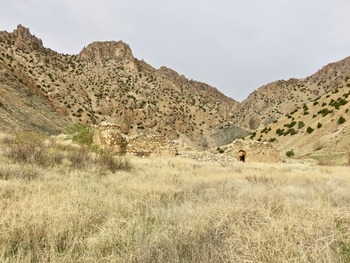
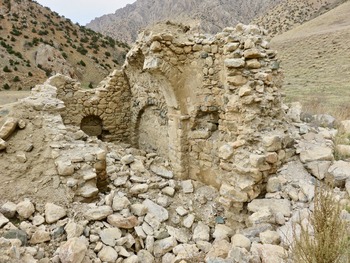
Finally, we caught sight of the ruins of the monastery in the distance, nestled in a narrow valley between two mountains (Image 1). We arrived first at the ruins of a small stone chapel that sat just outside the outer wall of the main monastery. One section of the wall stood intact amid piles of rubble (Image 2). Ibrahim, Azad, and I congregated in the middle of the dilapidated chapel, staring at the carefully wrought stonemasonry that was still visible. Wondering aloud, Azad asked, “How did it come to this state?” Ibrahim gestured toward a hole in the wall where a section of stones appeared to have been excavated, most likely by treasure hunters, and replied regretfully in Turkish, “This is because of our ignorance. We are ignorant. Not only ignorant (cahil), but savage (vahşi).” I thought back to the moment earlier on our hike when Ibrahim had spoken of his own treasure hunting expeditions. Contemplating the chapel’s plundered wall, I wondered if he might have searched for treasure in the ruins where we now stood, and whether his critical view of the church’s destruction was self-reflexive.
Front walls of Dêr Meryem monastery with Ibrahim standing in front of the arched entryway. Author’s photo, November 2015.

View of the interior walls of the ruined chapel. Author’s photo, November 2015.

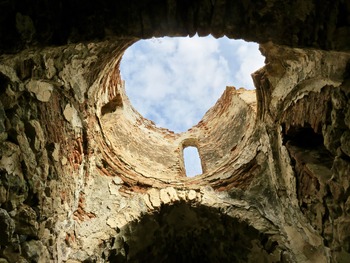
From the vantage point of the chapel, the monastery appeared to be comprised of one dilapidated wall. Entering under the arched doorway, though, we could see the traces of what had been a formidable complex with multiple structures, now mostly collapsed and overgrown with grass. Some of the vaulted halls and rooms were intact, though from above they looked like overgrown mounds. Crosses of all shapes and sizes were carved on the crumbling walls, and gravestones were strewn on the ground. As I walked over the grassy mounds, gingerly trying to avoid the fallen headstones, I could hear Ibrahim and the cousin’s voices as if they came from underground. I followed the sound to the side of one mound and found the entrance to where they were standing—a cool, dark, cavernous room with an arched doorway leading to a second room. Looking up, I could see the partially collapsed dome of a church (Image 3). The ground was covered in a thick layer of soft, ashy earth and pigeon feathers, and in the corner were the remnants of a fire pit with a large, blackened metal tea kettle beside it, evidence of birds and humans who had found shelter in this crumbling sanctuary.
The partially collapsed dome of a church within Dêr Meryem Monastery. Author’s photo, November 2015.

Graffiti decorated the walls around us, written in black ink or scratched into the stone surface. In bold letters someone had written “PKK” and “APO,” referring to Abdullah Öcalan, the imprisoned leader of the PKK. Following my gaze to the graffiti, the cousin said, “This used to be under the control of the PKK. At that time, the church was in better shape, but then the state discovered that guerillas were living here, and so they bombed it from the air and destroyed it further.” This was a narrative I had heard throughout the region. In remote areas, guerillas used whatever empty structures were available for shelter and the army bombed those buildings to drive them away. During the height of the fighting between the PKK and the Turkish military in the 1990s, the army burned thousands of villages in the southeast, as well as forested areas, to deprive the guerrillas of shelter (Jongerden Reference Jongerden2007). The war continues to shape the geography of the southeast of the country through processes of ruination and the marking of space as zones of military control.
The cousin’s reading of that space underscores how cycles of violence are imprinted onto the landscape. Within this historical frame, the past violence against the Armenian community is compounded by violence against Kurds in the present, and each new episode of violence is inscribed in layers onto the further ruined monastery. Dêr Meryem thus represents one node within the palimpsests of violence that make up the material world of southeastern Anatolia, in which the abandoned churches that are remnants of the genocidal violence of 1915 are layered with the destroyed Kurdish villages and burned forests of the 1990s, and the further destruction of Kurdish-majority cities in 2015. At the intersection of these violent histories, the crumbling space of Dêr Meryem, with its broken cross-stones and more recent graffiti, is a reflection, receptacle, and product of this cyclical violence, as well as a space in the present where the past is remembered, narrated, and critiqued, and the future is imagined and desired.
As I was contemplating the material traces of past and present violence sedimented in that space, the older woman called out to us from near the dilapidated chapel, and we picked our way through the overgrown grass and piles of rubble to join her. The time had come to sacrifice the rooster that she had carried all the way from Van city in hopes of ensuring a successful pregnancy and healthy baby for her daughter. She was wearing a long black velvet dress and a white headscarf with delicately crocheted blue and red flowers decorating the edges, draped loosely over her henna-dyed hair. Her daughter wore a black dress and brown sweater, along with a gold-hued headscarf tied at the nape of her neck, which matched her intricate gold necklace that sparkled in the sunlight. The daughter sat on a rock by the remaining wall of the chapel, in front of a stone arch, and lifted the hapless rooster from the blue plastic bag. She laid it on a stone in front of the arch, and her cousin, with a small pocket-knife, cut the animal’s throat, its crimson blood spattering the stones of the wall.
Dabbing her finger in the fresh blood, the daughter first marked her own forehead, and then mine and Nazlı’s, as her mother prayed aloud in Kurdish, asking God to accept this sacrifice, bring healing, and accept their prayers and the prayers of all Muslims. The sacrifice was a brief affair, and soon the expired rooster was back in the plastic bag. Nazlı then produced a few pieces of string from her purse, and she and I each chose a small stone from the ground and affixed it to the string and then to the wall, among the countless other bits of cloth and ribbon that had been left there over the years (Image 4). Nazlı explained to me that as we tied our strings to the wall, we should each make a wish, and so we stood solemnly side by side, each carefully knotting our rocks to our strings and our strings to the wall. We silently made our wishes and left them there among the hundreds made before.
Pieces of string, cloth, and stones tied to the outer wall of the ruined chapel. Author’s photo, November 2015.

After the rituals of sacrifice and wish-making, Ibrahim and the cousin walked down to the stream to wash their faces, arms, and feet as part of the ritual ablution (abdest) required of Muslims before prayer. They performed their prayers using a plastic bag laid flat on the ground as a makeshift prayer rug while the rest of us sat on the grass near the chapel and arranged the provisions that we had brought for a picnic. Our party offered thin lavaş bread, white cheese, tomatoes, and olives, while Ibrahim’s group shared flat tandır bread, otlu peynir (cheese with wild herbs), and a thermos of black tea. After he had eaten, Ibrahim leaned contentedly against a large boulder and posed for me to photograph him, smiling broadly with both arms raised in the air with two fingers displayed in a V—the victory sign, or zafer işareti, indicating his enthusiastic support of the Kurdish movement.
Throughout the day that we spent together at Dêr Meryem, this jovial man embodied an array of convictions that demonstrate the complicated intersections of history and politics and of peoples past and present in that place. Along with a commitment to his Muslim faith and practice, Ibrahim expressed a fervent passion for the cause of the militant PKK and the secular Kurdish movement. These various engagements all inform his critical historical perspective on the Armenian Genocide of 1915 and the concomitant role of the Kurdish community in that historic crime, as well as the legacies of that history today. Ibrahim also exemplified the contradictions inherent in a context shaped by historical and ongoing violence and the denial of that violence. While he criticized his community for both ignorance and complicity, and for the destruction of the Armenian community and their property, he concurrently admitted that he himself has dabbled in the semi-illicit pastime of searching for buried Armenian gold.
As we hiked back to our cars, I asked Ibrahim, “What will you do with the rooster now?” According to custom, he explained, a rooster sacrificed at Dêr Meryem must be given to the first person encountered on the road. As might be expected, as we began our drive, we came across a young man just outside the village of Aras. We stopped our caravan and Ibrahim called out to him, handing him the rooster, still in the blue plastic bag, through the car window. The young man, familiar with the scenario, thanked him graciously as he collected his prize. As we continued our journey, my companions and I chuckled, remarking that of everyone involved, the villagers of Aras seemed to benefit the most from this pilgrimage site. Many pilgrims come and go, and perhaps some of their wishes are granted. The people of Aras, on the other hand, sell the roosters that they raise to some of these visitors, and after the sacrifice is complete, it is almost guaranteed that the slaughtered roosters will be returned to them, free of charge, since the next village is miles farther down the road.
On the long drive back to Van city, I marveled at the ritual that we had just witnessed—a family of Muslim Kurds seeking health and healing in the ruins of an Armenian monastery, a place that was abandoned after the violence of 1915, a historic atrocity in which some of their ancestors may have played an active role. As I understood from Ibrahim’s ruminations during our trek to the monastery, the place did not tell only one story. Dêr Meryem embodies what Ann Stoler describes as “imperial ruins” (2013). Such sites are more than just “scenes of a crime” or “documents to damage” (ibid.: 28). Rather, they are nodes around which lives are lived and stories are told in the present and in which possible futures are imagined and performed. In Dêr Meryem, the Genocide of Ottoman Armenians is remembered and narrated. With heavy overtones of regret and remorse, the participation of Kurdish groups in the injustices of 1915 is openly acknowledged and condemned by the descendants of perpetrators.
But Dêr Meryem is not only a space of memory and nostalgia. It is not only a reflection, a material representation of past violence, or evidence of the historical crimes against the Armenian community. The afterlives of Dêr Meryem since 1915 tell repeating stories of destruction—of violence against the Kurdish community and the ongoing war that continues to shape Turkey’s Kurdistan region. The space embodies the cycles of ruination of the last century—ruination of both communities and the material environment—that are sedimented onto the landscape and become palimpsests of violence. The space is enmeshed in the ongoing war and may have been put to new use by guerrillas, then targeted and further destroyed by the military. Finally, Dêr Meryem is a lively space in the present, where rituals are enacted, health is sought for yet unborn generations, and buried riches are desired. In this way, the ruins produced in past violence are a site through which new futures are imagined—futures enriched with gold and healthy children. Thus, the ruins of Dêr Meryem become a space in which past, present, and future are entangled—where past and present violence converge, and imagined futures are performed.
* * * * *
Three years passed before I next saw Ibrahim, the Kurdish man who I had serendipitously encountered on the road to Dêr Meryem. We met at a teahouse on a bustling side street in the center of Van city, where we sat on low stools arranged around a small table in front of the shop. Over tea served in delicate, tulip-shaped glasses, we cheerfully exchanged pleasantries and asked about each other’s families and work, gesturing vaguely toward the economic and political crises in which the country was embroiled. I was eager to learn if our trip to Dêr Meryem had born fruit and asked, “How is your niece whom we met at Dêr Meryem?” Ibrahim happily reported that two years earlier she had given birth to a healthy baby girl, and according to the local custom regarding babies born after a visit to the monastery of Dêr Meryem, the girl was named Meryem. If the baby had been a boy, he added, he would have been called Isa, the Arabic name for Jesus. I mentioned to him that the married couple who had accompanied us had also had a baby two years prior. Ibrahim chuckled and suggested that perhaps the miracle of Dêr Meryem had fortuitously worked for them as well.
I mentioned that I would return to the United States the following week, and his eyes twinkling, Ibrahim replied, “What are you going to bring us as a present from America?” Not wanting to appear ungenerous, I asked, “What would you like?” Without hesitation, he declared, “A map!” Realizing that he was referring to a treasure map, I asked, “Do you believe in those things?” “Of course!” Ibrahim proclaimed emphatically. I queried, “Have you ever heard of anyone finding anything?” “Of course! I almost found things!” Ibrahim replied, with utmost confidence. Then, in hushed tones so that the customers sitting at adjacent tables would not overhear us, Ibrahim recounted a series of elaborate tales of how he nearly found buried Armenian treasure—in an old church or a historic Armenian village—yet how in each instance, at the last moment he was thwarted before he could reach the prize.
Just as suddenly as he had opened the subject of treasure hunting, Ibrahim closed it again. As I was about to ask about the perpetually thwarted attempts to find treasure, Ibrahim loudly proclaimed, “Let me treat you to lunch!” I politely declined, and after insisting twice more, he abruptly rose, paid for the tea, bid me a warm but hasty goodbye, and hurried off. On the way to this encounter, I had hoped that our meeting would shed light on some of my lingering questions about our earlier trip to Dêr Meryem, but instead our conversation had ultimately complicated the story with further contradictions and opened further questions about how Kurdish residents of the area, like Ibrahim, imagine and engage with the past, present, and future of that contested geography. Ibrahim’s narratives were imbued with sadness and regret about the violence of the past as well as an eagerness to uncover the traces of that past—the buried treasure—to build a more prosperous future. Just as his niece sought a future child in the space of a ruined Armenian monastery, so Ibrahim seeks to find precious objects left behind by the destroyed Christian community as a path to material wealth. These spaces do not tell a simple story about a violent past, but rather, they are sites with which locals continue to engage in the present as they envision and enact a desired future.
Conclusion
The example of Dêr Meryem underscores how the overlapping histories of violence against Kurds and Armenians in southeastern Turkey congeal in spaces of violent destruction and ruination, yet that these are not only negative spaces representing layers of violence, repositories for evidence of past crimes, or sites of melancholia. Ibrahim’s narratives demonstrate how the pasts and presents of the Kurdish and Armenian communities converge in the spaces of material ruination shaped by violent histories. Further, the ritual at Dêr Meryem illuminates how ruins create novel possibilities for alternative understandings of the past and new imaginations for the future.
The geography of Van is marked by cycles of state violence, forced migration, and material destruction suffered by both the Armenian and Kurdish communities at successive junctures over the past century, which sediment into palimpsests of violence. The Armenian community that inhabited the area for millennia has been absent since the Genocide of 1915, yet the material traces of their history and the memory of their destruction continue to live on in new contexts and on shifting landscapes. The remnants of the built environment of the Armenian community represent both “documents to damage,” and “scenes of a crime” (Stoler Reference Stoler2013) as they are material testaments to the ruination of the community that built them. They are also “survivor objects” (Watenpaugh Reference Watenpaugh2017), resilient artifacts that remain after atrocities and recall the peoples and places that were destroyed. Such ruins, however, are not solely repositories, reflections, or receptacles of a violent history. They are not only stagnant spaces of loss and melancholy, but rather sites of dynamic engagements with both a violent history and an imagined future. They are places in which Kurdish locals today both remember and recount the past and enact and perform desire—for health, for children, for prosperity, for gold. As such they become sites in which the Kurdish community—descendants of perpetrators who have themselves become the victims of cycles of repeated state violence over the past century—stakes a claim to political belonging in that contested and scarred territory marked by the material remnants of past victims of genocide.
Finally, by their very visibility and durability, by the stories told around them, and by the rituals performed within them, these spaces of material ruin also serve to interrupt and destabilize state attempts to create a national historical imaginary that excludes marginalized communities and effaces past and present crimes. A ruined monastery becomes a place to articulate silenced histories and to imagine new political possibilities. Dêr Meryem is a space in which the cyclical violence of the past and the present and the as-yet-unborn possibilities of the future converge in the material space of ruination. It is more than a space of nostalgia and regret or a reflection of a static past. Instead, the space itself is agentive as it engenders new futures, called into being through the enactment of ritual, the narration of memories, and the reinterpretation of violent histories. As a space constituted by histories of genocide and destruction, it does more than echo a past enmeshed in ongoing cycles of violence. It also generates the future.
Acknowledgments
I thank the editors of CSSH and the journal’s anonymous reviewers for their generous and productive feedback. Many thanks also to colleagues at the University of Michigan, Northwestern University, UCLA, and elsewhere for their feedback on earlier versions of this article. Research support was provided by the Social Science Research Council, the Council for European Studies, the University of California, Los Angeles, and the Calouste Gulbenkian Foundation. All translations are my own. I have changed all personal names, except those of public figures, to pseudonyms to protect the anonymity of my interlocuters.