Introduction
Herbivory can reduce plant fitness and thereby influence the selection of defence traits (Coley and Barone Reference Coley and Barone1996; Marquis Reference Marquis1992). However, the level and kind of defences against herbivores often change dramatically through plant development depending on internal and external constraints (Boege et al. Reference Boege, Dirzo, Siemens and Brown2007). Several studies have found variation in physical as well as in chemical plant defences across ontogenetic stages in both individual shoots/leaves or entire plants (Barton and Koricheva Reference Barton and Koricheva2010; Kariñho-Betancourt et al. Reference Kariñho-Betancourt, Agrawal, Halitschke and Núñez-Farfán2015). Understanding why defences change as plants grow might provide key insights into the role of allocation of resources and herbivory pressure on the ecology and evolution of plant traits.
Two current hypotheses, based on allocation theory and herbivore selection, attempt to explain the ontogenetic changes in plant defences against herbivory and offer opposite predictions about the general directionality of those patterns. The growth differentiation balance hypothesis (GDBH) assumes that plants need to maintain a balance between resources used for growth and for differentiation, which includes defence production (Herms and Mattson Reference Herms and Mattson1992). Since defence production is often costly, plants that allocate resources to the defence of young leaves will grow slower than they otherwise might (Herms Reference Herms1999; Herms and Mattson Reference Herms and Mattson1994). Consequently, the GDBH assumes that defences will be resource-limited in immature tissues and predict that defence levels increase as plants grow/leaves mature (Herms and Mattson Reference Herms and Mattson1992, Reference Herms and Mattson1994). In contrast, the optimal defence hypothesis (ODH) proposes that extrinsic factors such as selection by herbivores are key to determining where and when to assign defences (Bryant et al. Reference Bryant, Reichardt, Clausen, Provenza, Kuropat, Rosenthal and Berenbaum1992; Rhoades Reference Rhoades, Rosenthal and Janzen1979). The ODH assumes that plants would have the highest levels of defences in those parts that have the highest value in terms of fitness and/or are more frequently attacked by herbivores, such as young tissues (Zangerl and Bazzaz Reference Zangerl, Bazzaz, Fritz and Simms1992; Zangerl and Rutledge Reference Zangerl and Rutledge1996). Consequently, the ODH predicts that defence levels will decrease as plants or tissues grow (Bryant et al. Reference Bryant, Reichardt, Clausen, Provenza, Kuropat, Rosenthal and Berenbaum1992). Given that previous research partly supports both predictions (Barto and Cipollini, Reference Barto and Cipollini2005; Barton and Koricheva Reference Barton and Koricheva2010; Cronin and Hay Reference Cronin and Hay1996), more studies are still necessary that include different types of defences to better determine which pattern is more common and the conditions under which one or the other is favoured.
Ontogenetic changes at the plant level and at chemical defences have been more studied than changes at the organ level and in physical defences. For example, recent works often focus only at plant level (Barton and Koricheva Reference Barton and Koricheva2010; Boege et al. Reference Boege, Dirzo, Siemens and Brown2007; Boege and Marquis Reference Boege and Marquis2005; Hanley et al. Reference Hanley, Lamont, Fairbanks and Rafferty2007; McCall and Fordyce Reference McCall and Fordyce2010; Moreira et al. Reference Moreira, Zas and Sampedro2012, Reference Moreira, Abdala-Roberts, Galmán, Bartlow, Berny-Mier y Teran, Carrari and Rasmann2020; Ochoa-López et al. Reference Ochoa-López, Villamil, Zedillo-Avelleyra and Boege2015, Reference Ochoa-López, Damián, Rebollo, Fornoni, Domínguez and Boege2020; Ohnmeiss and Baldwin Reference Ohnmeiss and Baldwin2000), and in the review of Boege and Marquis (Reference Boege and Marquis2005), only one of 17 reviewed papers included a structural component (Wolfson and Murdock, Reference Wolfson and Murdock1990). Hence, the study of how physical defences change as the plant tissue grows will help to determine whether the GBDH or OD hypotheses can explain ontogenetic changes both at plant and organ level. Moreover, structural plant defences are not all the same, given that they can differ in their costs and developmental timing (Armani et al. Reference Armani, Goodale, Charles-Dominique, Barton, Yao and Tomlinson2020, Reference Armani, Charles-Dominique, Barton and Tomlinson2019; Coverdale Reference Coverdale2019). Sharp projections from plants, commonly known as spinescence, play a key role in plant defence but can arise from different plant tissue and/or organ (Cooper & Owen-Smith Reference Cooper and Owen-Smith1986; Cornelissen et al. Reference Cornelissen, Lavorel, Garnier, Díaz, Buchmann, Gurvich and Poorter2003; Crofts, and Stankowich Reference Crofts and Stankowich2021; Gowda Reference Gowda1996; Hanley et al. Reference Hanley, Lamont, Fairbanks and Rafferty2007; Obeso Reference Obeso1997). Consequently, their emergence during plant growth and their importance as defence may be constrained by the development of those plant parts (Armani et al. Reference Armani, Charles-Dominique, Barton and Tomlinson2019, Reference Armani, Goodale, Charles-Dominique, Barton, Yao and Tomlinson2020; Clark and Burns Reference Clark and Burns2015). Since spines arise from modified leaves, thorns from twigs or branches, and prickles from epidermal tissue, spines may emerge earliest in conjunction with the first growth of leaves, prickles shortly thereafter due to a slightly longer developmental period, and thorns only after primary stem growth and branching (Coverdale Reference Coverdale2019). Thus, the study of how different types of spinescence change as tissue grow may contribute to understand the relationship between plant growth and defence assignation (Hanley et al. Reference Hanley, Lamont, Fairbanks and Rafferty2007).
The shrub Rubus adenotrichos (blackberry) is a good model to test how physical defences such as prickles change as plants grow. First, this species shows high abundance of prickles on petioles and stems (Hammel et al. Reference Hammel, Grayum, Herrera and Zamora2014). Second, their leaves have high nutritional value and are preferred forage for several vertebrate herbivores (Kandylis et al. Reference Kandylis, Hadjigeorgiou and Harizanis2009). Consequently, physical defences such as prickles might play a key role in reducing foliar damage. Finally, young and mature petioles that sustain young and mature leaves are easy to distinguish and are located near each other allowing comparisons within the same plant. Here, we focus on within-plant variation in defence (e.g., Barto and Cipollini Reference Barto and Cipollini2005), and determine whether the petiole area occupied by prickles and the prickles density in the shrub R. adenotrichos change as the leaves grow, and if this change is consistent with the GDBH or with the ODH.
Material and methods
Study area and species
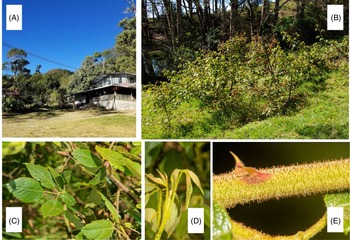
This study was carried out in the Cuericí Biological Field Station, Costa Rica (9”33’30” N, 83’39’42” W, Figure 1A). The elevation is ca 2800 m, the mean annual temperature is 8°C, the mean annual precipitation is 6500 mm, and the vegetation is classified as montane wet forest (Holdridge Reference Holdridge1967). Sampling was conducted on Rubus adenotrichos (blackberry) shrubs that surrounded the Biological Station (Figure 1B). Hybrid Andean blackberries are native from Mexico to Ecuador and are widely cultivated in the south of Costa Rica for their edible polyphenolics-rich fruits, which are eaten fresh or consumed as juice, jelly and wine (Castro and Cerdas Reference Castro and Cerdas2005). R. adenotrichos is a shrub up to 5 m tall, with copious hairs and scattered curved prickles in its stems and petioles. Leaves are compound, with three or five leaflets. Flowers are white or pink, and fruits are red or black (Hammel et al. Reference Hammel, Grayum, Herrera and Zamora2014, Figure 1C, D). The main vertebrate herbivores in the region are tapir (Tapirus spp) and rabbits (Sylvilagus spp) (Kappelle and Horn Reference Kappelle and Horn2016).
The Cuericí Biological Field Station, Costa Rica, where the study was carried out (A), shrub of Rubus adenotrichos (B), mature (C) and young (D) petioles with their leaves, and a detail of the spines in the petiole (E).

Methods
Sampling
In the summer of 2022 (January and February), we randomly selected 51 plants of R. adenotrichos with 2 ± 0.5 m in height (mean ± SE) that were, at least, 5 m apart from each other. All individuals were located in an open field, receiving full sun. We covered a total sampling area of approximately 2 ha. In each individual, we randomly selected one or two young and mature petioles that emerged from the same stem. Young and mature petioles and their leaves were easily distinguished because of their colour (light green for young leaves and dark green for mature leaves (Figure 1C and 1D), form, and location (terminal for young and more basal for mature). We sampled a total of 144 petioles, 72 young and 72 mature.
Trait measurements
We measured the length and the diameter of each petiole with callipers, the total number of prickles along the petiole, and the area of the petiole occupied by each individual prickle. The area of each petiole was estimated as its length x its perimeter (π * 2r), and the area of the petiole occupied by each prickle was calculated through photos with the software ImageJ ® (Rasband Reference Rasband1997), considering the base of the spine such as a circle (π * r2) (Figure 1E). Finally, prickles density was calculated as # prickles/petiole length, and the petiole area covered by prickles was calculated as the ratio of prickles area versus petiole area. The mean area of an individual prickle, the petiole area covered by prickles and prickles density were compared between young and mature petioles using paired t-tests.
Results
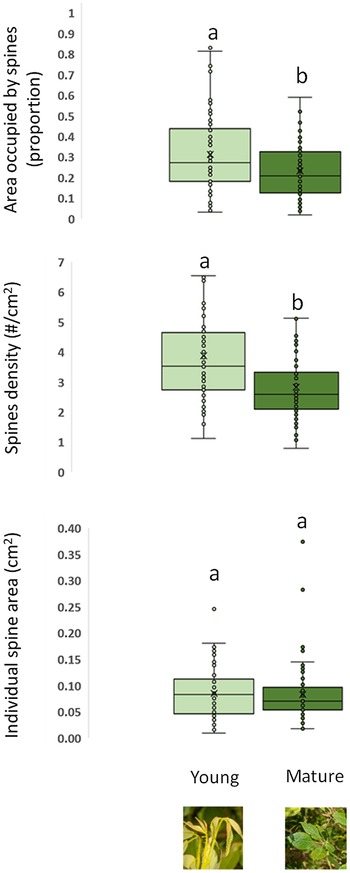
Young and mature petioles differed in their area covered by prickles and prickles density, but individual prickles showed similar area (Figure 2). The area of petiole covered by prickles (proportion) was higher in young than in mature tissues (0.31 ± 0.0 vs. 0.23 ± 0.02, t = 2.8, P < 0.001). Accordingly, prickles density was higher in young than in mature tissues (3.9 ± 0.2 vs. 2.8 ± 0.1 prickles /cm2, respectively, t = 4.6, mean ± SE, P < 0.001). Finally, the mean area of an individual prickle was similar between young and mature tissues (0.085 ± 0.006 vs. 0.083 ± 0.006 cm2, mean ± SE, t = 0.3, P = 0.78).
Petiole area occupied by spines (proportion), spine density (#/cm2), and individual spine area (cm2) in mature and young petioles. Different letters imply statistical significant differences (paired t-test; see text for more details).

Discussion
Internal restrictions, such as the need for growth or differentiation, and external factors, such as natural enemies, can both affect how anti-herbivory defences change as the plant tissue grows. As explained before, the ODH predicts that young tissues should be more defended relative to older tissues because the former are more vulnerable and more valuable to plant fitness. In contrast, the GDBH predicts that young tissues should be less defended than mature tissues because growth processes precede differentiation processes. Here, we found evidence that supports the ODH, illustrating how herbivory pressure might drive the assignation of plant defences.
Our comparative results suggest that, in R. adenotrichos, young tissues are more protected than mature tissues because prickles density and the petiole area occupied by prickles were up to 25% higher in young than in mature petioles. Since the area of petiole occupied by an individual prickle was similar between young and mature petioles, our results suggest that the production of prickles precedes the elongation of the petiole, resulting in higher prickles density in earlier stages of petiole development. Several comparative and experimental studies demonstrated that spinescence are an effective defence against vertebrate herbivores that often prefer younger plant tissues (Fenner et al. Reference Fenner, Hanley and Lawrence1999; Hanley et al. Reference Hanley, Lamont, Fairbanks and Rafferty2007,). For example, in East Africa, the large thorns of Acacia tortilis protect young leaves and axillary meristems from herbivory by goats (Gowda Reference Gowda1996; Gowda and Palo Reference Gowda and Palo2003), and shrubs of Ilex aquifolium with exceptionally spiny leaves are much less likely to suffer herbivory by ungulates than neighbouring less spiny plants (Obeso Reference Obeso1997). It is known that herbivores choice not only is driven by spines but also relies on many other plants traits. However, and given that the large body of evidence from previous works, it seems logical to assume that young tissues of R. adenotrichos could more preferred by herbivores and that prickles could be an effective anti-herbivory defence.
A higher prickles density in early stages of leaf development is also documented in other plant species and in similar physical defences, like trichomes (Kellogg et al. Reference Kellogg, Branaman, Jones, Little and Swanson2011). For example, young leaves of Verbascum thapsus show higher hair density and are less eaten than mature leaves (Woodman and Fernandes, Reference Woodman and Fernandes1991). Similarly, a high initial trichrome density in Aristolochia californica helps protect its emerging leaves from herbivory (Fordyce and Agrawal, Reference Fordyce and Agrawal2001), and trichome density decreased with age in two Japanese Birch species (Matsuki et al. Reference Matsuki, Sano and Koike2004). Taken together, all this evidence suggests that structural defences such as spinescence may play a relevant role against vertebrate herbivore in young leaves, in which the loss of photosynthetic tissue represents a higher cost than in mature ones (Barton and Koricheva Reference Barton and Koricheva2010; Hanley et al. Reference Hanley, Lamont, Fairbanks and Rafferty2007; Ochoa-López et al. Reference Ochoa-López, Villamil, Zedillo-Avelleyra and Boege2015, Reference Ochoa-López, Damián, Rebollo, Fornoni, Domínguez and Boege2020). Moreover, this structural defence in young tissues could also reduce the herbivory of the entire plant. Shrubs like blackberry tend to privilege lateral growth over height growth. Consequently, the plant forms a structure so that younger, softer tissues are also in the external part of the plant and therefore more exposed to vertebrates. A higher density of spinescence in younger tissues not only can protect the more exposed new leaves but could also act as a spinescence shield protecting the most internal part of the shrub (Archibald and Bond Reference Archibald and Bond2003).
Despite the fact that vertebrate herbivores have been considered a key selective force driving the evolution of spinescence (Charles-Dominique et al. Reference Charles-Dominique, Barczi, Le Roux and Chamaillé-Jammes2017; Cooper and Owen-Smith Reference Cooper and Owen-Smith1986; Coverdale Reference Coverdale2019; Hanley et al. Reference Hanley, Lamont, Fairbanks and Rafferty2007), structural plant defences and ontogenetic changes at organ level have been less studied than chemical defences and changes at plant level (Barton and Koricheva Reference Barton and Koricheva2010; Hay et al. Reference Hay, Kappel and Fenical1994; Mithöfer and Boland Reference Mithöfer and Boland2012). Therefore, the study of how less known structural defences like prickles change as plant tissues grow will help to better understand the relationship between ontogeny and the assignation of anti-herbivore defences. Our single-species study provides additional support to the ODH, suggesting that herbivore pressure can drive the assignation of plant structural defences as tissues grow.
Acknowledgements
We thank two anonymous reviewers and Kety Huberman for their helpful suggestions. We also thank the Organization for Tropical Studies for its logistical support. This research received no specific grant from any funding agency, commercial or not-for-profit sectors.
Competing interests
The authors declare none.