Climate activist Greta Thunberg has pointed out, ‘The climate crisis has already been solved… We already have all the facts and solutions… All we have to do is to wake up and change’ (Caldwell, Reference Caldwell2019: para. 8). So why are we still asleep? Why are we not changing? In spite of being Time magazine's Person of Year, are we unwilling to accept the decrees of a high-school student? How about the words of United Nation's Secretary General António Guterres? In March 2018, he called climate change ‘the most systemic threat to humankind’ (Sengupta, Reference Sengupta2018: para. 2). Guterres has gone on to urge world leaders to curb their countries' greenhouse gas emissions. Our failure to be awake to such appeals and take more timely actions points out an almost inexplicable disinclination of corporate and government leaders to make sufficient change on a broader scale to forestall an environmental doomsday.
This causes several questions to present themselves that will be addressed below. One, what is the climate crisis, what is sustainable development, how do the two concepts relate to each other, and where do the United Nation's Sustainable Development Goals fit with addressing climate change issues? Two, are Sustainable Development Goals being stalled by organizational and government inaction that may be attributable to what researchers have labeled ‘stupidity’? As well, what do we mean by ‘stupidity’ in this context. Finally, can we find cures for ‘stupidity’ in addressing climate change and sustainable development issues?
The Climate Crisis and Sustainable Development
Separately, the climate crisis and sustainable development are critical elements in humanity's fate. As well, their interrelationships are of vital importance.
The climate crisis
According to NASA scientists ‘climate is the description of the long-term pattern of weather’ (Dunbar, Reference Dunbar2005: para. 12). Weather is, ‘the way the atmosphere is behaving, mainly with respect to its effects upon life and human activities’ (Dunbar, Reference Dunbar2005: para. 5). A crisis ‘entails a threat to… the functioning of life-sustaining systems, which must be urgently dealt with under conditions of deep uncertainty’ (Rosenthal, Boin, & Comfort, Reference Rosenthal, Boin, Comfort, Rosenthal, Boin and Comfort2001: 7).
To address the potential for crisis regarding climate change, the United Nations promulgated the Framework Convention on Climate Change (Leiserowitz, Reference Leiserowitz2005). ‘The ultimate objective of the Convention is to stabilize greenhouse gas concentrations ‘at a level that would prevent dangerous anthropogenic (human induced) interference with the climate system’’ (United Nations, 1992: para. 4). To state this concisely, we can say that facing the climate crisis means addressing interference in the climate system caused by humanity.
The ‘crisis’ part of the climate crisis has, in the past, been less obvious. Unger (Reference Unger2000) notes that to realize that a crisis is upon us is that an issue must overcome the ‘knowledge-ignorance paradox’ and be a ‘hot crisis’ (p. 297). The ‘knowledge-ignorance paradox’ is where the growth of specialized knowledge results in a concurrent increase in people being more-and-more ignorant of the needed knowledge to address the issue at hand. It can be overcome via engendering some public understanding and concern, as well as encouragement of knowledge acquisition with easy-to-understand bridging metaphors. Global climate change is abstract until it creates a Hurricane Sandy and closes the New York Stock Exchange for two trading days in late October 2012 – the first time weather had closed the exchange for more than a day in 127 years (O'Brien, Reference O'Brien2014). Unger's ‘hot crisis’ is that the issue provides a sense of immediate and concrete risk with everyday relevance. In this sense, Greta Thunberg, in calling for a strike to address climate change makes the topic hot: it brings the issue up as a daily and ongoing concern. Addressing these issues then becomes paramount and thus creates the dilemma as to how to balance human needs for economic growth and a survivable climate via sustainable development.
Sustainable development
For business and government desires for economic development to co-exist with an environment in peril we have come to accept the concept of sustainable development. The classic definition of sustainable development by the Brundtland Commission (1987) is that ‘Sustainable development is development that meets the needs of the present without compromising the ability of future generations to meet their own needs’ (Chapter 2, para. 1). The phrase ‘Sustainable development… [has become] the most widely accepted starting point for scholars and practitioners concerned with environment and development dilemmas’ (Sneddon, Howarth, & Norgaard, Reference Sneddon, Howarth and Norgaard2006: 255).
Also, there are alternative perspectives for addressing climate change, for example, Banuri (Reference Banuri1999) suggests ‘welfare optimization’ and ‘resilience and durability’ (pp. 4–5). Though, such a comparative discussion is beyond the scope of the dialog here. As well, former Deputy Executive Secretary for the UN Climate Change Secretariat, Richard Kinley (Reference Kinley2006), notes that, ‘sustainable development has won almost universal acceptance as a principle’ (paras. 3–4). He further notes that, ‘dealing with climate change is a precondition for sustainable development,’ and that ‘climate change is the ultimate sustainable development issue.’
Citing the Brundtland Commission (1987), Robert, Parris, and Leiserowitz (Reference Robert, Parris and Leiserowitz2005) broadly address the question, ‘What is sustainable development?’ (p. 10). This broadly breaks down into two simple issues: (1) ‘what is to be sustained’ and (2) ‘what is to be developed?’ Three major categories are to be sustained: ‘nature, life support systems, and community – as well as intermediate categories for each, such as Earth, environment, and cultures.’ Similarly, three major categories are to be developed: ‘people, economy, and society…[including] economic development, with productive sectors providing employment, desired consumption, and wealth.’ Thus, although sustainability may be seen as ecological considerations and development economic ones (Daly, Reference Daly1996), the idea of development has evolved to include human development – Robert, Parris, and Leiserowitz (Reference Robert, Parris and Leiserowitz2005) include ‘increased life expectancy, education, equity, and opportunity’ (p. 10). A failure to create a sustainable society may create ecological collapse, a failure to develop may create economic collapse, and a failure to do both will create a global collapse endangering both people and places.
Climate change and sustainable development are inexorably intertwined. So much so that climate change issues compose a great deal of the United Nations' sustainable development goals. This is discussed in greater detail below.
The relationship between the climate crisis and sustainable development
As noted in the Third Assessment Report of the Intergovernmental Panel on Climate Change (2001), ‘Climate change decision making is essentially a sequential process under general uncertainty. Decision making has to deal with uncertainties including… balancing the risks of either insufficient or excessive action, and involves careful consideration of… consequences (both environmental and economic)’ (p. 3). This means that decision makers need to balance climate considerations and sustainable development. Halsnæs and Verhagen (Reference Halsnæs and Verhagen2007) note that Third Assessment Report specifically ‘recognized the importance of understanding the relationship between sustainable development and climate change’ (p. 678). More exactly they note that, ‘the climate change issue is part of the larger challenge of sustainable development (Intergovernmental Panel on Climate Change, 2001: 2).’
Thus, the uncertainties noted in Third Assessment Report mean that decision makers are potentially stepping into the realm where even the best-educated analysis may be insufficient to come to an optimal assessment. As such, climate change decisions that are made as part of a sustainable development effort may fail to create either positive impacts for climate or sustainable development. In other words, as we will discuss below, the likelihood that a sustainable development decision may end up being a stupid one is quite possible.
Fit between UN sustainable development goals and climate change issues
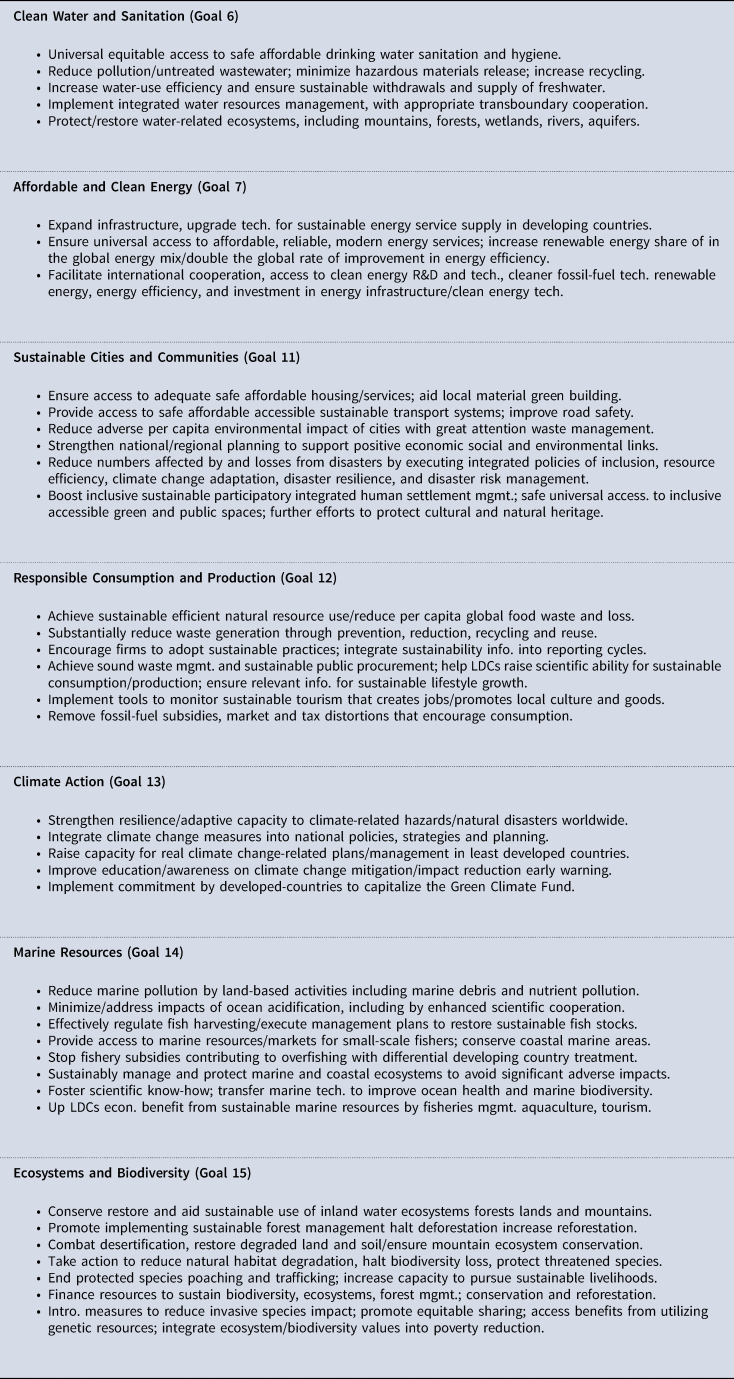
United Nations sustainable development goals cover four basic needs (food security, poverty reduction, health, and education) and three equality and justice items (gender empowerment, equality, and peace with capable institutions) each (United Nations Department of Public Information, 2015). There are also three economic issues (work and economic growth, industry and infrastructure, and cross-government partnerships to achieve goals). The remaining seven address climate and environmental livability. These seven (water and sanitation, energy, sustainable communities, responsible consumption and production, climate, marine resources, and ecosystems/biodiversity) are summarized in Table 1.
Precis of UN sustainable development goals for climate and environmental livability

Source. UN Sustainable Development Goals. Compiled from https://sustainabledevelopment.un.org/?menu=1300.
How sustainable development goals get blocked by stupidity
The Organization for Economic Co-operation and Development (OECD) provides guidelines on needed investment in climate-resilient infrastructure (OECD, 2018). To the extent that we are not making those investments something is blocking those actions. We will propose that this dilemma is based on stupidity.
Blocked goals
‘In 2014, the world invested $391 billion in low-carbon and climate-resilient infrastructure’ (Walsh, Reference Walsh2015: para. 3). To reach sustainable development goals, the number should have been an order of magnitude higher: 7 trillion dollars. By 2017, the situation had improved and spending on global climate-related primary investment improved to $612 billion. This is less than a third of what spending should be to keep global warming under 1.5°C and is being far outstripped by fossil fuel investment (Buchner et al., Reference Buchner, Clark, Falconer, Macquarie, Meattle, Wetherbee and Tolentino2019).
Goals blocked by stupidity
We thus know that there is a crisis. We know that there are actions that we can take to avoid the worsening of the crisis. We know we are not taking those actions. Are we being stupid? We may have more polite terms for inaction toward a sustainable future, but perhaps ‘stupidity’ is an appealing one.
What is Stupidity
To address ‘stupidity’ and how it is maintained in organizations and institutions, we will first look at the recent psychological underpinnings of the ‘science of stupid.’ Then we outline recent organizational applications to ‘functional stupidity,’ and what organizational researchers have called the ‘threat-rigidity effect.’ We then discuss what we consider humanity's biggest threat to our future and our ability to sustain our lives on this planet: what we call the ‘stress–stupidity system.’ Building on these research streams, we outline the elements of the stress–stupidity system.
Stupidity is not simply failing to properly handle complexity. To deal with uncertainty and complexity requires bounded rationally. Thus, decisions are rational within the limits of available information and mental processing capabilities (Simon, Reference Simon1957). Stupidity, as we shall see, does not require such analysis: decision makers are confidently ignorant, fail to adequately attend to the conditions at hand and lack impulse control.
Identifiable stupidity: stupid is as stupid does
To label something as ‘stupid’ is not simply name-calling. People have something specific in mind if they use this term. Aczel, Palfi, and Kekecs’ (Reference Aczel, Palfi and Kekecs2015) analysis of what people label as ‘stupid’ is an intuitively functional one, that is, to take Forrest Gump's line, ‘Stupid is as stupid does’ (Pappas, Reference Pappas2015: 1). This is to say that we have an intuitive understanding of what ‘stupid’ looks like. To quote U.S. Supreme Court Justice Potter Stewart to describe his test for obscenity he wrote: ‘I shall not today attempt further to define the kinds of material I understand to be embraced within that shorthand description… But I know it when I see it…’ (Gewirtz, Reference Gewirtz1996: 1023). In an analysis of people's response to a range of ill-considered actions Aczel, Palfi, and Kekecs (Reference Aczel, Palfi and Kekecs2015) found that people employed the label ‘stupid’ in identifying three separate types of scenarios. One, stupid is confident ignorance or a failure to maintain a balance between confidence and abilities. Two, stupid is absentminded failure of attention or lack of practically. Finally, stupid is lack of impulse control.
Confident ignorance
Pomeroy (Reference Pomeroy2015) describes confident ignorance as an actor that takes high risks whereas lacking the needed skills to perform the action. Take the extreme case of serial killer Aileen Wuornos. At various times she applied to be a lawyer and a police officer (Arrigo & Griffin, Reference Arrigo and Griffin2004). This was despite having an IQ just above impairment, no formal schooling or experience, and an extensive liaison with the wrong side of the law (Arrigo & Griffin, Reference Arrigo and Griffin2004; Myers, Gooch, & Meloy, Reference Myers, Gooch and Meloy2005). Had her knowledge of the law been as good as she believed, she may have been able to stop running afoul of it. Basically, this is not just a circumstance of being ignorant of one's own ignorance – the ‘Dunning–Kruger effect’ (Dunning, Reference Dunning2011; Kruger & Dunning, Reference Kruger and Dunning1999) – but being more certain about one's abilities in spite of being presented with evidence to the contrary.
A more public example was when, in a debate with Hillary Clinton, Donald Trump ‘blamed her, as a senator, for allowing him to get away with paying no taxes. He made his accusation with the smug certainty of the uninformed. He had no idea… fiscal bills originated in the House, not the Senate’ (Grigsby, Reference Grigsby2018: para. 8). Moreover, ‘he didn't know that he didn't know’ (Grigsby, Reference Grigsby2018: para. 8). Such Confident ignorance has continued well into his term with claims that ‘he has ‘total’ authority to order states to relax social distancing to combat the novel coronavirus outbreak and reopen their economies’ (Jacobs, Sink, & Mohsin, Reference Jacobs, Sink and Mohsin2020: para. 1); a power that belongs to the states and not the federal government.
In addition, Rollwage, Doland, and Fleming (Reference Rollwage, Doland and Fleming2018) found that people holding radical beliefs (both liberal and conservative) were more likely to experience metacognitive failures. The more radical participants in their study not only displayed less insight into the correctness of their objective perceptual choices, but they reduced updating of their confidence when presented with post-decision evidence. Their subjects looked at two different clusters of dots to identify which group had more. They then rated how confident they were in their choice. People with radical political opinions completed this exercise with much the same accuracy as moderate subjects. But ‘after incorrect decisions, the radicals were less likely to decrease the estimate confidence’ (Chodosh, Reference Chodosh2018: 6).
Under ambiguous conditions where no routines exist, individuals, groups, and organizations may call upon a biased situational view and employ heuristics, preconceptions, and prejudices to address the threat (Gilovich, Griffin, & Kahneman, Reference Gilovich, Griffin and Kahneman2002; Kahneman & Frederick, Reference Kahneman, Frederick, Holyoak and Morrison2005). As per Staw, Sandelands, and Dutton (Reference Staw, Sandelands and Dutton1981) poor information may severely hurt the organization. As well, when efforts begin to look like failure, decision makers reformulate organizational goals and/or rules for success (e.g., profit for this year is unimportant as we have reconfigured our investments for future profit). Stress responses eventually lead to inapt actions that may endanger future conditions. Such efforts may be irrelevant in tackling the real problem at hand: higher dykes may achieve the goal of reducing flooding in places due to rising sea levels, but the rise in sea level is the real problem and the eventual need, for example, to construct a dyke around the entire state of Florida is difficult.
Failures of attention
Aczel, Palfi, and Kekecs (Reference Aczel, Palfi and Kekecs2015) note that those in their ‘absentminded’ group, knew the right thing to do. Yet, they were not paying sufficient attention to avoid doing something ‘stupid.’ Pappas (Reference Pappas2015) cites the example of walking out of a store with a chosen item and unintentionally not paying for that desired purchase.
It is hard to imagine that global players would fail to notice the unsustainable impact of human activity on the environment. Yet, the behavior of commercial organizations – when interpreted by Ocasio's (Reference Ocasio1997) attention-based view (ABV) of organizations – indicates that they do have attention failures. The ABV explains how organizations ‘focus of time and effort… on a set of issues… and on a particular set of action alternatives…’ (p. 188). Thus, organizational attention creates an agenda of ‘issues and action alternatives that guide the allocation and deployment of resources’ (Ocasio, Laamanen, & Vaara, Reference Ocasio, Laamanen and Vaara2018: 155). That is, sustainability issues get lost when, in the shorter-run, firms are more concerned with profit and governments are more concerned with re-election. Thus, if sustainability issues fail to rise to the level where they seriously impact those goals, they are ignored.
Lack of impulse control
The lack of impulse control category includes cases of obsessive, compulsive, or addictive behavior. One example is the person who canceled a meeting with a good friend to stay home and continue playing video games. It could also be the case where political party members reject their own statutory recommendations because the opposition brought the bill to the legislature.
Argenti (Reference Argenti1976) talks about the notion that autocratic decision makers may imperil the very existence of their organizations. They do this by failing to accept objections from those charged with implementing their preconceived plans. In addition, such autocratic decision makers may select biased information to support their proposals. Managers either buy into the efforts to selectively use information, limit alternatives, and execute these preconceived plans, or they leave the organization.
Functional stupidity
Although Aczel, Palfi, and Kekecs (Reference Aczel, Palfi and Kekecs2015) give us the basis for defining the concept of stupid, Alvesson and Spicer (Reference Alvesson and Spicer2012) provide us with ‘a stupidity-based theory of organizations’ (p. 1194). Alvesson and Spicer discuss what they call ‘functional stupidity.’ As they define it, ‘functional stupidity is inability and/or unwillingness to use cognitive and reflective capacities in anything other than narrow and circumspect ways… a disinclination to require or provide justification, and avoidance of substantive reasoning’ (p. 1201). They note functional stupidity is a mixed blessing.
Good functional stupidity
Alvesson and Spicer (Reference Alvesson and Spicer2012, Reference Alvesson and Spicer2016) note that functional stupidity offers group members a sense of certainty for smooth organizational operations. When a relaxed attitude toward being reflective, critical scrutiny, or justification is adopted, it saves the group from frictions created by reflection and doubt. By accepting and embracing group values, functional stupidity allows group members to avoid task fragmentation and contradictions to focus on organizational goals and the means to achieve them.
There is also economy to functional stupidity. If organizations were constantly justifying all their actions, they would need to devote significant resources to creating and expressing such justifications. Via functional stupidity, organizations can avoid costs associated with such critical thinking. A sense of mindlessness, to use Ashforth and Fried's (Reference Ashforth and Fried1988) term, allows a great deal of work to be accomplished when narrow and predictable conditions and action responses are required.
Bad functional stupidity
The down side to functional stupidity is that the organizationally-supported lack of being reflective, substantive reasoning and justification brings about a refusal to use intellectual resources outside a narrow and safe space (Sidhu, Reference Sidhu2015). Group members may thus lack the ability or desire to use or process knowledge (Sternberg, Reference Sternberg and Sternberg2002), question claims to knowledge or norms (Alvesson & Sköldberg, Reference Alvesson and Sköldberg2009), or use cognitive resources and intelligence (Alvesson & Spicer, Reference Alvesson and Spicer2012). A lack of curiosity, closed-mindedness, and a reluctance to diminish one's identity as an ‘organizational person’ can be a barrier to broader thinking (see Kets de Vries, Reference Kets de Vries1989; Whyte, Reference Whyte2002).
Alvesson and Spicer (Reference Alvesson and Spicer2012) argue that by exerting their power via manipulation of symbols, corporate branding, strong corporate cultures, and charismatic leadership, organizations often block communicative action. The result is adherence to edicts by higher-ups, and a muffling of criticism or reflection. Doubts are stymied and there is a false sense of certainty about norms. What can and cannot be raised during group deliberation is restricted. Pair all this with a leader who lacks impulse control (Aczel, Palfi, & Kekecs, Reference Aczel, Palfi and Kekecs2015), and the potential for disaster is great. Functional stupidity can thus increasingly expose wide gaps between shared assumptions and reality that may produce a disaster.
The inability of an organization, or the main actors in it, to be reflective, exercise substantive reasoning and be able to logically justify what would otherwise be questionable decisions adds to the likelihood of some kind of failure. We see all these elements in the case of the Boeing 737 Max. Rick Ludtke, an engineer with 19 years at Boeing who helped design the 737 Max's cockpit noted that the plane: ‘was state of the art… 50 years ago… [but] not… for the current environment’ (Nicas & Creswell, Reference Nicas and Creswell2019: 11). He points out what the notion of functional stupidly speaks to, but in the context of the Boeing corporate culture: ‘Nobody was quite perhaps willing to say it was unsafe, but we really felt like the limits were being bumped up against’ (Nicas & Creswell, Reference Nicas and Creswell2019: 23).
The overall effect
Overall, there is a trend toward inapt, rigid, or pre-planned approaches. This leads to stupidity in response causing intensification of threats or stressors. Actions become riskier as commitment increases to double down on attempts to make maladaptive behaviors work. Thus, in corporations, without board or creditor intervention, decision makers will allow top management teams to pursue inapt decisions unabated until the organization fails or is taken over. In political systems, leaders have to either be voted out or otherwise removed. Punctuated change may be needed to overcome confident ignorance and remove inattentive or autocratic leaders. Such change allows for new leadership, more realistic information and better decisions. The alternative is eventual collapse.
Engaging in confident ignorance, absentmindedness, and lack of control does not necessarily mean a lack of intelligence. Aczel, Palfi, and Kekecs (Reference Aczel, Palfi and Kekecs2015) say these acts reveal more about the observer's behavioral expectations. A person doing a stupid thing may be working with different expectations. On a grander scale, can we say whole organizations or institutions are ‘stupid’? Within an organizational context, people may myopically rely more on group and/or organizational cohorts' opinions that might otherwise be the case (Jaeger, Reference Jaeger2019; Janis, Reference Janis1983). Thus, the importance of the response for those decision-making individuals, groups, and organizations comes into play when there is the need to react to some change or threat.
The threat-rigidity effect
A number of classic organizational studies address the behavioral antecedents of sub-optimal acts (e.g., Smart and Vertinsky, Reference Smart and Vertinsky1977; Tversky and Kahneman, Reference Tversky and Kahneman1974). The most widely known work is Staw, Sandelands, and Dutton's (Reference Staw, Sandelands and Dutton1981) multilevel analysis on the threat-rigidity effect. Their focus was on how adversity affects the adaptability of multiple layers of organizational or institutional systems. They postulated that when a group is threatened, processes become more rigid and actors rededicate themselves to once routine solutions to address the threat, even if such behaviors are inappropriate.
There are, to use the phrasing from Aczel, Palfi, and Kekecs (Reference Aczel, Palfi and Kekecs2015), actors who are confident in their ignorance in handling the situation at hand. Looked at another way, under threat, the direction of organizational inertia is maintained, if not strengthened – resources are misallocated and routines are entrenched (Gilbert, Reference Gilbert2005). This would be Aczel, Palfi, and Kekecs's (Reference Aczel, Palfi and Kekecs2015) lack of impulse control.
For stupid actions to be enacted by organizations, it may take the combined actions that occur at multiple levels of organizational decision-making. Staw, Sandelands, and Dutton's (Reference Staw, Sandelands and Dutton1981) analysis is multilevel because it addresses individual, group, and organizational effects. Such an analysis allows us to address concurrent actions that result in the overall appearance of organizational stupidity. These multilevel impacts are discussed below.
Individual level effects
Individual level effects described by Staw, Sandelands, and Dutton (Reference Staw, Sandelands and Dutton1981) include psychological stress, anxiety, and physiological arousal. Just as in Rollwage, Doland, and Fleming's (Reference Rollwage, Doland and Fleming2018) work, new information that may change evaluation of the facts is ignored. Weick (Reference Weick1996) noted how 27 wild land fire fighters failed to follow orders to drop their heavy tools so they could outrun an exploding fire. Their training told them this was a thing they must never do, and they died within sight of safe areas. Such actions, according to Staw, Sandelands, and Dutton (Reference Staw, Sandelands and Dutton1981), restrict information processing and result in constriction of control. Thus, the need for rapid response increases belief bias in such a way that decision makers are not fully able to engage their analytical abilities in ways that lead to correct logical decisions (Evans & Curtis-Holmes, Reference Evans and Curtis-Holmes2005). Thus, frontline workers' individual decision shortcuts may result in behaviors that create negative outcomes.
Engler, Abson, and von Wehrden (Reference Engler, Abson and von Wehrden2017) note several fallacies occurring at the individual level. One, an endeavor may be continued when it might otherwise need to be abandoned to justify already sunk costs. Two, Engler et al. also discuss problems decision makers have with probabilities and may see probabilities as different as one in a million and one in a thousand as roughly equivalent (Sunstein & Zeckhauser, Reference Sunstein and Zeckhauser2011; Wagner & Zeckhauser, Reference Wagner and Zeckhauser2012). There may be a preference for zero risk even if the greater risk reduction can be achieved more efficiently via other alternatives. Managers may make poor use of the knowledge they have in that they overestimate rates of occurrence based on well-publicized events, or have a bias toward data acquired early that meets preconceived expectations, their professional orientation, and personal experience (Wagner, Reference Wagner and Sternberg2002). Three, decision makers may stick with a default option if it is specified, or otherwise lean toward a sub-optimal status quo. Also, information processing biases mean that managers may apply evaluative criteria unevenly when faced with an array of alternatives, non-linear relationships, and special circumstances (Wagner, Reference Wagner and Sternberg2002). Finally, in lieu of rational decision processes there may be a preference toward decisions guided by an ‘affect heuristic… [i.e. a] fast, intuitive, automatic, emotional, effortless and implicit mode of thinking’ (Engler, Abson, & von Wehrden, Reference Engler, Abson and von Wehrden2017: 8). If data are incorporated, it may be over generalizations from small samples (Wagner, Reference Wagner and Sternberg2002).
Group level effects
According to Staw, Sandelands, and Dutton (Reference Staw, Sandelands and Dutton1981), group level effects include the effect of threat upon group leadership and control, as well as pressures toward uniformity. If the threat is attributed to external sources and it is thought that group efforts will succeed, group cohesiveness, leadership support and pressure for uniformity increases. This results in restriction of information and constriction of control. If instead the threat is credited to internal sources or it is thought that group efforts will fail, group cohesiveness and leadership stability declines and dissention increases. This may force the input of new information and looser controls. If different groups within the organization have highly polarized positions, the in-group's position is favored such that discourse is difficult and decisions may be delayed so that actions are not taken in a timely manner (Engler, Abson, & von Wehrden, Reference Engler, Abson and von Wehrden2017). Thus, the ability to allow for change depends on whether the great majority of the groups involved believe the current sub-optimal approaches need reanalysis.
Organizational or institutional level effects
Organizational or institutional level effects in the threat-rigidity research come from the crisis literature (e.g., Smart and Vertinsky, Reference Smart and Vertinsky1977). The perception that one is in a crisis means that there is the potential for loss. Decision makers may initially increase information seeking to confirm the existence of the crisis, but as the crisis progresses, information gathering declines, in part because information channels get overloaded. As well, ‘leaders may be unwilling to admit a crisis is possible because of what the threat would present to their sense of personal or organizational identity’ (Jacobsen, Reference Jacobsen2010: 51). This may also lead to collective rationalization in a group's logic that may prevent leaders from detecting risk (Jacobsen, Reference Jacobsen2010; Seeger, Sellnow, & Ulmer, Reference Seeger, Sellnow and Ulmer2003).
Authority gets more centralized and formalized to direct efforts to address the crisis. Information gathered by previous authorities may be seen as suspect; if it were useful, those previously in charge would have used it to avoid the current problems in which the institution is mired. Basically, organizations shut down being open to acceptable alternatives to current behaviors when they are incapable of processing all the information available.
The overall effect
Overall, there is information restriction and constriction of control. The result is a tendency toward reinforcing well-learned responses. This all leads to rigidity in response that leads to the intensification of the threat. This will either lead to eventual collapse (see Hambrick & D'Aveni, Reference Hambrick and D'Aveni1988) or a gradual change that allows for new information and better decisions. Whether collapse or change occurs is discussed below.
The Stress Stupidity System
What happens if there are no routines to fall back on? The question is critical for addressing needs in a new or radically changed environment. This is what we face in a well-altered natural environment and the need to address sustainability issues.
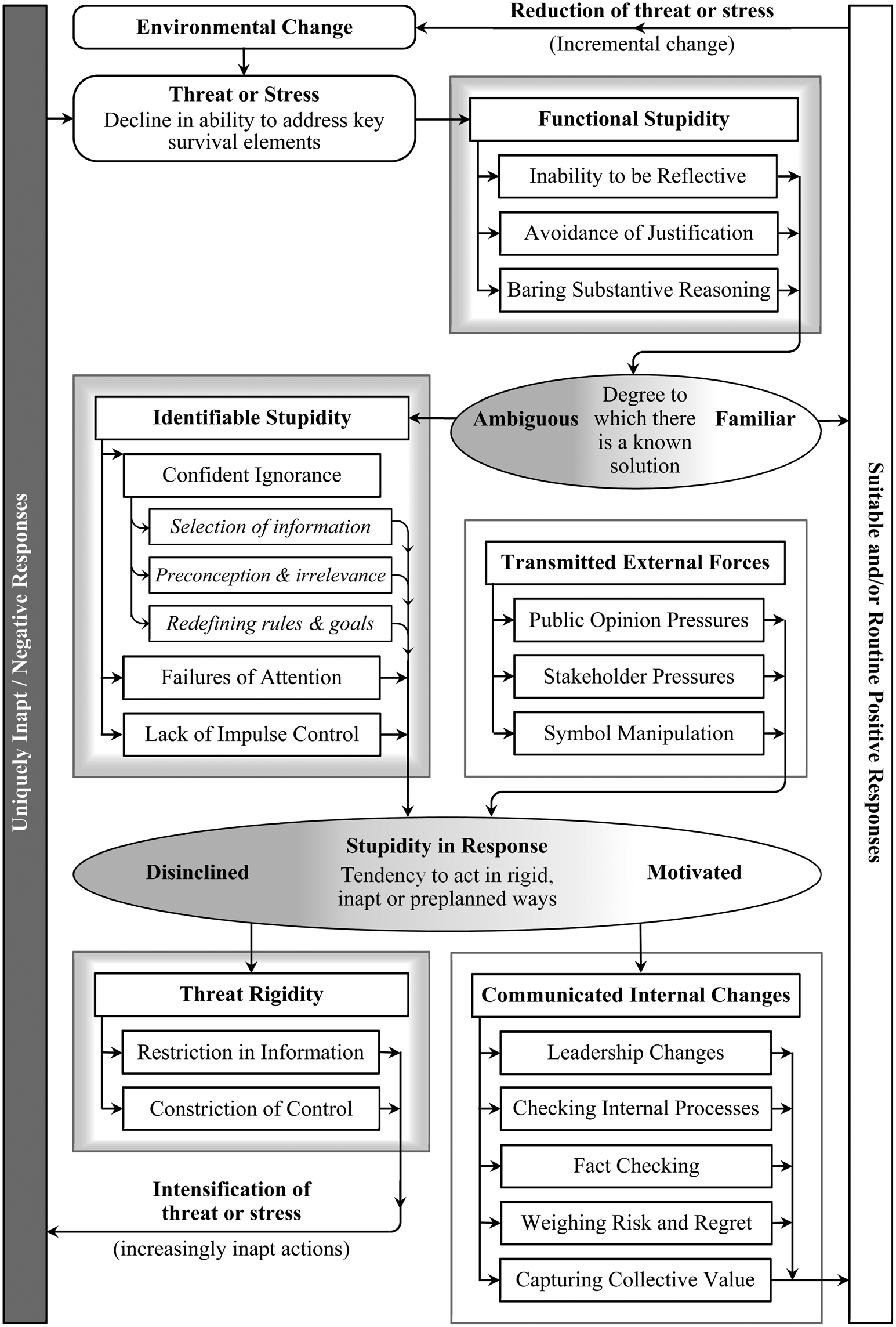
As shown in Figure 1, an environmental change may create a threat or stress that triggers a performance gap between expected and actual results. This creates a decline in the organization's ability to address key survival elements (i.e., profit for corporations, legitimacy for governments, or other important institutions). This triggers the functional stupidity subsystem. If this is a familiar situation, standard operating procedures and a routine response may be suitable enough to address the threat or stress. If the situation is less familiar and the proper response is more ambiguous, we encounter what Aczel, Palfi, and Kekecs (Reference Aczel, Palfi and Kekecs2015) have identified as ‘stupid’ (what we have labeled ‘identifiable stupidity’): confident ignorance, absentmindedness, and lack of impulse control.
The stress–stupidity system.

The above subsystems and decisions lead to what we call ‘stupidity in response.’ At this point, decision makers may be motivated to address their stupid intuitional actions because external forces have created sufficient pressure for change. These additional ‘transmitted external forces’ include public opinion pressures, stakeholder pressures, and the ability of these external actors to manipulate their message so that it has some impact on organizational decision makers. With sufficient motivation from transmitted external forces, internal organizational changes will occur. This should allow for positive, suitable responses to threats and/or stressors. If, however, decision makers are disinclined to change, the threat rigidity responses of information restriction and constriction of control will intensify stressors. These elements will be discussed in more detail below.
The Stress–Stupidity Solution: Fixing Stupid
It has been argued, ‘you can't fix stupid’ (White, Reference White2006). In fact, the more familiar you are with a subject, the stupider you might be. Atir, Rosenzweig, and Dunning (Reference Atir, Rosenzweig and Dunning2015) found that in some cases over 90% of their subjects in a knowledge test claimed some familiarity of at least one fictitious concept in a list. As well, the more familiar subjects considered themselves to be with an area of knowledge, the more familiar they claimed to be with meaningless terms (Rutter, Reference Rutter2015).
On the other hand, Timothy Egan (Reference Egan2018) has argued the exercise of political citizenship can at least remove some of the institutional stupidity from our democratic discourse. That is, educating our fellow voters and ourselves allows us to mobilize and vote out the office holders. This does not happen without transmitting messages to those institutions from which we wish to remove stupidity. Therefore, the first step toward fixing the potential toward making stupid moves is determining whether one is sufficiently motivated to institute change. This motivation comes via the transmission of signals, or what we have labeled ‘transmitted external forces.’ The next step is whether such forces influence bring about bring change or recalcitrance and thus lead to further stupidity or intelligent response, respectively.
Transmitted external forces
In prodding youth not to be silent in the face of what is wrong Pope Francis said ‘Dear young people, you have it in you to shout… It is up to you not to keep quiet’ (Egan, Reference Egan2018: 1). He is telling us that decision makers can only come to a valid choice if their attention has been drawn to the issue at hand. This speaks to correcting the failures of attention discussed by Aczel, Palfi, and Kekecs (Reference Aczel, Palfi and Kekecs2015) above. To do this, the three principal forces mentioned above come into play: public opinion, stakeholder pressures, and the concomitant symbol manipulation brought to bear.
Public opinion pressures
Public opinion pressures serve to put issues on an organization's agenda. Ocasio's (Reference Ocasio1997) ABV of organizations tells us that institutional attention creates an agenda of issues and action alternatives that guide the organization. If attention can be brought to an issue it can get on the agenda and addressed. This applies to the adoption of sustainable environmental manufacturing practices as well (Adebambo, Ashari, & Nordin, Reference Adebambo, Ashari and Nordin2014). Otherwise, the organization remains stupid.
Stakeholder pressures
Stakeholder pressures are similarly important. Alvesson and Spicer (Reference Alvesson and Spicer2012) note that there are, ‘…spaces within and around organizations that can host stupidity-disturbing dialogue’ to break a standard pattern of response (p. 1212). They note that these include broader social movements (Spicer & Böhm, Reference Spicer and Böhm2007), and the media (Patriotta, Gond, & Schultz, Reference Patriotta, Gond and Schultz2011). Darnall, Henriques, and Sadorsky (Reference Darnall, Henriques and Sadorsky2008) note that stakeholder pressures play a major role in adoption of environmental management systems.
Symbol manipulation
Social movements also employ symbol manipulation. The so-called Great Pacific Garbage Patch (GPGP) ‘conjures images of a floating landfill in the middle of the ocean, with miles of bobbing plastic bottles…’ (NOAA, 2019: para. 2). Experts at the U.S. National Oceanic and Atmospheric Administration (NOAA, 2019: para. 2) point out that while, ‘these areas have a higher concentration… much of the debris found in these areas are small bits of plastic…’ Rather than a Texas-sized island that one could walk on, the debris in the GPGP ‘is more like flecks of pepper floating throughout a bowl of soup…’ (NOAA, 2019: para. 2). The collection of these plastics up through the food chain is a problem, but without the images of islands of floating trash, decision makers, and the public may be less likely to take any actions regarding plastics' use.
If the GPGP is just peppery water, we may ignore it; it would fail to be Unger's (Reference Unger2000) ‘hot crisis.’ A massive garbage slick puts a more severe image in your head, and it is effective. This speaks to Ocasio, Laamanen, and Vaara's (Reference Ocasio, Laamanen and Vaara2018) discussion of the need to discuss strategic vocabularies as micro foundations of attention formation and the rhetorical tactics as determinants of attentional engagement.
One reaches a crossroads once stupid decisions and the above pressures come to bear upon individuals, groups, and organizations. That crossroads is whether decision makers are disinclined toward change and toward continued errors or motivated to respond with addressing the need for change. In other words, will decision makers exhibit ‘stupidity in response’ to previous inapt decisions and transmitted external forces?
Stupidity in response
The disparity between being motivated or disinclined to act can imperil organizational existence. Sheppard and Chowdhury (Reference Sheppard and Chowdhury2005) note that disinterested private family ownership may have led to the demise of Canada's once leading department store, Eaton's. Eaton's lost billions before launching a failed attempt to address pressures arriving with U.S. entrant Wal-Mart. They contrast this with another major chain, Canadian Tire (CT). CT's housewares lines came under attack from Wal-Mart and its hardware lines were threatened by U.S. giant Home Depot. However, CT had interested family owners, was publicly traded and had local franchisees. Pressure from these groups more quickly forced CT to address the challenges and mobilize resources to successfully develop newer, bigger, more competitive stores.
An additional point here is that, insurgent movements within organizations can help break through functional stupidity (Creed, Scully, & Austin, Reference Creed, Scully and Austin2002). As well, ‘leaders who are willing to open up broader reflection on fundamental assumptions within an organization’ allows for a to change (Alvesson & Spicer, Reference Alvesson and Spicer2012: 1212). A failure to be so driven means that threat-rigidity effects come into force and the organization further restricts information, constricts control and intensifies its threats and/or stressors.
We have outlined six ways in which motivated decision makers can correct a likely cycle of stupidity and inapt responses. These deal with communication, leadership, internal processes, descent, risk/regret, and collective value. These are discussed further below.
Communicated internal changes
Ocasio's (Reference Ocasio1997) ABV of organizations reminds us that to affect change one needs to communicate the need for performing activities in a different way. An overt commitment must be made and in many cases this commitment begins at the top of the organization. Ughakpoteni's (Reference Ughakpoteni2015) extensive scoping review of top management leadership and corporate sustainability points to the importance of top management commitment for corporate sustainability performance, sustainability-oriented innovation and sustainability-oriented practices. In addition, Adebambo, Ashari, and Nordin (Reference Adebambo, Ashari and Nordin2014) have reviewed how top management commitment can positively influence the implementation and other aspects of environmental practices regarding sustainable environmental manufacturing practices.
Leadership changes
Leadership changes aid in turning around the direction of the institution. To turnaround corporations Schoenberg, Collier, and Bowman's (Reference Schoenberg, Collier and Bowman2013) review concluded that organizations are aided in their turnaround efforts via changes in the chief executive officer (CEO) and top management team. This helps to signal a change in the organizational culture to break old habits and create new behaviors (Stopford & Baden-Fuller, Reference Stopford and Baden-Fuller1990). More broadly, as Harris (Reference Harris1998) and Kuhn (Reference Kuhn1996) have pointed out, there are some areas, for example, the scientific community, where an entire generation often has to die off in order for new ideas to be accepted.
An alternative is that leaders open up broader reflection on fundamental assumptions in an organization (Hatch, Reference Hatch, Ashkanasy, Wilderom and Peterson2011). Yet, as noted above, such a move may be harder with continuity of leadership. One might simply promote out of the way a leader who has reached their level of incompetence (Peter, Reference Peter1984; Peter & Hull, Reference Peter and Hull1969). A vice president (VP) of finance thus becomes the VP of harmless special projects; a CEO becomes chair of the board with no real power. In any case, there is a change in the way leaders handle the situation and stakeholders can begin to address how to perform differently based on a real analysis of the facts. The principal downside is that unless the company is large and the use of this technique is limited it is financially onerous for an organization to employ such methods (Grudin, Reference Grudin2015). Thus, changing leadership in a direct and obvious way would more likely promote an end to ongoing stupidity.
Checking internal processes
Effectively, checking internal processes is avoiding groupthink (DuBrin, Reference DuBrin2012). This concept, in brief, represents ‘a deterioration of mental efficiency, reality testing, and moral judgment in the interest of group solidarity’ (Mannes, Reference Mannes2016: para. 5). The symptoms of groupthink – such as the suppression of dissent, polarization of attitude, and poor decision quality – are well established and demonstrated with Janis’ (Reference Janis1972) dissection of the Bay of Pigs decision and later events (e.g., see Cohen and DeBenedet, Reference Cohen and DeBenedet2012). We recommend and reiterate here Janis' recommendations to prevent groupthink: ‘appointing a devil's advocate, introducing outside voices and allowing brainstorming to occur without judgment or criticism’ (Cohen & DeBenedet, Reference Cohen and DeBenedet2012: para. 4).
The concepts of organizational learning (Argyris, Reference Argyris1977; Argyris & Schon, Reference Argyris and Schon1978) and team reflexive learning (Swift & West, Reference Swift and West1998; West, Reference West, Beyerlein and Johnson2000) can play a role here. Argyris sees organizational learning principally as the process by which organizational members seek to detect and correct error. Swift and West (Reference Swift and West1998) see reflexivity as driving awareness via ‘a turning back on the self’ (p. 4). This involves employing reflection to identify discrepancies between actual and desired performance, planning ways to minimize discrepancies and adapting to plan-directed behaviors. Vashdi, Bamberger, Erez, and Weiss-Meilik (Reference Vashdi, Bamberger, Erez and Weiss-Meilik2007) outline practical applications for team reflexive organizational learning along the lines of the Swift and West model. Vashdi et al. (Reference Vashdi, Bamberger, Erez and Weiss-Meilik2007) looked at a reflexive organizational model from the Israeli Air Force that was used to improve the performance of surgical teams. Reflection was characterized as an open, pleasant, egalitarian, and democratic discussion where there was a primary focus on error detection and analysis (with an effort to acknowledge both exceptional and standard performance) reexamination of basic assumptions and rules of operations when needed and an undertone of constructive competition. Planning occurred when team members discussed how the lessons they learned could be applied in the future. Finally, adaptation ensues as team members apply the lessons learned in previous debriefings and examine across debriefings their individual and team-based progress.
Fact checking through authentic dissent
All the subsystems outlined here point to some reduction in the input of reliable information. Solid information is sometimes hard to come by and even the potentially best informed of decision makers, in an effort to forward an agenda, can fall prey to glossing over facts. Facilitating such discussion, Boin and McConnell (Reference Boin and McConnell2007) note that addressing catastrophes requires some form of expertise to inform critical decision-making and a network of experts can assist in this regard. Yet, some well-known failures have occurred while employing experts. U.S. presidents have at their disposal some of the world's best information and experts. Yet, President Kennedy committed to the Bay of Pigs without checking information from the previous administration (Janis, Reference Janis1972).
Research by Nemeth, Brown, and Rogers (Reference Nemeth, Brown and Rogers2001) notes that, although including a devil's advocate is often touted as a method to insure facts, assumptions, and options gain a more thorough review, the voice of authentic dissenting opinions to a course of action generates better discussion. That is, including those whose opinions genuinely disagree with the views of the majority of decision makers create a wider range of useful alternative courses of action. As well, such discussion may aid in bringing up underlying assumptions and information that may be needed to insure a better, or less stupid, decision.
Weighing risk and regret
Weighing risk and regret may involve taking a hard look at the potential for loss. This is especially important with regard to environmental concerns. Reducing negative environmental impact is expensive (Walsh, Reference Walsh2015). The cost of destroying the earth could be more expensive. There are two types of possible errors here. ‘A type I error occurs when… a pollution control device is unjustly imposed on an industry. A type II error occurs when no action is taken to control an industry when, in fact, damage is taking place’ (M'Gonigle, Jamieson, McAllister, & Peterman, Reference M'Gonigle, Jamieson, McAllister and Peterman1994: 99). Deciding on a proper course of action then involves which kind of error to which one wishes to be exposed.
Capturing collective value
Mancur Olson (Reference Olson1965) tells us that overcoming collective action problems, like those required to clean up the environment, requires selective incentives. In other words, unless those taking action can incentivize people, organizations and/or institutions are unlikely to participate. Individual actions toward green consumerism are unlikely to have such incentives and governments are logically called upon to overcome resistance to environmental efforts (Johnstone & Hooper, Reference Johnstone and Hooper2016; Pettit & Sheppard, Reference Pettit and Sheppard1992). This is the logic behind carbon taxes: to create a private incentive for a public good. Governments may reduce air pollution from government-controlled facilities at a cost if they can recoup those costs, for example, from reduced public health care costs. Governments may invest in basic research in photovoltaic cell development if it aids in future commercial sales and adds to national industrial development.
How stupidity impacts sustainable development
Cipolla's Basic Laws of Human Stupidity (Reference Cipolla1987, Reference Cipolla2019), tells us that people fall into four categories: intelligent, helpless, bandits, and stupid. He explains this as an interaction between two people: (1) in the intelligent interaction cooperation leaves both parties better off; (2) in the helpless interaction one takes an action resulting in self-loss; (3) in the bandit interaction one takes an action resulting in another's loss; and (4) in a stupid interaction, both parties suffer a loss. Kuperman, Bárcenas, and Kuperman (Reference Kuperman, Bárcenas and Kuperman2019), employing iterative game theory, found ‘that even the smallest fraction of stupid… [people] produces a notable effect,’ in part because they lessen the positive impact of intelligent actors (p. 8). They state, ‘a stupid person is the most dangerous one’ since they lead ‘to a lower global gain’ (p. 8).
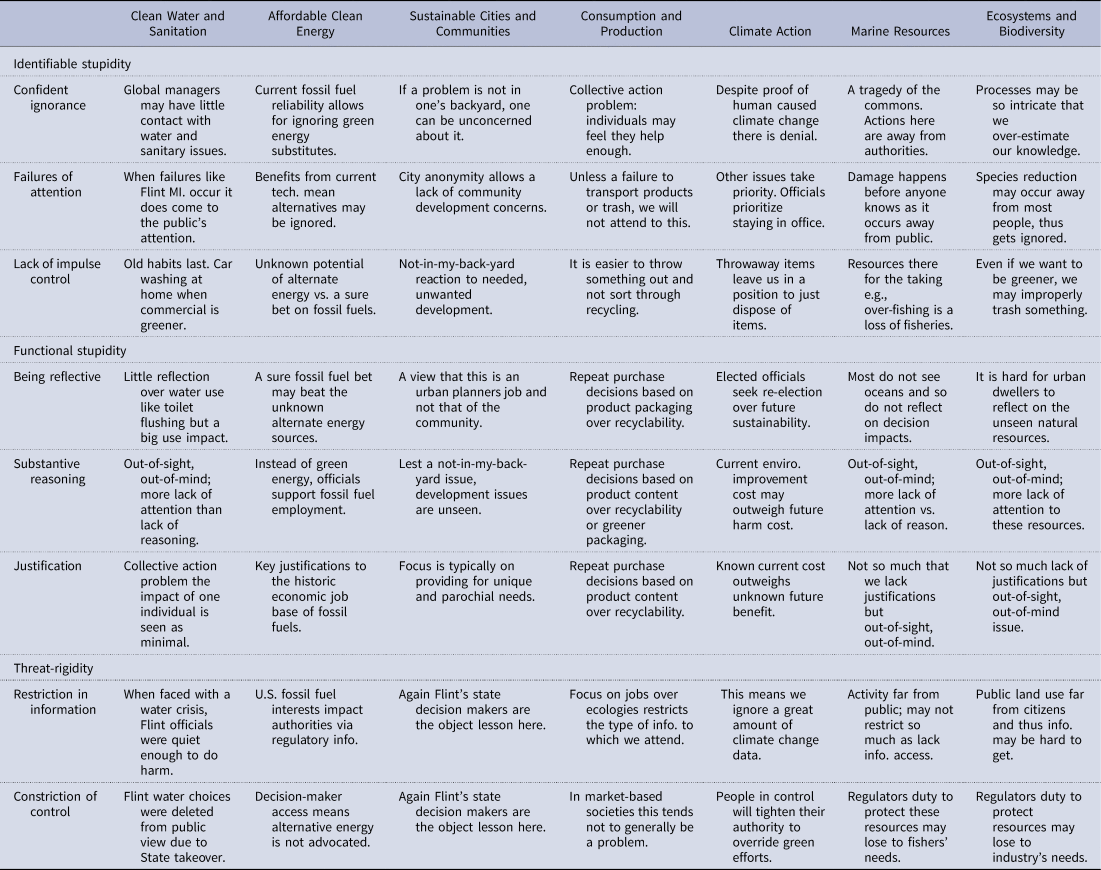
Similarly, the positive interaction between sustainability and development gives us an intelligent outcome. As we noted earlier, failure, through the exercise of stupidity, in either realm creates an ecological, economic, or global collapse. Thus, intelligent interaction occurs when sustainable development meets both economic and environmental goals. One should at least avoid the realm of the truly stupid where economic and other human development pursuits and environmental goals block each other so that we all suffer a loss because we fail to make positive sustainable development decisions. To avoid being blocked by stupidity we analyzed each of the seven climate and environmental livability goals from Table 1 (water/sanitation, energy, communities, consumption/production, climate, marine resources, and ecosystems/biodiversity) for how identifiable stupidity, functional stupidity, and threat-rigidity impact them.
A quick summary of Table 2 tells us several things. For identifiable stupidity, there were three consistent themes for why stupidity may occur: events being out-of-sight out-of-mind (Aczel, Palfi, & Kekecs, Reference Aczel, Palfi and Kekecs2015), not knowing what we do not know (Dunning, Reference Dunning2011; Kruger & Dunning, Reference Kruger and Dunning1999), and the collective action problems (Olson, Reference Olson1965) of one individual feeling an inability to affect change. Confident ignorance also includes straight out denial (Elkington, Reference Elkington1994). Failures of attention may also stem a preference for the status quo (Staw, Sandelands, & Dutton, Reference Staw, Sandelands and Dutton1981). Lack of impulse control may be the result of habit, being unaware of alternatives, ease of use, and just plain judgment errors. Functional stupidity can derive from out-of-sight out-of-mind conditions, a preference for known but sub-optimal choices. Being reflective also may result from actions being of low consequence, deferring to other decision makers (Sheppard & Young, Reference Sheppard and Young2007), derived from habit (Henriques, Reference Henriques2020), and others' political expediency (Mella, Reference Mella2017). Both substantive reasoning and justification are also related to a preference for local benefits but global costs, a failure to internalize externalities (O'Hara, Reference O'Hara2003), and current costs being seen to outweigh future benefits (Farber & Hemmersbaugh, Reference Farber and Hemmersbaugh1993). Justification is also related to collective action difficulties (Olson, Reference Olson1965). Threat-rigidity aids stupidity via lack of public exposure of actions, political influence, decision makers that are far removed from consequences, skewed data, and regulatory capture (Stigler, Reference Stigler1971).
Stupid analysis of UN sustainable development goals for climate and environmental livability

Fixing stupid: How do we get past being stupid
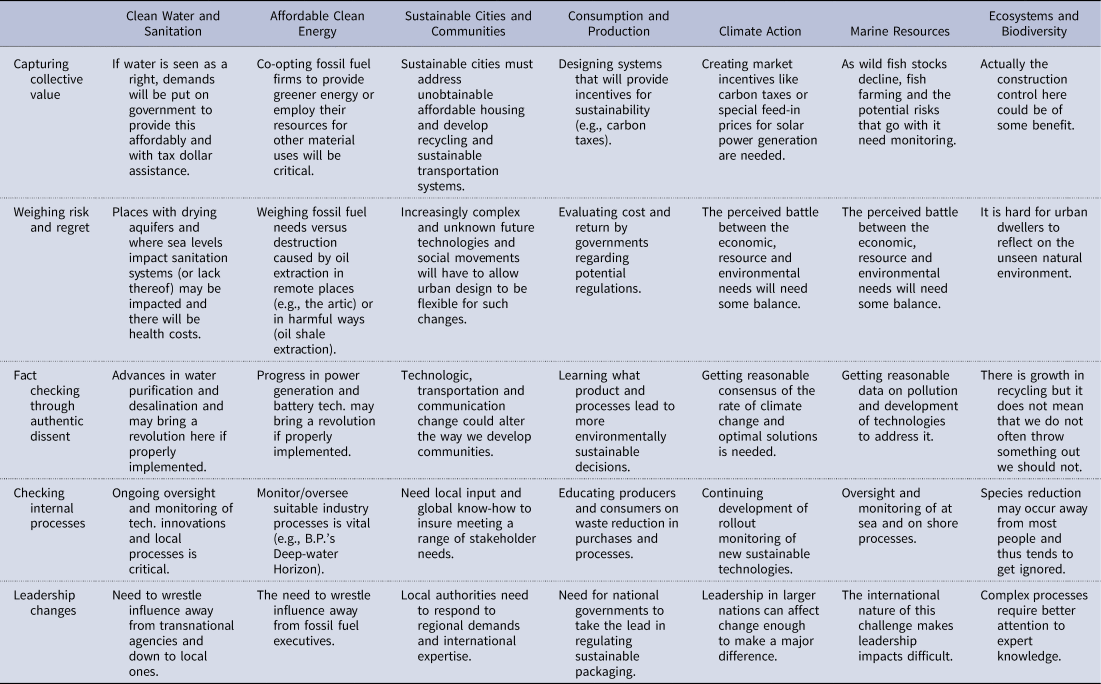
We analyzed each of the seven climate and environmental livability goals for how they could be impacted by the five ‘stupid’ fixes we discussed earlier regarding leadership, processes, fact checking, risk and regret, and collective value. These are reviewed in Table 3. Leadership changes are almost always advisable, as are attention to true dissent voices to break the status quo and introduce new information and methods. Additionally, many of the corrections involved the development and monitoring of products, processes and new technologies to ensure sustainable practices are explored and, if appropriate, implemented.
Stupid fixes for UN sustainable development goals for climate and environmental livability

The list presented in Table 2 is far from complete. However, it does give us some insight into the stupidity that may go into a decision maker's analysis about sustainability. Similarly, Table 3 is short of detail but gives us some corrections that are required on the difficult road we have ahead.
Caveats and Conclusions
We must note one final caveat here. Although stupidity is a cause for why we are not doing more to create a sustainable environment, it is not the only possible reason for why we are not doing more. Issues of organizational and institutional inertia are present (Kelly & Amburgey, Reference Kelly and Amburgey1991), particularly with regard to continued investment in fossil fuel technology. As well, politicians may succumb to some variant of Munchausen at Work (Bennett, Reference Bennett2007) where letting a problems fester so that decision makers can take credit as a problem solver when they implement known solutions. This latter possibility presents us with the very real possibility that our leaders are playing chicken with our collective future.
If the worldwide lockdown due to the novel coronavirus of 2020 pointed out anything obvious about the environment and the impact of human activity, it is that we are capable of reducing our ecological footprint (Gardiner, Reference Gardiner2020). The future will confront us with the question of whether we will return to development with its previously associated ecological derogations or do so more sustainably. There is evidence to suggest that the habits we developed from the novel coronavirus lockdown of 2020 may alter future behaviors (Henriques, Reference Henriques2020), but such prognostications are beyond the scope of this work.
In conclusion, Shiva (Reference Shiva2009) concisely notes, ‘Chasing economic growth while ecosystems collapse is a sign of stupidity, not wisdom’ (p. 18). Although we have mentioned above that there are a range of causes besides stupidity that can block sustainable development, stopping stupid notions concerning sustainability and development would certainly go toward helping to improve the environment. Reducing stupid roadblocks to sustainable development is up to us. As Thompson (as cited in Hansen, Reference Hansen1996) perhaps best summarizes the importance of intelligent environmental efforts. Although ‘society may collapse because of shortsighted stupidity… [from] resource exploiting power elites… the collapse will only be tragic if it is shortsightedness or ignorance on the part of environmentally and ethically concerned people that helps bring it about’ (p. 127).
Acknowledgement
We would like to acknowledge helpful comments of, and encouragement from, Anneke Fitzgerald, Eelko Huizingh and several anonymous reviewers.
Jerry Paul Sheppard is an Associate Professor Strategic Management at Simon Fraser University, Burnaby, BC, Canada. His research focuses primarily on organizational decline, turnaround, survival, and failure. He has published journal articles in the Journal of Management, Long Range Planning, Journal of Business Ethics, and Social Science Research.
Jesse Young is currently completing his degree in Psychology at Simon Fraser University, Burnaby, BC, Canada. This paper was developed from his earlier work at Simon Fraser University and work presented at the Australian and New Zealand Academy of Management Conference in Cairns, Australia, December 3–6, 2019.