INTRODUCTION
Coral reefs are hotspots for marine biodiversity but they are seriously threatened worldwide (Walker & Ormond Reference Walker and Ormond1982; Linden Reference Linden1999; McClanahan Reference McClanahan2002; Hughes et al. Reference Hughes, Baird, Bellwood, Card, Connolly, Folke, Grosberg, Hoegh-Guldberg, Jackson, Kleypas, Lough, Marshall, Nyström, Palumbi, Pandolfi, Rosen and Roughgarden2003; Riegl Reference Riegl2003; Wilkinson Reference Wilkinson, Côté and Reynolds2006). The shores of many coral islets and the coasts close to main reef structures are the most seriously degraded (Jobbins Reference Jobbins, Côté and Reynolds2006). One of the major threats resulting from rapidly growing tourism is its concentration along shorelines and the acceleration of habitat destruction with increasing development (Jobbins Reference Jobbins, Côté and Reynolds2006). Many species of sea snakes are dependent on coral reefs, and all sea kraits (amphibious sea snakes) depend on both marine and terrestrial environments. These snakes forage at sea, but commute to the shore of coral islets to digest and to reproduce (Heatwole Reference Heatwole1999). Retaining essential habitats for these reptiles should offer a straightforward way to conserve these neglected vertebrates. However, there is currently little information about the types of terrestrial or marine habitats that should be protected for these species.
The aim of this study was to provide the first detailed data on the habitat requirements of two species of sea kraits and so provide a robust foundation for the conservation of their habitat. We studied their habitat selection in the Great Lagoon of New Caledonia. This major biodiversity hotspot contains well-preserved reef ecosystems that were recently added to the UNESCO world heritage list (http://whc.unesco.org/fr/list/1115). In New Caledonia, sea kraits play a significant role in the functioning of many coral reefs, as they feed on vast quantities of anguilliform fish (a top-order predator); stomach content analyses revealed that this fish group is far more diverse and abundant than previously known (Ineich et al. Reference Ineich, Bonnet, Brischoux, Kulbicki, Seret and Shine2007; Brischoux & Bonnet Reference Brischoux and Bonnet2008a; Brischoux et al. Reference Brischoux, Bonnet and Pinaud2009a, Reference Brischoux, Bonnet and Shineb). As a consequence, assessing the sea kraits' habitat requirements is not just a question of reptile conservation, but also concerns the functioning of species-rich reef ecosystems (Alcala Reference Alcala2004; Ineich et al. Reference Ineich, Bonnet, Brischoux, Kulbicki, Seret and Shine2007).
The sea krait (laticaudids) group consists of at least eight species living in the Indo-Pacific oceans (Heatwole et al. Reference Heatwole, Busack and Cogger2005). Exploitation of laticaudids for their meat and skin has led to the local extinction of populations (Punay Reference Punay and Dunson1975; Bacolod Reference Bacolod1983, Reference Bacolod1984, Reference Bacolod1990), suggesting that protection measures are required before irreversible damage occurs to populations. Field experiments have shown that sea kraits exhibit strong philopatry for their home islets (Shetty & Shine Reference Shetty and Shine2002a; Brischoux et al. Reference Brischoux, Bonnet and Pinaud2009a), suggesting limited colonization capacity of new areas if their usual habitats are destroyed. Sea kraits forage at sea, mainly for anguilliform fish (Reed et al. Reference Reed, Shine, Shetty and Cogger2002; Brischoux & Bonnet Reference Brischoux and Bonnet2008a). After a foraging trip, they return to their home islet to digest their prey, slough their skin or reproduce. Typically, the snakes haul up onto the shore and seek a shelter where they remain for a week on average (Shetty & Shine Reference Shetty and Shine2002b; Brischoux et al. Reference Brischoux, Bonnet and Shine2007b; Ineich et al. Reference Ineich, Bonnet, Brischoux, Kulbicki, Seret and Shine2007). Selecting a suitable shelter is crucial to provide protection against predation, but it must be thermally buffered to enable bodily processes such as digestion and sloughing, as well as humid enough to limit water loss (Bonnet & Brischoux Reference Bonnet and Brischoux2008). Thus the shore of the islets and their immediate adjoining habitats are of prime importance to sea kraits. Two species co-occur in the Neo-Caledonian Lagoon, namely the endemic Laticauda saintgironsi (Cogger & Heatwole Reference Cogger and Heatwole2006) and the more widespread L. laticaudata (Heatwole Reference Heatwole1999). Their diet and the foraging ecology have been studied (Brischoux et al. Reference Brischoux, Bonnet and De Crignis2007a, Reference Brischoux, Bonnet and Shineb, Reference Brischoux, Bonnet and Shine2009b Reference Brischoux, Bonnet and Legagneuxc; Brischoux & Bonnet Reference Brischoux and Bonnet2008a, Reference Brischoux and Bonnetb), but little information is available on their terrestrial habitat requirements.
From the description of the terrestrial habitats used by each species of sea krait, we aimed to infer the probable distribution of populations on different islets in the south lagoon of New Caledonia. Fine-scale habitat preferences were evaluated for one island (Signal) and this information was then used to extrapolate to the other islands to estimate the abundance of different habitat types on those islands. Such analyses form the basis of our investigations into the extent that anthropogenic modification of islets is impacting on sea kraits (for example alteration of coastline to accommodate tourism; a process occurring in areas nominally reserved for nature conservation). Further, we propose practical and cost-effective conservation actions to preserve the diverse assemblage of species that rely on specific and complex shore habitats adjacent to coral reefs. Our main objective was to provide robust data on the ecological requirements of sea kraits that could be used to assist the conservation of their preferred coral islets.
METHODS
Study areas
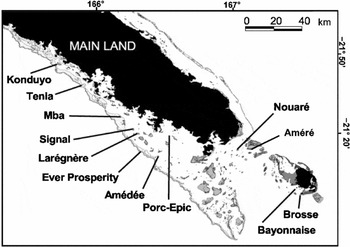
A total of 11 islets situated in the south-west lagoon of New Caledonia were sampled in this ongoing study, as well as the wreck of the ship Ever-Prosperity, which lies on the barrier reef (Fig. 1). Each islet exhibits a particular set of physical characteristics. For this study, we focused on terrestrial habitats, especially the structure of the shore exploited by sea kraits. Some islets are surrounded almost exclusively by sandy beaches, whilst on others, rocks and cliffs form the shore.
Location of study area (south-west lagoon, New Caledonia). Black areas indicate emergent land (mainland and islands); grey areas represent coral reef flats. The barrier reef and other fringing reefs are represented by the light grey areas. Two sites were not included in the statistical analysis: the wreck of Ever Prosperity, a ship that stands on the barrier reef, and Konduyo islet, which does not shelter any sea snake population.

The coastlines of the study islets were broadly classified into four main habitat types:
(1) Sandy beaches consisting of flat sandy beaches or sand dunes. As sea kraits are not fossorial species, beaches do not provide any shelter and the snakes have to cross them to reach the vegetation and/or shelter sites.
(2) Beach rock ‘slabs’ formed by sedimentary sandstone or flat fossil coral outcrops, typically forming the islet basement. These slabs are exposed by tidal movements and erosion tends to excavate open cup-shaped cavities that are rarely suitable as refuges for kraits. However, there are natural crevices between slabs where the snakes can shelter.
(3) Rock cliffs or rock overhangs 1.5–4 m high (‘cliffs’) derived from strata formed during geological periods with higher sea levels. Cliffs and overhangs provide few shelters (crevices or cavities). Constant tidal erosion results in the creation of cavities, leading to cliff collapses and the generation of mobile beach rocks (see below). Cliffs complicate the movement of the snakes between terrestrial refuges and the sea (Bonnet et al. Reference Bonnet, Ineich and Shine2005).
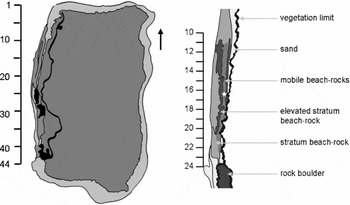
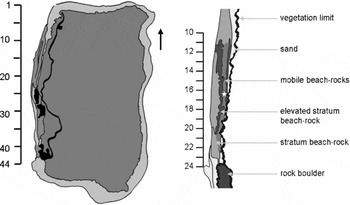
(4) Mobile beach rocks (‘beach rocks’) that are no longer connected to the original substrate and are the products of long-term erosion of slabs. Cavities underneath these beach rocks provide abundant refuges but they are spatially limited to a narrow fringe (1–10 m) of the islets corresponding to intertidal zones (see Fig. 2).
Distribution of habitats on Signal Island (a) full islet, and (b) part of the west shore. Light grey areas represent sandy beaches, dark grey areas represent vegetation. On the west shore, dark grey areas represent beach rocks (stratum slabs and mobile beach rocks). Rock boulders are shown as black patches. The black line (left) indicates the west part of a tourist pathway. The scale shows the 10 m long sampling segments.
Habitat assessment
We estimated the linear proportion of each islet's shoreline that consisted of sandy beaches versus other types of potential habitats as follows. The occurrence (length) of each landform was measured in the field and by using Google Earth free software (http://earth.google.com/) to calculate distances. The image definition of our study sites was such that measuring the length of sandy areas was easily conducted. However, it was more difficult to discriminate between the other habitat structures (slabs, cliffs or beach rocks), so we also relied on ground truthing of the study areas. Using repeated measures of the same structures (for example the length of a sandy beach), we calculated a mean measurement error of 5.6 m (7%).
Techniques for sea krait capture and processing
Since 2002, we have conducted a long-term mark-recapture study in New Caledonia. A total of 4920 snakes (approximately half L. saintgironsi and half L. laticaudata) have been captured and individually marked; as well as many recaptures (n = 4233). Following processing, kraits were released between one and 24 hours after capture. For each individual, the species, the sex and an age class were recorded. We measured snout-vent length (SVL ± 1 cm), by gently stretching the snake along a flexible ruler.
Detailed studies on Signal Island
Signal Island (22° 17′ 45″ S; 166° 17′ 34″ E) is a rectangular islet declared as a natural reserve that was intensively monitored. Sandy beaches border the south, east and north shores (Fig. 2). The west shore is far more complex and consists of an alternation of slabs and sand covered by beach rocks. The west shore was divided into 44 segments, each 10 m long.
Population estimates have been performed and published (see Brischoux & Bonnet Reference Brischoux and Bonnet2008a for details) for each species of sea krait on Signal Island using CAPTURE program software under the M(th) model (both individual and time heterogeneities are taken into account; Otis et al. Reference Otis, Burnham and Anderson1978). During a long field session of 58 consecutive days, the basic assumptions required to perform robust snake population size estimates were met (Otis et al. Reference Otis, Burnham and Anderson1978; Bonnet & Naulleau Reference Bonnet and Naulleau1996; Bonnet et al. Reference Bonnet, Lourdais, Shine and Naulleau2002). We used a closed model because data were collected over a relatively short time period (thus mortality and emigration/immigration were negligible) and because sea kraits are extremely philopatric. Signal Island was used by an average of 4000 individual snakes (1700 ± 96 L. laticaudata and 2387 ± 264 L. saintgironsi; Brischoux & Bonnet Reference Brischoux and Bonnet2008a).
Environmental thermal conditions
We measured the thermal parameters of the various potential microhabitats for sea kraits to determine their preferences. We used rubber tubes filled with seawater to mimic the sea krait's thermal inertia. Temperature loggers (ACR SmartButton Data Loggers: ± 0.5 °C: sampling rate: 5 min) were placed inside each model. We recorded thermal profiles during three consecutive days (typical summer days); in the open (models positioned in full sun); under a beach rock located in the intertidal area; under a beach rock placed over dry substrate (beyond the high tide limit); inside a seabird burrow (2 m deep); under a big rock boulder (beyond the high tide limit); and under water (covered by 10 cm of water at low tide). Snake models recording thermal conditions under beach rocks were positioned under the largest beach rocks we could lift.
Presence of sea kraits under beach rocks
At Signal Island, we sampled seven transects (four in November–December 2005 and three in December 2006) during which we randomly lifted 695 beach rocks. Each beach rock was examined only once, and the total number of beach rocks present at the site amounted to several thousand. Therefore, our sampling was not exhaustive. We were also limited by our ability to move large beach rocks. Each beach rock lifted was measured along its three main dimensions (height, length and width to the nearest 5 cm). Precision was variable because the size and the shape of beach rocks. Error was estimated at around 15% for the linear measurements. Analyses using the main length (L) resulted in similar results to those using various combinations (height × length × width for instance), thus only main length is reported. Contemporaneously, temperatures of the upper and lower surfaces of the beach rocks were recorded when rocks were lifted using a calibrated laser thermometer (Raytek MX2, Fotronic Corporation, USA). Temperatures for three different points on each surface were obtained and a mean value was calculated. This procedure was not performed on submerged rocks.
We attempted to capture all snakes present under each beach rock and determined the species, sex and age class (Brischoux & Bonnet Reference Brischoux and Bonnet2008b). The beach rocks were then carefully repositioned. In total, we lifted beach rocks in 32 of the 44 shore segments because some lacked beach rocks or only had large boulders that could not be lifted. Since all the captured snakes were individually marked, each snake only appeared once in the dataset, so removing statistical complications posed by pseudo-replicates.
RESULTS
We inferred the respective distributions of the two species of sea kraits at a large geographic scale (between islands) from the detailed behavioural study performed on Signal Island. Consequently, the analyses first focused on Signal Island where precise data on the influence of different microhabitats on the location and movements of the snakes were collected.
Distribution of snakes on Signal Island
On Signal Island, L. saintgironsi were found around the whole coastline and were regularly spotted in the island's interior, typically along tourist pathways (n = 122 L. saintgironsi; Fig. 2). In contrast, L. laticaudata were only found on the west coast where beach rock occurred. Only four individuals were observed greater than 10 m from the shore, on a tourist pathway. Such apparent segregation led to significant differences in the proportion of snakes of each species observed on the west versus the three other sides of the islet: 46% of the snakes observed on the west shore were L. saintgironsi versus 100% on the three other shores pooled (χ2 = 82.48, n = 5447, p < 0.001). Since the west side of Signal Island appears the only one to offer suitable habitat for both species of sea kraits, we concentrated more sampling effort in this area. We believe that any sampling bias due the higher catchability of snakes on the western side of the island did not impede our ability to examine which habitats were the most suitable for the snakes. The maximum number of snakes observed over a single survey (< 1 hour) was 119 individuals on the west coast versus nine individuals on the three other shores combined.
Spatial distribution of kraits on the west shore of Signal Island
Based on the analysis of capture rates in each 10 m segment along the shore, we found that the species displayed different distributions at a small spatial scale (χ2 = 286.33, n = 796, p < 0.001). Both species were mostly observed in rocky areas, but, in terms of proportions, L. saintgironsi was captured more often on sandy segments than L. laticaudata (16% versus 11%). Such fine-scale heterogeneous distributions suggest a strong association between the structure of microhabitats (for example the presence of beach rocks) and the occurrence of the sea kraits. These results encouraged us to more closely examine the beach rocks that were preferred by the snakes.
Influence of the distribution and dimension of the beach rocks on snakes
The following analyses focused on the snakes found sheltered under the beach rocks lifted during seven surveys. Of 695 beach rocks lifted, 116 were sheltering 207 snakes. Twenty-eight snakes escaped quickly and were not identified; the remainder were captured and examined. One species, L. laticaudata was overrepresented in captures (n = 165 L. laticaudata versus n = 14 L. saintgironsi) using the expected proportions of snakes based on population size estimates (χ2 = 146.84, p < 0.01). The proportions of females and juvenile L. laticaudata were greater than expected for the snakes found sheltering versus those visible in the open (effect of sex: 33% of snakes under rocks were females [n = 187] versus 19% of snakes in the open [n = 4221]; χ2 = 23.05, p < 0.01; effect of age: 38% of snakes found under rocks were immature [n = 186] versus 14% of the snakes that were visible in the open [n = 4207], χ2 = 84.45, p < 0.01).
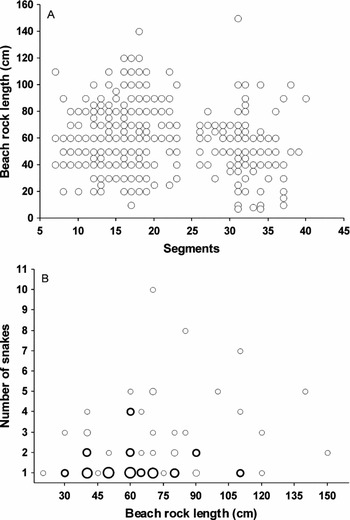
Some 10 m shore segments were less intensively used, despite the fact that they contained beach rocks. The dimensions of lifted beach rocks were relatively homogeneous along the shore (i.e. there was no correlation between the sampled 10 m segments and the size of the beach rocks; Spearman rank correlation rs = −0.03, p > 0.05, n = 695; Fig. 3a), however we observed snakes only under beach rocks larger than 20 cm in length. If beach rocks smaller than 20 cm are excluded, there was a positive relationship between beach rock size and the probability of finding a snake (logistic regression with the presence/absence of snakes as the dependent variable and the dimension of the beach rock as the predictive variable: χ2 = 14.08, p < 0.01). There was also a positive relationship between beach rock size and the number of sheltered snakes (Spearman rank correlation rs = 0.12, p < 0.05, n = 686), however data were scattered and the largest beach rocks did not shelter the highest number of snakes (Fig. 3b).
(a) Size distribution of beach rocks lifted in each of the shore segments (n = 695 beach rocks). Segment 25 contained a rock boulder (very large rock that could not be lifted). (b) Relationship between the size of beach rocks that sheltered snakes and the number of snakes observed under each rock. Because data overlapped (for example many rocks measured 60 cm), the relative size of the circles is an indication of the number of beach rocks (1–23, n = 116).

The location of snakes did not simply conform to the availability of the beach rocks; rather the sea kraits selected particular rocks within relatively few of the sampled 10 m segments (i.e. Fig. 2, segment number 16, 18, 19, 31 and 32). If distribution had been uniform, on average we could have expected to observe one snake for every six beach rocks lifted. The expected distribution differed from the observed distribution (χ2 = 176.47, p < 0.01); snakes showed preferences for sheltering under several particular beach rocks.
To further test this hypothesis, we generated 200 distributions of 207 snakes randomly allocated among the 686 beach rocks larger than 20 cm assuming a uniform distribution. On average, the resulting expected numbers of snakes under a given beach rock (0 < n < 3) differed from the observed distribution (0 < n < 10; χ2 = 96.30, p < 0.01). In the field, a greater than expected proportion of beach rocks harboured no snakes, a lower than expected number of rocks had a single snake and thus a greater than expected number sheltered several snakes (up to 10 snakes). This suggests that size was not the only characteristic determining sea krait preferences. Given the known importance of thermal characteristics of microhabitats for reptiles, we examined the thermal characteristics of the beach rocks.
Thermal characteristics of beach rocks
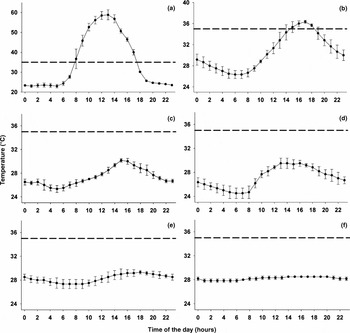
We compared the thermal profiles of snake models positioned in the open versus those placed in different potential shelters or in seawater. Snakes could not remain for long in the open (as a lethal body temperature was soon reached; < 40 °C in snakes) during the day and the model cooled rapidly at night (Fig. 4). Puffin burrows and very large boulders provided buffered thermal conditions. Large beach rocks just above the high tide limit remained dry and exhibited high daily temperatures (close to lethal temperatures); so smaller beach rocks would have certainly exceeded the lethal threshold. By contrast, beach rocks in the intertidal zone remained thermally buffered owing to periodic tidal inundation (at high tide) and the evaporation of the water (at low tide) from their very porous matrix. These rocks tended to mirror the thermal profiles of the seawater. The mean temperature of the lower surface of lifted beach rocks that sheltered snakes was warmer (28.3 ± 3.5 °C) than the beach rocks without snakes (26.2 ± 3.8 °C; ANOVA F1, 446 = 25.2, p < 0.001). Conversely, the maximum temperature recorded was lower (37.4 °C versus 39.5 °C). Thus preferred rocks were buffered against high temperatures, but remained warm and humid. Many were fully submerged at high tide.
Thermal conditions recorded in the main types of microhabitats available on the west shore of Signal Island. Values were pooled from three typical summer days; for simplicity only one temperature value was retained per day (mean ± SD). Temperatures recorded (a) in the open (note temperature scale difference), (b) under a beach rock above the high tide limit (segment 30), (c) in seawater, (d) under a beach rock in the intertidal zone (segment 18), (e) under a big rock boulder (segment 30) and (f) inside a seabird burrow (2 m deep). The dashed line indicates the snakes' overheating limit; snakes cannot safely stay above this temperature for periods >1 hour.

Broad distribution of snake species between the studied islands
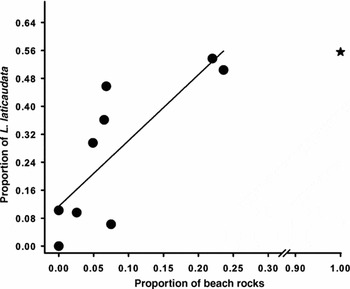
We found L. saintgironsi was able to exploit various types of shore landforms, including sandy beaches, whereas L. laticaudata was dependent on the presence of beach rocks. The relative proportion of the shore containing beach rocks was related to the proportion of captures of L. laticaudata (rs = 0.79, p < 0.05, n = 10 including Porc-Epic islet and rs = 0.69, p < 0.05, n = 9 excluding Porc-Epic islet; see Fig. 5).
Proportion of L. laticaudata out of total kraits captured versus the proportion of the shore composed of mobile beach rocks. Each dot provides data for one of the 10 islets sampled (see Fig. 1). Note that the star indicates an outlier (Porc-Epic islet), an islet with a shore composed entirely of mobile beach rocks, whereas all the other study sites had less than 25% mobile beach rocks.

DISCUSSION
For sea kraits, beach rock areas of coral islets are both essential and spatially limited, and therefore require strong protection if sea kraits are to be conserved. Unlike mangroves, rocky shores are seldom considered as a major habitat functionally linked to adjacent reef ecosystems (Côté & Reynolds Reference Côté and Reynolds2006). The effectiveness of protected natural areas that conserve reef biota requires the careful management of rocky areas to avoid the loss of sea krait populations and probably other species.
Our analyses clearly indicate that the structure of terrestrial coastline micro-habitats, especially refugia, plays a key role in the distribution of different species of sea kraits. The need for shelter conforms to our understanding of the ecology of reptiles and, more generally, that of most animal species, and the need to protect refuges for conservation is obvious (Webb & Shine Reference Webb and Shine2000; Berryman & Hawkins Reference Berryman and Hawkins2006; Shine & Bonnet Reference Shine, Bonnet, Mullin and Seigel2009). How then can the results of this study translate into conservation management? Without detailed behavioural observations, the notion of ‘shelter’ may remain imprecise. For instance, bird burrows provided the most buffered thermal conditions and both sea krait species only use them occasionally (X. B. Ineich & I. Ineich, unpublished data 2003). However, conservation plans based on preserving bird burrows alone would only benefit L. saintgironsi, because L. laticaudata primarily depends on particular beach rocks in the intertidal zone. In the absence of micro-habitat information, such as we have presented, we would have little insight to plan the conservation of the most sensitive and important zones of the shore. The fine-scale data gathered on Signal Island also enables a better understanding of the distribution of the sea kraits at a large geographic scale, indicating that ecophysiological characteristics linked to environmental constraints determine the respective shelter requirements of each species.
Laticauda saintgironsi was able to exploit a vast array of terrestrial refuges, including puffin burrows, cavities among tree roots, large logs, debris, buildings and a range of types of beach rocks. This species exhibits well developed abilities to move on land and to climb steep cliffs (Bonnet et al. Reference Bonnet, Ineich and Shine2005). In contrast, L. laticaudata is a poor climber that crawls slowly on land (Bonnet et al. Reference Bonnet, Ineich and Shine2005); it is almost invariably observed close to the sea and in close proximity to beach rocks that are at least partially submerged at high tide. The strong selection for terrestrial microhabitats exhibited by L. laticaudata is in accordance with available physiological data. The marked skin permeability of L. laticaudata compared to L. saintgironsi for improved underwater respiration, increases dehydration risk (Lillywhite Reference Lillywhite2006). The desiccating influence of strong south-east trade winds is an additional factor that may explain why L. laticaudata was only observed on the protected west coast of Signal Island. Thermal-moisture balance is likely to be very important as sea kraits typically remain on land for long time periods (one week on average), and the opportunities to drink fresh water are limited (Bonnet & Brischoux Reference Bonnet and Brischoux2008). The physiological characteristics of L. laticaudata may well constrain this snake to shelter in near-ocean thermally buffered and wet refuges. Intertidal beach rocks offer both, with sea water providing relatively stable temperatures and humidity. These results are reinforced by the observed strong philopatry exhibited by the sea kraits for very narrow areas (maximum 50 m wide) of the west shore of Signal Island (Brischoux et al. Reference Brischoux, Bonnet and Pinaud2009a). Snakes use regular pathways over years when returning from foraging trips and rapidly locate their terrestrial refuges. As might be expected, L. laticaudata exhibits a greater degree of philopatry than L. saintgironsi (Brischoux et al. Reference Brischoux, Bonnet and Pinaud2009a).
The occurrence of beach rocks was a common characteristic in respect to the terrestrial requirements of the two snake species. When resting on land, L. saintgironsi prefers to use the refuges distributed up to 20 m from the low tide level. There is no fresh water on these islets and, during rain, large numbers of L. saintgironsi were observed to emerge from beach rocks to drink, revealing the massive reliance on these areas as terrestrial refuges (Bonnet & Brischoux Reference Bonnet and Brischoux2008). We also suspect that shorelines covered with large boulders are used as laying sites. We base this conclusion on the observation that many pregnant females and almost all neonates were captured in these areas. Overall, fields of beach rocks extending from the intertidal zone to 10–20 m level above low tide mark are most likely to provide critical refuges for both species. Unfortunately, such favourable habitats are extremely limited; not only is there no equivalent area to the west shore of Signal Island among all the islets we sampled, but only a subset of the 10 m segments examined on Signal Island offered suitable refuges for L. laticaudata.
Proposals for sea krait conservation plan
Beach rocks are a key terrestrial habitat for both species of sea kraits. Unfortunately, intertidal rocks are rarely appreciated as important components of coastal environments. On many tropical islands tourism is central to local economies, and sandy beaches are far more attractive to tourists than rocky areas. In New Caledonia, beaches on Maitre Island, a natural reserve, were drastically altered during the construction of a tourist resort in 2003. Prior to this time it had a similar coastline to Signal Island, but no longer provides any shelter for sea kraits (Brischoux & Bonnet Reference Brischoux and Bonnet2008b). The perception of a pristine sandy tropical beach is all-pervasive in the tropical tourist industry. Areas of beach rock and artificial concrete rocks associated with wharves and seawalls are viewed as eyesores. However, on several islets (such as Amédée Island [22° 28′ 37″S–166° 28′ 05″E], a popular snorkelling and sunbathing location), L. laticaudata is concentrated in localized and small artificial areas such as concrete blocks that stabilize the posts of wharves or in seawalls, which offer valuable shelter on otherwise sandy islets. Cosmetic ‘improvements’ to such artificial habitats to restore a more ‘natural’ image would result in the disappearance of L. laticaudata. Therefore, it is important to not only protect natural fields of beach rocks, but also to retain artificial concrete structures that now partially compensate for the removal of beach rocks in other areas. On the islets of New Caledonia, the shore areas favourable for the two species of sea kraits (and critical for L. laticaudata) are not abundant (Signal Island being the best islet with large and complex beach rock fields). The rarity of favourable terrestrial habitats renders sea kraits extremely vulnerable to perturbation, with no alternative refuges being available. However, on a positive note, conservation planning can be effectively oriented towards a few well-identified habitats with major positive conservation outcomes. When on land, sea kraits tend to move at dusk and during the first few hours of the night. At other times, they tend to remain sheltered in their terrestrial refuges (or are at sea). Limiting the numbers of tourists on particular beaches to diurnal times, as practised on Amédée Island (thanks to regulations imposed by the operation of a major lighthouse), is compatible with snake movements.
Not only it is essential to conserve beach rocks, but the enhancement of available habitats is also conceivable (Shine et al. Reference Shine, Webb, Fitzgerald and Sumner1998; Goldingay & Newell Reference Goldingay and Newell2000; Webb & Shine Reference Webb and Shine2000). Adding artificial beach rocks would be the most obvious option. Concrete slabs could offer valuable protection by preventing the collapse of burrows under the feet of wandering tourists. Puffins dig their nest burrows under large flat slabs, resistant to human disturbance and so provide refuges for kraits. We propose several simple and relatively inexpensive actions that can be applied across the range of the sea kraits.
(1) The protection of the beach rock fields (either natural or artificial) where populations of sea kraits occur. Many islets considered important for seabirds, seals or marine turtles (for example for breeding or resting sites) have benefited from protected status. Our results provide robust data to adopt a similar approach for particular parts of islets, like the western shore of Signal Island, which are intensively used by sea kraits. Anthropogenic modification of the west coast of Signal Island could cause a dramatic reduction in sea krait populations (we estimate a c.90% reduction for L. laticaudata) in the area between Mba and Porc Epic Island (Fig. 1); disturbance of only 400 m of habitat could result in catastrophic consequences. Such destruction has already removed sea kraits from Maitre Island, and a proposal to build tourist facilities on the west shore of Signal Island threatens its sea krait populations. We agree with the recommendation of Wilkinson (Reference Wilkinson, Côté and Reynolds2006) that extensions of existing marine protected areas (MPAs) and the declaration of new ones are needed in New Caledonia; any such protections should include the rocky shores of islets. The west coast of Signal Island should be an immediate priority, as its current protection status is insufficient to save the possible destruction of sea krait habitat. The recent addition of New Caledonian reefs to the list of natural world heritage sites provides a favourable environment to pursue such an initiative.
(2) A prohibition on lifting beach rocks, for example for sea snail harvesting, is required because the hunters do not move rocks carefully and do not replace them (Goldingay & Newell Reference Goldingay and Newell2000).
(3) Restriction of tourism operations in areas used by sea kraits at dusk (for example as operated on Amédée Island) is desirable.
(4) The value of artificially created beach rocks for sea kraits needs to be more fully understood by undertaking trials with concrete slabs or rocks (Goldingay & Newell Reference Goldingay and Newell2000; Webb & Shine Reference Webb and Shine2000). If successful, this might be a means of attracting threatened populations of sea kraits into natural reserves where they could be more easily monitored, or restoring populations impacted by hunting (Punay Reference Punay and Dunson1975; Bacolod Reference Bacolod1984, Reference Bacolod1990).
(5) Field-based educational programmes are required to explain to people the need to conserve both habitats and species. Such programmes have proven effective elsewhere (Alcala et al. Reference Alcala, Russ, Nillos, Côté and Reynolds2006; Browning et al. Reference Browning, Finlay, Fox, Côté and Reynolds2006) and, in New Caledonia, sea kraits attract considerable attention from the general public.
Sea kraits play a major role in the functioning of the reef ecosystems in New Caledonia, because they exert a strong influence on large communities of more than 50 species of predatory fish (Brischoux et al. Reference Brischoux, Bonnet and Shine2007b, Reference Brischoux, Bonnet and Legagneux2009c; Ineich et al. Reference Ineich, Bonnet, Brischoux, Kulbicki, Seret and Shine2007; Brischoux & Bonnet Reference Brischoux and Bonnet2008a). Our results are directly relevant to the protection of two marine reptiles, as well as large numbers of fish from a diverse range of species. Beside sea kraits and their prey, the protection of the beach rocks situated in the intertidal zone is likely to be beneficial for a vast assemblage of other organisms. For instance, many algae, arthropods (such as crabs), molluscs (for example chitons or sea-snails), echinoderms (such as sea cucumbers or ophiurids), fish (for example moray eels and gobies) and birds (for example bridled terns nest on large beach rocks) occur specifically in this narrow fringe of the shore. Beach rocks also protect the shore from erosion and so enable the persistence of fringing vegetation on the islets. New Caledonia is considered a biodiversity hotspot that deserves important attention (Myers et al. Reference Myers, Mittermeier, Mittermeier, da Fonseca and Kents2000). In New Caledonia, few islets are protected for nature conservation; there are just 10 special marine reserves. Of these, only five shelter sea krait populations, and only one is effectively protected by an integral reserve status (i.e. tourism and fishing are prohibited). Unfortunately, the most sensitive species, L. laticaudata, occurs in low numbers on this islet. Other islets are potentially vulnerable to anthropogenic disturbance likely to be disastrous for sea krait habitats, as already observed on three islets despite their status as marine reserves. Signal Island has a key role for sea kraits, especially L. laticaudata, but it is used as a recreational place without any conservation measures to protect the kraits (people, dogs and campfires are all permitted). Our data will enable local authorities (Province Sud) to justify the urgent conservation of the rocky shores of islets against the march of tourist infrastructure development.
ACKNOWLEDGEMENTS
R. Cambag and M. Guillon helped to lift beach rocks. I. Ineich, S. Lorioux, M. De Crignis, O. Wang-Mayol, O. Lourdais, A. Ramirez, C. Michel, D. Serin, M. Bonnet and A. Lavandier helped with fieldwork. We thank F. Devinck, C. Chevillon and P. Plichon (DENV Province Sud, Nouméa), E. Potut for logistics, and D. Ponton (IRD). The study was carried out under permits 6024-179/DRN/ENV and 6024-3601/DRN/ENV.