Californians during the gubernatorial recall election of 2003 were constantly reminded how bizarre their politics had become. Discouraging that impression was difficult, with 135 replacement candidates on the ballot to replace Governor Gray Davis, including the lieutenant governor from Davis' party, a porn king, a stripper, a former child actor, and a professional body builder turned Hollywood action hero. Among political scientists attempting to make sense of the process the question was, how might we understand the recall as an institution or process, and to what might we compare it in order to make sense of what was going on? Was it a referendum on Gray Davis, animated by popular discontent about the energy crisis, the state's gargantuan budget deficit, and Davis' own disconnect from the voters? Was it a “Republican power grab” foisted on the people of California by a small band of wealthy malcontents and professional signature gatherers manipulating a directdemocracy provision in California's constitution intent on exploiting a political opportunity? Or, as some contended, was it an exercise in direct democracy unfettered by politics as usual? We suggest that, after a fair amount of brushclearing that had to occur before the election could settle down to focus on Davis versus a major alternative candidate, the California recall looked like a general election of a sitting governor whose record was problematic.
The Essential Recall
The recall election involved two separate questions on the same ballot. Voters could vote on the first question only, the second question only, or on both. The first question was whether Davis should be recalled. To remain in office, Governor Davis needed a majority of those voting on the recall to vote “no,” in which case the votes cast on the second question—which candidate would succeed him—would be irrelevant. Voters, of course, did not know the outcome of the first question when they voted on the second, so on the same ballot all 135 candidates who met the filing requirements and deadline were randomly listed. California law did not permit Governor Davis to run as a replacement candidate. Voters could vote for one replacement candidate, whether they voted for or against the recall, and the plurality winner of the second question would be the next governor, no matter how small the plurality, if a majority supported the recall.
Watching the recall unfold, it looked like an amalgam combining one part general election referendum on a sitting governor, one part primary election, and one part direct-democracy initiative. It looked like a direct-democracy initiative in that it started as a petition drive and reflected the populist spirit of the Progressive reforms that swept California and other western states in the early 20th century. It was different from an initiative in that it involved candidates, rather than an issue question.
The recall reminded us of a direct primary because it involved many candidates jockeying for position and attention. Well-known potential candidates moved to run, then withdrew without filing; candidates on the ballot dropped out when they realized their chances were slim; debates were held that most but not all prominent candidates attended. Of course, it was unlike a primary in that it was not the first stage of a two-staged process, no party nomination was at stake, and no definitive resolution of the “nomination” stage of the process could be had before the final contest began.
The recall was like a referendum on Governor Davis because his low ratings in the polls motivated the recall in the first place, and his record as governor ended up at the forefront of debate. It was unlike a referendum on Davis, at least in the early weeks of the campaign, because it was not clear who the major alternative candidates would be or whether the issue motivating the election would in fact be Davis' record as governor.1
In the early going, Davis sought to define the election as a “Republican power grab” that was costing the taxpayers millions in precious state dollars, and distracting the government from the serious business at hand.
The debates were among the replacement candidates, and for the most part excluded Davis from directly participating.
2 In the first televised debate, Davis was invited to respond to reporters' questions for the first half hour, without the replacement candidates on stage with him. When that phase was complete, Davis left and the invited replacement candidates came on for a traditional debate format.
Despite these differences from a general election in which a sitting governor is on the hot seat, as the campaign progressed attention increasingly focused on Davis, especially as several prominent Republican candidates dropped out to make way for Arnold Schwarzenegger who, it was increasingly obvious, was the presumptive “nominee” of the Republican Party.
Arnold Schwarzenegger led the field of challengers by stressing that he was not a “politician” and that he would “fix the mess in Sacramento.” The recall election tapped a discontent with “politics as usual” reminiscent of Ross Perot's 1992 independent bid for the presidency.
Analyzing the Vote
To provide a rough snapshot of the California recall vote, we assembled demographic and political data on the state's 58 counties.
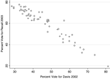
3 Figure 1 shows a strong relationship between counties' vote for Davis in his 2002 general election contest against Republican nominee Bill Simon and their vote for the recall less than a year later in 2003. The OLS regression equation summarizing the linear relationship in
Figure 1 is:
The b coefficient indicates that for a 1% difference in counties' vote for Davis, the vote for the recall declined by just over 1%. The fit and significance of the effect (t=−24.950) suggest that the recall indeed ended up largely as a referendum on Governor Davis. The difference between 2002 and 2003 is that Davis lost considerable ground. A county that gave Davis 50% of its vote in the 2002 election would be expected to give him only 44% of its vote against the recall. Had he not lost that 6% of the vote between 2002 and the recall, he might have managed to hold onto the governorship, as the recall passed by a statewide majority of just under 55%.
Of course, it is an open question whether Davis lost ground because his performance between 2002 and 2003 declined in the public's eye, or because in the 2003 recall he faced a stronger Republican “nominee” in Arnold Schwarzenegger than he had in 2002 against Bill Simon.4
During the 2002 Republican primary, the Davis campaign famously intervened by spending $10 million to defeat the moderate former mayor of Los Angeles, Richard Riordan.
Davis' decline in the polls to an approval rating of only about 25% of Californians before the recall suggested there was more to his defeat than the obvious strengths of Arnold Schwarzenegger as a challenger, compared with his conservative predecessor in the 2002 campaign.
To assess the basis of the recall vote, we performed a multiple regression of the percent voting for the recall. We included indicators of three politically important demographic groups (Latinos, Native Americans, and African Americans), percent unemployed in 2000 as a measure of local economic discontent, percent vote for Davis in 2002 as an indicator of local economic stress, percent registered Republican to capture core Republican affiliation, and percent voting for Perot in 1992.
The largest effect on the recall vote by far remains the percent voting for Davis in 2002. These results support the conclusion that the election was a referendum on the governor. We lack a measure of economic distress since the 2002 election, but on the assumption that counties that were hurting in 2000 continued to suffer economically, there is some evidence of an additional effect of economic hard times in counties, over and above the Davis vote in the previous election. Apart from the partisan division of the 2002 gubernatorial vote, there is no independent effect of long-term commitment to the Republican Party.5
The partisan basis of the recall and the 2002 election is evident in the correlation between percent Republican registration and the recall (r=.82), and between percent Republican and the vote for Davis in 2002 (r=−.88).
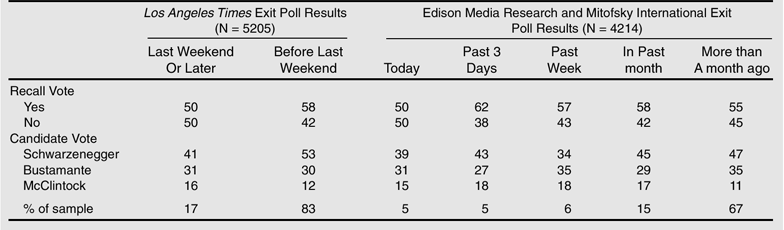
The absence of an effect of Republican registration may undermine the claim that this election was merely an artificial partisan exercise. It is perhaps surprising that the percent Latino and African American both have positive effects on the recall vote. Both groups are firmly in the Democratic coalition in California, with African Americans especially loyal, but exitpoll data indicate that both groups defected from the Democrats to support the recall at relatively high rates. Native Americans strongly supported Davis, although the negative effect of percent Native American in counties is not significant.
More than a dozen years after the 1992 election, a significant effect of the Perot candidacy on the California recall election appears. We do not suggest a direct effect of Perot's campaign, nor do we assert that individual Perot voters necessarily account for the result.6
However, Rapoport and Stone provide evidence of long-term effects of the Perot movement on major-party change in national politics (Rapoport and Stone 2003). These effects are evident in electoral returns data analogous to Table 1, but they also are present through the 2000 election in panel data on individuals active in the 1992 Perot campaign.
However, the appeal of an outsider candidate such as Schwarzenegger when major-party leaders are judged harshly by the electorate echoed that of Ross Perot, and apparently played especially well in counties were Perot ran well. The Perot effect, of course, is independent of the partisan and referendum effects tapped by the Davis 2002 vote.
Despite the unconventional aspects of the 2003 California recall election, counties' votes on the recall were strongly related to their vote divisions in the 2002 gubernatorial election. Some would say that it was a relatively modest corrective action, a reprise of the election that should have been had a stronger Republican challenger received the GOP nomination in 2002. Some saw it as an unwarranted departure from the fixed-term tradition in American politics, made possible by a relatively low threshold in California for a recall election to make the ballot. Others characterized it as an example of Republican hardball politics, a partisan power play in the face of intractable issues and political opportunism. Still others saw it as a free-for-all, drive-by election in which California's reputation as flaky and undisciplined was reinforced by its infatuation with celebrities and refusal to deal seriously with the issues at hand.
Whatever the truth of these characterizations, our analysis shows that the extensive field of candidates sorted itself remarkably quickly to produce a much clearer outcome than many had thought possible. The recall passed by 55% in a state dominated by Democrats both in voter registration and in statewide officeholders. Despite the large number of candidates and potential for mischief in the plurality rule for the second question on the ballot, Arnold Schwarzenegger won a convincingly large plurality, besting his nearest rival, Democratic Lt. Governor Cruz Bustamante, by more than 15%. To be sure, the effect of the Perot vote suggests that a wild-card, anti-establishment element in the California electorate was also at work in the recall. In addition, we hope there will be a healthy debate about how to remedy some of the flaws in the California recall provision. Nonetheless, the clear structure to the vote and strong Schwarzenegger victory suggest that the election was primarily a referendum on the Davis governorship, an administration most Californians judged to be a failure. Whether it will encourage future recalls, raise expectations to unrealistic heights, or foster unhealthy impatience in the electorate remains to be seen.