In 1746 the Abbé de Condillac made the following reflections on the relationship between French declamation, musical notation and the tragédie en musique:
Although our declamation cannot be notated, it seems to me that one might be able to preserve it in some way. It would be sufficient if a composer had enough taste to observe, in his melody, more or less the same proportions that the voice follows in declamation. Those who had familiarised themselves with this melody could therein rediscover, by ear, the declamation that had served as its model. Would not a man filled with the recitatives of Lully declaim the tragedies of Quinault as Lully himself had declaimed them? However, to make the thing easier, one would wish that the melody were extremely simple, and that its vocal inflections were not distinguished more than was necessary to make them perceptible. The declamation in Lully's recitatives would be even more recognisable if he had put less music into them. One therefore has reason to believe that this would be a great help for those who have a disposition for declamation.Footnote 1
Condillac here not only implies that a general understanding of the relationship between music and recitation would be of great use to those with an inclination to declaim, but specifically states that an eighteenth-century orator could extract Lully's own style of spoken declamation from the musical notation of operatic recitatives. It is well known that Lully was supposed to have based his recitative style on the declamation of the great French actress Champmeslé, who was instructed in the art by Jean Racine.Footnote 2 Condillac's remarks, therefore, suggest the possibility of recovering this underlying seventeenth-century theatrical declamatory style from Lully's scores.
Support is lent to Condillac's claims by certain passages in the letters of Voltaire, who was himself a successful playwright and therefore someone who could be supposed thoroughly to understand the art of theatrical recitation. Even as late as 1773 Voltaire felt that Lully remained the unrivalled master of French declamation. He wrote to Chabanon on 1 February of that year, ‘For me Lully will always be the god, and the only god, of declamation’.Footnote 3 Moreover, Voltaire wrote that an orator could move his auditors by reciting Quinault's verses while simplifying Lully's musical setting into inflected speech. He noted, in a letter dated 18 December 1767, that
Lully's declamation is such a perfect mélopée that I declaim all of his recitative by following his notes, but only softening the intonations; thus I have a very strong effect on the auditors, and there is no one who is not moved.Footnote 4
So it would seem that Condillac's theory was very close to Voltaire's practice; by ‘softening’ Lully's intervals, Voltaire would have removed some of the ‘melody’ that Condillac advocated against. Both of these eighteenth-century writers believed that the tragédie en musique could serve as a basis for spoken performances. Could the practice have been more general? A heavily annotated 1685 livret of Roland held in the Harvard Theater Collection at the Houghton Library, Harvard, points to the possibility that by the end of the seventeenth century Lully's compositional style was already seen as a school for spoken declamation.Footnote 5
This article aims to introduce the reader to the livret, which seems to have escaped scholarly attention until now; to describe its various annotations (focusing particularly on the manuscript markings to Roland's monologues in Act IV), and to explore more generally their links to spoken declamation. This exploration will consist of two parts: the first, an examination of seventeenth-century treatises that describe the use of the so-called tons or oratorical pitches; and the second, a presentation of a selection of eighteenth-century sources that link actors from the Comédie française to the Académie royale de musique.
The livret annotations
The full title of the livret is Roland: tragedie en musique representée devant Sa Majesté à Versailles, le huitième ianvier 1685. It was published by Ballard in Paris in 1685 and is adorned with the well-known frontispiece, engraved by Juan Dolivar after Jean Bérain, showing the onset of Roland's madness at the end of Act IV scene 6. This livret has been preserved as part of a collection of 15 stage works by Quinault and Lully (including 12 tragédies en musique, a tragi-comédie, a ballet and a pastorale héroïque), bound together in a leather binding. The title ‘Opera de Quinaut’ [sic] appears on the book's spine.Footnote 6
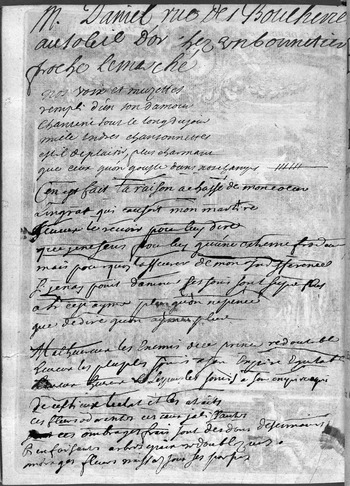
The livret of Roland is the only one in this collection with unusual annotations; these, however, are many and various.Footnote 7 For instance, the verso of its frontispiece displays script in three different hands (see Fig. 1). The uppermost text, written in confident, somewhat sprawling letters in brown ink, is as follows: ‘M. Daniel rue des Boucherres au soleil d'or [c]hez [u]n bonnetier proche le marché’ (Mr. Daniel, rue des Boucherres, in the soleil d'Or, at a bonnet-maker's house, near the market). Given the placement of this annotation on the page, it would seem that ‘M. Daniel’ was the first person to write in the livret.Footnote 8
Annotations in three different hands, made to the verso of the frontispiece of the livret. Courtesy of Houghton Library, Harvard University.

The second hand appears just below M. Daniel's address, where six lines of pastoral poetry have been copied out in very neat script. It is worth mentioning that a further 17 lines of verse written in the same careful hand appear in the margin of page 48. These latter, more copious verses form a parodie Bacchique of the duet air ‘Vivez en paix’ from Act IV scene 3 of Roland, and in the livret they appear in the margin next to the printed text of that air. Neither these verses nor the six lines on the verso of the frontispiece are marked up in any way. It seems likely that this hand was the second to write in the book.
The text of an air de cour by Madame de Sainctonge, entitled ‘C'en est fait’, as well as discontiguous groups of verses by Jean Racine taken from Lully's Idylle sur la paix (1685), have been copied out in a third, slapdash hand that is bottom-most on the verso of the frontispiece. The position of these texts on the page indicates that they were probably added last. They are remarkable for the horizontal, rising and descending strokes that have been drawn in above the verses. Further annotations of this nature were made to some of the printed lines of the livret: Act I scene 2, Act IV scene 2 and Act IV scene 7 are remarkable for being similarly marked up. It is these latter markings, made to Quinault's text, that form the main subject of investigation in this article.
Roland had its première on 8 January 1685 in Versailles, and opened in Paris two months later on 8 or 9 March.Footnote 9 If M. Daniel (whose name and Paris address are written along the top of the verso of the frontispiece) was the initial owner, it seems plausible that he could have purchased the livret before attending a Paris performance of that year. The text of ‘C'en est fait’, which appears, marked-up, further down the page, was published, together with the music, in the Mercure Galant in February 1685, where it was described as an ‘Air Nouveau’.Footnote 10 Furthermore, Lully's Idylle sur la paix, similarly marked-up verses of which appear just below ‘C'en est fait’, received its première on 16 July of the same year. This means that all three of the texts that are marked up with lines and dashes – ‘C'en est fait’, Idylle sur la paix and Roland – were published in 1685. It seems probable, therefore, that all of the chirographic activity in the livret would have taken place not long after the Paris première of Roland, when the texts of the livret, the Idylle and ‘C'en est fait’, were still fresh.
Such a dating is further supported by an examination of the binding. It seems clear that all of the annotations on the verso of the frontispiece were made before the 15 Lully livrets were bound together into a book; at that time the livret for Roland was cut down, and the tops of some of the letters of M. Daniel's name and address were sheared off in the process.Footnote 11 Moreover, the verses by Madame de Sainctonge and Racine run too far into the gutter to have been copied after the ‘Opera de Quinaut’ was bound. Presuming that the book was put together shortly after the publication of the latest of the 15 livrets (that of the 1690 revival of Cadmus et Hermione), this would date the annotations to the very end of the seventeenth century, a date not inconsistent with the style of the book's binding. Given the strong circumstantial evidence in support of dating the annotations to somewhere between 1685 and 1700, this article will proceed on the premise that all of the markings in the livret date from this period.
The annotations: musical notation, and function
The first line of ‘C'en est fait’, ‘C'en est fait, la raison a chassé de mon cœur’, will serve as an introduction to the annotations as a whole. As mentioned above, the text of this air de cour has been copied onto the verso of the frontispiece and marked with shorter dashes and longer lines (see Fig. 2). When these annotations are compared to the vocal line of the air, a remarkable correspondence is revealed (see Ex. 1).
Annotations made to the text of C'en est fait.

The opening line of C'en est fait as published in the Mercure Galant, February 1685.

For instance, a line has been drawn in above the words ‘C'en est’, and these words have been set to the same pitch, while the dash above ‘fait’ is lower than the line that preceded it: this corresponds well with the descent of a fifth in the melody. Conversely, the word ‘la’ and the first syllable of ‘raison’ share a line, while the second syllable of ‘raison’ is marked by a higher dash: here the melody rises by a fourth (at some later point, a longer line joining these three syllables together was created above the original shorter lines, as if to indicate a slur of some kind). The three short dashes above ‘a chassé’ convey the rise and fall of these syllables in the score. The word ‘de’ is unmarked in the livret. ‘Mon cœur’, on the other hand, is marked with one long line that droops slightly at the end, indicating the descent of a half step in the music; the length of this drooping line would very nicely reflect a tremblement appuyé being made at this point.
The same neat relationship between musical intervals and the physical placement of the annotated lines on the page (both in relationship to the words and to each other) is also evident in the annotations made to the text of Roland itself. For example, Act IV scene 2 has a small number of annotations: only lines 2–5 and 7–9 of this scene have been marked up. Dashes – horizontal, rising and descending – drawn in above the lines mark individual syllables. The placement of these dashes, and their distance from the tops of the letters above which they are written, again bears a remarkably consistent relationship to the rise and fall of the intervals of Lully's score. Line 5, ‘O Nuit, favorisez mes desires amoureux’, may serve as an example. Almost every syllable of this line is supplied with a dash (see Fig. 3). High above ‘O’ is a short descending dash, pointing towards a much lower horizontal one above ‘Nuit’. Similarly, the first and last syllables of ‘favorisez’ show horizontal dashes at the same level as that on ‘Nuit’, while the penultimate syllable, ‘ri’, is marked with one placed higher than those surrounding it. A comparison with Lully's musical notation shows a relationship between the placement of these dashes and the pitches to which the words have been set (see Ex. 2).
Annotations made to Quinault's text from Act IV scene 2 of Roland.

A line from Roland Act IV scene 2, as set by Lully.

Indeed, such correspondence between the annotations and the musical setting is so consistent throughout the livret that it will hereafter be understood as the rule to which only a small number of exceptions occur.
Horizontal dashes are not the only signs used by the annotator to chart the rise and fall of Lully's intervals: sometimes the dashes themselves rise or fall, being drawn in on a slant. As mentioned above, this was the case on the word ‘O’, and further examination of this same line shows that the word ‘mes’ and the first syllable of ‘desirs’ are also marked with falling dashes, while the final syllables of the words ‘desirs’ and ‘amoureux’ are marked with rising ones. However, Lully has not set any of these syllables to descending or rising melismas. So, while it is true that the direction of these slanting dashes does reflect the contours of Lully's line, the question must be asked why the horizontal dashes are not used here, as they are elsewhere in the line, if the intention is accurately to reflect Lully's score.
Is it possible that the annotations here indicate how a line was actually to be sung, rather than Lully's notation of it? Looking again to the score, it is clear that the two rising dashes could be intended to remind the singer to add ornaments from below, for instance ports de voix. Similarly – in the case of ‘C'en est fait’ – the long line above ‘mon cœur’ could have reflected the addition of an un-notated appuyé. Could the livret, then, be an aide-mémoire marked up by a singer? It is probable that many amateur musicians of the period would have had a tenuous grasp of music theory and even musical notation. Singers in particular seem to have been dependant on the music master in order to learn new songs, at least if an English contemporary, Roger North, is to be believed. The following scornful remark is directed at English ladies, but probably applied more generally to Europeans of both sexes:
Ladys hear a new song, and are impatient to learne it. A master is sent for, and sings it as to a parrot, till at last with infinite difficulty the tune is gott, but with such infantine imperfect, nay broken abominable, graces, in imitation of the good, that one would splitt to hear it.Footnote 12
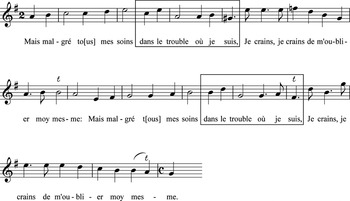
In this light, it would be easy to see the livret as a simple memory aid, marked up for an unskilled singer, with basic pitches and simple ornaments indicated by rising and falling lines; but as attractive as this interpretation seems, it is problematic for a number of reasons. Discrepancies between slanting annotations and Lully's precise notation like those discussed above are simply too frequent always to relate to ornamentation; and, more importantly, they very often occur in passages where the addition of ornaments would be musically improbable at best.Footnote 13 Furthermore, Ballard's text cannot physically serve as an effective aide-mémoire because the livret as printed does not repeat text when Lully chooses to do so in his setting. This makes it impossible for a singer to mark up passages in which repeated text is set to differing pitch intervals. This can be illustrated by a passage from Act I scene 2. Here Lully has Angélique repeat the lines ‘Mais malgré tous mes soins dans le trouble où je suis / [J]e crain de m'oublier moy-mesme’.Footnote 14 They are first stated in A minor, then repeated, with a few significant intervallic and rhythmic changes, a fourth lower in E minor (see Ex. 3). Though repeated in the score, the words appear only once in the livret. The single annotation to this section, remarkably, does not make any attempt to indicate the intervals that differentiate the two musical statements, but rather highlights words whose setting remains basically the same in both versions, though of course transposed: ‘dans le trouble’ (see Fig. 4). Surely this would be of little use to a singer trying to remember pitches?
Lully's setting of lines from Roland Act I, scene 2. The boxes encompass the section of the text that is annotated in the livret.

Annotation to Act I scene 2 of Roland.

This passage introduces yet another obstacle to seeing the document as an aide-mémoire: the different rôles and voice-types associated with the annotated words. The part of Angélique was written for soprano, that of Roland for a bass, and the text ‘Malhereux les ennemis’ from Idylle sur la paix that was copied onto the verso of the frontispiece was set by Lully for haut-contre. Yet music for all three parts has been marked up in the livret by the same hand. This suggests that the annotator was studying Lully's mélopée in general, rather than preparing a specific rôle.
So, if the livret is not a singer's aide-mémoire, what is it? To whom, other than someone practicing declamation, would it have been useful to map out, above Quinault's text, the rise and fall of Lully's vocal settings? Given the improbability of the annotations being related solely to musical practice, and the enticing possibility, pointed to by Condillac and Voltaire, that Lully's scores could have served as guides for spoken recitation, the rest of this article will explore the hypothesis that the livret's annotations represent a contemporary attempt to distill an underlying spoken declamation from Lully's music.
To return to the scenes of the livret examined above, the question arises: what could the meaning of the horizontal and slanted dashes be if they do not represent sung ornaments? Did orators use ornaments? The logical extension of the idea that the horizontal dashes on the page reflect spoken pitch is that the slanting dashes indicate rising or descending microtonal slides: spoken appuyés and ports de voix.Footnote 15 It was proposed above that ports de voix would have been appropriate to the musical performance on the words ‘desirs’ and ‘amoureux’. Would spoken ports de voix be similarly appropriate to a declamation of the same text? Searching the primary literature for references to theatrical vocal slides is a frustrating exercise: the term port de voix is almost exclusively defined in dictionaries as a purely musical term. Tantalisingly, Furetière's Dictionnaire universel (1690) does offer the following in defining ‘voix’: ‘This actor has a fine port de voix, he raises, he lowers, he manages his voice with propriety.’Footnote 16 This, however, merely indicates changes in vocal pitch, without specifically mentioning microtonal sliding.
One of the classic anecdotes of the seventeenth-century French stage, that of Champmeslé interpreting the role of Monime in Racine's Mithridate, suggests the possibility that a gigantic slide was made, for dramatic effect, at a climactic moment in the play. L'Abbé Dubos relates that Racine himself instructed Champmeslé to lower her tone to an extraordinary degree, so that:
she easily was able take a pitch one octave higher than that on which she had said these words: Nous nous aimions, in order to pronounce Seigneur, vous changez de visage at the octave. This port de voix, extraordinary in declamation, was an excellent means of pointing out Monime's mental disorder at the moment she realises that her gullibility in believing Mithridate, who only wanted to extract her secret from her, has thrown her and her lover into extreme peril.Footnote 17
Admittedly, Du Bos does not specifically mention a vocal glissando, and it is possible that Champmeslé changed pitch after ‘aimons’ by jumping up the octave. If, however, she made the transition on the word ‘Seigneur’ itself, this would indeed have entailed the actress making an unexpected octave slide, a microtonal, ascending éclat de voix, to stunning effect (see Ex. 4).Footnote 18
A reconstruction of Champmeslé's declamation of a line from Racine's Mithridate, as described by L'Abbé du Bos in Réflexions critiques sur la poësie et sur la peinture. The notation refers to an oratorical ‘ut’, rather than to any specific musical pitches. The rhythms, based on remarks by de Grimarest (Traité du recitatif) and Richesource (L'eloquence de la chaire), have been supplied by the author for the sake of legibility. This example is meant to demonstrate the actress’ change of ton, or basic pitch level; it is likely, however, that the octave jump served as a basis for a richer mélopée than is suggested here.

The dramatic context of the words ‘desirs’ and ‘amoureux’ from Act IV scene 2 of Roland (see fig. 3) is not nearly as overwrought as the Racinian example cited above, and the gentler quality of the livret's annotated slides (suggested by the variously angled dashes) suits the mood of Quinault's scene: Roland here hopes to meet his love, and wanders, filled with amorous thoughts, alone in a shady wood. His pronunciation would surely be as soft as the music that Lully had provided for him. The sharp rise on the second syllable of ‘desirs’ fittingly suggests a more energetic pronunciation than does the languorous, nearly horizontal dash above the last syllable of ‘amoureux’. Such variety of notation might indicate that the orator here used slides in order to express the passions of the words. It seems, then, that the manuscript dashes indicate places where vocal pitches for specific words – and even for individual syllables – are being gleaned from Lully's score, and that these pitches are sometimes reached by slides. How literally should the idea of pitch be taken in this context? How close to singing was the declamation of the annotator, or for that matter, of Condillac and Voltaire?
The seventeenth-century context
The ‘singing’ quality of French declamation was closely related to the use of oratorical pitches, or tons, both in church and on the stage. The word ‘ton’ has multiple meanings: anything from the vocal inflections of polite conversation, to an emotionally coloured pronunciation, to the imitation of regional accents or individual eccentricities can be referred to in the rhetorical sources as ‘tons’. There are, however, a number of seventeenth-century sources in which the word clearly relates to specific pitches used in spoken orations. These sources will be examined at some length here, in order not only to throw light on the singing quality of recitation in the period, but also to explore just how the study of Lully's pitches could have been of use to déclamateurs.
It is not insignificant that information about the use of pitches in seventeenth-century public speaking can be found in a work on music. Mersenne, in his Seconde partie de l'harmonie vniverselle (1637), claimed that ‘those who know how to sing have a greater facility in discerning and practicing the oratorical intervals than those who do not know music’.Footnote 19 Mersenne goes on to assert that it is more difficult for the orator properly to adjust the pitch of his voice than it is for him to speak at the correct speed. Indeed, Mersenne states that there are many orators who can deliver their speech in the proper tempo,Footnote 20 but who
do not have the vocal inflections necessary to pass from one sentence to the next, and who do not take the best pitch [ton] of their voices at the places where it must be strongest and most robust. However, to come to this practice one must learn a sermon, or a part of one, in order to recite it in the presence of a friend who is at liberty to insist that the voice take the proper tone and repeat the sentences and vocal modulations until it has grown accustomed to the inflections necessary to express all kinds of passions.Footnote 21
Mersenne then refers his readers to the works of Dionysius of Halicarnassus, agreeing with the latter that the normal vocal range of the orator forms the interval of a fifth; but the Frenchman insists that the expression of emotion can enlarge this vocal range:
However, whatever the intervals used by the ancient orators, it is certain that the range of a preacher is a full octave, and that the accent of anger can suddenly jump up an octave, even though it is customary to stop at the fifth; but, all these intervals must be examined before use, since that which is good for one voice is worthless for another.Footnote 22
Mersenne here proposes a demarcated vocal range – the octave – for preachers, but does not prescribe exact terminal pitches: each individual speaker must find where his voice is ‘strongest and most robust’, and calculate his octave accordingly. Mersenne further suggests that the orator make surreptitious use of one of a number of musical devices designed to help him find his pitches while speaking:
And once the preacher has distinguished the best pitch for his voice, and the intervals in which he most successfully can express all kinds of passions and affections, it will be easy for him to prepare a little stick of brass containing a monochord of either the wind or string variety, by means of which he will be able to adjust his voice to all kinds of pitches, and make most exactly whatever intervals he wishes, without the auditors being able to apprehend this instrument.Footnote 23
Not all churchmen would have agreed with Mersenne's precepts, however. Mazarini's Practique povr bien prescher (1618), for instance, gives quite another point of view, and roundly condemns
those who glory in observing certain pitches [tons] in speaking, to the extent that they seem to be singing…. This has caused an ancient and excellent rhetorician to say, entirely correctly, that any other vice would be more tolerable in the orator than this one, which is only suitable for the theatre and for plays.Footnote 24
Such criticism, however, did not impede one of the most influential writers on rhetoric, Michel le Faucheur, from advocating the use of oratorical tones.Footnote 25 His Traitté de l'action de l'orateur (1657) gives detailed instructions to preachers on the use of the voice. Le Faucheur's oratorical technique is based on a default setting of the mean [médiocrité], or median, for the three basic vocal qualities of pitch, volume and speed. This enabled the orator to vary his speech according to the content and structure of his text without it becoming unpleasant or unintelligible, even when going to expressive rhetorical extremes. The result was that, in terms of pitches, the use of the outermost limits of the orator's vocal range were discouraged:
… he [the orator] must maintain the mean [médiocrité] because the extremities are faulty [vicieuses] and disagreeable. Therefore, in terms of elevation, he must never raise his voice to the highest pitches that it can reach, nor must he ever lower it to the lowest pitches to which it can descend.Footnote 26
However, this vocal ‘happy medium’ still allowed the orator ample room to vary the pitch of his voice, which was in no way meant to be monotonous:
I must add that one must employ variety, because the mean of which I speak does not consist of an indivisible point, but rather has a certain latitude, and certain degrees. For, as to that which concerns the height or lowness of the voice, there are five or six tones between the highest and the lowest. And thus, while the orator avoids the extremes that I condemn, and keeps to a reasonable median, he still has enough space between the two to vary his voice by making use of five or six tones, as he ought.Footnote 27
Le Faucheur's text is somewhat ambiguous as to the exact range of the voice: taken casually, its advocacy of a maximum of six pitches suggests an ideal vocal compass slightly narrower than Mersenne's; if, however, le Faucheur literally means that there were five or six tones at the orator's disposal in between the two outermost pitches, then both writers agreed that the full extent of an octave fell within the acceptable range. Either way, there was a wide enough compass of acceptable tones for the orator to vary his pitches without compromising either his vocal quality or intelligibility. That such vocal techniques might have been perceived – for instance, by followers of Mazarini – to be theatrical does not appear to have concerned le Faucheur, who, later in the Traitté de l'action de l'orateur, in the chapter ‘On the variation of the voice according to the passions’, recommended training the voice in a theatrical style of declamation:
And, to forget nothing that can contribute to something as important, in the matter of pronunciation, as the variation of the voice, I add that one of the most suitable methods for acquiring the faculty for doing so properly, and in all kinds of subjects, is to read, often and out loud, from comedies, tragedies, dialogues and other works by authors whose style most closely approaches the theatrical.Footnote 28
Even more precise information on the use of oratorical pitches can be found in another seventeenth-century oratorical treatise: in Richesource's L'eloquence de la chaire (1665), each individual tone was designated by a different solmisation syllable. This enabled Richesource to actually map out the rise and fall of the orator's voice over the course of a sermon, and allows a modern reconstruction to be made using musical notation. Richesource, like le Faucheur before him, advocates the use of a vocal mean [médiocrité]. He limits the compass of the voice to five pitches, insisting that the preacher:
must study the mean and keep his voice in the middle, which is proper, since on the one end it will not break and on the other, not be muffled. When he wants to excite his listeners, he should raise it bit by bit, and by degree, up to a certain point without becoming grating, and, when softening and mitigating the affections, lower it to a certain degree that puts it in its stable range.
Finally it must be remarked that the preacher's voice must never normally rise higher than the fifth, and never to the octave in reproaches, laments and not even in female rage, for such screams are never used in the pulpit, but only in the theatre; it is sufficient that the voice should spread itself out between the two extremities that cantors call ‘ut’ and ‘sol’.Footnote 29
Though Richesource very usefully goes on to describe the rhetorical applications of each pitch, parts of his text are cumbersome and ambiguous. Fortunately, however, this section of L'eloquence de la chaire was reprinted in the eighteenth century in condensed form in Dinouart's L'éloquence du corps ou l'action du prédicateur (1761). Because it presents the essentials of Richsource's explanation in an easily digested form, Dinouart's summary will be cited here first, and thereafter elucidated with specific examples from Richsource's original:
The ut, being the first pitch, is used in explications, expositions, hypotheses, etc., which demand a manly, natural and steady voice. The re, added to the ut, elevates the vowels at the end of incisions or hemistiches, and at pauses, which is the smallest inflection or elevation of the voice. The mi, called the third [tierce] is for the sweet, gentle passions that are raised in the body of the sermon; which is called the ‘little pathos’ [le petit pathétique]. The fa, which is the fourth [quarte] is for strong emotions, when one must develop the grandeur of the soul's feelings and the heart's emotions concerning some particular truth. The sol, which is the fifth [quinte], only appears in the ‘grand pathos’ [le grand pathétique].Footnote 30
Dinouart, following Richesource, relates the proper oratorical pitch to the emotional content of the text. Rational discourse, scriptural exegesis and the reduction of the general to the particular [hypothèse] occur on ut, with re used as an inflection for the sake of variety and intelligibility: thus, unemotional text is pronounced on the two most stable tones, where the voice is full, consistent and uninflected by strong feeling (‘manly, natural and steady’). In contrast, the higher pitches are well suited to the expression of emotion: the mi is used for the gentler emotions, the fa for more violent ones, and the sol is reserved for the strongest passions, or ‘grand pathos’. Thus, the voice rises up the gamut as the emotional intensity of the text increases.
In L'eloquence de la chaire, Richesource gives specific examples of the use of pitch in a sermon, which help to elucidate what the ‘singing’ quality of this type of church oratory was like. His illustration for the proper use of ut and re is the text ‘Et le Sauveur du monde aiant chargé sa Croix’ (And the Savior of the world having taken up his cross):
All of the syllables must be pronounced in a firm and manly tone and with the same tenor and consistency of voice, as on the ut, which is the first pitch; and the final syllables, being Monde and Croix, must be pronounced on the pitch re, which is to say a pitch higher than the preceding syllables of the same verse.Footnote 31
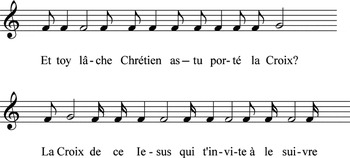
Richesource's proposed performance of the line, with ut rising to re at the end of each hemistich, is meant to prevent the oratorical fault of sinking into unintelligibility at the end of a phrase, the so-called ‘swallowing the syllables’ (‘manger les voieles, ou les syllabes’).Footnote 32 This is more a technical than an expressive device, and therefore when the orator moves up from ut to the more emotional pitch of mi the same kind of variety in inflection will occur: fa will now function in relationship to mi just as re had functioned in relation to ut. Richesource uses the following alexandrine to demonstrate this, ‘Ah Chrétiens, si ce Christ a sceu porter sa Croix!’ (Ah, Christians, if this Christ knew how to carry his cross!). However, though the two examples look very similar when put into musical notation (see Exx. 5 and 6), their performance would have been very different: Richesouce is explicit in stating that mi is for passions associated with desire and aversion, the so-called concupiscible passions of the Scholastic tradition (love and hate, desire and aversion, joy and sorrow).Footnote 33
Reconstruction of Richesource's use of ‘ut’ and ‘re’ as described in L'eloquence de la chaire. As in example 4, oratorical tons are indicated here using standard musical notation. The rhythms have been supplied by the author to aid legibility.

Richesource's use of ‘mi’ and ‘fa’ to express one of the concupiscible passions, presumably sorrow.

The contrast between the rising intonation and warmth associated with the concupiscible passions (the ‘little pathos’, pronounced on mi) and the lower tones of rational discourse (associated with ut) is further underscored in Richesource's example by the punctuation, for the higher oratorical pitch he prescribes for the line ‘Ah Chrétiens, si ce Christ a sceu porter sa Croix!’ neatly corresponds to its exclamation mark. The raised pitch (mi) of the orator's voice was, first and foremost, an indication of heightened emotional intensity in his performance.
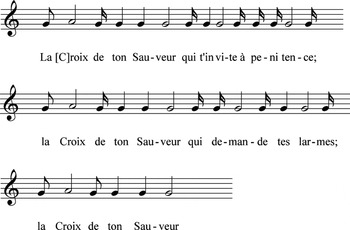
Increasing affective elevation resulted in the orator's voice rising even further up the gamut: fa was used for the group of passions associated with anger, the irascible passions (hope, fear, courage, despair, anger).Footnote 34 Here again, the adjacent higher pitch (sol) was used in combination with fa for the sake of both vocal variety and emphasis. In order to illustrate this, Richsource gives an example of what he describes as an animated reproach, full of pathos, boldly interrogative and containing two rhetorical figures (apostrophe and anadiplosis): ‘Et toy lâche Chrétien as-tu porté la Croix? La Croix de ce Iesus qui t'invite à le suivre?’ (And you, cowardly Christian, have you carried the cross? The cross of this Jesus that invites you to follow him?). Richesource remarks that ‘Those whose voice and declamation are unconstrained can, and even must, elevate the repetition of Croix’ (see Ex. 7).Footnote 35 By elevating the word ‘croix’, the orator can bring out more forcefully the word repetition at the end of the first and beginning of the second line (anadiplosis).
Finally, having reached the sol, Richesource mentions that it is possible for the orator's voice to rise to la for the sake of variety and emphasis. He has here reached the emotional and musical highpoint of his text (see Ex. 8):
Two lines showing Richesource's use of ‘fa’ and ‘sol’ to express one of the irascible passions, presumably anger.

one can go to la, surpassing the sol in order to stave off monotony; but one must be confident of the force and the reach of one's voice; and especially when the subject can be repeated or, even more beautifully, when the fecundity of the voice permits its doubling, tripling and even quadrupling and quintupling [i.e. repeating the subject of the sentence up to five times], each time pushing the voice but without elevating it, or at least just a bit; as in La croix de ton Sauveur qui t'invite à la penitence; la Croix de ton Sauveur qui demande tes larmes; la Croix de ton Sauveur, &c.. (The cross of your Saviour that invites you to penitence; the Cross of your Saviour that demands your tears; the Cross of you Saviour, etc.)Footnote 36
Richesource suggests the orator go to ‘sol’ and even to ‘la’ in expressing the ‘grand Pathetique’.

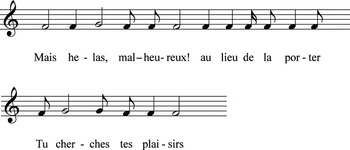
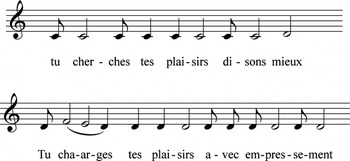
Having reached this climax, the orator's voice begins to descend, first down one tone to fa (with sol used for emphasis) at the text ‘Mais helas, mal-heureux! au lieu de la porter tu cherches tes plaisirs’ (But, alas, sinner! instead of carrying it/You seek your pleasures) (see Ex. 9) and then, in order to express the orator's contempt (‘mépris’), the voice suddenly drops sharply to re (or, according to Richesource, possibly even down to ut, if the orator's voice is reliable) at the words ‘Tu cherches tes plaisirs disons mieux’ (see Ex. 10). This drop from fa to re or ut (and thus out of the vocal range of the irascible passions into the cooler regions of discourse) is justified by the affective theory of the day: contempt was thought to be unmixed with anger.Footnote 37
Richesource suggests ‘sol’ as appropriate here ‘à cause de l'exclamation passionnée’.

Two lines cited by Richesource where, for the sake of expression, a sudden drop in the orator's voice and microtonal slide are required. Either ‘ut’ or ‘re’ may be used as the fundamental pitch; in this realization they are used in succession, for variety's sake.

This sudden drop in range also prepares the orator's voice for the coming line, for by lowering his tone the orator gives himself sufficient vocal compass to make an ornamental, microtonal slide. This slide was used to highlight the presence of the rhetorical figure paranomase, a kind of wordplay based on the similarity of sound between two words of different meaning. Thus, ‘Tu cherches tes plaisirs disons mieux’ (You seek your pleasures, or better said) is followed by ‘Tu charges tes plaisirs avec empressement’ (You take up your pleasures with ardour); ‘charges’ ironically echoes ‘cherches’, and is, therefore, a paranomase (see Ex. 10). In order to point up the relationship between ‘cherches’ and ‘charges’ for the listener, Richesource prescribes lengthening the latter word and pronouncing it with a sliding intonation:
And if the preacher wishes to vary the expression and performance of the correction and the paronomase (or allusion and changing of certain letters in the words), he can say, always in the same low, firm voice:
Tu cherches tes plaisirs dison mieux
Tu charges tes plaisirs avec empressement
But the ‘tu’ must be on the pitch re and the ‘a’ in ‘Charges’ must be doubled, as if one were saying ‘Chaarges’, so that the first ‘a’, joined to the ‘ch’ in ‘char’ is on the pitch fa, the second ‘a’ on the pitch mi and the ‘ge’ on the pitch re, like two notes slurred together.Footnote 38
Here the orator underscores the irony of his rebuke (that the sinful auditors not only seek their pleasures, but take them up as readily as Christ took up his cross) with an ornamental slide. The fact that the slide is given such prominent treatment here implies that similar microtonal ornaments are lacking elsewhere in the sermon. If this is the case, then Richesource's performance would indeed have come very close to chanting or singing: it is the microtonal character of speech that differentiates it most sensibly from song.
Such use of oratorical pitches was not, as noted above, universally admired. A piece published in the Nouvelles de la republique des lettres in August of 1708 makes this very clear. It contains a list of common oratorical faults so obvious that they could be recognised even by children; and prominent among them is the use of oratorical tones:
There are some who base their vocal pitch on the eight musical tones, and after having gone from the lowest ut to the highest, they descend again to the lowest and re-ascend to the highest and so forth, successively, from the beginning to the end of their discourse. Some don't take the full octave; all is reduced to the incessant repetition of ut, re, mi, fa, sol; ut, re, mi, fa, sol. It's easy to make children sensible of these faults, by imitating them in their presence and slightly exaggerating them, so that they distance themselves from them.Footnote 39
This commentary clearly shows that in the early eighteenth century there were still two schools of thought as to an orator's vocal compass, with some speakers limiting themselves to the interval of a fifth, while others used the full octave.Footnote 40 Of the two, this critic seems to find the smaller range the more unbearable, due to the greater monotony of its repeated rise and fall.
The tons in the livret of Roland
There is evidence for the use of oratorical pitches or tons in the livret annotations to Roland's Act IV scene 2 monologue. Before discussing them, however, it will be useful to establish whether any other stylistic similarities exist between Richesource's declamatory style and that of either the score of Roland or the livret. To begin with the score of Roland, a comparison between the notated examples from Richesource's L'eloquence and Lully's recitative shows greatly differing approaches to declamation: the preacher's uniform intonations, in which the majority of the syllables of a given line are spoken on one pitch, with only the upper adjacent tone used to avoid monotony or to add emphasis, are very far removed from the richly varied mélopée of Lully's setting. Because the annotations to the livret generally seem to follow Lully's intervals, the same discrepancy can be seen between Richesource (who, for instance, only once specifies the use of a descending slide) and the many rising and descending dashes of the livret. These differing styles should not be surprising: Lully, after all, was supposed to have based his recitative on Champmeslé's performance of Racine, not on the delivery of a sermon.
However, the use of pitches, or the tons, to express the nature and intensity of the passions (concupiscible or irascible) seems to be the same in the annotations to the livret and in Richesource's detailed prescriptions, though the operatic text was delivered with far greater variety of inflection. For instance, lines 8 and 9 of Act IV scene 2 are part of a larger apostrophe addressed to Night (starting in line 5). The two lines in question are: ‘[J]e ne troubleray plus par mes cris douloureux/Vostre tranquillité profonde’ (I will no longer trouble, with my dolorous cries/Your profound tranquility). These verses are not marked with dashes of any kind in the livret. However, there are two significant annotations, one at the end of line 8 and one to the beginning of line 9 (see Fig. 5). The former is illegible; its possible significance will be discussed in due course. The latter is clearly the solmisation syllable ut. The obvious explanation for the placement of this syllable – that a singer added it in order to find his pitch while singing – is untenable for a number of reasons. First, whether the system used here was that of hexachords or the so-called méthode du si, ut would not be the proper syllable to use.Footnote 41 Second, even if some explanation for using ut could be found, for instance some obscure or perhaps entirely personal system of solmisation, there is no reason for this interval, of all the intervals of this monologue, to be singled out for annotation: it simply is not difficult for the singer to find his pitch at this place in the score (see Ex. 11).
‘Vt’ added to Act IV scene 2 of Roland.

A line from the score of Roland, with ‘Vt’ indicated at the same point as in the livret.

However, if it makes no sense as a musical solmisation syllable, the ‘ut’ does make sense as an indication of oratorical tone. It would be only logical for the orator to sink to his lowest vocal pitch for the words ‘Vostre tranquillité profonde’, in order to express the deep tranquility of the text. This might seem obvious and therefore unworthy of annotation, but in fact the passage is a tricky one for an orator trying to choose the proper pitch for his declamation, because the preceding line refers to one of the irascible passions, and therefore theoretically demands a heightened vocal pitch-level. Roland's ‘cris douloureux’ are those of an impatient, frustrated lover; according to affective theory, the existence of an obstacle between the desirer and the desired generated the anger characteristic of the irascible passions, and therefore Roland's frustration belongs to this heightened affective category. This would, according to Richesource, push the voice up at least to fa. However, the dolorous cries here have a poetic function, and are not the immediate expression of actual physical pangs; at this point in the monologue Roland is more amorous than distressed. Lully understood this. He set the words to a smooth rising line quite unlike the jagged intervallic setting of the beginning of the Act IV scene 2 monologue ‘Je suis trahi’, where Roland's emotions begin to overpower his reason, heralding his imminent mental breakdown. Therefore, though Quinault's verse here speaks of ‘cries’, neither Lully nor the orator would have wanted Roland to cry out like someone in pain.
So, what oratorical pitch should the annotator have chosen, irascible fa (emphasising the lover's frustration) or concupiscible mi (emphasising his amorous yearning)? The illegible marking at the end of the line seems to indicate something of a struggle on the annotator's part, as several layers of writing appear on top of each other. Frustratingly, this mark can probably never be deciphered with certainty: at first glance it resembles the letters ‘nd’, an annotation without any obvious significance (see Fig. 6).
A remarkable annotation to Act IV scene 2 of Roland.

After thorough examination, however, one possible, logical interpretation presents itself: the conglomerate letters might consist of a delicately penned ‘fa’ almost fully obscured by a heavy-handed correction to ‘mi’.Footnote 42 This hypothesis could be further supported by the presence of two obliquely descending dots marked in above the letters. If these dots are seen as representing the oratorical pitches, they might indicate a descent of two tones: from mi to re, and from re to ut. Thus, this complex combination of dots, illegible letters and the solimisation symbol ut could indicate that the annotator changed his mind about the pitch level of line 8, but not about the obvious use of ut for line 9; the two dots descending therefore would simply clarify his intentions, indicating that the voice was about to descend two tones.
The association of dots with pitch levels on which the above hypothesis is based is not as fanciful as it at first may seem, for the annotator made ample use of dots in the livret. These markings cannot be explained in musical terms, but do seem to make sense when compared to the emotional intensity of the text that they gloss. This relationship can most clearly be seen in Act IV scene 7. This scene is entirely taken up by Roland's descent into madness, the text punctuated by acts of physical violence and ending in an insane vision of a demon from Hell. The various stage business causes the text of the monologue to fall into neat sections.
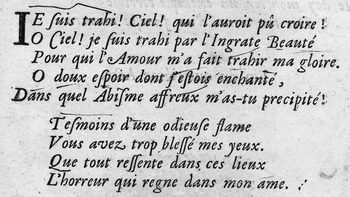
The first section comprises the first nine lines of the scene. In them Roland expresses his surprise at being betrayed by Angélique and his sorrow at the destruction of his own reputation (gloire) for the sake of a treacherous love. He is flooded with an emotion that finally breaks out into violence: he begins to dismantle the set around him. Three dots, in a rising line, have been added to the margin after the final line of this section (see Fig. 7).
Annotations to Act IV scene 7 of Roland. Note the three rising dots at the end of the last line.

This could indicate that Roland's voice, having risen through the expression of the concupiscible passions of love, hate and sorrow associated with mi, had arrived at an irascible anger, associated with fa.Footnote 43 Then, in a rage, he proceeds to tear up trees and throw rocks on stage.
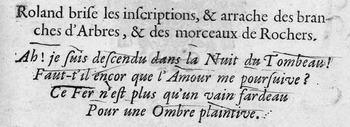
The following section of the monologue is short, only four lines long, and in it Roland expresses his (irascible) despair (see Fig. 8). The annotator seems to indicate a lower pitch than fa for most of the words ‘dans la Nuit du Tombeau!’ by drawing dashes through the words themselves, with the exception of ‘la’ and ‘Tombeau’. The use of dashes, rather than dots, could indicate that while the basic intonation and intensity associated with fa was maintained, the orator's mélopée dipped down briefly to ‘paint’ the metaphorical image of a gloomy tomb. It should further be noted that the marking above ‘la’ is particularly remarkable because it does not correspond to Lully's setting (see Ex. 12). The end of this quatrain is annotated with four rising dots, indicating that fa has been fully reached and that the orator is on his way to sol, which was, according to Dinouart, associated with grand mouvemens. Roland here casts aside his armour, and completely loses both his self-control and his mind. However, the next line shows a radical shift of vocal direction within the hero's mounting fury, for up until now the voice has been steadily rising in pitch.
Annotations to Act IV scene 7 of Roland. Note the four rising dots at the end of the last line.

A line from Lully's setting of Roland Act IV scene 7.

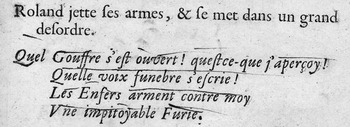
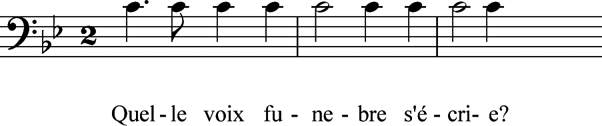
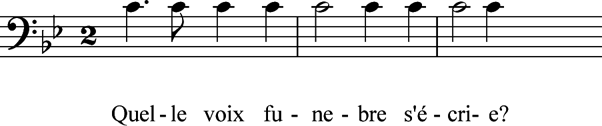
Here, in a terrifying quatrain, Roland describes his vision of a chasm opening at his feet, releasing a merciless inhabitant of Hell (see Fig. 9). The word ‘Quel’ from the line ‘Quel Gouffre s'est ouvert! questce-que j'appercoy!’ (What chasm opens! What do I perceive!) is marked with a high descending dash, ‘Gouffre’ with a horizontal one just above the tops of the letters, and ‘s'est’ with a solitary dot. Thus, the annotator here dictates a return to ut (therefore this vocal illustration of the depths of the infernal ravine is probably lower in tone than dipping mélopée indicated by dashes at the words ‘dans la Nuit du Tombeau!’). It is not clear from the annotations at which point the voice should rise again to sol, however the text implies that the words ‘Quelle voix funebre s'ecrie!’ (What fatal voice cries out!), marked as they are with an extraordinarily long horizontal line, should be pronounced broadly, in a loud, high monotone; and indeed, Lully has set them that way (see Ex. 13).
Annotations to Act IV scene 7 of Roland. Note the single dot above ‘s'est’ as well as the thick, downward-sloping line above ‘Furie’, which could indicate a forceful pronunciation and doubling of the initial consonant.

Lully's setting of a line from Act IV scene 7 of Roland.
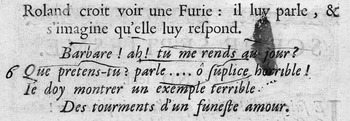
In the final quatrain, Roland interrogates the Fury,Footnote 44 from which he learns his fate: ‘[J]e doy montrer un exemple terrible/Des tourments d'un funeste amour.’ (I must provide a terrifying example/Of the torments of a fatal love.) (see Fig. 10). The penultimate line is marked at the end with five rising dots, indicating that the final line be declaimed above sol, on the extraordinary pitches reserved for the display of great emotion. The dot above the word ‘[J]e’ indicates that the orator's voice sank to ut in order to rise at least to la, if not higher, on the word ‘terrible’. This would have been close to the terrifying effect of Champmeslé's ‘Seigneur, vous changez de visage’. It seems, therefore, that the annotator used dots, as well as the solmisation syllable ut, to indicate oratorical pitch in the livret.Footnote 45 This further supports the idea that the annotations form some kind of ‘school of declamation’, or orator's workbook, inspired by Lully's score.
Annotations to Act IV scene 7 of Roland. Note the five rising dots at the end of the penultimate line..

It must be stressed that, although the annotations to the livret of Roland are highly suggestive, much of what has been proposed here must remain hypothetical until a corroborative source comes to light. However, if the above interpretation of the dashes and dots of the livret is correct, then a ton functioned as a basic pitch or ‘tonal centre’, chosen to express the emotional level of a line. The orator's voice rises and falls in a rich and varied mélopée around this basic pitch in a way that that makes the sermon of Richesource look like simplistic singsong. Was this greater vocal flexibility, combined with the widest possible compass of oratorical pitches, the hallmark of the theatrical declamatory style during the ancien régime? Having examined the tons in their seventeenth-century context, and theorised about their possible application to the livret, we may now look at the document in an eighteenth-century, theatrical light.
The eighteenth-century theatrical context
Numerous musicologists have pointed out the surprising continuity of aesthetic goals at the Paris opera from Lully to Rameau.Footnote 46 The longevity of this conservative bias justifies an examination of the seventeenth-century livret in the context of the eighteenth-century discourse surrounding declamation and opera. Furthermore, it will be proposed that a reconstruction of the annotations to the livret made in light of eighteenth-century sources could stimulate renewal in our current performance practice for ancien régime opera and spoken theatre. Therefore, in the interest of placing the annotations in a broader historical context, and of facilitating their practical application, an exploration of a few select eighteenth-century sources will follow here.
When L'Abbé Dubos, in his Réflexions critiques sur la poésie et sur la peinture, related the anecdote about Champmeslé's use of the octave in Racine's Mithridate, he did so as part of a larger exposition on the singing nature of the declamation of the ancients. He favourably compared the recitation of his countrymen to that of the Greeks and Romans, describing the vocal style of French tragic actors as follows:
The French do not rely on costumes to give a fitting nobility and dignity to the actors of tragedy. We also desire that these actors speak with a more elevated, more serious and more sustained voice than that used in everyday conversation.Footnote 47
Dubos praised his countrymen's superiority over their neighbours as creators and performers of tragic drama. According to him, only the French, with their elevated declamation, could suitably express the dignity of tragic verse:
As I have already said, it is well accepted in Europe that the French, who for a hundred years have composed the best dramas that appear today, also recite tragedies best, and know how to put them on with the greatest decorum [décence]. In Italy the actors recite tragedy in the same tone and with the same gestures that they use for comedy. There the buskin is hardly different from the sock. When the Italian actors wish to animate themselves in passages of pathos, they immediately exaggerate. The hero becomes a Capitano.Footnote 48
Dubos admitted that the French style, ‘more elevated, graver, and more sustained’ than that of conversation, came close to singing, and he claimed that even the Italians believed it to resemble the ‘singing’ recitation of the ancients:
The Italians, who treat us justly without too much repugnance when discussing those arts and talents at which they do not pride themselves in excelling, say that our tragic declamation gives them an idea of the lost melody, or theatrical declamation, of the ancients.Footnote 49
Dubos had already argued elsewhere in his Réflexions that the ancients had notated their recitations; it was therefore only natural for him, having established a link between French and Antique theatrical practices, to address the idea of notating French declamations. The ancients, Dubos believed, notated their ‘song’ by means of their accent marks.Footnote 50 This, indeed, seems to be the system used in the livret of Roland, where the accent aigu and accent grave became rising and falling dashes that broadly mapped out Lully's intervals above Quinault's words.Footnote 51 Dubos, however, felt that this method would be inadequate to the task of properly recording the orator's declamation. Instead, he recommended a notational system based on existing musical symbols:
I asked several musicians if it would be difficult to invent some symbols with which one could notate the declamation in use on our stage, for we don't have enough accent marks to be able to notate it as did the ancients. These musicians replied that the thing was possible, and even that one could notate declamation using our musical scale, as long as one gave to the notes but half of their normal intonation. For example, notes that have a semi-tone's intonation in music would only have a quarter-tone in declamation. Thus one could notate the smallest descent and the smallest elevation of the voice that is perceptible, at least to our ears.Footnote 52
Voltaire and Condillac, who both knew Dubos’ work well, could easily have taken the idea of declaiming Lully's recitative with ‘softened’ intervals from this passage. What neither Voltaire nor Condillac specifically addressed, however, was how to handle Lully's notated rhythms. Spoken recitation had to take syllable length into account, but what to do when the rhythms were already notated by the composer?Footnote 53 Here Dubos’ remarks can be of service:
I was also told that it would be possible, in declamation, to give the notes only half their ordinary value. One would only give a minim the value of a crotchet, to the crotchet the value of a quaver; and one would value the other notes according to this proportion, just as one would do with the intonation.Footnote 54
Dubos’ instructions would effectively double the speed at which the verses would be spoken, in comparison to how they would be sung. This suggestion, along with the remarks on speed of delivery in Mersenne's Seconde partie de l'harmonie vniverselle, offers concrete evidence that an exaggeratedly slow and stately style of delivery was unfashionable among ancien régime orators and actors.Footnote 55
It seems likely that déclamateurs using musical notation as a guide would not only have diminished the note values, however, but would have adjusted them as well: if Condillac and Voltaire performed microtones where Lully wrote diatonic notes, then perhaps their rhythms too would have been subtly adapted in order more closely to approach those of spoken language. Grimarest, in his Traité du recitatif (1707), had already warned singers that they had to be mindful of the need to treat notated rhythms flexibly when performing Lully:
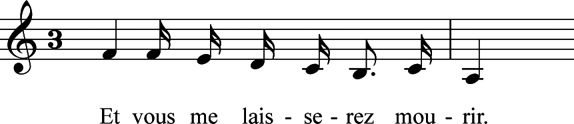
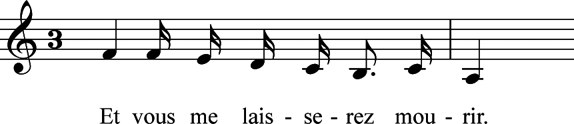
As I have already remarked, because the composer has often been constrained by the rules of his art to disturb the quantity of the syllables, it is up to the clever actor to redress the fault by making those syllables long that ought to be, and making the short syllables short, without paying attention to the length or shortness of the notes to which they have been set. For example, in Zangaride's [sic] scene in Atys, if one were to sing the first two syllables of & [et] vous me laisserez mourir according to the notation, the & would be much longer than vous, which would break the most common rules of quantity. [see Ex. 14] Therefore the singer takes from the first note and gives to the second, in order to make his manner of expression more correct.Footnote 56
Grimarest cites this line from Act I scene 6 of Atys as an example of a mistake in Lully's notation that must be corrected in performance.
Surely then, if singers were advised to take rhythmic liberties with the score in order to properly represent the syllable lengths, orators would have been as free to do so when extracting the underlying mélopée from Lully's recitatives?Footnote 57
Dubos’ remarks on the notation of declamation are admittedly hypothetical; however, throughout the eighteenth century various writers on theatre and opera insisted that it should be possible to preserve an orator's pitches on paper. It therefore will be of use briefly to examine the discourse around notation and the ‘singing’ declamation of three actresses who worked at the Comédie française during the long eighteenth century.
From Académie royale de musique to École royal de chant et déclamation
Two leading ladies at the Comédie française in the eighteenth century had links to the Académie royale de musique; both Mlle. Duclos and Mlle. Clairon started their careers at the Opéra and it was believed of both actresses that their recitations could have been notated. It is very tempting to see their ‘singing’ style as the result of their early experiences in performing tragédies en musique; however, contemporaries seem rather to have discerned a tradition of recitation leading back, through Champmeslé, to Jean Racine himself.
Mlle. Duclos became Champmeslé's understudy at the Comédie française in the late seventeenth century, after an unsuccessful stint at the Opéra. Her career at the Opéra is poorly documented, but she seems to have made little impression as an interpreter of the tragédie en musique. On the other hand, her career at the Comédie française was highly successful, though her declamation gained a reputation for being unnatural and ‘singing’. As late as the 1760s, Claude-Joseph Dorat, in his La déclamation théatrale (1761), castigated Duclos for her melodious delivery: ‘Mlle. Duclos, for her part, introduced a kind of music and singing into declamation that made it into a separate language and destroyed all of its charms. She declaimed by the octave and one could have notated her inflections.’Footnote 58 Such criticism seems unfair. Given that Racine had instructed Duclos’ teacher Champmeslé to use the octave in Mithridate, it seems likely that Duclos, rather than introducing this ‘singing’ style to the stage, simply took over an existing method of declamation. Indeed, Racine's son Louis, claimed that it was Champmeslé who introduced, out of ignorance, a false declamatory taste to the French stage, after her liaison with Racine ended. According to Louis Racine, his father chose the exact ‘tons’ for his mistress as she was preparing her rôles: ‘He first made her understand the verses she had to say, showed her the gestures and dictated the tones to her, which he even notated.’Footnote 59 Thus, according to Louis Racine, the playwright appears not only to have dictated the meaning of his verses to the actress, but also to have prescribed and notated the appropriate oratorical pitches. However, Racine's son insisted that Champmeslé's style became corrupted and ossified after his father's demise: an ageing Champmeslé, incapable of finding the ‘tons’ without his father's guidance, passed her defective and inflated vocal style on to Duclos. Of course, by blaming the actresses, he absolved his father of all responsibility for the style:
Those who imagine that he [Jean Racine] introduced an inflated and singing declamatory style to the stage are, I believe, in error. They base their judgements on Duclos, who was a pupil of Champmeslé, and they don't take into account that Champmeslé was no longer the same once she was deprived of her master, and that, growing older, she forced her voice with great cries [grands éclats de voix], giving actors a false taste.Footnote 60
If Duclos took over a singing style from Champmeslé, she seems to have passed it on to Mlle. Clairon, of whom Collé wrote in 1750, ‘her declamation – swollen, singing and filled with sighs – is that of old Duclos, and seems unbearable to me’.Footnote 61 Clairon began the successful phase of her Paris career as understudy to Mlle. Lemaure at the Opéra. Clairon insisted that her success there said more about the incompetence of her colleagues than her own vocal talents. Although a number of factors contributed to her leaving that stage for the Comédie française in 1743, the most interesting for the current discussion is her frustration at not being allowed to create her own mélopée: ‘I found so little merit in only following the modulations of the composer’.Footnote 62
Once established at the Comédie française, Clairon's own mélopée retained the ‘singing’ style associated with Duclos until sometime around 1752, when, according to Marmontel, her recitation became more natural.Footnote 63 Yet even this new, natural technique invited notation. None other than Chabanon, who corresponded with Voltaire about reciting Lully, promised, in his Éloge de Rameau (1764), to publish an operatic monologue based on Clairon's declamation.Footnote 64 Unfortunately, he seems never to have done so, but Grétry did notate her inflections. According to his Mémoires [1797], Grétry went to see Mlle. Clairon, together with Marmontel, while working on his opera Silvain. During their visit, the actress declaimed some lines from Marmontel's libretto. Grétry notated the resulting mélopée, incorporating ‘her intonations, her intervals, her accents’ into his score.Footnote 65
What is of greatest interest here is not that an overly song-like declamation was considered ‘unnatural’ by critics (‘unnatural’ being too imprecise a pejorative to be of use to scholars working at a distance of hundreds of years), but that all three of these famous actresses from the Comédie française were associated with notation: Racine notated the pitches for Champmeslé's declamations, and Lully in his turn notated them in his recitative; Duclos’ use of the octave was so obvious that it could have been notated; and Grétry actually did notate fragments Clairon's declamation and incorporated them into his music. In fact, it seems almost as if the close relationship between a musical spoken declamation and declamatory operatic singing had become something of a cliché in eighteenth-century France; and indeed there is concrete evidence from late in the century of strong links between spoken and sung theatrical performances.
The École royal de chant et déclamation was founded in 1784, nearly one hundred years after the première of Roland.Footnote 66 The intention was to create an establishment ‘in the style of the Italian conservatories, where one would train performers not only for the Opéra, but for the musique de Versailles’.Footnote 67 Although every attempt was made to keep the project as inexpensive as possible, it was considered highly important, being ‘the only means of preserving an entertainment so essential to Paris, and so useful to the arts, to commerce, and even to the finances of His Majesty due to the custom of foreigners attracted to and kept in Paris for a longer period by the opera’.Footnote 68
Amongst the faculty teaching at the school (mainly musicians, but there was also a dancing master and a fencing master) were two literary figures: one to teach grammar and literature (‘un Maître de Grammaire et de Fable’), the other a ‘maître de Déclamation’. The former position was held by a certain Rossel, ‘who for several years has taught humanities and rhetoric, a knowledgeable and honest man’; the latter by none other than François-René Molé, star actor of the Comédie française.Footnote 69 Their shared duties were to be carried out from three o'clock to eight, on every day that an opera was performed; this was because the singing teachers, who also taught in the afternoons, were required to be at the Académie royale de musique on performance days. Rossel and Molé were expected to teach the students:
to read verses, to pronounce exactly, to articulate, to properly understand and conceive what they read or pronounce, to declaim, to make proper and graceful gestures &c. They will make them learn operas by heart, which they will make them declaim either entirely, or by rôle, separately and as an ensemble, in order thereafter to rehearse them on the school's stage in the presence of people who want to come and hear them in order to accustom them to appearing in public.Footnote 70
Thus, the students had to learn the vocal techniques associated with reading aloud and theatrical declamation.Footnote 71 Although the passage is ambiguous, it seems they had to declaim not only their own parts, but entire operas. This is significant, given that various rôles were marked up by the same hand in the livret of Roland: perhaps it was considered worthwhile, at least at the end of the eighteenth century, for singers to be able to recite all of the rôles in a given work? The students at the École de chant et déclamation also formed ensembles and declaimed entire operas on a stage, before an audience. All of this points towards an extremely close connection between spoken and sung theatrical traditions in the performance of French opera at this period.
Molé's instruction was not confined to the students at the school, but extended to some of the performers at the Académie royale de musique:
The declamation master will go in the morning to the actors and actresses understudying the operas being performed or prepared, in order to teach, to those who wish, the spirit and nuances of their rôles and to make them declaim them without music; and in addition he can attend the general rehearsals in order to fix, in accord with the author and the leading singers, the entrances and exits of the actors, as well as their positions on stage [‘les positions Théatrales’] and to give advice about particular scenes.Footnote 72
Molé seems to have enjoyed a sliding scale of authority depending on the status of the actor: students had no choice but to recite; understudies could, if they wished, refuse; the stars at the Opéra, however, did not have declamation lessons with Molé at all, but merely discussed matters of staging with him. Yet, questions of status aside, it was clearly felt that repeatedly declaiming operatic rôles was extremely important to the finished sung performance. Thus, long after the demise of Lully's tragédie en musique at the Opéra, spoken declamation was still considered a basic technique for singers learning their parts. Could the livret of Roland have served a similar purpose, one hundred years earlier?
* * *
The livret has been examined here in both seventeenth-century religious and eighteenth-century theatrical contexts; the document has, it is hoped, served as a locus of profitable, if highly speculative, study. In concluding, however, it remains to touch upon its relevance to the performance practice of today.
Taken on its own, the annotated livret of Roland is a fascinating curiosity, suggesting much while proving little. It can only be transformed into a catalyst for renewal in today's performance practice through acts of conscious and conscientious reconstruction. In this respect, the annotations to Roland's Act IV scene 7 monologue are particularly significant, for here not just a few isolated lines but an entire mad scene can be reconstructed using historical evidence. By drawing on a variety of sources, from the livret's annotations to Lully's score, from rhetorical treatises to anecdotes about performers and performance, a reconstruction of the pacing and emotional power of an ancien régime actor can be mapped out over the course of an entire scene. The results, though hypothetical, may then serve as a touchstone for the declamatory style of historically informed spoken theatre in vogue today, and thus open up discourse about the current use of pitches and ports de voix, and the speed and emotional intensity of delivery. Finally, the insights thus gained could influence musical performances of French recitative, airs and even airs de cour. By respecting the underlying declamatory structures of a piece, and by vivifying the passions of the notated pitches in accordance with the concupiscible and irascible affects indicated by the text, new forms of expression can be sought for the emotional content of the verses. The music, thus performed, would not only function differently in dramatic context, it would sound different as well. Herein, ultimately, lies the greatest significance of the livret; for there is nothing that the Early Music movement – drowsy on the incense of its own commercial triumph – more urgently needs than to rethink some of its most cherished performance traditions in the light of historical evidence.