How are new forms of violence expertise organized and exploited? Scholars of American political development (APD), like most social scientists, have usually assumed this to be a question of state formation.Footnote 1 This assumption is evident, for example, in the state-centric terms in which APD scholars have explained the coercive incorporation of the late 19th-century trans-Mississippi West. Some, for example, have argued that incorporation was facilitated by the exploitation of private violent capabilities by federal policy makers, while others see it as a functional byproduct of the expansion of a national legal system, or a natural implication of the professional U.S. military's role in providing public security against native groups.Footnote 2 As a result, although this literature offers a powerful critique of extant theories of state capacity, it ultimately holds to a conception that the organization of violence is inherently a matter of state-building. That is, when even private actors with special skills in violence either use or threaten to use those skills, those actors are supposed by scholars to simultaneously be engaged (or attempting to engage) in activities such as regulating economic transactions or extracting and redistributing resources via protection rents either for themselves or at the behest of political elites.Footnote 3 However, in holding onto such an assumption, scholars ignore alternative modes through which violent skills can be organized and controlled.
This article demonstrates that local coercion in one of the key regions in the incorporating West—the cattle frontier of Texas and Kansas—was constructed around a market in violence expertise, in which gunfighting specialists both sold their skills as employees to public or private corporate actors and worked as independent entrepreneurial opportunists. Gunfighters—those American icons such as Jesse James, Wild Bill Hickok, and scores of others—were in actuality an organized class of violence experts, operating in a context where extraordinarily powerful macro-level forces were incorporating the region into the national economy.Footnote 4 These experts, in turn, used fighting to develop reputations for excellence in a much coveted and remunerative skill. Whether they were the “bad men” or “white hats” of popular mythology, late 19th-century gunfighters operating in the Southwest shared a commitment to using skills, cultivated through fighting, to make money however they could by working as local law officers, serving as cattle detectives or stagecoach or railroad guards, or by going into business for themselves as bandits and thieves.
The market organization of force, I contend, presents an important alternative mode to those forms based solely in political action. Gunfighters did not use violence to regulate economic activity, gather authority for themselves, extract resources from the less powerful in the form of a tax, or pursue a strategy of monopolizing violence under an incorporating framework. Instead, gunfighters were the market complement to state power, often operating in coordination with but not substituting for forces managed by political actors. Indeed, there were two overlapping forms of organized violence used in the country's southwestern expansion; the military also was active in the Southwest, although it was involved primarily (though not exclusively) in territorial incorporation rather than protection for economic interests. The coexistence of these two distinct forms of coercion undermines our assumptions about how organization of violence expertise is necessarily an affair of the state, demonstrating that powerful corporate actors may be able to manage their own security in concert rather than in competition with expanding state institutions. It also suggests that when market actors take on “core” functions of the state, this may not impinge on its capacity to pursue other goals of extraction and enforcement.
Using a dataset of 255 well-known participants in gunfights active from the 1850s through the early 20th century, I demonstrate that gunfighting gradually emerged and evolved as a market over time and space. In particular, I show that a subset of these individuals adopted the market identity of “gunfighter” by pursuing flexible careers—that is, they were professional firearms experts who were willing both to sell their skills to cattle interests and other large-scale incorporating social actors in the Southwest and to use those skills for self-aggrandizement. At first, these actors were largely recruited in entrepôt boomtowns, places in which cattle were shipped via the railroad to eastern markets. Because they connected different spatial scales, however, these towns also allowed local displays of violent skill to be integrated into a translocal demand for violence expertise. Over time, opportunities to use fighting skills professionally ultimately detached from the confines of the cattle frontier, as a complex social network emerged that was composed of overlapping and extensive relations of conflict and alliance among participants. These networks helped both to diffuse information and consolidate the career of the non-partisan gunfighter within a market that by the 1880s included part of the Rocky Mountain West. In other words, social network relations among gunfighters allowed what was originally a spatially circumscribed activity to evolve into a regional market.
This article, therefore, proceeds in several sections. To begin, I lay out the general argument about the role of gunfights in the creation of a market for violence, showing how this approach helps fill critical gaps in our understanding of where skills in violence come from and how they are propagated. I also link this discussion to a spatial model of institutional genesis. Next, I explore the empirical dimensions of the argument, demonstrating that a key mechanism—the social linking of individuals with professional expertise in violence through spatially organized gunfighting—was critical for transforming sporadic conflicts into an organized social system capable of diffusing and reproducing violent skills.
VIOLENT SKILLS AND THE U.S. WEST IN THE lATE 19TH CENTURY
Partly as a consequence of its mythic role in shaping American conceptions of individualism and civic violence, 19th-century gunfighting has been the subject of countless books and articles, most of which focus on specific fighters, feuds, wars, and battles.Footnote 5 Most historians view gunfighting as the provenance of reckless, deinstitutionalized men living in isolated environments on the frontier, as a product of a cultural code of honor transmitted by southern migrants into new environs, or as a manifestation of post-war social banditry.Footnote 6 For these scholars, gunfighting is actually a consequence of other social phenomena rather than a systematic social form of its own. Gunfighters are not perceived as important because of the actual roles they played in the economic or political development of the United States, then, but rather because they are exemplars of how post-bellum men, and occasionally women, negotiated frontier life in the West.
In one very important exception, Richard Maxwell Brown has described a late 19th-century “civil war” of incorporation in the plains and far West between the powerful new business/state entities and local interests he terms the “grassroots.”Footnote 7 While focused on a variety of specific issues—railroad rights of way, the use of shared grazing land, local political autonomy and influence, and so forth—what these conflicts had in common, Brown argues, is that they often turned violent, providing opportunity for enterprising actors to participate in fighting. Gunfighters, for Brown, are crucial historical actors in their own right, since they were the key players in this new war, representing different factions of “Incorporators” and “Non-Incorporators.” Indeed, he claims this can be traced in the biographies of the fighters themselves. For example, he argues that northern gunfighters tended to fight battles on behalf of incorporating interests, whereas those from the South—for example, John Wesley Hardin from Texas, Jesse James from confederate Missouri—were responding to the attempt to consolidate the United States on behalf of powerful and remote interests.
Like much of the work on the post-bellum West, Brown's view conflates two distinct but related forms of incorporation, with important implications for his argument. On the one hand, the central state was involved in a project of expanding territorial control over Indian tribes, setting up and organizing new political units for settlement, and paving the way for the construction of a national state. As a result of policies such as, for instance, the Homestead Act, this process involved attempts to harness private efforts of citizens to state aims as well as a strong reliance on legal institutions as a means of supplementing organized coercion.Footnote 8
On the other hand, the West was also subject to an explicitly market form of incorporation from powerful railroad and cattle companies whose most important field of development included states and territories in the trans-Mississippi West. The intersection of these two sectors was most pronounced in the Southwest, where the consolidation of large-scale ranches in post-war Texas coincided with a rapidly expanding railroad infrastructure. Later, the market pathways established by the post-war southwestern cattle industry were linked to the burgeoning copper and silver mining activities of Arizona and New Mexico, in addition to Sonora, Mexico. In this second, private form of market integration, concern for property rather than territory was paramount.Footnote 9
Both forms of incorporation operated together, but they led to very different logics of coercion. In particular, the military was engaged primarily in managing native groups, patrolling borders, and expanding federal control rather than protecting the property interests of new, powerful firms operating in the Southwest. Instead, following a well-paved institutional pathway for securing property in the United States, these firms turned to the local machinery of law enforcement or, in many cases, their own resources for protection. This move, I will demonstrate, allowed gunfighters to form a decentralized supply of violence expertise characterized by the same employee-employer relationships and incentives for opportunism found in the market as a whole.
Scholars of APD have, for the most part, paid very little attention to how different levels of jurisdiction engendered multiple logics of coercion in the 19th century, examining tasks of state-building and expansion of interest to central political elites rather than the grassroots component of organized violence. Most scholars, for example, have followed the lead of Ira Katznelson, who has offered a powerful critique of extant approaches to state capacity but who still privileges central state control over violence rather than fundamentally alternative forms of coercive organization. Instead of constructing an unpopular bureaucratized force for enforcing claims on political authority, Katznelson argues that federal elites in the early United States instead relied on what he terms “flexible capacity”—that is, the ability to harness private coercive power in a centralized way to achieve multiple policy goals without over-investing resources in creating a standing army.Footnote 10 This means that local coercive institutions are important for Katznelson in large part because of how they allow the central state to manage the periphery rather than how they serve as independent sites of institutional activity.
Other researchers have investigated local violence, but continue to privilege the effects of coercive organization on the state and the way in which state elites instrumentally control and harness force. Kathryn Frydl, for example, shows how local alliances with law enforcement officials proved vital in J. Edgar Hoover's campaign to centralize and institutionalize the FBI in the 1920s while still, ultimately, viewing violence professionalization as a uniquely political activity.Footnote 11 Other scholars who have examined local violence organization in U.S. political development, including Ilia Murtazashvili and Gautham Rao, either examine the political exploitation of local forces through the lens of federal policy, or examine amateur and politically directed violence organizations rather than independent local market expertise.Footnote 12 Each of these approaches focuses on the political organization of violence in American state-building; nonetheless, these scholars have difficulty in explaining why both a private market in force and a centrally managed program of territorial incorporation could coexist.
In particular, the commitment of extant APD scholarship to viewing violence through a state-centric lens is unfortunate for two reasons. First, by recognizing correctly that states are constituted, in part, by how they control violence, scholars tend to reverse the syllogism in a manner that may be unwarranted, assuming that the use of violence must, therefore, involve some form of statecraft as well. Nicholas Parrillo, for example, in a highly admirable piece, shows how privateering in the United States was exploited by the federal government, challenging our notions of how conventional state control over violence is necessarily a form of bureaucracy-building.Footnote 13 In this regard, he offers an important correction to conventional notions of how to measure and observe state capacity. Yet, at the same time, he assumes that the activity in which privateers engaged was destined to become an affair of the state, merely because it was violent.Footnote 14 Yet privateering was a matter of statecraft not because it was violent but, rather, because it was initiated and controlled by central political elites intending it to be a cheap and efficient way to achieve foreign policy goals. Gunfighting, I will argue, was different because it was primarily driven by market actors, whose concerns with protecting their own property were not construed as a means of substituting for state authority. Indeed, much of the so-called “Incorporation” and “Non-Incorporation” fighting in the West might be more usefully seen as reputation-building and opportunity-seeking allowing particitipants to thrive in a difficult marketplace.
Second, viewing violence through a state-centric lens is unfortunate also because treating violence primarily as a means to centralize or resist political authority introduces a kind of spatial bias into our accounts of how violence is organized. Specifically, it privileges central actors and focuses solely on how they “control” (or fail to control) violence. Yet, in the antebellum and post-bellum United States, the most important institutional loci for public violence—sheriffs, police officers, constables, watchmen, and even militia—were local rather than central, organized in county and municipal jurisdictions rather than in states and territories.Footnote 15 County and town law officers, rather than the military, were the cornerstone to the provision of order for citizens of the United States, allowing room for local actors to shape institutions to meet their own needs. Moreover, local legal institutions were the key locales for the protection of property rights, since they were where minor claims of theft and vandalism were arbitrated. Although the federal court system was increasingly used for property protection later in the century, even this change did not undermine the need for federal officials to respond to local conditions by cooperating with, for instance, local experts in posses and militias.Footnote 16 By focusing on the importance of central coercion over local law enforcement, APD scholars have overlooked one of the most profound implications of the U.S. tradition of private participation in law enforcement—the fragmented, highly local quality of most law enforcement.
Reversing this spatial bias and focusing on potentially non-political forms of violence expertise allows us to identify the unique effects of market rather than territorial incorporation on 19th-century coercive legal institutions. On the one hand, market actors were involved in constructing a large-scale regional communication and transportation network. This was particularly true in the Southwest, where the geographically vast cattle industry was forged out of the translocal link between grazing lands and railroad hubs by way of the cattle drives. On the other hand, this meant that there was a spatial mismatch between extant institutions of property rights protection and the scope of the market incorporation. Because the normal legal and coercive means for the protection of property remained part and parcel of local county and town jurisdiction, market actors turned first to those institutions to protect themselves. But market actors also demanded experts who could use force effectively; hence, the amateur nature of those institutions began to change. Multiple and distinct logics of coercion could coexist in the United States because market incorporation, although as widespread and dramatic as territorial incorporation, was forced to operate on a different scale of political institution to secure protection. This, in turn, provided an opportunity for a supply of experts to emerge from the bottom up, occupying law enforcement roles and finding creative (and lucrative) ways to use their skills in force.
To explain the full spectrum of violence in the West and Southwest, then, means to look past attempts at political centralization. Instead, we need to address the way in which different kinds of incorporation worked at different spatial scales, allowing the top-down use of force by state actors to coincide with the bottom-up emergence of a private supply of specialists.
THE SPATIAL AND TEMPORAL EMERGENCE OF A GUNFIGHTING MARKET
This article suggests that understanding changes in how coercion was organized in the southwestern United States requires putting local and regional processes into relation with one another rather than treating them as separate and distinct. Specifically, as noted, a market for force could emerge in the first place only because of the spatial mismatch between the protection needs and demands of incorporating market actors and the extant regime of property enforcement and protection. It was this gap—mediated in specific market centers where both of these “levels” intersected most directly—that provided the opportunity for experts in gunplay to build and diffuse reputations for skill and to consolidate their activity into a professional role. Before addressing how these different scales combined to provoke the gunfighting market, I first discuss what makes this market so unusual.
The gunfighting market was distinct, in several ways, from the state-centric organization of violence studied by most scholars. First, this supply of violence expertise was built through local fighting rather than by the top-down coordination of specialists. Although many gunfighters gained their initial training in violence during the Civil War, as a class of actors they were often diffusely connected and locally organized drifters sporadically employed in the highly irregular cattle industry rather than as permanent employees of a central state. Second, the gunfighting market involved informal relations among private non-violent employers, violence-expert employees, and independent entrepreneurs; the market did not have formal ties to an all-encompassing organization like a mafia or military-style entity oriented toward territorial control and extraction. Individual gunfighters used fighting in entrepôts to build reputations and to make connections with buyers. This meant that they were incorporated into the market economy from the bottom up for local fighting, developing vertical ties to translocal corporate actors on an ad hoc and freelance basis. A third distinguishing characteristic of the gunfighting market is that, unlike the dependence on a central actor for top-down forms of protection, over time local fighting allowed gunfighters to self-organize into a decentralized network of horizontal ties, a network that was capable of expanding throughout the Southwest as participants shared information about job opportunities and reputations for skill outside of entrepôts.
Most importantly, market organization of force meant that gunfighters became opportunists, willing to take work regardless of whether or not it contributed to a project of political centralization. From the outset, this process involved the deployment of earlier coercive roles to economic ends—the local, political, and coordinating nature of the shrievalties and constabularies were transformed by an influx of experts into sites for fee- and wage-seeking; the mechanism of deputization was expanded to allow for the creation of forces of violence experts who would move easily in and out of public employment; private employees could be given a mandate from the state to act as peace officers in service of particular interests; and traditional institutions like the U.S. Marshal program became a way for gunfighters to overcome jurisdictional limitations of local law enforcement in pursuit of bounties and rewards. I turn now to the components of this argument, beginning with a depiction of how specific skills in violence—a crucial prerequisite to the creation of an expert class—were cultivated in the post-bellum United States through gunfights.
GUNFIGHTS AND SKILL FORMATION
The first spatial dimension through which this market was organized was the local level of the fights themselves. This was the world of county sheriffs and town constables, in which former soldiers and guerrillas trained in violence used their skills in actual armed conflicts, often in response to a huge variety of parochial concerns like romantic jealousy, masculine rivalry, gambling disputes, or drunken revelry. Gunfighting emerged in the aftermath of the Civil War, which had taught soldiers to cultivate two specific skills: overcoming fear, and cultivating reputations for fighting efficacy.
Gunfights are confrontations based on mutual use of firearms and fought by actors with more or less expertise in their use. The key characteristic of gunfights is that, on their own, they are transient and local; participants usually engage in fighting for only a few moments. But the effects of these fights could be dramatic—hundreds of individuals were killed in pitched gunfights throughout the late 19th century. The introduction of the Colt revolver in 1836 and the dramatic surge in personal (and concealable) firearms distributed during the Mexican-American War, and especially the Civil War, significantly increased the likelihood that guns would be used in conflicts, particularly when liquor or romantic conflict was involved.Footnote 17 The uptick in firearms use was particularly noticeable, for instance, in the post-Civil War crime wave.Footnote 18 But, more importantly for the development of a gunfighting class of experts, the easy availability of small firearms ensured that actors carrying guns in everyday life had more-frequent encounters than previously, when the most ubiquitous weapons were hunting rifles.
Randall Collins has demonstrated that situations leading to violence—situations marked by particular emotional configurations between participants, who take specific pathways to violence to resolve their interactive tension—are unusual, deeply uncomfortable, and often require explicit training to skillfully master.Footnote 19 These situations require, in other words, emotional competence and the mastery of fear.
One of the key ways this skill emerges is experience in warfare. In the case of the United States, the Civil War—one of the largest, most industrialized conflicts of the 19th century—served as a prime mover for the sudden, mass cultivation of violence expertise. The Civil War, as Drew Gilpin Faust has noted, fundamentally altered perceptions of mortality, fear, and bodily harm for participants and onlookers alike, as the industrialized slaughter of nearly 700,000 soldiers upended traditional techniques of adapting to the consequences of violence in society.Footnote 20 In the process, wartime experience expanded the capacity for actors to engage in brutal behavior they may have previously found unimaginable.
This was particularly true in the vicious southwestern theater, where an exhausting and bloody conventional campaign was inflected with extraordinarily violent guerrilla conflict. In Missouri in particular, but also in parts of Appalachia, Arkansas, and Texas, the Civil War was a matter of local grievance and disagreement, much of which was exacerbated by and filtered through the lens of the larger dispute between North and South.Footnote 21 Particularly in guerrilla conflict, the kinds of brutality imprinted through collaborative violence was also, almost by default, rendered very personal. This form of organized violence involved exposure to a different set of skills—such as raiding, hiding, and ambushing—than those commonly practiced by conventional soldiers; the result was a priority on powerful, quick use of gunfire with plenty of opportunities for the kinds of individual achievement often lost in more-conventional conflict. But such violence also required an acutely developed capacity to master confrontational interactions through controlling the use of fear since guerilla conflicts often devolve into cycles of personal vengeance.
Producing effective violence in the gunfighting milieu required a second skill as well: the capacity to cultivate a reputation for skill. Using guns is quite easy, but the costs of being insufficiently skilled in an interaction wherein personal firearms are used can be greater than with other technologies. Being skillful with a firearm thus also means avoiding contests in which one is likely to prove a less-skillful participant—bullets are fast and deadly, and if one acts too slowly or with poor aim, the chance of death is high.
As with international conflict, establishing the credibility of one's reputation as a skilled and dangerous adversary occasionally means actually demonstrating those skills in a public way.Footnote 22 Gunfights, in the 19th century, played a key role in establishing such a reputation. While fights themselves almost never followed the “walkdown” formula made famous in Western movies and were intense, sporadic, and incoherent affairs, in which ambushes were common and bystanders were frequently killed or maimed, the publicness of the gunfight was one of its most important characteristics.Footnote 23
The reason for this had to do with American legal traditions, in which the “duty to retreat” found in English common law was revised to allow for the principle of standing one's ground. This meant, in practice, that as long as one could credibly (or sometimes incredibly) claim that an opponent also had a weapon and was threatening one's life, homicidal self-defense was legally justifiable. Hence, the trick for many specialists was to “get the drop” on one's opponent—surprising them with an attack while simultaneously eliciting a counterattack, rendering the proceedings “legal.” This also meant that the publicness of many gunfights could be a boon to the participants—witnesses who could testify that the interaction was a square meeting of equally armed individuals could provide a legal escape for fighters whose opponents met an unfortunate demise.Footnote 24
When fighting with guns is widespread and participants in those fights survive and become known as powerful gunfighters, they are able, presumably, to avoid challenges to their expertise—at least from everyone except those who understand that vanquishing a well-known fighter would also provide a quick means to cultivating precisely such a reputation for one's self.
Indeed, in large measure, the gunfighters we know so well—Wyatt Earp, John Henry “Doc” Holliday, James Butler “Wild Bill” Hickok, Jesse James, and Billy the Kid—are famous precisely because of their careful management of their reputation as “tough” men of the West, many of whom had close relationships with the press, powerful political allies, or biographers who could spread the word about their dangerous capacities.Footnote 25 The post-frontier mythologization of the gunfighter so important in American cultural history might be seen as a practical historical byproduct of the gunfighter's attention to matters of reputation and publicity as a form of marketing their skills.
A couple of caveats. First, I do not argue that the cultivation of reputation for mastery over violent skill is the only or even most significant cause for gunfights on the cattle frontier. Indeed, the most proximate causes for gunfights among cattle industry workers were usually drinking, romantic jealousy, or criminal activity.Footnote 26 Instead, I consider the social consequences of gunfighting for the creation of a specific class of actors—a group called “gunfighters” whose skills in violence are personal, saleable, and subject to the kinds of formational and reproductive dynamics I've identified here.
Second, I also do not claim that gunfighting is an inevitable response to the dispersion of firearms—in other words, a functional response to a social problem. Instead, it is an institutional invention, one that, while drawing on the older tradition of the duel, emerges in the particular conditions of the post-Civil War Southwest in ways that are both locally contingent and shaped by macro-level social processes. Indeed, gunfighting would have remained transient and local rather than the basis for a class of violent experts unless two other conditions could be met: (1) opportunities for that expertise to become economically viable, and (2) means for spreading the news about the relative expertise of potential buyers.
THE TRANSLOCAL DEMAND FOR VIOLENCE
The second factor affecting the marketization of violence expertise was the initial emergence of a widespread demand for coercive services on the U.S. cattle frontier following the Civil War. This demand emerged out of two developments: (1) residual disorder in areas where a new cattle industry was developing, and (2) the lack of viable central state options for protecting that burgeoning industry.
The end of the Civil War was a mixed outcome: racial, economic, political, and personal animosities of Texas, Arkansas, and Missouri boiled over precisely at the moment the cattle industry was transforming itself into a translocal and very powerful regional player. This made coercion an important technique for those involved in protecting stock and railroads as well as for those interested in exploiting those resources. Moreover, although this demand originated in the Southwest, as mining and railroads expanded the spatial scale of incorporation, the need for coercive services followed apace.
Settlement and incorporation of the southwestern U.S. (especially New Mexico, Arizona, Texas, and Oklahoma) had been, with a few exceptions, stymied by sectional disagreements before the Civil War, as debates over slavery and native resistance had rendered economic returns from this area tenuous. The end of the conflict and the turning of the U.S. military toward the Southwest broke this impasse, providing the cattle industry with a new impetus to exploit the altered political situation and expand toward the northern railheads, where land-hungry settlers and the federal government established a strong presence in the 1860s.
As a result of the post-Civil War order, despite the fact that Texas was still reeling from a very difficult transition into Reconstruction, ranchers such as Charles Goodnight, Oliver Loving, and John Chisum took advantage of military buyers to explore new routes for moving cattle from remote regions in Texas to regional market centers. Rapid expansion in western railroad development—particularly the Atchison, Topeka & Santa Fe (AT & SF), which was chartered in 1859—meant that the cattle industry would soon be able to reach much wider markets in the East.Footnote 27 The size and scope of these cattle operations was unprecedented; while small-scale family ranching continued (especially in areas around the Big Bend), the 1870s and early 1880s saw the consolidation of massive operations such as the XIT ranch, which reportedly covered nine Texas counties in 1882.Footnote 28
The development of the cattle industry was rife with conflict. The new cattle barons not only stirred up trouble with Comanche, Cheyenne, Arapahoe, and Kiowa Indians, but also occasionally with government agents and, especially, with each other and with bandit gangs. Rustling and raiding, which had been part of the Comanche economy, continued in a newly invigorated form as organized bands of white rustlers, such as the John Kinney and Jesse Evans gangs, both active in southwestern Texas, got in on the game, leading to intense rivalries and driving demand for some form of protecting herds. Rustling became a serious problem for ranchers in the early and mid-1870s, when profits for beef sales had skyrocketed.Footnote 29 A congressional commission in 1872, for instance, reported that cattle rustling by cross-border raiders had led to the loss of $27,859,363 in livestock; one witness testified that between 1865 and 1872, 60,000 head of stolen cattle crossed into Mexico between Brownsville and Point Isabel.Footnote 30 Large-scale cowboy activity, in large measure, involved violence from the outset, as trail hands were expected to be prepared at any time to use force to protect the herds.Footnote 31 Conflicts between ranchers and their employees and with smaller competitors also created a demand for protection. In particular, smaller-scale herdsmen organized in response to ranching consolidation, forming anti-fencing leagues that engaged in occasional property destruction of the barbed fences installed by large firms.Footnote 32 This led ranchers, first, to seek out armed guards to help manage their own employees and, second, to establish cattlemen's associations to mediate disputes.Footnote 33
Violence in the Texas cattle industry was endemic to the extraordinarily complex and violent set of Reconstruction feuds that plagued the state in the 1860s and 1870s. The Sutton-Taylor and the Higgins-Horrell feuds, the El Paso Salt War, as well as the banditry of Cullen Baker Montgomery and Ben Bickerstaff along with countless other violent incidents, pitted the small but vigorous pro-Union forces present in Texas against the more numerous and angrier southern partisans. These wars continued through the tumultuous period of Reconstruction and state entities like the detested Texas State Police were often powerless to protect the unionists and African-Americans (a number of whom worked for the large ranches) who became easy targets for many of the most unforgiving partisans.Footnote 34
Racial antagonism, one of the most important precipitating forces engendering violence in Texas during Reconstruction, played an important role in the mobilization of local violent expertise. Key gunfighting participants—John Wesley Hardin, Cullen Baker Montgomery, the Taylor gang, and Bob Lee (among many others)—all cultivated their skills in violence, in part, by targeting freedmen. And due to the warfare perpetrated against Reconstruction forces in Texas, particularly after 1870, hundreds of African-American residents lost their lives in what should be described as an assassination campaign, often for seeming complicity with the Texas State Police (approximately 30 percent of the force was likely composed of African-Americans).Footnote 35 As a result, gunfighting was never merely a white man's prerogative; as employees, as participants of Reconstruction feuds, and even as practitioners and targets of extra-legal violence, African-Americans and Native Americans became important (though often forgotten) actors in the gunfighting system.Footnote 36
While racism, Reconstruction politics, border troubles, and cattle rustling were leaving Texas and parts of New Mexico in a condition of near anarchy, the railroads farther north were also facing threats from organized bandits like the James–Younger gang of Missouri. From 1866, when the Reno brothers of Indiana “invented” the modern train heist, other groups used the convenient, mostly predictable schedules of the railroad to plan their own increasingly elaborate robberies.Footnote 37 Given the role that railroad price-gouging played in the resentment of small-scale farmers in states like Missouri and Kansas, it is not surprising that such robbers could often be cast as social bandits; but as T.J. Stiles notes in his penetrating study of Jesse James, the real value to many bandits of attacking railroads was that it also served as an attack on the distant forces of “Northern Aggression.”Footnote 38 Much so-called social banditry, then, was actually the conversion of wartime animosities into the economic arena.
Why didn't private interests turn to the central state for protection? In part, of course, they did. Central state institutions did assume some responsibility for protecting market expansion—the military, as noted, was responsible for managing (though not necessarily fighting) much of the war of conquest against Native Americans in the Southwest, which many private parties agreed was critical for economic development.Footnote 39 Moreover, state and territorial governments also organized constabulary police like the Texas and Arizona Rangers to patrol the plains.Footnote 40 And the constabularies, in particular, played an important role in the protection of property, serving, for example, as agents of the Texas & Pacific Coal Company during the strike of 1888.Footnote 41
But several characteristics limited the effectiveness of central military and state police in providing protection, which in turn created an additional impetus to the demand for a private market in violence expertise. First, government forces were both organized primarily to manage threats from outsiders—Native Americans, foreign nationals, and so on—rather than local threats. Consequently, they were subject to political actors that private interests (even powerful cattle barons) had a difficult time manipulating.Footnote 42 Second, the actors involved in market incorporation were often involved in violent conflict with one another, making military intervention on behalf of private interests perilous.Footnote 43 A third factor limiting military and police effectivenss was that the army itself increasingly evinced disinterest in becoming active in these squabbles, particularly after 1878, the year in which military forces were legally prohibited from participating in domestic law enforcement.Footnote 44 Such activity took them away from what they considered their core duty of territorial incorporation.Footnote 45 A fourth factor was that the military often had contentious relationships with local settlers that prevented them from acting as impartial arbiters of property crime.Footnote 46 While many local boosters in retail centers depended on railroad connections for access to eastern markets, local farmers and ranchers often resented the dominance of outside corporate and federal actors, whose power and connection to translocal networks of capital and resources created inequities in prices and political influence.
At the same time, private corporate interests in the Southwest—like everyone else—operated in a context in which the traditional, local institutions of order provision rather than the military were the most important locus of coercion in the United States. Incorporating actors did not intentionally “invent” new forms of organizing coercion because they already had strong conceptions of how property was supposed to be protected by sheriffs and constables, whose attachment to local jurisdictions had deep roots in English political organization. These priorities often took precedence over centralized and bureaucratic approaches to violence, even in matters of statecraft. Indeed, it was law enforcement officials who often organized local responses to so-called Indian “depredations,” despite this being the explicit purview of the U.S. military.Footnote 47
From the standpoint of powerful market actors, the major problem was that despite holding legal authority to prosecute property crimes through arrest and physical force, traditional law officers were expected to coordinate rather than actually practice violence; indeed, they often depended on a form of personalistic authority to enforce legal norms or collect taxes and serve legal process (through most of the 19th century, sheriffs and constables were paid in fees rather than with salaries). When necessary, sheriffs—and, to a lesser degree, constables—could raise the posse comitatus—the power of the county—to ward off more serious threats.Footnote 48
The translocal scale of the new threats in the Southwest, as well as the intense social mobility on the frontier, undermined the close relationship between public and private authority that allowed these roles to function elsewhere in the country. Moreover, the decentralized nature of these jurisdictions meant that translocal railroad and cattle interests would not necessarily be able to rely on equal levels of protection everywhere they operated. In particular, sheriffs and marshals were always, to some extent, local political actors, often elected by their constituents and more attentive to popular mood than to the interests of translocal corporate interests.Footnote 49 In many jurisdictions, it was precisely the inability of large-scale mining and cattle interests to obtain cooperation by locals that induced them to rely on their own outside experts.Footnote 50 Hence, for larger, incorporating interests the local solution of amateur participation in violence rarely worked as intended.
Thus, by the 1870s, many private corporations throughout the West began to try to field their own guards or hire guards provided by firms like the Thiel Detective Agency or the Pinkerton Agency.Footnote 51 The sheriff/constable system allowed such guards to be named “special” deputies and given legal powers of arrest despite the fact that their fees were paid for by private interests.Footnote 52
Private firms and protective associations also needed to identify those with suitable skills and local knowledge. For example, the Pinkertons, who normally relied on a pool of violence experts from Chicago to manage large-scale strike-breaking and property guard activity in the West (as they did with the railroad strike in Wyoming in 1885), nevertheless also turned to more specialized experts in cases involving detection and infiltration.Footnote 53 This often posed a problem of identifying competent individuals; the firm, for example, seems to have had a difficult time finding experts capable of reining in the James gang in 1873 and 1874.Footnote 54 The Pinkertons, in particular, relied on reputations earned via connections to the gunfighting system to hire experienced operatives like Tom Horn, Charlie Siringo, and others for range work.Footnote 55
Another solution was to try to adapt older institutions to new demands by finding the right individuals to serve as more permanent law officers, or by expanding the power of those who were able to act translocally. The only law officer with any degree of territorial or trans-state authority was the U.S. Marshal, the policing official of the federal court system. U.S. Marshals had expansive territorial jurisdictional powers, but were limited as to which crimes they could police; up through the Civil War, marshals were involved primarily in serving federal district court process, catching fugitive criminals and slaves, addressing counterfeiting, aiding in some customs/border issues, and dealing with illegal liquor trading.Footnote 56 Whereas other crimes that affected interstate commerce, such as bank robbery and train heists, gradually came under the mantle of federal law, the service itself was initially minuscule—each state or territory had a single marshal and a small staff.
However, that staff could include deputies and, just as with local law enforcement, the deputization mechanism provided a means whereby actors could be granted federal policing powers, with the advantages of being able to act within a larger territorial ambit.Footnote 57 While deputy marshals were accountable to the executive branch, by enforcing interstate commercial law, their activity helped protect private property interests. Moreover, the federal government relied heavily on a reward system for paying territorial deputy marshals that increased the incentives for professional trackers and gunmen to become involved in what had previously been an extension of posse comitatus law.Footnote 58 In short, operating within the context of extant legal institutions, the new private firms nonetheless initially looked directly at traditional mechanisms like deputization as a means of allowing competent martial experts to protect their property.
By linking roles—by serving as county sheriff in addition to deputy marshal—actors could overcome the jurisdictional limits of the local institutions as well as the problems posed by local animosity to corporate interests.Footnote 59 Moreover, by having a network of contacts to rely on to help mobilize force when needed for powerful buyers, private companies and other interests would also be able to pursue their security needs in an ad hoc fashion. Using older roles to secure local order in the West, therefore, made room for the construction of a class of skilled individuals with translocal contacts and experience in fighting, a new expert class neither the gunfighters nor the buyers likely envisioned in the period right after the Civil War. The real question then became how to identify the right experts.
ENTREPÔTS AND SPATIAL MEDIATION
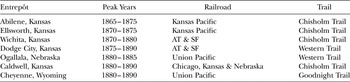
Thus, the third and final factor shaping the gunfighting market lay in the process by which the local world of gunfights, the seedbed for reputations and violence supply, was connected to the larger spatial scale of demand by incorporating actors. Gunfighters were able to become professionals in entrepôts because these locales served as points of diffusion for information about reputations for fighting skill and allowed actors to consolidate random fighting into professional role identity. In other words, it was in the high plains boomtowns of the cattle frontier—Dodge City (Kansas), Abilene (Kansas), Cheyenne (Wyoming), and others—where gunfighting became an actual career. These towns were intersections of the burgeoning cattle-trailing industry with railheads to Chicago, where big business met many of the actual participants in gunfights in the 1860s through the mid-1880s (see Table 1 for a list of the cattle entrepôts used in this study, as well as information on which railroads and trails they serviced).Footnote 60 Over time, the connections forged in these towns provided a framework upon which a larger industry of private violence experts would be built, and diffusion of information and role consolidation was the byproduct of social connections among gunfighters themselves.
Entrepôt Towns on the Cattle Frontier

By mediating spatial scales and providing a forum for gunfighting, entrepôts helped make the gunfighter market in two ways. First, they served as a diffusion mechanism for marketable reputations.Footnote 61 In such towns, a thriving local newspaper industry and informal rumor mill allowed information to spread quickly about comings and goings, particularly when events occurred that were bloody and sensational.Footnote 62 Moreover, the reputations of entrepôt fighters diffused regionally and beyond through a number of channels. The national press played an important role in this regard; cattle entrepôt affairs were nationally important, particularly during the boom years, when even “mundane” saloon brawls were covered with some frequency in big-city newspapers.Footnote 63 Individual entrepôt notables such as Wild Bill Hickok were profiled by “serious” periodicals as Harper's, while John Wesley Hardin, Luke Short, and Bat Masterson first gained notoriety through sensationalist journals like The National Police Gazette.Footnote 64 As key economic locales in a very important new market, entrepôts were also central nodes in diffusing information translocally.
Dodge City, a classic Kansas cattle entrepôt, was a particularly important meeting ground for violence experts to develop a shared economic identity and point of diffusion for information. Dodge became famous not only for its shootouts but also for an assortment of gunfighting talent that could be made available to buyers.Footnote 65 For example, when he served as sheriff of Ford County, Bat Masterson (a good friend of Wyatt Earp, a well-known former buffalo hunter, and a gambling-hall proprietor) was asked by the Atchison, Topeka & Sante Fe Railroad to gather a group of gunmen to protect railroad interests against the efforts of the Denver & Rio Grande (D & RG) to seize the right of way in a prized Colorado mountain pass. Masterson (with the help of Doc Holliday) put together a mercenary band of Dodge denizens, who, after making their way to Pueblo, Colorado, engaged in a short but violent struggle at the AT & SF roundhouse against the D & RG's men. Despite their willingness to work for Kansas interests in the Rocky Mountains, many of Masterson's colleagues (such as Dave Mather, Joshua Webb, and Ben Thompson) went on to careers as professional gunmen, selling their skills to a variety of bidders or, in the case of some, finding a life of occasional crime more profitable.Footnote 66 Dodge City's reputation as a gunfighting emporium continued through the 1880s, when it served as the recruiting ground for the mercenary bands who participated in the county seat wars of Kansas, a group which included at least one former outlaw (Ben Daniels), one future U.S. Deputy Marshal (Bill Tilghman), and Bat's brother James Masterson.Footnote 67
These examples are somewhat unusual—railroads and towns only rarely hired entire armies of gunfighters for military-style confrontation—but they still demonstrate the importance of the communication network connecting these towns. It was also this network which allowed gunfighters who were physically distant to share information among themselves about more usual economic opportunities to serve in posses, collect rewards, or identify targets for banditry. Livestock associations like the Wyoming Stock Growers Association and the Protective and Detective Association of Texas issued circulars detailing rewards for stolen cattle, while the Rocky Mountain Detective Association, founded by Dave Cook in Denver in 1873, had affiliates throughout the Rocky Mountain West (including the cattle frontier) who shared photos and information about wanted criminals.Footnote 68 Cattle and mining associations began seeking out those who had good reputations as fighters-for-hire, while well-known lawmen like Cyrus Shores and others became clearinghouses for information on identifying competent deputies and mining or railroad guards.Footnote 69 Sheriffs used the telegraph to mobilize posses composed of expert trackers with local knowledge in remote areas, while bandits used the same technology to coordinate stage and train heists.Footnote 70 The social organization of the gunfighting market depended, in other words, on the existence of towns embedded in a regional communications system.
Diffusion of information about job opportunities was also a matter of personal relationships forged in the entrepôt towns themselves, which continued to aid former residents as they moved throughout the Rocky Mountain West in the 1880s. Ben Daniels, for example, who had seen action as both a horse thief in Nebraska and a law officer in Dodge City, benefited from the network of former boomtown affiliates, including Jim Talbot, who helped him find work as a deputy in Lamar, Colorado, in the late 1880s.Footnote 71 After his experience with the Gray County seat war in Kansas in 1887 and 1889 (organized by Dodge City colleague Bat Masterson), he worked as an armed guard in the Cripple Creek struggle of 1893.Footnote 72 Former Dodge residents also organized a thieving ring in Las Vegas, New Mexico, in 1879 which drew heavily on the personal relationships forged in the saloons and gambling halls of the Kansas entrepôt.Footnote 73
But entrepôts also allowed for a second mechanism to help seal the gunfighting identity: they facilitated role consolidation—the making of gunfighting as a distinct career path from simple anti-statistic resistance or pro-state incorporation fighting. As interstitial zones with highly mobile populations, entrepôts were also places where novel forms of identity could flourish.Footnote 74 Without exaggerating the “free space” of the cowtowns—which, after all, also witnessed periodic and persistent counter-efforts at social restriction via vigilantism and temperance crusades—it was nevertheless in this space of role improvisation that the new career of the professional, non-partisan gunfighter crystallized.Footnote 75 Towns’ social recreations such as gambling and drinking (in addition to more prosaic activities like attending the local Mason hall or church) gave (mostly) men from different occupations a chance to interact with each other. Indeed, these various backgrounds often proved a fruitful source for violent conflict as well.Footnote 76 Moreover, open exposure to vice and to marginal and racially mixed populations also undermined social classifications, which had been fairly taken for granted in many Victorian communities.
The social life of these towns was important because it brought together actors within a setting in which they were no longer required to select among a limited set of racial, social, and economic identities—instead, they could, and largely did, improvise them, though often with a goal toward ultimately gaining respectability.Footnote 77 Moreover, they could supplant their older motives for fighting—honor or partisan attachment, for example—with a new, pecuniary concern. In an adaptation of Ann Swidler's terms, older economic roles in entrepôts confronted an “unsettled” space, specifically one wherein old traditions of localized fighting and masculine honor intersected with an emphasis on economic and entrepreneurial activity valuable to translocal actors, thereby inventing a distinct type of social actor capable of viewing violence as a remunerative skill.Footnote 78
The overlap between gambling, brothels, saloons, cattle entrepôts, and the gunfighting identity in the decades following the Civil War is striking. Fighters and aspirational fighters were often members of the “sporting” set, working not only as violence experts but also as faro dealers, professional gamblers, saloonkeepers, and small business operators who found uses for their skills in the rough and tumble entrepôts on a day-to-day basis.Footnote 79 Wild Bill Hickok, Wyatt Earp, Ben Thompson, John Wesley Hardin, Luke Short, Doc Holliday, and many others, for example, were owners of semi-licit businesses or professional gamblers in entrepôts during the 1870s and 1880s.Footnote 80 Of the 255 participants in gunfighting in my sample, 41 worked as saloonkeepers/owners, dance hall proprietors, or gamblers (mostly in boomtowns) at some point in their careers. These small-scale opportunities, too, were dependent on large-scale market incorporation. But unlike simple paid work as cattle drivers on the range, in which gunfighting skill was useful in a sporadic and limited fashion, the diverse set of industries composing the sporting life were a means for experts to apply their coercive capacities to different ends. As the social milieu of the entrepôt towns was harnessed to a larger, regionalized social network of proven gunslingers who knew each other and had fought with and against one another, these fighters, in turn, developed a specific, distinctly marketized role as autonomous violence experts, capable of combining a general approach to coercion in a variety of economic settings. They could be both employees and entrepreneurs, in other words.
As a result of the mechanisms of information diffusion and role consolidation, gunfighters increasingly began to regard all their employment options as violence experts—from law enforcement, to banditry, to private detection—as economic opportunities rather than commitments to a cause. Entrepôts fundamentally transformed the nature of all kinds of local coercive roles into a vibrant extension of the integrated post-bellum market, one infused by experts who had more in common with each other than they did with either traditional peace officers or outlaws. They provided pathways for, say, cowboys to become gunslingers, feudists to become bandits, and buffalo hunters to become stagecoach guards.
Over time, as the gunfighting role became more clearly detached from pro- and anti-state incorporation forces, gunfighting activity in specific entrepôts became less important than the social structure linking gunfighters together. In the late 1880s and 1890s, for example, mining boomtowns developed in places like Leadville, Colorado, and Tombstone, Arizona, which served a similar function of connecting resources to eastern market interests. But by then, the gunfighting market had become institutionalized, and gunfighters developed other ways of establishing reputation and sharing information about expertise. In particular, the social network of gunfighters became a means of reproducing the mediating function of entrepôts. The institutionalization of the gunfighting market, in turn, meant that the activity could spread beyond the narrow confines of the entrepôt towns. In other words, entrepôts were most useful in the early period of the gunfighting system, later supplanted by the creation of a socially integrated and translocally active class which served the same functions of diffusing information and consolidating the gunfighter role.
The most important consequence of this market's creation through entrepôts was not the expansion of a monopoly of violence on the part of central (or even local) state in western expansion; rather, it was the creation of a class of self-identified gunfighters who could sell their services to the highest bidder. Gunfighters were less engaged in a struggle against one another in pursuit of partisan political and social commitments than they were in seeking out economic opportunities in the marketplace. The next section tests this claim empirically.
GUNFIGHTING AS A MARKET INSTITUTION: 1850–1930
If gunfighting composed a market rather than a system of conflicts between state-builders and resisters, we should expect to see several things. For one, gunfighters should pursue careers that followed the logic of economic competition rather than political or social partisanship. This means that they should be concerned about building reputations in violence expertise in order to secure employment. It also means, however, that they should only rarely be committed to a particular cause; rather, gunfighters ought to pursue opportunities wherever they might arise. Even among those actors most committed to incorporation, we should be able to detect economic preoccupations. Moreover, if gunfighters are organized as an economic class through a spatial process of market integration, their gunfights ought to exhibit patterns that reflect the distribution of entrepôt towns as well as result in social connections that allow participants to share information and cultivate their skills.
Additionally, this market will evolve over time. For example, we should have evidence of the importance of precipitating events like the Civil War on participation in gunfighting, as well as decay in such relative participation over time as a market evolves. Additionally, entrepôts should be particularly important in the early years of the gunfighting system in both diffusing information about expertise and consolidating an opportunistic gunfighter identity. Over time, the social networks of gunfighters should provide the grounds to reproduce diffusion and role consolidation.
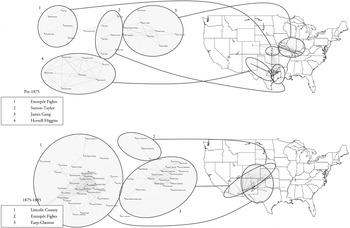
Gunfighting developed in four stages. The first, take-off stage lasted from just before the Civil War through approximately 1875 and was centered in Texas, Kansas, and Missouri. This period involved the organization of the James–Younger Gang out of the remnants of Quantrill's Raiders as well as the emergence of the first “Wild West” gunfighter characters in the buffalo hunting regions of the northern plains (e.g., Wild Bill Hickok) and the explosion of some of the most violent Reconstruction battles in Texas (e.g., the Lee–Peacock and Sutton–Taylor feuds of the 1860s). Participants in these events were, in large measure, relatively disconnected from one another, but the convention of gunfighting was born in this period, as was the linking of other categories of violent actor (such as “desperado”) to the larger category of the gunfighter. At the same time, a small network of individuals tied through entrepôts began to lay the groundwork for the transformation of random fighting into a means for diffusing skills and consolidating economic roles.
The second, professionalization stage of gunfighting occurred from approximately 1875 to 1885 and expanded its reach into New Mexico, Arizona, and Colorado, while remaining focused on the cattle frontier—this was the “golden age” of gunfights in popular mythology (for example, this was the period when famous gunfights occurred, involving Wyatt Earp at the Tombstone, Arizona, OK Corral and Billy the Kid in Lincoln County, New Mexico, as well as the martyrdom of Jesse James and Wild Bill Hickok). The key structural difference in this period was that what had, for the most part, been sporadic violent events now took on the cast of a larger system of social interaction, in which entrepôts played an important role in providing professional opportunities to savvy violence expert and diffusing their reputations. Indeed, this period has been mythologized for precisely this reason—what had appeared to be random violence could now be interpreted as a recognizable form of organized force.
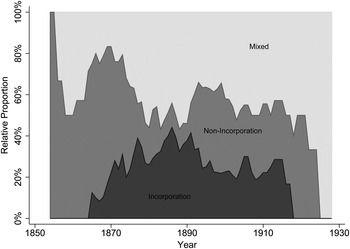
The third, consolidation stage of gunfighting, from 1885 through the end of the century (the period of the large, organized gangs like the Dalton and “Hole-in-the-Wall” gangs, as well as the development of a robust railroad and private detective industry), involved the partial polarization of gunfighting into camps, broadly speaking, of pro- and anti-incorporation forces. Though the social network tied bandits and lawmen into a gunfighting network across the Rocky Mountain West, the focus of the gunfighting system remained the Southwest—Oklahoma and the borderlands of Texas and New Mexico. This process by no means undermined the fundamental market logic of gunfighting, however, nor did it lead to any attempts at actually establishing a state monopoly over this pool of experts. Instead, gunfighters remained as mercenary as ever, often working for very powerful private interests such as livestock and mine owners’ associations rather than for the state, but they also became more specialized in the kinds of skills employed. Railroad and range detectives, for example, were expert at tracking the highly organized train robbery gangs, which allowed some of them (like Tom Horn) to hire out as assassins for extra money.Footnote 81 During this stage, entrepôts became less important than the social relations among gunfighters themselves in diffusing information about opportunities.
The last stage of gunfighting, from approximately 1900 through the 1920s, was a period of rapid decline. Most of the old gunfighters had died out by then, and the political organization of violence in the United States was transformed by participation in the Spanish-American War and, especially, World War I. A few fringe figures held on, but the older traditions of banditry were transformed by the introduction of the automobile and the advent of prohibition into a nationally organized set of criminal syndicates.
GUNFIGHTING: THE MAKING OF A CAREER
To explore these trends, I use a dataset of 255 gunfighting participants active mostly (though not exclusively) in the Southwest between 1850 and 1930 (the online appendix provides a list of these individuals and information about when their first and last gunfights occurred). The data are derived primarily from Bill O'Neal's Encyclopedia of Western Gunfighters, widely considered the standard reference work on the topic.Footnote 82
Although it is the most reliable and comprehensive dataset of its kind, relying on O'Neal's book comes with some important drawbacks. First, it is not fully representative of the group of individuals involved in the gunfighting system in the late 19th century. Only 12 of the 255 individuals were Hispanic or Native American, for example, which is almost certainly an underestimate.Footnote 83 This is a problem which can only be rectified by painstaking historical work, which is fortunately (if slowly) emerging.Footnote 84 But the dataset, as it stands, is biased toward the traditional view that gunfighting was under the purview of white males rather than involving individuals from a variety of backgrounds. Similarly, members of private agencies are also somewhat underrepresented; for example, there is only one known Pinkerton agent in the dataset (Tom Horn), though the agency was quite active throughout the West in the late 19th century.
A second drawback is that the data reflect the selection bias of historical memory. Specifically, the names in the dataset are actors whom historians have agreed ex post facto are gunfighters and on whom they have, therefore, collected information. Thus, the observations of events and actors are not independent from one another—gunfights are defined, to some extent, as those events involving gunfighters, while gunfighters are those who fight gunfights. A more random and representative sample of gunfight participants would start by identifying events and actors independently rather than relying on a pre-processed sample. This is a task that, unfortunately, must await future work.
Nonetheless, despite the drawbacks, these data offer some very important advantages. First, even given the historical selection bias, it is possible to explore patterns of social connection within the data—indeed, one of the most striking findings of my analysis is that historians examining individual gunfighters and gunfights in a more or less ad hoc fashion have also been evaluating instances of an interconnected social system. Thus, the most important unexplored fact about the creation of this social system—and one I can test directly—is how gunfighters were socially organized into a market, in which the opportunism often identified by historians is systematically verifiable. The fact that famous southwestern gunfighters forgotten, and then “rediscovered” by journalists and popular historians beginning in the 1920s, were nevertheless also historical actors embedded in an empirically verifiable social network offers confirmation for the research strategy I have adopted in this article.
A second advantage is that the data include important variation. Specifically, not all of the 255 individuals identified in the dataset were professional gunfighters, nor were all gunfights equally likely to lead to professional employment I have outlined above. Despite engaging in gunfights, 67 of the individuals in the dataset never seemed to have earned their living as gunfighting professionals. Instead, differences in the temporal and spatial patterns of interconnection among these actors should indicate how and why some were able to convert their experiences with violence into viable careers as gunfighting specialists while others were not. For example, the spatial theory depends heavily on the incorporation of the ranching industry in the post-War Southwest; gunfights involving actors embedded in the cattle trade in the 1870s and early 1880s should, therefore, be more important in diffusing reputation and consolidating role identity than those fought in Montana or California during the same period. The variation available in this dataset—including, as it does, events across a 60-year period and extending from California to Arkansas—provides an adequate means of testing this theory.
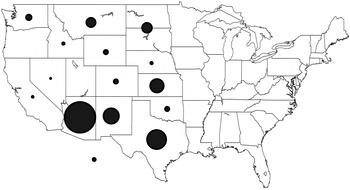
The data are quite comprehensive, though by no means exhaustive. In total, these actors fought at least 590 gunfights, ranging from 1854 (the earliest gunfight in the dataset) to 1928.Footnote 85 Texas (165) had, by far, the largest number of gunfights in the sample, followed by New Mexico (81), Kansas (78), and Arizona (65).Footnote 86 These four states, in fact, represent two-thirds of the total number of gunfights, providing a first hint as to the spatial concentration of gunfighting.
Moreover, while these data are a very small sample of the overall number of gun battles in southwestern states during the 1854–1928 period, they provide a rough approximation of the general trends in violence identified by other scholars.Footnote 87 Many gunfights on the cattle frontier were not captured in the data, but these likely reflect a fairly representative sampling of those that did occur.
Before embarking on an analysis of the emergence of the gunfighting market, I first present brief summary data of gunfighting and fighter participation trends over time. This helps establish a context for understanding the contours of the market and confirms the basic empirical discussion presented thus far.
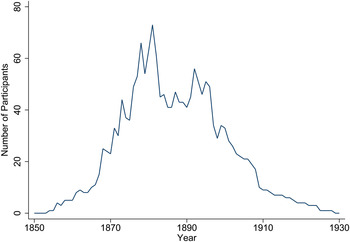
Gunfighting exhibited a particular development pattern—it grew initially after the Civil War, peaked in the mid-1880s, then gradually declined. Figure 1 depicts the number of participants in the gunfighting system. The slope of the line indicates that, after a period of slow growth in the 1850s and early 1860s, the Civil War catalyzed a dramatic escalation of individuals who had had a gunfight or would have one in the future. Figure 1 bears out the claim in the preceding narrative that the Civil War helped induce higher levels of gunplay in general.
Gunfighting System Participants.

Additionally, as we would expect, participation in the war was a key experience for many gunfighters. Over 80 percent of gunfighters in the mid-1860s were known to be Civil War veterans; even at the height of the participation in the gunfighting system in the mid and late 1870s, nearly 40 percent of the total gunfighting population had been active in the war.Footnote 88
A third point is that the earliest period of gunfighting activity was also the most intense in terms of fights per participant. Between 1850 and 1875, there were approximately .43 fights per participant per year, while in the second stage (1875–1885) the number declined to .34. In the last two stages of the gunfighting system, the average number of yearly fights per participant was reduced to .27 (1885–1900) and .15 (post-1900) respectively. These proportions declined despite the fact that the aggregate number of fights per year actually increased until after the cattle boom declined in the late 1870s (in 1878, for instance, there were 36 fights, the most of any given year). In other words, even though overall levels of violence did not decline until the mid-1880s, individual gunfighters were increasingly able to go about their work without having to resort to force as frequently as they had previously. Some of this can be explained as simply a consequence of the net cumulation of gunfighting system participants over time, but it also suggests, potentially, that reputations may have begun to substitute for actual fighting as a means of securing career opportunities. Later, I show more precisely how the diffusion of reputations played out in the career pathways of professional gunfighters, but this trend illustrates the general point that the practices of gunfighters changed over time in a manner consistent with the creation of a market.
Although these snapshots of the gunfighting system over time provide a macro-level view of the temporal trends in gunfighting, they do not tell us (1) how reputations became attached to particular gunfighters who fought in specific places and diffused to potential employers; (2) how these physical locations helped consolidate random fighting into a career; nor (3) how social connections forged by gunfighters helped organize these careers into a bottom-up supply of experts forged by local fighting and capable of extending throughout the West. In order to understand the role those fights played in creating a class of violence expertise and to identify gunfighting's unique market logic, in other words, it is also necessary to delve deeper into who these individuals actually were and how the roles they adopted changed over time. These issues are addressed in turn.
ENTREPÔTS, REPUTATION DIFFUSION, AND EMPLOYMENT OPPORTUNITIES
The first way to examine the gunfighting market is to look at how gunfighters transformed a reputation for skill into a career. If entrepôts were important for helping to convert gunfighting into a profession, not only does this fact provide general evidence that gunfighting was part and parcel of the vast cattle market's creation in the Southwest, but it should also show empirically that those who fought in such towns would be specifically more likely to engage in paid gunfighting work than those who fought elsewhere. In other words, entrepôts should have played a key role in diffusing reputations about gunfighting skill. At the same time, if the developmental story I have outlined is correct, entrepôts should have been most important in the earliest stages of the gunfighting market's emergence. Over time, new entrants into the gunfighting system ought to have developed professional careers through personal contacts rather than geographic locale.
Without access to evaluative documents and internal memos across a variety of employers, it is difficult to systematically test the diffusion of reputations in historic markets. Although newspapers and other media, as noted, provided coverage of boomtown events, this alone does not establish the extent to which information about specific gunfighters created professional opportunities. Thus, as a proxy for diffusion, I have tried instead to identify the effects of experience in entrepôts on professional opportunities directly, assuming that at least one way in which employers would be willing to hire such experts would be a function of demonstrated expertise in a specific place.
To begin, therefore, I have distinguished between amateur and professional gunfighters. I coded “professional” gunfighters as those who either held a frequently violent role where making money was the primary aim (e.g., gambling) or held a job in which violence was the key function (e.g., law enforcement).Footnote 89 Professional fighters in the dataset were employed in at least 34 different firms during their careers, ranging from huge entities like the XIT Ranch in the Texas Panhandle and national transport businesses like Wells Fargo and the Union Pacific, to smaller family ranches and local range associations. While most incorporation and mixed gunfighting professionals worked for local communities or large associations, others such as Wyatt Earp, Bat Masterson, and Ben Thompson also went into business as saloonkeepers and gamblers.
Fighting in entrepôt towns was a key way for gunfighting participants to become professionals, particularly in the early stages of the gunfighting system. Indeed, of the 32 gunfight participants in the dataset who fought in the entrepôt locales listed in Table 1 between 1865 and 1885 (the height of the cattle boom), only 4 failed to become gunfighting professionals, whereas over a third of the non-entrepôt fighters failed to become professionals: a statistically significant difference.Footnote 90 In other words, entrepôts were crucial in connecting fighters to job opportunities, forging links between employer and employee in those crucial years after the Civil War.
To mitigate the obvious concern that individuals in entrepôts were simply killed less frequently than other kinds of gunfighters (and hence had more “chances” to become professionals), we need also to look at gunfighters who had long and varied careers.Footnote 91 Even here the importance of the entrepôts is clear, however: those who had fights over multiple years and fought one of their first two fights in entrepôt towns were significantly more likely to become professionals in later years than those with multi-year gunfighting experiences in other places.Footnote 92 When we consider the fact that well over half (69 of 120) of the professional gunfighters identified in the sample for this period also fought in the cattle trail country of Texas, Oklahoma, Nebraska, and Wyoming, it is clear that not only was gunfighting relatively common in cattle towns, but it also played a unique role in opening up professional opportunities for participants in fights by spreading the news about their skill.
More strikingly, there is evidence that fighting in entrepôt towns also created more opportunities for professional career-development over time. That is, having experience in an entrepôt early in one's career was a professional advantage in later years, when the cattle trade had declined in significance. To measure this, I coded the number of “moves” made by professional gunfighters into new positions as violence experts in the years following their first professional experience with violence; those who fought in entrepôt towns made more such moves, on average, than those who did not.Footnote 93 In other words, entrepôt fighters were significantly more flexible in their career trajectories than other kinds of professional gunfighters, exploiting multiple opportunities to use violence in order to earn money.
That they had more jobs, of course, could also mean that such entrepôt fighters were also less likely to keep jobs they did have, perhaps because they were the sort who lived a more mobile life—the peripatetic careers of Wyatt Earp, John Wesley Hardin, and other famous entrepôt fighters, many of whom made their way from boomtown to boomtown, indicate that this factor likely played a role. But even if this were true, these naturally entrepreneurial actors were still critical in the formation of the empirical gunfighting market, since boomtown fighters were more likely to occupy violence expert positions and convert them into professional careers. Thus, regardless of whether the entrepôt difference in professional mobility is a selection effect of boomtowns, the underlying spatial effect is real: those who were active in places on the cattle frontier where large-scale capital interacted with the small-scale propensity for southwestern gunfighting were also pioneers in professionalizing a market for violence.
After 1885, entrepôt towns themselves played less of an important role in mediating the relationship between gunfighting experience and professional opportunity. Although fighting was still clustered in southwestern market centers—for example, Tombstone (Arizona), El Paso (Texas), and Las Cruces (New Mexico)—it was no longer as important to have connections to specific places to become professionals as the pre-1885 period.Footnote 94 Professional opportunities in the later period were more influenced by personal connections to pre-existing gunfighters and to a burgeoning system of institutionalized opportunities to gain jobs. Thus, latter-day professional fighters like Bob Meldrum and “Deacon Jim” Miller had close friends or relatives who were already part of the gunfighting system.Footnote 95 By this latter period, gunfighting had become a professional career, distinct from partisan commitments, banditry, or other political activities.
CAREERS AND ROLE-CONSOLIDATION
The second way to examine the creation of a market identity for these actors, then, is to identify how their experiences became consolidated into a particular role. That is, if gunfighters were truly market actors, we should expect them to pursue opportunities wherever they might be found; if they were state-builders or feuding partisans, on the other hand, we should observe them committing to predictable and stable ways of using their skills. The consolidation of the economic role of “gunfighter,” in other words, should be marked by a lack of partisanship and the predominance of certain kinds of actors in the gunfighting system.
Building on Richard Maxwell Brown's original typology, I coded the roles of each professional gunfighter in the sample (n = 188), noting whether or not they worked at any point for law enforcement or incorporation interests (e.g., private detectives, range detectives, etc.), whether they had any criminal behavior or activity in their careers, and whether or not they had combined both kinds of roles. Those whose biography included only the first set of roles, I coded as Incorporation gunfighters; those whose biography included only the second set, I coded as Non-Incorporation, whereas those whose biography contained both, I coded as Mixed.Footnote 96
Figure 2 depicts the yearly proportion of professional gunfighters fitting each profile. The curves in the figure demonstrate two important things. First, the early period of gunfighting was characterized by a relatively high level of other and non-incorporation activity and a low level of incorporation participation. This was, I have argued, the result of the conversion of Civil War activity into banditry, as well as generalized expansion of gunfighting techniques. Clear roles had yet to change, and the market had yet to develop a clear set of options, a feature that would change over time. Both the rise of incorporation and, especially, the emergence of a type of gunfighter capable of switching back and forth between pro- and anti-incorporation activity (the mixed type) indicate increasing levels of diversity in the kinds of jobs taken on by gunfighters.
Professional Gunfighter Career Types.

Second, and more intriguingly, mixed gunfighters were also an increasingly overrepresented proportion of the yearly gunfighting system, particularly after 1877 and 1878. These were the true “professionals,” who used their skills to pursue opportunities as they emerged. The growth of this class complicates Brown's binary story about incorporation and non-incorporation and introduces strong evidence that gunfighters had developed a conception of themselves as autonomous market actors. It also suggests, however, that these new market actors were not acting as the kinds of predators identified as state-builders by scholars, such as Charles Tilly and Mancur Olson, despite occasional forays into self-interested criminality—instead, gunfighters became dependent on a burgeoning demand from other powerful economic actors who were involved in building an integrated market in the West, since finding paid work as a gunfighter during this period began to mean taking a position with a railroad corporation or a private detective firm.Footnote 97
The social milieu of entrepôt towns was critical to forging the mixed identity. Those who fought in the entrepôt towns identified in Table 1 in the early part of their careers were much more likely to move back and forth between different kinds of incorporation and non-incorporation roles than those gunfighters who did not. Overall, 119 of the 188 total professional fighters in the subsample were active during this period; of those who fought in entrepôt towns during this period, 57 percent can be categorized as mixed fighters, while only 30 percent of the non-entrepôt fighters pursued this kind of path, a statistically significant difference.Footnote 98
Moreover, there is evidence that early exposure to the violence and the sporting life of entrepôts made actors more likely to pursue mixed career paths in the later parts of their careers. It is not possible to compare all of the career sequences of professional gunfighters directly, since we do not yet have very good details on many of their biographies. However, when I restrict the sample to those for whom we have reasonable biographical information, it is possible to test, at least partially, the effect of entrepôt exposure on career trajectory. Indeed, the difference in career trajectories before and after time spent in entrepôt towns in the period between 1865 and 1885 is striking—those who spent time in such towns were significantly more likely to take on both incorporation and non-incorporation jobs after their time in the towns than before.Footnote 99 This is true despite the fact that prior to coming to the entrepôt town these professionals were more or less similar in their career trajectories to those who never came to such towns.Footnote 100 In other words, entrepôts were important in transforming relatively stable career trajectories as pro- and anti-state incorporation fighters into more opportunistic economic roles.
Brown's typology ultimately fails to capture the underlying economic motivations characterizing many gunfighters, as well as the flux in seemingly stable careers. This is clear even when we examine the most ostensibly pro-state actors. Indeed, even among gunfighters who only worked for incorporation interests, a significant minority (around 38 percent) moved between private and public employment, working as private detectives, cattle inspectors, bounty hunters, private guards, or special constables in addition to serving as law officers. Moreover, at least one-third of the incorporation fighters held both federal or state and local law enforcement roles at some point in their careers (the true proportion is likely higher, given the frequency with which Deputy U.S. Marshal credentials were bestowed upon sheriffs coupled with the scarcity of extant records), allowing them to maximize opportunities for earning fees. Though these actors were, undoubtedly, contributing to the “law and order” of the frontier, many were likely doing so with an eye first and foremost toward making money. Local state formation, in this sense, was secondary to the process of market formation and was initially mediated through market centers. The new career of professional gunfighter, however, increasingly took on an explicitly opportunistic bent, and soon became the provenance of the social network among violence experts which was developing in the 1870s and 1880s.
SOCIAL CONNECTIONS OVER SPACE
Thus far, I have empirically demonstrated that (1) fighting in entrepôts allowed actors to find economic opportunities to use coercive skills by diffusing information about their reputations, and that (2) over time, these opportunities were consolidated into a professional and explicitly economic career reflecting opportunism rather than partisan attachment. At the same time, in order to properly differentiate this market from the top-down, state control of violence with which most scholars have been concerned, I now turn to an analysis of how social connections among gunfighters helped create a bottom-up supply of violence experts, in which fighting created conduits through which participants could themselves share information about jobs and reputations. If gunfighting were organized as a market, it should begin to resemble a relatively decentralized but integrated system of interactions rather than a hierarchical and coordinated system of relationships organized by a state center. Additionally, over time, economic actors ought to be organized into a social network in which both alliances and conflicts offer routes for social connection, reflecting a commitment to opportunism rather than deep partisanship or political commitments. Finally, if gunfighting evolved out of the cattle market and in entrepôt centers according to the developmental story I have outlined, we ought to be able to detect the expansion of these gunfighter social connections over space, as entrepôts became less important.
The best way to examine these relationships is to use the tools of social network analysis, which both depict whether or not any two actors had a social relationship, as well as the overall pattern of relationships across all actors. With these tools, we can identify measures to help us understand exactly how integrated and complex the system of interactions among gunfighters was, as well as identify important structural changes over time.
Fighting was the key way that these experts developed skills and built reputations. Fights were also, however, social occasions in which individuals got to know each other directly, either as allies or enemies—in other words, they helped make precisely just such a network. To capture the relationships among gunfighting actors, I created an original database including information for each of the 255 members of my sample in which network ties indicate who each fought against (conflict) and those with whom each were in league with during fights (alliance). These data help me demonstrate two things. First, they show that actual fighting was patterned; that is, it involved clusters of individuals rather than random individuals engaging in otherwise disconnected fights. This is important because it helps sustain the point that even those who didn't know each other directly could still gather information through participating in a social network. Second, when combined with information about where these fighters were active, I can show how these networks expanded across space, allowing actors to spread information about their skills and exploit opportunities outside the entrepôts themselves.
In Figures 3 and 4, I depict both the networks of gunfights as well as the geographical locales of the fights in question. These diagrams are somewhat simplified (e.g., they capture only the most important gunfighting dyads during each period, not all dyads). The circles around the networks on the left side identify activity “clusters” of gunfighters who knew each other and engaged in various kinds of fights. This provides some narrative coherence to the activities of those in the network. These clusters are tied to circles on the right that indicate the space in which those individuals were active. Table 2 provides general information about each cluster, including notes about what the participants fought about and a shorthand for who was involved in the conflicts.
Spatial and Social Gunfighting Networks.*

Spatial and Social Gunfighting Networks.*

Gunfighter Activity Clusters (1850–1930)

In this article I have not examined each cluster in detail; the summary information provided in the table helps establish the general applicability of the four-stage model of gunfighting development I outlined earlier. Thus, early fighting was mostly concerned with feuding and banditry, whereas what I call “general” fighting over personal or purely opportunistic issues and politico-economic matters became more important in the second stage. During the third stage, when gunfighting had consolidated into a professional role, banditry re-emerged as an important focus of gunfighter activity without displacing more general economic conflicts (such as class conflicts between small and large-scale ranchers in Johnson County, Wyoming). In the fourth stage, gunfighting collapsed as a viable economic activity; although actors such as Jim Miller and Tom Horn, for example, engaged in work as paid assassins, they were not part of a larger social community tying fighters together, and only small isolated clusters can be identified in the data.
These diagrams reveal several useful pieces of information about the spatial development of the gunfighter market. First, they graphically represent the transformation of a system of local fighting on the cattle frontier in the post-Civil War era into a regional but decentralized system. In the first period (roughly 1869–1875), fighting was clustered in Texas and the northern plains, while most participants engaged in local and fragmented social clusters. This is reflected in the fact that most of the circles on the map do not intersect with one another; much of the activity in Texas, for example, was limited to that state and, though proximate, the feuds generally were located in distinct counties. By the second period, however, gunfighters in entrepôts and those active all along the cattle frontier were moving into Arizona and New Mexico. Moreover, these clusters began to converge with one another geographically (as seen in the two overlapping circles on the map for the period between 1875 and 1885) while expanding outward, reflecting the fact that gunfighters were beginning to move away from entrepôts to find work, particularly after the initial cattle boom subsided. By the third stage (1885–1900), gunfighters were active throughout the Rocky Mountains and Southwest, fighting in Oklahoma, near the U.S.–Mexico Border, and Montana/Wyoming in particular. At the same time, however, these actors, now mostly professionals, also moved between these regions to follow opportunities for banditry or for working as hired guns on range wars (as they did in Arizona's Pleasant Valley and Wyoming's Johnson County). The gunfighting system ultimately collapsed after the turn of the century and was reduced to residual fighting in Texas and on the borderlands.
The diagrams also depict important information about the group fragmentation and complexity of the fighting systems connecting actors together. Both of these characteristics, in turn, are crucial for understanding the social patterning of a gunfighting market. We can think of group fragmentation as the opposite of integration—the more fragmented into small rather than large groups a network of actors is (relative to the number of actors in a network), the less likely actors are to get a chance to interact with one another. I treat groups as a subunit including all those who are connected in some way in a network, what scholars call weak components—hence, a single network is broken into multiple groups if there are actors anywhere in the network who are unable to reach each other through some tie of alliance or conflict.Footnote 101 Moreover, if there are smaller groups in a network, those groups are mutually exclusive—the group to which a gunfighter belongs includes all those with whom he or she is connected. Groups can be as small as a single actor who doesn't possess any ties (an isolate) or as big as the entire network. Obviously, the fewer groups into which a social network of a given size is split, the better integrated the network is on whole and the more that participants are, potentially, able to spread information about their successes to others.
Graphically, we can see the growing integration of the gunfighter market in the late 19th century by ignoring the cluster circles and focusing instead on the network ties on the left-hand side of Figures 3 and 4; even though the number of participants in the gunfighting system grows larger in the second and third time period, the number of groups into which they are divided stays the same or even decreases. For example, the four activity clusters I identify in the pre-1875 period in Figure 3 are divided into three mutually exclusive groups (John Wesley Hardin, for example, connects the Sutton–Taylor and Entrepôt clusters into a single group), while the much larger networks of actors between 1875 and 1885, and 1885 and 1900, are divided into two groups.Footnote 102 By the late 19th century, participants in these historical activity clusters—such as the Doolin-Dalton gang system in Oklahoma—were also connected to actors in other clusters (such as the Johnson County War in Wyoming). Despite usually being treated as distinct by scholars, these different clusters of activity were in actuality integrated into a larger system of social interaction through which information about reputations and professional opportunities could spread.
Moreover, these connections were complex—that is, they were composed of multiple mixed conflict and alliance experiences. Complexity in a group is important because markets among gunfighters were built both through fighting to cultivate reputations as well as participating in alliances and partnerships to share information and consolidate a professional role identity. Thus, on the one hand, a group of actors tied together solely through conflicts would indicate duels or rivalries between actors who were themselves not involved in alliances. This might have permitted fighting without also providing opportunities to spread information regarding reputations among allies. A group made up solely of alliance ties, on the other hand, would indicate the presence of armed bands or partners fighting together against outsiders, indicating information diffusion but not necessarily reputation building by vanquishing other known participants in the gunfighting system. Conversely, mixed groups—with both kinds of relations present—would indicate a complex factional system of interaction, as alliances and conflicts concatenated into extended chains of affiliated and conflictual fighters.Footnote 103 In this sense, complex groups sustained both reputation building as well as the role consolidation mechanism at the core of the formation of a gunfighting market.
The patterns in the network diagrams suggest growing complexity over time. Graphically, Figures 3 and 4 evince increasing number of ties and diversity of tie type until the end of the 19th century. These groups were not only quite decentralized (in that actors possessed multiple links to one another and no single actor dominated the links in any given group), but they were also increasingly composed of both conflict and alliance ties. This is just what we might expect from locally oriented actors using fights to exploit paid opportunities or build their reputations among a diverse set of participants.
One advantage of network analysis is that it allows us to measure some of these properties. Network analysts have developed a number of such descriptive techniques. These include measures such as the smallest number of ties (or “degrees”) it takes to get from one actor or node to another, as well as the overall number of actors to whom one is tied out of a population, the centrality of nodes in a pattern of ties (how important a single node is in linking other nodes), and so forth. For the purposes of this article, I focused on two numerical measures: first, I identified the extent to which gunfighters actually were linked into larger groups rather than merely acting on their own or in many smaller groups (which I used as a proxy for group fragmentation) and, second, I measured the degree to which different kinds of relationships tied actors together (a proxy for complexity).
Table 3 provides summary information on the general network organization of gunfights over time (such as number of participants and number of ties), including the composition of the gunfighting networks in each period.Footnote 104 I provide a measure of both the overall level of group fragmentation of the gunfighter networks and of the relationship strength between the complexity of the groups in the networks and the types of actors who belonged to those groups (e.g., the number of professional fighters in the group and the number of fighters in the group with entrepôt experiences). The top panel of the table includes information on the complete networks—that is, both conflict and alliance relations within fights across time. The bottom panel isolates each relation type, depicting only alliance and only conflict ties among the group of actors for each period. This panel also contains information about how fragmented the network of alliance ties or conflict ties were into small groups when networks are reduced to that type of relation alone.
Gunfighting Networks (1850–1930)

As we would expect with the growth of a decentralized but expanding market, gunfighters became more integrated into groups over time, as participants got to know one another and engaged in extensive factional disputes. To demonstrate this, I rely on a group fragmentation score, which indexes the proportion to which a network among individuals during a given period is broken up into distinct, disconnected subgroups, allowing us to evaluate the relative concentration of actors involved in larger social groups rather than isolated interactions.Footnote 105 The closer each score is to 1, the more fragmented a network is into smaller communities of actors. Over time, as seen in Table 3, this number decreases; whereas before 1875, the ratio of groups in the whole network to active individual gunfighters was .49 (indicating that the groups in this network were quite small and did not provide gunfighters opportunities to interact broadly across the network), between 1875 and 1885, this proportion declined to .35, indicating that even though the number of fighters in the network increased from 76 to 134, these fighters were more likely to have extensive social interactions. The scores thus reveal the growth of gunfighting into an integrated system of social interaction in the 19th century before suffering collapse in the following years.
Table 3 also displays quantitative information about the complexity of these networks. I treat complexity in a network as the extent to which different kinds of ties connected actors together in each group of more than two members (complexity in dyads or isolated groups doesn't make sense since the measure depends on the possibility of distinct tie relations among multiple actors). To measure this property, then, I used a score based on the likelihood that any two ties within a group were of the same type of relation to account for the “diversity” of the ties linking actors within a group. This score, which also ranges from 0 to 1, thus measures the average extent to which a given group is dominated by conflict or alliance relations; the higher the score, the more a complex set of relationships tie actors together within each group. I then averaged this measure across all groups to create a composite score for each period.Footnote 106
As is evident in Table 3, gunfighter groups grew more complex throughout the late 19th century. Specifically, the average complexity index for groups across the network increased from .21 in the pre-1875 period to .41 and .46 in the following periods (there is no score for group complexity in the last period because all the groups active in the network in this period were made up of isolated actors or dyads). This indicates that simple feuding or duelling relationships were being replaced by much more intricate forms of gunfighting conflict and suggests that a market was forming.
How do we know that this was the case? One indication might be that those who fought in market centers should also have members of more complex groups. And, indeed, this is precisely what we see; as indicated in the rising rho association coefficients correlating complexity and entrepôt experience in Table 3, the strength of the relationship between the two phenomena grew stronger over time, rising from essentially no such relationship (.03) in the earliest stage to fairly robust positive correlations of .62 and .74 in the second and third stages respectively. This suggests actors carried the early social experiences and connections forged in entrepôts with them even after the cattle boom was over in the mid-1880s and that such social relationships were crucial in helping to perpetuate the market for fighting over the long haul.
Surprisingly, the same relationship does not hold when we measure the relationship between earning money as a gunfighter and participating in a complex group; indeed, the relationship between professional identity and complexity was negatively (though weakly) in the second (–.27) and third (–.20) stages of the gunfighting system. This seems to imply that, while professionals composed a larger proportion of the overall fighters in the system, they increasingly lacked the capacity to both build reputations and diffuse information via complex social ties possessed by those with entrepôt experience. Indeed, this suggests that the gunfighting market was quite fragile; while the complex social networks established in the entrepôts allowed it to expand past the cattle frontier, the gradual disappearance of those networks also may have helped precipitate the collapse of the market at the turn of the century.
In short, integration across social networks and complex patterns of interaction among gunfighters provided the raw material through which fighters could shed their partisan attachments, providing chances for those with very different kinds of careers to interact with one another, form alliances, share information, and evaluate each other's skills. This, in turn, was manifest in fighting between and with actors who had very different kinds of careers—indeed, most fights were not between pro- and anti-state forces, but rather involved actors with very different career trajectories.
Data on gunfights involving actors for whom we have information about career role for multiple participants bolster this claim. Among the 255 individuals in the sample, there were, in total, 205 specific dyads who experienced, at some point, a gunfight between them and 176 dyads in which both members were, at some point, allies during a gunfight.Footnote 107 Of the dyads in which both parties fought each other, most (about 88 percent, or 180) had different kinds of careers (i.e., one member might be a non-incorporation actor while another would be an incorporation specialist). At first blush, this would appear to undermine the argument that fights reflected non-partisan commitments, but when we look closer at the data, we find that only 36 percent (or 73) of conflictual dyads were of the classic incorporation vs. non-incorporation variety; most involved actors who fit uneasily within the divide between state-builders and resisters. Moreover, well over 48 percent (or 86) of those who were allies in gunfights also pursued different kinds of careers. Gunfighting clearly forged alliances and friendships among individuals who had very different experiences as violence professionals, allowing them to relate to each other through their marketable skills rather than in commitment to a shared cause.
One of the key claims in my theory is that gunfighters became highly mobile, willing to pursue economic opportunities wherever they might be found—they were not, in other words, organized from the top-down or focused on only partisan or parochial issues in specific locales. Thus, it is useful to depict the overall flow of fighters between different locales as well, which can shed light on how gunfighting activity was clustered as well as where actors were likely to move. Figure 5 graphically depicts the number of gunfighters in the sample who fought in the locales connected by the lines and aggregates the data found in Figures 3 and 4. It demonstrates, first and foremost, that the vast majority of fighters who were geographically mobile moved through the Texas–Oklahoma–Kansas and Texas–New Mexico–Arizona cattle and mining corridors, just as the model above predicts.
Flow of Gunfighters between Locales (1850–1930).*

But if the theory is correct, these actors should also have been organized into an abstract “social space” in which violence experts focused their activity in economic “hotspots” rather than simply fighting in areas to which they were physically proximate. To test whether or not gunfighting activity of fighters reflected mere geographic concentration, I used a nonmetric multidimensional scaling to calibrate “distance” in a two-dimensional space among locales, with similarity scores (e.g., proximity) among locales derived from the number of gunfighters active in both places.Footnote 108 Multidimensional scaling is a technique used to minimize a distance function among attributions of similarity or dissimilarity so as to generate an n-dimensional set of coordinates through which those similarities or dissimilarities can be examined in Cartesian space.Footnote 109
When we compare the social similarity of these locales to their geographic proximity using a Mantel correlation test, however, we find that social and physical distance are only very weakly (though positively) associated (r = .24).Footnote 110 What this indicates is that although their patterns of movement were affected by geography, fighters were mobile in ways that cannot be explained by physical proximity alone. One reasonable interpretation of this finding, then, is that gunfighters tried to locate opportunities to use their skills, wherever they might be found. They did not only engage in local or parochial fights, as we might expect if gunfighters were primarily interested in political consolidation or resistance.
At the same time, although gunfighters gravitated toward zones of economic opportunity, this does not mean that the location of actual fights was unimportant. Indeed, because, according to the theory, only some places could help incorporate actors into this system, we nevertheless expect actual fights to cluster around specific entrepôt locales. When I calculated a Moran's I coefficient to test gunfight proximity, the results indicate this exact phenomenon: gunfights did not take place randomly across the system, but were focused in locales that were relatively close to one another.Footnote 111 Given the fact that the cattle, mining, and railroad industry created a network of geographically interlinked towns and that the highest overall levels of fighting were in these very areas, such clustering supports the notion that entrepôts were critical in bridging local gunfighting and market formation.
In other words, as the theory would predict, fighting clustered in specific places was crucial in initiating social ties and building reputations, but the fighters themselves became highly mobile, moving from place to place as opportunities presented themselves. How, though, can this spatial pattern be distinguished from the activities of the state? That is, what does this actually tell us about an explicitly market form of organizing force that is distinct from that of political centralization and control?
To get a sense of these differences, I provide a spatial representation of the activities of the military during the same period. If the theory is correct, then the state ought to be concerned primarily about territorial rather than economic incorporation. Gunfighting, on the other hand, should be concentrated in areas reflecting economic prerogatives.
Indeed, this is just what we see. The map in Figure 6 depicts the distribution of U.S. military battles with Indian communities across space following the Civil War. The first thing to notice is that the federal government was quite active in fighting the Indian Wars across the West during the 1860s and 1870s. Though obviously not that surprising, this reinforces the general point made by scholars such as Stefan Heumann that the West was actually the site of a fairly profound expansion in state capacity in the post-bellum era.Footnote 112
U.S. Military Battle Campaigns against Indian Groups (1866–1891).*

On the other hand, market incorporation, which was just as profound, nevertheless led to a different pattern across space, one focused on the cattle and mining extraction zones of the lower Rocky Mountain West and Southwest. Thus, while there was significant overlap between the presence of gunfighting and the military (in part because territorial incorporation often was a facilitating condition leading to market incorporation), the overall pattern still suggests important functional differences. In particular, the U.S. Army was heavily involved in patrolling the Canadian border region in Montana and the Dakotas in the 1870s and early 1880s, an area where gunfighting was relatively scarce and population densities (and hence, market activity) were fairly sparse. This is what we would expect from a force engaged in trying to secure national borders and manage native groups. At the same time, gunfighters were more active in areas of the Rocky Mountain West where Indian pacification had been more or less accomplished by the late 1870s but where mining interests grew considerably. Moreover, historically we know that, although some gunfighters did indeed participate in anti-Indian campaigns (particularly at the second battle of Adobe Walls in 1874), they did so independently and on an ad hoc basis; the military, conversely, was primarily engaged in precisely this kind of warfare during the post-bellum period.Footnote 113 In other words, while both gunfighters and the military were involved in some of the same areas, there was a very clear division of labor between them, one that reflected the territorial and market bases for their activity.
In short, although it is important to be careful with these findings—the geographic data are not very granular and the correlations reflect general tendencies rather than local mechanisms of market incorporation in specific towns—this analysis nonetheless strongly suggests that gunfighting had a distinctly spatial organization that followed a market rather than political logic. That is, while the fighting itself tended to cluster in specific places, the gunfighters who participated those fights were incorporated into a much larger, national market which was not bound to geographic proximity. In becoming institutionalized as a class of violence experts, gunfighters used entrepôt towns to move from the local level of the gunfight itself to integration with a translocal market, allowing their skills to become transferable and saleable.
However, my theory ultimately hinges on evidence that gunfighters were involved in a decentralized, bottom-up supply of local fighters who were nevertheless highly interconnected, allowing not only reputation building but also information diffusion and role consolidation. Thus, the final piece of evidence for the market organization of southwestern gunfighting comes when we broaden our scope beyond the fights to examine historically verifiable social interactions among these actors in general. Although somewhat less reliable than relying on discrete events like gunfights, the reconstruction of the general social network among gunfighters—including relations such as friendship or economic rivalry, which may not have actually led to gunfighting—provides a useful snapshot of how the temporal development of this network of entrepreneurs looked as a whole.Footnote 114
When all such social ties among the sample group of actors are included in the network, it is possible to measure just how diffuse and widespread the interactions were among gunfighters. Indeed, 196 of the 255 total gunfighters in the sample (approximately 77 percent), including most of the important figures in gunfighting's history, were connected to each other in some way, through social alliance, kinship, or conflict with other members of the sample set. Moreover, as we would expect in a market rather than in a system organized by particular sets of state-building or state-resisting actors, this network was not organized around a single hub or central individual.Footnote 115 Instead, it was diffuse and decentralized. When we include ties to individuals who were not themselves members of the sample, it is possible to trace connections among at least 220 (or 86 percent) of the gunfighters examined in this article. This evidence demonstrates that famous gunfighters clearly knew each other both professionally and socially, through small groups of closely knit friends and relatives as well as through figures who bridged those more enclosed groups.Footnote 116
Because this article is part of an ongoing research project, I reserve a detailed longitudinal and statistical analysis of the composition and organization of this network for future work, but this snapshot nevertheless suggests that regardless of which “side” they were on, a majority of gunfighters knew each other, fought against each other, and, consequently, participated in a shared identity. And this identity, I have demonstrated, was grounded in the pursuit of economic opportunities. These actors engaged in a translocal forum that they could use to learn skills and share professional knowledge, gravitating toward each other socially and working together in posses, on specific ad hoc jobs, and permanently for organizations like that of the Pinkertons. And, in the process, they created a form of organized violence that was driven by their distinctive status as entrepreneurial experts, one in which they would sell their skills to powerful buyers, whomever they might be.
CONCLUSION
Gunfighters, as this article has demonstrated, were not only important actors in the history of western incorporation in the post-Civil War era but were also organized into a market, selling their skills to the highest bidder rather than fighting for partisan or personal reasons. This market emerged in the aftermath of the Civil War when a translocal demand for skilled violence-experts in the cattle industry, and a burgeoning supply of men with experience in the complex guerilla war of the Southwest and with local skills in using firearms, was mediated through specific entrepôt towns. It was in these towns that gunfighters began both to cultivate and diffuse reputations for being good with a gun and to identify opportunities to convert their skills into money, consolidating their activities into a professional role in the process. Over time, complex patterns of social interactions among gunfighters and integration across clusters of local social activity began to serve the functions of diffusing information and perpetuating the gunfighting career, although by the end of the century, as the older fighters who had experience in entrepôts began to die out and the state began to reassert its claim to organizing force in the West, the market imploded.
During these critical years, a bottom-up supply of gunfighters rather than top-down bureaucracy of the military or state police—the focus of much APD and historical scholarship—met the demand for protection from the new, powerful economic actors moving into the West. This is not to say that the central state in the Southwest and West in the post-bellum era was weak; far from it. Indeed, the military was highly active in territorial incorporation, “managing” native groups and facilitating homesteading settlement. Indeed, the military's pervasive activities in the West, as well as a complex system of alliances between the federal government and private actors, coupled with a territorial system based on limiting local resistance and representative authority, helped produce an often imperial state presence in the trans-Mississippi West.
This article has, however, empirically and theoretically demonstrated that private force continued to thrive throughout this period, a phenomenon which is difficult to explain without disentangling economic from territorial incorporation. Because the institutions of property enforcement usually operated at a smaller scale than the large, translocal cattle industry's security needs, participants in gunfights in key locales on the cattle frontier were somewhat inadvertently organized into a professional class, one that allowed participants to find a demand for their services and move easily between vastly different kinds of occupational positions. Moreover, because this profession was parasitic on powerful corporate interests, gunfighters themselves rarely attempted to regulate markets or extract resources in a centralized manner; indeed, precisely because they were a decentralized collective of (mostly) men who knew and fought each other as a process of cultivating employment opportunities in a powerfully expansive market economy, even the most organized forms of banditry in which they engaged rarely took the form of a protection racket.
This leaves us with an important empirical finding: the growth of a relatively powerful state expanding its control over territory coincided with the emergence of a network of independent, decentralized violence experts working in the milieu of economic incorporation. The coexistence of these two, seemingly distinct forms of coercion challenges the view that we should think of organized violence as necessarily a matter of the state; indeed, legally and practically, private firms in the United States have often relied on their own means to secure protection. But it also suggests a deeper challenge to the idea that the value of such protection requires the monopolistic organization of force, a key precept in much state formation theory.
Instead, services for protection can be oriented not only toward very different purposes, but can also be organized at different scales. In this sense, organized coercion in the United States was (and is) both centralized and decentralized, making it difficult to attribute qualifiers like “weak” and “strong” to state capacity to use force. Indeed, in the 20th century, the United States has managed (seemingly singularly) to combine pervasive private access to the means of violence with a powerful security bureaucracy; this analysis suggests that the emergence of a market of violence experts in the Southwest after the Civil War was part of a deeper logic sustaining older traditions of private force even as the late 19th century witnessed a powerful set of reforms in the management of military and policing power in the United States.
This analysis of gunfighting also points the way to some intriguing insights for future research on institutional change. One possibility, hinted at in the spatial model presented in this article, is how traditional local political institutions like those of sheriffs, constables, and town marshals were transformed into sites of professionalism through a translocal influx of experts. Such roles had always offered the promise of pecuniary reward for ambitious local politicians. But once actual experts with their own set of contacts and commitment to cultivating their skills began to monopolize them, what had originally been a law enforcement system based on the coordination of citizens was transformed into an actual profession without any corresponding change in its organization at all. Radical changes in the management of coercion, including bureaucratic autonomy and professionalism, could have been the inadvertent result of a basically conservative approach to maintaining institutional roles rather than an intentional attempt to redesign them. Moreover, should this be the case, the state-building benefits towns and settlements received from having expert practitioners of violence in their employ were a mere byproduct of an essentially economic activity by career violence specialists rather than an ambition of state elites. Gunfighters did bring law and order to the cattle frontier, but in the guise of making a dollar rather than building a state.
SUPPLEMENTARY MATERIALS
To view supplementary material for this article, please visit http://dx.doi.org/10.1017/S0898588X13000187.