


Introduction
Intrusive mental images are internal perceptions that come into a person's awareness suddenly and unintentionally (Hackmann and Holmes, Reference Hackmann and Holmes2004). Intrusive images are a key symptom of PTSD (DSM IV, American Psychiatric Association, 1994) and have also been found to occur in other anxiety disorders (e.g. Hirsch and Holmes, 2010), mood disorders (Patel et al., Reference Patel, Brewin, Wheatley, Wells, Fisher and Myers2007; Gregory, Brewin, Mansell and Donaldson, Reference Gregory, Brewin, Mansell and Donaldson2010) and eating disorders (Somerville, Cooper and Hackmann, Reference Somerville, Cooper and Hackmann2007; Cooper, Reference Cooper2011). Exploring a person's intrusive imagery can act as a guide to understanding a person's idiosyncratic fears, which can aid the therapeutic process of developing a shared formulation within a cognitive behaviour therapy (CBT) framework (Holmes and Mathews, Reference Holmes and Mathews2010).
Morrison and colleagues (Reference Morrison, Beck, Glentworth, Dunn, Reid and Larkin2002) found that 74% of the people that they sampled with psychosis (N = 35) experienced negative intrusive images associated with their psychotic symptoms, of whom 69% experienced the intrusive image in conjunction with a psychotic symptom. The content of the images related to the content of their psychotic symptoms and for those people who experienced voices the images related to the perceived source of the voice or the voice content. From this study, Morrison proposed that images may be involved in the maintenance of psychotic symptoms. Garety, Kuipers, Fowler, Freeman and Bebbington (Reference Garety, Kuipers, Fowler, Freeman and Bebbington2001), in their cognitive model of psychosis, posit that there are multiple processes that serve to develop and maintain the distress associated with hearing voices. It is feasible that imagery might contribute to maintaining the distressing voice hearing experience via several different pathways, including: by maintaining negative appraisals of voices, by maintaining misattribution of the voices as external, by causing negative emotional changes that trigger the voice, or by maintaining negative schemas.
Working on imagery and memories therapeutically has its roots in cognitive models of PTSD (Arntz, Tiesema and Kindt, Reference Arntz, Tiesema and Kindt2007; Ehlers and Clark, Reference Ehlers and Clark2001; Smucker and Niederee, Reference Smucker and Niederee1995; Hackmann, Reference Hackmann2011). Imagery rescripting was developed to treat people who could not engage in traditional reliving procedures because they were experiencing high levels of shame, anger or guilt (Arntz et al., Reference Arntz, Tiesema and Kindt2007; Arntz and Weertman, Reference Arntz and Weertman1999). Imagery rescripting involves imagining entering an image or memory, from an observer perspective, and then re-entering the image again from the field perspective, this time with the observer self still present. There is evidence to suggest that focusing on an image or memory as an observer, does not invoke such strong emotional responses for both positive and negative emotions (Berntsen and Rubin, Reference Berntsen and Rubin2006; McIsaac and Eich, Reference McIsaac and Eich2004). For some people this may be a helpful therapeutic device to reduce the amount of negative affect associated with the intrusive image.
In the past 15 years there have been a number of studies looking at the use of imagery rescripting outside of the PTSD literature (Stopa, Reference Stopa2011). Techniques have been adapted to be used effectively with a number of anxiety disorders (Holmes, Arntz and Smucker, Reference Holmes, Arntz and Smucker2007; Hunt and Fenton, Reference Hunt and Fenton2007; Wild, Hackmann, and Clark, Reference Wild, Hackmann and Clark2008; Wild and Clark, Reference Wild and Clark2011), mood disorders (Brewin et al., Reference Brewin, Wheatley, Patel, Fearon, Hackmann and Wells2009; Wheatley et al., Reference Wheatley, Brewin, Patel, Hackmann, Wells and Fisher2007) and eating disorders (Ohanian, Reference Ohanian2002; Cooper, Reference Cooper2011; Cooper, Todd and Turner, Reference Cooper, Todd and Turner2007). Currently, there is limited evidence for the use of imagery rescripting with people with psychosis. To date, there have been two single case studies using imagery in people with delusional beliefs by Morrison Reference Morrison(2004) and Serruya and Grant Reference Serruya and Grant(2009) and a case series using imagery rescripting with people with persecutory delusions (Schultze, Reference Schultze2009).
Given that a significant minority of people with severe PTSD also experience auditory hallucinations (e.g. Anketell, Dorahy and Curran, Reference Anketell, Dorahy and Curran2011) and that approximately 25% of people with psychosis meet criteria for PTSD (Hardy et al., Reference Hardy, Fowler, Freeman, Smith, Steel and Evans2005); it is surprising that there are currently no studies investigating the use of imagery rescripting for people who hear voices. Similarly, as imagery rescripting has also been found to be an effective method of reducing distress for people with emotional disorders, and high levels of anxiety and depression have been consistently found amongst people who hear voices (Freeman and Garety, Reference Freeman and Garety2003; Huppert, Smith and Apfeldorf, Reference Huppert, Smith and Apfeldorf2002; Smith et al., Reference Smith, Fowler, Freeman, Bebbington, Bashforth and Garety2006) it seems timely for the use of imagery rescripting to be investigated with people with psychosis.
In summary, there is evidence to indicate that up to 75% of people who hear voices experience recurrent intrusive images that could play a role in maintaining the distress associated with the experience. There is also evidence to indicate that imagery rescripting is an effective tool for reducing the distress associated with intrusive images. This study aimed to explore the use of imagery rescripting with people with psychosis who hear voices. It was predicted that image rescripting would reduce the level of distress associated with the image and/or memory related to the voices. It was hypothesized that imagery rescripting may also indirectly reduce the level of distress associated with voices.
Method
Design
A single case series A-B design was used with two follow-up assessments. The single case design was chosen to assess the feasibility of using this approach with a new population.
Participants
Four participants were recruited from Community Mental Health Teams for adults in the South London and Maudsley NHS Foundation Trust, as part of a study into the prevalence of intrusive imagery in people with psychosis who hear voices (NHS ethical committee approval 10/H80807/39). These participants were chosen out of the original 40 participants who took part in the study because they were experiencing distressing images that related to the content or meaning of their voices, they were able to identify memories that the images related to, they did not meet diagnostic criteria for co-morbid PTSD, and they were able to take part in the study. All four participants had been hearing voices for between 18 and 40 years and found their voices distressing. Participants one, three and four had been diagnosed with schizophrenia and participant two had been diagnosed with schizoaffective disorder. They had all completed cognitive behaviour therapy for psychosis (CBTp) in the past, except for participant one who was currently in the process of receiving CBTp. None of the participants had completed any imagery interventions before.
Measures
A semi-structured interview schedule was used to assess the intrusive images. The interview schedule was based on an existing interview schedule for social phobia developed by Hackmann, Surawy and Clark (Reference Hackmann, Surawy and Clark1998) and adapted by the authors for people who hear voices. The interview helped clients identify intrusive images that they experienced in the presence of the voice, discuss any associated memories, and develop an encapsulated meaning that they associated with both the image and memory. It also encourages clients to rate different aspects of the image and associated memories, including distress and controllability, using subjective units of distress (SUDs) rated from 0 to 100. The Psychotic Symptom Rating Scale for Hallucinations (PSYRATS-Auditory Hallucinations; Haddock, McCarron, Tarrier and Faragher, Reference Haddock, McCarron, Tarrier and Faragher1999), the Psychotic Symptom Rating Scale for Delusions (PSYRATS – Delusions; Haddock et al., Reference Haddock, McCarron, Tarrier and Faragher1999) and the Voice Power Differential Scale (Birchwood, Meaden, Trower, Gilbert and Plaistow, Reference Birchwood, Meaden, Trower, Gilbert and Plaistow2000) were used to assess the severity of psychotic symptoms. The Depression Anxiety Stress Scale (Lovibond and Lovibond, Reference Lovibond and Lovibond1995) was used to assess the participant's current level of anxiety, depression and stress. The Brief Core Schema Scale (Fowler et al., Reference Fowler, Freeman, Smith, Kuipers, Bebbington and Bashforth2006) was used to assess participant's core schemas. The Post-traumatic Stress Diagnostic Scale (Foa, Cashman, Jaycox and Perry, Reference Foa, Cashman, Jaycox and Perry1997) was used to assess PTSD symptoms.
Treatment
Each participant attended a baseline session (T1), an image rescripting session one week later (T2), a follow-up session after one week (FU1) and then a final follow-up session 1 month after treatment (FU2). All sessions took approximately one and a half hours to complete, with breaks included as required. The intrusive imagery semi-structured interview and self-report questionnaires were completed before each session. Participants were asked to re-rate the emotion, distress, threat and meaning associated with the image and memory at the end of treatment sessions one and two.
Treatment session one (T1)
This was a baseline session where participants were given a brief description of the rationale for therapy for intrusive images. The rationale included explaining that some people find talking about distressing images and memories helpful and that there is also evidence to suggest that image rescripting can be helpful for people experiencing intrusive images. Image rescripting was briefly described to participants using the following rationale:
Some of our beliefs about these events may be unhelpful, distorted, or out-of-date. These memories need to be updated so that they find their proper place amongst your other memories. One way to do this is for us to access the memories by re-experiencing them in your imagination. We can then try to transform them using creative imagery so that they become less distressing. (Wheatley et al., Reference Wheatley, Brewin, Patel, Hackmann, Wells and Fisher2007)
Participants spent some time discussing the memory and image without any attempt to change or modify the memory or challenge their beliefs. Then participants re-rated the threat, controllability, encapsulated meaning and distress associated with the intrusive image and associated with the memory, separately. Participants were then debriefed and given a chance to feed back on how they found the session.
Treatment session two (T2)
During the second session (1-week later) participants were reminded of the rationale for imagery rescripting. In collaboration with the therapist participants were given the choice as to whether or not they would like to work directly on the image or the memory, based primarily on which was most distressing for them. They then completed the 3-stage rescripting protocol (see Arntz and Weertman Reference Arntz and Weertman(1999) for more details). Once this was complete, the participants were asked to re-rate the threat, controllability, meaning and distress associated with the intrusive image and associated memory. The participant was given time to debrief and give feedback on how they found the session. Participants were then given CDs of the session to listen to at home. It was explained that this can be helpful to consolidate the new information and meanings that the person has given to the memory/image. They were asked to listen to the session at least once over the next week but were welcome to listen to the session more times if they chose to.
Follow-up sessions (FU1 and FU2)
The first follow-up session took place approximately one week after the rescripting session (T2) and the second follow-up took place one month after the rescripting session.
Results
At baseline participants gave detailed descriptions of the voices, intrusive images and associated memories (see Table 1 for details).
Table describing participant's symptoms at baseline (T1) for all participants

NB: Items in bold indicate the image and associated memory that was worked on in the imagery rescripting session.
Changes in imagery
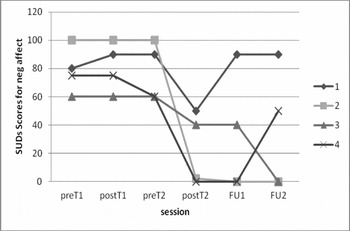
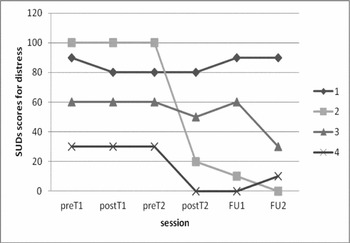
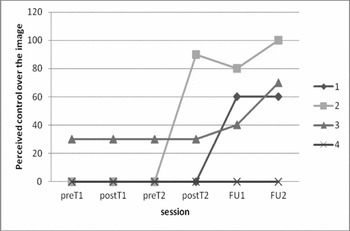
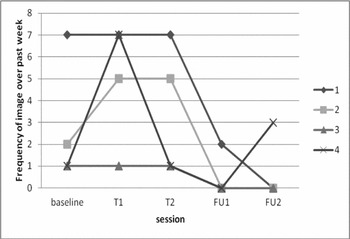
As predicted, there was a decrease in negative affect and distress associated with the image for participants two, three and four following imagery rescripting (see Figures 1 and 2 for details). There was also an increase in perceived sense of control over the image for all participants (Figure 3), which seemed to increase at follow-up for participants one, two and three. The frequency with which participants experienced the image also reduced for participants one, two and three (Figure 4).
A graph showing the negative affect associated with intrusive image over time

A graph showing the level of distress associated with intrusive image for each participant over time

A graph showing perceived sense of control over the image over time.

A graph showing frequency of the image coming into the participants mind

Changes in the memory
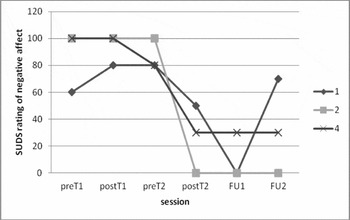
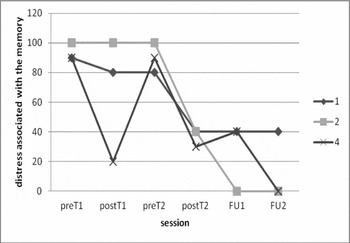
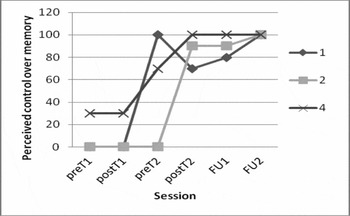
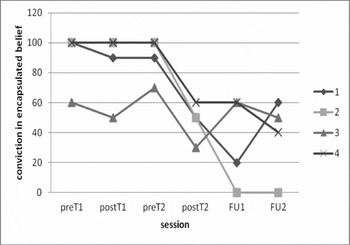
Following image rescripting all three participants who worked on the associated memory using imagery rescripting experienced a decrease in negative affect and distress in relation to the memory (see Figures 5 and 6). However, this was not maintained at follow-up for participant one. All participants also experienced an increase in perceived control over the memory (see Figure 7) and a reduction in the encapsulated belief associated with the memory and image following imagery rescripting (Figure 8). However, again this was not maintained at follow-up for participant one.
A graph showing ratings of negative affect associated with the memory over time

A graph showing the level of distress associated with the memory for each participant over time

A graph showing perceived control over the memory over time
Note: Participant 3 chose to work on the image directly as the memory he associated with image was for him an empowering memory. Therefore his data have not been included in Figures 5–7.

A graph showing level of conviction in encapsulated belief over time

Changes in other symptoms
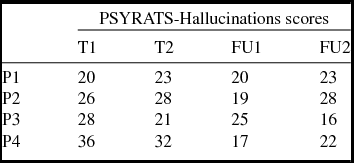
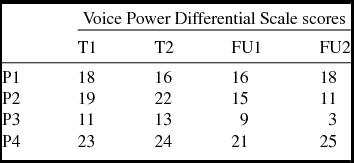
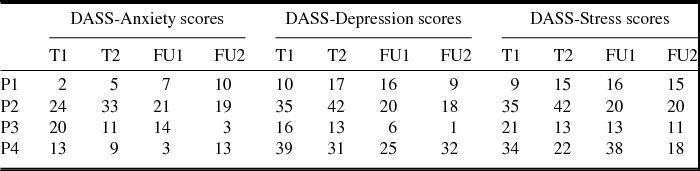
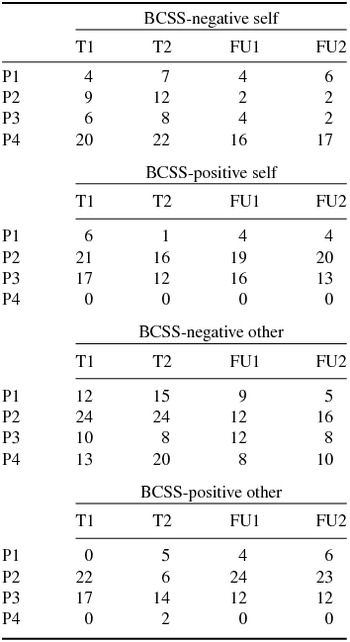
As a group, there was very little change in the severity of the voices, depression, anxiety and stress levels, or core schemas over the course of the rescripting therapy (see Tables 2–5 for details).
Severity of voices over time

Severity in perceived power of voices over time

DASS scores over time

Belief in core schema scores over time

A Reliable Change Index (Jacobsen and Traux, Reference Jacobson and Traux1991) was used to see if there had been any reliable changes in symptoms on the standardized measures pre to post-therapy. For participant four there was a significant reduction in the severity of her voices as measured by the PSYRATS hallucinations questionnaire (Haddock et al., Reference Haddock, McCarron, Tarrier and Faragher1999; RCI = −3.72, p ≤ 0.05) and for participant two there was a significant reduction in her negative schema's about others, as measured by the brief schema questionnaire (Fowler et al., Reference Fowler, Freeman, Smith, Kuipers, Bebbington and Bashforth2006; RCI = −2.46, p ≤ 0.05).
Discussion
This was the first study to look at the use of a one-off image rescripting session for people with psychosis, who hear voices. As with other studies, a single imagery rescripting session was found to be a viable method of working with intrusive imagery in people with psychosis (Morrison, Reference Morrison2004; Schultze, Reference Schultze2009) and reductions in distress, negative affect, encapsulated beliefs and increased control were observed for three of the four participants. These gains were maintained at 1-month follow-up. Few changes were found in psychotic symptoms for these participants and it therefore remains unclear what role imagery may have in maintaining the voice hearing experience.
The case series highlights a number of areas of clinical interest. The reduction in negative affect associated with the memory and conviction in the encapsulated belief was not maintained at follow-up for participant one. Also, for this particular participant, the reduction in negative affect and distress did not reduce for the imagery following imagery rescripting. Analysis of the sessions indicates that there were two possible confounding factors for this participant. First, this participant was the only participant who was having CBT when the intervention took place. Second, she had experienced childhood abuse but unlike other participants chose to work on a different memory; the onset of her psychosis. This may indicate that repeated imagery rescripting sessions may be more appropriate when clients experience more than one distressing image and/or memory present (Brewin et al., Reference Brewin, Wheatley, Patel, Fearon, Hackmann and Wells2009). It is also important to highlight that participant four experienced a feeling of derealization in the third stage of the image rescripting. Given that many people who hear voices have dissociative experiences (Schafer et al., Reference Schafer, Harfst, Aderhold, Briken, Lehmann and Morritz2008) it is important that therapists have experience of using grounding techniques that help clients cope with dissociative experiences in session, and are alert to this possibility, particularly in cases with longstanding abuse histories.
Another challenge that the therapist came across was that three of the participants disliked using the audio CD to reinforce the work in session. Reasons given included feeling uncomfortable listening to their own voice, and finding listening to the session at home to be too emotionally powerful. This difficulty was overcome by encouraging participants to write down the imagery rescripting steps that they had completed to follow at home. This highlights the need for the therapy protocol to be flexible to the needs of this client group.
This was a small case series, without a control group, and therefore the findings need to be approached with caution. However, these findings are nonetheless encouraging and indicate that using imagery rescripting in people with psychosis who hear voices can be helpful. There is a need for further such studies to be developed that are robust, randomized, and well-controlled to explore the use of imagery rescripting in this population, particularly focused on how this therapeutic technique may be applied within a formulation driven CBTp framework. There is also a need for a standardized, reliable measure of intrusive imagery, validated with people with psychosis. In its absence, it remains difficult to determine how studies of intrusive imagery in psychosis compare to other studies of healthy controls or other populations.




Comments
No Comments have been published for this article.