Introduction
Inpatient aggression within psychiatric facilities continues to demand attention. Aggressive acts often cause physical or psychological injury that impact the lives of the patients or staff victims of these incidents. However, it should be noted that the vast majority of psychiatric patients are not aggressive while hospitalized. Studies on inpatient aggressionReference Broderick, Azizian, Kornbluh, Warburton, Warburton and Stahl 1 – Reference Arango, Calcedo Barba, Gonzalez and Calcedo Ordonez 3 showed approximately 25%–35% of inpatients committed acts of aggression. For those inpatients who are aggressive, there is a substantial literature that that describes a small subset of “chronically aggressive” patients, who are responsible for the majority of inpatient aggression.Reference Lussier, Verdun-Jones , Deslauriers-Varin , Nicholls and Brink 4 – Reference Owen, Tarantello, Jones and Tennant 11
Numerous research studies have described clinical characteristics of inpatient psychiatric patients who meet some definition of a chronic aggressor.Reference Lussier, Verdun-Jones , Deslauriers-Varin , Nicholls and Brink 4 , Reference Decaire, Bédard, Riendeau and Forrest 8 , Reference Bader and Evans 12 While there has not been universal agreement in past studies, several clinical characteristics have been shown to be significant in discriminating between the chronically aggressive and nonaggressive populations, including: cognitive deficits, Reference Lussier, Verdun-Jones , Deslauriers-Varin , Nicholls and Brink 4 , Reference Krakowski and Czobor 13 , Reference Krakowski, Convit and Volavka 14 suicidal behavior, Reference Bader and Evans 12 , Reference Krakowski, Convit and Volavka 14 borderline or antisocial personality disorder, Reference Lussier, Verdun-Jones , Deslauriers-Varin , Nicholls and Brink 4 , Reference Langton, Hogue, Daffern, Mannion and Howells 15 , Reference Kraus and Sheitman 16 history of substance useReference Lussier, Verdun-Jones , Deslauriers-Varin , Nicholls and Brink 4 diagnosis of schizophrenia or psychosis, Reference Cooper, Browne, McClean and King 10 , Reference Krakowski and Czobor 13 hospitalization as a juvenile, Reference Bader and Evans 12 and diagnosis of a mood disorder.Reference Lussier, Verdun-Jones , Deslauriers-Varin , Nicholls and Brink 4 , Reference Bader and Evans 12
Given the amount and variety of these clinical characteristics, it is difficult to develop a cohesive theory based on the heterogeneity of the results, and given a finite amount of resources, develop specialty programs that address all of these problems. This informational morass has provided challenges to researchers and clinicians trying to piece together many different clinical features of this population.
Research on the topic of chronic aggression has been clouded by a variety of labels as well as definitions. Studies, that have investigated patients with multiple aggressive acts, have used different terms to describe these patients, such as “chronically aggressive,” “repeatedly aggressive” and “chronically violent”. While every study reviewed included aggression toward others, there was a lot of variability on the inclusion of aggression toward self, aggression toward property, and verbal aggression. In addition, the primary method of determining if a patient was chronically aggressive has been to set a minimum number of aggressive incidents and a time frame for those incidents to be committed. The number of incidents has ranged from a minimum of 2–20 and the time frame has varied from 5 months to 10 years. This variability creates a problem in clearly defining the group of patients to be studied. A patient committing 20 acts of aggression within 5 months will likely look clinically different from a patient committing 20 aggressive acts within 10 years.
This issue of variability in definitions was highlighted in a study by Krakowsi and CzoborReference Krakowski and Czobor 13 who subdivided a sample of aggressive patients into a “transiently violent” group and a “persistently violent” group. Their findings showed that the transiently violent patients became less psychotic and less violent over a 4-week period, whereas the persistently violent did not show any substantial changes in illness or violence. Further investigation showed the persistently violent patients showed more neurological impairment than the transiently violent patients. The positive response to treatment in the transiently violent group highlights the impact that psychopharmacological treatment can have for psychosis, but also highlights the relative lack of benefit for persistently violent patients with neurological impairment. Despite the differences in the clinical picture and response to treatment, several studies have lumped these 2 groups of patients together when conducting research on chronic aggression.
Despite the short 4-week duration, Krakowski and Czobor’sReference Krakowski and Czobor 13 model, dividing patients into a transiently violent and persistently violent groups, provides a useful blueprint for further study. In their model, the transiently aggressive patients were individuals, who were aggressive for a period of time but as a result of treatment, time, or other factor, greatly reduced or eliminated their aggressive behavior. The persistently violent patients were those that remained aggressive despite psychopharmacology, therapies, extra resources, reviews by expert clinicians, and other varied interventions. One criticism of their model is the short amount of time that passed before a patient was considered persistently violent. Several psychopharmacological and psychiatric treatments can take months to be effective and so it is unclear if the treatments had worked in the study. In addition, the short duration does not allow researchers to determine if the patient was consistently aggressive.
The aim of the study was to further refine the definition “chronic aggressor” and study patients who had been consistently aggressive over multiple years, labeling this group as, “long-term chronic aggressors.” To better understand this group, we then contrasted them with a matched control group to see if we could classify patients into a long-term chronic aggressor group or a nonaggressor group based on the clinical factors that were most related to chronically aggressive patients. More specifically, we aimed to test whether common characteristics of the chronically aggressive patients were present in the long-term chronic aggressive patients.
In an effort to study a long-term chronic aggressor, a more stringent inclusion criterion was used. In this study, we required that a patient have at least 15 incidents of physical aggression, we believed that having a stricter definition would provide a better contrast to the control group. This number is on the high end of what previous studies have required to be considered a chronic aggressor. In addition to the count of aggressive incidents, a consistency factor was implemented, which required a patient to be consistently aggressive 5 times for 3 years, for a total of at least 15 aggressive incidents. Only aggressive acts that were physical assaults toward another patient or staff member were counted. Acts such as verbal aggression, aggression toward self, or aggression toward an object or property were not counted in this study.
Method
This study was completed in a state hospital system that comprises 5 maximum security hospitals and has approximately 6000 beds. The hospitals are located throughout California and treat patients deemed Not Guilty by Reason of Insanity, Incompetent to Stand Trial, Mentally Disordered Offenders, and patients who are civilly committed. Patients have a variety of diagnoses including schizophrenia, schizoaffective disorder, bipolar disorder, major depressive disorder, personality disorders, and cognitive disorders. Approval for this study was obtained through the California Committee for the Protection of Human Subjects.
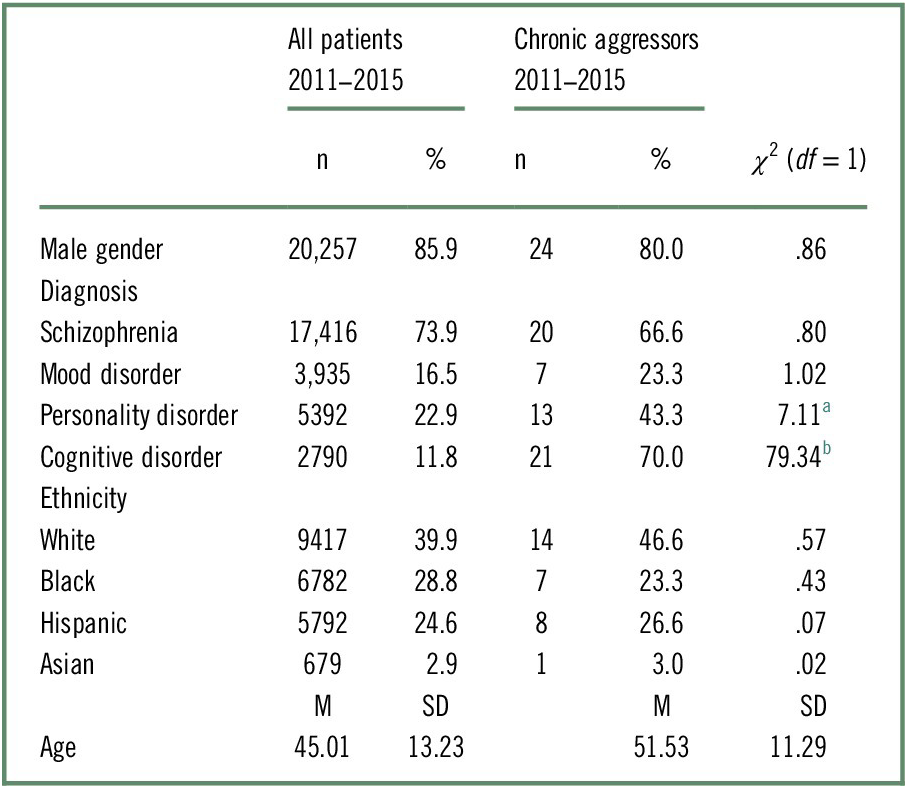
The study included 30 long-term chronically aggressive hospitalized patients and 30 matched hospitalized controls with zero incidents of aggression within their hospitalization. A long-term chronically aggressive patient as defined as a hospitalized patient who had committed 5 or more physically aggressive acts each year for 3 years from January 2011 to December 2015. Physical aggression, within this hospital system, is defined as “hitting, kicking, pushing, or other similar acts directed against another individual to cause potential or actual injury.” As mentioned previously, acts of verbal aggression, self-harm, and aggression toward property did not qualify as aggression in this study. A description of the demographic information can be seen in Table 1.
Sociodemographic characteristics of the participants

a p < .05
b p < .01
A chart review was completed on each individual and information related to aggression, suicidal ideation and behavior, psychiatric diagnosis, psychosocial history, and demographics were recorded. Interrater reliability was obtained from the 6 raters for this study, all who were clinical psychologists or psychiatrists. Kappa coefficients for all of the items exceeded .80.
Patient demographic and legal class information were collected from system databases that are routinely used for census tracking. Data on aggressive incidents was collected through a computerized incident management system module of the patient treatment planning database. Within the hospital system, suicidal ideation and behavior are captured in 2 main areas for each patient. Suicidal ideation and behavior incidents within the hospital are collected from the computerized incident management system. In addition, a thorough lifetime suicidal ideation and behavior history is completed and recorded in a yearly suicide risk assessment that is completed by the patient’s psychologist. For this study, both sources of information were reviewed for the presence of suicidal ideation or behavior and the presence of suicidal ideation was coded separately from suicidal behavior.
The rest of the variables were obtained from a chart review. Psychiatric diagnosis was recorded from the most recent note written by the treating psychiatrist. A patient was considered to have a cognitive disorder if according to the DSM-5, they had a Neurocognitive Disorder, Intellectual Disability, or Borderline Intellectual Functioning. The psychosocial history was obtained from the treating social worker’s notes and demographic information was available in admission assessments.
The aggression databases were queried to obtain lists of patients having 5 or more aggressive acts for 3 years from 2011 to 2015. There were a total of 110 patients who met this definition of a chronic aggressor. Due to resource and time limitations, 30 were chosen at random for inclusion in the study. The 30 patients did not significantly differ from the 110 individuals on age (p = .16), gender (p = .11), race (p = .90), or length of stay within the hospital (p = .28). In order to find a comparison group, 30 patients who had not had any aggressive incidents while hospitalized within the forensic hospital system, were matched to the chronically aggressive group based on variables that have been shown in the literature to be related to aggression: age
 $ \pm $
2 years,Reference Gudjonsson, Rabe-Hesketh
and Wilson
17
gender,
Reference Staniloiu and Markowitsch
18
and length of stay within the hospital.
Reference Arango, Calcedo Barba, Gonzalez and Calcedo Ordonez
3
,
Reference Barnard, Robbins, Newman and Carrera
19
It should be noted that patients were not matched on diagnosis. The long-term chronic aggressors and the nonaggressive controls were hospitalized at the same time (with no more than 100 days difference), however, the 2 groups were chosen from all 5 hospitals and the matched pairs were not necessarily at the same hospital. Each clinical variable was entered as either present or not present.
SPSS statistical package version 23 was used in completing statistical analyses. To determine if the sample was representative of the hospital system, Chi square analyses were used to compare the sample to the population on diagnosis, gender, and ethnicity. Univariate analyses were conducted first to evaluate differences between groups on each variable of interest separately. Variables entered into the model were a history of suicidal behavior, current or previous diagnosis of a personality disorder, current or previous diagnosis of a cognitive disorder, history of psychiatric hospitalization as a juvenile, previous problems with employment, and current or previous diagnosis of a mood disorder. The multivariate analysis was a binary logistic regression, which was chosen because of its ability to use variables to classify cases into a dichotomous dependent variable. Variables were entered in the backwards LR approach to determine the most parsimonious model.
Results
Univariate and stepwise binary logistic regression analyses were run to test the contributions of a presence of history of a cognitive disorder, a history of suicidal behavior, history of hospitalization as a juvenile, presence or history of a mood disorder, presence or history of a personality disorder, and problems with employment in classifying a patient as long-term chronic aggressor or a control group.
The samples of long-term chronic aggressors were randomly selected from all of the long-term chronic aggressors from 2011 to 2015. The age of the sample (M = 51.53 years, SD = 11.29, CI: 47.49–55.57) was not significantly different from the entire sample of long-term chronic aggressors (M = 48.08 years, SD = 11.2), however, the sample of long-term chronic aggressors were statistically older than the hospital population (M = 45.01 years, SD = 13.23).
Univariate results
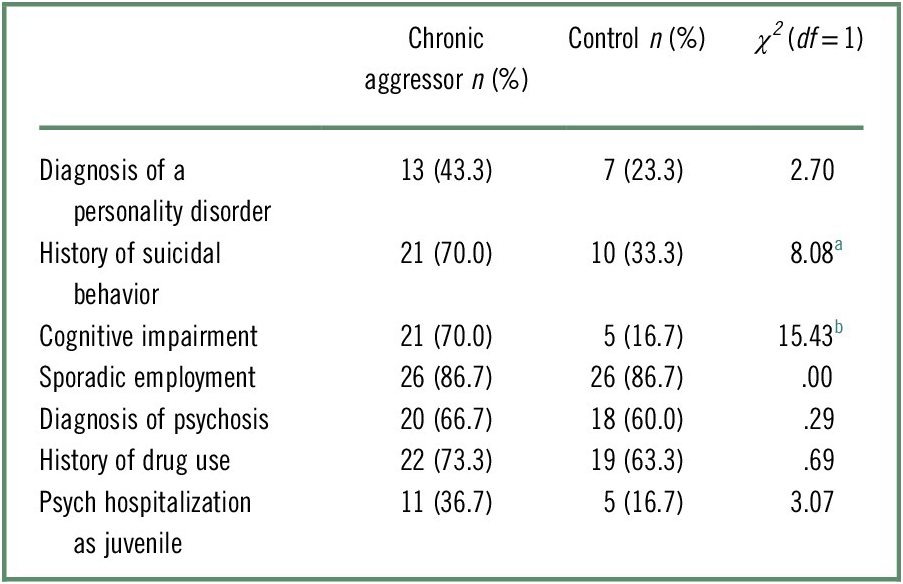
Univariate results (
Table 2) showed that long-term chronically aggressive patients were more likely to have a cognitive disorder than the nonaggressive controls (16.7%), (
 $ \chi $
2[1, N = 60] = 15.43, p < .001) with 70.0% of the long-term chronic aggressors having a cognitive disorder compared to 16.7% of the controls. In addition, 70.0% of patients had a history of suicidal behavior in the long-term chronically aggressive group compared to 33.3% of controls (66.7%,
 $ \chi $
2[1, N = 60] = 8.08, p < .01). Psychiatric hospitalization as a juvenile was present in 36.7% of the long-term chronic aggressors and 16.7% of the nonaggressive matched controls. In the univariate analysis, this difference approached significance (p = .08).
Frequencies and chi square results

a p < .01
b p < .001
Multivariate results
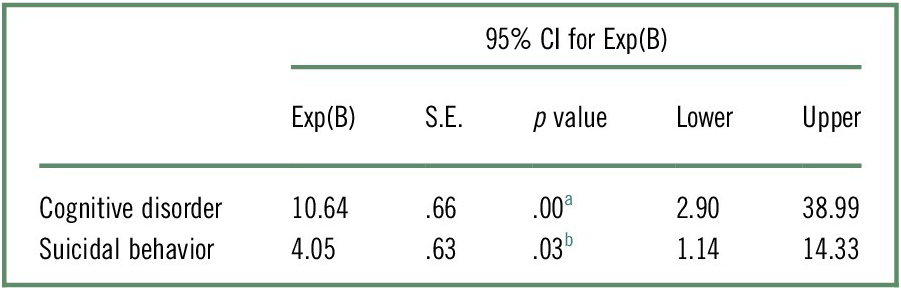
Binary logistic regression was run with a stepwise backwards likelihood ratio entry method. All variables were tested for multicollinearity, with no substantial relationships. With all 6 variables, the full model correctly classified 80% of the cases. The final reduced model included 2 variables, Cognitive Disorder (
 $ {e}^{\beta} $
= 10.64, p < .001) and Suicidal Behavior History (
 $ {e}^{\beta} $
= 4.05, p = .03) and correctly classified 76.7% of the cases (
Table 3). The first model and reduced model were compared with the Likelihood Ratio Statistic; there was no statistically significant difference between the full and reduced model. The loss of 3.3% of accuracy in classification was judged to be acceptable. Therefore, the most parsimonious reduced model was used to present these results.
Binary logistic regression

a p < .01
b p < .05
Psychiatric hospitalization as a juvenile, presence of a personality disorder, and the presence of a mood disorder did not make unique contributions to the model and the results are listed in Table 3.
Discussion
Chronically aggressive patients have been a difficult group to study. One reason is the lack of a clear definition of chronic aggression. Definitions have been largely based on meeting a minimum number of aggressive incidents within a timeframe, but in previous research the number of incidents and duration of time has varied greatly. In addition, there been disagreement on whether to include aggression toward self, aggression toward property, or verbal aggression. The lack of a uniform definition has created a mixed clinical profile in the literature that has created problems when researching or developing clinical programs. The result has been a description of chronic aggressors that has varied across clinical, legal, and demographic factors and provided little help to researchers or clinicians aiming to treat these patients more effectively.
This study aimed to rectify the situation by providing a clearer definition of the term “chronic aggressor” and then applying it to patients in our psychiatric hospital system, to better identify targets of treatment. This study adds to the research on the chronically aggressive population by investigating the portion of chronically aggressive patients who have not only met a threshold for the number of incidents, but also met a consistency requirement (number of incidents per year for x amount of years). In addition, the authors also included a nonaggressive control group that was matched for age, gender, and length of stay within the hospital to reduce the effect of known correlates of aggression.
Results of the study identified cognitive disorders as the strongest predictor of the model. This result fits with several previous studies, which also identified cognitive disorders as a key characteristic of the chronic aggressor population.Reference Lussier, Verdun-Jones , Deslauriers-Varin , Nicholls and Brink 4 , Reference Owen, Tarantello, Jones and Tennant 11 , Reference Krakowski and Czobor 13 , Reference Kraus and Sheitman 16 Interestingly, similar to this research project, all of the studies that required 15 or more incidents of aggression, found cognitive impairment to be statistically significant finding.Reference Lussier, Verdun-Jones , Deslauriers-Varin , Nicholls and Brink 4 , Reference Owen, Tarantello, Jones and Tennant 11 Cognitive disorders can come from a variety of etiologies, but ultimately have the same effect of reducing a patient’s ability to effectively reason, understand, and function in the world. Cognitive deficits arising from many etiologies are known to be long-term problems, if not lifelong problems. The length and consistency components of our study suggest that these long-term problems play a distinct role in this group of long-term chronic aggressors. Clinically this is important, because while many cognitive disorders have no known cure (eg, Alzheimer’s dementia), cognitive deficits stemming from other disorders have shown to respond to cognitive rehabilitationReference Best and Bowie 20 (eg, cognitive deficits resulting from severe mental illness).
A history of suicidal behavior was also a statistically significant variable in classifying the long-term chronic aggressors. Previous research has suggested that suicidal ideation or suicidal behavior were related to aggression toward othersReference Lussier, Verdun-Jones , Deslauriers-Varin , Nicholls and Brink 4 , Reference Bader and Evans 12 with results that supported the inclusion of a suicidal behavior history variable in a classification model. Interestingly, in Lussier’sReference Lussier, Verdun-Jones , Deslauriers-Varin , Nicholls and Brink 4 study, the results suggested that with increasing numbers of aggressive acts, the prevalence of all types of aggressive acts increased, including aggression toward self. The results of the LussierReference Lussier, Verdun-Jones , Deslauriers-Varin , Nicholls and Brink 4 study, fit with the data from this study, where the presence of suicidal behavior was part of a model that was significantly able to classify between an aggressive and nonaggressive group.
Despite the significance of past suicidal behavior in discriminating between aggressive and nonaggressive groups, a diagnosis of a mood disorder was not significant in univariate or multivariate analyses. This relationship was also seen by GrubeReference Grube 21 who concluded that the exhibition of aggressive behavior is more to do with “disinhibited aggressive potential” and not a specific diagnosis, hypothesizing a neurological basis. Several studies have examined cognitive dysfunction in patients with suicidality and found deficits in executive functioning, attention, memory, and working memory.Reference Jollant, Lawrence, Olié, Guillaume and Courtet 22 – Reference Keilp, Gorlyn, Russell, Oquendo, Burke and Harkavy-Friedman 24
One interesting finding was that the long-term chronic aggressive patients were significantly older than the hospital population with the average age being 51.53 years. The majority of aggression research suggests that aggressors are much younger, finding a majority of chronic aggressors are in their 20s and 30s.Reference Barlow, Grenyer and Ilkiw-Lavalle 6 , Reference Cooper, Browne, McClean and King 10 , Reference Bader and Evans 12 , Reference Hoptman, Yates, Patalinjug, Wack and Convit 25 , Reference Tardiff 26 One studyReference Owen, Tarantello, Jones and Tennant 11 found that patients with 20 or more aggressive incidents within a 7-month time frame, were significantly older, finding a mean age of 60.6. It is interesting to note, that the study by Owen et al.Reference Owen, Tarantello, Jones and Tennant 11 and the current study, both required a high number of incidents to be included, 20 and 15 respectively. This difference supports the argument for a subgroup of chronic aggressors that are characteristically different than chronic aggressors as a whole. It is possible that the inclusion requirement of at least 3 years of aggressive behavior skewed the sample to an older population but the study by Owen et al.Reference Owen, Tarantello, Jones and Tennant 11 had a similar finding with only a 7-month duration.
In addition to a diagnosis of a mood disorder, other variables were investigated and found to not be significant: psychiatric hospitalization as a juvenile, a diagnosis of a personality disorder, and difficulties with employment. One reason for the lack of significance could be due to the inclusion criteria. Acts of aggression toward self, aggression toward property, and verbal aggression were not included as aggressive incidents. Employment problems were equally present within the group, which may suggest that the variable is more an outcome of severe mental illness as opposed to being directly related to aggression.
Conclusion
Based on the data from this study, results of the study showed that long-term chronic aggressors were older, had a cognitive disorder, and had a history of suicidal behavior. We hypothesize that these clinical and demographic variables might all have their roots in cognitive impairment. As people age, cognitive abilities are known to decline, patients with cognitive disorders would have more cognitive impairments by definition, and patients with a history of suicidal behavior have been shown to have deficits in several domains of cognitive functioning. While much is unknown, cognitive deficits appear to play a central role in patients with long-term chronic aggression.
The results of this study showed that presence of a cognitive disorder and a history of a suicidal behavior helped classify patients as either a long-term chronically aggressive patient or a nonaggressive patient. This research lends support to the idea that there are different types of chronic aggressive patients and that long-term chronically aggressive patients may look clinically different from other aggressors, labeled as “chronic” but whose aggressive period was of much shorter duration. Further research may look to replicate these results with a larger sample and prospectively look to determine if age, cognitive disorder, and suicidal behavior history can correctly predict patients who go on to become long-term chronic aggressors.
Clinically, it will be important to screen patients for these problems to identify patients who might be at risk for chronic aggression. A standard psychological intake, review of previous records, speaking with a family member, as well as a formal screening assessment of cognitive abilities could aid in identifying patients who would be at risk for long-term chronic aggression. While this study does not confirm that a cognitive disorder and a history of suicidal behavior are the clinical factors that cause aggression, it is clinically reasonable to treat conditions that are related to aggression in this population. One promising treatment program for aggression in patients with cognitive deficits is the combination of cognitive remediation and social cognition treatments. Cognitive remediation is the set of treatments designed to improve a person’s cognitive abilities and social cognition treatments are designed to improve a person’s perceptions and interactions with other people. In a recent systematic review of literature, Reference Darmedru, Demily and Franck 27 the authors concluded cognitive remediation and social cognition treatments led to a reduction in aggressive attitudes and physical aggression. In addition to treatments to add, clinicians should carefully weigh the pros and cons of any treatments that could impair cognition. Medications that are known to impair cognition (eg, anticholinergics and benzodiazepines) could further complicate a person’s aggressive behaviors.
This study has several limitations that impact the conclusions. Data was collected retrospectively. We were not able to control for legal commitment and as such, we were comparing patients from one legal commitment to another. Other studiesReference Bader and Evans 12 have suggested the need for comparing them separately due to differences in housing and types of treatment available. Cognitive disorders were also combined into one group, which highlighted the clinical feature of cognitive deficits. However, there are a variety of etiologies of cognitive deficits and this study did not distinguish between the different etiologies for cognitive deficits including: traumatic brain injuries, developmental problems, severe mental illness, degenerative neurological conditions, and impoverished environments. Given the nature of the suicidal behavior data, we were not able to distinguish between subtypes of suicidal behavior or report a number of lifetime suicidal behaviors. We expect that having this type of information would improve the ability to understand the data.
Acknowledgements
We would like to thank the many people who were involved in making this study a reality. First, Katherine Warburton who has supported this project and gave us the resources to complete the study. Also, a special thank you to the clinicians who collected the data: George Proctor, Susan Velasquez, Laura Dardashti, Jennifer O’Day, Andrea Bauchowitz, Jonathan Meyer, Michael Cummings, Eric Schwartz, Charles Broderick, Darci Delgado, and Rebekah Kornbluh. Further, we would like to acknowledge the help of Barbara McDermott and Sean Evans who consulted on key aspects of the study. Also, another thank you to Carl Seele and Angela Stoner, for helping us locate the literature we reviewed. Finally, we would like to thank Stephen Stahl for mentorship in conducting this research.
Disclosures
Benjamin Rose, Psy.D., ABPP, Darci Delgado, Psy.D., Charles Broderick, Ph.D., and Rebekah Kornbluh, M.D. have nothing to disclose. Stephen M. Stahl, MD, PhD, is an Adjunct Professor of Psychiatry at the University of California San Diego, Honorary Visiting Senior Fellow at the University of Cambridge, UK and Director of Psychopharmacology for California Department of State Hospitals. Over the past 36 months (January 2016–April 2019), Dr. Stahl has served as a consultant to Acadia, Adamas, Alkermes, Allergan, Arbor Pharmaceuticals, AstraZeneca, Avanir, Axovant, Axsome, Biogen, Biomarin, Biopharma, Celgene, Concert, ClearView, DepoMed, Dey, EnVivo, Ferring, Forest, Forum, Genomind, Innovative Science Solutions, Intra-Cellular Therapies, Janssen, Jazz, Lilly, Lundbeck, Merck, Neos, Novartis, Noveida, Orexigen, Otsuka, PamLabs, Perrigo, Pfizer, Pierre Fabre, Reviva, Servier, Shire, Sprout, Sunovion, Taisho, Takeda, Taliaz, Teva, Tonix, Trius, Vanda, and Vifopharma; He has been a board member to RCT Logic and Genomind; he has served on speakers bureaus for Acadia, Astra Zeneca, Dey Pharma, EnVivo, Eli Lilly, Forum, Genentech, Janssen, Lundbeck, Merck, Otsuka, PamLabs, Pfizer Israel, Servier, Sunovion and Takeda, and he has received research and/or grant support from Acadia, Alkermes, AssureX, Astra Zeneca, Arbor Pharmaceuticals, Avanir, Axovant, Biogen, Braeburn Pharmaceuticals, BristolMyer Squibb, Celgene, CeNeRx, Cephalon, Dey, Eli Lilly, EnVivo, Forest, Forum, GenOmind, Glaxo Smith Kline, Intra-Cellular Therapies, ISSWSH, Janssen, JayMac, Jazz, Lundbeck, Merck, Mylan, Neurocrine, Neuronetics, Novartis, Otsuka, PamLabs, Pfizer, Reviva, Roche, Sepracor, Servier, Shire, Sprout, Sunovion, TMS NeuroHealth Centers, Takeda, Teva, Tonix, Vanda, Valeant, and Wyeth.