Self-esteem is the subject of a voluminous and growing literature, encompassing a wide range of issues and approaches. Although it would prove very difficult indeed to arrive at a consensus definition of self-esteem, it seems apparent that many researchers regard it as a form of evaluation of the self that guides future behavioral choice and action (e.g., Baumeister, Reference Baumeister, Gilbert, Fiske and Lindzey1998, Reference Baumeister and Baumeister1999; Leary & Baumeister, Reference Leary, Baumeister and Zanna2000; Tesser, Reference Tesser, Tesser and Schwarz2001, Reference Tesser, Brewer and Hewstone2004). The focus of much of the self-esteem literature has been on the relationship between self-esteem and functioning across a variety of domains (Andrews, Reference Andrews1998; Banaji & Prentice, Reference Banaji and Prentice1994; Baumeister, Reference Baumeister and Baumeister1999; Emler, Reference Emler2001; Tesser, Reference Tesser, Tesser and Schwarz2001), with links established between low self-esteem and a range of outcomes, including mental illness (e.g., Markowitz, Reference Markowitz2001; Nezlek, Kowalski, Leary, Blevins, & Holgate, Reference Nezlek, Kowalski, Leary, Blevins and Holgate1997; Tennen & Affleck, Reference Tennen, Affleck and Baumeister1993), substance abuse (e.g., Guglielmo, Polak, & Sullivan, Reference Guglielmo, Polak and Sullivan1985; Higgins, Clough, & Wallerstedt, Reference Higgins, Clough and Wallerstedt1995; Leary, Schreindorfer, & Haupt, Reference Leary, Schreindorfer and Haupt1995; Unger, Kipke, Simon, Montgomery, & Johnson, Reference Unger, Kipke, Simon, Montgomery and Johnson1997), suicidal behavior (e.g., Groholt, Ekeberg, Wichstrom, & Hadorsen, Reference Groholt, Ekeberg, Wichstrom and Haldorsen2000; McGee & Williams, Reference McGee and Williams2000; Overholser, Adams, Lehnert, & Brinkman, Reference Overholser, Adams, Lehnert and Brinkman1995; Van Gastel, Schotte, & Maes, Reference Van Gastel, Schotte and Maes1997; Wild, Flisher, & Lombard, Reference Wild, Flisher and Lombard2004), and social and adjustment problems (e.g., Crocker & Luhtanen, Reference Crocker and Luhtanen2003; Longmore, Manning, Giordano, & Rudolph, Reference Longmore, Manning, Giordano and Rudolph2004; Rosenberg, Schooler, & Schoenbach, Reference Rosenberg, Schooler and Schoenbach1989; Voss, Markiewicz, & Doyle, Reference Voss, Markiewicz and Doyle1999). A potential explanation for these pervasive associations is that it is possible that self-esteem plays a causal role in life outcomes, with an individual's level of self-esteem being critical in determining success and failure across a range of life tasks (e.g., Andrews, Reference Andrews1998; Harter, Reference Harter and Baumeister1993, Reference Harter1999). The aim of the present investigation was to examine the putative causal role of self-esteem in the domains of mental health, substance use, and life and relationship satisfaction, using data gathered from a longitudinal, prospective birth cohort. The investigation examined whether self-esteem in midadolescence was related to later mental health, substance use, and life and relationship outcomes.
In terms of specific outcomes, it has been observed that low self-esteem is related to problems in a number of domains. One such domain is mental health. A number of studies have identified low self-esteem as a contributing factor to mental health problems including depression, anxiety, and suicidal ideation. For example, Schroevers, Ranchor, and Sanderman (Reference Schroevers, Ranchor and Sanderman2003) found that low self-esteem was related to later depressive symptoms in both cancer patients and healthy controls. Similarly, Brown, Andrews, Harris, Adler, & Bridge (Reference Brown, Andrews, Harris, Adler and Bridge1986) found that low self-esteem was associated with depression stemming from a stressful life event, even at 1-year follow-up. Newbegin and Owens (Reference Newbegin and Owens1996) reported a link between self-esteem and anxiety in adolescent boys, noting that those low in self-esteem experienced higher levels of anxiety. A similar finding was reported by Rawson (Reference Rawson1992), who found that children reporting low self-esteem also reported high levels of anxiety. In terms of suicidal ideation and behavior, Overholser and colleagues (1995) reported that low self-esteem was associated with both suicidal ideation and attempted suicide in secondary school students. In a study of adults, Dieserud, Raysamb, Ekeberg, and Kraft (2001) found that low-self-esteem predicted suicide attempts. This range of findings would suggest that self-esteem plays a central role in mental health issues.
Another outcome related to self-esteem is substance use. A number of studies have found that self-esteem influences substance use behavior. Wild, Flisher, Bhana, and Lombard (Reference Wild, Flisher, Bhana and Lombard2004) reported that self-esteem was strongly associated with risk of substance abuse in secondary school students. Similarly, Unger et al. (Reference Unger, Kipke, Simon, Montgomery and Johnson1997) found that low self-esteem was an important risk factor in the development of substance use problems in homeless and troubled adolescents. In addition, Carvajal, Clair, Nash, and Evans (Reference Carvajal, Clair, Nash and Evans1998) found that high self-esteem was a determinant of avoiding substance use in early adolescence. The evidence seems to suggest that engaging in substance use behavior is related to one's level of self-esteem.
Relationship quality and life satisfaction in general are further domains that are thought to be related to self-esteem. For relationship quality, Voss et al. (Reference Voss, Markiewicz and Doyle1999) reported that self-esteem was significantly related to the quality of friendship and marital relationships for both women and men. Sprecher and Hendrick (Reference Sprecher and Hendrick2004), in a study of heterosexual dating couples, found that self-esteem predicted self-disclosure, with low self-esteem resulting in lower levels of self-disclosure, which in turn, predicted relationship breakup over a period of several years. In terms of life satisfaction, Huebner (Reference Huebner1991) found that low self-esteem predicted lower levels of life satisfaction in preadolescents. In a large, multinational (cross-sectional) study of university students, Diener and Diener (Reference Diener and Diener1995) found that life satisfaction and self-esteem were strongly correlated (.47). A further multinational study by Judge, Locke, Durham, & Kluger (Reference Judge, Locke, Durham and Kluger1998) supported these findings, reporting that self-esteem was one of several self-evaluative variables that predicted satisfaction with life and career. Self-esteem therefore seems to play an important role in judgments about the quality of one's relationships and life in general.
Adolescence is thought to be a critical time for the development of self-esteem (DuBois & Tevendale, Reference DuBois and Tevendale1999; Feldman & Elliott, Reference Feldman and Elliott1990; McGuire, Neiderhiser, Reiss, Hetherington, & Plomin, Reference McGuire, Neiderhiser, Reiss, Hetherington and Plomin1994), particularly because of the fact that the adolescent is rapidly approaching adulthood, and is beginning to assume adult roles and responsibilities (Chen & Faruggia, Reference Chen and Faruggia2002; Petersen & Leffert, Reference Petersen, Leffert and Rutter1995). It has been hypothesized that events in adolescence can have a great impact on later adult behaviors, and specifically that maladaptive behaviors in adolescence can have lingering effects in terms of adult adjustment and mental health (Bardone et al., Reference Bardone, Moffitt, Caspi, Dickson, Stanton and Silva1998; Jessor, Donovan, & Costa, Reference Jessor, Donovan and Costa1991; Pergamit, Huang, & Lane, Reference Pergamit, Huang and Lane2001). Self-esteem is often implicated in the development of adolescent behavior, with high self-esteem serving as a source of resiliency or positive adaptation (Rutter, Reference Rutter1987). Conversely, low self-esteem has been implicated in the development of a wide range of maladaptive responses to the issues of adolescence (Evans, Noam, Wertlieb, Paget, & Wolf, Reference Evans, Noam, Wertlieb, Paget and Wolf1994; Hammen, Reference Hammen1992; Harter, Reference Harter and Baumeister1993). However, there has been a relative lack of studies investigating the relationship between self-esteem and outcomes in later life, particularly in adulthood. Although a number of longitudinal studies examining self-esteem and outcomes have been conducted (e.g., Bergman & Magnusson, Reference Bergman and Magnusson1984; Bolognini, Plancherel, Bettschart, & Halfton, 1996; Crocker & Luhtanen, Reference Crocker and Luhtanen2003; DuBois et al., Reference DuBois, Burk-Braxton, Swenson, Tevendale, Lockerd and Moran2002; DuBois & Silverthorn, Reference DuBois and Silverthorn2004; DuBois, Tevendale, Burk-Braxton, Swanson, & Hardesty, 2000; Jessor, Turbin, & Costa, Reference Jessor, Turbin and Costa1998; Kim & Cicchetti, Reference Kim and Cicchetti2004; Longmore et al., Reference Longmore, Manning, Giordano and Rudolph2004; McGee & Williams, Reference McGee and Williams2000; Pelkonen, Marttunen, & Aro, Reference Pelkonen, Marttunen and Aro2003; Schroevers et al., Reference Schroevers, Ranchor and Sanderman2003; Sprecher & Hendrick, Reference Sprecher and Hendrick2004), most have concentrated on relatively short periods of time (over a few years), and few have charted the developmental course of the relationship between self-esteem and various life outcomes. Other studies have examined the stability of self-esteem into adulthood (Block & Robbins, Reference Block and Robbins1993; Roberts & Bengtson, Reference Roberts and Bengtson1996) but have not linked these to possible outcomes. In general, the longitudinal self-esteem literature is marked by various limitations, including the use of specialized or selected samples (Crocker & Luhtanen, Reference Crocker and Luhtanen2003; Kim & Cicchetti, Reference Kim and Cicchetti2004; Schroevers et al., Reference Schroevers, Ranchor and Sanderman2003; Sprecher & Hendrick, Reference Sprecher and Hendrick2004), a lack of control for a range of factors that could potentially confound the relationship between self-esteem and later outcomes (Bergman & Magnusson, Reference Bergman and Magnusson1984; DuBois et al., Reference DuBois, Tevendale, Burk-Braxton, Swenson and Hardesty2000, Reference DuBois, Burk-Braxton, Swenson, Tevendale, Lockerd and Moran2002; DuBois & Silverthorn, Reference DuBois and Silverthorn2004; Longmore et al., Reference Longmore, Manning, Giordano and Rudolph2004; Pelkonen et al., Reference Pelkonen, Marttunen and Aro2003; Sprecher & Hendrick, Reference Sprecher and Hendrick2004), and short time intervals restricted to adolescence (Bolognini et al., Reference Bolognini, Plancherel, Bettschart and Halfon1996; DuBois et al., Reference DuBois, Tevendale, Burk-Braxton, Swenson and Hardesty2000, Reference DuBois, Burk-Braxton, Swenson, Tevendale, Lockerd and Moran2002; DuBois & Silverthorn, Reference DuBois and Silverthorn2004; Jessor et al., Reference Jessor, Turbin and Costa1998; Longmore et al., Reference Longmore, Manning, Giordano and Rudolph2004; McGee & Williams, Reference McGee and Williams2000), making it difficult to evaluate the possible causal role of self-esteem in later life outcomes. Given the often-repeated statements in the professional literature about the profound and lingering effects of self-esteem on a host of outcomes later in life (e.g., Branden, Reference Branden1994; California Task Force To Promote Self-Esteem and Personal and Social Responsibility, 1990; Macdonald, Reference Macdonald, Trent and Reed1994; Mann, Hosman, Schaalma, & de Vries, Reference Mann, Hosman, Schaalma and de Vries2004; McCarthy, Reference McCarthy2004), a direct (longitudinal) test of some of these effects might clarify the nature of the relationship between self-esteem and later life outcomes.
The notion of cause is particularly relevant in terms of the measures taken to counteract the negative effects of low self-esteem. If low self-esteem is the cause of a range of poor outcomes, then it follows logically that interventions should be aimed at raising self-esteem. Indeed, efforts such as the California Task Force to Promote Self-Esteem (California Task Force To Promote Self-Esteem and Personal and Social Responsibility, 1990) have attempted to raise self-esteem in the service of ameliorating a wide variety of social problems at one stroke. More recent reports of programs manipulating self-esteem have targeted a range of specific outcomes, including the effectiveness of cognitive behavioral therapy (Shirk, Burwell, & Harter, Reference Shirk, Burwell, Harter, Reinecke, Dattilio and Freeman2003), increasing school achievement (Flay, Allred, & Ordway, Reference Flay, Allred and Ordway2001), reducing conduct problems (Flay et al., Reference Flay, Allred and Ordway2001), and the pursuit of continuing education and employment (Flay & Allred, Reference Flay and Allred2003). If, conversely, self-esteem is not a causal factor per se, but rather one that reflects other causal factors, then efforts to raise self-esteem may be somewhat misdirected. In this view, self-esteem should be regarded as an outcome or risk indicator measure, with close attention being paid to those factors that influence it, rather than concentrating on self-esteem itself (Baumeister, Campbell, Krueger, & Vohs, Reference Baumeister, Campbell, Krueger and Vohs2003; Seligman, Reference Seligman1993).
A further issue in understanding the relationship between self-esteem and later life outcomes is the structure of self-esteem, and the extent to which components of self-esteem may relate to later outcomes. Some researchers have argued that self-esteem is better conceptualized in terms of specific domains, such as academic self-esteem, relationship self-esteem, or skills self-esteem (see Baumeister, Reference Baumeister, Gilbert, Fiske and Lindzey1998, for a review). Alternatively, other researchers (e.g., Fleming & Courtney, Reference Fleming and Courtney1984) have argued that self-esteem is hierarchical in nature, with global self-esteem serving as the top level of the hierarchy, and domain-specific self-esteem serving as a range of determinants of global self-esteem. Some previous studies have attempted to examine the role of specific self-esteem domains in later outcomes (e.g., McGee & Williams, Reference McGee and Williams2000; Newbegin & Owens, Reference Newbegin and Owens1996; Wild, Flisher, Bhana, et al., 2004; Wild, Flisher, & Lombard, Reference Wild, Flisher and Lombard2004). However, because of the limitations in the literature (noted above), it remains unclear whether specific domains of self-esteem are related to later life outcomes.
A comprehensive and ecologically valid way to address the question of causality in the long-term developmental effects of self-esteem is through use of a longitudinal design, in which a representative cohort is studied from infancy to adulthood. In such a study measures of self-esteem and family, social, and emotional context can be collected, and a wide range of measures can be employed to effectively control for covariates. If analyses indicate that the effects of self-esteem on later outcomes are reduced or eliminated after control for covariates, it could be concluded that the effects of self-esteem are not causal, but rather reflect the influence of family, social, and emotional context. If, however, the effects of self-esteem remain after control for covariates, it could be concluded that self-esteem may indeed have a causal role in later outcomes.
Against this background, the present investigation sought to examine the relationship between self-esteem during adolescence and later life outcomes, addressing issues of both causality and the developmental course of self-esteem effects. Using a longitudinal design and a representative birth cohort, the investigation sought to determine whether self-esteem at age 15 predicted outcomes at ages 18, 21, and 25. Based on previous research, it was believed that the outcomes most likely to be influenced included mental health, interpersonal outcomes such as relationship satisfaction, and life satisfaction. It was further believed that the cause of such outcomes could be more clearly understood via the inclusion of family background and contextual factors. The aims of the study were therefore to determine: (a) whether self-esteem predicts later life outcomes including mental health, substance use, and relationship and life satisfaction; (b) whether the relationship between self-esteem and these later outcomes remains after control of family, social, and demographic factors; and (c) the strength of the relationship between self-esteem and life outcomes across ages 18, 21, and 25.
Method
The data reported in this investigation were gathered as part of the Christchurch Health and Development Study. The Christchurch Health and Development Study is a longitudinal study of an unselected birth cohort of 1,265 children born in the Christchurch (New Zealand) region during a 4-month period in mid-1977. This cohort has been studied at birth, 4 months, 1 year, at annual intervals to age 16 years, and at ages 18, 21, and 25 years. The study has collected a wide range of data on the health, development, and adjustment of the cohort throughout this period. A detailed description of the study and an overview of study findings can be found in Fergusson, Horwood, Shannon, and Lawton (Reference Fergusson, Horwood, Shannon and Lawton1989) and Fergusson and Horwood (Reference Fergusson and Horwood2001). The Christchurch Health and Development Study has been approved by the Canterbury (New Zealand) Regional Ethics Committee, and all participants have given their informed consent to participate in all aspects of the study. The following measures were used in these analyses.
Self-esteem (age 15)
Self-esteem was assessed at age 15 using the global measure from the Coopersmith Self Esteem Inventory (1981). The overall measure of self-esteem was generated by summing of the four subscale scores (general, academic, social, and home). The full scale score used in these analyses was found to be internally consistent (α = 0.87), whereas the internal consistency of the individual subscales varied (general, α = .78; academic, α = .58; social, α = .57; home, α = .75).
Mental health outcomes (15–25 years)
At ages 16, 18, 21 and 25 years cohort members were questioned about mental health issues since the previous assessment using questionnaires based on the Diagnostic Interview Schedule for Children (DISC, Costello, Edelbrock, Kalas, Kessler, & Klaric, Reference Costello, Edelbrock, Kalas, Kessler and Klaric1982) at age 16 years, and the Composite International Diagnostic Interview (CIDI; World Health Organisation, 1993) at ages 18, 21, and 25 years, supplemented by additional measures. Using these data the following measures were constructed reflecting the young person's experience of mental health problems over the intervals of 15–18, 18–21, and 21–25 years.
Major depression and anxiety disorder (ages 15–25)
At age 16 items from the DISC were used to assess DSM-III-R (American Psychiatric Association, 1987) symptom criteria for major depression and a range of anxiety disorders (including generalized anxiety disorder, panic disorder, agoraphobia, social phobia, and specific phobia). From age 18 onward these disorders were assessed using CIDI items and DSM-IV (American Psychiatric Association, 1994) diagnostic criteria. For the purposes of the present analysis sample, members who met DSM diagnostic criteria for a major depressive episode at any time during an assessment period were classified as having major depression during that assessment period (23.2% of the sample at ages 15–18, 23.6% of the sample at ages 18–21, and 22.1% of the sample at ages 21–25). Similarly, sample members who met DSM diagnostic criteria for one or more anxiety disorders during the specified periods were classified as having an anxiety disorder (29.0% of the sample at ages 15–18, 12.6% of the sample at ages 18–21, and 18.1% of the sample at ages 21–25).
Conduct/antisocial personality disorder (ages 15–25)
Conduct disorder symptoms at ages 15–16 were assessed using the Self-Report Early Delinquency Scale (Moffitt & Silva, Reference Moffitt and Silva1988) and thereafter using the Self-Report Delinquency Inventory (Elliott & Huizinga, Reference Elliott, Huizinga and Klein1989). To use a more age-appropriate instrument, from age 21 onward conduct/antisocial personality disorder was assessed using custom-written survey items reflecting the DSM-IV criteria for antisocial personality disorder. These items were considered to have face validity because of their derivation from DSM-IV behavioral descriptors. Sample members who met diagnostic criteria for conduct disorder or antisocial personality disorder during an assessment period were classified as having the disorder during that period (7.0% of the sample at ages 15–18, 3.4% of the sample at ages 18–21, and 3.1% of the sample at ages 21–25).
Suicidal ideation (ages 15–25)
Suicidal ideation was assessed by asking sample members whether they had ever thought about killing themselves during the assessment period and the frequency of such thoughts. Those individuals who reported having any suicidal thoughts in the assessment interval were classified as having suicidal ideation (20.3% of the sample at ages 15–18, 13.6% of the sample at ages 18–21, and 12.2% of the sample at ages 21–25).
Substance use outcomes (15–25 years)
At each interview from ages 16 to 25 years cohort members were questioned about their substance use behaviors since the previous assessment and problems associated with substance use. Using this information the following measures of substance use problems were created.
Nicotine dependence (ages 18, 21, and 25)
This was assessed by custom-written survey items designed to assess DSM-IV symptom criteria for nicotine dependence and administered at ages 18, 21, and 25 years. Sample members who, at each age, reported smoking 10 or more cigarettes per day and who also reported three or more of the relevant DSM-IV symptom criteria were classified as nicotine dependent (13.8% of the sample at age 18, 25.0% of the sample at age 21, and 22.9% of the sample at age 25).
Alcohol dependence (ages 15–25)
This was assessed by items from the CIDI to assess DSM-IV symptom criteria for alcohol dependence. Individuals who met the relevant DSM-IV diagnostic criteria for alcohol dependence in the assessment period were classified as alcohol dependent for that assessment period (5.3% of the sample at ages 15–18, 5.9% of the sample at ages 18–21, and 5.5% of the sample at ages 21–25).
Illicit drug dependence (ages 15–25)
This was assessed by items of the CIDI relevant to DSM-IV symptom criteria for dependence upon cannabis and other illicit drugs. Individuals who met the relevant DSM-IV diagnostic criteria for dependence on any illicit drugs in the assessment period were classified as illicit drug dependent for that assessment period (4.7% of the sample at ages 15–18, 7.1% of the sample at ages 18–21, and 8.2% of the sample at ages 21–25).
Life and relationship outcomes (18–25 years)
As part of the assessments at ages 18, 21, and 25, cohort members were questioned about their levels of satisfaction with life in general, their current or most recent intimate romantic relationship of 1 month or longer duration (at ages 21 and 25 only), and the quality of their peer attachments (at ages 18 and 21 only).
Life satisfaction (ages 18, 21, and 25)
This was assessed on the basis of 12 custom-written items assessing satisfaction with a range of life domains, including work, family, friends, leisure pursuits, and life in general. Participants responded to the items on a 4-point scale ranging from very happy to very unhappy. Confirmatory factor analysis of the item responses from each assessment showed that these could be scaled as a unidimensional scale reflecting the extent of current life satisfaction at each age. For the purposes of the present analysis, scale scores were created by summing the responses to the 12 items to create a general life satisfaction measure for each age. These measures were scaled so that higher scores on the measure reflected greater levels of life satisfaction. Alpha reliabilities for these scales were .85, .87, and .88 at ages 18, 21, and 25, respectively.
Relationship quality (ages 21 and 25)
This was assessed using the 25-item Intimate Relations Scale (Braiker & Kelley, Reference Braiker, Kelley, Burgess and Huston1979). Participants were asked to respond to the measure with reference to their most recent intimate romantic relationship of 1 month or longer duration at ages 21 and 25. Each item was rated on a 3-point scale, ranging from 1 = doesn't apply to 3 = definitely applies. The Intimate Relations Scale contains four subscales (love, maintenance, conflict, and ambivalence), which can be summed to form measures of positive and negative feelings about the relationship. Alpha reliabilities for the positive and negative scales were .86 and .83, respectively, at 21 years, and .92 and .82, respectively, at 25 years. For the purposes of the present study, the positive and negative scales were combined to create a single measure of relationship quality by subtracting scores on the negative scale from scores on the positive scale.
Peer attachment (ages 18 and 21)
The quality of peer attachments was assessed at ages 18 and 21 years using the 24-item Armsden and Greenberg (Reference Armsden and Greenberg1987) Inventory of Peer Attachment. Participants were questioned separately about their attachment for both their female and male friends in general (an overall peer attachment score was obtained by averaging the responses for female and male friends for each participant). Alpha reliabilities for the scales were .91 and .90 at ages 18 and 21, respectively.
Confounding factors
To assess the extent to which associations between self-esteem at age 15 and later outcomes (mental health, substance use, and life and relationship satisfaction at ages 18–25) could be explained by the effects of confounding factors, a range of measures was chosen from the database of the study for inclusion in the analysis. These measures were selected on the basis of (a) a review of the literature identifying factors that previously have been found to be associated with self-esteem; and (b) factors that were found to be correlated with both self-esteem and with the outcome measures in the present investigation. The covariate factors chosen for inclusion in the analysis were as follows.
Measures of family socioeconomic background
Maternal age
This was assessed at the time of the survey child's birth.
Family living standards (0–10 years)
At each year a global assessment of the material living standards of the family was obtained by means of an interviewer rating. Ratings were made on a 5-point scale that ranged from very good to very poor. These ratings were summed over the 10-year period and divided by 10 to give a measure of typical family living standards during this period.
Maternal education
This was assessed at the time of the survey child's birth using a 3-point scale that reflected the highest level of educational achievement attained. The scale was 1 = mother lacked formal educational qualifications (had not graduated from high school), 2 = mother had secondary level educational qualifications (had graduated from high school), and 3 = mother had tertiary level qualifications (had obtained a university degree or equivalent qualification).
Family socioeconomic status (SES)
This was assessed at the time of the survey child's birth using the Elley–Irving Scale of SES for New Zealand (Elley & Irving, Reference Elley and Irving1976). This scale classifies SES into six levels on the basis of paternal occupation, ranging from 1 = professional occupations to 6 = unskilled occupations.
Family functioning
Parental alcoholism/alcohol problems, criminal offending, and illicit drug use
When sample members were aged 11, their parents were questioned about parental use of illicit drugs. At the 15-year assessment parents were further questioned concerning their history of alcoholism or alcohol problems and criminal offending. On the basis of this questioning 11.9% of the sample were classified as having a parental history of alcoholism/alcohol problems, 12.4% of the sample as having a parental history of criminal offending, and 24.9% as having a parental history of illicit drug use.
Changes of parents
At each assessment from birth to 15 years, comprehensive information was gathered on changes in the child's family situation since the previous assessment. Using this information an overall measure of family instability was constructed on the basis of a count of the number of changes of parents experienced by the child up to age 15. Changes of parents included all changes resulting from parental separation/divorce, reconciliation, remarriage, death of a parent, fostering, and other changes of custodial parents.
Parental attachment (age 15)
This was assessed using the Parental Attachment Scale developed by Armsden and Greenberg (Reference Armsden and Greenberg1987), and administered when sample members were aged 15. The full Parental Attachment Scale was used in this analysis and was found to have good reliability (α = 0.87).
Child abuse
Childhood sexual abuse
At ages 18 and 21 years sample members were questioned about their experience of sexual abuse during childhood (<16 years; Fergusson, Lynskey, & Horwood, Reference Fergusson, Lynskey and Horwood1996). Questioning spanned an array of abusive experiences from episodes involving noncontact abuse (e.g., indecent exposure) to episodes involving attempted or completed intercourse. Sample members who reported an abusive episode were then questioned further about the nature and context of the abuse. Using this information a four-level scale was devised, reflecting the most extreme form of sexual abuse reported by the young person at either age. This classification was no sexual abuse; noncontact abuse only; contact sexual abuse not involving attempted or completed intercourse; or attempted/completed oral, anal, or vaginal intercourse.
Parental use of physical punishment (childhood physical abuse)
At ages 18 and 21 sample members were asked to describe the extent to which their parents used physical punishment during childhood (Fergusson & Lynskey, Reference Fergusson and Lynskey1997). Separate questioning was conducted for mothers and fathers. This information was used to create a four-level scale reflecting the most severe form of physical punishment reported for either parent: parents never used physical punishment; parents rarely used physical punishment; at least one parent used physical punishment on a regular basis; or at least one parent used physical punishment too often or too severely, or treated the respondent in a harsh or abusive manner.
Individual characteristics and behavior
IQ
Child cognitive ability was assessed at ages 8 and 9 using the Wechsler Intelligence Scale for Children—Revised (WISC-R: Wechsler, Reference Wechsler1974). Total scores were computed on the basis of results on four verbal and four performance subscales. The split half reliabilities of these scores were .93 at age 8 and .95 at age 9. For the purposes of these analyses the observed WISC-R total IQ scores at age 8 and 9 were combined by averaging over the two administrations.
Neuroticism (age 14)
This was assessed using a short form version of neuroticism scale of the Eysenck Personality Inventory (Eysenck & Eysenck, Reference Eysenck and Eysenck1964) administered when cohort members were 14 years old. The α reliability of this scale was .80.
Gender
Gender was recorded at birth.
Child behavior problems (ages 7–9; conduct, attention, and anxious/withdrawn behavior problems)
When sample members were aged 7, 8, and 9 years, information on child behavior problems was obtained from parental and teacher report. Parental reports were obtained from an interview with the child's mother using a behavior questionnaire that combined items from the Rutter, Tizard, and Whitmore (Reference Rutter, Tizard and Whitmore1970) and Conners (Reference Conners1970) parental questionnaires. Parallel to the maternal report, the child's class teacher was asked to complete a combined version of the Rutter et al. (Reference Rutter, Tizard and Whitmore1970) and Conners (Reference Conners1969) teacher questionnaires. Factor analysis of the item-level report data showed that it was possible to select items from these reports that formed unidimensional scales reflecting the extent of parent-reported and teacher-reported behavior problems in three domains of behavior (Fergusson & Horwood, Reference Fergusson and Horwood1993; Fergusson, Horwood, & Lloyd, Reference Fergusson, Horwood and Lloyd1991): (a) conduct problems: the extent to which the child exhibited aggressive, oppositional, and conduct disordered behaviors; (b) attentional problems: the extent to which the child exhibited restless, inattentive, or hyperactive behaviors; and (c) anxious/withdrawn behaviors: the extent to which the child displayed a tendency to behave in a shy, anxious or withdrawn manner. For the purposes of the present analysis, the parent and teacher reports were summed for each domain and the resulting scores averaged over the 3-year period to produce three scale score measures reflecting the extent of the child's tendencies to conduct problems, attentional problems, and anxious/withdrawn behavior problems at ages 7–9. The α reliabilities of these scales were .97, .93, and .87, respectively.
Measures of mental health prior to age 15
Mental disorders (14–15 years)
At age 15 cohort members were assessed using a comprehensive mental health interview designed to examine aspects of mental health and adjustment over the previous 12 months. This interview combined an array of questions from standardized assessment instruments including the DISC (Costello et al., Reference Costello, Edelbrock, Kalas, Kessler and Klaric1982), the Rutgers Alcohol Problems Index (White & Labouvie, Reference White and Labouvie1989), and the Self-Report Early Delinquency Scale (Moffitt & Silva, Reference Moffitt and Silva1988) with custom-written survey items to assess DSM-III-R symptom criteria for a range of disorders over the interval of 14–15 years. These disorders included major depression, anxiety disorder (generalized anxiety disorder, overanxious disorder, simple phobia, social phobia), conduct and oppositional defiant disorder, attention-deficit/hyperactivity disorder, and substance abuse.
Suicidal ideation
At age 15 sample members were also questioned as to whether they had ever experienced suicidal thoughts. Participants were classified as having experienced suicidal ideation if they had experienced such thoughts.
Statistical analysis
The unadjusted associations between self-esteem and the repeated measures of mental health and relationship outcomes (Table 1) were tested for statistical significance by fitting a random effects model to the data for each outcome. For the continuous outcomes (life satisfaction, partner, and peer relationships) a linear regression model was fit to the form

where Y it is the observation on outcome Y for the ith participant in the tth time period, X i is the value of self-esteem for the ith individual, v i is an individual specific random effect assumed to be constant over time, and e it is a random error term. The terms v i and e it were assumed to be normally distributed and uncorrelated with X i. In this model the beta coefficient B1 represents the effect of self-esteem pooled over the repeated measures for each outcome, and the coefficient B0 represents the intercept for the model. For dichotomous (mental health and substance use) outcomes a logistic regression model was fit by the form

where logit(Y it) represents the log odds of Y it. In all cases, the fitted models also included age terms (not shown) to allow for across time changes in the rate or mean of each outcome. All models were fitted using Stata 8 (StataCorp, 2003) and, in each case, the test of significance of the pooled association between self-esteem and the outcome was obtained from a Wald chi-squared test of the hypothesis that B1 = 0.
Relationship of later mental health, substance use, and life and relationship satisfaction outcomes to level of self-esteem at age 15

aSample size limited to those reporting partnerships.
The associations between self-esteem and covariate factors (Table 2) were tested for significance using the Mantel–Haenszel chi-square test of linearity. To adjust the observed associations between self-esteem and outcome measures for confounding factors, the random effects models above were extended to include the set of covariates for each individual. In fitting these models all covariates were scored in their natural metrics as described above, rather than in the dichotomous form shown in Table 2. In addition, the fitted regression results (Table 3) were derived from models in which self-esteem was scored in continuous form rather than in quintiles as shown in Tables 1 and 2. (Repeat analyses using the quintile measure of self-esteem produced essentially identical conclusions.) In addition, the regression models described above were further extended to incorporate interaction terms to test for Self-Esteem × Time of Measurement and Self-Esteem × Gender interactions. Finally, the modeling procedure was repeated using the four subscales of the Coopersmith Self-Esteem Inventory (general, academic, social, home; Coopersmith, Reference Coopersmith1981) in place of the overall self-esteem measure, to examine the associations between the individual subscales and the range of outcome measures.
Associations between self-esteem at age 15 and rates of individual, family, parental, and related characteristics
Note: SES, socioeconomic status.
aChi-squared test of linearity.
Associations between self-esteem at age 15 and mental health, substance use, and life and relationship satisfaction outcomes, before and after adjustment for covariates
Sample size and sample bias
The present analysis is based upon the sample having complete data on self-esteem at age 15 and on the outcome measures at each age. These samples ranged in size from 913 to 936, and represented between 72 and 74% of the initial cohort of 1,265 children. To examine the effects of sample losses on the representativeness of the sample, the obtained samples with complete data at each age, were compared with the remaining sample members on a series of sociodemographic measures collected at birth. This analysis suggested that there were statistically significant (p < .01) tendencies for the obtained samples to underrepresent individuals from socially disadvantaged backgrounds characterized by low parental education, low socioeconomic status, and single parenthood. To address this issue, the data weighting methods described by Carlin, Wolfe, Coffey, and Patten (Reference Carlin, Wolfe, Coffey and Patton1999) were used to examine the possible implications of selection effects arising from the pattern of missing data. These analyses produced essentially the same pattern of results to those reported here, suggesting that the conclusions of this study were unlikely to have been influenced by selection bias.
Results
Associations between self-esteem scores and later outcomes at ages 18–25
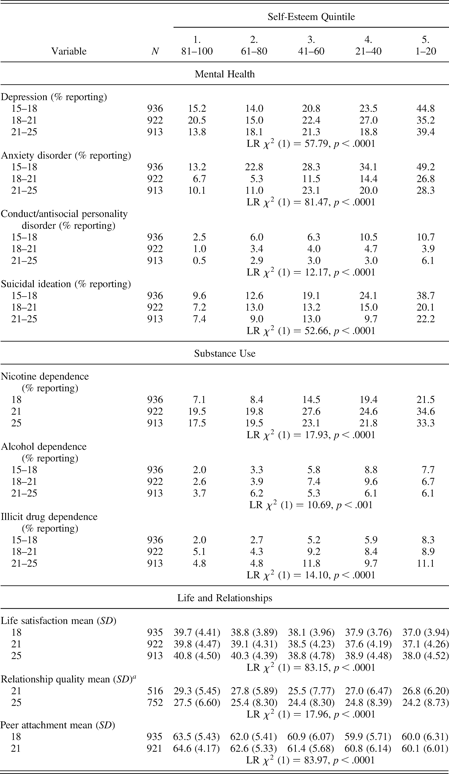
Table 1 shows the cohort divided into quintiles on the basis of the distribution of Coopersmith Self-Esteem scores (Coopersmith, Reference Coopersmith1981). The quintiles are arranged in order of decreasing levels of self-esteem, where 1 = the highest level of self-esteem, and 5 = the lowest level. For each quintile the table reports on measures of mental health, substance use, and life and relationship satisfaction variables at ages 18, 21, and 25 (two of the relationships variables were measured at two ages only; peer attachment at 18 and 21, and relationship quality at 21 and 25). As explained in Methods, the associations between self-esteem score and outcomes over the periods 18, 21, and 25 were tested for statistical significance by fitting linear random effects models to the data. These analyses show that in all cases there were significant associations between self-esteem score and the outcome measures. In general, the table suggests that lower self-esteem scores were associated with increasing risks of mental health problems, substance use, and lower levels of life and relationship satisfaction in early adulthood.
Table 1 yields the following specific findings:
1. Mental health: Self-esteem at age 15 was significantly (p < .001) associated with mental health outcomes at ages 18, 21, and 25. Lower levels of self-esteem were associated with higher rates of depression, anxiety, conduct/antisocial personality disorder, and suicidal ideation.
2. Substance use: Self-esteem at age 15 was significantly (p < .01) associated with self-reported substance use at ages 18, 21, and 25. Lower levels of self-esteem were associated with higher rates of nicotine dependence, alcohol dependence, and illicit drug dependence.
3. Life and relationship satisfaction: Self-esteem at age 15 was significantly (p < .001) associated with life and relationship outcomes at ages 18, 21, and 25. Lower levels of self-esteem were associated with lower levels of life satisfaction, poorer perceived relationship quality, and peer attachment.
Associations between socioeconomic, childhood, family, and related factors and self-esteem at age 15
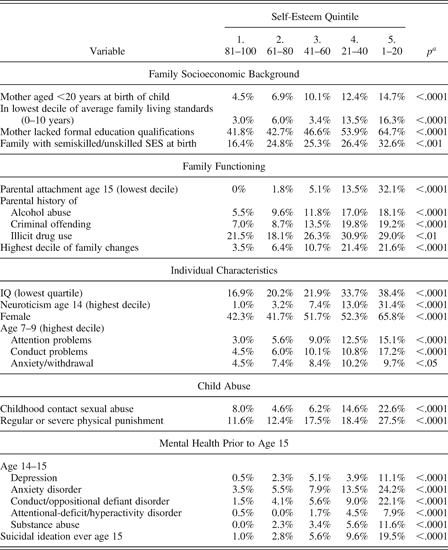
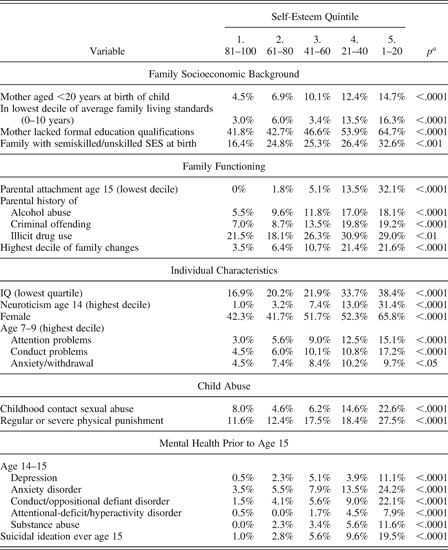
Table 2 shows the associations between measures of socioeconomic, childhood, family, and related factors and self-esteem at age 15. For ease of data display, all measures have been dichotomized and the association between each variable and self-esteem at age 15 is tested for significance using the chi-squared test of linearity. The table shows that lower levels of self-esteem were significantly associated (p < .05) with increasing rates of socioeconomic disadvantage, family dysfunction, child abuse, individual issues including lower IQ and higher neuroticism, and mental health and behavior problems (internalizing and externalizing behavior) prior to age 15. Table 2 also shows that lower levels of self-esteem were particularly strong for females. The results clearly indicate that low self-esteem at age 15 was more common amongst those who have suffered from multiple social, economic, and personal difficulties, disadvantages, and stresses.
Associations between self-esteem at age 15 and subsequent outcomes at ages 18–25 after adjustment for family context and personal background
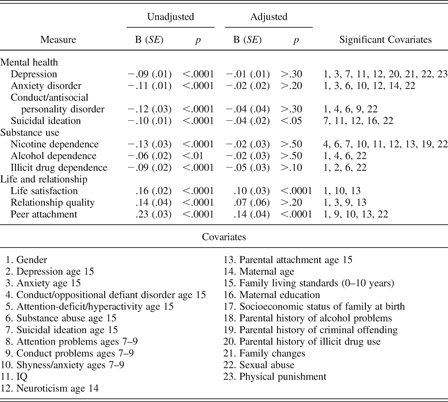
The preceding analyses raise the possibility that the increased risks of poorer outcomes at ages 18, 21, and 25 for those reporting low self-esteem at age 15 may be explained by the childhood and family factors identified in Table 2 rather than the direct effects of self-esteem on later outcomes. To address this issue, we conducted further analyses that adjusted the associations between self-esteem at age 15 and outcomes at 18, 21, and 25 for the factors identified in Table 2. The analyses adjusted the associations between self-esteem at age 15 and outcomes at ages 18, 21, and 25 by fitting linear random effects regression models to the data and adding the factors in Table 2 to the models as covariates. As all of the factors listed in Table 2 were significantly correlated (p < .05) with self-esteem at age 15, all of the factors were entered as covariates for each model fitted.
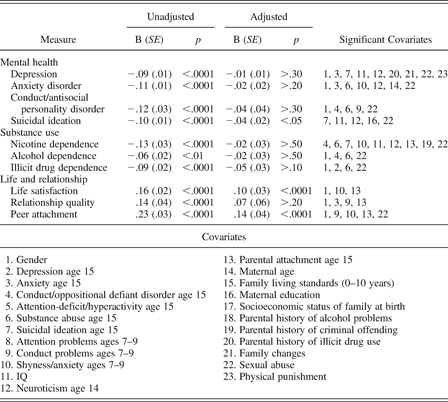
The results of these analyses are reported in Table 3, which shows the unadjusted and adjusted regression coefficients for self-esteem at age 15 and the range of statistically significant covariates for each outcome. The table demonstrates the following:
1. Mental health: Adjusting for confounding factors weakened the association between self-esteem at age 15 and later depression, anxiety, conduct/antisocial personality disorder, and suicidal ideation at ages 18, 21, and 25. With the exception of suicidal ideation the association between self-esteem and later outcomes was reduced to statistical nonsignificance (p > .05). Significant (p < .05) covariate factors for mental health outcomes included gender, anxiety prior to age 15, suicidal ideation prior to age 15, conduct disorder prior to age 15, substance use prior to age 15, conduct problems ages 7–9, shyness/social anxiety ages 7–9, IQ, neuroticism at age 14, maternal age, maternal education, parental history of illicit drug use, family changes, childhood sexual abuse, and childhood physical abuse. These results suggest that, with the exception of suicidal ideation, the apparent associations between self-esteem at age 15 and subsequent mental health and behavior problems were noncausal and reflected the influence of childhood and family-related factors that were associated with lower levels of self-esteem at age 15.
2. Substance use: Similarly, adjustment for confounding factors reduced the associations between self-esteem at age 15 and later substance dependence problems including nicotine, alcohol, and illicit drug dependence at ages 18, 21, and 25 to statistical nonsignificance (p > .05). Significant (p < .05) covariate factors included gender, depression prior to age 15, conduct disorder prior to age 15, substance use prior to age 15, suicidal ideation prior to age 15, shyness/social anxiety ages 7–9, IQ, neuroticism at age 14, parental attachment at age 15, parental history of criminal offending, and childhood sexual abuse. These results suggest that the apparent associations between self-esteem at age 15 and later substance dependence problems were noncausal and reflected the influence of childhood and family-related factors that were associated with lower levels of self-esteem at age 15.
3. Life and relationship outcomes: Adjustment for confounding factors reduced the strength of the associations between self-esteem at age 15 and life and relationship outcomes at ages 18, 21, and 25. The association between self-esteem at age 15 and life satisfaction remained statistically significant after adjustment for covariate factors (p < .0001), as did the association between self-esteem at age 15 and peer attachment (p < .0001). However, the association between self-esteem at age 15 and perceived relationship quality was reduced to statistical nonsignificance (p > .05) after adjustment for covariates. Significant (p < .05) covariates for life and relationship outcomes included gender, anxiety prior to age 15, conduct disorder prior to age 15, shyness/social anxiety ages 7–9, parental attachment at age 15, and childhood sexual abuse. These results suggest that life satisfaction and peer attachment at ages 18, 21, and 25 are predicted by self-esteem at age 15, but that the apparent association between self-esteem at age 15 and subsequent perceptions of the quality of romantic relationships was noncausal and reflected the influence of childhood and family-related factors associated with lower levels of self-esteem at age 15.
The above analyses suggest that 3 of 10 outcomes examined were significantly associated with self-esteem after covariate adjustment. However, it could be suggested that, given the comparatively large number of outcomes examined, at least some of the findings above may have been because of chance as a result of multiple tests of significance. To address this issue, a Bonferroni (Grove & Andreasen, Reference Grove and Andreasen1982) adjusted p value (p < .005) was employed to correct for multiple (10) tests of significance. In this instance, the association between self-esteem at age 15 and suicidal ideation was not statistically significant (p > .005) using the Bonferroni correction. However, the associations between self-esteem at age 15 and later life satisfaction and peer attachment remained statistically significant (p < .005) after employing the Bonferroni correction.
Supplementary analyses
Covariate overcontrol
A possible limitation of the results in Table 3 is that the results are “overcontrolled” following the inclusion of contemporaneously assessed mental health. It could be suggested that the mental health covariates included variables that were intervening in the relationship between self-esteem at age 15 and later outcomes. To address this question, three analyses were conducted in which covariates related to specific outcome measures were removed from the analysis. In the case of mental health outcomes, all mental health measures at 15 were removed as covariates; in the case of substance use outcomes, substance abuse measured at age 15 was removed as a covariate; in the case of life and relationship outcomes, parental attachment at age 15 was removed as a covariate. The results of these analyses suggest the possibility that the inclusion of mental health variables may have overcontrolled the relationship between self-esteem and mental health, revealing a detectable relationship between self-esteem at age 15 and two mental health outcome measures (depression, B = −.03, SE = .01, p < .05; anxiety, B = −.04, SE = .01, p < .05) and between self-esteem and later life satisfaction (B = −.12, SE = .02, p < .0001), relationship quality (B = .12, SE = .05, p < .05), and peer attachment (B = −.17, SE = .03, p < .0001). Again, however, the use of a Bonferroni corrected p value (p < .005) showed that, in this case, the associations between self-esteem at age 15 and later mental health outcomes, and the association between self-esteem and relationship quality were not statistically significant (p > .005). The associations between self-esteem and life satisfaction and peer attachment remained statistically significant (p < .005) after using the Bonferroni correction.
The effects of age
Another possibility considered was whether the associations between self-esteem at age 15 and later outcomes could in part be dependent upon the age at which the outcome was measured. This was examined by extending the models described in Table 3 to include Age × Self-Esteem at Age 15 interaction terms. In no instance was a significant interaction detected, suggesting that the associations between self-esteem at age 15 and later outcomes did not differ according to the age at which the outcome was assessed.
The effects of gender
A further possibility considered was the extent to which the associations between self-esteem at age 15 and later outcomes were dependent upon the gender of the participant. It was demonstrated in Table 2 that females in the current sample were more likely to report lower self-esteem, raising the possibility that the effects of self-esteem on later outcomes differ according to gender. This was examined by extending the models described in Table 3 in include Gender × Self-Esteem at Age 15 interaction terms. Again, in no case was a significant interaction found, suggesting that the associations between self-esteem at age 15 and later outcomes were similar for males and females.
Self-esteem subscales
As mentioned in the Methods section, the analyses above were repeated using the four subscales (general, academic, social, and home) of the Coopersmith Self-Esteem Scale (Coopersmith, Reference Coopersmith1981). The results of these analyses were generally consistent with those using the overall self-esteem measure. There was evidence of pervasive significant (p < .05) bivariate associations between the individual self-esteem subscales and each of the outcome measures. However, following control for the potentially confounding factors listed in Table 2, the majority of the associations between the self-esteem subscales and the range of outcome measures were greatly reduced in magnitude and to statistical nonsignificance. Exceptions to these findings included persistent statistically significant associations between each of the self-esteem subscales and life satisfaction (p < .0001) and peer attachment (p < .0001). There were also persistent statistically significant associations between the academic subscale at age 15 and four outcome measures; conduct/antisocial personality disorder (adjusted B = −.30, SE = .12, p < .05); nicotine dependence (adjusted B = −.18, SE = .09, p < .05), alcohol dependence (adjusted B = −.22, SE = .08, p < .01), and illicit drug dependence (adjusted B = −.22, SE = .09, p < .05). However, given the large number of tests conducted (40 tests; 4 subscales and 10 outcomes), it was possible that some of these associations may have been because of chance as a result of multiple tests of significance. Once again, the application of a Bonferroni corrected p value (p < .005) showed that the associations between academic self-esteem at age 15 and later conduct/antisocial personality disorder and substance dependence outcomes were not statistically significant (p > .005). These results suggest that (a) for the most part, there was only a weak relationship between the various self-esteem subscales and later outcomes, and (b) the only outcomes that were consistently related to self-esteem after adjustment for covariates were those relating to life satisfaction and peer attachment.
Discussion
In recent years there have been public and policy concerns about the effects of self-esteem on both short- and long-term developmental outcomes. These concerns have been underwritten by claims that low self-esteem is a principal cause of a range of negative life outcomes, including mental illness, substance use, and dissatisfaction with relationships and life in general. As such, increasing self-esteem in individuals has been raised as a method for addressing adjustment problems at both the individual and societal level. However, the evidence on which these concerns have been based has been relatively weak and research in this area has suffered from a number of limitations including (a) the use of cross-sectional samples (e.g., Carvajal et al., Reference Carvajal, Clair, Nash and Evans1998; Diener & Diener, Reference Diener and Diener1995; Dieserud et al., Reference Dieserud, Roysamb, Ekeberg and Kraft2001; Voss et al., Reference Voss, Markiewicz and Doyle1999), (b) the use of selected samples such as clinical populations or persons already subject to interventions for behavioral problems (e.g., Higgins et al., Reference Higgins, Clough and Wallerstedt1995; Iqbal, Birchwood, Chadwick, & Trower, Reference Iqbal, Birchwood, Chadwick and Trower2000; Unger et al., Reference Unger, Kipke, Simon, Montgomery and Johnson1997), or (c) failure to control for the psychosocial context in which self-esteem is shaped (e.g., Markowitz, Reference Markowitz2001; Newbegin & Owens, Reference Newbegin and Owens1996; Rawson, Reference Rawson1992; Schroevers et al., Reference Schroevers, Ranchor and Sanderman2003). In this study we have attempted to address many of these issues by using data gathered over the course of a 25-year longitudinal study to examine the extent to which self-esteem at age 15 was associated with later mental health, substance use, and life and relationship satisfaction issues. These analyses led to the following general conclusions.
The associations between self-esteem at age 15 and later mental health, substance use, and life and relationship outcomes were weak to moderate in nature. There was evidence to suggest that low self-esteem at age 15 was associated with greater risk of mental health problems including depression, anxiety, conduct/antisocial personality disorder, and suicidal ideation; substance dependence problems including nicotine, alcohol, and illicit drug dependence; and life and relationship satisfaction issues including lower levels of life satisfaction, poorer perceived relationship quality, and lower levels of peer attachment.
Further examination suggested that low self-esteem tended to be more common in those who had experienced previous mental health problems, had lower IQ and higher levels of neuroticism, had experienced a number of childhood adversities including socioeconomic disadvantage, family dysfunction, child physical and sexual abuse, and impaired parental bonding. It could be suggested, therefore, that any apparent associations between self-esteem at age 15 and later outcomes reflects the psychosocial context in which self-esteem developed in the child rather than the effects of self-esteem on longer term development. This conclusion was supported to some extent by the fitting of random effects models that suggested that following adjustment for psychosocial context in childhood, the apparent associations between self-esteem at age 15 and later life outcomes were small or nonexistent. Exceptions to these findings include the persistence of a small effect for self-esteem at age 15 to predict life satisfaction and peer attachment. These findings were replicated across analyses using the four subscales of the Coopersmith Self-Esteem Inventory (Coopersmith, Reference Coopersmith1981), which revealed that the findings for the overall self-esteem scale were reflected in the associations between the individual self-esteem subscales and the range of outcome measures. These results appear to hold for both males and females, despite a lower level of self-esteem at age 15 for females.
The pattern of findings regarding mental health and substance use outcomes suggests, in agreement with research on adolescent self-esteem, that adolescent self-esteem is related to later life outcomes (DuBois & Tevendale, Reference DuBois and Tevendale1999; Feldman & Elliott, Reference Feldman and Elliott1990; McGuire et al., Reference McGuire, Neiderhiser, Reiss, Hetherington and Plomin1994). However, the covariate-controlled reduction in associations observed in the current study would suggest that self-esteem should perhaps be more accurately viewed as a risk marker variable, with low self-esteem being associated with a range of negative outcomes, but with self-esteem itself contributing only a small component of unique variance in mental health and substance use outcomes.
The findings of a persistent relationship between self-esteem at age 15 and later life satisfaction and peer attachment are congruent with the sociometer theory of self-esteem (e.g., Leary, Tambor, Terdal, & Downs, Reference Leary, Tambor, Terdal and Downs1995) and with the notion of a human need to belong (Baumeister & Leary, Reference Baumeister and Leary1995), which suggests that belongingness and affiliation is one of the core human needs. If, as these theories suggest, self-esteem is an indication of the extent to which an individual feels he or she will be accepted by others, and if indeed acceptance and belonging are a basic human need, then one would expect a strong link between self-esteem and life satisfaction. Indeed, recent evidence suggests that these constructs, although psychometrically distinct, are closely related (Huebner & Alderman, Reference Huebner and Alderman1993; Huebner, Gilman, & Laughlin, Reference Huebner, Gilman and Laughlin1999). The current study supports this notion by finding a positive association between self-esteem at age 15 and life satisfaction at ages 18, 21, and 25.
This study's results may be viewed in terms of questions regarding the structure of self-esteem (for a review, see Baumeister, Reference Baumeister, Gilbert, Fiske and Lindzey1998). The agreement between the findings using the overall scale and the domain-specific scales (general, academic, social, and home; Coopersmith, Reference Coopersmith1981) gives some support to the notion that self-esteem is hierarchical in nature (e.g., Fleming & Courtney, Reference Fleming and Courtney1984), with domain-specific measures of self-esteem serving as indicators of a higher order construct reflecting global self-esteem. In the present study, the associations between the self-esteem subscales and later outcomes mirrored those between the overall measure of self-esteem and later outcomes, but were generally reduced in magnitude, suggesting a hierarchical structure.
The findings from this study can also be viewed in the context of the questions regarding the putative causal role of self-esteem. The current findings would suggest that self-esteem at best plays a weak causal role in later mental health, substance use, and life and relationship outcomes, and certainly reflect a causal role no greater than many of the contextual factors that were demonstrated to have affected self-esteem at age 15. The finding of, at best, a weak association between self-esteem and later outcomes is quite inconsistent with claims in the literature, which imply that low self-esteem has strong and pervasive consequences for later development. For example, the California Task Force to Promote Self-Esteem and Social Responsibility (1990) referred to self-esteem as a “social vaccine,” and Branden (Reference Branden1994) stated that “I cannot think of a single psychological problem . . . that is not traceable, at least in part, to the problem of deficient self-esteem” (p. xv). Similarly, Macdonald (Reference Macdonald, Trent and Reed1994) stated that “. . . the most basic task for one's mental, emotional and social health . . . is the construction of his/her positive self-esteem” (p. 19), and Mann et al. (Reference Mann, Hosman, Schaalma and de Vries2004) wrote “Self-evaluation is crucial to mental and social well-being” (p. 357). These discrepancies between the claims in the professional literature and the findings emerging from well-designed studies suggest the need for a reconceptualization of self-esteem away from the view that low self-esteem is a primary cause of a wide range of later adjustment problems and toward a more general view that sees low self-esteem as being one of a series of adversities that tends to co-occur. These adversities span earlier mental health difficulties, personal attributes, family dysfunction and parental difficulties, socioeconomic disadvantage, child abuse, and related factors. The weight of current research evidence suggests that it is the accumulation of such risk factors that has an impact on longer term development and adjustment and that the effects of specific factors in isolation tend to be small (Fergusson, Horwood, & Lynskey, Reference Fergusson, Horwood and Lynskey1994; Sanson, Okerklaid, Pedlow, & Prior, Reference Sanson, Oberklaid, Pedlow and Prior1991; Shaw, Winslow, & Flanagan, Reference Shaw, Winslow and Flanagan1999). These findings would also suggest that interventions aimed primarily at boosting self-esteem (e.g., California Task Force To Promote Self-Esteem and Personal and Social Responsibility, 1990; Flay & Allred, Reference Flay and Allred2003; Flay et al., Reference Flay, Allred and Ordway2001; Shirk et al., Reference Shirk, Burwell, Harter, Reinecke, Dattilio and Freeman2003) would have only a modest role in reducing long-term negative life outcomes at both the personal and societal level. In fact, focusing on self-esteem alone as a causal factor would result in a failure to reduce to any great extent the outcomes in question. These considerations suggest the need to position responses to self-esteem issues within a broader framework that sees self-esteem as being one of an array of co-occurring adversities that compromise the short- and long-term well-being of children (Baumeister et al., Reference Baumeister, Campbell, Krueger and Vohs2003; DuBois & Tevendale, Reference DuBois and Tevendale1999; Emler, Reference Emler2001; Seligman, Reference Seligman1993).
Although the present study has a number of advantages that accrue as a result of studying the effects of self-esteem in the context of a long-term study of human development, the findings are not without possible limitations. Possible threats to the validity of the findings and conclusions drawn above include the following.
Issues regarding the assessment of self-esteem
One possible limitation of the present study is that self-esteem was measured at age 15 only, and that this single measurement was related to later outcomes. Although this method can tell us that self-esteem in adolescence is associated with later outcomes, it is uncertain what kinds of intervening processes (after age 15) may have occurred that also affected later outcomes. That is, it is unclear how self-esteem at age 15 is related to self-esteem at later ages (but see Block & Robbins, Reference Block and Robbins1993, for evidence relevant to this point), and whether such a relationship plays an important role in determining later outcomes. In general, the present study is unable to identify the presence of any specific causal mechanisms in the link between self-esteem at age 15 and later outcomes. Furthermore, the use of a single time point measure of self-esteem does not provide the means to link changes in self-esteem to later life outcomes. Research has demonstrated that self-esteem may vary over the life course, particularly in the adolescent years (Block & Robbins, Reference Block and Robbins1993). It may be useful for future longitudinal research on the relationship between self-esteem and later life outcomes to include measures of self-esteem at multiple time points to assess the relationship between self-esteem variability and outcomes.
A related issue is the extent to which self-esteem at age 15 can be considered representative of self-esteem over the life course. As mentioned above, self-esteem varies over the life course, and tends to be particularly low during the midadolescent years (e.g., Block & Robbins, Reference Block and Robbins1993). It could be argued that because self-esteem appears to deviate from one's characteristic levels during the adolescent years, the current study is focused mainly on the “state” aspect of self-esteem, rather than the “trait” aspect (e.g., Tesser, Reference Tesser, Brewer and Hewstone2004). Again, assessment of self-esteem at multiple time points may assist in clarifying whether the observed associations between self-esteem and later outcomes are because of the state or trait aspects of self-esteem.
The use of a single measure of self-esteem limits the extent to which the effects of self-esteem on later outcomes can be modeled. More specifically, the use of a single predictor measure makes it impossible to model any potential reverse causal effects (i.e., the effects of mental health and other outcomes on self-esteem). As with previously noted limitations, the inclusion of multiple measures of self-esteem in future studies may allow for more comprehensive modeling approaches, such as structural equation modeling, that can include potential reverse causal pathways.
Control of covariates
There are two ways in which shortcomings of covariate control may have influenced the results. It is possible that the results were “undercontrolled” by the omission of related confounding variables (e.g., common genetic factors). Alternatively, as mentioned in Results, the covariates may have been “overcontrolled” as a result of including contemporaneously assessed measures of mental health. Conversely, although measures of mental health at age 15 were included in some analyses, the current study did not have data with respect to all outcome measures at age 15 (e.g., life satisfaction) to use as covariates, meaning that although some analyses might have been “overcontrolled,” the study was not able to use the same procedure for covariate control for all outcomes. One implication of this asymmetry in modeling is that the statistically significant associations observed between self-esteem and both life satisfaction and peer attachment after control for covariates may, in fact, have been reduced to statistical nonsignificance if earlier measures of life satisfaction and peer attachment had been used as covariates. Irrespective of this, however, the results clearly suggested that the associations between self-esteem and later outcomes were in the range of weak to nonexistent.
Sample bias
A further threat to the validity of conclusions may come from nonrandom sample losses. However, as mentioned in Methods, corrections for potential sample selection biases suggested that the influence of nonrandom sample biases on the results were likely to be small.
Summary and Conclusions
The results of the present study suggest that, for this cohort, the effects of self-esteem on later mental health, substance use, and life and relationship satisfaction tend to be weak, and are largely or wholly explained by the psychosocial context in which self-esteem developed. Although these results indicate that self-esteem may play some causal role in later outcomes, that role is likely to be small in nature and certainly no greater than the contextual factors that play a role in the formation of self-esteem. These findings are at odds with the oftentimes dramatic portrayal of self-esteem as a prime motivating force in human behavior and of low self-esteem as a key component of human maladjustment. The findings suggest instead a view of self-esteem as being but one in an array of forces that help to determine later adjustment.