Introduction
Research has pointed to the possible role of insecure attachment styles in psychotic disorders such as schizophrenia and bipolar disorder (Dozier, Reference Dozier1990; Mickelson et al. Reference Mickelson, Kessler and Shaver1997; Berry et al. Reference Berry, Wearden, Barrowclough and Liversidge2006; Morriss et al. Reference Morriss, van der Gucht, Lancaster and Bentall2009). However, it has been argued that different symptoms of psychosis, such as paranoia and hallucinations, may reflect different cognitive and emotional mechanisms in response to different kinds of adverse life experiences (Bentall & Fernyhough, Reference Bentall and Fernyhough2008). In this study we examine whether insecure attachment in patients with psychosis might be specifically associated with paranoid symptoms and explore the role of negative self-esteem and locus of control as potential underlying mechanisms to explain the association.
‘Attachment style’ is a central concept of attachment theory, which focuses on the emotional bond that develops between an infant and its primary caregiver, establishing feelings of safety and security. Bowlby (Reference Bowlby1969, Reference Bowlby1973) argued that this initial bond continues to be important across the life span and affects subsequent psychological functioning, including interpersonal relationships and the interpretation of others’ intentions. Bartholomew & Horowitz (Reference Bartholomew and Horowitz1991) built on the idea of Bowlby's ‘internal working models’ of the self and other, suggesting that each of these models can be viewed as positive or negative. For example, if a caregiver provides interactions that are trustworthy, responsive and easily accessible, positive self and positive other models are formed, resulting in a secure attachment style. If a caregiver is unpredictable or unavailable, negative models are formed, producing insecure attachment styles. These positive or negative self and other models yield four theoretical attachment styles which are named slightly differently in different accounts but here we describe as secure, anxious, avoidant and fearful.
It has been proposed that these four attachment styles can be explored by reducing them to two dimensions: attachment anxiety (associated with model of the self) and attachment avoidance (associated with model of others). In secure attachment both models are positive. The anxious attachment style is associated with a positive other-model and a negative self-model, the avoidant style with a positive self-model and a negative other-model, while, in the case of fearful attachment, both models are negative. Assessing attachment dimensionally rather than categorically is less restrictive, as the styles can vary in degree rather than by kind (Mikulincer & Shaver, Reference Mikulincer and Shaver2010).
Although working models developed early in childhood are presumed to act as templates for future relationships, some research has suggested that attachment styles may not be entirely stable, trait-like phenomena (Fraley et al. Reference Fraley, Vicary, Brumbaugh and Roisman2011). Indeed, Bowlby (Reference Bowlby1969) hypothesized that although people are more likely to integrate new information into their existing attachment styles, individuals are also capable of changing their attachment styles or vary in the degree to which they fluctuate within the dimensions. Hence, there is evidence that the assumptions individuals make about others and the self can be disrupted or challenged as a result of both positive experiences but also adverse experiences such as sexual, physical and emotional abuse (Read & Gumley, Reference Read and Gumley2008).
Insecure attachment styles can be thought of as adaptive strategies in response to unpredictable and rejecting social environments. However, empirical research has shown that they are associated with various kinds of adulthood psychopathology (Mickelson et al. Reference Mickelson, Kessler and Shaver1997; Dozier et al. Reference Dozier, Stovall, Albus, Cassidy and Shaver1999), including anxiety (Warren et al. Reference Warren, Huston, Egeland and Sroufe1997), depression (Fowler et al. Reference Fowler, Allen, Oldham and Frueh2013), obsessive–compulsive disorder (Carpenter & Chung, Reference Carpenter and Chung2011) and post-traumatic stress disorder (Muller et al. Reference Muller, Sicoli and Lemieux2000; Ortigo et al. Reference Ortigo, Westen, Defife and Bradley2013). It is possible that the apparent association between insecure attachment and so many broad diagnoses may reflect symptom overlap and co-morbidity (Buckley et al. Reference Buckley, Miller, Lehrer and Castle2009), rather than true associations with discrete disorders.
Insecure attachment has also been associated with severe mental health diagnoses such as bipolar disorder (Morriss et al. Reference Morriss, van der Gucht, Lancaster and Bentall2009) and schizophrenia (Mickelson et al. Reference Mickelson, Kessler and Shaver1997). Indeed, a high proportion of those diagnosed with schizophrenia show evidence of insecure attachment (Dozier et al. Reference Dozier, Stevenson, Lee and Velligan1991, Reference Dozier, Cue and Barnett1994; Berry et al. Reference Berry, Wearden and Barrowclough2007). Consistent with this observation, epidemiological and cohort studies have shown that psychosis in adulthood is associated with potentially attachment-threatening events in childhood such as being born of an unwanted pregnancy (Myhrman et al. Reference Myhrman, Rantakallio, Isohanni, Jones and Partanen1996), suffering loss or separation from a parent (Morgan et al. Reference Morgan, Kirkbride, Leff, Craig, Hutchinson, McKenzie, Morgan, Dazzan, Doody, Jones, Murray and Fearon2007) and a wide range of traumatic childhood events (Varese et al. Reference Varese, Smeets, Drukker, Lieverse, Lataster, Viechtbauer, Read, van Os and Bentall2012). Importantly, there is some evidence that attachment-threatening events such as being brought up in a children's home (Bentall et al. Reference Bentall, Wickham, Shevlin and Varese2012) and experiencing parental neglect (Sitko et al. Reference Sitko, Bentall, Shevlin, O'Sullivan and Sellwood2014) are specifically associated with paranoid symptoms. These findings make sense if it is assumed that these types of experiences establish internal working models which, on the one hand, allow the individual to anticipate and avoid unsatisfactory relationships in the future but, on the other hand, confer a legacy of enduring mistrust of others.
Only a handful of studies have investigated attachment at the symptom level in relation to psychosis (for a recent review, see Korver-Nieberg et al. Reference Korver-Nieberg, Berry, Meijer and de Haan2014), and most have failed to use appropriate statistical methods to identify specific associations with symptoms. Using non-clinical samples and psychosis-proneness measures, Berry et al. (Reference Berry, Wearden, Barrowclough and Liversidge2006) reported first-order associations between insecure attachment and both paranoia and hallucinations but without controlling for co-morbidity between them. MacBeth et al. (Reference MacBeth, Schwannauer and Gumley2008), in a similar study, used structural equation modelling and reported a strong association between insecure attachment and paranoia and a much weaker association between attachment anxiety and hallucinations, but again did not take into account co-morbidity between the two symptoms.
To our knowledge, only five studies have so far investigated the association between insecure attachment and psychotic symptoms in clinical samples. Using an interview measure, MacBeth et al. (Reference MacBeth, Gumley, Schwannauer and Fisher2011) failed to find any association with positive symptoms but this might reflect their small sample size (n = 34) and low levels of positive symptoms in the sample. Using the same measure, Gumley et al. (Reference Gumley, Schwannauer, Macbeth, Fisher, Clark, Rattrie, Fraser, McCabe, Blair, Davidson and Birchwood2014) found that, contrary to their prediction, attachment did not predict positive symptom recovery in their first episode sample. However, the authors did find a significant relationship between attachment and positive symptoms at 12 months. This relationship was mediated by insight at baseline.
Somewhat different findings have been obtained in studies using self-report measures of attachment. Berry et al. (Reference Berry, Barrowclough and Wearden2008), using a questionnaire especially designed for use with psychotic patients, found that attachment styles were stable over a 1-month follow-up, and that avoidant attachment was strongly associated with paranoia, even after adjusting for overall symptom severity, but they did not consider hallucinations in their analysis. Berry et al. (Reference Berry, Wearden, Barrowclough, Oakland and Bradley2012) later found that attachment anxiety was positively correlated with the severity of distress in relation to hallucinations and that attachment avoidance was associated with experiencing ‘rejection or criticism’ and ‘threat’ when hearing voices, but again did not investigate whether insecure attachment was associated with the occurrence of hallucinations. Finally, Ponizovsky et al. (Reference Ponizovsky, Vitenberg, Baumgarten-Katz and Grinshpoon2013) measured attachment styles using Bartholomew & Horowitz's (Reference Bartholomew and Horowitz1991) Relationship Questionnaire (RQ) and symptomatology in 100 out-patients with schizophrenia spectrum disorders. They found associations between the preoccupied attachment style and delusions and suspiciousness as measured by the Positive and Negative Syndrome Scale (PANSS; Kay et al. Reference Kay, Fiszbein and Opfer1987), whereas fearful attachment was associated with the severity of hallucinatory experiences. However, this study also failed to statistically control for co-morbidity between hallucinations and paranoia.
We are only of aware of two studies that have specifically assessed the specificity of insecure attachment for paranoia. First, in a study of over 500 students, Pickering et al. (Reference Pickering, Simpson and Bentall2008) found that both attachment anxiety and attachment avoidance predicted paranoid ideation but not hallucination-proneness. They also found that negative self-esteem and an external locus of control (belief in powerful others) mediated the relationship between insecure attachment and paranoid ideation. These latter findings were considered important because other research has implicated negative self-esteem (Freeman et al. Reference Freeman, Garety, Fowler, Kuipers, Dunn, Bebbington and Hadley1998, Reference Freeman, Garety, Bebbington, Smith, Rollinson, Fowler, Kuipers, Ray and Dunn2005; Bentall & Fernyhough, Reference Bentall and Fernyhough2008), negative cognitions (Fowler et al. Reference Fowler, Hodgekins, Garety, Freeman, Kuipers, Dunn, Smith and Bebbington2012) and an external locus of control (Kaney & Bentall, Reference Kaney and Bentall1989) in paranoid thinking. Second, in our recent study of the National Comorbidity Survey epidemiological sample, we found that the association between neglect experiences in childhood and paranoia was fully mediated by both anxious and avoidant attachment styles (Sitko et al. Reference Sitko, Bentall, Shevlin, O'Sullivan and Sellwood2014). An observed association between childhood sexual abuse and hallucinatory experiences could not be explained in terms of insecure attachment.
If insecure attachment is an important component in the psychological pathway to paranoia, this will have implications for the treatment of paranoid patients, suggesting a focus on attachment-related processes, and also for preventative interventions and mental health promotion. Although available research findings seem to support this specific association, the strongest evidence is from epidemiological studies and studies of other non-clinical samples. Evidence from patient samples is limited and compromised by the failure to adjust for co-morbidity with other symptoms. In this study, we therefore report an investigation of attachment styles in a large sample of patients with psychosis. We predict that insecure attachment will be associated with paranoia but not hallucinatory experiences. We further tested whether the association between insecure attachment and paranoia was mediated by negative self-esteem and belief in powerful others as reported in the non-clinical study by Pickering et al. (Reference Pickering, Simpson and Bentall2008).
Method
Participants
Two datasets that employed the same measures were combined for the purposes of the current analysis. Both studies recruited unselected patients currently diagnosed with a schizophrenia spectrum disorder from National Health Service (NHS) psychiatric facilities and voluntary organizations in the North West of England and North Wales. The first dataset was obtained from a study of psychosocial and neuropsychiatric predictors of recovery from psychosis (Morrison et al. Reference Morrison, Shryane, Beck, Heffernan, Law, McCusker and Bentall2013) and the second from a study investigating the relationship between negative childhood experiences and adulthood psychosis conducted by the first author. The only difference in inclusion criteria was that a minimum age of 17 years was required for the first study and a minimum age of 18 years for the second (decisions made by separate ethics committees). Participants were aged 17–77 years, and all had sufficient understanding of English to provide informed consent and complete the measures.
A total of 176 clinical participants (123 male, 53 female) provided data. Diagnoses were as follows: schizophrenia (n = 122), schizo-affective disorder (n = 17), substance-induced psychosis (n = 6), unspecified non-organic psychosis (n = 15), acute and transient psychotic disorder (n = 12), and delusional disorder (n = 4). Clinical participants were recruited from early intervention services (n = 40), other community-based mental health teams (n = 113), voluntary organizations (n = 11) and in-patient units (n = 12). Individuals were excluded if they lacked capacity to consent or if they had insufficient understanding of the English language to complete the questionnaire items. The clinical participants varied in their educational achievement, with 25 failing to complete secondary education, 73 completing secondary education, 49 completing further vocational training and 26 completing higher education (data missing for three participants). Of the participants, four were working, 15 undertook voluntary work, seven were students and eight were registered as disabled; 10 were married, eight were divorced and seven were cohabiting (data missing for two). A total of 140 patients were in receipt of antipsychotic drugs (data missing for 21).
A convenience sample of 113 healthy controls were recruited from local fire services, from staff working in the NHS and the University of Liverpool via posters, and from acquaintances of the research team using a snowballing method. The comparison participants completed the study in the same way as the clinical sample, directly with the researcher, and were compensated for their time. Of these subjects, 59 were male and 54 female, with a mean age of 37.73 (s.d. = 12.11) years. Individuals were excluded from the healthy control group if they had a lifetime diagnosis of schizophrenia spectrum disorders (ascertained by questioning) or if they had insufficient understanding of the English language to complete the questionnaire items. None had failed to complete secondary education, 17 had no education beyond secondary school, 37 had completed further vocational training and 51 had completed higher education (data missing from eight); 92 were working, nine were students and the rest were unemployed; 31 were married, six were divorced, and 18 were cohabiting (data missing for four).
An independent-samples t test revealed no difference between the groups in age [t = 0.9 (285), p = 0.93]. There was an over-representation of males in the patient group (χ2 = 9.22, p < 0.05). The control participants were more likely to be have gained higher or further education compared with the clinical sample [χ2 = 44.09 (1), p < 0.001]. The control participants were also more likely to be either married or cohabiting than single or divorced compared with the clinical sample [χ2 = 46.39 (1), p < 0.001].
Measures
Persecution and Deservedness Scale (PaDS)
The PaDS (Melo et al. Reference Melo, Corcoran, Shryane and Bentall2009) is a trait measure of paranoid thinking and the perception that persecution is deserved (‘deservedness’). The scale uses 10 items to measure persecution [internal consistency (α) = 0.91, in the current study], and 10 secondary questions on levels of deservedness. For the purpose of this study we only used the persecutory items, for example, ‘I often find it hard to think of anything other than the negative ideas others have about me.’ Participants answer on a five-point Likert scale from 0 (certainly false) to 4 (certainly true). The measure has been utilized in both clinical (Valiente et al. Reference Valiente, Cantero, Vázquez, Sanchez, Provencio and Espinosa2011) and non-clinical samples (Pickering et al. Reference Pickering, Simpson and Bentall2008) to assess persecutory thinking. The measure demonstrates good concurrent validity with other paranoia measures (see Melo et al. Reference Melo, Corcoran, Shryane and Bentall2009).
PANSS
The PANSS was also used to assess the presence and severity of positive symptoms in the week preceding the interview in both samples, and was administered by trained interviewers. Each symptom is scored on a scale ranging from 1 (symptom absent) to 7 (extreme symptom severity). The PANSS subscales have good internal consistency (α = 0.73 to 0.83), reliability and validity (Kay et al. Reference Kay, Fiszbein and Opfer1987). The PANSS scores for suspiciousness and hallucinations were used in the present analysis.
Multi-dimensional Locus of Control Scale (MLCS)
The MLCS (Levenson, Reference Levenson1973) is a 24-item locus-of-control questionnaire with three subscales measuring internality (α in the present study 0.58), belief in powerful others (α = 0.77) and belief in chance (α = 0.75). Responses to items on this questionnaire are obtained on five-point scales (‘agree strongly’, ‘agree somewhat’, ‘neither agree nor disagree’, ‘disagree somewhat’ and ‘disagree strongly’).
Self-esteem Rating Scale (SERS)
The SERS (Lecomte et al. Reference Lecomte, Corbière and Laisné2006) is a 20-item measure of explicit self-esteem, assessing both positive (10 items) and negative beliefs about the self (10 items). Participants rate how often each of the statements reflects their feelings about the self on a seven-point Likert scale from ‘never’ to ‘always’. Cronbach's α values for the positive and negative scales for this sample are α = 0.92 and α = 0.91, respectively.
RQ
The RQ (Bartholomew & Horowitz, Reference Bartholomew and Horowitz1991) is a four-item self-report questionnaire designed to measure four attachment styles: secure, anxious, avoidant and fearful. Participants were required to read each statement used to describe the differing attachment styles, choose the style considered to be most self-descriptive, and rate on a seven-point Likert scale from 1 (‘not at all like me’) to 7 (‘very much like me’) how each relationship style describes them. The scale with the highest score is used to assign each participant to an attachment style category (in the event of a tie, the self-chosen style is used). Scores on the four attachment styles can be combined to yield scores on two dimensions: attachment anxiety (relating to a negative self-model) and attachment avoidance (relating to a negative others-model). For analysis purposes we used these dimensions as recommended by Griffin & Bartholomew (Reference Griffin and Bartholomew1994).
Statistical analysis
We compared both groups on the attachment measures to determine whether attachment styles differed between psychotic patients and controls. Further analyses addressed the associations between the attachment variables and the hallucinations and paranoia in patients and controls separately, to determine whether the predicted specific associations could be found in each group. After examining direct effects, we tested a mediating model using only the clinical sample of 176 individuals, including those variables that showed the expected associations with paranoia (see below). In all analyses undertaken missing data were handled using listwise deletion. The model was estimated twice, using the different measures of paranoia, PANSS-suspiciousness and PaDS, as the dependent variable (DV); in all analyses co-morbidity was controlled for, alongside age and sex.
Descriptive and correlational analyses were conducted using SPSS v21, whilst regression and mediation analyses were specified using Mplus 6.11 (Muthén & Muthén, Reference Muthén and Muthén1998–2010). The mediation models were estimated using the maximum likelihood estimator. The statistical significance of mediating and indirect effects was assessed using bootstrapped bias-corrected percentile based confidence intervals (CIs) of 5000 bootstrap draws. If zero was not within the 95% CIs of the bootstrapped samples, then the mediating/indirect effect was considered statistically significant (Preacher & Hayes, Reference Preacher and Hayes2008). As proposed by Hu & Bentler (Reference Hu and Bentler1999) and Hoyle & Panter (Reference Hoyle, Panter and Hoyle1995), the goodness of fit for each model was assessed using the Satorra–Bentler χ2, the comparative fit index (CFI; Bentler, Reference Bentler1990), the Tucker–Lewis index (TLI; Tucker & Lewis, Reference Tucker and Lewis1973) and the standardized root-mean residual (SRMR). A non-significant χ2, values greater than 0.90 for the CFI and TLI, and a SRMR less than 0.08 are considered to reflect acceptable model fit. In addition, the root-mean-square error of approximation (RMSEA; Steiger, Reference Steiger1990) was calculated; a value less than 0.05 indicates close fit and values up to 0.08 indicate reasonable errors of approximation in the population (Jöreskog & Sörbom, Reference Jöreskog and Sörbom1993).
Results
Descriptive and correlational analysis
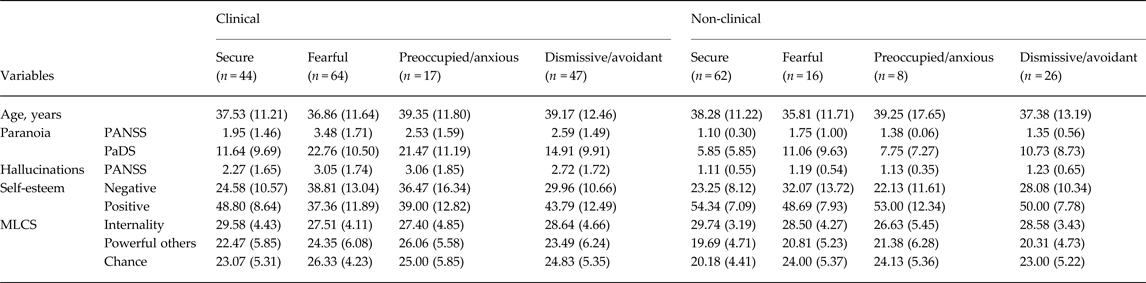
Table 1 shows means and standard deviations (s.d.s) for age and the psychological variables utilized in the analysis against the four different attachment styles assigned to participants in the two groups (clinical v. non-clinical). Of the clinical sample, 25.6% described their general attachment style as secure, 37.2% as fearful, 9.9% as anxious and 27.3% as avoidant (2.3% missing data). In comparison, 55.4% of the non-clinical sample described their general relationship style as secure, 14.3% as fearful, 7.1% as anxious and 23.2% as avoidant (0.9% missing data). There was a highly significant association between group and endorsed attachment style, [χ2 = 29.79 (3), p < 0.001].
Age and psychological variables for the four attachment styles in the clinical and non-clinical groups
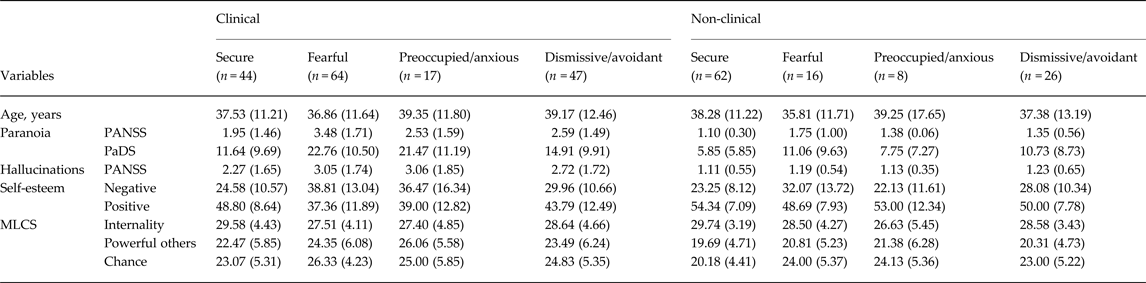
Data are given as mean (standard deviation).
PANSS, Positive and Negative Syndrome Scale; PaDS, Persecution and Deservedness Scale; MLCS, Multi-dimensional Locus of Control Scale.
No significant differences were observed between the sexes in the clinical group for attachment style category [χ2 = 5.48 (3), p = 0.14]. However, in the control group males were more likely to see themselves as either secure or avoidant than anxious or fearful, whereas females were more likely to see themselves as either secure or fearful rather than avoidant and anxious [χ2 = 11.67 (3), p < 0.01].
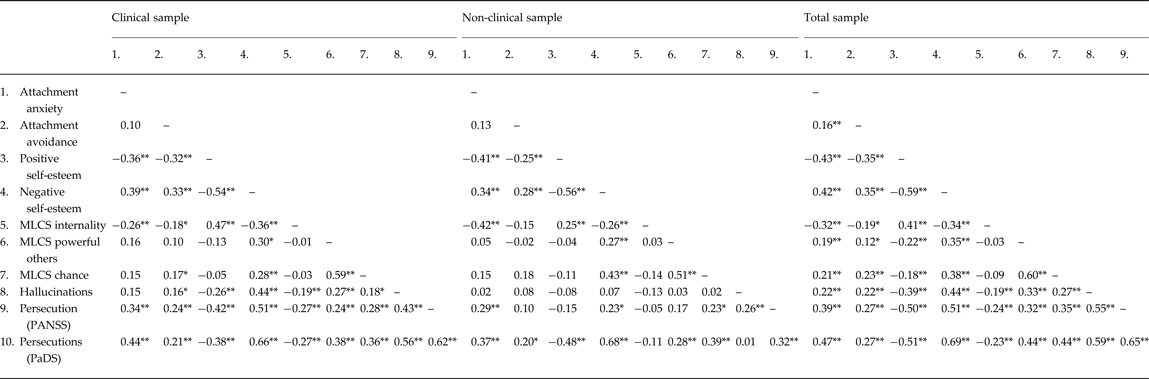
Correlation data for all variables used in the study are shown in Table 2. Looking at the clinical sample alone, both attachment dimensions (anxiety and avoidance) correlated with paranoia (PaDS: r = 0.44 and r = 0.21, p < 0.01; PANSS-suspiciousness: r = 0.34 and r = 0.24, p < 0.01, respectively). However, no significant correlations were found between the attachment dimensions and hallucinatory experiences. Negative self-esteem significantly correlated with both measures of paranoia (r = 0.51 and 0.66, p < 0.01) and hallucinatory experiences (r = 0.44, p < 0.01). Interestingly belief in powerful others was weakly correlated with both paranoia (r = 0.39, p < 0.01 for PaDS and r = 0.24, p < 0.01 for PANSS-suspiciousness) and hallucinatory experiences (r = 0.27, p < 0.01). However, it was not significantly associated with either attachment dimension. The results found in the non-clinical sample reflect those found in the clinical population in the majority of the correlations.
Correlation matrix between attachment anxiety and avoidance, psychological variables and positive symptoms of psychosis
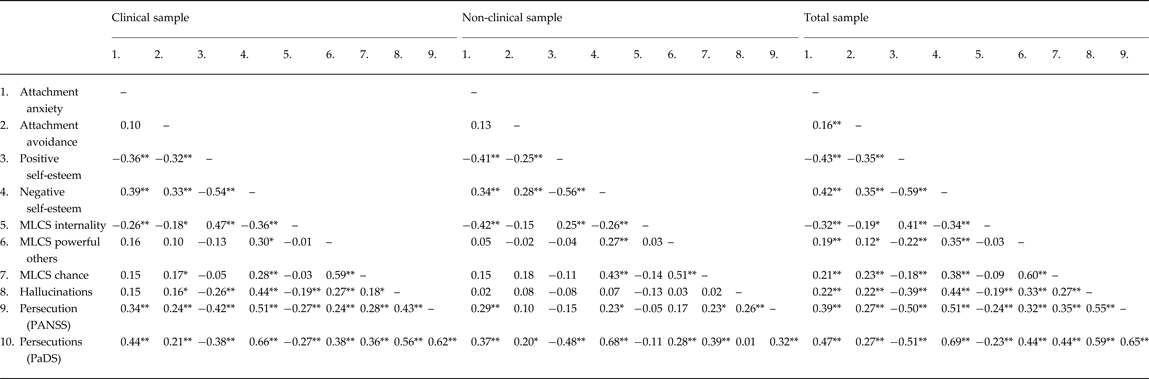
MLCS, Multi-dimensional Locus of Control Scale; PANSS, Positive and Negative Syndrome Scale; PaDS, Persecution and Deservedness Scale.
* p < 0.05, ** p < 0.01.
Regression analyses
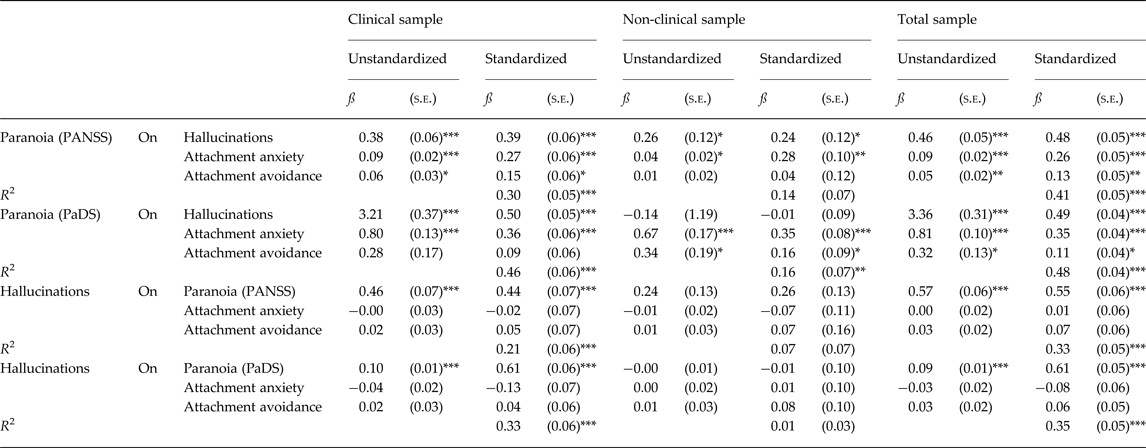
A summary of the regression analyses can be seen in Table 3. When using the PaDS as the DV and after controlling for hallucinatory experiences, attachment anxiety significantly predicted paranoia in the clinical sample, and the effect for attachment avoidance did not reach significance. However, both attachment dimensions predicted paranoia in the control sample.
Results of the regression analysis between the attachment dimensions, and positive symptoms of psychosis for each group
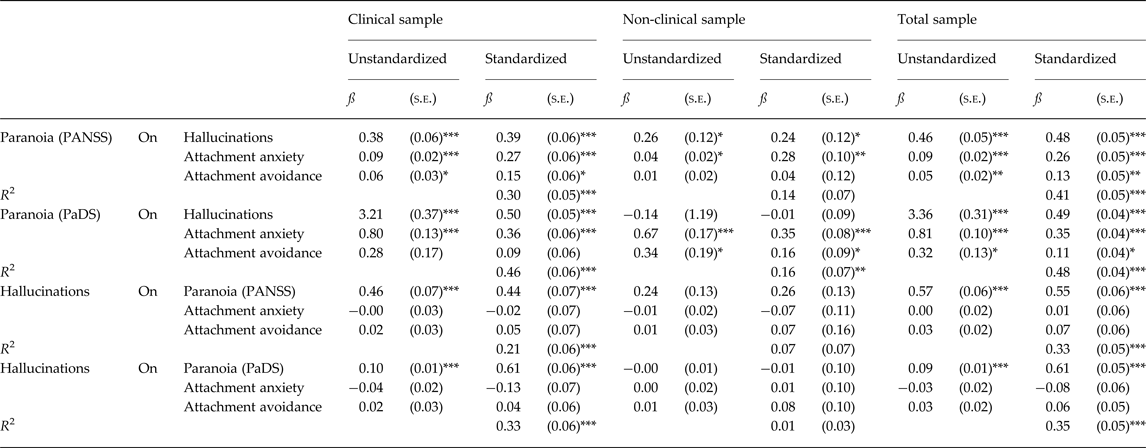
s.e., Standard error; PANSS, Positive and Negative Syndrome Scale; PaDS, Persecution and Deservedness Scale.
* p < 0.05, ** p < 0.01, *** p < 0.001.
When using PANSS-suspiciousness as the DV and after controlling for hallucinatory experiences, both attachment dimensions predicted paranoia in the clinical sample. However, in the non-clinical sample, only attachment anxiety predicted paranoia and attachment avoidance did not. When PANSS-suspiciousness was controlled for, neither attachment anxiety nor attachment avoidance predicted hallucinations in the clinical sample and the same was also true for the non-clinical sample. Similar results were obtained when the PaDS was used as the control measure of paranoia.
Mediation analysis
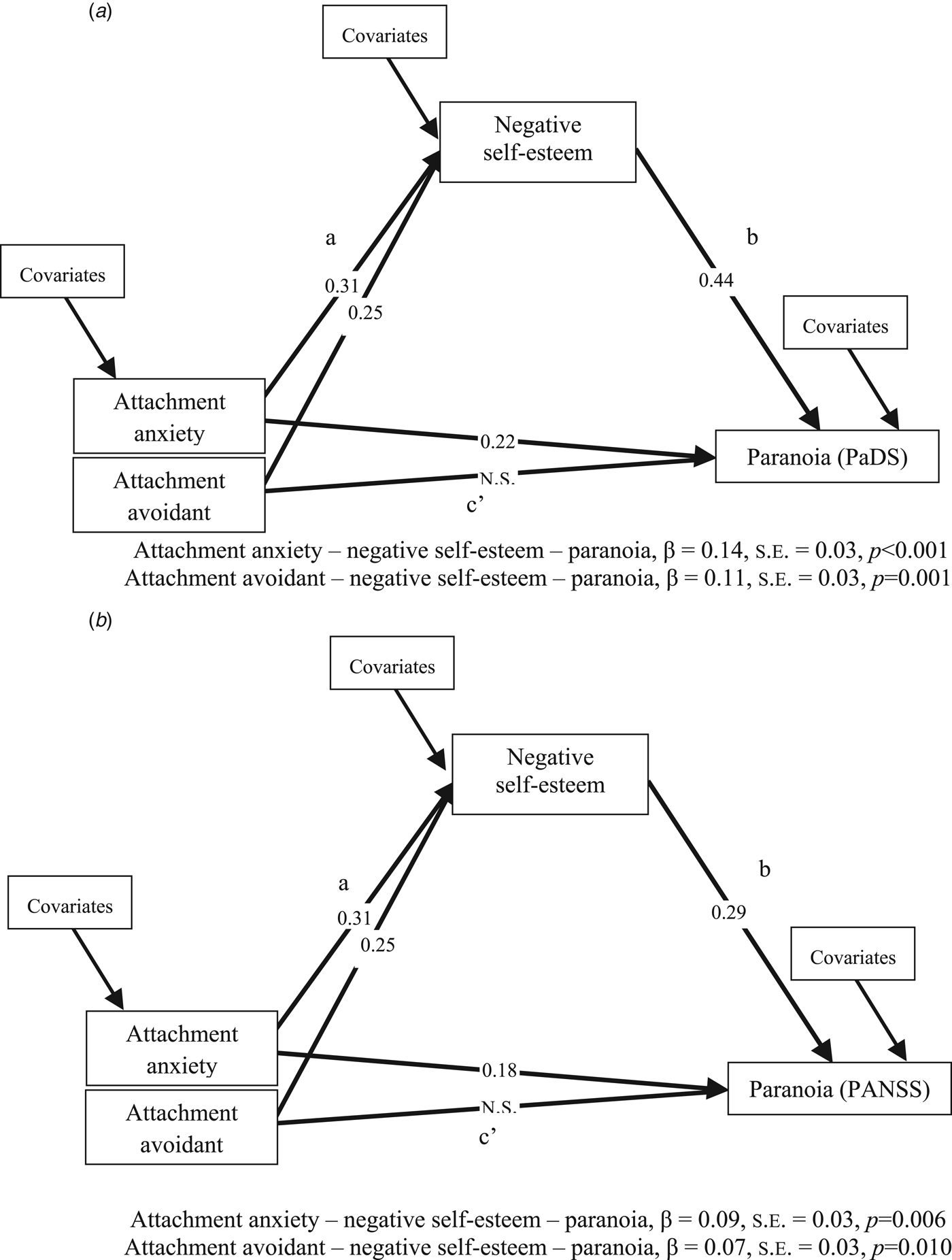
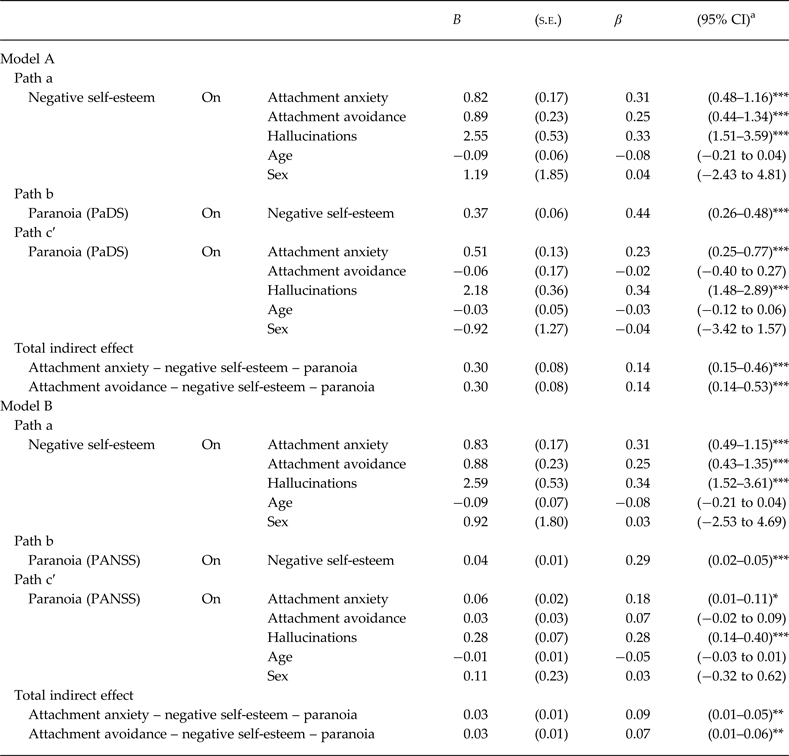
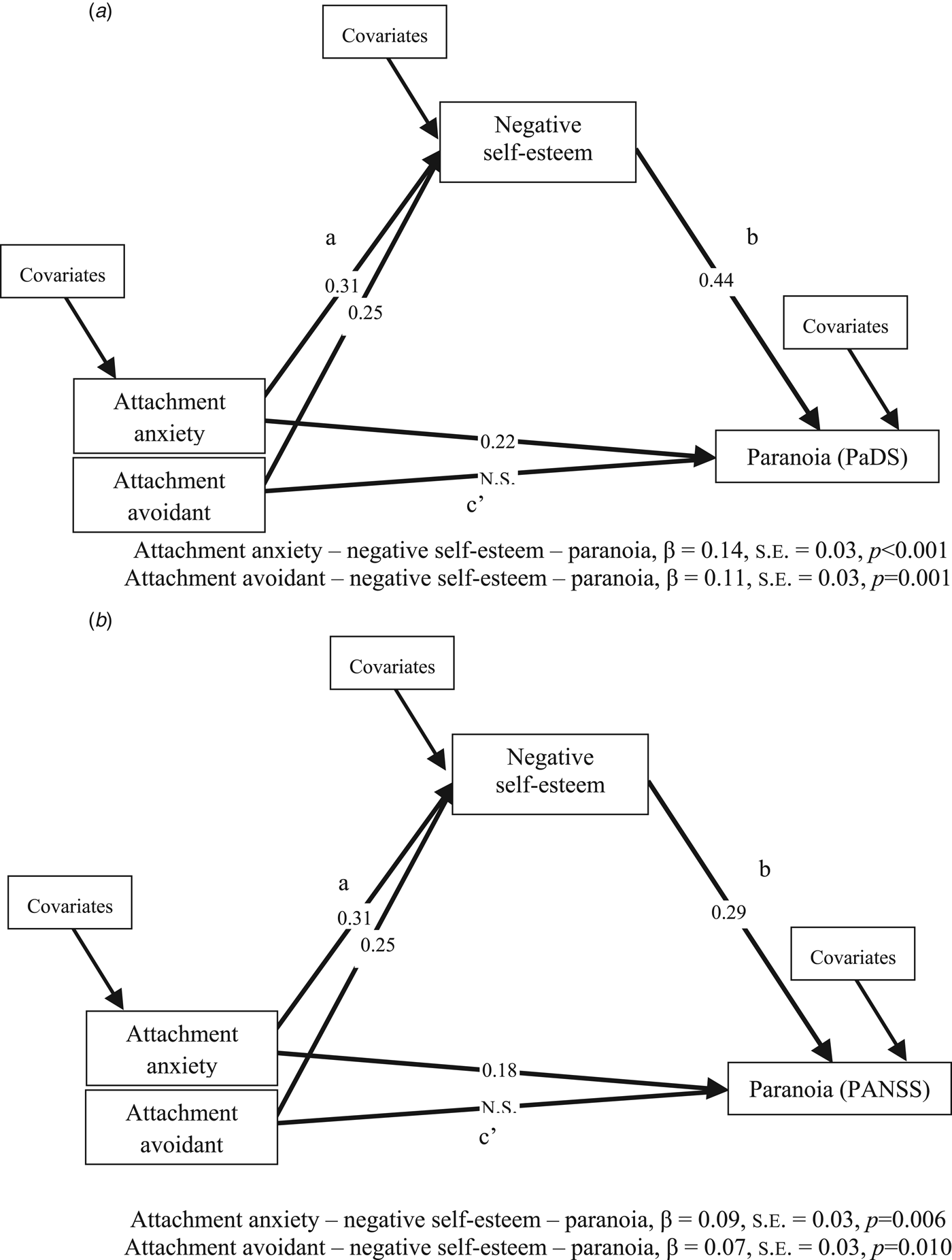
We carried out mediation analysis only on the clinical sample. As there was no direct relationship between attachment and hallucinations, we only computed models with paranoia as the DV, consistent with the recommendations of Baron & Kenny (Reference Baron and Kenny1986). Following the same recommendations, as no association was found between belief in powerful others and the attachment dimensions, this variable was not considered as a mediator in the paranoia models. We specified direct effects from the independent variables (IVs) attachment anxiety and attachment avoidance to the remaining mediating variable, negative self-esteem (path a), and direct effects from the mediating variable to the DV, paranoia (path b). Finally we specified direct effects from the IVs to the DV paranoia (path c′). Control variables included age, sex and hallucinatory experiences (see Fig. 1). We estimated the model twice using the different measures of paranoia as the DV (PaDS and PANSS-suspiciousness). The model for the PaDS demonstrated good model fit criteria [χ2 (1) = 0.54, p = 0.46, SRMR = 0.01, RMSEA = 0.00, CFI = 1.00, TLI = 1.04]. The model for PANSS-suspiciousness also demonstrated good model fit criteria [χ2 (1) = 0.76, p = 0.38, SRMR = 0.01, RMSEA = 0.00, CFI = 1.00, TLI = 1.03]. The unstandardized and standardized estimates and CIs of the direct and indirect effects of the mediation models are shown in Table 4.
Visual representation of the mediation model using the Persecution and Deservedness Scale (PaDS) (a) and the Positive and Negative Syndrome Scale (PANSS) (b) for paranoia as the dependent variable. The model controlled for age, sex and hallucinatory experiences (covariates) in all paths of the model. n.s., Non-significant.
Results of direct and indirect effects between attachment anxiety, attachment avoidance, negative self-esteem, and paranoia, whilst controlling for age, sex and hallucinatory experiences
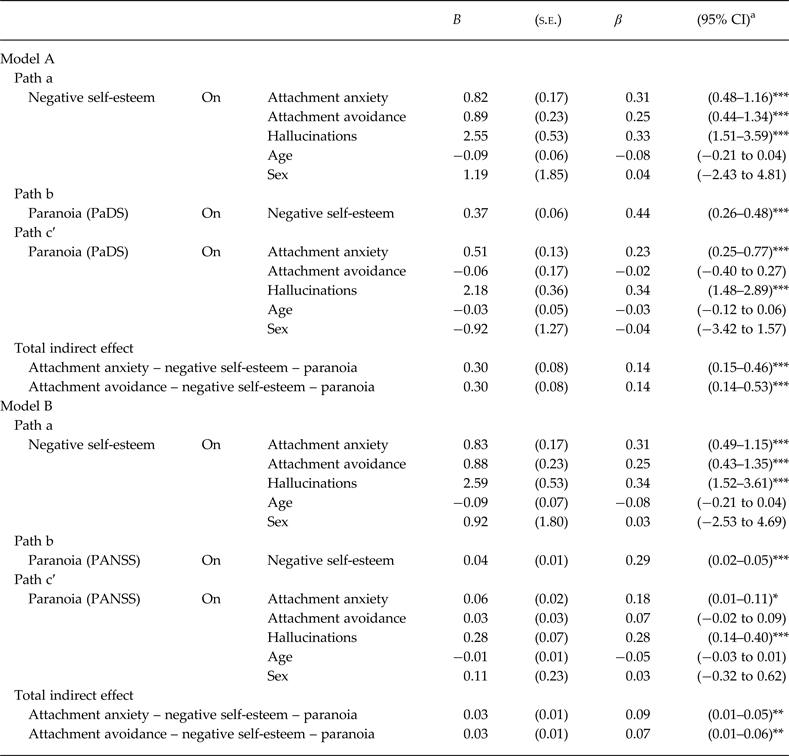
s.e., Standard error; CI, confidence interval; PaDS, Persecution and Deservedness Scale; PANSS, Positive and Negative Syndrome Scale.
aThe 95% CIs are for the unstandardized values (B).
* p < 0.05, ** p < 0.01, *** p < 0.001.
Partial mediation was observed for the relationship between attachment anxiety and paranoia through negative self-esteem using the PaDS as the DV (ß = 0.14, s.e. = 0.03, p < 0.001) and also using the PANSS as the DV (ß = 0.09, s.e. = 0.03, p < 0.01). Full mediation occurred between attachment avoidance and paranoia through negative self-esteem using the PaDS as the DV (ß = 0.11, s.e. = 0.03, p < 0.001), and also using the PANSS as the DV (ß = 0.07, s.e. = 0.03, p < 0.01) (see Fig. 1).
Discussion
Our understanding of the psychotic disorders can be progressed by studying mechanisms that are specific to each symptom (Bentall & Fernyhough, Reference Bentall and Fernyhough2008; Fibiger, Reference Fibiger2012). This study, for the first time, examined associations between insecure attachment and specific symptoms in a large group of patients with psychosis. As we had predicted, we found strong associations between the insecure attachment dimensions, negative self-esteem and paranoia. The finding of an association between attachment dimensions and paranoia in our patients is consistent with our previous findings with a non-clinical sample (Pickering et al. Reference Pickering, Simpson and Bentall2008). Consistent with our previous research, the effect was found in the non-clinical controls taking part in the present study even when the PANSS was used as an outcome, despite the low variance in the PANSS scores. In this group, just as importantly, as we had predicted, we found that insecure attachment was not associated with hallucinations in either the patients or the controls. A secondary aim of our study was to investigate the possible mediating role of negative self-esteem and belief in powerful others. These processes, sometimes described as negative schemas about the self and others, play an important role in current cognitive models of paranoia (Bentall et al. Reference Bentall, Corcoran, Howard, Blackwood and Kinderman2001; Freeman et al. Reference Freeman, Garety, Kuipers, Fowler and Bebbington2002). In fact, the latter variable, although correlated with paranoia, did not prove to play a mediating role between insecure attachment and paranoia in our clinical participants. However, in line with the findings of Pickering et al. (Reference Pickering, Simpson and Bentall2008), we found that negative self-esteem mediated the relationship between the insecure attachment dimensions and paranoid symptoms, partially for attachment anxiety and fully for attachment avoidance.
Previous studies have implicated insecure attachment in psychosis (Dozier et al. Reference Dozier, Stevenson, Lee and Velligan1991, Reference Dozier, Stovall, Albus, Cassidy and Shaver1999; Mickelson et al. Reference Mickelson, Kessler and Shaver1997; Berry et al. Reference Berry, Wearden, Barrowclough and Liversidge2006, Reference Berry, Wearden and Barrowclough2007). However, the present findings advance our understanding by demonstrating some degree of specificity for paranoid delusions. It might be argued that this finding is unsurprising, as insecure attachment implies mistrust of others, which is almost a defining feature of paranoia. However, in response we observe that: (i) previous researchers studying attachment in relationship to psychosis have not hypothesized the specific associations we have tested here; (ii) an association, even if thought to be self-evident, must be demonstrated empirically because supposedly self-evident associations do not always survive testing; (iii) none of the RQ items has obviously paranoid content and, indeed, mistrust is mentioned in only one item; and (iv) our findings are consistent with our previous epidemiological analyses that show a close association between paranoid symptoms and attachment-threatening early life events (Bentall et al. Reference Bentall, Wickham, Shevlin and Varese2012; Sitko et al. Reference Sitko, Bentall, Shevlin, O'Sullivan and Sellwood2014). The finding that insecure attachment is an important psychological process in paranoia is consistent with current psychological models, particularly the model of Freeman et al. (Reference Freeman, Garety, Kuipers, Fowler and Bebbington2002) which assumes that psychological schemas including low self-esteem and assumptions about others directly drive paranoid thinking.
It is notable that attachment anxiety and attachment avoidance, rather than either of these forms of insecure attachment, were both associated with paranoia. According to Bartholomew & Horowitz (Reference Bartholomew and Horowitz1991), the former is associated with a negative view of the self and the latter with a negative view of others, but the associations between both types of insecure attachment and paranoia were mediated (partially in the case of attachment anxiety, fully in the case of attachment avoidance) by negative self-esteem. These findings are consistent with evidence that negative self-esteem plays an important role in paranoid beliefs (Freeman & Garety, Reference Freeman and Garety2003; Freeman et al. Reference Freeman, Garety, Bebbington, Smith, Rollinson, Fowler, Kuipers, Ray and Dunn2005; Pickering et al. Reference Pickering, Simpson and Bentall2008; Bentall, Reference Bentall2009), and suggest that these beliefs are associated with schematic representations, not only of others as untrustworthy, but of the self as unlovable. It is not clear from these data how these schemas unfold developmentally although, as noted above, we have hypothesized that they are promoted by attachment-disrupting events in childhood such as being raised in an institution or being neglected.
There are some important limitations to this study that we would like to acknowledge. First, the present analysis used cross-sectional data and direction of causality cannot be tested using the statistical models we have employed. Complete backward causation seems unlikely, however, as previous research suggests that indices of many of the mechanisms we have investigated predate the onset of psychosis. As already noted, in our previous research we have shown that attachment-disrupting events in childhood predict paranoid symptoms but not hallucinations in adulthood (Bentall et al. Reference Bentall, Wickham, Shevlin and Varese2012; Sitko et al. Reference Sitko, Bentall, Shevlin, O'Sullivan and Sellwood2014). Other researchers have reported associations between other childhood markers of disrupted attachment, for example being unwanted at childbirth (Myhrman et al. Reference Myhrman, Rantakallio, Isohanni, Jones and Partanen1996) or early separation from parents (Morgan et al. Reference Morgan, Kirkbride, Leff, Craig, Hutchinson, McKenzie, Morgan, Dazzan, Doody, Jones, Murray and Fearon2007) and future psychosis, although specificity for paranoia was not tested in these studies. Longitudinal research has also shown that low self-esteem is predictive of incident psychotic symptoms in a general population sample (Krabbendam et al. Reference Krabbendam, Janssen, Bak, Bijl, de Graaf and van Os2002), although specificity for paranoia was again not tested. However, we cannot completely exclude the possibility of some backward causation, as a diagnosis of schizophrenia may give rise to negative self-esteem (perhaps linked to social and self-stigma) and this may in turn affect the way that individuals think about their attachments to others. Future studies might attempt more robust tests of causality, for example by conducting appropriately sophisticated analyses on longitudinal datasets, and also by exploiting ‘natural experiments’ such as prospective studies of children who have been reared in adverse circumstances.
A further limitation is that our measure of hallucinations, the PANSS, measured only current hallucinatory experiences and it is possible that some association with hallucinations might have been found over a longer time period. However, as noted above, when specificity has been tested, attachment-disrupting events in childhood have not been associated with hallucinations in adults and, moreover, Pickering et al. (Reference Pickering, Simpson and Bentall2008) did not find an association between insecure attachment and a trait measure of hallucination-proneness in a large non-clinical sample, although an association with paranoia was found. The variance in the PANSS scores was low in the control group, which must be considered when looking at the regressions found with this sample. However, significant results were obtained when using the PaDS. This needs consideration for future research. A final limitation that needs to be addressed by further research is the use of the four-item RQ to derive attachment dimensions. The measure, although routinely used by researchers to assess attachment styles, may be insufficient to address the complexities and progression of attachment in adulthood. In future research it may be appropriate to use other measures of insecure attachment. In particular, we note that the RQ measure of fearful attachment does not reflect the concept of disorganized attachment as assessed by interview measures such as the Adult Attachment Interview.
The likely role of attachment processes in paranoid delusions has important clinical implications. If this study is supported by future research, consideration might be given to how to protect young people who are exposed to attachment-threating experiences, for example children raised in children's homes. It may also be beneficial to adapt cognitive–behavioural therapy to address attachment-related cognitions specifically, especially when working with paranoid patients. It seems important for clinicians to be aware of their own attachment styles and how their interpersonal interactions are affected by them, as evidence from the broader literature suggests that early ratings of the therapeutic alliance are higher when therapist and client do not share the same insecure styles (see Marmarosh et al. Reference Marmarosh, Kivlighan, Bieri, LaFauci Schutt, Barone and Choi2014). Owen et al. (Reference Owen, Haddock and Berry2013) have discussed the need for clinicians to vary their therapeutic approaches based on their patients’ attachment styles and future research might address whether this leads to more personalized interventions of increased effectiveness. For these reasons, there may be important clinical advantages to be gained from assessing attachment styles within the therapeutic setting and considering targeted psychological interventions based on patients’ internal working models of themselves and of others.
Acknowledgements
We would like to acknowledge the help of Professor Tony Morrison, Dr Rosie Beck, Ms Suzanne Heffernine and Dr Heather Laws, who kindly provided us with data from their National Institute for Health Research-funded programme of research on subjective judgements of perceived recovery from psychosis.
Declaration of Interest
None.