INTRODUCTION
Hydroids are an important component of benthic marine ecosystems, on both hard and soft bottoms (Boero, Reference Boero1984; Morri et al., Reference Morri, Bavestrello and Bianchi1991; Gili & Hughes, Reference Gili and Hughes1995). Many of them are known for their essential role in benthic–pelagic coupling, either by filter feeding on plankton (Gili et al., Reference Gili, Alvà, Coma, Orejas, Pagés, Ribes, Zabala, Artz, Bouillon, Boero and Hughes1998) or because of their metagenetic cycles, which often involve a free-swimming medusa (Boero et al., Reference Boero, Belmonte, Fanelli, Piraino and Rubino1996; Marcus & Boero, Reference Marcus and Boero1998). In shallow hard bottom communities of temperate seas, like the Mediterranean, hydroids can outcompete algae as major substrate occupiers during the cold season (Bianchi et al., Reference Bianchi, Boero, Fraschetti, Morri, Argano, Chemini, La Posta, Minelli and Ruffo2004) or even persist year-round to form peculiar assemblages within otherwise algae-dominated communities (Bellan-Santini et al., Reference Bellan-Santini, Bellan, Bitar, Harmelin and Pergent2002).
The hydroid fauna of the Mediterranean Sea has been said to be ‘one of the better known in the world’ (Boero & Bouillon, Reference Boero and Bouillon1993) and a recent monograph with identification keys is available (Bouillon et al., Reference Bouillon, Medel, Pagès, Gili, Boero and Gravili2004). It must be recognized, however, that virtually all of our knowledge on Mediterranean hydroids comes from work done by French, Spanish and Italian scientists (Picard, Reference Picard1958a; Medel & López-González, Reference Medel and López-González1996; Boero et al., Reference Boero, Gravili, Denitto, Miglietta and Bouillon1997; and references therein), so that only the (north-)western Mediterranean and the Adriatic hydroid fauna may be considered adequately known (Boero et al., Reference Boero, Gravili, Denitto, Miglietta and Bouillon1997). The previous dearth of information on the Aegean Sea has been only partially remedied by Morri & Bianchi (Reference Morri and Bianchi1999), whereas the hydroid fauna of the Levant Sea remains little studied.
The available information on Levant Sea hydroids is summarized in the papers by Picard (Reference Picard1958b) and Vervoort (Reference Vervoort1993), both having studied material from Israel, and by El-Beshbeeshy (Reference El-Beshbeeshy1993, Reference El-Beshbeeshy1994a, Reference El-Beshbeeshy1994b, Reference El-Beshbeeshy1995a, Reference El-Beshbeeshy1995b), who worked on the hydroids of Egypt. A number of papers deal with fouling hydroids of the Suez Canal and Mediterranean Egyptian harbours (Abdel-Hamid et al., Reference Abdel-Hamid, Mona and Shoukr1983, Reference Abdel-Hamid, Mona, Shoukr and Seif1984; Shoukr & Abdel-Hamid, Reference Shoukr and Abdel-Hamid1987; Shoukr, Reference Shoukr1987). Also of interest are the papers on the pelagic hydromedusae of eastern Mediterranean waters (Schmidt, Reference Schmidt1973; Lakkis & Zeidane, Reference Lakkis and Zeidane1985; Goy et al., Reference Goy, Lakkis and Zeidane1988, Reference Goy, Lakkis and Zeidane1990, Reference Goy, Lakkis and Zeidane1991; Zakaria, Reference Zakaria2004).
Thanks to the French–Lebanese co-operation programme CEDRE, expeditions to collect marine fauna were organized between 1999 and 2003 along the coasts of Lebanon (Zibrowius & Bitar, Reference Zibrowius and Bitar2003). Results of these and collateral collections highlighted several points of interest: (i) sponge, isopod and bryozoan species new to science (Pérez et al., Reference Pérez, Bitar, Zibrowius and Vacelet2004; Bariche & Trilles, Reference Bariche and Trilles2006; Harmelin et al., Reference Harmelin, Bitar and Zibrowius2007; Vacelet et al., Reference Vacelet, Bitar, Carteron, Zibrowius and Perez2007, Reference Vacelet, Bitar, Dailianis, Zibrowius and Perez2008); (ii) lack of some ‘typical’ Mediterranean elements in brachiopods (Logan et al., Reference Logan, Bianchi, Morri, Zibrowius and Bitar2002); (iii) new records for the Mediterranean Sea in polychaetes (Aguado & San Martín, Reference Aguado and San Martín2007); and (iv) occurrence of Red Sea species among algae (Bitar et al., Reference Bitar, Dupuy De La Grandrive, Foulquie and Verlaque2005), various invertebrates (Zibrowius & Bitar, Reference Zibrowius and Bitar2003) and fish (Harmelin-Vivien et al., Reference Harmelin-Vivien, Bitar, Harmelin and Monestiez2005).
This paper reports on hydroids collected mostly within that project (with additions in earlier and later years). As collecting essentially aimed at a general biodiversity inventory in shallow rocky habitats, sampling was more ‘faunistic’ than ‘ecological’ in design. Nevertheless, the large amount of material obtained allowed for, beside the mere species inventory, a first analysis on some ecological traits of species occurrence, such as reproductive season and depth and habitat preference, in comparison with what is known for the more studied western Mediterranean. As the Levant Sea is currently the portion of the Mediterranean most prone to be colonized by the Red Sea immigrants (Galil, Reference Galil, Gollasch, Galil and Cohen2006), particular attention was given to the occurrence of non-indigenous or alien species (Streftaris et al., Reference Streftaris, Zenetos and Papathanassiou2005; Zenetos et al., Reference Zenetos, Çinar, Pancucci-Papadopoulou, Harmelin, Furnari, Andaloro, Bellou, Streftaris and Zibrowius2006, Reference Zenetos, Meriç, Verlaque, Galli, Boudouresque, Giangrande, Çinar and Bilecenoğlu2008).
MATERIALS AND METHODS
Field work
Hydroids were collected between 1999 and 2003 in Lebanon by G. Bitar and H. Zibrowius under the aegis of CEDRE. Additional samples from Lebanon were taken between 1991 and 2004 by G. Bitar, who also collected in a distant site to the north (Burj Islam, Syria) in 1999. Further, C. Morri had access to material taken in 2004 in a distant site to the south (Hadera, Israel). Altogether, 34 sites (including the two localities outside the Lebanese borders) were investigated, covering some 460 km of coastline (Figure 1); the regions of Trablus (Tripoli), Jebail (Byblos), Beirut and Saida (Sidon) were more intensively sampled. A total of a hundred and one samples were obtained, from depths ranging from near the surface down to 42 m. As samples were taken by free or SCUBA diving, the choice of sampling sites was significantly constrained by logistics (especially accessibility from shore). Dives were performed in different periods between April and November. During each dive, sampling was oriented visually; this approach has been proved most effective to establish large species inventories (Morri et al., Reference Morri, Bianchi, Cocito, Peirano, De Biasi, Aliani, Pansini, Boyer, Ferdeghini, Pestarino and Dando1999).
Map of the sampling localities along the Levant Sea coast.

Laboratory and data analysis
Specimens were fixed in formaldehyde 4% a few hours after sampling. Species were sorted months later, and analysed in the laboratory under both low- and high-power microscopes for taxonomic identification. Measures were taken on, and drawings were made from, fixed material. The presence of reproductive structures was noted. For some species, a number of pieces were washed with distilled water, dehydrated in graded ethanol series samples, and dried in a critical point dryer. Finally, they were coated with gold-palladium in a Balzer Union evaporator and examined with a Philips XL20 scanning electron microscope.
Data on species occurrence were organized in a presence–absence matrix. Frequency of occurrence of a given species with respect to the total number of samples (in the year, locality, season or habitat according to the case) was used as the only way available to obtain (semi-)quantitative data.
RESULTS
Diversity and systematics
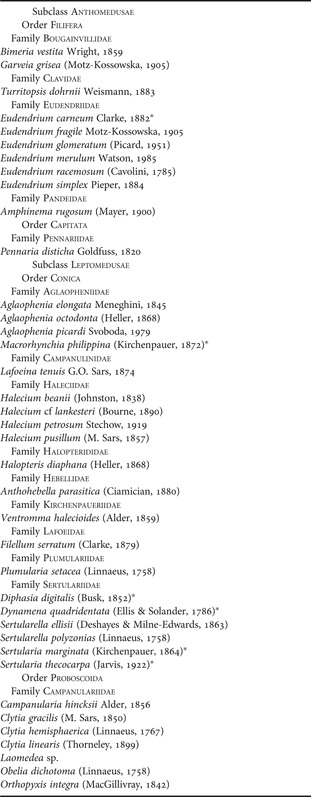
A total of 38 species was found, 11 of which were Anthomedusae and 27 were Leptomedusae (Table 1). Poor conservation conditions made specific identification of a Laomedea species impossible. We tentatively assigned a sterile colony of Halecium bearing zooxanthellae in the coenosarc to the species lankesteri. Halecium nanum, known from Bermuda (Calder, Reference Calder1991) to the north-western Mediterranean (Boero & Fresi, Reference Boero and Fresi1986), also has zooxanthellae and similar morphology but H. lankesteri, a strictly Atlantic–Mediterranean species (Peña Cantero & García Carrascosa, Reference Peña Cantero and García Carrascosa2002), has already been reported from the Levant Sea by El Beshbeeshy (1994a). A positive distinction between the two species requires the observation of female gonothecae (Schuchert, Reference Schuchert2005).
Taxonomic list of the species collected. Non-indigenous species are marked with*.

Six species can be considered as aliens: Dynamena quadridentata, Diphasia digitalis and Sertularia thecocarpa are recorded for the first time from the Mediterranean Sea, whereas Eudendrium carneum has been recorded from the western Mediterranean in recent years, but not yet from the eastern Mediterranean; Sertularia marginata and Macrorhynchia philippina had already been found in the eastern Mediterranean but no description of the Mediterranean specimens had been given before. Original drawings, SEM photographs and a detailed description of these six species, based on the Levant Sea material, are provided in the following paragraphs, as a useful addition to the scanty information available in the literature; in the case of S. thecocarpa descriptions and illustrations also substantiate the proposed move from the genus Sertularella to Sertularia and the synonymy with Sertularia stechowi Hirohito (Reference Hirohito1995).
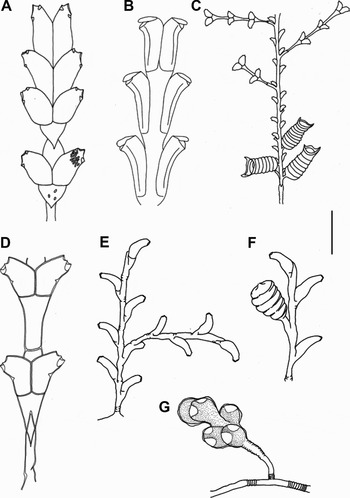
Hydrothecae of Dynamena quadridentata (A) and Diphasia digitalis (B); colony of Sertularia marginata with gonothecae (C); hydrothecae of Sertularia marginata (D); colony (E) and hydrothecae (F) of Sertularia thecocarpa; female gonophore of Eudendrium carneum (G). Scale bars: (A) 200 µm; (B, E) 600 µm; (C) 1.3 mm; (D) 250 µm; (F) 550 µm; (G) 400 µm.

DESCRIPTION
Colonies dioecious, arborescent, up to 10 cm high; stem fascicled, hydrocauli arising from creeping hydrorhiza; branches alternate, occurring over entire hydrocaulus, branches up to second order, radial or planar; pedicels arising from main stem or branches of first and second order. Perisarc of main stem thick, brown, smooth or with rare rings. Branches with 5–10 rings at origin. Pedicels with 2 rings at origin, sometimes corrugated. Hydranths poorly preserved.
Gonophores styloids, arising from body of hydranth. Immature styloids placed in a circle around body of hydranth. Male blastostyle with up to 14 sporosacs, each sporosac up to 5 chambered. Sporosac with a distinct spadix over its longitudinal axis, and sometimes a terminal tubercle on its apex; distal chamber 280–300 µm in diameter, 200–210 µm in height. Mature male blastostyles with tentacles and hypostome completely reduced. Female gonophores, up to 10, arise on blastostyles, immature eggs having a bifid and curved spadix over a single egg. During egg maturation, tentacles and hypostome of the blastostyle reduce completely. During development, spadices shed. Embryos borne in perisarc-covered capsules arranged irregularly along pedicel (Figure 2G).
Nematocysts of two categories, heterotrichous microbasic euryteles and heterotrichous anisorhiza. Small microbasic euryteles (not seen discharged), 7–7.5 × 2.5–3 µm, oval, common; distributed over hydranth body, hypostome, coenosarc, and tentacles. Large heterotrichous anisorhiza (not seen discharged), 20–22 × 10–12 µm, bean shaped, distributed at the base of hydranth body and coenosarc.
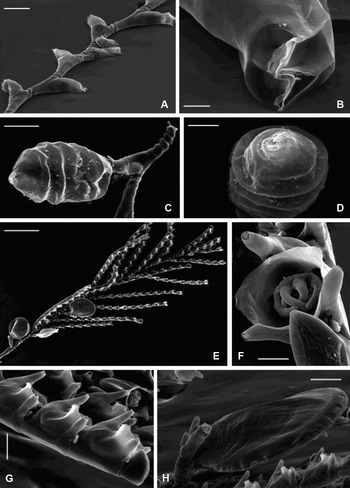
Scanning electron microscopy images of Dynamena quadridentata colony (A) and groups of hydrothecae (B, C); Sertularia marginata colony (D), hydrothecae (E) and gonothecae (F). Scale bars: (A) 1 mm; (B, D) 200 µm; (C) 100 µm; (E) 50 µm; (F) 500 µm.

Scanning electron microscopy images of Sertularia thecocarpa colony (A), operculum (B) and gonotheca (C, D); Machrorhynchia philippina colony (E), hydrothecae (F, G) and gonotheca (H). Scale bars: (A, C, H) 200 µm; (B) 25 µm; (D, G) 100 µm; (E) 1 mm; (F) 50 µm.

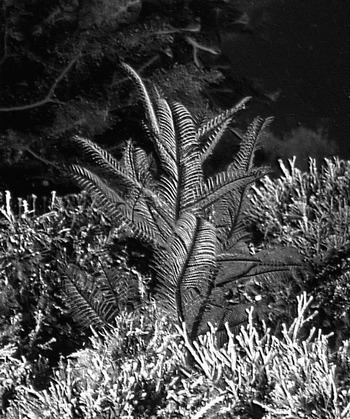
A colony of Macrorhynchia philippina amidst algae in shallow water (~7 m depth): Batrun, 4 July 2003 (photograph Jean Vacelet).

DESCRIPTION
Colonies up to 30 cm high (Figure 5), stinging to the touch when fresh. Hydrocauli polysiphonic, strongly and irregularly branched. Branches arising from peripheral tubes of stem, with a basal part bearing median nematothecae and a distal part bearing alternate hydrocladia (Figure 4E). Axial tube of stem and distal part of branches with internodes, each with one hydrocladian apophysis and two nematothecae. Mamelon present on anterior surface of apophysis. Hydrotheca sac-shaped, upper third curving away, opening obliquely, margin with two rounded lateral cusps and a median abcauline tooth; between margin and median inferior nematotheca, a triangular thick shelf projects halfway into hydrotheca (Figure 4F, G). Median inferior nematotheca conical, reaching beyond margin of hydrotheca, with three openings (Figure 4G). Lateral nematothecae tubular, inclined forward, generally overtopping the hydrothecal margin, with one or two openings (Figure 4F). Nematothecae with mastigophores of two sizes: 63–75 × 7.5 µm (undischarged) and 13–25 × 4 µm (undischarged). Small nematocysts (mastigophores?), 5 × 2.5 µm, very abundant in polyp. Gonothecae on modified hydrocladia (phylactocarps), one per phylactocarp (Figure 4E). Phylactocarps composed of one hydrocladial segment with hydrotheca as in normal hydrocladia, followed by cylindrical segments with one or two nematothecae. Gonotheca attached to segment following hydrothecate segment, black coloured, lens-shaped (Figure 4H).
DESCRIPTION
Stems arising from a creeping hydrorhiza, short, unbranched. Nodes transverse. Up to 3 pairs of hydrothecae on each stem; hydrothecae biseriate, paired, one pair on internode, long, tubular, adnate 3/4 adcauline length (Figure 2B). Margin quadrangular, one adcauline operculum, perisarc delicate, a low cusp at summit of a longitudinal frontal pleat extending from base of hydrotheca to margin. Gonotheca not recorded in the Levant Sea material. Coenosarc dark-brown coloured.

DESCRIPTION
Hydrorhiza creeping on Pennaria disticha hydrocaulus. Stem unfascicled, unbranched, reaching a maximum height of 5 mm. Normal nodes transverse and often indistinct. Oblique hinge-joints present at the base of the stem, each forming the termination of a separate, narrow, athecate internode at irregular intervals in the distal region (Figures 2A & 3A, B). Each thecate internode bearing one to three pairs of opposite hydrothecae; the pairs in a group up to three in number, contiguous with one another and showing a difference in shape, the proximal pair being more divergent than the distal one (Figures 2A & 3B, C). Members of a pair of hydrothecae contiguous in front, separate behind. Hydrotheca tubular, narrowing to margin, bent outwards, adnate 3/4 adcauline length, with internal teeth (Figure 3C). Lateral marginal teeth broad and triangular, adcauline marginal tooth larger than the abcauline ones. Operculum composed of two flaps (Figure 3C). Gonotheca not recorded in the Levant Sea material. Nematocysts (Figure 2A): 15–20 large isorhizae (?) present at the base of the hypostome of the polyps (20–22.5 × 9–10 µm undischarged; 20–22.5 × 7.5–8 µm discharged).

DESCRIPTION
Stem unfascicled, up to 20 mm, either pinnate or simple and unbranched. Pinnate stem with a short basal athecate part terminated by a hinge-joint and a long distal thecate part bearing alternate hydrocladia (Figures 2C & 3D). Thecate part divided by slightly oblique nodes into internodes with three hydrothecae (occasionally two), one basal, axillary with the apophysis of the hydrocladium, and two subopposite (Figure 2C). The two rows of hydrocladia in one plane. Hydrocladial internodes with two hydrothecae opposite touching frontally (Figures 2C & 3D, E). Hydrotheca with an abcauline intrathecal septum, swollen below septum, narrowing to mouth above it, bent outwards and slightly forwards, adnate for over half adcauline (Figure 2D). Margin with two well developed triangular and sharp lateral teeth and a small adcauline one (Figure 3E). Internal teeth absent. Operculum composed of two flaps, the adcauline one divided in two parts (Figure 3E). Gonotheca large, drum shaped, with 6–7 transverse ribs and two rounded lateral spines sometimes very developed, aperture circular, wide provided with a circular operculum (Figures 2C & 3F).
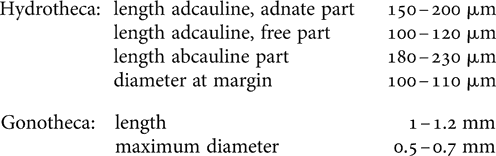
DESCRIPTION
Colony growing on hydrocaulus of P. disticha, reaching 15 mm in height. Stem unfascicled, erect, rarely branched, divided into internode by oblique nodes; nodes sloping alternately in opposite direction; each internode bearing usually one hydrotheca on upper part and usually one ring just above the node (Figures 2E & 4A). Hydrothecae arranged alternately in two longitudinal rows, nearly tubular, with smooth surface, bending outwards, adnate for about a third of adcauline length; free part tapering distally. Thecal margin bearing two distinct lateral teeth; operculum composed of two identical flaps, each one sometimes divided into two identical parts (Figure 4B). Hydrothecal renovations frequent. Polyp with many small nematocysts at the base of the hypostome. Gonothecae borne on lower part of stem, arising from within the remains of hydrothecae, sometimes directly on hydrorhiza, ovate, corrugated or with five to seven transverse rings, with a low collar at distal end and a small terminal aperture (Figures 2F & 4C, D).
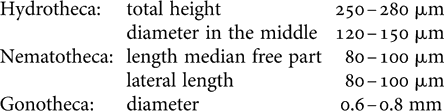
MEASUREMENTS
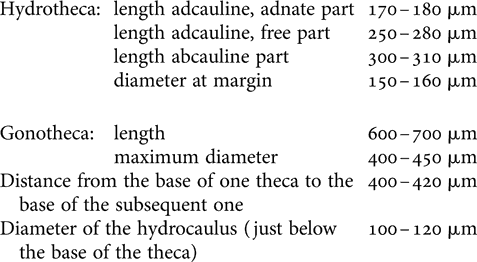
REMARKS
Jarvis (Reference Jarvis1922) named Sertularella thecocarpa a species from the Indian Ocean characterized by the hydrothecal margin bearing two large sharply pointed lateral teeth, and gonothecae arising from a lumen of a hydrotheca. Millard & Bouillon (Reference Millard and Bouillon1973) reported the same species from the Seychelles, but did not provide a detailed description of the marginal teeth and the operculum. Owing to the presence of an operculum made of two valves, this species must be placed in the genus Sertularia: Jarvis was possibly confused by the division of the valves into two sections. The presence of gonothecae arising from within the hydrothecal cavity, typical of the family Syntheciidae and also reported in the sertulariid genus Fraseroscyphus (which has three opercular valves, however), is unusual for the genus Sertularia and will deserve further taxonomic investigation. Sertularia stechowi described by Hirohito (Reference Hirohito1995) from Sagami Bay, Japan, agrees with the characters of S. thecocarpa. Hirohito observed: ‘…each flap divided into two identical sections. Consequently the operculum is seemingly composed of four identical flaps in view from above. When the operculum is closed, however, two flaps are in contact on one edge taking shape of pyramidal roof such as operculum of four flaps would take.’ We believe, therefore, that Sertularia stechowi is a junior synonym of S. thecocarpa.
Zoogeography
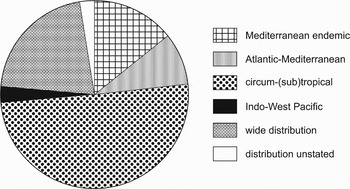
More than half of the species collected have a circumtropical distribution, although often extending into warm-temperate waters (Figure 6). Two of the three new Mediterranean records, D. digitalis and D. quadridentata, belong to this group, while the third, S. thecocarpa, was hitherto known only from the Indo-West Pacific (see remarks above). Several other species exhibit wider distributions, extending significantly into temperate waters, whereas Mediterranean endemics and typical Atlantic–Mediterranean species are comparatively less represented.
Zoogeographical affinities of the hydroid fauna on the basis of the 38 species collected.

Nine species are new for the Levant Sea and include widely distributed species (Filellum serratum, Halecium beanii, Plumularia setacea and Sertularella polyzonias), circum(sub)tropical species (E. carneum, Halecium pusillum and Lafoeina tenuis), and Mediterranean endemics (Garveia grisea and Halecium petrosum) indistinctly.
Occurrence of alien species
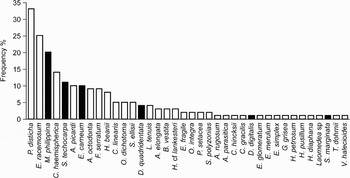
Three aliens out of six stand among the seven most frequent hydroid species in the present collection along the Levant coast: these are M. philippina, S. thecocarpa and E. carneum, in the order. Dynamena quadridentata is also notably frequent, whereas the latter two aliens, D. digitalis and S. marginata, were found only once (Figure 7). As a whole, the mean frequency of alien species in the present collection was greater than that of indigenous species.
Total absolute frequency of the species collected, pooling year, season and locality of collection. Species are ordered according to their frequency rank. Black bars indicate the six alien species.

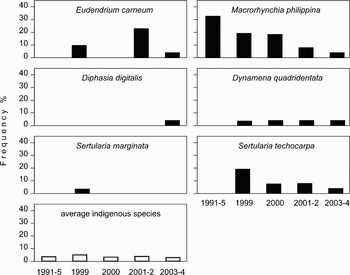
One may speculate that the higher frequency of some of the aliens may be related to their earlier arrival in the Levant Sea (Figure 8). Macrorhynchia philippina has occurred in the region since at least the early 1990s. Hirohito (Reference Hirohito1995) included the Mediterranean within the geographical range of this species but provided no detail—perhaps he misunderstood the finding by Stechow (Reference Stechow1919) at Suez as a Mediterranean occurrence. The first solid mention of the species in Lebanon was that by Bitar & Bitar-Kouli (Reference Bitar and Bitar-Kouli1995: identification confirmed by C. Morri), who found it in polluted waters near Beirut. Sertularia thecocarpa, E. carneum and D. quadridentata have been first collected in 1999. Although Picard (Reference Picard1958b) recorded S. marginata from Beirut as early as in 1930, we collected it in 1999 only. Finally, D. digitalis was never recorded before 2004.
Relative frequency with respect to the collection periods of the six alien species (black bars). Average indigenous species shown for comparison. Years were grouped to have roughly the same number of samples (18–23) for each period.

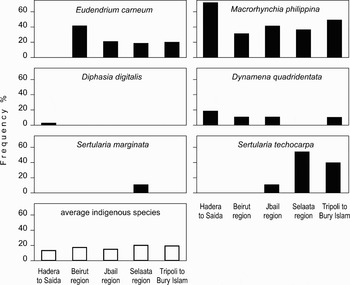
Macrorhynchia philippina was the most widely distributed alien species in the studied area, followed by D. quadridentata, which was collected everywhere but around Selaata (Figure 9). Eudendrium carneum was recorded only from Beirut northward, and S. thecocarpa from Jbail northward. The remaining two aliens were found at only one site each: S. marginata at Selaata and D. digitalis at Hadera.
Relative frequency with respect to different geographical areas (ordered south to north) of the six alien species (black bar). Average indigenous species shown for comparison. Sites were grouped to have roughly the same number of samples (16–22) for each area.

Seasonality
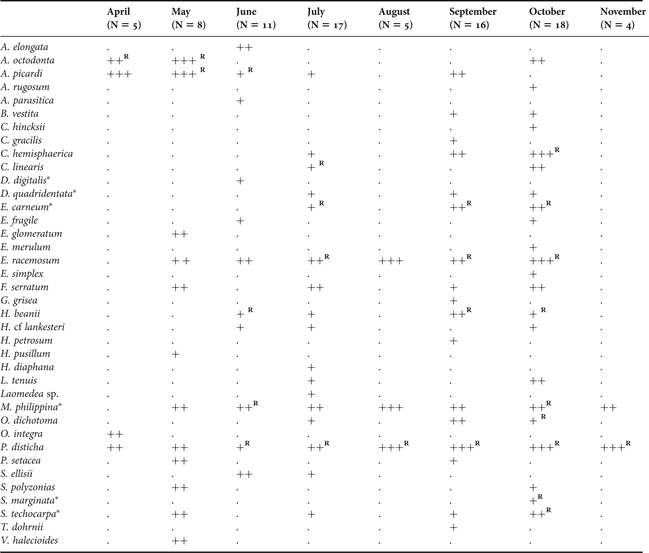
Only P. disticha was continuously present throughout the sampled months (April to November), increasing its frequency in late summer and autumn; colonies were bearing gonophores from June to November (Table 2). Macrorhynchia philippina, Eudendrium racemosum and H. beanii were also frequently collected throughout all sampled months, although not so regularly, and showed reproductive in June–July and September–October.
Seasonality of hydroid species occurrence in the study area, averaged per months over the years 1991 to 2004. No data are available from December to March. N, number of samples per month. Species are listed in alphabetical order. *, alien species. Frequency: +, <10%; ++, 10 to 30%; +++, >30%. R, fertile.
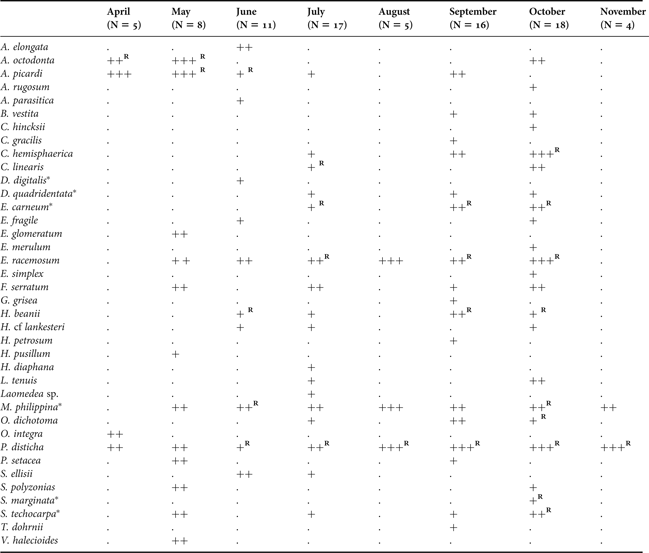
Clytia hemisphaerica, C. linearis, E. carneum, Obelia dichotoma, S. marginata and S. thecocarpa were fertile in summer and/or autumn. On the contrary, Aglaophenia octodonta and A. picardi were bearing gonothecae in spring: both are strictly Atlantic–Mediterranean species, whereas all the above mentioned species are more or less widely distributed in warm waters.
The remaining 26 species were never found fertile, and were differently frequent through the sampled months (Table 2).
Depth distribution
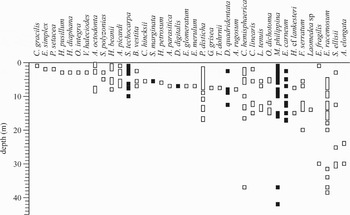
Although many species were only collected once, some were found frequently enough to allow for an analysis of their preferred depth-range. Four main situations can thus be distinguished (Figure 10).
Observed depth distribution of the species collected. Species are ordered according to their apparently preferred average depth. Black symbols individuate the six alien species.

(i) Six species (A. octodonta, S. polyzonias, H. beanii, A. picardi, S. thecocarpa and Bimeria vestita) seemed to prefer shallow depths, thriving from just below the sea surface down to less than 10 m.
(ii) Nine species (Sertularella ellisii, Eudendrium fragile, H. cf lankesteri, O. dichotoma, L. tenuis, C. linearis, D. quadridentata, P. disticha and F. serratum) were found from shallow waters to about 15 or 20 m.
(iii) Three species (E. racemosum, C. hemisphaerica and M. philippina) were also found in shallow waters but extended down to about 40 m.
(iv) Aglaophenia elongata was only collected between 20 and 30 m depth.
Habitat preference
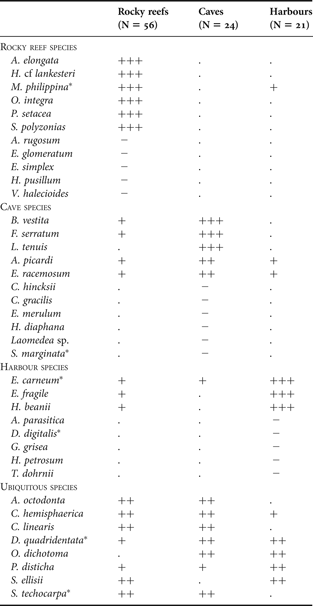
The present collection consists of samples mostly from three kinds of habitats: rocky reefs, caves and harbours (Table 3).
Preferred habitat of occurrence of the individual hydroid species in the study area. N, number of samples per habitat. Species are listed in order of apparent habitat preference and then alphabetically. *, alien species. Frequency: –, collected only once; +, >1 to 34%; ++, 34 to 67%; +++, >67%.
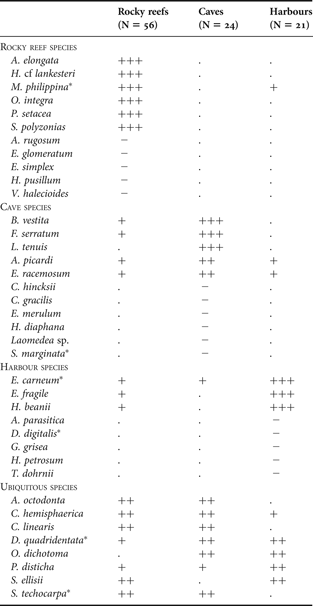
Five species (A. elongata, H. cf lankesteri, Orthopyxis integra, P. setacea and S. polyzonias) were collected exclusively on rocky reefs in open coastal waters. Macrorhynchia philippina was also found in harbours but nevertheless was distinctly more frequent on rocky reefs. Five species (B. vestita, F. serratum, L. tenuis, A. picardi and E. racemosum) were mainly recorded in submarine caves, although mostly at the entrance or in tunnels. Three species (E. carneum, Eudendrium fragile and H. beanii) were more frequent in harbours and marinas. Finally, eight species (A. octodonta, C. hemisphaerica, C. linearis, D. quadridentata, O. dichotoma, P. disticha, S. ellisii and S. thecocarpa) were ubiquitous in that they showed no preference for any of the three habitats. The remaining 16 species were collected only once.
DISCUSSION
The present record of 38 species, three of which are new for the Mediterranean and nine for the Levant Sea, constitutes a significant increase in the number of hydroid species known for the eastern Mediterranean. Although this figure may appear low in absolute terms, finding nearly one-tenth of the species known for the whole Mediterranean in a single collection, as large it may be, suggests that the regional biodiversity—although lower than that of the western Mediterranean (Boero & Fresi, Reference Boero and Fresi1986)—may not be as low as traditionally claimed (Tortonese, Reference Tortonese1951), provided that more studies are done. Few other species inventories for the eastern Mediterranean (Adriatic Sea excluded) are available for comparison. Picard (Reference Picard1958b) and Vervoort (Reference Vervoort1993) listed 13 and 25 species, respectively, from the Mediterranean coasts of Israel. El Beshbeeshy (1993, 1994a, 1994b, 1995a, 1995b) collected 19 species from Mediterranean Egyptian waters, while Abdel–Hamid et al. (1984) inventoried 13 species among the fouling organisms of the Suez Canal and Alexandria harbours and shipyards. Taking into account the species in common to two or more inventories, the total of hydroid species known from the Levant Sea rises to 70, with a seemingly exponential accumulation of newly found species with time (Figure 11). Morri & Bianchi (Reference Morri and Bianchi1999), who integrated pre-existing information (Yamada, Reference Yamada1965; Marinopoulos, Reference Marinopoulos1979), totalled 67 hydroid species (or subspecific taxa) from the Aegean Sea and nearby waters of Greece and Turkey.
Increment with time of the number of hydroid species known from the Levant, according to previously published information (Picard, Reference Picard1958b; Vervoort, Reference Vervoort1993; El Beshbeeshy, 1993, 1994a, 1994b, 1995a, 1995b) and the present collection.

Six of the species in the present collection can be qualified as aliens. Macrorhynchia philippina has been known from Lebanon for nearly two decades: it is now widespread and frequent in the whole area investigated and has recently been recorded also from Turkey (Çinar et al., Reference Çinar, Bilecenoglu, Öztürk and Can2006). Its diffusion on coastal rocks from just below the surface to more than 40 m and the frequent reproductive status (never recorded previously in the Mediterranean) support the claim by Zenetos et al. (Reference Zenetos, Çinar, Pancucci-Papadopoulou, Harmelin, Furnari, Andaloro, Bellou, Streftaris and Zibrowius2006) that it is now fully established in the Mediterranean. Sertularia marginata has been known from the Levant Sea since 1930 (Picard, Reference Picard1958b) but was found only once in the present collection (Selaata, October 1999). Thus, notwithstanding earlier introduction, S. marginata may not have established as well as M. philippina: as no further Mediterranean records are available, the species apparently has failed to get fully naturalized in the Mediterranean or the habitat where it thrives preferentially has not yet been detected. Eudendrium carneum had previously been recorded in the western Mediterranean and the Adriatic (Gili, Reference Gili1986; Bavestrello & Piraino, Reference Bavestrello and Piraino1991; Marques et al., Reference Marques, Peña Cantero and Vervoort2000). Being particularly frequent in the present collection may be interpreted as a significant range expansion to the Levant Sea in recent years (unless it arrived there before but went unnoticed). Dynamena quadridentata and Sertularia thecocarpa have been thriving in the Levant Sea since at least 1999. Finally, Diphasia digitalis seems to have penetrated very recently and still inhabits a restricted range in the Levant Sea: finding it in Hadera harbour parallels the finding of the Indo-Pacific gorgonian coral Acabaria erythraea (Fine et al., Reference Fine, Aluma, Meroz-Fine, Abelson and Loya2005).
The origins of the six alien species may not be homogeneous. Sertularia thecocarpa was previously known only from the Indo-West Pacific, so its penetration into the eastern Mediterranean by the route of the Suez Canal is likely. Macrorhynchia philippina, D. digitalis and D. quadridentata may also be Red Sea immigrants: although circumtropical in distribution, they have never been found to date in the western Mediterranean and are common in the Red Sea (Mergner & Wedler, Reference Mergner and Wedler1977). Things are different with E. carneum and S. marginata, two circumtropical species previously known from the western Mediterranean (Bouillon et al., Reference Bouillon, Medel, Pagès, Gili, Boero and Gravili2004): there are several recent cases of Atlantic immigrants that have crossed the Strait of Sicily to reach the Levant Sea (Bianchi, Reference Bianchi2007) so that a Red Sea origin for these two species cannot be taken for granted. None of these aliens has free-swimming medusa stages, so that their dispersal into the Levant Sea must have occurred as hydroids, perhaps within ship hull fouling (Morri & Boero, Reference Morri and Boero1986; Shoukr, Reference Shoukr1987).
The general warm-water affinity of these six aliens reinforces the subtropical character of the hydroid fauna of the Levant Sea. As a whole, the present collection showed a greater proportion of circum(sub)tropical species and a lowered proportion of Atlantic–Mediterranean elements and Mediterranean endemics with respect to the rest of the Mediterranean Sea (Boero & Bouillon, Reference Boero and Bouillon1993). This picture, however, may be in part due to lack of sampling during the coldest months of the year, as most Mediterranean hydroids thrive in winter (Bavestrello et al., Reference Bavestrello, Puce, Cerrano, Zocchi and Boero2006).
The ecology of the six alien hydroids in the Mediterranean Sea is outlined for the first time in the present paper. The ecology of the indigenous species is in many cases consistent with what is known for the more studied western Mediterranean. There are exceptions, however.
Some species (e.g. Eudendrium racemosum) showed reproductive in the same months as in the rest of the Mediterranean (Bouillon et al., Reference Bouillon, Medel, Pagès, Gili, Boero and Gravili2004), whereas for other species the reproductive period was extended (e.g. Halecium beanii) or, on the contrary, restricted (e.g. Clytia hemisphaerica and C. linearis). Among the latter, the two strictly Atlantic–Mediterranean species Aglaophenia octodonta and A. picardi, which reproduce all year round in the north-western Mediterranean, showed fertile only during spring months, thus probably avoiding the high summer temperature.
Depth distribution of the indigenous species roughly conformed to the patterns described by Boero & Fresi (Reference Boero and Fresi1986) in the north-western Mediterranean, although Sertularella polyzonias, A. picardi and Bimeria vestita were restricted to shallower water in the present collection. On the contrary, Pennaria disticha was found deeper than usual (Morri & Boero, Reference Morri and Boero1986).
As for habitat preference, considerable analogy with the western Mediterranean was found for rocky reefs (Boero & Fresi, Reference Boero and Fresi1986) and, to a lesser extent, submarine caves (Boero, Reference Boero1985), whereas harbours have no species in common (Chimenz Gusso & Rivosecchi Taramelli, Reference Chimenz Gusso and Rivosecchi Taramelli1975; Morri & Bianchi, Reference Morri and Bianchi1983). Four out of the six aliens (M. philippina, E. carneum, D. digitalis and D. quadridentata) were found in harbours. Ectopleura crocea (=Tubularia c.), the dominant species in western Mediterranean harbours, had been found abundant in Egyptian harbours (Abdel-Hamid et al., Reference Abdel-Hamid, Mona and Shoukr1983; Shoukr & Abdel-Hamid, Reference Shoukr and Abdel-Hamid1987) but was not observed in the ports sampled for this study (Beirut and Trablus).
The high incidence of alien species (perhaps not just Red Sea immigrants), the apparently reduced proportion of Atlantic–Mediterranean elements and Mediterranean endemics, and the peculiarities in the ecology of indigenous species ask for future investigation on the zoogeographical and ecological traits of the hydroid fauna of the Levant Sea. Because of the sampling approach, the present collection was probably efficient only in collecting the most conspicuous and obvious species: sampling in different microhabitats would surely lead to a greater number of species.
ACKNOWLEDGEMENTS
The bulk of the studied material was collected in the frame of the French–Lebanese co-operation programme CEDRE. Field activities received logistic support from the National Centre of Marine Research (at Batrun) of the Lebanese National Committee of Scientific Research and were facilitated by the Lebanese Army. Thanks are also due to local fishermen and divers for their help, and to J. Vacelet (Marseille) for the underwater photograph of Macrorhynchia philippina (Figure 5). Critiques by A. Zenetos (Athens) and F. Boero (Lecce) greatly improved the manuscript. For C.N. Bianchi and C. Morri, the study of the penetration of alien species into the Mediterranean Sea falls within the scope of the on-going project ‘The impacts of biological invasions and climate change on the biodiversity of the Mediterranean Sea’ (Italy–Israel Co-operation, R&D Proposal for 2007).