Introduction
The state and business interact in many ways, whether through direct state ownership of business in some form of state capitalism or through the impact of government policies in areas such as central planning, innovation, research and development, public procurement, public–private partnerships and outsourcing, competition, consumer protection and other regulation, and taxation.Footnote 1 The neoliberal model emphasizes characteristics such as private property rights, the enforcement of contracts, market liberalization, free trade, individual liberty, low taxation, and the role of entrepreneurs. In this model, the state is expected to limit its role to providing and maintaining the institutional framework and conditions in which neoliberalism’s key elements—globalization, deregulation, and financialization—can flourish.Footnote 2
Nevertheless, the state–business relationship is never permanently settled, adjusting to shifting economic and political circumstances and ideological perspectives.Footnote 3 Privatization, or “the transfer of the ownership and control of enterprises from the State sector to the private sector,” is one of the most controversial and far-reaching issues in political economy in the last forty years, generating a huge and wide-ranging literature.Footnote 4 Privatization was central to the rise of neoliberalism, and was one of the defining policies in the “ideological turn” and a cornerstone of Britain’s “Thatcherite project,” which pioneered the privatization of state-owned enterprises (SOEs). This provided a model for the implementation of “Chicago School” free-market economic orthodoxy later dubbed “the Washington consensus.”Footnote 5
Britain’s privatization program began after the May 1979 Conservative election victory. Some authors regard the program as lacking coherence.Footnote 6 We suggest, however, this is only a partial explanation of the apparently slow and cautious approach. While an intellectual and political case for privatization had been made, the practicalities, tensions, and contradictions inherent in policy implementation had not been resolved. No template existed, with little prior history of privatization in Britain. By the late 1970s, no politician in government or senior public official had direct experience of the only previous privatization: the steel industry in the early 1950s.Footnote 7 The ideological underpinnings therefore had to be tempered by practical considerations, such as developing expertise within the machinery of government; securing the cooperation of management and employees; gaining wider political support; overcoming legislative obstacles and uncertainty about the appetite of financial markets for public sector assets; and addressing concerns over issues such as competition, foreign ownership, and national security.Footnote 8
Many of the political debates and much of the academic literature on the relationship between the state and business in Britain involve arguments on “declinism.” These suggest variously that there was too much, too little, or the wrong kind of state involvement in business. The nature of these arguments has varied greatly, depending on the period in which they have been made, the identity of their advocates, and the chosen measures of decline.Footnote 9 While these arguments provide a backdrop for this article, we neither seek to add to this literature nor pronounce judgment on the success or lack thereof of privatization as a policy. Similarly, we do not offer a wider assessment of Thatcherism. Rather, we argue that privatization should be viewed from an eclectic perspective; frameworks such as neoliberalism, declinism, and corporatism each provide insights, but taken separately none offers a coherent view of how privatization actually developed in Britain.Footnote 10
Literature on privatization in Britain has concentrated on the sales of the large state-owned corporations, which began in 1983 during the second term of Thatcher’s Conservative government. This is understandable from economic and political standpoints, as these disposals realized the bulk of privatization proceeds and aroused controversy over issues such as competition, sale prices, the impact of restructuring, and the spread of ownership. However, this focus underplays an important part of the history of the neoliberal turn in the relationship between the state and business in Britain; namely, those privatizations that took place during the first term of Thatcher’s premiership. This article uses one of these as a specific example to show how the political commitment to privatization was translated into reality.
Disposals by the state holding company the National Enterprise Board (NEB), other than its largest holdings in British Leyland and Rolls-Royce, have received relatively little attention in the literature. We argue that the NEB’s 1980 sale of its controlling interest in the engineering and electronics company Ferranti offers significant insights into how privatization was translated from an ideological stance and policy commitment into practice. Although the structure and mechanics of this disposal differed from those in most of the later and larger privatizations, the Ferranti case arose before Thatcher’s first government had accumulated significant privatization experience. Ferranti’s passage from family control to state control in the mid-1970s and its later privatization demonstrate the state’s changing role in British business, illustrating the reality of returning a single enterprise to the private sector. Ideological factors played a part, but this privatization was shaped by the government’s interaction with a range of stakeholders, including company management, employees and their trade union representatives, the “Scottish lobby” (the company had extensive interests in Scotland), potential acquirers, and Ferranti’s most important customer: the Ministry of Defence (MoD). This process forced the government to reconcile its neoliberal agenda with other priorities such as national security and the need to maintain employment and innovative technical capacity.
The involvement of some of Britain’s most controversial post-World War II politicians adds a strong ideological dimension. Labour’s Tony Benn, to some a visionary policymaker and modernizer and to others a dangerous Socialist, was the architect of the NEB, “a body which Tories regarded as the quintessence of corporatist folly,” according to one of Thatcher’s biographers.Footnote 11 For Thatcher and Sir Keith Joseph, a key lieutenant who shared her political and intellectual outlooks, the NEB’s control of Ferranti was a clear example of the kind of economic interventionism that affronted their principles: Ferranti’s strong recovery after flirtation with collapse removed any reason for continued state involvement.
We base our analysis on secondary literature and a range of archival materials opened or deposited in recent years in Britain’s National Archives, principally Prime Ministerial records, records of the Department of Industry (DoI), records of the Cabinet’s key privatization committee, and records of the MoD.Footnote 12 We begin by reviewing the attitudes of Thatcher and her government to state ownership of business. We then provide a brief history of the NEB, followed by a discussion of how Ferranti fell under its control. In the following section we address the disposal of the NEB’s stake in Ferranti. Finally, we relate the Ferranti case to the policies and practices of privatization more widely, and draw some conclusions.
Thatcher, the Conservatives, and Privatization
In 1979 a range of major British industries and other businesses were in state ownership, mostly through nationalizations during the 1945–1951 Labour government.Footnote 13 This range was broader than in some other Western European countries, where state ownership was limited to sectors such as posts, telecommunications, transportation, and energy utilities.Footnote 14 Although Hannah described state ownership as a “failed experiment,” Tomlinson contested this view as simplistic, seeing a variety of motives for state ownership consistent with Britain’s postwar political settlement: the opportunity to enhance productivity, human relations, and egalitarianism.Footnote 15 The postwar Keynesian consensus in British politics was breaking down by the 1970s, under the pressures of oil crises, the end of the Bretton Woods fixed exchange rate arrangements, deindustrialization, popular discontent, labor militancy, and skepticism toward business. Precision in dating the consensus’s breakdown is difficult, but Conservative defeat in the February 1974 election was arguably key. The Conservative Party’s neoliberal fringe had long interacted with like-minded businessmen and academics, often through think tanks, and these connections intensified during the opposition years from 1974 to 1979, particularly after Thatcher’s election as party leader in 1975.Footnote 16 The Labour Left, frustrated by its inability to shape the economy during the party’s eleven years of government (1964–1970 and 1974–1979), was impatient for more radical policies to replace what it viewed as a failed consensus.Footnote 17 Disillusionment with state planning in Britain, arguably arising in part from overreach by both major political parties, contributed to the breakdown.Footnote 18
Historians generally accept that Thatcher intended to replace “the mixed economy with a private-sector market economy.”Footnote 19 Her personal commitment to reducing the size of the public sector was undoubted, given her economic, political, and moral imperatives expressed before and after serving as prime minister. Her foreword to her party’s 1979 election manifesto argued: “The balance of society has been increasingly tilted in favour of the State at the expense of individual freedom. This election may be the last chance we have to reverse that process.”Footnote 20 Her memoir asserted that privatization was “one of the central means of reversing the corrosive and corrupting effects of socialism…fundamental to improving Britain’s economic performance…at the centre of any programme of reclaiming territory for freedom.”Footnote 21
Many of Thatcher’s party colleagues shared her views, disappointed by the failure to reverse state ownership during Edward Heath’s 1970–1974 Conservative government.Footnote 22 A 1977 policy statement advocated policies more friendly to enterprise, supported wider home ownership and “direct encouragement to schemes which place assets in the hands of a much wider section of working people,” and endorsed privatization of SOEs.Footnote 23 John Moore, a Treasury minister from 1983 to 1986 and heavily involved in the privatization program, subsequently articulated Conservative sentiments: “Our objective is to promote competition and inspire efficiency.… Privatisation hands back, to the people of this country, [nationalized] industries that have no place in the public sector”; and that privatization was a mechanism “for transforming a command economy into a free one” to deliver the benefits of free markets and individual ownership.Footnote 24 Thatcher, however, told the Sun newspaper in 1978: “I am not going to go rushing into mass denationalization,” and did not use the term “privatization” in public until July 1981.Footnote 25
The financial performance of SOEs added to the political arguments for privatization, with some incurring significant losses and therefore adding to public expenditure pressures. The evidence on their performance is mixed: growth in output, employment, and productivity varied considerably across nationalized industries, with some performing better than the wider manufacturing industry and others worse. Overall, though, profitability of the public corporations, particularly in the 1970s, was much lower than that of industrial and commercial companies, an outcome often attributed to a lack of clarity in, or inherent conflicts between, the objectives of SOEs.Footnote 26
The National Enterprise Board
The NEB emerged in 1975 as a product of arguments about Britain’s decline and Labour’s internal battles, when politicians on the left sought greater control over business to address the perceived problem of underinvestment.Footnote 27 The idea of a state holding company appeared in 1969 in Labour Party documents, and in a 1973 party Green Paper that committed “the NEB…to be the basis for control across the economy through public ownership of 25 of the top 100 companies.”Footnote 28 These companies would be nationalized to “promote investment, employment and industrial democracy” in support of the party’s wider Alternative Economic Strategy.Footnote 29 The planned NEB had a broader scope than the Industrial Reorganisation Corporation (IRC), a government-sponsored and -funded body established by the Labour government in 1966 and abolished by the Conservative government in 1971. Modeled on Italy’s Istituto per la Ricostruzione Industriale (IRI), the NEB’s purpose was to promote industrial reorganization and rationalization schemes in “the national interest,” such as the creation through merger of British Leyland.Footnote 30 The IRC and the NEB updated earlier thinking: the Labour Party had proposed as early as 1934 “a National Investment Bank, to plan investment and industrial development.”Footnote 31
Labour returned to government in early 1974, but Prime Minister Harold Wilson disagreed with the Green Paper proposals, which ultimately led to an emasculated NEB and isolation of Benn, its chief political sponsor.Footnote 32 Benn, as the secretary of state for Industry, presented diluted plans for the NEB.Footnote 33 The party’s October 1974 election manifesto supported these proposals, including the objective “to extend public ownership into profitable manufacturing industry by acquisitions, partly or wholly, of individual firms.”Footnote 34 Benn’s final proposals in February 1975 would have forced pension funds and insurance companies to channel funds to the NEB, but then Wilson switched him to another role, and instead the November 1975 Industry Act created an NEB with “limited funds and autonomy.”Footnote 35 It still had wide-ranging aims and activities, with “the principal objective of promoting efficiency and international competitiveness in British industry” when directed by the government’s and its own initiatives, including the provision of finance and help in restructuring industry sectors, and with “special consideration to areas of high unemployment.”Footnote 36
Labour’s center-right stubbornly resisted Benn’s more radical proposals for several reasons, notably the electorate’s perceived antipathy to plans for nationalization and greater state intervention in the economy, given the political unpopularity of the nationalized industries, which stemmed in part from their questionable performance.Footnote 37 At a time when the economy was struggling, politicians also feared damage to relations with business, which bitterly opposed the plans for the expansion of state ownership and planning agreements.Footnote 38
The NEB’s explicit focus on manufacturing businesses contrasted with many of Britain’s other SOEs. Its initial portfolio comprised the government’s existing equity stakes in seven industrial companies, including Ferranti, which were transferred in February 1976.Footnote 39 By 1979 its interests extended across several sectors: aircraft engines, computers, machine tools, motorcycles, cars, trucks, construction equipment, and electronics. These investments fell into three broad categories: companies in long-term or terminal decline, those with significant short-term problems but better long-term prospects, and venture capital-style investments.Footnote 40 The first category included the loss-making vehicle giant British Leyland, which dominated the portfolio in financial terms, and the machine tool manufacturer Alfred Herbert. The second category included Ferranti and aero-engine and power plant manufacturer Rolls-Royce. The third category included investments in the computer industry and semi-conductor manufacturing. The first two categories were not necessarily easy to distinguish ex-ante, falling under the NEB’s “hospital role,” or what a Conservative Industry Minister, Norman Tebbitt, later referred to as “that lame-duck farm.”Footnote 41
The concept of the “Macmillan gap,” with banks and equity investors unwilling to finance small- and medium-sized enterprises, new and innovative businesses, and research and development, has been recognized since the 1930s.Footnote 42 Although institutions had been developed to address this problem, the NEB’s venture capital role reflected the view of some, not confined to the Labour Left, that this gap remained.Footnote 43 This critique was linked to the characterization of Britain’s system of corporate governance as an “outsider” system in which wealth-maximizing institutional shareholders dominated and sometimes pursued or supported short-term takeovers, all concerns that influenced the NEB’s disposal of its Ferranti stake.Footnote 44
Overall, the NEB did not fulfill its intended purpose: “Far from becoming the promoter of structural change in profitable areas of the economy, [it] came to focus on propping up…firms in financial trouble, something it had been devised explicitly not to do.… In all 95% of its funds went on lame ducks.”Footnote 45 Arguably, however, assessments of the NEB’s performance should reflect that it was never envisaged to operate in macroeconomic circumstances as difficult as those of the 1970s.Footnote 46 Its changing leadership was another factor in its performance. Its first chairman, Lord Ryder, was regarded as autocratic and unwilling to engage in debate, while the Labour government, focused on increasingly difficult macroeconomic and industrial relations issues, progressively marginalized his successor, Sir Leslie Murphy.Footnote 47
The 1979 Labour election manifesto promised to expand the NEB’s role but made no specific commitments.Footnote 48 In contrast, the Conservatives’ manifesto committed “to reduce government intervention in industry, particularly that of the [NEB]” and to “restrict [its] powers…solely to the administration of the Government’s temporary shareholdings, to be sold off as circumstances permit.”Footnote 49 The NEB’s directors opposed such disposals, resigning en masse in November 1979 after the Conservative government’s decision to transfer supervision of Rolls-Royce to the DoI.Footnote 50 The NEB’s new chairman, Sir Arthur Knight, acknowledged its changed role, and its major inherited shareholdings were disposed of in various ways as “the Conservatives purged the NEB of what they took to be its most undesirable features.”Footnote 51 The largest holdings, Rolls-Royce and British Leyland, were transferred to the DoI’s direct control in August 1980 and March 1981, respectively.Footnote 52 In 1981 the NEB and the National Research Development Corporation (NRDC) were merged “under the flag of the British Technology Group.”Footnote 53
The Ferranti Spirit and Government Control
Ferranti was a large and long-established British electrical engineering and defense electronics business.Footnote 54 In 1974 the Ferranti family held 56 percent of the equity, and the founder’s grandsons, the brothers Sebastian and Basil de Ferranti, were managing director/executive chairman and deputy managing director, respectively.Footnote 55 The family resisted moves to formalize financial management structures, which they argued would inhibit the company’s durable and distinctive, but controversial, management tradition known as “the Ferranti spirit.”Footnote 56 This emphasized innovation and engineering excellence in a decentralized group structure, an environment that attracted highly qualified engineers.Footnote 57 Harold Wilson, however, thought that “the brilliant Ferranti brothers were regarded as too theoretical and not profit-minded enough.” One might also argue that the Ferranti spirit reflected Alfred Chandler’s contested version of declinism—“the continuing commitment to personal capitalism in British industry”—although the family business literature is generally more nuanced and positive than Chandler on the potential benefits of family control.Footnote 58
The Ferranti spirit was undoubtedly responsible for stimulating a wide range of innovations in multiple areas of electronic engineering, from meters and avionics to micro-electronics.Footnote 59 However, the lack of rigorous financial control and the company’s loose management structure contributed to a severe liquidity crisis in the early 1970s. Crucially, Sebastian de Ferranti refused to take decisive action to limit the mounting losses associated with power transformers and micro-electronics, resulting in extensive calls on the company’s borrowing facilities with its main banker, National Westminster. These internal problems were exacerbated by the deep macroeconomic problems of the era, leading National Westminster to refuse to sanction increased borrowing.Footnote 60 The Bank of England provided the first hint that Ferranti would seek government support in summer 1974.Footnote 61 Discussions continued through the remainder of 1974, with Ferranti; National Westminster; Peat, Marwick, Mitchell & Co. (PMM) as reporting accountants; the Treasury; and the DoI. The Treasury was concerned not only about Ferranti’s role as a major employer but also about the lack of clarity on the government’s potential financial commitment, an issue on which PMM could offer little reassurance.Footnote 62 The DoI worried about the “prestige of this company,” which was a major exporter and a defense contractor with 35 percent of its 1973 sales going to the MoD.Footnote 63 The Ferranti brothers were also tempted into a preliminary possible partial or full takeover. Apparently concerned at the potential price for government support, the Ferranti brothers deferred approaching the government until National Westminster exerted extreme pressure.Footnote 64
Benn saw the irony of the Conservative-supporting Ferranti brothers seeking a “bail-out” from the Labour government, and he resisted their attempts to retain control and secure generous personal contracts.Footnote 65 He was influenced by a visit on September 17, 1974, from “a huge delegation representing Ferranti workers from all over the UK” who wanted government support to preserve the group’s current form and avoid job losses or takeover.Footnote 66 The government took 50 percent of the voting shares and 62.5 percent of the total equity in Ferranti, plus loan stock in exchange for a £15 million cash investment and an £11 million guarantee of bank borrowings.Footnote 67 The Ferranti brothers moved into nonexecutive roles, other nonexecutive directors were appointed, and the family shareholdings were diluted to just under 20 percent of the voting shares. The new managing director, Derek Alun-Jones, was an outsider and a former manager at Burmah, the oil company.Footnote 68
Ferranti’s turnaround involved consolidation of its financial position, debt reduction and asset sales, restructuring of the business, introduction of stronger accounting and financial controls, retention of the Ferranti spirit, and an emphasis on expanding its U.S. business, all with the ultimate aim of escaping from government control.Footnote 69 The NEB’s first annual report flagged a rapid recovery.Footnote 70 In 1977 the company raised an £18 million syndicated loan to repay the loan stock and reduce its debt to National Westminster, and the 1979 £7 million sale of its loss-making Canadian subsidiary further improved its finances.Footnote 71
State control saved Ferranti from financial distress and protected it from takeover or breakup. Whether this would have occurred under a Conservative government is unclear, and opinions vary according to political persuasion as to whether Ferranti would have survived without government help.Footnote 72 Although the conservative newspaper the Daily Mail recognized Ferranti as the “NEB’s biggest success story,” the roles of the NEB and the government in the company’s recovery are also debated.Footnote 73 The importance of management change was widely acknowledged, but Alun-Jones had been appointed before the transfer of the government’s stake to the NEB, and some argued that the NEB contributed little.Footnote 74 Ferranti and Fairey Engineering, another NEB investment, arguably benefited from government custom as defense suppliers, but the NEB was supportive of Ferranti’s new leadership, trusting Alun-Jones and his team to effect a recovery.Footnote 75
Disposal of the NEB’s Interest in Ferranti
Under the terms of the agreement for government assistance, the NEB reduced its shareholding in Ferranti to 50 percent when the company’s recovery allowed it to be floated on the London Stock Exchange in September 1978. This sale realized a profit of £960,000, and the NEB’s remaining holding on December 31, 1978, was valued at £38.9 million against a cost of £6.9 million.Footnote 76 The NEB began to dispose of its legacy holdings after the 1979 Conservative election victory. It sold its minority stake in International Computers Limited for £37 million, for a profit of £24 million, and received an offer of £19.5 million for its holding in Fairey.Footnote 77 Ferranti, “the jewel of the NEB’s rather tarnished crown,” was next: “The NEB and the company are considering ways in which the future of Ferranti can best be secured. In reaching any decision, the NEB will take account of the interests of the company and the taxpayer.”Footnote 78
Disposal options were numerous: public offering of the shares; sale to institutional investors; management buy-out; sale to a single bidder, most likely a British or international industrial rival; breakup of the Ferranti group, whose spread of businesses effectively made it a mini-conglomerate; or some combination of these approaches.Footnote 79 In August 1980, all but 2 percent of the NEB’s remaining 50 percent stake in Ferranti was widely distributed in “a placing with more than one hundred institutional shareholders,” accompanied by an issue of new shares that raised nearly £21 million and left Ferranti virtually debt-free.Footnote 80 The NEB’s proceeds amounted to £54 million, although “the Government’s policy that the shares of Ferranti should be placed with restrictions on resale resulted in the disposal being on less favourable terms than could have been obtained on the open market.”Footnote 81 The cash inflow benefited the public finances, although the loss on the liquidation of Alfred Herbert, another inherited holding, almost exactly offset the NEB’s profit on the disposal (£47.27 million).Footnote 82
The Ministerial Committee on Economic Strategy: Sub-Committee on Disposal of Public Sector Assets (hereafter the sub-committee) was central to the Ferranti disposal. It first met on June 5, 1979, just over one month after the election on May 3, 1979. A memorandum from Nigel Lawson, financial secretary to the Treasury, documented his discussions with the NEB over the disposal of its stakes in Ferranti and International Computers Limited.Footnote 83 In another memorandum, Lawson noted the “need to treat each of the NEB sales on its merits,” and that offers to the public “may not lead to the best price or offer the best solution in industrial terms or for introducing better commercial discipline into management.… In some cases we could do better to agree to a sale to another company; for example, I understand that a good deal of interest has already been shown by other companies in Ferranti.”Footnote 84 The sub-committee’s second meeting discussed this memorandum and possible measures to encourage employee participation in share sales, such as the establishment of trusts to lend money to employees to help them participate and the need to give preference to “small applicants.”Footnote 85
The disposal process culminated in mid-1980 after a year, during which time disposal options were explored; potential bidders and the attitudes of interested government departments were identified; and representations were made by Ferranti, potential bidders, and others. Prime responsibility for dealing with the NEB lay with Sir Keith Joseph, secretary of state for Industry, and his junior minister, Adam Butler.Footnote 86 Scottish Labour House of Commons Member Gavin Strang wrote to Joseph only four days after the election, and Ferranti directors were in touch soon after.Footnote 87 Alun-Jones and Sebastian de Ferranti met with Butler, and they requested an outcome that would secure the company’s independence.Footnote 88 Alun-Jones suggested a gradual sale of the NEB’s stake to reduce the risk of takeover, possibly in two tranches, a solution that was also advocated by a stockbroker specializing in the engineering and electronics sectors.Footnote 89
In June 1980 Butler made the case for sale to the highest bidder, but acknowledged: “Whatever decision is made the Government is likely to be criticised!”Footnote 90 His position aligned with Lawson’s, and reflected advice from Rothchilds, the merchant bank advising the government and the NEB, which favored selling to “a larger industrial group.” This solution alarmed Ferranti’s board, which unanimously preferred an option offering independence, although Alun-Jones feared that wide dispersal of the NEB’s stake would further empower the Ferranti brothers, who were reasserting themselves.Footnote 91
Several potential bidders for all or part of the NEB’s stake had identified themselves: the British companies BICC, GEC, Hawker Siddeley, Northern Engineering Industries, Racal, and Vickers; the British subsidiary of the U.S. Sperry Corporation; and the French company Matra.Footnote 92 GEC was persistent but recognized that its market position and significance as a supplier to the MoD complicated its potential acquisition of part or all of Ferranti. Weinstock lamented the loss of the opportunity to create a “national champion” in electronics, comparing the British government’s position unfavorably to its counterparts in West Germany, France, and elsewhere.Footnote 93 His deputy suggested that a minority GEC stake in Ferranti and exchange of directors would be more acceptable than acquisition of the NEB’s shareholding or a full bid.Footnote 94 Racal, with less overlap with Ferranti and so more likely to retain its Scottish plants, appears to have been the government’s and Ferranti’s favored British bidder, but it did not pursue its interest.Footnote 95 The MoD opposed sale to any foreign company for several reasons, including “in a number of areas…there is no adequate alternative capability in the UK”; potential limits to access to technologies arising from foreign ownership; and Ferranti’s value as “a source of innovation in ideas…in areas of technology yet to be explored.”Footnote 96 The MoD, however, viewed the German company Siemens positively, and the DoI showed particular antipathy toward potential French buyers due to “the obstructive attitude of the French authorities to British investment in France.”Footnote 97
Thatcher initially supported the Butler–Lawson approach, telling the House of Commons with characteristic directness: “The NEB and the previous Labour Government assisted Ferranti during a very difficult period. Ferranti no longer needs that assistance. The NEB wishes to sell the shares and to obtain the best possible price. It must be free to do that.”Footnote 98 Lobbying against this position occurred directly and indirectly, and publicly and privately. The Times newspaper published letters from Ferranti directors and senior managers pleading for a solution that would secure the company’s independence.Footnote 99 Ferranti’s directors met with Butler to argue their case.Footnote 100 Basil de Ferranti went directly to John Hoskyns, head of the Downing Street Policy Unit from 1979 to 1982, to reinforce their arguments.Footnote 101 He also wrote to Thatcher, who assured him that a decision would be taken only “after the most careful consideration.”Footnote 102 Director Donald McCallum wrote to Keith Joseph, with copies to several Cabinet ministers, to advocate “wide placing of the NEB’s shareholding.”Footnote 103 Derek Alun-Jones asked James Prior, secretary of state for Employment, to support Ferranti’s independence, and highlighted the role of employee cooperation in its turnaround.Footnote 104 Thatcher politely declined to receive a delegation led by the mayor of Oldham, a town with many Ferranti employees.Footnote 105
Opposition to the disposal from Labour members of the House of Commons, who wanted the NEB to retain its stake, was expected, but thirteen “doubtful” Conservative Members of Parliament (MPs) were also identified.Footnote 106 During a House of Commons debate on Ferranti, several of them urged caution, and various Conservative and Labour MPs referred to letters they had received from Alun-Jones and constituents who were employees, as well as to their meetings with constituents and union representatives.Footnote 107 The debate ended with a vote in which a large majority supported the sale “as soon as practicable, having regard to the interests of the company, the taxpayer and other such considerations as the Government may draw to the [NEB’s] attention.”Footnote 108 Joseph and Butler met separate delegations of Conservative and Labour MPs before this debate and union representatives afterward, and NEB Chairman Knight also met union representatives and Labour MPs after the debate.Footnote 109
Scottish Secretary and Cabinet Minister George Younger noted that Ferranti had seventy-three hundred employees in Scotland, many in high-quality jobs, and that Scotland accounted for 30 percent, 40 percent, and 50 percent of the group’s assets, employment, and profits, respectively. He argued against selling to the highest bidder: “It is no part of our industrial policy to further the extinction of independent companies with records of technological success,” and that such a disposal “would run counter…to our defence, industrial, competition and regional policies”; provoke unnecessary conflict with the Ferranti management and workforce; and further alienate Scottish business and public opinion, already bruised by deindustrialization and recession.Footnote 110 The best option would be “to look for the best price on a widely dispersed placing of the [NEB’s] shareholding, on the basis of a solution which takes proper account of the Scottish interest in a company so important to the economy of Scotland.”Footnote 111 He also claimed that Scottish financial institutions had indicated to the NEB their willingness to support such a solution.
The political pressure in Scotland was evidenced in several ways. In an election for the vacant Glasgow Central seat on June 26, 1980, the Conservative share of the vote fell to 8.8 percent from 16.4 percent at the 1979 election.Footnote 112 An open letter to Thatcher in a popular Scottish newspaper on the day before this election attacked a possible sale to the highest bidder.Footnote 113 Michael Ancram, Conservative MP for Edinburgh South, warned that “the political ramifications would be great in Scotland” if the disposal resulted in job losses in Ferranti’s Scottish business.Footnote 114 Scottish church leaders feared “the gradual extinction of the flame of local enterprise and leadership.”Footnote 115 Scottish sentiments were driven by concern that GEC would gain control of Ferranti and rationalize its Scottish business.Footnote 116
Joseph professed sympathy for the position of Ferranti and its employees, but continued to favor seeking the highest bid. He suggested that wide dispersal, necessarily at a discount to the market price, and at an even greater discount to what a single bidder would pay, would reduce the sale proceeds but fail to guarantee independence.Footnote 117 However, in the House of Commons debate, he limited potential bidders to domestic ones, confirming that “the Government are not prepared to contemplate [Ferranti] passing into foreign ownership.”Footnote 118
Other ministers pressed Joseph. John Nott, secretary of state for Trade, indicated his unwillingness to “destroy the credibility of our competition policy” by overruling any recommendation to refer a bid for Ferranti to the competition authorities. He noted that any such reference would raise considerable uncertainty and prolong the disposal process.Footnote 119 Prior asked to be consulted before a final decision.Footnote 120 Some ministers suggested that higher procurement costs for the MoD, Ferranti’s largest customer, could offset the financial gain from sale to the highest bidder.Footnote 121
Joseph chaired the sub-committee’s meeting in which “a small but clear majority” supported Younger’s proposal for wide dispersal of the NEB stake, subject to suitable conditions preventing onward sales to a single buyer such as GEC.Footnote 122 The meeting noted that employee involvement would reduce the shares available to a potential bidder, and considered the desirability but unlikelihood of the involvement of major British banks as long-term shareholders.Footnote 123 Thatcher accepted the sub-committee’s recommendation, which Joseph reported could yield proceeds at least £10–20 million lower than sale to the highest bidder.Footnote 124
On July 1, 1980, Joseph announced to the House of Commons that the NEB stake would be placed with institutional shareholders. There would be a two-year lock-in to prevent disposals, with acquirers barred from voting on control issues during this period, and 4 percent of the NEB’s stake (i.e., 2 percent of the total equity) would be retained for an employee trust.Footnote 125 The announcement was timed to eliminate any uncertainty ahead of the Queen’s visit to Ferranti’s Edinburgh factories on the following day. The outcome was a total victory for the Ferranti board’s aggressive lobbying for such a solution across political and other networks.
The placing operation was successful but proved more difficult than expected, as some institutional investors had hoped for a substantial discount in exchange for the two-year lock-in period and voting restrictions.Footnote 126 The NEB’s stake was placed at £5.30 per share, an 11 percent discount to the £5.97 market price at which trading had been suspended on June 30, 1980, ahead of Joseph’s announcement. Trading reopened on July 2, 1980, with a closing price of £5.72, an 8 percent premium to the placement price and a 4 percent discount to the preannouncement price.
Discussion and Conclusions
In this section we reflect on the disposal of the NEB’s stake in Ferranti and its wider relevance to privatization. The disposal was very deliberately intended to reconcile the interests of various stakeholder groups. Sale to a single bidder, domestic or foreign, could have realized significantly higher proceeds, but at the price of antagonizing management and employees, and with the potential for higher procurement costs and serious political damage. The placing terms realized significant proceeds and limited opportunities for subsequent takeover. The disposal secured the company’s independence from government and lifted the immediate threat to thousands of jobs, many in politically sensitive areas such as Greater Manchester in England and various locations in Scotland where marginal parliamentary seats were at risk. The government could claim that it had responded to concerns over the sale, had not sold the shares too cheaply, and had preserved competition in defense procurement. The shadow of GEC, which heavily influenced the behavior of Ferranti, the government, and the NEB, was dodged for the moment. However, the fragmentation of the NEB’s stake left no significant, large shareholders who would have been in a position to monitor Ferranti’s corporate governance. This contributed to the outcome that so many had sought to avoid when GEC bought most of Ferranti’s activities after its disastrous 1987 merger with the U.S. company International Signal and Control.Footnote 127
The literature does not treat Ferranti as a mainstream privatization like those of the major state corporations, such as British Aerospace, British Airways, British Steel, British Telecom, and utility companies. Parker’s two-volume official history of privatization, written with full access to all government documents, has little to say on the NEB or the disposals of its interests other than British Leyland and Rolls-Royce; Ferranti does not even have an index entry.Footnote 128 We argue, nevertheless, that the Ferranti case provided important early experience in the Thatcherite privatization program.
After leaving office Thatcher commented in her memoirs:
In some cases it was a choice between having the ideal circumstances for privatization, which might take years to achieve, and going for a sale within a particular politically determined timescale, [and] the second was a preferable option [as] state-owned businesses can never function as proper businesses.… Our privatization programme was constantly breaking new ground. Each industry posed its own special problems. Each flotation or trade sale raised separate issues.Footnote 129
This statement can be interpreted as a principled determination to pursue privatization with close attention to the particular circumstances of individual companies, or an ex post rationalization of the ad hoc implementation of a policy lacking a fixed plan. Her comments are consistent with both the views on the coherence of privatization policy discussed earlier, and the pragmatic approach adopted in the Ferranti case, which reflected her government’s early caution in some areas. This contrasts with notable radicalism in other aspects of Conservative policy; for example, reform of trade union legislation, monetarist macroeconomic policy, and abolition of foreign exchange controls.Footnote 130
There were several reasons for this early cautiousness, which helped to establish the privatization program’s political acceptability and credibility. First was the question of priorities. Parker argues that the first two years of the 1979–1983 Conservative government were characterized by a struggle to find saleable assets to reduce borrowing as the economy slid into deep recession.Footnote 131 From within government, Hoskyns viewed the initial priority as stabilization of its finances and downplayed privatization’s early significance.Footnote 132 Lawson, however, claims that “privatization was a central plank of our policy right from the start,” but that “little detailed work had been done on the subject in Opposition.”Footnote 133 A second reason was that privatization’s public appeal was unclear, and the limited 1979 manifesto promises reflected “Margaret’s understandable fear of frightening the floating voter” and Conservative uncertainty whether voter antipathy toward the nationalized industries would translate into an appetite for privatization.Footnote 134 Thatcher’s fear was rational because “public opinion was invariably hostile” to every major privatization; although, once executed, “the private sector status of the industry concerned became accepted as a fact of life.”Footnote 135 Surveys on voter attitudes, however, showed that support for denationalization in 1979 had almost doubled to 40 percent from the previous October 1974 election.Footnote 136 Finally, the government’s own banking advisers, other City bankers, the Bank of England, and industrialists expressed persistent doubts about the ability of the financial markets to absorb privatization sales.Footnote 137
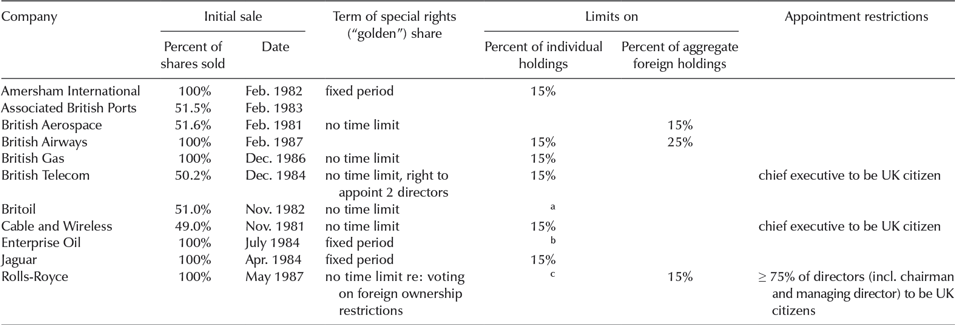
The Ferranti disposal, with the company’s shares already listed on the stock exchange, showed that the existence of a market price could be used to measure disposal options and investor appetite. Some later privatizations adopted the model of selling shares in tranches, allowing for the establishment of a market (see Table 1). This should have secured greater proceeds than one-stage disposals, although a recurring criticism was that particular companies were privatized too cheaply for political reasons and to secure success of the sales.Footnote 138
Features of major privatizations

Note: This table includes only those companies sold by (tender or fixed price) public offer in the first ten years of the Conservative government. Blank cells denote no relevant features.
a Temporary majority to special rights share if percentage of voting rights held by one person exceeds 25%.
b Temporary majority to special rights share if percentage of voting rights held by one person exceeds 50%.
c Fifteen percent on holdings other than foreign holdings.
Source: Parker, Vol. 1: The Formative Years, 180–181, 200, 261, 428.
Chancellor of the Exchequer Geoffrey Howe argued in 1982 that maximization of sale proceeds should be the dominant consideration in privatizations, not ensuring “a wide spread of holdings.”Footnote 139 The Ferranti case contradicted this, and “special problems” led the government to accept lower disposal proceeds than could have been achieved by sale to a single industrial buyer.Footnote 140 The direct placement of shares with institutional investors also differed from the disposal methods most commonly used in later privatizations: typically public share offerings, usually by fixed price offer but sometimes by tender.Footnote 141 However, the aims of maximizing proceeds and wide distribution were not necessarily in conflict. The size of the companies involved made aggressive public marketing campaigns and wide distribution inevitable in most of the later privatizations.Footnote 142 The two-year ownership lock-in at Ferranti reflected the desire to protect the company’s postprivatization independence. Later privatizations used alternative methods to address similar concerns, as Table 1 summarizes. These included the retention of minority interests until companies were established in the private sector; limits on the percentage of shares that any individual and/or foreign owners could hold; restrictions on the appointment of non-British directors; and the issue to the government of special preference, or “golden,” shares that conferred special rights, typically allowing the government to block changes of control or amendments to company constitutions as reflected in their articles of association.Footnote 143 We found no evidence that the possible use of such methods was discussed in the Ferranti case.
Notwithstanding Conservative rhetoric on the benefits of wider employee-share ownership, the Ferranti disposal came too early to be representative of the Thatcherite ideological drive to a property-owning democracy that in part motivated later privatizations. Measures to encourage employee-share ownership became a standard feature, partly to disarm union opposition.Footnote 144 Incentives were almost invariably more generous than at Ferranti, where the 2 percent stake made available to employees was small, and employees were reluctant to back the company in this way, despite their appeals that the NEB should retain its stake and their commitment to the company’s turnaround and belief in its prospects.Footnote 145 Similarly, none of Ferranti’s directors increased their shareholdings after the disposal, and a management buy-out does not appear to have been contemplated during the sale process.Footnote 146
The desire to preserve competition, retain capacity for innovation in defense procurement, and uphold competition policies featured prominently in the arguments of the ministers who supported wide dispersal of the NEB’s stake in Ferranti. However, the case did not raise the competition and regulatory issues that represented considerable obstacles in later privatizations of natural or regulated monopolies, such as British Telecom; the rail industry; and the electric, gas, and water utilities.Footnote 147 These required new regulatory structures with industry-specific regulators who were established preprivatization, an issue that the 1983 Conservative manifesto recognized.Footnote 148 The Ferranti case also represented a rejection of the “national champion” concept: the creation of a company with the scale and scope to dominate domestically and compete internationally, an argument GEC used to support its potential takeover of Ferranti. In this and other respects, the Ferranti disposal shared another important feature much discussed in relation to later privatizations: the need to secure the support of incumbent management.Footnote 149
From a political perspective, on the one hand, the Ferranti disposal could be seen as a defeat for privatization “evangelists” such as Joseph, Lawson, Butler, and Redwood. In some respects, the disposal should have been relatively straightforward, but pragmatic considerations forced compromises. On the other hand, if Ferranti and other early privatizations reflected the need for cash as much as a fully coherent agenda, the limited 1979 manifesto commitments were delivered to begin the privatization program. Many of the issues in the Ferranti case—balancing pricing against other considerations, such as maintaining competition, protecting the “national interest,” securing employee and management support, ensuring sufficient demand for the sale—would recur in later privatizations. The 1983 Conservative election manifesto referred to full or partial sales of a range of SOEs.Footnote 150 By then privatization was seen as a means of promoting wider share ownership and as part of a “property- [or capital-] owning democracy” that was emboldened by and extended beyond the success of the popular “right to buy” for tenants in municipal housing, and offered a means of funding cuts in personal taxation.Footnote 151
This article addresses several issues that have recently reentered British political debate over the relationship between the state and business. The 2013 part-disposal of the state-owned Royal Mail Group revived familiar controversies around the underpricing of privatized assets.Footnote 152 Actual and prospective sales of government holdings in Lloyds Banking Group and the Royal Bank of Scotland, acquired through financial crisis bail-outs, and Lloyds’ disposal of part of its business in the form of TSB, have also contributed to a renewal of interest in privatization. Jeremy Corbyn’s 2015 election as Labour Party leader opened the possibility of renationalization of some privatized industries: energy and water utilities, the Royal Mail, and railways.Footnote 153 Discussions on the need to maintain a domestic steel industry have provoked debate on the necessity and most effective means of undertaking state “bail-outs.”Footnote 154 We expect future governments in Britain and elsewhere to face similar problems to those that Ferranti, the NEB, and the privatization program more generally posed.