INTRODUCTION
Striga hermonthica is a parasitic weed that attacks maize, sorghum and other staple cereal crops. It has long been considered the most serious biotic constraint to cereal production in Africa (Sauerborn, Reference Sauerborn1991). Many communities in northern Nigeria have indicated that S. hermonthica is a priority problem (Emechebe et al., Reference Emechebe, Ellis-Jones, Schulz, Chikoye, Douthwaite, Kureh, Tarawali, Hussaini, Kormawa and Sanni2004). Similarly, Dugje et al. (Reference Dugje, Kamara and Omoigui2006) reported that about 85% of fields grown to maize and sorghum in some communities in northeast Nigeria were infested with S. hermonthica. Crop losses resulting from damage from this parasitic weed have been reported to range between 10% and 100% (Lagoke et al., Reference Lagoke, Parkinson and Agunbiade1991), with Striga impairing photosynthetic efficiency and exerting phytotoxic effects (Ransom et al., Reference Ransom, Odhiambo, Eplee and Diallo1996) on its host.
During community livelihood analysis, farmers in 30 communities in Borno State, northeast Nigeria, ranked Striga along with low soil fertility as major constraints to cereal production (Tarawali and Kureh, Reference Tarawali and Kureh2004). This is likely to be due to continuous cultivation of local cereal crops with little or no application of fertilizer, since Striga infestation becomes worse with the continuous cultivation of cereals and a decrease in soil fertility (Oswald and Ramsom, Reference Oswald and Ramsom2001).
Research has resulted in a range of component technologies that have been found to be effective in combating Striga. For instance the use of resistant (reduced parasitism by Striga) or tolerant (reasonable crop yield even with high parasitism) maize varieties, maize–legume rotation using trap crops that stimulate suicidal germination and the application of nitrogen fertilizer can all be effective in reducing infestation and damage (Ellis-Jones et al., Reference Ellis-Jones, Schulz, Douthwaite, Hussaini, Oyewole, Olanrewaju and White2004; Franke et al., Reference Franke, Ellis-Jones, Tarawali, Schulz, Hussaini, Kureh, White, Chikoye, Douthwaite, Oyewole and Olanrewaju2006; Kim et al., Reference Kim, Adetimirin and Akintunde1997; Parker and Riches, Reference Parker and Riches1993). At the same time farmers cope with low soil fertility and Striga through the use of crop rotation, organic manure and inorganic fertilizer (Dugje et al., Reference Dugje, Kamara and Omoigui2006). It has been generally accepted that Striga control is more likely to be effective when a range of individual technologies are combined into a programme of integrated Striga control (ISC) that can provide sustainable control over a wide range of biophysical and socio-economic environments (Berner et al., Reference Berner, Winslow, Awad, Cardwell, Mohan Raj, Kim, Badu-Apraku, Akoroda, Oudraogo and Quin1997; Ellis-Jones et al., Reference Ellis-Jones, Schulz, Douthwaite, Hussaini, Oyewole, Olanrewaju and White2004). In fact, researcher-developed Striga control options have already shown that ISC is effective in reducing infestation as well as increasing maize grain yield on farmers' fields (Ellis-Jones et al., Reference Ellis-Jones, Schulz, Douthwaite, Hussaini, Oyewole, Olanrewaju and White2004; Franke et al., Reference Franke, Ellis-Jones, Tarawali, Schulz, Hussaini, Kureh, White, Chikoye, Douthwaite, Oyewole and Olanrewaju2006; Schulz et al., Reference Schulz, Hussaini, Kling, Berner and Ikie2003). Ellis-Jones et al. (Reference Ellis-Jones, Schulz, Douthwaite, Hussaini, Oyewole, Olanrewaju and White2004) showed that Striga-resistant maize grown after a soyabean trap crop compared with continuous maize increased the net benefit over two cropping seasons by over 100%. Franke et al. (Reference Franke, Ellis-Jones, Tarawali, Schulz, Hussaini, Kureh, White, Chikoye, Douthwaite, Oyewole and Olanrewaju2006) found ISC which combined all the above-mentioned components reduced the Striga seed bank by 46% and improved crop productivity by 88%. They also found that the use of a participatory research and extension approach (PREA) improved community and group cohesion, and relationships between farmers and extension agents (EAs), resulting in farmer-to-farmer transfer of knowledge for Striga management to a large number of farmers. The need now exists for widespread scaling-up of ISC options.
Results from the use of ISC have been largely reported for the Guinea savannas. These involved a rotation of a soyabean trap crop followed by a single late-maturing Striga-resistant maize without taking into consideration farmers' preference for different maize varieties or their suitability for a range of ecological and climatic conditions. This paper reports the use of PREA for scaling-up ISC in three different agro-ecological zones (AEZs) in northeast Nigeria, where Striga is endemic. All three AEZs are characterized by monomodal rainfall distribution with an average precipitation of 1000 mm and 170 days growing period in the southern Guinea savanna (SGS), 900 mm and 150 days growing period in the northern Guinea savanna (NGS), and 700 mm and 120 days growing period in the Sudan Savanna (SS).
The study reports on the performance of ISC packages tested by farmers in the SGS, NGS and SS from both researcher and farmer perspectives.
MATERIALS AND METHODS
Approach and experimental design
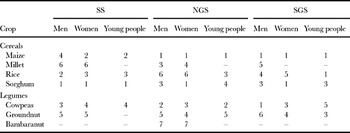
The project used PREA to allow communities to identify their key problems and suggest potential solutions (Ellis-Jones et al., Reference Ellis-Jones, Schulz, Douthwaite, Hussaini, Oyewole, Olanrewaju and White2004; Hagmann et al., Reference Hagmann, Chuma, Murwira and Connelly1999). As a first stage in the PREA cycle, community analysis and social mobilization activities were undertaken with 30 communities in the three AEZs in southern Borno State, northeast Nigeria. A total of 43 EAs and three zonal supervisors from the Borno State Agricultural Development Programme in four local government areas were involved. This provided information on livelihood constraints, crop production problems, farmers' coping strategies for these problems, as well as local institutions. Over 95% of the participants in three community workshops relied on crop production for both food security and a major part of their livelihoods (Tarawali and Kureh, Reference Tarawali and Kureh2004). Of the cereal crops, maize was the most important especially in the NGS and SGS; sorghum was more important in the SS, although there were some differences in opinions between men, women and young people. For instance women ranked maize and sorghum as equally important in the NGS and SGS, while young people ranked maize and rice highest in the SGS (Table 1). Cowpea was the most important legume crop in all three areas.
Crop priority ranking by farmers in three agro-ecological zones in Borno State, northern Nigeria (1 = highest, – = not ranked).

SS: Sudan Savanna; NGS: Northern Guinea Savanna; SGS: Southern Guinea Savanna.
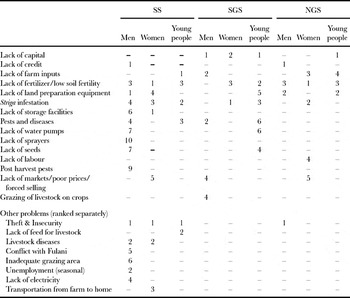
Farmers identified a wide range of priority problems including a lack of capital, credit and farming inputs, particularly fertilizer, seed and equipment for land preparation, and also insecurity, storage problems and post harvest pests. Striga and low soil fertility were identified as the major constraints limiting cereal production across the three AEZs (Tarawali and Kureh, Reference Tarawali and Kureh2004) (Table 2).
Problem prioritization by farmers in three agro-ecological zones in Borno State, northeast Nigeria. (1 = highest, – = not identified as a problem).
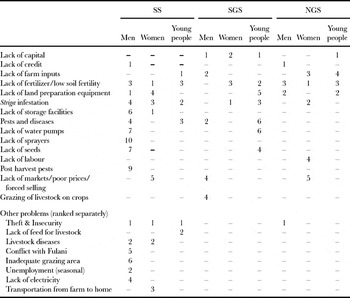
SS: Sudan Savanna; NGS: Northern Guinea Savanna; SGS: Southern Guinea Savanna.
Source: Tarawali and Kureh (Reference Tarawali and Kureh2004).
Subsequently some 193 farmer groups, based on kinship and other local links located across the 30 communities and AEZs, nominated one or two farmers from each group to test the innovative ISC methods on their fields and under their management conditions. As a result, 228 farmers tested the Striga control methods during a two-season period over 2004 and 2005. Training was provided for the EAs so that they, in turn, provided training for farmers not only in crop and Striga management and crop utilization, but also in leadership and communication skills. At the same time, these farmers were encouraged to share with other members of their groups the skills and knowledge they had acquired during training and field evaluation activities. They were also encouraged to provide knowledge on Striga management to other farmers in their communities and to lead participation in evaluating the performance of the Striga control methods. At the same time community-based seed production was initiated to provide maize varieties suitable for each AEZ. As a result, the farmers testing ISC and seed producers became involved in farmer-to-farmer knowledge transfer. During this process, EAs played a facilitating role during trial establishment, monitoring and evaluation.
There were two treatments, ISC and farmer practice (FP). The ISC treatment consisted of soyabean grown as a legume trap crop in the first year followed in the second year by an improved maize variety selected from one of four varieties, based on farmer choice and suitability for the AEZ. In addition, the same maize varieties were also grown alongside soyabean in the first year to assess their effect on Striga control in comparison with local maize. Maize varieties selected were late maturing ACROSS 97 TZL COMP1-W, TZL COMP1 SYN (both Striga-resistant) and TZE COMP3 DT (drought-tolerant) in the SGS and NGS, while farmers in the SS selected an early maturing maize variety, 94 TZE COMP5-W (Striga-tolerant). FP comprised a local maize variety in both years. Most local maize varieties were retained seed of improved varieties that had been acquired many years previously through the State Extension Agency.
Agronomic practices
All crops were planted in rows 0.75 m apart in plots measuring 20 × 20 m. Inter-row spacing for maize in the ISC plots was 0.5 m with two plants per hill giving a plant density of 53 333 plants ha1. The inter-row spacing for soyabean was 0.20 m with five plants per stand to give a plant population of 266 666 plants ha−1. Farmers used their preferred spacing in the FP plots, as many considered the ISC spacing to be too close. However, many farmers did in fact use the closer spacing in the second year on the FP plots, as they thought that closer spacing would lead to higher yields.
Farmers were also asked to bury fertilizer in the ISC plots to minimize nutrient loss through rain water run-off and volatilization. Many farmers also buried fertilizer applied in the FP plots, especially in the second year. NPK 15:15:15 was applied either at planting or one week after planting (WAP) at the rate of 50 kg N, 50 kg P2O5 and 50 kg K2O ha−1 using standardized measures. Urea was used for top dressing maize plants with 50 kg N ha−1 at 4–5 WAP to give a total of 100 kg N ha−1. Some farmers considered this application too high and therefore applied lower quantities of between 50 and 60 kg N ha−1 on the FP plots. Soyabean plots were supplied with SSP at 40 kg P2O5 ha−1 at the onset of the trials.
Sampling
Data on Striga counts and grain yield were collected at 10 WAP for the late maturing maize and at 8 WAP for the early maturing maize. Four 1 × 1 m quadrats were placed diagonally in each plot and the numbers of emerged Striga plants were recorded. Grain yield was determined at physiological maturity at 12 WAP for late maturing varieties and at 10 WAP for the early maturing variety. At maturity, farmers with support from EAs harvested all the maize in a plot, dehusked and weighed it. Representative samples of 20 cobs were shelled and the moisture content determined using a Dickey John Moisture meter. The moisture content was used to adjust yield to 12% moisture using a shelling percentage of 80%. Soyabean was harvested by cutting plants at ground level and air drying before threshing. The moisture content of the grain was used to calculate grain yield per ha after adjusting to 12% moisture content.
Data analysis
Prior to data analysis, all sites that were free of Striga were removed from the data set leaving 58 farmer trial blocks in the analysis. The overall structure of the trials was an incomplete design with each farmer plot set (triples in 2004 and pairs in 2005) representing one block. Comparisons between local maize, improved maize and soyabean in 2004, and then local maize and improved maize varieties in 2005 were made using these blocks and plots. Statistical analyses were undertaken using the package GenStat 4.2 (GenStat, 2000) with differences between means considered significant at a probability level of p < 0.05. Variability of means are presented as standard errors between means (s.e.d.) or as standard errors (s.e.). Because the improved maize varieties occurred unequally, the design was unbalanced and so the data were analysed using residual maximum likelihood (REML) (Robinson et al., Reference Robinson, Thompson and Digby1982) to assess differences in crop yields between FP and ISC. The statistical significance of treatment effects was assessed using Wald statistics, which are distributed asymptotically as chi-squared with appropriate degrees of freedom. Striga weed counts were transformed by taking logs to the base e in order to stabilize the variance and make the treatment effects additive.
Mid- and end of season farmers' evaluations
Mid-season evaluations for assessing soyabean–maize rotations were undertaken by farmers' groups in all 30 communities, with 30 men's groups, 30 women's groups and 18 youth groups undertaking separate evaluations on 112 farmers' plots. Facilitation was undertaken by extension staff at a time before crop maturity when treatment effects on maize, particularly crop condition and Striga presence, could be visually assessed. During this process, other farmers, both from the group and the wider community, were invited to visit the experiments so that lead farmers could present their trials, give their views and share knowledge in a process of farmer-to-farmer extension. Men, women and young people, separately, identified the advantages and disadvantages of each treatment.
In addition, an end-of-season evaluation was undertaken with farmers after harvest, again facilitated by extension staff. This included recapping and modifying, as necessary, the advantages and disadvantages identified during mid-season evaluations and undertaking a participatory budgeting process to assess the financial viability of the technologies from farmers' perspectives. Farmers' groups undertook 112 end-of-season evaluations during March 2006, some time after harvest. In each case, yields of grain and fodder, inputs (seed, fertilizer and labour) and local prices were used to compare ISC and FP. Local units of measurement per 20 m × 20 m plot were used in the evaluation and later converted to kg and ha for reporting. Values based on actual costs experienced by farmers ensured local assessment of the economic performance. These included the following:
• Comparing crop grain yields and their values (gross returns) for each treatment over the two-year period. In addition, an estimate was made by farmers of the value of crop residues, based on local market prices for livestock fodder. This included both the stover remaining after harvest as well as residues after shelling and/or dehusking the grain.
• Undertaking a partial budget analysis deducting the main costs which varied between treatments from the gross returns to determine treatment margins. Costs included seed, fertilizer and labour, based on quantities used, market values, and for family labour, the opportunity cost of hiring that labour.
Scaling-out to other farmers
A participatory adoption assessment of ISC was undertaken over a two-day period in September 2006, towards the end of the growing season before crops were harvested in seven communities covering the three AEZs. Different crop varieties could still be identified and some of the field management practices could be confirmed. The assessment measured adoption in three ways, through discussion with i) participating farmer groups, ii) individual farmers and seed producers working within the groups, and iii) through 10 transect walks through the arable areas in each community, where crops and management practices were assessed every 100 m over a 2–3 km distance, providing an opportunity to establish an unbiased view of technology adoption, reflecting the observed situation on the ground, rather than farmers' own assessment. A total of 476 people including 288 men (of whom 140 were young men) and 188 women (overall 61% male, 39% female) participated in group or individual discussions.
RESULTS
Yield and Striga count data
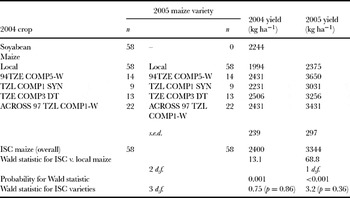
In 2004, the mean yield of soyabean was 2244 kg ha−1. Local maize yield was 1994 kg ha−1 compared with ISC maize yields of 2400 kg ha−1, showing a 20% increase in the yield of ISC maize over local maize. In 2005, the mean ISC maize yield following the 2004 soyabean was 3344 kg ha−1 compared with 2375 kg ha−1 for local maize following local maize. This represented a 39% yield increase (Table 3). Yield differences between ISC and local maize were statistically significant (p < 0.001) in both years. However, differences among yields of the different ISC maize varieties were not statistically significant and there was no significant difference among AEZs. This suggests that the ISC maize varieties had the same yield potential across AEZs.
2004 and 2005 average crop yields across three agro-ecological zones (kg ha−1).

n = number of farmers growing each crop or variety.
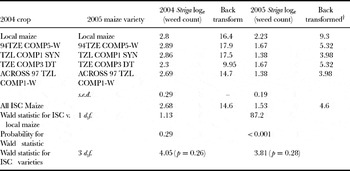
The reduction in Striga for the ISC varieties compared with local maize plots was only 12% in 2004 but 50% in 2005 (Table 4). However, only the 2005 reduction is statistically significant. This confirms the importance of growing soyabean in the first year to reduce Striga, even when Striga tolerant or resistant maize varieties are grown.
2004 and 2005 average Striga counts (counts m−2).

†Back transformed data gives the Striga count m−2.
Mid- and end of season evaluations
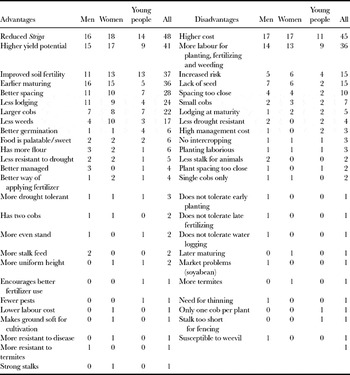
The advantages and disadvantages of ISC are ranked in order of the number of times they were mentioned by farmers' groups (Table 5).
Number of farmers groups identifying advantages and disadvantages of legume–cereal rotations† ranked in order of times mentioned.

†The 2005 maize crop was viewed after production of soyabean in 2004.
The main advantages were identified as being reduced Striga, higher yields, improved soil fertility, earlier maturing new maize varieties with better spacing, less lodging, larger cobs and fewer weeds. The main disadvantages were seen as the higher cost of seed and fertilizer, increased labour requirement for planting, fertilizing and weeding, increased risk, a lack of seed for scaling-up and too close spacing. There were no significant differences among men, women and the young men and women.
Results from the 112 end of season evaluations indicated that grain yields from both soyabean and maize tend to be highest in the SGS and the NGS where most evaluations were undertaken. Because of limited rainfall, the SS is not normally regarded as suitable for either maize or soyabean, although some farmers, especially those in close proximity to the NGS, insist on growing them. However, the availability of early and extra-early maturing maize varieties has made it possible for farmers to grow maize in the SS (Kamara et al., Reference Kamara, Kureh, Menkir, Tarfa, Kartung and Amaza2006). These varieties, however, have a lower yield potential than the late maturing varieties grown in the SGS and the NGS. In years of above average rainfall, such as 2004 and 2005, yields were acceptable to farmers.
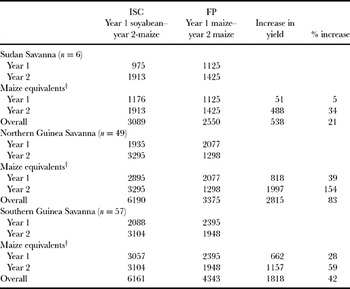
To compare soyabean and maize yields, the yield of soyabean was converted to maize equivalents using local soyabean:maize price ratios. Yields from ISC and FP could then be compared for both a single year and for the two-season ISC rotation. Since soyabean was a new crop in all areas and farmers were still assessing its value soyabean:maize ratios varied across AEZs. In all AEZs increases in ISC over local maize yields were achieved, varying between 5 and 154%, dependent on year and AEZ (Table 6).
Average grain yields from farmer trials in soyabean–maize rotations (kg ha−1).

†Soyabean yields have been converted to maize yield equivalents using local prices in each AEZ. In the Sudan Savanna 1 kg of soyabean was equivalent to 1.21 kg of maize, in the Northern Guinea Savanna 1 kg of soyabean was equivalent to 1.50 kg of maize and in the Southern Guinea Savanna 1 kg of soyabean was equivalent to 1.46 kg of maize.
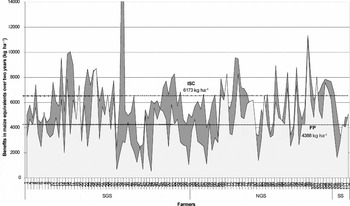
Over the two years, an 83% increase in yields was achieved in the NGS, 42% in the SGS and 21% in the SS. The increase in yield productivity across AEZs for all 112 farmers was 41% (Figure 1). This shows the high level of variability although most farmers experienced an increase in yields.
Average 2-year yields from farmer-managed trials in soybean-maize rotations (maize equivalents as kg ha−1) (n = 112).

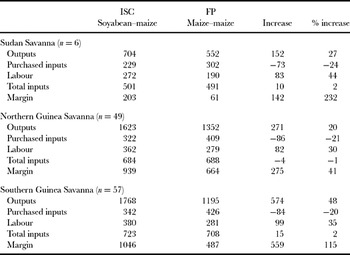
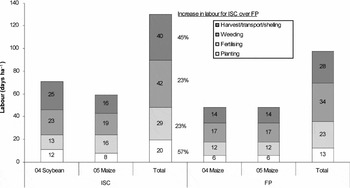
Participatory budget analysis (Table 7) was based not only on grain yield values, which had been accurately measured, but also included an estimated value for crop residues, based on their market value for livestock fodder. This included both the stover remaining after harvest as well as residues after shelling the grain. Output increases for ISC over FP for the 2 years were 48% in the SGS, 20% in the NGS and 27% in the SS. However, the purchased input prices for ISC were more than 20% lower than for FP, largely because of the reduced fertilizer required for soyabean. Seed and fertilizer costs were similar for ISC and FP maize, but the major concern from farmers had been the increase in labour requirements for closer spacing and burying fertilizer. Closer spacing also increased the subsequent labour needed for weeding. Overall labour requirement increased by between 30% and 44%. In the SGS, for instance, labour requirements for planting increased by 57%, for fertilizing by 23%, for weeding also 23%, and then for harvesting as a result of increased yield 45% (Figure 2). Similar increases were experienced in the NGS and the SS.
Participatory partial budget analysis of lead farmer trials in soybean-maize rotations (US $ ha−1).

US $1 = naira 125.
Typical labour profile for ISC and FP (days ha−1) showing % labour increases of ISC over FP.

It was feared that these increases in labour could lead to the adoption of ISC crops and varieties but without the desirable change in management practices to closer spacing and burying fertilizer.
Scaling-out to other farmers
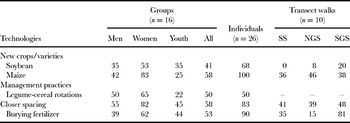
The adoption rates resulting from the three assessment methods, group discussion, individual discussion and transect walks are compared (Table 8). As expected, the highest adoption rates are reported by the individual farmers, second highest by the groups, with the lowest being observed in the transect walks.
Adoption rates (%) reported by groups and individuals, and observed in transect walks.

–: not able to be assessed.
Results reported from the group discussions indicated that across the AEZs, 58% of participants had adopted the new maize varieties, 41% had adopted soyabean, and over 50% had adopted the new management practices. This included use of a legume–cereal rotation, closer crop spacing and burying fertilizer. The highest adoption rates were reported by women and the lowest by young people. In the NGS, adoption of soyabean was 65%, and in the SGS, 45%; adoption of new maize varieties was over 60% and, interestingly, the rate of adoption of many new management practices was higher in the NGS and the SGS than in the SS. Although farmers reported that new management practices are often taken as a package with the new crop varieties, there were complaints about the additional labour, the tediousness of the work and the additional costs for many of the new practices. These were considered likely to limit the area of land over which they are adopted, and to restrict them to farmers who have the resources for their introduction.
Results reported from individual discussions indicated 100% adoption of new maize varieties and 60% adoption of soyabean, slightly higher than the adoption reported in the group discussions. Likewise the adoption of management practices on at least some portion of farmers' fields was high, legume–cereal rotations (70%), covering fertilizer after application (90%), closer spacing (over 80%), improved fertility and weed management (over 70%), with 30% also indicating that they had applied herbicide.
Results observed from the transect walks showed new maize varieties having the highest adoption rates, 36% in the SS, 47% in the NGS and 39% in the SGS. Observations of new varieties in the cropping systems show that in all systems where maize was cropped, a high proportion was a new variety. For instance, in maize–cowpea intercropping systems, 75% of the maize was a new variety. With regard to soyabean, adoption was 8% in the NGS, 20% in the SGS and 0% in the SS due to the unsuitability of the crop in that area. New management practices were also observed to be widely adopted, often over 40% and mostly associated with the use of the new maize varieties and highest in the SGS.
DISCUSSION AND CONCLUSIONS
The use of PREA involving local communities in identifying their own problems and seeking solutions is a process which allows close interaction between research, extension and farmers, ensuring joint assessment and addressing of priority problems. The involvement of local groups and farmers in the evaluation process ensures immediate feedback to researchers as well as promoting farmer-to-farmer extension of new technologies.
The ISC soyabean and maize yields achieved shown in this study corroborate those of Ellis-Jones et al. (Reference Ellis-Jones, Schulz, Chikoye, de Haan, Kormawa and Adedzwa2004) in which they found Striga-resistant maize yielded 47% more than local maize and the use of a legume trap increased maize yield by 64% in the second year. At the same time Striga counts also corroborate those of Ellis-Jones et al. (Reference Ellis-Jones, Schulz, Chikoye, de Haan, Kormawa and Adedzwa2004), in which 69% lower Striga counts in maize following leguminous trap crops than in maize following local maize or sorghum and 53% lower in Striga-resistant maize than in local maize were found. In addition Franke et al. (Reference Franke, Ellis-Jones, Tarawali, Schulz, Hussaini, Kureh, White, Chikoye, Douthwaite, Oyewole and Olanrewaju2006) reported a 46% reduction in Striga seed density when Striga-resistant maize followed a soyabean trap crop.
Although farmers identified some disadvantages, notably increased costs resulting from a higher labour requirement for planting, fertilizing and weeding, many advantages were noted, in particular reduced Striga, higher yields and improved soil fertility. Partial budget analysis confirmed that productivity of ISC was greater than FP. This is reflected in high initial levels of both reported and observed adoption especially of new maize varieties. With regard to soyabean, lower early adoption can be explained as the crop is still relatively new and until farmers become certain of a market they are unlikely to expand the initial areas planted. Although adoption rates differ between sources, trends across technologies and management practices are similar with the highest adoption rates occurring in the NGS and the SGS. It also appears that women farmers have adopted the innovations at a higher rate than both older men and young men, with maize and soyabean featuring particularly highly. This may be due to a deliberate policy to mainstream gender in all activities. However the higher rate of adoption of improved agricultural technologies by women is unprecedented in the Nigerian savannas. In fact most studies in Africa have found low levels of adoption of technologies by women farmers (Abebaw and Belay, Reference Abebaw and Belay2001; Adesina and Chianu, Reference Adesina and Chianu2002). This is attributed to the traditional gender bias in favour of men and better contact between EAs and male farmers than with female farmers.
High rates of adoption for new maize and soyabean varieties can be partly attributed to the availability of improved seeds through the establishment of community-based seed production schemes. Several studies have shown lack of seeds to be responsible for low adoption of crop varieties (Feder et al., Reference Feder, Just and Zieberman1985; Yanguba, Reference Yanguba2005). In addition, the high adoption rates can be attributed to regular contact between leaders of farmer groups and extension agents and the resulting knowledge transfer between farmers. For instance, Adesina and Chianu (Reference Adesina and Chianu2002), Abebaw and Belay (Reference Abebaw and Belay2001) and Manyong et al. (Reference Manyong, Houndekon, Gogan, Versteeg and Van Der Pol1996) reported a positive relationship between adoption of improved agricultural technologies and contact with extension staff.
With regard to non adoption, discussions with farmers revealed that many farmers see the new varieties as requiring higher inputs of fertilizer and pesticides than local varieties. At the same time, it is believed that if traditional varieties are grown it is best to keep to traditional management practices. Lower adoption of management practices in the Sudan Savanna can be attributed to lower rainfall and hence a higher perception of risk associated with closer spacing and the use of fertilizer.
Clearly, technical solutions are now available to problems of declining soil fertility and Striga infestation provided farmers have access to effective input and output markets. Striga control is best achieved through ISC of soyabean followed by Striga-resistant or tolerant maize, using management practices, which increase productivity, although the relative prices of maize and soyabean will be important in ensuring long-term sustainability.
Since the Guinea and Sudan Savannas constitute the major cereal-growing areas in the West African savannas, where Striga is known to be a serious problem (Berner et al., Reference Berner, Winslow, Awad, Cardwell, Mohan Raj, Kim, Badu-Apraku, Akoroda, Oudraogo and Quin1997), there is opportunity for scaling out in this region. The use of Striga-resistant cereal cultivars in rotation with legume trap crops offers a clear opportunity to control this weed. Rapid dissemination of these technologies, requires researchers and extension workers to use a participatory approach, where farmers are able to test and compare new varieties and management practices with their local production systems. Farmer involvement in identifying their own problems and learning though local experimentation is a prerequisite for rapid scaling out of these Striga control technologies.
Acknowledgements
We thank the Canadian International Development Agency for funding the project ‘Promoting Sustainable Agriculture in Borno State’, which financed this study and the extension staff of the Borno State Agricultural Development Programme for collecting the data at the household level, and Rose Umelo for editorial assistance.