



No CrossRef data available.
Article contents
HOW THE VICTORIANS BECAME SEXY: THE FLESHLY SCHOOL OF PAINTING
Published online by Cambridge University Press: 07 April 2005
Extract
EXPOSED: THE VICTORIAN NUDE, an extensive exhibition initiated by and first shown at Tate Britain in 2002, and The Crimson Petal and the White by Michael Faber, a best-selling novel set in Victorian times and published in the same year, illustrate the interchange of the scholarly and the popular, more particularly how the recent rich work in Victorian sexuality, familiar to readers of this journal, informs and is transformed within blockbuster museum shows and popular fiction. Both exhibition and novel shed some light on the question of how the Victorians have become so sexy.
Information
- Type
- REVIEW ESSAYS
- Information
- Copyright
- © 2005 Cambridge University Press
EXPOSED: THE VICTORIAN NUDE, an extensive exhibition initiated by and first shown at Tate Britain in 2002, and The Crimson Petal and the White by Michael Faber, a best-selling novel set in Victorian times and published in the same year, illustrate the interchange of the scholarly and the popular, more particularly how the recent rich work in Victorian sexuality, familiar to readers of this journal, informs and is transformed within blockbuster museum shows and popular fiction. Both exhibition and novel shed some light on the question of how the Victorians have become so sexy.
Exposed, curated by Alison Smith, a distinguished British art historian, traveled from Tate Britain to Munich, the Brooklyn Museum of Art (where I saw the show), and finally to Kobe, Japan. As a scholarly intervention in Victorian art history, in its visual richness, and through the critical essays in the fine catalog, the project demonstrates a number of important points, many of which were earlier articulated in Smith's excellent monograph, The Victorian Nude: Sexuality, Morality and Art. The plenitude–the acres of flesh, primarily female, but also male– convincingly refutes the common wisdom that Victorians did not do nudes. Instead, Exposed shows that through the nineteenth century British artists employed the tradition of the nude for a complex array of purposes. Furthermore, through a combined thematic and chronological organization the exhibition breaks down the monolithic category of “Victorian Art.” The representation of the nude is seen as unfolding and shifting from the 1830s through the 1890s in the various sections of the show–The English Nude (1840s); The Classical Nude (1860s); The Private Nude; The Artist's Studio; Sensation! The Nude in High Art (1870s–1890s); The Modern Nude (1880s–1890s).
In its intellectual organization, however, Exposed exhibits some of the contradictions within recent Victorian art history. Following the work of feminists scholars such as Griselda Pollock, who enabled us to see such representations of women as the Rossettian stunner not as emblems of female loveliness, but of male erotic fantasies and patriarchal power, Exposed seeks to show the importance of the Victorian nude as an ideological figure to be read as registering complex social meanings that shift over the century, to see these unclothed bodies in terms of signification rather than erotics. In her introductory catalog essay on “The Nude in Nineteenth-Century Britain,” Smith speaks of the English nude as “functioning to contain a complex set of cultural and historical associations” (11). Thus, the characteristic Victorian integration of the nude figure within a mythic or historical narrative is revalued as ideological work with political and cultural importance. For example, the outpouring of Lady Godiva paintings in the 1840s following Tennyson's poem of 1842, epitomized by Edwin Landseer's Lady Godiva's Prayer (1865), a work admired by Queen Victoria, demonstrates a politicizing of nudity that could transform Lady Godiva into “a Saxon heroine who acted in defence of English Liberty” (Exposed 67).
But as Kenneth Clark famously noted in his study of the nude, an observation quoted by Smith in her monograph, “No nude, however abstract, should fail to arouse in the spectator some vestige of erotic feeling” (7). Indeed, the laudable effort by the exhibit to rescue the Victorian nude for signification runs against the inherent erotic charge of the unclothed body, an erotics shaped in this particular case by the scholarly reimagining of Victorian sexuality and a museum marketing that represents Victorian sexuality within the category of the perverse, a category itself constructed in the nineteenth century.
The title of the exhibition, Exposed: The Victorian Nude, in its multiple suggestions and suggestiveness neatly encapsulates the dynamic between the realm of scholarly publication and the world of major museums dependent for their income on attracting large crowds. At the Brooklyn Museum of Art, Exposed followed Sensation, a 1999 show of young British artists that incurred the wrath of Mayor Giuliani, who threatened to withdraw municipal funds because of the sacrilege of The Holy Virgin Mary by Chris Ofili showing a Virgin Mary in part constructed of elephant dung. Exposed itself quite nicely offers a bit of titillation as voyeurism, lifting the clothing, the covering of the flesh. But in contrast to Sensation, a show of contemporary art, the erotic frisson is purified by historical distance, a distinct advantage for museums supported by public funds here and abroad. After all, a postmodern painting of naked women tied to posts in the football stadium to be ravaged by the Detroit Lions would be a bit more touchy for taxpayers than naked bound female Christian martyrs about to be devoured by real lions in a painting by the aptly named Herbert Schmalz, Faithful unto Death: ‘Christianes and Leones!’ of 1888. Ironically, then, the exhibition replicates in the twenty-first century, the hypocritical prurience that, in part, it claims to find in the Victorians. If the narrative art of the Victorian nude provided an excuse to see naked ladies, Exposed is presented as an opportunity to see naked Victorian ladies, as well as men and boys, while feeling superior to the benighted inhabitants of nineteenth-century Britain. The critic of the Village Voice simply accepts that the purpose and the intent of the art is sexual titillation, “These nudes are calculated to produce a buzz” (Saltz 53).
There is another implication in the title–that these are not timeless nudes, but Victorian nudes, Victorian bodies rendered by Victorian artists. Indeed, Exposed marks the triumph of Foucauldianism in the popular imagination. Michael Kimmelman, reviewing Exposed for the New York Times, says, “You don't need to be Michel Foucault and write a book about the history of sexuality to recognize” that the Victorians were absorbed by sex. The exhibition assumes the Foucauldian idea of the historicity of Eros, that each era constructs its own specific sexuality. Furthermore, the title assumes that the word “exposed” has a specific relevance to Victorian sex. One cannot, for example, imagine a show called “Exposed: The Renaissance Nude.” For it is exposure, unveiling that defines the particular frisson of Victorian sexuality today. It is seeing the nineteenth-century sexual body uncovered, seeing the piano legs without the flounces, the flesh beneath the crinoline that provides a sexual kick equal to if not greater than, say, viewing the body in the work of Degas, imitated by such late-Victorians as Walter Sickert, and certainly viewing the naked contemporary body.
In its erotic intensity and in its particular and even peculiar form, the sexual afterlife of the Victorians becomes attractive not for its purity, but for its perversion. The Village Voice critic suggests that the show should have been called “Kinky.” To the contemporary viewer, the nineteenth-century sexological definitions still apply; the Victorian nudes appear as a gallery of perversion, a visual Krafft-Ebing. In Lawrence Alma-Tadema's Tepidarium (1882), the reclining woman masturbates with a feather fan while contemplating an “overtly phallic strigil” (Exposed 148) held in the other hand. Like Schmalz's Faithful unto Death, the well-known Knight Errant (1870) by John Everett Millais and The Greek Slave of Hiram Powers, seen here in a replica made for the Great Exhibition of 1851, show the voyeuristic charge of female bondage. Henry Scott Tuke's August Blue (1894), a non-narrative painting of adolescents bathing in Falmouth Harbor, registers the new acceptability of representing a pedophilic homoeroticism centered on the young boy. The late Victorian male fantasy of the fatal woman appears in many works, including John Collier's painting of Lilith (1887) wrapped round by a giant snake and Herbert Draper's Ulysses and the Sirens (1909) showing the bound Ulysses threatened by a boarding party of predatory naked women.
In its expanse of fleshly intensity and non-normative sexual scenes, the art in Exposed shows erotics trumping signification. As if confirming the Foucauldian notions of the truth of sex within our discourse of sexuality, what the exhibition seems to expose is the authentic motivation of the Victorians as neither religion nor economics nor social class, but Eros, albeit an Eros deformed.
Like Exposed, Michael Faber's enormously skilful novelThe Crimson Petal and the White exemplifies the ways in which the scholarly revaluing of Victorian sexuality enters the public realm. This is no steamy Victorian bodice ripper, but rather a canny and informed imagining of the nineteenth century. An impressive knowledge of quotidian Victorian life combines with post-modernist reflexiveness, as in this self-conscious use of the panoramic mode and the narrator speaking directly to the Reader:
That is why I've brought you here to Church Lane, St. Giles: I've found just the right person for you.
I must warn you, though, that I'm introducing you at the very bottom: the lowest of the low. The opulence of Bedford Square and the British Museum may be only a few hundred yards away, but New Oxford Street runs between there and here like a river too wide to swim, and you are on the wrong side. The Prince of Wales has never, I assure you, shaken the hand of any of the residents of this street, or even nodded in passing at anyone here, nor even, under cover of night, sampled the prostitutes. (4)
In this novel, the quotidian truth of Victorian life is rendered brilliantly, but the deeper truth of the Victorians is seen to be neither the desire for monetary gain nor moral sanctity, but, as in Exposed, the truth of sex. The plot is energized by the notion that the Victorians, or rather Victorian men, were motivated at the foundation of their being by sexual desire. Sugar, the proto-feminist prostitute as heroine lies there thinking not of England, but of her cash accounts and Mary Wollstonecraft. The male protagonist, William Rackham, a Victorian businessman, is obsessed with Sugar because he finds no satisfaction in his dutiful, sexless relationship with his hysterical wife. Yet his erotic drives are registered under the label of perversion; he needs a woman to satisfy his outré sexual desires. Even the economic self-interest that was once seen as powering industrial England is here registered as secondary. William energetically fattens the profits of Rackham Perfumeries through innovations, but only so that he can fund his passion for Sugar. Even William's brother, ostensibly a man of God, thinks only of the body of a woman. In our current sexualized view of the Victorians, religion functions as a hypocritical cover for prurience.
Here, sex is the essential motivating force of nineteenth-century Britain; the plot is driven by desire, or more specifically by male desire, but the texture of nineteenth-century realism employed with irony and intelligence provides a welcome counterpoint to the Victorian male fantasies registered in Exposed. Even though the dust jacket shows a detail of D. G. Rossetti's Lilith, female flesh is hardly idealized; Sugar suffers from severe eczema. She must cope with a cold room and a full bladder, with douches and stained bed sheets while employing her sexual knowledge to enthrall a bourgeois man. In this extended rewriting of Rossetti's “Jenny,” the enigmatic prostitute, the Victorian nude as object of the male gaze, speaks. And her speech displays, in a mildly anachronistic fashion, a modern feminist consciousness; her female secret life lies in her angry journals kept in her closet.
Both novel and exhibition, then, imply not only that the Victorians were sexy, but that, mirabile dictu, they were more intensely sexual than we. Although the old idea of Victorian sexual repression continues to control contemporary views, the scholarly rethinking of repression, exemplified in the influential work of John Kucich and John Maynard, has percolated into present awareness so that inhibition now appears as intensifying rather than enervating the erotic. In The Crimson Petal William's desire becomes a fierce passion precisely because he must overcome his inhibition about his sexual needs as well as his sense of duty to his childlike wife. The world of the Victorian nudes becomes a lost sexual paradise, of a particular kind, of Eros in restraint, both literally in bondage paintings such as Bondage (1895) by Ernest Norman, showing a Semitic slave dealer offering a Nubian slave to the Pharaoh, and in the general artistic effort to contain flesh within classical or mythic narratives.
The power of repression in generating the sexual frisson of the show appears in contrast to the quite fascinating section of pornographic photographs and early moving images, curtained off by the Brooklyn organizers in another contemporary replication of Victorian prudery. A fine catalog essay, “Prudery, Pornography and the Victorian Nude (Or, what do we think the butler saw?)” by Martin Myrone, sees the new technologies of image reproduction as enabling the democratization of pornography, moving porn downscale from the elite to the larger male public. The insouciance of the comic turns in these early films, where moral machinery has been jettisoned for the exposure of female and male flesh without the excuse of classical myth, provides some relief after the Arnoldian high seriousness of Victorian artistic machines, but, paradoxically, these films are the least erotic, and the most risible, work of all the nudes of Exposed. To the modern viewer in New York City, who can see more salacious examples on the side of passing buses, women stepping out of their bloomers unconstrained by moral narrative lacks the prurience, the kick of the perverse in the paintings and sculptures of chained ladies.
The inclusion of pornography near the end of this vast array of nineteenth-century works points toward the art historical narrative that informs Exposed, the conflation of art history with what Foucault famously calls the Liberation Hypothesis–as moderns became liberated from sexual inhibition, so British art over the course of the nineteenth century liberated itself from moral and religious narrative so as to expose the nude in itself, see the nude plain, with a visual and sexual pleasure outside discourse. While laudably amassing examples to deconstruct the deadening generalization of a unitary Victorian art, in showing the complexity and the variation of the genre over time, the chronological organization still imposes the deadening teleology, the notion that Victorian art worked almost providentially toward the French model of modernism, a model that contemporary Victorian art history is moving to counteract. For all its art historical acumen, Exposed sings the old song, that the Victorians were benighted artistically and sexually, until the French freed up English painting and the England libido. A work such as Sickert's Woman Washing her Hair (1906) showing only the torso of a woman bending over the sink in a shabby bed-sitter, or Philip Wilson Steer's Seated Nude: The Black Hat depicting a nude wearing only a black hat with flowers, painted in 1900 but never exhibited because of its clear eroticism, show the desire of English artists to emulate Degas and Manet. In spite of its respectful concern for signification in early and mid-Victorian work, the catalog still invokes the avant-garde model to praise what is termed “The Modern Nude,” as the work of cutting-edge British painters, inspired by developments in French art” (250). The “avant-garde” works take on value because they were “greeted with revulsion by conservative critics” (250).
If, then, applying the model of French modernism to the Victorian nude only distorts our reading, if the nineteenth-century British treatment of this traditional genre remains outside our usual art historical categories, the question remains: What are we to do with the Victorian nude? Certainly, for all the contradictions and ambivalence in the realizing of this exhibition, the general approach–close, historically specific contextualizing– provides one productive method. For moving beyond the avant-garde paradigm and considering Victorian painting within its own national context, we can turn to the methodology employed in Elizabeth Prettejohn's reading of Alma-Tadema's paintings of Rome, “Lawrence Alma-Tadema and the Modern City of Ancient Rome,” where she argues that we can read these paintings as a modernist response to the multitudinousness of the nineteenth-century city analogous to that of Parisian painters, yet rendered in an historicist manner specific to Victorian England.
I would end with a few personal responses. Exposed definitively proves the basic fact, the existence of the Victorian nude, but the multitude of works, the acres of flesh, primarily female, but also male, wearies even the most devoted Victorianist. The exhibition provided less a visual treat, than visual exhaustion. The paintings and sculpture demonstrate the conviction of the organizers that the nude provided the Victorians a vehicle for complex and changing ethical, political, and gendered signification, but there is no doubt either that there is an excess in the occupation with the nude body beyond the need of moral and religious meaning. Draper's Ulysses and the Sirens surely figures manly sexual restraint, but the erotic attraction of three naked sirens climbing over the gunwales, two of whom are women rather than sea-monsters, their flesh highlighted in the foreground while the men remain shadowed in the background, overwhelms the ethical import.
And yet the show contains a few surprises of stunning visual quality. For this viewer, the gems were art without narrative done in the 1840s and 1850s, well before the pallid imitations of the French and the homoerotic paintings, by such artists as Tuke, William Stott, and Frederick Walker at century's end. Because they were done as life studies, drawings such William Mulready's Male Academic Study (1845), Ford Madox Brown's Academic Study of a Man (late 1840s), and especially John Everett Millais's Study of a male nude seated as if on horseback (1843–53) (Figure 29) stand as an art focused without excuse on the beauty of the body, on the power of flesh and muscle before its being covered by the costumes of finished painting. These sketches reveal, or I should say expose, an artistic energy and skill, an artistic power cloaked by the narrative machinery of the Victorian nude.
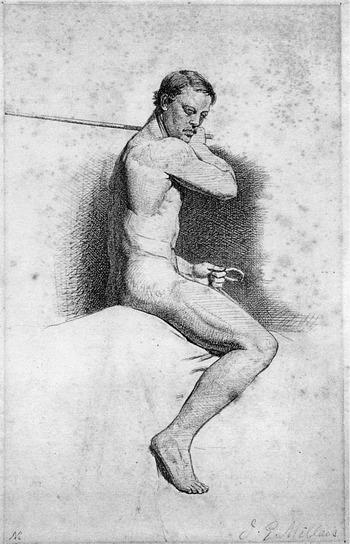
John Everett Millais, “Study of a male nude seated as if on horseback.” c. 1843–53. Pencil and pen and ink on white paper. Courtesy of the Victoria and Albert Museum.
References
Clark Kenneth.
1956.
The Nude: A Study in Ideal Form.
New York:
Pantheon
Faber Michael.
2002.
The Crimson Petal and the White.
New York:
Harcourt
Foucault Michel.
1978.
History of Sexuality: Volume I: An Introduction.
New York:
Vintage
Kimmelman Michael.
“The Invasion of the Nude Victorians (In the Name of Art, of Course).”
New York Times
6
Sept. 2002.
Kucich John.
1987.
Repression in Victorian Fiction: Charlotte Bronte, George Eliot, and Charles Dickens.
Berkeley:
U of California P
Maynard John.
1993.
Victorian Discourses on Sexuality and Religion.
Cambridge:
Cambridge UP
Myrone Martin.
“Prudery, Pornography and the Victorian Nude (Or, what do we think the butler saw?).”
Smith, Exposed.
23–
35.
Pollack Griselda.
1988.
Vision and Difference: Femininity, Feminism, and Histories of Art.
London:
Routledge
Prettejohn Elizabeth.
“Lawrence Alma-Tadema and the Modern City of Ancient Rome.”
The Art Bulletin
84
(March 2002):
115–
29.
Saltz Jerry.
2003.
“Naughty, Naughty.”
Seeing out Loud.
New York:
The Figures,
53–
55.
Smith Allison, ed.
2002.
Exposed: The Victorian Nude.
New York:
Watson-Guptill
Smith Allison, ed.
1996.
The Victorian Nude: Sexuality, Morality and Art.
Manchester:
Manchester UP
 You have Access