Arobust medical volunteer program is critical to ensuring a successful response to public health and medical emergencies. The national Medical Reserve Corps (MRC) program, organized and managed by the US Surgeon General's Office, was launched in 2002 after the September 11, 2001 terrorist attacks and the realization that there was no adequate mechanism to organize health professional volunteers and the valuable skills and expertise they could offer during an emergency response.1 Its goal is to develop a network of community-based units to “locally organize and utilize volunteers who want to donate their time and expertise to prepare for and respond to emergencies and promote healthy living throughout the year.” The initial scope of the program has since grown to include volunteers who are not health professionals. There are 867 MRC units throughout the United States and its territories, with more than 193 171 volunteers registered.1 The focus of each unit is unique to its sponsoring community. Many units recruit volunteers to perform public health work in their communities and to be trained and ready for potential emergency response.
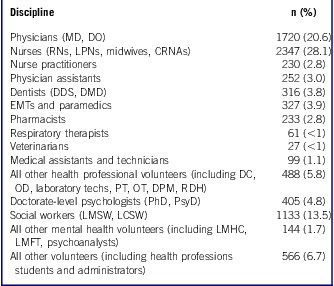
The New York City (NYC) Department of Health and Mental Hygiene (DOHMH) created the NYC MRC in 2003 to build a multidisciplinary team of health professionals who wish to assist NYC with response during large-scale health emergencies; Table 1 provides a breakdown of volunteers by discipline.2 The largest MRC unit in existence, the NYC MRC was formed initially to identify and prepare volunteers to assist with mass prophylaxis operations and point-of-dispensing staffing following a large-scale outbreak of disease, such as would be caused by a bioterrorism attack. The mission of the NYC MRC has been expanded to include large-scale sheltering (including special medical needs shelters) and medical surge capacity. Although a relatively small number of volunteers have assisted the DOHMH with seasonal influenza vaccination, the NYC MRC does not engage in standard public health activities (eg, administering school immunizations, screening people for diabetes mellitus) in the community on a regular basis, as most other MRC units do. Training for NYC MRC volunteers is not required, although it is strongly encouraged. Training sessions on a variety of topics (eg, biological, chemical, and radiological agents, mass prophylaxis dispensing) and incidents (eg, bombs, blast injuries) pertaining to emergency preparedness are offered each year.
NYC Medical Reserve Corps (MRC) Volunteers by Discipline as of January 9, 2009 (N = 8348)
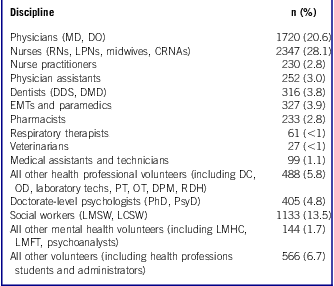
CRNA = certified registered nursing assistant; DC = doctor of chiropractic; DDS = doctor of dental surgery; DMD = doctor of dental medicine; DO = doctor of osteopathic medicine; DPM = doctor of podiatric medicine; EMT = emergency medical technician; LCSW = licensed certified social worker; LMFT = licensed marriage and family therapist; LMHC = licensed mental health counselor; LMSW = licensed master social worker; LPN = licensed practical nurse; MRC = Medical Reserve Corps; OD = doctor of optometry; OT = occupational therapist; PsyD = doctor of psychology; PT = physical therapist; RDH = registered dental hygienist; RN = registered nurse.
Several studies have explored the willingness and ability, and the factors that increase the willingness and ability, ofhealth professionals to report to work during emergencies.Reference Qureshi, Merrill, Gershon and Calero-Breckheimer3-Reference Balicer, Omer, Barnett and Everly10 We also know that large numbers of volunteers have historically offered to assist when they believed their skills and expertise may be needed, including during the September 11 attacks and in the aftermath of Hurricane Katrina; such volunteers may be termed “unaffiliated,” “convergent,” or “spontaneous” because they were not preregistered with a program before volunteering for those events. Little concrete research has determined why some health professionals volunteer and some do not, even when they understand the critical need for volunteers.
A broad range of recruitment activities have been implemented since the inception of the NYC MRC program, with varying degrees of success. These activities have included partnerships with professional organizations and hospitals, direct invitation from the NYC Health Commissioner, a targeted public health detailing campaign, and peer-to-peer recruitment. To ensure that its best efforts were being put forth to grow the NYC MRC, the DOHMH examined how successful each of the respective prior recruitment initiatives have been to date, in other words, which initiative(s) resulted in the most number of new health professional volunteers.
Methods
A variety of methods were used to determine the most successful strategies for recruitment of NYC MRC volunteers, including a volunteer survey, focus groups, and a retrospective review of volunteer registration data.
2004 Volunteer Survey
A volunteer survey was mailed to all of the NYC MRC volunteers registered as of November 11, 2004 (N = 2917), along with a Volunteer Liability Protection Form and identification card, as well as a postage-paid envelope for ease of return. The survey queried NYC MRC volunteer respondents about how they heard of the NYC MRC, what recruitment methods influenced their willingness to join the program, how quickly they could respond if the MRC were activated, and what competing obligations to the MRC they may have during emergencies.
2005 Focus Groups
A series of 6 focus groups were conducted by an external communications agency in June 2005—3 with a multidisciplinary mix of current volunteers and 3 with a multidisciplinary mix of potential volunteers (unpublished data, June 2005). The focus groups were implemented to determine what materials and messengers most influenced volunteers to join the NYC MRC or what materials and messengers were most likely to resonate with potential volunteers. In addition, participants were asked how likely they were to be able to respond during an activation of the NYC MRC. A program brochure was also shared with participants during the focus groups to test key messages developed for the NYC MRC unit.
Retrospective Review of Volunteer Registration Data
A retrospective review of volunteer registration data, recorded monthly from September 2003 through December 2008, was conducted in December 2008 to verify the earlier survey and focus group findings. The registration data were used to determine when there were surges in NYC MRC registration and were cross-referenced with implementation dates for the 2 largest types of recruitment initiatives yet undertaken by the NYC MRC: multiple mailings of an invitation letter from the NYC Health Commissioner to licensed health professionals across the 5 NYC boroughs, and personal visits to provider offices in NYC ZIP codes with fewer than 30 MRC volunteers by NYC DOHMH public health detailers. The mailing lists used for the Commissioner's invitational mailings consisted of data obtained from the NY State Education Department Office of the Professions, which is the licensing entity for the majority of health professionals in New York State.
Results
2004 Volunteer Survey
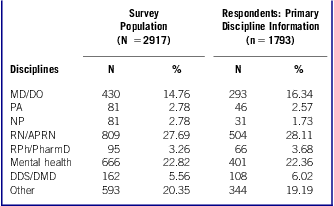
There was a 63% response rate to the 2004 NYC MRC Volunteer Survey (n = 1842), and respondents were representative of the survey population.Reference Rinchiuso11 Eighty-two percent indicated that they had heard about the MRC through their professional group (40%) or through the Commissioner's invitational mailing (42%), the latter receiving slightly more affirmative responses. Correspondingly, 86% indicated that they were the most influenced to join the NYC MRC by their professional groups (45%) or the Commissioner's invitational mailing (41%). Responses to this question seem to indicate that volunteers believed that professional groups had slightly more influence on their decision to join. Survey respondents were representative of the survey population (Table 2).
2004 NYC MRC Survey Demographics
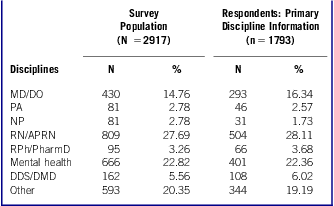
APRN = advanced practice registered nurse; DDS = doctor of dental surgery; DMD = doctor of dental medicine; DO = doctor of osteopathic medicine; MRC = Medical Reserve Corps; NP = nurse practitioner; NYC = New York City; PA = physician assistant; PharmD = graduate of a school of pharmacy; RPh = registered pharmacist; RN = registered nurse.
2005 Focus Groups
The majority of NYC MRC volunteers who participated in the focus groups said that their feelings of frustration and helplessness on September 11, 2001, most influenced them to join the program; they wanted to feel connected to a group that they believed could actually help during emergencies in NYC.Reference Rinchiuso11 Non-volunteers also generally reacted favorably to the NYC MRC program based upon their memories of feeling like there was nothing they could do on September 11, 2001. All of the respondents agreed that the local recruitment message resonated most, and that they were most concerned with wanting to be used effectively during a response and understanding what was expected of them as volunteers. Current MRC volunteers were those individuals who were already involved with projects in their community, whereas nonvolunteers were almost never involved with any community-related projects. Nonvolunteers and current volunteers had the same demands on their time and commitments to their work or family. All of the nonvolunteers agreed that there was value in building a group of potential responders before an incident occurred that required their assistance, but those who chose not to volunteer were still resistant to the idea of joining the NYC MRC. Many said they would likely only volunteer to help during an emergency.
A number of credible messengers for the program were suggested, including the mayor or other elected officials, the NYC Health Commissioner, professional organizations, hospitals, and other MRC volunteers.Reference Rinchiuso11 Volunteers indicated that they learned of the NYC MRC primarily through newsletters and presentations by their professional organizations about the NYC MRC, the invitation letter from the Health Commissioner, and brochures placed in their hospital mailboxes or e-mailed to their hospital accounts. Focus group participants confirmed that these were the best ways to communicate the NYC MRC message to them, in addition to peer-to-peer recruitment and public service announcements/commercials.
Retrospective Review of Volunteer Registration Data
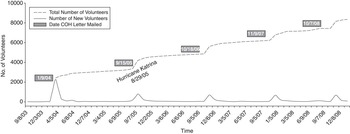
The NYC MRC has continued to grow, with registrations recorded every month since its inception in September 2003. However, there were surges in registration above the standard monthly range in the 2 to 3 months after the Commissioner's invitational mailing to health professionals across NYC (Figure 1). The initial mailing in January 2004 to 155 806 health professionals yielded a total of 2752 new volunteers (a 1.7% response rate). In 2005, a targeted mailing to 87 132 physicians, physician assistants, nurse practitioners, registered nurses, and pharmacists was completed, which yielded approximately 1163 new volunteers (a 1.3% response rate). Subsequent mailings to between 138 000 and 150 000 health professionals yielded approximately 1 059 987, and 930 new volunteers in 2006, 2007, and 2008, respectively (<1% response rates). The average cost per new volunteer during the 5 mailings completed to date was $54.81.
NYC Medical Reserve Corps (MRC) Registrations: September 8, 2003, to January 9, 2009

Additional surges were seen in the 2 weeks after Hurricane Katrina in 2005 and after the summer 2008 public health detailing campaign implemented by the NYC DOHMH. (The NYC DOHMH Public Health Detailing Program works with primary health care providers to improve patient care around key public health challenges by promoting clinical preventive services and chronic disease management through the delivery of brief, targeted messages to doctors, physician assistants, nurse practitioners, nurses, and administrators at their practice sites. It is based on the pharmaceutical representative detailing model, whereby detailers make a number of visits to providers’ offices during the course of a given campaign to continually remind providers to convey the desired messages and distribute campaign materials to their patients.) The exact number of new volunteers resulting from Hurricane Katrina and its aftermath cannot be explicitly determined because registration numbers were not reviewed immediately before the disaster, allowing for a comparison to be made. We did, however, cross-reference the new registrations for June 5-October 17, 2008, with the list of providers visited by the public health detailers during the campaign and determined that 92 of the 835 new volunteer registrations (11%) during that time period could be attributed to the detailer visits. More specifically, there were 73 new registrations from 58 ZIP codes with fewer than 30 volunteers and 19 new registrations from ZIP codes that already had more than 30 volunteers. Each new registration resulting from the public health detailing campaign cost $3913.
Discussion
There is little concrete research determining why some health professionals volunteer and some do not, even when they understand the critical need for volunteers. Based on experience working to recruit health professionals for the NYC MRC and from anecdotal reports from other MRC unit leaders and volunteer partner agencies, some intangible reasons emerge as to why people volunteer: there are just some people who will volunteer, whereas most will not. This translates into a perpetually limited pool from which to draw volunteers, making recruitment a constant challenge. Qualitative evidence collected during the June 2005 focus groups supports this conclusion.
Notably, those choosing not to volunteer said that they would probably respond during an emergency. However, prior studies that examined health professionals’ and public health employees’ willingness to report to work demonstrated that they are more likely to report if they know what is expected of them; believe that the appropriate protective equipment and protocols are available; and believe that they are educated, comfortable, and valued in their role, particularly through participation in drills and trainings.Reference Gullion8-Reference Marquez, Patel, Raphael and Morgenthau12 Programs such as the NYC MRC that offer ongoing training, maintain ongoing communications with their volunteers, precredential their volunteers, and are an official part of local emergency management plans can offer clarification around volunteers’ roles and responsibilities and prepare them to respond with increased confidence. Hence, these benefits of established volunteer programs figure prominently in NYC's recruitment messages. It should be noted, however, that no large-scale emergency deployments of the NYC MRC have occurred to date. It is therefore not known whether volunteers who claim they would report would actually do so.
Lessons Learned
The NYC MRC has evolved to become self-sustaining and continues to attract new members each month, likely due to peer-to-peer recruitment (“word of mouth”) and information presented at professional meetings and in professional newsletters on an ongoing basis. As noted above, respondents to the 2004 NYC MRC volunteer survey indicated that both the Commissioner's invitational mailing and their professional groups had most influenced their decisions to join the NYC MRC. From the retrospective review of registration data, however, there seemed to be a marked increase in registration for the 2 to 3 months after each mailing from the NYC Health Commissioner inviting health professionals to join the NYC MRC. I believe that the response to the very first Commissioner's invitational mailing in 2004 was the greatest because it was the first time that such a large number of health professionals learned about the program, and so there was the largest potential pool of volunteers available from which to recruit. The decline in number of registrations after each subsequent mailing seems to support this assertion.
Although the Commissioner's invitational mailing has a low response rate of ≤2%, because it is sent to a large group of potential volunteers and the Health Commissioner is perceived as one of the most trusted messengers of the NYC MRC, the total number of new volunteers registered as a result is greater than all of the other recruitment methods. The average cost per new volunteer across the 5 mailings completed to date was $54.81. This may be considered costly depending on the size of the target population, and thus many volunteer groups may not be able to implement it. There may be other recruitment methods, such as partnering with local professional groups or the state licensing entity to have them include an invitation letter in their mailings and/or placing the letter on the recruiting entity's Web site and the Web sites of professional organization partners, that could be helpful in leveraging a personal invitation from the Health Commissioner to health professionals in the community to join a volunteer program. For those groups that have sufficient funding to develop and publish these mailings, the success with the Commissioner's invitational mailing suggests that commercials or advertisements by the local health commissioner (or other trusted figure, such as a mayor or county executive) could also increase volunteer registration.
The surge in volunteering after Hurricane Katrina in 2005 shows that real emergencies inspire people to volunteer, perhaps because they are reminded of how needed their assistance is. Volunteer leaders may wish to leverage such sentiments to increase membership after actual emergencies by increasing the frequency of recruitment messaging during such times. The post Katrina registration surge also adds to the anecdotal evidence that many will want to help out at the time of the emergency, even if they do not preregister to do so. Emergency recruitment messages should therefore also be predeveloped and methods for delivering them predetermined.
The 2008 Public Health Detailing Program initiative to recruit volunteers from ZIP codes with fewer than 30 NYC MRC volunteers resulted in 92 additional NYC MRC registrations during the course of the campaign: 73 new registrations from 58 ZIP codes with fewer than 30 volunteers and 19 new registrations from ZIP codes that already had more than 30 volunteers. Although this was the recruitment method that obtained the highest response rate overall, the potential pool of volunteers was small given the time required to complete a detailing visit using the current model, so the total number of new volunteers garnered was relatively low. In addition, this initiative proved to be a poor return on investment, with each new registration costing $3913, making it both inadvisable for all and infeasible for most volunteer programs. Federal grant funds (eg, the Public Health Emergency Preparedness grant provided by the Centers for Disease Control and Prevention) to support public health preparedness are constantly decreasing (20% in 2009).Reference Marquez, Patel, Raphael and Morgenthau12 With limited funding, it becomes more difficult to build robust preparedness and response programs. Knowing which recruitment activities are most successful for health professionals can allow jurisdictions to target their limited funding and staffing resources to achieve volunteer membership goals.
Although not directly related to messages and methods for recruitment, the 2005 focus groups showed that some participants believed they got NYC MRC information from the NY State Education Department (the licensing board) or the Medical Society of the State of New York. In fact, those entities were promoting a parallel list of state volunteers. However, their respective recruitment efforts could have influenced NYC-based providers’ decision to join the NYC MRC. Therefore, it is recommended that state and local volunteer programs coordinate messaging for potential volunteers across their states to reduce confusion among health professionals and clearly define their options for becoming involved with emergency volunteer programs in whatever capacity they believe is most appropriate for them.
Finally, it should be noted that there is a considerable amount of effort needed after volunteers are recruited to ensure that they continue with the program and that volunteer managers are able to contact them if and when they are needed. To that end, NYC offers a combination of online and in-person training sessions throughout the year, all of which carry continuing education accreditation. A brief, monthly newsletter is also sent to all of the volunteers, and the NYC MRC Web site includes information that keeps volunteers informed of various “educational resources of interest” that are not sponsored by the NYC DOHMH but are offered by other preparedness partners. Although it is the protocol of the NYC MRC to request that volunteers log into the database to update their own information as it changes, many do not do so because they forget to do it, cannot locate their log-in name and/or password, or do not have Internet access. Some volunteers re-register when trying to update their information, so duplicates must be removed from the database each month. Data cleanup is often done by program staff and is ongoing. Staff work to follow up on bad contact information as soon as they become aware of it, using several methods to resolve problems, including using alternate information in a volunteer's record to try to reach him or her, searching the US Postal Service Web site to resolve mailing address issues, and searching online white pages by address or telephone number to obtain updated information. Numerous attempts to reach volunteers are made for approximately 12 months; when no working contact information can be found by then, the volunteer is deleted. Quarterly notification tests are also done to test volunteer contact information and to ensure that volunteers are familiar with the system that will be used to contact them during emergencies.
Limitations
It is difficult to compare recruitment strategies directly to provide exact numbers of volunteers that may be attributed to each of the various recruitment methods used in the present study for a number of reasons. First, the analysis was based on a mix of qualitative and quantitative data. Second, volunteers are not asked to indicate their reasons for joining the NYC MRC. Third, only definitive dates for the Commissioner's invitational mailings, the Public Health Detailing campaign, and Hurricane Katrina could be cross-referenced with surges in NYC MRC registration. This may be acceptable because the surges were seen only during these respective initiatives/points in time. However, if volunteer programs want to know exactly which methods led to the greatest number of new volunteers, it is recommended that this question be added to their registration application.
The author recognizes that it is customary to use focus groups primarily to generate hypotheses due to the open discussion format and small sample sizes. Therefore, focus groups should have been used before designing the survey, because survey participants were given a closed-ended checklist to use for indicating the reasons that they joined the NYC MRC. Unfortunately, the funding for the focus groups could not be secured in a timely fashion, so the DOHMH chose to move forward with adding the survey to an existing mailing in autumn 2004 for which funding had been secured. Finally, the analysis was limited to the New York City area, and health professionals from other parts of the country may have different motivations for volunteering and thus may be more receptive to different messengers, messages, and recruitment methods.
Conclusions
The substantial and complex medical and public health responses that may be required for large-scale emergencies will necessitate the use of health professional volunteers from across a variety of disciplines. It is challenging to recruit and maintain a group of prepared and engaged volunteers, and a mix of recruitment strategies is recommended to reach the broadest range of potential volunteers and to consistently reiterate the message. A series of invitational mailings by the health commissioner to between 87 000 and 150 000 licensed NYC health professionals since 2004 has generated the largest number of NYC MRC volunteers to date, demonstrating that the health commissioner or another trusted community figure is an excellent messenger for recruiting emergency volunteers, and that it is important to ensure that recruitment messages reach as many potential volunteers as possible. With funding for public health preparedness ever decreasing, targeting recruitment efforts for medical volunteers could lead to more efficient and effective use of limited funds to build and prepare cadres of health professional volunteers that are needed for emergency response. Additional research is needed to more accurately assess whether volunteers understand what they may be asked to do during emergencies and whether they will truly be able to report to the scene to support response efforts given their myriad other commitments.
Author Disclosures
The author reports no conflicts of interest.
Published Online: February 14, 2011. doi:10.1001/dmp.2011.7. This article was corrected on March 14, 2011.