Introduction
Since the 1970s, divorce has become more common across the Western world, although there is considerable international variation. In Europe, the highest divorce rates can be found in the Nordic countries (around 50%), whereas the Mediterranean countries have the lowest rates (Eurostat 2015). Sociologists have studied the rise of divorce in two ways. First, there are studies that explain the rising divorce rate and its determinants as part of the wider de-standardisation of the lifecourse (Fogli and Veldkamp Reference Fogli and Veldkamp2011). Second, there is a large body of research on the social and economic consequences of divorce. Divorce is found to impact negatively upon the wellbeing of children, the economic situation of women and the likelihood of intergenerational transfers (Gruber Reference Gruber2000; Kalmijn Reference Kalmijn2007; Uunk Reference Uunk2004).
Housing researchers have pointed out that many of the negative consequences of divorce pertain to the housing situation. Upon divorce, moves from home-ownership (the former marital home) to rental housing are common for both men and women. Time stress and financial stress after a divorce are the main motivators why divorcees move down the housing ladder in terms of tenure (Dewilde Reference Dewilde2008). However, the housing consequences of divorce persist in the long run. Even in later life, many years after marital dissolution, (especially female) divorcees are found to have a far larger chance of residing in rental housing than home-ownership. A decayed economic position, combined with reduced possibilities for income-pooling, exclude them from the financial and other benefits of home-ownership (e.g. security of tenure, reduced housing costs, independence and control, better housing quality). Institutional arrangements are found to mitigate the housing consequences of divorce: generous welfare payments, female employment and the availability of (mortgage) credit reduce the odds of moving into the rental sector following divorce (Dewilde and Stier Reference Dewilde and Stier2014). By focusing on the tenure consequences of divorce, previous research implicitly assumes that home-owning divorcees in later life did not experience any negative housing consequences.
This paper focuses on the majority of all divorcees that are overlooked by previous studies: those who remain in home-ownership or re-enter this tenure after a spell in rental housing (60–70% in most countries). We compare the housing wealth holdings of divorced home-owners with non-divorced home-owners in later life in order to demonstrate that divorce adversely affects the socio-economic position of a wider group than thus far assumed. Housing wealth is operationalised as the current market value of the owned home minus any mortgage debts. It is likely that divorced home-owners display lower housing wealth holdings than couples in an intact first marriage due to downward moves on the property ladder, temporary episodes in rental housing or increased mortgage debt. However, as is shown in an international comparative study on the tenure consequences of divorce (Dewilde and Stier Reference Dewilde and Stier2014), institutional arrangements (e.g. welfare and housing regimes) might mitigate or reinforce the housing wealth consequences of different housing trajectories of divorcees.
Studying the housing wealth effect of divorce is urgent because (a) divorce rates are expected to remain high, and (b) housing wealth plays an increasingly important role in the provision of welfare. First, although there is large international variation, divorce rates have increased across Europe (González and Viitanen Reference González and Viitanen2009). Some scholars argue that divorce rates will fall again, because an increasing number of people co-habit rather than marry (Stevenson and Wolfers Reference Stevenson and Wolfers2007). However, the complex tangle of living arrangements is here to stay, and by researching the consequences of divorce, conclusions can be drawn about the broader economic implications. Second, a shift towards asset-based welfare becomes politically more attractive now that a large share of elderly people possesses housing wealth, which can be used in order to cater for welfare needs (Price and Livsey Reference Price and Livsey2013). The large share of elderly people with housing wealth is mainly the result of a continuous policy focus on the promotion of home-ownership in most European countries since the Second World War (Angelini, Laferrère and Weber Reference Angelini, Laferrère and Weber2013). The relative upswing in house prices since the 1980s, which accompanied the liberalisation of housing finance (Organisation for Economic Co-operation and Development (OECD) 2014), resulted in financial gains for housing market insiders. Especially the baby-boom cohort has been able to profit (Cowell, Karagiannaki and McKnight Reference Cowell, Karagiannaki and McKnight2012). When disruptive lifecourse events like divorce impede the accumulation of housing wealth into later life for more people, asset-based welfare strategies, however, need to be reconsidered.
This paper investigates housing wealth holdings of elderly home-owners with divorce experience, relative to couples in an intact first marriage in the same age group. Different mechanisms that could result in lower housing wealth holdings for divorcees are tested. Since the analysis is limited to home-owners, our results are partly driven by the selectivity of home-ownership in different countries. Housing regimes and welfare regimes determine the selectivity of home-ownership, and are tested as drivers of cross-country variations in the association between divorce experience and housing wealth holdings. The empirical work is based on the Survey of Health, Ageing and Retirement in Europe (SHARE, Waves 3 and 4, conducted in 2008/9 and 2011/12). This paper solely focuses on individuals in later life (50+ at the moment of data collection), which enables us to grasp the long-term consequences of divorce.
Our study adds to previous research in three ways. First, it investigates the housing wealth consequences of divorce, rather than focusing on tenure transitions. Second, building on Dewilde and Stier (Reference Dewilde and Stier2014), a focus on elderly people enables us to investigate the long-term effects of disruptive lifecourse events in different institutional contexts, and how these come about. Third, it studies housing wealth from an international comparative perspective, whereas most authors focus on single countries.
Why divorce has a price tag: the micro-level
We expect that differences in housing transitions between divorcees and couples in an intact first marriage are associated with lower housing wealth holdings of elderly home-owners with divorce experience. Beer and Faulkner (Reference Beer and Faulkner2011: 31) describe these housing transitions as ‘a series of housing decisions about whether to move or not move, the quality and quantity of housing to occupy, location relative to employment and social networks’. We acknowledge that financial stress might contribute to divorce before any ensuing housing transitions, but it is far more common that housing transitions are the result of post-divorce financial stress (Andersen Reference Andersen2005). We envisage three wealth-reducing housing transitions for elderly divorcees who had not moved out of home-ownership at the time of the survey. First of all, moves down the property ladder could reduce housing wealth holdings in a direct way. The strong effect of divorce on residential mobility implies that in many cases both partners move to another dwelling (Speare and Goldscheider Reference Speare and Goldscheider1987). A reduced demand for space and a weakened financial position often leads to moves into a housing market segment with lower prices (Feijten and van Ham Reference Feijten and van Ham2010). Second, housing wealth holdings of divorced home-owners are likely to be temporary or permanently lower than those of married couples, even when housing consumption does not decline upon divorce. A larger housing loan may be needed when the ex-partner takes out his or her share of housing wealth or while staying put in the former marital home. Third, temporary moves into rental housing upon divorce might reduce housing wealth holdings when house prices increase faster than incomes. In such a situation, it becomes relatively more expensive to buy a home with the same quality as the former marital home. Therefore, moves down the property ladder or larger residential debts are expected to be more common among those with an episode in rental housing.
-
• Hypothesis 1: Home-owning elderly with divorce experience have smaller housing wealth holdings than couples in an intact first marriage.
Especially women are economically vulnerable following divorce (Uunk Reference Uunk2004). Because of their lower labour market participation and wages, and weaker financial position, women have a larger chance than men to move into rental housing. The financial position of women after a divorce is also worse than men because they re-partner less often and less quickly (Dewilde Reference Dewilde2008). We expect the association between divorce experience and the accumulation of housing wealth to be moderated by gender. In this line of reasoning, lower female wages translate into smaller purchasing power on the housing market, and subsequently lower housing wealth holdings. There are, however, reasons to believe that women with a sufficient income in certain situations have a larger chance to remain in the marital home. In some countries it is common practice that the male partner keeps his pension wealth, whereas the female partner is entitled to the housing wealth (see Joseph and Rowlingson Reference Joseph and Rowlingson2012 for the United Kingdom). Altogether, however, we expect that the weaker financial position of women impacts negatively upon their housing wealth accumulation after a divorce.
-
• Hypothesis 2: Home-owning elderly divorced women have smaller housing wealth holdings than home-owning elderly divorced men.
When re-partnering co-occurs with the establishment of a new shared household with a stable future perspective, possibilities for income pooling enable the couple to exercise more purchasing power on the housing market (Lersch and Vidal Reference Lersch and Vidal2014). In this way re-pooling (a) increases the likelihood of re-entering home-ownership for those who dropped out of this tenure following divorce, or (b) increases the likelihood of upward movements in the housing market for those who remained in home-ownership upon divorce. This mechanism might be stronger in contexts in which economically independent women are considered more attractive partners (De Graaf and Kalmijn Reference De Graaf and Kalmijn2003), or somewhat weakened in contexts where the lack of employment and income support pushes women with a low socio-economic status into re-marriage (Dewilde and Uunk 2008). Overall, empirical evidence shows that couples of which at least one partner has been married before display comparable housing transitions as couples in an intact first marriage (Beer and Faulkner Reference Beer and Faulkner2011; Feijten and van Ham Reference Feijten and van Ham2010).
-
• Hypothesis 3: Home-owning elderly re-partnered men and women have comparable housing wealth holdings as couples with an intact first marriage.
Variation across Europe
The later-life housing wealth consequences of divorce are expected to vary between countries due to institutional differences in housing and welfare regimes. Furthermore, we expect the institutional impact to vary over time, due to policy changes within these countries.
Divorce, housing wealth and welfare regimes
The welfare state determines to what extent especially women are able to remain in home-ownership after experiencing partnership dissolution. Previous research stresses that divorced women have a larger chance of residing in home-ownership in countries where the state fosters female employment (e.g. through extensive family policies and affordable and accessible child care) (Dewilde and Stier Reference Dewilde and Stier2014). However, mechanisms that increase home-ownership rates among the divorced do not necessarily translate into larger housing wealth holdings. Where home-ownership rates are higher, more divorcees have some housing wealth, whereas in countries with more socially selective models of home-ownership, average housing wealth holdings among those divorcees that remained in home-ownership can be expected to be larger. Controlling for the social selectivity of home-ownership, we envisage two ways in which gendered welfare state policies affect the housing wealth holdings of divorced individuals. First of all, policies fostering the labour market participation of women might have a positive effect on the housing wealth accumulation of both men and women. Being active in the labour market increases the purchasing power in the housing market for divorced women. When divorced men re-partner, high female employment rates increase the chance of having a double income, which in turn gives them more purchasing power in the housing market. Being able to buy into more expensive housing results in larger housing wealth holdings (if financed with an annuity mortgage). Second, legal arrangements between partners might impact upon the housing wealth accumulation of both former partners. Although all countries in our sample have no-fault divorce laws (González and Viitanen Reference González and Viitanen2009), Adema et al. (Reference Adema, del Carmen Huerta, Panzera, Thevenon and Pearson2009) have shown that the financial arrangements between two partners after a divorce differ between European countries. In more conservative welfare states with lower female employment rates, child maintenance payments, spousal support or alimony are much higher than in liberal or social-democratic welfare states. These payments can improve the financial position of women considerably. In countries where entering the labour market is troublesome for women, spousal support might be essential for women to remain in the former marital home.
-
• Hypothesis 4: The negative association between divorce experience and housing wealth holdings in later life is smaller in countries with a female employment-supportive or income-supportive welfare state (especially for women).
Divorce, housing wealth and housing regimes
Housing regimes determine who are able to enter home-ownership, at what price and with which returns (for an overview of housing wealth accumulation in different housing regimes, see Wind, Lersch and Dewilde Reference Wind, Lersch and Dewilde2015). Different institutional constellations might impact upon the three mechanisms that are conceptualised as mechanisms behind lower wealth holdings of divorcees (moving down the property ladder or staying put, temporary spells in rental housing, increased mortgage debts). First of all, the size of the home-ownership sector determines the possibilities for moving down the property ladder. In ‘rental societies’ with a more socially selective model of home-ownership, like Germany and Switzerland, smaller and lower-quality units can barely be found in the home-ownership sector (Bourassa and Hoesli Reference Bourassa and Hoesli2010). In these countries it is likely that divorcees move out of home-ownership altogether due to the restricted possibilities of moving down the property ladder within the home-ownership segment.
Temporary spells in rental housing, and even staying put in the marital home, might be ‘costly’ when house prices outpace inflation and turnover rates on the housing market are high. Morrow-Jones and Wenning (Reference Morrow-Jones and Wenning2005: 1740, italics added) suggest that the ‘Inability to move upward between units, or the inability to move up as other groups, can reinforce exiting social disparities’. In other words, the relative disadvantage of divorced individuals increases when divorcees who stay put in the marital home or move into rental housing temporarily are unable to keep up with married couples that are able to move up within home-ownership. This is likely to be the case in a subset of countries that combine moderate home-ownership rates with a ‘dynamic housing market’ (e.g. the Netherlands), where it has become common to ‘trade up’ on the market for owner-occupied housing during the lifecourse (Van der Heijden, Dol and Oxley Reference Van der Heijden, Dol and Oxley2011). In ‘static housing markets’, turnover rates on the housing market are far lower and most households buy a dwelling for their entire life time (e.g. Belgium, Germany and Italy).
Higher mortgage debts among individuals with divorce experience compared to those in an intact marriage are put forward as a mechanism behind their relatively disadvantaged position. The availability of mortgage finance shows large cross-country variation. More liberal housing finance systems take ‘the waiting out of the wanting’ by allowing individuals to borrow a larger part of the value of the home (high loan-to-value ratio), and by extending the amortisation time. This reduces the necessity of (temporary) moves into rental housing or moves down the property ladder. However, the increased indebtedness decreases housing wealth holdings in a direct manner. Moreover, liberal housing finance systems are expected to strengthen the above-mentioned mechanisms. First of all, they allow a larger share of divorcees to remain in home-ownership or to re-enter this tenure. Second, there is evidence that house price inflation and volatility (e.g. property booms and busts) have been more severe in countries with liberal housing finance systems (OECD 2014), which increases the price of staying put in the marital home or temporary spells in rental housing.
-
• Hypothesis 5: The negative association between divorce experience and housing wealth holdings in later life is larger in countries with a larger (finance-led) expansion of home-ownership.
Data and method
Data and sample
Our analysis is based on the third and fourth waves of SHARE (2008/9 and 2011/12), an ex-ante harmonised panel study, carried out in 13 European countries among the population aged 50 and over. The third wave of SHARE contains retrospective life histories, including housing careers and family transitions. We enrich these data with information from Wave 4 about housing wealth. The SHARE data are valuable for at least three reasons. First, they contain comparative information on housing careers and housing wealth. Second, the national sample sizes are large. Third, the countries in the data-set cover a wide variety of continental welfare and housing regimes (unfortunately, SHARE does not cover any country with a liberal welfare regime).
The analysis sample consists of elderly who have ever been married (or still are), and reside in home-ownership at the moment of interview. Those who never married are not included because they have never been ‘at risk of divorce’. A small number of respondents (3% of the total sample) that entered home-ownership for the first time after experiencing divorce is included in the sample. In the first models, we present information on the entire sample, in which tenants are assumed to have zero housing wealth. Our later analyses are based on a sample of home-owners only, since the institutional characteristics that are hypothesised to impact upon tenure status and housing wealth are conceptually different. By including tenants in the analysis, the underlying mechanisms would become obscured. Furthermore, the moderating effect of institutional arrangements on the relationship between divorce and exits from home-ownership has already been widely researched by others (e.g. Dewilde Reference Dewilde2008; Feijten Reference Feijten2005). Only respondents belonging to the main sample of SHARE are included. Others living in the household, like co-resident children or co-resident parents, are excluded because they are likely not entitled to the household's housing wealth. Furthermore, respondents born before 1920 are excluded as their number is too small to draw conclusions about cohort effects. The sample of countries is restricted to Austria, Germany, Sweden, the Netherlands, Spain, Italy, France, Denmark, Switzerland and Belgium. We exclude the Czech Republic and Poland, since the transition from communism to capitalism dramatically changed their housing and welfare regimes, and macro-level indicators about the period before 1990 are unavailable. Furthermore, we dropped Greece, because of the low incidence of divorce, and the unavailability of macro-level indicators for the period before 1990. Altogether, the analysis sample consists of ten countries with 318 (Austria) to 1,595 (Belgium) respondents. The number of respondents in Austria is disproportionally low because of the small initial sample and the large share of tenants (see Table 2).
Micro-level variables
Net housing wealth is our dependent variable. It is calculated as the value of the first dwelling and – when applicable – a second home, minus the value of all outstanding debts. The housing wealth estimate is derived from self-evaluation of the market value of the house at the moment of the interview (2011/12). Previous studies have proven such subjective evaluation of housing wealth to produce reliable results (Ansell Reference Ansell2014; Mulder et al. Reference Mulder, Dewilde, Van Duijn and Smits2015). We use top coding at the 99.8 per cent level to remove outliers in the housing wealth distribution per country. For reasons of international comparability, housing wealth holdings are calculated as a percentage of the national median. Although housing wealth can be considered to be a household characteristic, it is treated as an individual, non-equivalised characteristic for analytical reasons.
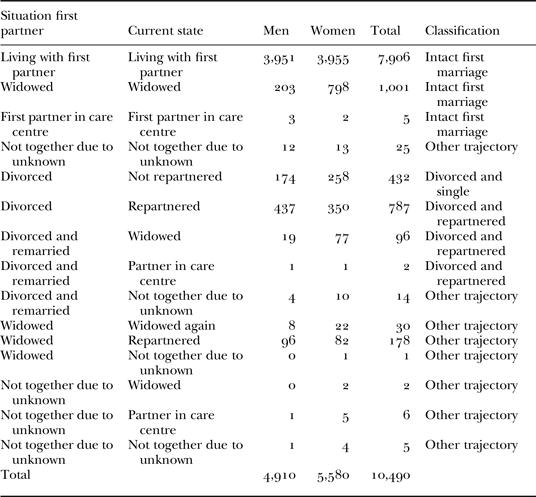
The complex tangle of marital pathways is summarised in four categories, based on the result of the first marriage (still living together, divorced, widowed, not living together) and the current situation for those who entered a new partnership (still living together, divorced, widowed, not living together). The 15 trajectories that follow from this evaluation are summarised in four categories (see Table 1). The first category includes all respondents who are still in their first marriage. Widows who never re-partnered and those with a partner in a nursing home are included in this category as well. Their housing wealth is expected to be accumulated by two partners. The second category includes all respondents whose first marriage ended in divorce and who are currently single. The third category contains all respondents whose first marriage ended in divorce and who are currently co-habiting with a new partner. We do not differentiate between re-partnering and re-marrying due to the small number of cases. Widow(er)s of new partners and those who are living alone because the new partner moved to a nursing home are placed in this category as well because the housing wealth is likely to have been accumulated by the couple. The fourth category consists of respondents that are not living together due to unknown reasons and re-partnered widow(er)s. In the remainder, we do not comment on the results of this category, because they fall outside the scope of this research.
Marital trajectories, followed by respondents in SHARELIFE, and their final classification

Source: SHARELIFE, own calculation.
Three mechanisms behind a negative association between divorce experience and housing wealth accumulation of elderly people can be tested directly. First, the impact of downward moves on the property ladder is measured by a variable indicating (a) whether someone lives in a house (free-standing house) or an apartment (terraced house/small flat, large flat, housing for elderly), and (b) how many rooms the house has. Together, both variables give an indication of the housing quality. Second, the effect of episodes in rental housing is measured by a variable indicating how many times someone has moved within the rental sector, after the first-time entry into home-ownership. Third, the effect of increased indebtedness is measured by a variable indicating which percentage of the housing value is covered by a residential loan.
Re-partnering is hypothesised to mitigate the negative association between divorce experience and the accumulation of housing wealth among home-owning elderly. It is measured in terms of the above-mentioned marital trajectories (see Table 1). We use the following micro-level variables to control for factors that are expected to influence the odds of experiencing a divorce, or the housing wealth accumulation process: age at first marriage, age at entering home-ownership, residing in rental housing five years after first marriage, number of children, migrant status, receiving a financial gift from a family member (€5,000 or more), the urbanity of surroundings (rural, small town/large town, big city), highest achieved educational level (International Standard Classification of Education scores: no education/primary education/lower-secondary education/higher-secondary education/post-secondary education/tertiary education), income (lower than median/higher than median/higher than two times the median).
Macro-level variables
Macro-level indicators are measured on the country–period level, since the context within one country changes over time. Macro-level variables are assigned to individuals on the basis of country and moment of divorce. We distinguish between respondents who divorced before 1985 and respondents who divorced after 1985. Since the mid-1980s, the liberalisation of the economy, in general, and the housing market, in particular, changed the context in which divorce took place. Furthermore, both groups have an almost equal size. To assign macro-variables to non-divorcees, we use the ‘most likely year in which a divorce would take place’. We calculate the average duration of a marriage before divorce in every country, and add this to the year of marriage. This is the context in which both divorcees and non-divorcees take the decision to divorce or not. Six macro variables, describing the welfare and housing regime context at the moment of a (non-)divorce are taken into account.
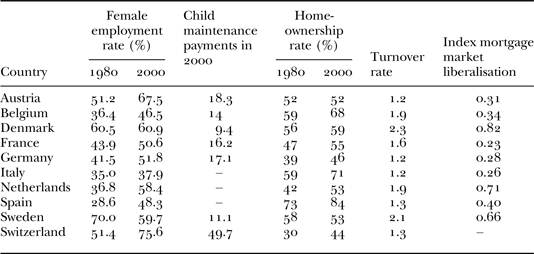
Two sets of macro-level indicators are ought to capture cross-country variation in welfare regimes and housing regimes. The welfare regime context is measured by the female employment rate and the generosity of child maintenance payments. For respondents who divorced before 1985, we use the average female employment rate of the 1980s, for those who divorced after 1985, we use the average female employment rate of the 2000s (Olivetti Reference Olivetti, Boustan, Platt, Frydman and Margo2014). The indicator for the generosity of child maintenance payments is measured as the relative importance of child maintenance payments in the income of divorced women, and based on information from the Luxemburg Income Study in the year 2000 (Adema et al. Reference Adema, del Carmen Huerta, Panzera, Thevenon and Pearson2009). This indicator is not available for Spain, Italy and the Netherlands.
The housing regime is operationalised by the home-ownership rate, the turnover rate on the housing market and an index of housing finance liberalisation. For the respondents who divorced before 1985, we use the home-ownership rate of 1980, or the earliest observation available. For respondents who divorced after 1985, we used information from 2000 (in the case of Germany, information from 2004) (Atterhög and Song Reference Atterhög and Song2009; Dol and Haffner Reference Dol and Haffner2010). The turnover rate on the housing market is based on an estimate from SHARE, indicating the average number of homes the current sample in each country has owned during the lifecourse. The accessibility of housing finance is measured with an index of financialisation, constructed by the International Monetary Fund (2008). The index evaluates national mortgage systems on the possibilities for mortgage equity withdrawal, possibilities for refinancing, loan-to-value ratios, and information on the market for covered bonds and mortgage-backed securities. Unfortunately, this index is not available for Switzerland. An overview of all macro-variables is given in Table 2.
Overview of macro-level indicators

Sources: Atterhög and Song (Reference Atterhög and Song2009), Dewilde and Stier (Reference Dewilde and Stier2014), Dol and Haffner (Reference Dol and Haffner2010), Gwartney, Lawson and Hall (Reference Gwartney, Lawson and Hall2013), Organisation for Economic Co-operation and Development (2015) and Scruggs, Jahn and Kuitto (Reference Scruggs, Jahn and Kuitto2014).
Methods
For setting the scene, descriptive analyses are presented. First, home-ownership rates among three marital categories (always married, divorced and single, divorced and re-partnered) are shown. Second, average housing wealth holdings (as a percentage of the national median) are displayed for all three marital groups, to show international variations in the consequences in later life of divorce experience. We proceed with two country-fixed effects analyses (using ordinary least-squares regression), focusing on the individual-level mechanisms behind housing wealth inequalities, controlling for all unobserved heterogeneity on the macro-level (Möhring Reference Möhring2012). Robust standard errors are used to allow residuals to vary in a non-random way due to the structured nature of the data. One analysis investigates whether men and women in two divorce cohorts (before and after 1985) display a different association between divorce experience and the accumulation of housing wealth in later life. This analysis is replicated on two samples: a sample of home-owners only, and a sample of home-owners and tenants. This places our analyses on the association between divorce experience and the accumulation of housing wealth among home-owning elderly in perspective, because it illustrates the impact of being excluded from accumulating any housing wealth at all. Further models evaluate to what extent lower housing wealth holdings among ever-divorced home-owners in later life result from moves down the property ladder, temporary residence in rental housing or increased indebtedness. These three mechanisms are not included in the final model, in which cross-level interactions between institutional characteristics and marital categories are presented. Indeed, we assume that these institutional arrangements are the driving forces behind the three mechanisms associated with lower housing wealth holdings of divorcees, compared to those in an intact first marriage. We run all models for men and women separately. Main effects of macro-level variables cannot be added in such a country fixed-effects model, because country-level variations are captured by the model itself.
Results
Setting the scene
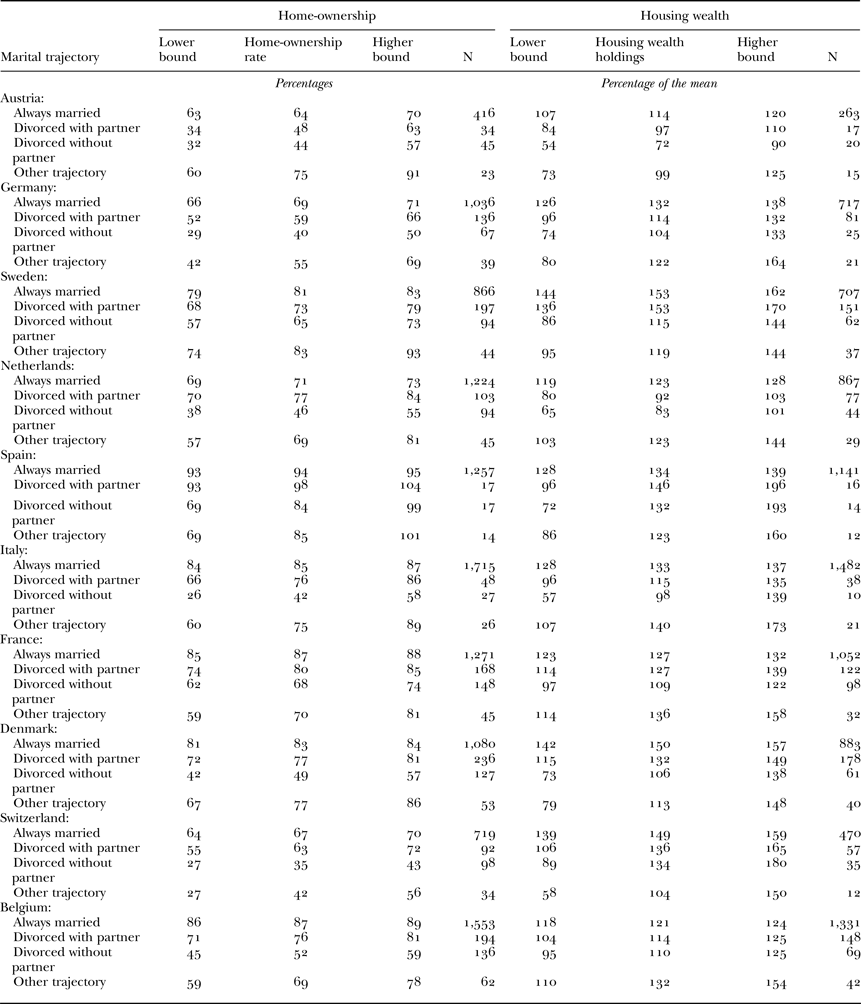
Descriptive results (see Table 3) show that individuals with divorce experience have a smaller chance of residing in home-ownership (Dewilde Reference Dewilde2008; Dewilde and Stier Reference Dewilde and Stier2014; Feijten and van Ham Reference Feijten and van Ham2010). In general, the opportunities for elderly divorcees to be a home-owner reflect the well-known pattern of high home-ownership in the Mediterranean home-ownership societies (80–90%), low home-ownership in the German-speaking rental societies (60–70%), and moderate home-ownership in the rest of continental Europe and Scandinavia (70–80%). Exceptions are Italy, Denmark, Belgium and the Netherlands, where divorcees have a far smaller chance of residing in home-ownership than expected on the basis of the home-ownership rate among those in an intact first marriage.
Descriptive statistics, showing the home-ownership rate and housing wealth holdings of people in different marital trajectories

Source: Survey of Health, Ageing and Retirement in Europe 2008/9 and 2011/12, own calculations.
More importantly, the descriptive statistics show that divorce has negative consequences beyond tenure. In nearly all countries, single elderly home-owners with divorce experience have significantly lower housing wealth holdings than those in an intact first marriage (the largest differences are found in Denmark, Austria and the Netherlands). Divorced re-partnered individuals take a middle position, but differences with individuals in an intact marriage are in many countries non-significant.
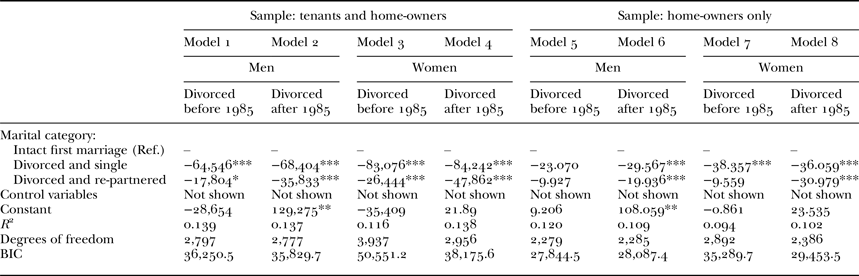
We present eight country-fixed effects analyses to (a) check whether the results of the descriptive analyses hold while controlling for other factors and co-variates, (b) account for the impact of permanent moves out of home-ownership, and (c) investigate how the association between divorce and housing wealth holdings changes over time (Table 4). Control variables are not displayed. We present models for both genders and two divorce cohorts (before and after 1985), and replicated them on two samples (total sample versus home-owners only). First, nearly all models in Table 4 show a strong and significant negative association between divorce experience and housing wealth accumulation. The coefficient is stronger for single divorcees than for re-partnered divorcees, and for women than for men. In conclusion, the findings from the descriptive analyses are fairly robust while controlling for many factors and co-variates. Second, a comparison of the first four models (based on the total sample) and the last four models (based on a sample of home-owners only) demonstrates that the negative association between divorce experience and housing wealth accumulation is much stronger when exits from home-ownership (resulting in zero housing wealth) as well as life-long tenants are included. For example, based on the total sample of home-owners and tenants, single women who divorced before 1985 have 83 per cent lower housing wealth holdings than women in an intact first marriage. A comparison with the same group of single divorced women in the sample of home-owners only shows that this negative association partly arises from permanent exits out of home-ownership (resulting in zero housing wealth). Single female divorcees (divorced before 1985) in the sample of home-owners nevertheless still have 38 per cent smaller housing wealth holdings than women in an intact first marriage. Interestingly, for those who divorced before 1985 and re-partnered later on, a significant negative association with housing wealth holdings is found while analysing the entire sample, whereas no significant association is found in the analysis based on the sample of home-owners. This implies that the negative association is mostly explained by exits out of home-ownership. In other words: if these women remained in home-ownership, regained access to the tenure or entered home-ownership for the first time after the divorce, they fared equally well as their peers in an intact first marriage. Although we control for many individual characteristics, there may be some endogeneity here, since we cannot exclude that in the more distant past (i.e. for the older cohort), mainly better-off women were the ones who divorced and re-partnered more often (De Graaf and Kalmijn 2006). Third, a comparison of the regression coefficients for both divorce cohorts shows that the negative association between divorce and housing wealth strengthened over time for men, but weakened for women. Whereas the negative divorce-effect for single men who divorced before 1985 is mostly the result of exits out of home-ownership, single divorced home-owners who divorced after 1985 show 30 per cent lower housing wealth holdings than those in an intact first marriage (compare Models 1, 5 and 6). A comparison of Models 7 and 8 shows that single women who remain in home-ownership or regain access to the tenure experience a negative divorce-effect in both divorce cohorts, but this association becomes slightly weaker (from −38 to −36%). For both re-partnered men and women, the negative association between divorce experience and housing wealth holdings increased substantially. Taken together, these findings support previous research indicating that the economic position of divorced women has improved due to higher female employment rates, whereas the position of divorced men has declined, as a breadwinner-income is no longer sufficient to afford home-ownership (DiPrete and McManus Reference DiPrete and McManus2000).
Country fixed-effects models, estimating the association between divorce experience and housing wealth holdings in later life for men and women in two divorce cohorts

Notes: Ref.: reference category. BIC: Bayesian information criterion.
Source: Survey of Health, Ageing and Retirement in Europe 2008/9 and 2011/12.
Significance levels: * p < 0.1, ** p < 0.05, *** p < 0.01.
Explaining the housing wealth effect: the micro-level
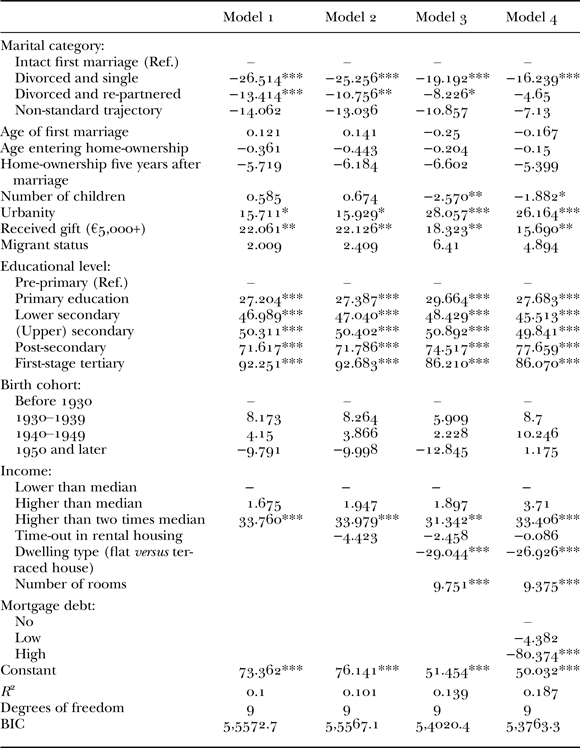
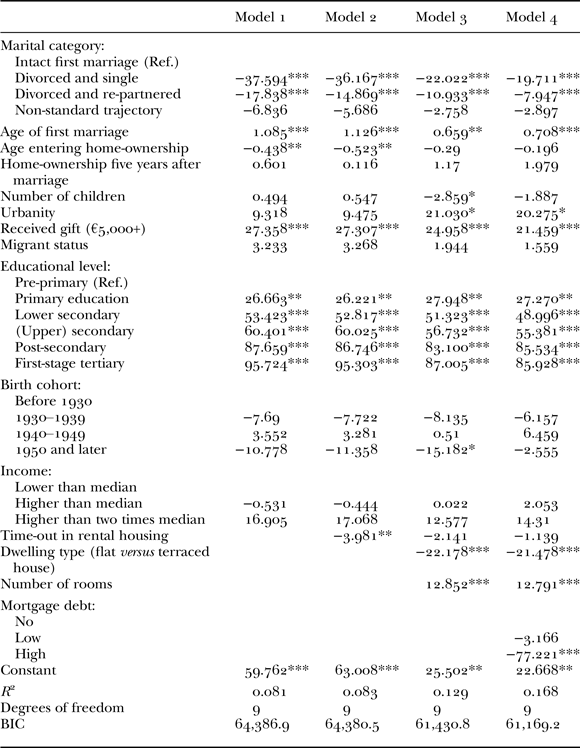
The first model in Tables 5 and 6 presents the association between different marital categories (with couples in an intact first marriage as the reference category) and the accumulation of housing wealth for men and women separately, controlling for a variety of individual characteristics. The analyses are based on the sample of home-owners only, since the mechanisms under scrutiny are conceptualised to influence housing wealth holdings, rather than the odds to be in home-ownership. Not surprisingly, results are similar to the results of Table 4, in which the same variables are used to investigate the difference between an earlier and a later ‘divorce cohort’. Model 1 in Table 5 shows that single elderly home-owning men with divorce experience have 26.5 per cent less housing wealth than men in an intact first marriage, whereas re-partnered elderly home-owning men have 13.4 per cent less housing wealth than men in an intact first marriage. Model 1 in Table 6 shows that the association between divorce experience and reduced housing wealth in later life is stronger for women. Single elderly home-owning women have 37.6 per cent less housing wealth than their counterparts in an intact first marriage, whereas those who re-partnered have 17.8 per cent less housing wealth than women in an intact first marriage. The control variables in the model show the expected results (Tables 5 and 6). Higher education and income levels, a more urban environment, larger financial gifts, an older marital age and a lower number of children are all correlated with larger housing wealth holdings. Together, Model 1 in Tables 5 and 6 provides evidence for the first three hypotheses. First of all, elderly home-owners with divorce experience have lower housing wealth holdings than elderly home-owners in an intact first marriage. Second, it provides evidence for the hypothesis that housing wealth holdings of women with divorce experience are lower than those of men. Finally, the higher housing wealth holdings of re-partnered divorcees relative to single divorcees show that re-partnering partly mitigates the negative effect of divorce experience on the accumulation of housing wealth over the lifecourse (contrasts between these categories are all significant).
Country fixed-effects models, estimating the association between divorce experience and housing wealth holdings in later life for men

Notes: Ref.: reference category. BIC: Bayesian information criterion.
Source: Survey of Health, Ageing and Retirement in Europe 2008/9 and 2011/12.
Significance levels: * p < 0.1, ** p < 0.05, *** p < 0.01.
Country fixed-effects models, estimating the association between divorce experience and housing wealth holdings in later life for women

Notes: Ref.: reference category. BIC: Bayesian information criterion.
Source: Survey of Health, Ageing and Retirement in Europe 2008/9 and 2011/12.
Significance levels: * p < 0.1, ** p < 0.05, *** p < 0.01.
Two mechanisms behind the lower housing wealth holdings of elderly home-owners with divorce experience stand out: downward moves on the property ladder and the increased usage of mortgage finance. The second model in Tables 5 and 6 shows that temporary spells in rental housing after the first-time entry into home-ownership are associated with lower housing wealth holdings for elderly, divorced, home-owning women (only significant at the 0.10 level), but not for men. However, this effect becomes non-significant in Model 3, after the addition of variables describing the housing quality. In other words: women who have resided in rental housing after a divorce have lower housing wealth holdings than those who did not, especially because they moved into smaller properties when they re-entered home-ownership. A substantial part of the lower housing wealth holdings among divorced elderly home-owners can be explained by downward moves on the property ladder, which can be concluded from a comparison of Models 2 and 3 (see Table 5 for men and Table 6 for women). Model 3 shows that living in an apartment rather than a house, and living in a home with fewer rooms, is associated with lower housing wealth holdings. The lower coefficients of the different marital categories in Model 3 compared to Model 2 imply that elderly men and women with divorce experience are over-represented in smaller apartments. For men, the estimate of being divorced and single on housing wealth holdings in later life declines from −25.3 per cent (Model 2) to −19.2 per cent (Model 3) after the addition of variables that describe the dwelling type and size. For women, the estimate of being divorced and single declines from −36.2 per cent (Model 2) to −22.0 per cent (Model 3) after the addition of variables that describe the dwelling type and size. Model 5 (Tables 5 and 6) confirms that elderly home-owners who have a relatively larger mortgage have lower housing wealth holdings than those who are outright owners. The lower coefficients for the divorced elderly in Model 4 compared to Model 3 imply that elderly men and women with divorce experience have larger residential debts than those in an intact first marriage. This finding provides evidence for the idea that housing wealth holdings of elderly divorced home-owners are lower due to their larger indebtedness. Even after the introduction of three mechanisms that might reduce housing wealth holdings in Models 2, 3 and 4, a fairly strong negative association between divorce experience and lower housing wealth holdings in later life remains in place. Local house price developments (in particular differentiated developments for divorced and non-divorced respondents, e.g. when living in different types of neighbourhood) may be expected to explain another share of the variation, but could not be measured in our analysis.
Explaining the housing wealth effect: the macro-level
The association between divorce experience and the accumulation of housing wealth in later life shows considerable cross-country variation, as can be concluded from the cross-country differences in average housing wealth holdings of elderly home-owning divorcees (see Table 3). By including cross-level interactions between macro-level indicators and the marital trajectories to the previously presented country fixed-effects model, we investigate the influence of different institutional characteristics on the housing wealth holdings of single and re-partnered divorcees. We take into account home-owners only, since institutional arrangements that promote housing wealth holdings are conceptually different from those that influence the tenure status.
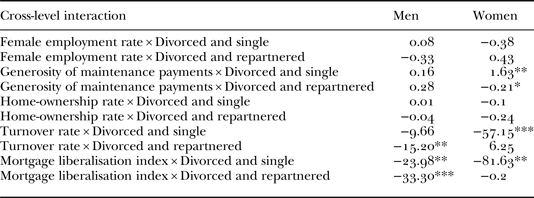
The first two cross-level interactions presented in Table 7 describe the welfare regime context. The second cross-level interaction in Table 7 provides evidence that more generous systems of spousal child maintenance payments/alimony mitigate the negative association between divorce experience and the accumulation of housing wealth for both single and re-partnered divorced women. Spousal child maintenance payments are relatively high in conservative welfare states with low female labour market participation. In these countries, spousal payments are essential to remain in the former marital home. The first cross-level interaction presented in Table 7 shows that the association between divorce experience and housing wealth holdings in later life does not vary across countries on the basis of their female employment rates. This result is remarkable, since previous research shows that higher female employment rates increase the odds of residing in home-ownership for divorced women (Dewilde and Stier Reference Dewilde and Stier2014). In other words, the selection into home-ownership is driven by different institutional arrangements than the accumulation of housing wealth. We suggest that it is indeed easier for previously non-working women to start working after a divorce in countries with higher female employment rates, and hence to remain in home-ownership upon divorce. It is, however, also likely that the incomes of new labour market entrants are not sufficient for the accumulation of large housing wealth holdings. Spousal child maintenance payments might therefore be a more crucial factor in determining the eventually accumulated housing wealth, given that a woman can stay in the marital home. From the two cross-level interactions describing the welfare state context, we conclude that there is partial evidence for Hypothesis 4, stating that income support of women might mitigate the negative association between divorce experience and the accumulation of housing wealth.
Cross-level interactions between marital trajectories and institutional characteristics for men and women

Source: Survey of Health, Ageing and Retirement in Europe 2008/9 and 2011/12.
Significance levels: * p < 0.1, ** p < 0.05, *** p < 0.01.
The last three cross-level interactions presented in Table 7 describe the housing regime context. Altogether, the image arises that it is not the proliferation of home-ownership in itself, but rather certain strategies to promote home-ownership, that reinforce or mitigate the housing wealth consequences of divorce. The third cross-level interaction in Table 5 shows that the overall home-ownership rate in a country is not significant. This is in line with the results from the descriptive analyses (see Table 3) that showed that home-ownership rates do not necessarily reflect the selectivity of this tenure for divorcees. For example, in Italy, a country with high overall home-ownership rates, relatively many divorcees drop out of this tenure, and those who remain in home-ownership have considerably lower housing wealth holdings. In Sweden, a country with moderate home-ownership rates, divorcees have a relatively large chance of remaining in this tenure and those who remain do not have considerably lower housing wealth holdings. The fourth and the fifth cross-level interactions provide evidence for Hypothesis 5, stating that it is a financialised expansion of home-ownership that strengthens the negative association between divorce experience and the accumulation of housing wealth. In such a housing regime, speculation on housing is more common and turnover rates are higher. The results suggest that it is harder for single women with divorce experience to keep up with couples in an intact first marriage in countries with higher turnover rates on the housing market. Moreover, the stronger negative coefficient for single divorced women shows that their housing transitions differ more from couples in an intact first marriage than those of single divorced men. Our results indicate that re-partnered male divorcees also have relatively lower housing wealth holdings in countries with higher turnover rates on the market for owned homes. For re-partnered elderly home-owning women, the interaction is not significant. The liberalisation of housing finance has a strong effect on the accumulation of housing wealth for home-owning individuals with divorce experience (Table 7). In other words, the association between divorce experience and the accumulation of housing wealth in later life is stronger in countries where it is easier to re-enter this tenure due to liberal mortgage finance and where it is easier to prolong indebtedness into later life. Housing finance liberalisation has a stronger impact on single women than on men. This means that men (a) make less use of advanced mortgage finance to remain in home-ownership or re-enter this tenure, or (b) that they are better able to amortise their debt during their lifecourse after a divorce than women, who find themselves in general in a weaker economic position. Moreover, house price inflation and price volatility in countries with more liberal housing finance might increase the relative difference between elderly home-owners with and without divorce experience.
Discussion
Following divorce, it is common that one or both partners move to a new home. Previous research concluded that (especially female) divorcees have a larger likelihood of moving into the rental sector. This might damage their economic position, because it excludes them from a common means to wealth accumulation. Although a large majority of divorcees stay in home-ownership, or re-enter this tenure at a later moment in the lifecourse (around 60%), it has never been researched how a divorce impacts on the housing wealth holdings of those who remain in home-ownership or re-enter this tenure later on.
The results of our study suggest that housing wealth holdings of elderly home-owners with divorce experience are lower than those of couples in an intact first marriage. Compared to previous research, we conclude that divorced women do not only have smaller odds of living in home-ownership (Dewilde Reference Dewilde2008; Dewilde and Stier Reference Dewilde and Stier2014), but also have smaller housing wealth holdings than their male counterparts when in home-ownership in later life. In line with DiPrete and McManus (Reference DiPrete and McManus2000), we find that this negative association is strengthened over time for men, whereas it is weakened over time for women, which can be attributed to the latter's increased labour market participation and the increased necessity of a double income for home purchases. Furthermore, the negative association between divorce experience and the accumulation of housing wealth is found to be stronger for single elderly home-owners than for re-partnered elderly home-owners. In other words, re-partnering partly mitigates the housing wealth consequences of divorce. Two mechanisms behind the lower housing wealth holdings of individuals with divorce experience stand out. First, elderly men and women with divorce experience live more often in smaller houses and apartments than couples in an intact first marriage. In other words, divorce is associated with downward moves on the property ladder. Second, elderly men and women with divorce experience have larger mortgages relative to the value of their homes than couples in an intact first marriage. Increased indebtedness, or prolonged indebtedness into later life, is often the only way for divorcees to remain in home-ownership or to re-enter this tenure.
The negative association between divorce experience and housing wealth holdings of home-owners in later life is found in all ten researched European countries. However, there is considerable cross-country variation in the size of this association on the basis of housing and welfare regime characteristics. Whereas previous research finds the odds of remaining in home-ownership after a divorce to be mainly linked to the welfare regime (Dewilde and Stier Reference Dewilde and Stier2014), we find that it is especially the housing regime that is able to reinforce or mitigate the association between divorce experience and the accumulation of housing wealth in later life. We find evidence that the negative association between divorce experience and housing wealth holdings in later life is stronger in countries that facilitate re-entering home-ownership after a divorce. These are not necessarily countries with high home-ownership rates, but especially those with a liberal housing finance regime. Allowing increased indebtedness, and extended indebtedness into later life, provides opportunities for individuals with divorce experience to move down the property ladder within the home-ownership segment instead of permanently moving into rental housing. Furthermore, in ‘dynamic housing markets’ (those with liberal housing finance), trading up is more common among couples with an intact first marriage (Van der Heijden, Dol and Oxley Reference Van der Heijden, Dol and Oxley2011). In these countries, divorcees are not able to trade up in the housing market to the same extent as couples in an intact first marriage, which increases their relative disadvantage. One specific welfare state regulation is, however, found to mitigate the consequences of divorce experience on the accumulation of housing wealth in later life for single divorced women: generous spousal child maintenance payments. Especially in conservative welfare states, with low female employment rates, child maintenance payments may be essential for women to remain in the former, owned, marital home.
The question of under which institutional circumstances elderly with divorce experience are better off is hard to answer for two reasons. First of all, we note that our results underestimate the total association between divorce experience and housing wealth, by solely focusing on those who are able to remain in home-ownership or regain access to this tenure later on (since permanent moves into rental housing result in zero housing wealth). However, institutional mechanisms that impact upon the home-ownership rate of individuals with divorce experience might differ from mechanisms that impact upon housing wealth holdings (e.g. in case higher housing wealth holdings among divorcees are the result of a more socially selective home-ownership sector). Relatively low housing wealth holdings might be preferable over no housing wealth holdings at all, although precarious home-ownership might also adversely impact on economic and social outcomes (e.g. insecurity, affordability problems, maintenance). Furthermore, the distributional effect of a divorce on housing wealth can only be speculated upon while simultaneously reflecting on broader findings with regard to the propensity of being in home-ownership in the first place. Second, a large difference in housing wealth holdings between elderly home-owners with and without divorce experience might hide a more equal distribution of net worth, a variable which we did not include. For instance, those who move out of home-ownership permanently might exchange their housing wealth for financial wealth. However, previous research found housing wealth to be the prime source of wealth for most households (Cowell, Karagiannaki and McKnight Reference Cowell, Karagiannaki and McKnight2012), in particular in the lower half of the wealth distribution. Moreover, many couples divorce at a moment in the lifecourse when they have not yet accumulated much housing or financial wealth.
To conclude, divorce experience is associated with a lower likelihood of residing in home-ownership in later life (Dewilde and Stier Reference Dewilde and Stier2014), but also with lower housing wealth holdings among those who remain in home-ownership or re-enter this tenure again after a spell in rental housing. Differences between home-owning elderly with and without divorce experience are larger in countries that facilitate moves from rental housing into home-ownership. To grasp in more detail in which way divorce experience affects the accumulation of housing wealth, future research needs to be directed to the interplay between housing wealth and financial wealth, and to local housing market dynamics in which housing transitions before and after divorce take place. Furthermore, future research should focus on the implications of cross-country variations in housing wealth holdings of countries with different lifecourses and housing pathways.
Acknowledgements
This research is funded by the European Research Council (Grant Agreement 283615, directed by Caroline Dewilde). This paper uses data from SHARE Wave 4 release 1.1.1, as of 28 March 2013 (doi:10.6103/SHARE.w4.111) or SHARE Waves 1 and 2 release 2.6.0, as of 29 November 2013 (doi:10.6103/SHARE.w1.260 and 10.6103/SHARE.w2.260) or SHARELIFE release 1, as of 24 November 2010 (doi:10.6103/SHARE.w3.100). The SHARE data collection has been primarily funded by the European Commission through the 5th Framework Programme (project QLK6-CT-2001-00360 in the thematic programme Quality of Life), through the 6th Framework Programme (projects SHARE-I3, RII-CT-2006-062193, COMPARE, CIT5-CT-2005-028857 and SHARELIFE, CIT4-CT-2006-028812) and through the 7th Framework Programme (SHARE-PREP, 211909, SHARE-LEAP, 227822 and SHARE M4, 261982). Additional funding from the US National Institute on Aging (U01 AG09740-13S2, P01 AG005842, P01 AG08291, P30 AG12815, R21 AG025169, Y1-AG-4553-01, IAG BSR06-11 and OGHA 04-064) and the German Ministry of Education and Research, as well as from various national sources, is gratefully acknowledged (see www.share-project.org for a full list of funding institutions).