The first Christian churches were built in the Andes soon after Spaniards arrived. Initially simple structures, they were later remodeled into large stone monuments. Aside from their architectural construction, the furnishing and decoration of these churches was an ongoing project that involved many participants, often under the watchful eye of a parish priest. Art historians have uncovered fascinating cases in which native artists exercised agency in creating works to be displayed in church interiors, many of which expressed Andean as well as Christian beliefs.Footnote 1 This scholarship has focused primarily on the art forms of painting and sculpture, which were very visible within the church, especially in cases such as the baptism murals discussed by Ananda Cohen Suarez in this issue. An underappreciated yet equally notable aspect of church decoration was textiles. Throughout the colonial period churches were abundantly adorned with “church clothing,” textile ornaments meant to cover floors, walls, and altars as well as clothe church functionaries and religious statuary. The purchase and maintenance of church textiles consumed the lion's share of annual church budgets.
While Spanish priests preferred to obtain ornaments made of imported European silks and brocades, they also hired local textile makers to create church clothing. Furthermore, when they did purchase imported cloth they commissioned local artisans to tailor the materials into objects that would fit their churches and, if vestments, their bodies. We thus find evidence, beginning in the early colonial period and extending through to the post-Independence period, of the sustained participation of Andean textile artisans in the creation of the visual culture of the colonial Andean church. Considering their adaptation and use of imported forms and materials, these artisans emerge as important mediators between ancestral Andean textile traditions and those promoted by the Catholic Church. This mediation, expressed in their finished cloths, grew out of artisans’ cooperation with priests, native church officials, and native as well as Spanish patrons.
Many paintings from the colonial period survive in Andean churches and are readily viewable in museums. In contrast, textile works from the same period are much less well preserved and are very rarely still on display in churches. These factors have probably contributed to their underestimation today. It is for this reason that we will look first to a painted representation of an Andean church interior in order to appreciate the range of textiles employed in such buildings. I will reference documentary examples that support the painting's details and highlight the various possibilities for the contribution of Andean artisans. We will subsequently turn to rare surviving examples of church textiles, and further documentary references, to concretize our observations. The textiles I will discuss correspond to three main periods: the years after the conquest but before 1577, from 1578 to 1700, and (roughly) from 1700 to 1900.
In this essay I argue that, by adapting European norms and styles to their ancestral materials and techniques and creating a rich variety of textiles that were displayed in Andean churches, indigenous actors participated in the Church at a level that has so far gone unnoticed. Although they created textile pieces primarily in response to priestly requests, they also created them in the name of confraternities and secular donors. They likely worked closely with native church sacristans and mayordomos (church stewards) when executing and finishing their pieces.Footnote 2 While obligated to conform to priestly oversight, Andean artisans became active mediators in the cultural exchange that the creation and maintenance of the Andean Church entailed. Their participation should be accounted for when considering the depth to which Catholic culture transformed the Andean region. It also serves as a rich example of the ways in which Christianity was, through Andean adaptation and creativity, transformed in the New World.
Church Interiors and “Church Clothing”
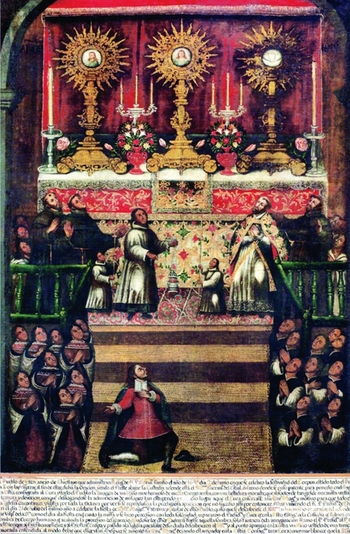
A painting likely created in the workshops of eighteenth-century Cusco provides a credible example of the ways in which church textiles were employed in the Andes. As detailed in its lengthy inscription in Spanish, the work refers to a series of miracles believed to have occurred in the coastal Peruvian town of Eten in 1649 (see Figure 1). The miracles consisted of an image of the Christ Child appearing on the Host three times—thus the three outsized monstrances shown on the altar at the top of the composition. Since the miracles occurred in the context of church services and involved the participation of the townspeople and local officials, we see displayed here a great variety of textiles, both as dress and as “church clothing.”
Miracle of the Child of Eten, Cusco School of Painting, Peru, Early Eighteenth Century
Source: Monastery of Los Descalzos, Lima. Photograph courtesy of Daniel Giannoni.

Although the miracles depicted in the painting were believed to have occurred on the coast in the mid seventeenth century, the highland artist rendered costumes more typical of the sierra and gave the actors clothing that corresponded to the eighteenth century. The townspeople, gathered to the left and right and separated by gender, wear simple garments made of the type of cloth that was produced in the colonial textile factories of the Cusco region, known as ropa de la tierra.Footnote 3 White cottons were used to create the men and women's blouses, while sheep's wool dyed black, dark blue, or brown was used to create their overgarments. Women also wore striped mantles or llikllas, probably created at their own backstrap looms following traditional techniques.Footnote 4 We can readily see those color schemes and a general representation of those garments in the painting in Figure 1.
The painting also depicts a visiting secular official, shown kneeling at bottom center and wearing a rich red coat. Such a coat, worn by a colonial official, would have been made of cloth imported from Europe, even if it had been dyed with American cochineal.Footnote 5 The intricate white lace of his cuffs and collar may also have been imported; while lace was very popular in colonial Peru, Andean artisans did not often practice lace-making. Pieces of lace as well as white stockings such as those seen here were available for purchase from shops specializing in efectos de Castilla, or goods imported from Spain.Footnote 6 But it is also possible that an Andean tailor would have been provided with the materials (including buttons and lining) to make such a red coat to order. The official also wears a dark blue cape, which could have been made locally of Andean materials such as dyed camelid (vicuña, llama, or alpaca) wool, which Spaniards prized for its warmth.
We move now to the church textiles displayed in the painting. The Franciscan friars and acolytes wear simple wool habits and cotton albs (white gowns donned for altar service), perhaps also made locally, as would befit their vow of poverty. But the officiating priest wears a richly embroidered cope (a wide cape-like garment) edged with gold and rendered with gold leaf in the painting. He also wears a golden stole over a lace-trimmed alb.Footnote 7 His cope matches the antependium or altar frontal, the panel covering the altar's front, and indeed it was common for priests to commission vestments that matched the altar cloths.Footnote 8 These purchases allowed for sets of items that were changed regularly according to the liturgical calendar. In this example the main (base) color is white, which was prescribed by the Church for feasts of Christ and the Virgin Mary. Since the inscription notes that the last of the miracles, depicted here, occurred on a feast of the Virgin Mary, the use of white to render the textiles provides a visual cue to that element of the narrative.
In terms of the church's clothing, we see that the floor and steps to the altar are covered with what appears to be a rug of woven vegetal fiber. This likely represents a mat of the type known in South America as a petate, which took its name from the Nahuatl petatl but is widely manufactured today from palm leaves and the reed known as totora (Schoenoplectus californicus, from the Quechua t'utura). In the painting its color, herringbone pattern, and openwork border all suggest a textile of local manufacture. On the sanctuary floor lies a brightly colored rug, whose pattern of rosettes in a lattice-like framework follows that seen on Hispano-Islamic rugs of the period.Footnote 9 But such a rug could have also been made in the Andes, since church inventories often refer to patterned rugs made of lana de la tierra, or camelid wool. Instead of using the Spanish word alfombra, scribes penning the inventories most often used the Aymara term for a thick blanket, chusi (often written chuze or chuse).Footnote 10 In this case Andean weavers adapted imported styles to local techniques and tradition, including camelid husbandry, traditional spinning and dyeing methods, and loom weaving. It is likely that when such rugs were first made in the Andes, they were not created as pile rugs like those made in Spain but were instead rough tapestry weaves, like kilim rugs, following the Andean technique more common at the time.Footnote 11
The principal backdrop for the church officials in the painting is the altar frontal, a vertical panel spanning the altar's width and extending to its base. Here the frontal is shown with a rich floral and arabesque pattern on a white background, and might represent a frontal made of imported textiles that would have been tailored to fit by an Andean. Church inventories from seventeenth- and eighteenth-century Peru list many white altar frontals, made of silk from either China or Spain. The floral patterning on these sorts of pieces was often woven into the original fabric, but it could also have been embroidered after the fact by Andean artisans. In 1634, Tomás de Castro, the priest of the town of Calca, near Cusco, purchased 176 pesos of white lamé (a fabric interwoven with gold or silk threads), which he specified were for a cope, a chasuble, and the campo or “field” of a frontal.Footnote 12 Such a purchase further explains why in the painting the priest's cope matches, in color and pattern, that of the frontal. The fact that the purchase is described as one of yardage and not of finished objects also suggests that a local tailor would have been commissioned to manufacture the pieces. Though that commission is not mentioned, the same year Castro paid a tailor four pesos to confect a separate, green altar frontal.Footnote 13 No ornamentation is noted for the white lamé, so it is also likely that the fabric would have been decorated further by either the tailor or another artisan. The Andean author Felipe Guaman Poma de Ayala reported that native Andeans were employed as both embroiderers and tailors in Peru by the early seventeenth century.Footnote 14
Above the painted frontal we see an additional panel with a red background, gold foliate patterning, and gold edging. This panel represents a frontlet (frontalera), an additional framing overlay also made of rich cloth and often featuring narrow vertical panels at the outer edges, known as caídas. As we will see further on, the gold border of such a piece could have been the product of Andean artisans. In the center of the altar, under the central monstrance, we see yet another rich cloth edged in lace. This was known as a palia, a cloth that hung down vertically to provide a visual frame for the base of the monstrance and was attached to a white linen panel that extended to the back of the altar table. Finally, under this and covering the altar's entire upper surface lengthwise is a white altar cloth, also edged in lace, that extends downward to further frame the frontlet. And backing the whole altar, instead of an architectural altarpiece, is a red, gold-trimmed canopy of the type known as a cielo or dosel in the documents. The painting represents the common textile backdrop of colonial churches, where items of local manufacture were placed closer to the ground and further from the altar. Pieces made of imported fabrics graced the altar itself, but Andean artisans may have further elaborated those works. Thus, despite a hierarchy of materials that privileged imported items, we see the intervention of Andean textile workers, whether tailors or weavers, in virtually every element of church clothing.
Surviving Examples and a Chronology of Change
A further consideration of the documentation, along with select surviving examples, will help confirm these interventions and also establish a rough chronology for the mediation by Andean artisans in the textile culture of the Catholic Church. Fernando Silva Santisteban and Neus Escandell Tur have established a chronology for colonial Andean textile manufacture in relation to Spain's promotion of its own textile industry.Footnote 15 They identify three periods: an early phase from 1548–1577, in which the Crown encouraged the development of a local textile industry and the first obrajes (textile mills) were founded; a post-1577 period under Philip II when a prohibitionist policy encouraged the Spanish wool market but allowed for some growth in the colonies; and a final period corresponding to the Bourbon reforms, under which the Crown was highly protectionist and limited the cloth industry in the colonies. Spanish production and the trade (and export to Peru) of cloth from other European countries and China was focused on fine, high-quality textiles, either superbly milled woolens or silks and gauzes.Footnote 16
Our consideration of church textiles created in the Andes corresponds only partly to this scenario, since fine imported cloths like silk were always desired for churches, and the woolens of the Peruvian obrajes were not of the quality that would have been used for church ornaments. Furthermore, textile artisans appear to have worked outside of the industrial context of the obrajes and smaller-scale chorrillos, which produced piecework, often in domestic settings. These workshops had a guaranteed labor force of native Andeans needing to earn coin to meet tribute obligations.Footnote 17 In contrast, as Gabriela Ramos's work on tapestry textile production in the early colonial period suggests, Andeans creating church textiles were highly skilled artisans who were commissioned on an as-needed basis.Footnote 18 Weavers were brought to the premises of homes and, presumably, churches, while tailors were itinerant or established in shops. These skilled artisans, when officially recognized as such, were exempt from tribute obligations.Footnote 19
Despite these distinctions, the chronology is still quite useful for understanding the types of interventions allowed to Andean artisans through the colonial period. Specifically, the creation of fine camelid-wool tapestries for church interiors appears to correspond primarily to the period before 1577, the first of our three. This stage, in which the products of Andean looms were highly esteemed by both Andeans and Spaniards, also corresponds to the popularity of tapestries in Spain, which waned at the turn of the century.Footnote 20 We thus find in highland Peru, in one of the earliest surviving sets of church inventories, dated 1560, that five churches in the province of Chucuito were equipped with multiple textiles made of lana or manta (cloth) de la tierra, surely camelid wool. The pieces are described as having brightly colored figures and patterning and were not used as rugs but, in the absence of imported cloth, as altar coverings. They were thus placed in the position of covering the church's central, most essential piece of furniture. A frontal on the main altar in the church of Juli, for example, was created in blue camelid wool and bore a cross in the center. Its frontlet featured a red and yellow checkerboard pattern, and the whole piece was fringed in yellow and blue.Footnote 21 Other frontals are described similarly, some with figures such as small birds.Footnote 22 We do not know exactly how the Chucuito artisans worked with priests to establish the designs and execute tapestries to fit specific altars. But the fact that some of the works featured checkerboard patterns, hailing directly from the Inca design vocabulary and geometric aesthetic, as well as figural images such as crosses and birds, from the European tradition, suggests that a cultural exchange was well underway.Footnote 23 We thus receive, at this early date, the impression that Andean textile art was involved in the very beginnings of the Catholic Church in Peru.
Church inventories from the seventeenth-century Archbishopric of Cusco demonstrate that finely woven and brightly colored tapestries, known as cumbi, also hung in churches there until mid-century, at which point they began to disappear because they were worn out.Footnote 24 Knowing that such tapestries as survive today are surprisingly durable, it is likely that many of the tapestries that disappeared at mid-century were from the sixteenth century. The town of Vilque had a red cumbi altar frontal with red and white fringe as late as 1636, the town of Soraya had a colored wool frontal until 1647, and various churches had rugs (chuses) or unspecified square cloths (paños) made of cumbi.Footnote 25 It is possible that as these cloths’ popularity waned, priests did not take great care to preserve them, as they might have done with imported items. And it is largely due to the zeal of museum collectors in the early twentieth century that any such works survive today.
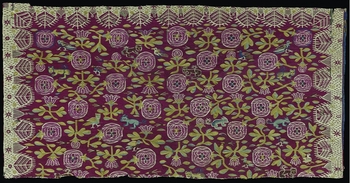
A tapestry fragment now in the Museum of Fine Arts in Boston appears to represent one of the late sixteenth or early seventeenth-century altar cloths that the documents suggest were relatively widely produced in Peru (see Figure 2).Footnote 26 The work's composition and imagery suggest it was specifically created to imitate the sorts of European cloths that hung in front of altars, as we saw in the Eten painting in Figure 1. The main field is a rich red, interwoven with floral and animal imagery that makes the cloth look like a brocade, a prized European cloth with supplementary-weft figures.Footnote 27 Its size (56 × 110.5 cm) does not appear sufficient for it to have spanned the width of an altar, since most altars were nearly two meters wide. But another possibility emerges if we look more closely at this piece and remember that in altar configurations like that seen in the Eten painting, the frontlet often covered a large section of the top of a frontal and featured strips (caídas) that hung down the sides. Essentially the frontlet was a wide frame that surrounded the frontal proper on all sides except the bottom.
Tapestry Altar Cloth, Peru, Sixteenth or Early Seventeenth Century
Source: Museum of Fine Arts, Boston. Denman Waldo Ross Collection, 07.844. Photograph courtesy of the museum.

The Boston fragment clearly has a specific orientation, since the animals need to be viewed right side up. Along the upper, left, and right edges appear woven white patterns that imitate the look of lace edging, here made part of the cloth instead of overlaying it. At the right border we see that a narrow strip of blue tapestry still survives, with some of its white warp threads exposed. The other three edges are not selvages and appear to have been cut, so the tapestry once likely continued beyond them as well. Imagining that the blue tapestry extended beyond the lace on the three sides where that border survives, I think this piece originally formed the center panel of an altar configuration that fused three textile types together—a frontal per se, a blue frontlet with an inverted U-shape, and lace edging that marked the division between the frontal and frontlet. Instead of multiple types of cloth overlaying or lying adjacent to one another, here we see evidence of an Andean approach to textiles, which preferred to create a whole piece as a single web that was removed intact from the loom and never cut. In this case the entire web represented the European altar configuration and was used as a single piece to cover an altar front. A highly adaptive approach was thus taken, in order to conform to European precedents for liturgical textiles as well as Andean norms.
The color palette, with a rich red likely obtained from Peruvian cochineal, makes it a piece that would have been classified as a “red ornament,” appropriate for important days in the liturgical calendar including feasts of the Cross and martyrs.Footnote 28 But the rich reds and yellows also recall an ancestral palette that relied on Andean dyeing capabilities. These colors along with white (which would have been undyed yarn from pristinely white camelids) even recall the Inca palette and refer back to the finest of royal cumbi tapestries.Footnote 29
Three larger tapestries that survive today were almost certainly meant as altar frontals to be used for funerals, the Day of the Dead, and monthly masses in honor of the dead.Footnote 30 One at the Textile Museum in Washington, D.C., was reported to have come from Juli in Chucuito, the same region whose churches housed cumbi ornaments in 1560 (see Figure 3).Footnote 31 The work measures 102 × 160 cm and is thus the correct size to have served as an altar frontal, if framed by a separate frontlet with caídas. Utilizing a rectilinear layout appropriate for the rectangular space of an altar front, this work features a principal register with four figures housed in a classical architectural frame. Two are fully skeletal and with their ornaments stand for European secular and sacred authority—a king and a pope, respectively. The other two figures are only half-fleshed and half-dressed. Their dressed halves represent Spanish noblemen, while their skeletal halves serve as chilling reminders of the fate that awaits all, noble or commoner. These images are drawn from the medieval European iconographic repertoire, while the tapestry is woven in camelid wool using the Andean tapestry technique.Footnote 32 Its death imagery makes it appropriate for masses for the dead, and its somber black background echoes Spanish prototypes. However, the black is actually a dark brown and the bright yellows, reds, and blues used to render the figures respond to an Andean palette, one that appeared on the finest Inca tapestries.
Tapestry Altar Frontal, Peru, Sixteenth or Early Seventeenth Century
Source: The Textile Museum, Washington, D.C., 91.412. Acquired by George Hewitt Myers in 1944. Photograph courtesy of the museum.

As noted above, the use of cumbi for major church textiles, including altar frontals, appears to have waned in the mid seventeenth century. No new commissions or purchases were documented in this period, although cumbi items were still listed sporadically in inventories as furniture covers and small, seemingly multipurpose paños.Footnote 33 Wool weavings of Andean manufacture also survived as rugs throughout the colonial period.Footnote 34 But for altar coverings, and certainly vestments, imported cloths began to predominate. There had already been ideological resistance on the part of the Church to weavings such as the Boston cloth shown in Figure 2, whose animal imagery featuring felines, owls, birds, and viscachas appeared less informed by European iconography and was therefore held to be less sacred. Such works were sufficiently localized and unassociated with Christian ideas to inspire the Viceroy Francisco de Toledo's orders regarding weaving issued for La Paz in 1574. Toledo declared that since the native people adored certain types of birds and animals, and since they wove them in altar frontals and hangings (doseles), such works should be destroyed or removed.Footnote 35
Many church stewards may have continued to treasure the cumbi altar cloths they had acquired, and certainly many priests appear to have supported their creation and use in earlier decades. But the wider anti-idolatry environment of the first half of the seventeenth century seems to have ended the commissioning of such works. In Cusco during the tenure of Bishop Manuel de Mollinedo y Angulo (1670–1699) there was also a tendency to replace altar frontals with costly, yet durable panels made of worked silver with wooden backings.Footnote 36 When silver was not a viable option, patterns that imitated textiles were painted onto rough canvases heavily coated in gesso and then installed as frontals.Footnote 37 Even walls were covered with painted patterns termed damascos, meant to imitate but avoid the cost of European textiles such as damask.Footnote 38
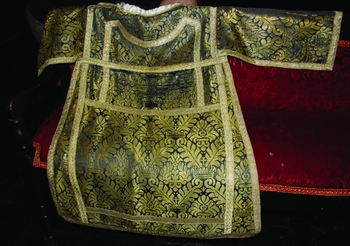
A dalmatic from the cathedral of Cusco, the type of vestment worn by a deacon at mass, epitomizes the imported textile types privileged in the mid-colonial period (see Figure 4). The background cloth is a type of silk known as lampas, due to its supplementary weft patterning in gold-wrapped thread. It features a blue ground and, in gold, church-appropriate motifs of leaves interspersed with crowns topped by crosses. Additional thin strips of delicate ribbon, made with silver-wrapped thread, cover the seams and compensate for the areas in which the pattern was necessarily broken. It is possible that in this case both the ground cloth and the ribbons were imported, especially since church documents mention a type of ribbon known as sevillaneta, perhaps produced in Seville's textile workshops.Footnote 39
Dalmatic, Seventeenth Century, Cathedral of Cusco
Source: Archbishopric of Cusco. Photograph courtesy of the archbishopric.

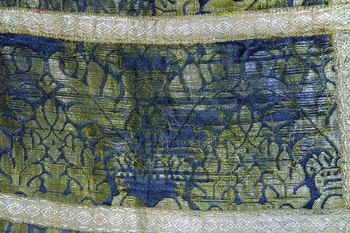
As can be seen in the dalmatic detail (from Figure 4) shown below, the ribbons in this group, probably created as a weft-float weave, feature a repeating pattern of stepped concentric diamonds.Footnote 40
Detail
Source: Archbishopric of Cusco. Photograph courtesy of the archbishopric.

That sort of geometric motif was a common feature of Inca textiles and could certainly have been replicated by Andean weavers.Footnote 41 In fact, it is in these woven ribbons that we will see the next phase of Andean weavers’ intervention in church textiles.
It has been supposed that the manufacture of gold and silver thread was reserved for artisans in Spain, even if the metals came from Peruvian mines.Footnote 42 But documentary evidence suggests that it could also have been done in Peru, by artisans of varied ethnicities. For example, in Cusco in 1686, the goldsmith (tirador de oro y plata) Blas de Aguirre, likely a creole or mestizo, was contracted to work in a home over the course of four years. Part of his responsibility was to “pull gold and silver into the state that it can be woven in silk or on thread.”Footnote 43 Since at this time gold and silver thread was created by wrapping sheets of metal around a fiber-core thread, it would seem that Aguirre was expected to complete the first stage of that process, “pulling” the metal so that it could be wrapped around thread.Footnote 44 Surely the threads were also completed in Cusco and sold there, to church patrons among others. It also appears that churches commissioned textile workers to produce this thread on their own, as part of other tailoring duties. In Calca in 1613 an unnamed indio sedero, or Indian silk-worker, was given yards of black silk, satin, and taffeta from China to create an altar frontal. He was also given seven ounces of silver and an unspecified quantity of thread, presumably to manufacture silver thread that would also become part of the frontal. The frontal's black color suggests it was meant for masses for the dead, similar to the tapestry example we saw in Figure 3. This suggestion is confirmed by the fact that the priest also paid an unidentified person seven pesos to paint skulls on the frontal.Footnote 45 A similar commission was made in 1640, when gold, silk, and lining were given to an unnamed artisan for the creation of two frontlets, one crimson and one white.Footnote 46 The gold in this case was meant for a row of fringe (flocadura); indeed, gold and silver thread could be used to weave ribbons or larger cloths, to embroider, or to twist fringe.
Occasionally we see the participation of indigenous elites in these commissions, in addition to the contribution of local artisans.Footnote 47 These elites figure as donors, and in fact donations were probably much more common than the documents suggest. As their costs did not come out of the church budget they are not usually listed in account books, and inventories do not always note the sources of objects. The most commonly donated items were processional banners. Confraternity leaders and festival sponsors carried banners in processions, and their display was an important way for laypeople to showcase their involvement in the Church. In the seventeenth century the Confraternity of the Holy Sacrament and Souls in the church of Huanoquite (near Cusco) received three separate donations of banners, all from individuals with Quechua surnames.Footnote 48 Then in 1778 the priest of Huanoquite received a donation of fabric for a processional banner from the local (unnamed) cacique. The finished banner, which was commissioned from a tailor, featured five varas (about four meters) of golden ribbon and had a coat of arms embroidered on it with gold thread details.Footnote 49 The coat of arms on the Huanoquite banner may have been that of the cacique's family. A surviving banner likely from the same period, from the church of San Cristóbal in Cusco, was made with imported fabric but features gold fringe, tassels, and ribbon along its edges that certainly could have been made locally (see Figure 5).
Banner, Church of San Cristóbal, Cusco, ca. 1800
Source: Archbishopric of Cusco. Photograph courtesy of the archbishopric.

As noted earlier, priests often acquired vestments in sets that included a cope, a stole, and other elements, including matching altar coverings. The Roman rite in force during the colonial period allowed for a priest and two deacons to officiate at mass, and often all three would be dressed in matching vestments—a chasuble for the priest, a dalmatic for the deacon, and a tunicle for the subdeacon. Church officials thus linked their personas with the church's central ceremony, and the union was visually articulated through cloth. Andean elites appear to have also commissioned textiles such as banners that would visually identify them with the church officials and ceremonies. The Corpus Christi paintings from Cusco show examples of standard-bearers carrying banners whose cloth matches that of the clothing on their parishes’ titular statues.Footnote 50 They might also have donated cloth for altar frontals, and even for vestments, that would match that of the banners they were privileged to carry. Textile color, type, and pattern would have served as non-literate ways to link political entities from different sectors of colonial society. As José Carlos de la Puente notes in this issue, caciques and indigenous community groups donated ornaments to churches as part of their wide-ranging efforts to make alliances with both secular and ecclesiastical authorities. These commissions likely involved the participation of Andean artisans, who themselves became the intermediaries between forces.
In the Huanoquite commission of 1778 mentioned above, the priest paid the tailor and the cacique gave the fabric and seemingly dictated the design. We do not know the identity of the tailor, but we can now imagine him as the facilitator of a delicate and important cultural interchange, materialized in the cloth of church ritual. The participants in church rituals were the wider communities that the churches served, and included Andeans as well as Spaniards. The artisans’ work thus facilitated the union in practice of various sectors of colonial society—priests and laypeople, elites and commoners, Spaniards and Andeans.
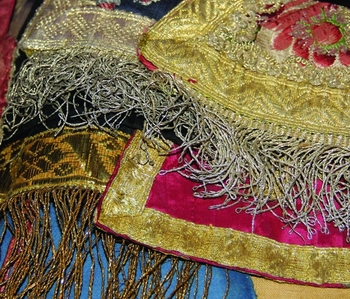
Returning to the gold and silver ribbon, or sevillaneta, this became an obligatory part of church textiles in the seventeenth and eighteenth centuries. Delicate ribbon such as that on the Cusco cathedral's dalmatic was woven with cylindrical threads that, as noted above, featured a fiber (usually silk) core and were wrapped in metal. It now appears that these sorts of ribbons were made equally in Spain and Peru. A wider, flatter, sort of ribbon that is referred to simply as franja appears to have emerged from Andean workshops in the later colonial period. Indeed, that is the term used for the ribbon given by the cacique of Huanoquite in 1778. These woven strips used flat metallic threads as their weft and either yellow or white fiber threads as their warp, depending on whether the finished strip was meant to look golden or silver-toned. The strips feature much bolder, often geometric patterns and could have been created on a backstrap loom, the most basic weaving apparatus of the Andean textile artisan.Footnote 51 But they were used in the same ways as were the narrower and denser strips of sevillaneta, that is, as the borders for vestments and other church textiles such as frontals. A detail of a selection of stoles, also from the church of San Cristóbal in Cusco, helps compare the two styles (see Figure 6). The edges of the stoles at the right and upper left were woven with cylindrical thread as both the warp and weft, and their patterns are achieved with weft-float patterning. In contrast, the strip on the stole at the lower left was woven with flat gold-toned metal strips as the weft and yellow threads as the warp. The intertwining geometric plant-and-flower pattern was also created with weft patterning, however. Very thin threads made entirely of metal (perhaps copper) also cross the strip horizontally, keeping the loose weave in place.
Stoles, Church of San Cristóbal, Cusco, ca. 1800
Source: Archbishopric of Cusco. Photograph courtesy of the archbishopric.

It is difficult to pinpoint the exact period in which the strips with flat metallic threads, surely of Andean manufacture, began to replace the sevillaneta-type ribbons. Paintings of the eighteenth century, such as the well-known Virgin of Potosí from Bolivia, suggest that relatively wide and boldly patterned borders were aspired to on vestments by that time.Footnote 52 Flat metallic threads also appear on embroidered vestments dated to the eighteenth century, such as those in the Museo del Convento de Santa Catalina in Cusco. But the answer to this question may lie in Spanish trade policies, and it is yet to be determined how much Spain protected its production of sevillaneta. The answer may also be related to the availability of certain types of metal, since the metal strips were not pure gold or silver, but appear to be made of an alloy thinly plated with gold or silver. Setting these questions aside, Andean artisans nevertheless encountered, in the second half of the colonial period, a way to mediate between the imposition of European textile types and their local materials and techniques. They adapted the form of the sevillaneta to the backstrap loom and used local materials such as yellow-dyed and flat metal thread, weaving these into patterns of both European and Andean origin. Thus, like the weavers who created all-in-one altar configurations that represented integral fusions of various textile types (shown in Figure 2), later Andean cloth makers introduced another important modification to the production and design of church clothing, drawing from Spanish examples but also departing from them. They contributed to a uniquely Andean visual culture of the church, fostering a sort of visual literacy that drew from sources outside the church but applied directly to it.
The woven strips framed and qualified the European textiles they surrounded. Indeed, the borders of these cloths might be seen as more significant than their fields in considering the participation of Andean artisans.Footnote 53 The plant-and-flower patterns are best understood as adaptations of European floral borders, but other patterns such as zigzags and repeating diamonds are known from pre-Hispanic Andean textiles. These patterns can also be connected to those seen on Andean backstrap weavings of the past two centuries, including the patterned areas on cloths used for non-Christian agricultural and animal fertility rituals known as señalakuy.Footnote 54 These ceremonies, although they are not Christian, retain elements that suggest historical knowledge of Catholic rituals and the use of textiles in them. They involve the unfolding, arranging, and refolding of bundles of textiles and sacred objects such as animal figurines. These sets of ritual actions are called misas (“masses”) or mesas (“tables”), by which is perhaps meant “altar tables.”
It appears that textile makers understood these works to have ritual significance and that the exact nature of the ritual (whether Andean or Catholic) was not grounds for distinction in their visual features. It is in this sense that we can understand overlaps in the sorts of patterning on the cloths used for agricultural rituals and those used for Catholic rituals. For example, the patterned bands woven into a four-part señalakuy cloth (k'uchu unkhuña) from the community of Pitumarca southeast of Cusco evidence more complicated versions of the types of patterns seen on the church textiles (see Figure 7). The zigzag and complex flower forms at the upper and lower left of the unkhuña can been seen, in simplified form, in the strips on the San Cristóbal stoles shown in Figure 6. Scholars have shown that such patterns have specific associations and names for Andean weavers today. While their exact meanings can vary by community, they nevertheless usually carry local significance.Footnote 55 Zigzags can stand for agricultural fields in various stages of cultivation, and narrow rows of triangles (especially those that border a main pattern) for mountain peaks on the horizon.Footnote 56 Frontal flower forms are usually called t'ika (“flower” in Quechua) and are further specified as rose, potato, or “star” flowers.Footnote 57 Roses have Christian significance in their association with the rosary and European church textiles such as those also referenced by the Boston fragment shown in Figure 2. But potato flowers are of course native to the Andean setting, and “star” flowers could refer to any number of highland flowers.
K’uchu unkhuña, Pitumarca, Peru, Twentieth Century
Source: Olivera Collection, Cusco, Peru. Photograph by the author.

The compositions of warp-patterned pieces such as the unkhuña feature strips of pattern (pallai) bounded by stripes (listas) and surrounding solid areas of color, known as pampas or “uncultivated fields.”Footnote 58 The pallai and listas are understood as the representations of culture in a weaving composition, while the pampas are literally the wild and uncivilized places.Footnote 59 It is curious to think about these concepts as applied to the church textiles in which Andean metallic strips were used. The strips surrounded and qualified areas of imported fabric which, while patterned, might still have counted as not entirely knowable, considering they were made using foreign materials, dyes, and techniques. The notion that the metallic strips may have had deeper meaning and relevance for Andeans seems reinforced by the fact that festival hats from Pitumarca continue to display such strips.Footnote 60 Pitumarca is also one of very few communities in Peru that has revived the tapestry-weaving technique, and today weavers there create small replicas of works in the colonial style.Footnote 61 If we see textile makers as creators of ritual cloths, regardless of whether for Andean or Catholic rituals, their role as intermediaries takes on an additional dimension. These weavers become agents who connect the opposing religious spheres of Andean society.
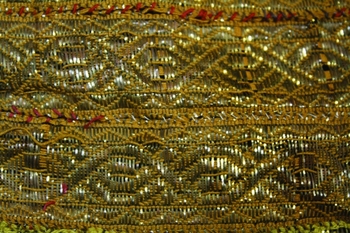
A surviving cloth made entirely of metallic strips, likely the end of a palia meant to hang over the center of an altar, further suggests the importance of these strips in the minds of Andeans. It represents an exclusively indigenous contribution to the Andean church interior (see Figure 8). A conservative dating of this work would suggest the post-Independence nineteenth century, when imported cloths became more difficult to obtain, as did pure gold and silver of the types extracted from colonial mines by workers subject to the mita system of tribute labor.Footnote 62 For this work an artisan sewed together nine horizontal strips made with flat metallic threads, using the technique described above. While the flat metallic threads are a silvery color, they are interwoven with fiber threads dyed a golden yellow. Following the composition established for palias early in the colonial period, as shown in Figure 1, additional strips made of metallic threads and a lemon yellow (as opposed to gold-toned) thread are attached along the side and lower borders, and a fringe made with cylindrical silver threads runs along the bottom. This stiff and relatively inflexible work (39.5 × 111 cm) must have been made to hang over the front of an altar on very special occasions.Footnote 63
Palia, Cusco Region, Peru, Nineteenth Century
Source: Olivera Collection, Cusco, Peru. Photograph by the author.

From afar, the metal and the yellow threads contribute to an undulating, shimmering golden surface. And when examined more closely (as in the detail of Figure 8 below), another geometric pattern from the Andean repertoire can be perceived.
Detail
Source: Olivera Collection, Cusco, Peru. Photograph by the author.

The central motif, an image of crisscrossing threads, refers to the textile medium itself and has ancient origins in the Andes.Footnote 64 Mary Frame has shown that images of twisted, braided, and interlocked threads were represented in ancient textiles throughout the Andes, many created with incredibly complex structures that went well beyond that of the imagery they displayed. Nevertheless, this imagery reinforced the importance of the textile medium in Andean thought. In its most basic forms, the medium stands as a metaphor for forces coexisting in opposition. This metaphor can, of course, be extended to human relations and may represent an ideal state of relationships, whether between political entities or coexisting religions (Catholic and Andean). The textile artisan's role, as an intermediary, was to weave together these opposing forces and place them in balance. This balance could even be expressed through the imagery on the final product, as has occurred in the palia shown in Figure 8. In this work we see that the art form of the church textile has been redefined in an Andean idiom. But this redefinition still seems to speak to the colonial setting and the need for commensurability. That is, the Andean artisan was still obligated to express the tying together of disparate forces—social, cultural, and religious.
Conclusions
The fact that this palia likely dates to the nineteenth century underscores the point that during the entire course of the colonial period, and even beyond it and into the present, Andean textile artisans have been involved in clothing the church.Footnote 65 As they participated in the visual and tactile culture of textiles, Andean cloth makers inserted themselves as important players in the cultural and economic realms of colonial Peru. Scholarship on colonial Andean textiles has often focused on the ways in which tapestries continued to follow models established in Inca times, and thus serve as examples of the maintenance of Inca beliefs.Footnote 66 It is nevertheless the case that many of the patterns that functioned as important ethnic signifiers in the Inca era disappeared during the colonial period, as the social formations and distinctions that prevailed in Inca times were also transformed. The textile types that carried those patterns, namely the man's tunic, or unkhu, also disappeared.
However, a major driver of economic activity and cultural fluorescence in the colonial period was the Catholic Church, and a great deal of its consumption was focused on textiles. It is there that we can look most productively for ways in which Andean textile traditions were transformed and survived. Equally important, there we can identify ways in which native Andeans participated in creating—and reproducing—the colonial church. From the early colonial period onward, Andeans were employed to cut, sew, paint, patch, and even wash church textiles that followed European norms. This close engagement with textile ornaments allowed them to find ways to create original Andean works that both responded to and transformed the prototypes they had seen and touched. In the early colonial period tapestry weavers used camelid wool and the loom weaving technique, which involved carefully interlocking adjacent color areas to create integrated textile webs, to make altar cloths of various types. These cloths featured Christian imagery as well as patterning that collapsed various European textile forms (lace, ribbon, damask, and others) into a single woven piece.
Once these tapestries fell out of favor, Andean artisans found other ways to contribute to church textiles. They became adept at embroidering imported cloth and creating gold and silver thread to further embellish ornaments of all types. They also developed a unique approach to the sevillaneta ribbon—a wider ribbon that was woven on a backstrap loom and featured bold geometric patterns, locally produced fibers, and flat metallic thread. While textiles that feature these ribbons are no longer used or displayed in Andean churches, sacristies still house hundreds of these items, most on vestments worn in the (pre-Vatican II) past by church officials. More research is needed to better understand these works in terms of their materials and the historical circumstances that led to their emergence. Select examples of cumbi tapestries for church use also survive in museum collections and others may still be hidden in church depositories. If more of these specimens can be found and analyzed we will better understand their uses and the mechanisms involved in their production, including their links to Inca tapestry production. All of these considerations will allow us to better isolate the role of the artisan as intermediary and actor in the spiritual economy of colonial Peru. Comparative study of the ways in which other textile traditions of the Americas were adapted to clothe Christian churches may even allow for a hemispheric view of the ways in which Amerindian textile artisans facilitated the creation of a New World church.
As of now, we are presented with another facet of the participation of Andeans in the creation of colonial culture. Textile artisans mediated between priests and patrons, and between European and Andean textile forms, technologies, and styles, to create unique textile works that expansively celebrated the Christian faith. Like the creators of the Baptism of Christ murals discussed by Cohen Suarez elsewhere in this issue, the artisans created local meanings by mixing both local and foreign source materials. They thus contributed to making the church an intercultural space that could be inhabited, and understood on some level, by all.