Introduction
Towards the end of her personal account of an illness that began with psychosis and then progressed to delirium and seizures, Susannah Cahalan, a New York Post journalist, asks a simple but powerful question. After eventually being diagnosed with an antibody-driven N-methyl-d-aspartate (NMDA) receptor encephalitis, she wonders: ‘how many people currently are in psychiatric wards and nursing homes denied the relatively simple cure of steroids, plasma exchange, [or] more intense immunotherapy?’ (Cahalan, Reference Cahalan2012).
The notion that pathogenic autoantibodies may cause psychiatric disease is over half a century old. Recent developments in neurology have shifted the spotlight to a particular class of autoantibody targeted against the NMDA receptor (Lennox et al. Reference Lennox, Coles and Vincent2012; Pollak et al. Reference Pollak, Lennox, Vincent and Nicholson2012). These antibodies cause an autoimmune encephalitis that features psychotic symptoms in addition to catatonia, thought to be related directly to an impairment of NMDA receptor function. Interest in the relevance of these and other synaptic autoantibodies to psychiatric disease, in particular to psychosis, has increased in the past few years and we are currently witnessing a period of fertile cross-collaboration between psychiatrists, neurologists and immunologists that may hold considerable promise for our future understanding of psychosis and its treatment. Anti-NMDA antibodies are of particular interest for psychosis research because of the increasingly central role of NMDA receptor hypofunction in theories of the aetiology of psychotic symptoms.
Anti-NMDA receptor encephalitis
Anti-NMDA receptor encephalitis, first described in 2005, was initially reported in a case series of four young women who presented with a rapidly progressing encephalitis in association with an ovarian teratoma and antibodies to an unspecified brain autoantigen (Vitaliani et al. Reference Vitaliani, Mason, Ances, Zwerdling, Jiang and Dalmau2005; Dalmau et al. Reference Dalmau, Tuzun, Wu, Masjuan, Rossi, Voloschin, Baehring, Shimazaki, Koide, King, Mason, Sansing, Dichter, Rosenfeld and Lynch2007). These antibodies were later characterized as immunoglobulin (Ig)G antibodies reactive with the NMDA receptor (Dalmau et al. Reference Dalmau, Tuzun, Wu, Masjuan, Rossi, Voloschin, Baehring, Shimazaki, Koide, King, Mason, Sansing, Dichter, Rosenfeld and Lynch2007), specifically the NR1 subunit (Dalmau et al. Reference Dalmau, Gleichman, Hughes, Rossi, Peng, Lai, Dessain, Rosenfeld, Balice-Gordon and Lynch2008). An increasing proportion of cases, male and female, are now known to be associated with no underlying malignancy (Titulaer et al. Reference Titulaer, McCracken, Gabilondo, Armangue, Glaser, Iizuka, Honig, Benseler, Kawachi, Martinez-Hernandez, Aguilar, Gresa-Arribas, Ryan-Florance, Torrents, Saiz, Rosenfeld, Balice-Gordon, Graus and Dalmau2013).
The clinical picture of the encephalitis syndrome has been fully described. A majority (65%) of adults first present with behavioural and psychiatric symptoms, predominantly with psychosis, but anxiety and catatonia are also common (Titulaer et al. Reference Titulaer, McCracken, Gabilondo, Armangue, Glaser, Iizuka, Honig, Benseler, Kawachi, Martinez-Hernandez, Aguilar, Gresa-Arribas, Ryan-Florance, Torrents, Saiz, Rosenfeld, Balice-Gordon, Graus and Dalmau2013). This figure is lower in children and adolescents, but ‘behavioural’ symptoms remain the most common initial presentation in adolescents; in children, they are second only to movement disorder (Titulaer et al. Reference Titulaer, McCracken, Gabilondo, Armangue, Glaser, Iizuka, Honig, Benseler, Kawachi, Martinez-Hernandez, Aguilar, Gresa-Arribas, Ryan-Florance, Torrents, Saiz, Rosenfeld, Balice-Gordon, Graus and Dalmau2013). In the aforementioned first case series, 80% of patients initially presented to psychiatric services (Dalmau et al. Reference Dalmau, Gleichman, Hughes, Rossi, Peng, Lai, Dessain, Rosenfeld, Balice-Gordon and Lynch2008). The disorder usually progresses rapidly to include some or all of delirium, memory deficit, autonomic dysfunction, movement disorder, central hypoventilation and seizures, and sometimes, death.
Studies conducted in vitro and in vivo have demonstrated the pathogenicity of these cell-surface antibodies; notably, they have been shown to cause a reversible reduction in numbers of neuronal surface NMDA receptors in addition to a reduction in the NMDA-mediated component of the excitatory post-synaptic potential (EPSP), without causing neuronal death (Hughes et al. Reference Hughes, Peng, Gleichman, Lai, Zhou, Tsou, Parsons, Lynch, Dalmau and Balice-Gordon2010). Application of the antibodies to neuronal slices inhibits long-term potentiation (LTP), possibly through direct antagonism at the receptor (Zhang et al. Reference Zhang, Tanaka, Sun, Nakata, Yamamoto, Sakimura, Matsui and Kato2012). Importantly, an increase in extracellular glutamate levels has been found in rats following injection of patients' cerebrospinal fluid (CSF) (Manto et al. Reference Manto, Dalmau, Didelot, Rogemond and Honnorat2010).
Immunotherapy, including steroids, plasmapheresis and intravenous immunoglobulins, along with tumour removal if it is necessary, is recommended as treatment for these patients and is associated with improved outcome. Significant neurocognitive deficits are common after recovery and relapse is well recognized, occurring in 12% after 2 years (Titulaer et al. Reference Titulaer, McCracken, Gabilondo, Armangue, Glaser, Iizuka, Honig, Benseler, Kawachi, Martinez-Hernandez, Aguilar, Gresa-Arribas, Ryan-Florance, Torrents, Saiz, Rosenfeld, Balice-Gordon, Graus and Dalmau2013).
It is possible that a partial or attenuated syndrome exists with prominent psychosis and fewer, if any, other features of anti-NMDA receptor encephalitis; such disease heterogeneity is seen in other autoimmune conditions. A recent observational study of 571 patients diagnosed with anti-NMDA receptor encephalitis identified five patients (0.9%) who presented initially with isolated psychiatric (including psychotic) symptoms and a further 18 who presented with isolated psychiatric symptoms during a relapse of established anti-NMDA receptor encephalitis (Kayser et al. Reference Kayser, Titulaer, Gresa-Arribas and Dalmau2013). This might imply that clinical presentations similar, if not identical, to schizophrenia could result, given that catatonia and ‘soft neurological signs’ (e.g. mild movement disorder) have a clear association with schizophrenia. There is already some evidence for a monosymptomatic presentation with isolated seizures that is now an important differential diagnosis for ‘cryptogenic’ epilepsy (Correll, Reference Correll2013).
Relevance of anti-NMDA receptor antibodies to psychosis
There are three reasons why the anti-NMDA receptor autoantibody may have special relevance to schizophrenia and related psychoses.
-
(1) Anti-NMDA receptor encephalitis presents with psychosis. As noted, 65% of adults with anti-NMDA receptor encephalitis present with psychiatric features, often psychosis. In one audit of all requests for anti-NMDA receptor antibodies in a tertiary neurological centre in the UK, the strongest predictor of antibody positivity was a history of psychosis (Lennox et al. Reference Lennox, Coles and Vincent2012).
-
(2) Multiple immune and autoimmune abnormalities have been implicated in schizophrenia. Multiple, converging strands of evidence have been postulated to link schizophrenia to dysfunction of the immune system (Benros et al. Reference Benros, Mortensen and Eaton2012). Reports of increased prevalence of anti-brain antibodies in the sera of patients with schizophrenia were published as early as the 1930s (Henneberg et al. Reference Henneberg, Horter and Ruffert1994). In subsequent decades, with improvements in immunological methods and laboratory characterization of autoantibodies, further claims have been made for the association between schizophrenia and a wide variety of autoantibodies, both neuronal and non-neuronal. However, none have been replicated consistently or had any impact on routine psychiatric practice in terms of screening or treatment of schizophrenia or other psychoses.
The development of schizophrenia has been associated with maternal infection and perinatal viral infections (Khandaker et al. Reference Khandaker, Zimbron, Dalman, Lewis and Jones2012, Reference Khandaker, Zimbron, Lewis and Jones2013) in addition to a personal history of severe infection (Benros et al. Reference Benros, Nielsen, Nordentoft, Eaton, Dalton and Mortensen2011). An association with particular human leucocyte antigen (HLA) genes has long been recognized (Wright et al. Reference Wright, Nimgaonkar, Donaldson and Murray2001), and further strengthened by identification of disease-linked single nucleotide polymorphisms within the HLA region (Bamne et al. Reference Bamne, Wood, Chowdari, Watson, Celik, Mansour, Klei, Gur, Bradford, Calkins, Santos, Edwards, Kwentus, McEvoy, Allen, Savage, Nasrallah, Gur, Perry, Go, Devlin, Yolken and Nimgaonkar2012). Schizophrenia has been associated with antibodies against pathogens such as cytomegalovirus and Toxoplasma gondii in the CSF of untreated patients (Leweke et al. Reference Leweke, Gerth, Koethe, Klosterkotter, Ruslanova, Krivogorsky, Torrey and Yolken2004) and on retrospective analysis of patients' serum taken at birth (Blomstrom et al. Reference Blomstrom, Karlsson, Wicks, Yang, Yolken and Dalman2012). Differential levels of circulating cytokines may also be of significance [e.g. raised interleukin (IL)-3 and IL-6 in schizophrenia] although many factors confound the relevant studies (Na et al. Reference Na, Jung and Kim2012). From an autoimmune perspective, the prevalence of certain autoimmune disorders (e.g. coeliac disease, rheumatoid arthritis, Type 1 diabetes) differ in schizophrenia patients and their first-degree relatives compared with control subjects (Benros et al. Reference Benros, Nielsen, Nordentoft, Eaton, Dalton and Mortensen2011). Small numbers of schizophrenia patients have received anti-inflammatory and immunomodulatory treatments (e.g. corticosteroids, celecoxib, minocycline, plasmapharesis, azathioprine), but mainly with limited success (reviewed in Muller et al. Reference Muller, Myint, Krause, Weidinger and Schwarz2013).
-
(3) Dysfunction of the NMDA receptor may be central to the pathogenesis of schizophrenia. Although the dopamine hypothesis has dominated theories of the aetiology of schizophrenia, there is an increasing recognition that dysfunction in the glutamate system is of central importance and may even be primary to the dopaminergic dysfunction (Moghaddam & Javitt, Reference Moghaddam and Javitt2012). The NMDA antagonists ketamine and phencyclidine (PCP) produce both positive and negative psychotic symptoms and acute administration of these drugs reproduces behavioural and cognitive abnormalities observed in patients with schizophrenia (Corlett et al. Reference Corlett, Honey, Krystal and Fletcher2011). Acute administration of ketamine causes an increase in extracellular glutamate levels in animals (Liu & Moghaddam, Reference Liu and Moghaddam1995; Moghaddam & Adams, Reference Moghaddam and Adams1998), in addition to causing increased glutamate levels in the human anterior cingulate cortex (Rowland et al. Reference Rowland, Bustillo, Mullins, Jung, Lenroot, Landgraf, Barrow, Yeo, Lauriello and Brooks2005). Furthermore, anterior cingulate glutamate following ketamine administration correlates with positive psychotic symptomatology (Stone et al. Reference Stone, Dietrich, Edden, Mehta, De Simoni, Reed, Krystal, Nutt and Barker2012).
Administration of anti-NMDA antibody-positive CSF has a similar effect on extracellular glutamate levels in rats (Manto et al. Reference Manto, Dalmau, Didelot, Rogemond and Honnorat2010), suggesting that there are parallels between the effects of these antibodies and pharmacological NMDA antagonists at the neurochemical and the clinical/phenomenological level.
There now exists a significant body of work demonstrating, on a computational or information-processing level, how NMDA antagonism and/or hypofunction might lead to the phenomenological or clinical signs and symptoms of schizophrenia (Corlett et al. Reference Corlett, Honey, Krystal and Fletcher2011; Rolls & Deco, Reference Rolls and Deco2011; Adams et al. Reference Adams, Stephan, Brown, Frith and Friston2013).
Aim of the current review
From this theoretical perspective, anti-NMDA antibodies, already understood to cause psychosis in patients with encephalitis, represent an exciting avenue for schizophrenia research and the past few years have seen an increasing number of reports and studies in the area. We therefore conducted a literature search to review all published reports of the prevalence of anti-NMDA receptor autoantibodies in patients with a primary psychiatric diagnosis of psychosis.
Method
Search strategy and inclusion criteria
A literature search encompassing all years up to October 2013 was conducted using databases Medline, EMBASE and PsycINFO. Database-controlled vocabulary headings (e.g. MeSH headings) for schizophrenia and psychosis were used. These were combined with the terms ‘anti-NMDA’, ‘anti-N-methyl-d-aspartate’, ‘autoantibody’ or ‘glutamate receptor’. Non-English publications were included. Bibliographies of included studies were also hand searched.
Studies were included if they met the following criteria: (a) subjects had a diagnosis of schizophrenia or non-organic psychosis using standard criteria; (b) subjects had serum samples analysed for the presence or absence of autoantibodies to the NMDA receptor; and (c) the stated purpose of the study was to look for the presence of the antibody in patients with a primary psychiatric diagnosis and without clinical signs of anti-NMDA receptor encephalitis (this criterion was to exclude case reports or series of patients with an eventual diagnosis of anti-NMDA receptor encephalitis who presented initially with psychotic features and/or initially received primary psychiatric diagnoses).
Two authors (T.A.P. and R.M.C.) independently conducted a screen of title and abstracts. Papers that potentially met criteria were taken to full reading, and included if confirmed to meet full criteria. If multiple papers reported on the same group of subjects, the largest and most comprehensive paper was selected. Any dispute over the inclusion of a particular paper was resolved by liaison with the supervising author (A.S.D.).
Data extraction and synthesis
The following data were extracted: (1) patient characteristics, including the number and nature of cases and controls, age, sex, diagnosis, duration of psychosis, whether or not patients were on treatment at the time of blood sampling; (2) NMDA receptor antibody assay type; (3) results, including the number of cases and controls positive for the NMDA receptor antibody. Confidence intervals (CIs) for the prevalence of subjects who were anti-NMDA receptor positive were calculated for each study using the adjusted Wald method.
Results
The search yielded 344 abstracts after duplicates were removed. Eleven publications met inclusion criteria (Kanbayashi et al. Reference Kanbayashi, Tsutsui, Tanaka, Ito, Boku, Sagawa, Tokunaga, Sato, Nishino and Shimizu2011, Reference Kanbayashi, Tsutsui, Tanaka, Boku, Ito, Imanishi, Suda, Takahashi, Inomata, Takeshima, Kosaka, Yaegashi, Yuasa, Mori, Nishino, Takahashi and Shimizu2012; Rhoads et al. Reference Rhoads, Guirgis, McKnight and Duchemin2011; Zandi et al. Reference Zandi, Irani, Lang, Waters, Jones, McKenna, Coles, Vincent and Lennox2011; Dickerson et al. Reference Dickerson, Stallings, Vaughan, Origoni, Khushalani and Yolken2012, Reference Dickerson, Stallings, Origoni, Vaughan, Katsafanas, Khushalani and Yolken2013; Haussleiter et al. Reference Haussleiter, Emons, Schaub, Borowski, Brune, Wandinger and Juckel2012; Masdeu et al. Reference Masdeu, Gonzalez-Pinto, Matute, Ruiz De Azua, Palomino, De Leon, Berman and Dalmau2012; Tsutsui et al. Reference Tsutsui, Kanbayashi, Tanaka, Boku, Ito, Tokunaga, Mori, Hishikawa, Shimizu and Nishino2012; Hammer et al. 2013; Steiner et al. Reference Steiner, Walter, Glanz, Sarnyai, Bernstein, Vielhaber, Kastner, Skalej, Jordan, Schiltz, Klingbeil, Wandinger, Bogerts and Stoecker2013). Of these, three (Kanbayashi et al. Reference Kanbayashi, Tsutsui, Tanaka, Ito, Boku, Sagawa, Tokunaga, Sato, Nishino and Shimizu2011, Reference Kanbayashi, Tsutsui, Tanaka, Boku, Ito, Imanishi, Suda, Takahashi, Inomata, Takeshima, Kosaka, Yaegashi, Yuasa, Mori, Nishino, Takahashi and Shimizu2012; Tsutsui et al. Reference Tsutsui, Kanbayashi, Tanaka, Boku, Ito, Tokunaga, Mori, Hishikawa, Shimizu and Nishino2012) reported on the same group of patients and so only the most recent and comprehensive was selected (Tsutsui et al. Reference Tsutsui, Kanbayashi, Tanaka, Boku, Ito, Tokunaga, Mori, Hishikawa, Shimizu and Nishino2012). Two studies that tested for antibodies to the ‘NR2 peptide fragment’ alone, as opposed to the NR1/NR2 heterodimer/clustered subunit, used a commercial assay that measured levels of anti-NR2 antibodies. The test was not for the presence versus absence of the antibody and so numbers of antibody-positive psychotic patients could not be extracted from these studies (Dickerson et al. Reference Dickerson, Stallings, Vaughan, Origoni, Khushalani and Yolken2012, Reference Dickerson, Stallings, Origoni, Vaughan, Katsafanas, Khushalani and Yolken2013).
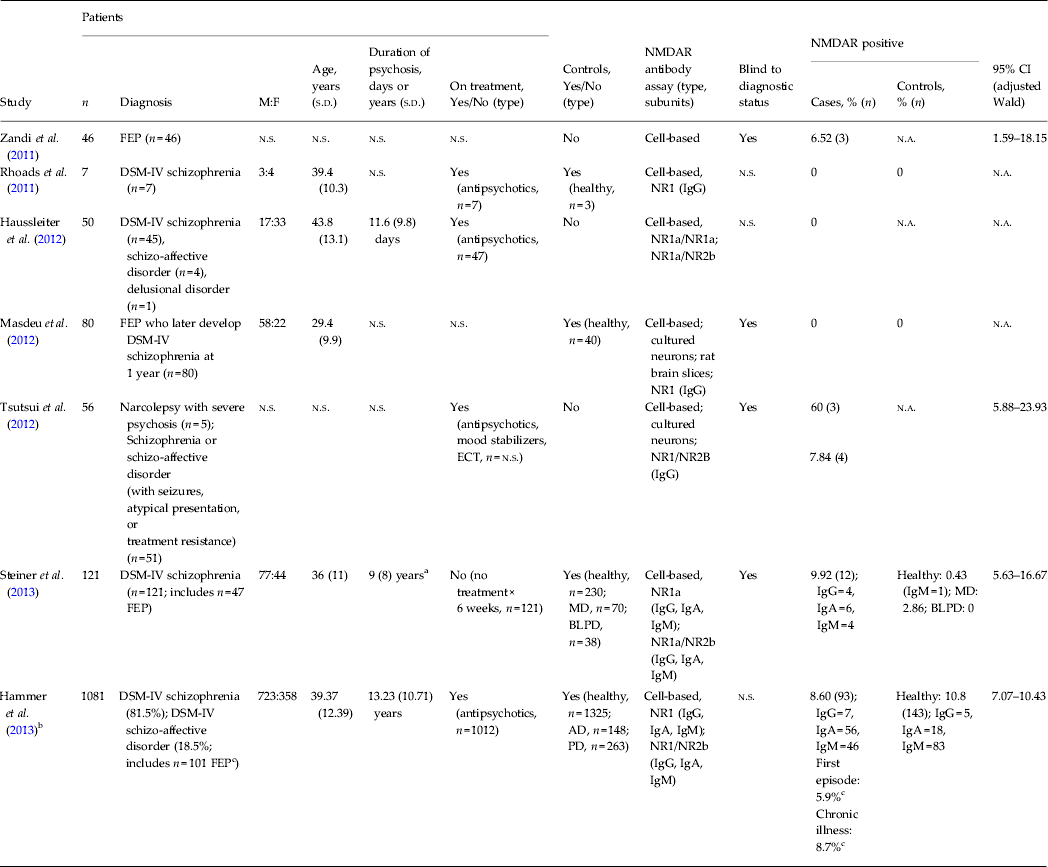
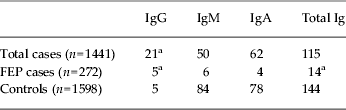
The seven remaining papers described the antibody status of 1441 patients and 1598 healthy controls in total (Rhoads et al. Reference Rhoads, Guirgis, McKnight and Duchemin2011; Zandi et al. Reference Zandi, Irani, Lang, Waters, Jones, McKenna, Coles, Vincent and Lennox2011; Haussleiter et al. Reference Haussleiter, Emons, Schaub, Borowski, Brune, Wandinger and Juckel2012; Masdeu et al. Reference Masdeu, Gonzalez-Pinto, Matute, Ruiz De Azua, Palomino, De Leon, Berman and Dalmau2012; Tsutsui et al. Reference Tsutsui, Kanbayashi, Tanaka, Boku, Ito, Tokunaga, Mori, Hishikawa, Shimizu and Nishino2012; Hammer et al. Reference Hammer, Stepniak, Schneider, Papiol, Tantra, Begemann, Siren, Pardo, Sperling, Mohd Jofrry, Gurvich, Jensen, Ostmeier, Luhder, Probst, Martens, Gillis, Saher, Assogna, Spalletta, Stocker, Schulz, Nave and Ehrenreich2013; Steiner et al. Reference Steiner, Walter, Glanz, Sarnyai, Bernstein, Vielhaber, Kastner, Skalej, Jordan, Schiltz, Klingbeil, Wandinger, Bogerts and Stoecker2013). There was significant heterogeneity in terms of patient characteristics, antibody assay used and control group. Two papers did not state whether antibody assays were carried out blinded to diagnostic status. These reported negative results, suggesting that knowledge of diagnostic papers is unlikely to be a significant source of bias in the selected studies. Patient characteristics and outcomes are outlined in Table 1. Prevalence figures in patient groups and controls are given in Table 2.
Patient characteristics and results

M, Male; F, female; s.d., standard deviation; NMDAR, N-methyl-d-aspartate receptor; n.s., not specified; CI, confidence interval; FEP, first-episode psychosis; IgG, immunoglobulin G; ECT, electroconvulsive therapy; MD, major depression; BLPD, borderline personality disorder; AD, affective disorders; PD, Parkinson's disease; n.a., not applicable;.
a Duration cited for non-first-episode schizophrenia cases only.
b Demographic information also taken from Ribbe et al. (Reference Ribbe, Friedrichs, Begemann, Grube, Papiol, Kastner, Gerchen, Ackermann, Tarami, Treitz, Flogel, Adler, Aldenhoff, Becker-Emner, Becker, Czernik, Dose, Folkerts, Freese, Gunther, Herpertz, Hesse, Kruse, Kunze, Franz, Lohrer, Maier, Mielke, Muller-Isberner, Oestereich, Pajonk, Pollmacher, Schneider, Schwarz, Kroner-Herwig, Havemann-Reinecke, Frahm, Stuhmer, Falkai, Brose, Nave and Ehrenreich2010).
c Unpublished data, personal communication, Prof. H. Ehrenreich, as follows (pertaining to Hammer et al. Reference Hammer, Stepniak, Schneider, Papiol, Tantra, Begemann, Siren, Pardo, Sperling, Mohd Jofrry, Gurvich, Jensen, Ostmeier, Luhder, Probst, Martens, Gillis, Saher, Assogna, Spalletta, Stocker, Schulz, Nave and Ehrenreich2013): ‘GRAS data collection: of 954 chronic patients, 8.7% were NMDAR-AB positive. Of 101 first-episode patients, 5.9% were positive (p = 0.599 after age correction). Of the six seropositive first-episode patients, none were IgG positive, one was IgA positive, four IgM positive, and one was positive for both IgA and IgM’.
Note: only IgG NR1 antibodies have been implicated as pathogenic in anti-NMDAR encephalitis.
Prevalence of anti-NMDA antibodies and subtype specificity in cases and controls

NMDA, N-methyl-d-aspartate; Ig, immunoglobulin; FEP, first-episode psychosis.
a Difference from controls, significance level = 0.05.
Of the 1441 patients, 115 (7.98%, 95% CI 6.69–9.50) were anti-NMDA receptor antibody positive. Of these, 21 (1.46%, 95% CI 0.94–2.23) patients were positive for antibodies of the IgG subclass. The remaining patients were IgA and/or IgM positive in the absence of IgG positivity.
Of all seven studies, only two found antibodies in control subjects. In the paper by Steiner et al. (Reference Steiner, Walter, Glanz, Sarnyai, Bernstein, Vielhaber, Kastner, Skalej, Jordan, Schiltz, Klingbeil, Wandinger, Bogerts and Stoecker2013), one healthy control subject out of 230 was antibody positive. In the paper by Hammer et al. (Reference Hammer, Stepniak, Schneider, Papiol, Tantra, Begemann, Siren, Pardo, Sperling, Mohd Jofrry, Gurvich, Jensen, Ostmeier, Luhder, Probst, Martens, Gillis, Saher, Assogna, Spalletta, Stocker, Schulz, Nave and Ehrenreich2013), 143 controls out of 1325 were antibody positive. In total, 144 of 1598 (9.01%, 95% CI 7.70–10.52) healthy controls were antibody positive.
The overall prevalence of NMDA antibodies of any subtype (IgG, IgM, IgA) was not significantly different between cases and controls (χ 2 = 1.03, p = 0.31). If only IgG antibodies were considered, the prevalence was significantly greater in cases than controls (χ 2 = 11.70, p < 0.01).
If only cases of first-onset psychosis were included in the analysis, 14 of 272 (5.15%, 95% CI 3.02–8.52) were found to be antibody positive. However, two of these patients were subsequently reclassified as meeting criteria for anti-NMDA receptor encephalitis, giving a more conservative figure of 12 out of 269 (4.46%, 95% CI 2.49–7.71). Of these 12, five patients had IgG antibodies.
The prevalence of NMDA antibodies of any subtype (IgG, IgM, IgA) was significantly greater in controls than in first-episode psychosis (FEP) patients (all controls in the study were entered into the analysis as insufficient information was given as to which controls in the selected studies had been matched to FEP patients; χ 2 = 4.49, p = 0.03). If only IgG antibodies were considered, the prevalence was significantly greater in FEP cases than controls (χ 2 = 10.17, p < 0.01).
Two patients in the study by Steiner et al. (Reference Steiner, Walter, Glanz, Sarnyai, Bernstein, Vielhaber, Kastner, Skalej, Jordan, Schiltz, Klingbeil, Wandinger, Bogerts and Stoecker2013) were reclassified as having anti-NMDA receptor encephalitis. Tsutsui et al. (Reference Tsutsui, Kanbayashi, Tanaka, Boku, Ito, Tokunaga, Mori, Hishikawa, Shimizu and Nishino2012) found that four of 51 patients with ‘atypical psychosis’ (a category used by Japanese researchers) were antibody positive. Two of these had ovarian tumours (one non-teratoma cyst), three had narcolepsy and two had ‘convulsions’; although the authors are clear that these patients did not meet the criteria for ‘typical encephalitis’, it is not obvious that these findings can be extended to a ‘purely psychiatric’ population with schizophrenia.
Methodologically, the most sophisticated study was that of Steiner et al. (Reference Steiner, Walter, Glanz, Sarnyai, Bernstein, Vielhaber, Kastner, Skalej, Jordan, Schiltz, Klingbeil, Wandinger, Bogerts and Stoecker2013), who used a prospective study design, ensured patients were medication free for at least 6 weeks, had both psychiatric (major depression and borderline personality disorder, with and without psychotic features) and non-psychiatric control groups and looked at multiple immunoglobulin subtypes aimed at different NMDA receptor epitopes.
Discussion
Current evidence suggests that anti-NMDA receptor autoantibodies are found in a small proportion of patients with schizophrenia or FEP. Further prospective, population-based studies are required to arrive at the most accurate estimate of this proportion.
An issue that pertains directly to the aetiological relevance of these antibodies is that of their prevalence in the general population. Overall, in the selected studies, 144 of 1598 healthy controls were anti-NMDA receptor antibody positive for any antibody subtype (although all but five of these controls subjects had antibodies of a non-IgG subtype). This was significantly greater than the proportion of antibody-positive psychotic patients. However, if the paper by Hammer et al. (Reference Hammer, Stepniak, Schneider, Papiol, Tantra, Begemann, Siren, Pardo, Sperling, Mohd Jofrry, Gurvich, Jensen, Ostmeier, Luhder, Probst, Martens, Gillis, Saher, Assogna, Spalletta, Stocker, Schulz, Nave and Ehrenreich2013) is excluded from the analysis, only one out of 273 healthy controls was antibody positive. This is in line with data from studies looking primarily at anti-NMDA encephalitis patients that have also tested healthy controls (e.g. Dalmau et al. Reference Dalmau, Tuzun, Wu, Masjuan, Rossi, Voloschin, Baehring, Shimazaki, Koide, King, Mason, Sansing, Dichter, Rosenfeld and Lynch2007; Irani et al. Reference Irani, Bera, Waters, Zuliani, Maxwell, Zandi, Friese, Galea, Kullmann, Beeson, Lang, Bien and Vincent2010; Wandinger et al. Reference Wandinger, Saschenbrecker, Stoecker and Dalmau2011), and that failed to find evidence of antibody positivity in healthy controls. The reasons for the strikingly different results of this study remain unclear: the authors of the discrepant paper suggest that the relatively greater age of their control population may have been relevant insofar as autoantibody prevalence correlates with age across both health and disease. A notable result in this meta-analysis was that rates of antibody positivity across all antibody subtypes were greater for controls than FEP patients; however, in this analysis controls were older than FEP patients, hence age-related differences may have influenced the result.
Further studies are required to establish whether this one discrepant study finding can be replicated. If, as is suggested by all studies except that by Hammer et al. (Reference Hammer, Stepniak, Schneider, Papiol, Tantra, Begemann, Siren, Pardo, Sperling, Mohd Jofrry, Gurvich, Jensen, Ostmeier, Luhder, Probst, Martens, Gillis, Saher, Assogna, Spalletta, Stocker, Schulz, Nave and Ehrenreich2013), anti-NMDA receptor antibodies are not found in the general population, this is an argument in favour of their clinical relevance in the patient groups in this study, although the possibility remains that even if antibodies are present in a patient population, they do not have aetiological relevance for the disease state in question.
There was heterogeneity between studies in terms of the assay used to establish the presence of the autoantibodies; this was reflective of the different methods preferred by the laboratories involved. Josep Dalmau, who identified these antibodies and first developed methods for their detection, has argued that the gold standard for their detection should involve three antigen-binding assays: (1) a recombinant cell-based assay using transfected cells expressing the antigen of interest; (2) cultured dissociated neurons; and (3) brain sections optimized for antigen presentation. According to Dalmau, if a patient's serum shows weak antibody positivity in the cell-based assay, either the other assays or a cell-based assay of CSF should be performed to verify the result and avoid false positives (Lancaster & Dalmau, Reference Lancaster and Dalmau2012). The study by Masdeu et al. (Reference Masdeu, Gonzalez-Pinto, Matute, Ruiz De Azua, Palomino, De Leon, Berman and Dalmau2012) was the only one of the studies selected for this review to use this three-stage methodology. It failed to find a single antibody-positive patient out of 80 patients with schizophrenia.
None of the selected studies with a positive result in patients reported performing any assay other than a cell-based assay and hence, by Dalmau's criteria, all had the potential to generate false-positive results.
Researchers in Angela Vincent's Oxford-based laboratory, however, have developed a cell-based assay modified from that used by Dalmau and colleagues that, they claim, is more sensitive than assays using cultured neurons or brain sections (Irani et al. Reference Irani, Bera, Waters, Zuliani, Maxwell, Zandi, Friese, Galea, Kullmann, Beeson, Lang, Bien and Vincent2010). This assay was used in the positive study by Zandi et al. (Reference Zandi, Irani, Lang, Waters, Jones, McKenna, Coles, Vincent and Lennox2011). Furthermore, researchers in Luebeck, Germany have developed an assay that they report demonstrates 100% sensitivity and specificity in detecting patients diagnosed with Dalmau's criteria (Wandinger et al. Reference Wandinger, Saschenbrecker, Stoecker and Dalmau2011); this assay was used in the positive study by Steiner et al. (Reference Steiner, Walter, Glanz, Sarnyai, Bernstein, Vielhaber, Kastner, Skalej, Jordan, Schiltz, Klingbeil, Wandinger, Bogerts and Stoecker2013). It is therefore not clear whether, as Dalmau's work would suggest, the positive studies in this review simply represent false-positive results, or whether the three-stage ‘gold standard’ criterion is in fact too stringent and may generate false-negative results when used in patients with a purely psychiatric presentation.
Another controversy concerns whether the presence of antibodies in CSF must be demonstrated to prove pathogenicity, as suggested by Dalmau and colleagues, or whether, as work by the Oxford laboratory suggests, serum testing is in fact more sensitive than CSF testing (Irani et al. Reference Irani, Bera, Waters, Zuliani, Maxwell, Zandi, Friese, Galea, Kullmann, Beeson, Lang, Bien and Vincent2010).
Clearly, for the prevalence of anti-NMDA receptor antibodies to be fully clarified in the setting of schizophrenia, there is a need to develop better assay platforms, possibly using recombinant antigens and highly sensitive radioimmunoassay. These will benefit from, for example, sharing of samples, blind testing and the development of standardization, as has been the case in other autoimmune conditions. As autoantibodies tend to wane over time, there is also a strong case for examining populations of patients with psychoses as close to first diagnosis as possible.
In addition, an external criterion, such as clinical response to immunological therapy would also be one argument in favour of the pathogenicity of any antibodies that are detected, by whatever method, in patients with psychosis. Similarly, early evidence of treatment responsiveness may be emerging.
Implications for understanding schizophrenia
If it was established that these antibodies were pathogenic in even a small proportion of patients with schizophrenia, it would be highly significant because it would fit comfortably within a conception of schizophrenia that puts NMDA receptor hypofunction in an aetiologically central position. From this perspective, antibody-positive patients might represent compelling evidence that endogenously mediated NMDA receptor antagonism in humans can cause a chronic psychotic illness or a phenocopy of schizophrenia.
In vitro and in vivo animal studies on anti-NMDA receptor IgG antibodies have demonstrated their pathogenicity to a high degree of likelihood in the initial cases of antibody-positive encephalitis (for discussion of the criteria that must be fulfilled to demonstrate autoimmune pathogenicity in such cases, see Moscato et al. Reference Moscato, Jain, Peng, Hughes, Dalmau and Balice-Gordon2010). The only similar work suggesting pathogenicity of these antibodies as they occur in psychotic patients without the full encephalitic syndrome is described in the study by Hammer et al. (Reference Hammer, Stepniak, Schneider, Papiol, Tantra, Begemann, Siren, Pardo, Sperling, Mohd Jofrry, Gurvich, Jensen, Ostmeier, Luhder, Probst, Martens, Gillis, Saher, Assogna, Spalletta, Stocker, Schulz, Nave and Ehrenreich2013), who found that injection of IgM, IgG or IgA from schizophrenic patients with anti-NMDA antibodies led to alterations in spontaneous and MK-801-induced open field activity (a putatively psychosis-like measure) in mice with a deficient blood–brain barrier (BBB) but not in mice with an intact BBB. Cellular effects of antibodies from such patients have not yet been reported.
Diagnostically and nosologically, the studies reviewed in this paper raise important questions. If the autoantibodies can be demonstrated to have a pathogenic role in antibody-positive patients with a diagnosis of schizophrenia, can these patients really be said to have schizophrenia? This issue of ‘diagnostic bias’ is central here. A recent observational study of 507 patients with confirmed anti-NMDA receptor encephalitis described 23 patients who presented, either during a first episode or a relapse, with isolated psychiatric (largely psychotic) symptoms (Kayser et al. Reference Kayser, Titulaer, Gresa-Arribas and Dalmau2013). Had the first-episode patients not presented to neurology services (they did so on the basis of abnormalities on brain imaging), it is conceivable that they would have remained in the psychiatric system, possibly with a diagnosis of schizophrenia; once a diagnosis of encephalitis is made, however, a diagnosis of schizophrenia is excluded. Conversely, as CSF analyses, electroencephalography (EEG) and measurement of anti-neuronal antibodies are not part of the standard work-up of patients with psychosis who present to psychiatric services, the diagnostic bias in psychiatric services is towards a diagnosis of primary psychiatric disorder such as schizophrenia.
Steiner et al. (Reference Steiner, Walter, Glanz, Sarnyai, Bernstein, Vielhaber, Kastner, Skalej, Jordan, Schiltz, Klingbeil, Wandinger, Bogerts and Stoecker2013) retrospectively reclassified two of their FEP patients as suffering from anti-NMDA receptor encephalitis; this reclassification occurred on the basis of the development of catatonic features, neurological and autonomic deterioration plus the finding of specific IgG antibodies against NR1a in the serum and CSF. These seem uncontroversially to be special cases of ‘missed encephalitis’; it is more difficult to know what to make of the antibody-positive patients with seizures in the study by Tsutsui et al. (Reference Tsutsui, Kanbayashi, Tanaka, Boku, Ito, Tokunaga, Mori, Hishikawa, Shimizu and Nishino2012), because the authors are explicit that these patients did not meet the criteria for anti-NMDA receptor encephalitis.
On the one hand, antibody-positive, non-encephalitic psychotic patients might be seen as suffering from a partial form of the full encephalitic syndrome; the implication here may be that there is a continuum of expression of antibody positivity, perhaps with catatonic presentations of psychosis occupying a middle ground between relatively ‘pure’ psychotic presentations at one end and the potentially moribund encephalitic end-point at the other. This formulation has elements in common with Bechter's ‘mild encephalitis’ model of schizophrenia (Bechter, Reference Bechter2013). How an individual clinically presents on this continuum may be determined by several factors, potentially including antibody titre, antibody subtype and anatomical distribution of antibody binding within the brain. It is interesting to consider that cases of autonomic collapse, catatonia and neurological dysfunction in acutely disturbed or psychotic patients in psychiatric settings are not uncommon, particularly in psychiatric intensive care settings, and are often diagnosed as ‘likely neuroleptic malignant syndrome’. It has been suggested that such cases may in fact be missed cases of anti-NMDA-mediated disease (Punja et al. Reference Punja, Pomerleau, Devlin, Morgan, Schier and Schwartz2013).
On the other hand, it may turn out that there are sharp discontinuities at the molecular, if not at the clinical, level between antibody-positive schizophrenia patients and patients with encephalitis, a possibility suggested by Steiner et al. (Reference Steiner, Walter, Glanz, Sarnyai, Bernstein, Vielhaber, Kastner, Skalej, Jordan, Schiltz, Klingbeil, Wandinger, Bogerts and Stoecker2013), who found that antibody-positive schizophrenia patients tended to have a differential profile of antibody subtypes to that reported as characteristic of anti-NMDA receptor encephalitis.
As with all so-called functional mental illnesses, psychiatric classificatory systems such as DSM-IV and ICD-10 specify the presence of potentially causal organic pathology as an exclusion criterion for a diagnosis of schizophrenia. By these standards, it could be argued, antibody-positive patients may not in future be identified as suffering from schizophrenia. Alternatively, since the advent of non-invasive neuroimaging, we have come to expect a small proportion of patients diagnosed with schizophrenia to have brain abnormalities (cysts, developmental anomalies, inflammatory lesions, etc.) and accept this within the notion of heterogeneity of schizophrenia (or, as Bleuler suggested, ‘the group of schizophrenias’). The difference will be if a new brand of abnormalities comes to be regarded as specifically pathogenic rather than mere factors associated with the disorder. Thus, as our biological understanding of schizophrenia grows, our diagnostic boundaries will expand, divide or otherwise change to accommodate this new understanding. These issues are particularly relevant in light of studies suggesting that many other synaptic protein autoantibodies known to cause encephalitis, such as those directed to the voltage-gated potassium channel complex or the α-amino-3-hydroxy-5-methyl-4-isoxazolepropionic acid (AMPA) receptor, may also have pathogenic relevance in patients with a more purely psychiatric presentation (Lennox et al. Reference Lennox, Coles and Vincent2012).
Although this review has focused on schizophrenia, anti-NMDA receptor antibody positivity of one form or another has also been reported in other neuropsychiatric patient groups, including mania (Dickerson et al. Reference Dickerson, Stallings, Vaughan, Origoni, Khushalani and Yolken2012), slow cognitive decline (Pruss et al. Reference Pruss, Holtje, Maier, Gomez, Buchert, Harms, Ahnert-Hilger, Schmitz, Terborg, Kopp, Klingbeil, Probst, Kohler, Schwab, Stoecker, Dalmau and Wandinger2012), narcolepsy with psychotic features (Tsutsui et al. Reference Tsutsui, Kanbayashi, Tanaka, Boku, Ito, Tokunaga, Mori, Hishikawa, Shimizu and Nishino2012), early-onset autism (Scott et al. Reference Scott, Richer, Forbes, Sonnenberg, Currie, Eliyashevska and Goez2013) and late-onset autism (Creten et al. Reference Creten, van der Zwaan, Blankespoor, Maatkamp, Nicolai, van Os and Schieveld2011). What causal role, if any, can be attributed to these antibodies remains unknown; the fact that they occur in these clinically distinct populations demands explanation. It is unlikely that the psychiatric specificity of these antibodies, once known, will respect DSM boundaries. Some patients with variant Creutzfeld–Jacob disease have been found to demonstrate anti-NMDA receptor antibody positivity (Mackay et al. Reference Mackay, Ahmad, Stone, Sudlow, Summers, Knight, Will, Irani, Vincent and Maddison2012): given the clearly defined aetiology of this disorder, this serves as a timely reminder against inferring causality over epiphenomenon. In particular, the possibility that anti-NMDA antibody formation occurs as an event secondary to neuronal damage due to some other cause is a plausible explanation for antibody positivity among diverse patient groups.
Relevance of antibody subtypes and targets
The NMDA receptor is a tetrameric complex made up of the obligate NR1 subunit, which binds glycine, and the NR2 (A–D) subunit, which binds glutamate. The subunits bind heteromerically to form different subtypes of the NMDA receptor, with distinct distributions (on a synaptic and whole-brain level) and pharmacological properties. As NR1 is an obligate subunit, it is expressed ubiquitously. The observation that some non-encephalitic antibody-positive cases had either IgA or IgM antibodies or were directed against the NR1/NR2B complex, rather than IgG antibodies directed against the NR1 subunit as in the full-blown encephalitic syndrome, is on the face of it suggestive that the pathological process occurring in the two cases is quite distinct (Steiner et al. Reference Steiner, Walter, Glanz, Sarnyai, Bernstein, Vielhaber, Kastner, Skalej, Jordan, Schiltz, Klingbeil, Wandinger, Bogerts and Stoecker2013). IgG is the predominant immunoglobulin subtype in humans and can cross the placenta whereas IgM is the most efficient complement-fixing subclass and is involved in the early stages of the B-cell-mediated immune response, and IgA plays a key role in mucosal immunity.
Higher rates of antibody positivity were seen in cases (both overall and first episode) compared to controls when only IgG antibody was considered, but not when antibodies of any subtype were included in the analysis. Many patients in the selected studies were positive for antibodies of the IgA or IgM subtypes but negative for IgG antibodies; the aetiological relevance of these antibodies is unclear because pathogenicity has been most convincingly demonstrated for NR1 IgG antibodies. However, we suggest that non-IgG antibodies may have pathogenic relevance and it is unwarranted to discount this simply on the basis that they are not the pathogenic antibodies in anti-NMDA receptor encephalitis. By way of support for the relevance of non-IgG antibodies, IgA anti-NMDA receptor antibodies have been shown to decrease membrane NMDA receptor numbers and alter NMDA-mediated currents (Pruss et al. Reference Pruss, Holtje, Maier, Gomez, Buchert, Harms, Ahnert-Hilger, Schmitz, Terborg, Kopp, Klingbeil, Probst, Kohler, Schwab, Stoecker, Dalmau and Wandinger2012). Additionally, IgM and IgA antibodies from anti-NMDA antibody-positive schizophrenic patients caused prominent behavioural changes in mice with impaired BBB integrity (Hammer et al. Reference Hammer, Stepniak, Schneider, Papiol, Tantra, Begemann, Siren, Pardo, Sperling, Mohd Jofrry, Gurvich, Jensen, Ostmeier, Luhder, Probst, Martens, Gillis, Saher, Assogna, Spalletta, Stocker, Schulz, Nave and Ehrenreich2013). Finally, IgM from a single subject with a bipolar affective presentation and extrapyramidal signs reduced numbers of NMDA receptors in vitro, whereas serum taken from the same patient after successful immunotherapy did not (Choe et al. Reference Choe, Karamatskos, Schattling, Leypoldt, Liuzzi, Gerloff, Friese and Mulert2013). It therefore remains to be established whether these antibodies have functional effects in humans in vivo.
Because of methodological differences, some studies tested directly for antibodies against the NR1 subunit whereas others tested for antibodies with the NR1/NR2 heterodimer as a target. It is not clear that these methods pick out the same antibodies, particularly because the study by Steiner et al. (Reference Steiner, Walter, Glanz, Sarnyai, Bernstein, Vielhaber, Kastner, Skalej, Jordan, Schiltz, Klingbeil, Wandinger, Bogerts and Stoecker2013) found two schizophrenia patients with antibodies reactive to the heterodimer but not to NR1 alone. By contrast, the cell-based assay described in the much larger study by Hammer et al. (Reference Hammer, Stepniak, Schneider, Papiol, Tantra, Begemann, Siren, Pardo, Sperling, Mohd Jofrry, Gurvich, Jensen, Ostmeier, Luhder, Probst, Martens, Gillis, Saher, Assogna, Spalletta, Stocker, Schulz, Nave and Ehrenreich2013) used cells transfected with NR1 and with the heterodimer and failed to find a fluorescent signal that was present for the heterodimer-transfected cells that was not also present for the NR1-transfected cells, suggesting equivalence of methods. Parallel in vitro characterization of both antibody types would be one way of establishing whether they were equivalent and therefore whether they have different pathogenic implications when found in the sera of psychotic patients.
Of note, neuropsychiatric systemic lupus erythematosus (SLE) is associated with antibodies against the NR2A and NR2B subunits of the NMDA receptor. It has been suggested that a subset of the antibodies against double-stranded DNA, which are characteristic of SLE, cross-react with a single epitope present in the extracellular region of these subunits, causing synaptic dysfunction at low doses and cell death at higher doses (Lauvsnes & Omdal, Reference Lauvsnes and Omdal2012). These cases frequently present with psychosis, which is at least suggestive that the psychotogenic effects of antibody-mediated NMDA receptor antagonism is not subtype specific (although note that antibodies against the NR2 peptide are also reported to be increased in ischaemic stroke and epilepsy and are thought in these conditions to be markers of cell death; Bokesch et al. Reference Bokesch, Izykenova, Justice, Easley and Dambinova2006; Weissman et al. Reference Weissman, Khunteev, Heath and Dambinova2011).
Implications for treatment
Anti-NMDA receptor encephalitis is potentially treatable although there is thought to be an initial ‘treatment window’ for immunotherapy. The synaptic effects of these antibodies have been demonstrated to be reversible (Hughes et al. Reference Hughes, Peng, Gleichman, Lai, Zhou, Tsou, Parsons, Lynch, Dalmau and Balice-Gordon2010) and have not been shown to cause cell death in vivo, nor is there evidence of complement-mediated cell lysis in postmortem subjects. Early treatment predicts a better outcome generally (Titulaer et al. Reference Titulaer, McCracken, Gabilondo, Armangue, Glaser, Iizuka, Honig, Benseler, Kawachi, Martinez-Hernandez, Aguilar, Gresa-Arribas, Ryan-Florance, Torrents, Saiz, Rosenfeld, Balice-Gordon, Graus and Dalmau2013) and in terms of cognitive function (Finke et al. Reference Finke, Kopp, Pruss, Dalmau, Wandinger and Ploner2012).
Given that a proportion of patients with psychosis are anti-NMDA receptor antibody positive and that these antibodies may be pathogenic in these patients, it is natural to ask, as Susannah Cahalan asks in the quotation that begins this review, whether some proportion of patients with schizophrenia might have an illness that responds to immunological therapy.
Zandi et al. (Reference Zandi, Irani, Lang, Waters, Jones, McKenna, Coles, Vincent and Lennox2011) reported one of their anti-NMDA receptor antibody-positive FEP cases resolving with plasmapheresis and steroid treatment. Early uncontrolled work by groups looking at the response to immunomodulatory therapies in antibody-positive psychotic patients (some of whom are not responsive to traditional antipsychotic medication) suggests promising results (Lennox et al. Reference Lennox, Deakin, Zandi, Scoriels, Cox, Coles and Vincent2013). Furthermore, the majority of patients diagnosed with anti-NMDA receptor encephalitis who presented with isolated psychiatric symptoms at first episode or during relapse responded well to immunotherapy (Kayser et al. Reference Kayser, Titulaer, Gresa-Arribas and Dalmau2013).
In addition to the field of neuroimmunology, important treatment advances may also come from within the field of psychiatry. The past few years have seen great interest in the development of drugs for schizophrenia that target the glutamatergic system (Papanastasiou et al. Reference Papanastasiou, Stone and Shergill2013). Although work is ongoing, effect sizes are often modest and some of the compounds with the greatest initial promise (such as the metabotropic glutamate receptor 2/3 agonist LY2 140 023) have performed disappointingly in patient trials (Kinon et al. Reference Kinon, Zhang, Millen, Osuntokun, Williams, Kollack-Walker, Jackson, Kryzhanovskaya and Jarkova2011). It has been suggested that such underperformance might be an inevitable consequence of the likely heterogeneity of the schizophrenic cohorts recruited into trials. Targeting NMDA antibody-positive patients in trials of glumatergic potential novel antipsychotics may be a principled next step in finessing our understanding of these compounds and their clinical applications.
Finally, recent imaging studies suggest that treatment-resistant schizophrenic patients have normal dopaminergic neurotransmission (Demjaha et al. Reference Demjaha, Murray, McGuire, Kapur and Howes2012) and that these patients may have abnormalities in the glutamate system (Egerton et al. Reference Egerton, Brugger, Raffin, Barker, Lythgoe, McGuire and Stone2012). It is interesting to speculate whether some treatment-resistant cases would have an autoimmune aetiology to this glutamatergic dysfunction.
Implications for the assessment of psychotic patients
Some authors have recommended the routine screening for anti-NMDA antibodies of all patients with a first presentation of psychosis (Lennox et al. Reference Lennox, Coles and Vincent2012). Before this suggestion is taken up, further information on several issues is required. First, using state-of-the-art assays, we need to know the baseline prevalence of positive tests in the general population or even in ‘enriched’ populations such as, for example, all those presenting to psychiatric services. The studies reviewed in this article have produced conflicting results. Even a very small proportion would make screening unfeasible based on the simple arithmetic of likely sensitivities and specificities. Second, a prerequisite of screening is that those screened positive should have available to them a safe and effective treatment. Building an evidence base for such a treatment has only recently begun.
Furthermore, it is important to be clear that, even if it is accepted that a proportion of patients with a first presentation of psychosis have anti-NMDA receptor antibodies, this does not mean that they will all go on to develop the syndrome of anti-NMDA receptor encephalitis as it is currently understood by neurologists. What is being suggested in this review is that some proportion of FEP patients may have an autoimmune-mediated psychotic illness. Of this proportion, a percentage may go on to develop a full-blown encephalitis (which is known to be responsive to immunotherapy) whereas the remainder may not.
The association between these antibodies and catatonia merits special attention: anti-NMDA receptor encephalitis frequently presents with or develops into catatonia. Pharmacological NMDA antagonism in humans and animals can cause a state that some authors describe as catatonic (Corlett et al. Reference Corlett, Honey, Krystal and Fletcher2011). Although catatonia is a loose label applied to a heterogeneous condition that also occurs in non-psychotic psychiatric illnesses and in non-psychiatric medical conditions (Daniels, Reference Daniels2009; Fink, Reference Fink2013), some authors have linked its occurrence in schizophrenia to dysfunction of the glutamatergic system (Northoff, Reference Northoff2002). The increasing use of memantine, a non-competitive NMDA antagonist, in the treatment of catatonia, is indirectly supportive of a glutamatergic basis for catatonic symptoms (Carroll et al. Reference Carroll, Goforth, Thomas, Ahuja, McDaniel, Kraus, Spiegel, Franco, Pozuelo and Munoz2007; Obregon et al. Reference Obregon, Velasco, Wuerz, Catalano, Catalano and Kahn2011). Clinical experience reported by groups screening for antibodies in psychotic patients suggests that antibody-positive patients frequently have a catatonic presentation. It is therefore important to determine whether screening psychotic patients who present with catatonia for anti-NMDA receptor antibodies will yield positives.
Conclusions
This review of the existing literature suggests that a significant minority of patients presenting with psychosis in the absence of other encephalitic features are anti-NMDA receptor antibody positive but that prevalence rates only differ from the general population with regard to antibodies of the IgG subclass. These patients may represent a discrete subgroup of psychotic patients in terms of their underlying pathophysiology and response to treatment. On the current evidence, some anti-NMDA receptor antibody-positive cases are clinically indistinguishable from antibody-negative cases, suggesting that further research is needed to establish the full pathological implications of such antibodies, and crucially, there is a need to be confident that ‘false positives’ are truly exceptional with standard tests. Similarly, the prevalence of positive test results in other diverse neurological and psychiatric populations needs to be quantified definitively. Currently, there are only a few published reports of immunotherapy for ‘purely psychiatric’ presentations of psychosis, therefore as yet there is no clear evidence for treatment to deviate from the standard management of psychosis. However, this is an exciting area of active research and may soon change.
Acknowledgements
We thank Dr B. Lennox, Prof. A. Vincent, Prof. H. Ehrenreich, Dr A. Church and Prof. T. Kanbayashi for their valuable advice and contributions.
Declaration of Interest
None.