Introduction
Until recently, very little attention has been given to adolescent nutrition and growth performance in developing countries, even though approximately a quarter of the population falls into this age group, as defined by the World Health Organization as individuals between the ages of 10 and 19 years (Kurz & Johnson-Welch, Reference Kurz and Johnson-Welch1994; Kurz, Reference Charturvudi, Kapal, Gnanasekeren, Sachdev, Pandey and Bhanti1996; Allen & Gillespie, Reference Allen and Gillespie2001; Cordeiro et al., Reference Cordeiro, Lamstein, Mahmud and Levinson2006). In these countries, the focus of adolescents' health has primarily been on reproductive and sexual health such as pregnancy and sexually transmitted diseases, including HIV, to the exclusion of nutrition (Kurz, Reference Kurz1996). The few available studies on adolescents show the prevalence of malnutrition, as evidenced by stunting, underweight, anaemia and micronutrient deficiencies, to be high (Kurz, Reference Kurz1996; Charturvudi et al., Reference Charturvudi, Kapal, Gnanasekeren, Sachdev, Pandey and Bhanti1996; Anand et al., Reference Anand, Kant and Kapoor1999; Mukuddem-Peterson & Kruger, Reference Mukuddem-Petersen and Kruger2004; Deshmurkh et al., 2006). However, due to the sheer magnitude of the problem of undernutrition in developing countries and its links to child mortality, the focus remains on child and maternal nutrition (UNICEF, 2009). According to a recent UNICEF report, 41% of children under the age of five years in Nigeria are moderately or severely stunted (UNICEF, 2009) and as such, a strong call for interventions to be focused on children under five years and mothers has been released, limiting adolescents to interventions only through the ‘maternal’ route.
Adolescence is the only period following birth when the relatively uniform growth of childhood increases in velocity (Spear, Reference Spear and Rickert1996), thereby creating special nutritional needs during a period of transition from childhood to adulthood. If the demands are not met, growth can become compromised with serious consequences (UNICEF, 2005a). Furthermore, in several developing countries such as Nigeria, 20% of females are married by age 15 and over a half (52.7%) by age 20 (National Population Commission, 2000), increasing their nutritional demands and exposing them to additional risks and consequences such as maternal mortality, pregnancy complications and the delivery of low birth weight infants if adequate growth had not been achieved (Cordeiro et al., 2006).
Gender differences and variations in the onset of sexual maturation are very important aspects to consider in the nutritional assessment of adolescents (Cordeiro et al., 2006). The patterns of growth for males and females appear to follow different paths, with implications for interventions (Kurz, Reference Kurz1996). Studies suggest that in developing countries, females are closer to the international reference standards for height and weight when compared with males, and adverse environments have a greater impact on the growth of males (Kurz, Reference Kurz1996; Venkaiah et al., Reference Venkaiah, Damayanti, Nayak and Vijayaraghavan2002; Cordeiro et al., 2006; Wamani et al., Reference Wamani, Astrøm, Peterson, Tumwine and Tylleskär2007; Ayoola et al., Reference Ayoola, Ebersole, Omotade, Tayo, Brieger, Salami, Dugas, Cooper and Luke2009). Poverty and low socioeconomic status were found to cause greater stunting in boys when compared with girls in rural Uganda (Wamani et al., Reference Wamani, Tylleskär, Astrøm, Tumwine and Peterson2004). While the timing of sexual development influences the height and weight changes of adolescents, nutritional status is also affected by the onset of menarche and other pubertal changes (Chowdhury et al., Reference Chowdhury, Shahabuddin, Seal, Talukder, Hassan and Begum2000). Cordeiro et al. (2006) recommend that both physiological and chronological ages be considered in assessments of adolescents' nutritional status.
High rates of poverty and low socioeconomic levels prevail in most developing countries, taking their toll on diet and nutritional status (Igbedioh, Reference Igbedioh1993; UNICEF, 2009). According to Tanner (Reference Tanner, Ulijaszek, Johnston and Preece1998), who coined the phrase ‘growth as a mirror of the conditions of society’, the growth and development of children and adolescents have been described as consistent indicators of the health and nutrition of the society in which they live. A low height-for-age, also known as stunting and an indicator for chronic malnutrition, is said to capture the multiple factors impacting a child's health such as low birth weight, poor psychosocial stimulation, inadequate nutrition and recurrent infections (Cole & Parkin, Reference Cole and Parkin1977; Espo et al., Reference Espo, Kulmala, Maleta, Cullinan, Salin and Ashorn2002; Wamani et al., Reference Wamani, Astrøm, Peterson, Tumwine and Tylleskär2007; Grantham-McGregor et al., Reference Grantham-McGregor, Cheung, Cueto, Glewwe and Richter2007).
Several societies have shown a trend towards greater height and earlier sexual maturation with improvement in socioeconomic factors, as evidenced by Greece, which remained an underdeveloped country through most of the 20th century and attained development in the 1970s (Papadimitriou et al., Reference Papadimitriou, Chiotis, Tsiftis, Hatzisimeon, Maniati, Krikos, Tzonou and Dacou-Voutetakis2002). In line with the socioeconomic changes, height gain at age 17 for Greek boys from 1928 to 2001 was 11.8 cm and 7.3 cm for girls. In 1968 recruits living in urban Greece were significantly taller than those living in rural areas, but by 1990 there were no height differences (Papadimitriou et al., Reference Papadimitriou, Chiotis, Tsiftis, Hatzisimeon, Maniati, Krikos, Tzonou and Dacou-Voutetakis2002). Deprived versus affluent and rural versus urban differences in nutritional status still persist in several regions of the world (Schwekendiek, Reference Schwekendiek2009).
Aside from nutrition, other important factors that have been found to influence the growth of adolescents are parental education, socioeconomic class and disease. In a study of 720 children in rural Uganda, mother's education was the only independent predictor of stunting, with children of mothers without any formal education being two times more likely to be stunted than those whose mothers had greater than primary education (Wamani et al., Reference Wamani, Tylleskär, Astrøm, Tumwine and Peterson2004). Several diseases are nutritionally related, and especially those linked closely to poverty (Temple & Burkitt, Reference Temple and Burkitt1994). Recurrent infections and parasitic infestations are often cited as primary causes of linear growth faltering in children (Martorell et al., Reference Martorell, Khan and Schroeder1994; Abioye-Kuteyi et al., Reference Abioye-Kuteyi, Ojofeitimi, Aina, Kio, Aluko and Mosuro1997; Cole, Reference Cole2000; Beasley et al, Reference Beasley, Brooker, Ndinaromtan, Madjiouroum, Baboguel, Djenguinabe and Bundy2002).
The neglect of the study of adolescent nutrition still persists in Nigeria, and there are few studies focusing on nutritional health during this period of increased nutritional need. Study samples have been limited to girls, sexual maturity has not been taken into consideration, correlates have not been determined and in some studies international growth standards have not been used for comparison (Dieojomaoh & Faal, Reference Dieojomaoh and Faal1982; Brabin et al., Reference Brabin, Ikimalo, Dollimore, Kemp, Ikokwu-Wonodi, Babatunde, Obunge and Briggs1997; Cole et al., Reference Cole, Taiwo, Nwagbara and Cole1997; Fawole et al., Reference Fawole, Obisesan, Ojengbede, Babarinsa, Cole, Fawole and Arowojolu2005). One study reported twice the rate of stunting (10.4%) in rural compared with urban (4.7%) girls in south-east Nigeria (Brabin et al., Reference Brabin, Ikimalo, Dollimore, Kemp, Ikokwu-Wonodi, Babatunde, Obunge and Briggs1997).
A recently published report on the relative height and weight of males and females aged 5–30 years in south-west Nigeria had comparisons with National Centre for Health Statistics (NCHS) and WHO reference data (Kuczmarski et al., Reference Kuczmarski, Ogden, Grummer-Strawn, Flegal, Guo and Wei2000). The sample was limited to individuals living in a rural area (Ayoola et al., Reference Ayoola, Ebersole, Omotade, Tayo, Brieger, Salami, Dugas, Cooper and Luke2009). In the study, more than 60% of males aged 13–16 years were stunted and the prevalence of underweight was highest during the adolescent period in males aged 13–14 years (36.8%) and females aged 11–12 years (22.7%). No correlates for malnutrition were identified and sexual maturity was not determined.
Nigeria has an estimated population of 148 million people with over 50% being children and adolescents (World Bank, 2009). Unfortunately this oil-rich country with a sizeable natural resource base is ranked as number 158 out of 177 countries in the world in terms of human development index. Due to economic reforms by the government in the 1980s, the incidence of poverty increased tremendously from 28.1% in 1980 to 65.6% in 1996 (Federal Office of Statistics, 1999; Yusuf et al., Reference Yusuf, Adesanoye and Awotide2008) and since the 1990s, there has been a marked drop in life expectancy from 51 to 43 years (UNICEF, 2005b; Central Intelligence Agency, 2009).
The aim of this study is to present the height and weight patterns, disaggregated by region, and the prevalence of stunting and underweight (defined as height-for-age and body mass index (BMI)-for-age respectively) less than 2 SDs of the 2007 WHO reference data and overweight as those with BMIs above 1 SD (De Onis, Reference De Onis, Onyango, Borghi, Siyam, Nishida and Siekmann2007), of school-going adolescents aged 10–19 years. The influence of nutritional status on sexual development, determined by reported age of menarche for girls and age of attaining adult voice for boys, and several socio-demographic variables, is also examined.
Methods
Setting
This study was carried out in Ibadan. This is a region in south-west Nigeria lying in the equatorial rain forest with an estimated population of about 2,550,593 people, living in either a central urban core or a rural periphery. The central urban core has a population of 1,338,659 (52%) living in five districts (also known as local government areas) consisting mainly of unplanned, overcrowded slums consisting of old and low-quality residences with no identifiable sanitation facilities. There are squatting areas and there are also low- and medium-income residential areas better controlled by planning authorities but with illegal squatting and unplanned outskirts along major traffic routes (UN-Habitat, 2003). A few planned residential areas exist.
The rural periphery, consisting of six districts, is located an average of two hours' drive from the main urban centre. This consists of mostly farming communities, with other artisan occupations such as petty traders, carpenters, cobblers and palm wine tappers.
School setting
The sample for this study was taken from adolescents in secondary schools. Schools are classified as either public or private schools depending on the source of funding. Public schools are funded by the government and in the region where this study was carried out tuition is free in secondary schools. Private schools are funded by individuals, corporate organizations and religious bodies and tuition fees are charged. In Nigeria, the type of school a child attends depends on the environment where the child lives and the parent's socioeconomic status. Most children from affluent and middle class families attend private schools while the children of low socioeconomic status are in public schools. The main factor affecting choice is financial means (Adekoya-Sofowora et al., Reference Adekoya-Sofowora, Nasir, Oginni and Taiwo2006). A visit to most public schools in Ibadan land would reveal dilapidated infrastructure with overcrowding (Adebayo, Reference Adebayo2009). Urban areas have both public and private schools, but in the remote rural farming communities there are no private schools and the few government-owned schools are in a state of disrepair.
Sampling
The target population were all students in secondary schools in the eleven districts of Ibadan. From the five urban and six rural districts, three urban and two rural districts were randomly selected and eighteen schools were sampled from the 101 schools in the five districts, based on probability proportional to size. Thus, districts with more schools had a greater number of selected schools and the population of students selected in each school was determined proportionally using the size of the school. Students were randomly selected from each of the six classes in grades 7 to 12, and in the final sample there were five rural schools, nine urban public schools and four urban private schools. There were no private schools in the rural areas.
This was a part of a larger study on the mental and physical health of adolescents. Therefore, based on an estimated prevalence of mental health problems of 20% (Jegede & Cederblad, Reference Jegede, Cederblad, Chiland and Young1990; Gureje et al., Reference Gureje, Omigbodun, Gater, Ikuesan and Morris1994), a minimum sample size of 1345 students was obtained, which was increased to 2000 to accommodate for attrition.
Information about the total number of students in each school, the class and the gender ratio was used to obtain the number of students to be involved in the study proportionally. The Table of Random Digits was used to select students, either from the class register or by allocation of a number to sitting position in the class.
Ethical issues
The Oyo State Ministry of Health Institutional Review Board gave ethical approval for the study and ethical principles were observed in line with internationally and locally accepted standards. A few days before administration of the instruments, the schools were visited and students were chosen. A consent form explaining the purpose and procedure of the study in both English and Yoruba was available for both the student and the parent/guardian to sign if they agreed to participate. Students were given the option of giving consent for both the interview and physical examination or the interview only.
Procedure
Before the physical examination, each student was given a pencil and an eraser. The seating arrangement was such that each student had adequate privacy to complete the questionnaire on their own. The administration of the questionnaire was done in both the local language, Yoruba, which is the mother tongue, and in English, the language of instruction in secondary schools. All questionnaires had been translated into the local language, Yoruba, using the back-translation method. Every student was given the option to choose either an English or Yoruba questionnaire. However, to ensure that each student had access to both languages, the researchers stayed in front of each class or hall and each question was read aloud in both English and Yoruba by two of the researchers. Respondents were encouraged to seek clarification during this process.
Anthropometry
For cultural reasons, females were examined by a female paediatrician and nutritionist and the males by a male senior resident in the Child and Adolescent Psychiatric Unit, University College Hospital, Ibadan, Nigeria. A physical examination was performed on each student; anthropometric measurements (weight and height) were taken and the findings recorded in a section on the questionnaire. The weight was measured using a standardized, flat weighing scale (Hanson, model 89p, Ireland), which was checked for zero error before each measurement was taken and then read to the nearest 0.1 kg. Each adolescent was weighed bare-foot and in school uniform of light material because of the hot tropical weather and without a coat or a jacket.
A measuring tape fixed to the wall was used for measurement of height. The adolescent was asked to stand upright on the floor in front of the wall and with their bare heels together, their back straight and their heels, buttocks and shoulders touching the fixed measuring tape. The head was placed such that the left tragus and the lowest point of the inferior margin of the left orbit were in the same plane (Frankfort plane horizontal). A rigid rule was then brought to the crown of the head and the measurement taken in centimetres and read to the nearest 1.0 cm.
To reduce measurement errors, the two evaluators received training in the measurement procedures with particular emphasis on subject positioning and instrument application. In addition, the instruments used were checked periodically to ensure measurements were accurate (Waterlow et al., Reference Waterlow, Buzina, Keller, Lane, Nichaman and Tanner1977).
Each student who gave consent was examined to determine their stage of sexual development using Tanner's staging and to identify obvious physical disabilities (to be reported elsewhere).
Data analysis
The data were entered and analysed in SPSS version 12.0. Median values, means and standard deviations were calculated for all quantitative variables and anthropometric variables by age and sex. Categorical variables were summarized using frequencies and percentages. Differences between the sexes were investigated using Student's two-tailed t-test. The 2007 WHO reference values (De Onis, Reference De Onis, Onyango, Borghi, Siyam, Nishida and Siekmann2007) were used to assess nutritional status (underweight, stunting and overweight). Subjects whose height and BMI were below 2 SDs of the WHO/NCHS reference were classified as having low height-for-age (stunting) and low BMI-for-age (underweight) respectively. Those with BMIs above 1 SD were classified as overweight.
Association between nutritional status, socio-demographic and dietary behaviours was tested using the chi-squared test. Multivariate logistic regression was used to identify the independent factors associated with nutritional status after controlling for the influence of other variables. The goodness of fit of the logistic regression models was assessed using the Hosmer and Lemeshow test. All statistical tests were carried out at the 5% significance level.
Results
Socio-demographic characteristics
In total 1799 adolescents (924 [51.4%] males and 875 [48.6%] females) aged 10–19 years (mean 15.0±2.3 years) residing in urban (75.2%) and rural areas (24.8%) were studied. There were 447 (24.8%) in rural schools, 1090 (60.6%) in urban public schools and 262 (14.6%) in urban private schools. Males (15.2±2.2 years) were significantly older than females (14.9±2.3 years) by about 3 months (p<0.05) and all the adolescents described having a religious affiliation to either Islam (32.4%) or Christianity (67.6%). An onset of menstruation for girls or voice break for boys was reported by 1004 (55.8%) respondents and the mean age of onset of puberty was 13.6±1.5 years and 14.3±1.9 years for girls and boys respectively.
Family characteristics revealed that 27% were from polygamous homes, 10.7% had parents who were either divorced or separated and 67.3% were living with both parents. Almost half (47%) of the adolescents' mothers had either no formal education (29.6%) or a primary school education (17.5%) and 49.2% had five or more children.
Anthropometric characteristics
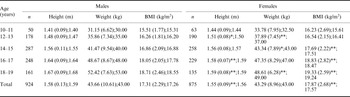
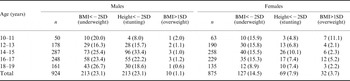
Age and gender differences. Tables 1 and 2 shows anthropometric characteristics and nutritional status according to age group and gender. As expected, height, weight and BMI increased with age. At ages 14 and 15 years, a quarter of males (25.4%) were underweight and a third (33.4%) were stunted. Only 1.1% of the male population studied were overweight. Approximately 16% of females were underweight between ages 10 and 15 years and rates dropped to 8.9% at 18 and 19 years. Ten per cent or less of females were stunted at all ages and approximately 4% were overweight.
Subjects' anthropometric characteristics and nutritional status by gender and age group (mean (SD); median), Ibadan, Nigeria

Significant differences between males and females in each age group:
* p<0.05;
** p<0.01.
Percentage of subjects with anthropometric values below −2 SD of the reference Ibadan, Nigeria: n (%)

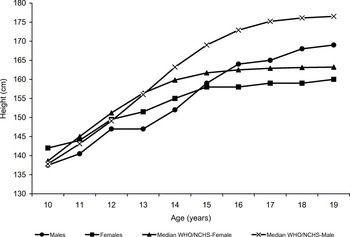
The trend in height (Table 1 and Fig. 1) across ages 10–19 years showed that males and females were of similar height in early adolescence (10–12 years), but by mid-adolescence (12–15 years) females were taller. Between 16 and 19 years, males become increasing taller so that by age 19 years they were 9 cm taller than females. However, at age 19 years, stunting was more pronounced for males, who were 7.5 cm shorter than the WHO/NCHS median for males compared with females who were 3.2 cm shorter. Overall, the males were significantly taller than the females (p<0.05), but the weights and BMIs for girls were greater than those of boys (p<0.05).
Median height-by-age of male and female adolescents in Ibadan in comparison with median WHO/NCHS references.

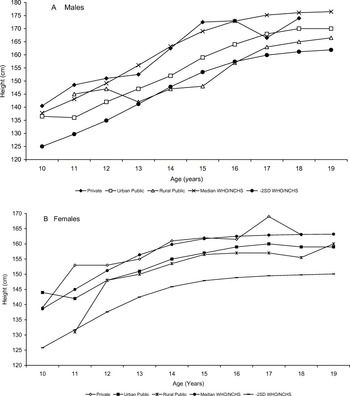
Rural–urban differences. Figures 2 and 3 show the height and BMI of adolescents in Ibadan, across the different types of schools, compared with WHO/NCHS reference values. Rural adolescents had lower heights and BMIs compared with those in urban areas. The median height of male adolescents in rural schools fell below 2 SDs of the WHO/NCHS reference between 14 and 17 years. For rural females there was also a dip in the mean height between ages 12 and 14 years but this did not go below the 2 SD mark.
Median height of male (A) and female (B) adolescents in schools in Ibadan in comparison with WHO/NCHS references.

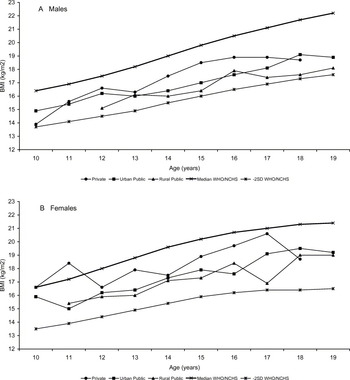
Median BMI by age of male (A) and female (B) adolescents in schools in Ibadan in comparison with WHO/NCHS references.

Adolescents in private schools were taller and had higher BMIs than those in rural and urban public schools. The height of male and female adolescents in private schools was similar to the median WHO/NCHS standard, exceeding this at ages 10–12 and 16–17 years for females and 10–12 and 15 years for males. The median BMI for private school adolescents was very close to the median reference at ages 15 and 16 years for males and ages 16 and 17 years for females. At age 13 years for males, while the BMI for private school adolescents showed an increase in trend, that of rural adolescents had a downward trend. This downward trend in BMI occurred at ages 16–17 years for rural female adolescents.
Nutritional status and correlates
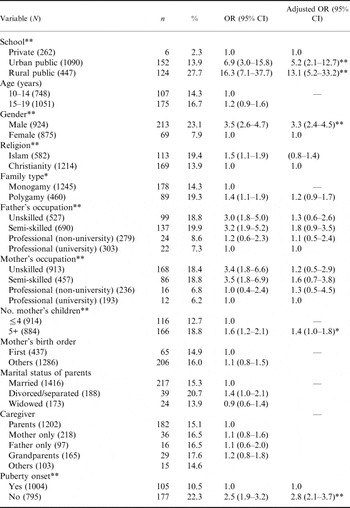
Low height-for-age (stunting). Two hundred and eighty-two (15.7%) adolescents had low height-for-age. Table 3 summarizes the association between low height-for-age (stunting) and socio-demographic characteristics. Factors significantly associated with stunting were school type, fathers' and mothers' occupation, gender, religion, number of mother's children, polygamy and onset of puberty. However, after multivariate analysis, school type, gender, number of mother's children and puberty onset were significantly associated with stunting. Adolescents in rural schools (27.7%) were seven and sixteen times more likely to be stunted than those in urban public (13.9%) and private schools (2.3%) respectively (AOR 13.1; 95% CI 5.2–33.2) and males (23.1%) were three times more likely to be stunted compared with females (7.9%) (AOR 3.3; 95% CI 2.4–1.4).
Socio-demographic correlates of stunting among adolescents in Ibadan, Nigeria

Categories with OR 1.0 are the reference groups.
** p<0.01;
* p<0.05.
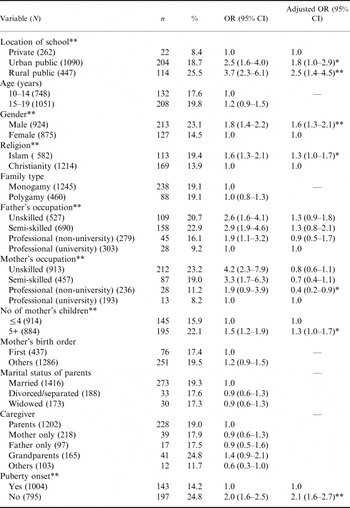
Low BMI-for-age (underweight). Three hundred and forty (18.9%) adolescents had low BMI-for-age. Table 4 shows the socio-demographic correlates for being underweight among Ibadan adolescents. Factors associated with thinness also affect stunting. The proportions of adolescents with low BMI-for-age by school type were: private schools 8.4%, urban public schools 18.7% and rural schools 25.5%. Male adolescents (23.1%) were more likely to be underweight than their female (14.5%) counterparts (OR 1.8; 95% CI 1.4–2.2). Adolescents who were in the pre-puberty stage were twice as likely to have low BMI-for-age (OR 2.0; 95% CI 1.6–2.5) than those with signs of puberty.
Socio-demographic correlates of underweight among adolescents in Ibadan, Nigeria

Categories with OR 1.0 are the reference groups.
** p<0.01;
* p<0.05.
In the multivariate analysis, school type, gender, mother's occupation, number of mother's children and puberty were the factors independently associated with underweight. Adolescents in rural public schools were two times more likely to be underweight than those in private schools (AOR 2.3; 95% CI 1.3–3.9). Similarly pre-pubertal adolescents (24.8%) were two times more likely to be underweight than adolescents with signs of puberty (14.3%) (AOR 2.1; 95% CI 1.6–2.7).
Overweight
There were 45 (2.3%) adolescents with BMI above 1 SD of the WHO/NCHS reference group (overweight). Type of school was still a dominant factor as those in private school (7.6%) had the highest prevalence of overweight. Adolescent girls with professional parents in monogamous marital unions were more likely to be overweight. Pubertal adolescents (2.8%) were more overweight than pre-pubertal ones (1.8%) but the difference did not attain statistical significance. Among boys, the prevalence of overweight was: private schools 5.0%, urban public schools 0.4% and rural public schools 0.4% (p<0.01). Among girls it was: private schools 10.7%, urban public schools 2.7% and rural public schools 2.0% (p<0.01). Overweight was more prevalent among girls (3.7%) than boys (1.1%) (Table 1). A multiple regression analysis showed that school type and gender were the independent predictors of overweight. Girls were more likely to be overweight (AOR 3.5; 95% CI 1.7–7.3) while students in private schools had higher odds of being overweight than those in rural public schools (AOR 5.6; 95% CI 1.6–20.1).
Discussion
The findings from this study clearly show that gender is an important determinant of growth performance among in-school adolescents in south-western Nigeria. Important differences were also observed between adolescents in public schools compared with those from private schools, and between those in urban compared with those in rural schools. These latter differences may, however, be a proxy for socioeconomic status rather than the type or location of school in and of itself.
The growth trend observed in this study is similar to the findings from a study on relative height and weight in rural south-west Nigeria (Ayoola et al., Reference Ayoola, Ebersole, Omotade, Tayo, Brieger, Salami, Dugas, Cooper and Luke2009). Similar heights, weights and BMIs among males and females in early adolescence, a greater height of females compared with males in mid-adolescence and males surpassing the height of females in late adolescence were also observed in this study. However, the heights, weights and BMIs in this study at the start of adolescence at ages 10–11 years were higher than in the south-west Nigeria rural study, but by the end of adolescence at 19 years, anthropometric measurements were similar, revealing the very important catch-up growth period in late adolescence (Ayoola et al., Reference Ayoola, Ebersole, Omotade, Tayo, Brieger, Salami, Dugas, Cooper and Luke2009). A study of 11- to 14-year-old urban adolescents in West Bengal, India, revealed similar growth trends but mean heights were much lower than those found in this study. Boys and girls at ages 10 and 11 years in this study had mean heights of 1.41 m and 1.44 m respectively compared with West Bengal boys (1.32 m) and girls (1.42 m) of a similar age (Mukhopadhyay et al., Reference Mukhopadhyay, Bhadra and Kaushik2005). Both males and females fell short of the WHO/NCHS standards, although males were three times more likely to be stunted than females.
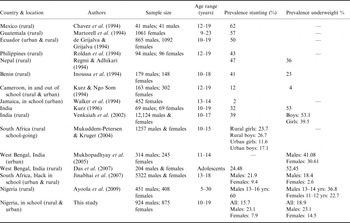
The prevalence of stunting obtained in this study (15.7%) is much lower than that found in other developing countries (see Table 5). There are several possible reasons for this finding. The rate of stunting obtained in this study was for both male and female adolescents in rural, urban public and urban private schools and the measurements on adolescents were done approximately a decade after these quoted studies were carried out, thereby allowing for possible improvements in nutrition, health and growth performance. In south-western Nigeria, where this study was conducted, primary school gross enrolment rates are 91% for boys and 93% for girls (Federal Ministry of Education, 1999). For secondary school enrolment, the rates are lower. Therefore, adolescents attending school in whatever environment, whether rural or urban, would be privileged in that society. They are likely to be better nourished and have a better health status, compared with out-of-school adolescents who were not part of this study and who may have greater rates of stunting and other nutritional problems. The studies from India and Philippines were also of in-school adolescents (Table 5).
Studies on adolescent nutrition and growth performance from different settings

The rate of stunting in the rural school adolescents in this study (27.7%) was also lower than the rural adolescent samples, but similar to rates for rural school-going adolescents aged 10–15 years in the North West Province of South Africa (Mukuddem-Petersen & Kruger, Reference Mukuddem-Petersen and Kruger2004) (see Table 5). The rural study carried out in south-western Nigeria, though not specific for adolescents (Ayoola et al., Reference Ayoola, Ebersole, Omotade, Tayo, Brieger, Salami, Dugas, Cooper and Luke2009), found that 60% of males between the ages of 13 and 16 years were stunted, a rate that dropped to 12% for individuals aged 21–30 years. Aside from this sample being collected about a decade earlier (Cooper et al., Reference Cooper, Rotimi, Ataman, McGee, Osotimehin and Kadiri1997), there was a mixture of both in- and out-of-school adolescents. The rate obtained for rural males aged 10–19 years in this study was 38.1%. Therefore the difference may reflect improvements in growth performance as well as the ‘privileged’ adolescent being in school, even within the rural area. Studies in Cameroon (Kurz & Ngo Som, Reference Kurz and Ngo Som1994; Kurz, Reference Kurz1996) and Jamaica found rates similar to the rate in the affluent, private school adolescents (2.3%) in this study (Walker et al., Reference Walker, Grantham-McGregor, Himes, Williams and Bennet1994) (see Table 5). Cameroon and Jamaica are described as nutritionally strong.
The mean height of adolescents in private schools was similar to the median 2007 WHO standard, exceeding this for boys and girls aged 10 and 12 years, males aged 14–16 years and females aged 17 years. Observations of growth curves in children in the south-west of Nigeria had, as far back as 1974 and in the 1990s, revealed that privileged urban children do not differ from international growth standards such as the British Tanner growth charts or median WHO/NCHS standards (Janes, Reference Janes1974; Walker et al., Reference Walker, Omotade and Walker1996).
Approximately one in five adolescents (18.9%) in south-west Nigeria had a BMI less than the 5th percentile of the 2007 WHO reference (De Onis, Reference De Onis, Onyango, Borghi, Siyam, Nishida and Siekmann2007). Similar to the finding with stunting, these rates are lower than those found in other African countries such as Senegal (29.8%), Benin (23%) and Sudan (25%) but slightly higher than in Mozambique and Kenya (16%) (Inoussa et al., Reference Inoussa, Alihonou, Vissoh, Capo-Chichi, Quenum and Sagbohan1994; Kurz & Johnson-Welch, Reference Kurz and Johnson-Welch1994; Benefice et al., Reference Benefice, Caius and Garnier2003; Prista et al., Reference Prista, Maia, Damasceno and Beunen2003; Leenstra et al., Reference Leenstra, Petersen, Kariuki, Oloo, Kager and ter Kuile2005; Cordeiro et al., 2006). The rate from Cameroon is the closest to the 8.4% obtained in the private school sample (Kurz & Johnson-Welch, Reference Kurz and Johnson-Welch1994; Kurz & Ngo, Reference Kurz and Ngo Som1994) (see Table 5).
Males in this study were three times as likely to be stunted (23.1%) compared with females (7.9%) and twice as likely to be underweight (males 23.1%) compared with females (14.5%). A study of black school-going teenagers in South Africa revealed similar gender differences with boys more likely to be stunted than girls and boys more likely to be underweight than girls (Jinabhai et al., Reference Jinabhai, Taylor, Reddy, Monyeki, Kamabaran, Omardien and Sullivan2007) (Table 5). This was also the finding in several studies on adolescents in developing countries, where twice as many boys had undernutrition when compared with girls (Kurz, Reference Kurz1996; Venkaiah et al., Reference Venkaiah, Damayanti, Nayak and Vijayaraghavan2002). In the under-five age group sixteen studies from different parts of sub-Saharan Africa have revealed that male children are more likely to become stunted than females (Wamani et al., Reference Wamani, Astrøm, Peterson, Tumwine and Tylleskär2007). The South African study also reported a trend towards increasing prevalence of underweight and stunting for boys with increasing age. This trend was not observed in this study except for the rural boys, who showed faltering height and weight from age 13 to 15 years – the same age with the highest prevalence of stunting in the rural-only study in south-west Nigeria (Ayoola et al., Reference Ayoola, Ebersole, Omotade, Tayo, Brieger, Salami, Dugas, Cooper and Luke2009).
Stunting and underweight were most severe in the rural adolescents, where they were 16 times more likely to be stunted and 4 times more likely to be underweight than adolescents in urban private schools. For the adolescents residing in urban areas, those in public schools were 7 times more likely to be stunted and 3 times more likely to be underweight than their private school counterparts. After the onset of puberty, private school subjects had BMIs that were similar to WHO standards, and of the 2.3% who were overweight in this study, the largest proportion were in private schools.
A suitable comparison for rural adolescents in this study would be other rural adolescents in developing countries. The prevalences of underweight and stunting in this study were 25.5% and 27.7% respectively among rural adolescents. The underweight rate is similar to that obtained in a rural community in West Bengal, India, but the stunting rate was almost twice at high (see Table 5) (Das et al., Reference Das, Ray, Joardar and Dasgupta2007).
There are clear differences in the growth performance of adolescents in the three types of school settings, with rural adolescents suffering the biggest disadvantage and having the greatest prevalence of stunting and underweight. Differences in growth patterns have been reported in the past among Nigerian children (Janes, Reference Janes1970). Similar to what was reported here among adolescents, growth curves drawn showed a great amount of stunting in children from urban slums while privileged urban children, who would be similar to the private school adolescents in this study, had growth curves similar to international growth standards (Janes, Reference Janes1974; Walker et al., Reference Walker, Omotade and Walker1996). The persisting disadvantage of rural and urban poor children may reveal several factors impacting on the health of these growing adolescents.
There were very similar social and demographic correlates for stunting and underweight, all pointing towards disadvantage. Apart from gender, rural–urban differences and puberty, other factors strongly and independently related to both stunting and underweight were low-income father and mother occupations, practising Islam, mother having five or more children, and polygamous family. Cultures or beliefs allowing the practise of polygamy, especially in situations of low earning capacity, may have far reaching implications for the health and nutrition of the whole family and society. A family with two of more wives married to one husband would mean a larger number of individuals sharing the same resources. The role of the mother in the culture of the Yoruba is very important, as the day-to-day sustenance of children depends solely on her. Therefore, when a mother has many children and is in a low-paid job, there will be less food, hence stunting and undernutrition. These correlates can all be linked directly or indirectly to poverty. The importance of the mother and the nutrition of children was illustrated in a study of 720 mother and child pairs, where the mother's education was found to be the best predictor of nutrition of children in rural Ugandan (Wamani et al., Reference Wamani, Tylleskär, Astrøm, Tumwine and Peterson2004). The role of religion in nutrition is not quite clear but it is likely that this factor acts indirectly in situations where practices within certain social strata would lead to deprivation. Over 12,000 rural adolescents in India had factors such as religion, family size, type of house, occupation and per capita income of family associated with stunting and undernutrition (Venkaiah et al., Reference Venkaiah, Damayanti, Nayak and Vijayaraghavan2002). The significance of polygamy and other correlates associated with stunting and underweight needs further study so as to determine the nature of association with growth performance as there may be other mechanisms of influence.
Strong associations have also been reported between the onset of puberty and stunting as it is suggested that age of menarche is strongly influenced by growth performance in adolescence and notably the level of stunting (Bosch et al., Reference Bosch, Willekens, Baqui, Van Ginneken and Hutter2008). The average reported age at menarche for girls of 13.6 years found in this study is the exact age that has been reported by several other studies conducted among the Yoruba, the major ethnic group domiciled in south-western Nigeria (Thomas et al., Reference Thomas, Okonofua and Chiboka1990; Odujinrin & Ekunwe, Reference Odujinrin and Ekunwe1991; Fakeye & Adegoke, Reference Fakeye and Adegoke1994; Abioye-Kuteyi et al., Reference Abioye-Kuteyi, Ojofeitimi, Aina, Kio, Aluko and Mosuro1997). Similar to reports from other studies in developing countries, the onset of menarche or voice break in boys in this study was associated with improvement in growth performance (Chowdhury et al., Reference Chowdhury, Shahabuddin, Seal, Talukder, Hassan and Begum2000). In a study of Sudanese adolescent girls, one of the strongest correlates of growth performance was whether menarche had been attained or not (Cordeiro et al., 2005).
In this mixed rural–urban sample 2.3% of adolescents were overweight, with most being from private schools, female and post-pubertal. A few studies in sub-Saharan adolescents have looked at the prevalence and epidemiological characteristics of overweight adolescents. Black in-school South African teenagers aged 13–18 years had higher rates of overweight, with girls (20.9%) being significantly more likely to be overweight than boys (4.2%) (Jinabhai et al., Reference Jinabhai, Taylor, Reddy, Monyeki, Kamabaran, Omardien and Sullivan2007). This is similar to the gender differences found in this study, but with much lower rates in both girls (3.7%) and boys (1.1%). In a review of international trends in adolescent nutrition, Schneider (Reference Schneider2000) identified work in Senegal where the prevalence of obesity in adolescents was found to be 2%, and in South African rural school children aged 7–19 years 17% of females were found to be obese, with virtually no obesity in males. Rates of overweight in Senegal are similar to those found in this study, but lower than in developed regions of the world, with high rates in inner-city neighbourhoods of Montreal Canada of 35% and 33% for boys and girls respectively, and 24% or more for youth in the United States (Schneider, Reference Schneider2000).
Studies have revealed that when nutrition transitions occur, the impact is usually seen first among the affluent in society, as is the observation in this study (Schneider, Reference Schneider2000). The finding of 7.6% overweight adolescents in private schools in Ibadan suggests even higher rates among the adults in this social stratum (Drewnowski & Popkin, Reference Drewnowski and Popkin1997; Schneider, Reference Schneider2000). There are suggestions that the high rate of obesity found in South African adolescents may be due to school feeding schemes and this may affect those who are already stunted more. The issue of stunting as a factor producing overweight does not yet arise in the Nigerian adolescents as the private school students, who comprised most of the overweight adolescents, also had the lowest rate of stunting (2.3%), with average height curves running alongside the WHO/NCHS height curves.
The fact that adolescents in private schools had heights and BMIs very close to the WHO/NCHS median references may further validate these international growth standards and be indicative of the standards for this society. This mitigates the criticism the NCHS has come under for its use in developing countries (Cordeiro et al., 2006), but at the same time does not remove the responsibility for developing local reference data.
The sample utilized in this study reveals several social and demographic characteristics of school-going adolescents in Nigeria. The slight male predominance in the sample reflects the gender ratios of the school class registers, which is in keeping with recent secondary school enrolment data for Nigeria. The sample used in this study is representative of adolescents in south-west Nigeria, albeit without the important out-of-school adolescents.
Tracking nutritional transitions is important as it allows nations and regions to predict future disease patterns and the health care needs of populations (Schneider, Reference Schneider2000). These findings from Nigeria, with high rates of stunting and undernutrition, especially in adolescents in rural areas and urban slums, and the emergence of overweight people, especially among the affluent, reveals an emerging ‘double nutritional’ problem. Both males and females require attention. This has been described (Schneider, Reference Schneider2000) as the effect of globalization and urbanization speeding up the nutrition transition in regions of the world so that both undernutrition and ‘overnutrition’ are seen at the same time in adolescent populations (Popkin, Reference Popkin1994; Popkin et al., Reference Popkin, Richards and Montiero1996). These observations point to a need to address not only undernutrition, but malnutrition in its entirety in all locations and strata of society. The findings from this study demonstrate that poverty, rather than being in an urban or rural location, is what accounts for stunting and being underweight. Intervention measures must be designed with these in mind.
The reproductive needs of females may provide greater access to nutritional interventions. Innovative and creative interventional programmes need to be employed to reach adolescent males who have more severe stunting and underweight. The first Millennium Development Goal calls for the eradication of extreme hunger and poverty and one of the indicators selected is the prevalence of underweight children under the age of five years (UNDP, 2000). As the focus is given to this vulnerable under-five age group, adolescents, who are also in a period of increase growth velocity, should not be left out of interventions.
Acknowledgments
This research was supported by a University of Ibadan Senate Research Grant. The authors are grateful to Dr Ajibike, Deputy Director, Oyo State Ministry of Education, for providing logistic support and to all the principals of schools visited for creating an enabling environment. They also thank the school health nurses in the Oyo State Ministry of Health for their help with data collection, and appreciate all the students for their cooperation during the long period of interview and examination.