INTRODUCTION
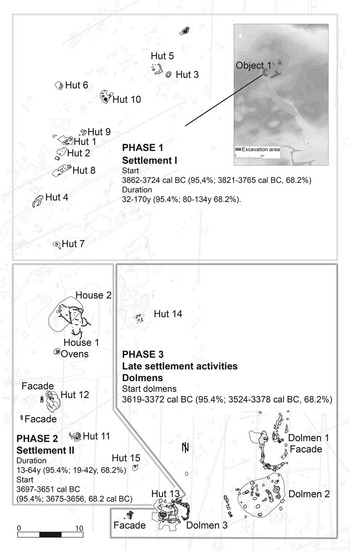
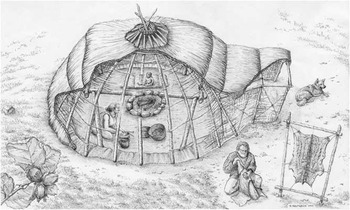
Our understanding of the Early Neolithic and the transition from the Mesolithic to the Early Neolithic in southern Scandinavia is in many ways contentious and patchy. Quite a few sites have been excavated so far, but there are a limited number of radiocarbon dates available for the early farming societies in this region (cf. Artursson et al. Reference Artursson, Linderoth, Nilsson and Svensson2003; Nilsson and Rudebeck Reference Nilsson and Rudebeck2010). In connection with the European Spallation Source (ESS) project, the remains of 14 huts, two houses, pits, several ovens, three wooden post facades, two inhumation burials (one with a wooden post façade), a stone-built façade, and three dolmens were documented along the edge of a shallow wetland (Figure 1). The site is one of the largest early Neolithic settlements excavated in Sweden known to date. Early Neolithic huts and houses are relatively rare, as the remains are not easy to recognize in the archaeological record. The huts at the site were simple, small, round structures, built in a Mesolithic tradition with small posts and organic material covering (e.g. animal skins or vegetation) (Figure 2). After clearing the surface, these structures are just visible as a distinct patch of darker soil, since they have been dug into the ground. In some of these huts, remains of hearths were found. The floor surfaces varied considerably in size and not all were large enough to have functioned as living areas for a whole family. Instead, they may have been used for special activities or for storage. The huts of the settlement were arranged in two segments of a half circle around the wetland with two houses placed in the center. These two long houses were partly overlapping each other, and they are either interpreted as chiefs’ houses or special communal buildings used successively. Different Bayesian models were tested with the horizontal stratigraphy of the site and the hypothesis that the huts were built from north to south.
Plan of the settlement with the phases from Model 1. The oversight map with the excavation areas shows a reconstruction of the Stone Age wetland based on topographic mapping from 1810.

Reconstruction of a hut (drawing Richard Holmgren, ARCDOC)

DATING PROGRAM, RADIOCARBON DATES, AND BAYESIAN MODELS
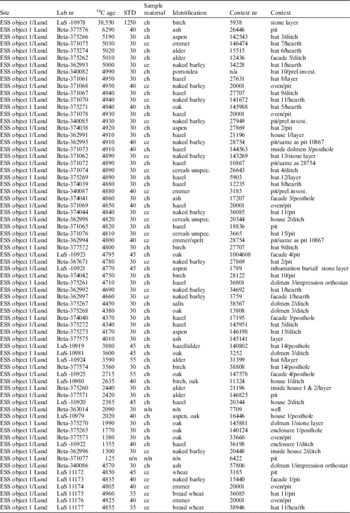
The dating strategy for the ESS site (object 1) was to produce 14C dates for all structures using, where possible, cereals or short-lived charcoal from the hearths inside the huts and houses. The features were undisturbed and the whole settlement was completely excavated. This provided the ideal conditions for establishing a highly precise chronology for the building sequence of the site. We used a Bayesian statistical approach, which is today a well-established method to limit considerably the probable time interval for the calendar dates. The models and the calibrated data presented in the analysis have been obtained using the program OxCal v 4.2 (Bronk Ramsey Reference Bronk Ramsey2001, Reference Bronk Ramsey2009a, Reference Bronk Ramsey2009b; Bronk Ramsey et al. Reference Bronk Ramsey, Buck, Manning, Reimer and van der Plicht2006, Reference Bronk Ramsey, Dee, Lee, Nakagawa and Staff2010) and the IntCal13 calibration data (Reimer et al. Reference Reimer, Bard, Bayliss, Beck, Blackwell, Bronk Ramsey, Grootes, Guilderson, Haflidason, Hajdas, Hatté, Heaton, Hoffmann, Hogg, Hughen, Kaiser, Kromer, Manning, Niu, Reimer, Richards, Scott, Southon, Staff, Turney and van der Plicht2013). In total, 70 14C dates were produced for the early Neolithic site (object 1) (Table 1, Figure 3). The wood species is identified for all 45 charcoal samples; most are short-lived (1 Salix, 1 Pomoidea, 15 hazel, 1 hazel/alder, 8 oak, 4 birch, 1 birch/oak, 4 ash, 1 ash/oak, 4 aspen, 5 alder). In total, 23 charred plant remains (12 naked barley, 5 emmer, 2 bread wheat, 1 wheat, 3 unspecified cereals) were measured. The sample material of two 14C dates is unidentified. For the Bayesian models, we concentrated on the Neolithic phases and excluded 17 14C dates most from the Bronze and Iron Age.
IntCal13 calibration curve (Reimer et al. Reference Reimer, Bard, Bayliss, Beck, Blackwell, Bronk Ramsey, Grootes, Guilderson, Haflidason, Hajdas, Hatté, Heaton, Hoffmann, Hogg, Hughen, Kaiser, Kromer, Manning, Niu, Reimer, Richards, Scott, Southon, Staff, Turney and van der Plicht2013) for the period with the probability distribution of individual samples used for the models.

TWO ALTERNATIVE BAYESIAN MODELS FOR THE ESS SITE (OBJECT 1)
For the 14C dates of the ESS site (object 1), we tried different possibilities with a Bayesian statistical framework focusing on the earliest settlement activities. The beginning of the early Neolithic is rather unclear for the region and we wanted to gain a closer insight into early settlement processes. Thus, here we present and discuss two alternative models with a slightly time-delayed onset for the beginning of the settlement. The main differences of the models are recognizable in phase 1. The two models do, however, differ slightly in the phases 2–4. The OxCal code for the models is given in the online Supplementary Material.
Model 1
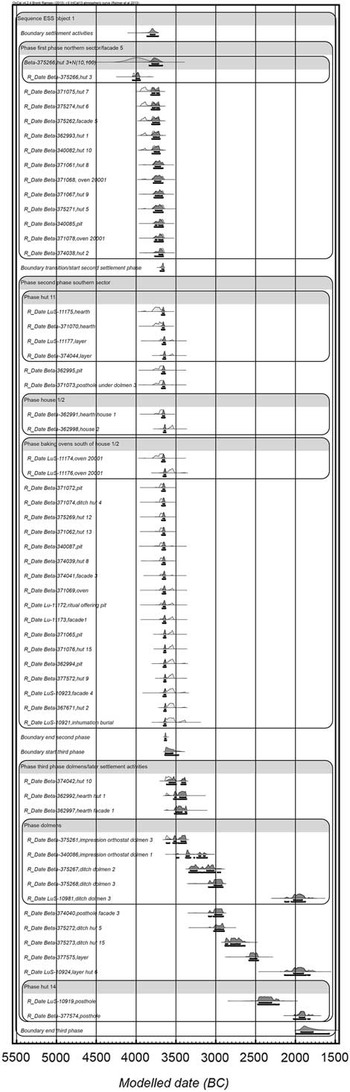
The first model (Model 1) was established under the assumption that the earliest 14C date (Beta-375266, 5190 ± 30 BP) does not represent its own earlier phase and is incorporated into phase 1 (phases 1–3). In doing so, the calibrated values of this 14C date show a poor agreement (A=34.1%). Beta-375266 came from a charcoal sample of the aspen species and originates from a small ditch in hut 3. This includes both a potential old-wood effect and the possibility of intrusive material and a terminus post quem (TPQ) value. For Model 1, a potential inbuilt age of 100 yr was corrected (average age of aspen) by the help of a normal distribution. This rather hypothetical approach requires indications for an old-wood effect over the distribution of the data and the species of the wood. We decided to limit this procedure to Beta-375266, which is a crucial 14C date for our main research question regarding the beginning of the early Neolithic in southern Scandinavia. The remaining charcoal samples used are mostly hazel, a tree with a short lifespan, and there are also no other clear indications visible for an old-wood effect. Model 1 thus shows an agreement index of Amodel=103.2, Aoverall=99.1 (Figure 4).
Model 1. Probability distributions of dates from the settlement ESS (object 1). Beta-375266 is belonging to the first settlement phase. A hypothetical inbuilt age is corrected by 100 yr (average age of aspen) (Amodel=103.2, Aoverall=99.1).

Model 2
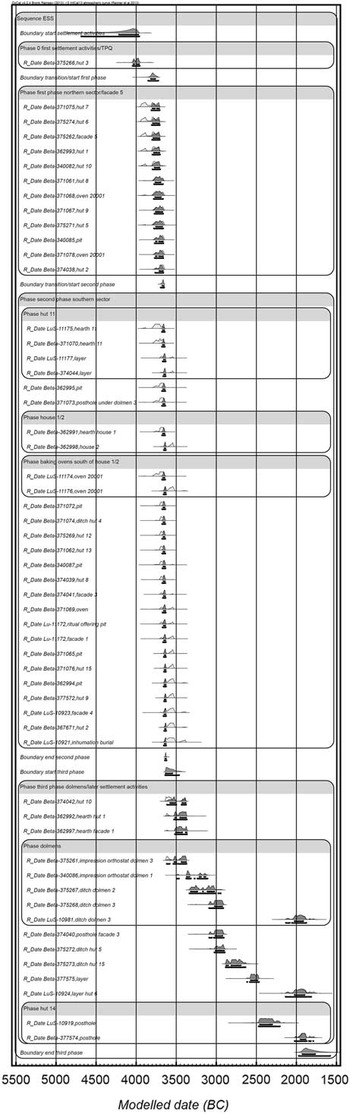
The second model (Model 2) was established under the hypothesis that Beta-375266 represents its own phase with a first prospection of the site or settlement activities (phases 0–3). The date is either associated with an early hut (3) or representing a TPQ value for hut 3. This model shows an agreement index of Amodel =127.2, Aoverall=120.5 (Figure 5). Model 2 starts with a phase 0.
Model 2. Probability distributions of dates from the settlement ESS (object 1). Beta-375266 is representing an own phase with a first prospection of the site or settlement activities and the data is either associated with an early hut (3) or representing a TPQ value to hut 3 (Amodel=127.2, Aoverall=120.5).

Phase 0: First Prospection/Early Settlement Activities
This early phase in Model 2 is possibly describing a first activity on site in the early Neolithic as, for example, a prospection of the place in 4044–3957 cal BC (95.4%; 4035–3965 cal BC, 68.2%) or the very first hut (3) on site. The sample for Beta-375266 (charcoal, aspen) originates from a small ditch in hut 3. The context and direct association to hut 3 are therefore insecure.
Models 1/2 Phases 1–3
Phase 1: Settlement I
The time interval for the start of this phase is calculated for Model 1 to 3862–3724 cal BC (95.4%; 3821–3765 cal BC, 68.2%). In the very beginning, between 32–170 yr (95.4%; 80–134 yr, 68.2%), 10 huts (huts 1–10) were built throughout the northern sector of the settlement. The 14C dates for this phase are mostly of short-lived sample materials from hearths. These data reflect the earliest activities in the huts and on site, even if we could expect to find here most likely find remnants of the last uses. The huts had a short lifetime of a few years and required regular restoration work or renewing. From most of the huts, several 14C dates are available, indicating activities in the huts also in later phases or, taking the last argument into consideration, the renewing of these huts on site. Whether or not the 10 huts of phase 1 existed at the same time or some of them consecutively cannot be resolved by the 14C dates. The spatial distribution of the huts in a half circle along the wetland would allow both interpretations.
Façade 5, situated under dolmen 3 in the southern sector, is either built in this phase or there is some earlier settlement material in the filling of the postholes. The dates may cluster towards the last use of the huts, which would favor a different Bayesian model. Yet, we have no clear indication for such a phasing over the horizontal stratigraphy or the artifacts; thus, from a Bayesian point of view, it would be incorrect to split phase 1 into two phases. In Model 2, the interval for the start of phase 1 is calculated somewhat later to 3811–3707 cal BC (95.4%; 3779–3713 cal BC, 68.2%). The duration of this phase is between 37–150 yr (95.4%; 77–130 yr, 68.2%).
Phase 2: Settlement II
In Model 1, the time interval for the start of phase 2 or the transition to this phase is calculated to 3697–3651 cal BC (95.4%; 3675–3656 cal BC, 68.2%). In phase 2, the settlement is extended between 13–64 yr (95.4%; 19–42 yr, 68.2%) to the southern sector. Huts 11, 12, 13, and 15 are built, and activities continue in the huts of the northern sector. Near the huts, façades 2 and 3 are constructed. The first long house (1) is built in the northern part of the southern sector. There is evidence for activities in this house from 3678–3640 cal BC (95.4%; 3666–3647 cal BC, 68.2%) onwards. The break between phases 1 and 2 occurs before the building of house 1. To place the 14C dates for house 1 in the end of phase 1 would result in poor agreement for the beginning of phase 2 and the huts of the southern sector (hut 11; Model 1/2, A=35.6%). To then insert hut 11 into phase 1, under the hypothesis that hut 11 was built contemporaneous to the huts of the northern sector, would also give a poor agreement for the beginning of phase 1 (hut 7, A=57.9%) and for hut 11 itself (A=36.1%).
House 1 was rebuilt (house 2) in place somewhat before 3656–3629 cal BC (95.4%; 3647–3634 cal BC, 68.2%). Large baking ovens placed to the south of the houses were in use during both stages. An inhumation burial with a wooden façade (4) from 3656–3626 cal BC (95.4%; 3645–3631 cal BC, 68.2%) in the southern sector belongs to this horizon, along with an inhumation burial without markings. In Model 2, these time intervals differ only slightly. The onset of the phase is calculated to 3695–3651 cal BC (95.4%; 3675–3656 cal BC, 68.2%), with the duration of the phase to between 12–62 yr (95.4%; 20–41 yr, 68.2%).
Phase 3: Dolmens and Late Settlement Activities
This phase starts between 3616 and 3377 cal BC (3584–3282 cal BC), when the settlement’s main building phases have ended. 14C dates from cereals in the hearths of huts (1 and 10) in the northern and southern sector indicate either possible late activities in former built huts, or rather, since these are short-lived structures, the renewing of these huts on site (Beta-374042; 4750±30 BP; Beta-362992; 4690±30 BP). These data closely follow 14C dates gained from samples from a hearth at stone façade 1 and from the impression of a side stone from a megalithic grave. The stone façade 1 is associated with three megalithic graves (dolmens 1–3) in the southeastern part of the sector, which are built in this later phase. The dating of these dolmens is more problematic than the dating of the huts. The cereals in the hearths of the huts indicate direct activities, while the charcoal from the impression of the stones is not necessarily connected to the construction and use of the megaliths. The four dates from the dolmens suggest a time interval of 3619–1878 cal BC (95.4%; 3524–1916, 68.2%). The beginning of the dolmens is calculated to 3619–3372 cal BC (95.4%; 3524–3378 cal BC, 68.2%), while LuS-10981 obviously reflects a later activity at dolmen 3. These dolmens have been built after regular habitation at the site stopped. One hut (14) is newly built in the Late Neolithic. In Model 2, this phase of late settlement activities and grave construction is calculated to 3618–3372 cal BC (95.4%; 3524–3378 cal BC, 68.2%).
CONCLUSION
The sample for the earliest 14C date (Beta-375266, 5190 ± 30 BP) originates from the ditch around hut 3. This context is uncertain and the arguments for an earlier prospection of the site and a TPQ phase for hut 3 or even a first hut ~200 yr earlier than the remaining 10 huts of this phase, which are built contemporaneous or within a short time interval, are limited. We prefer Model 1 with a later onset for the ESS settlement and the start of the Early Neolithic activities on site at 3862–3724 cal BC (95.4%; 3821–3765 cal BC, 68.2%) (Figures. 1, 4). The Beta-375266 sample (5190 ± 30 BP) may originate from clearing the place in connection to the first building activities and an old-wood effect seems plausible. We corrected this hypothetical old-wood effect with a normal distribution of 100 yr (average age of aspen). The dating strategy to produce 14C dates from cereals and other short-lived samples from the hearths of the huts and houses allowed us to calculate the duration of the phases to short time intervals [phase 1 between 32–170 yr (95.4%; 80–134 yr, 68.2%); phase 2 between 13–64 yr (95.4%; 19–42 yr, 68.2%)]. These results provide concrete insight into settlement processes and strategies from the beginning of the Neolithic in southern Scandinavia.
Radiocarbon dates from the ESS project (object 1).

SUPPLEMENTARY MATERIAL
To view supplementary material for this article, please visit http://dx.doi.org/10.1017/RDC.2016.72