

Published online by Cambridge University Press: 10 May 2005
“Be careful what you ask for,” goes the old adage. “You just might get it.” This advice is well-taken by interest groups that successfully press for policy goals at odds with the preferences of the broader population. Victory may be won, but at the expense of awakening widespread opposition and aggravating friend and foe alike.
But what happens when an interest group gets something it doesn't particularly ask for? Such can arguably be said to be the case for gay Americans and state-sanctioned civil marriage. Since the Stonewall rebellion of 1969, two generations of gay activists have pushed for a variety of policies to benefit LGBT1
LGBT is the standard acronym for lesbian, gay, bisexual, and transgender. In this article, we use terms such as LGBT, the lesbian and gay movement, and gay people interchangeably as best fits a decent sense of prose style. Public opinion surveys also employ a diversity of terms, and we use their language when referring to their results. In general, we strive to be as accurate and inclusive as possible while remaining readable.
Massachusetts may be an exception. Polling in the state around the time of the court decision found near-majorities in support of same-sex marriage.
In this article, we explore the consequences of these events for the gay rights movement in the United States. We examine survey data to understand the attitudes of LGBT Americans toward same-sex marriage, and we speculate about the relationship between this issue and the American movement for LGBT rights.
As has been the case in most civil rights movements, gay activists have long squabbled over their ultimate goal: is it liberty or equality? Do gays seek the freedom to live the lives they desire—or do gays seek the respect from straight people that is the prerequisite for them to invite LGBTs into society as fellow citizens? Of course, liberty and equality are not always at cross-purposes, and many policies sought by LGBT activists can be rightly said to promote both goals. But in their ideal types, liberty and equality imply quite different self-conceptions for LGBT people vis-à-vis society and the state.
While the goals of the LGBT movement have always ranged widely, until recently liberty has trumped equality as its primary aim. The post-Stonewall groups Gay Liberation Front and the Gay Activists' Alliance focused on two primary issues: an end to the laws that criminalized homosexual behavior, and freedom from retaliation for being openly gay (see Sherrill 1999). The struggle to end criminalization successfully culminated in the U.S. Supreme Court's 2003 decision Lawrence v. Texas,which struck down all state laws criminalizing consensual sodomy as violating the Fourteenth Amendment's Due Process Clause. The struggle to be free to be openly gay continues: gays and lesbians have achieved protection from discrimination in states that account for 37% of the U.S. population3
Authors' calculation using 2004 population estimates by the U.S. Census.
For example, in 2004, 89% of respondents told the Gallup Poll that they agreed with the statement “homosexuals should have equal rights in terms of job opportunities.”
Now consider how different civil marriage is from these aforementioned concerns. While the goal of attaining same-sex marriage is certainly somewhat about liberty—the freedom to live one's life with the partner of one's choice—it is much more about having this partnership be treated as the same as a heterosexual marriage before the law and in the eyes of fellow Americans. Whereas once LGBT people sought primarily the right to be left alone, they now increasingly demand the right to be recognized as equals.
The recent shift toward marriage probably would not have occurred for another decade without the court victories that propelled the issue to the top of the agenda. Although efforts to protect gay and lesbian families—including domestic partners benefits and adoption rights—gathered steam in the 1990s, marriage was only rarely explicitly promoted by the movement's leaders. Given that support for gay marriage has rested at about one-third of the U.S. population over the past few years, many gay activists have long believed they would face a losing battle over its enactment.
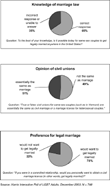
Gay people themselves have shown a remarkable degree of ambivalence over this issue, particularly when civil unions are offered as an alternative. An online poll of 748 LGBT people in the United States conducted by Harris Interactive for the Human Rights Campaign Foundation in December 2003—just one month after the Massachusetts Supreme Judicial Court's initial decision in Goodridge—found that half of respondents agreed that “civil unions for same-sex couples are essentially the same as civil marriage or a marriage license for heterosexual couples.” (See Figure 1.) The same poll found that a third of LGBTs could not correctly answer a question regarding whether there was anywhere in the U.S. where same-sex couples could get legally married (at that point, there was not).

LGBTs Knowledge and Attitudes Regarding Same-Sex Marriage
In addition, nearly a quarter of the poll's respondents said they would not seek marriage even if it were legalized. A year later, in exit polling conducted during a presidential election that focused intensely on the issue of gay marriage, only a bare majority of self-identified gay, lesbian, and bisexual voters said they preferred marriage to civil unions or no legal recognition whatsoever. (See Table 1.) While support for gay marriage among LGBT people is strong, it is by no means uniform.

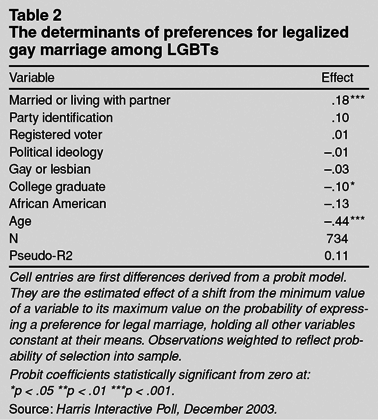
What is the source of this ambivalence? Opposition appears to lie among older, more educated LGBT Americans—in other words, exactly the kinds of “elites” that we would expect to lead gay opinion, not trail behind it. As shown in an analysis estimating the determinants of personal preference for samesex marriage (Table 2), college graduates are 10 percentage points less likely to desire gay marriage than non-college graduates, and a 65-year-old respondent is 31 percentage points less likely to personally want legalized marriage than an 18 year old. Same-sex marriage appears to be an issue that resonates with everyday LGBT people to a degree even stronger than it does with elites—and it is reminiscent of the younger (if well-educated) activists who overcame the reluctance of older, more traditional LGBTs to develop new goals and tactics in the days after the Stonewall rebellion.

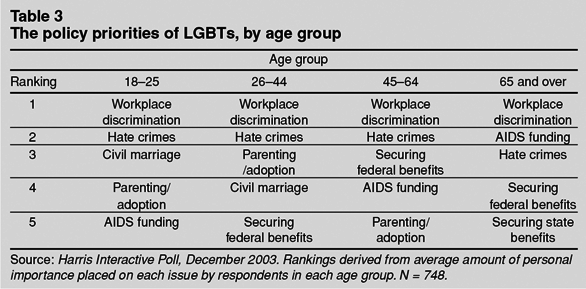
These demographic differences are not huge, but they indicate a diversity of priorities in the LGBT movement. This can be seen in Table 3, which shows the top five priorities of four different age groups in the LGBT population, again taken from the Harris Interactive survey. In these rankings, derived from the relative personal importance attached to each issue by respondents in each age group, we see critical differences: while workplace discrimination and hate crimes are high-priority issues for LGBTs of all ages, marriage and parenting are much more important to younger respondents. Some of these differences are likely due to life-cycle, rather than cohort-specific changes: for example, seniors (as expected) are more concerned about benefits programs. (Not shown in the table is that those over 65 ranked marriage dead last as a priority among the 10 policy issues included in the survey.) In sum, these results suggest that a strong generational effect may be in place among LGBTs that will lead same-sex marriage to become an issue of steadily increasing priority.

Shortly after the flurry of weddings began in San Francisco in February 2004, Andrew Sullivan wrote in the New Republic that gays and lesbians “still lack the legal protections that make marriage a civil reality. Today, they no longer ask for these. They demand them. This is the changed consciousness that every civil rights movement aims for” (Sullivan 2004).
Have gay Americans—particularly younger gay Americans who are the future of the movement—made a shift in consciousness from desiring simply to be left alone to demanding the full, equal rights of citizenship? Regardless of the ultimate answer to this question, it is clear that the images broadcast from San Francisco and Massachusetts in 2004 have raised what the average gay person expects from her country and fellow citizens. The shift has complicated the careful, incremental strategy of national gay rights groups and has probably made compromise more difficult to achieve. Gay rights groups are left with the difficult task of developing strategies that capitalize on the euphoria instilled by same-sex marriage among the gay rank and file, while at the same time avoiding costly battles with gay marriage opponents. But however inconvenient or untimely, the new demands of younger LGBT people are most likely an indication of the movement's success: born after Stonewall, they have grown up in a different world than their queer elders.
Forms of oppression and discrimination that were once tolerable have become targets for new generations, who—both for better and for worse—prefer to think of themselves as equal, not separate.
We thank Ethan Geto, Abe Newman, Laura Stoker, and Bob Witeck for helpful comments; Aubrie Dillon for research assistance; the Human Rights Campaign Foundation and Warren Mitofsky for generously sharing their data; and the Gill Foundation for financial support.

LGBTs Knowledge and Attitudes Regarding Same-Sex Marriage

Which comes closer to your view of gay and lesbian couples?

The determinants of preferences for legalized gay marriage among LGBTs

The policy priorities of LGBTs, by age group