Introduction
There were over 5100 registered suicides in England and Wales in 2013 (Office for National Statistics, 2015). Recent data from the National Confidential Inquiry into Suicide and Homicide by People with Mental Illness (NCISH) showed that 28% of suicide deaths in England were by patients in contact with mental health services 12 months before their death (23% in Wales). In England and Wales in-patient suicides accounted for an average of 124 deaths per year, 9% of patient deaths (NCISH, 2015a ). Patients are admitted to acute in-patient care at a time of crisis, and observation is an intervention used to reduce the risk of serious adverse incidents such as suicide (Manna, Reference Manna2010). NCISH previously found that 22% of in-patient suicides occurred while the patient was under intermittent observation (i.e. being checked every 5–25 min), and 3% occurred while the patient was under constant observation (i.e. within eyesight or within arms-length) (NCISH, 2015b ). Concern has previously been raised that there is a lack of empirical evidence for the effectiveness of formal observation in preventing harm to patients or in providing therapeutic benefit (Green & Grindel, Reference Green and Grindel1996). The international literature is inconclusive (Green & Grindel, Reference Green and Grindel1996; Cutcliffe & Barker, Reference Cutcliffe and Barker2002), and dated as reviews have shown (Manna, Reference Manna2010; Stewart et al. Reference Stewart, Bilgin and Bowers2012). The current literature is generally limited by methodological shortcomings, predominately focusing on constant or ‘special observations’ (Duffy, Reference Duffy1995), qualitative studies (Bowers et al. Reference Bowers, Gournay and Duffy2000; MacKay et al. Reference MacKay, Paterson and Cassells2005), case reports, small case-series designs (Gournay & Bowers, Reference Gournay and Bowers2000; Whitehead & Mason, Reference Whitehead and Mason2006; Kettles & Paterson, Reference Kettles and Paterson2007) and opinion-based articles (Bowles et al. Reference Bowles, Dodds, Hackney, Sunderland and Thomas2002). In this current research we used unique data from NCISH to examine a national consecutive case series of in-patient suicide while under observation in England and Wales. We aimed to describe the demographic and clinical characteristics of mental health in-patients who died by suicide under observation and examine the service-related antecedents in relation to clinical care and safety.
Method
Research design
We examined a national consecutive case series of mental health in-patients who died by suicide whilst under observation in England and Wales. We studied deaths that occurred between 1 January 2006 and 31 December 2012. The data were part of a larger mixed-method study of in-patient suicide under observation in the UK, which included qualitative analysis from an online survey and focus groups (NCISH, 2015b ).
Case ascertainment
Data on suicide and open verdicts were obtained from the Office for National Statistics. By contacting National Health Service (NHS) trusts and independent hospitals in the deceased's district of residence, we identified whether any of the individuals had contact with mental health services within 12 months of their death. If recent contact was confirmed, a questionnaire was sent to the consultant psychiatrist responsible for the patient's care. The questionnaire consisted of sections requesting sociodemographic information, information on the last in-patient admission and details of clinical care received at the time of death. NCISH have used this methodology since 1996 and have generated a unique internationally recognized UK-wide database of all suicides, homicides and sudden unexplained deaths by people in contact with mental health services. In addition to these data, serious untoward incident (SUI) reports were requested from NHS trusts and independent hospitals where the incidents occurred. SUI reports provided a detailed account of the organization's internal investigation, often using root cause analysis; the reports included recommendations for improving patient safety. The method of data collection for NCISH has been described in detail elsewhere (NCISH, 2015a ).
Definitions
Observation levels were defined in accordance with published guidance from the National Institute for Health and Clinical Excellence (NICE, 2005). The four levels were level 1: low-level general observation; level 2: intermittent observation (15–30 min checks); level 3: continuous within eyesight; and level 4: continuous observation within arm's length of one staff member. For this study, we used the term ‘under observation’ to describe all ‘non-general’ observation levels (i.e. levels 2, 3 and 4). The guidance enables individual health and social care providers to develop their own policies for observation practice including: how often observation levels should be reviewed; who can instigate and change observation levels; directions for staff undertaking observations; how the experiences of patients are considered; and recording and documenting these decisions.
We defined an in-patient mental health ward as a therapeutic environment where patients are admitted for assessment and treatment. They are usually same-sex accommodation with communal areas and individual bedrooms.
Statistical analysis
The main findings are presented as proportions with 95% confidence intervals. All proportions are provided as valid percentages, i.e. the denominator in all estimates is the number of valid cases. If an item of information was not known for a case (i.e. data were missing), the case was removed from the analysis of that item. In these cases the denominator is provided for clarity. Stata 12 software (USA) was used in the analysis.
Research ethics
Approvals were sought and received from the University of Manchester Research Ethics committee (19/12/2013); National Research Ethics Service (NRES) Committee North West (09/05/2014); Health Research Authority (amendment to existing approval) (03/01/2014); and Research Management and Governance approvals from individual NHS Trusts. NCISH is registered under the Data Protection Act, 1998.
Results
Characteristics of patients under observation at the time of their suicide
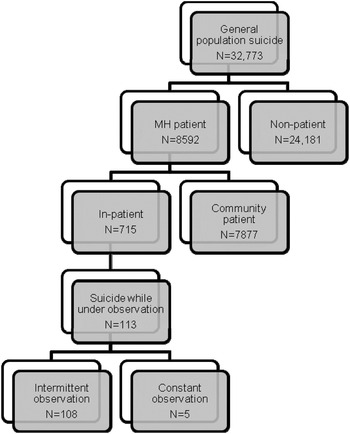
In England and Wales between 2006 and 2012, 8592 patients had been in contact with mental health services within 12 months before taking their own lives, 26% of deaths by suicide in the general population. There were 715 in-patient suicides during this period, 8% of all patient suicides. At the time of their death, 113 (16%) in-patients were under observation, an average of 16 deaths per year (Fig. 1).
Suicide in the general population and by mental health (MH) patients under observation (England and Wales 2006–2012).

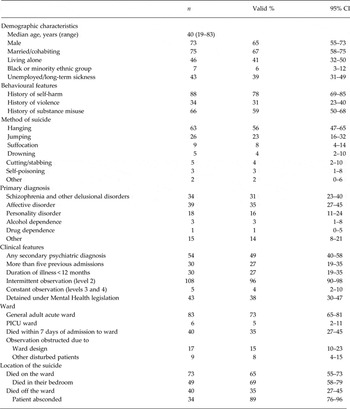
The following results are based on the 113 in-patient suicides that occurred while under observation. Of the patients, 65% were male. The median age of patients was 40 years (range 19–83). The majority had a history of self-harm. Over one-third were detained under mental health legislation at the time of their death. Most had serious mental illness (affective disorder or schizophrenia and other delusional disorders). Almost half had a secondary diagnosis, most commonly affective disorder (13/54, 24%), alcohol dependence/misuse (12/54, 22%) and drug dependence/misuse (11/54, 20%). The most common method of suicide was hanging (63, 56%) (Table 1). Of the 56 deaths by hanging on the ward, the most commonly used ligatures were sheets and towels (16, 32%) and belts (15, 30%). Of the patients, 108 (96%) were under intermittent observation (65% of these were male) and five (4%) were under constant observation (60% were male).
Sociodemographic, behavioural and clinical characteristics of in-patients under observation at the time of their suicide (n = 113)

CI, Confidence interval; PICU, psychiatric intensive care unit.
Clinical care and patient safety prior to suicide
Breach of policy and procedure
We received 78 SUI reports relating to the in-patient deaths, a 69% response rate. Of those with SUI reports, we found that suicide under observation occurred when observation was implemented poorly (46/76, 61%). For example, in 11/50 cases (22%), the observations were carried out later than the time scheduled. The planned observation was often disrupted due to ward distractions (16/69, 23%) such as responding to other disturbed patients (6/77, 8%). Of the deaths, 26 (33%) occurred during busy periods on the ward (e.g. 07.00–09.00, 13.00–15.00 and 19.00–21.00 hours) when staff had multiple duties to attend to. Furthermore, one SUI stated night-time observation was not carried out in accordance with Trust policy as staff did not want to disturb the patient's sleep by entering their bedroom. Of all the 113 incidents, poor ward design was said to have hindered the observation in 17 cases (15%).
Staff experience, familiarity with the patient and staffing levels
Of the deaths, 27 (27/48, 56%) occurred when observation was by less senior staff (i.e. student nurses/nursing or healthcare assistants) or by staff who were likely to be unfamiliar with the patient (e.g. bank/agency staff). Also, there were examples of poor documentation (11/42, 26%), with no information on the patient's presentation or how staff engaged with the patient. In 19/77 (25%) cases staffing levels on the ward were found to be below the required level at the time of the death.
Location of the suicide
Patient safety was put at risk when patients left the ward. We found 40 (35%) suicides occurred when the patient had left the ward either with or without agreement; in most cases patients who left the ward had absconded (34/38, 89%) (Table 1). However, those who left with agreement were permitted to leave the ward either escorted or unescorted, e.g. for cigarette breaks, to attend to their laundry or to attend other appointments. Of the patients who died on the ward, two-thirds took their own life in their bedroom (Table 1).
Constant observation
In five cases (4%) the suicide occurred while the patient was under constant observation. In one case, the patient was within eyesight but not being continuously observed because the patient was thought to be sleeping. Two deaths occurred after the patient had absconded from the ward, one of whom escaped while being escorted outside to retrieve laundry.
Discussion
This study examined a consecutive case series of patient suicide deaths while under observation on an in-patient ward. Our findings show that on average, 16 patients per year took their own life while under observation, including constant observation. In over half the cases, observations were not carried out as required. Previous studies have shown that some staff made their own judgement when undertaking observation, and tended to modify practice, not adhering to the observation policy (Duffy, Reference Duffy1995; Langenbach et al. Reference Langenbach, Junaid, Hodgson-Nwaefulu, Kennedy, Moorhead and Ruiz1999; Neilson & Brennan, Reference Neilson and Brennan2001; MacKay et al. Reference MacKay, Paterson and Cassells2005; Kettles & Paterson, Reference Kettles and Paterson2007; Vråle & Steen, Reference Vråle and Steen2008). Duffy (Reference Duffy1995) reported that staff modified observation practice considerably, departing from what was prescribed and recorded in care plans. Individual judgement and flexibility were used when conducting the observation, particularly around escorting patients on bathroom breaks (Duffy, Reference Duffy1995). Bowers et al. (Reference Bowers, Gournay and Duffy2000) also reported a variation in observation practice with nurses amending procedure on an ad hoc basis. A number of researchers have identified non-compliance with existing procedures as a factor that can increase risk (Porter et al. Reference Porter, McCann and McGregor Kettles1998; Bowers et al. Reference Bowers, Gournay and Duffy2000).
Another important finding of the current study was that less experienced staff members had been assigned the role of observation at the time of death. Previous research has shown a variation in the use of qualified and unqualified personnel for the intervention (Green & Grindel, Reference Green and Grindel1996; Bowers et al. Reference Bowers, Gournay and Duffy2000). In a study of observation policies from 27 in-patient units in England and Wales, Bowers et al. (Reference Bowers, Gournay and Duffy2000) reported a disparity across trusts as to which staff members were authorized to observe patients. There was no consensus as to whether agency, bank staff or nursing assistants should be used. Similarly, student nurses were permitted to assume the role at all levels of observation in 24% of trusts and some levels in 43%. Therefore, it is not uncommon practice for the most inexperienced or least trained members of staff or staff who were not familiar with the patients to be assigned this skilled nursing intervention, the rationale for this being limited staff and financial resources. We also found staffing levels in a quarter of cases were below the optimum level. Gournay & Bowers (Reference Gournay and Bowers2000) who examined 31 cases of suicide and serious self-harm on in-patient wards noted the difficulties in maintaining adequate levels of nursing cover and appropriate skill mix due to the changing requirements of patients including the need to provide observations. Bowers et al. (Reference Bowers, Whittington, Nolan, Parkin, Curtis, Bhui, Hackney, Allan and Simpson2008) in a study of self-harm and observation on 136 wards found a reduction in the rate of self-harm when qualified nursing staff were on duty, and the reverse effect, an increase in rates, when student nurses or unqualified nurses were on shift.
Deaths on wards still occurred despite patients being under observation in a controlled setting. The most common method was hanging. These deaths are often from low-lying ligature points such as doors and windows using sheets and towels as ligatures. In a recent study Hunt et al. (Reference Hunt, Windfuhr, Shaw, Appleby and Kapur2012) concluded that increasing awareness of the methods of suicide used by in-patients, the removal of potential ligature points and restricting access to potential ligatures for high-risk patients may help to reduce risk.
We found the most common location for in-patient suicides were patients’ bedrooms. Conducting observations by entering a bedroom is common practice; however, we found evidence of staff being reluctant to enter private spaces, particularly when patients were sleeping. The implementation of new technology to monitor vital signs would avoid disturbing patients at night. A contactless camera system has been trialled by Oxford University in custody suites and in Broadmoor high-security hospital. The system is less intrusive than conventional intermittent observations and monitors changes in respiration, heart rate and movement, automatically alerting staff to safety issues (Hodson, Reference Hodson2016).
We found a third of patients died while off the ward; in most cases the patient had absconded. Staff members need to be aware of the action to be taken if the patient absconds both from the ward and whilst on escorted leave. Hunt et al. (Reference Hunt, Windfuhr, Swinson, Shaw, Appleby and Kapur2010) in a study of in-patient suicide following absconding suggested two major suicide prevention measures, improving the patients’ experience by making wards more therapeutic and less intimidating and having tighter controls of ward exits. Technology such as electronic monitoring has also been trialled in a forensic setting to enhance risk management and help locate patients who abscond (Tully et al. Reference Tully, Hearn and Fahy2014).
In this study, five deaths occurred while patients were under constant observation. The patients showed a determination to either abscond or deliberately evade the view of the observer. It is particularly important therefore, for those undertaking constant observation, to be experienced and know the patient well to ensure that changes in mental state can be recognized early.
Limitations
The findings should be considered in the context of the following methodological shortcomings. First, we are unable to quantify the number of lives saved due to observation, as the study was not designed to measure the effectiveness of observation in preventing suicide. Second, this was a descriptive study which examined the circumstances preceding the suicide. Without a comparison group we cannot determine causality or draw aetiological conclusions. Third, data provided by clinicians and NHS trusts in the questionnaire and SUI reports may be subject to bias due to their awareness of the outcome. Fourth, the SUI reports were not standardized or written for research purposes; therefore while the information contained was valuable, the reports varied in their content and quality.
Implications for clinical practice
Although the number of in-patient suicides has fallen over the past decade (NCISH, 2015a ), reducing the number of deaths by patients admitted to acute care remains a priority for mental health services. Consequently, our findings have important implications for clinical practice. We have identified key areas for service improvement. Improving systems to ensure proper implementation of protocols could reduce human error and prevent adverse events. Observation policies have previously been shown to be well-defined documents; however, non-adherence to procedure has been associated with adverse events. The use of checklists in other healthcare settings, i.e. anaesthetics and surgery, have increased adherence to procedures and reduced the risk of serious incidents (Haynes et al. Reference Haynes, Weiser, Berry, Lipsitz, Breizat, Dellinger, Herbosa, Joseph, Kibatala, Lapitan and Merry2009). Systematic safety checks are commonplace in other high-risk industries such as aviation and aeronautics (Helmreich, Reference Helmreich2000; Hales & Pronovost, Reference Hales and Pronovost2006). Researchers from Stockholm have developed a 28-item Suicidal Patient Observation Chart which identifies the most important observation items to be documented in constant observations (Björkdahl et al. Reference Björkdahl, Nyberg, Runeson and Omérov2011).
Less ambiguity and better communication within the multidisciplinary team, particularly with staff new to the ward or unfamiliar with the patient, could also help improve adherence to policies. This is particularly pertinent during handover periods.
The observation component of a risk management plan should follow clear protocols, which should be adhered to, recorded and monitored with the inclusion of a clear rationale for the commencement of observation and a clear guidance for when the observation should stop. Observation is an acute clinical intervention and, as such, significant deviation from the observation plan should be recorded and reviewed by senior staff, including breaches of policy that did not result in harm to the patient. Serious breaches of protocol should be investigated under SUI procedures.
We found staffing levels to have been below the required level in a quarter of cases. Staffing levels can also be a deterrent to going on or coming off observation, the availability of staff should not prevent a patient being placed under observation; this decision should be based on clinical need. Patients at the highest risk of harming themselves are often placed under constant observation. This level of observation can be challenging and difficult for patients and staff; therefore clearer guidance is required to ensure that staff can remain vigilant whilst ensuring the patients’ dignity is respected.
Undertaking regular risk assessment and carefully monitoring the patient's mental state while under observation should inform decision making when clinicians are considering changing observation levels or ending the intervention. This is a skilled acute clinical intervention and, consequently, only staff members who have experience and skills in engaging with seriously unwell and distressed patients should undertake this intervention.
Observation should not be a stand-alone intervention; time with a patient is an opportunity for engagement. Positive engagement with the patient is an essential aspect of this level of observation (Cleary et al. Reference Cleary, Jordan, Horsfall, Mazoudier and Delaney1999). We found the current observation approach (especially intermittent observation) is not working safely enough. In a Cochrane review of containment strategies for people with mental illness, it was suggested that randomized controlled trials were not impossible to measure the effectiveness of observation (Muralidharan & Fenton, Reference Muralidharan and Fenton2006). Future studies could measure changes to observation levels, staff patient ratios, and comparisons of patients on intermittent or constant observation. Consequently, new models of care under observation could be developed.
Acknowledgements
The study was carried out as part of the National Confidential Inquiry into Suicide and Homicide by People with Mental Illness. We thank the other members of the research team: Alison Baird, James Burns, Huma Daud, Myrsini Gianatsi, Julie Hall, Isabelle M. Hunt, Saied Ibrahim, Rebecca Lowe, Cathryn Rodway, Phil Stones, David While and Nicola Worthington. We acknowledge the help of NHS Trust contacts for forwarding SUI reports and consultant psychiatrists and mental health teams for completing the NCISH questionnaires. The study was commissioned by the Healthcare Quality Improvement Partnership (HQIP) and funded by NHS England, the Scottish Government, Welsh Government, the Northern Ireland Department of Health, Social Services and Public Safety (DHSSPS) and the State of Jersey.
S.F., T.N., A.W., K.W., N.K., L.A. and J.S. designed this study. S.F., T.N. and S.-G.T. collected the data and S.F., T.N. and S.-G.T. carried out the final data preparation and analyses under supervision from J.S. and L.A.; S.F., A.W., N.K., L.A. and J.S. produced the initial draft of the paper and all authors contributed to the revision of the manuscript and approved the final version. J.S. is the study guarantor.
Declaration of Interest
L.A. and N.K. are members of the Suicide Prevention Advisory Group and L.A. is a non-executive director for the Care Quality Commission (CQC).