INTRODUCTION
The survival rate of breast cancer patients has increased in recent years mainly due to improved treatment and earlier diagnosis (American Cancer Society, 2011). However, survivorship is often followed by long-term physical and psychological symptoms that may limit daily functioning and social relationship capabilities, which in turn may seriously reduce quality of life (QoL) (Howard-Anderson et al., Reference Howard-Anderson, Ganz and Bower2012; Monga et al., Reference Monga, Garber and Thornby2007).
The main psychological symptoms reported postchemotherapy are different degrees of depressive symptoms, ranging from poor mood to clinical depression (Mitchell et al., Reference Mitchell, Chan and Bhatti2011), as well as anxiety and posttraumatic symptoms (Karakoyun-Celik et al., Reference Karakoyun-Celik, Gorken and Sahin2010). Cancer-related fatigue (CRF) is also highly prevalent. CRF is defined, as chronic tiredness, lack of energy, and weakness. CRF differs from the temporary feelings of fatigue experienced by a healthy person, is not related to one's degree of activity, and is not alleviated by rest or sleep (Mendoza et al., Reference Mendoza, Laudico and Wang2010; Ryan et al., Reference Ryan, Carroll and Ryan2007).
Studies have shown that the symptoms of depression and CRF are prevalent at the time of diagnosis, as well as when chemotherapy and radiotherapy are administered. One year after diagnosis, a large proportion of patients reported a gradual decline in the levels of these symptoms and a good QoL (Bower et al., Reference Bower, Ganz and Desmond2006; Brown & Kroenke, Reference Brown and Kroenke2009; Hofman et al., Reference Hofman, Ryan and Figueroa-Moseley2007; Jean-Pierre et al., Reference Jean-Pierre, Figueroa-Moseley and Kohli2007; Naaman et al., Reference Naaman, Radwan and Fergusson2009; Schultz et al., Reference Schultz, Dalton and Christensen2011). Nevertheless, other studies have shown that 20 to 40% of breast cancer patients continue to report different levels of depression and CRF for long periods after the end of the treatment (Liu et al., Reference Liu, Fiorentino and Natarajan2009; Schmid-Büchi et al., Reference Schmid-Büchi, Halfens and Dassen2011; Vahdaninia et al., Reference Vahdaninia, Omidvari and Montazeri2010).
The causes of CRF are not fully understood (Bower et al., Reference Bower, Ganz and Irwin2011; Palesh et al., Reference Palesh, Roscoe and Mustian2010). Researchers have suggested different etiologies, including the direct effects of the tumor and treatment, anemia, pain, hormonal changes, hot flashes, loss of muscle mass, alterations in the activity of neurotransmitters, and chronic inflammatory state (Littlewood et al., Reference Littlewood, Kallich and San Miguel2006; Paschoin de Oliveira Campos et al., Reference Paschoin de Oliveira Campos, Hassan and Riechelmann2011). Low physical activity and inadequate nutrition (Nail, Reference Nail2002) or sleeping disturbances have also been suggested as possible causes of CRF (Morrow et al., Reference Morrow, Andrews and Hickok2002; Mustian et al., Reference Mustian, Morrow and Carroll2007; Ryan et al., Reference Ryan, Carroll and Ryan2007).
The nature of the relationship between CRF and psychological symptoms has been the focus of several studies (e.g., Bower et al., Reference Bower, Ganz and Desmond2006; Liu et al., Reference Liu, Fiorentino and Natarajan2009). Some have found a positive association between CRF and depression or anxiety (Bower et al., Reference Bower, Ganz and Desmond2000; Hofman et al., Reference Hofman, Ryan and Figueroa-Moseley2007; Mendoza et al., Reference Mendoza, Laudico and Wang2010). Two metaanalyses, one of 55 studies (Donovan & Jacobsen, Reference Donovan and Jacobsen2010) and another of 59 studies (Brown & Kroenke, Reference Brown and Kroenke2009), found a consistently positive association between CRF and depression. However, the effects of different psychosocial factors or processes on each of these symptoms have received very little attention.
Jacobsen and colleagues (Reference Jacobsen, Donovan and Weitzner2003) suggested three possible explanations for the connection between symptoms of depression and CRF. First, patients may react with depression and to the fatigue caused by cancer treatment and its impairment of QoL. Second, fatigue is a common symptom of depression and may be among the psychological reactions to cancer and its negative effects on many aspects of daily life. A third explanation is that fatigue and depression occur simultaneously or emerge from the same physiological processes of cancer and its treatment, although they might not be directly connected.
The present study is based on the cognitive model of coping with stressors developed by Lazarus and Folkman (Reference Lazarus and Folkman1984), which proposes that the psychological and physical health outcomes of coping with chronic and intense stressors are affected by personal resources (e.g., optimism), appraisals of the stressor, and the coping strategies employed. Moreover, personal resources and appraisals were found to mediate the associations of stressors and personal characteristics with psychological and physical outcomes (Ben-Zur, Reference Ben-Zur2009; Cohen et al., Reference Cohen, Katz and Baruch2007a ). Similar to previous studies that focused on assessing the stress model's resources and appraisal components, the present study aimed to assess the associations between optimism, as a major personal resource (Carver et al., Reference Carver, Smith and Antoni2005), and threat and challenge appraisals (Lazarus & Folkman, Reference Lazarus and Folkman1984) in relation to depressive and CRF symptoms, representing the psychological and physical outcomes of coping with breast cancer.
Optimism is a personal resource defined as a general expectation or belief that good things will often happen in the future, while bad things will happen only rarely (Karademas et al., Reference Karademas, Karvelis and Argyropoulou2007; Scheier & Carver, Reference Scheier and Carver1992). Some studies have indicated that optimism is an effective resource for coping with adversity and challenges (Jobin et al., Reference Jobin, Wrosch and Scheier2013). Indeed, a considerable number of studies (e.g., Karademas et al., Reference Karademas, Karvelis and Argyropoulou2007; Lam et al., Reference Lam, Bonanno and Mancini2010), including a study of 2,595 breast cancer survivors (Bardwell et al., Reference Bardwell, Natarajan and Dimsdale2006), found a negative association between levels of optimism and depression in cancer patients. After controlling for intervening variables—such as treatment type and stage of disease—the level of optimism remained a significant predictor of depression and anxiety among breast cancer patients (Epping-Jordan et al., Reference Epping-Jordan, Compas and Osowiecki1999; Lam et al., Reference Lam, Bonanno and Mancini2010). However, other studies of breast cancer patients reported that optimism did not predict levels of depression (Reichelt et al., Reference Reichelt, Møller and Heimdal2008).
In contrast to the plethora of reports on the relationship between optimism and depression, only a few have examined the association between optimism and CRF in cancer patients in general (Allison et al., Reference Allison, Guichard and Gilain2000; Chambers et al., Reference Chambers, Meng and Youl2012; Kurtz et al., Reference Kurtz, Kurtz and Given2008) or breast cancer patients in particular (Matthews et al., Reference Matthews, Schmiege and Cook2012), and these results were not consistent. One study found an association between a high level of optimism and lower levels of CRF (Chambers et al., Reference Chambers, Meng and Youl2012), while no association was reported in another (Kurtz et al., Reference Kurtz, Kurtz and Given2008). These contrasting results might have been caused by study samples that included patients at various stages of their cancer (Allison et al., Reference Allison, Guichard and Gilain2000; Matthews et al., Reference Matthews, Schmiege and Cook2012) or the variety of cancers sites (Kurtz et al., Reference Kurtz, Kurtz and Given2008).
Cognitive appraisals of stressors were conceptualized as a principal aspect of the process of coping with stress and were categorized into three groups—appraisals of an event as (1) a threat, (2) harm, or (3) a challenge (Lazarus & Folkman, Reference Lazarus and Folkman1984)—often aggregated into two groups of threat/harm and challenge (Gilbar et al., Reference Gilbar, Ben-Zur and Lubin2010). Previous studies have shown that, although all appraisals of cancer as a challenge and as a threat/harm are prevalent among cancer patients, more cancer patients report appraising their disease as a challenge rather than as a threat (Büssing & Fischer, Reference Büssing and Fischer2009). In a study sample comprised of 1,012 women with breast cancer at various timepoints after diagnosis (Degner et al., Reference Degner, Hack and O'Neil2003), more than 50% reported appraising their cancer as a challenge. Other studies support these findings. Appraisals of breast cancer as a threat or harm were found to be associated with higher anxiety and depression (Alcalar et al., Reference Alcalar, Ozkan and Kucucuk2012; Büssing & Fischer, Reference Büssing and Fischer2009; Degner et al., Reference Degner, Hack and O'Neil2003). However, other studies found no association between threat or challenge appraisals and depressive symptoms (e.g., Bigatti et al., Reference Bigatti, Steiner and Miller2012). The only prior study that we found to assess appraisals of cancer in relation to CRF reported that CRF was not correlated with either of the abovementioned appraisals (Büssing & Fischer, Reference Büssing and Fischer2009).
Examining the relationship between optimism and appraisals, Scheier and Carver (Reference Scheier and Carver1985) posited that the ability to continue engaging in coping strategies is fueled by optimism when stress increases, which may affect stress appraisals and, hence, coping outcomes. A longitudinal study with nearly 2,000 colorectal cancer survivors found that lower optimism and a higher use of threat appraisals were both associated with poorer life satisfaction (Dunn et al., Reference Dunn, Ng and Breitbart2013). In a study of prostate cancer patients, loss and threat appraisals were related to higher depression and anxiety, while optimism was negatively related to these symptoms (Bjorck et al., Reference Bjorck, Hopp and Jones1999).
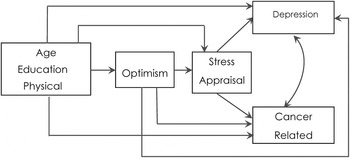
To conclude, very few studies to date have assessed the associations of the resource of optimism and stress appraisals with CRF, as compared to the many studies conducted on their role in depression in cancer patients. This gap coincides with unanswered questions regarding the association between CRF and depressive symptoms. Many previous research on the role of resources and appraisals in relation to depression or CRF (Bardwell et al., Reference Bardwell, Natarajan and Dimsdale2006; Bigatti et al., Reference Bigatti, Steiner and Miller2012) studied participants undergoing various types of therapy at different timepoints since completion of treatment. This may comprise a major intervening factor that might have affected the results. The aim of the present study was to assess the relationship between depression and CRF, and the relationship of these two variables to optimism, threat, and challenge appraisals, while controlling for demographic variables (Fig. 1). In addition, the study assessed the mediating role of cognitive appraisal between optimism and depression and CRF.
Conceptual model representing hypothesized links between research variables.

METHODS
Participants
The current study is a part of a larger ongoing study that examines the levels of CRF and psychological distress in relation to markers of inflammation. Our participants included 95 women with breast cancer (stages 1–3, locally focused disease) who were 1–6 months postchemotherapy and surgical intervention, with no current evidence of disease and who had not experienced cancer previously. The inclusion criteria were as follows: not being diagnosed with dementia or other known mental illness (according to medical records) and having sufficient knowledge of Hebrew or Arabic. Patients with comorbidities that can directly affect levels of fatigue—such as autoimmune diseases, fibromyalgia, HIV, hepatitis C, and chronic inflammatory diseases—were excluded. Participants were recruited at two main oncology units in northern Israel and through an online forum for breast cancer patients and survivors.
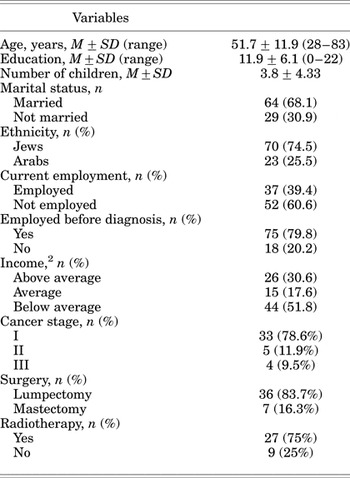
The demographic characteristics of participants are presented in Table 1. The mean age was about 52, ranging from 28 to 83, and the number for mean years of education was about 12. About 70% of participants were married and on average had 3.8 children. Most of the women worked outside the home before their cancer diagnosis, and around 40% reported that they were working at the time of the study. About half reported a below-average level of family income, and the rest reported an average or above-average income. Most of the women were secular.
Demographic characteristics of participants

Valid percentage is presented. SD = standard deviation.
1Not married: single, divorced, widowed.
2Average incomes per household as published by Israel's Central Bureau of Statistics.
Questionnaires
The personal and medical details included age, marital status, number of children, employment status, income, and stage of cancer were self-reported by participants.
The Physical Symptoms' Questionnaire included a list of nine physical symptoms prevalent after breast cancer treatment. We included the following items: pain, insomnia, nausea/vomiting, and hot flashes—taken from the European Organization for Research and Treatment of Cancer Quality-of Life-Questionnaire (EORTC QLQ-C30, v. 3) (Aaronson et al., Reference Aaronson, Ahmedzai and Bergman1993) and the EORTC QLQ breast cancer-specific questionnaire (EORTC QLQ–BR23) (Sprangers et al., Reference Sprangers, Groenvold and Arraras1996), which assesses various aspects of QoL. This questionnaire was previously translated into Hebrew by the Mapi Research Institute and validated according to EORTC guidelines (Koller et al., Reference Koller, Aaronson and Blazeby2007). Participants were asked to rate the intensity of the symptoms they had experienced during the previous week on a scale from 0 (“not at all”) to 4 (“very much”). A mean score for physical symptom severity was calculated, with higher scores indicating higher symptom intensity. This scale has been employed in a number of multicenter trials, including one in Israel (Paltiel et al., Reference Paltiel, Avitzour and Peretz2001). The internal reliability (Cronbach's alpha) for the current study was 0.86.
The Symptoms of Depression Questionnaire (Center for Epidemiological Studies Depression, CESD–10) (Andresen et al., Reference Andresen, Malmgren and Carter1994) is comprised of 10 items and is a shortened version of a 20-item instrument (Radloff, Reference Radloff1977). The items were subcategorized as positive (feeling good and generally satisfied) and negative (loss of interest, trouble concentrating, feeling depressed, feeling tired or low in energy, feeling afraid, trouble falling asleep, feeling alone, and finding it hard to get going) (Irwin et al., Reference Irwin, Artin and Oxman1999; Kohout et al., Reference Kohout, Berkman and Evans1993). Participants were asked to rate the intensity of their experiences during the previous week on a 4-point Likert-type scale (0 = “never” to 3 = “to a great extent”). We excluded the trouble-sleeping item, since it overlaps with the fatigue symptom inventory. The mean score was calculated, with higher scores reflecting a higher level of symptoms. This questionnaire is widely used in research among cancer patients (Liu et al., Reference Liu, Fiorentino and Natarajan2009) and is suitable for testing with different age groups (Brown et al., Reference Brown, Levy and Rosberger2003; Mui et al., Reference Mui, Burnette, Chen and Skinner2002). Its internal reliability in previous studies was α ≥ 0.82 (Cohen et al., Reference Cohen, Mansoor and Langut2007b ). It was translated into Hebrew (Cwikel & Segal-Engelchin, Reference Cwikel and Segal-Engelchin2005; Iecovich & Cwikel, Reference Iecovich and Cwikel2010), and its internal reliability (Cronbach's alpha) for our study was α 0.81.
The Fatigue Symptom Inventory (FSI) (Hann et al., Reference Hann, Jacobsen and Azzarello1998) includes 14 items that measure the severity of CRF symptoms and their perceived interference, rated on a scale from 0 (“not at all”) to 10 (“extremely”). Severity assessment consists of four items (e.g., “Please rate your level of fatigue on average this past week”). Perceived interference of fatigue during the past week consists of seven items. Scores for mean severity and interference on the CRF subscales were calculated as suggested before (Hann et al., Reference Hann, Jacobsen and Azzarello1998), with a higher score indicating a higher level of CRF. The items related to the number of days per week the participant reported CRF and to fatigue patterns throughout the day were not included in the current analysis. The questionnaire was translated into Hebrew. A previous study yielded an internal reliability (Cronbach's α) equal to or greater than 0.91 (Cohen & Fried, Reference Cohen and Fried2007), while the current study had a value of α equal to 0.89. The correlation between the two subscales was 0.74.
The Life Orientation Test (LOT–R) (Scheier et al., Reference Scheier, Carver and Bridges1994) was employed to assess the personality disposition of optimism. This instrument is a six-item scale, with three items worded as positive statements (e.g., “In uncertain times, I usually expect the best”) and the other three as negative statements (e.g., “If something can go wrong for me, it will”), which reflect a patient's expectations regarding the future. Participants were asked to rate the items using a scale ranging from 1 (“completely agree”) to 4 (“completely disagree”). After reversing the negative statements, a mean score was calculated, with higher scores indicating a higher level of optimism. This questionnaire has been widely used in studies with cancer patients (Härtl et al., Reference Härtl, Engel and Herschbach2010; Ho et al., Reference Ho, Rajandram and Chan2011; Zenger et al., Reference Zenger, Brix and Borowski2010) and has been translated into Hebrew (Amir et al., Reference Amir, Lewin-Epstein and Becker2002). Its internal reliability in previous studies was α ≥ 0.80 (Peleg et al., Reference Peleg, Barak and Harel2009), and the internal reliability in the current study was α = 0.76.
The Stress Appraisal Questionnaire focused on threat and challenge appraisals and was adapted from previous studies (e.g., Ben-Zur et al., Reference Ben-Zur, Yagil and Oz2005; Gilbar et al., Reference Gilbar, Ben-Zur and Lubin2010) that assessed appraisals of various stressors (based on Lazarus and Folkman's (Reference Lazarus and Folkman1984) appraisal of stressor conceptualization). Participants were asked to rate their appraisal of their experience with cancer as either a threat or a challenge. There were two items for each, rated on a scale from 1 (“not at all”) to 5 (“very much”) (e.g., “How important is it for you to overcome the situations you have recently experienced?”). Its internal reliability (Cronbach's alpha) was α 0.70 for challenge and α = 0.59 for threat. However, the correlation between challenge appraisal and threat appraisal was not significant (r = 0.11, p > 0.05).
Procedure
The institutional review board at each participating medical center approved our study, and each participant submitted an informed consent. Questionnaires were translated into Arabic using the back-translation method, after which a pretest of the Hebrew and Arabic versions was conducted. Patients who met the inclusion criteria were identified by the hospital's oncologists or were self-identified at the internet forum site. Due to the multisource nature of our study (two medical centers and an internet forum of breast cancer patients), a comparison of the demographic variables among participants from the different sources was conducted, and no statistically significant differences were found.
The response rate of medical center participants was 68%. The primary reasons for refusal were: geographical distance, lack of time, and desire to gain some distance from the disease. The response rate of forum participants could not be determined.
Data Analysis
Data analysis was carried out using SPSS software (v. 19). Means, standard deviations (SDs), and Pearson correlation coefficients were derived to assess associations among the study variables. Path analysis was conducted using a series of regression analyses. Only the demographic variables that were significantly correlated with CRF or depression were included in the regression analyses. However, because education was highly and significantly associated with income (r = 0.67, p < 0.001) and marital status (r = 0.40, p < 0.001), these two variables were not entered into the regressions. Therefore, the demographic variables controlled for in the regression were age, physical symptoms, and education. Mediation tests were conducted using Baron and Kenny's (Reference Baron and Kenny1986) model and Sobel's test for the statistical significance of mediations (Reference Sobel1982).
RESULTS
The means, standard deviations, and ranges of study variables are presented in Table 2. Mean levels of depression and CRF were moderate (possible ranges 0–3 and 0–10, respectively). The mean score for optimism was above the scale's midway point (possible range, 1–5), reflecting a medium level of optimism. The mean score of threat appraisal was at the scale's midway point (possible range, 0–9), while the mean score for challenge appraisal was above the midway point (possible range, 0–9), reflecting medium levels of threat appraisal and relatively high levels of challenge appraisal.
Mean (SD) and Pearson correlation coefficients of study variables

*p<0.05, **p < 0.01, ***p < 0.001.
The associations between study variables are presented in Table 2. Depression and CRF were positively associated. Optimism was significantly and positively associated with challenge appraisal and negatively associated with threat appraisal and depression. Threat appraisal was significantly associated with CRF, but the association with depression was not significant, while challenge appraisal was negatively associated with depression. Physical symptoms were significantly and positively associated with threat appraisal, depression, and CRF and negatively associated with optimism and age. Age was significantly and negatively associated with CRF and physical symptoms, and years of education were positively and significantly associated with optimism and challenge appraisal and negatively associated with depression.
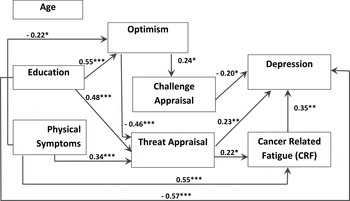
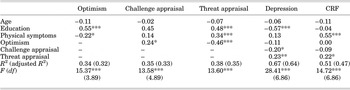
In the next step, regression analyses were conducted to assess the study model (Table 3, Figure 2). Optimism was regressed on the demographic variables—namely, age, education and physical symptoms—thus explaining 34% of the variance for optimism. Education and physical symptoms were significantly associated with optimism. Challenge and threat appraisals were then regressed on demographic variables and optimism. Some 35% of the variance for challenge appraisal and 38% of the variance for threat appraisal were thus explained. Challenge appraisal was significantly associated with optimism only, while threat appraisal was positively associated with education and physical symptoms and negatively associated with optimism.
Regression analyses for study variables (beta coefficients).

Regression analyses for study variables (beta coefficients)

*p<0.05, **p < 0.01, ***p < 0.001.
Hierarchical regression analyses were conducted to assess the associations of depression and CRF with study variables. Background variables and optimism were entered in the first step and explained 56% of the variance for depression [F(4,88) = 34.22, p < 0.001], with education (β = –0.54), physical symptoms (β = 0.18, p < 0.05), and optimism (β= –0.26, p < 0.01) being positively associated with depression (results not shown). Appraisals were then entered (see Table 3). The addition of appraisals in the second step (Table 3) increased the explained variance by 11%, with challenge appraisal positively associated and threat appraisal negatively associated with depression, rendering the associations of physical symptoms and optimism with depression nonsignificant.
The first step of the hierarchical regression analysis showed that demographic variables and optimism explained 39% of the variance for CRF [F(6,86) = 14.72, p < 0.001], with only physical symptoms being significantly associated with CRF (β = 0.55, p < 0.001). The addition of appraisals in the second step (Table 3) increased the explained variance by 12%, while physical symptoms and threat appraisal were found to be significantly associated with CRF.
Finally, the possibility that challenge and threat appraisals acted as mediators between optimism and CRF and depression was assessed while controlling for the intervening variables of age, education, and physical symptoms. Controlling for these variables, optimism was not significantly associated with CRF (β = 0.12, p > 0.05) but was significantly associated with depression (β = 0.26, p < 0.05). Therefore, mediation was assessed only for depression. The association of optimism and challenge appraisal was β = 0.24 (p < 0.05), while the association between challenge appraisal and depression (controlling for optimism in addition to the demographic variables) was β= –0.25 (p < 0.05). The association between optimism and depression became β = –0.21 (p < 0.05). According to Sobel's test, the mediation effect was significant (Z = –0.20, p < 0.05), indicating partial mediation of challenge appraisal for the optimism–depression association. Regarding assessment of threat appraisal as a mediator between optimism and depression, the association between optimism and threat appraisal was β = –0.45 (p < 0.05); the association between threat appraisal and depression (controlling for optimism in addition to the demographic variables) was β = 0.21 (p < 0.05); and the association between optimism and depression became β = –0.20 (p < 0.05). According to Sobel's test, the mediation effect was significant (Z = –02.1, p < 0.05), indicating partial mediation of threat appraisal for the optimism–depression association.
DISCUSSION
The present study demonstrated that depression and CRF are positively associated. When demographic variables were controlled for, CRF was associated with physical symptoms and threat appraisals, while a more complex picture appeared for depression: it was negatively associated with optimism and challenge appraisal and positively associated with threat appraisal. Further analysis revealed that challenge and threat appraisals partially mediated the relationship between optimism and depression, but not CRF.
The strong association found between depression and CRF is supported by previous studies (Bower et al., Reference Bower, Ganz and Desmond2000; Hofman et al., Reference Hofman, Ryan and Figueroa-Moseley2007; Mendoza et al., Reference Mendoza, Laudico and Wang2010), including longitudinal ones (Donovan & Jacobsen, Reference Donovan and Jacobsen2010; Otte et al., Reference Otte, Carpenter and Russell2010) and metaanalyses (Brown & Kroenke, Reference Brown and Kroenke2009; Donovan & Jacobsen, Reference Donovan and Jacobsen2010), although several studies reported finding no associations between CRF and depression (Ryan et al., Reference Ryan, Carroll and Ryan2007; Schumacher et al., Reference Schumacher, Wewers and Heinecke2002). The nature of these associations between CRF and depression has recently been the focus of much research (Bower et al., Reference Bower, Ganz and Desmond2000; Hofman et al., Reference Hofman, Ryan and Figueroa-Moseley2007; Liu et al., Reference Liu, Fiorentino and Natarajan2009; Mendoza et al., Reference Mendoza, Laudico and Wang2010), all of which suggest that reciprocal relations exist between these two groups of symptoms or that they have a common etiology (e.g., inflammatory cytokines), although they are not necessarily directly related (Ryan et al., Reference Ryan, Carroll and Ryan2007). It was also suggested that CRF and depression may occur simultaneously but generate from different antecedents (Jacobsen et al., Reference Jacobsen, Donovan and Weitzner2003). The somatization of psychological symptoms, exhibited by increased complaints about fatigue and distress, may indicate another trajectory of the close relation between depression and fatigue (Grassi et al., Reference Grassi, Caruso and Nanni2013).
The present results are cross-sectional and thus cannot explain the causes of either depression or CRF, yet they do suggest that different pathways may exist for the development of each of these symptoms. When demographic variables were controlled for, higher levels of physical symptoms and threat appraisal were the only factors associated with CRF. In contrast, higher levels of depression were associated with lower optimism, lower challenge appraisal, and higher threat appraisal. Scholars often stressed that studying physiological as well as psychological outcomes of coping is essential to expanding the theoretical and empirical knowledge about coping processes and about the role of coping resources (Lazarus & Folkman, Reference Lazarus and Folkman1984; Kohout et al., Reference Kohout, Berkman and Evans1993; Carver et al., Reference Carver, Scheier and Segerstrom2010), Nevertheless, many of the studies on coping have measured only psychological outcomes (Bigatti et al., Reference Bigatti, Steiner and Miller2012; Petticrew et al., Reference Petticrew, Bell and Hunter2002). The present results—showing different ways in which the personal resource of optimism is related to depression and CRF—stress the importance of further studying the differential effects of personal resources on each of the outcomes.
Although associations between threat appraisal and CRF have not been previously reported, this result may be explained in several ways. Many studies conducted among patients with cancer and other chronic diseases have demonstrated that a higher tendency to catastrophize—a construct similar to threat appraisal—was associated with higher fatigue levels and a higher level of fatigue-induced daily disruption (reviewed in Lukkahatai & Saligan, Reference Lukkahatai and Saligan2012). In addition, Grassi et al. (Reference Grassi, Caruso and Nanni2013) reported strong associations between fatigue and somatization. The tendency toward somatization is an outcome, among other factors, of the perceptions and meanings attributed to physical symptoms (Grassi et al., Reference Grassi, Caruso and Nanni2013).
Depression, similar to CRF, was associated with higher threat appraisal, as supported by much previous work. However, only depression—and not CRF—was associated with optimism and challenge appraisals. These associations are in accordance with cognitive theory (Carver et al., Reference Carver, Smith and Antoni2005; Lazarus & Folkman, Reference Lazarus and Folkman1984) and previous studies on chronic stress situations (Jobin et al., Reference Jobin, Wrosch and Scheier2013) and cancer (Cohen, Reference Cohen2002; Dunn et al., Reference Dunn, Ng and Breitbart2013; Franks & Roesch, Reference Franks and Roesch2006). Challenge appraisals occur when individuals perceive that they have the ability to control a situation (Cohen, Reference Cohen2002). In such an event, they expect positive outcomes (Carver et al., Reference Carver, Scheier and Segerstrom2010) and perceive the stressful situation as an opportunity for growth or development (Lazarus & Folkman, Reference Lazarus and Folkman1984). It might be that while threat appraisals increase both symptoms—CRF and depression—challenge appraisals are a protective factor, especially against psychological symptoms. However, it is plausible to assume that individuals who experience higher CRF levels also perceive their situation as more threatening or that more depressed individuals express lower levels of optimism, more threat perceptions, and less challenge perceptions.
Our results demonstrate that cognitive appraisals partially mediate the associations between optimism and depression and coincide with previous reports that cognitive appraisals serve as a mediator between personal resources and psychological outcomes of coping with cancer (Curtis et al., Reference Curtis, Groarke and McSharry2013; Henselmans et al., Reference Henselmans, Sanderman and Baas2009) or other stressors (Kennedy et al., Reference Kennedy, Evans and Sandhu2009; Newton & McIntosh, Reference Newton and McIntosh2010).
The findings have several clinical implications. They point to the importance of specifically evaluating each of the symptoms, depression and CRF, in cancer patients. They stress the need to be aware of the connections between them, as well as the different characteristics of each of the symptoms, and to specifically intervene in an attempt to reduce each of these symptoms. Identification of patients at high risk for CRF and depression at the initial stages of diagnosis and treatment and treating them either by pharmacological or psychosocial means (Grassi et al., Reference Grassi, Caruso and Nanni2013; Raison & Miller, Reference Raison, Miller, Halaris and Leonard2013) can improve quality of life in the posttreatment phase and during the many years of survivorship remaining for the growing numbers of women that survive their bouts with cancer (Lee et al., Reference Lee, Park and Lee2011; So et al., Reference So, Marsh and Ling2009). The other main results—that optimism and challenge appraisal are related to lower depression and that threat appraisal is related to higher levels of depression—also have important implications. They suggest that, in order to reduce depression, psychosocial interventions with cancer patients should directly focus on strengthening patients' sense of optimism and positive appraisals, and that patients should be advised about how to reduce threat appraisals.
Several strengths and limitations of the present study must be underscored. Its main strength is the homogeneity of the participant group in terms of cancer stage (participants had early-stage breast cancer), receiving chemotherapy, and being 1–6 months postchemotherapy. This homogeneity in characteristics related to stage and treatment allowed controlling for the effects of chemotherapy. This is an extremely influential factor in terms of both CRF and depression (Ryan et al., Reference Ryan, Carroll and Ryan2007; Schultz et al., Reference Schultz, Dalton and Christensen2011) but was often not controlled for in previous studies assessing CRF (Bower et al., Reference Bower, Ganz and Irwin2011; Otte et al., 2009) or depression (Kim et al., Reference Kim, Son and Hwang2008; Reuter et al., Reference Reuter, Classen and Roscoe2006).
Our study has several limitations. The first is the fact that we employed a convenience sample, which limits the generalizability of our results. However, using several sources for recruiting participants—two major institutes of oncology and an internet forum that serves a diverse population of patients over a wide geographical area—provided some indication of the sample's representativeness. Another study limitation lies in its being a cross-sectional study, which does not allow for drawing conclusions either about the direction of the relationships among optimism, depression, and CRF or about causality. Longitudinal studies with larger groups of participants are needed to offer a better understanding of the nature of the relationship between depression and CRF, and their connections to personal resources and appraisals. More studies would be desirable regarding efficient screening and intervention methods in order to reduce CRF and depression, which would significantly improve the quality of life of many breast cancer patients and survivors.
ACKNOWLEDGMENT
The study was funded by The Israel Cancer Association, No of grant 20132007.