Worldwide, there has been a dramatic and promising increase in both research and the number of policies supporting bilingual and multilingual learners in elementary schools (Cardinal, Reference Cardinal2013; Gorter & Cenoz, Reference Gorter and Cenoz2017; Valentino & Reardon, Reference Valentino and Reardon2014). Across these studies, there is great variation in parental level of education of the learners and in instruction time and amount of language practice that multilingual children receive. These factors undoubtedly influence learning opportunities and in turn affect our understanding of how multilingual children develop language proficiency and reading comprehension, which are essential skills for long-term academic and social achievement (Hoff, Reference Hoff2013). The primary objective of the current study was to examine the development of language proficiency and reading comprehension in both English (second language, L2) and French (third language, L3) of multilingual students in French immersion (FI) programs in Canada and to compare their performance to that of English (L1)/French (L2) bilingual students. In this paper, multilingual children are defined as students who learned a L1 at home that is different from either English or French, the two official languages in Canada. The multilingual children were exposed to English as a L2 before schooling began, because English is the dominant societal language in the area where children lived and were learning French as a L3 in school.
To investigate the effects of multilingualism on language and literacy development, we used an analysis of individual growth modeling (IGM) because it provides information about between-person, for example, to account for vocabulary and reading proficiency in English that may differ between bilingual and multilingual students, and within-person relationships, for example, a student’s English vocabulary and reading proficiency may be expected to change from their baseline measure. Moreover, IGM allows us to examine the same variables simultaneously, longitudinally (in this study, between Grades 4–6), which was one strength of the current study. Another strength of our study was to track the oral language and reading comprehension skills of bilingual and multilingual children who lived in communities that had equal and relatively high social, economic, and educational opportunities to learn English and French. A final strength was our ability to focus on an understudied population of older multilingual children who are quickly expanding their abilities to comprehend text across middle grades.
All children were enrolled in Canadian FI programs that provide a consistent context in which bilingual and multilingual children receive an equivalent amount and type of classroom instruction. From kindergarten to Grade 3, the instruction is 100% in French. English is first introduced as a language of instruction in Grade 4, accounting for 30% of instructional time. Then, English is gradually increased until Grade 8 and accounts for up to 50% of instructional time. The FI context enabled us to examine the within- and cross-language associations between oral language and reading comprehension, while controlling for the possible influence of parental level of education and methods of instruction on reading achievement.
Effects of parental level of education, language use, and language of instruction on oral language and reading development
The transformation in policies for bilingual and multilingual education reflects the recent and rapid changes in global immigration and the need to provide appropriate education to all learners. In the USA, the percentage of children from immigrant families is expected to rise to 40% by 2030, with Hispanic and Asian students being the largest groups (Aud et al., Reference Aud, Hussar, Johnson, Kena, Roth, Manning and Notter2012). In Europe, the increase of immigrants is the main factor behind multilingualism (Extra & Yagmur, Reference Extra and Yagmur2012). In Canada, over 20% of the population speaks a language other than French and English, with most speaking an Asian language (Statistics Canada, 2016). In the case of Canadian FI programs, long considered one of the most successful bilingual programs, most students between the 1960s and 1990s were native English speakers who were learning French as a L2 in school (Genesse & Fortune Reference Genesse and Fortune2014). However, in recent years, a change in social demographics, including an increase in interest in FI programs from parents of various cultural backgrounds, has led to a larger number of multilingual students enrolling in FI programs. Now, multilingual children make up to 50% of students in FI classrooms across major metropolitan cities in Canada (Vancouver School Board, 2019).
Recognizing the educational, professional, and social advantages of good reading skills in more than one language, numerous studies across the world, including in the USA, Europe, and Canada, have examined the reading outcomes of bilingual and multilingual children. Many studies with bilingual children have included Spanish–English children in the USA who are, for the most part, educated in English-only classrooms and receive little instruction in their other language (for a review, see Uchikoshi & Marinova-Todd, Reference Uchikoshi, Marinova-Todd, Grøver, Uccelli, Rowe and Lieven2019). These bilinguals may feel that it is necessary to prioritize English, as opposed to Spanish, to understand instruction in reading comprehension strategies (Kieffer, Reference Kieffer2012). For the most part, Spanish–English bilinguals in the USA come from homes where parental level of education is lower and have limited access to classroom resources that support reading development in Spanish and English. This could further jeopardize their reading comprehension outcomes and school achievement more generally (e.g., Hoff, Reference Hoff2013; Kieffer, Reference Kieffer2010a, Reference Kieffer2010b; Lesaux & Kieffer, Reference Lesaux and Kieffer2010; Uccelli et al., Reference Uccelli, Galloway, Barr, Meneses and Dobbs2015). In fact, low parental level of education is related to an increased risk of later reading comprehension difficulties that appear after Grade 3 and can last beyond Grade 8 (Kieffer, Reference Kieffer2010b; Lesaux & Kieffer, Reference Lesaux and Kieffer2010).
The bulk of the studies on reading comprehension outcomes with multilingual children have been conducted in Europe because of the large number of immigrant children learning a L2 (usually the majority language) as well as a L3 (such as English) in school, and educational policies that are supportive of the acquisition of several languages (e.g., Content and Language Integrated Learning approach, for a review see Gorter & Cenoz, Reference Gorter and Cenoz2017). In the few studies where bilingual and multilingual children lived in relatively high, and equal, social, and economic circumstances, such as Basque–Spanish or Catalan–Spanish speakers learning English as a L3, multilingual children showed advantages relative to bilingual students in vocabulary knowledge, listening comprehension, and reading comprehension in English (e.g., Cenoz, Reference Cenoz, Cenoz, Hufeisen and Jessner2003; Cenoz & Valencia, Reference Cenoz and Valencia1994; Errasti, Reference Errasti2003; Sanz, Reference Sanz, Perez-Vidal, Juan-Garau and Bel2008). By contrast, studies with groups of immigrant children – often multilingual – who had comparatively lower level of parental education revealed that these children had lower vocabulary and reading skills in English as compared to bilingual children (e.g., Bos & Pietsch, Reference Bos and Pietsch2006; Schoonen et al., Reference Schoonen, van Gelderen, de Glopper, Hulstijn, Simis, Snellings, Stevenson, Randsdell and Barbier2002; Van Gelderen et al., Reference Van Gelderen, Schoonen, Gloper, Hulstijn, Snellings, Simis and Stevenson2003).
In parallel, based on parental reports from the immigrant families in the European studies, it appears that the multilingual children had fewer opportunities to use the majority language (L2) and this may have led to disadvantages in learning the more socially and economically valuable language (Schoonen et al., Reference Schoonen, van Gelderen, de Glopper, Hulstijn, Simis, Snellings, Stevenson, Randsdell and Barbier2002; Van Gelderen et al., Reference Van Gelderen, Schoonen, Gloper, Hulstijn, Snellings, Simis and Stevenson2003). As an example, Van Gelderen et al. (Reference Van Gelderen, Schoonen, Gloper, Hulstijn, Snellings, Simis and Stevenson2003) reported that multilingual children in the Netherlands between the ages of 11 and 13, who came from immigrant families and were learning Dutch (their L2) and English (their L3) at school, tended to use their L1 (e.g., Turkish, Moroccan, or Surinam) outside the school on a regular basis. Most of the multilingual participants reported learning/using Dutch, considered the more socially valuable language in the Netherlands, only at school. By contrast, native speakers of Dutch reported using Dutch on a regular basis, both in the school and home environment, for example, in various sporting and cultural activities. English was taught as an additional language at school to all groups. The multilingual children showed a continued lag in oral language, especially in vocabulary knowledge and grammatical knowledge, as well as reading comprehension both in Dutch and in English compared to the native speakers of Dutch. Similar findings of lower oral language and literacy skills were reported in other groups of immigrant multilingual children in Grades 6, 8, and again in older children in Grade 10 who used mostly their L1 at home and were acquiring literacy in Dutch and English at school (Schoonen et al., Reference Schoonen, van Gelderen, de Glopper, Hulstijn, Simis, Snellings, Stevenson, Randsdell and Barbier2002).
Moreover, for multilingual students, the amount of time learning the L2 and L3 at school varied tremendously across studies in Europe, with some receiving as little as 1 hr per day, whereas others were exposed to each language as much as 4 hr per day. For example, in the two studies already discussed above (Schoonen et al., Reference Schoonen, van Gelderen, de Glopper, Hulstijn, Simis, Snellings, Stevenson, Randsdell and Barbier2002; Van Gelderen et al., Reference Van Gelderen, Schoonen, Gloper, Hulstijn, Snellings, Simis and Stevenson2003), the multilingual and bilingual participants received most of their academic instruction in Dutch, for example in math, resulting in approximately 3.5 hr per day. They also received an additional 1 hr of English instruction per day. The focus of English instruction was developing basic oral communication skills only. By contrast, the studies conducted in Spain reported a balanced approach where oral language instruction was provided in all languages (e.g., Cenoz, Reference Cenoz, Cenoz, Hufeisen and Jessner2003; Cenoz & Valencia, Reference Cenoz and Valencia1994; Errasti, Reference Errasti2003). Specific oral/literacy instruction was given approximately 2 hr per day in each language, the L1 (Basque), the L2 (Spanish), and the L3 (English) for a total of 6 hr. Indeed, differences in the amount of language of instruction, as well as the type of instruction, for example, the types of literacy activities in the classroom, reported across the studies suggest that instruction may have played a key role in the development of reading comprehension.
The few existing studies on Canadian FI programs have included younger children developing word reading skills. In these studies, multilingual and bilingual children came from households where parents had a relatively high level of education – described as “middle-class” with some post-secondary education – and lived in households that generally supported language and literacy development in all languages (e.g., Au-Yeung et al., Reference Au-Yeung, Hipfner-Boucher, Chen, Pasquarella, D’Angelo and Deacon2015; Dagenais, Reference Dagenais2003; Hipfner-Boucher et al., Reference Hipfner-Boucher, Lam and Chen2014). One study by Au-Yeung et al. (Reference Au-Yeung, Hipfner-Boucher, Chen, Pasquarella, D’Angelo and Deacon2015) examined the effects of bilingual education on the development of language proficiency and reading comprehension skills in the L2 and L3 of multilingual students from Grade 1 to Grade 3. The authors found that across grades, bilingual and multilingual children showed equivalent performance on all French measures, whereas the bilingual students demonstrated stronger English vocabulary than the multilingual students despite faster English vocabulary growth for the multilingual children. Scores in both groups on English vocabulary were within or above the average range for Grades 1–3. Both groups performed similarly on English word reading and reading comprehension. Relatedly, a different study found that multilingual Chinese L1 students learning English and French in FI programs had English vocabulary and word reading skills comparable to those of bilingual learners in Grade 1 (Hipfner-Boucher et al., Reference Hipfner-Boucher, Lam and Chen2014). In summary, to better understand the oral and literacy development in multilingual children, it is important to consider the effects of parental level of education, language use, and language of instruction.
Theoretical framework for reading comprehension in multilingual students
When studying the reading development of multilingual children, it is inevitable that the theoretical model on which the research is grounded must account for possible cross-language associations. Transfer effects, between measures of language proficiency and reading comprehension in all the languages involved, exist as predicted by the linguistic interdependence hypothesis (Cummins, Reference Cummins2000). According to the hypothesis, which has been used primarily to explain reading achievement in a L2, literacy development in the L2 is influenced by underlying oral language proficiency that transfers from the L1 to the L2 and vice versa (Cummins, Reference Cummins2000). Therefore, children’s acquisition of a L2 is partly influenced by their competence in the L1, in which well-developed skills in the L1 facilitate the acquisition of L2 (Cummins, Reference Cummins2000). Moreover, interdependence is heightened in rich sociocultural contexts, for example, classrooms, that value bilingualism and support acquisition of all spoken languages, such as Canadian FI contexts (Genesee & Fortune, Reference Genesse and Fortune2014). Fewer studies have examined transfer effects in multilingual children (Bérubé & Marinova-Todd, Reference Bérubé and Marinova-Todd2012; Bourgoin & Dicks, Reference Bourgoin and Dicks2019; Hipfner-Boucher et al., Reference Hipfner-Boucher, Lam and Chen2014; Haeni-Hoti et al., Reference Haenni Hoti, Heinzmann, Muller, Oliveria, Wicki and Werlen2011; Sinclair et al., Reference Sinclair, Jang and Vincett2019; Thibault & Matheson, Reference Thibault and Matheson2020; for a review, see Prevoo et al., Reference Prevoo, Malda, Mesman and van Ijzendoorn2016). Subsequently, more empirical evidence is needed to reveal how these relationships develop longitudinally as bilingual and multilingual children further improve their L2 and L3 skills.
Several models exist for explaining English reading comprehension in monolingual children (see Snow et al., Reference Snow, Burns and Griffin1998 for a review). The most prevalent among them has been the simple view of reading (SVR; Hoover & Gough, Reference Hoover and Gough1990), which has also been applied to bilingual populations (e.g., Gottardo et al., Reference Gottardo, Javier, Farnia, Mak and Geva2014; Farnia & Geva, Reference Farnia and Geva2013; Mancilla-Martinez et al., Reference Mancilla-Martinez, Kieffer, Biancarosa, Chistodoulou and Snow2011; Nakamoto et al., Reference Nakamoto, Lindsey and Manis2008). According to the SVR model, reading comprehension is explained primarily by: (1) word reading in all languages and (2) language knowledge (emphasis on vocabulary and listening skills) in all languages. The model has since been broadened to include additional factors, such as pseudoword reading (e.g., Proctor et al., Reference Proctor, August, Carlo and Snow2006), morphological awareness (e.g., Silverman et al., Reference Silverman, Proctor, Harring, Hartranft, Doyle and Zelinke2015), syntactic skills (e.g., Farnia & Geva, Reference Farnia and Geva2013), and phonological awareness (e.g., Au-Yeung et al., Reference Au-Yeung, Hipfner-Boucher, Chen, Pasquarella, D’Angelo and Deacon2015). Ultimately, all factors fall within the two main pillars, namely decoding and oral language, that underlie reading comprehension.
When children are first learning to comprehend text, it is the combined effect of word reading and oral language skills that helps explain their reading comprehension abilities. As children attain higher levels of decoding fluency, it is their oral language proficiency that becomes more important for reading comprehension (see Farnia & Geva, Reference Farnia and Geva2013 for a thorough description of the SVR model). Particularly for second language learners, who may have weaker skills in their L2, this could further jeopardize their reading comprehension in the L2. Therefore, in the current study conducted with children between Grades 4 and 6, we used the SVR model to help identify which literacy and oral language predictors to include when examining reading comprehension and to establish whether it could be readily applied to multilingual populations.
Next, we present a summary of the literature outlining transfer effects between language and reading skills, first among bilingual children and then in multilingual populations.
Transfer effects in bilingual children
Research on bilingual children spanning more than two decades has examined the extent to which oral language skills and reading skills in the L1 transfer to the child’s reading comprehension skills in the L2 (e.g., Carlisle et al., Reference Carlisle, Beeman, Davis and Spharim1999; Dufva & Voeten, Reference Dufva and Voeten1999; Erdos et al., Reference Erdos, Genesee, Savage and Haigh2011; Gottardo et al., Reference Gottardo, Javier, Farnia, Mak and Geva2014; Nakamoto et al., Reference Nakamoto, Lindsey and Manis2008; Proctor et al., Reference Proctor, August, Carlo and Snow2006; Swanson et al., Reference Swanson, Rosston, Gerber and Solari2008). In all studies, within-language relationships, especially between vocabulary knowledge and reading comprehension in the L2, were stronger than the cross-language relationships (e.g., Duran et al., Reference Duran, Roseth and Hoffman2015; Hwang et al., Reference Hwang, Mancilla-Martinez, McClain, Oh and Flores2020; Kieffer, Reference Kieffer2012, see Prevoo et al., Reference Prevoo, Malda, Mesman and van Ijzendoorn2016 for a review). Nonetheless, cross-language relationships facilitated biliteracy (for a review, see Uchikoshi & Marinova-Todd, Reference Uchikoshi, Marinova-Todd, Grøver, Uccelli, Rowe and Lieven2019). For example, in some studies conducted with Spanish speakers learning English, vocabulary knowledge in the L1 was correlated with L2 reading comprehension (Proctor et al., Reference Proctor, August, Carlo and Snow2006; Ramirez et al., Reference Ramirez, Chen and Pasquarella2013). In addition, listening comprehension in the L1 was associated with L2 reading, especially when the two languages utilized the same writing system, such as alphabetic languages (Carlisle et al., Reference Carlisle, Beeman, Davis and Spharim1999; Dufva & Voeten, Reference Dufva and Voeten1999; Ramirez et al., Reference Ramirez, Chen and Pasquarella2013).
Transfer effects in multilingual children
Fewer studies have examined the cross-language relations between oral language skills and reading comprehension of older multilingual students, beyond Grade 3, who are rapidly shifting from learning to read words to comprehending more complex texts. In Canadian FI contexts, one study examined the transfer effects of language proficiency and reading skills in English and French of multilingual students (Bérubé & Marinova-Todd, Reference Bérubé and Marinova-Todd2012). Bilingual and multilingual children came from families with equivalent middle to high levels of parental level of education (i.e., most parents had completed a bachelor’s degree). The study was conducted with students in Grade 4 because this was the first year in which they received formal instruction in English at school. Findings revealed that for bilingual and multilingual children, for example, those who were literate in a L1 such as Spanish, word reading and vocabulary knowledge in French strongly predicted English and French reading comprehension. Relatedly, in a different study with younger multilingual Chinese L1 students learning English and French in FI programs in Grade 1, transfer of French morphology knowledge to English word reading skills was observed (Hipfner-Boucher et al., Reference Hipfner-Boucher, Lam and Chen2014).
Similarly, in Europe, Haenni Hoti et al. (Reference Haenni Hoti, Heinzmann, Muller, Oliveria, Wicki and Werlen2011) explored how multilingual German-speaking students (L1) in Grades 3 and 5 learning English as a L2 and French as a L3 developed reading comprehension. Throughout the week, students were primarily instructed in their L1 and L2 and received one additional hour of L3 instruction per day. Both listening comprehension and reading skills in the L2 were significant predictors of listening comprehension and reading skills in the L3 for all students in Grade 3 and in Grade 5.
The results from the two studies conducted in Canada and the one in Germany revealed that cross-language associations – oral language to reading – occurred in one direction only. In the two Canadian studies, L3 French language proficiency significantly predicted L2 English reading (Bérubé & Marinova-Todd, Reference Bérubé and Marinova-Todd2012; Hipfner-Boucher et al., Reference Hipfner-Boucher, Lam and Chen2014), which was the opposite to that found by Haenni Hotti et al. (Reference Haenni Hoti, Heinzmann, Muller, Oliveria, Wicki and Werlen2011). The direction of transfer of oral language to reading could be explained by the academic context in which the children were learning. In all cases, much of the instruction focused on developing strong oral language skills. Students in the Haenni Hoti et al. (Reference Haenni Hoti, Heinzmann, Muller, Oliveria, Wicki and Werlen2011) study were receiving most of their academic instruction in the L2 (English), whereas reading instruction in the L3 (French) was provided to a lesser degree. In the FI contexts (Bérubé & Marinova-Todd, Reference Bérubé and Marinova-Todd2012; Hipfner-Boucher et al., Reference Hipfner-Boucher, Lam and Chen2014), students were receiving most of their classroom instruction in the L3 (French) and to a lesser degree in the L2 (English). Therefore, it is likely that the amount of formal oral language instruction in one language provided a basis to support reading comprehension in the other. These findings further support the SVR model by showing how oral language proficiency becomes a more significant predictor of reading comprehension comparatively to word reading, in later reading acquisition. The findings from the Canadian/German studies were further supported by a study with children in Grade 3, living in Kenya (Piper et al., Reference Piper, Schroeder and Trudell2016). In this very different context, the multilingual children were receiving English-only (L3) academic instruction but had received prior instruction in Kiswahili (their L2). While oral language skills were not directly measured in this study, English word reading was strongly related to Kiswahili (L2) reading comprehension. Finally, a study with a different language combination was conducted with multilingual Kapampangan (L1)/Filipino (L2) speakers aged 8–13 years old in the Philippines learning English as a L3 in a context where children were learning Filipino and English at school (Padilla, Reference Padilla2021). Hierarchical regression showed that word reading and vocabulary knowledge in the L2 and L3 were associated with reading comprehension only in English.
To fully understand how oral language is associated with reading comprehension, in multilingual children, including within- and cross-language associations, the current longitudinal study followed bilingual and multilingual students from Grade 4 through Grade 6. We utilized the SVR model to examine the role of language proficiency on reading comprehension of multilingual students who were expected to have already developed strong word reading skills in both of their languages of instruction.
In addition, the current study followed multilingual and bilingual children who had relatively rich and equal economic, social, and educational opportunities to learn a L2 and L3 in school. By comparing children with similarly high parental level of education and equivalent instruction at school, it was possible to better understand the within and cross-language associations among word reading skills, oral language skills, and reading comprehension. The following two research questions were addressed:
-
1) Do multilingual students develop equivalent language proficiency and literacy skills in English (L2) and French (L3) to those of bilingual students between Grade 4 and Grade 6?
-
2) What are the patterns of growth in reading comprehension in English and French of bilingual and multilingual students from Grade 4 through Grade 6? Do cross-language word reading and oral language skills uniquely predict English and French reading comprehension in Grades 4 through 6, after controlling for within-language word reading and oral language skills?
Based on past research with younger students (e.g., Au-Yeung et al., Reference Au-Yeung, Hipfner-Boucher, Chen, Pasquarella, D’Angelo and Deacon2015), we hypothesized that the bilingual students would demonstrate stronger English oral proficiency than the multilingual students because English was their native language and they had likely received greater exposure to English over time. Based on findings from Bérubé and Marinova-Todd (Reference Bérubé and Marinova-Todd2012) where education context influenced the direction of transfer between oral language and reading, we hypothesized that L3 French language proficiency would predict L2 English reading comprehension because most of the formal academic language instruction in FI programs was provided in French.
Method
Participants
A total of 150 students, 73 multilingual students and 77 bilingual students, participated in the study. The participants’ language use was determined by a demographic questionnaire completed by the parents in which language background, exposure, and use were documented. The questionnaire was adapted from the Alberta Language Environment Questionnaire (Paradis, Reference Paradis2011) and the Parent Interview of Acquiring Literacy in English Study (Duursma et al., Reference Duursma, Romero-Contreras, Szuber, Proctor, Snow, August and Calderon2007). Participants were identified as bilingual if: (1) they spoke English 90–100% of the time at home, (2) the parents reported speaking English almost always to their children at home, and (3) the parents were born in Canada or another English-speaking country (e.g., USA). The multilinguals were those who: (1) spoke a language other than English or French at home on a daily basis in a variety of settings (e.g., at home, with grandparents, or with friends), (2) at least one of their parents was born outside Canada in a non-English speaking country, and (3) their parents reported that the first language spoken by the child was a language other than English or French.
They were tested at three time points: at the beginning of Grade 4 (T1), at the end of Grade 4 (T2), and at the end of Grade 6 (T3). After the end of Grade 4, 35 students (19 from the multilingual group and 17 from the bilingual group) did not complete any further testing. The reasons for attrition after Grade 4, for example, family relocation and transfer to an English mainstream program, were similar for the two language groups. Moreover, no significant differences on vocabulary knowledge and listening comprehension at T1 were found between the children who dropped out of the study and those who continued onto T2. Between 2003 and 2016, there was a 52% increase in FI enrollment in Canada, and approximately 8% of all K-12 students were enrolled in FI programs in 2020 (DeWiele & Edgerton, Reference DeWiele and Edgerton2021). Transfer of students from FI to an English mainstream program has been well documented. For example, by Grade 4, up to 35% of students transfer to an English mainstream program (Bosetti et al., Reference Bosetti, Van Pelt and Allison2017). The primary reasons given by parents were that they felt that the content in a second language was becoming too difficult and that children were no longer motivated to learn in French (Genesee & Fortune, Reference Genesse and Fortune2014).
The multilingual students had the following home languages: Amharic, Afrikaans, Chinese, Croatian, Czech, Danish, Fanti, German, Greek, Hungarian, Japanese, Korean, Persian, Polish, Punjabi, Romanian, Serbian, Spanish, Tagalog, and Vietnamese. The largest majority (21% of participants) of multilingual students had Chinese as a L1. All multilingual students were exposed to their L1 from birth and 85% of the children were born in Canada. Multilingual students lived in a culturally and linguistically diverse city. However, English was the dominant language used in many aspects of life, such as television, grocery shopping, cultural (e.g., dance classes), and sporting events (e.g., soccer team). Therefore, 70% were also exposed to English within the first year of life.
Student participants were from seven public FI schools in a major Western Canadian city and had parents with comparable high levels of education, where most parents had completed a bachelor’ degree. All students, including bilingual and multilingual, were enrolled in early FI program and were learning in the same classrooms. They received 100% of their instruction in French from kindergarten to Grade 3, and from Grade 4 to Grade 6, approximately 70% of instruction was in French and 30% of instruction was in English. Public elementary schools in this Canadian city are mandated by a provincially funded program that emphasizes a language-rich environment. Classroom instruction between Grades 4 and 6 supports strong oral language in French, including direct vocabulary instruction and reading practice through activities such as guided reading and reading aloud. Students received French instruction in math, sciences, social sciences, music, physical education, and language arts. They received English instruction during English language arts, which emphasized explicit vocabulary and reading practice, as well as during some math classes.
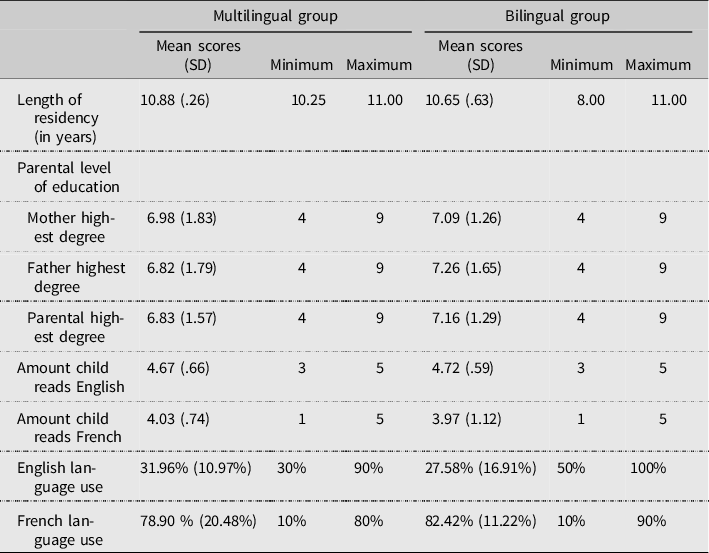
Background information on the literacy activities and language use of all languages outside of school was collected to establish that, in Grade 6, the multilingual group and the bilingual group had similar exposure to English and French and used both languages equally (see Table 1). Most parents reported that their children had been exposed to reading in English since kindergarten. These observations show that the multilingual children were using English and French on a regular basis and suggest that they engaged in several activities in both languages. Moreover, multilingual children reported using their L1 daily, such as communicating with siblings and with grandparents, especially outside of school activities. The frequency with which the students read independently in English, t(139) = .42, p = .67, d < .001, and in French, t(137) = .31, p = .76, d < .001, was equivalent in the two groups. More than half of the children in the multilingual group were literate in their L1 and read in the home language at least twice per month. Most parents of the multilingual children reported that they had moderate to strong English-language skills. By contrast, much like the parents of bilingual children, they did not speak French; therefore, students were learning French solely at school. There was no significant difference between groups on the education levels of their mothers, t(133) = .50, p = .62, d = .001, or fathers, t(136) = .72, p = .48, d = .001.
Mean scores (standard deviations) on socio-linguistic measures in English and French

Note. The amount the child reads in English and French is measured in number of days. A score of “3” for amount a child reads in English and French indicates that the child reads 1–2 days a week, and a score of “4” indicates that the child reads 3–5 days a week. For English and French language use, parents estimated the amount of time their child spoke English and French during an average school day. The number “7” in degree of maternal education indicates that mothers had achieved at least a bachelor’s degree and “6” indicates that mothers had achieved at least some college education or trade school training.
Materials
The materials consisted of standardized measures of language proficiency and reading skill that have been used in prior studies with bilingual and multilingual children in FI programs (e.g., Au-Yeung et al., Reference Au-Yeung, Hipfner-Boucher, Chen, Pasquarella, D’Angelo and Deacon2015; Hipfner-Boucher et al., Reference Hipfner-Boucher, Lam and Chen2014) and included equivalent measures in both English and French.
English oral language proficiency measures
The Peabody Picture Vocabulary Test-III (Dunn & Dunn, Reference Dunn and Dunn1997) is a standardized test of English receptive vocabulary knowledge commonly used in educational research. This test includes 228 items of increasing difficulty. For each item, the student was asked to identify one of four pictures that corresponded to the stimulus word presented orally by the examiner. The test was administered according to standardized procedures. The test–retest reliability coefficient for participants between ages 8 and 11 (same age group as the participants from the present study) was .93 (Dunn & Dunn, Reference Dunn and Dunn1997).
The Listening Comprehension subtest from the Woodcock Language Proficiency Battery-Revised ([WLPB-R], Woodcock, Reference Woodcock1991) is a standardized test of comprehension of spoken language. The experimenter read aloud short sentences which were each missing a word. The task required the children to complete the sentence with a word that was appropriate both in terms of structure (syntax) and meaning (semantics) in the context of the sentence. The test–retest reliability coefficient for participants between ages 8 and 11 (same age group as the participants from the present study) was .86 (Woodcock, Reference Woodcock1991).
English reading measures
English word reading skills were assessed using the Letter-Word Identification subtest from the WLPB-R (Woodcock, Reference Woodcock1991). Children were asked to read aloud words that were increasingly more complex. The test was administered according to standardized procedures. The test–retest reliability coefficients for participants between ages 8 and 11 (same age group as the participants from the present study) were between .90 and .94.
English reading comprehension was assessed using the Passage Comprehension subtest from the WLPB-R (Woodcock, Reference Woodcock1991). Children were asked to read a short passage with a missing word that required them to produce a word that would be appropriate both in terms of structure (syntax) and meaning (semantics) in the context of the paragraph. The test–retest reliability coefficients for participants between ages 8 and 11 (same age group as the participants from the present study) were between .90 and .94. (Woodcock, Reference Woodcock1991).
French oral language proficiency measures
The Échelle de vocabulaire en images Peabody [Peabody Picture Vocabulary Test] (Dunn et al., Reference Dunn, Thériault-Whalen and Dunn1993) is a commonly used standardized test of French receptive vocabulary knowledge. Children were asked to identify from among four pictures the image that correctly corresponds to an orally presented word. The test–retest reliability coefficient for participants between ages 8 and 11 (same age group as the participants from the present study) was .93 (Dunn & Dunn, Reference Dunn and Dunn1997).
The Compréhension orale [oral comprehension] subtest from the Test de rendement individuel de Wechsler ([WIAT-II], Wechsler, Reference Wechsler2007) is a standardized test of spoken language comprehension. This test is similar to the English WLPB-R, although it also uses a picture elicitation task and includes items that measure vocabulary knowledge. The test–retest reliability coefficient for participants between ages 8 and 11 (same age group as the participants from the present study) was .88 for this age group (Wechsler, Reference Wechsler2007).
French reading measures
French word reading skills were evaluated with the Lecture de mots [word reading] subtest from the WIAT-II (Wechsler, Reference Wechsler2007). Children were asked to read aloud words that were progressively more complex. The test–retest reliability coefficients for participants between ages 8 and 11 (same age group as the participants from the present study) were between .88 and .94.
French reading comprehension was assessed with the Compréhension de lecture [reading comprehension] from the WIAT-II (Wechsler, Reference Wechsler2007). The test–retest reliability coefficients for the age group were between .88 and .94 on the different subtests (Wechsler, Reference Wechsler2007). Participants read short stories (aloud or silently) and answered questions relating to the stories. The test–retest reliability coefficients for participants between ages 8 and 11 (same age group as the participants from the present study) were between .88 and .94.
Procedure
Identical procedures were followed for each group at T1, T2, and T3. Each child was tested individually in two sessions (one in each language) that lasted approximately 45 min each and were separated by 1–2 weeks. English- and French-speaking research assistants who were specifically trained for the purposes of the study administered all tests in the two languages. To counterbalance for order effects, one-half of the participants were tested first in English, and the other half were tested first in French.
Statistical analysis
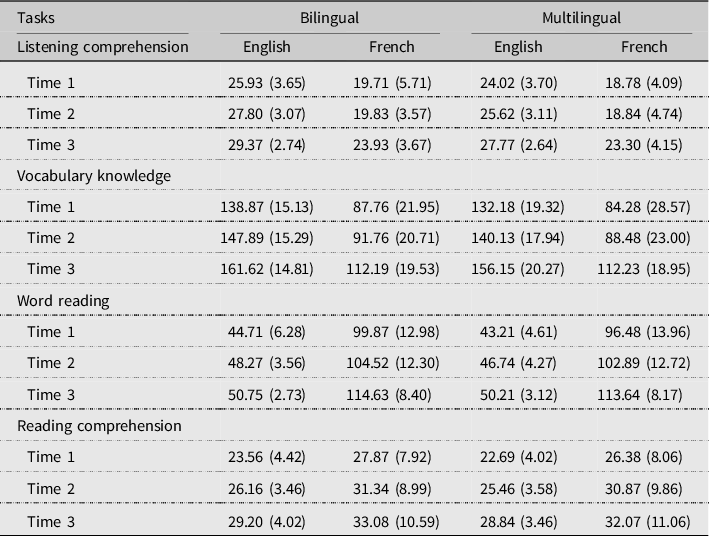
All statistical analyses were conducted using the SAS statistical package. First, a descriptive analysis using raw scores was conducted on all variables (see Table 2). Correlation analyses using raw scores were also conducted to investigate the relationships between the variables, which were used to foreshadow the subsequent analysis.
Raw scores test means (standard deviations) on English and French oral language tests and reading tests at T1 (beginning of Grade 4), at T2 (end of Grade 4), and at T3 (end of Grade 6)

Then, to examine the differences in the level and rate of change in reading comprehension among individuals, a series of individual growth models using the PROC MIXED procedure available in the SAS statistical package were fitted to the data (Littel et al., Reference Littell, Milliken, Stroup and Wolfinger1996; Singer, Reference Singer1998). For the growth modeling analyses, raw scores were used. Using a χ2 estimate to power our study for a large effect size (> .8) at the p-level of .05, we were able to recruit more than 34 children in each group to detect a large effect size between language dyads (Duncan et al., Reference Duncan, Duncan and Strycker2011). Participant recruitment was based on an expected 20% attrition rate across the three time points. We used IGM using the multilevel model for change (Singer & Willett, Reference Singer and Willett2003), with time indexed by age in months. We used age in months because it allows for the model to follow the developmental timeframe more precisely. IGM is designed for exploring longitudinal data on individuals over time and allows for data sets with varying numbers of waves of data and with the spacing of waves of data to vary across individuals (Littell et al., Reference Littell, Milliken, Stroup and Wolfinger1996; Singer & Willett, Reference Singer and Willett2003). For all variables measuring growth, we used raw scores. Models were run separately for English reading comprehension and French reading comprehension.
As all subjects had either two or three data points, a linear model was used (Singer & Willett, Reference Singer and Willett2003). Exploratory analysis was conducted to check the variables for linearity and normality. We tested the data and examined the assumption of collinearity. Results showed that multicollinearity was not a concern (tolerance for predictors variables, vocabulary knowledge, listening comprehension, and word reading was between 1.59 and 2.68, and VIF was between .37 and .67). First, an unconditional means model was fitted with no predictors. This model described variation in the outcomes (Singer & Willett, Reference Singer and Willett2003). Then a growth model was fitted, where within-person change was examined by fitting growth trajectories for each child over time. For the French reading comprehension model, the standard error of the random effect of slope became larger than the parameter estimate for the random effect of slope when additional predictors were added to the model. For the English reading comprehension model, in the last model the fixed and random effects could not be estimated because the error-covariance matrix was not positive definite (Singer & Willet, Reference Singer and Willett2003). As a solution, the random components of growth rate were removed (Singer & Willet, Reference Singer and Willett2003). In this approach, all students are assumed to have the same value for the growth rate and average group differences are tested for children with different characteristics.
Next, between-person variation was examined and predictors, such as background variables, were added to investigate whether they affected individual changes in reading comprehension. Given our interest in potential differences in the growth trajectories of children who were bilingual or multilingual, we examined the growth trajectories for the two groups. Group (bilingual or multilingual) was kept in the model even when it was not significant. Parental level of education was also kept in the model, even if it was not significant, as a control measure for level of education background. In our preliminary analyses, school variables for each school were also included to control for school differences. However, since there appeared to be no significant differences among schools, and the AIC values suggested that the model without school variables was a better fit, school variables were taken out in this set of models.
Then, within-language variables, including interactions with time, were added to investigate whether individual changes in reading comprehension were related to within-language variables. All within- and cross-language variables were mean-centered and used to predict the intercept and growth factors. Within-language variables that were non-significant were removed from the models. Finally, cross-language variables, including interactions with time, were added to investigate whether individual changes in reading comprehension were related to cross-language variables. Cross-language variables that were non-significant were removed from the models (Prevoo et al., Reference Prevoo, Malda, Mesman and van Ijzendoorn2016). Full maximum likelihood estimates were used because models that differ in their fixed effects, but not in their variance components, were compared (see Singer, Reference Singer1998). As suggested by Singer and Willett (Reference Singer and Willett2003), the likelihood ratio test was used as the primary criterion for evaluating model fit, and the Akaike and Bayesian information criteria are also provided as additional indicators of goodness of fit.
Results
First, we will present the descriptive statistics that compare the development of language proficiency and literacy skills of bilingual and multilingual children in Canadian FI programs. Then, we will present the individual growth models that describe patterns of growth in reading comprehension in English and French from Grade 4 through Grade 6 and examine how the word reading skills and language skills in English and French are related to reading comprehension among bilingual and multilingual students.
Descriptive statistics
Our first objective was to compare the development of language proficiency and literacy skills of bilingual and multilingual students between Grade 4 and Grade 6 using raw scores. Using raw scores has the distinct advantage that they can be easily compared to published norms.
English vocabulary and listening comprehension
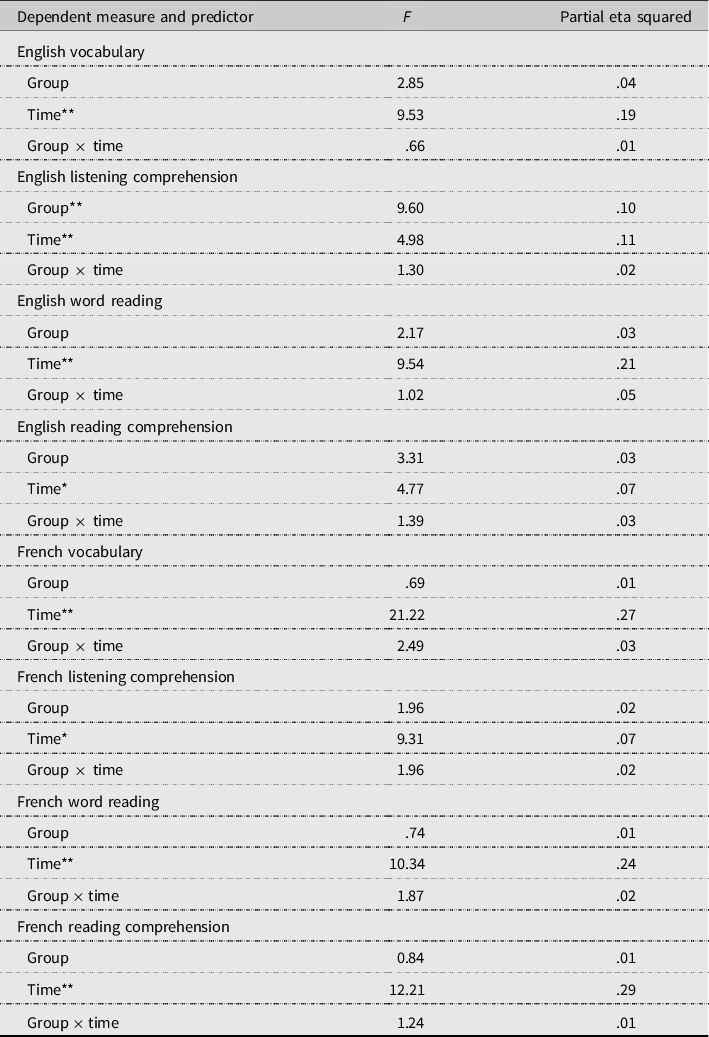
Results from a series of 2×3 (Group × Time) ANOVAs (see Table 3) showed that for English vocabulary size, the main effect for group and the interaction were not significant. The main effect for time was significant, thus showing an increase in skill for both language groups from T1 to T3. For English listening comprehension, both main effects were significant, while the interaction was not. The bilingual students had stronger listening comprehension skills than the multilinguals (η2 = .11, which corresponds to a small to medium effect size) and both groups had an increase in listening comprehension from Time 1 to Time 3.
Effects of group, time, and group × time interaction on measures of oral language proficiency and reading ability in English and French (based on raw scores)

Note. *p < .05, **p < .01, time is a measurement that was recorded in months.
English reading
On both the English word reading task and reading comprehension task, the interaction and main group effect were not significant, whereas time was the only significant effect, showing an improvement for both groups from T1 to T3.
French vocabulary and listening comprehension
On the French measures, both for vocabulary knowledge and listening comprehension, the interaction and the main group effect were not significant. There was a main effect of time, indicating that all students improved from T1 to T3.
French reading
On the two French reading tasks, word reading and reading comprehension, the interaction and the main group effect were not significant. There was a main effect of time only indicating an increase in reading performance from T1 to T3 for the two language groups.
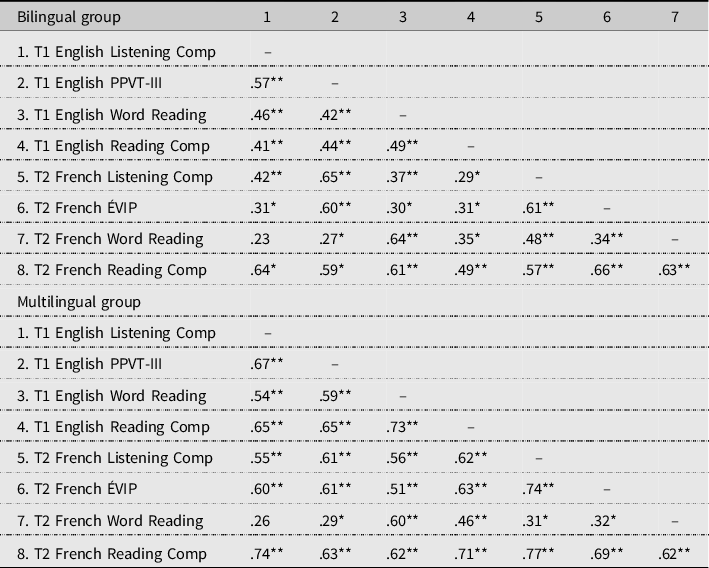
Next, correlations using raw scores among variables in English and French are presented for bilingual students and multilingual students separately in Table 4. English vocabulary and French vocabulary were both strongly correlated with English reading comprehension for both groups. Moreover, English listening comprehension was highly correlated with English reading comprehension for the two groups. However, English comprehension was more strongly associated with French reading comprehension for the multilingual group, as compared to the bilingual group.
Correlations (raw scores) between the English and French oral proficiency and reading measures at the beginning of Grade 4 (T1) and the end of Grade 4 (T2) for the bilingual (N = 64 in T1; 47 in T3) and the multilingual (N = 56 in T1; 41 in T2) groups

Note. *p < .05, **p < .01
Individual growth modeling
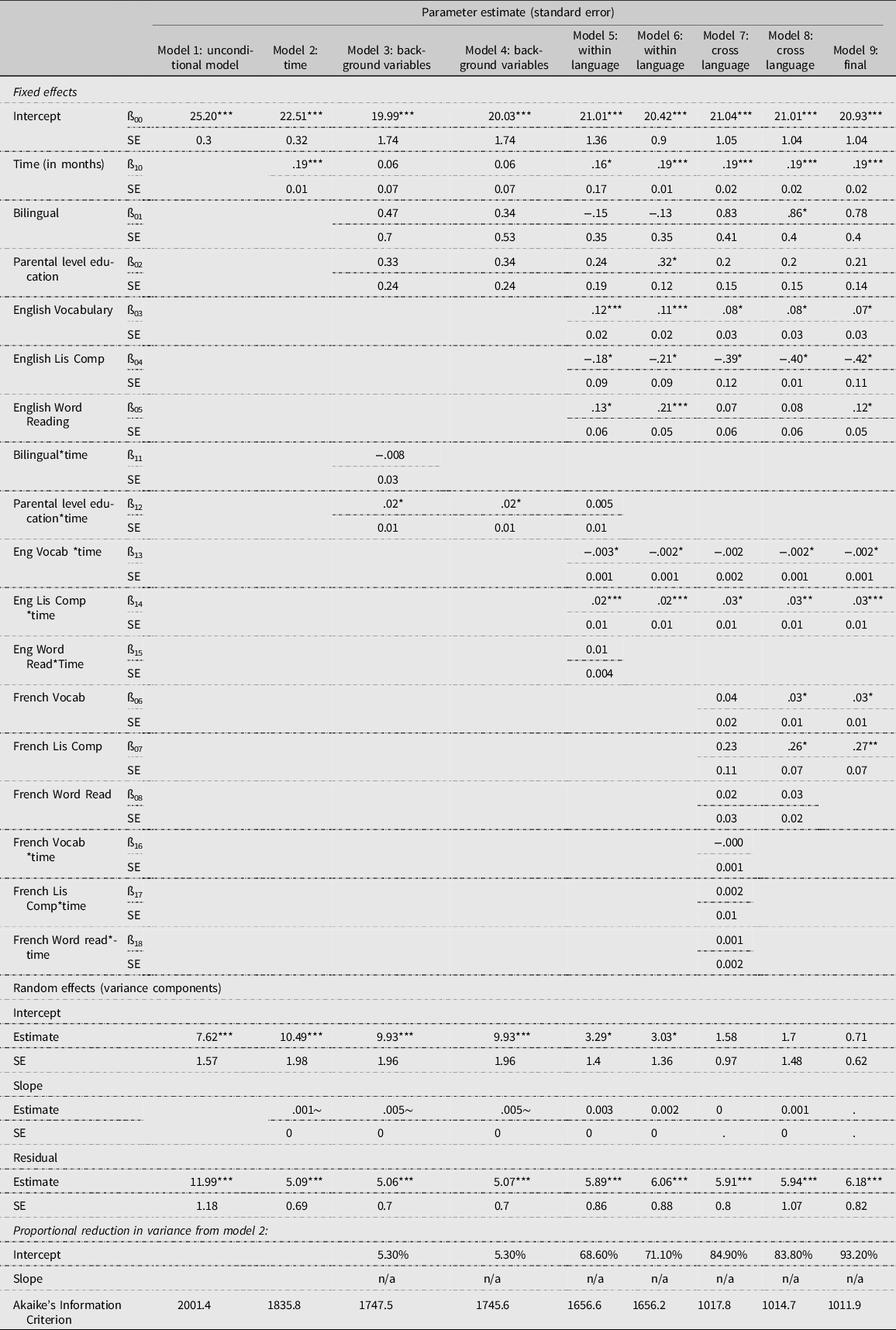
Guided by the SVR model, our second objective was to explore patterns of growth in reading comprehension in English and French of bilingual and multilingual students from Grade 4 through Grade 6 and examine whether word reading skills and language skills in English and French were related to reading comprehension. We used IGM using the multilevel model for change, with time indexed by age in months (Singer & Willett, Reference Singer and Willett2003). Model 9 in Table 5 was chosen as the final model for prediction of English reading comprehension and the final equation is as follows: English Reading Comprehension Predicted = 20.93 + .19*time + .78*group (bilingual) + .21*level of education + .07*English vocabulary −.42*English listening comprehension + .12*English word reading − .002*English vocabulary*time + .03*English listening comprehension*time + .03*French vocabulary + .27*French listening comprehension.
Estimates of fixed and random effects from a series of fitted individual growth models in which English vocabulary, English listening comprehension, English word reading, French listening comprehension, and French vocabulary predict the average English reading comprehension (bilingual/multilingual) during the period between Grades 4 and 6 for all children (n = 150). Final model: Model 9

Note. ∼ p < .10, *p < .05, ** p < .01, *** p < .001
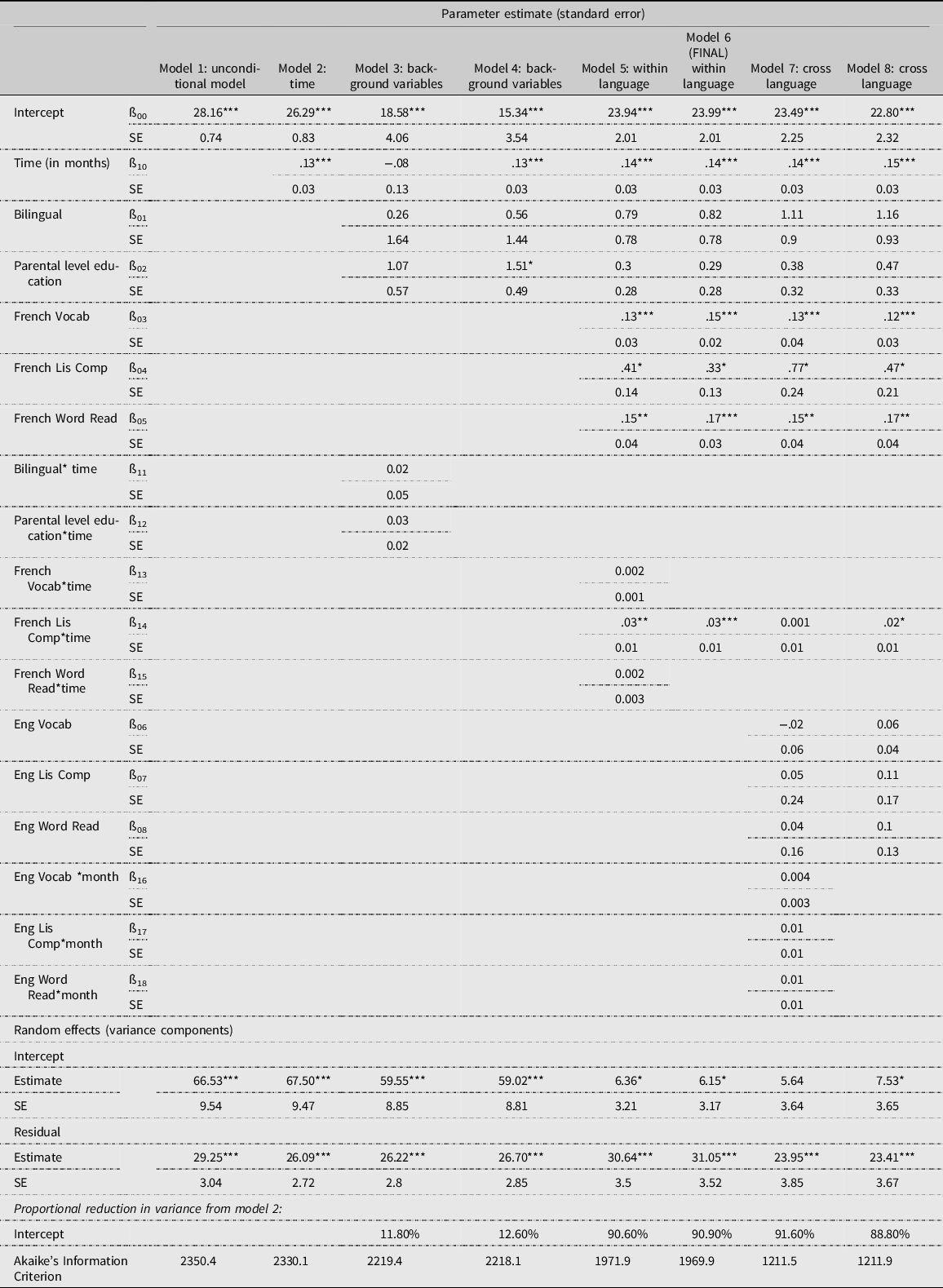
Model 6 in Table 6 was chosen as the final model for prediction of French reading comprehension and the final equation is as follows: French Reading Comprehension Predicted = 23.99 + .14*time + .82*group (bilingual) + .29*level of education + .15*French vocabulary + .33*French listening comprehension + .17*French word reading + .03*French listening comprehension*time.
Estimates of fixed and random effects from a series of fitted individual growth models in which French vocabulary, French word reading, and French listening comprehension predict the average French reading comprehension at the start of Grade 4 and rate of change in French reading comprehension, after controlling for parental level of education and group (bilingual/multilingual) during the period between Grades 4 and 6 for all children (n = 150). Final model: Model 6

Note. *p < .05, ** p < .01, *** p < .001
English reading comprehension
The main finding is that whether the child was bilingual or multilingual did not have an effect on the estimated average initial level or growth of English reading comprehension. Additionally, parental level of education was not a significant predictor.
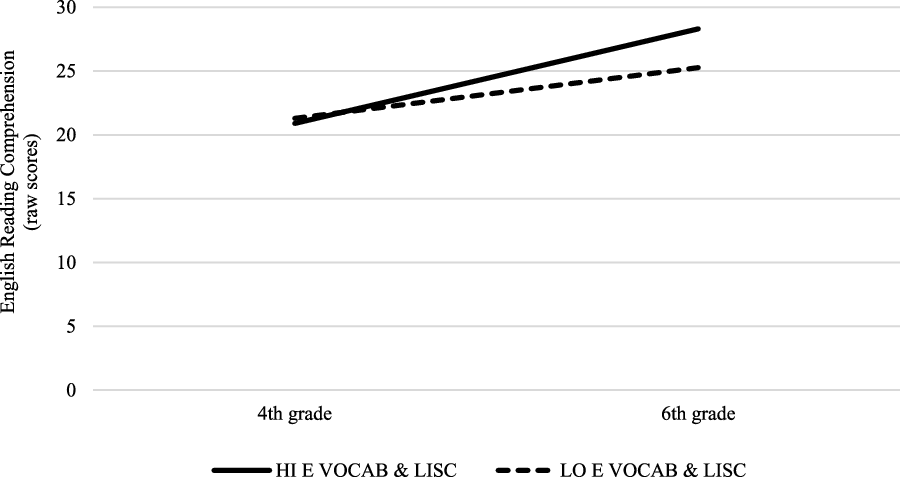
The three within-language variables (English vocabulary, English listening comprehension, and English word reading) were all associated with the estimated average initial level of English reading comprehension in Grade 4. Both oral proficiency variables, including English vocabulary and English listening comprehension, were also significant on the rate of growth of English reading comprehension. Since the standard deviation for English reading comprehension pooled across all 3 years was 4.44 points, the coefficient of .07 for English vocabulary corresponds to an effect size of .5 standard deviation for the 3-year period. Yet, the estimated coefficient for the interaction between English vocabulary and time was also significant with a coefficient of −.002, suggesting that the growth of English reading comprehension was different depending on English vocabulary scores. Taken together, children who began Grade 4 with higher English vocabulary started with higher English reading and their growth was still steeper than those who had started Grade 4 with lower English vocabulary scores. For English listening comprehension, the coefficient of −.42 for English listening comprehension and the coefficient of .03 for the interaction between English listening comprehension and time suggest that those who had high English listening comprehension started Grade 4 with lower English reading comprehension, yet they had a steeper growth in English reading comprehension than those who started with lower English listening comprehension. When combining the effects of both the English vocabulary and English listening comprehension, the results suggest that children whose English vocabulary and English listening comprehension scores were at the 75th percentile started Grade 4 at similar English reading comprehension levels as those who were in the 25th percentile but their increase in scores were significantly steeper (approximately 6 points) over the 3 years (see Figure 1).
Average fitted trajectories, after controlling for parental level of education, group, and cross-language variables that describe the effect of English vocabulary and English listening comprehension on the change in English reading comprehension. High is defined as scoring at the 75th percentile, and low is defined as scoring at the 25th percentile (n=150).

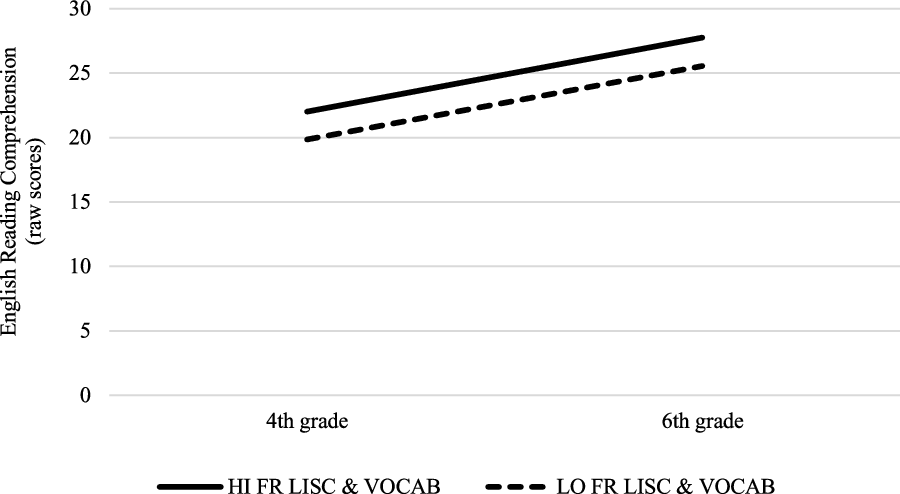
Individual changes in English reading comprehension were also related to cross-language variables, after controlling for within-language variables. Children with higher French vocabulary and higher French listening comprehension in Grade 4 had higher English reading comprehension at the beginning of Grade 4 (see Figure 2). Specifically, since the standard deviation for English reading comprehension pooled across all 3 years was 4.44 points, the coefficient of .03 for French vocabulary and .27 for French listening comprehension corresponds to an effect size of a quarter of a standard deviation and 2 standard deviations, respectively, for English reading comprehension for the 3-year period. There was no cross-language effect on the rate of growth of English reading comprehension, after controlling for the within-language variables, so those who had high French vocabulary and high French listening comprehension also had higher English reading comprehension than those who started with lower French scores and the difference remained the same until Grade 6.
Average fitted trajectories, after controlling for parental level of education, group, and within-language variables (English vocabulary, English listening comprehension, and English word reading) that describe the effect of French listening comprehension and French vocabulary on the change in English reading comprehension. High is defined as scoring at the 75th percentile, and low is defined as scoring at the 25th percentile (n=150).

French reading comprehension
Similar to the results for English reading comprehension, whether the child was bilingual or multilingual did not have an effect on the estimated average initial level or growth of French reading comprehension. Additionally, parental level of education was not a significant predictor.
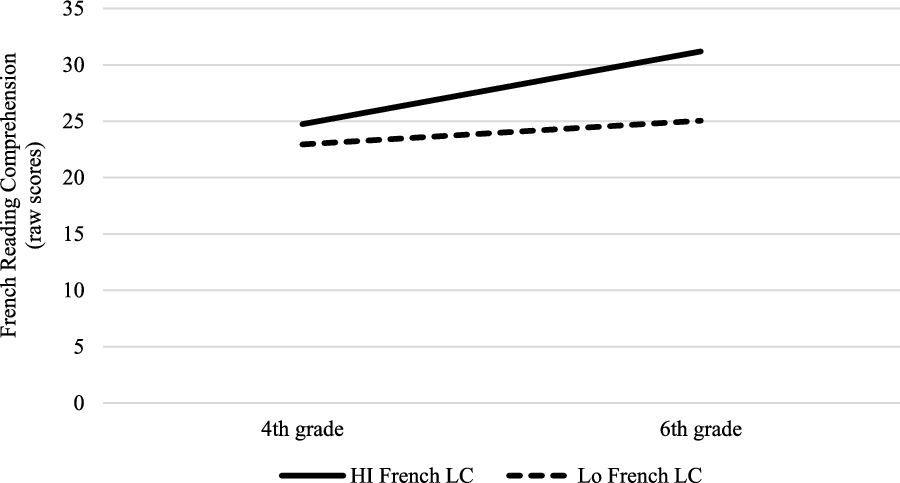
The three within-language variables, including French vocabulary, French listening comprehension, and French word reading, were all associated with the estimated average initial level of French reading comprehension in Grade 4. Specifically, since the standard deviation for French reading comprehension pooled across all 3 years was 9.38 points, the coefficients of .12 for French vocabulary, .47 for French listening comprehension, and .17 for French word reading correspond to an effect size of approximately half of a standard deviation, 1.8 standard deviations, and slightly over a half of a standard deviation, respectively, for French reading comprehension for the 3-year period. French listening comprehension also contributed to the rate of growth in French reading comprehension (see Figure 3). That is, children who started with high French listening comprehension in Grade 4 had high initial and higher rates of growth in French reading comprehension than those who started with low French listening comprehension.
Average fitted trajectories, after controlling for parental level of education, group, French vocabulary, and French word reading, that describe the effect of French listening comprehension on the change in French reading comprehension. High is defined as scoring at the 75th percentile, and low is defined as scoring at the 25th percentile (n=150).

However, individual changes in French reading comprehension were not related to cross-language variables and there was no cross-language effect on the growth of French reading comprehension, after controlling for the within-language variables.
Discussion
This longitudinal study investigated the oral language proficiency and reading skills in English and French of bilingual and multilingual students in FI programs, who were in Grade 4 and Grade 6. Our first main goal was to examine language skills, in addition to word reading skills, in older children who are learning several languages. Previous empirical evidence in support of the SVR model with bilingual children showed that once decoding skills are well established, language proficiency becomes more important for reading comprehension in bilingual students (Geva & Farnia, Reference Geva and Farnia2012; Swanson et al., Reference Swanson, Rosston, Gerber and Solari2008). The present study was designed to add to the existing body of evidence by focusing on older multilingual students who were now focusing on the acquisition of reading comprehension skills. The second main goal was to explore the within- and cross-language associations between word reading and language proficiency to reading comprehension, thus providing evidence in support of transfer effects in multilingual contexts. We included multilingual children who had relatively equivalent and high economic, social, and educational opportunities to learn English and French in school. Moreover, we included children who had received an equal and high amount of English and French instruction, therefore controlling the variation in level of parental education and language and amount of instruction that are associated with reading comprehension in bilingual and multilingual children.
Comparing the oral language and reading skills of bilingual and multilingual students
As expected, in English, the multilingual students had lower language proficiency, but only in listening comprehension. These results are consistent with previous findings conducted with younger multilingual children in FI programs (Au-Yeung et al., Reference Au-Yeung, Hipfner-Boucher, Chen, Pasquarella, D’Angelo and Deacon2015). The relatively lower listening comprehension skills for multilingual students in English compared to the bilingual children, after 3 years of formal English instruction, suggest that multilingual children would benefit from continued opportunities to use oral language in meaningful ways in a variety of classes in school. For example, children in FI programs transition from learning mathematics in French in Grade 4 to learning mathematics in English in Grade 6. To support and expand their language skills in English, teachers could provide purposeful activities such as asking meaningful questions and reflecting on how to use English to construct more complex sentences (Bourgoin & Dicks, Reference Bourgoin and Dicks2019; Thibault & Matheson, Reference Thibault and Matheson2020).
In spite of group differences in English listening comprehension, it should be noted that the bilingual and the multilingual children developed strong oral language proficiency in English that was approximately one standard deviation above the expected mean on test norms between Grades 4 and 6. These high scores have been reported with younger children in Canadian FI programs (Au-Yeung et al., Reference Au-Yeung, Hipfner-Boucher, Chen, Pasquarella, D’Angelo and Deacon2015; Hipfner-Boucher et al., Reference Hipfner-Boucher, Lam and Chen2014) and are different from many English Language Learners enrolled in English mainstream programs in the USA (e.g., Kieffer, Reference Kieffer2012) and in Canada (e.g., Jean & Geva, Reference Jean and Geva2009) who generally have lower language proficiency and lower reading scores in English. Possible explanations for the higher language proficiency in the current study is the relatively high parental level of education which is not uncommon for families in FI programs (DeWiele & Edgerton, Reference DeWiele and Edgerton2021). Moreover, most multilingual children were exposed to English within the first year of life and had engaged in home literacy practice and extra-curricular activities in English further supporting their English skills. Parents may have chosen to send their children to a FI program based on their assessment of their children’s English language skills as sufficiently strong to learn French (Dagenais, Reference Dagenais2003).
By Grade 6, multilingual and bilingual children in the current study had equivalent English vocabulary knowledge. This finding is in contrast to the study reported with younger multilingual children in FI programs, between Grade 1 and Grade 3, who showed a rapid growth in English vocabulary but overall had lower scores as compared to bilingual children (Au-Yeung et al., Reference Au-Yeung, Hipfner-Boucher, Chen, Pasquarella, D’Angelo and Deacon2015). It appears that by Grade 6, multilingual children had sufficient exposure to English for a total of 3 years of academic use which contributed to the continued growth of English vocabulary skills.
English word reading and reading comprehension skills were equivalent between multilingual and bilingual children and these findings are also in line with those of previous research conducted with younger (Au-Yeung et al., Reference Au-Yeung, Hipfner-Boucher, Chen, Pasquarella, D’Angelo and Deacon2015) and older children (Sinclair et al., Reference Sinclair, Jang and Vincett2019) in FI programs in Canada. Similar to the Au-Yeung et al. (Reference Au-Yeung, Hipfner-Boucher, Chen, Pasquarella, D’Angelo and Deacon2015) study that included groups of bilingual and multilingual students between Grades 1 and 3, our results show that for older children in FI programs, reading instruction leads to strong word reading skills in English and French for both bilingual and multilingual students, despite lower listening comprehension skills in English of the multilingual students. It is probable that the strong word reading and reading comprehension skills of the children in this study are related to their overall high oral language skills and to literacy-rich home environments that also tend to be associated with higher parental level of education in the family and have been reported in other studies (Korat et al., Reference Korat, Klein and Segal-Drori2007; Van Steensel, Reference Van Steensel2006).
Overall, the high scores on the measures of oral proficiency in English and French attest to the strength and success of bilingual and multilingual children in FI programs. The results suggest that instruction in an additional language, in this case French, within an education framework that supports equally strong language and literacy learning for all children also fosters the development of oral language skills in the majority language (English) and the minority language (French) in both bilingual and multilingual children (British Columbia Ministry of Education, 2019).
Developmental trajectories of reading comprehension
English reading comprehension
According to the SVR model, reading comprehension is explained primarily by word reading and language knowledge in all languages. Based on the SVR model, we predicted that oral language skills and word reading would be associated with reading comprehension both within and across language. Compared to word reading skills, we expected that oral language proficiency would be the most important predictors of reading comprehension since the children between Grades 4–6 were further acquiring text comprehension. In addressing the second research question, IGM allowed us to provide evidence for transfer effects as it applied to multilingual learners. Specifically, we explored the unique trajectories of within- and cross-language associations between word reading, language proficiency, and reading comprehension in English and French over time. First, for English reading comprehension, we found that the two groups of students followed similar trajectories in the development of English reading comprehension. These findings in a North American context are in line with some of the European studies that found multilingual students attained the same level of reading comprehension as those of bilingual children especially when the children were from similarly high parental level of education backgrounds (e.g., Cenoz, Reference Cenoz, Cenoz, Hufeisen and Jessner2003; Cenoz & Valencia, Reference Cenoz and Valencia1994; Sanz, Reference Sanz, Perez-Vidal, Juan-Garau and Bel2008). With regard to within-language associations, we found that English oral proficiency and English word reading predicted English reading comprehension at the beginning of Grade 4 for the two groups of children, as previously reported with bilingual children in English mainstream programs (e.g., Farnia & Geva, Reference Farnia and Geva2013; Mancilla-Martinez et al., Reference Mancilla-Martinez, Kieffer, Biancarosa, Chistodoulou and Snow2011; Nakamoto et al., Reference Nakamoto, Lindsey and Manis2008). Furthermore, English oral proficiency influenced the rate of growth in English reading comprehension for both bilingual and multilingual students mirroring previous studies that have shown remarkably strong within-language relationships between oral language and reading comprehension over time (Carlisle et al., Reference Carlisle, Beeman, Davis and Spharim1999; Farnia & Geva, Reference Farnia and Geva2013; Gottardo et al., Reference Gottardo, Javier, Farnia, Mak and Geva2014; Jean & Geva, Reference Jean and Geva2009; Nakamoto et al., Reference Nakamoto, Lindsey and Manis2008; Proctor et al., Reference Proctor, August, Carlo and Snow2006). Our findings among groups of older multilingual children also lend support to the SVR model as they showed the relative contribution of L2 word reading and oral language to L2 reading comprehension. The same association was also found in the multilingual children’s L3.
Like previous research in FI programs (Bérubé & Marinova-Todd, Reference Bérubé and Marinova-Todd2012; Hipfner-Boucher et al., Reference Hipfner-Boucher, Lam and Chen2014), cross-language transfer was also revealed. Specifically, French vocabulary and French listening comprehension predicted English reading comprehension equally for both bilingual and multilingual students. As predicted by the SVR model and supported by previous studies (e.g., Farnia & Geva, Reference Farnia and Geva2013; Proctor et al., Reference Proctor, August, Carlo and Snow2006; Silverman et al., Reference Silverman, Proctor, Harring, Hartranft, Doyle and Zelinke2015), our data also show that for older multilingual children with strong decoding skills, oral language proficiency, including French vocabulary and listening comprehension, plays a more important role in their development of reading comprehension skills in both English and French (Farnia & Geva, Reference Farnia and Geva2013).
French reading comprehension
Much like English reading comprehension, both French language proficiency and word reading skills were revealed as important within-language predictors of French reading comprehension, which is consistent with previous research (e.g., Bérubé & Marinova-Todd, Reference Bérubé and Marinova-Todd2012; Farnia & Geva, Reference Farnia and Geva2013; Mancilla-Martinez et al., Reference Mancilla-Martinez, Kieffer, Biancarosa, Chistodoulou and Snow2011; Nakamoto et al., Reference Nakamoto, Lindsey and Manis2008; Proctor et al., Reference Proctor, August, Carlo and Snow2006) and replicates previous studies conducted with bilinguals in mainstream English programs (e.g., Geva & Farnia, Reference Geva and Farnia2012; Swanson et al., Reference Swanson, Rosston, Gerber and Solari2008). Again, our data now provide further evidence that the SVR model of reading comprehension is also a good fit for multilingual children who have acquired good word reading skills and are rapidly learning to comprehend text.
In terms of cross-language associations, word reading, vocabulary knowledge, and listening comprehension in English were not associated with reading comprehension in French from Grade 4 through Grade 6, once within-language measures (French) were considered. These findings contrast with the cross-language association observed between French oral language skills and English reading comprehension. Previous research with multilingual children learning a L2 and L3 in different countries, for example in Canadian FI programs, in Europe, and in the Philippines, has shown that the educational context may influence the direction of transfer between oral language and reading comprehension (Bérubé & Marinova-Todd, Reference Bérubé and Marinova-Todd2012; Hipfner-Boucher et al., Reference Hipfner-Boucher, Lam and Chen2014; Haenni-Hotti et al., Reference Haenni Hoti, Heinzmann, Muller, Oliveria, Wicki and Werlen2011; Padilla, Reference Padilla2021). Children in the current study were receiving most of their academic instruction in one language – in this case, the L3 was French. Moreover, the focus of instruction was on building strong academic oral language, with less time in class formally developing English reading comprehension. Therefore, similar to previous research, the students in our study were utilizing their stronger academic oral language skills acquired in one language (in this case, their L3) to help them learn to read in the other language (in this case, their L2). Thus, transfer may be supported by the amount and richness of academic language instruction that children receive at school.
Limitations and future directions
The current study involved students from culturally and linguistically diverse communities in a major city in Western Canada, in which English is the dominant language outside of the school. This FI population was characterized by a high level of parental education. In our sample, over 90% of the parents reported having completed a college/university degree. Obviously, the homogeneity of children whose parents have a high parental level of education limits the generalizability of our results. Additional sources of information such as parental occupation or income are warranted as they may also shed light on their children’s language and literacy acquisition (De Cat, Reference De Cat2021). Nonetheless, our findings with bilingual and multilingual students are like other studies conducted with children from lower parental level of education and thus allow us to draw some conclusions about the associations between oral language and literacy development across a broader range of parental level of education. Some multilingual children from lower parental level of education backgrounds may not receive as much support in their L1 or L2 at school or at home and may struggle to learn an additional L3. Therefore, future research should focus on multilingual children from more varied parental level of education backgrounds to inform educational practice about what would constitute optimal support for multilingual children in school. As an example, findings in the current study suggest that providing additional English vocabulary instruction to multilingual children could enhance their success in FI programs.
Listening comprehension and vocabulary knowledge were only measured in English and French, the L2 and L3 of the multilingual students. The majority of multilingual children in the current study were primarily speaking and reading in English and French at school, and skills in the L1 were used almost exclusively at home, for example, in conversation with one of the parents. According to the SVR model, language proficiency and reading skills in all the child’s languages are related to reading comprehension. To gain a complete understanding of the transfer skills pertaining to the development of reading comprehension in multilingual students, it would be important to examine and account for the students’ language and literacy skills in their L1 too. Alternatively, the effect of L1 could be controlled for by including only specific language groups and the study samples.
One strength of the current study is that it included multilingual students who spoke a variety of L1s and whom mostly were literate in their L1, thus providing a lens into the skills of children from different language backgrounds. The inclusion of children with diverse L1s has its limitations, including a writing system that may (e.g., Spanish) or may not (e.g., Chinese) align with English and French. It is possible that the transfer of reading skills in the L1, L2, and L3 of multilingual would be more closely related across languages that share a common orthography, as suggested by the script-dependent hypothesis (Geva & Siegel, Reference Geva and Siegel2000). One study has previously explored the effect of the writing system in the L1 on the L2 and L3 in multilingual children in FI programs (Bérubé & Marinova-Todd, Reference Bérubé and Marinova-Todd2012). Findings revealed that multilingual children who were literate in an alphabetic L1 (e.g., Spanish) developed greater reading comprehension in English and French, as compared to children who were literate in non-alphabetic languages (e.g., Chinese). Additional studies now need to examine more carefully how home language literacy practice including use of oral language, word reading, and reading comprehension in the L1, and reading skills in the L2 and L3 interact within a specific group of multilingual students (e.g., Spanish or Chinese L1) that would help determine more precisely the importance of each factor in the development of reading comprehension. Moreover, future studies with multilingual children, as has been done with monolingual and bilingual children, should also include a measure of nonverbal intelligence to control for its possible influence on reading comprehension. Whenever possible, additional measures of oral proficiency in the L1, L2, and L3, such as vocabulary depth (i.e., morphological awareness, awareness of semantic relations, and syntactic awareness) should be included to capture children’s skills more broadly as they relate to reading comprehension acquired in the classroom (Silverman et al., Reference Silverman, Proctor, Harring, Hartranft, Doyle and Zelinke2015). But for now, it is made clear that in a context where bilingual and multilingual children have equal and relatively high parental level of education and receive direct instruction and support in learning two languages at school, oral language skills are an important support for reading comprehension within and across the two languages. FI programs in Canada are working successfully for all students: the literacy skills in the two languages of instruction of bilingual and multilingual students are strong, and teachers should continue to support the English and French language skills of all students which will help foster later reading ability.
Acknowledgments
We are grateful to the children and their parents as well as the teachers, teaching assistants, and school principals for their active participation over 3 years spanning this project. They have allowed us to better understand how to support the language and literacy skills of bilingual and multilingual children. A special thanks to the many research assistants and volunteers who have made the data collection and analysis possible.