INTRODUCTION
According to socio-constructivism, language is socially co-constructed between the participants of social actions in a cultural context, and the parent–child interaction has a key role in the cognitive and language development of children (e.g. Snow, Reference Snow, Coleman and Cameron1996; Tomasello, Reference Tomasello2003). By the time children begin to use productive language, they have already established a variety of social-communicative routines with their caregivers. Ratner and Bruner (Reference Ratner and Bruner1978) analyzed these routines and demonstrated how such non-linguistic interactions scaffold the child's early language; it is within these exchanges that the child learns the actions and expressions of the parent and how to produce them. Tomasello and Farrar (Reference Tomasello and Farrar1986) stressed that these interactions provide the young child with a predictable referential context that makes both the child's and the mother's language immediately meaningful.
Given the importance of the ambient language for the linguistic development of a child (see Tomasello, Reference Tomasello, Kuhn and Siegler2006), over the last thirty years some studies have focused on the role of child-directed language characteristics in child communicative development, supporting the socio-constructivism theory. Many studies indicated that caregivers play an important role in the development of children's early use of language (Snow, Reference Snow, Coleman and Cameron1996; Westerlund & Lagerberg, Reference Westerlund and Lagerberg2008). However, these studies have generally focused on the role of mothers, since in past decades they have played the main role in the development of children (Cabrera, Shannon & Tamis-LeMonda, Reference Cabrera, Shannon and Tamis-LeMonda2007). In particular, classical studies have focused on quantitative indices, such as the amount of talk mothers direct to their children (e.g. Hart & Risley, Reference Hart and Risley1995; Hurtado, Marchman & Fernald, Reference Hurtado, Marchman and Fernald2008; Van Veen, Evers-Vermeul, Sanders & Van den Bergh, Reference Van Veen, Evers-Vermeul, Sanders and Van den Bergh2009) and the mothers' vocabulary characteristics (Hoff-Ginsberg, Reference Hoff-Ginsberg1991; Huttenlocher, Vasilyeva, Cymerman & Levine, Reference Huttenlocher, Vasilyeva, Cymerman and Levine2002). For example, Barnes, Gutfreund, Satterly and Wells (Reference Barnes, Gutfreund, Satterly and Wells1983) found a positive correlation (r=0·42, p<0·05) between the quantity of maternal language and children's mean length of utterances (MLU).
Other evidence supports the relationship between the amount of mother-input language and the breadth of the child's vocabulary (e.g. Hoff & Naigles, Reference Hoff and Naigles2002). In particular, one line of research has focused on the characteristics of maternal child-directed speech (CDS), such as pitch patterns (e.g. Fernald & Kuhl, Reference Fernald and Kuhl1987), prosodic patterns (Kuhl et al., Reference Kuhl, Andruski, Chistovich, Chistovich, Kozhevnikova, Ryskina, Stolyarova, Sundberg and Lacerda1997), the number of tokens and types (Hoff & Naigles, Reference Hoff and Naigles2002; Pan, Rowe, Singer & Snow, Reference Pan, Rowe, Singer and Snow2005), the frequency of isolated words (Brent & Siskind, Reference Brent and Siskind2001), the variety of input (e.g. Beals, Reference Beals1997; Weizman & Snow, Reference Weizman and Snow2001), the complexity of verbal forms (Wijnen, Kempen & Gillis, Reference Wijnen, Kempen and Gillis2001), the use of causal connectives (McCabe & Peterson, Reference McCabe, Peterson, Costermans and Fayol1997), and maternal MLU (Bornstein, Haynes & Painter, Reference Bornstein, Haynes and Painter1998). Overall, the literature has indicated that maternal CDS, including vocabulary, complexity and speech clarity, is related to children's early language development. For example, many studies have specifically shown that parents modify their speech to their young children in ways that support their early language learning through, for example, simplified language that is grammatically less complex, more redundant, and with a higher pitch and exaggerated intonation pattern (e.g. Liu, Kuhl & Tsao, Reference Liu, Kuhl and Tsao2003). According to Snow (Reference Snow, Fletcher and Garman1985), linguistic changes result from the intention of mothers to ensure that an immature speaker has the opportunity to act as a conversational partner. This is in line with the idea of ‘audience design’ proposed by Clark and Murphy (Reference Clark, Murphy, LeNy and Kintsch1983), which involves the speakers' tailoring of their utterances to suit their audience. In CDS, this means that parents progressively increase the complexity of their language to encourage the child to produce slightly more complex structures (Van Veen et al., Reference Van Veen, Evers-Vermeul, Sanders and Van den Bergh2009). So, the mother–child interaction assumes the trend in turns, similar to that observed between adults. The difference is that, in the case of mother–child interaction, the conversation is asymmetrical, thus the participants have different levels of participation.
Another line of research has focused on adult–child functional aspects (e.g. Della Corte, Benedict & Klein, Reference Della Corte, Benedict and Klein1983; Bornstein et al., Reference Bornstein, Tal, Rahn, Galperin, Pecheux, Lamour, Toda, Azuma, Ogino and Tamis-Lemonda1992), such as information-salient utterances (D'Odorico, Salerni, Cassibba & Jacob, Reference D'Odorico, Salerni, Cassibba and Jacob1999) or communicative functions (e.g. Snow, Reference Snow, Coleman and Cameron1996; Masur, Flynn & Eichorst, Reference Masur, Flynn and Eichorst2005). Longobardi (Reference Longobardi1992) found that maternal interventions which were highly synchronized and well adapted to the focus of attention/action of the child (tutoring) were strongly correlated with the child's breadth of vocabulary and language production. In particular, some studies have investigated the role of the supporting setting, such as book reading (e.g. Ratner, Reference Ratner1988), problem solving and literacy tasks (Conner, Knight & Cross, Reference Conner, Knight and Cross1997), joint attention episodes (Tomasello, Reference Tomasello1992), or family discussion at home (Beals, Reference Beals1997) in child linguistic and cognitive development. For example, data indicated that parent–child reading activities represented a particularly rich source of verbal interaction (e.g. Hoff-Ginsberg, Reference Hoff-Ginsberg1991), stimulating the use of very complex language (Weizman & Snow, Reference Wijnen, Kempen and Gillis2002) and expanding the child's vocabulary (Saracho, Reference Saracho2002). It has also been shown that new words are best learned in a context of shared attention, compared to a condition without it (Cleveland, Schug & Striano, Reference Cleveland, Schug and Striano2007). Moreover, the adult's ability to follow the children's focus of attention and use more tutorial and information-salient utterances, the proportion of maternal utterances referring to something to which children pay attention, and labelling during mother–infant object involvement episodes may contribute in important ways to child language development (Stevens, Blake, Vitale & MacDonald, Reference Stevens, Blake, Vitale and MacDonald1998). In particular, Hobson, Patrick, Crandell, Garcia Pérez & Lee (Reference Hobson, Patrick, Crandell, Garcia-Perez and Lee2004) reported that sensitive and non-intrusive care by mothers correlated with a high level of infant triadic interpersonal engagement with strangers and a greater propensity to make requests.
While the role of the mother in adult–child interactions has been quite thoroughly investigated, there has been limited research in the area of comparing the role of mothers and fathers, or research that focuses on paternal characteristics generally. This could be considered a promising research area since, over the past few decades, many changes in family structure and function have highlighted the need to include both mothers and fathers in studies concerning child cognitive or socio-emotional development. As documented by Pancsofar and Vernon-Feagans (Reference Pancsofar and Vernon-Feagans2010), the number of mothers entering the workforce is increasing and the role of fathers is becoming less stereotypical. As paternal involvement in childcare is increases, fathers take more responsibility for the organization and planning of their children's lives (Cabrera, Tamis-LeMonda, Bradley, Hofferth & Lamb, Reference Cabrera, Tamis-LeMonda, Bradley, Hofferth and Lamb2000). Therefore, mothers are shifting from being primary caregivers to being co-parents.
Recent research has largely moved away from the initial quantitative approach to the study of paternal contribution to child development, towards describing the different roles that fathers play in cognitive, linguistic, communicative and emotional child development (Tamis-LeMonda, Shannon, Cabrera & Lamb, Reference Tamis-LeMonda, Shannon, Cabrera and Lamb2004). Observed data show that the quality of father–child interactions is consistent across time and that fathers, like mothers, can be sensitive and supportive to children (Cabrera et al., Reference Cabrera, Shannon and Tamis-LeMonda2007). Moreover, sensitive fathering predicts children's linguistic achievements, just as sensitive mothering does (Shannon, Tamis-LeMonda, London & Cabrera Reference Shannon, Tamis-LeMonda, London and Cabrera2002).
However, studies in this area in recent decades have found contradictory results. One group of researchers supported the existence of differences in paternal speech register and child-directed language characteristics. For example, some studies have indicated that fathers talk with a higher pitch than do mothers (e.g. Fernald, Taeschner, Dunn & Papousek, Reference Fernald, Taeschner, Dunn and Papousek1989), use fewer utterances in dyadic and triadic play (e.g. Golinkoff & Ames, Reference Golinkoff and Ames1979), and produce shorter utterances (Rondal, Reference Rondal1980). However, these differences are less evident in interactions with older children. Another group of researchers found differences in the pragmatic aspects; Pancsofar and Vernon-Feagans (Reference Pancsofar and Vernon-Feagans2006) indicated that fathers produce lower verbal input, shorter turn length, and fewer why-questions. Some studies (e.g. Rondal Reference Rondal1980; Rowe, Coker & Pan, Reference Rowe, Coker and Pan2004) found differences in question production, since fathers use more open-ended questions and fewer yes/no questions than do mothers. Other researches indicated that fathers produce fewer conversational turns (Golinkoff & Ames, Reference Golinkoff and Ames1979; Rondal, Reference Rondal1980), use less total language, less supportive language, less negative language, and more directive and informing language than do mothers (see Leaper, Anderson & Sanders, Reference Leaper, Anderson and Sanders1998). In contrast, other evidence did not support this research, indicating that the characteristics of CDS are similar for both mothers and fathers (e.g. Golinkoff & Ames, Reference Golinkoff and Ames1979; McLaughlin, White, McDevitt & Raskin, Reference McLaughlin, White, McDevitt and Raskin1983; Pancsofar & Vernon-Feagans, Reference Pancsofar and Vernon-Feagans2006; Rowe et al., Reference Rowe, Coker and Pan2004). Recently, Pancsofar and Vernon-Feagans (Reference Pancsofar and Vernon-Feagans2010) indicated in a longitudinal study with a large sample of families from low-income rural communities that, during book reading with children at age 0 ; 6, paternal, but not maternal, vocabulary was related with their child language development at ages 1 ; 3 and 3 ; 0. Several authors have underlined the important role of fathers in child development and the importance of the different, and probably complementary, behavioural styles of parents in interactive situations (Cabrera et al., Reference Cabrera, Tamis-LeMonda, Bradley, Hofferth and Lamb2000; Guzell & Vernon-Feagans, Reference Guzell and Vernon-Feagans2004).
In addition to these contradictory results, further grounds for criticism of the research on the infant language development originate from the lack of studies on Italian families (Keren-Portnoy, Majorano & Vihman, Reference Keren-Portnoy, Majorano and Vihman2009). In fact, if the characteristics of maternal language in relation to child language development have been largely investigated using different indices and aspects, such as speech characteristics (e.g. D'Odorico & Jacob, Reference D'Odorico and Jacob2006), communicative functions (e.g. Longobardi, Reference Longobardi1992), and interactive style (D'Odorico et al., Reference D'Odorico, Salerni, Cassibba and Jacob1999), investigations about the characteristics of Italian parental language are not present.
To gain a more complete understanding of early language development, it is necessary to consider sources of influence from multiple caregivers, including mothers, fathers and non-familial care providers (Pancsofar and Vernon-Feagans, Reference Pancsofar and Vernon-Feagans2006). However, previous research has paid less attention to this diversity of influences.
First, although father's child-directed speech is considered critically important for language development, father–child interactions have been observed in very few studies (e.g. Cabrera et al., Reference Cabrera, Shannon and Tamis-LeMonda2007; Pancsofar and Vernon-Feagans, Reference Pancsofar and Vernon-Feagans2010).
Second, according to Feldman and Masalha (Reference Feldman and Masalha2010), family interaction affords infants their first experience in a multi-person interactive setting, which reflects the culture-specific model of social relatedness. So, fathers and children must be viewed as parts of a complex social system in which each person affects each other reciprocally, directly and indirectly. It follows that Italian children's language development needs to be studied through observations of triadic interactions, including mother, father and child, but such interactions have been rarely studied (e.g. Pancsofar and Vernon-Feagans, Reference Pancsofar and Vernon-Feagans2006).
Third, given that the direct effects of fathering are especially salient when paternal and maternal interactions differ (Lamb & Tamis-LeMonda, Reference Lamb, Tamis-LeMonda and Lamb2004), it is necessary to examine the differences between maternal and paternal CDS and their relationship with language development.
Data from Italian CDS can be particularly useful, as it can be used to test the relationship between structural characteristics of the Italian language and the learning of particular lexical categories, since D'Odorico and Fasolo (Reference D'Odorico and Fasolo2007) indicated that studies on Italian maternal child-directed input showed controversial results in this regard. Indeed, the question of whether Italian input is verb oriented, as opposed to balanced oriented, is still controversial and could benefit from other data, such as those which will be analyzed in this article. Moreover, results from researches about Italian CDS could be relevant, as the structural characteristics of the Italian language (e.g. word order variation, omission of subject, and the sentence-initial or sentence-final position of verbs) make it quite different from English and more similar to Korean and Chinese (D'Odorico, Carubbi, Salerni & Calvo, Reference D'Odorico, Carubbi, Salerni and Calvo2001). However, Longobardi and Camaioni (Reference Longobardi and Camaioni2002) argue that there are other characteristics that differentiate Italian from Chinese and Korean, in particular, the presence in the Italian language of a rich nominal and verbal morphology, and greater complexity and variability of verbal forms with respect to names. This feature, called ‘morphological simplicity’, would assist with learning names, rather than verbs, in children's language development.
The aim of the present study is to compare the characteristics of maternal and paternal language in relation to child language development. Since the studies discussed in the literature have focused on children from age 2 ; 0, this study focuses on early language development with children aged from 1 ; 3, using a triadic observational situation in order to compare, directly, maternal and paternal CDS in the same setting. The language assessment at 1 ; 3 was chosen because, at this age, at least 50 percent of Italian children have reached the first words stage (0–10 words produced), according to the norms for the Italian version of the MacArthur-Bates questionnaire (Caselli & Casadio, Reference Caselli and Casadio1995).
The novel contribution of this study is the choice of longitudinal design. In fact, although some comparisons between maternal and paternal CDS have already been conducted, few studies have focused on paternal input into older children's language development.
AIMS
The present study had three different aims:
• To compare maternal and paternal language characteristics, both in qualitative (communicative functions) and quantitative (lexical and morphosyntactic) indices. Differences between mothers and fathers in both structural and functional characteristics were expected. In particular, we expected differences in quantitative and qualitative characteristics indicated by recent research (e.g. Pancsofar and Vernon-Feagans, Reference Pancsofar and Vernon-Feagans2006).
• To evaluate the role of maternal and paternal communicative functions and their possible relation with child language development. Continuity between prelinguistic social interaction and the development of language was expected, in particular, between tutorial function and child language ability, both for comprehension and production. Early paternal contribution in children's later language development was expected.
• To assess the relation between parental lexicon and child language development at ages 2 ; 6 and 3 ; 0, assuming a significant effect of the lexical indices (in particular the frequency of use) and parental tutorial function on the children's language skills, as reported in the literature (e.g. Matthews, Lieven, Theakston & Tomasello, Reference Matthews, Lieven, Theakston and Tomasello2005).
METHOD
Participants
The study involved forty families who were recruited through nurseries from a list of parents who had volunteered to participate. Of these, two did not complete the study due to family and health problems. Two sessions were inappropriately recorded. Of the thirty-six infants in the final sample (18 males and 18 females), twenty-six children (73%) were firstborn, eight children had one sibling, two had two siblings. All children came from Italian monolingual families and none of the children experienced health complications or developmental disabilities. Mothers had a mean age of thirty-five years (SD 4·19), and fathers thirty-seven (SD 5·76). The mothers' and fathers' levels of education were high; twenty mothers and sixteen fathers had a university degree, twelve mothers and sixteen fathers had completed high school, and four mothers and four fathers had only attended the eight years of compulsory schooling. Each parent gave informed consent to participate in the research.
Procedure
Each family was observed for 20 minutes in the observational laboratory of the Department of Psychology at the University of Parma in each of two session fifteen months apart. The first observation was carried out when the children were an average of 15·3 months of age (range: 14·5–16·6 months) and the second took place when they were an average of 20·8 months (range: 19·2–22·1 months). Observation was carried out in compliance with the ALB protocol (Assessing Linguistic Behaviour; Olswang, Stoel-Gammon, Coggins & Carpenter, Reference Olswang, Stoel-Gammon, Coggins and Carpenter1987). In the play session, four different sets of toys were used to give the children the opportunity to exhibit their naming competence; a farm set (a farm with different animals), a ‘nurturing’ set (a doll with a bed, a mattress, and a telephone), a ‘food’ set (plastic fruit and vegetables with dishes and cutlery), and cars and tractors. Mothers were instructed to play normally with the children but to try to maintain their attention on each set of toys. The experimenter attended each play session and could participate if directly invited to do so by the children or the mothers. Each play session was video-recorded.
The observer transcribed each child's vocal and verbal production, noting durations and contextual elements. These included the children's interaction with the objects, their communicative gestures, their gaze direction, and the maternal and paternal verbal production immediately preceding and following that of the children. The completed transcriptions were entered into individual CHAT files (Codes for the Human Analysis of Transcripts; MacWhinney, Reference MacWhinney, Pizzuto and Bortolini1997).
Coding
Maternal and paternal child-directed language (quantitative aspects)
For each observational session, the following maternal and paternal language indicators were considered; total utterances (an utterance was bounded at either side by one second of silence or by an intervening adult utterance, following Olswang et al., Reference Olswang, Stoel-Gammon, Coggins and Carpenter1987), total tokens, total types and Mean Length of Utterance (MLU).
Maternal and paternal communicative functions
For each free-play session, the maternal and paternal child-directed communicative functions were coded in accordance with Longobardi (Reference Longobardi1992). Five categories were used, which are described below.
Tutorial function: This includes sentences that follow the child's attention focus and boost their action initiatives. This function is divided into eight subclasses and includes repetition (e.g. parent repeats etto after the child's utterance questo, for ‘this’), expansion/extension (e.g. child says ‘car’ and the parent says ‘It's a yellow car’), reformulation (e.g. child indicates the bottle of milk and the parent says, ‘Do you want some milk?’), paraphrasing (e.g. child goes away and parent asks, ‘Where are you going?’), reference to a shared experience (e.g. child uses a toy and the parent says, ‘It's like the one at home!’), reference to roles in social games (e.g. when playing ‘peek-a-boo’), praising/encouraging (e.g. parent says, ‘Very good!’), and description/demonstration given to the child by the adult (e.g. parent shows the child how to use something).
Didactic function: This involves sentences that transmit new knowledge to the child, or consolidate existing knowledge. This function is divided into four subclasses: closed question (e.g. parent says, ‘It's a little dog, isn't it?’), request for repetition (e.g. parent says, ‘Say doll’, i.e. doll), labelling (e.g. parent says, ‘It's a flower’), and correction (e.g. parent says, ‘This is not a dog, it's a sheep!’).
Conversational function: This aims to maintain or promote the communicative exchange between two persons. This function is divided into four subclasses: conversational suggestion (e.g. parent says, ‘Here you are’), open question (e.g. parent asks the child, ‘What's your favourite toy?’), emphatic comment (e.g. parent says, ‘Oh, you look so tired!’), and question and answer (e.g. parent says, ‘What's this? A house!’).
Control function: This includes sentences aimed to direct or divert the child's attention. This class is further divided into two subclasses; directive action (e.g. parent says, ‘Get the book!’) and directive attention (e.g. parent says, ‘Look at this!’).
Asynchronous function: This involves the educator's sentences opposing the action started by the child. This function is divided into three subclasses; intrusive behaviour (e.g. the child mixes something in a cup, and the parent says, ‘No, do it like this’ and shows an alternative way), change of subject (e.g. child reads a book and the parent gives him/her another one), and sentences ignoring the child's behaviour (e.g. child shows parent an object and s/he ignores it).
Maternal and paternal lexical characteristics
Five indices were analyzed for each noun produced by the mothers and fathers, as reported in Rinaldi, Barca and Burani (Reference Rinaldi, Barca and Burani2004) for 519 Italian words.
Age of acquisition (%CFV): This is defined as the estimated age at which a word was first learned. This value is derived from the norms for the Italian version of the MacArthur-Bates questionnaire (Primo Vocabolario del Bambino-PVB, Caselli & Casadio, Reference Caselli and Casadio1995) and indicates the percentage of children reported by their mother as having produced the word at ages 1 ; 4–2 ; 6.
Imageability (IMAG): This is defined by Rinaldi et al. (Reference Rinaldi, Barca and Burani2004) as the “ease and the speed with which a target word evokes a mental image, a visual representation, a sound or any other sensory experience” (p. 526). The value is obtained from the ratings on a 7-point Likert scale given by fifty Italian university students aged between twenty and thirty years.
Child written frequency (CWFq): This is extracted by a corpus of 1 000 000 word tokens constructed by Marconi, Ott, Pesenti, Ratti and Tavella (Reference Marconi, Ott, Pesenti, Ratti and Tavella1994), taken from texts read or written by children.
Adult written frequency (AWFq): This is taken from the frequency count by Laudanna, Thornton, Brown, Burani and Marconi (Reference Laudanna, Thornton, Brown, Burani, Marconi, Bolasco, Lebart and Salem1995) on a corpus of 3 000 000 word tokens.
Adult spoken frequency (ASFq): This is taken from the frequency count by De Mauro, Mancini Vedovelli and Voghera (Reference De Mauro, Mancini, Vedovelli and Voghera1993) on a corpus of 500 000 word tokens.
The mean value of the total words produced for each variable was considered for each participant.
Child language development
Each child's language production during the free-play session was coded and the Italian version of the MacArthur-Bates Communicative Inventory (PVB) was completed by each mother in the two observational sessions. The following indices were considered: total number of utterances, types, tokens and mlu (using Brown, Reference Brown1973, and Olswang et al., Reference Olswang, Stoel-Gammon, Coggins and Carpenter1987, adapted criteria), as coded by the experimenter from the video-recorded session, and vocabulary size, as reported in PVB. The MLU was calculated on partially and fully intelligible utterances and productive morphemes. Fillers, self-repetitions, imitations or completely unintelligible utterances were excluded.
Child's language outcome
The Italian version of the revised Peabody Picture Vocabulary Test (PPVT-R) (Stella et al., Reference Stella, Pizzoli and Tressoldi2000) was administered individually to each child at home at age 3 ; 0 in order to measure the child's receptive vocabulary, and the Italian version of the MacArthur-Bates questionnaire (PVB; Caselli & Casadio, Reference Caselli and Casadio1995) was administered to each parent when each child turned 2 ; 6. For the analysis, sentence complexity was considered an appropriate measure of language development at 2 ; 6, as reported in the literature (e.g. Kuhl, Conboy, Padden, Nelson & Pruitt, Reference Kuhl, Conboy, Padden, Nelson and Pruitt2005).
Reliability
Two independent coders transcribed the free-play situations; the mean reliability (Cohen's κ) for child language measures was 0·87 (number of utterances: 0·87; number of tokens: 0·86; number of types: 0·88; MLU: 0·87), the mean reliability of parental language measures was 0·88 (number of utterances: 0·90; number of tokens: 0·86; number of types: 0·88; MLU: 0·88), and the reliability for parental communication function coding was 0·89.
RESULTS
Child and parental language and parental communicative functions during the two sessions
Child language development (vocabulary size, utterances, tokens, types and MLU) during the two free-play sessions and parents' communicative functions (tutorial, conversational, didactic, control and asynchronous) are reported in Table 1.
Child language development and parents' communicative function at ages 1 ; 3 and 1 ; 9

note:* Child's lexical production as reported in the Italian version of the MacArthur-Bates Communicative Development Inventory (Primo Vocabolario del Bambino-PVB; Caselli & Casadio, Reference Caselli and Casadio1995).
A T-test for related-samples indicates a significant increase between ages 1 ; 3 and 1 ; 9 in all the measures of child language development considered; number of utterances (t 31=9·12; p<0·001), MacArthur-Bates production (t 31=7·03; p<0·001), tokens [t 31=8·04; p<0·001), types [t 31=6·39; p<0·001), and MLU (t31=2·62; p<0·001).
In order to analyze the differences between mothers and fathers in communicative functions, a series of Wilcoxon non-parametric tests for related samples was used. This analysis indicates differences in the percentage of didactic utterances at age 1 ; 3 (Z=2·19; p=0·03) and in the proportions of asynchronous utterances at age 1 ; 9 (Z=2·35; p=0·02). Moreover, analysis using the Wilcoxon non-parametric test for related samples indicated a decrease from 15 to 21 in maternal didactic utterances (Z=2·19; p=0·03) and in paternal asynchronous utterances (Z=2·11; p=0·03), while an increment in paternal control utterances emerged (Z=3·5; p<0·001).
A one-way 2×2 (2 sessions by 2 parents) repeated measure ANOVA was conducted in order to analyze differences in parental MLU. Results indicated a significant difference between mothers and fathers in MLU (F(1,34)=15·19; p=0·001; η2=0·34), since mothers produced longer utterances than fathers. Moreover, an increase emerged in the mothers' and fathers' MLU from ages 1 ; 3 to 1 ; 9 (F(1,34)=6·98; p<0·01; η2=0·19).
Lexical differences in parents' language during the two observational sessions
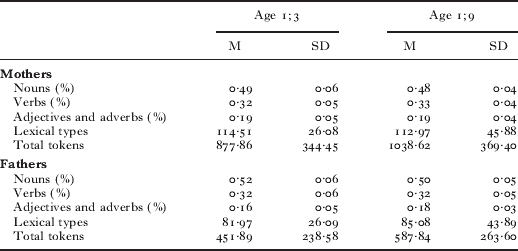
The lexical characteristics of parental language were considered at the 1 ; 3 and 1 ; 9 sessions. Data are reported in Table 2.
Parents' lexical characteristics at ages 1 ; 3 and 1 ; 9
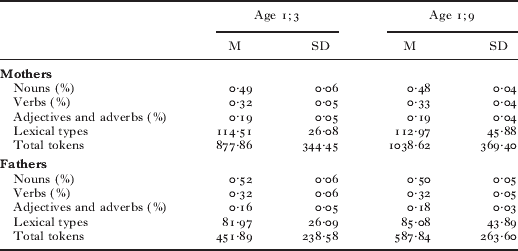
A series of Wilcoxon non-parametric tests for related samples did not reveal significant differences between maternal and paternal lexical composition, at both ages 1 ; 3 and 1 ; 9 (p>0·05). A one-way 2×2 repeated measures ANOVA was conducted. Analysis indicated a significant difference between parents in tokens and types produced, since mothers produced a high number of tokens (F(1,34)=354·56; p<0·001; η2=0·93) and types (F(1,34)=30·31; p<0·001; η2=0·57). Moreover, an increase in parental token production emerged (F(1,34)=7·28; p<0·01; η2=0·23).
Parental psycholinguistic standard lexical characteristics
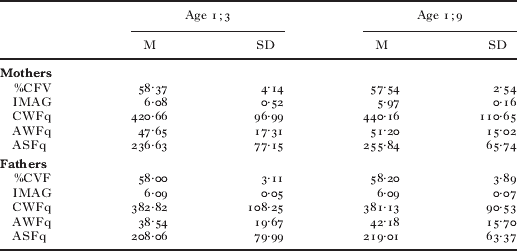
The psycholinguistic norms for Italian language, as reported in Rinaldi et al.'s (Reference Rinaldi, Barca and Burani2004) database, were considered for each noun (types) produced by mothers and fathers. The mean value for each variable of the database was then computed. Descriptive statistics for mothers and fathers are reported in Table 3.
Parents' lexicon characteristics of the nouns produced in the 1 ; 3 and 1 ; 9 sessions
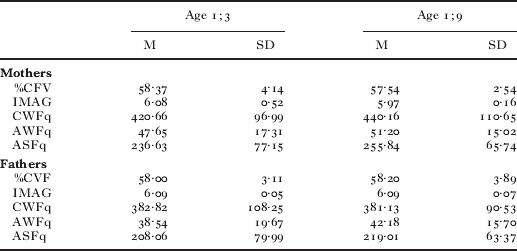
note: Five indices for each noun produced by the mothers and fathers, as reported in Rinaldi, Barca and Burani (Reference Rinaldi, Barca and Burani2004) database for 519 Italian words, are presented. %CFV: age of acquisition; IMAG: imageability; CWFq: child written frequency; AWFq: adult written frequency; ASFq: adult spoken frequency.
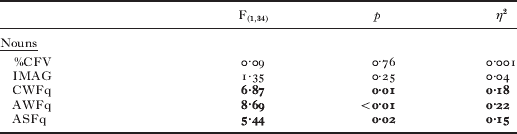
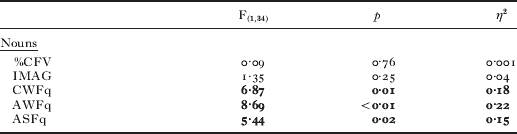
A series of 2×2 repeated measure ANOVAs was conducted. Analysis revealed the effect of the factor parent on many indicators, while the factor session had no statistical effect. The statistical indicators for the ANOVAs are reported in Table 4.
Statistical values of differences in psycholinguistic indicators between mothers and fathers as reported in 2 (session)×2 (parent) repeated measures ANOVAS
note: Five indices for each noun produced by the mothers and fathers, as reported in Rinaldi, Barca and Burani (Reference Rinaldi, Barca and Burani2004) database for 519 Italian words, are presented. %CFV: age of acquisition; IMAG: imageability; CWFq: child written frequency; AWFq: adult written frequency; ASFq: adult spoken frequency.
As reported above, data indicated a significant difference between CWFq, AWFq and ASFq. In particular, in both observational sessions, mothers produced a greater number of names common in the written language of children, as well as in the written and spoken language of adults (such as ‘friend’, ‘child’, ‘dog’, ‘school’, etc.). Nouns produced by at least 50 percent (N=18) of mothers and fathers are reported in the Appendix.
So far, developmental changes in the language characteristics of children aged between 1 ; 3 and 1 ; 9 and their parents have emerged. Specifically, a significant increase in all the measurements of children's language, in parental tokens, MLU and paternal control utterances is reported, while a decrease in maternal didactic and paternal asynchronous utterances has emerged. In addition many differences in mothers' and fathers' language characteristics are shown, both for quantitative indices (with mothers producing a higher number of tokens, types and MLU than fathers), communicative functions (with mothers producing a higher number of didactic and asynchronous utterances in the 1 ; 3 and 1 ; 9 session, respectively), and lexical characteristics (with fathers producing names with a lower frequency in the Italian lexicon).
Predicting child language development at ages 2 ; 6 and 3 ; 0 from parental language at 1 ; 3 and 1 ; 9
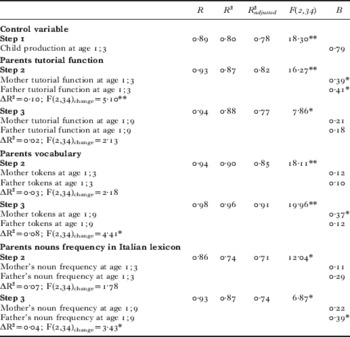
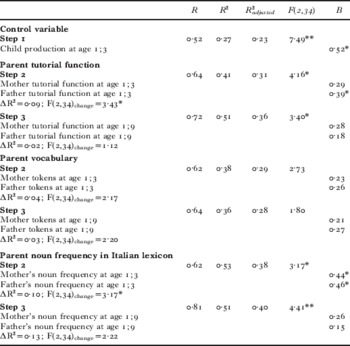
In order to analyze how different aspects of parental language predict children's production and comprehension, three separate linear regression analyses for each domain of interest for production at age 2 ; 6 (sentence complexity) and comprehension at age 3 ; 0 (PPVT scores) were conducted; parental communicative function (tutorial), parental quantitative input (tokens produced for each sessions), and parental lexicon characteristics (mean frequency of occurrences in the Italian lexicon of parental nouns produced for each session). These analyses assess the contribution of the single mothers' and fathers' linguistic characteristics to child language development. Then, two separate overall hierarchical linear regression analyses were conducted in order to link all of the predictors of interest for mothers and fathers with child language development at ages 2 ; 6 and 3 ; 0, following Pancsofar & Vernon-Feagans (Reference Pancsofar and Vernon-Feagans2010) . This analysis focused on the separate contributions of mothers and fathers while in the same environment with each other. Since child language at ages 1 ; 3 and 1 ; 9 may influence later child language outcomes, for each regression model, child language production during the 1 ; 3 session as reported in PVB was introduced in the first step to control for this potential influence in the relation between parental input and language outcome. The second step was parents' tutorial function and the third step was parental noun production frequency in the sessions. Results for each hierarchical regression analysis are reported in Tables 5 and 6.
Predicting language production (sentence complexity) at age 2 ; 6 by parents' language

note: p<0·05; ** p<0·01; *** p<0·001.
Predicting lexical comprehension at age 3 ; 0 by parents' language

note: * p<0·05; ** p<0·01; *** p<0·001.
As reported in Tables 5 and 6, child language production at age 1 ; 3 significantly predicts later language outcomes for both lexical production (F(2,34)=18·30; p<0. 01) and comprehension (F(2,34)=7·49; p<0·01). As shown, the addition of parental tutorial function during the 1 ; 3 session was a significant predictor of child language comprehension (F(2,34)change=3·43; p<0·05) and production (F(2,34)=5·10; p<0·05). In the case of parental vocabulary, only the addition of parental tokens in the 1 ; 9 session had a significant effect on child language production at age 2 ; 6 (F(2,34)change = 4·41; p<0·05). Moreover, the addition of paternal noun frequency in the Italian lexicon predicts language production [F(2,34)change = 3·43; p<0·05) and comprehension (F(2,34)change = 3·17; p<0·05).
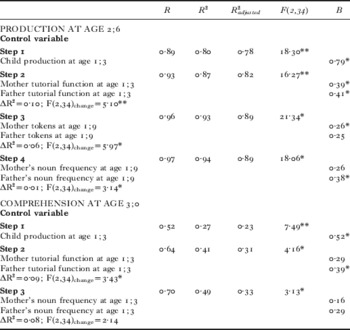
An overall regression model that included all of the significant parental language variables as predictors in the hierarchical regression for each domain was conducted for both language comprehension and production. Results are reported in Table 7.
Hierarchical linear regression analysis for overall model predicting children's production at age 2 ; 6 and comprehension at age 3 ; 0

The overall regression model was significant. The addition of parental tutorial function in the 1 ; 3 session had a significant effect on language comprehension (F(2,34)change=3·43; p<0·05) and production [F(2,34)change=5·10; p<0·05) after accounting for early child production during the 1 ; 3 session. Parental tokens and parental noun frequency had a significant effect on language production at age 2 ; 6 (F(2,34)change = 5·97; p<0·05 and F(2,34)change = 3·14;p<0·05).
DISCUSSION
The aim of the present study was to compare the role of maternal and paternal CDS during a triadic free-play situation in Italian child language development. In particular, possible differences or analogies between these two language registers were investigated, and the possible relation between child language quantitative and qualitative aspects, specifically lexical indices, and child language outcome (production and comprehension) was considered.
This work identified several differences between the language input of mothers and fathers to their young children. Perhaps most importantly, this study linked paternal CDS to children's early language development, finding that paternal language input to their children at ages 1 ; 3 and 1 ; 9 made a unique contribution to children's expressive and comprehension language skills at ages 2 ; 6 and 3 ; 0, after maternal CDS and children's production at 1 ; 3 was considered.
The analysis of parental CDS suggested that paternal MLU is shorter than that of mothers. So far, only a few studies have shown a longer maternal than paternal MLU (e.g. Rondal, Reference Rondal1980). Also, the reviews of other quantitative indices of parental productions revealed that mothers produced a greater number of tokens and types compared with fathers, despite fathers showing an increase in production of tokens between the first and second observations. This could indicate that fathers talk more when children have become older; when he/she produces a higher number of turns and the conversation becomes more symmetrical. In the past, a similar increase in productivity was observed in maternal language (Longobardi, Reference Longobardi1992). It follows that the data of this study corroborate the position of those authors who support the presence of a difference between mothers and fathers in relation to total language production (e.g. Pancsofar & Vernon-Feagans, Reference Pancsofar and Vernon-Feagans2006) and in the number of tokens and types (e.g. Rondal, Reference Rondal1980).
As regards the qualitative indices of parental language, the proportion of occurrences of nouns, verbs and adjectives/adverbs was almost the same whether children are aged 1 ; 3 or 1 ; 9. However, for the lexical indices suggested by Rinaldi et al. (Reference Rinaldi, Barca and Burani2004), mothers showed a greater lexical simplification than their partners, producing items with a high frequency of use in the written language of children and adults, as well as in their spoken language. Previously, other authors showed a difference between mothers and fathers in the production of words with greater frequency of use in adult language (e.g. Ratner, Reference Ratner1988), stressing the importance of this index in the study of language acquisition (Levelt, Roelofs & Meyer, Reference Levelt, Roelofs and Meyer1999). Overall, these data confirmed the initial hypothesis that there was a difference in the language that mothers and fathers use to talk to their children in both quantitative (MLU, tokens and types) and qualitative (lexicon) features.
Concerning the continuity between prelinguistic social interaction and the development of language, the parental tutorial function at age 1 ; 3 was predictive of child language development, above and beyond those contributions from children's production. Particularly, maternal and paternal tutorial function was predictive of child language production at age 2 ; 6 and only paternal tutorial function was predictive of comprehension at age 3 ; 0. This finding is consistent with the study by Longobardi (Reference Longobardi1992), who considered the relationship between maternal communication and the communicative–linguistic development of the child. Therefore, even paternal tutorial function was positively related to the richness of the children's vocabulary, as reported in other studies (e.g. Pancsofar & Vernon-Feagans, Reference Pancsofar and Vernon-Feagans2006).
Finally, the influence of the lexical features of paternal communication on child language production at age 2 ; 6 and on comprehension at age 3 ; 0 was highlighted. In particular, children's communicative skills were promoted by the fathers' high-frequency words. This is in agreement with the recent results reached by Pancsofar and Vernon-Feagans, (Reference Pancsofar and Vernon-Feagans2006), which emphasized a relationship between paternal CDS and child language development. Moreover, this research confirms the importance of Zevin and Seidenberg's (Reference Zevin and Seidenberg2004) concept of a frequency trajectory that recalls how words characterized by a low frequency of use in adult speech are actually very common in the language of children (e.g. potty and stroller). These words are simpler than those commonly used by adults and this affects the ease of learning the word (Zevin & Seidenberg, Reference Zevin and Seidenberg2004). It follows that the adult who is able to turn to the child using terms which are more frequent in child language plays the important role of scaffolding; supporting the child during the acquisition of the linguistic code. The importance of this role of compensating for the gap between the skills required in a conversation and the still limited capacity of the small child was also highlighted by Weizman and Snow (Reference Weizman and Snow2001). The authors noted that, despite parental language addressed to a child being characterized by a more complex vocabulary, the introduction of more sophisticated words in the course of interaction with the small child was accompanied by a process of scaffolding.
In addition, parental lexical complexity was related to later child language development, with greater significance than the quantitative characteristics of language (the amount of language addressed to the child). Overall, these data appear consistent with the socio-constructivist approach, describing the need for the adult role in the process of child language acquisition. In particular, the use of words adapted to the limited abilities of the child and a linguistic input focused on the tutorial aspects (repetition, expansion, reformulation, paraphrasing, etc.) are predictive of child language competence at age 2 ; 6. Finally, the present research has revealed a difference in maternal and paternal CDS, highlighting the importance of the father–child relationship in understanding child development. Furthermore, our work shows evidence of the similarities of support that parents offer to their children, as previously indicated by Cabrera et al. (Reference Cabrera, Shannon and Tamis-LeMonda2007).
The present study suggests a complex interaction between multiple factors on child linguistic development in contemporary Italian families using longitudinal observational data in a triadic situation. Individual characteristics of children's production at age 1 ; 3 could be important for later language development for the word processing task, as indicated by Werker and Tees (Reference Werker and Tees1999), who stated that, at that age, known words and unknown words are processed differently. However, these findings do suggest that, while children's communicative skills at age 1 ; 3 may significantly predict their language development, there are many other important contributing factors influencing children's language abilities. In fact, from our analysis, it emerges that child language development is affected by parental CDS in both quantitative and qualitative aspects. The results confirm and extend what previous studies have found; some aspects of child syntax development are related to variations in input, and father interactions with young children contribute to more advanced child language development (see Huttenlocher et al., Reference Huttenlocher, Vasilyeva, Cymerman and Levine2002).
Furthermore, this investigation suggests that the language of mothers and fathers predicts child language development differently, and highlights the need to include fathers in future research on children's communicative skills and language development and their complementary roles in language acquisition.
In addition, it may also be that the contributions of parental CDS on child language development may be best understood in conjunction with the analysis of the interactions in contexts that were not measured in this study, such as book reading or different kinds of play, in order to assess possible differences in qualitative and quantitative indices. Moreover, the parent–child language interactions should be compared with children at risk regarding language development, such as very premature infants.
APPENDIX
Nouns produced by at least 50% (N=18) of mothers and fathers during the two observational sessions.