Cardiovascular complications are among the leading causes of morbidity and mortality among survivors of childhood cancer, after cancer relapse and secondary malignancies.Reference Tukenova, Guibout and Oberlin 1 , Reference Mertens, Liu and Neglia 2 Advances in cancer treatment have improved the 5-year survival rates over the past 3 decades for children diagnosed with cancer, from about 60 to more than 80%;Reference Ward, DeSantis and Robbins 3 however, the same treatments that cure cancer also increase the risk of adverse effects in cardiovascular and other organ systems.
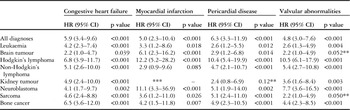
Clinical and sub-clinical cardiovascular damage, heart failure, coronary artery disease, and cerebrovascular events are examples of some treatment-related health complications in survivors of childhood cancer.Reference Mertens, Liu and Neglia 2 , Reference Oeffinger, Mertens and Sklar 4 , Reference Armstrong, Oeffinger and Chen 5 Compared with siblings, survivors have an almost six-fold increased risk for heart failure, a five-fold increased risk for myocardial infarction, a six-fold increased risk for pericardial disease, and an almost five-fold increased risk for valvular abnormalities (Table 1).Reference Mulrooney, Yeazel and Kawashima 6 Furthermore, beyond the age of 35 years, survivors have an almost 11-fold increased risk for heart failure, compared with siblings, indicating that risks are persistent and progressive over the years.Reference Armstrong, Kawashima and Leisenring 7 Overall, about 65% of anthracycline-treated childhood cancer survivors will have some kind of late cardiovascular abnormality.Reference Lipshultz, Colan and Gelber 8
HRs and 95% CIs of reported cardiac conditions in childhood cancer survivors compared with the sibling control group.Footnote *

CI=confidence interval; HR=hazard ratio
Reprinted with permission from the BMJ Publishing Group, LtdReference Mulrooney, Yeazel and Kawashima 6
* Adjusted for gender, race, household income, education, and tobacco use
** Not significant at p=0.05
*** Unable to estimate
Mechanisms of athracycline-induced cardiotoxicity
Anthracyclines, a commonly used class of chemotherapeutic agents, impose substantial risk of cardiotoxicity through several possible mechanisms.Reference Diamond, Franco and Miller 9 The most commonly accepted is the oxidative stress hypothesis, which suggests that generating reactive oxygen species and lipid peroxidation of the cell membrane damage cardiomyocytes.Reference Sawyer, Peng and Chen 10 In addition, a recent report suggests that alterations in topoisomerase II β by anthracyclines may also be important in cardiac injury.Reference Zhang, Liu and Bawa-Khalfe 11 Understanding the mechanism of injury may help develop targeted strategies for the prevention and treatment specific to anthracycline-induced cardiac injury.
Course of cardiotoxicity
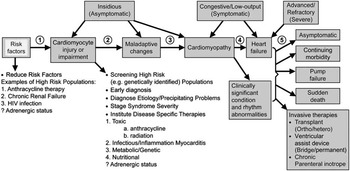
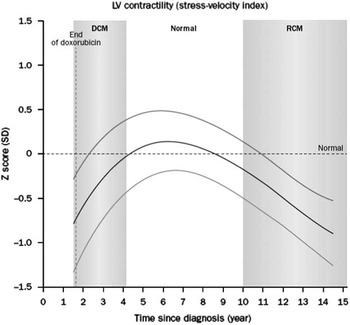
Cardiotoxicity in survivors of childhood cancer is progressive and can take years to develop (Fig 1).Reference Lipshultz, Lipsitz and Sallan 12 The first evidence of anthracycline-induced cardiotoxicity is sub-acute cardiac damage that manifests as depressed myocardial contractility and, if left undetected or untreated, can progress to heart failure during or shortly after completion of therapy.Reference Minow, Benjamin and Gottlieb 13 In a previous study of patients with a diagnosis of acute lymphoblastic leukaemia, acute heart failure – heart failure beginning within 1 year of completion of doxorubicin therapy – was identified in 10% (11/115) of those treated with anthracyclines during childhood. All 11 patients improved with anti-congestive therapy.Reference Lipshultz, Colan and Gelber 8 Between 3 and 10 years later, subsequent recurrence of heart failure was seen in five of these patients, two of whom underwent heart transplantation.Reference Lipshultz, Colan and Gelber 8 Those patients who initially presented with early sub-clinical cardiac abnormalities had a dilated-type cardiomyopathy, which was characterised by reduced left ventricular fractional shortening and left ventricular contractility along with left ventricular dilation; however, over time, the cardiac abnormalities became more of a restrictive-type cardiomyopathy, with normal-to-reduced left ventricular dimensions and markedly reduced left ventricular wall thickness for body surface area, reduced left ventricular fractional shortening, and reduced left ventricular contractility (Fig 2).Reference Lipshultz, Colan and Gelber 8
Stages in the course of paediatric ventricular dysfunction. Preventive strategies progressively become less effective as the number increases. For example, primary prevention is possible at number 1; secondary prevention is possible at numbers 2, 3, and 4. Treatment strategies have a greater impact with higher numbers but longer effects with lower numbers. For example, treatment is possible at numbers 4 and 5 to reduce sequelae. Biomarkers/surrogate end points are potentially more useful with lower numbers for possible alteration of course with interventions and are potentially more useful with higher numbers for decisions about transplantation (Reprinted with permission from ElsevierReference Lipshultz 15 ).

Progressive cardiac dysfunction after doxorubicin therapy in children treated for acute lymphoblastic leukaemia. DCM was characterised by echocardiographic signs of reduced LV fractional shortening and contractility with LV dilation. In time, the pattern changed, and children showed signs consistent with a RCM: normal to reduced LV dimension with significantly reduced LV thickness, fractional shortening, and contractility. The blue line indicates the overall group mean in this model. Green and red lines are the upper and lower 95% CI from the predicted mean (Reprinted with permission from the American Society of Clinical OncologyReference Lipshultz, Lipsitz and Sallan 12 ). CI=confidence interval; DCM=dilated cardiomyopathy; LV=left ventricle; RCM=restrictive cardiomyopathy.

In 115 survivors, after a median follow-up of 17 years, left ventricular dimension for body surface area decreased with a subsequent rise in left ventricular wall thickness for body surface area, resulting in a normal left ventricular thickness-to-dimension ratio, a marker of left ventricular re-modelling, and reduced left ventricular mass. This type of chronic cardiomyopathy is marked by a shrinking myocardial and cavity size (“Grinch” syndrome) for body surface area, and it may progress to heart failure, heart transplantation, or death in childhood cancer survivors.Reference Lipshultz, Lipsitz and Sallan 12 , Reference Lipshultz, Scully and Stevenson 14 , Reference Lipshultz 15
Risk factors for cardiotoxicity
Risk factors associated with cardiotoxicity include higher cumulative anthracycline dose, female sex, younger age at diagnosis, black race, trisomy 21, longer time since treatment, and the presence of pre-existing cardiovascular disease and co-morbidities.Reference Lipshultz, Alvarez and Scully 16 In a recent study of documented, symptomatic cardiac events, a higher cumulative anthracycline dose was associated with a higher risk for cardiac events in survivors of childhood cancer.Reference van der Pal, van Dalen and van Delden 17 The risk of cardiotoxicity is 11 times higher in children who receive cumulative anthracycline doses of >300 mg/m2 compared with those who receive lesser dosages;Reference Kremer, van Dalen and Offringa 18 however, sub-clinical cardiac abnormalities are evident at lower doses,Reference Orgel, Zung and Ji 19 , Reference Leger, Slone and Lemler 20 suggesting that there is no “safe” dose of anthracycline.Reference Bansal, Franco and Lipshultz 21 A particular study specifically designed to evaluate the effects of very low doses of anthracyclines (⩽100 mg/m2) on left ventricular function in 91 survivors of childhood cancer found, after a mean of 9.8 years from diagnosis, that 28% had abnormal left ventricular posterior wall thickness (⩾2 SD) and four patients had an abnormal left ventricular fractional shortening (<28%).Reference Leger, Slone and Lemler 20
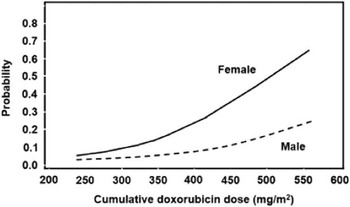
Female childhood cancer survivors had a greater reduction in left ventricular contractility and lower left ventricular mass compared with males after a median follow-up of 8.1 years, even after receiving the same cumulative dose of doxorubicin. In addition, higher cumulative dose was associated with an even greater reduction in contractility for females, further broadening the gap between sexes (Fig 3).Reference Lipshultz, Lipsitz and Mone 22 Girls tend to have more body fat than boys; therefore, this risk might be partially explained by the low clearance of anthracyclines with increased body fat and its longer persistence in higher concentrations in non-adipose tissues, including the heart.Reference Lipshultz, Lipsitz and Mone 22 Younger age at diagnosis, particularly before 4 years of age, is a risk factor for anthracycline cardiotoxicity.Reference Lipshultz, Lipsitz and Mone 22 Damage induced by anthracyclines could impair the heart’s ability to grow in these young patients, increasing their vulnerability for cardiac dysfunction.
Probability of depressed contractility as a function of the cumulative dose of doxorubicin in female and male patients (Reprinted with permission from the Massachusetts Medical SocietyReference Lipshultz, Lipsitz and Mone 22 ).

Historically, cranial irradiation has been the standard treatment for childhood leukaemia and brain cancers and to prevent brain metastases. Unlike chest-directed radiation, cranial radiation increases the risk of cardiotoxicity more indirectly. Cancer survivors exposed to cranial radiation, compared with those unexposed, had decreased left ventricular mass and left ventricular dimensions over a 10-year follow-up period.Reference Landy, Miller and Lipsitz 23 These changes in cardiac structure were associated with reduced concentrations of insulin-like growth factor-1 that were likely related to growth hormone deficiency.Reference Landy, Miller and Lipsitz 23
The presence of traditional cardiovascular risk factors further increase the risk of cardiovascular disease in childhood cancer survivors treated with cardiotoxic treatments. An analysis of 5-year survivors from the Childhood Cancer Survivor Study reported on 10,724 survivors followed-up longitudinally for the development of traditional cardiovascular risk factors.Reference Armstrong, Oeffinger and Chen 5 The cumulative prevalence of all cardiovascular risk factors, except obesity, increased with age in survivors and was greater in survivors than in siblings. Furthermore, the cumulative incidence of all major cardiac events was greater in survivors than in siblings and was also associated with exposure to cardiotoxic therapies. In a related study, a higher number of traditional cardiovascular risk factors was associated with a higher cumulative incidence of cardiovascular disease, such that the cumulative incidence for having two or more risk factors is almost three times as high as having none. Furthermore, the cumulative incidence is even higher when the risk factors are coupled with exposures to cardiotoxic treatments.Reference Armenian, Sun and Vase 24
It is important to highlight that cardiovascular risk factors can develop in survivors both exposed and unexposed to cardiotoxic therapies.Reference Lipshultz, Landy and Lopez-Mitnik 25 Compared with siblings, in both exposed and unexposed survivors, the increase in cardiovascular abnormalities results from abnormal left ventricular structure and function, an increase in traditional risk factors for atherosclerotic disease – for example, elevated body mass index, insulin level, and non-high density lipoprotein cholesterol – and systemic inflammation.Reference Lipshultz, Landy and Lopez-Mitnik 25 These results support the need for comprehensively assessing the global risk for cardiovascular disease in all childhood cancer survivors.
Cardioprotection during cancer treatment
Dexrazoxane is an iron chelator that reduces the formation of anthracycline–iron complexes, thus reducing the generation of reactive oxygen species.Reference Sterba, Popelova and Vavrova 26 , Reference Simunek, Sterba and Popelova 27 It also mitigates doxorubicin-induced DNA damage by hindering the action of topoisomerase 2-β.Reference Zhang, Liu and Bawa-Khalfe 11 , Reference Hasinoff, Kuschak and Yalowich 28 Earlier pre-clinical studies have found evidence of cardioprotection from dexrazoxane, which prompted its exploration in humans.Reference Herman, Hasinoff and Steiner 29 At present, dexrazoxane is the only drug approved to reduce doxorubicin-related cardiotoxicity in humans;Reference Doroshow 30 however, its use has been limited to adults with metastatic breast cancer who would benefit from additional doxorubicin treatment but in whom the cumulative dose of doxorubicin is already >300 mg/m2.
In children treated with anthracyclines, ascertaining the long-term impact of dexrazoxane on clinical outcomes such as heart failure is difficult, given the limited length of follow-up and the progressive nature of anthracycline-related cardiac dysfunction. Nevertheless, sub-clinical cardiac outcomes such as changes in left ventricular structure and function and serum biomarker concentrations – for example, cardiac troponin T [cTnT] and NT-proBNP levels – were better in children treated with anthracyclines plus dexrazoxane than in those treated without dexrazoxane.Reference Lipshultz, Rifai and Dalton 31 , Reference Lipshultz, Scully and Lipsitz 32
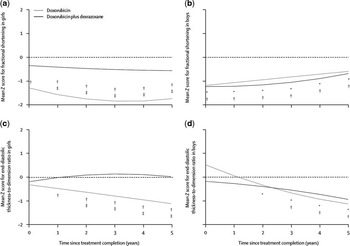
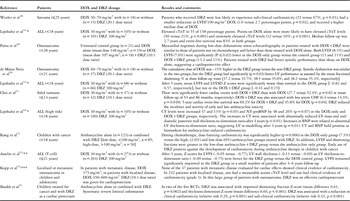
Several large studies involving children with different tumour types treated with dexrazoxane have found similar results (Table 2). In particular, one study by the Dana–Farber Cancer Institute Acute Lymphoblastic Leukemia Consortium examined the cardioprotective effects of dexrazoxane in 206 children with high-risk acute lymphoblastic leukaemia. By the end of the doxorubicin therapy, concentrations of cTnT were elevated in 50% of the children treated with doxorubicin alone, but in only 21% of those treated with doxorubicin and dexrazoxane;Reference Lipshultz, Rifai and Dalton 31 5 years after the completion of the doxorubicin therapy, the cardioprotective benefits of dexrazoxane were predominant in girls, particularly with respect to changes in the left ventricular end-diastolic thickness-to-dimension ratio – a marker of pathologic left ventricular re-modelling – and left ventricular fractional shortening (Fig 4).
Mean left ventricular echocardiographic Z scores in boys and girls (n=134). Plots are adjusted for age. *p⩽0.05 for comparison of the mean Z score of the doxorubicin plus dexrazoxane group with zero; †p⩽0.05 for comparison of the mean Z score for the doxorubicin group with zero and ‡p⩽0.05 for comparisons of mean Z scores between the doxorubicin and doxorubicin plus dexrazoxane groups (Reprinted with permission from ElsevierReference Lipshultz, Scully and Lipsitz 32 ).

Summary of studies investigating the cardioprotective effects of dexrazoxane in children and adolescents with haematological or solid tumours receiving a chemotherapeutic regimen containing doxorubicin.

ALL=acute lymphoblastic leukaemia; BNP=brain natriuretic peptide; CHF=congestive heart failure; CT=cardiac troponin; cTnT=cardiac troponin T; DOX=doxorubicin; DRZ=dexrazoxane; ESD=end systolic dimension; LV=left ventricular; LVEF=left ventricular ejection fraction; LVESD=left ventricular end-systolic diameter; LVFS=left ventricular fractional shortening; NT-proBNP=N-terminal pro-brain natriuretic peptide; RCT=randomised clinical trial.
Reprinted with permission from ElsevierReference Lipshultz, Franco and Sallan 34
* Protocol Dana-Farber 95-01
** Protocol POG 9404
*** Protocol AOST0121 and POG9754
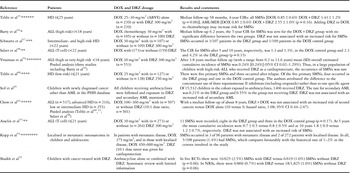
This protective effect of dexrazoxane was once feared to extend to malignant cells, potentially leading to secondary malignancies,Reference Tebbi, London and Friedman 33 but several other studies have found no such increase (Table 3).Reference Lipshultz, Franco and Sallan 34
Summary of studies investigating the development of second malignant neoplasms in children and adolescents with haematological or solid tumours treated with a chemotherapy regimen containing doxorubicin, with or without dexrazoxane.

ALL=acute lymphoblastic leukaemia; AML=acute myeloid leukaemia; CI=confidence interval; CIR=cumulative incidence rate; DOX=doxorubicin; DRZ=dexrazoxane; HD=heart disease; MDS=myelodysplastic syndrome; NRSs=non-randomised studies; RCTs=randomised clinical trials; SMN=second malignant neoplasm
Reprinted with permission from ElsevierReference Lipshultz, Franco and Sallan 34
* Protocol Dana–Farber 95-01
** Protocol POG 9404
*** Protocol POG 9425
**** Protocol POG 9426
***** Protocols POG 9404, POG9425, and 9429
****** Protocol POG 9425 and 9426
******* Protocols 95-01, 00-01, and 05-01
******** Protocols POG9754 and AOST 0121
Enalapril has been tested as a cardioprotective agent in survivors who have received anthracycline therapy. One study found that treatment with enalapril resulted in an early decrease in left ventricular end systolic wall stress;Reference Silber, Cnaan and Clark 35 however, Lipshultz et al. found that these beneficial effects of enalapril on cardiac function were transient and were largely related to how changes in blood pressure reduced left ventricular wall stress.Reference Lipshultz, Lipsitz and Sallan 36 Thus, the long-term effects of enalapril as a cardioprotectant are yet to be determined.
Based on studies that have found higher dose rates of doxorubicin to be associated with cardiotoxicity in children, continuous doxorubicin infusion was hypothesised to provide some cardioprotection by lowering peak serum concentrations of the drug.Reference Levitt, Dorup and Sorensen 37 In addition, continuous infusion of doxorubicin does reduce the risk of cardiotoxicity in adults.Reference Legha, Benjamin and Mackay 38 As a result, paediatric protocols began to incorporate continuous infusion, despite the lack of evidence for long-term cardioprotection. In a multi-centre, randomised trial of children with high-risk acute lymphoblastic leukaemia, 8 years after diagnosis, neither cardioprotection nor event-free survival was better in children who received doxorubicin as a continuous infusion compared with a bolus infusion.Reference Lipshultz, Miller and Lipsitz 39 Both groups had similar values of abnormal left ventricular function and structure. In addition, 10-year event-free survival was not significantly different – 83 and 78% for continuous and bolus doxorubicin infusions, respectively – suggesting no effect on efficacy.Reference Lipshultz, Miller and Lipsitz 39 In another study of anthracycline-treated childhood cancer survivors, a mean of 7 years after treatment, 20% of the bolus group and 11% of the continuous infusion group had reduced cardiac function, but the difference was not statistically significant.Reference Gupta, Steinherz and Cheung 40 Despite the lack of definitive evidence of cardioprotection and the higher hospital length of stay, costs, and the risks of thromboembolic events and mucositis, continuous infusion is still incorporated into paediatric treatment protocols for cardioprotection.Reference Lipshultz, Giantris and Lipsitz 41
Surveillance of cardiotoxicity
Conventional methods for monitoring heart function, such as echocardiography, radionuclide ventriculography, and cardiac MRI, detect changes only after a certain degree of damage has already occurred. Thus, detecting cardiotoxicity before irreversible damage has occurred is challenging. Newer imaging modalities such as myocardial strain and strain rate have limited specificity to detect myocardial injury.Reference Colan, Lipshultz and Sallan 42 Strain and strain rate depend on loading conditions, which are often disturbed in cancer patients. Thus, more studies are needed to determine the clinical utility of these modalities for detecting clinically important cardiotoxicity in childhood cancer survivors.
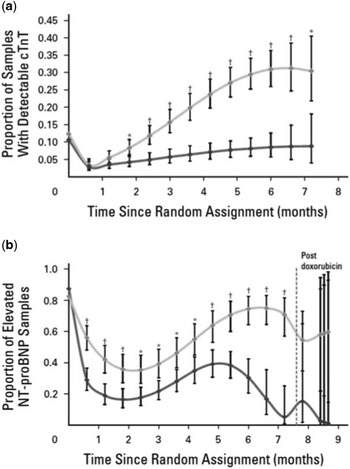
In addition to the imaging modalities mentioned above, serum cardiac biomarker concentrations that have been validated as surrogates for late cardiac status in this population might also prove to be useful.Reference Lipshultz, Rifai and Sallan 43 Elevated serum concentrations of cTnT, an indicator of myocardial damage, and N-terminal pro-brain natriuretic peptide (NT-proBNP), produced in response to pressure overload and stretching, have been studied extensively in childhood cancer survivors.Reference Lipshultz, Rifai and Dalton 31 , Reference Lipshultz, Rifai and Sallan 43 , Reference Lipshultz, Miller and Scully 44 In a study of children with high-risk acute lymphoblastic leukaemia, elevated concentrations of serum cTnT during the first 90 days of anthracycline therapy were associated with reduced left ventricular mass and left ventricular end-diastolic posterior wall thickness and increased left ventricular pathologic re-modelling 5 years later (Fig 5a).Reference Lipshultz, Miller and Scully 44 In that same study, elevated serum concentrations of NT-proBNP in the first 90 days of therapy were also associated with an abnormal left ventricular thickness-to-dimension ratio, suggesting left ventricular pathologic re-modelling 4 years later (Fig 5b);Reference Lipshultz, Miller and Scully 44 however, before, during, and after treatment, the percentage of patients with elevated serum NT-proBNP concentrations was higher than the percentage with elevated cTnT concentrations, indicating that NT-proBNP may detect cardiac stress before irreversible myocardial damage has occurred.Reference Lipshultz, Miller and Scully 44 This relationship, if validated, may have implications for identifying early cardiac damage in at-risk children, when prevention or cardiac treatment may be most successful.
Model-based estimated probability of having ( a ) an increased cTnT level and ( b ) an increased NT-proBNP at each depicted time point in patients treated with doxorubicin, with or without dexrazoxane. Increased cTnT is defined as a value >0.01 ng/ml. Increased NT-proBNP is defined as a value ⩾150 pg/ml for children younger than 1 year and a value ⩾100 pg/ml for children aged 1 year or older. The doxorubicin–dexrazoxane group is indicated by the blue line and the doxorubicin group by the gold line. Vertical bars show 95% CIs. *p value versus dexrazoxane group ⩽0.05 and †p value versus dexrazoxane group ⩽0.001. An overall test for dexrazoxane effect of cTnT during treatment was significant (p<0.001). An overall test for dexrazoxane effect of NT-proBNP during treatment was significant (p<0.001) and after treatment was not significant (p=0.24) (Reprinted with permission from the American Society of Clinical OncologyReference Lipshultz, Miller and Scully 44 ). CI=confidence interval; cTnT=cardiac troponin T; NT-proBNP=N-terminal pro-brain natriuretic peptide.

Despite receiving the same cumulative doses, or even having similar risk factors, cardiotoxicity does not affect patients equally. Some might never experience any kind of cardiac dysfunction, whereas others might experience heart failure. Owing to this variation, there is a growing interest in the potential of genetic markers to identify high-risk patients. Preliminary studies have found that patients exposed to low-to-moderate doses of anthracyclines who express the G allele of the CBR3 gene, which encodes carbonyl reductase 3, have an increased risk for cardiomyopathy.Reference Blanco, Sun and Landier 45 Another study explored the genetic pre-disposition for iron overload, hereditary haemochromatosis, in survivors treated with doxorubicin. On the premise that doxorubicin–iron complexes generate doxorubicin semiquinone free radicals, which then lead to lipid peroxidation and DNA damage, investigators screened 184 survivors of high-risk acute lymphoblastic leukaemia for the frequency of hereditary haemochromatosis gene mutations – C282Y and H63D.Reference Lipshultz, Lipsitz and Kutok 46 In the 10% of children carrying a mutation in the hereditary haemochromatosis C282Y allele, the risk for doxorubicin-related myocardial injury was nine times as high as that of non-carriers.Reference Lipshultz, Lipsitz and Kutok 46 Although validation studies are required, screening for these genetic mutations may prove useful for guiding treatment and in post-chemotherapy monitoring.
With more childhood cancer survivors now reaching adulthood, it is vital to understand the adverse effects of cancer treatment on the cardiovascular system and their long-term consequences to identify and establish optimal prevention and management strategies that balance oncologic efficacy with long-term safety.Reference Lipshultz, Franco and Miller 47
Acknowledgement
None.
Financial Support
Dr Steven Lipshultz was also supported in part by grants from the National Institutes of Health (HL072705, HL078522, HL053392, CA127642, CA068484, HD052104, AI50274, HD052102, HL087708, HL079233, HL004537, HL087000, HL007188, HL094100, HL095127, and HD80002), the Children’s Cardiomyopathy Foundation, the Women’s Cancer Association of the University of Miami, the Lance Armstrong Foundation, the STOP Children’s Cancer Foundation, the Scott Howard Fund, and the Michael Garil Fund. Vivian Franco was supported by the Michael Garil Fund.
Conflicts of Interest
Steven Lipshultz was a paid consultant to The Clinigen Group to help organise the expert panel on cardio-oncology in Newark, NJ, in July, 2014. There are no other relevant conflicts of interest to disclose.