Introduction
Rising Uyghur ethnic consciousness in the post-1978 era is believed to be related to tense Uyghur-Han relations and conflicts in Xinjiang.Footnote 1 Scholars have accounted for rising Uyghur consciousness with variables such as Han migration into Xinjiang,Footnote 2 ethnic inequalities,Footnote 3 Uyghur language,Footnote 4 and Islamic religiosity.Footnote 5 Given the importance of this topic, it is surprising that there is no concrete effort to summarize, elaborate, and verify these accounts. Furthermore, there are different opinions on the effect of each of these variables on Uyghur consciousness. It is not clear whether these variables are related to Uyghur consciousness. Nor is it clear which variables are good predictors of Uyghur consciousness and which variables are irrelevant for research on this important topic. More generally, is there a high level of ethnic consciousness among Uyghurs? Is Uyghur consciousness based more on instrumental needs than on cultural and psychological properties, or vice versa?
This paper addresses these questions with data from a survey (N = 900) conducted in Ürümchi in 2007. In this paper, ethnic consciousness refers to the awareness of membership in an ethnic group by both group members and the larger society in which they reside. Ethnic consciousness commonly emerges in situations where groups sharing common attributes and interests, such as a religious belief, organize to influence the exercise of state power, or to defend their shared interests.Footnote 6
Uyghur ethnic consciousness in Mao's China
Uyghurs are one of the 56 nationality groups in the People's Republic of China. Han Chinese are the ethnic majority. Uyghurs are a Turkic people and Sunni Muslims. They lived in north-western Mongolia. After the demise of the Uyghur Empire in 840, they migrated en masse to the areas known as Xinjiang today. They practiced Manichaeanism, Nestorian Christianity, and shamanism before 932.Footnote 7 Some Uyghurs in southern Xinjiang became Muslims before the Mongol conquest of Xinjiang around 1200. Massive Uyghur conversion to Islam occurred after 1200 but was not completed until the mid-1400s.Footnote 8 Some scholars argued that the conversion was not concluded until the 1600s. Xinjiang became a province of the Qing Empire in 1884. Uyghur rebellions against Qing Rule occurred from time to time. Xinjiang was governed by Chinese warlords after the demise of the Qing Empire in 1911. The Nationalist Government managed to place direct control over the region after 1944. With Soviet support, Uyghurs established the East Turkistan Republic in Ili, Tarbagatay, and Altay in northern Xinjiang between 1944 and 1949, which was a landmark in the evolution of Uyghur national identity from the 1920s.Footnote 9
Smith Finley argued that prior to 1949, there existed, in addition to oasis and social group identities, an over-arching regional identity based on social, cultural and religious practices and norms common to all Central Asia and subsumed under the term ‘Muslim’.Footnote 10 However, Rudelson maintained that most Uyghurs were oriented towards their oases before 1949.Footnote 11 Shichor claimed that Uyghur nationalism began to take shape in the 1920s and 1930s.Footnote 12 Gladney argued that ‘the people of the (Xinjiang) oases lacked any coherent sense of identity’.Footnote 13 Heller believed that despite some commonalities throughout the oases, Uyghurs had ‘a very weak historical claim to a coherent Uyghur identity’.Footnote 14
When the Chinese Communist Party (Party) came to power in 1949, it strived for total power in an effort to transform China into a socialist country and to fully integrate Xinjiang into the People's Republic of China. The Party regarded Islam as an alternative to political allegiance to the socialist state and made efforts to undermine the position of mosques and imāms in Xinjiang. General Wang Zhen mercilessly handled ethnic affairs and executed some Uyghurs with ‘deviant’ political or religious views in the 1950s. The Party abolished Islamic taxes and expropriated mosque lands. ‘The state then put clerics on its payroll and incorporated them institutionally within the Beijing-based Chinese Islamic Association.’Footnote 15
In spite of these evolving socioeconomic changes in Xinjiang, Uyghur-Han relations seemed to be on good terms between 1949 and 1966. It is true that in the One Hundred Flowers Campaign of 1956–1957, some Uyghurs criticized government policies and raised the issue of Uyghur identity. In 1962, 60,000 Uyghur and Kazak refugees fled northern Xinjiang into the Soviet Union.Footnote 16 But overall, there were few Uyghur-Han disputes or conflicts between 1949 and 1966.Footnote 17 Clark found the undivided loyalty to the Party and total commitment to socialist construction among Uyghurs before 1966.Footnote 18
The good Uyghur-Han relations were partly based on socioeconomic development in Xinjiang that the Party promoted after 1949. The central government supported Xinjiang with relief funds, direct subsidies, and tax relief. The region witnessed the extensive development of infrastructure and rapid industrialization. Employment opportunities were provided on an unprecedented scale by state enterprises. Xinjiang's regional GDP per capita in 1952 ‘was a mere 170 yuan. By 1960 this figure had doubled, and reached 314 yuan’.Footnote 19 Uyghurs’ living standards were improved greatly.Footnote 20 There was little ethnic inequality in income as China was one of the most equal societies (in terms of the Gini coefficient) in the world at that time.
Also, early policies of the People's Republic of China in Xinjiang were relatively liberal.Footnote 21 Han migrants helped to develop the local economy, building much of the infrastructure in the region and training Uyghur workers with skills. Some of them attained functional fluency in the Uyghur language and abstained from practices that could have caused offence to Uyghurs. Many Uyghurs thought that the Party had been a positive force in Xinjiang.Footnote 22
Finally, the government raised new Uyghur elite groups including professionals, officials, and the modern working class. These new social groups enjoyed upward mobility, benefited from Xinjiang's modernization process, and were the main supporters of the Party's nationality policy in the region.Footnote 23 They served as role models and gave hope for upward mobility to their co-ethnics.
However, during the Cultural Revolution of 1966–1976, the Party carried out political campaigns against the so-called agents of local nationalism. Uyghur elite members, including intellectuals, were hit hard.Footnote 24 It is found that from 1966 to 1976, 99,000 of the 106,000 minority cadres were dismissed from their leadership posts.Footnote 25 Large-scale religious suppression included the closing of rural bazaars, attacks on imams and mosques, and the public burning of religious scripts.Footnote 26 The political campaigns appeared to be an all-out attack on ethnic minority cultures and religions in Xinjiang by the Chinese government and Han Chinese. The extremist nature of the Cultural Revolution policies led to the growth of ethnic consciousness and resentment towards the Party among Uyghurs.Footnote 27
Uyghur ethnic consciousness in the post-Mao era
After the Cultural Revolution, the Party recognized the damages done to Uyghurs. To reconcile with Uyghurs, its policies allowed a relatively tolerant environment for ethnic and religious expressions from the late 1970s to the mid-1990s.Footnote 28 In 1982, a campaign was launched to encourage Han Chinese to learn from minority groupsFootnote 29 and a return from Latin-based scripts to Arabic script was granted.Footnote 30 Uyghur intellectuals were given some freedom to express their opinions on Uyghur history and culture, which were not always consistent with official rhetoric.Footnote 31 Also, after a 15-year break, pilgrimage missions to Mecca were resumed in 1979.Footnote 32 Some Uyghurs studied Islam in Malaysia, Pakistan, and some Middle-East countries.Footnote 33 By 1989, the number of mosques in Xinjiang had increased by 5.8 times compared with a decade earlier to some 20,000.Footnote 34
The Chinese government also gave Uyghurs preferential considerations in family planning, college admissions, job placement, and ethnic slots in leadership representation.Footnote 35 Sautman claimed that an educated minority person in Xinjiang was more likely to attain an elite position than a Han of equal qualification.Footnote 36 In 1984, the government announced the ‘two restraints and one leniency’ policy to give minority suspects leniency in restraining and prosecuting.Footnote 37 Han Chinese have complained the lenient treatments and sentences that Uyghurs criminals have received from the courts in China.
Finally, the Chinese government has placed economic development at the centre of political rhetoric, hoping that economic growth would strengthen ethnic unity.Footnote 38 It introduced the Great Western Development policy in 2000 to boost economic growth in China's West. Its policies have included tax exemptions and investments in infrastructure.Footnote 39 Xinjiang's economy has developed rapidly. Its GDP climbed from 105 billion RMB in 1997 to 420 billion RMB in 2008. The GDP per capita in Xinjiang increased from 1,680 RMB in 1997 to 16,820 RMB in 2007.Footnote 40
However, economic growth did not enhance national unity in Xinjiang as was hoped by the Party. It was instead accompanied by rising Uyghur consciousness and intergroup tensions in Xinjiang.Footnote 41 The creation of new Central Asian states encouraged Uyghurs to ask for more regional autonomy or outright independence.Footnote 42 Uyghur demands began to manifest in the dissemination of alternative histories about Uyghur heroes and myths of origins.Footnote 43 There was also violence against Han Chinese and the Chinese government.Footnote 44
The government attributed the repeated unrest during the 1990s to its liberalization of religious and cultural policy in the region,Footnote 45 and has since 1996 carried out multiple ‘Strike Hard’ campaigns to target the three evils of separatism, terrorism, and religious extremism in Xinjiang.Footnote 46 Yet Uyghur resistance has continued.Footnote 47 Uyghurs have developed strong ethnic consciousness vis-à-vis Han Chinese and the Chinese government. There has been ‘everyday resistance’ by Uyghurs.Footnote 48 For some Uyghurs, the ‘Strike Hard’ campaigns had turned their acceptance and tolerance to hatred towards Han rule.Footnote 49 Growing Uyghur consciousness has become a major subject of discussion among China scholars.
Existing accounts of Uyghur ethnic consciousness
Rudelson is perhaps one of the first scholars to examine the roots of rising Uyghur consciousness in the post-1978 era. Whilst acknowledging the possibility of a pan-Uyghur identity, he argued that the immensity and harshness of the Tarim Basin separated rather than united the oasis centres in the region. The practice of oasis endogamy (marriage within the community) perpetuated a local identity. Oasis identities led to competing Uyghur identities that undermined hopes to build a coherent Uyghur national identity.Footnote 50 Rudelson also argued that Uyghurs were unable to forge a single ethnic nationalism due to political differences between urban secular activists and advocates of rural Islamic movements. Class distinctions between intellectuals, merchants, and peasants in Xinjiang were strong. Islam could not define the identity of all Uyghurs, as the majority of Uyghur intellectuals strongly rejected Islamic conservatism. Uyghur ‘identity is formed according to social class and occupation rather than family types, descent, or pan-oases solidarity.’Footnote 51
More recent studies have emphasized a growing pan-Uyghur identity in Xinjiang. For example, when Smith Finley conducted her research in 1996, she met a minkaohan intellectual who expressed deep sympathy for the Palestinians’ situation.Footnote 52 She did not find anyone from other Uyghur social groups who openly supported the Palestinians’ position. When she visited Xinjiang in 2004, she found that identifications with the Palestinians’ cause were a common attitude of all Uyghur social groups.Footnote 53 Other scholars have reported widespread discontent against Chinese rule across social groups among Uyghurs, as there is an acute sense between us (Uyghurs) and them (Han Chinese) in the region.Footnote 54 Yee found that 88.7 per cent of his Uyghur respondents were proud of Uyghur identity.Footnote 55 Below, I develop five hypotheses about ethnic consciousness based on the insights from the existing studies of Uyghurs in Xinjiang.
Status attainment
The first account focuses on the relationship between status attainment and ethnic consciousness. It differs from Rudelson's claim that members of the Uyghur elite groups are the champion of Uyghur ethnic consciousness. Instead, Dwyer claimed that Uyghurs in better-off northern areas were more sinicized than Uyghurs in other regions.Footnote 56 Steiner maintained that Uyghurs in northern urban centres accepted Han tendencies whilst remaining Uyghur only in name.Footnote 57 Hess argued that the Uyghur elite groups ‘may be well connected to Hans in the workplace, well-integrated into the Chinese state, and loyal to the PRC.’Footnote 58 The Chinese government has promoted a new, unified Xinjiang ren identity (Xinjiang person) and suppressed the moves to enhance Uyghur identity.Footnote 59 The members of the Uyghur elite groups may be more likely than other Uyghurs to support the Party's policy of national unity at the expense of Uyghur consciousness, and vice versa. Hence, Hypothesis 1: Status attainment is adversely related to Uyghur ethnic consciousness.
Han migration
Hypothesis 1 cannot be taken for granted. Members of the Uyghur elite groups may develop stronger ethnic consciousness than other Uyghurs because they are more likely than other Uyghur groups to compete with Han Chinese in the formal labour market and suffer from Han discrimination. Equally important, Uyghur consciousness may have little to do with status attainment. As noted, occupational mobility among Uyghurs took place before 1978, yet the rise of Uyghur consciousness has been a post-1978 development. Starr claimed that Uyghur identity was a historical conglomerate, and only recently has been constructed in opposition to Han Chinese state power.Footnote 60 Heller argued that Uyghur identity was still evolving and the major catalyst to this evolution and formation of the ‘Uyghur’ identity was primarily a result of the governance of ChinaFootnote 61—it is government policy that has contributed to rising Uyghur consciousness.
One of the policy issues at stake is post-1978 Han migration into Xinjiang. The Chinese government has supported Han migrants to move to Xinjiang as a means of strengthening Party control over the territory. The percentage of the Uyghur population in Xinjiang declined from over 75 per cent in 1949 to less than 46 per cent in 2004, whereas the Han population grew from under 10 per cent in 1949 to nearly 40 per cent in 2004.Footnote 62 Thus, some Uyghurs worried that ‘they are quickly becoming a minority nationality within their own territory’,Footnote 63 and have regarded Han migration as an encroachment on their ethnic space.Footnote 64 Han migrants are not interested in learning the Uygur language and ‘denigrate the Uyghur language, dress, food, and social customs’.Footnote 65 With the arrival of many Han migrants, Uyghurs believed that their culture and religion were under serious threat.Footnote 66 They placed importance on ethnic cultural characteristics such as Uyghur language and Islam that distinguished themselves from Han Chinese.Footnote 67 Also, Han migrants have competed with Uyghurs in the labour market. Governmental projects have employed Han workers rather than Uyghur workers,Footnote 68 but the worst offenders are private Han enterprises, which are not obliged to fulfil ethnic quotas. This has led to heightened Uyghur consciousness. Furthermore, since Uyghurs and Han Chinese have separate interests, it is hard to avoid a stratification of ethnic identity in everyday life. Han migration is important to ethnic identity because it increases cultural clashes between Han Chinese and Uyghurs, therefore stratifying ethnic definitions.Footnote 69 Uyghurs who see little Han migration or do not live in closer quarters with Han migrants ‘harbo[u]r less suspicion of and ethnic hatred towards Han Chinese’.Footnote 70 It is likely that the more contacts Uyghurs have with Han Chinese, the more intergroup tensions there are, and the higher the levels of their ethnic consciousness are. Hence, Hypothesis 2: The greater percentage of Han Chinese in a Uyghur's neighbourhood, the higher is his or her ethnic consciousness.
Uyghur-Han inequalities
Hypothesis 2 cannot be taken for granted. Intergroup contacts may lead to mutual understanding and a more tolerant environment for both the majority and minority groups, provided that both groups are of equal status. Intergroup contacts may lead to ethnic tensions if there are ethnic inequalities.Footnote 71 Unsurprisingly, some scholars have highlighted intergroup inequalities as the root of rising Uyghur consciousness.Footnote 72 As noted, the government has hoped to reduce ethnic inequalities and tensions with economic development. Yet some Uyghurs did not see themselves as benefiting from government development programmes.Footnote 73 Uyghurs claimed that the resources in Xinjiang had been sapped for the benefit of Han Chinese, and that they had received inadequate compensation.Footnote 74 There was the lack of economic opportunities for Uyghurs.Footnote 75 It is found that ‘Uyghurs are poorer than the Han’.Footnote 76 Han Chinese have better and easier access to economic benefits, whereas Uyghurs are discriminated against.Footnote 77
Some Uyghurs have expressed their growing discontent at widening Uyghur-Han inequalities in the wake of successive regional development campaigns.Footnote 78 ‘Urban dissatisfaction stems from the fact that Uyghurs now have something to compare themselves with. It is socio-economic inequalities, there, which lies at the root of a rapidly strengthening Uyghur national identity.’Footnote 79 It is argued that these perceptions had fuelled the ethnic tensions and Uyghur discontent that had become ‘indicative of their identity’.Footnote 80
However, the post-1978 era has also witnessed a growing Uygur middle class and business community.Footnote 81 It is argued that rural Uyghurs in pursuit of economic opportunity in Han-dominated economic sectors do not dislike Han Chinese as much as urban Uyghurs.Footnote 82 If economic hardship has promoted Uyghur discontent and ethnic consciousness vis-à-vis Han Chinese and the Chinese government, it is possible that well-off Uyghurs are less nationalistic since they have benefited from Han-led economic growth in Xinjiang. Hence, Hypothesis 3: Income is negatively related to Uyghur ethnic consciousness.
Uyghur language skills
Hypothesis 3 cannot be taken for granted. As noted above, some Western scholars have observed widespread opposition to Han Chinese and the Chinese government across different Uyghur social groups. Smith Finley argues that Uyghur identity results from the combination of pre-existing ‘We-hood’ (shared group experiences) and more recent ‘Us-hood’ (enmity towards the ‘Other’) vis-à-vis Han Chinese.Footnote 83 Hess claimed that Uyghurs had few unifying markers that transcended the entire grouping other than Islam, the Uyghur language, and an emerging sense of an imagined history.Footnote 84 However it is necessary to discuss the effects of Uyghur language and religiosity on Uyghur consciousness separately. Reny stressed the different impacts of Uyghur language and religion on Uyghur mobilization.Footnote 85 Dwyer claimed that Uyghur language was central to ethnic identity since it embodies nearly every dimension of a given culture: ‘ritual and routine activity, conversation, emotion, and artistic expression’.Footnote 86 Taynen argued that it was vital to consider the role of language since it cut across socioeconomic lines among Uyghurs.Footnote 87
Scholars have found that official education policy has steered away from accommodative pluralism towards assimilative monoculturalism after 1995.Footnote 88 In 2004, the government directed schools in Xinjiang to use Mandarin as the language of instruction to improve the ‘quality’ of Uyghurs so that they would be more competitive in the job market. Also, this policy was said to promote economic and societal integration.Footnote 89 Yet this policy has reframed the Uyghur ethnic sentiment of being distinct (that of being different from Han) into a politicized anti-majority feeling (being ‘anti-Han’). Uyghurs have perceived it as a cultural attack; and this perception has fostered the identity polarization (Uyghur versus Han Chinese).Footnote 90
Dwyer argued that Uyghur language was valued by many Uyghurs as the central aspect of their identity. It was considered inviolable and semi-private, encroachment by a dominant Chinese culture was perceived as an attack on Uyghur identity. Restrictions placed on minority cultural expression fostered resentment and resistance.Footnote 91 Uyghurs ‘often emphasize language as a distinguishing feature of their ethnic identity and, indeed, one specifically in opposition to the language and identity of the Han Chinese’.Footnote 92 Some Uyghurs have avoided pinyin as a matter of ethnic identity since pinyin smacked of Chineseness to them. Other Uyghurs have preferred Eastern Turkestan to Xinjiang to signal a strong ethnic identity in the face of Han dominance and to highlight the latter's ponderously colonialist tone.Footnote 93 Some Uyghurs have chosen to study in Uyghur language schools (minkaomin).
Other Uyghurs however have enrolled in Mandarin schools (minkaohan) where they may assimilate and advance their careers by entering the structure of the Chinese state.Footnote 94 Minkaohan education is preferable to some Uyghurs who are ‘willing to sacrifice or risk their cultural identity’.Footnote 95 Minkaohan often found difficulty functioning in Uyghur environments.Footnote 96 They were taught in the Chinese language, learned about the Chinese cultural heritage, and absorbed the Chinese version of history. They tended to speak, dress, and act like Han Chinese.Footnote 97 Taynen argued that minkaohan took on many Chinese characteristics culturally and linguistically.Footnote 98 They were favoured for admission into Chinese society and received political and employment advantages over minkaomin who remained linguistically/culturally Uyghur. Minkaohan were integrated into the People's Republic of China state, served as its functionaries, and were described by minkaomin as the fourteenth minority—neither Han Chinese nor Uyghur but an entirely different group altogether.Footnote 99
However, it is empirically difficult to compare minkaohan and minkaomin in terms of Uyghur ethnic consciousness. ‘In certain situations Uighurs can be very unconformable being labelled as Min kao Han. Complicating the prejudice against this group is the fact that it is not always superficially evident who is a Min kao Han.’Footnote 100 A better approach is to compare the levels of Uyghur language skills and the levels of Uyghur consciousness, given the differences in Uyghur language skills between minkaohan and minkaomin. Those with weak Uyghur language skills are likely to be minkaohan and less nationalistic than those with better Uyghur language skills, who are likely to be minkaomin. Hess claimed that speaking Uyghur had become central cultural markers of a person's claim to be a Uyghur, and those with limited ability to speak Uyghur were unlikely to be imagined or accepted as authentic members of the Uyghur nation but rather as outsiders.Footnote 101 Hence, Hypothesis 4: Uyghur language skills are positively associated with Uyghur consciousness.
Religiosity
Hypothesis 4 cannot be taken for granted. This is partly because Uyghur language skills may not be related to a high level of ethnic consciousness. Some Uyghurs said that ‘We must compete with the Chinese on their terms’ and considered minkaohan education essential for promoting Uyghur identity.Footnote 102 Although some Uyghurs viewed their mother tongue as intimately bound up with Islam and Uyghur identity, other Uyghurs did not give the same importance to the Uyghur language. They might be more instrumentally driven, thinking strategically in terms of the potential constraints associated with exclusively speaking the mother tongue and benefits with learning Mandarin.Footnote 103 In fact, the divide between minkaohan and minhaomin have become more and more blurred in recent years as some minkaohan are embracing religion and studying Uyghur language and culture.Footnote 104
Furthermore, Uyghurs with good Mandarin skills may hold a higher level of ethnic consciousness than other Uyghurs. It is argued that Uyghur intellectuals, most of whom were minkaohan, were highly nationalistic, saw themselves as part of the larger Turkic world, and played a key role in shaping cultural values and influencing identity formation among Uyghurs.Footnote 105 Since these Uyghurs were better educated than other Uyghurs, they appeared to know more about Uyghur tradition and culture than other Uyghurs.Footnote 106 It is also argued that Uyghurs with good Mandarin skills ‘can sufficiently separate their professional and home identities and, indeed, work equally well in two environments’. There is a distinction between the instrumental use of Mandarin as a tool for achieving employment and taking on Uyghur as a mark of identity. There is no evidence that ‘learning Mandarin is part of acquiring a pan-Chinese identity’.Footnote 107
Finally, Reny has pointed out linguistic accommodation by the Chinese government (preferential policy and incorporation of Uyghur secular elites into the political hierarchy on the basis of language) has significantly reduced the possibilities of anti-regime sentiments and the incentives for disruption in Xinjiang. In comparison, Uyghur religious demands and interests have not been accommodated in a similar way and have been central to Ugyhur mobilization in the region.Footnote 108
Hence, Koch argued that in recent years the Uyghur national identity had come to be equated exclusively with Islam.Footnote 109 Hess found that Islam had played a key role in defining Uyghur national identity and distinguishing Uyghurs from Han Chinese.Footnote 110 Fuller and Lipman suggested that most prominent among those distinguishing Uyghur characteristics was Islam, and attending mosque and engaging in other public religious rituals were ‘consciously recognized as a means of reinforcing the distinctiveness of the Uyghur community from the dominant Han population and the Chinese state’.Footnote 111 Dwyer pointed out that being Muslim Turkic was central to a modern Uyghur ethnic identity.Footnote 112 Those with questionable adherence to Islam are unlikely to be imagined or accepted as authentic members of the Uyghur nation but rather as outsiders.Footnote 113
Islam has become a key component of Uyghur consciousness and identity because of the following three reasons. Firstly, Smith Finley argued that Islamic revival in Xinjiang might be viewed as a means of alternative minority representation. Uyghurs have used Islam as the subtle means of representing their own identities. At present, Islam is increasingly assuming an important function in Uyghur social and cultural life and individual psychology, as well as in the political consciousness of some individuals.Footnote 114 Secondly, some Uyghurs have used Islam ‘to express social and political frustrations in a variety of areas’ against Han Chinese and the government,Footnote 115 which is conducive to a dichotomy between us (Uyghurs) and them (Han Chinese) and has strengthened Uyghur identity and consciousness. Thirdly, Smith Finley stressed the significance of Islam as a symbolic form of Uyghur opposition to the Chinese state.Footnote 116 Moreover, the surveillance and suppression of religion have had the paradoxical effect of strengthening the central role of Islam in Uyghur life.Footnote 117 Hence: Hypothesis 5: The more committed to Islam a Uyghur is, the higher his or her Uyghur consciousness.
Hypothesis 5 cannot be taken for granted. It is likely that religiosity is not related to Uyghur consciousness. Fuller and Lipman argued that the phenomenon of Islam reinforcing nationalist movements had so far scarcely been manifested in Xinjiang.Footnote 118 Shichor claimed that Islam had come to represent an integral part of Uighur identity, ‘yet not necessarily the dominant characteristic’, and that despite the impression that the influence of Islam was growing among Uyghurs, ‘the reality is the opposite’ due to government strict control over religion in Xinjiang.Footnote 119
Data
This paper examines the above five hypotheses with survey data gathered in Ürümchi in 2007. Before the 2007 survey, local collaborators had obtained the official household registration map of Ürümchi as the sampling frame. Simple random sampling was not used: Uyghurs represented only 9 per cent of the total population in Ürümchi in 2001 and were not evenly distributed in the city. Geographical cluster sampling was used for the 2007 survey instead. The local collaborators chose ten neighbourhoods with the highest percentages of Uyghur households in Ürümchi as the sampling clusters. However, Badaowan Street and Toutunhe Street, which reported the seventh and tenth highest percentages of Uyghur households in the city, declined to cooperate with the survey-takers. Sangong Street, which was ranked eleventh with 17.06 per cent of Uyghur households among its residents in 2000, was used to make up the shortfall. A total of 1,394 Uyghur households were selected from the nine clusters using probability proportional to size selection methods. Data were collected by face-to-face interviews with one proxy respondent from each household (only those aged between 18 and 65 were selected). Among the sampled households, 494 were not interviewed due to unavailability, refusals, or no access to gated residential buildings. The completion rate for the survey was 64.7 per cent (n = 900).
Variables and measures
The dependent variable is Uyghur consciousness. Two questionnaire items were used to solicit information on Uyghur consciousness in the 2007 survey. Each of the two items is coded from 1 (not important) to 10 (very important). The first item reads: ‘It is important to use Uyghur’. Xinjiang's economy is dominated by Han Chinese. Some Uyghurs have been ‘lured by new opportunities in education, employment and trade’ in the Han-dominated sectors.Footnote 120 They have looked ‘on knowledge of Chinese as the sine qua non for secular advancement’.Footnote 121 Under this environment, the Uyghurs who insist on the importance of speaking Uyghur are likely to have a high level of ethnic consciousness.
The second item reads: ‘It is important to promote Uyghur culture’. Rudelson and Jankowiak argued that some Uyghurs ‘have been assimilated into Chinese society-mastered the Chinese language, achieved public recognition. . .’ Some of them have embraced ‘a secular Sinocentrism’ at the expense of their Uyghur identity.Footnote 122 They are unlikely to consider it vital to promote Uyghur culture. In addition, the Chinese government is hostile to attempts by Uyghurs to promote their identity and culture. Under this circumstance, those who explicitly insist on the promotion of Uyghur culture are likely to have a high level of ethnic consciousness.
I recoded the responses from 10-point scales to 5-point scales, since many respondents thought it was vital to speak Uyghur and promote Uyghur culture. I then created a composite index of Uyghur consciousness by combining the responses to these two items. The Cronbach's alpha is .838, indicating a high degree of reliability or internal consistency. The index ranges from 2 (not important) to 10 (very important).
Data analyses below involve the prediction of Uyghur consciousness from a battery of thirteen independent variables listed below.
Control variables. In data analyses, I control for age (an interval variable); sex coded as (1) male and (0) female; marital status coded as (1) married and (0) single, widowed, or divorced; and urban status coded as (1) urban residents and (0) rural migrants.
Status attainment is measured by four variables. University education is a dummy variable with university graduates coded as 1 and others as 0. Professional is a dummy variable with professionals coded as 1 and others as 0. Professionals include educators, government officials, engineers, managers, and doctors.Footnote 123 State employment is also a dummy variable with Uyghur state workers coded as 1 and others as 0. Employment in the state sector is a treasured achievement given the cut-throat competition in the labour market. Party membership is a key indicator of upward mobility in China. It is a dummy variable with Party members coded as 1 and others as 0.
Inequalities are measured by two variables. The first is Monthly income, which is an objective measure of income inequality. It is the sum of a respondent's monthly wage and bonuses in 2006, and is log-transformed to establish normality and constant error variance to obtain better linearity in the regression function. The second variable is Family financial standing or Subjective class status, which is an ordinal variable based on the respondent's subjective assessment of his or her family financial standing in the local community. It has four levels representing four income groups: (1) lower, (2) lower middle, (3) middle, and (4) upper middle.
The Percentage of Han Residents—the effect of Han migration into Xinjiang is measured by the percentage of Han residents in the respondent's neighbourhood as reported by the respondent. This is an interval variable.
Religiosity. Most scholars have used religious self-identification variables such as religious commitment and activities reported by survey respondents to measure the levels of religiosity.Footnote 124 When I constructed the questionnaire for the 2007 survey, I decided not to use mosque attendance since Uyghur women were not allowed to enter the mosque. In the survey, the interviewer asked the Uyghur respondent: (1) ‘How often do you pray?’ (2) ‘How religiously pious do you think you are?’ and (3) ‘How important is religion in your life?’ The frequency of prayers ranges from (1) ‘several times a day’ to (7) ‘once a year or never’. The scale of religious piety ranges from (1) ‘very pious’ to (7) ‘not pious at all’. The importance of religion in life ranges from (1) ‘very important’ to (7) ‘unimportant’. I created a composite index of religiosity by combining the responses to the three items. The index of religiosity ranges from 3 (very religious) to 21 (not religious) and the Cronbach's alpha is .736, indicating a good degree of reliability or internal consistency.
In the 2007 survey, 16 respondents said they were not Muslims. Their answers to the above three questions were coded as 7. To gain a good picture of Uyghur consciousness, I conducted analyses with both the Ürümchi sample (n = 900) and Muslim sample (n = 884). No major differences were detected.
Uyghur language skills—in the 2007 survey, the interviewer asked the respondent: ‘How well do you speak Uyghur?’ ‘How well do you read Uyghur?’, and ‘How well do you write in Uyghur?’ The answers to the each of the questions range from (1) ‘very well’ to (5) ‘not well’. I recoded the responses from 5-point scales to 4-point scales because few respondents chose (5). I then combined the responses to the three items to create a composite index. The composite index ranges from 3 (very well) to 12 (not well) and the Cronbach's alpha is .755, indicating a good degree of reliability or internal consistency.
Findings
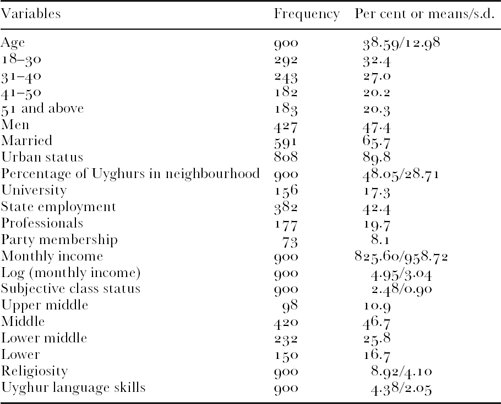
Table 1 shows that 47.4 per cent of the Ürümchi respondents are men, 65.7 per cent are married, 89.8 per cent are urban residents, 17.3 per cent are university graduates, 19.7 per cent are professionals, and 42.4 per cent are employed in the state sector. Their mean age is 38.6 years old and their average monthly income is RMB 825, and the log-transformed monthly income is 4.95. Table 1 also shows the other background characteristics of the Ürümchi respondents, including the distributions of class subjectivities, religiosity, and Uyghur language skills.
Background Characteristics of the Ürümchi respondents

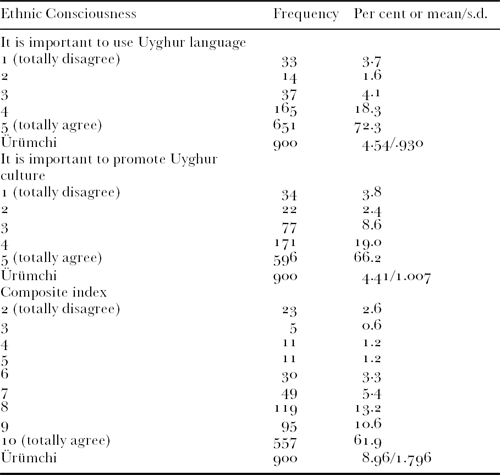
Table 2 shows the distribution of the indicators of ethnic consciousness among the Uyghur respondents. It can be seen that 72.3 per cent of the Uyghur respondents consider it important to use Uyghur language and the mean score is 4.54 out of the five-point scales. More than 66 per cent of them agree strongly that it is important to promote Uyghur culture and the mean score is 4.41 out of the five-point scales. Finally, the composite index shows that nearly 62 per cent of the Uyghur respondents scored 10 points (totally agree) and that the mean score is 8.96 out of the nine-point scales. It can be concluded that there is strong ethnic consciousness among Uyghurs in Ürümchi.
Distribution of Ethnic Consciousness among Uyghurs in Ürümchi
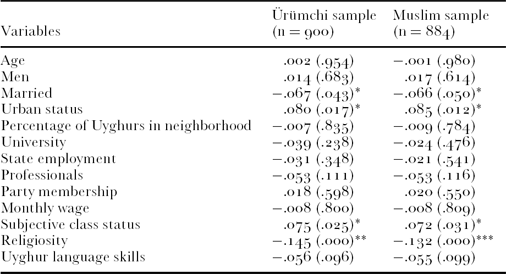
Table 3 shows the correlations between the composite index of Uyghur consciousness and each of the 13 independent variables. It can be seen that married Uyghurs tend to have lower levels of ethnic consciousness than single Uyghurs. Urban Uyghurs were more aware of their ethnic identity than rural Uyghurs. Also, the higher the subjective class status one rates himself or herself, the higher the level of ethnic consciousness he or she holds. However, income is not statistically correlated with Uyghur consciousness. Hypothesis 3 is not supported. Table 3 also shows that the better one's Uyghur language skills, the more nationalistic he or she is. This finding tentatively supports Hypothesis 4. Finally, the more committed to Islam one is, the more nationalistic he or she is. This finding tentatively supports Hypothesis 5. The other independent variables such as the indicators of status attainment are not statistically correlated with Uyghur consciousness. These findings do not support Hypotheses 1 and 2.
Correlations with Ethnic Consciousness among Uyghurs in Ürümchi
*p < .05 **p < .01. Figures in parentheses are statistically significant (2-tailed) values.
The above findings are derived from bivariate analyses. It is not clear if these findings are the outcomes of spurious relationships. Thus, I perform two OLS regression analyses to verify the relationship between Uyghur consciousness and the independent variables. It is necessary to mention that multicollinearity is not an issue as all independent variables in the multivariate analyses pass the tolerance tests (the tolerance levels range from .538 to .945).
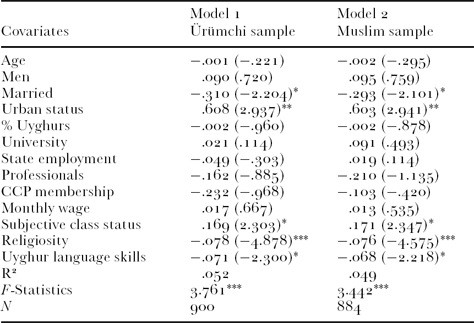
Model 1 of Table 4 uses the Ürümchi sample (n = 900). It shows that controlling for other independent variables, the indications of status attainment such as professionals and state employment are not statistically correlated with the dependent variables. This finding does not support Hypothesis 1 and suggests that the Uyghur elite social groups are no less nationalistic than disadvantaged social groups. Holding other independent variables constant, the coefficient for the per cent of Uyghur residents in the neighbourhood is not statistically significant. This finding does not support Hypothesis 2.
Multivariate Regression Analyses of Uyghur Ethnic Consciousness
*p < .05 **p <.01 ***p <.001. Figures in parentheses are t-ratios.
Controlling for other independent variables, the coefficient of religiosity is statistically significant. This finding supports Hypothesis 5. Holding other independent variables constant, there is a statistically significant relationship between Uyghur language skills and the dependent variable, supporting Hypothesis 4. Everything being equal, class subjectivities are related to the dependent variable statistically. However, the coefficient for income is not statistically significant. These findings suggest that Uyghur consciousness is associated with how one feels about his or her material condition and social status rather than how much he or she actually earns. Hypothesis 3 is not supported by empirical data.
Finally, Model 2 of Table 4 uses the Muslim sample (n = 884) to examine the relationships between the dependent variable and the independent variables. It can be seen that the findings reported in Model 2 are similar to those reported in Model 1.
Discussion and conclusions
This paper is an attempt to map the contours and main determinants of Uyghur identities. Rising ethnic consciousness among Uyghurs in the post-1978 era is a major subject of research since it is related to Uyghur-Han relations and ethnic conflicts in Xinjiang. Scholars have proposed different accounts of Uyghur ethnic consciousness. Surprisingly, there is no concrete effort to summarize, elaborate, and verify these accounts. It is not certain which of these accounts explain the roots of Uyghur ethnic consciousness. Nor is it certain whether Uyghurs hold a high level of ethnic consciousness.
This paper shows the high level of ethnic consciousness among Uyghurs in Ürümchi. It also examines five possible accounts of Uyghur consciousness. It shows that the effect of Han migration on Uyghur consciousness is not statistically significant. This finding is plausible since the levels of ethnic consciousness are not necessarily related to the size of a minority group (or the size of the majority group). Whilst the majority group dominates society, it may not be able to prevent a minority group from developing its ethnic identity and consciousness. An example is the ethnic revival among minority groups in Europe and America. It seems that the levels of ethnic consciousness are dependent more on political, cultural, and religious factors than population size or ethnic composition. Indeed, this paper shows that religiosity and Uyghur language skills are two good determinants of Uyghur consciousness.
The findings from this paper raise questions on the effect of inequalities on Uyghur consciousness. Uyghur ethnic consciousness is not statistically related to university education, state employment, professional status, Party membership, and income. These are main indicators of status attainment in Xinjiang and China. Commonsense suggests that a lower status minority person is likely to have a high level of ethnic consciousness as a means of dissatisfaction and resentment against the majority group, whereas a high status person is less likely to have a high level of ethnic consciousness since he or she may be bought off by the majority group. Why are not low status Uyghurs more nationalistic than high status Uyghurs? A possible explanation is that high status Uyghurs are more likely than low status Uyghurs to work with Han Chinese. It is possible that the former must have higher qualifications or work harder than the latter to receive similar wages, given discrimination against Uyghur workers in the labour market noted above. Thus, after comparing with a Han counterpart, a high status Uyghur places himself and herself relatively low in the social hierarchy in Ürümchi. This comparison may lead to resentment and heightened ethnic consciousness. This account may explain why class subjectivities are a good predictor of Uyghur ethnic consciousness, whereas status attainment is not related to Uyghur consciousness in Ürümchi.
The above discussion suggests that Uyghur identities result from a complex combination of instrumental and cultural/psychological factors. Different groups of Uyghurs draw on different variables to construct their versions of Uyghur identity, and identity expressions vary situationally over time and over space. As Heller points out, ‘Uyghur identity is still evolving’.Footnote 125 In the 1980s, the levels of ethnic consciousness were mainly based on occupational groups.Footnote 126 Today, Uyghur language skills and Islamic affiliation are becoming key determinants of Uyghur ethnic consciousness. Cultural and religious factors are universal forces capable of promoting ethnic cohesion and unity among Uyghurs, whereas status attainment is a stratifying force. This may explain the emergence of a pan-Uyghur identity in Xinjiang as suggested by Smith Finley and other scholars.Footnote 127