Outbreaks of infection or colonization from contaminated gastrointestinal endoscopes have been reported. These outbreaks have been associated with multidrug-resistant organisms that have resulted in infection and death of patients.1–Reference Carbonne, Thiolet and Fournier6 Although, meticulous cleaning of the duodenoscopes prior to high-level disinfection (HLD) should reduce the risk of transmitting infection, it does not entirely eliminate it.7
Breaches in reprocessing of the gastrointestinal endoscopes results in the development of the cyclic-buildup biofilm (CBB) inside the endoscope channelsReference Pajkos, Vickery and Cossart8 that is more difficult to remove than traditional biofilm.Reference Alfa and Howie9, Reference Zhong, Alfa, Zelenitsky and Howie10 Unlike traditional biofilm that develops during continuous hydration, CBB develops after many cycles of exposure to patient secretions, cleaning, HLD, rinsing, and drying. This “cyclical” process results in a gradual accumulation of fixed layers of organic material containing embedded microorganisms within lumens that poses a greater challenge than traditional biofilm for cleaning and HLD during endoscope reprocessing.Reference Zhong, Alfa, Zelenitsky and Howie10 Removal of CBB from endoscope channels may be impossible even after many cleanings, necessitating the replacement of the endoscope channel.Reference Quiu, Zhou, Liu, Ni, Zhao and Cheng11
The manufacturer’s instructions for use (MIFU) and endoscope guidelines emphasize the necessity of brushing (ie, using friction) of all channels. However, in some channels (eg, air/water channels), the design does not allow a channel brush to be used for cleaning. So this channel can only be cleaned by flushing detergent through the channels.Reference Ribeiro, Oliveira, Ribeiro, Watanabe, Resende and Ferreira12, Reference Ribeiro and Oliveira13 To our knowledge, no previously published studies have evaluated the role of friction and detergent on the removal of CBB versus traditional biofilm from endoscope channels.
The first objective of this study was to evaluate the impact of flushing alone compared to friction provided by either a bristle brush or a Pull Thru channel cleaner (Cantel, Minneapolis, MN) on the removal of traditional biofilm and CBB formed within a flexible endoscope channel. For this first objective, alkaline and enzymatic detergents were compared to water alone. The second objective was to assess the ability of HLD using 2.6% glutaraldehyde to kill microorganisms within CBB and traditional biofilm after these cleaning procedures.
Material and methods
Traditional biofilm and CBB formation
Enterococcus faecalis (ATCC 29212) and Pseudomonas aeruginosa (ATCC 15442) were suspended in freshly prepared Artificial Test Soil (ATS) as previously described.Reference Alfa, DeGagne and Olson14–Reference Alfa, DeGagne and Olson16 Olympus PTFE channels (Endoscopy Development Company, Olympus America, Center Valley, PA) with an internal diameter of 3.7 mm and length of 1,800 mm were used as test devices. Before use, all new channels were processed through the Steris system 1 (Steris, Mentor, OH) using peracetic acid Steris 20 sterilant concentrate. Once used in an experiment, the channels were appropriately discarded (ie, channels were not reused).
Traditional biofilm
The entire length of the sterile PTFE channel was perfused with 20 mL ATS containing 108 colony-forming units (CFU)/mL of each test microorganism (ATS-bacteria). The perfused PTFE channel was connected to the peristaltic pump (Masterflex, Montreal, Canada), and the ATS-bacteria were circulated through the channels at 75 mL/hReference Vickery, Ngo, Zou and Cossart17, Reference Vickery, Pajkos and Cossart18 for 2 hours at room temperature. The PTFE channel was rinsed with 20 mL sterile tap water and was then flushed with 30 mL air using a sterile 30-mL syringe. The PTFE channel was stored overnight at room temperature inside a basin with the lid on. This procedure was performed each day for 5 days and is referred to as traditional biofilm.
Cyclic-buildup biofilm (CBB)
The same procedures described above were also conducted to develop CBB. However, each day after rinsing and flushing with air, the PTFE channel was transferred into a chemical fume hood and underwent HLD via perfusion of the channel with 20 mL glutaraldehyde 2.6% (Metricide, Orange, CA) for 20 minutes (exposure time) at room temperature. The channel was then rinsed with 90 mL sterile tap water and flushed with 60 mL air (60-mL syringe). The PTFE channel was then held overnight at room temperature. On day 5, the channel was exposed to the ATS-bacteria solution for 2 hours and was then rinsed and dried prior to testing (ie, no HLD on day 5). The biofilm that resulted was CBB. The glutaraldehyde was reused for 4 days only, and the minimum effective concentration (MEC) test (Metricide, Orange, CA) was performed daily to ensure that the concentration was adequate (ie, ≥1.5%).
Detergents evaluated
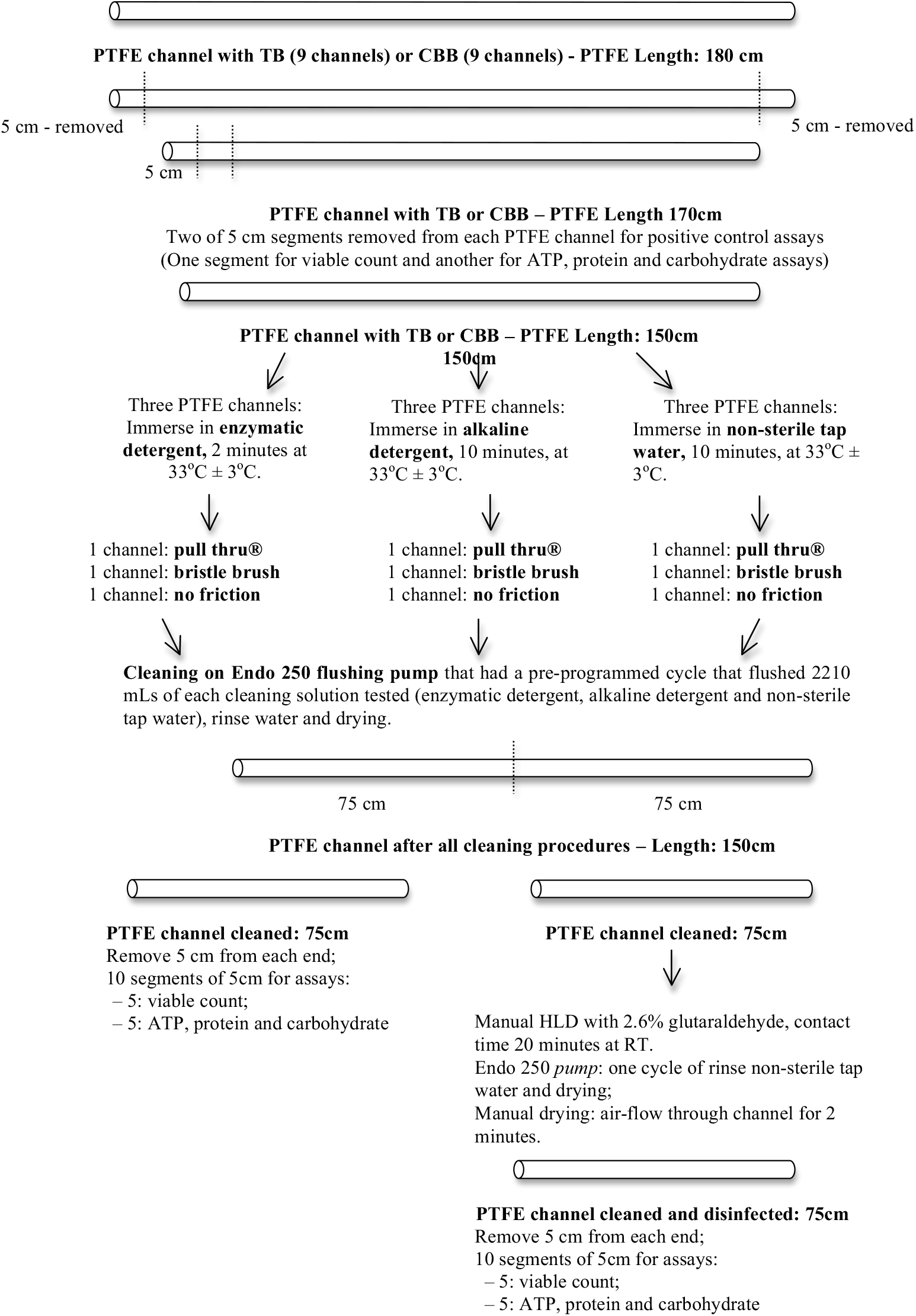
Endozime Bioclean (Ruhof, Mineola, NY) is a neutral pH, a multienzymatic detergent that contains amylase, carbohydrase, protease, and lipase, is reported to remove biofilm. This detergent was used at the maximum concentration of 8 mL/L, with 2 minutes of contact at 33 ± 3°C. MediClean (Neodisher, Miele, Vaughan, Ontario, Canada) alkaline detergent was used (pH 10.4–10.8) with10 minutes of contact at 33 ± 3°C at the maximum recommended concentration of 30 mL/L. An overview of the experimental protocol is shown in Fig. 1.
Outline of the traditional biofilm (TB) and cyclic-buildup biofilm (CBB) experimental protocols.

Disinfectant evaluated
After the various cleaning protocols were completed, one portion of the PTFE was subjected to HLD according to the MIFU. The disinfectant used was 2.6% glutaraldehyde (Metricide, Orange, CA) for 20 minutes at room temperature (Fig. 1).
Assay methods
PTFE extraction method
The external surface of the PTFE channel containing traditional biofilm or CBB was wiped with isopropyl alcohol 70% v/v (Steven, Winnipeg, Manitoba, Canada) and placed on sterile tinfoil inside the biological safety cabinet. A sterile stainless steel surgical blade (Bard-Parker, Beckton-Dickenson, Mississauga, Ontario, Canada) was used to cut the PTFE tubing into 5-cm segments after the 5-cm ends of the tube were cut off and discarded. Two segments (5 cm each) were taken, one for viable count, another for ATP testing and organic residue assessment and 0.5 cm was used for AFM (positive control). The remainder of the PTFE channel (~150 cm) with traditional biofilm or CBB was cleaned using different methods (Fig. 1). After cleaning, half of the PTFE channel (75 cm) was exposed to HLD, and the remainder of the PTFE channel (75 cm) was analyzed to determine the cleaning efficacy. After all cleaning procedures and HLD, the PTFE channel was cut into 5-cm segments that were each placed into separate sterile petri dishes and cut into 10 small pieces. The 10 pieces were dropped into 5 mL sterile reverse osmosis (sRO) water for ATP, protein, and carbohydrate analyses (5 replicate 5 cm segments were processed in this manner). For viable count, another 10 pieces were dropped into a sterile 50-mL conical tube containing an extraction solution consisting of 2.5 mL sterile reverse osmosis water and 2.5 mL neutralizing solution: Tween 80 (Sigma, St Louis, MO) 6% (v/v), lecithin (Sigma) 0.6% (w/v), L-histidine (Sigma) 0.2% (w/v), and sodium thiosulfate (Sigma) 1.0% (w/v).Reference Pineau and Philippe19 All conical tubes were mixed on a shaker for 2 minutes, sonicated for 5 minutes, and was then vortexed for 1 minute (5 replicate 5-cm segments were processed in this manner).
For AFM analysis, a 0.5-cm segment was cut longitudinally, and 1 smaller piece was placed in a sterile tube with PBS to be sent for analysis.
ATP testing
The Ruhof ATP Complete Test was used to test extracted channel samples. A pipette was used to inoculate 40 µL of the extracted sample onto the ATP test swab, and the ATP in each swab was measured as relative light units (RLU) following the manufacturer’s instructions.
Organic material
Protein was quantitatively measured using the QuantiPro BCA assay kit, (Sigma). Carbohydrate was measured according to the technique described previously.Reference Liu, Lau, Chau and Pacepavicius20 The protein and carbohydrate assays had limits of detection of 0.5 µg/mL and 10 µg/mL, respectively.
Viable count
Bacterial quantitation was performed using standard serial 1:10 dilutions with the spread plate method by inoculating 0.1 mL of each dilution onto the surface of tryptone soya agar with 5% sheep blood (Oxoid, Nepean, Ontario, Canada) followed by incubation at 35–37°C for 24 hours. The limit of detection for the viable count assay was 10 CFU/mL or 8.61 CFU/cm2.
Atomic force microscopy
For atomic force microscopy (AFM), the PTFE channel was rinsed with 10 mL sterile PBS for 10 minutes at room temperature, and this rinse step was repeated three times. The samples were placed in the AFM (Veeco Dimension 3100 with NanoScope IVa controller, Plainview, NY) with magnetic sample holders. Analyses were conducted at room temperature. Diamond cantilevers were used at ~250 kHz. The lateral resolution was 1–5 nm and the vertical resolution was 0.05 nm. Images were captured at 10 nm/10 nm. For AFM, we used Nanoscope Iva software (Veeco Digital Instruments, Santa Barbara, CA). Roughness was quantified by analyzing the arithmetic mean value (Ra) and the quadratic mean value (Rq). Three-dimensional images were obtained for the specimens for visual analysis of changes in topography.
Neutralizing test for detergent and disinfectant
The neutralizer was prepared as described by Pineau and Philippe (2013).Reference Pineau and Philippe19
Flow verification and endoscope flushing pump (EFP)250 decontamination
The EFP250 (Olympus America, Center Valley, PA) is a machine designed to flush all channels simultaneously in 90 seconds using detergent, water, and air. Before use each day, the EFP250 was decontaminated and the flow verification of this machine was tested according to MIFU.
Statistical analysis
The Kruskal-Wallis test was performed to determine whether the distribution of groups tested was the same or different. If the distribution was different, the hypothesis was rejected and the post hoc Dunn-Bonferroni analysis was performed to compare the groups.
Results
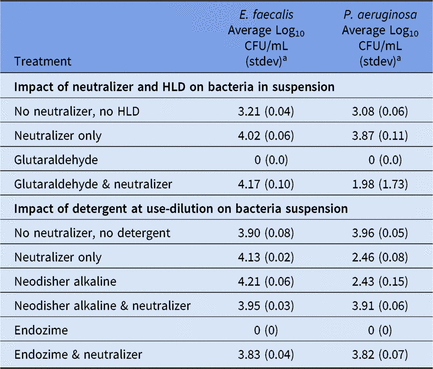
Culture of the tap water used to prepare detergents and for rinsing showed no detectable organisms. This finding was also reflected in the negative PTFE controls that showed no detectable bacteria for any of 5 replicates after flushing with detergents alone or after flushing with detergents and subsequent HLD. The data regarding the effect of the neutralizer are listed in Table 1.
Impact of Neutralizer, Detergent, and High-Level Disinfection (HLD) on Bacterial Survival in Suspension

Note. CFU, colony-forming units; stdev, standard deviation.
a The bacterial suspensions were exposed to the detergents tested at the manufacturer’s recommended use-dilution and exposure time. The ability of the neutralizer to protect the bacteria in suspension was tested for glutaraldehyde at a 1:10 dilution of the manufacturer’s recommended concentration for a final concentration of “The enzymatic detergent showed better removal of E. faecalis 0.26%.” Values listed in the table as “0” represent less than the limit of detection for the viable count assay. The limit of detection was 10 CFU/mL or 8.61 CFU/cm2.
ATP tests
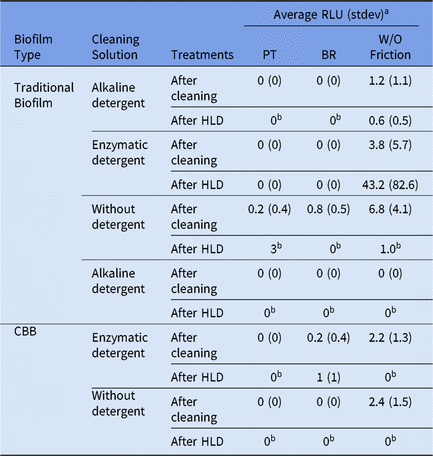
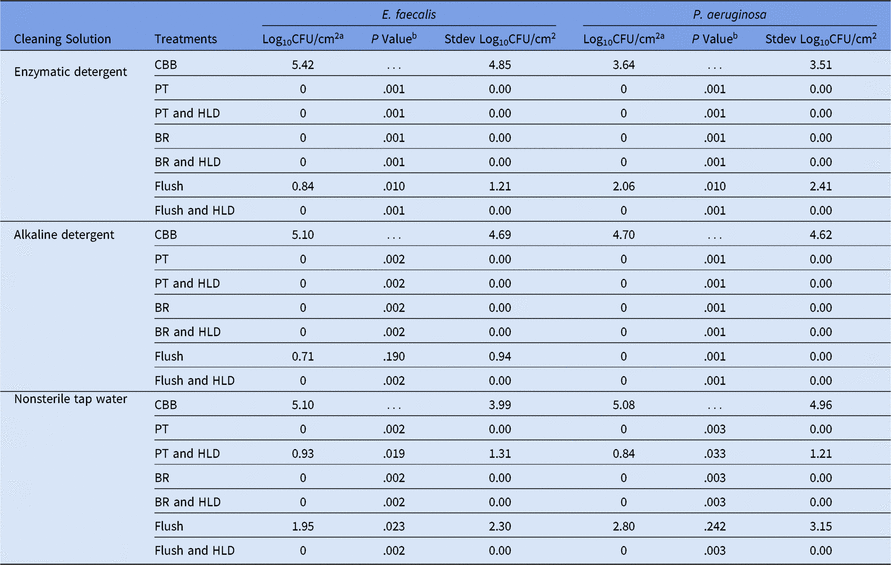
Table 2 shows the ATP tests results. Tables 3 and 4 show the impact of various cleaning and HLD parameters on removal and killing of bacteria within traditional biofilm and CBB. The averages of E. faecalis and P. aeruginosa for traditional biofilm were 5.83-log10 CFU/cm2 and 6.46-log10 CFU/cm2, respectively, and for CBB they were 5.20-log10 CFU/cm2 and 4.47-log10 CFU/cm2, respectively.
Relative Light Units on Polytetrafluoroethylene (PTFE) Segments With traditional Biofilm and Cyclic-Buildup Biofilm (CBB) (Soiling and Rinsing) and After Cleaning and High-Level Disinfection (HLD)

Note. Stdev, standard deviation; RLU, relative light units. PT, Pull Thru channel cleaner; BR, bristle; W/O, without.
a The averages and standard deviations for RLU from the negative controls were 16.7 RLU ± 23.1 RLU; positive control of BBF: 16.6 RLU ± 12.8 RLU; and positive control of traditional biofilm: 275 RLU ± 481 RLU.
b 1 sample was analyzed.
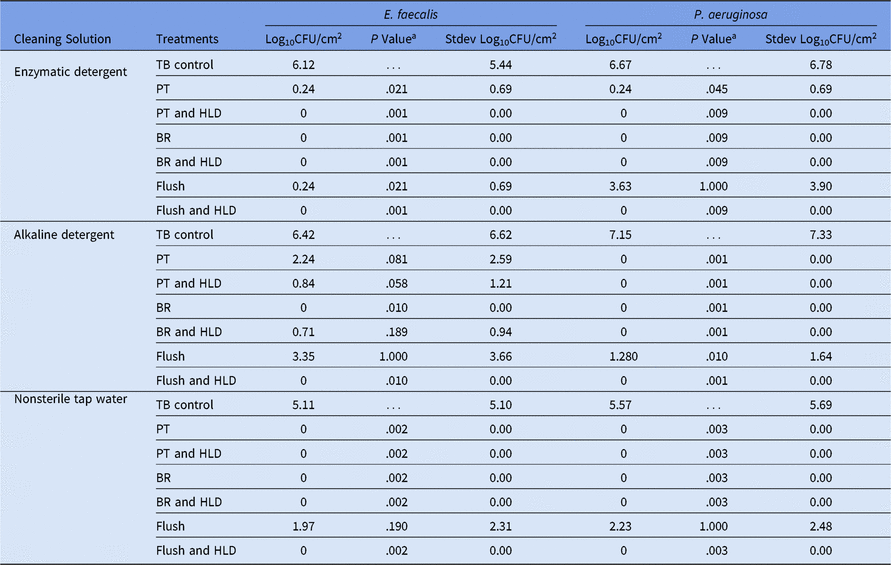
Comparision of the Impact of Cleaning With Pull Thru, Bristle Brushes, and No Friction (Flush), Using Enzymatic Detergent, Alkaline and Nonsterilized Tap Water, and High-Level Disinfection (HLD) in the Removal of E. faecalis and P. aeruginosa in Traditional Biofilm

Note. Stdev, standard deviation; CFU, colony-forming units; TB, traditional biofilm; PT, Pull Thru channel cleaner; BR, bristle brush; HLD, high-level disinfection.
a The P values shown in the table are the results of Dunn-Bonferroni tests and show the comparison of each group with the control (traditional biofilm) and adjusted for multiple comparisons. bFor all Kruskal-Wallis tests, done before Dunn-Bonferroni tests, the P values were as follows: enzymatic detergent - E. faecalis: P = .001; enzymatic - P. aeruginosa: P < .001; alkaline detergent - E. faecalis: P = .008; alkaline detergent - P. aeruginosa: P < .001; Nonsterile tap water - E. faecalis: P < .001; nonsterile tap water - P. aeruginosa: P < .001. The P data shown as “0” indicated that the detectable level of bacteria was below the limit of detection for the viable count assay. The results show log10CFU/cm2 of the average of samples in CFU/cm2 for all tests done. There was no statistically significant difference between the quantity of E. faecalis (P = .099) or P. aeruginosa (P = .099) in the traditional biofilm positive controls used for all cleaning and disinfection procedures.
Comparision of the Impact of Cleaning With Pull Thru, Bristle Brushes, and No Friction (Flush), Using Enzymatic Detergent, Alkaline and Nonsterilized Tap Water, and High-Level Disinfection (HLD) in the Removal of E. faecalis and P. aeruginosa in Cyclic Biofilm Buildup (CBB)

Note. PT, Pull Thru channel cleaner; BR, bristle brush; CFU, colony-forming units.
a Data shown as “0” indicated that the detectable level of bacteria was below the limit of detection for the viable count assay. The results show log10CFU/cm2 of the average of samples in CFU/cm2 of all tests done.
b The P values are the results of Dunn-Bonferroni tests and show the comparison of each group with the control and adjusted for multiple comparisons. For all Kruskal-Wallis tests, done before the Dunn-Bonferroni tests, the P values were as follows: enzymatic detergent - E. faecalis: P < .001; enzymatic detergent - P. aeruginosa: P < .001; alkaline detergent - E. faecalis: P < .001; alkaline detergent - P. aeruginosa: P < .001; nonsterile tap water - E. faecalis: P = .001; nonsterile tap water - P. aeruginosa: P = .002. There was no statistically significant difference between the quantity of E. faecalis (P = .099) or P. aeruginosa (P = .099) in the CBB positive controls used for all cleaning and disinfection procedures.
Moreover, the data in Table 3 show that the removal of E. faecalis and P. aeruginosa from traditional biofilm was not as effective when detergent or water only were flushed through the channels compared to when friction was utilized during the cleaning process. It is unclear why the only exception occurred when the enzymatic detergent flush alone provided good removal of E. faecalis without the use of friction in the cleaning process. Both the Pull thru and the bristle brush channel cleaners provided friction that improved cleaning, leaving low or undetectable levels of microbes. The only exception was the removal of E. faecalis when cleaning was done using the alkaline detergent and the Pull Thru. The glutaraldehyde disinfection after the cleaning step was effective in eradicating the test bacteria, except for E. faecalis after alkaline detergent cleaning (only low levels remained <0.95-log10 CFU/cm2).
The data for CBB demonstrate the value of friction as part of the cleaning process and that HLD after cleaning eradicated the test organisms (Table 4). The exception was the combination of the Pull Thru device and nonsterile tap water, in which low levels of viable E. faecalis and P. aeruginosa were detected (<0.95-log10 CFU/cm2).
Organic residual tests
The protein and carbohydrate assays produced unreliable data that were highly variable between replicates and positive controls that often were negative, so the data are not shown.
Atomic force microscopy (AFM) results
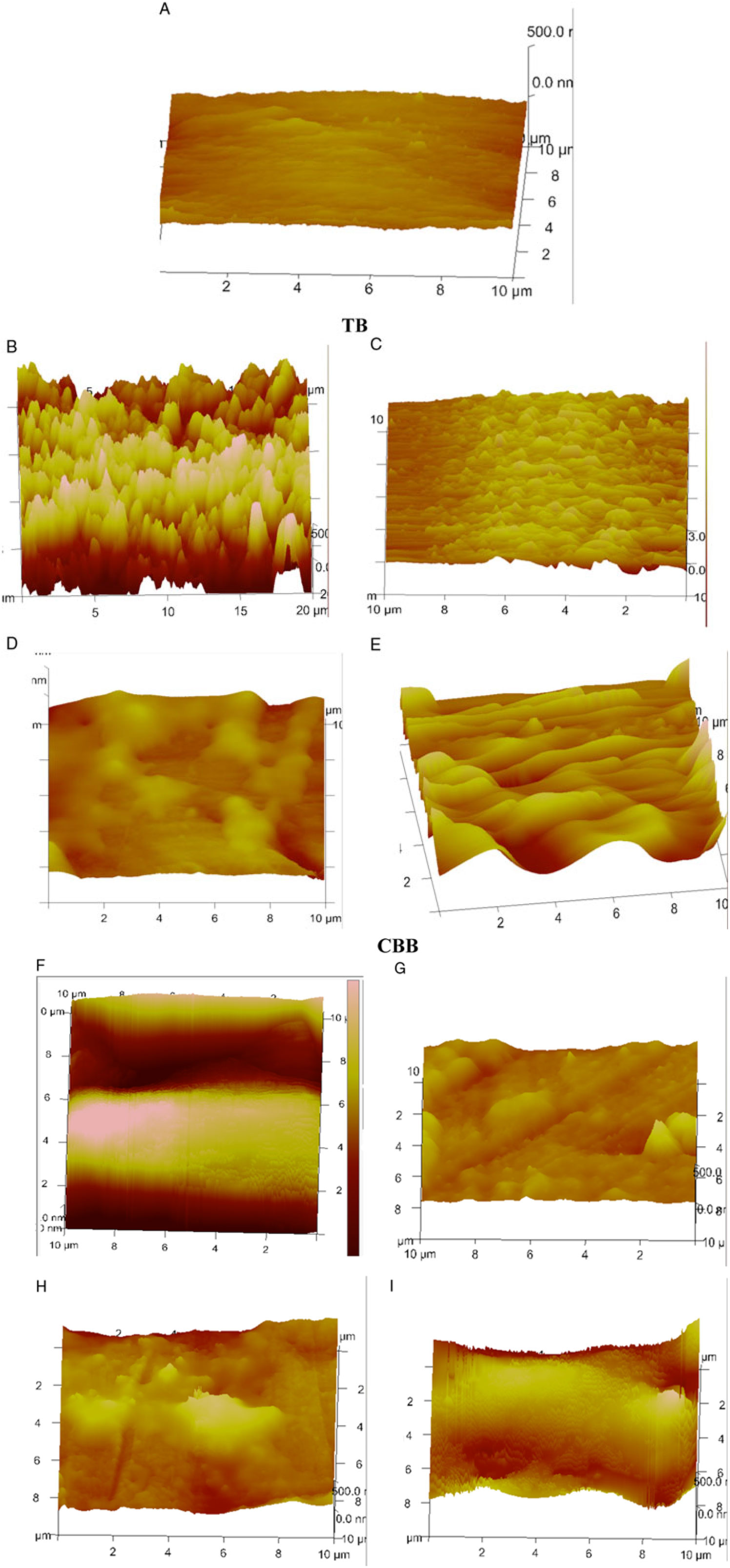
Figure 2A represents the negative control, and the other images represent some experimental groups evaluated by AFM. The negative control is a sterilized PTFE channel without CBB or traditional biofilm and with no exposure to detergent or disinfectant; it shows relatively smooth surface topography. Figure 2B–E shows the topography of traditional biofilm alone (2B) or after flushing with alkaline detergent only (2C), after traditional biofilm after bristle and alkaline detergent cleaning (2D), and after Pull Thru and alkaline detergent cleaning (2E). Figure 2F–I shows the AFM analysis of the surface topography of the CBB alone (2F), after flushing with alkaline detergent only (2G), after bristle brushing and alkaline detergent cleaning (2H), and after Pull Thru and alkaline detergent cleaning (2I).
Surface topography of the control and experimental groups evaluated by atomic force microscopy. (A) The negative control; (B) traditional biofilm alone; (C) traditional biofilm after flushing with alkaline detergent only; (D) traditional biofilm after traditional biofilm after bristle and alkaline detergent cleaning; (E) traditional biofilm after Pull Thru and alkaline detergent cleaning; (F) CBB alone; (G) CBB after flushing with alkaline detergent only; (H) CBB after bristle brushing and alkaline detergent cleaning; and (I) CBB after Pull Thru and alkaline detergent cleaning.

Discussion
For our investigation, we selected E. faecalis and P. aeruginosa because E. faecalis is a gram-positive organism found in the gastrointestinal tract and P. aeruginosa is a gram-negative organism that has been reported as a contaminant in patient ready endoscopesReference Ribeiro and Oliveira13; both have resulted in infection transmission.Reference Quiu, Zhou, Liu, Ni, Zhao and Cheng11 Both of these bacteria have biofilm-forming capability and are considered organisms of concern to duodenoscope sampling and culture protocol.21
Although the enzymatic detergent and HLD evaluated killed both E. faecalis and P. aeruginosa, the neutralizer used would ensure optimal growth because trace residuals of detergent or HLD would be inactivated. Tracking the removal of patient material from endoscope channels by ATP after cleaning is an effective method to monitor cleaning adequacy.Reference Fushimi, Takashina and Yoshikawa22–Reference Alfa, Fatima and Olson24 However, in our study, the ATP test for traditional biofilm and CBB positive controls showed highly variable RLU, indicating a lack of sensitivity for this test method to detect traditional biofilm or CBB within PTFE channels.
The cleaning process is composed of 4 variables: mechanical action, chemical action, temperature, and time. Our data demonstrate that friction is a critical component: bacterial levels were consistently higher with flush only methods regardless of detergent used.Reference Vlková, Babák, Seydlová, Pavlík and Schlegelová25 The MIFU for cleaning the air/water channel only recommends manual or pump-assisted flushing. Contamination of the air/water channel after patient procedures has been documentedReference Ribeiro and Oliveira13, Reference Alfa, DeGagne and Olson14 as well as persistent contamination of this channel in clinical practice with P. aeruginosa despite repeated rounds of reprocessing.Reference Ribeiro and Oliveira13 Our findings indicate that new cleaning methods that provide friction are needed for such narrow channels.
The Pull Thru channel cleaner was more effective at removing the colored solution compared to the bristle brush.Reference Charlton26 Alfa et al (2017)Reference Alfa, Harminder and Nugent27 reported that the Pull Thru channel cleaner was more effective than a bristle brush at preventing accumulation of organisms and organic material. Our study showed no significant difference between removal of bacteria using the bristle brush versus the Pull Thru device, but this finding may be related to the difficulty in removing traditional biofilm once it has been allowed to form over many days. A single pass of the Pull Thru device cleaner was easier to perform than the multiple passes indicated in the MIFU for the bristle brush.
The enzymatic detergent showed better removal of E. faecalis from traditional biofilm in the absence of friction, whereas the alkaline detergent under the same conditions promoted better removal of P. aeruginosa. For CBB, in the absence of friction, the enzymatic detergent again provided better removal of E. faecalis than P. aeruginosa, whereas the alkaline detergent showed equivalent removal of both organisms. This difference in the ability of detergent to remove E. faecalis and P. aeruginosa may be related to the difference in the composition of the cell wall or the matrix of polymeric substances produced by these bacteria. These findings reinforce the importance of manufacturers using a mixed biofilm formed using an organic test soil to verify the efficacy of cleaning processes in endoscope channels. We believe this approach is more stringent than the ISO/TS 15883-5, Annex F,28 method, in which P. aeruginosa forms a monomicrobic biofilm without the added challenge of organic material; therefore, it may represent a lesser challenge than that found in clinical practice. Our data support the findings of othersReference Vickery, Ngo, Zou and Cossart17, Reference Vickery, Pajkos and Cossart18, Reference Ren, Sheng, Huang, Zhi and Cai29, Reference Fang, Shen and Li30 showing that nonenzymatic detergents can be effective, and our findings reinforce the importance of validating each formulation for cleaning efficacy independent of whether it is an ezymatic or nonenzymatic detergent.
After cleaning of traditional biofilm and CBB, the glutaraldehyde treatment was effective at killing the bacteria for most of our test conditions. The few exceptions were mostly for E. faecalis, and the level of survival was near the limit of detection for the culture method.
The AFM images allow characterization of the surface topography (eg, roughness). Before cleaning, traditional biofilm had a thick, rough topography in contrast to CCB, which had a thin, smooth topography. This difference is likely due to the repeated rounds of fixation used for CBB that would cross link and flatten the organic material onto the channel surface. The method of friction used for cleaning did alter the AFM appearance with bristle brushing, showing patchy, noncolumnar residuals for traditional biofilm and increased roughness with patchy residuals for CBB. The Pull Thru device showed reduced thickness and smooth flat residuals for both CBB and traditional biofilm. This may be related to Verran’sReference Verran and Boyd31 report that the “Linker layer” dictates the stability of the accumulated organic material and how this affects how easy (or difficult) it is to clean away the organic material if the linker layer is strongly adherent. More AFM studies of biofilm are needed to determine the role that surface roughness assessment has in the analysis of cleaning efficacy in endoscope channels.
This study has several limitations. We were unable to develop CBB that contained viable bacteria at detectable levels when HLD was used on all 5 days of the protocol. This may be because the 5 rounds of CBB formation were short and the level of viable bacteria was too low to detect with our direct culture method. Subsequent research has shown that use of partial HLD combined with filter membrane concentration improved detection of low levels of viable bacteria in CBB.Reference Alfa, Harminder and Nugent27
In conclusion, our study provides further support for the importance of friction in the endoscope-channel cleaning process. Furthermore, we demonstrated that multispecies biofilm formed using a relevant organic test soil with repeated rounds of fixation provides a more stringent approach for cleaning validation.
Acknowledgments
The authors thank Ruhof for providing the Pull Thru channel cleaners, Endozime detergent and ATP tests for this project. The authors acknowledge the assistance of Cristiana Luciano Costa, who performed the repeat neutralizer, protein and carbohydrate tests for this project. The authors acknowledge the excellent training and support provided by Pat DeGagne (research technologist in M.A.’s laboratory) during this project.
Financial support
M.M.R. received a scholarship to train at the St Boniface Research Centre from CAPES (Coordenação de Aperfeiçoamento de Pessoal de Nível Superior).
Conflict of interest
Dr Michelle Alfa is the inventor of Artificial Test Soil (ATS), and the patent has been licensed through the University of Manitoba by Healthmark Industries. Dr Alfa has been an invited guest speaker at many national and international conferences that were sponsored by various companies including Olympus, 3M, STERIS, J&J, Healthmark, and Sealed Air Diversey. She has provided consulting services for Olympus, 3M, STERIS, KARL STORZ, Novaflux, Ofstead Associates, and J&J. The remaining authors report no conflicts of interest relevant to this article.