Introduction
Depression is a common and serious healthcare problem for older adults (Vieira et al., Reference Vieira, Brown and Raue2014). In older adults, the prevalence of depression may vary in wide spread (4.8–45.8%), depending on the diagnostic scale, age, comorbidities and living areas (Arslantas et al., Reference Arslantas, Ünsal and Ozbabalık2014; McCall and Kintziger, Reference McCall and Kintziger2013; Forlani et al., Reference Forlani2014). Geriatric depression is associated with several comorbidities, such as, falls, sleep disorders, cognitive deficiency, malnutrition, higher risk for suicide, and increased risk of morbidity and mortality (Iaboni and Flint, Reference Iaboni and Flint2013; McCall and Kintziger, Reference McCall and Kintziger2013; Sachs-Ericsson et al., Reference Sachs-Ericsson2014; Reinlieb et al., Reference Reinlieb, Ercoli, Siddarth, St Cyr and Lavretsky2014; Bailly et al., Reference Bailly, Maître and Van Wymelbeke2015; Murphy and Peterson, Reference Murphy and Peterson2015) and also it is associated with increased health expenditures (Choi et al., Reference Choi, Lee, Matejkowski and Baek2014, Reference Choi, Hasche and Nguyen2015). Therefore, early diagnosis and treatment of depression are important in geriatric practice.
On the other hand, diagnosis of depression is more difficult in elderly than in others. Depressed old adults are less likely to remark affective symptoms than younger adults. Furthermore, sleep disturbance, fatigue, psychomotor retardation, loss of interest in living, and somatic symptoms are more common in this population (Fiske et al., Reference Fiske, Wetherell and Gatz2009; Mitchell et al., Reference Mitchell, Rao and Vaze2010), which can be attributed to normal changes associated with age-related changes and lead to under-recognition and under-treatment, due to the subtle and atypical clinic presentation of depression in older adults (Mitchell et al., Reference Mitchell, Rao and Vaze2010). These problems require the development of some screening instruments for geriatric depression. One of the most commonly used screening instruments in routine practice is the 30-item Geriatric Depression Scale (GDS) established by Yesavage et al. (Reference Yesavage1983) and the GDS-15 (the 15-item form of GDS) modified by Burke et al. (Reference Burke, Roccaforte and Wengel1991).
For a shorter, and more practical, reliable geriatric depression screening instruments that can be used, especially in primary care, GDS-4 scale (including four questions) (van Marwijk et al., Reference van Marwijk, Wallace, de Bock, Hermans, Kaptein and Mulder1995) and GDS-5 scale (including five questions) (Hoyl et al., Reference Hoyl1999) were developed, and they were validated for different languages (Rinaldi et al., Reference Rinaldi2003; Castelo et al., Reference Castelo2010). Besides, SLU “AM SAD” (including five questions), another short GDS was developed (Chakkamparambil et al., Reference Chakkamparambil, Chibnall, Graypel, Manepalli, Bhutto and Grossberg2015), and it was validated in Turkish (Soysal et al., Reference Soysal, Isik, Usarel, Kaya, Ellidokuz and Grossberg2016).
In this study, we aim to determine the validity and reliability of GDS-4 and GDS-5 in Turkish, and to establish a new short-form GDS for our population. We also aim to determine the superiority of each short scale to another.
Methods
Procedure
All participants were 65 years or older community-dwelling patients, who were admitted to Dokuz Eylul University, Department of Geriatrics between November 2016 and May 2017 for any reason. After a comprehensive geriatric assessment, a researcher determined whether the participants were depressed or not, according to the Diagnostic and Statistical Manual of Mental Disorders-fifth edition (DSM-5) diagnostic criteria. Then, another researcher, who had no information about prior assessment, applied GDS-15 to all participants. We obtained the questions of short GDS forms examined in this study from GDS-15 forms.
Translation procedure was not necessary during the validation phase, as the validation of the long form had already been done in 1997 by Ertan et al. and the items of short forms were sorted out of the long form using exactly the same structures of items.
Patients were evaluated for their age, gender, marital status, level of education and year, comorbidities (hypertension, diabetes mellitus, thyroid disease, ischemic heart disease, congestive heart failure, chronic obstructive pulmonary disease, hyperlipidemia, cerebrovascular disease, cataract, and hearing impairment), and the number of the drugs used by the patients were recorded.
Comprehensive geriatric assessment (Soysal et al., Reference Soysal, Isik, Buyukaydin and Kazancioglu2014)
Cognitive functions of the patients were evaluated by Mini-Mental State Examination (MMSE), Cognitive State Test (COST), and Montreal Cognitive Assessment (MOCA) scale. In addition, scores of the GDS, Mini-Nutritional Assessment (MNA), and Basic and Instrumental Activities of Daily Living (BADL and IADL) scales were also recorded for each patient.
Exclusion criteria
After detailed patient history and medical record review, patients who had cognitive deficiency (Alzheimer's disease, fronto-temporal dementia, Lewy Body Dementia, etc.), were in delirium, with psychotic disorder, had acute disease within the last two weeks (infections, acute coronary syndrome, acute cerebrovascular accident and gastrointestinal hemorrhage, staying in the intensive care unit, etc.), had been using drugs likely to influence emotional state such as benzodiazepine and antipsychotics, and alcohol and substance addicts were excluded. Finally, 437 patients meeting the criteria were enrolled.
Measures
In 1991, Burke et al. (Reference Burke, Roccaforte and Wengel1991) described the validity and reliability of the GDS-15. GDS-15 is a 15-element questionnaire, focused on the mood of the people in the last week. The questions can be answered only in the form of “yes” or “no.” Each question is scored “0” or “1” point, and the value of the answer “yes” or “no” changes depending on the question.
After Cohen's κ analysis, we compared the diagnostic value of each question for geriatric depression according to their κ values, and we developed three (TGDS-3), four (TGDS-4), five (TGDS-5), and six (TGDS-6) question scales to screen geriatric depression in Turkish population.
The study was in compliance with the Declaration of Helsinki and approved by the local ethics committee.
Statistics
We performed statistical analyses by the Statistical Package for the Social Sciences (SPSS) 17.0 as well as Power Analysis and Sample Size (PASS) 2008 Statistical Software (NCSS, Kaysville, UT). Demographic characteristics of participants were analyzed using descriptive statistics. The Kappa consistency test was used to evaluate the consistency between DSM-5 criteria and the items of GDS-15. A factor analysis using principal component analysis with an eigenvalue of 1 as extraction criteria, with varimax rotation, was applied to the data. Cut-off scores were assessed by the receiver operating characteristics (ROC) curve. Sensitivity, specificity, and positive and negative predictive values (PPV and NPV) were calculated for different cut-off scores. In all analyses, p < 0.05 was considered to indicate statistical significance. A sample size of 292 participants was calculated to ensure that the minimum required size was within a 95% confidence interval and 5% of the true proportion.
Results
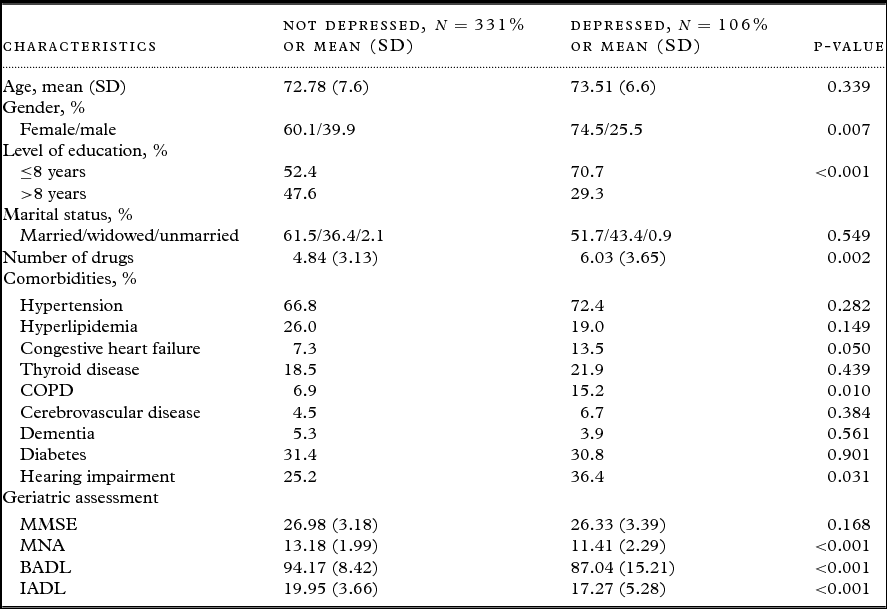
In the present study, we evaluated a total of 437 participants. The mean age (SD) of the patients was 72.95 (7.37), with 63.6% being female. Characteristics and comorbidities of the participants are demonstrated in Table 1. When gender, number of drug, COPD, and hearing impairment factor were removed, it was observed that depression was still associated with MNA, IADL, and BADL (p < 0.01).
Characteristics and comorbidities of the participants (n = 437)

COPD: Chronic Obstructive Pulmonary Disease, MMSE: Mini-Mental State Examination, MNA: Mini-Nutritional Assessment, BADL: Basic Activities of Daily Living, IADL: Instrumental Activities of Daily Living.
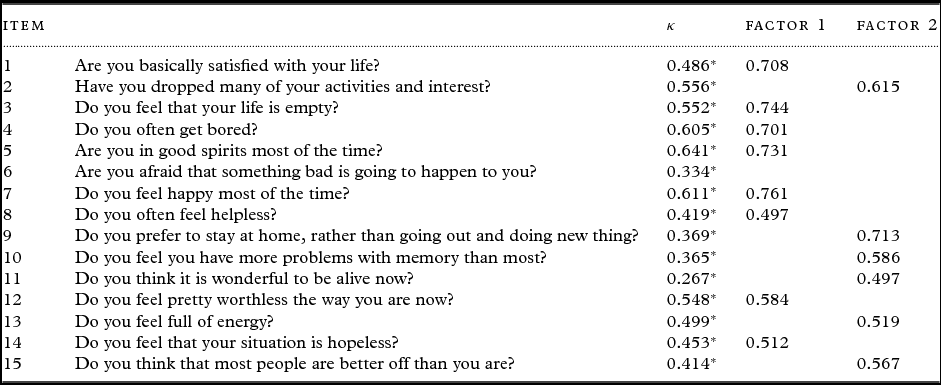
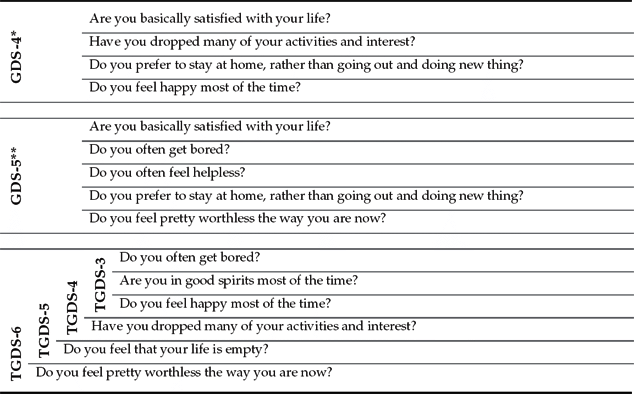
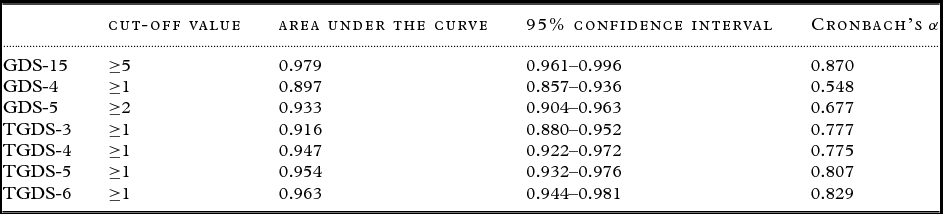
The mean scores were 2.93 (3.46) for GDS-15, 0.94 (1.21) for GDS-5, and 0.76 (1.01) for GDS-4. The prevalence of major depression was 24.3% according to DSM-5. In factor analysis, KMO coefficient was 0.918 (p < 0.001). Two factors emerged. The factor analysis explained 48.31% of the total variance. The first factor (depression), which included eight items of the GDS, accounted for 48.31% of the variance in the model (Eigenvalue = 1) and the second factor (psychosocial activities and energy level), which included six items, accounted for 8.28% of the variances. Item 6 loaded less than 0.4 (Table 2). Kappa analyses performed for the consistency between the items of DSM-5 and GDS-5 are demonstrated in Table 2. We constructed our own short-form depression scales based on the κ values in GDS-15. Turkish GDS-3 (TGDS-3) (include questions 4, 5, and 7), TGDS-4 (include questions 2, 4, 5, and 7), TGDS-5 (include questions 2–5 and 7) and TGDS-6 (include questions 2–5, 7, and 12) were established. We summarized all the scales in Table 3. Internal-consistency reliabilities of GDS-15, TGDS-3, TGDS-4, TGDS-5, and TGDS-6 were good but those of GDS-4 and GDS-5 were not so. Cronbach's α values are shown in Table 4.
The κ values for each items and factor structure of Geriatric Depression Scale-15
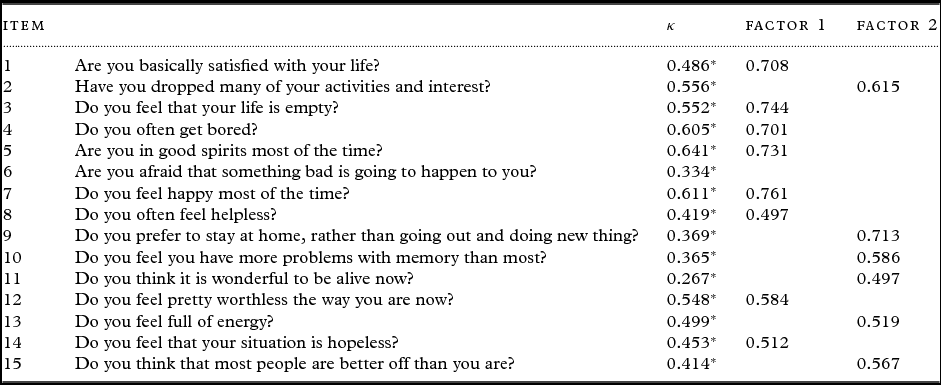
Item 6 with factor loading of less than 0.4 was not loaded on any factors.
*p < 0.001.
GDS-4, GDS-5, and TGDS scales

*van Marwijk et al. (Reference van Marwijk, Wallace, de Bock, Hermans, Kaptein and Mulder1995).
**Hoyl et al. (Reference Hoyl1999).
The cut-off values, Cronbach's α values, 95% confidence intervals (95% CI), and values of area under the curve for each scale

GDS: Geriatric Depression Scale, TGDS: Turkish Geriatric Depression Scale.
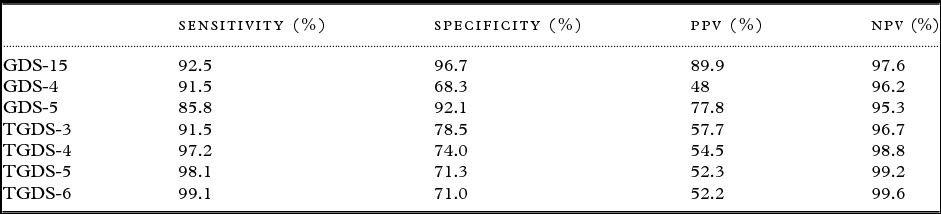
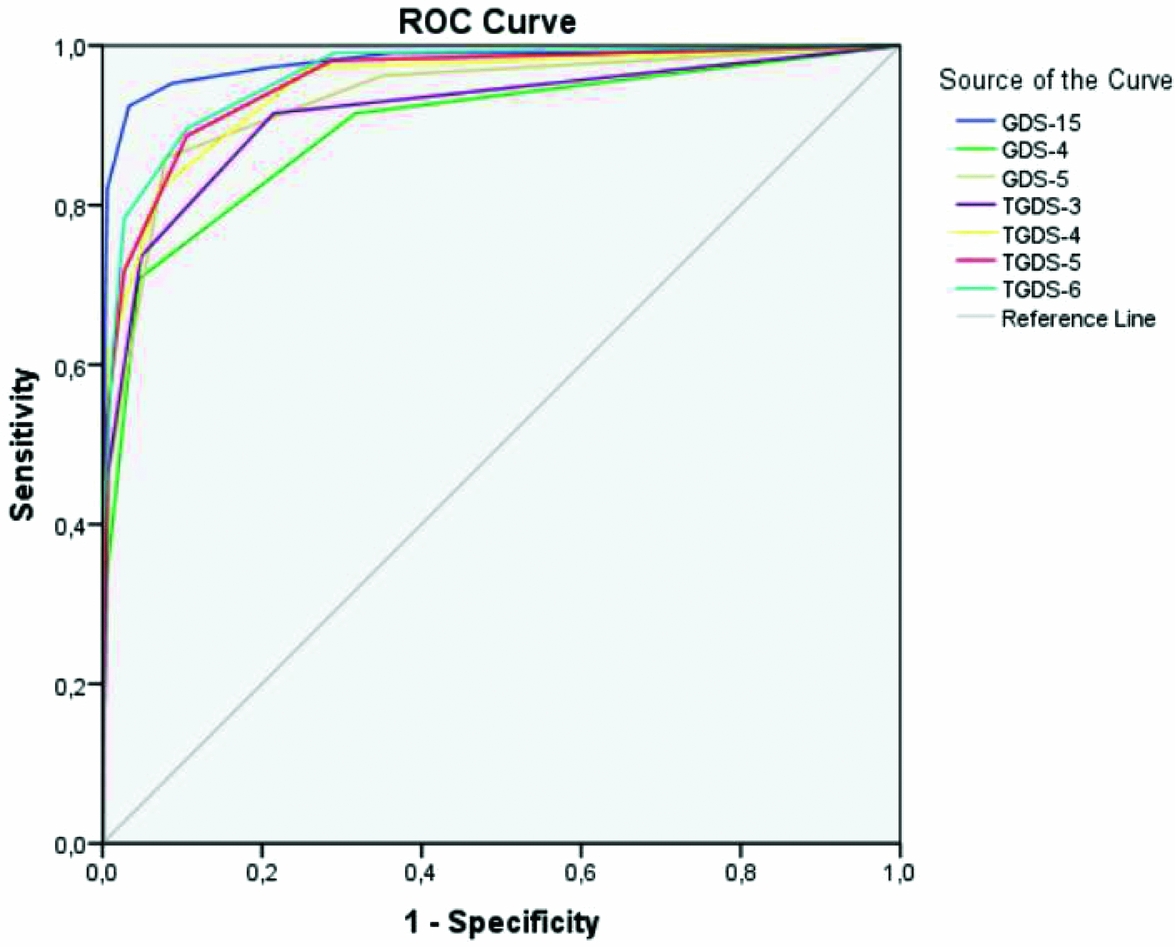
Receiver-operating characteristic (ROC) curves are used to estimate the threshold score for a positive depression screening and get the cut-off values for the scales. We evaluated the diagnostic performance of the each scale by examining the areas under the ROC curve (Figure 1). Confidence intervals for differences between the areas under the curves are presented in Table 4. The sensitivity, specificity, and PPV and NPV of the scales according to the DSM-5 are shown in Table 5.
Receiver operating characteristic curve (ROC) analysis of GDS-15, GDS-4, GDS-5, TGDS-3, TGDS-4, TGDS-5, and TGDS-6. GDS: Geriatric Depression Scale, TGDS: Turkish Geriatric Depression Scale.
The sensitivity, specificity, and negative and positive predictive values of scales

PPV: Positive predictive value; NPV: Negative predictive value; GDS: Geriatric Depression Scale; TGDS: Turkish Geriatric Depression Scale.
Discussion
In this study, we found that GDS-4 and GDS-5 were not reliable for the Turkish elderly population, whereas TGDS-4 and TGDS-5, which are newly constructed, were established as an appropriate, practical, rapid geriatric depression screening scale for our Turkish elderly population.
The prevalence of depression was 24.3% in our study. In accordance with the literature, the rate of depression in women was higher, and high education levels were protective against depression (McCall and Kintziger, Reference McCall and Kintziger2013; Hall and Reynolds-Iii, Reference Hall and Reynolds-Iii2014; Li et al., Reference Li, Theng and Foo2015). Similar to other studies, we found an association between high number of drug and depression, which may be due to the fact that multi-morbidities, increased drug number of antidepressant treatment, and drug–drug interactions are more frequent in patients with depression (Mizokami et al., Reference Mizokami, Koide, Noro and Furuta2012; Wauters et al., Reference Wauters2016; Kok and Reynolds, Reference Kok and Reynolds2017). Additionally, it was reported that geriatric depression was associated with the lack of appetite, poor interest in self-care, apathy, and physical weakness (Van Bokhorst-de van der Schueren et al., Reference van Bokhorst-de van der Schueren, Lonterman-Monasch, de Vries, Danner, Kramer and Muller2013). In compatible with the literature, we found that depression was related to lower MNA scores. Furthermore, we also found that geriatric depression was related to limitations in BADL and IADL scores. However, while some studies demonstrated that depression does not cause a decline in BADL and it affects IADLs by cognitive impairment (Li and Conwell, Reference Li and Conwell2009), in our results depression was associated with both BADL and IADL. The others demonstrated that sensory impairments, which are common in older adults, could be a predictor of both onset and persistence of depression and functional disability (Crews and Campbell, Reference Crews and Campbell2004; Owsley et al., Reference Owsley, McGwin, Scilley, Meek, Seker and Dyer2007). The independence of older people in daily life is of great importance in terms of themselves, caregivers, and health expenditures. Therefore, the early recognition and treatment of depression in older adults are more important.
GDS-15 is one of the widely used depression screening scales in the world. Validation studies were conducted in different countries and different cut-off values were determined. However, the cut-off value could not only vary from country to country, for example, five for Singapore and Turkey (Nyunt et al., Reference Nyunt, Fones, Niti and Ng2009; Durmaz et al., Reference Durmaz, Soysal, Ellidokuz and Isik2018), and three for Puerto Rico (Robinson et al., Reference Robison, Gruman, Gaztambide and Blank2002), but could also vary from one region to another in the same country, for example five (Marc et al., Reference Marc, Raue and Bruce2008) or six for the USA (Friedman et al., Reference Friedman, Heisel and Delavan2005). All these differences may reflect cultural differences. On the other hand, 15-item is still long and time consuming to use in daily routine, especially in primary care. There is a need for quick, practical, easily applicable screening tools that can be used in the first step, to protect older adults from adverse outcomes that are caused by depression.
The questions with highest κ value, which are detected in this study, were not the same as the questions in GDS-5 and GDS-4 (Hoyl's and van Marwijk's study). We thought that the reason why the questions in this study were different from the previous might also be related to the socio-cultural differences of the communities. Accordingly, in a study comparing British and Turkish societies in terms of depressive symptomatology, it was found that the feeling of guilt was more prevalent in the British sample, while somatization was more prevalent in the Turkish one, even if the core symptoms were present in both samples (Uluşahin et al., Reference Uluşahin, Başoğlu and Paykel1994). It was reported that East Asian culture contexts promote a more balanced perspective on positive emotions than people in European American culture do, which may be a result of exacerbated attention to others thoughts and population-based motivation to have low-arousal positive states like peacefulness and calm (Chentsova-Dutton et al., Reference Chentsova-Dutton, Ryder, Tsai, Gotlib and Hammen2015). Since these cultural diversities may cause a difference in the sensitivity and specificity of the scales for depression among the societies; we re-constructed short forms of GDS with different questions as TGDS-3, TGDS-4, TGDS-5, and TGDS-6, according to κ values of the questions of GDS-15. The best cut-off value for all TGDSs was >1, in this study.
We identified two important factors in the factor analysis results. The first factor was related to “depressive mood,” whereas the second factor was related to “psychosocial activities and energy loss” Different results were found in the literature regarding factor analysis. There are three important factors in a research conducted in Japan: “energy loss and pessimistic outlook,” “positive mental status (reversed),” “empty feeling” (Imai et al., Reference Imai2014). In a study conducted in Greece, there are four factors: “depressive thought content factor,” “depressive mood factor,” “social isolation and functioning,” “feelings of helplessness and fear for the future” (Fountoulakis et al., Reference Fountoulakis1999). In a study conducted in Iran, there are two factors “depression,” and “psychosocial activities” (Malakouti et al., Reference Malakouti, Fatollahi, Mirabzadeh, Salavati and Zandi2006). These results again support cultural differences.
Cronbach's α values of GDS-4 and GDS-5, which we tested for depression recognition power according to DSM-5, were <0.70. In addition, when GDS-4 was compared with TGDS-4, TGDS-5, and TGDS-6, it had lower sensitivity, specificity, NPV, and PPV. GDS-5 had significantly lower sensitivity value, although specificity and PPV were high. Because low sensitivity values for the screening tool restricts its use. Because of these mentioned drawbacks and the low internal consistency of GDS-4 and 5 (according to Cronbach's α analysis), the use of GDS-4 and GDS-5 in Turkish older adults is not appropriate.
Since sensitivity and NPV of all short TGDSs are higher than specificity and PPV, these scales are more effective to exclude the depression rather than to diagnose the depression. Thus, the TGDSs may be useful test as a first-stage screening test in a daily practice, especially in the primary care setting. In addition, it is important that these short scales can prevent the loss of time and resources by identifying the population who do not need longer screening and diagnostic tests. As TGDSs has high NPV, they can exclude depression, and thus they can prevent unnecessary, time-consuming diagnostic procedures and referral to specialist and reduce health expenditures. The sensitivity and specificity values of TGDS-4 were more remarkable, as compared with TGDS-3, TGDS-5, and TGDS-6, and more questions did not increase the screening value of the scales. Therefore, TGDS-4 was considered to be a short, easy-to-implement and reliable scale.
One of the strengths of this study is that it has the large sample size, and all the patients are evaluated with the DSM-5 diagnostic criteria. The main limitation is the study group consisting of patients admitted to a single outpatient clinic. Accordingly, it is partly representative of the entire population. The other limitation is the inclusion of only cognitively normal older persons. The power of elderly individuals with cognitive impairment has not been assessed.
In conclusion, we determined that GDS-4 and GDS-5 are not suitable for depression screening in Turkish older adults. It seems to be beneficial to develop appropriate scales for each population, according to their socio-cultural characteristics. In this study, we demonstrated that TGDS-4 might be an appropriate test for depression in the elderly, both as a bedside screening and daily clinical practice test, especially in the primary care setting.
Conflict of interest
The study has no funding or conflict interest.
Description of authors’ roles
O. Dokuzlar collected and analyzed the data, and wrote the paper. P. Soysal designed the study and wrote the paper. C. Usarel collected the data. A. T. Isik designed the study and wrote the paper.
Acknowledgments
The authors would like to thank Hulya Ellidokuz for statistical analysis.