Introduction
Major depressive disorder (MDD) is a common and impairing mental health disorder significantly contributing to the global burden of disease as the second leading cause of years-lived-with-disability globally (Vos et al., Reference Vos, Flaxman, Naghavi, Lozano, Michaud, Ezzati, Shibuya, Salomon, Abdalla, Aboyans and Abraham2012; Ferrari et al., Reference Ferrari, Charlson, Norman, Patten, Freedman, Murray, Vos and Whiteford2013). Symptoms of depression that fall below the diagnostic threshold are also associated with functional impairment and with subsequent ‘full-blown’ episodes of MDD (Johnson et al., Reference Johnson, Weissman and Klerman1992; Judd et al., Reference Judd, Akiskal, Maser, Zeller, Endicott, Coryell, Paulus, Kunovac, Leon, Mueller and Rice1998). The peak period of incidence of MDD occurs in early adult life and, once experienced, depression often recurs. An important public health priority is therefore the early identification of individuals at high risk in order to effectively target prevention and intervention (Stice et al., Reference Stice, Shaw, Bohon, Marti and Rohde2009). One possibility that has received considerable attention is that exposure to early life adversity is associated with long-lasting elevated risk for depression.
Epidemiological studies of adults examining retrospective accounts of adverse childhood experiences (ACEs) such as maltreatment, neglect, and maladaptive family functioning have found strong associations with assessments of adult depression (Felitti et al., Reference Felitti, Anda, Nordenberg, Williamson, Spitz, Edwards, Koss and Marks1998; Dube et al., Reference Dube, Anda, Felitti, Chapman, Williamson and Giles2001; Kilpatrick et al., Reference Kilpatrick, Saunders and Smith2003; Chapman et al., Reference Chapman, Whitfield, Felitti, Dube, Edwards and Anda2004; Collishaw et al., Reference Collishaw, Pickles, Messer, Rutter, Shearer and Maughan2007; Hughes et al., Reference Hughes, Bellis, Hardcastle, Sethi, Butchart, Mikton, Jones and Dunne2017). Findings show that the greater the number of retrospectively reported ACEs the greater the probability of a current or lifetime diagnosis of MDD. One difficulty with prior studies testing associations between contemporaneous assessments of adult depression and adult retrospectively reported ACEs concerns potential recall bias. Adults asked to recall childhood experiences many decades after they occurred sometimes forget whether and when events occurred (Hardt and Rutter, Reference Hardt and Rutter2004), and the likelihood of reporting adverse childhood events appears in part dependent on current mood state (Reuben et al., Reference Reuben, Moffitt, Caspi, Belsky, Harrington, Schroeder, Hogan, Ramrakha, Poulton and Danese2016). This could result in inflated estimates of associations between ACEs and adult depression. Evidence from two prospective studies – the Dunedin birth cohort study and the Environmental Risk Longitudinal Twin Study – shows that independent prospective accounts and retrospective reports of childhood adversity only show low-to-moderate agreement (Reuben et al., Reference Reuben, Moffitt, Caspi, Belsky, Harrington, Schroeder, Hogan, Ramrakha, Poulton and Danese2016; Newbury et al., Reference Newbury, Arseneault, Moffitt, Caspi, Danese, Baldwin and Fisher2018). Importantly, discrepancy between prospective and retrospective reports of childhood ACEs was associated with personality traits including neuroticism (Reuben et al., Reference Reuben, Moffitt, Caspi, Belsky, Harrington, Schroeder, Hogan, Ramrakha, Poulton and Danese2016). At present, there are relatively few long-term prospective studies examining links between ACEs and adult depression.
Some prospective longitudinal studies have compared psychiatric outcomes for officially substantiated cases of abuse and neglect to matched controls. Such studies benefit from certainty that recording of childhood ACEs is independent from reporting of adult mental health and these studies provide evidence of increased rates of depression in individuals who experienced maltreatment in childhood (Horwitz et al., Reference Horwitz, Widom, Mclaughlin and Raskin2001; Widom et al., Reference Widom, DuMont and Czaja2007). However, it is unclear whether findings generalise to the general population where most ACEs are not officially recognised (Gilbert et al., Reference Gilbert, Kemp, Thoburn, Sidebotham, Radford, Glaser and MacMillan2009). For example, in the UK around three children in 1000 are recorded on the child protection register. In contrast, epidemiological studies indicate that around 5–20% of children and adolescents have experienced serious forms of maltreatment (Gilbert et al., Reference Gilbert, Kemp, Thoburn, Sidebotham, Radford, Glaser and MacMillan2009; Radford et al., Reference Radford, Corral, Bradley, Fisher, Bassett, Howat and Collishaw2011).
Population cohorts with prospective assessments of ACEs are relatively rare, and most of those that have been undertaken have focused on adult outcomes associated with single childhood adversities such as bullying or parental divorce (Fergusson et al., Reference Fergusson, McLeod and Horwood2014; Takizawa et al., Reference Takizawa, Maughan and Arseneault2014). The few population cohort studies that have tested associations between prospectively assessed cumulative indices of child adversity and depression show strong associations in adolescence (Oldehinkel et al., Reference Oldehinkel, Ormel, Verhulst and Nederhof2014; Newbury et al., Reference Newbury, Arseneault, Moffitt, Caspi, Danese, Baldwin and Fisher2018) and early-to-middle adulthood (Clark et al., Reference Clark, Caldwell, Power and Stansfeld2010; Reuben et al., Reference Reuben, Moffitt, Caspi, Belsky, Harrington, Schroeder, Hogan, Ramrakha, Poulton and Danese2016; Copeland et al., Reference Copeland, Shanahan, Hinesley, Chan, Aberg, Fairbank, van den Oord and Costello2018). However, a number of important issues remain to be clarified. Does the risk for mood problems associated with prospectively assessed ACEs extend beyond middle-adulthood? To what extent do risk associations with mood problems in later life reflect continuity of psychopathology already evident in childhood? Are risk associations particularly pronounced for chronic depression or do they diminish with time? Repeat assessment of mood problems across adulthood is required to test this. Finally, are there gender differences in risk for mood problems associated with ACEs?
The current study extends prior analyses of links between prospectively assessed ACEs and adult mood problems by addressing these questions using the UK National Child Development Study (NCDS) birth cohort. This cohort has previously shown evidence of associations between prospectively and retrospectively assessed ACEs and mood disorder (Clark et al., Reference Clark, Caldwell, Power and Stansfeld2010) and physical health indicators (‘allostatic load’) (Barboza Solis et al., Reference Barboza Solís, Kelly-Irving, Fantin, Darnaudéry, Torrisani, Lang and Delpierre2015) at age 45 years. Here, we track developmental change in associations between childhood adversity and adult mood problems using data on four occasions through adulthood up to age 50 years representing one of the longest prospective follow-ups to date. The study is able to test whether childhood adversity is associated with adult mood problems independent of associations with psychopathology already evident in childhood or adolescence. This is important to know because it is currently unclear whether screening for early mental health difficulties in childhood and adolescence is likely sufficient, or whether long-term prevention of depression should also be targeted at children with experiences of ACEs but without early mental health problems. One prior study observed that risk for psychiatric disorder at age 45 years in children exposed to ACEs persists after adjusting for psychopathology in adolescence, but that study did not consider measures of psychopathology in childhood (Clark et al., Reference Clark, Caldwell, Power and Stansfeld2010).
We are not aware of studies that have directly tested whether prospective risk associations and adult mood problems persist or diminish with time, nor whether they are particularly pronounced for more pernicious (recurrent) presentations of mood problems.
Finally, we are not aware of any long-term follow-ups that have directly tested gender differences in prospective associations between ACEs and depression across the life course. This is important because there are substantial gender differences in the prevalence and developmental patterning of depression over the life course (Thapar et al., Reference Thapar, Collishaw, Pine and Thapar2012; Maughan et al., Reference Maughan, Collishaw and Stringaris2013), and because previous research suggests both similarities and differences in the aetiological pathways linking childhood risk exposures to adult depression for males and females (Kendler and Gardner, Reference Kendler and Gardner2014). Furthermore, it has been suggested that gender differences in depression might in part reflect increased sensitivity to psychosocial stressors amongst females (Hyde et al., Reference Hyde, Mezulis and Abramson2008).
Using data collected on seven occasions starting at age 7 and following to age 50 years in the 1958 UK birth cohort (NCDS), this study aims to test longitudinal associations between childhood adversity and adult mood problems, testing (1) whether children who experience a greater number of ACEs show increased rates of mood problems across adult life (from age 23 to age 50); (2) whether childhood ACEs are associated with increased adult mood problems after adjusting for child and adolescent mental health difficulties assessed at ages 7, 11 and 16 years and (3) if associations between childhood ACEs and adult mood problems differ by gender.
Methods
Sample
NCDS is a longitudinal study of children born in England, Scotland and Wales in 1 week in March 1958 (Power and Elliott, Reference Power and Elliott2005). Following the initial birth survey (n = 18 558), representing 98% of all live births, there have been nine further survey sweeps at ages 7, 11, 16, 23, 33, 42, 46, 50 and 55 years. Surviving cohort members still resident in the UK were eligible for participation at each sweep. Of the 12 553 with ACE exposure data and relevant childhood covariates, mental health data were available from 9716 (age 23), 8830 (age 33), 8790 (age 42) and 7537 (age 50) cohort members. Data were downloaded from the UK Data Archive (usage number 86906). Informed consent in NCDS was obtained from parents in childhood and from cohort members in adulthood (Shepherd, Reference Shepherd2012).
Measures
Adverse childhood experiences
ACEs were defined according to previous work in NCDS (Barboza Solis et al., Reference Barboza Solís, Kelly-Irving, Fantin, Darnaudéry, Torrisani, Lang and Delpierre2015) and included six types of familial adversities assessed across childhood using parent, teacher or health visitor/interviewer reports at ages 7, 11 and/or 16 years: (1) parental separation up to age 16 (due to death, divorce or separation) as reported by parents or health visitors; (2) family member of child in contact with mental health services at 7 years (health visitor report) or 11 years (parent report); (3) parental alcohol abuse age 7 (health visitor report); (4) family member of child in prison or on probation (health visitor or parent reports at ages 7, 11 or 16); (5) physical neglect (teacher reported child being dirty or undernourished at ages 7 or 11) and (6) child ever in public/voluntary care services or foster care (caregiver reports at ages 7, 11 or 16). For those with data available for at least four of these indicators, cohort members were divided into three groups comprising those with no ACEs (0), those with a single ACE (1) and those with multiple ACEs (⩾2).
Adult mood problems
The 15-item psychological subscale of the Malaise Inventory was used to index mood problems at ages 23, 33 and 42 (Rutter et al., Reference Rutter, Tizard and Whitmore1970). We excluded additional somatic items because many of these become more common as people age (Rodgers et al., Reference Rodgers, Pickles, Power, Collishaw and Maughan1999). The 15 psychological items (e.g. ‘Do you often suddenly become scared for no good reason?’; ‘Do you often feel miserable or depressed?’) were each coded 0 ‘no’ or 1 ‘yes’ and then summed to create a total score at each age. The 15-item subscale showed acceptable internal consistency (α = 0.75–0.87) and has good external validity with respect to interview-assessed MDD and mental health service use using a threshold of 5+ to indicate significant mood problems (Rodgers et al., Reference Rodgers, Pickles, Power, Collishaw and Maughan1999). At age 50, a shortened 9-item version of the Malaise Inventory (α = 0.79) was administered in NCDS. We used an adjusted threshold of 3+ to indicate the presence of mood problems at age 50 (Takizawa et al., Reference Takizawa, Maughan and Arseneault2014). Recurrent mood problems were defined as above-threshold symptom scores on 2 or more occasions. Additional analyses used eight psychological Malaise items common across all four occasions to test variation in associations between ACEs and mood symptoms (range 0–8) across ages 23, 33, 42 and 50 years.
Childhood covariates
Abbreviated 9-item versions of the Rutter A and Rutter B scales (Rutter et al., Reference Rutter, Tizard and Whitmore1970) were used to obtain parent (ages 7, 11 and 16) and teacher (age 16) reports of child mental health problems including symptoms of hyperactivity, conduct problems and emotional problems. Individual items were coded as 0 ‘never’, 1 ‘sometimes’ or 2 ‘frequently’ and summed to derive total symptom scores for each informant at each age (range 0–18). The top decile on each measure was used to identify significant problems. Information on potential social and perinatal confounders was collected at birth: low birth weight (<2500 g); maternal smoking after 4 months of pregnancy; young maternal age (<18 years at birth of study child); paternal low social class (semiskilled or unskilled occupation); no maternal education past minimum school-leaving age (15/16 years).
Analysis
Inverse probability weights were constructed using multiple logistic regression to calculate predicted probabilities of a cohort member being present in each adult data collection ‘sweep’ on the basis of measured childhood predictors. In NCDS, adult respondents tended to under-represent men, those with a greater number of ACEs or with child mental health problems, participants from semi- or unskilled childhood social class backgrounds, those whose mothers had left education at the minimum school leaving age, and individuals who had lower reading and maths test scores at age 7 years. Weights were effective at accounting for measured predictors of attrition (online Supplementary Table S1) and these were included in all analyses that follow.
Main analyses were stratified by gender and examined links between ACEs (0, 1, 2+) and the presence of mood problems using logistic regression analyses. Odds ratios (ORs) with 95% confidence intervals (CIs) were calculated comparing rates of above-threshold mood problems at each adult assessment for individuals with no ACE (reference), one ACE and multiple ACEs. Analyses further tested ACE-by-gender interactions to examine differences in associations for men and women. Multiple regression analyses adjusted for childhood mental health (above threshold difficulties at 7, 11 or 16 years) and other potential confounders [low birth weight, maternal smoking during pregnancy, maternal age (<18 years at birth of study child), paternal social class (unskilled v. other), maternal education].
Further analyses tested whether associations between ACEs and adult mood problems varied across adulthood. To ensure comparability of measurement across time, analyses focused on cohort members' mean mental health symptom score using the eight psychological Malaise items common across all four occasions. Multivariate multilevel linear regression models tested the interaction between ACEs (0 reference, 1 or 2+) and age (23 reference, 33, 42, 50 years) with mean Malaise score as the outcome (range: 0–8). Analyses were undertaken in Stata with measurement occasion (age) nested within individuals and ID specified as a random effect. Two models were run, one for men and one for women, and each model included childhood covariates (any above threshold mental health problem at ages 7, 11 or 16 years, low birth weight, maternal smoking during pregnancy, maternal age, paternal social class, maternal education). Unstandardised coefficients (b) and 95% CIs are reported reflecting predicted differences in mean Malaise symptom score.
Results
Prevalence of ACEs and mood problems in the 1958 birth cohort
Of the 12 553 cohort members with childhood ACEs and covariate data, 9168 (73.0%) were not reported to have any measured ACEs, 2488 (19.8%) experienced a single ACE and 897 (7.1%) multiple ACEs. The prevalence of reported childhood adversities ranged from 1.0% (parental alcoholism) to 13.4% (parental separation). The prevalence of mood problems in the cohort as a whole differed by age and gender, with rates increasing from 7.2% at age 23 years to 17.5% at age 50 years in men, and from 18.2% at age 23 years to 26.7% at age 50 in women. See online Supplementary Tables S2 and S3 for details.
ACEs and child mental health
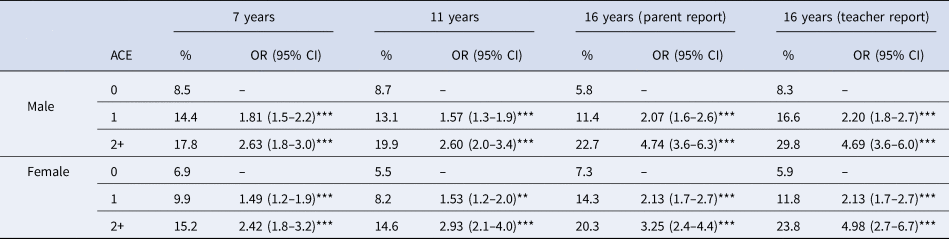
Each specific type of adversity showed statistically significant associations with the presence of child mental health problems (online Supplementary Table S4). As shown in Table 1, boys with one ACE (ORs 1.57–2.20, ps < 0.001) or multiple ACEs (ORs 2.60–4.74, ps < 0.001) and girls with one (ORs 1.49–2.13, ps < 0.001) or multiple ACEs (ORs 2.42–4.98, ps < 0.001) had increased odds of child mental health problems (>90% decile Rutter scores) at ages 7, 11 and 16 years. There were no significant interactions by gender (all p > 0.1).
Unadjusted associations between ACEs and mental health problems at ages 7, 11 and 16 in childhood by gender

ACE, adverse childhood experiences; OR (95% CI), odds ratio (95% confidence interval) with 0 ACEs as reference group; *p < 0.05; **p < 0.01; ***p < 0.001. N boys (7 years: 6453; 11 years: 5787; 16 years parent reports: 4814; 16 years teacher reports: 5027). N girls (7 years: 6110; 11 years: 5504; 16 years parent reports: 4609; 16 years teacher reports: 4853).
ACEs and adult mood problems
Parental separation (ORs 1.40–1.43, all p < 0.01), having been in care (ORs 1.89–2.51, all p < 0.001), physical neglect (ORs 1.55–2.02, all p < 0.001), family member mental illness (ORs 1.42–2.13, all p < 0.01), and family criminality (ORs 1.49–2.28, all p < 0.001) were each associated with increased odds of adult mood problems at every adult assessment (ages 23, 33, 42 and 50). Parental alcoholism was associated with mood problems at most but not all follow-ups. See online Supplementary Table S4 for details.
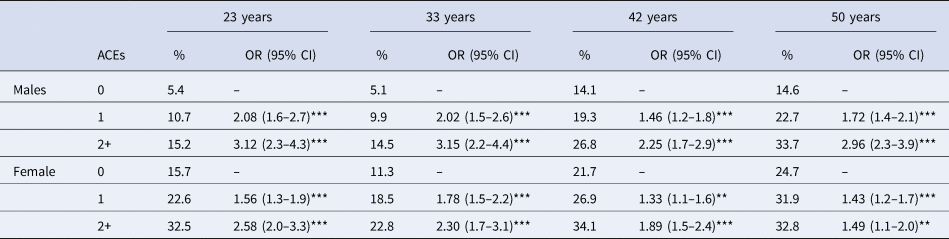
Number of ACEs was associated with increased rates of adult mood problems at all ages (Table 2). Individuals with a single ACE (men: ORs 1.46–2.08; women: ORs 1.33–1.78; all p < 0.001) and those with multiple ACEs (men: ORs 2.25–3.15; women: ORs 1.49–2.58; all p < 0.01) had increased odds of mood problems compared to those with no ACEs. ACEs were also associated with recurrent mood problems, i.e. above-threshold symptom scores on two or more occasions in adulthood, [men: single ACE, OR 1.87 (1.5–2.3), p < 0.001; multiple ACEs, OR 2.84 (2.1–3.8), p < 0.001; women: single ACE, OR 1.50 (1.3–1.8), p < 0.001; multiple ACEs, OR 1.89 (1.5–2.5), p < 0.001].
Unadjusted associations between ACEs and adult mood problems at ages 23, 33, 42 and 50 years by gender

ACE, adverse childhood experiences; OR (95% CI), odds ratio (95% confidence interval) with 0 ACEs as reference group; *p < 0.05; **p < 0.001; ***p < 0.001. N men (23 years: 4832; 33 years: 4335; 42 years: 4290; 50 years: 3689). N women (23 years: 4884; 33 years: 4495; 42 years: 4300; 50 years 3848).
Adjustment for childhood covariates
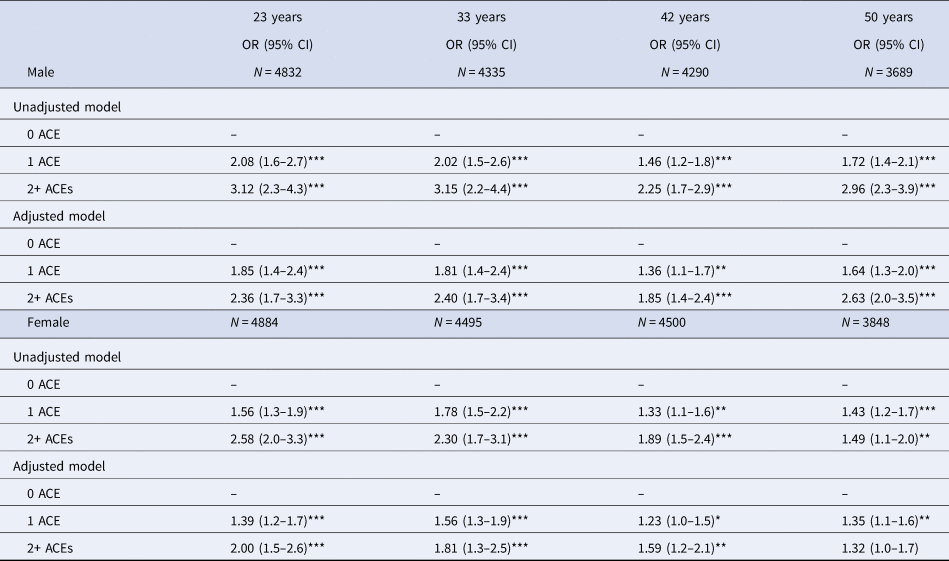
Table 3 summarises multivariable models of associations between ACEs and adult mood problems separately for males and females. As shown, there was little attenuation in associations between single or multiple ACE exposure and risk of adult mood problems when controlling for child psychopathology (any above-threshold Rutter score) and for socio-demographic confounders. Final multivariable models showed that men who had experienced multiple ACEs had substantially increased rates of mood problems throughout adult life, including high rates of recurrent problems [OR 2.36 (1.7–3.2), p < 0.001]. For women, risk associations were evident on most occasions, but appeared to reduce over time [age 23: OR 2.00 (1.5–2.6), p < 0.001; age 50: OR 1.32 (1.0–1.7), p = 0.053]. Tests of interactions by gender indicated significantly different associations between ACEs and mood problems at age 50 [OR 0.75 (0.6–0.9), p = 0.001] and risk of recurrent mood problems [OR 0.83 (0.7–1.0), p = 0.03], in both instances reflecting stronger associations between ACEs and mood problems for men. Gender interactions were not significant at 23 years [OR 0.89 (0.7–1.1), p = 0.22], 33 years [OR 0.87 (0.7–1.1), p = 0.20] and 42 years [OR 0.93 (0.8–1.1), p = 0.35].
ACEs and risk for adult mood problems: comparison of unadjusted and adjusted models

ACEs, adverse childhood experiences; OR (95% CI), odds ratio (95% confidence interval) with 0 ACEs as reference group; *p < 0.05; **p < 0.01; ***p < 0.001. Adjusted model controlling for low birth weight, marital status at birth, paternal social class, maternal education, maternal age and child psychopathology (any above threshold Rutter score ages 7–16).
Testing for change in association between ACEs and mood symptoms by age
Secondary analyses tested for change in association between ACEs and mean mood symptoms (using eight common psychological Malaise items, range 0–8). Controlling for childhood covariates (family demographics and child mental health), the model for women found main effects of age [33 v. 23: unstandardised coefficient b = −0.31 (−0.36 to −0.25), p < 0.001; 42 v. 23: b = 0.23 (0.17–0.30), p < 0.001; 50 v. 23: b = 0.18 (0.11–0.25), p < 0.001], and ACEs [1 v. 0: b = 0.41 (0.29–0.53), p < 0.001; 2+ v. 0: b = 0.85 (0.63, 1.07), p < 0.001]. Tests of interactions between ACEs and age showed that when compared to age 23, there were reduced associations between ACEs and mood symptoms at ages 33 years [1 v. 0 ACE: b = −0.03 (−0.16 to 0.10), p = 0.65; 2+ v. 0: −0.28 (−0.54 to −0.01), p = 0.04], 42 years [1 v. 0: b = −0.23 (−0.38 to −0.09), p = 0.001; 2+ v. 0: −0.43 (−0.70 to −0.16), p = 0.002], and 50 years [1 v. 0: −0.10, (−0.27 to 0.08), p = 0.29; 2+ v. 0: −0.38 (−0.70 to −0.05), p = 0.02]. The model for men found main effects of age [33 v. 23: b = −0.10 (95% CI −0.14 to −0.06), p < 0.001; 42 v. 23: b = 0.42 (0.37–0.47), p < 0.001; 50 v. 23: b = 0.35 (0.29–0.40), p < 0.001], and ACEs [1 v. 0: b = 0.29 (0.20–0.39), p < 0.001; 2+ v. 0: b = 0.75 (0.57–0.93), p < 0.001], but no significant variation in risk associations between ACEs and mood problems by age (ACE × age interaction: all ps > 0.05).
Discussion
This five-decade UK population study tested associations between prospectively assessed ACEs and mood problems in adult life. Multiple ACEs were associated with increased rates of self-reported adult mood problems, including recurrent depressed mood. These associations cannot be ascribed to differences in reporting of ACEs between adults with and without mood problems due to the prospective longitudinal nature of the study. Individuals with multiple ACEs had higher rates of adult mood problems even accounting for mental health problems already evident in childhood. When examining the pattern of associations over time, findings showed strong persistence of risk associations to age 50 but also some evidence of attenuation across time for women.
The findings support the conclusions from previous retrospective studies that individuals who experience ACEs are a high risk group for adult depression, and extend findings from some prior longitudinal research (Clark et al., Reference Clark, Caldwell, Power and Stansfeld2010; Reuben et al., Reference Reuben, Moffitt, Caspi, Belsky, Harrington, Schroeder, Hogan, Ramrakha, Poulton and Danese2016; Copeland et al., Reference Copeland, Shanahan, Hinesley, Chan, Aberg, Fairbank, van den Oord and Costello2018) by using repeated and extended assessments of mood problems up to age 50 years. In general (and in this study particularly for females), there was a dropping off in the magnitude of associations with increasing age. This is to be expected given the important role of proximal stressors in precipitating episodes of depression (Kendler and Gardner, Reference Kendler and Gardner2010). Nonetheless, there were robust associations between adverse childhood events and mood problems assessed up to four decades later.
In this cohort, associations between childhood adversity and adult mood problems were not accounted for by psychopathology assessed in childhood and adolescence. Associations between ACEs and adult mood problems may therefore reflect mechanisms other than persistence of psychopathology across the life course. It was beyond the scope of this study to test alternative mechanisms, but associations between ACEs and adult mood problems may reflect continuity of social adversity and increased exposure to stressful life events in adulthood (Harper et al., Reference Harper, Marcus and Moore2003; Bird, Reference Bird2007; Kendler and Gardner, Reference Kendler and Gardner2010). Individuals are not passive recipients of their environments and people interact with and to some extent shape their environmental experiences (Kendler et al., Reference Kendler, Gardner and Prescott2003; Kendler and Baker, Reference Kendler and Baker2007). It is also important to consider the biological underpinnings of links between early life adversity and later depression (Hertzman, Reference Hertzman1999; Danese et al., Reference Danese, Moffitt, Harrington, Milne, Polanczyk, Pariante, Poulton and Caspi2009; Shonkoff et al., Reference Shonkoff, Gardner, Siegel, Dobbins, Earls, McGuinn, Pascoe and Wood2012; Barboza Solis et al., Reference Barboza Solís, Kelly-Irving, Fantin, Darnaudéry, Torrisani, Lang and Delpierre2015). Stress is associated not only with short-term adaptive biological responses but also with longer-lasting signs of ‘physiological wear-and-tear’ affecting the hypothalamic–pituitary–adrenal axis, cardio-vascular, metabolic and immune systems (Danese et al., Reference Danese, Moffitt, Harrington, Milne, Polanczyk, Pariante, Poulton and Caspi2009; Barboza Solis et al., Reference Barboza Solís, Kelly-Irving, Fantin, Darnaudéry, Torrisani, Lang and Delpierre2015). What is unclear is the extent to which early adversity shows shared or specific associations with physiological indices and depression in adulthood. Further, given evidence of bidirectional relationships between depression and ill health (Brunner et al., Reference Brunner, Schreiner, Sood and Jacobs2014), it is important to consider whether and how physiological changes associated with ACEs are related to change in risk for mood problems across development. A third possibility is that associations between ACEs and adult mood problems are mediated by maladaptive behavioural or cognitive coping responses. For example, ACEs are also strongly associated with substance abuse and dependence (Kendler et al., Reference Kendler, Bulik, Silberg, Hettema, Myers and Prescott2000), which in turn are well-established risk factors for depression (Boden and Fergusson, Reference Boden and Fergusson2011). These and other potential mechanisms through which early adversity may affect risk of later depression merit further investigation in future studies.
Finally, the study considered gender differences in patterns of associations between ACEs and mood problems and how these changed across adulthood. It has previously been suggested that females may be more sensitive to certain inter-personal forms of adversity and that this may partly account for the female preponderance of depression (Hyde et al., Reference Hyde, Mezulis and Abramson2008). As expected, we found that mood problems were more prevalent amongst women than men at all ages, though gender differences did narrow over time. However, this study found no evidence that ACE associations with adult mood problems were more pronounced for women. If anything, evidence here pointed to the opposite, with the persistence of risk associations across adulthood for males and a fading of risk associations for women. Due caution is required as other childhood adversities not captured by the measures used here may show a different pattern of effects. For example, the study did not include measures of sexual abuse, bullying, harassment or discordant peer relationships.
Nevertheless, this is an interesting finding and accords with other prospective high-risk studies that have shown that ACEs are associated with deleterious adult mental health outcomes at least as strongly in men as in women (e.g. Schilling et al., Reference Schilling, Aseltine and Gore2007; Choi et al., Reference Choi, DiNitto, Marti and Choi2017). The finding of apparent greater persistence of risk associations across the life course for men compared to women requires replication, and if found to be robust then potential explanations will need to be tested. Different possibilities might include gender differences in biopsychosocial risk mechanisms (e.g. physiological response to stress, development of substance use problems, availability of social support; Choi et al., Reference Choi, DiNitto, Marti and Choi2017; Kuehner, Reference Kuehner2017), methodological artefact (e.g. differences in reporting of mood problems across adult life between women and men) and change in the relative importance of other more proximal predictors of mood problems in adulthood for men and women.
Strengths and limitations
This study is one of the longest prospective cohorts to consider associations between ACEs and adult mood problems. Prospective studies such as this are important because of the potential for recall bias to inflate associations between measures of adult mental health and concurrent retrospective reports of childhood adversity (Reuben et al., Reference Reuben, Moffitt, Caspi, Belsky, Harrington, Schroeder, Hogan, Ramrakha, Poulton and Danese2016). The availability of directly comparable measures of mood problems on four occasions in adulthood is a further strength as it permitted us to test whether risk associations persisted or diminished across time.
There are also limitations. We were limited by the availability of measures included within this historical cohort study. It is likely that ACEs measured in this study represent a significant underestimate of the overall burden of childhood adversity. Relatively common experiences such as physical and sexual abuse, and domestic violence, were not prospectively recorded, and it also possible that parents and teachers under-reported those adversities that were included (e.g. parental alcoholism). We chose to focus on familial adversities, and so did not include reports of peer bullying. Maltreatment and bullying are known to have strong and enduring negative effects on adult mental health (Gilbert et al., Reference Gilbert, Kemp, Thoburn, Sidebotham, Radford, Glaser and MacMillan2009; Takizawa et al., Reference Takizawa, Maughan and Arseneault2014), and it is likely that the estimated risk associated with childhood ACEs in this study would have been greater had it been possible to include these in this study. Additionally, it was beyond the scope of the study to test in detail the role of specific childhood adversities in predicting life-course mood problems. However, findings showed a broadly consistent pattern across all six adversity variables used to operationalise the ‘ACEs’ measure. That is, findings did not appear to be driven by a single type of childhood adversity. In terms of outcome measures, adult mood problems were assessed using a symptom screen and it was not possible here to consider clinical diagnoses. However as noted, the Malaise inventory has good validity when compared to interview-assessed MDD and mental health service use (Rodgers et al., Reference Rodgers, Pickles, Power, Collishaw and Maughan1999), and prior evidence from this study has shown links with interview-based diagnosis of depression (Clark et al., Reference Clark, Caldwell, Power and Stansfeld2010).
As with nearly all cohort studies, it is important to consider evidence of selective attrition. Participants from more disadvantaged family background, those with a greater number of ACEs and those with child mental health problems were less likely to remain in the study to age 50. Analyses included inverse probability weights which appeared to work well in accounting for measured childhood predictors of non-response at each age. Nevertheless, it is still possible that unmeasured factors associated with non-participation might have biased findings. Given the social stratification of adversity (Aber et al., Reference Aber, Bennett, Conley and Li1997) and the selective loss of those at highest risk, results may present conservative estimates of the prevalence and risk of mood problems associated with childhood adversity.
It is important to see the study findings within their historical context. It is not certain that findings are generalisable to more recent generations. Certain ACEs (e.g. parental separation) have shown marked changes in prevalence (Amato, Reference Amato2010). Furthermore, whilst it would be hoped that there is better recognition and intervention for children at risk of mental health problems today than in the past, evidence from cross-cohort comparisons suggests that the reverse may also be true (Gore Langton et al., Reference Gore Langton, Collishaw, Goodman, Pickles and Maughan2011; Sellers et al., Reference Sellers, Warne, Pickles, Maughan, Thapar and Collishaw2019).
It was beyond the scope of this paper to test hypotheses about risk mechanisms. ACEs likely index a broad spectrum of risk, including familial/inherited liability. It is not possible to infer causality regarding associations between ACEs and adult mood problems because of the possibility of residual confounding, including both genetic and social factors unmeasured in this study that may be associated both with ACEs and with adult mood problems. In addition to testing explanatory mechanisms, it will also be important for future research to consider protective factors that act as risk buffers for children exposed to adversity (Collishaw et al., Reference Collishaw, Pickles, Messer, Rutter, Shearer and Maughan2007, Reference Collishaw, Hammerton, Mahedy, Sellers, Owen, Craddock, Thapar, Harold, Rice and Thapar2016).
Implications
Childhood family adversities are highly prevalent, most children exposed to even extreme adversity remain unrecognised by official authorities, and care provision is far from optimal (Cawson et al., Reference Cawson, Wattam, Brooker and Kelly2000; Gilbert et al., Reference Gilbert, Kemp, Thoburn, Sidebotham, Radford, Glaser and MacMillan2009). Findings of this study demonstrate that individuals with ACEs are a high risk group with long-term risk for adult mood problems, even when there is no evidence of mental health problems in childhood and adolescence. The findings are important for prevention (regardless of the causal nature of the ACE-mood problems relationship) because they identify a group of children who are at increased risk of later mood problems who might benefit from early preventative intervention. Next steps for future research are to better understand the mechanisms by which childhood adversity confers risk for adult mood difficulties, and to determine whether existing early prevention programmes for depression can improve long-term outcomes in those at risk.
Supplementary material
The supplementary material for this article can be found at https://doi.org/10.1017/S003329171900271X.
Acknowledgements
The authors express their gratitude to the National Child Development Study participants, and to the UK data archive for providing access to the anonymised data.
Financial support
This research received no specific grant from any funding agency, commercial or not-for-profit sectors.
Conflict of interest
None.
Ethical standards
The authors assert that all procedures contributing to this work comply with the ethical standards of the relevant national and institutional committees on human experimentation and with the Helsinki Declaration of 1975, as revised in 2008.