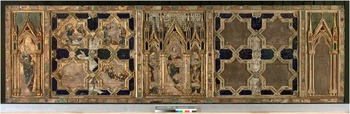
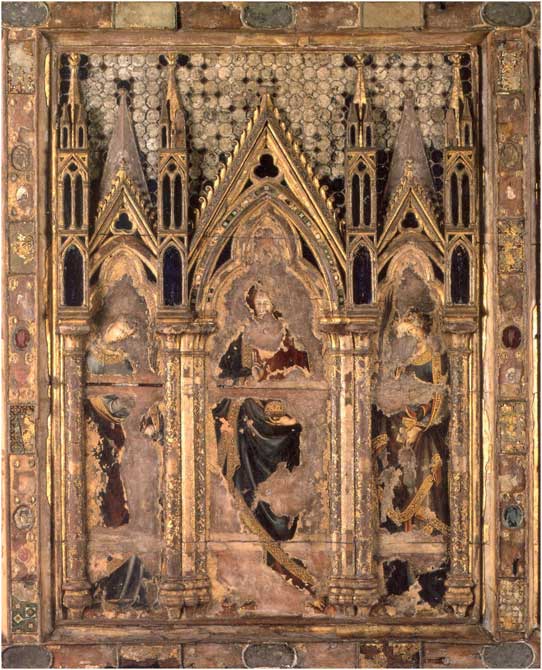
One of the most haunting passages in George Vertue's notebook of 1721–5 must surely be his fleeting description of the iconography of the Westminster Retable. Numbering a quick diagrammatic sketch of the five vertical divisions of the Retable, he states:
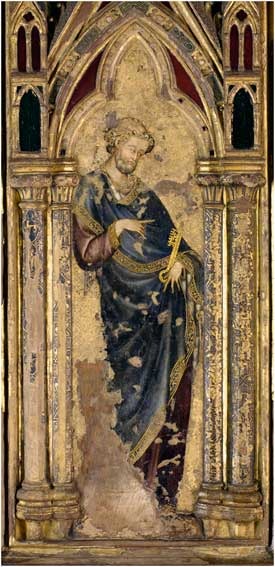
1. in the first is represented St Peter standing with the keys in his hand.
5. in the fifth is St Paul with the sword.
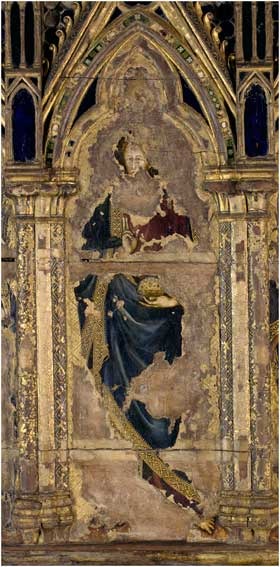
3. in the middle paine Christ standing & the Virgin Mary on the right, and another (St Elizabeth) on the left.
2. and 4. is filled up with beautiful ornaments & in each in 4 divisions in so many several scripture Storyes represented.
The frame and bordures being beautifully adonred & gilt.Footnote 1
Given that Vertue examined the Retable when it was fixed as the top of a tall Elizabethan ‘presse’ or cupboard, with its painted surface facing upwards, it is perhaps not surprising that he was unable to identify the scenes. Having discovered the Retable, Vertue might also have hoped that his work would ensure that it would be better described as it became known to other scholars. He could not have known that by 1778 half of the ‘so many several scripture Storyes’ would have been removed to turn the Retable into the new ceiling of another cupboard, intended to house members of the so-called ‘Ragged Regiment’ and in particular a new waxwork effigy of William Pitt the Elder.Footnote 2
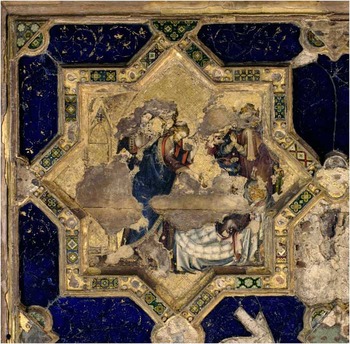
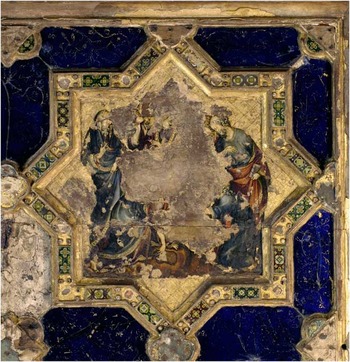
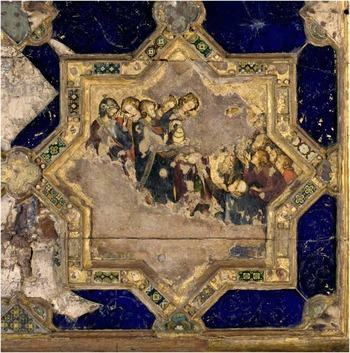
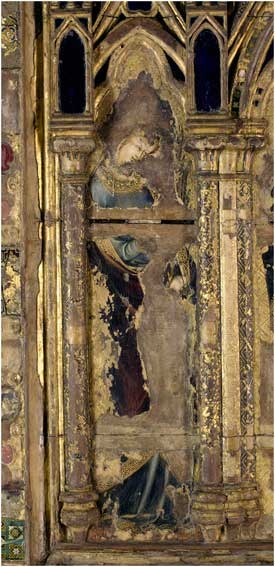
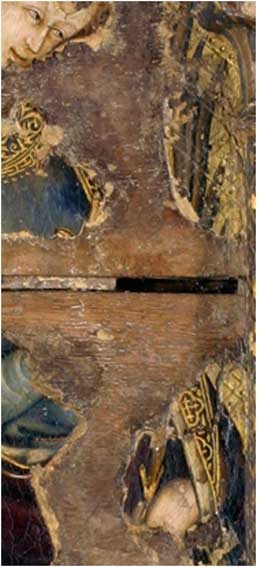
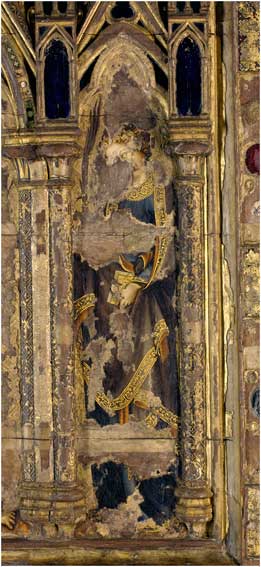
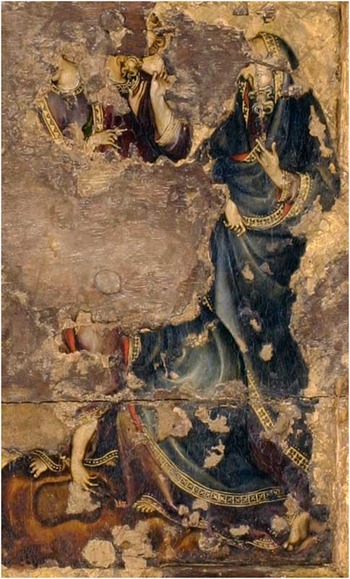
The central division has now been better identified as depicting Christ standing and blessing while holding the Orb of the World between the Virgin, on the left-hand side, and St John the Evangelist, on the right-hand side, both holding palms. The three surviving, but severely damaged, miracle scenes on the left of the central division of the Retable are now generally agreed to represent the Raising of Jairus's Daughter, the Healing of the Man Born Blind and the Feeding of the Five Thousand. St Paul, probably severely damaged even in Vertue's day, once stood on the extreme right of the Retable. This image met the same fate as the four scriptural scenes on the right of the central grouping, but St Peter survives on the extreme left (figs 1–11).Footnote 3
Westminster Retable, Westminster Abbey Museum. Photograph: © Dean and Chapter of Westminster

Westminster Retable (detail): the Raising of Jairus's Daughter. Photograph: © Dean and Chapter of Westminster

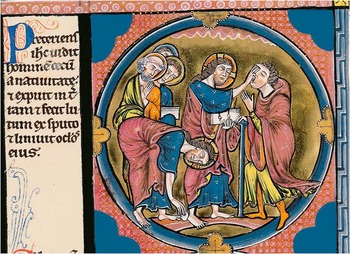
Westminster Retable (detail): the Healing of the Man Born Blind. Photograph: © Dean and Chapter of Westminster

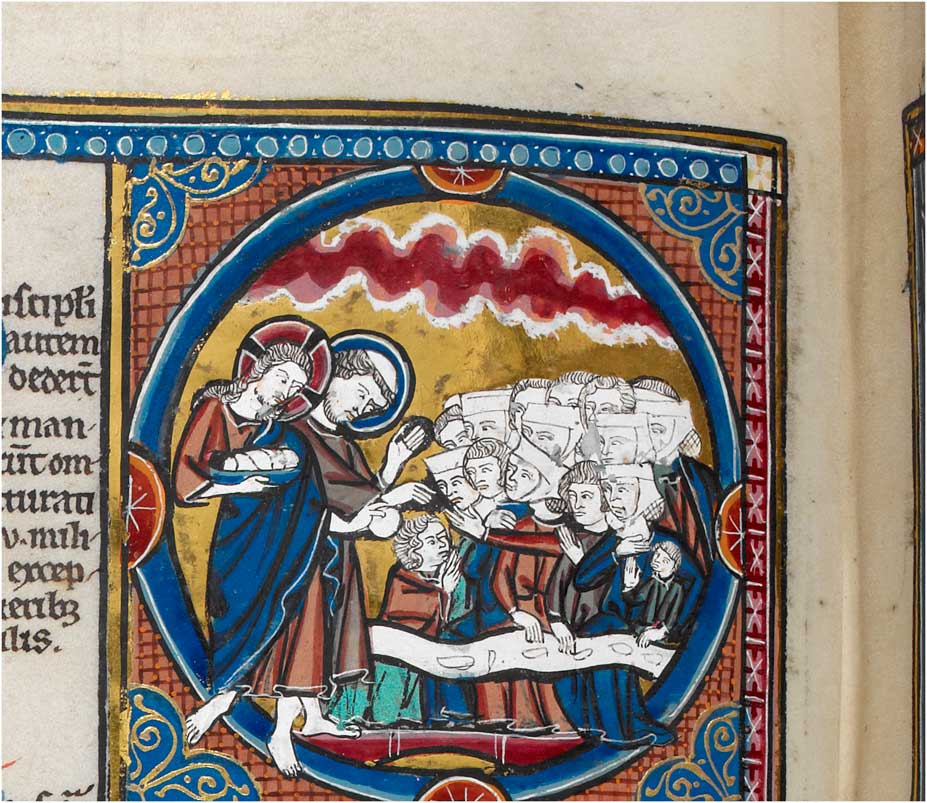
Westminster Retable (detail): the Feeding of the Five Thousand. Photograph: © Dean and Chapter of Westminster

Westminster Retable, central section (detail): Christ between the Virgin (left) and St John the Evangelist (right). Photograph: © Dean and Chapter of Westminster
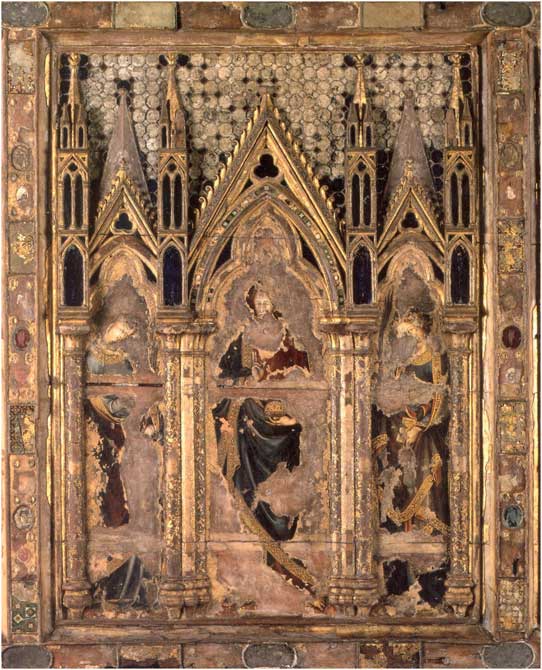
Westminster Retable (detail): the Virgin. Photograph: © Dean and Chapter of Westminster

Westminster Retable (detail): the palm held by the Virgin. Photograph: © Dean and Chapter of Westminster

Westminster Retable (detail): St John the Evangelist. Photograph: © Dean and Chapter of Westminster

Westminster Retable (detail): St Peter. Photograph: © Dean and Chapter of Westminster

Westminster Retable (detail): Christ Blessing while holding the Orb of the World. Photograph: © Dean and Chapter of Westminster

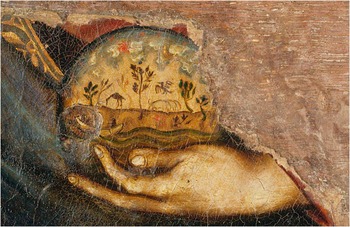
Westminster Retable (detail): the Orb of the World. Photograph: © Dean and Chapter of Westminster

This much has been known and described many times since the middle of the nineteenth century.Footnote 4 The mysterious nature of the particular grouping of standing figures and narrative scenes on the Retable has, however, remained largely unexplained. The standing figures appear to be straightforward in their iconography, but few if any comparisons have been made that suggest sources for the particular arrangement of the figures, apart from the obvious pairing of SS Peter and Paul. In particular, the figure of Christ Blessing and carrying an orb remains enigmatic and the surviving miracle scenes have yet to be successfully compared with other works of art that could have served as sources for this particular compositional arrangement.
THE BIBLE MORALISÉE AND THE MIRACLE SCENES
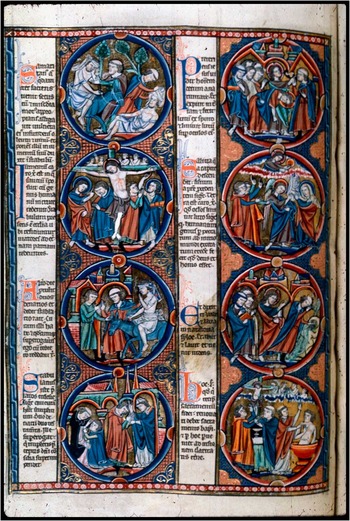
Recent work on the Bible moralisée manuscripts produced in Paris during the reign of St Louis ix of France has suggested ways in which the use of these books as a political act of gift-giving can be reassessed.Footnote 5 In particular, John Lowden has established beyond any reasonable doubt that the copy of the Bible moralisée, BL, Add ms 18719 (figs 12–14), was made in England around 1265–75. He has shown on codicological and compositional grounds that it is a direct copy of what has become known as the ‘Oxford, Paris, London’ copy of the Bible moralisée, which, because of this evidence, can be proved to have been in England by this time.Footnote 6 He has also suggested that the creation of long cycles of images to accompany the Apocalypse manuscripts produced in England during the thirteenth century should be linked to the creation of an expanded number of images of the Apocalypse for illustration in the Bible moralisée.Footnote 7
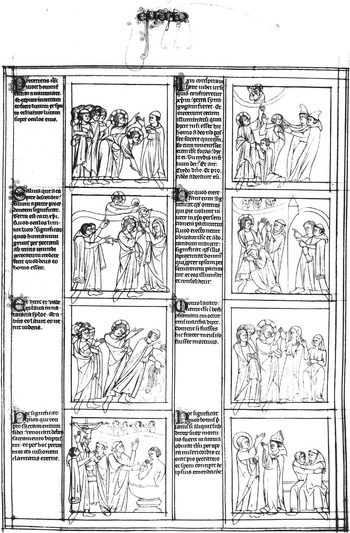
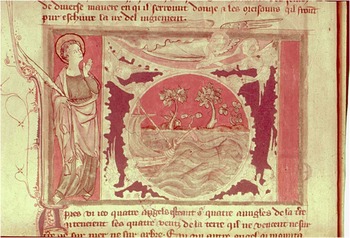
BL, Add ms 18719, Bible moralisée, fol 262v (1265–75). Photograph: © 2014 The British Library Board. All Rights Reserved

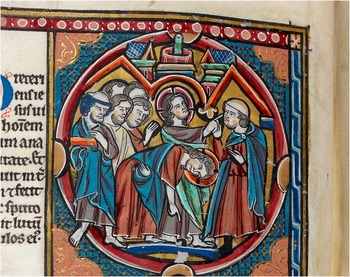
BL, Add ms 18719, Bible moralisée, fol 262v (detail): the Healing of the Man Born Blind (c 1270). Photograph: © 2014 The British Library Board. All Rights Reserved

BL, Add ms 18719, Bible moralisée, fol 254v (detail): the Feeding of the Five Thousand (c 1270). Photograph: © 2014 The British Library Board. All Rights Reserved

It remains a matter of conjecture, as no surviving documents survive, as to how the ‘Oxford, Paris, London’ copy of the Bible moralisée arrived in England and to whom it was given. Lowden has suggested, quite plausibly, that it was perhaps given as a wedding or betrothal gift on the occasion of the marriage of Eleanor of Provence to Henry iii of England in 1236. St Louis himself was married to Margaret of Provence, Eleanor's sister, and the rivalry mixed with alliance that this reflects during the period of Henry iii's reign is a well-known phenomenon.Footnote 8 It has also been suggested that it was the arrival of the Bible moralisée in England that provided artists close to the court with new iconographical models – some of which had never been used before in England.Footnote 9
THE MAN BORN BLIND
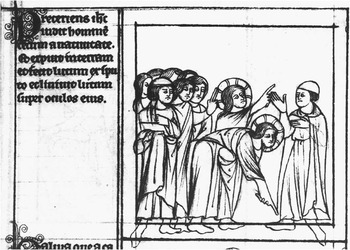
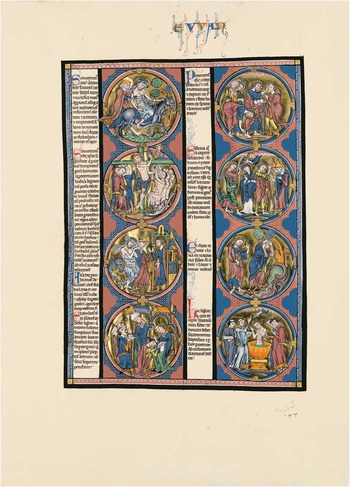
It can be demonstrated that the Bible moralisée provides a hitherto unknown source for the composition of the scene of the Miracle of the Man Born Blind depicted on the Westminster Retable, which confirms the hypothesis that a copy of the Bible moralisée provided compositional and iconographical models in England at this time.Footnote 10 The part of the Bible moralisée that contains the scene of the Healing of the Man Born Blind in the copy which was brought to England at some time after 1236 and certainly before c 1270, is contained in BL, Harley ms 1527 (fol 44v) (figs 15–17). It has a distinctive way of showing Christ bending down to mix his saliva with mud by pointing to the ground and then pointing to the eyes of the blind man. The same compositionally similar scene is depicted in the Toledo Cathedral copy of the Bible moralisée (the Biblia de San Luis, iii, fol 45v: figs 18–19), but this does not show the detail of the pointing hand.Footnote 11 It shows instead the closed hand of Christ and the application of the mud. This is important in itself, as it confirms Lowden's observation that the artist working on the copy made in England (that is, BL, Add ms 18719, fol 262v: figs 12–13) was working directly from the French copy contained in the ‘Oxford, Paris, London’ Bible moralisée (that is, the part contained in BL, Harley ms 1527: figs 15–16). Lowden has also demonstrated convincingly, through examination of underdrawings and incisions made in the Toledo and Harleian volumes, that individual compositions in these two books depend on drawings or a model book which is more loosely adhered to in the Harleian copy.Footnote 12
BL, Harley ms 1527, Bible moralisée, fol 44v (c 1236). Photograph: © 2014 The British Library Board. All Rights Reserved

BL, Harley ms 1527, Bible moralisée, fol 44v (detail): the Healing of the Man Born Blind (c 1236). Photograph: © 2014 The British Library Board. All Rights Reserved

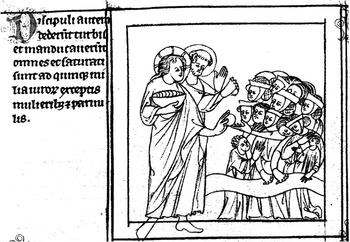
BL, Harley ms 1527, Bible moralisée, fol 30v (detail): the Feeding of the Five Thousand (c 1236). Photograph: © 2014 The British Library Board. All Rights Reserved
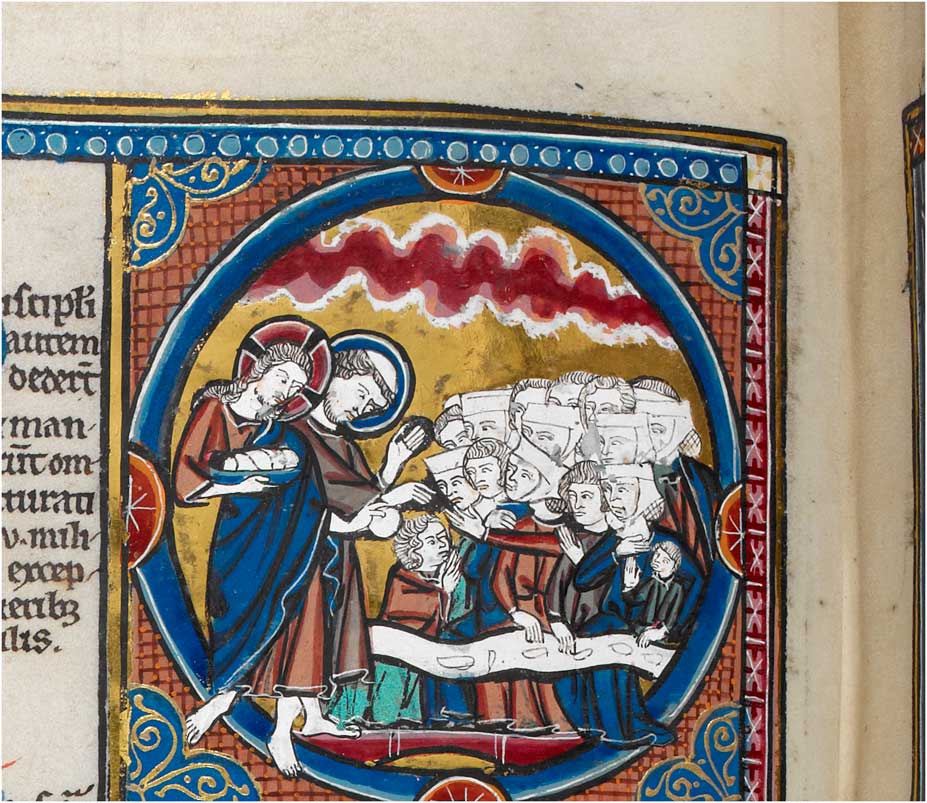
Toledo, Tesoro del Catedral, Biblia de San Luis, iii, fol 45v (c 1236). Photograph: The Bible of Saint Louis, fol 45v; © Moleiro.com

Toledo, Tesoro del Catedral, Biblia de San Luis, iii, fol 45v (detail): the Healing of the Man Born Blind (c 1236). Photograph: The Bible of Saint Louis, fol 45v; © Moleiro.com

It is the literalism of the scene itself that helps us better to understand its significance on the Westminster Retable. By showing Christ bending over, the iconography of the Man Born Blind diverges from the accepted format for this scene as depicted in all earlier representations in Christian iconography, in which Christ is seen either applying the mud or blessing the Man Born Blind. Moreover, in such scenes the Man Born Blind is shown later washing his eyes in the Pool at Siloam, often in continuous narrative.Footnote 13 The literalism of the scene in the Bible moralisée tradition may be an artistic response to the text of the moralisation, which demands a clear visual exposition of the actions of Christ in mixing his saliva with the mud rather than the normal emphasis on the moment of application and the subsequent scene of the blind man washing his eyes.
Saliva qui a capite descendit; filium a patre precedentem significat. Terra est caro Christi. Quod oculos linivit luto; significat quod humanum genus per peccatum ab initio mundi excecatum credere fecit quod deus eo homo esset.Footnote 14
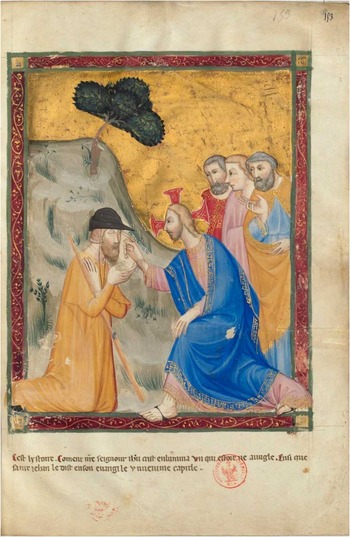
Christ does not point to the ground in the Retable scene. It is therefore noteworthy that this feature is also absent from the scene of the Healing of the Man Born Blind, similar in nearly all other respects, found in the Toledo copy of the Bible moralisée (fig 19). The fact that the blind man kneels in the Retable image is also significant in this respect. He does not do so in either the Toledo or the Harleian copy of the Bible moralisée, but he does so in the fourteenth-century Naples Bible moralisée (BN, ms Fr 9561, fol 153) (fig 20).Footnote 15 Comparison between the outstretched left back leg of Christ and the same figure in the Naples Bible moralisée reveals an uncanny resemblance, which looks more than coincidental as the awkwardness of the position of the foot (caught in action) is highly unusual (fig 21).
BN, ms Fr 9561, fol 153, the Naples Bible moralisée: the Healing of the Man Born Blind (c 1350). Photograph: © Moleiro Editor


Whether this means that the artist of the Retable had access to other Bible moralisée models or not is impossible to say. What is certain is that in all cases this particular iconography can be associated with Bible moralisée models and with no other source, and it seems that no earlier instances of the bending-down gesture can be associated with the iconography of the Healing of the Man Born Blind before its invention for use in the Bible moralisée.Footnote 16 If the artist of the Retable did not use the Harleian or Toledo models, it does, however, beg the question how else could he have been aware of this special composition created for the Bible moralisée? One explanation would be that he had learned this composition or carried it in his repertoire of models because he had been trained in France and, specifically, in Paris. Lowden's demonstration of the use of common models in the underdrawing of the Harleian and Toledo volumes also suggests that the artist of the Retable had access to these or similar models.
THE FEEDING OF THE FIVE THOUSAND
The scene of the Feeding of the Five Thousand also depends on the Bible moralisée and in particular on the composition of the scene found in BL, Harley ms 1527 (fol 30v: fig 17) and repeated in the copy of this composition found in BL, Add ms 18719 (fol 254v: fig 14). The elements that make this comparison so compelling are: the depiction of the group of the Five Thousand on the right as seated; the angle of inclination of the heads of St Peter and of Christ; and the central position of the circular loaf of bread. So close are these comparisons that it suggests that the artist of the Westminster Retable did not just use the general positioning of the figures, but appropriated these key compositional aspects of the design. The Eucharistic significance of the central round loaf is particularly notable for its importance in the interpretation of the scene on the Retable. It can also be argued that the rebalancing of the scene to fit the star-shaped field necessitates the inclusion of two heads inclined forwards instead of the one found in the Bible moralisée scenes. In this case there is no equivalent scene in the Naples Bible moralisée to compare with it, but the source in the Harleian and Additional Bibles moralisées suggests a full awareness of the scene and its moralisation through the emphasis on the Eucharistic symbolism of the bread that has been emphasised by the artist of the Retable.
THE RAISING OF JAIRUS'S DAUGHTER
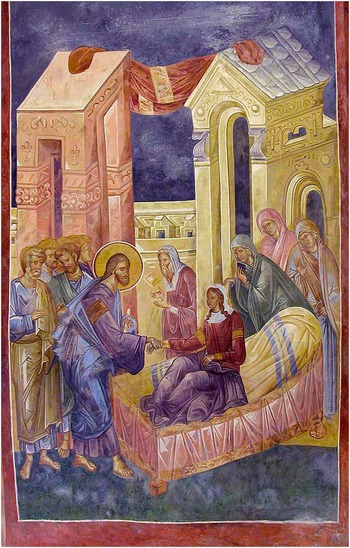
Perhaps because the Bible moralisée imagery does not emphasise the healing of Jairus's daughter in a pictorially transferable way, or perhaps because the artist of the Retable had already formulated a composition based on other sources, this scene cannot be compared directly with BL, Harley ms 1527, BL, Add ms 18719 or the Toledo Bible moralisée. What is notable, however, is that it does not follow the tradition of showing Jairus's daughter in her bed on the left-hand side of the scene – an arrangement that can be found in English examples such as the twelfth-century wall painting at Copford in Essex, or in the glass at Strasbourg Cathedral of the 1270s (window 10).Footnote 17 The closest parallels may be found in Byzantine cycles of the Life of Christ and those from an earlier tradition in the West, such as the ninth- or tenth-century cycle of miracles at St George in Reichenau-Oberzell.Footnote 18 This scene should also be compared compositionally with the scene of the Raising of Jairus's Daughter in numerous Byzantine examples, such as that from the Church of Christ in Chora, in Istanbul, which, although of the early fourteenth century, is compositionally very close to the scene on the Westminster Retable (fig 22).Footnote 19 An iconographically unrelated scene, which is compositionally close to both the Retable and later Byzantine examples of this scene, is the miracle of St Eustratios, from a later twelfth-century panel painting of the saint's life at St Catherine's Monastery, Mount Sinai. Of particular interest here is the richness of the bed and the gold-embroidered pillow of Jairus's daughter – a feature that is repeated in the Retable scene.Footnote 20
Istanbul, Church of Christ in Chora: the Raising of Jairus's Daughter (c 1315–21). Photograph: © Kariye Müzesi

CHRIST BLESSING WITH THE ORB OF THE WORLD BETWEEN THE VIRGIN AND ST JOHN
Since the recent technical analysis of the Westminster Retable, it has been possible to suggest more clearly that it was intended for use at the high altar of Westminster Abbey and that it was almost certainly made for installation in 1269, or soon after, when the altar was rededicated after the translation of the body of St Edward the Confessor from in front of the high altar to the Confessor's chapel behind the sanctuary.Footnote 21 The technical report has also shown that changes were carried out during the construction of the Retable so that it would fit the length of the new high altar. Extensions were made to accommodate the canopies and figures of SS Peter and Paul at the extreme left- and right-hand sides (figs 1 and 9).Footnote 22 Originally, it terminated with the star-shaped panels that accommodate the miracle scenes. As a panel without the terminal figures of SS Peter and Paul, the Retable has the form more commonly used in surviving French, Scandinavian, Catalan and Italian antependia rather than in retables.Footnote 23 It is impossible to say definitively, but this change may have altered the function of the panels that we now know as the Westminster Retable from antependium to altarpiece. In itself this is significant, as the form of the altarpiece was being created at this time all over Europe.Footnote 24 What is more certain is that the original scheme would have included at least the figure of St Peter, the patron of the Abbey, and the central section of the Retable would have been the only place where such a figure could have been placed. This suggests that the current iconography of the central panel may have been changed when the Retable was extended, not just by the addition of SS Peter and Paul but by moving them from the central section to the periphery.
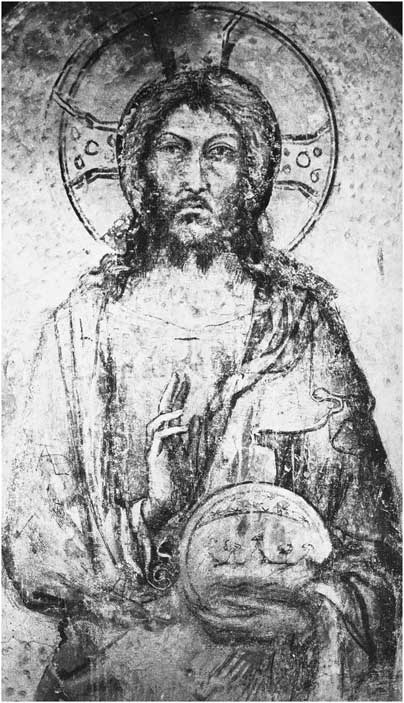
Of the numerous innovations found in the Retable, be they technical, compositional, decorative or iconographical, the depiction of the standing Christ Blessing and holding the Orb of the World (figs 5, 10 and 11) may be the most profound because of the resonance it has beyond the thirteenth century for European culture. The familiar label for such a figure is the ‘Salvator Mundi’, but there is no evidence for the use of this term in the thirteenth century and little evidence for it before the sixteenth century. The label ‘Salvator’ is associated with a figure of Christ Blessing and holding a globe executed by Dürer in about 1507, but this is in an inventory of 1573 (National Gallery of Art, Washington, DC).Footnote 25 No evidence that the term ‘Salvator Mundi’ was associated with early images of Christ Blessing with an orb can be found, although it has become a standard iconographical term used in modern times.Footnote 26 The image on the Westminster Retable appears to be one of the earliest pieces of evidence of such an image being used as a central theme on a work of art designed to be used as part of an altarpiece. It should be placed at the beginning of the development of the iconography that we now understand as the ‘Salvator Mundi’ in the thirteenth century, which is also linked to the devotional imagery of the Holy Face that became increasingly popular at this time.Footnote 27
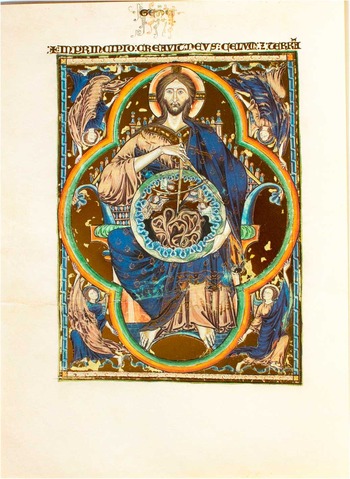
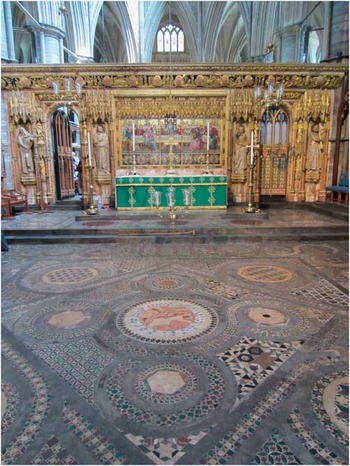
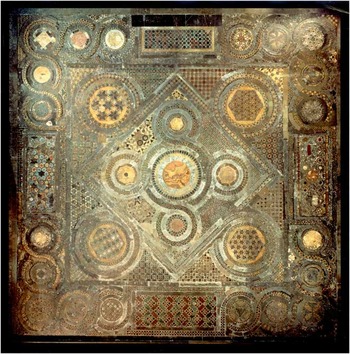
Michael Kauffmann has explored the use of imagery associated with Anglo-Saxon and Ottonian images of Christ/God holding an orb, but has rightly concluded that these images belong to a post-Carolingian tradition where the regalia of kingship (such as the crown and the orb and sceptre) become associated with the image of Christ/God and even the Virgin.Footnote 28 This tradition, going back to Roman images of rulers, was adapted and adopted during the Carolingian and Ottonian periods to emphasise the regality of Christ/God. The image on the Westminster Retable does not come out of this tradition, but can be traced to ideas that are first explored in the opening pages of all the surviving Bible moralisée manuscripts where the image of God as Creator of the World is depicted with compasses inscribing the circle of the universe. John Lowden has suggested that these images define the whole context of the decorative scheme of the Bible moralisée as each illuminated scene in these manuscripts is contained in a circle, as inscribed by Christ/God himself in the opening miniature (fig 23).Footnote 29 Lowden has gone on to show that BL, Add ms 18719 was used to inspire the image of Christ/God creating the world in the Holkham Bible picture book.Footnote 30 At Westminster the importance of the globe held by Christ/God as the orbis terrarum is particularly significant because of the Latin inscriptions incorporated into the Great Pavement in front of the high altar (figs 24–25).Footnote 31 At the centre of the pavement the inscription (in translation) reads:
Toledo, Tesoro del Catedral, Biblia de San Luis, iii, fol 1v: God as Creator of the World (c 1236). Photograph: The Bible of Saint Louis, fol 1v; © Moleiro.com

Westminster Abbey: the high altar and Great Pavement. Photograph: © Dean and Chapter of Westminster

Westminster Abbey: the Great Pavement. Photograph: © Dean and Chapter of Westminster

The spherical globe here shows the archetypal macrocosm.
Around it a careful, but obscure, reference to the creation of the pavement and all creation was also made:
In the year of Christ one thousand two hundred and twelve plus sixty minus four, the third King Henry, the city [ie Rome], Odoricus and the abbot put these porphyry stones together.
If the reader wisely considers all that is laid down, he will find here the end of the primum mobile [the ninth sphere of the heavens, moved by God]; a hedge (lives for) three years, add dogs and horses and men, stags and ravens, eagles, enormous whales, the world: each one following triples the years of the one before.Footnote 32
If the Retable were part of the scheme of refurbishment of the high altar ready for the translation of the relics in 1269 or soon after – and this seems increasingly likely – it would be an obvious iconographical innovation to show Christ holding the globe of creation in this context.Footnote 33
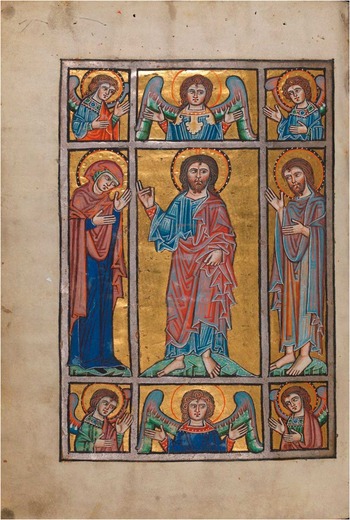
But there are other contexts which suggest that the moment of the invention of this iconography at Westminster on the Retable represented the coming together of a number of culturally diverse sources. The image of the standing Christ on the Retable forms part of a central focus which can be paralleled only in Byzantine art in the form of the Deësis (‘prayer’ or ‘supplication’), a Byzantine Christian Orthodox iconography in which Christ stands between the Virgin and St John the Baptist as intercessors through whom prayers may be addressed to Christ because of their familial relationship to Him.Footnote 34 This form of the Deësis had already been imported into western Europe in the thirteenth century and examples that appear to be direct copies of this Byzantine iconography can be found, for instance, in the Hildesheim Psalter (Stuttgart, Württembergische Landesbibliothek, Cod. Don. 309, 1235–40: fig 26).Footnote 35 The substitution of St John the Evangelist for John the Baptist suggests that the original meaning of this iconography was not necessarily transported with the appropriation of the composition.Footnote 36 The pairing of St John the Evangelist with the Virgin around a central Christ/God figure is more in keeping with the theme of the Last Judgement in western European Christian iconography, but it may have an even more obscure meaning here when the attributes of the Virgin and St John are considered as part of the iconography. Both carry palms, suggesting a link to the text of the Golden Legend where the palm is carried first by the Virgin and then given to St John the Evangelist, who gives it to St Peter.Footnote 37 The eschatological implications of the grouping are also apparent through St John's role as author of the Apocalypse. The use of the palm as a symbol carried by St John in images of him in English Apocalypse manuscripts of the thirteenth century suggests another way in which this symbol may carry meaning on the Retable.
The Hildesheim Psalter: Stuttgart, Württembergische Landesbibliothek, Cod. Don. 309, fol 185v: the Deësis (1235–40). Photograph: © Stuttgart, Württembergische Landesbibliothek

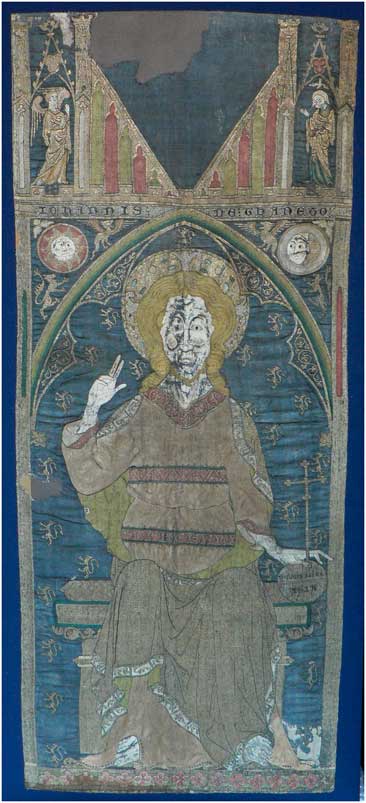
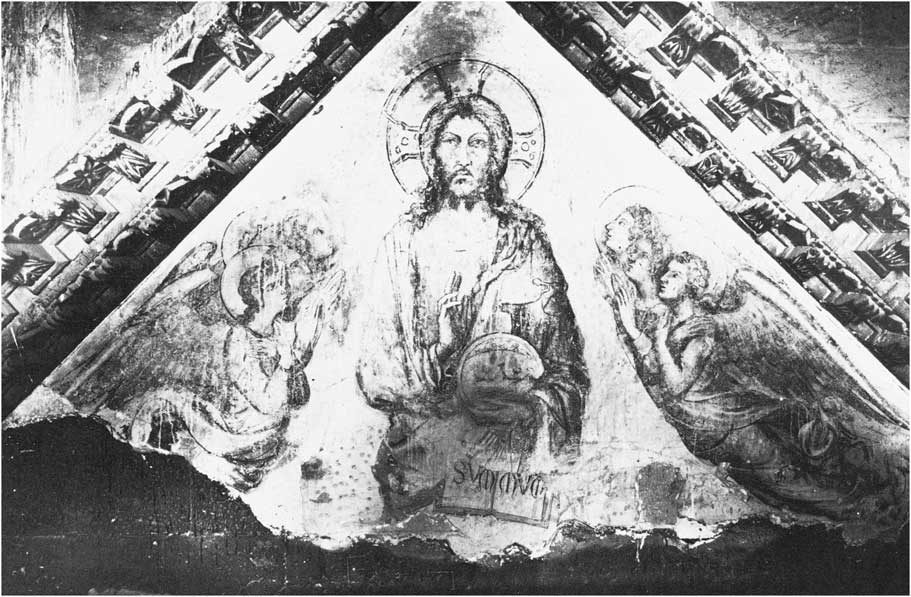
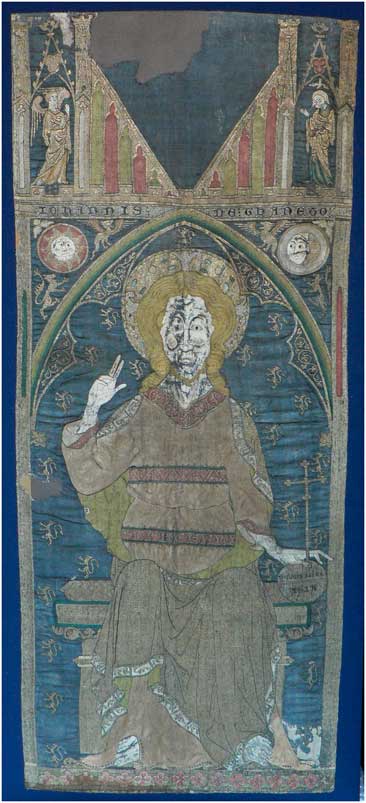
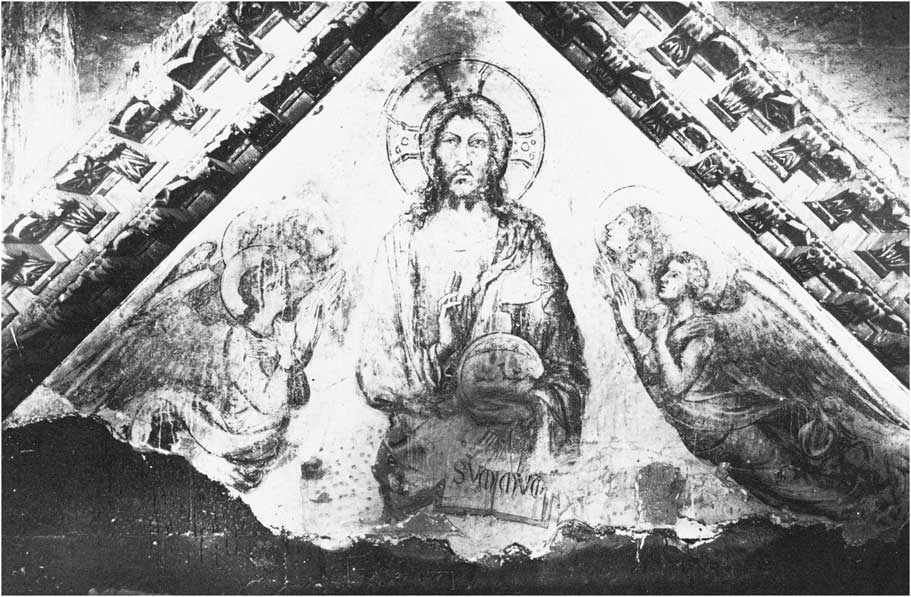
The globe held by Christ/God as Creator becomes a standard feature of English medieval art from this time onwards and can be found in numerous examples in illuminated manuscripts and opus anglicanum embroidery, such as the John of Thanet Panel in the Victoria and Albert Museum (fig 27).Footnote 38 It is perhaps through the intermediary of English embroidered textiles, which were known and admired at the papal court in Avignon, that the earliest and most famous manifestation of the image of Christ Blessing carrying the globe of creation was made outside England by Simone Martini around 1340 at Notre Dame des Doms (figs 28–29).Footnote 39 The humanity and delicacy of execution of the face and hands of Christ and the care taken in depicting the scene within the globe by the artist of the Retable is matched by Simone. However, as Andrew Martindale has pointed out, the first stage sinopia that has survived indicates that Simone changed his mind, or was instructed to alter his work, as Christ originally carried a book, in the style of ‘Pantocrator’ or as a Christ in Majesty figure. The normal text for such a book, seen in both Byzantine and western images, would be that of John 8: 12 – ego sum lux mundi (‘I am the light of the world’). As Martindale observed, this text was transferred (in an innovative iconography that was probably invented to suit these particular circumstances) to the scroll held by the Christ Child in the Madonna of Humility, which forms a pair as a lunette painting with the Christ Blessing carrying the globe.
The John of Thanet Panel: Christ Blessing with the Orb of the World (before 1319). Photograph: © V&A Images/Victoria and Albert Museum, London
Avignon, Musée du Palais des Papes (formerly Notre Dame des Doms): Christ Blessing with the Globe of the World, by Simone Martini (c 1340). Photograph: © Musée du Palais des Papes
Avignon, Musée du Palais des Papes (formerly Notre Dame des Doms): Christ Blessing with the Globe of the World (detail), by Simone Martini (c 1340). Photograph: © Musée du Palais des Papes
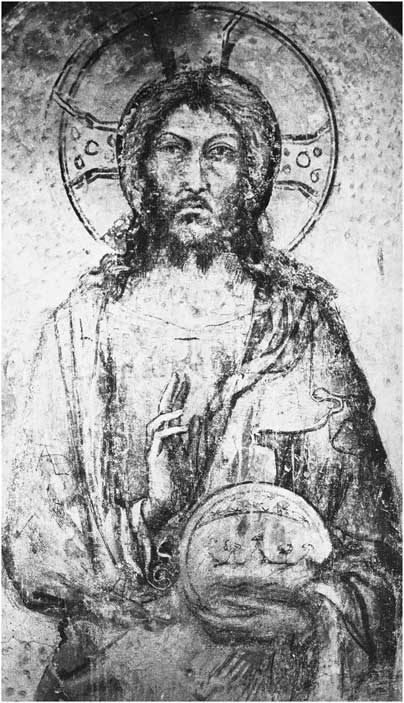
The necessity to transfer this redemptory message to the scene of the Virgin and Child does not, however, transform the meaning of the Blessing Christ from that of redeemer to ruler and judge.Footnote 40 That care was taken to make Him into a ‘creator’ of the world is shown in the detail included in the globe.Footnote 41 Martindale was right to note that no other examples of this type of globe seem to have survived before this time: only that on the Retable and that depicted by Simone Martini – but this may not be because there were many more that have been lost. It is important, therefore, to note again that the same components that make up the globe were used in English Apocalypse manuscripts of the Lincoln College group, made in all likelihood for courtly patrons after the image on the Retable was created (fig 30).Footnote 42
Oxford, Lincoln College, ms Lat 16, fol 150v (c 1330). Photograph: © Rector and Fellows of Lincoln College, Oxford

As Paul Binski has shown, the final chapter in the development of this iconography can be traced to the fifteenth century and Rogier van der Weyden's Braque Diptych, where the liturgical significance of the grouping of the Virgin, St John the Evangelist and Christ Blessing as creator with the globe of the world is made explicit through supporting inscriptions. The scroll held by the Virgin tells a story of praise, that of St John of Redemption.Footnote 43 On the Retable the palm-bearing of St John should be compared with the Apocalypse tradition in England where he is also shown carrying the palm, again in the same group of apocalypses that uses the globe imagery found on the Retable, but these all post-date the imagery on the Retable.Footnote 44 The palm-bearing Virgin tells another story. It refers to her Assumption through her conversation with St John where the palm given to her by the Angel Gabriel is offered by her to him, and his subsequent transference of this responsibility to St Peter:
I have heard say that the Jews have made a council, and said: ‘Let us abide brethren unto the time that she that bare Jesus be dead, and then incontinent we shall take her body and shall cast it into the fire and burn it’. Thou therefore take this palm, and bear it tofore [before] the bier when ye shall bear my body to the sepulchre … and John said to Peter: ‘Bear this palm tofore the bier, for our Lord hath ordained thee above us, and hath made thee pastor and prince of his sheep’. To whom Peter said: ‘It appertaineth better to thee to bear it, for thou art chosen virgin of our Lord, and thou oughtest to bear this palm of light at the exequies of chastity and holiness, thou that drankest at the fountain of perdurable clearness’.Footnote 45
It is perhaps too far to go to suggest that St Peter's gesture of pointing to the central panels reflects St Peter's statement to St John: ‘It appertaineth better to thee to bear it’, but the subtlety of the iconography of the Retable does not preclude this possibility.
INTERPRETATION
Several conclusions can be drawn from the evidence of the compositional and iconographical sources used to create the Westminster Retable. These seem to confirm Christopher Wilson's observations on the architecture and ornament of the Retable, which suggest that the artist and designer had his origins in France.Footnote 46
The first, and most important, is that there is clear evidence that the artist of the Retable knew of compositional models that were invented in the thirteenth century to illustrate the Bible moralisée. Although John Lowden has shown that a copy of the Bible moralisée was present in England from probably after 1236 and before c 1270, the particular composition of the Healing of the Man Born Blind and the pose of the Christ figure can be linked not with this particular copy, but with the Toledo Bible moralisée tradition and that which inspired the fourteenth-century Naples Bible moralisée. Although it is possible to suggest that the artist of the Retable saw the copy of the Bible moralisée contained in BL, Harley ms 1527, or the copy from it made in England, it seems equally possible that he already knew of the compositions in the Bible moralisée. If the latter is the case, it is likely that he was trained in France before he arrived in England, even if he painted the Retable in London, an indisputable fact made certain by the technical evidence.
It is clear also that the artist of the Retable was not merely copying from a manuscript or following instructions from an iconographer because of the extra detail he added to the compositions. The creation of the pool of mud in which Christ dips his hand to mix his saliva shows the imagination of the artist at work. The same process of decision-making can be seen in the scene of the Feeding of the Five Thousand. Here the positioning of the circular loaf of bread, with all its Eucharistic overtones, has been adapted by the artist to create a particular effect by its placement at the centre of the composition.
The Retable artist's sensitivity to the fresh iconographical models used in the Bible moralisée also suggests that he may have been party to discussions about the nature of the central scenes of the Retable and in particular the innovative depiction of Christ holding the globe of the world between the Virgin and St John the Evangelist. It seems clear that SS Peter and Paul may well have been initially intended to occupy the space next to Christ in the Retable's original configuration, as many examples of such a composition have survived from both Byzantine and western sources.Footnote 47 An artist who seems to have imbibed the spirit of the Bible moralisée to such an extent as to borrow both the iconographical meanings as well as the compositions from the commentaries to the moralisations in this book must also have understood the humanising and modernising effect of depicting Christ Blessing with such a detailed depiction of the world in his hand. That this fitted in with the plans for the Westminster Great Pavement also suggests the type of discussion that may have gone on between artist and patron about the iconography.
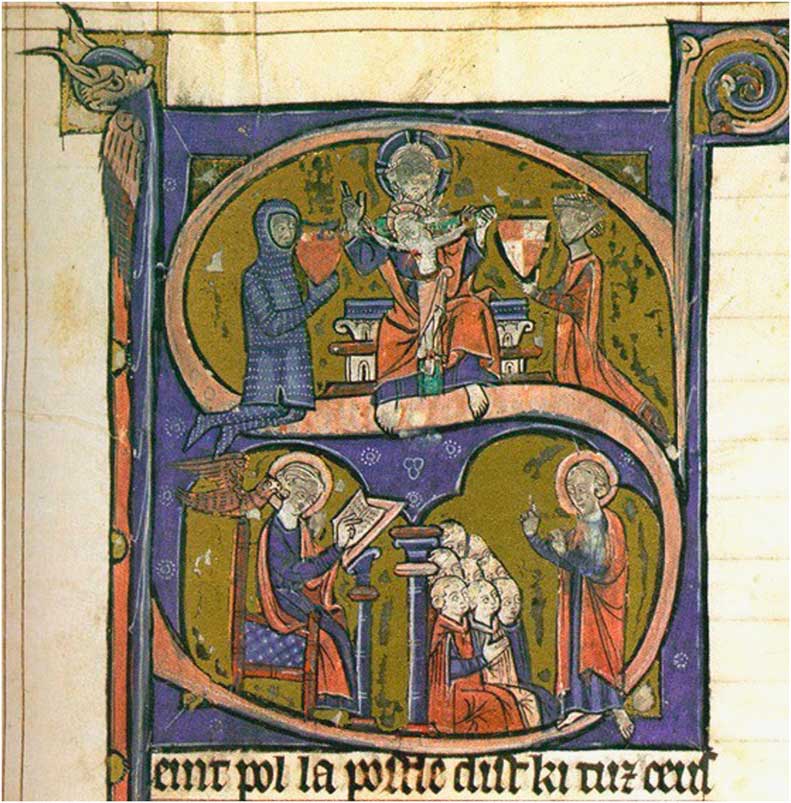
Most important of all in this discussion is the early date of the Retable, which appears to have been confirmed by tree-ring analysis as well as by the overwhelming evidence of comparative materials from Westminster Abbey itself.Footnote 48 The impact of the Retable was extraordinary in the history of English art. The technical and aesthetic impact of its design and figure style can be seen, for example, in the south transept wall paintings, in the tombs in the sanctuary and in the sedilia.Footnote 49 But the artist of the Retable also appears to have trained others, or inspired them to change their view of the world, as in the case of the artist of the Douce Apocalypse, for example,Footnote 50 who borrows hand gestures and head-types from the Retable. It is also interesting to note that the second artist of the Douce Apocalypse, who executed the initial containing portraits of Edward i and Eleanor of Castile in the prefatory French translation (fig 31), is very close stylistically to the artist of the single-volume Bible moralisée contained in BL, Add ms 18719. All of this suggests the type of exchange that was going on between court artists at the time.
Bodleian, ms Douce 180, initial to the French Translation of the Apocalypse: Edward i and Eleanor of Castile kneeling before the Holy Trinity, and St John preaching and writing the Gospel (before 1272). Photograph: © Bodleian Library, Oxford
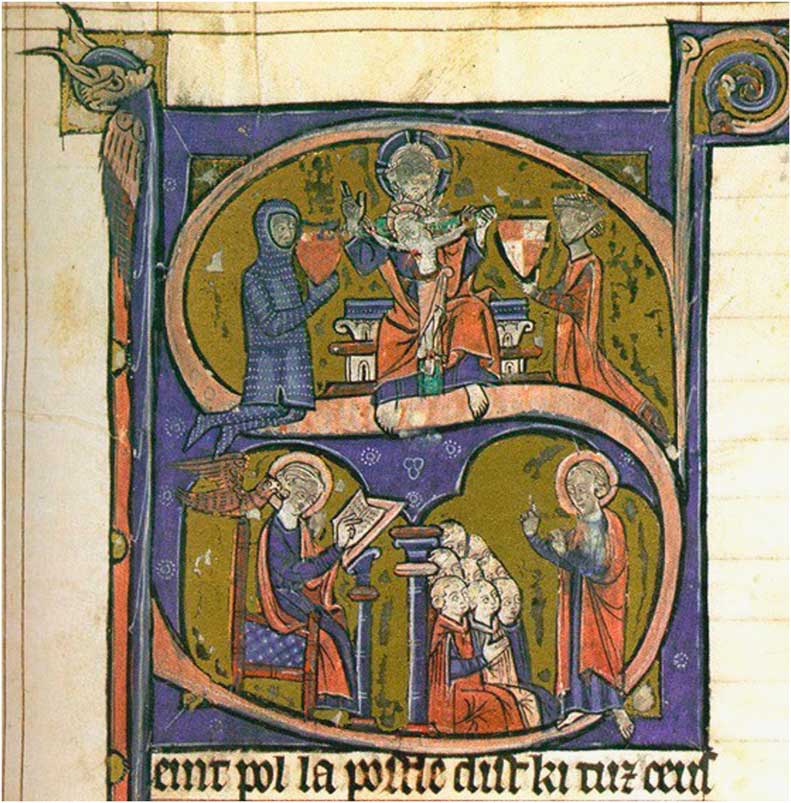
If, as many observers from Violet le Duc onwards have felt, the artist was trained in France, it is also time properly to reassess his impact on French painting, for it is difficult to imagine the work associated with the illuminator Maître Honoré without the sophisticated thinking and ability to visualise new and exciting concepts that is epitomised by the work of the artist of the Retable.Footnote 51 It seems unlikely that the innovatory modelling techniques and figure style combined with an interest in nature and three-dimensionality could have started life within the pages of Maître Honoré's illuminated manuscripts (and it seems increasingly likely that he himself may not have illuminated as many of these as was once thought).Footnote 52 All these observations suggest that the Retable itself, through its combination of features, from glass inlays to imitation cameos and the subtle use of oil paint, should be placed at the topmost point of avant-garde painting in the thirteenth century.Footnote 53 If, as seems likely, the artist of the Retable was French, then he should be understood as one of the most important figures in the history of European painting, rather than as an English artist who, to use an old art-historical term, ‘came under the influence’ of France. The artist of the Retable clearly worked in England, but it is time to reassess his work and the effect it had on European painting, particularly in France, if not on a wider scale.
ABBREVIATIONS AND BIBLIOGRAPHY
- Abbreviations
- BL
British Library, London
- BN
Bibliothèque nationale de France, Paris
- Bodleian
Bodleian Library, Oxford
- SAL
Society of Antiquaries of London
- Manuscript sources
- BL, Add ms 18719
- BL, Add MS 23069, George Vertue, Notebook
- BL, Harley ms 1527
- BN, ms Fr 9561
- BN, ms Lat 11560
- Bodleian, ms 270b
- Bodleian, ms Douce 180
- New York, Pierpont Morgan Library, ms M 240
- New York, Pierpont Morgan Library, ms M 360
- Oxford, Lincoln College, ms Lat 16
- Stuttgart, Württembergische Landesbibliothek, Cod. Don. 309
- Toledo, Tesoro del Catedral, Biblia de San Luis