


This address is about rules and organizations, core concepts in theories of institutions as rules. Economic historians have long understood that a handful of countries began to diverge economically and politically from the rest of the world in the late nineteenth century. We have debated why some countries grew, and other countries initially failed to grow and have subsequently failed to catch up. We know that political institutions, particularly the appearance of democratic governments and durable political parties, are strongly associated with improved economic performance. We know that the increase in economic productivity occurred in organizations rather than in atomistic individual endeavors. We also know that human societies became more complex and heterogeneous and, following Adam Smith, that heterogeneity combined with trade is a source of economic growth.
We do not know, however, how all the pieces fit together. A conceptual framework that combined, connected, and explained political and economic development together would be a big step forward.Footnote 1 This paper lays out an alternative framework for thinking about how organizations and rules interact with one another, how organizations structure relationships between each other by using rules, and how the entire rule and organization structure of society changes when agreements between powerful organizations become capable of creating and supporting impersonal rules: rules that treat everyone the same. In contrast, the form or enforcement (or both) of identity rules depends on the social identity of the persons to whom the rule applies. Governments in societies around the world before 1850 relied on identity rules. This paper explores the possibility that the adoption of impersonal rules in a small number of countries triggered economic and political development in the late nineteenth century.
This is a general approach to institutions as rules and organizations. Agreed-upon rules are defined as the result of deliberate agreements reached within organizations through a collective choice process. To be clear, this is not an approach to institutions as the “rules of the game” where norms, beliefs, conventions, and customs are taken as the rules of the game. Norms and the rest do matter when we try to understand how societies work. But when we stretch the concept of “rules” to include norms of behavior, for example, by calling norms “behavioral rules,” we tend to ignore important features of agreed-upon rules. Our institutional concepts have not included all of the relevant aspects of agreed-upon rules. Our theories, therefore, are incomplete. We have trouble seeing how the pieces fit together because we do not have all the pieces. As the saying goes, we have not been playing with a full deck.
Agreed-upon rules differ along four dimensions (a glossary follows). Identity and impersonal rules lie along one dimension of rules. The argument turns on how the agreed-upon rules that organizations create are or are not followed. We often attribute the institutional origins of growth and development to better rules enforced by more capable governments that produce more homogeneous and predictable behavior because people follow the rules. Homogenous, rule-following behavior is more predictable, enabling greater investment and innovation. Prescriptive rules are rules that are meant to be followed. Organizations devote resources to actively enforcing these rules. The implications drawn about homogeneous behavior are perfectly reasonable, but the approach to institutions that treats all rules as constraints on behavior ignores almost completely the fact that many rules are enforced but not followed. Default rules are rules that are enforced but not necessarily followed. Organizations create default rules, then do not devote resources to ensuring that they are followed and impose no penalties on behavior that does not follow the rule. A major empirical finding in the sociology of organizations is that organizations spend substantial resources creating rules that no one follows. Default rules are everywhere. Prescriptive and default rules lie along the second dimension of rules.
A default rule provides an outside option that parties in a relationship can invoke but do not have to follow. For example, two people might write a contract that states that goods will be delivered each day by 5:00 pm or a penalty will be imposed. In practice, goods are delivered at different times each day, sometimes before and sometimes after 5:00, and occasionally even the next day. As long as the relationship between the two people creates enough value for each party, the rule is not enforced. No court or policeman devotes resources to check that the contract is enforced. If, however, the relationship breaks down, one party can go to court and claim the penalty damages. In the example, the time of day clause provides both parties with better information about what will happen if their relationship breaks down and the default rule is invoked and therefore enables them both to enter into a more productive agreement with each other because the outside options can be more clearly specified.Footnote 2
The key connection between impersonal rules and default rules is that an impersonal default rule provides clearer predictable outside options for individuals in a relationship without forcing their behavior to conform to the actual rule. As a result, an impersonal default rule can support more heterogeneous and productive behavior and organizations. Drawing out these implications takes up the first part of the paper.
All agreed-upon rules are created within organizations. Mothers and fathers agree to rules that apply within a family, rules that apply to their children without the children’s consent. Agreed upon does not imply consent. All organizations have what Reference HartHart (1961/1994/2012) calls secondary rules: the rules for making the rules. What distinguishes a group of people from an organization is an agreement between members of an organization to adopt some rules to govern their interactions. Secondary rules are the rules they adopt for making and changing rules, primary rules are the rules that actually govern their behaviors. Primary and secondary rules lie on the third dimension of rules.
Organizations adopt rules to increase the value of relationships within the organization. These are internal rules. Organizations often interact with other organizations and adopt rules to help coordinate their interactions, to create an organization of organizations. Within these agreements, it sometimes happens that rules created and enforced by one organization are used by another organization to increase the value of relationships within the organization using the rule. These are external rules to the using organization. These are rules that an organization can use internally, but rules created and enforced by another external organization. Internal and external rules lie on the fourth and final dimension of rules.
The second part of the paper develops the concept of external rules. It explains why it may be difficult for any organization to create and enforce internal rules, particularly impersonal rules. The difficulty follows from an inherent conflict between the enforcement of rules and the importance of relationships within organizations. As a result, organizations would like to access external rules and, in large societies, groups of organizations often reach agreements with each other to create a coordinating organization that will enforce external rules for the organizations within the group. Governments are a prime example of a coordinating organization, but they are not the only type of coordinating organization. Governments are organizations whose essential function is to provide a venue for reaching agreements about rules through a collective choice process and then enforce those rules in agreed-upon ways. This is not a Hobbesian or Weberian definition of government.Footnote 3 In most societies, powerful organizations reach agreements between themselves to form a government or governments to create and enforce external agreed-upon rules that the members of the agreement can access.
Unfortunately, for reasons that are explained, in most societies, the government organizations are only able to create and enforce identity rules, and the rules governing the economy privilege some individuals and organizations over others. The rules that govern the economy do not apply equally to everyone. Those rules are designed to solve political problems: creating and maintaining more stable relationships between powerful, dangerous organizations, and at the extreme, limiting them from using violence against one another. This is the logic of the natural state developed by North, Wallis, and Weingast (2009). Before the mid-nineteenth century, there were no societies with governments capable of creating and enforcing impersonal rules on a broad scale, and, as a result, there were very few external impersonal default rules available to organizations to coordinate their internal relationships and their external relationships with other organizations.
The last part of the paper considers what happens when a society adopts impersonal rule provisions: impersonal rules covering broad areas of society. Only brief consideration is given to why a society might adopt impersonal rules. Attention is focused on the implications of adopting impersonal rules for the economic and political system and how they were sustained. In a natural state, identity rules are used by the political process to create rents. What happens when the political process can no longer use identity rules to build a majority or a consensus necessary to create a new rule or amend an existing rule? Rather than reaching agreements about rules and laws that apply narrowly to specific individuals, groups, or organizations, political leaders must now forge more complicated agreements that apply equally to everyone. In order to reach more complex and longer-lived agreements, political organizations must themselves become longer lived.
Before impersonal rules, the political organizations that contend for control over governments and influence policies are narrow, fragmented, and numerous factions. When impersonal rules provisions are adopted, political factions transform into modern political parties that are longer lived, durable organizations, that are fewer in number, and are committed to maintaining three specific sets of agreed-upon rules: institutional rules that support competitive elections, create political control of government organizations, and mandate impersonal rules. The agreements between the parties enable all of the major parties to lose elections without fearing that they will be suppressed by the winning party. The agreements they create form a new type of party system. Over time, the agreements dramatically reduce political uncertainty because the parties that control access to the government, as well as the formation and amendment of agreed-upon rules, now agree not to threaten or coerce each other.
If these ideas are correct, then adopting impersonal rule provisions should result in a series of predictable changes in the organization of both the economy and the political system. After drawing out these implications, the last part of the paper considers them in light of the development of party systems in the late nineteenth and early twentieth-century Europe, using the extensive political science studies of those systems. The societies that initially adopted impersonal rule provisions all subsequently adopted or strengthened the sets of agreed-upon rules governing elections, government administration, and impersonal rule provisions. Societies that did not adopt impersonal rules, did not adopt substantial changes in any of the three areas.
Modern societies are composed of extensive networks of organizations coordinated by impersonal external default rules. The changes result from explicitly agreed-upon rules that we can readily observe in legislative and political records. The alternative approach to institutions as agreed-upon rules presented here enables us to develop a conceptual framework capable of integrating economic and political development and, potentially, a better explanation for why development took off where it did and not elsewhere.
ALL KINDS OF RULES
Default Rules
Institutions defined as rules that are followed is a fundamental starting point in the institutional literatures in law, philosophy, history, anthropology, sociology, political science, economics, as well as economic history.Footnote 4 Institutions coordinate human relationships because if people follow the rules, then their behavior is more predictable, and expectations about how others will behave are more reliable and accurate. The intuitive importance of institutions in human societies in all the literatures rests on the effectiveness of institutions to support homogeneous, stable behavior: if everyone follows the rules, their behavior is homogeneous and, therefore, predictable.
Unfortunately, many rules in every society are created by collective action agreements and then not necessarily followed.Footnote 5 Our tendency to ignore default rules and focus on prescriptive rules flies in the face of overwhelming empirical evidence from the sociology of organizations that organizations devote significant amounts of resources to rules that are enforced but not followed. Mark Granovetter (Reference Granovetter1985) famously wrote that anyone who believes that organizations follow all the rules they create were “sociological babes in the woods” (p. 502). Both Meyer and Rowan (Reference Meyer and Rowan1977) and DiMaggio and Powell (Reference DiMaggio and Powell1983) frame their fundamental papers as addressing why organizations create so many rules that are not followed.
Groups of people exist in every society. Organizations are groups of people who adopt rules to order some of their relationships. Organizations are the source of all rules. Secondary rules are the rules for making rules. All organizations create agreed-upon rules that result from the collective action process governed by the secondary rules. Primary rules are the rules that directly affect how people relate and interact with one another.
The easiest way to understand default rules is with a concrete example. When I was younger, I spent several years working construction jobs. I was a member of the Laborer and Hod Carriers union, the lowest rung of the construction unions. There was also a Carpenters Union. Each laborer/carpenter pair reaches a unique agreement about how they will work together. Each laborer/carpenter pair is an organization with its own agreed-upon rules.
The laborer/carpenter pairs are embedded in three other levels of organizations: the firms they work for, the two unions whose work rules govern their relationship, and the state government, whose health and safety rules affect their behavior. In each case, the rules at the external levels of society affect the relationships and the productivity (positively or negatively) of the carpenters and their helpers. The external rules thereby affect the productivity of the construction process within the firm. Each laborer/carpenter pair is embedded in a larger organization ecology, as shown in the left-hand column of Table 1. The rule environment contains all the rules in the organizational ecology, shown in the right-hand column of Table 1. Together they make up the rule and organization matrix.
THE ORGANIZATIONAL ECOLOGY AND RULE ENVIRONMENT OF LABORERS AND CARPENTERS WITH RESPECT TO DRIVING NAILS: THE RULE AND ORGANIZATION MATRIX
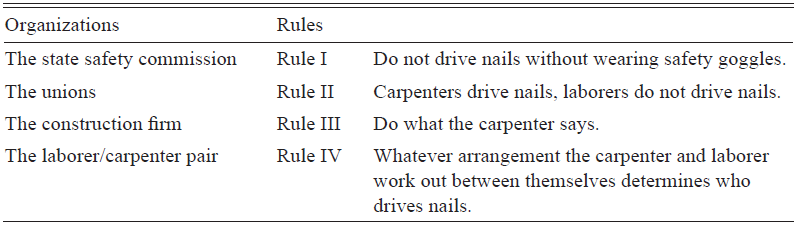
While every organization has its own unique internal rules, all the rules in the organizational ecology potentially interact. Employment on a union construction site involves lots of rules. On a big project, union representatives and state safety officials make regular visits to check that the rules are being followed. And yet, many of the rules are not followed to the letter. Not all the rules can be followed because the rules at different levels are not always in agreement with one another. Rules within the matrix are often in conflict with one another, what we can call incongruent rules.
The simplest example is hammering (driving) nails. It is very clear from the union rules that carpenters are supposed to drive nails—laborers are not.Footnote 6 Laborers always carry hammers, however, and laborers are often asked to drive nails. Why is there a clear union rule prohibiting laborers from driving nails when it is equally clear that they often do? When a laborer drives nails, it is not thought of as breaking the rule, even though everyone involved understands the union rules about driving nails. Every laborer/carpenter pair works in the rule environment in Table 1. The union nail rule is an external rule that allocates authority over the decision about who drives nails to carpenters. The nail rule a laborer/carpenter pair actually agree to can be incongruent with the union nail rule because the union nail rule is a default rule. It is always there but only applies if either the laborer or the carpenter disagrees and decides to access the rule.
Default rules provide outside options in relationships. That is critical to understanding how default rules enhance coordination. Whether a laborer drives nails or not depends on the unique relationship between individual carpenters and laborers. Disputes between laborers and carpenters, however, will be resolved in favor of the carpenter, so disputes rarely arise. Because that issue has already been settled by the default rule, laborers and carpenters can more easily reach agreements about how they will work together because the issue of who has the ultimate decision-making authority has already been decided. In practice, the nail rule gives laborers and carpenters a place to begin their relationship and gives them a clearer idea of what will happen if their relationship ends.
The nail rule seems pretty trivial until you think about it. At any specific firm, laborers and carpenters are transitory. Since new laborer/ carpenter pairs are created quite often, by giving the carpenter discretionary authority from the beginning, new partners do not have long involved discussions about how they should work together. As the relationship deepens and matures, the relationship changes and the nail rule can accommodate a range of behavior. All kinds of coordination within the construction firm are ordered by hundreds of similar rules. The rules increase the productivity of every laborer/carpenter pair because the default rules allow individual laborer/carpenter pairs to work out the arrangement that works best for them. A single default rule can support multiple and heterogeneous relationships.
It is very important to understand that the union nail rule only enhances coordination because it is not always followed. The opportunity to use rules in this fashion only exists if the rules are incongruent, if the rules across the rule environment do not agree with one another completely. Having a union rule that is incongruent with the agreements laborer/carpenter pairs reach actually reduces disputes between laborer/carpenter pairs and enhances coordination and productivity. In order for the union nail rule to work, all the laborer/carpenter pairs and construction firms must have access to the third-party rule enforcement that the unions provide.
This does not mean that all union rules are default rules. Many union rules are prescriptive. Unions devote resources to seeing that some of their rules are enforced, and those rules do not always lead to higher productivity. Nor does it mean that all default rules increase productivity either. What matters is whether the union nail rule is enforced as an identity rule or an impersonal rule.
THE DYNAMIC RELATIONSHIP BETWEEN ORGANIZATIONS AND RULES
External Rules and the Interaction of Rules and Relationships
If impersonal default rules improve the productivity of the firm, why doesn’t the firm just adopt the union nail rule? That is a very good question. If the firm enforced a default nail rule, where the carpenter always had the right to decide, however, then the firm would face the problem of enforcement. Could situations arise in which it was better, for whatever reason, for an individual construction boss to overrule a carpenter and let a laborer drive nails? Any rule works better as a coordinating device the more predictably it is enforced. Work units in construction firms, even large ones, tend to be small and develop complicated interactions between individuals over time. Changing relationships within the firm may make it difficult or impossible to enforce the rule. When I first talked about this to my wife, I asked her to suppose she was the foreman of a construction gang. There was a laborer everyone liked and a carpenter who was a jerk. By enforcing the rule against the carpenter, she might induce the carpenter to leave the firm. I didn’t even finish the example, as she immediately replied “rule against the carpenter, get rid of the jerk. Relationships drive rules, not the other way around.”Footnote 7
This is a serious issue in all organizations. Organizations are concerned with maximizing the value of relationships, and if a rule reduces the value of relationships, the rule will be ignored and not enforced, even in cases of a dispute.Footnote 8 Often, however, it is not possible to adopt rules that always maximize the value of relationships over time for a very simple reason: relationships develop and change over time, while effective rules must be predictable over time. Predictable default rule enforcement is just as important as predictable prescriptive rule enforcement. Relationships are complicated. They involve more than just the direct interaction between two individuals, although they certainly involve that. Relationships involve norms of behavior, shared and individual beliefs about how the world works as well as how the world should work. Individuals develop relationships that are idiosyncratic as well as shared. Often a changing relationship will be more valuable in specific circumstances if the agreed-upon rules are not followed or enforced. Rules whose form or enforcement are expected to change in unpredictable circumstances, however, are less effective coordinating tools. This is what is meant by saying relationships may erode (or corrode) rules.
The solution to the problem depicted in Table 1 is for the construction firm to kick the enforcement problem upstairs to the unions by using an external rule. If the unions enforce their nail rule impersonally, then the construction firms can use the external union rule to enhance the value of heterogeneous relationships within the firms. If the unions are insulated from the relationships that make a default nail rule unenforceable at the level of the construction firm, then the presence of the external rule can make relationships more valuable at the level of the firms and laborer/carpenter pairs.Footnote 9 Relationships within the firm will not erode the efficiency of the rule within the firm because rule enforcement has effectively been insulated from the relationship. Is this problem serious enough to worry about?
The Institutional Literatures
In North’s (1990) definition of institutions as the rules of the game, there are formal and informal rules. In a rough way, formal rules are agreed-upon rules reached within an organization following its secondary rules. Informal rules are norms, conventions, beliefs, customs, culture, and the like. Informal rules arise out of patterns in the relationships between individuals. The philosopher David Lewis’s (1969/2002) concept of Conventions is a beautiful example of this logic. Will people drive on the left side or right side of the road if there is no rule? Lewis shows how, if even slightly more people drive on the right than the left, people’s expectations about how others will drive can lead to a self-enforcing norm of behavior, an equilibrium, where everyone drives on the right. Norms, conventions, beliefs, values, and culture are all examples of these social forces that arise unintentionally out of social interactions. Emile Durkheim (Reference Durkheim and Halle1982) insightfully called these forces “social facts.”Footnote 10
To keep these social forces that work without human intention conceptually distinct from agreed-upon rules, I will call these forces relationships. All of the norms, conventions, customs, cultures, values, and beliefs that come under the informal rule umbrella are phenomena rooted in people’s relationships with and expectations of how other people will behave, whether those relationships are repeated or not.Footnote 11 These kinds of relationships (norms, beliefs, etc.) always exist within organizations. Relationships also exist outside of organizations, like Lewis’s norm of driving on the right. In contrast, agreed-upon rules cannot exist outside of organizations. How do rules and relationships interact within organizations?
The sociologist Philip Selznick suggested that “The most striking and obvious thing about an administrative organization is its formal system of rules and objectives. Here tasks, powers, and procedures are set out according to some officially approved pattern… The term “organization” thus suggests a certain bareness, a lean, no-nonsense, system of consciously co-ordinated activities. It refers to an expendable tool, a rational instrument engineered to do a job” (1957, p. 4, emphasis in original).Footnote 12 He then defines institutions: “institutionalization is a process. It is something that happens to an organization over time, reflecting the organization’s own distinctive history, the people who have been in it, the groups it embodies and the vested interest they have created, and the way it has adapted to its environment… In what is perhaps its most significant meaning, ‘to institutionalize is to infuse with value beyond the technical requirement of the task at hand’” (pp. 16–17, emphasis in original).
What Selznick calls an organization is the bare, lean, consciously agreed-upon rules. What Selznick calls institutions are the relationships that develop as norms of behavior, as beliefs about appropriate behavior and roles, and as values that are shared (or not) among the members of the organization. As organizations develop, they acquire histories, and the agreed-upon rules are supplemented by relationships. For Selznick, the term “organization” describes the core set of agreed-upon rules in an organization, and the term “institution” describes the relationships that grow up around those rules. Organizations are bare and lean, and institutions are complex, dynamic, and idiosyncratic bundles of relationships.
In contrast to Selznick, Doug North defines institutions as the rules of the game: “Institutions are the rules of the game of a society or more formally are the humanly devised constraints that structure human inter-action. They are composed of formal rules (statute law, common law, regulations), informal constraints (conventions, norms of behavior, and self imposed rules of behavior); and the enforcement characteristics of both” (North Reference North1992, p. 4). North (Reference North1990) further distinguishes rules that are “created” (deliberately devised) and rules that “evolve” but are not designed or devised.
North needed to explicitly separate organizations from institutions in order to articulate his theory of institutional change. For North, organizations are actors. Organizations result from the historical development of both rules and relationships. Institutions are rules. Organizations, and their relationships, are the players.
Inadvertently, North inverted Selznick’s (and the organizational sociologist’s) definition of institutions and organizations. (You can see why it is important to know what the words mean when reading across the different institutional literatures.) Both, however, acknowledge a fundamental tension between rules and relationships, as in this long quote from Selznick:
But as we inspect these formal structures we begin to see that they never succeed in conquering the non-rational dimensions of organizational behavior. The latter remain at once indispensable to the continued existence of the system of coordination and at the same time the source of friction, dilemma, doubt, and ruin. This fundamental paradox arises from the fact that rational action systems are inescapably imbedded in an institutional matrix, in two significant senses: (1) the action system-or the formal structure of delegation and control which is its organizational expression-is itself only an aspect of a concrete social structure made up of individuals who may interact as wholes, not simply in terms of their formal roles within the system; (2) the formal system, and the social structure within which it finds concrete existence, are alike subject to the pressure of an institutional environment to which some over-all adjustment must be made. The formal administrative design can never adequately or fully reflect the concrete organization to which it refers, for the obvious reason that no abstract plan or pattern can-or may, if it is to be useful-exhaustively describe an empirical totality. At the same time, that which is not included in the abstract design (as reflected, for example, in a staff-and-line organization chart) is vitally relevant to the maintenance and development of the formal system itself. (Selznick (Reference Selznick1948, p. 25), italics of the word “whole” in original, the other italics are added emphasis.)
For both Selznick and North, some interactions and relationships between people are governed by rules that people deliberately design and can deliberately change. Other interactions between people are governed by relationships that result from human action but are beyond the ability of individuals or groups to deliberately change (that “within which it finds concrete existence”). Rules and relationships are very different social processes. Rules are agreed to: the result of deliberate collective action. Relationships evolve: sometimes in deliberate ways, but often as the result of unintended patterns of behavior. The potential conflict between rules and relationships is not a theoretical one; it is inherent in the reality and behavior of organizations.
External Rules in the Rule and Organization Matrix
Moving rule creation and enforcement into an external organization may have significant benefits to organizations—if by doing so, rule enforcement can be insulated from relationships within the organizations utilizing external rules. If so, we expect to see groups of organizations with relationships to each other banding together to form a new organization in their midst, a new organization capable of creating and enforcing rules that the member organizations can use as external rules. These coordinating organizations will still face the problem that relationships erode rules but may at the margin be able to insulate rule enforcement from the relationships in the member organizations and enforce rules more predictably. Governments, of course, are organizations whose essential feature is to provide external rules and rule enforcement for other organizations in society. Establishing and operating coordinating organizations is not easy, and many do not work well. It is easier to see the logic if we look first at a purely private coordination organization that appears to work well.
Lisa Bernstein examines a number of industry groups that have collectively established trade organizations to create and enforce rules for their members. These organizations exist in the context of a larger, impersonal rule society but are, nonetheless, able to establish rules that enable private ordering between the organizations. Bernstein (Reference Bernstein2001) studies how private legal systems in the cotton market support relational contracting in the marketing of raw cotton and cotton milling.Footnote 13 The cotton industry does not use the government courts or the Uniform Commercial Code to resolve internal disputes. Two trade associations have been created by the firms in the raw cotton marketing and cotton milling industries. Raw cotton is an extremely variable commodity. Merchants and mills reach detailed verbal agreements about the kind of cotton to be delivered, but detailed contracts are not drawn up. Personal reputation matters enormously to parties on both sides, and it is the value of relationships between merchants and mills that usually results in fulfilled agreements. When disputes arise between merchants and mills, they are resolved by an arbitration court run by the associations with clearly defined external impersonal default rules. Members of the association must submit to arbitration as a requirement for membership. The arbitration court is the coordinating organization established by the agreement between the merchants and mills. The cotton textile industry deliberately created a corner of the rule and organization matrix where external rules could be used to better coordinate within and between organizations.
Despite the intensely relational and reputational-based nature of exchange in the cotton market, the association rules for arbitrating disputes take no account of reputation, relationships, norms, or the customs of the cotton trade. The rules are cut and dried, formalistic, and applied as narrowly and legalistically as possible: “First, the industry-drafted trade rules do not, for the most part, include the types of standard-like words, such as ‘reasonable,’ ‘seasonable,’ and ‘without objection in the trade,’ that permeate the [Commercial] Code. Rather, they contain primarily clear, bright-line rules” (Bernstein Reference Bernstein2001, pp. 1732–33).
Bernstein argues the rules enforced by the trade associations do not conform to the practices that the members actually use when they contract with each other. The trade association rules are incongruent default rules within the rules environment that rarely need to be enforced and that facilitate relational contracting. Whether the trade association court is higher or lower in the matrix than the member organizations is not clear, and it really doesn’t matter. The court is an organization that publicly signifies an agreement between its member organizations about rules. Its role is to better coordinate the relationships between its members by creating a set of clear and predictable external impersonal default rules.
Governments as Coordinating Organizations
Is it possible for powerful organizations to create an organization in their midst, like a government, that will enforce impersonal rules? An organization that can credibly be insulated from the corrosive effects of relationships on rules? Unfortunately, the answer appears to be no. Worse than no, it appears in most societies as you move up the rule and organization matrix that organizations become systematically less capable of supporting impersonal rules and more dependent on identity rules. In most societies, powerful organizations are embedded in a set of relationships with other powerful organizations based on identity rules.
North, Wallis, and Weingast (2009) explained how powerful organizations were able to coordinate on agreements that limited violence between them: the logic of the natural state. The biggest threats to powerful organizations are each other. The organizations might like to agree to a set of rules that proscribe violence, but such rules are not credible as all the powerful organizations will use violence if it suits their purposes. The powerful organizations agree to create and recognize a coordinating organization, a government, that signifies, clarifies, and enforces their agreement. To limit violence, the agreement devises rules that create different and specific rents for specific organizations. If the agreement breaks down, the specific rents disappear. Every member organization, therefore, has some incentives to honor their promise to coordinate through the agreement and not use violence.
The agreement creating the coordinating organization creates external rules that the member organizations can access. One of the most valuable privileges elite organizations possess is the ability to access the external rules that the coordinating organization will enforce. Connections between elite organizations and the coordinating organizations enable elites to access, or not access, the external rules. Access to these rules is limited to elite organizations by the very logic of a natural state. Limits on the ability of organizations to access rules are a key part of the rule and organization matrix.
The agreements creating privileges for elite organizations are only viable if the rules and the rents they create are consistent with the relationships between elite organizations. In natural states, the first priority of elite agreements and coordinating organizations (governments) is to maintain peaceful and stable relationships between powerful organizations. If circumstances change and the relationships between the powerful organizations change, then elite agreements and the rules the agreements create must either change or break down.
Relationships drive rules. The central contribution of Violence and Social Orders is the logic of the natural state: explaining why most societies have a core of elite economic, political, and social organizations that dominate the society and coordinate with each other through identity rules. Natural states are not corrupted forms of modern societies. They are the way that humans figured out to provide a modicum of social order and begin to achieve increases in social scale that enabled them to realize the gains from specialization, division of labor, and comparative advantage that come with increasing heterogeneity. The key advantage that natural states create is to support the establishment of coordinating organizations that can provide external rules to a larger group of organizations.
The logic of the natural state, however, implies organizations higher in the rule and organization matrix of society will be more dependent on identity rules. The destabilizing and corrosive effect of relationships on rules becomes more, not less, pronounced the higher in the matrix organizations are located. This is why agreements at the top of the rule and organization matrix are so fragile, even in stable identity rule regimes. Circumstances always change, and relationships between elite organizations require changes in the agreed-upon rules.
How did a few societies get out of this dilemma? How did the existing organizations create new agreed-upon rules and coordinate organizations in which the dynamics of relationships would lead to coordinating organizations that could credibly and incorruptibly sustain external, impersonal rules?
FACTIONS, PARTIES, IDENTITY RULES, EXTERNAL RULES, GOVERNMENTS, AND THE TRANSITION TO IMPERSONAL RULES
The last part of the paper lays out explanations for why societies first moved to impersonal rules and how impersonal rules were sustained. The why and how questions have very different answers. Impersonal rule provisions were not inherently self-enforcing. We can be fairly sure that impersonal rules were not initially adopted because people expected substantial economic benefits to follow. No one knew that would happen. But economic benefits did follow the adoption of impersonal rule provisions because impersonal rules led to changes in the organization of the economy. Those economic changes eventually led to the transformation of political organizations in ways that made impersonal rule provisions sustainable outcomes. We can draw two pictures of how a society’s economic and political systems look before and after the adoption of impersonal rule provisions. The hypothetical pictures can then be compared to how societies in Europe looked before and after the adoption of impersonal rules or how they did not change if they did not adopt impersonal rule provisions in the late nineteenth century.
Factions, Organizations, and Governments in Identity Rule Societies: Before Impersonal Rules
A stylized summary of organizations, rules, and governments in an identity rule society goes like this. All rules are created by organizations. Organizations create rules to increase the value of relationships within the organization. Relationships drive rules. Organizations do not follow their own rules when following rules would decrease the value of relationships over the long term. Purely internal rules are inherently unpredictable to some extent, particularly impersonal rules. Groups of organizations can create an external coordinating organization(s) to create and enforce external rules that the member organizations can access. The organizations create a new “organization of organizations” through their agreement. Often those coordinating organizations are governments. Most societies are natural states where powerful organizations create and support governments that create and enforce identity rules, not impersonal rules. The agreements, governments, and agreed-upon rules are fragile because the agreements depend on rents that cannot be fixed over time.
This is not an unreasonable picture of how governments and societies work. Governments are not inherently strong or weak. A government that appears strong one day can suddenly appear weak if a major powerful organization(s) withdraw its support. Over time, the capacities and abilities of any government wax and wane depending on the agreements and arrangements that the powerful organizations make with each other and with the government.
Political organizations are organizations that attempt to influence or control the government and/or its policies. This is true of all natural states, whether they have representative institutions or not. A natural state that has not developed formal ways of creating and enforcing external agreed-upon rules through a representative body, however, is nowhere near the point where impersonal rules can be contemplated. So it is safe to assume that a potential transition to impersonal rules will only occur when some form of a representative organization, a legislature, exists to create and enforce agreed-upon rules.Footnote 14 We expect that most of the identity rules the legislature creates affecting aspects of the economy will create benefits or impose costs on specific individuals, organizations, or localities, reflecting the logic of the natural state. As a result, the political organizations that contend for control of or influence the government also tend to be narrow, fragmented, and numerous. Historically, the appropriate term for this kind of political organization is a faction: a group or organization of people with a narrow common interest. Coalitions of factions will form when it is necessary to deliver a majority in the legislature or if a consensus among the leaders of the government is needed to create or implement a rule. These coalitions are fluid over time: different configurations of factions appear and disappear regularly. Political leadership requires constant tending to factions and coalitions of factions. Factions can be managed by creating different rules to meet the interests of different factions: identity rules.
On the economic side, the rule environment limits the ability to form economic organizations that can access external rules to elite organizations, and the number of recognized organizations is limited in number (compared to the numbers after impersonal rules are adopted). So, for example, in both the United States and Great Britain before 1840, and throughout Europe even later, all formal corporate organizations were created by special legislation (or acts of the sovereign) that applied to just one organization. Most economic legislation was private, special, or local legislation that applied to specific individuals, specific organizations, or specific localities.Footnote 15 Evidence, presented later, clearly shows that three-quarters of all legislation enacted by the British Parliament and American state governments before 1850 was private, special, or local legislation.
On the political side, political organizations are small, numerous, fragmented, and often short-lived. Even when there are elections and political organizations who hope to gain control of the government must form coalitions to win elections, the coalitions are unstable over time. When agreements break down, governments change, and violence is often an element of regime change or threats of regime change.
The Economic Effects of Impersonal External Default Rules: After Impersonal Rules
The state of Indiana implemented the first impersonal rule provision in its constitution of 1851. The constitution required that the legislature pass general laws for 17 specific purposes, pass general laws whenever possible, and create corporations only through a general incorporation act. By 1900, most states outside of New England had made similar changes to their constitutions. The Indiana provisions give us a baseline for imagining what the “after impersonal rules” regime might look like. We can expect to see several changes in the organization and organizations of the economy.Footnote 16
An increase in the number of organizations: Open access to the external rules for forming corporations and other organizations will lead to a direct increase in the number of organizations.
Reduced transaction costs: Within organizations, impersonal default rules allow individuals and organizations to create and negotiate relationships with each other at a lower cost, as we saw with the union nail rule. Any individual who attempts to form a relationship can draw on a set of external impersonal default rules as outside options to shape their relationships. In both the legal and economic sense, individuals can reach “incomplete contracts” that rely on default rules to cover gaps in their agreement, significantly reducing the cost of reaching agreements.Footnote 17 They may raise costs on other dimensions, as will be discussed in the next section.
More traditionally, since impersonal rules apply equally to everyone, they lower uncertainty with respect to how rules will be applied and lower the transaction costs of any relationship in which rules are involved as a way to ensure credible relationships. This is the sense that “impersonal exchange” plays such a central role as a source of growth and development in Greif (Reference Greif2006) and North (Reference North1990). At the level of whole societies, reducing transaction costs in this way creates broader and deeper markets and leads to increased productivity because of gains from specialization and division of labor. If rules are predictably enforced impersonally, many disputes will resolve themselves because the outcome of a court decision can be predictably anticipated, again lowering transaction costs. Greater heterogeneity: Impersonal default rules support a much wider range of individual and organizational relationships because the relationships use the rule as an outside option rather than a constraint on behavior. Increased heterogeneity is the single most important effect of the transition to impersonal rules. Increasing heterogeneity is, in Smithian terms, the first-order source of economic growth. Impersonal default rules significantly expand the freedom of individuals and organizations to form new relationships and arrangements. All citizens and subjects now have access to external rules that they can use to structure organizations and individual relationships. The diversity of outcomes and the complexity of outcomes increases.
Increased innovation: Heterogeneity leads directly to greater innovation in two ways. First, the relationships supported by impersonal default rules are free to become more different from one another. Existing relationships will transform into new forms, and some of those new forms will turn out to be more effective than the old forms. Second, the number of relationships will increase both because impersonal rules connect all the organizations in the rule and organization matrix and because impersonal rules for forming organizations now extend to all citizens. Increasing the number of relationships increases the probability that some of the relationships will discover an innovation.
Greater stability: In a very general way, external impersonal default rules create more stable relationships than identity rules because, when circumstances change, behavior and relationships can change without having to change the rules. The rules themselves become more stable. There is another very important effect on stability that results from how the political system copes with impersonal rule provisions, discussed in the next sections.
In summary, the adoption of impersonal rule provisions leads to more organizations, lower transactions costs, and more heterogeneity between and within organizations. All are first-order sources of Smithian economic growth through larger markets and more specialization and division of labor. Organizations with access to impersonal external default rules are more productive, ceteris paribus, than organizations without that access. Existing organizations may lose their privileged access to external rules, but they gain access to impersonal rules. Many new organizations form and, in principle, every citizen or subject of the polity gains access to impersonal external rules, both default and prescriptive rules, to make their organizations more productive.
On the political side, however, the cost of reaching political agreements increase because the political system’s ability to manipulate economic privileges to stabilize political agreements and coalitions is reduced.
Impersonal Rules and Political Parties
How will the imposition of impersonal rule provisions affect the political system? Before impersonal rule provisions, political organizations could not reasonably enter into agreements with each other that required long times to come to fruition because the expected lifetime of factions and coalitions was limited. Legislative majorities were built by assembling short-lived coalitions lubricated by identity rules. Identity rules keep the legislative machine running, and if impersonal rule provisions are imposed that lubrication begins to dry up.
When many more economic organizations come into existence and the legislature loses control of economic entry, a major tool for creating rents is gone. Coalition building requires more complicated deals that stretch over longer periods of time and across legislation that necessarily affects larger numbers of legislators and constituents directly, as every piece of legislation now applies to everyone. Short-term agreements built around rules that apply to specific groups no longer suffice to assemble coalitions. When impersonal rule provisions are implemented, the organizational structure of the political system has to change. How could politicians and legislators, living in a world where no one could expect that a particular coalition would last for more than a legislative session, come to believe that a political party could have a durable life of decades or longer? How could two or more parties come to an agreement that required a long future relationship to be credible?
Sustaining a political system where parties have more durable lives requires that politicians themselves develop expectations that parties would be around longer in the future. Politicians and political organizations collectively control the rule creation process. Conceptually, what set of agreed-upon rules could be enacted to guarantee parties would have longer lives? Such an agreement involves three elements, three sets of agreed-upon rules, all within the control of the political organizations that make up the legislative and political process. The three elements are competitive elections, constitutional changes in government administration, and impersonal rule provisions. Together these three sets of institutional rules create a party system capable of sustaining durable long-lived political parties.
Competitive elections: Durable parties have to believe when they lose an election that they will be able to return and compete in an open and fair election in the future. Ultimately, free, fair, and open elections required rules under which voters were allowed to cast their ballots without undue outside influence. Sustaining competitive elections also involved parties forswearing the use of violence as an electoral technique, either against other parties or directly threatening voters. In a party system where elections are competitive and open, major parties know they will lose elections in the future, but existing parties can also believe they will have a chance to compete in future elections even if they lose the current one.
Constitutional arrangements for government administration: All parties must agree to changes in constitutional structures so that the leaders of government organizations, such as cabinet ministers, are either directly subject to election or are appointed and easily removed by elected officials. The selection of the leaders of government organizations must depend on elections. Elections must matter to governments, and elections matter much less if control of the government lies outside of the electoral system, say with the king. By placing control of government administration with elected officials, political party leaders became both government officials when their parties were in power and party officials when their parties were out of power. Robert Dahl described this as a system of “reciprocal control.” The parties put themselves under the discipline of elections and ensure that the parties that win elections have access to positions of control within the government.Footnote 18 How then was the winning party to be prevented from using its control of the government and legislature to change the rules in order to suppress or eliminate the losing parties?
Impersonal rule provisions: Since the party that wins an election has disproportionate influence over the legislative process and the formation of new rules, all parties have to agree that whatever rules they pass when in power apply equally to everyone. The party in control cannot pass identity rules that discriminate against or suppress the parties out of power. A firm commitment to impersonal rules ensures that when a party loses an election, it is capable of competing again in the next election. Support for impersonal rule provisions must be baked into the institutional agreed-upon rules that structure the party system. All the organizations with a legitimate chance to control the legislative process and the government must have clear incentives to support and sustain impersonal rules.
The three elements of the agreement the parties reached can be institutionalized in agreed-upon rules passed by the legislatures or embedded in constitutions. Perhaps unexpectedly, the new party systems do not need to include many rules about the formation and operation of political parties themselves. Any rules about parties could be used to adversely affect some parties over others.Footnote 19 Instead of rules about parties, the party system creates rules about elections, government administration, and impersonal rule provisions that are external to the parties themselves. The agreed-upon external rules create assurances and incentives for parties to become more durable through time, abide by the results of open and competitive elections, and continue to sustain impersonal rule provisions. In this way, the government comes under the reciprocal control of organizations that have a strong and abiding interest in maintaining competitive elections and impersonal rules.
If parties are able to reach these agreements, in the “after” picture, we expect that parties will become longer-lived, and the number of parties with a significant chance to influence elections will decline. The major parties remain competitive in many ways. They are, however, integrated into and through the party system. The parties stop trying to suppress or eliminate each other. Instead, they accommodate one another. The parties adopt agreed-upon rules that appear in one part of the rule and organization matrix to sustain the existence of political organizations, modern political parties in another part of the rule and organization matrix.
Histories, Briefly
The comparison of party systems before and after the adoption of impersonal rule provisions offers a potential test of these hypotheses. Evidence for why elites adopted impersonal rule provisions in the first place rests on the “fear of faction” that is so pervasively and thoroughly documented in the history of political thought in the eighteenth and early nineteenth centuries. Any elite organization could be singled out by an identity rule to be privileged or to be destroyed. By the eighteenth century, politically minded intellectuals, as well as politicians contending for power, had developed a well-articulated theory of how their societies worked and the threats that factions presented to them and their organizations.Footnote 20 The elites who collectively controlled the creation and enforcement of rules began, in the 1840s and 1850s, to implement impersonal rule provisions to protect their organizations from each other. They had no idea that impersonal rules would produce the economic and political development that ensued, indeed many elites feared that moving toward impersonal rules would remove the rents that kept their societies ordered and, relatively, stable.Footnote 21 Nineteenth-century elites who pushed for impersonal rule provisions did so because they feared the political implications of factional competition would have on their organizations, including the threat of civil war. The why questions are fascinating, but they are not so important to answer here because we know that transitions to impersonal rules actually occurred in some societies and not others.
Unfortunately, there are no detailed histories indicating when societies moved to impersonal rule provisions in the nineteenth century. Even in the United States, where the appearance of impersonal rule provisions is easiest to document, those histories are just beginning to be written. We can, however, proxy for the appearance of impersonal rules by the changes in rules allowing citizens to form organizations at will without political approval. Leslie Hannah’s (2015) census of corporations in 1910 suggests that the following countries had opened access to the corporate form, the list ordered by corporations per million residents: United States, Norway, Canada, New Zealand, Australia, United Kingdom, the Netherlands, Switzerland, Sweden, Denmark, and Finland. The United States had 2,913 corporations per million and Finland 850. Belgium 551, Germany 403, and France 306 come next. The list from the United States to Finland proxies for the societies with impersonal rules, with Belgium, Germany, and France on the cusp. Austria, Italy, Spain, and Portugal are definitely not impersonal rules societies in 1910 by this measure.
Fortunately, the history of political parties is much richer than the history of impersonal rules. Several sets of deep empirical studies were undertaken in the 1960s, focusing explicitly on how modern democracies emerged in the late nineteenth century and early twentieth-century Europe.Footnote 22 The three elements of the modern party system appeared in all the countries which had earlier adopted impersonal rules. All the impersonal rule democracies moved toward more open, free, and fair elections with a suite of procedural changes and much wider suffrage, where voters were able to cast their ballots privately (secretly) without social pressure. All of the governments changed their constitutional arrangements to place control over government administrations in the hands of elected officials or appointed by elected officials. They all show evidence of impersonal rule provisions. We can see those patterns clearly in the histories, even though I do not have space to relate the details. Robert Dahl described the new party systems this way: “Throughout recorded history, it seems, stable institutions providing legal, orderly, peaceful modes of political opposition have been rare. If peaceful antagonism between factions is uncommon, peaceful opposition among organized, permanent political parties is an even more exotic historical phenomenon. Legal party opposition, in fact, is a recent unplanned invention that has been confined, for the most part, to a handful of countries in Western Europe and the English speaking world” (1966a, p. xi, emphasis added). In the 1960s, permanent legal competitive political parties were indeed an exotic historical phenomenon. They had never been seen before.
In contrast, Germany, Italy, Austria, Spain, and Portugal failed to adopt impersonal rule provisions. They subsequently failed to adopt the three fundamental sets of rules to structure a stable party system. All five countries adopted elements of democracy and held elections in the late nineteenth and early twentieth century. Elections in each country, however, were dominated by what the Spanish called caciquismo, a system in which local political and economic leaders manipulated the interests of voters in order to deliver election results at the national level.Footnote 23 Electoral coalitions were made up of fragmented factions manipulating atomized local interest. The political systems of these countries remained fragmented and incapable of reaching durable agreements about institutional agreed-upon rules.
Daniel Ziblatt (Reference Ziblatt2017, pp. 334–62) documents the democratic break-downs in Germany, Italy, Spain, and Portugal, as does Berman (Reference Berman2019). Ziblatt’s Conservative Parties and the Birth of Democracy (2017) persuasively argues that the failure of conservative parties to develop durable, well-organized structures in Germany frustrated the development of democracy and ultimately led to the debacle of national socialism in the 1930s. Ziblatt shows how the conservative party in Britain developed from a coalition of fragmented factions into a durable, long-lived organization and transformed British democracy. Gary Cox (Reference Cox1987) persuasively argues the entire British party system was transformed, not just the conservative factions. In contrast, German conservative parties remained fragmented and fractionalized well into the Weimar period. Ziblatt’s argument that the “birth of democracy” in Britain rests on the transformation of the British party system (as represented by the Conservative Party) and the failure of such a transformation in the German party system is compelling.
Research into party systems has continued, expanding to examine countries in Latin America, Africa, and Asia. This literature has studied party system “institutionalization,” which simply means a stable party system develops.Footnote 24 In almost every country studied in Latin America, Africa, and Asia, party systems are characterized by numerous small factional parties, unstable coalitions and voting patterns, and an inability to reach stable long-term political agreements.Footnote 25 Political parties around the world, at the beginning of the twenty-first century, look like the factional party systems that prevailed everywhere before impersonal rules were adopted. What about finer-grained outcomes? Before enacting impersonal rule provisions, American state legislatures frequently passed private, special, and local laws that applied to specific individuals, specific organizations, or specific localities, respectively. These were deliberately designed identity rules. In Indiana, before the adoption of general law provisions in 1851, 75 percent or more of all legislation was private, special, or local. General laws, which had accounted for less than 10 percent of all legislation before 1851, accounted for one-half to two-thirds of the total after 1851, with laws to finance and run the state government accounting for most of the rest (Lamoreaux and Wallis 2021). Indiana was typical in this regard, not unusual.
In Britain, Julian Hoppit’s recent research finds it “Much more helpful is to distinguish legislation which appears to have been ‘general’ in intended reach from that which was ‘specific’, a distinction some at the time effectively made” (2017, p. 53). Between 1660 and 1800, Parliament passed 14,217 acts, of which 10,290 acts, or 73 percent, were specific acts intended to benefit specific individuals, organizations, or local governments. It is difficult to measure the decline in specific legislation in Britain, as the terms used to describe parliamentary legislation do not conform neatly to the identity rule/impersonal rule distinction. By the end of the nineteenth century, however, private legislation introduced by external parties for the benefit of a specific organization or locality had almost disappeared.
There is a distinctly different pattern to legislation before and after impersonal rule provision in Britain and the American states. Likewise, there is a distinctly different pattern in the organization of their political parties and party systems. What implications do these political outcomes have for economic development?
LESSONS: HETEROGENEITY AND STABILITY
The economic, political, and social transformation of the developed impersonal rule societies was so thorough, so deep, and so pervasively transformed organizations of all types that something seems to have happened in the organizational DNA of entire societies in the development process. All of the organizations in society are affected. Understanding the rule and organization matrix is central to understanding what happens. Impersonal rule provisions opened access to external impersonal default and prescriptive rules to a wide range of citizens and subjects, much wider than ever before. Women, slaves, children, and aliens were still denied access, but connection and access to external rules within the rule and organization matrix were dramatically opened and strengthened. The coordinating power of all the agreed-upon rules in all of the existing organizations was enhanced, as well as making possible the formation of many new heterogeneous organizations and relationships.
The transition to impersonal rules is a strong candidate for understanding why development occurred in a few places but not in most places. Even at the beginning of the twenty-first century, most societies are incapable of creating and enforcing impersonal rules. Political systems are not stable over the long run anywhere outside of the developed impersonal rule societies. Stabilizing political agreements requires stabilizing political relationships by embedding those relationships in a set of organizations, modern political parties. Modern political parties operate in a rule environment that gives them reciprocal control over governments and government policies and laws, and strong incentives to maintain competitive elections and impersonal rules. The stability of governments and institutional regimes in the developed world is truly remarkable.Footnote 26
Impersonal rules create higher and more stable economic outcomes in three ways. Impersonal default rules enable greater heterogeneity of relationships and organizations. Increased heterogeneity, in itself, is a first-order source of Smithian growth. Heterogeneity is further enhanced by the implementation of impersonal rules for forming organizations that dramatically increase the number of organizations. When Britain and France enacted their registration laws in the 1840s and 1860s, respectively, the number of corporations increased by ten times within a decade (North, Wallis, and Weingast 2009).
Impersonal default rules directly enhance both economic and political stability. Default rules are enforced but not followed. When circumstances change, behavior is free to change within wide limits without changing the rules. Economic and political relationships and organizations become more stable and more flexible, and the erosion of rules by relationships is reduced as more predictable external rules become available. Stable economies and polities enhance growth by reducing the frequency of economic shrinking over time (Broadberry and Wallis 2017).
Impersonal rule provision in the nineteenth century led to the transformation of political systems. Not only were impersonal rule societies able to support the rule of law, their political organizations transformed from systems of fragmented factions to a party system of durable, long-lived, modern political party systems. Political factions stopped suppressing, persecuting, or killing their enemies and factions who lost elections. Factions were replaced by competitive political parties with a strong interest in maintaining open elections, constitutional arrangements, and impersonal rules. The organizations that controlled governments, the political parties, began to accommodate one another, and the nature of political competition was transformed.
These are just hypotheses, of course. I have not offered definitive proof in this brief paper. But they are empirically testable hypotheses that follow from an alternative way of thinking about institutions as agreed-upon rules. Economic historians need to pursue new ways of thinking about institutions until we are finally playing with a full deck.
Glossary
The following definitions define ideal types of rules and organizations. The definitions of rules are paired along dimensions, where the ideal definitions refer to either end of a continuum. In practice, rules lie along these continuous dimensions. I usually refer to the types of rules in the paper as discrete entities without “continuous” qualifications.
agreed-upon rules: all agreed-upon rules are deliberately created within organizations
coordinating organizations: organizations whose primary purpose is to enforce rules for other organizations; coordinating organizations are often created by groups of organizations in order to provide external rules that the members of the group can use
identity and impersonal rules: the form and/or the enforcement of identity rules depends upon the social identity of the individuals or organizations to whom the rule applies; impersonal rules apply the same to everyone; impersonal rules can also apply to categories of people—for example, all citizens, all subjects, all men, all women, all children, all cities over 100,000 population and the like; as a result, a rule’s form may be impersonal, but its application may be so specific that, in practice, it is an identity rule
internal and external rules: internal rules are created by organizations and apply within the organization that created them; external rules are created and enforced by one organization and used by other organizations; governments are a key example of an organization that specializes in the creation and enforcement of external rules that are used by other organizations and individuals
prescriptive and default rules: the form of prescriptive rules defines some behavior that is mandated or proscribed, and defines consequences for behavior that does not follow the rule; organizations devote resources to enforcing prescriptive rules and applying sanctions to rule-breakers; default rules are enforced, but not followed; default rules are enforced in case of a dispute between individuals or organizations, are brought to the appropriate third party, but actual behavior is not required to follow the form of the rule
primary and secondary rules: primary rules apply to the behavior and relationships of individuals (or sub-units) with an organization; secondary rules are the rules for forming new rules or amending existing rules within the organization; all organizations have secondary rules
Note: There is no category of “Not Agreed to Rules.” Within many definitions of institutions, however, there are norms, beliefs, values, conventions, customs, and cultures that are often referred to as “rules.” They are not referred to as rules in this paper; the term rules apply only to “agreed-upon rules.”



