EARLY IRON AGE FUNERARY EVIDENCE ON NAXOS AND IN THE CYCLADES: AN INTRODUCTION
Recent research in the Cyclades for different periods of antiquity has demonstrated that insularity, fragmentation and maritime connectivity were key features of this part of the Aegean (Broodbank Reference Broodbank2000; Constantakopoulou Reference Constantakopoulou2007; Reference Constantakopoulou2017; Knapp Reference Knapp2008).
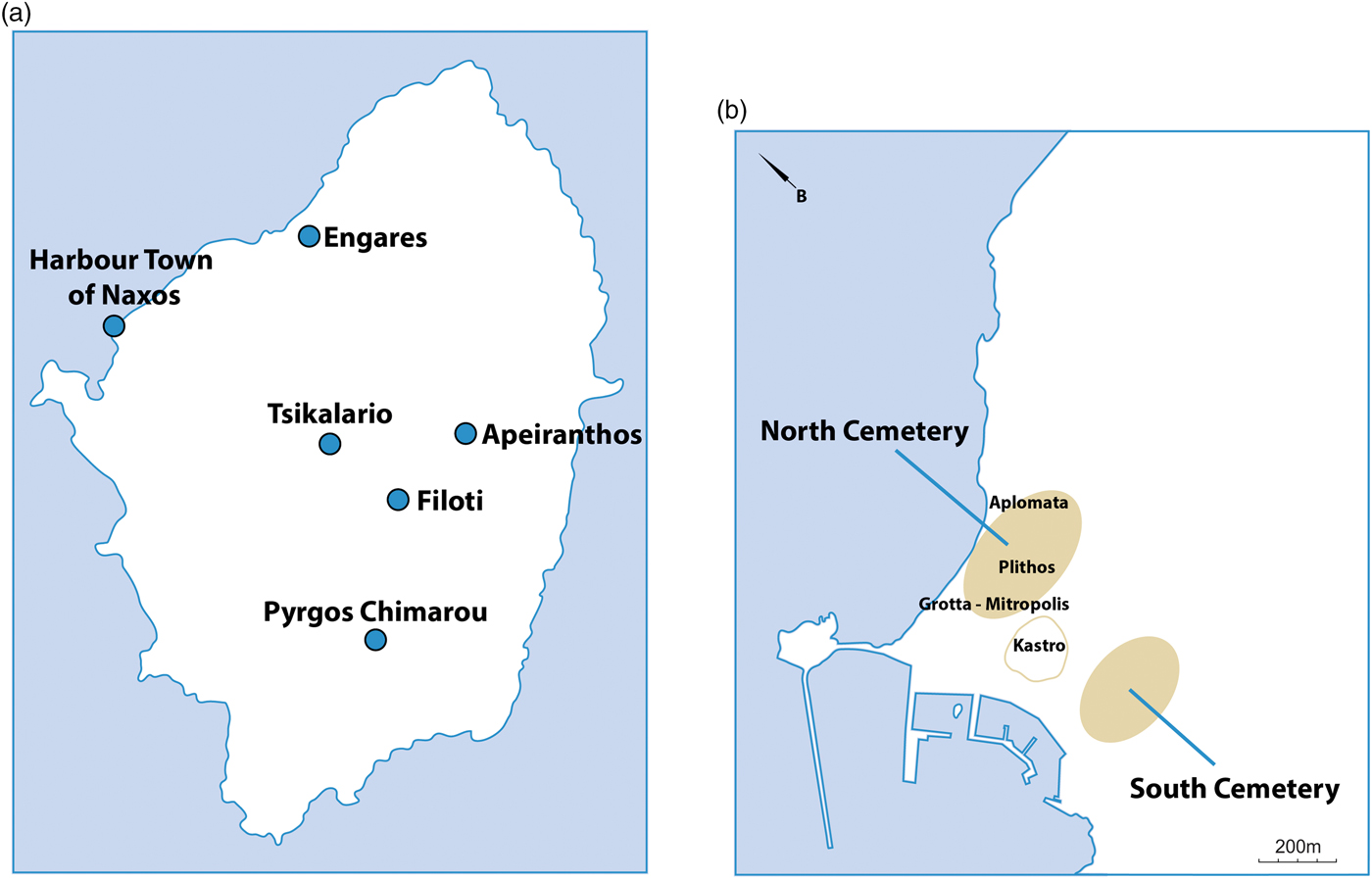
After the collapse of the Late Bronze Age (LBA) centres of power and their trade networks, from early in the Iron Age, maritime connections were again an indispensable element of Cycladic communities. From the Protogeometric (PG) period, intensifying in the Late Protogeometric (LPG), the Cycladic islands, including Naxos (Fig. 1a) – the largest island at the ‘heart’ of this ‘polynesia’ – received wares from Aegean trade nodes, such as Attica and Euboea, or imitated the pottery styles of these regions (Lemos Reference Lemos2002, examples on 27–100; Coldstream Reference Coldstream2008, 164–95, 467–9). Such an array of contacts would have played a role in shaping individual and communal lifestyles and status.Footnote 1
(a) Map of Naxos with sites mentioned in the text; (b) map of the harbour town of Naxos with sites mentioned in the text.

In the public sphere, aspects of communality can mainly be observed through the lens of cult in the Early Iron Age (EIA) Cyclades and, on Naxos in particular, from the tenth and ninth centuries bc onwards via divine and ancestor cults (see below); such evidence indicates complex processes of socio-cultural evolution already from this period onwards.
It is in the eighth century that scholarship detects the acceleration of the social, political and economic processes that led to the birth of poleis (city-states). Scholars, especially in the 1980s and 1990s, stressed cultural and symbolic means of building collective identities, religious bonds and commensality in relation to the foundations of the poleis and the question of ‘what makes a community’ (see Zurbach Reference Zurbach and Moreno García2016, 357–8).
Towards the end of the eighth century and in the seventh, shifts in the locations of some settlements in the Cyclades have been explained in relation to the rise of poleis and by the phenomenon of synoecism (Gounaris Reference Gounaris and Stampolidis1999, 104–5; Schilardi Reference Schilardi2002, 240–1; Palaiokrassa-Kopitsa Reference Palaiokrassa-Kopitsa2007, 16; Mazarakis Ainian Reference Mazarakis Ainian, Charalambidou and Morgan2017, 174; see also Charalambidou Reference Charalambidou, Charalambidou and Morgan2017b, 148; Reference Charalambidou, Mazarakis Ainian, Alexandridou and Charalambidou2017c, 95). The largest of the Cycladic islands – Naxos, Paros, Andros and Melos – are held to have founded a single polis each, whereas some other islands had more than one city-state (Lambrinoudakis Reference Lambrinoudakis and Lentini2004, 68; Gounaris Reference Gounaris, Yeroulanou and Stamatopoulou2005, 20; Mazarakis Ainian and Leventi Reference Mazarakis Ainian, Leventi, Raaflaub and van Wees2013, 214, 220).
Recently, in order to study the history of Greece and the Mediterranean – even below or beyond the level of polis formation – emphasis has been put on network theory (Malkin, Constantakopoulou and Panagopoulou Reference Malkin, Constantakopoulou and Panagopoulou2009; Knappett Reference Knappett2011; Malkin Reference Malkin2011; Taylor and Vlassopoulos Reference Taylor and Vlassopoulos2015) and the multifaceted ways in which ancient communities interacted with each other. Kostas Vlassopoulos (Reference Vlassopoulos2007) stresses the need to understand the form of associations that bring people of various statuses and backgrounds together, as well as the complex links between them and the ways in which the many communities scattered all over the Mediterranean communicated. On Naxos, various levels of association can be sought, especially between the coastal and inland regions of the island in the eighth century bc, as will be discussed in this paper.
The research presented focuses on the inland region of Naxos, and draws comparisons mainly with the island's harbour town, with the aim of identifying the ways in which the communities of the hinterland and coastal regions interacted, including practices of differentiation as seen in the archaeological record. In addition to discussion of the types of funerary constructions chosen to serve certain purposes, grave-offerings from the cemetery of Tsikalario are described in detail with respect to their ‘life history’. This serves to illustrate Naxian consumption of grave-goods and possible flows of communication between inland and coastal Naxos and between Naxos and other regions in the Aegean. The focus is on two funerary contexts: Tumulus 6 and its vicinity, and Cist Grave 11 and its vicinity (Burial Context 11).
The harbour town of Naxos on the island's west coast (Fig. 1b) is among the very few sites in the Cyclades which have thus far provided evidence for occupation shortly after the Mycenaean disintegration and throughout the EIA. The harbour of Naxos was a node of communication with the world beyond the island and a base for the circulation of wares within it (as certain grave-offerings from the Tsikalario cemetery indicate; see below). After the abandonment of the Mycenaean settlement of Grotta towards the end of the Late Helladic (LH) IIIC period, a new habitation phase is indicated (Vlachopoulos and Charalambidou Reference Vlachopoulos, Charalambidou, Lemos and Kotsonasforthcoming) by a small quantity of late Sub-Mycenaean/Early Protogeometric (SM/EPG) pottery at the same site, as well as an EPG (child?) burial, cist grave 12, at Aplomata.Footnote 2 Early evidence from the mortuary sphere is supplemented with evidence from cult sites, while settlement data remain sparse. The sanctuary at Hyria, in the fertile plain near the harbour town, is among the few instances in the Cyclades where cult was practised in the same place in the Bronze Age and in the EIA (indicatively Lambrinoudakis Reference Lambrinoudakis1992, 215; Simantoni-Bournia Reference Simantoni-Bournia2000, 211; Reference Simantoni-Bournia, Stamatopoulou and Yeroulanou2002, 270).
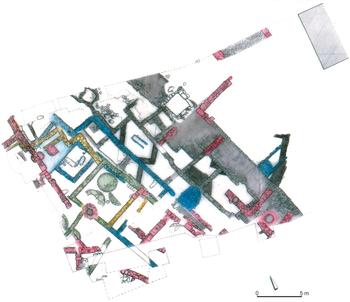
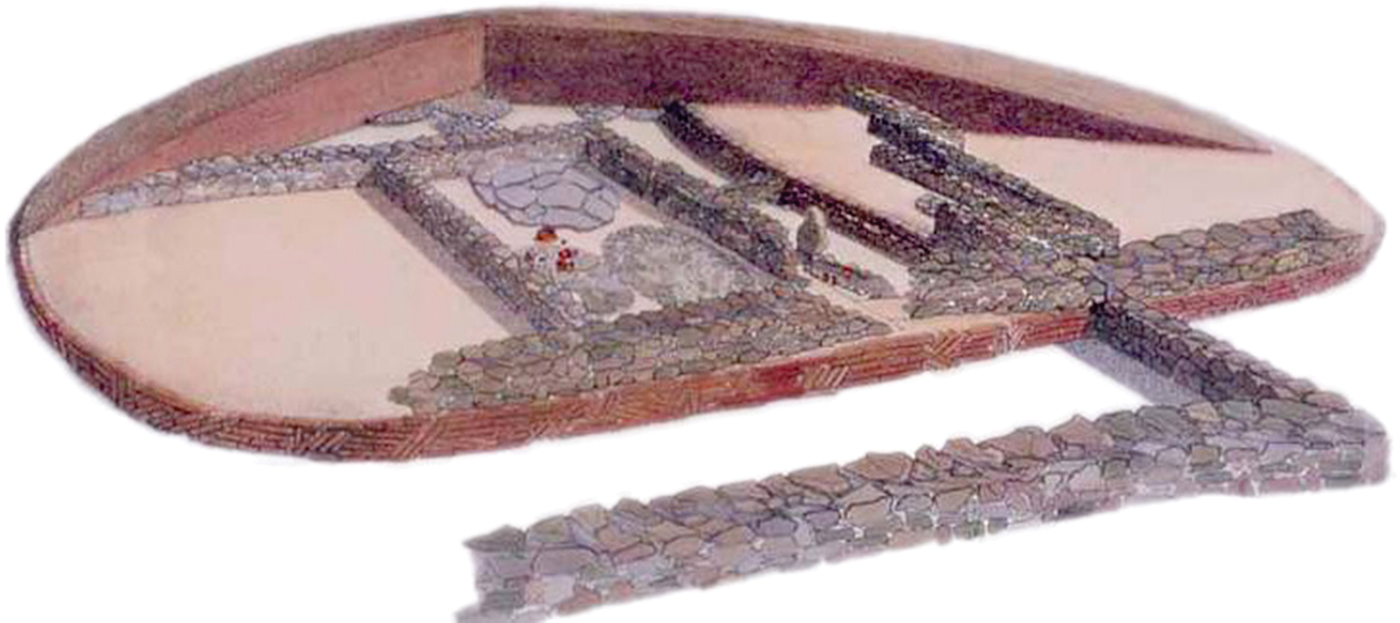
In the harbour town, apart from the EPG cist tomb at Aplomata, PG (mainly Middle Protogeometric [MPG] and LPG) burials have also been found in the other burial grounds that are considered to comprise the North Cemetery; that is, in Grotta, including the area underneath Mitropolis Square, the site of the present cathedral of the island (from now on referred to as Mitropolis) (Figs 2, 3), and at Plithos (see below). Grotta-Mitropolis has yielded archaeological evidence that indicates successive phases of activity from PG burials to the building of constructions related to Geometric ancestor veneration (Lambrinoudakis Reference Lambrinoudakis, Hägg, Marinatos and Nordquist1988, 235–8, 245; Reference Lambrinoudakis2000, 301; Reference Lambrinoudakis and Lentini2004, 61–3; Reference Lambrinoudakis and Vlachopoulos2006a, 279; Reference Lambrinoudakis, Sergis and Psaras2006b, 65–6; see also Antonaccio Reference Antonaccio1995, 201; Lemos Reference Lemos2002, 179–80, 208).
Plan of the Mitropolis excavations (courtesy of V. Lambrinoudakis).

Reconstruction of the Mitropolis tumulus (courtesy of V. Lambrinoudakis).

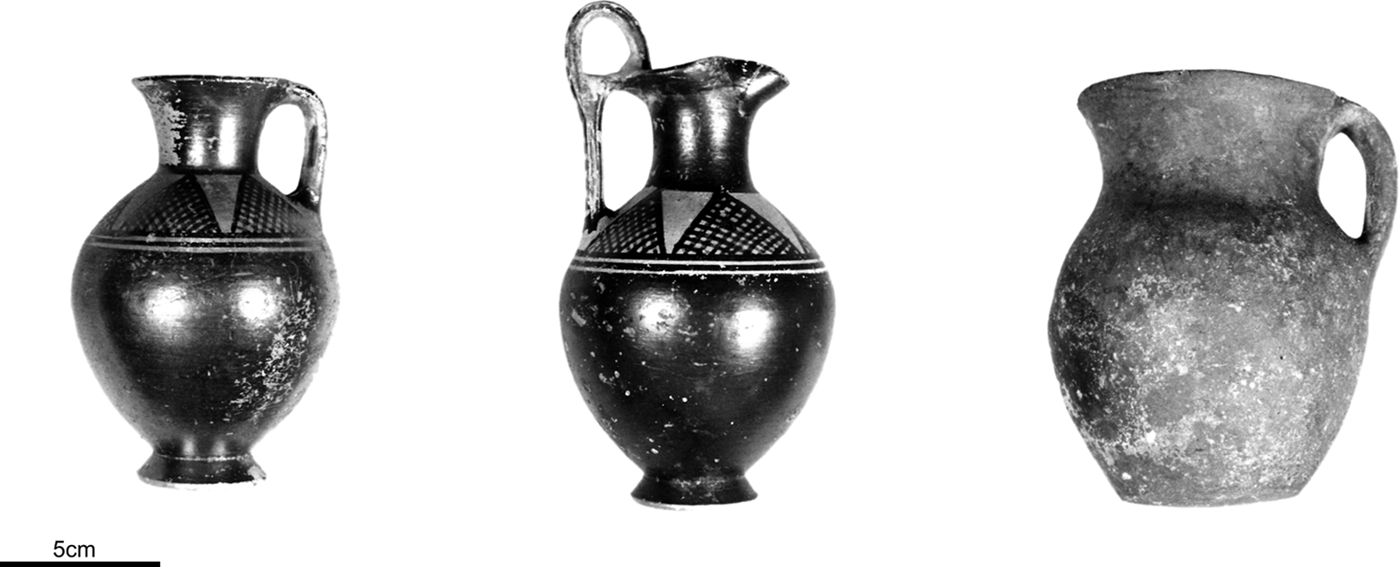
In the PG period, the area of the abandoned Mycenaean fortified settlement at Grotta-Mitropolis mainly functioned as a burial ground. Vassilis Lambrinoudakis and Photini Zaphiropoulou have uncovered PG burials, often cist graves, set within enclosures and outfitted with a rather small number of grave-goods. Among the PG interments, a cist grave, which contained a cremation burial (Grave II, Mitropolis 1984) and included three LPG vessels, two fine wheelmade and painted Attic imports and a coarse Naxian handmade cooking jug (Fig. 4), was marked by a huge stone 1.35 m in height signalling that this was the tomb of a significant person (Lambrinoudakis Reference Lambrinoudakis, Hägg, Marinatos and Nordquist1988, 238). Also noteworthy among the graves at Grotta is an LPG cist tomb which was marked by an LH IIIC hydria that was discovered partially on top of the cover slab of the tomb. Having been retrieved from the Bronze Age ruins, this hydria has been interpreted by Lambrinoudakis (Reference Lambrinoudakis, Hägg, Marinatos and Nordquist1988, 234, fig. 9) as an heirloom used as a symbolic marker for the PG grave and as an expression of respect for the inhabitants' ancestors.Footnote 3
The grave-offerings from Grave II, Mitropolis 1984 (courtesy of V. Lambrinoudakis).

Carla Antonaccio (Reference Antonaccio, Hill and Hageman2016, 118) observes that the PG burials were a deliberate act designed to preserve or extend a link between past and present by the living, who had moved away from the area of the abandoned Mycenaean settlement where they had lived for generations. Lambrinoudakis (Reference Lambrinoudakis, Hägg, Marinatos and Nordquist1988, 245; Reference Lambrinoudakis and Lentini2004, 61, n. 2; Reference Lambrinoudakis, Sergis and Psaras2006b, 65) suggests that the community that buried its dead in the ruins of the Mycenaean town sought out residence in the area of the Kastro (the acropolis hill) and its slopes in the years following the end of the Bronze Age.Footnote 4
The function of the area of Grotta-Mitropolis changed considerably from the Early Geometric (EG) period onwards, but Geometric burials are not entirely absent, as indicated by the Middle Geometric (MG) ‘Kontoleon amphora’ that probably came from a grave (Kontoleon Reference Kontoleon1945–7). At Mitropolis during this period, ‘the funerary stone enclosures were reconstructed on a higher level and their compartments were redistributed; the main elements preserved from their new use were many slightly raised circular platforms constructed of stones and pebbles or just of strewn pebbles on the floor’ (Lambrinoudakis Reference Lambrinoudakis, Hägg, Marinatos and Nordquist1988, 238). These platforms and their vicinity were used for activities (probably libations, meals and lustrations) connected to the veneration of ancestors: the PG deceased buried at the abandoned Mycenaean settlement.Footnote 5
Lambrinoudakis attributes another important shift at the site to around 700 bc: the enclosures at Mitropolis were covered by a low, elliptical tumulus (Fig. 3) that was built with mud brick from the ruins of the Mycenaean fortification wall, raising the status of venerated ancestors to that of civic founders of the harbour-town community (Lambrinoudakis Reference Lambrinoudakis, Hägg, Marinatos and Nordquist1988, 238–45; Reference Lambrinoudakis2000, 301; Reference Lambrinoudakis and Lentini2004, 62–3; Reference Lambrinoudakis and Vlachopoulos2006a, 279; Reference Lambrinoudakis, Sergis and Psaras2006b, 65–6). The Mitropolis tumulus became a landmark for the community and continued to be venerated, standing at the entrance to the Classical agora (Lambrinoudakis Reference Lambrinoudakis and Lentini2004, 62–3). This deliberate act connecting the community to the past is seen as an evolution from the veneration of ancestors into a hero cult (Mazarakis and Leventi Reference Mazarakis Ainian, Leventi, Raaflaub and van Wees2013, 219); a comparable instance of ancestor veneration in the Cyclades is also discerned at Minoa on Amorgos (see below).Footnote 6
At another important site in the harbour town, Plithos, Zaphiropoulou and Karl Reber indicate a period of function from the LPG until at least the end of the MG.Footnote 7 This burial ground, also considered to be part of the North Cemetery (Kourou Reference Kourou1999, 1), shows no elements of the shift in use observed at Grotta-Mitropolis (i.e. from burials to ancestor cult). Adult cremation is recorded by Reber (Reference Reber, Vlachou and Gadolou2017, 473, 477) as the preferred burial custom here.Footnote 8 For examples where osteological analysis could be performed, the results show that the cremations mostly belong to males between c.16–42 years of age. The funerary practice of e nchytrismos is reported to have been used in nine burials: for infants aged between six and nine months (five cases), young girls of 12–15 years of age (two cases) and a young woman (aged 18–19) who was buried in two pithoi with their mouths abutted. E nchytrismos burials involve the interment of bodies in coarse vessels (Reber Reference Reber, Vlachou and Gadolou2017, 474): either a pithos or a pithoid pot or a three-footed variation of this form (from now on called a tripod pithoid vessel). At least six graves were inhumations in simple earth pits with a number of grave-offerings. These include the burial of a six- to seven-year-old boy and a c.25-year-old man. The existence of a group of inhumations in the form of oblong pits without grave-goods is also evident. These latter inhumations have been dated to the LPG period. Among them, osteological analysis has indicated the presence of a 45- to 50-year-old man and a grown woman aged 59–63 years. Reber (Reference Reber, Vlachou and Gadolou2017, 475–8) wonders whether this type of inhumation burial without grave-offerings belonged to ‘social outcasts’ on Naxos.
In the southern part of the town, the South Cemetery probably functioned from at least the beginning of the Geometric period, to judge from the earliest EG II graves (Kourou Reference Kourou1999). So far, the published Geometric evidence comes from the burial clusters around the Church of Agia Paraskevi on the slope of the hill and the gymnasion area next to the Agia Theodosia chapel; two additional areas defined as burial grounds have been recognised by rescue excavations in the vicinity (the Cemetery Square burial ground and the Agios Georgios burial ground: Kourou Reference Kourou1999, 209). The burials of the South Cemetery have been identified as rectangular shaft graves, and the extant evidence indicates that cremation was the prevalent rite (Kourou Reference Kourou1999, 141–69, 210–14). An ‘orientalising’ amphora from the area of Agia Paraskevi, known as the ‘Aphrodite amphora’, which served as an ash urn, indicates that burials continued in this area in the seventh century bc (Karouzos Reference Karouzos1937; Kourou Reference Kourou1999, 213).
For both the North Cemetery and the South Cemetery, the fact that these areas have been excavated in a fragmentary way over the years makes it difficult to ascertain whether we have discrete burial plots or two large cemeteries at the harbour town. The organisation of the graves also raises the question of the organisation of the settlement area. Nota Kourou (Reference Kourou1999, 139, 209–10) has pointed out that the considerable distance between the North Cemetery and the South Cemetery, and the existence of an intervening acropolis hill may suggest that the ancient harbour town consisted of several smaller villages probably dispersed around Kastro, which was likely the centre of this village-based (κατά κώμας) settlement. The possibility that the burial plots/cemeteries encircled the settlement area, as in some other Aegean regions, should also be considered. John Papadopoulos and Evelyn Smithson (Reference Papadopoulos and Smithson2017, 17–18) have argued this for Athens (i.e. that several cemeteries surrounded the primary area of habitation in the Athenian Agora), with reference to similar patterns at Lefkandi, Knossos, Argos, Iolkos, Ialysos, Old Smyrna and even Vitsa Zagoriou in Epirus (see also Gaignerot-Driessen Reference Gaignerot-Driessen, Mazarakis Ainian, Alexandridou and Charalambidou2017, 518, on the Mirabello region of Crete).
For inland Naxos, the published evidence from PG funerary contexts is thus far limited to one Attic LPG amphoriskos from an unknown burial context at Filoti (Kourou Reference Kourou1999, 183–98). Evidence from the inland region of the island is certainly more abundant for the Geometric period. In addition to the systematically excavated cemetery of Tsikalario, which forms the focus of this paper (see below), funerary evidence, albeit scanty, is also provided by a handmade Geometric tripod pithoid vessel with incised decoration which includes a figural scene that is among the very few known for EIA Naxian coarse pottery (Charalambidou Reference Charalambidou, Lambrinoudakis, Mendoni, Koutsoumpou, Panagou, Sfyroera and Charalambidouforthcoming). It was discovered at Agios Ioannis in the vicinity of Apeiranthos and probably comes from a funerary context; sherds from similar pithoid vessels have been observed on the surface of the same site (Philaniotou Reference Philaniotou and Lentini2004, 91). Evidence, by way of extrapolation, of Geometric occupation largely comes from inland Naxian cult sites. Probably in order to serve the role of a religious centre for the communities of the inland plain, the sanctuary at Gyroulas in Sangri evolved from the MG period onward (Lambrinoudakis et al. Reference Lambrinoudakis, Gruben, Korres, Simantoni-Bournia, Bilis and Magnisali2001; Lambrinoudakis Reference Lambrinoudakis and Lentini2004, 65–7; Reference Lambrinoudakis and Vlachopoulos2006a, 282). Another cult site from the Late Geometric (LG) period onwards is the sanctuary at Phlerio in the Melanes valley, where marble quarries are located (Lambrinoudakis Reference Lambrinoudakis and Lentini2004, 67; Reference Lambrinoudakis, Yeroulanou and Stamatopoulou2005). Additionally, on Mount Zas evidence for Iron Age cult activities dates to the eighth and seventh centuries bc (Morris, S. Reference Morris, Simantoni-Bournia, Lemou, Mendoni and Kourou2007, 100–6). Lambrinoudakis (Reference Lambrinoudakis and Lentini2004, 67) argues that, while the main sanctuary of the island at Yria near the harbour town demonstrates continuity from Mycenaean cult practices through to the monumentalisation of the Archaic temples, the sanctuaries in the countryside seem to develop only in the eighth century to create order and authority.
The results of surveys can complement those of systematic excavation of sites in the Naxian hinterland. One such example is the survey in the area of Engares in the early 1990s, which indicated settlement dispersal and significant exploitation of the land in the Geometric period (Èrard-Cerceau et al. Reference Èrard-Cerceau, Fotou, Psychoyos, Treuil, Dalongeville and Rougemont1993; see also Gounaris Reference Gounaris and Stampolidis1999, 104).
Aside from those on Naxos, the number of EIA burial sites thus far discovered in the northern and central Cyclades is not large. Considering the rather restricted EIA evidence from cemeteries on these islands and, furthermore, the scarcity of evidence of inland burial sites on Naxos, understanding the burial behaviour of the Tsikalario cemetery is particularly valuable for the study of mortuary behaviour on Naxos and in this part of the Cyclades. In addition to the Naxian material, for this part of the Cycladic islands the following examples are known to comprise or include EIA burials: a small burial ground at Kardiani on Tenos has yielded eight cist graves which date from the LPG to MG II (Kourou Reference Kourou, Stampolidis and Giannikouri2004, 429–30; Étienne, Kourou and Simantoni Bournia Reference Étienne, Kourou and Simantoni-Bournia2013, especially 39–41) and, on Paros, the necropolis of Paroikia included two polyandria in the form of large cist graves, containing secondary cremations in urns and dating from the LG IIa (Zaphiropoulou Reference Zaphiropoulou, Rystedt and Wells2006; Reference Zaphiropoulou, Simantoni-Bournia, Lemou, Mendoni and Kourou2007; see also Coldstream Reference Coldstream2008, 468–9). Some individual burials indicate the existence of more burial grounds in the northern and central Cyclades, as, for example, a few LPG/Sub-Protogeometric (SPG) cist tombs near the Zagora settlement on Andros (Cambitoglou et al. Reference Cambitoglou, Pierce, Segal and Papadopoulos1991, 99–101; S. Paspalas and B. McLoughlin, personal communication).
On the other hand, ample evidence is known from burial sites in the southern Cyclades: at Minoa on Amorgos there are 12 cremation burials of men and women, and one child enchytrismos, which were subsequently marked by an enclosure that functioned as a ‘sanctuary of the dead’ from c.700 bc (Marangou Reference Marangou and Stampolidis2001; Reference Marangou2002, 122, 207–24); on Melos, Geometric graves were found near the Church of Agia Phaneromeni (Coldstream Reference Coldstream2003a, 122, 279–81) and, on Kimolos, evidence from the cemetery at Limni, dating mainly to the LG, commonly comprises multiple cremation burials in pits (Mustakas Reference Mustakas1954–5; Pantou and Ditsa Reference Pantou, Ditsa and Mazarakis Ainian2011). On Thera (an overview has recently appeared in Kaklamani Reference Kaklamani, Mazarakis Ainian, Alexandridou and Charalambidou2017), evidence comes from the cemetery on the southeastern slope of Mesa Vouno with the frequent appearance of chamber tombs and a substantial number of pit graves, from the necropolis of Sellada with most burials being pit graves and only a small number of chamber tombs (which have been identified from the MG II period onwards) and, lastly, from the necropolis of Kamari, dating from the mid-eighth century bc onwards, and so far comprising a small number of Geometric cremation burials in pits.
In the EIA Cyclades, where fragmentation was a key element of this area of the Aegean, a diversity of funerary practices can therefore be recognised that is also evident within specific islands, as is the case for coastal and inland Naxos (see also Papadopoulos and Smithson Reference Papadopoulos and Smithson2002, 183–4).
THE TSIKALARIO CEMETERY IN A WIDER CONTEXT
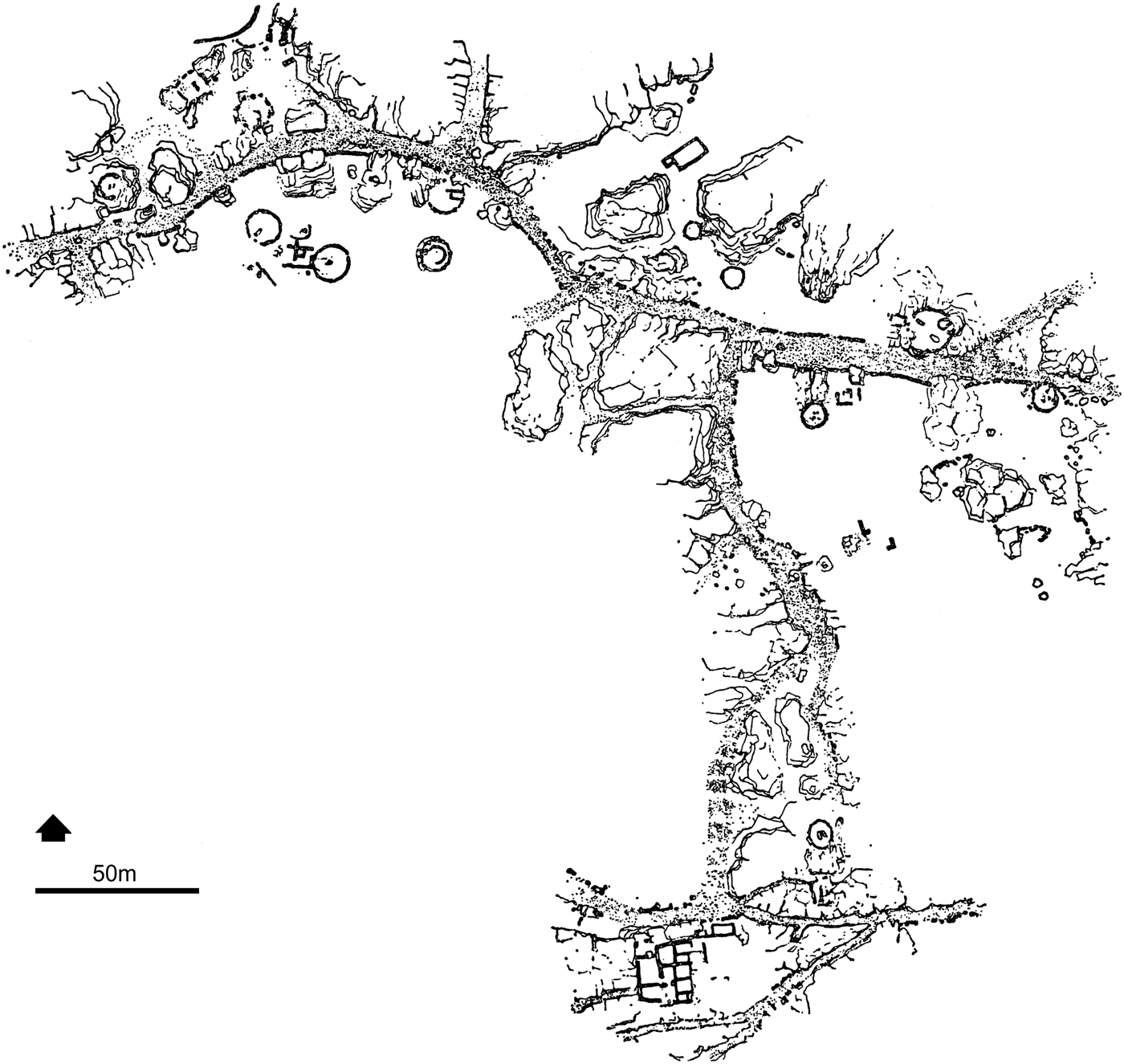
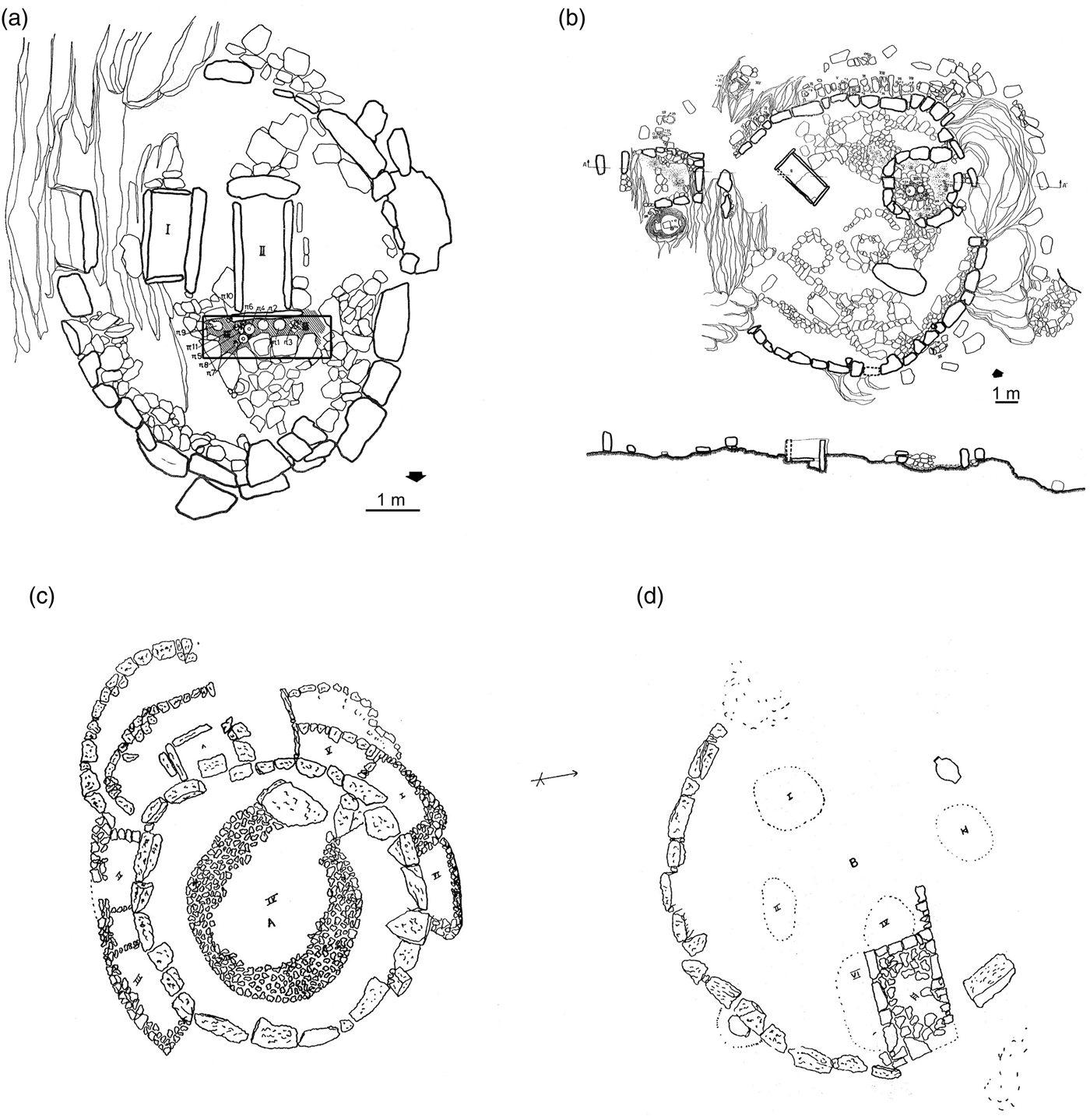
Systematic excavations at the inland cemetery of Tsikalario on Naxos (Fig. 5), in the region of Tragaia, were conducted in the 1960s, bringing to light a necropolis that was probably founded in the Geometric period.Footnote 9 A significant number of the funerary structures at Tsikalario can be placed in the MG II to LG I period, but more sporadic burials and offerings were deposited in the area of the necropolis later in the Geometric and at least until the end of the Archaic/beginning of the Classical period. The Tsikalario cemetery was located on the gneissic core of the Naxos metamorphic dome (Charalambidou, Kiriatzi and Müller Reference Charalambidou, Kiriatzi, Müller, Handberg and Gadolou2017, 120). The decision to locate the cemetery in this imposing landscape cannot have been accidental. The most representative tombs at the site were circular and elliptical stone periboloi/enclosures, some as large as 9 to 12 m in diameter (Figs 6, 7). These funerary structures were designated as tumuli early on (e.g. Zaphiropoulou Reference Zaphiropoulou1983; Kourou Reference Kourou1999; Coldstream Reference Coldstream2003a, 92) because of their shape. Although we can only speculate on how their mounds would have been formed, since none survives intact, most probably these stone enclosures were under low tumuli constructed from earth and stones. They clearly served a different function from that of the later Mitropolis tumulus in the harbour town of Naxos, which covered earlier enclosures dedicated to ancestor cult. As mentioned above, these EIA funerary structures at Tsikalario contribute to a diversity of funerary practices, even on the restricted scale of an island, as is clear when compared to the types of graves found in the harbour town of Naxos. Grave-tumuli have not thus far been attested elsewhere for EIA Naxos or within the EIA Cyclades. Consequently, the reasons behind the decision to construct these funerary monuments deserve further discussion that adopts a wider Aegean perspective.
The Tsikalario cemetery (after Zaphiropoulou Reference Zaphiropoulou1983, 3, map N.1).

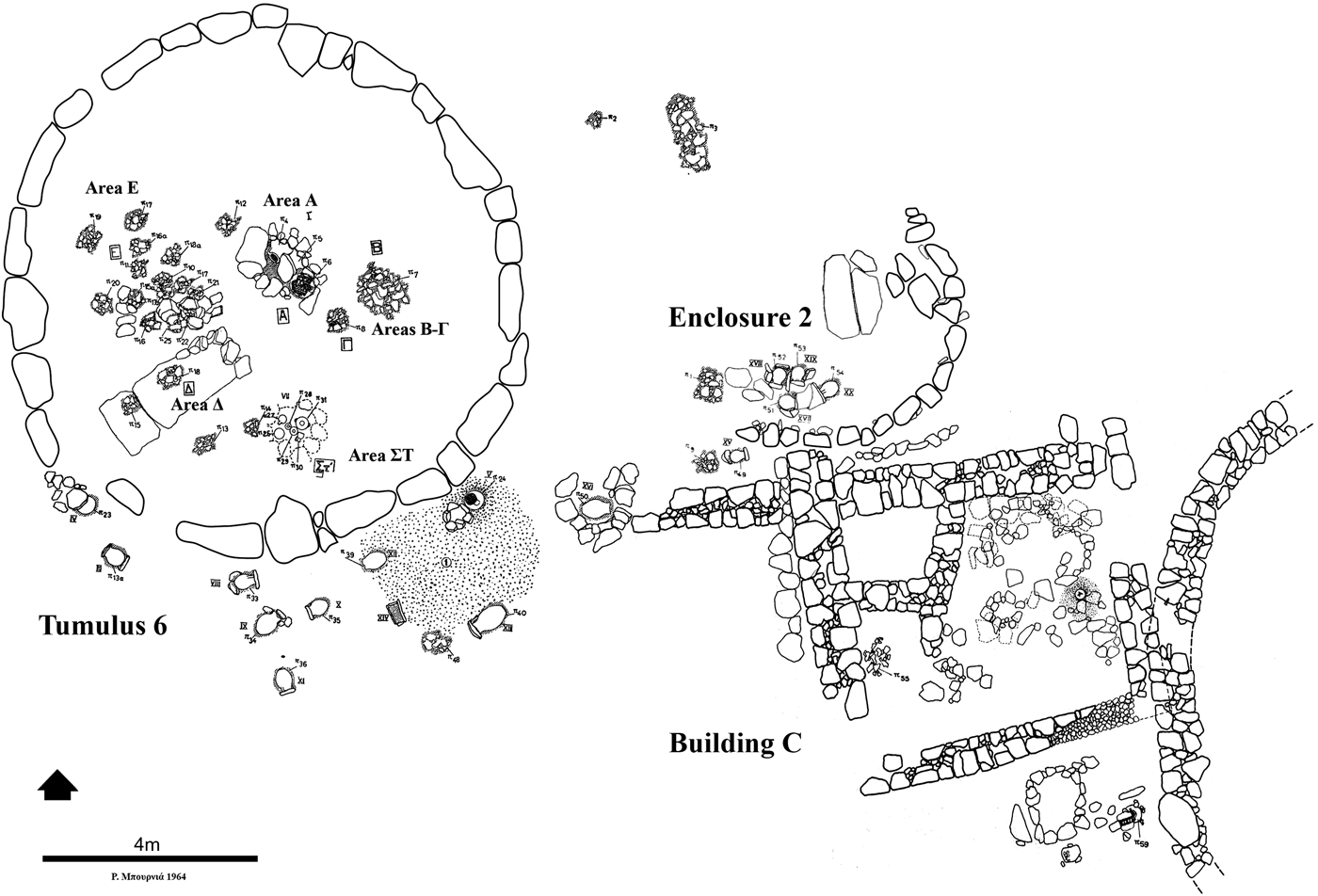
Tumulus 6 and its vicinity (after Papadopoulou-Zaphiropoulou Reference Papadopoulou-Zaphiropoulou1965, 517, figs 14–15).

(a) Tumulus 10 (after Papadopoulou-Zaphiropoulou Reference Papadopoulou-Zaphiropoulou1965, fig. 20); (b) Tumulus 1 (after Papadopoulou-Zaphiropoulou Reference Papadopoulou-Zaphiropoulou1965, fig. 16); (c) and (d) Tumuli A and B (after Doumas Reference Doumas1963, fig. 2).

The cemetery was demarcated by a huge upright slab, a veritable menhir, 3.2 m high. This served as a sema for the cemetery and is not related to an individual burial, as is the case with the stone slab which marked Grave II at Mitropolis in the harbour town. A network of pathways has been detected within the Tsikalario necropolis, and the main path passed by the cemetery entrance where the slab was erected (Zaphiropoulou Reference Zaphiropoulou2008–9, 49–50).
Most of the Tsikalario funerary structures were robbed to varying extents; hence the full range of their original contents is not known. At least some of the Tsikalario grave-tumuli seem to have housed multiple burials. This is suggested by the number of large closed vessels (at least eight; see below), most of which would have been used as burial pots in the interior of Tumulus 6 (Fig. 6), as well as the presence of two cist graves in the interior of Tumulus 10 (Fig. 7a). Based on the excavation diaries, cremation often took place inside these structures. The practice of cremation accords with local contemporary practices, especially for adults within the harbour-town cemeteries (see above). On the basis of the current data, however, it is difficult to discern the funerary rite – cremation or inhumation – for all the closed vessels (that were probably burial pots) inside and on the periphery of some of the Tsikalario tumuli (see the example of Tumulus 6 below).
Parallels for the Tsikalario tumuli were first sought by J.N. Coldstream (Reference Coldstream2003a, 92), who posited that the collective nature of these Tsikalario tombs and their carefully laid circular kerbs find similarities in the EIA Vergina tumuli in Imathia, which date from the tenth to the end of the seventh century bc. Although the grave-tumuli from the two sites display these similarities, they also show some differences in funerary practice (see also Charalambidou Reference Charalambidou2008–9, 66): the Tsikalario low tumuli, based on the present evidence, often contained cremations in their interior, whereas inhumation in pit graves and also in pithos burials prevailed at the tumuli of Vergina. Cremations are rarer in Vergina and seem to belong mostly to the last phase of use of the cemetery in the seventh century bc (Andronikos Reference Andronikos1969; more recently Braüning and Kilian-Dirlmeier Reference Bräuning and Kilian-Dirlmeier2013). At the time of the discovery of the Vergina tumuli by Manolis Andronikos, these tombs were thought to have been unique in northern Greece, but we now know that Vergina was part of a larger funerary tradition; a concentration of such cemeteries is now recognised in, for example, Almopia and around Giannitsa, as well as in the region of Olympus and around Pydna (see Schmidt-Dounas Reference Schmidt-Dounas, Henry and Kelp2016, 102). Nevertheless, the frequency of grave-tumuli in northern Greece (most recently Schmidt-Dounas Reference Schmidt-Dounas, Henry and Kelp2016; Yildirim Reference Yildirim, Henry and Kelp2016; Chemsseddoha Reference Chemsseddoha, Mazarakis Ainian, Alexandridou and Charalambidou2017) shows that a northern Aegean influence on the Tsikalario tumuli remains a strong likelihood, as Coldstream suggests.
Tumuli appear in other Aegean regions as well, such as Thessaly, Attica and Ionia. In Thessaly, at least 40 Iron Age tumuli have been reported from the Voulokaliva cemetery (Malakasioti Reference Malakasioti and Kalogerakou2000; Malakasioti and Mousioni Reference Malakasioti, Mousioni, Stampolidis and Giannikouri2004; Malakasioti and Tsiouka Reference Malakasioti, Tsiouka and Mazarakis Ainian2011; Lagia et al. Reference Lagia, Papathanasiou, Malakasioti, Tsiouka, Lochner and Ruppenstein2013). Tumulus 36 (one of four to have been excavated at Voulokaliva), a well-documented context, consists of small periboloi/precincts dating to the SPG, LG and Archaic periods, and arranged in a concentric/beehive-like structure; the earliest (SPG) precincts form a nucleus around which the LG and Archaic structures were constructed. In this tumulus, cremation for adults and inhumation for children suggests that the choice of burial rite was primarily dictated by age (Karouzou Reference Karouzou, Mazarakis Ainian, Alexandridou and Charalambidou2017). This particular form of tumulus differs in certain aspects from the Tsikalario tumuli; even in the case of Tumulus A, where concentric-like structures seem to have been shaped around the main kerb of this Tsikalario funerary structure (see Fig. 7c), the beehive-like pattern of small periboloi does not occur. Further south, in Attica, EIA tumuli are hardly evident before the LG period, becoming more common from the LG II onwards (Goulakos Reference Goulakos2015, 122–3, 227). Therefore, comparisons with Tsikalario cannot easily be made at this point in time. Nevertheless, the Attic tumuli do indicate the spread of the use of this burial type to regions not known to have a robust tradition of such funerary structures from the beginning of the EIA.
Moving to another region, Coldstream (Reference Coldstream2003a, 97) proposes Colophon in Ionia (in addition to Vergina) as a possible counterpart to Tsikalario (on the Colophon tumuli, see more recently Mariaud Reference Mariaud and Mazarakis Ainian2011; Bammer et al. Reference Bammer, Draganits, Gassner, Grammer, Gretscher, Mariaud, Muss, Trinkl and Noedl2014; Gassner et al. Reference Gassner, Muss, Grammer, Gretscher and Mariaud2017). At Colophon, according to Olivier Mariaud's initial conclusions (Reference Mariaud and Mazarakis Ainian2011), the tumuli in the Northeast Cemetery (or ‘Geometric’ or Valley Cemetery), which contain collective burials of primary cremations for adults and inhumations in vases for children (enchytrismoi), should be dated from the MG/LG to the Archaic period. Mariaud (Reference Mariaud and Vecchioforthcoming) has, however, recently lowered the date by one or two generations, mainly on the basis of the types of fibulae which accompanied adults and children in the graves; he thus proposes a date in the first half of the seventh century. Consequently, the Tsikalario tumuli and those of the Northeast Cemetery cannot be compared easily, since the former are earlier in date than the Colophon tumuli.
Still with respect to tumuli from Asia Minor, Lambrinoudakis (Reference Lambrinoudakis and Lentini2004, 69–70) draws a parallel between those at Tsikalario and Carian tumuli (on Carian tumuli, see recently Carstens Reference Carstens and Pedersen2008; Mariaud Reference Mariaud and Konuk2012; Diler Reference Diler, Olivier and Kelp2016; Henry Reference Henry, Henry and Kelp2016). In Caria there is indeed a long tradition of grave-tumuli ranging from the LH IIIC to the PG and Geometric periods (Mariaud, personal communication). Carian tumuli were often built on high hills. Like the Tsikalario tumuli, they had a good view over the landscape; this was certainly not meaningless, because the tumulus ‘was recognised not only as a tomb but also a sema keeping the memory of the power of the buried individuals alive’ (Diler Reference Diler, Olivier and Kelp2016, 463). The Halikarnassos peninsula is the best-understood region of Caria for early periods. The graves at Assarlık provide an illustrative example. There, already in the PG period, we encounter tumulus tombs, often built in isodomic or polygonal masonry, which either consist of a rectangular chamber placed in a circular ‘enclosure’ covered by a mound (various types of vaults and roofs for the chambers have been reported) or comprise a dromos, a chamber (or one or more cist tombs) in circular or rectangular ‘enclosures’ and a mound (Carstens Reference Carstens and Pedersen2008, 71–9). Thus far, these tombs appear different from the Tsikalario low tumuli, which consist of stone circles with no chambers and were not built with isodomic or polygonal masonry.
Closer to Naxos we find the Samian tumuli, established on a flat coastal site in the southwestern part of Pythagoreion on Samos (Viglaki-Sofianou Reference Viglaki-Sofianou, Stampolidis and Giannikouri2004; Reference Viglaki-Sofianou and Alvanou2013; Tsakos and Viglaki-Sofianou Reference Tsakos and Viglaki-Sofianou2012). They were raised there probably from the second half of the tenth century bc. It has been suggested by Konstantinos Tsakos and Maria Viglaki-Sofianou (Reference Tsakos and Viglaki-Sofianou2012, 209) that in the tenth century this cemetery was the final resting place of the first Ionian colonists who settled on the southeastern side of the island. The burials on Samos are reported to have been surrounded by limestone, built circular enclosures in a chain arrangement with a diameter of 3–5.50 m and height of c.1.35 m; these were covered with hard reddish soil and stones in the form of a tumulus (Viglaki-Sofianou Reference Viglaki-Sofianou, Stampolidis and Giannikouri2004, 190; Tsakos and Viglaki-Sofianou Reference Tsakos and Viglaki-Sofianou2012, 213). The chronological range of this necropolis is estimated to have stretched from the tenth until the seventh century bc, when this area was abandoned and the Archaic cemetery was formed outside the western stretch of the fortification wall of the city. Adults were usually cremated, while infants and children are reported to have been buried in enchytrismoi. This cemetery in the Aegean can be identified as another possible ‘candidate’ that provided the stimulus to the inhabitants of inland Naxos to choose this distinct burial type for their deceased.
Elsewhere in the Cyclades, at Minoa on Amorgos, the enclosure that functioned as a ‘sanctuary of the dead’ included 12 late tenth/early ninth- to late eighth-century cremation burials of men and women, and one child enchytrismos (see above). This enclosure, built c.700 bc, is reported to have been covered by a tumulus (Marangou Reference Marangou2002, 207–24, especially 224). The function of this enclosure and the mound seems to be more closely related to the function of the Mitropolis tumulus (which unified the memorials of the buried ancestors, raising them to the status of founders of the local community: Lambrinoudakis Reference Lambrinoudakis and Lentini2004, 62) than to the Tsikalario grave structures.
The inspiration for the Tsikalario tumuli could have come from beyond Naxos, given the fact that this type of funerary structure is not encountered again on EIA Naxos (apart from the later Mitropolis tumulus which was not, however, a grave per se). Influence on the form of these funerary structures at Tsikalario may have derived from the northern Aegean or from Samos, but a very close parallel cannot be recognised easily. The Naxian style of many of the grave-offerings in the Tsikalario cemetery points towards the Naxian provenance of the occupants of these funerary structures (see below).
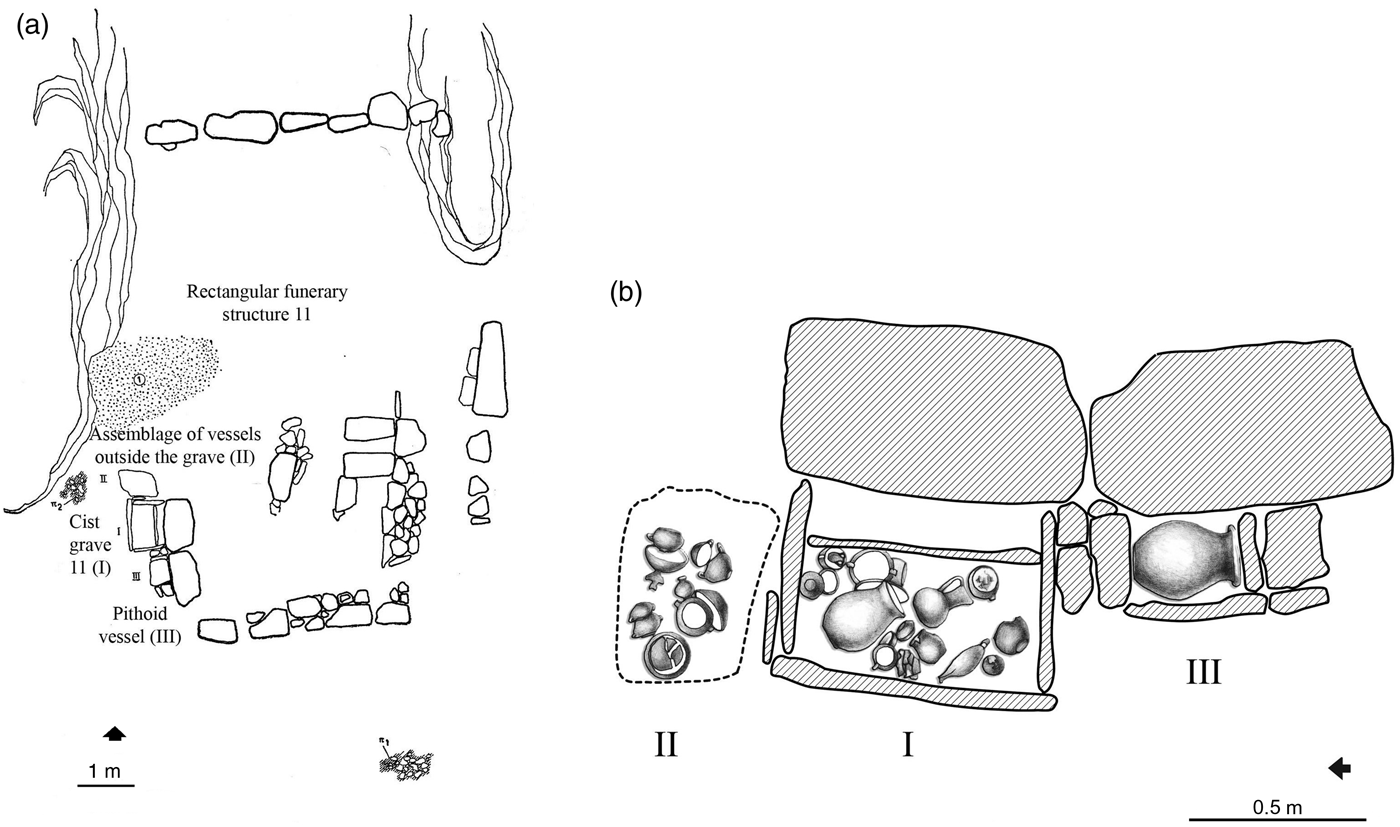
Other types of graves have also been recognised and excavated at the site. A particularly important context is a cist grave, Cist Grave 11, alongside a rectangular enclosure (Burial Context 11) (Fig. 8). The cemetery also included funerary pyres bordered by small, irregular, stone enclosures. In one instance, a pit grave, Pit Grave 14, was found in the vicinity of such a pyre. Furthermore, burials in pots were deposited in the necropolis at least until the Late Archaic or Early Classical period.
(a) Cist Grave 11 near rectangular funerary structure (enclosure) no. 11 (after Papadopoulou-Zaphiropoulou Reference Papadopoulou-Zaphiropoulou1965, 520, fig. 18); (b) Cist Grave 11 (Group I) and its vicinity (Groups II and III) (drawings by R. Bournia; digitised by D. Nenova).

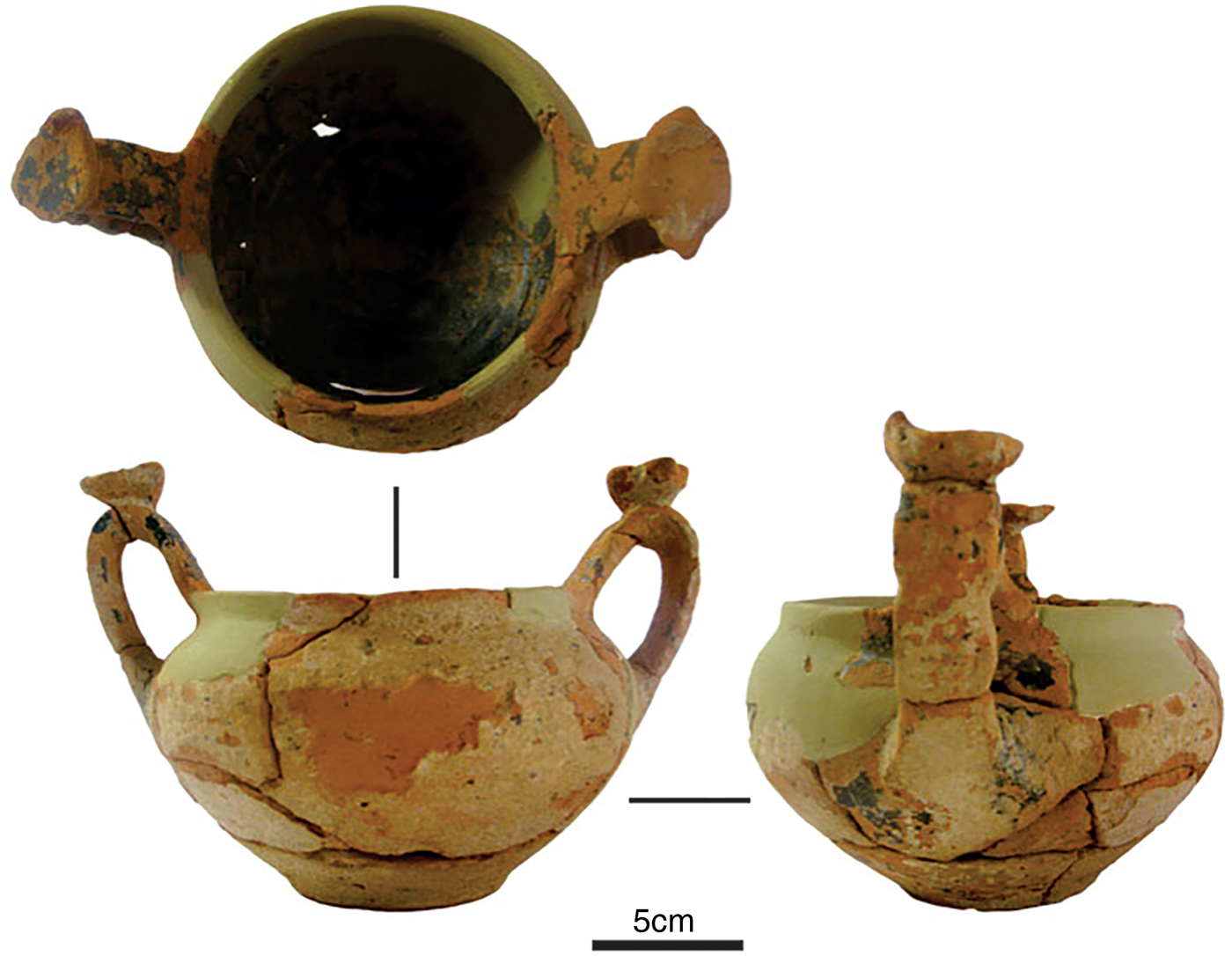
Cist Grave 11 belongs to a burial type evident on Naxos from the beginning of the EIA (see Grave 12 at Aplomata in the harbour town of Naxos: Kontoleon Reference Kontoleon1960, 259–60; Kourou Reference Kourou and Vlachou2015, 84–5). Cist tombs used for inhumation or cremation have been found at the harbour town in the North Cemetery, whereas no cist tomb is currently known from the South Cemetery (Kourou Reference Kourou1999, 214). The Tsikalario cist grave (and its vicinity) will also be discussed in this paper, not only because it illustrates the presence of other types of graves at the cemetery, in addition to the tumuli, but also because the grave-offerings from this context are an inland Naxian example of a well-thought-out selection that has symbolic value and further indicates the networks of direct and indirect connections of the inhabitants of this part of the island. The grave-offerings from this tomb and its vicinity strengthen our comprehension of the circulation of products from coastal to inland Naxos and between Naxos and other regions far beyond the limits of the island which reached the hinterland probably through the island's main harbour. From Cist Grave 11 comes the high-handled kantharos with plastic terminals (Museum of Naxos [MN] 3876; see below) that Coldstream (Reference Coldstream2003a, 92) takes as evidence of contact with northern Greece, in addition to the construction of tumuli, on account of its terminals, which he interprets as knobs. On the contrary, I argue below that these terminals are in the shape of birds, but poorly preserved today, thereby necessitating a new interpretation of this vessel and its context.
EXAMPLES OF NAXIAN MORTUARY BEHAVIOUR AT TSIKALARIO
Among the tumuli discovered thus far in the Tsikalario cemetery, the MG II to LG I Tumulus 6 and the area immediately surrounding it will be presented here because it illuminates the range of funerary rites and consumption of grave-offerings performed inside and outside the Tsikalario tumuli. Consideration of a different grave type, Cist Grave 11 and its vicinity (Burial Context 11), will follow, for the reasons mentioned above. These contexts are also discussed in comparison with other funerary structures and their grave-offerings at Tsikalario in order to highlight inland Naxian mortuary practices and the possible functions of the grave-goods.
Tsikalario Tumulus 6 and its vicinity
Owing to the thorough excavation undertaken by Zaphiropoulou, several sections within Tumulus 6 (Fig. 6) have been identified as distinct areas which included grave-offerings (Areas A, B–Γ, Δ, Ε, ΣΤ, Λ), and the locations of the finds were meticulously recorded. Most of the areas were divided with stones into roughly shaped spaces and Area Δ was covered by a single, rectangular stone slab (Papadopoulou-Zaphiropoulou Reference Papadopoulou-Zaphiropoulou1966, 516–17, drawings 14–15). Within the tumulus, in addition to drinking and pouring vessels, a minimum of eight storage (and transport) vessels of fine/semi-fine ware and coarse ware were uncovered (on the quantification of this ceramic assemblage, see Charalambidou Reference Charalambidou, Verdan, Theurillat and Kenzelmann Pfyffer2011). These vessels were mostly Naxian in their provenance, like the majority of the other grave-offerings from the interior of the structureFootnote 10 (a small number of imports was recognised as well, for example the Cycladic, non-Naxian, skyphos MN 3852; see below). In the 1960s, osteological material from the tumuli and other funerary structures at Tsikalario was collected during excavation, but the whereabouts of some of this bone material is not currently known, including the assemblages from the interior of Tumulus 6 and from Cist Grave 11.Footnote 11 Therefore, hypotheses about the age and sex of the deceased inside Tumulus 6 can rest on the grave-goods only, with the uncertainties that this entails. The problems inherent in using only grave-offerings to identify the sex and age of the deceased are well-known (see Papadopoulos Reference Papadopoulos2005, 349–50). The question is whether these (at least) eight vessels were all burial pots (or whether some could have been used for other purposes – as containers for liquid or foodstuffs, for example). Comparisons with other contexts from Tsikalario and the function of the transport/storage vessels in these locations (see below) supports the assumption that these pots were used for burials and that this tumulus was a collective funerary structure.
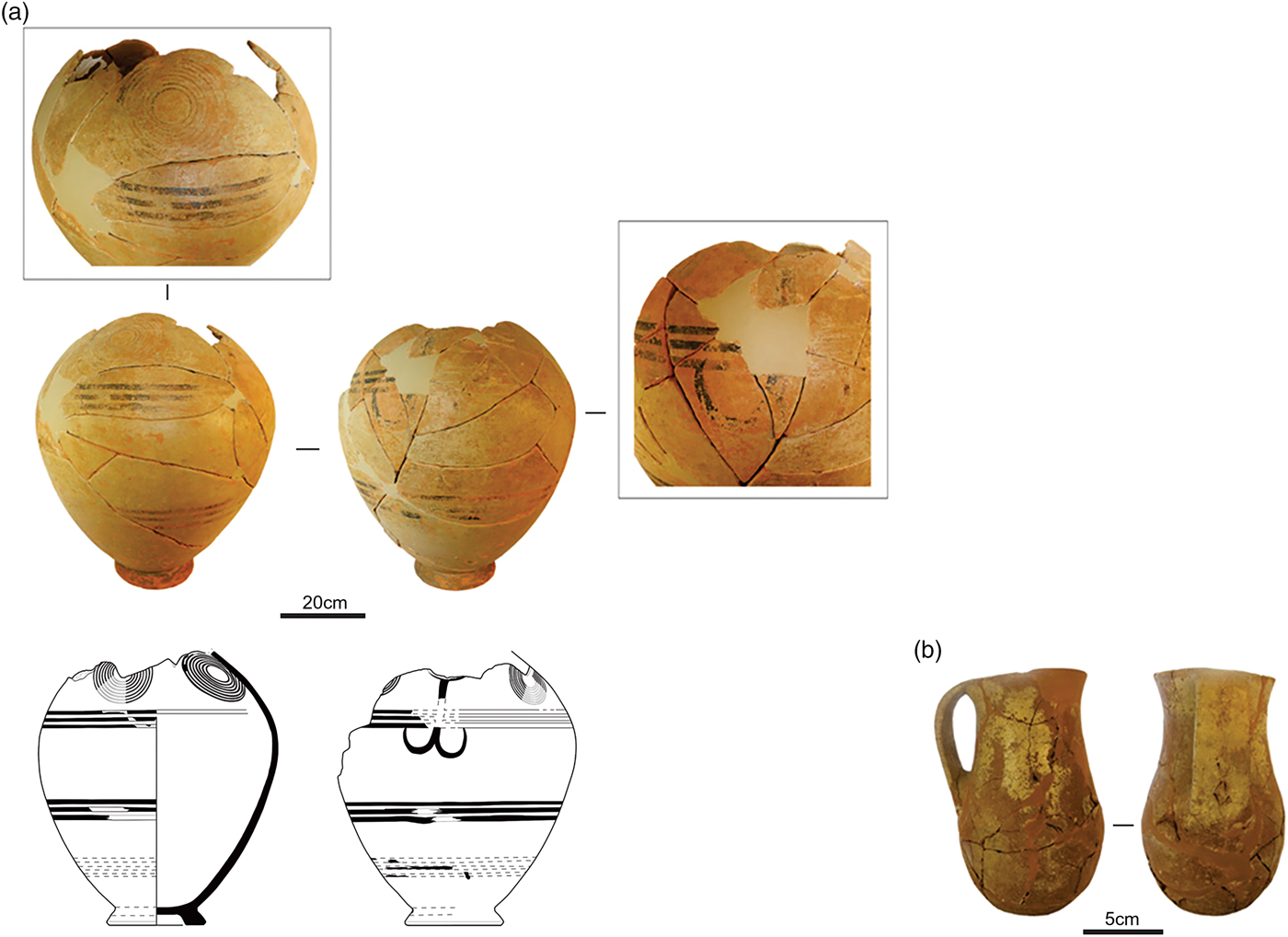
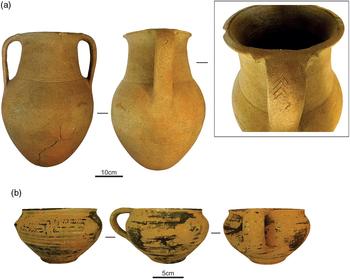
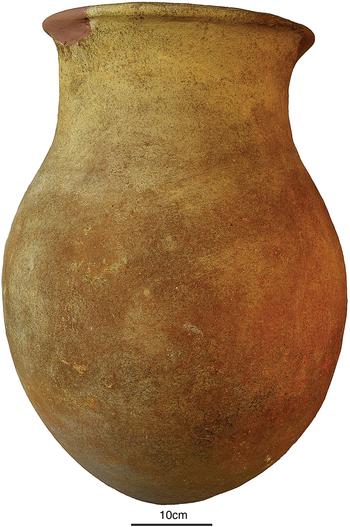
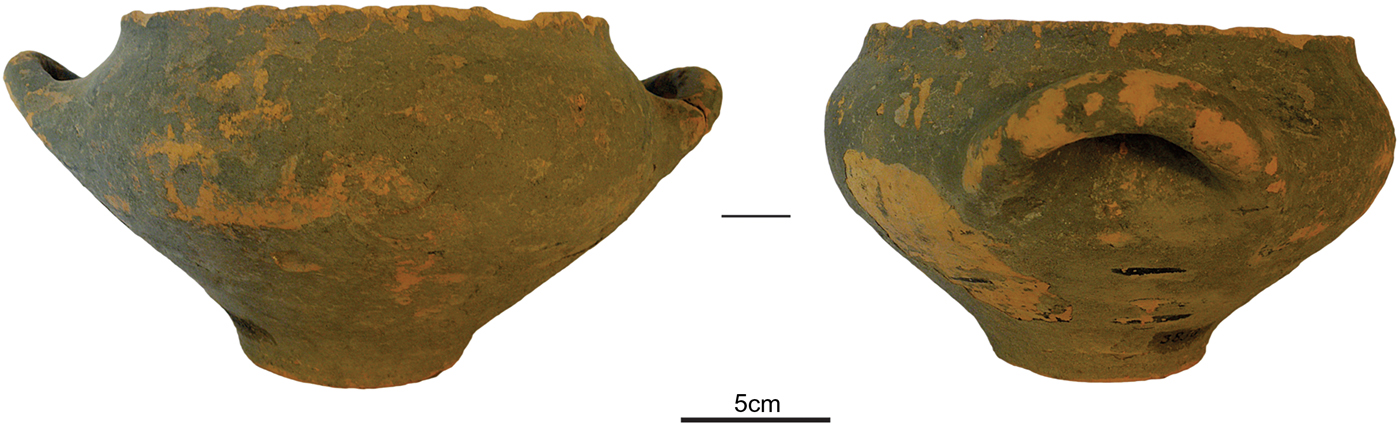
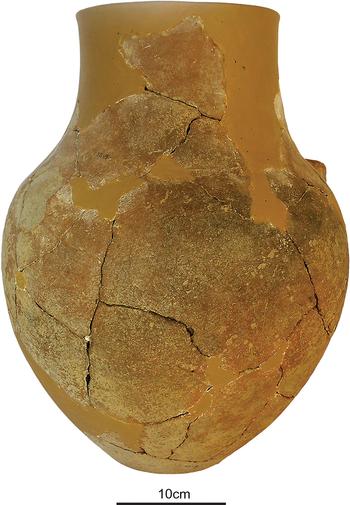
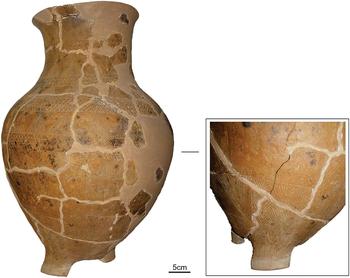
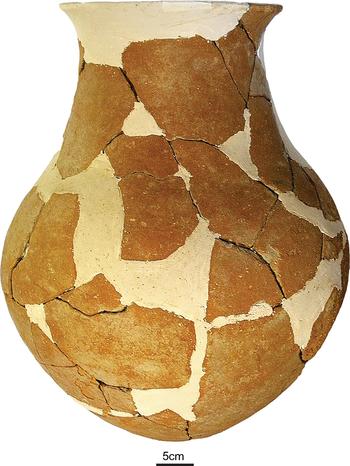
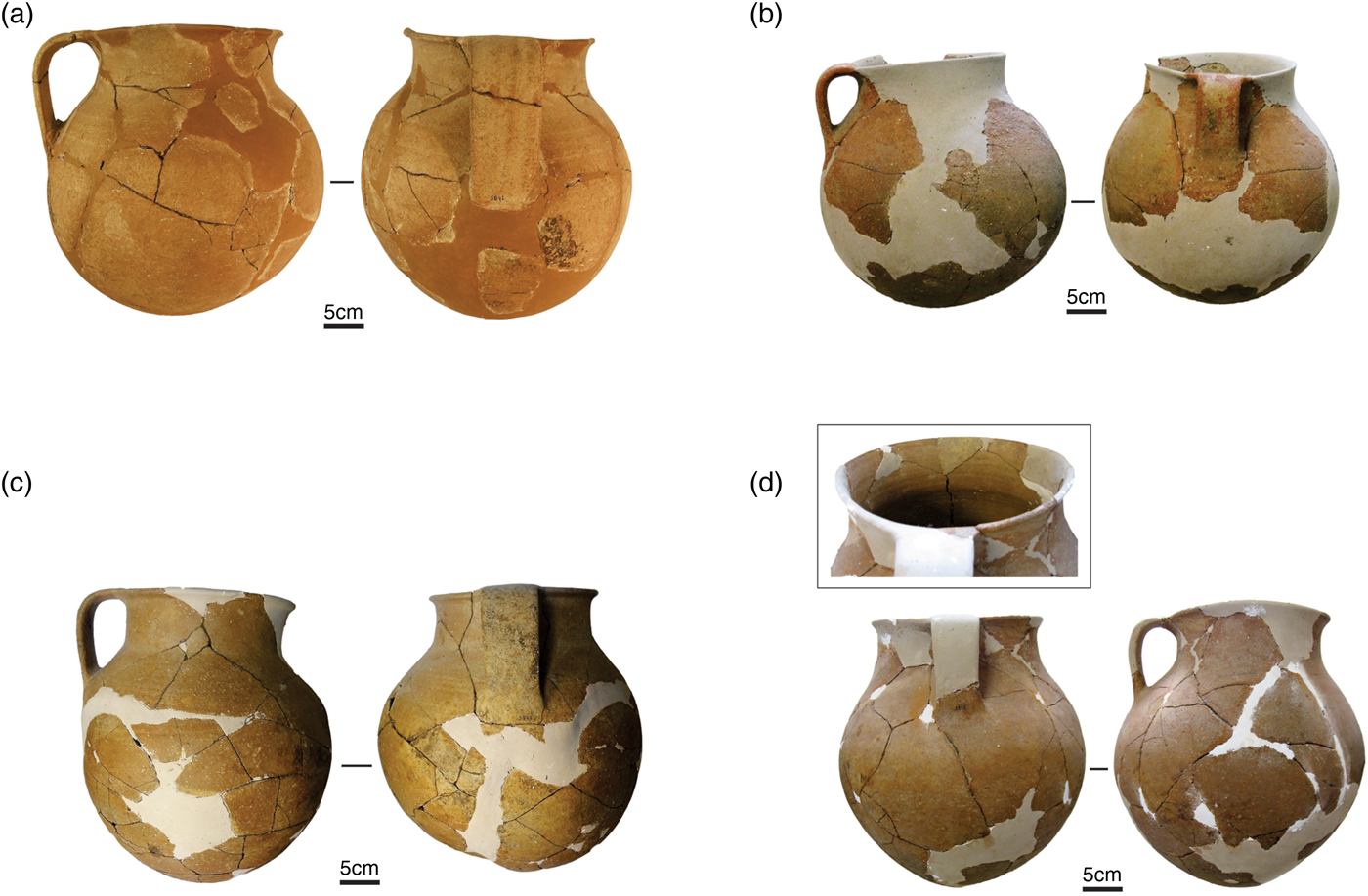
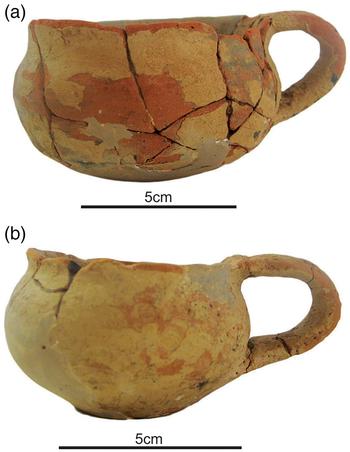
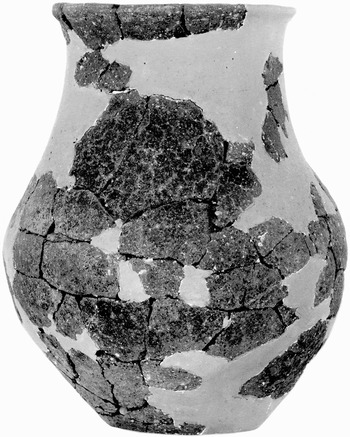
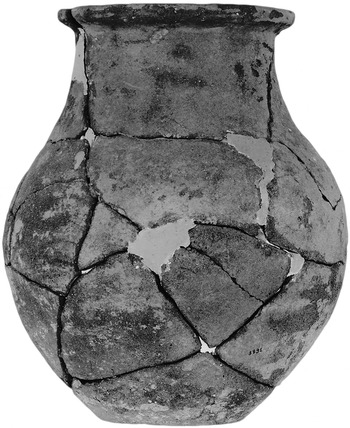
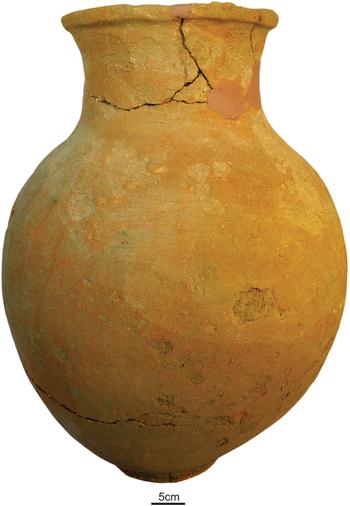
The centre yielded an oval-shaped area (Area A) formed by stones, in which a number of complete vessels were deposited.Footnote 12 In particular, the assemblage at the centre of Area A included three transport/storage vessels in an upright position: a fine/semi-fine amphora (Fig. 9a), in the interior of which a small coarse burnished cooking jug was found (Fig. 9b); a coarse amphora (Fig. 10a), in the interior of which a fine mastoid kyathos was placed (Fig. 10b); and a coarse pithoid vessel (Fig. 11). The cremation pyre was unearthed beneath these vessels and its limits extended beyond this group of ceramics. Within the pyre, where cremated bones are reported to have been found (Papadopoulou-Zaphiropoulou Reference Papadopoulou-Zaphiropoulou1965, 515), more vases were discovered, predominantly fragmentary drinking vessels including another mastoid kyathos as well as an almost intact inverted skyphos (MN 3830) (Fig. 12), which was found beneath the amphora illustrated in Figure 10a, along with pieces of iron armour, a ring or earring, a few loom weights and burnt fruit.Footnote 13 The fact that the cremation pyre below the closed vessels included pieces of iron armour may indicate at least one male burial in this central part of the tumulus.
Tumulus 6, Area A: (a) fine/semi-fine amphora (MN 3828) and (b) the small coarse burnished jug (MN 3829) found inside (photographs by D. Nenova; drawing of MN 3828 by B. Konnemann).

Tumulus 6, Area A: (a) coarse amphora (MN 3825) and (b) the fine kyathos (MN 3826) found inside (photographs by D. Nenova).

Tumulus 6, Area A: coarse handleless pithoid vessel with plain base (MN 3827) (photograph by D. Nenova).

Tumulus 6, Area A: intact skyphos (MN 3830), found inverted beneath amphora MN 3825 (photographs by D. Nenova).

Among the transport/storage vessels, the pot MN 3828 (Fig. 9a) is a neck-handled amphora (the lower handle roots are preserved) and has recently been restored at the Archaeological Museum of Naxos.Footnote 14 After its restoration, it became clear that it was decorated in the PG style, with sets of mechanically drawn concentric circles on the shoulder, probably made by a pivoted multiple brush (compare Papadopoulos and Smithson Reference Papadopoulos and Smithson2002, 159), and three groups of horizontal bands placed below the shoulder. The decoration is based on a light-ground scheme. Furthermore, an almost vertical band that ends in two ‘hooks’ is preserved under the handle roots; this is probably the ‘tail’ of the handle stripe(s). In addition to the completed macroscopic study, petrographic and elemental analyses are currently being conducted to assess the likelihood of this vessel coming from Naxos.Footnote 15 This type of neck-handled amphora with sets of concentric circles on the shoulder has not been recorded before for Geometric Naxos, but SPG Naxian styles are present in the Geometric period, including the late use of PG concentric circles in a metope, as seen, for example, on the ‘Kontoleon amphora’ (see above) (Kourou Reference Kourou1999, 97–9, 204–5). Furthermore, a number of vessels from other Cycladic islands, ranging in date from the LPG/EG to the LG, are known to have been decorated in an ‘archaising’ PG style (Kourou Reference Kourou2002, 92–3; Papadopoulos and Smithson Reference Papadopoulos and Smithson2002). The ring base, the ovoid body with the maximum diameter set high and the large size of the Tsikalario amphora suggest that this is not a PG vessel,Footnote 16 but, instead, point towards the date indicated by the rest of the grave-offerings inside the structure: probably the second or third quarter of the eighth century bc. Archaising PG style in Geometric contexts is a phenomenon known from various Aegean regions: Attica, Euboea, Boeotia, Thessaly, the northern Aegean, the Cyclades, Rhodes and elsewhere.Footnote 17 Examples of a Cycladic SPG style have also been identified in the settlement of Vathy Limenari on Donousa, near the island of Naxos, which dates from the second half of the ninth to the early eighth century bc (Zaphiropoulou Reference Zaphiropoulou, Promponas and Psarras1994, 231–2). Among the SPG vessels from Donousa exhibited in the Archaeological Museum of Naxos, some closed forms are decorated with mechanically drawn concentric semicircles on the shoulder as well as full concentric circles (in a metope) or bands on the body. Some others are banded wares reminiscent of the PG light-ground scheme (compare Papadopoulos and Smithson Reference Papadopoulos and Smithson2002, 169–71). In an unpublished neck-handled banded amphora from Donousa, and exhibited at the Archaeological Museum of Naxos (MN 7905), we find similarities in the shape of the body and the ring base to the Tsikalario amphora.
The small Naxian handmade one-handled cooking jug MN 3829 (Fig. 9b), found within the amphora mentioned above, is burnished and preserves a line of incised lozenges on the handle.Footnote 18 Small and medium-sized burnished vessels are known from EIA Naxos, especially from funerary contexts.Footnote 19 Together with this example from Tsikalario, two of the contexts from which cooking jugs have been recovered in the harbour town of Naxos indicate that such pots were used both in funerary and cult practices in inland and coastal Naxos. One would expect that they were also used widely in domestic settings. A coarse cooking jug (Fig. 4) was found in the LPG Grave II at Mitropolis, which also contained two fine wheelmade and painted Attic pouring vessels (see above). Another cooking jug, dated to the MG II period, was found at the sanctuary of Hyria. It was excavated from a deposit at the south-eastern corner of an inner retaining wall of the sanctuary, resting on top of the skull of an ox or bull. Lambrinoudakis identifies this context as preserving the remains of a foundation ritual (Lambrinoudakis Reference Lambrinoudakis1992, 214, fig. 13; Reference Lambrinoudakis, Leclant and Balty2002, 2, 6, fig. 4; see also Hunt Reference Hunt2006, 75–6).
The other amphora from the same assemblage – MN 3825 – is of Naxian coarse fabric (Fig. 10a).Footnote 20 It is a narrow-bodied amphora with handles embellished with horn-like terminals; a row of inverted Vs runs along the spine of the handles. A similar pattern of inverted Vs along the spine of the handle also appears in the Cyclades on a coarse cooking jug from cremation pyre 97/3 at Minoa on Amorgos (Marangou Reference Marangou and Stampolidis2001, 212, figs 20–1). The MG II kyathos of Figure 10b found within it, of a type that occurs also in the harbour town of Naxos and that was decorated with two pairs of hatched maeander hooks, provides a terminus post quem for the amphora.Footnote 21 One of the most significant features of this amphora is that it demonstrates an intermediate technique between hand-modelling and wheel-throwing. It preserves evidence that it was coil built and formed using a wheel-fashioning method, through the use of rotative kinetic energy (Roux and Courty Reference Roux and Courty1998; Charalambidou, Kiriatzi and Müller Reference Charalambidou, Kiriatzi, Müller, Handberg and Gadolou2017, 126). The way it was formed contrasts with that of other coarse handmade vessels from the interior of the structure. The same technique is, however, observed on an amphora from the periphery of Tumulus 6 (MN 3800; see below). A recent study of unpublished material from other Cycladic contexts, especially those of the Zagora settlement on Andros (McLoughlin Reference McLoughlinforthcoming), confirms that the use of a turntable in the production of coarse vessels, especially of small shapes, is a phenomenon that starts at least from the LG I–II period. These two amphorae from Tumulus 6 and its vicinity are so far among the first indications of the use of rotative kinetic energy on coarse wares on Naxos during the EIA. The use of a rotational device for their production indicates manufacturing transformations within the EIA Naxian system of pottery production (see also Charalambidou, Kiriatzi and Müller Reference Charalambidou, Kiriatzi, Müller, Handberg and Gadolou2017). Furthermore, this sophisticatedly manufactured coarse vessel, MN 3825, which was chosen to be placed in the centre of Tumulus 6 alongside the fine amphora of ‘archaising’ PG style, also defies any notion that only fine painted pots could have a central role in funerary rites (as noted by Whitley Reference Whitley and Vlachou2015, 122).
The fact that the two amphorae, MN 3828 and 3825 – one fine/semi-fine, the other coarse – each had a smaller vase placed inside them, may indicate that they were used for burials containing the remains of the deceased. The third Naxian storage vessel, MN 3827, a handleless, handmade pithoid vessel with a plain base (Fig. 11), may also have been a burial pot.Footnote 22 The form of this vessel is attested at several other locations in this inland cemetery. In addition to the interior of Tumulus 6, it also appears on the periphery of the same tumulus, in Tumulus 10 and in Pit Grave 14; two small versions of it appear in Burial Context 11 (see below).
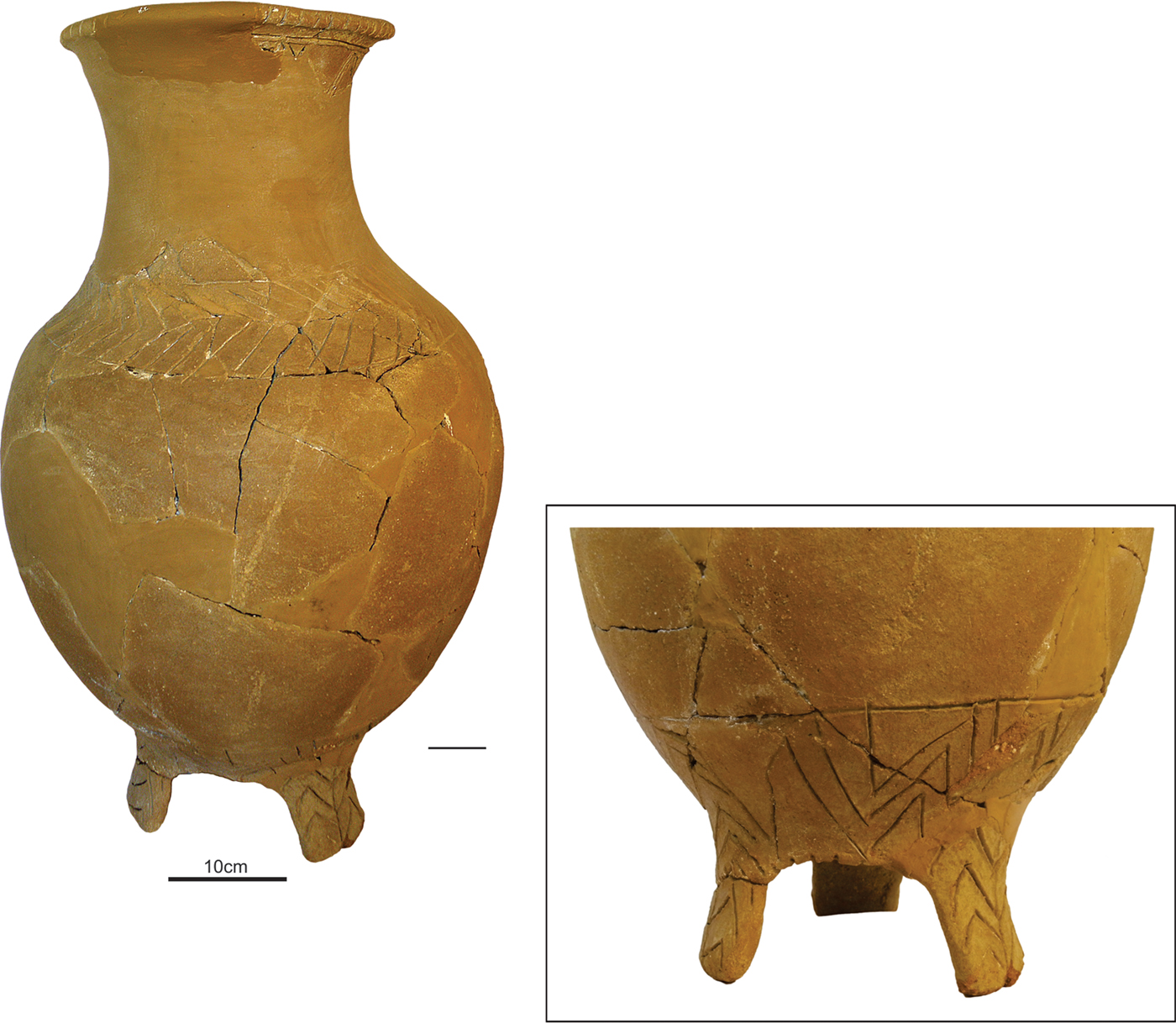
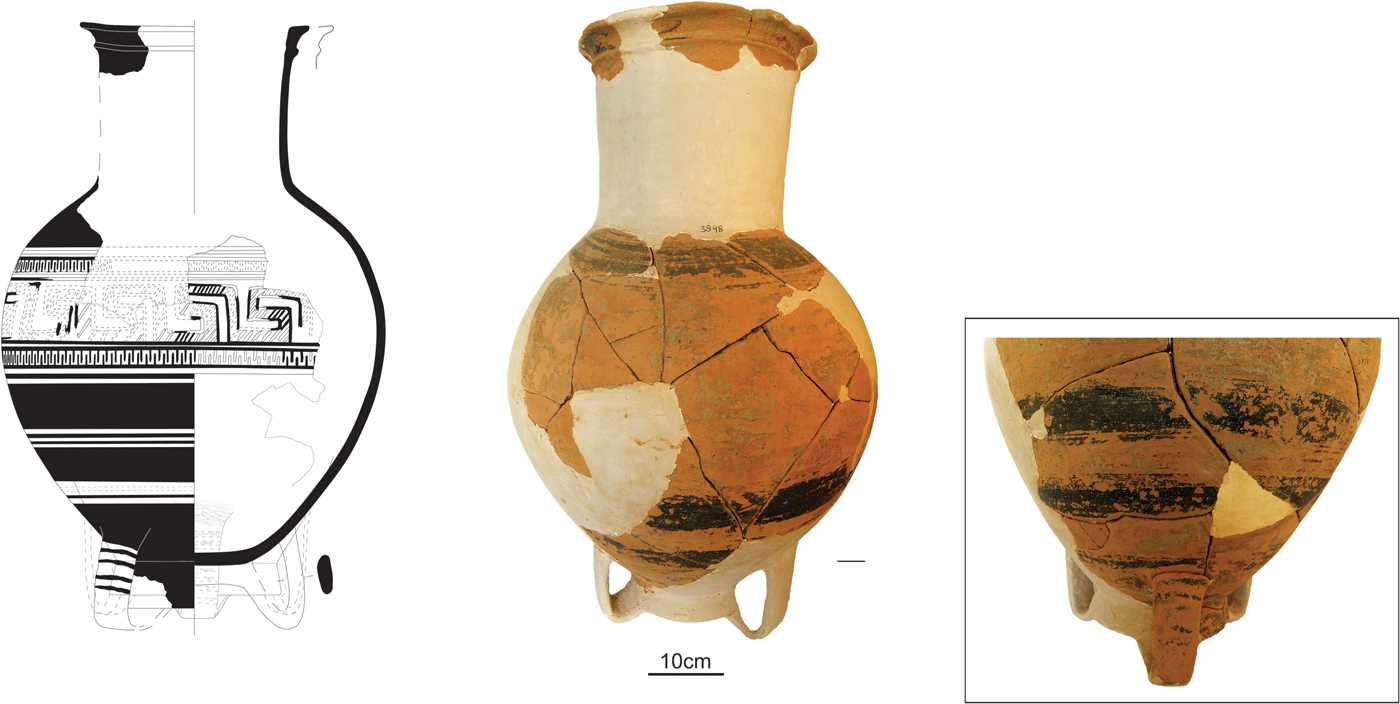
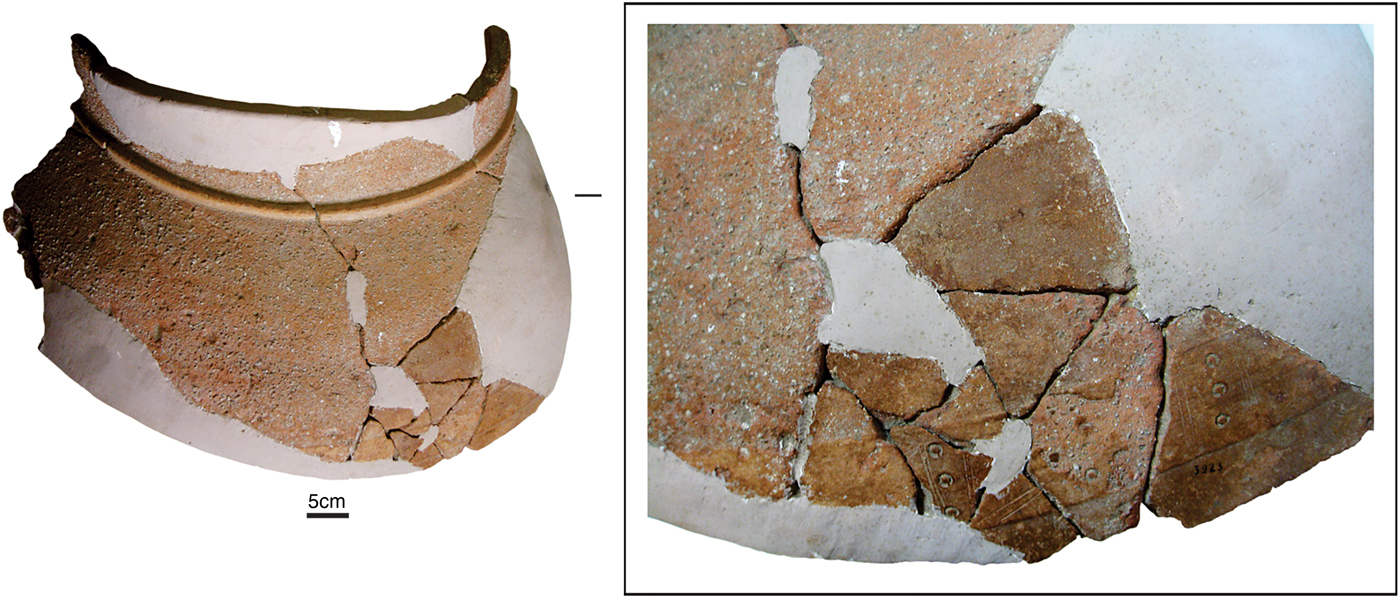
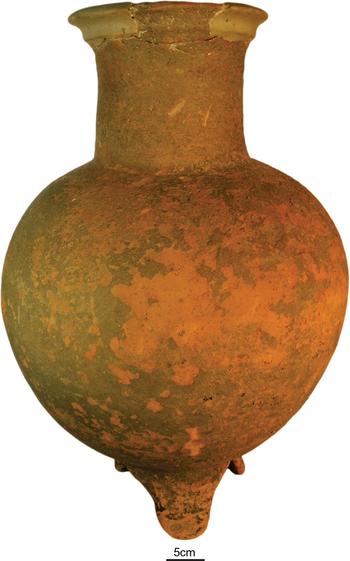
Other areas inside Tumulus 6 also revealed a selection of storage as well as drinking and pouring vessels. Most of the storage vessels may have been intended for more burials. Area Β–Γ included a coarse tripod pithoid vessel with incised decoration (Fig. 13). Such coarse pithoid forms, especially tripod pithoid pots with incised (and/or impressed) decoration, often embellished with linear motifs and occasionally with figural scenes, seem to have been local Naxian wares that were used for ceremonial purposes (in primary or secondary use) on Geometric Naxos.Footnote 23 Thus far, they are known mainly from funerary contexts and circulated throughout the coastal and inland parts of the island (Charalambidou Reference Charalambidou, Lambrinoudakis, Mendoni, Koutsoumpou, Panagou, Sfyroera and Charalambidouforthcoming). Area Δ included a large fine/semi-fine closed vessel (MN 3823) and Area E two coarse closed vessels (one of which is illustrated in Fig. 14), a large fine/semi-fine closed vessel with triple-loop base (Fig. 15) and a small number of drinking vessels, mainly skyphoi.
Tumulus 6, Area Β–Γ: coarse tripod pithoid vessel with incised decoration (MN 3831) (photographs by D. Nenova).

Tumulus 6, Area E: coarse closed vessel (MN 3849) (photograph by D. Nenova).

Tumulus 6, Area E: fine/semi-fine closed vessel with triple-loop base (MN 3848) (photographs by D. Nenova; drawing by B. Konnemann).

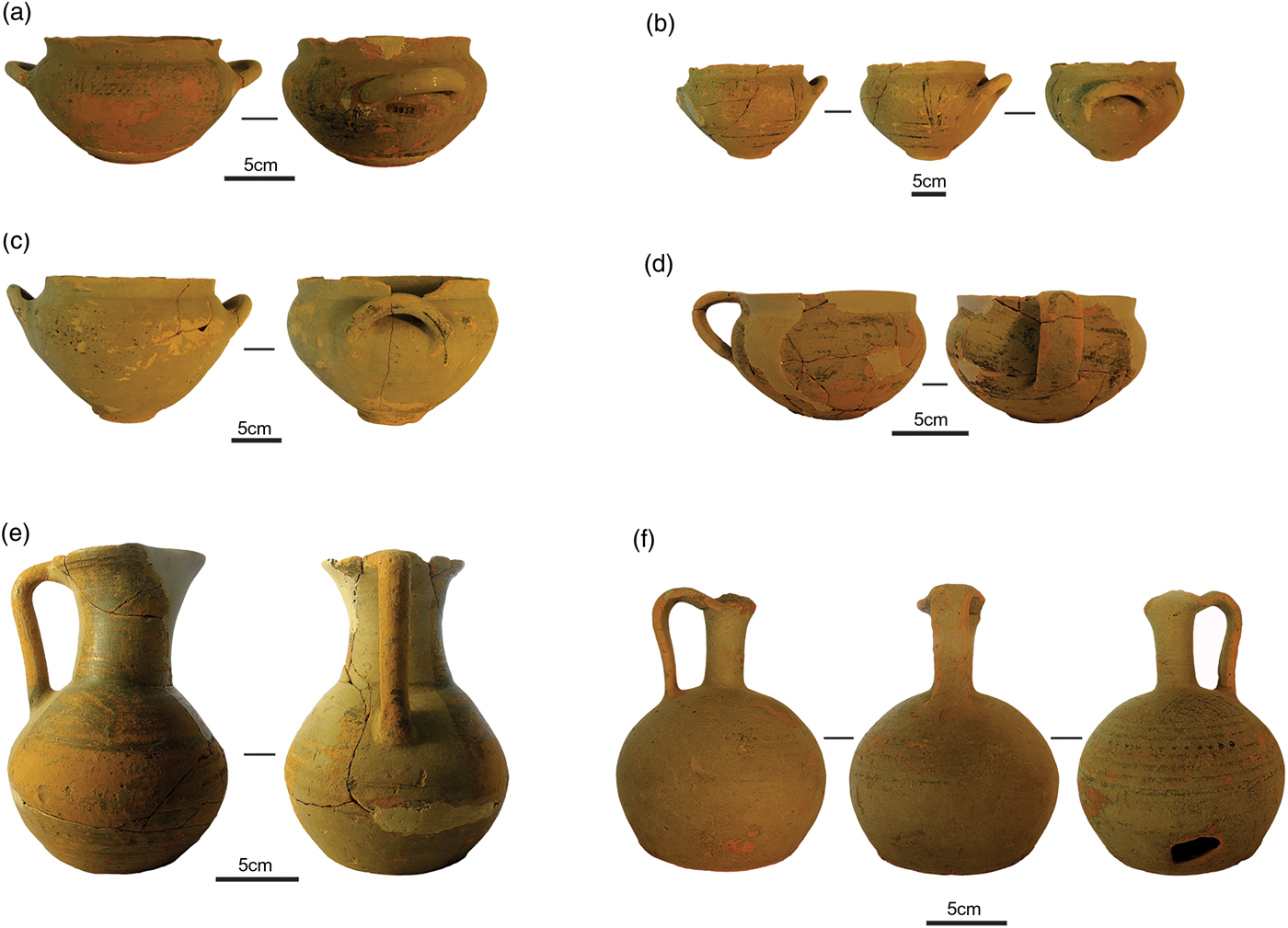
A funerary rite (or rites) associated with pouring and drinking in the interior of the structure is also clearly evident through the presence of a small group of complete vases in Area ΣΤ, including fine wheelmade vases, specifically four drinking vessels (skyphoi and a kyathos), an oinochoe and a trefoil lekythos (Fig. 16). The fact that the vessels of this group were found upside down (see also the inverted position of skyphos MN 3830 at the centre of the structure) implies that their contents could have been poured out during a funeral ceremony. Such ceremonies resemble a rite observed in the cult context of Hyria: offerings to the deity worshipped at this sanctuary, mainly drinking vessels (skyphoi and kyathoi), have been reported by Eva Simantoni-Bournia (Reference Simantoni-Bournia, Stamatopoulou and Yeroulanou2002, 273) to have been placed in a stream, some of them having been deposited inverted. Finally, carbonised fruits found within Tumulus 6 (under study by Evi Margaritis) provide concrete evidence for the nature of funerary feasting.Footnote 24
Tumulus 6, Area ΣΤ: (a)–(d) drinking vessels (skyphoi MN 3852, 3853 and 3855; kyathos MN 3850); (e) oenochoe (MN 3854); (f) trefoil lekythos (MN 3851) (photographs by D. Nenova).

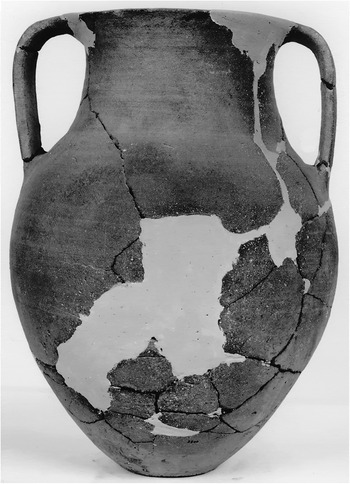
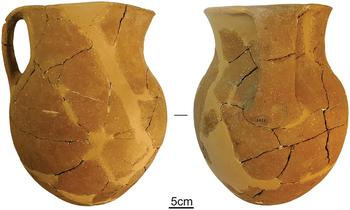
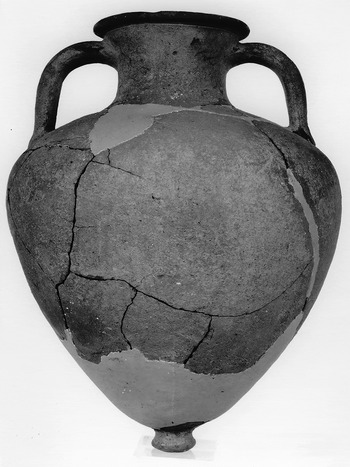
In the vicinity of some of the tumuli at Tsikalario, or in other smaller, sometimes irregular, stone enclosures, coarse vessels were frequently used. On the periphery of Tumulus 6 the predominant forms are pithoid vessels (Figs 17, 18), amphorae (Fig. 19) and cooking jugs (Figs 20, 21). That at least some of these served for infant enchytrismoi (as, for example, the pithoid forms), the human remains having disintegrated, is a strong possibility (a hypothesis first suggested by Coldstream Reference Coldstream2003a, 92). Coarse vessels from the periphery of Tumulus 6 were not accompanied by grave-offerings, and, consequently, any attempt to date these pots has to be based on their shape, type and manufacturing techniques. Pots that can be dated probably to the MG and LG (I?) periods include a tripod pithoid vessel with incised decoration (Fig. 17)Footnote 25 and a handleless pithoid vessel with a plain base (Fig. 18), both coarse and handmade, as well as the coarse amphora MN 3800 (Fig. 19), which was probably coil-built and then fashioned on a wheel in the manner of the coarse amphora MN 3825 from the centre of the funerary structure. This chronological determination is based on parallels in shape and style to finds from the interior of the tumulus. This could mean that some pots were placed at the periphery of Tumulus 6 roughly contemporaneously with vessels deposited inside the tumulus. At some later date, probably still in the course of the LG, the range of shapes deposited in the cemetery changed. At the periphery of Tumulus 6 and also in other contexts of the cemetery, the coarse cooking jug appears to be a common shape, a shift in preference which seems to continue at least into the Archaic period. An illustrative example is given by the four chytrai (Fig. 21) that comprise the contents of Enclosure 2 (Fig. 6) built in the vicinity of the tumulus and closely connected to it.Footnote 26 Whether these vessels, found in the 1960s, functioned as receptacles for infants or as containers for foodstuffs to be used in a funerary ceremony is difficult to determine.
Periphery of Tumulus 6: coarse tripod pithoid vessel with incised decoration (MN 3839) (photographs by D. Nenova).

Periphery of Tumulus 6: coarse handleless pithoid vessel with plain base (MN 3838) (photograph by D. Nenova).

Periphery of Tumulus 6: coarse amphora (MN 3800) (photograph by I. Iliadis).

Periphery of Tumulus 6: coarse cooking jug (MN 3837) (photographs by D. Nenova).

Periphery of Tumulus 6: coarse chytrai from Enclosure 2 (MN 3841–4) (photographs by D. Nenova).

In general, a wide diversity of manufacturing and finishing techniques with the use of a rotational device can be detected in the coarse cooking pots, especially those located outside the tumuli at Tsikalario (or those coming from the smaller and often irregular enclosures).Footnote 27 Given the early adoption of rotational devices for the production of coarse wares on Naxos (see the amphora MN 3825, Fig. 10a, from the interior of the tumulus), it is possible that the Naxian examples from Tsikalario that make use of a turntable date from the LG period onwards.
Vessels found on the periphery of Tumulus 6 were deposited at least until the Late Archaic to Classical periods, as is indicated by the pithos shown in Figure 22, with incised crosses and stamped small circles,Footnote 28 or a transport amphora which, according to Liston's osteological analysis (unpublished report), included an adult cremation burial (Fig. 23). An adult aged 18–30 years of unknown sex was buried in this amphora.
Periphery of Tumulus 6: pithos (MN 3923) (photographs by D. Nenova).

Periphery of Tumulus 6: transport amphora (adult burial; MN 3921) (photograph by X. Charalambidou).

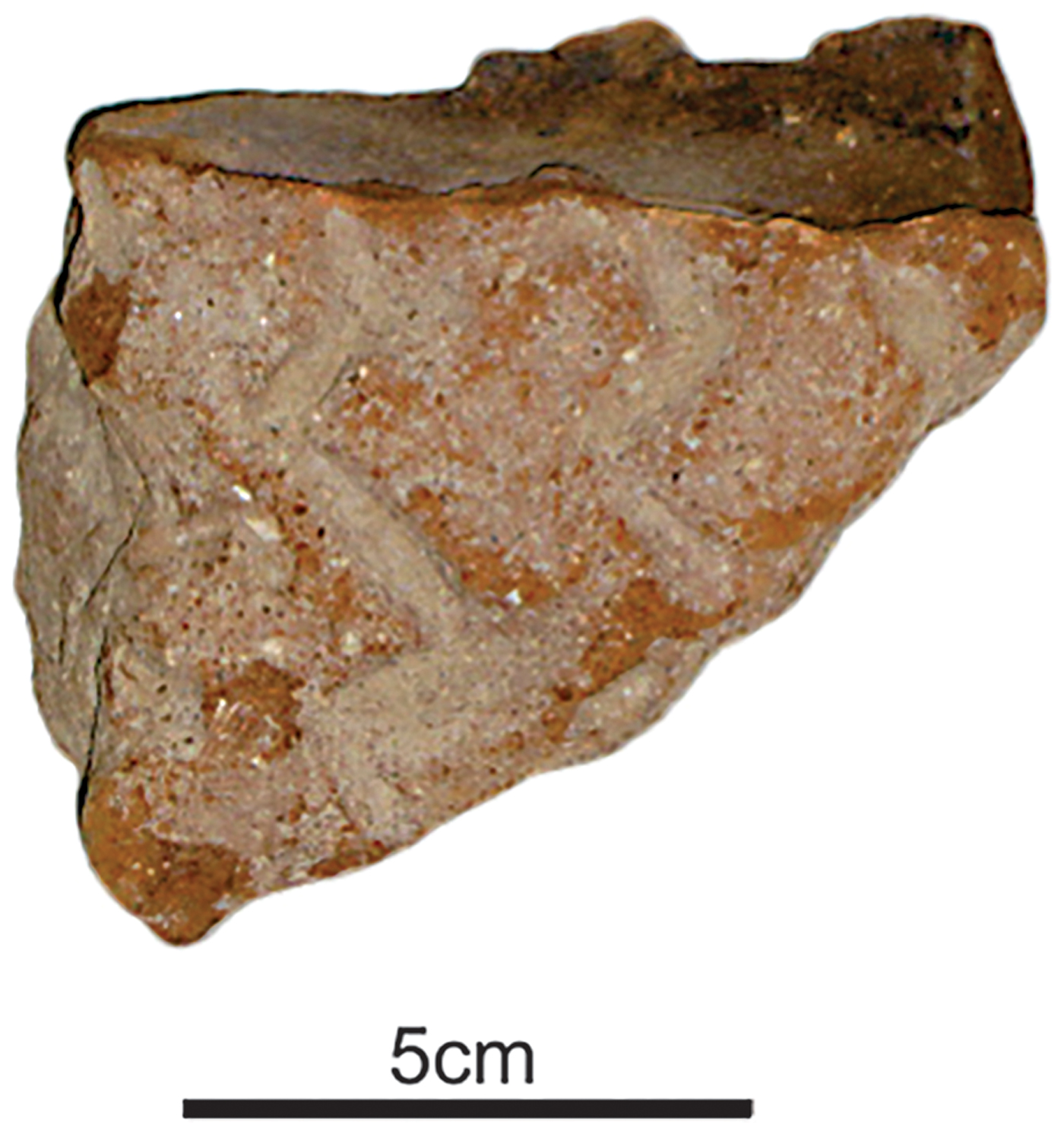
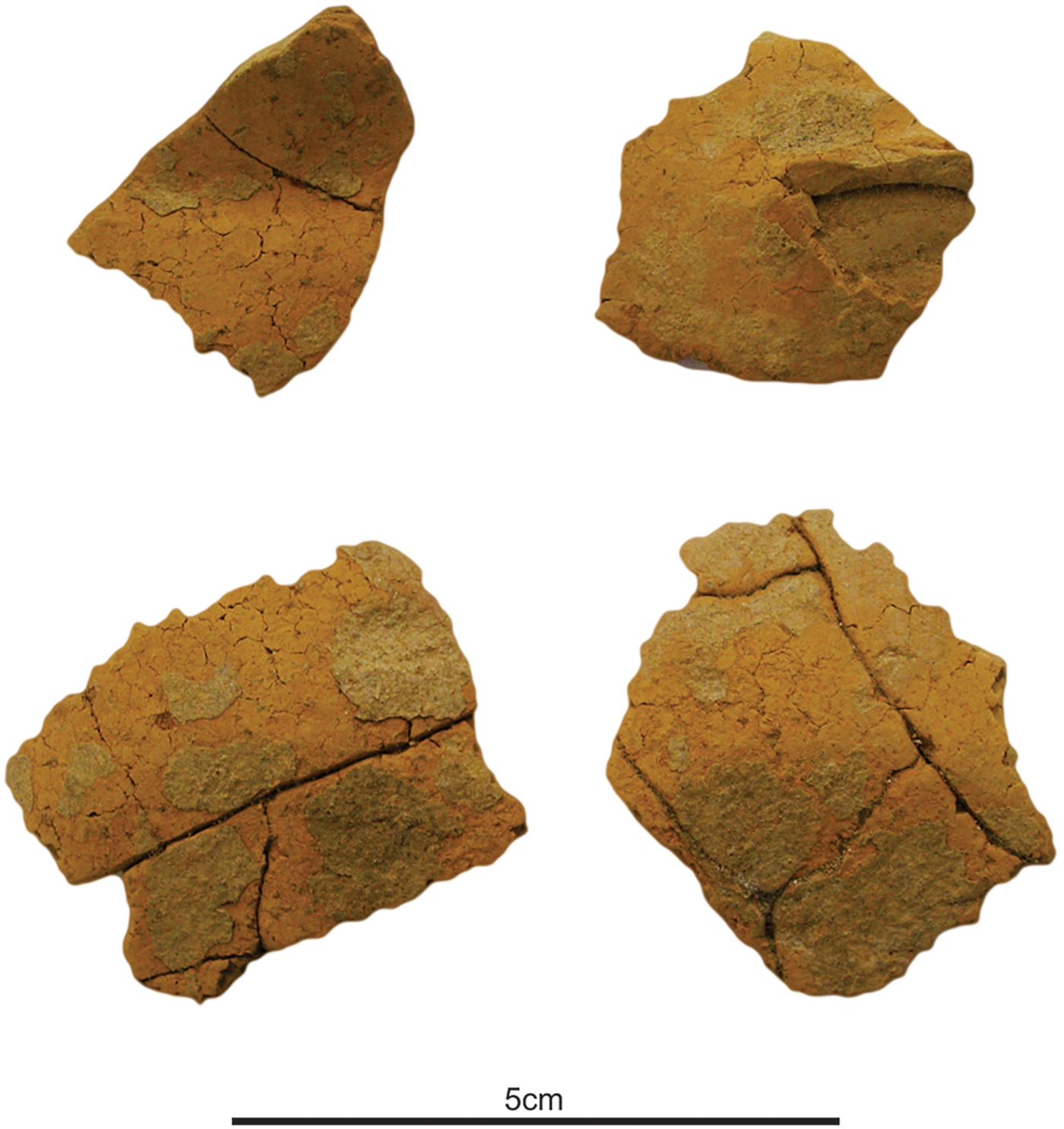
That Building C (Fig. 6) is located in the vicinity of Tumulus 6 and in proximity to another circular funerary structure can justify its interpretation by Zaphiropoulou and other scholars as a structure related to funerary feasts and/or chthonian cults.Footnote 29 Among the few preserved ceramic finds associated with Building C is a large plain pithos base (MN 3820), which was found in situ and may belong with a LG or Early Archaic pithos fragment with incised decoration (Fig. 24). That this pithos was used for provisions destined for funerary feasts remains a possibility.
Building C, near Tumulus 6: pithos body fragment (MN 3920; belonging with MN 3820?) (photograph by D. Nenova).

Tsikalario Cist Grave 11 and its vicinity (Burial Context 11)
Burial Context 11 (Fig. 8) consists of the contents of Cist Grave 11 (Group I) and, outside the grave, an assemblage of vessels (Group II from the northern side of the grave) along with a pithoid vase inside a cist/slab-lined theke with a cover slab (Group III from the southern side). This complex was located to the west of a rectangular structure, which the excavator labelled number 11, thus giving rise to the conventional designations ‘Burial Context 11’ and ‘Cist Grave 11’.Footnote 30 The majority of the grave-goods within Groups I–III are Naxian wares, although certain products (most of them discussed below) are imports.
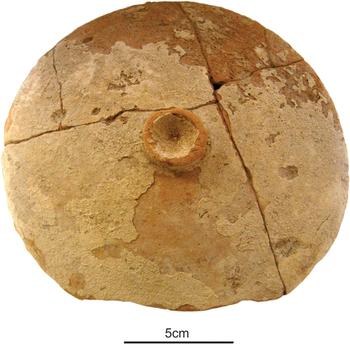
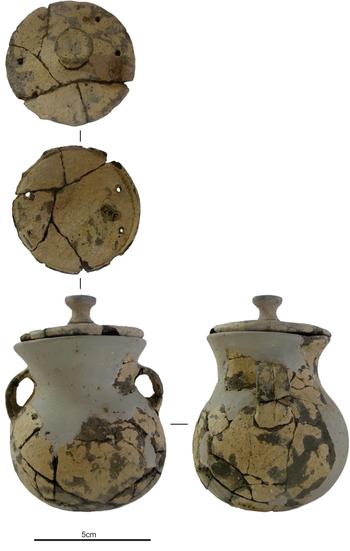
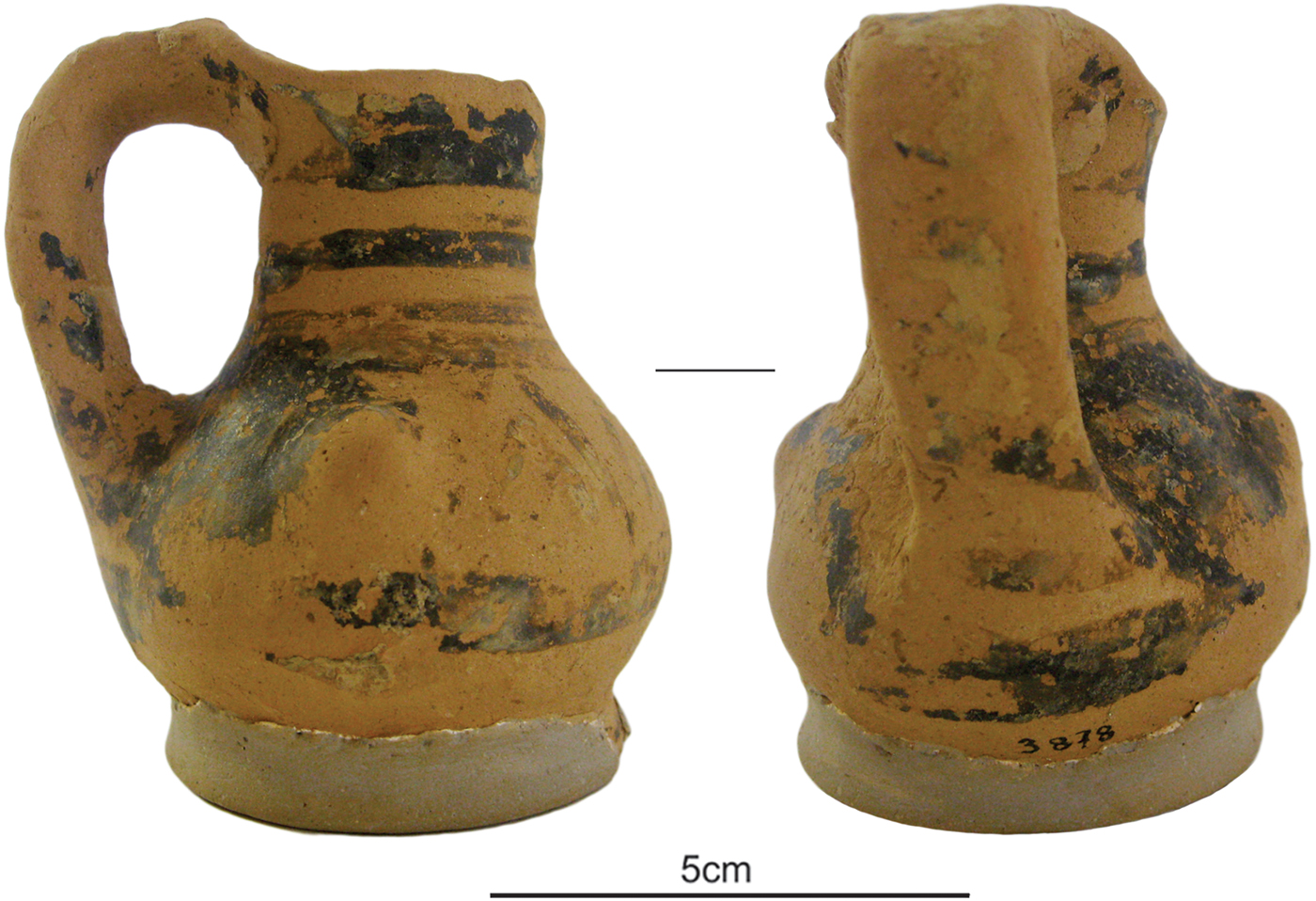
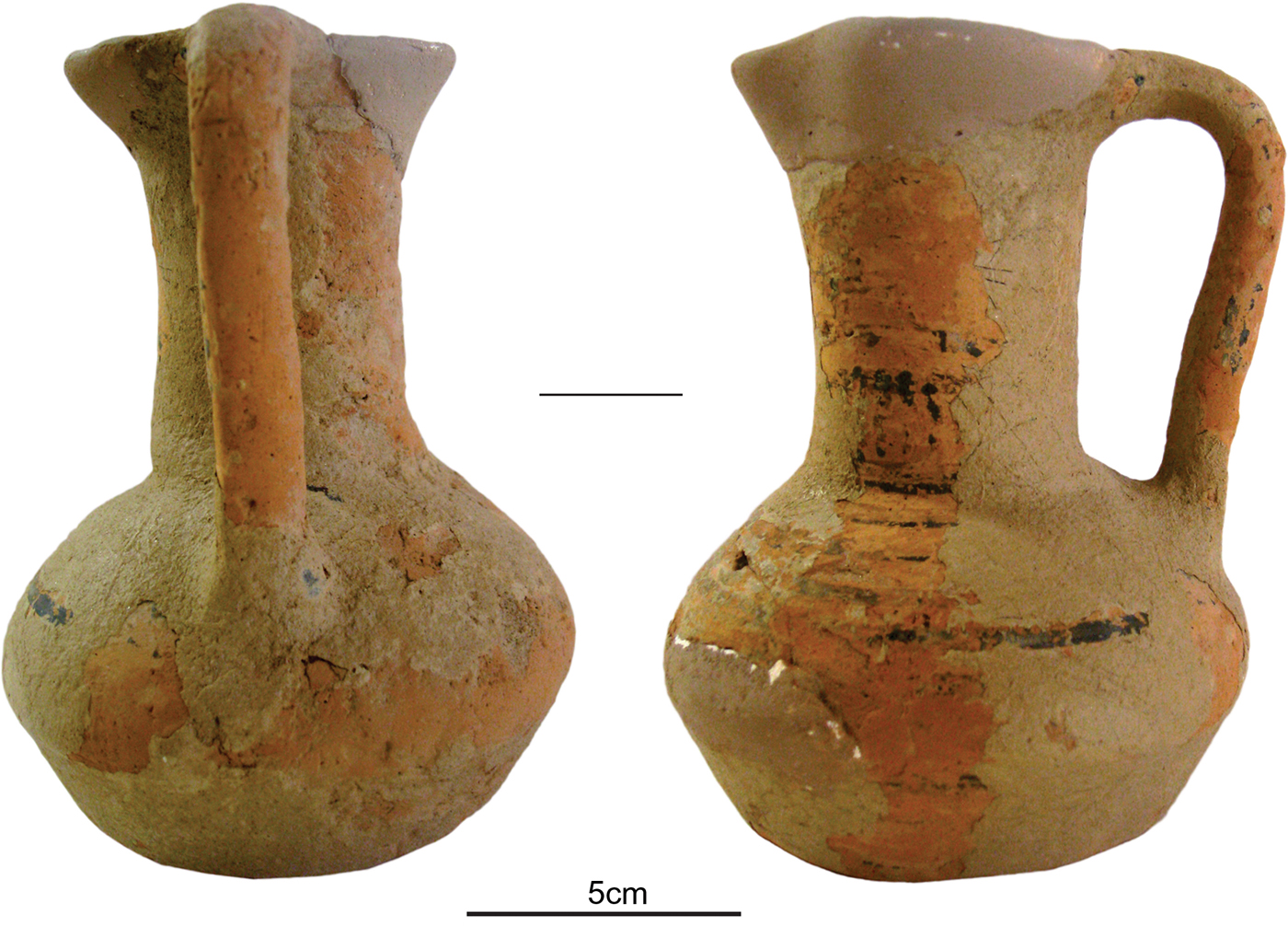
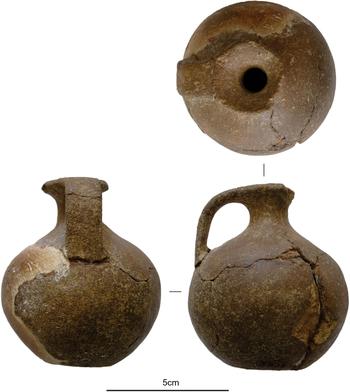
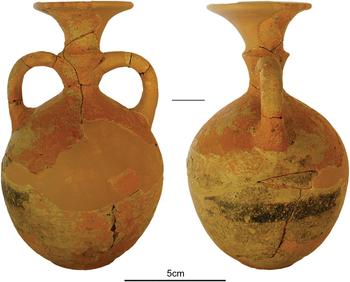
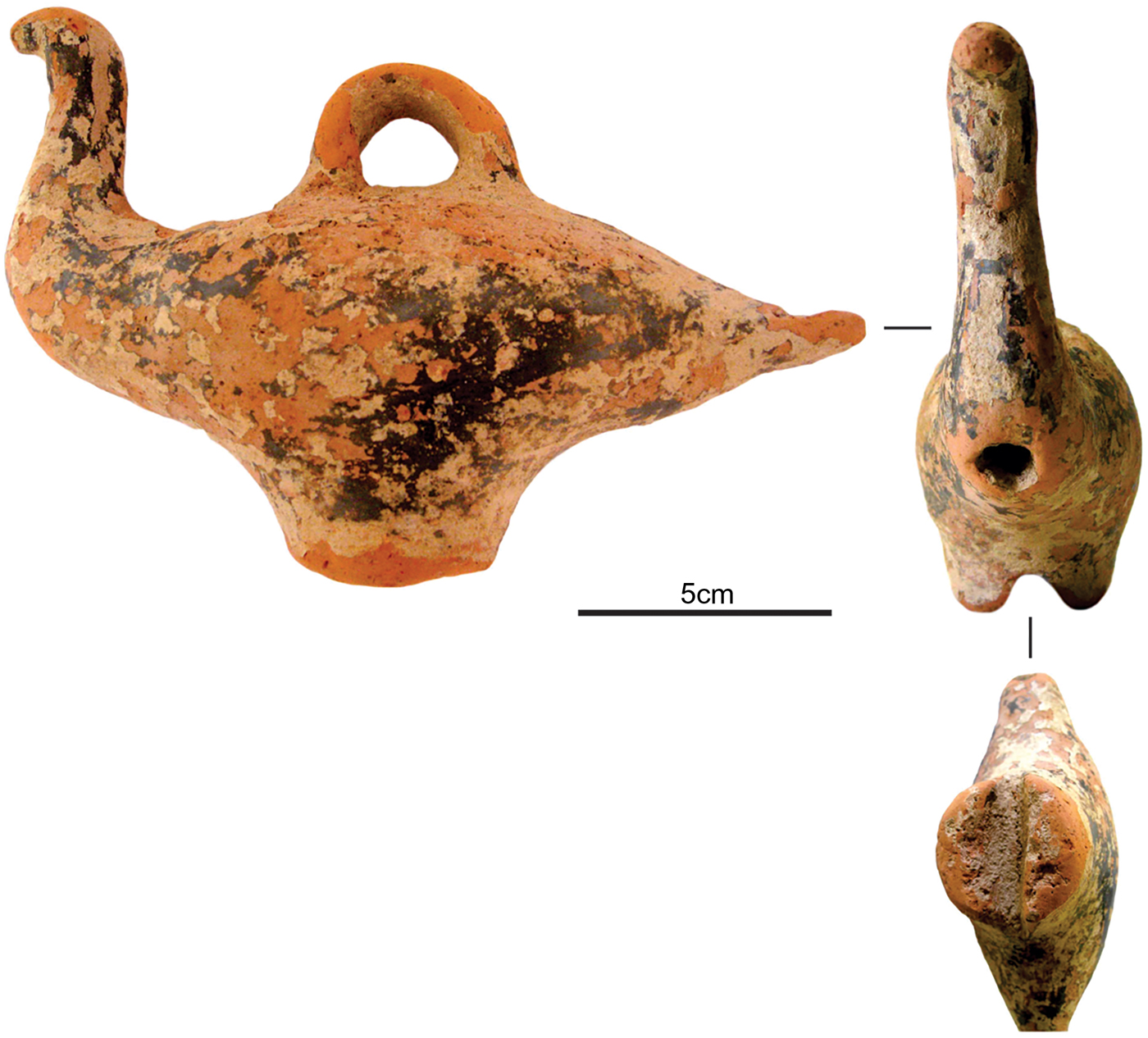
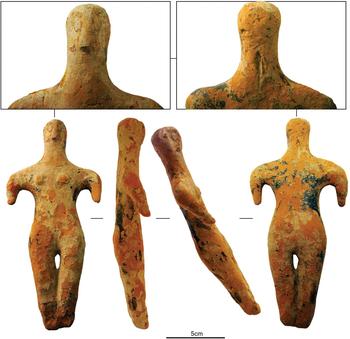
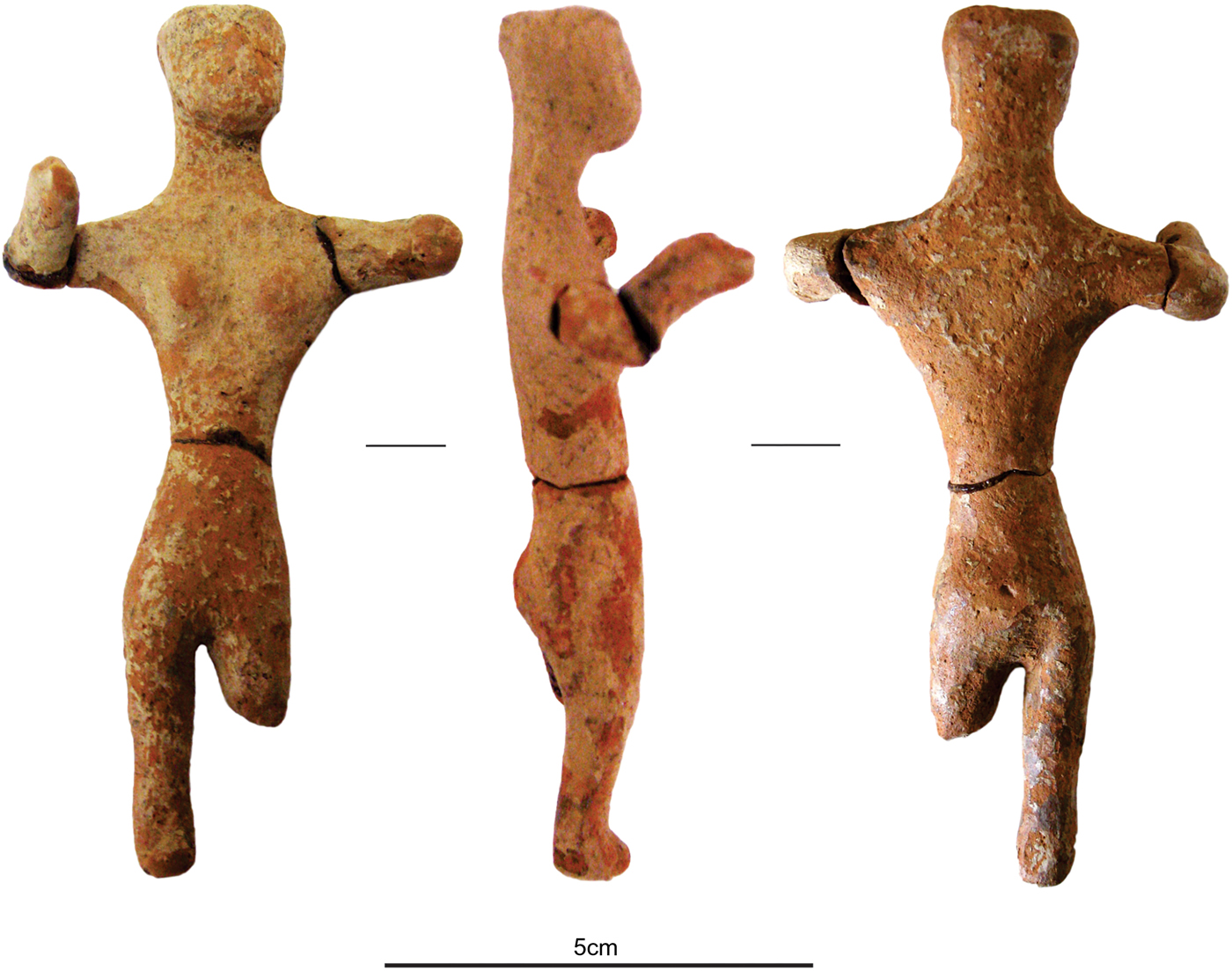
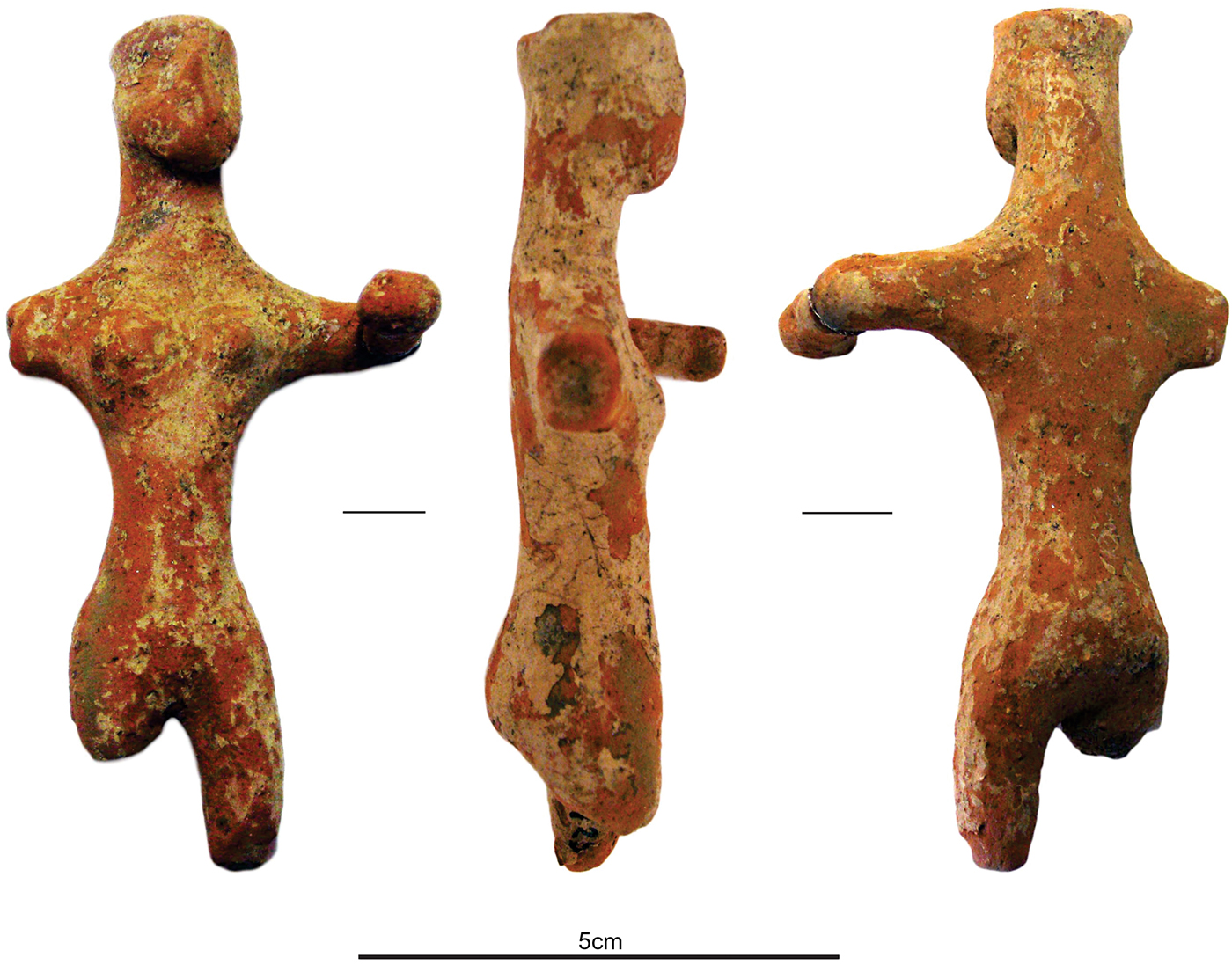
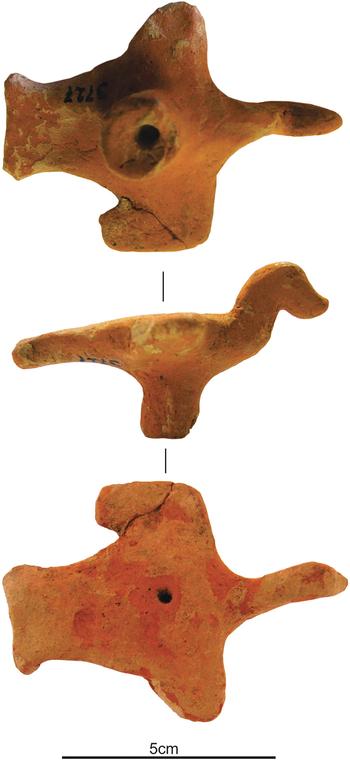
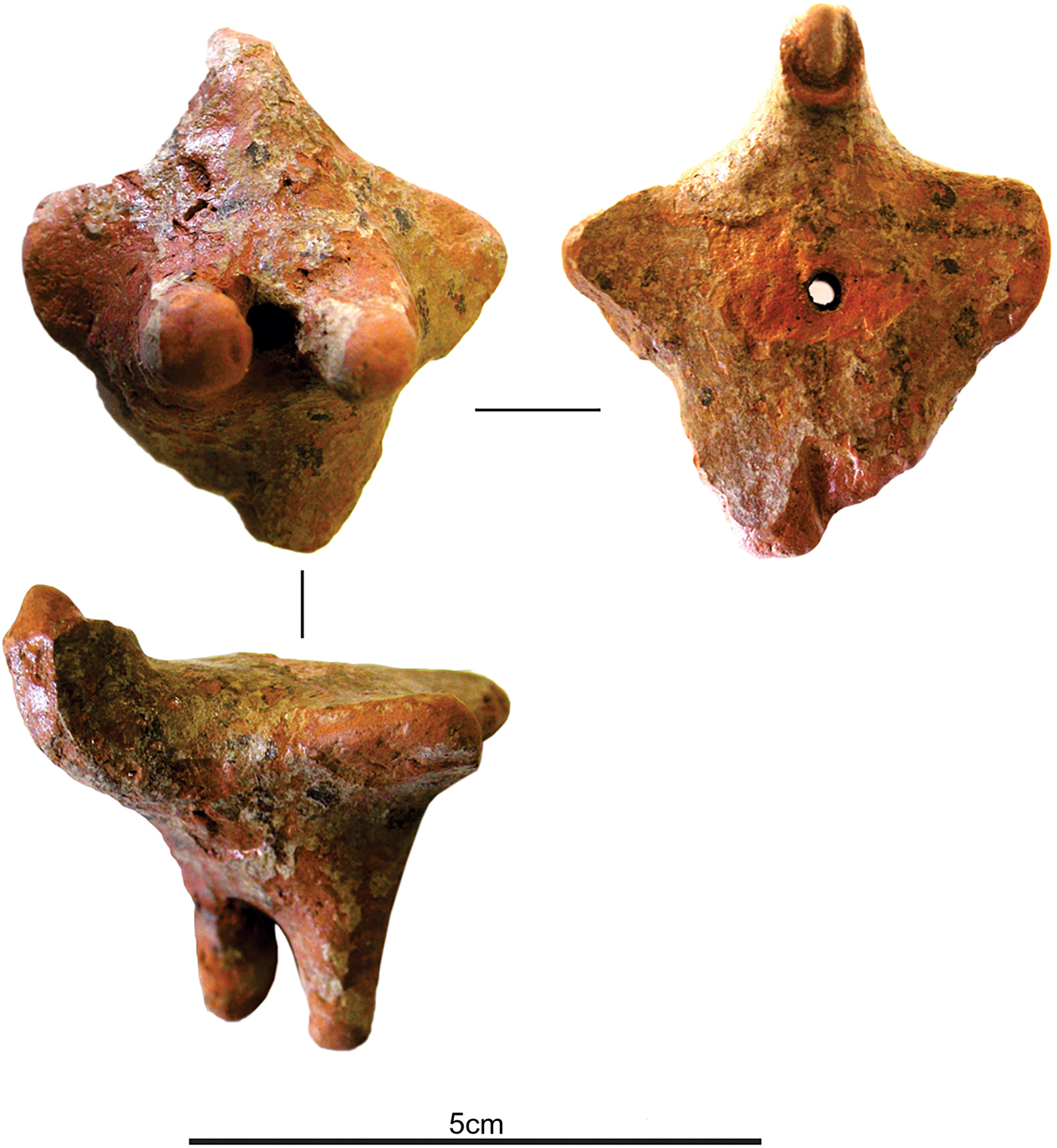
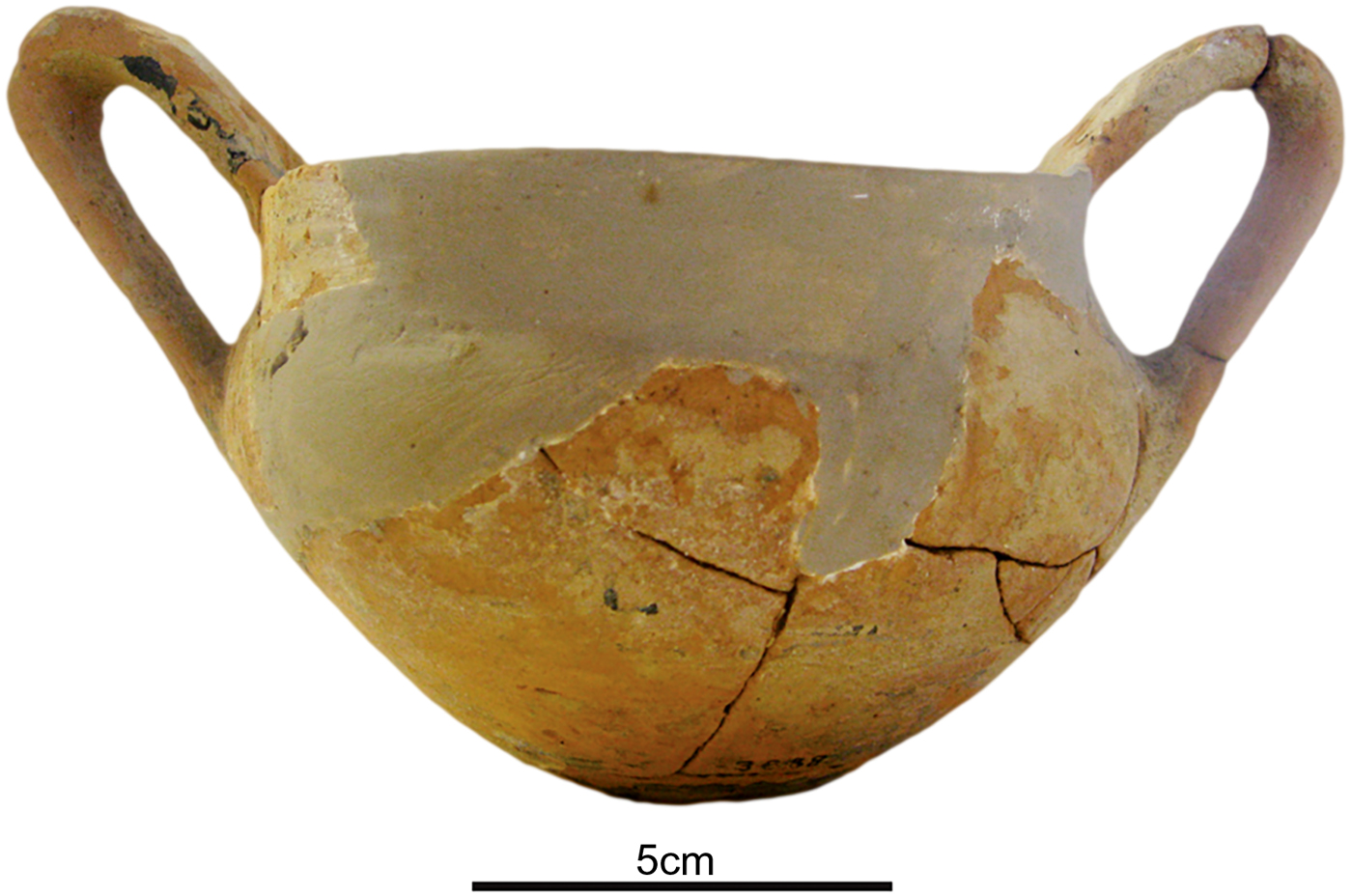
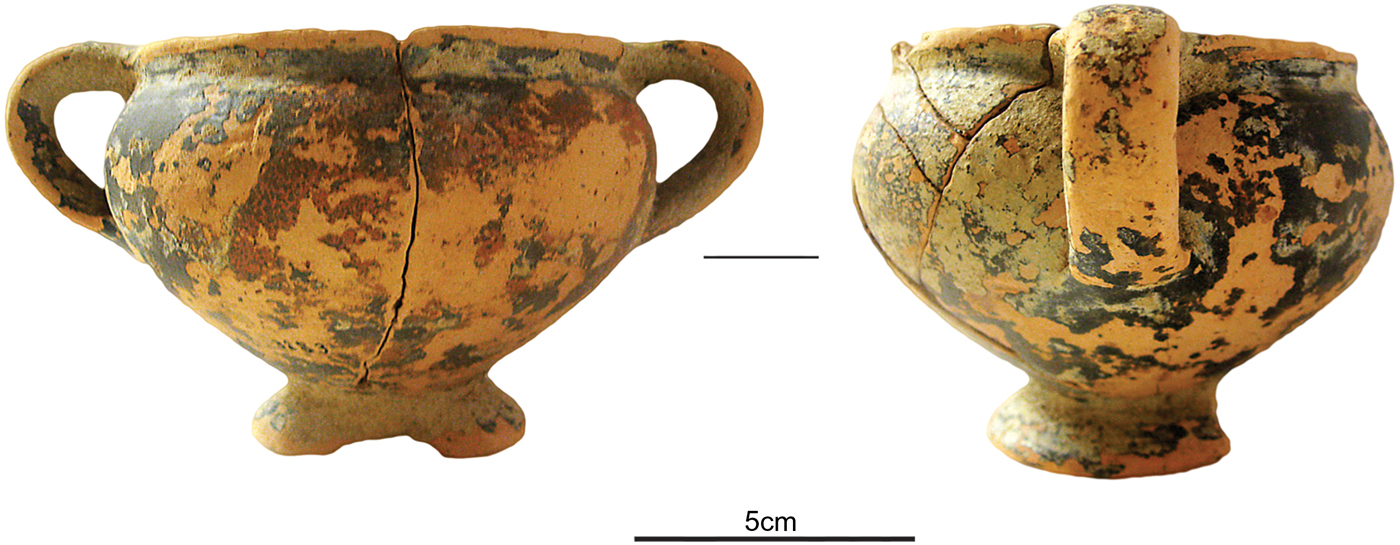
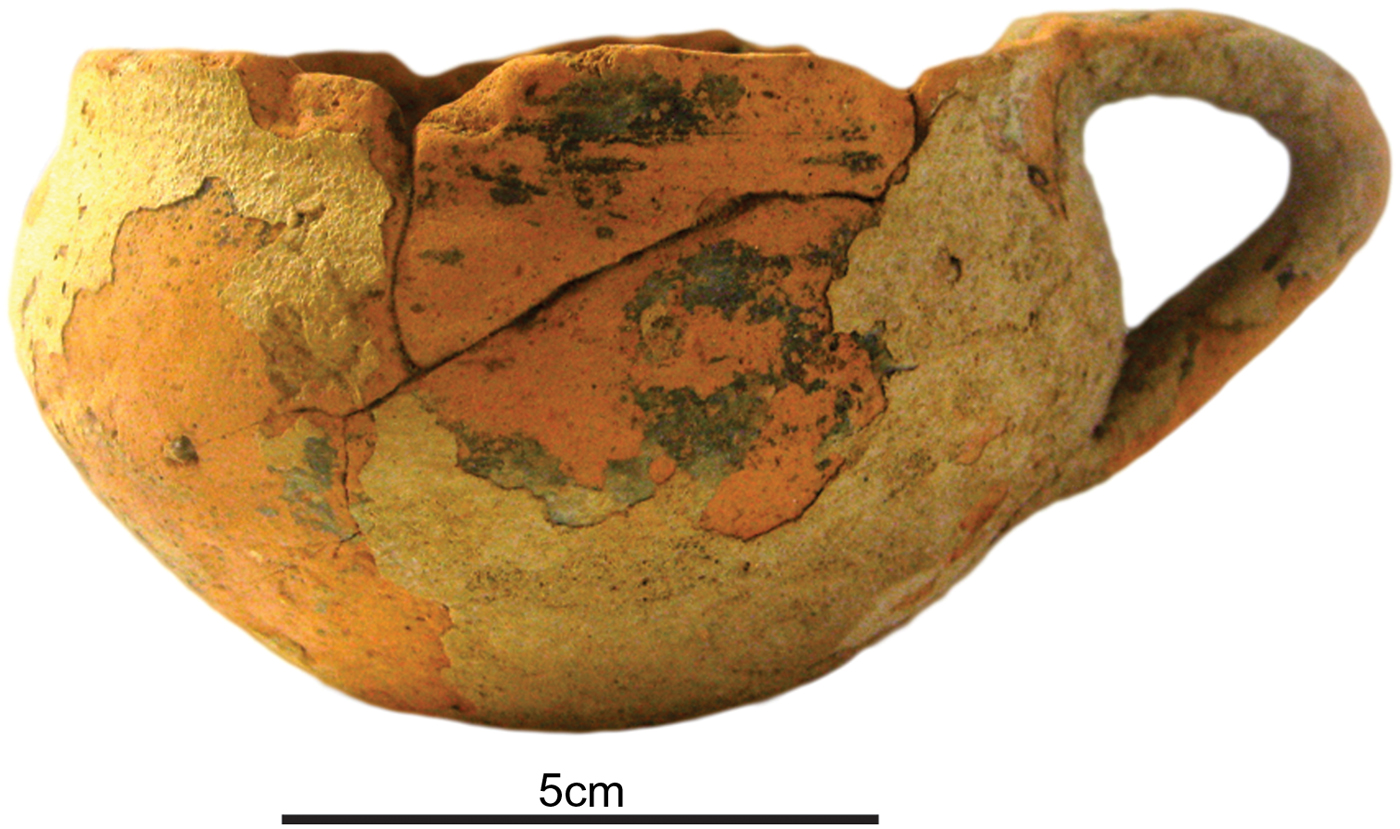
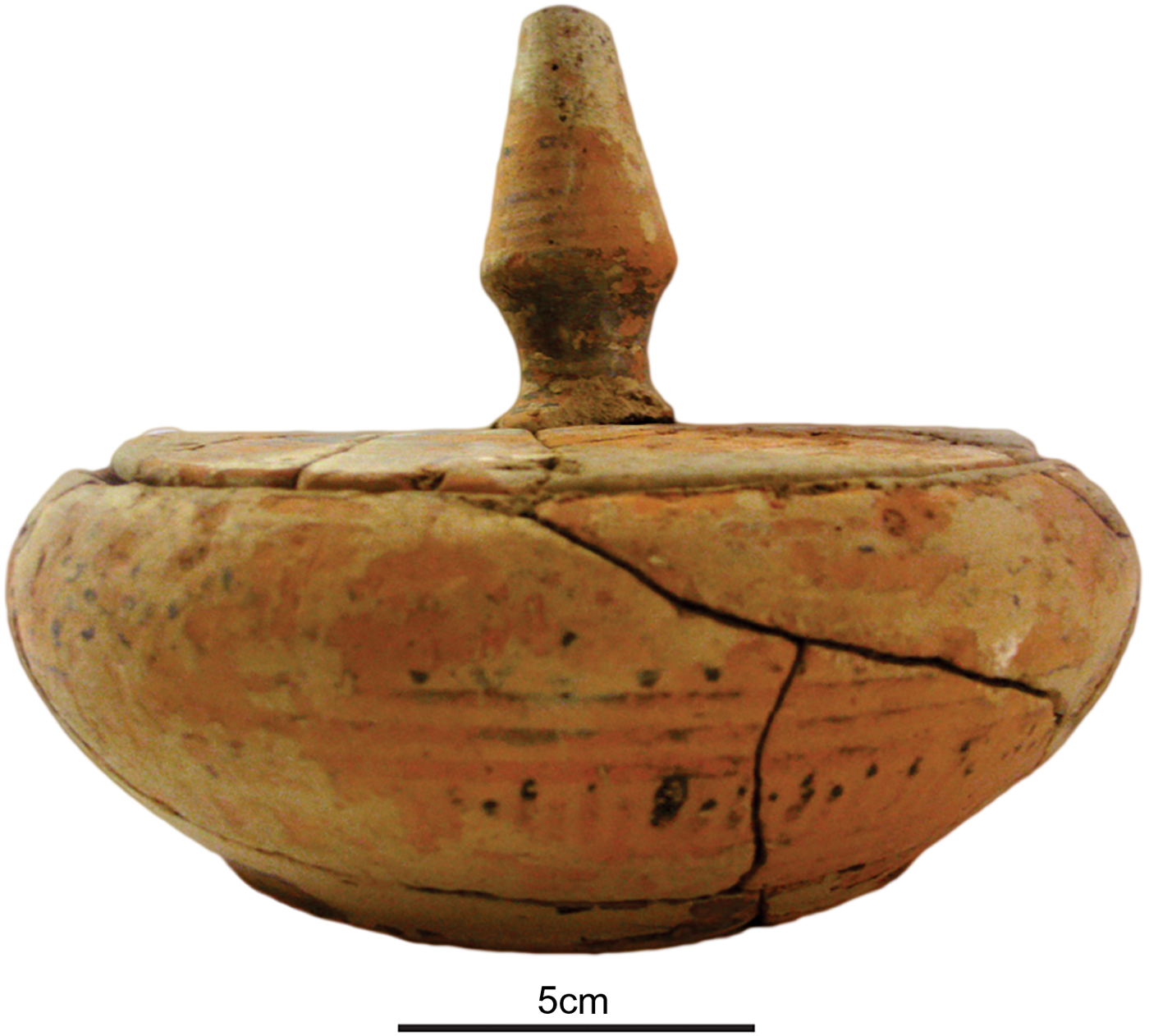
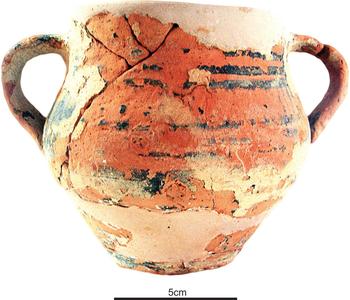
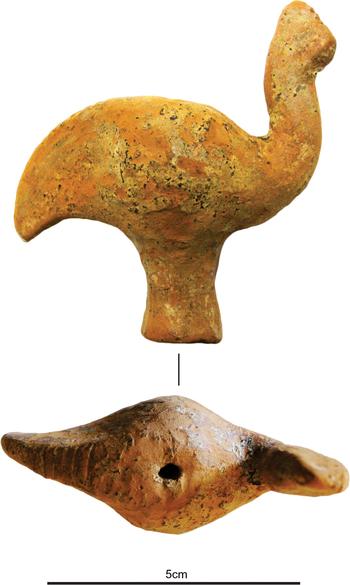
Group I, from a layer of ash no deeper than 0.1 m (Papadopoulou-Zaphiropoulou Reference Papadopoulou-Zaphiropoulou1965, 520–1), comprises the following grave-offerings: 54 small perforated clay objects resembling spindle whorls that were most likely used as beads; a round, green-glass bead; and a bronze, arched fibula and small bronze spirals (probably from a separate piece of jewellery). In addition to these grave-goods, the excavator discovered a number of ceramic vessels reportedly deposited on the funeral pyre: a kantharos (Fig. 25), a number of kyathoi (e.g. Fig. 26),Footnote 31 a small coarse handleless pithoid vessel with plain base (Fig. 27), a lid (Fig. 28), an amphoriskos-pyxis (Fig. 29), a miniature jug with breast-like protrusions (Fig. 30) and a small oenochoe (Fig. 31), the lower half of yet another pouring vessel, as well as an aryballos (Fig. 32), a two-handled Black-on-Red juglet (Fig. 33) and a bird vessel (Fig. 34). The excavator reports that, when the vessels were removed, a small assemblage of terracotta figurines also came to light from the interior of the grave: three anthropomorphic figurines (Figs 35, 36, 37) and two bird figurines (Figs 38, 39).Footnote 32
Group I: kantharos (MN 3876) (photographs by D. Nenova).

Group I: kyathoi (MN 3879–80) (photographs by D. Nenova).

Group I: small coarse handleless pithoid vessel (MN 3870) (photograph by I. Iliadis).

Group I: lid (MN 3869) (photograph by D. Nenova).

Group I: amphoriskos-pyxis (MN 3873) (photographs by D. Nenova).

Group I: miniature jug (MN 3878) (photographs by D. Nenova).

Group I: oenochoe (MN 3871) (photographs by D. Nenova).

Group I: aryballos (MN 3875) (photographs by D. Nenova).

Group I: two-handled Black-on-Red juglet (MN 3877) (photographs by D. Nenova).

Group I: bird vessel (MN 3726) (photographs by D. Nenova).

Group I: anthropomorphic figurine (MN 3730) (photographs by D. Nenova).

Group I: anthropomorphic figurine (MN 3728) (photographs by D. Nenova).

Group I: anthropomorphic figurine (MN 3729) (photographs by D. Nenova).

Group I: bird figurine (MN 3727) (photographs by D. Nenova).

Group I: bird figurine (MN 3731) (photographs by D. Nenova).

As mentioned above, inside the tomb the excavator found a funeral pyre as well as burned bones (Papadopoulou-Zaphiropoulou Reference Papadopoulou-Zaphiropoulou1965, 520). Since it has not been possible to locate the osteological remains from this grave, the gender and age of the deceased remain matters of speculation. It is not certain whether the interior of the grave represents a single burial; nonetheless, the ceramic assemblage from the interior of the tomb, which includes a good number of vessels of small dimensions, appropriate for a juvenile, seems rather homogeneous.
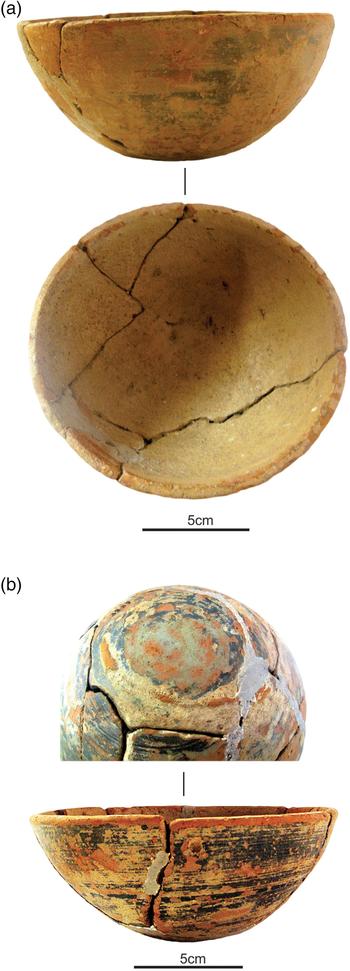
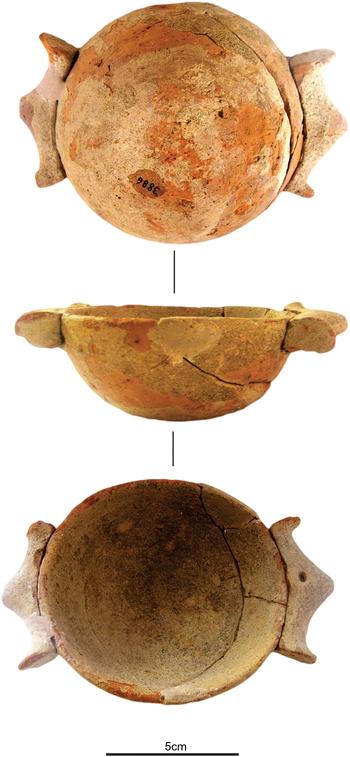
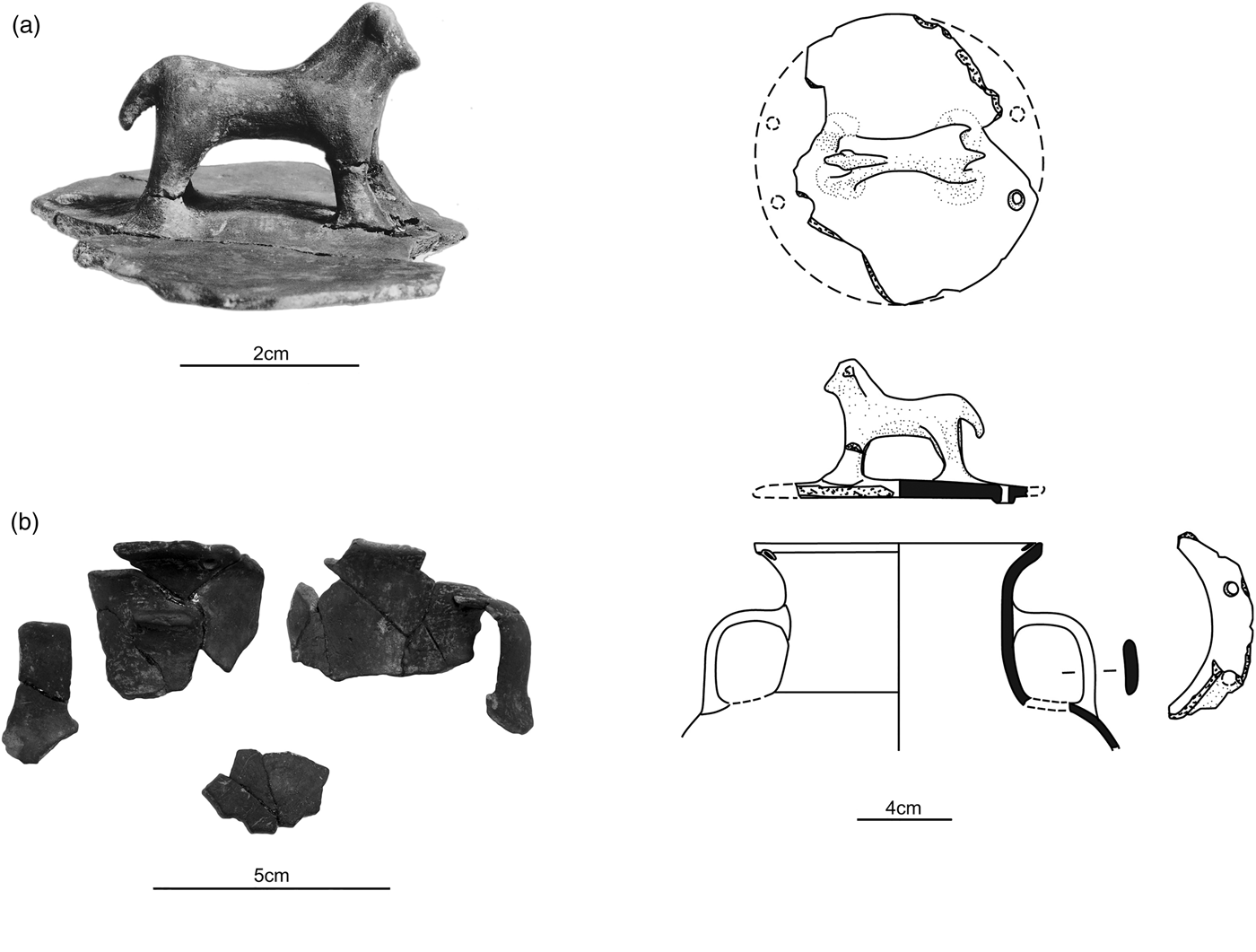
Outside Cist Grave 11 on its northern side, a stone slab and the group of vases it covered were unearthed (Group II). This assemblage consists of two kantharoi (Figs 40, 41), a few kyathoi of the same type as those found inside the burial (e.g. Fig. 42), two bowls (Fig. 43), one bowl with reflex handles (Fig. 44), a flat pyxis (Fig. 45), an amphoriskos (Fig. 46), an amphoriskos-pyxis with a horse on its lid (Fig. 47), a partly preserved slow-pouring vessel, probably an aryballos (Fig. 48), and a bird figurine (Fig. 49). Yet another bowl with reflex handles belonging to the same type as that in Group II was discovered in close proximity to this assemblage. Some of the vases in this group were found in pairs, particularly the bowls.
Group II: kantharos (MN 3888) (photograph by D. Nenova).

Group II: kantharos (MN 3883) (photographs by D. Nenova).

Group II: kyathos (MN 3885) (photograph by D. Nenova).

Group II: bowls (MN 3882 and 3889) (photographs by D. Nenova).

Group II: bowl with reflex handles (MN 3886) (photographs by D. Nenova).

Group II: flat pyxis (MN 3881) (photograph by D. Nenova).

Group II: amphoriskos (MN 3887) (photograph by D. Nenova).

Group II: (a) lid of (b) amphoriskos-pyxis (MN 3790) (photographs by D. Nenova; drawings by B. Konnemann).

Group II: aryballos (MN 10996) (photographs by D. Nenova).

Group II: bird figurine (MN 3789) (photographs by D. Nenova).

The excavator reports discovering burned bones also in the interior of the coarse handleless pithoid vessel with plain base (Group III) that was recovered from the cist/theke on the southern side of the cist grave (Papadopoulou-Zaphiropoulou Reference Papadopoulou-Zaphiropoulou1965, 522) (Fig. 50). It is possible, therefore, that both this and the handleless pithoid vessel from Group I (the cist grave) (Fig. 27), which are similar in shape, were used as burial pots, indicating that there were at least two burials in the whole complex (Burial Context 11). This assumption is strengthened by the fact that the same shape in another Tsikalario context, in Pit Grave 14, was probably used as an urn for a child as indicated by the osteological analysis (unpublished report). From this pit grave, where the osteological material has been preserved, Liston has identified cremated human bones in one coarse handleless pithoid vessel with plain base (Fig. 51), of the same shape as the pithoid vessels in Groups I and III from Burial Context 11, and in a second fine/semi-fine pithoid pot with tripod base (Fig. 52). Both vessels were found inside the pit. The former pithoid vessel held the cremated bones of a child of unknown sex and the pot with the tripod base probably contained an adult cremation of unknown sex. The case for a double burial in Pit Grave 14 that might have belonged to a child and an adult who were perhaps related is strengthened by the presence of two almost stylistically identical fine painted pyxides, which, however, differ in size (Fig. 53) (see also Charalambidou Reference Charalambidou2010–12, 161).
Group III: small coarse handleless pithoid vessel (MN 3891) (photograph by I. Iliadis).

Pit Grave 14, interior: coarse handleless pithoid vessel (MN 3941) (photograph by D. Nenova).

Pit Grave 14, interior: fine/semi-fine pithoid pot with triple-loop base (MN 3943) (photograph by D. Nenova).

Pit Grave 14, interior: two pyxides. (a) MN 3940; (b) MN 3945 (photographs by D. Nenova).

The date of Burial Context 11 can be determined by certain grave-offerings that offer some chronological controls. The stylistic features of the finds from the interior of the cist grave (Group I) point towards the end of the MG II or LG (possibly LG I).Footnote 33 This date concurs with the period of use of the coarse handleless pithoid vessels with plain bases within the Tsikalario cemetery (here, in Groups I and III, we meet the small version of this shape).
The ceramics from outside the grave (Group II) can be placed in the time span from the MG to at least the LG I/II.Footnote 34 This accumulation of offerings in Group II may be related to one or more ceremonies probably connected with the deceased housed in the interior of the cist grave. It is possible that Group II includes offerings that were used at the enagismos (the ritual performed during burial) plus some offerings destined for the recently deceased in the cist grave. The rectangular enclosure (no. 11), which is associated with Groups I–III, recalls the shape of a wall at Antissa on Lesbos that has been interpreted as a temenos wall built around two Geometric cist tombs and believed to indicate ancestor worship (Spencer Reference Spencer1995, 55–6). But for the Tsikalario Burial Context 11, the small number of offerings in Group II, especially those of later date which might have been provided for the recently deceased, does not indicate proper ancestor cult.
That many vessels in Groups I and II are of small dimensions – a feature suggesting that the interior of this grave included at least one juvenile, as mentioned above – accords with the association of bird figurines and bird vessels, also evident in Groups I and II, with burials of children in the Aegean (Lemos Reference Lemos and Karageorghis1994, 234; Xagorari Reference Xagorari1996, 54; Kotsonas Reference Kotsonas2008, 324; Langdon Reference Langdon2008; Vizyinou Reference Vizyinou2011, 403; Alexandridou Reference Alexandridou2016, 349). Furthermore, the connection of beads with female burials – the 54 small perforated clay objects in Group I most likely functioned as beads – may further indicate that Cist Grave 11 included the burial of a (young) female.Footnote 35
In relation to the open shapes that were found in this complex, the presence of small kyathoi (e.g. Figs 26, 42) both inside and outside the grave (Groups I and II) which share many morphological features strengthens the idea that there was a connection between Groups I and II. In addition to kyathoi, one kantharos was found inside the cist grave (Group I) and two more among the group of vessels outside the grave (Group II). The kantharos from within the grave (MN 3876; Fig. 25) has high handles with plastic representations on the terminals; this is a type that has found no counterpart so far in the EIA Naxian pottery tradition. Coldstream (Reference Coldstream2003a, 92; Reference Coldstream2008, 468) interprets these terminals as knobs, suggesting north Aegean connections, and mentions that its clay indicates Naxian manufacture. The fabric indeed looks Naxian,Footnote 36 but the terminals most likely represent plastic birds, though poorly preserved.Footnote 37 The depiction of birds on the handles of this kantharos accords with the presence of bird figurines and a bird vessel in the same context (see below) rather than indicating a north Aegean connection.
The small fast-pouring vessels, together with the kyathoi and the kantharos found inside the grave, as well as the kyathoi, kantharoi and bowls discovered among the group of vessels outside the grave, may have been used for libations and/or funerary dining. On the other hand, slow-pouring vessels, such as the aryballoi and the Black-on-Red juglet, which were discovered inside and outside the cist grave (shapes that can appear in children's burials: Kourou Reference Kourou1999, 175), are usually thought to have contained unguents or scented oils for the washing and anointing of the deceased (Kurtz and Boardman Reference Kurtz and Boardman1971, 209; Scheibler Reference Scheibler1995, 44; Bourogiannis Reference Bourogiannis2000, 17–18; Langdon Reference Langdon, Lyons and Westbrook2005, 13; Kotsonas Reference Kotsonas2008, 310). The possibility that their functions could have been broader should not be excluded. Noteworthy is the fact that chemical analysis which was conducted on a Geometric lekythos from a burial at the harbour town of Naxos detected the use of sulphur, and Kourou (Reference Kourou, Christiansen and Melander1988, 321) associates its use with purification purposes. The Black-on-Red juglet (Fig. 33) from Group I has been identified by Zaphiropoulou (in Stampolidis Reference Stampolidis2003, 258, no. 137) as possibly Cypriot on account of its fine, well-levigated, light-red clay. Such Black-on-Red wares – Cypriot or imitations made on Crete and in the Dodecanese – are rare in the Cyclades, and the presence of such an ‘orientalium’ in this burial indicates it was a prestigious gift (see also Charalambidou Reference Charalambidou, Vlachou and Gadolou2017a, 382). This find underlines once again the interconnections between Naxos and regions of the eastern Mediterranean that have been demonstrated in various media for the Bronze Age and Iron Age (Kourou Reference Kourou1999; Lambrinoudakis and Philaniotou-Hadjianastasiou Reference Lambrinoudakis, Philaniotou-Hadjianastasiou, Karageorghis and Morris2001, 163, 165–6; Simantoni-Bournia Reference Simantoni-Bournia2004; Reference Simantoni-Bournia2004–5; Charalambidou Reference Charalambidou, Vlachou and Gadolou2017a).
Some hints as to the functions of the other closed forms can also be deduced from comparanda. Apart from the flat Naxian Atticising pyxis, which may have been used to store and offer (precious) items and have been a reference to property or a dowry signifier,Footnote 38 the use of amphoriskoi on Naxos can be the subject of speculation only.Footnote 39 The vertical-handled amphoriskos MN 3887 (Fig. 46) from Group II can be associated with the young age of the deceased in the interior of the cist grave. Miniature/small vases such as amphoriskoi have been connected with EIA child burials elsewhere on Naxos and in other parts of the Aegean. At the harbour town of Naxos, amphoriskoi appear also in child enchytrismoi.Footnote 40 At Plithos an amphoriskos is mentioned among other grave-goods in an enchytrismos that belonged to a child aged six to seven years old (Zaphiropoulou Reference Zaphiropoulou, Promponas and Psarras2013, 73). In EIA graves on Euboea, sets of a multiple vase (e.g. in the form of an amphoriskos) and a single amphoriskos (or other miniature/small closed vase) are thought to indicate a rite in which a liquid – probably wine, honey or water – was used for a libation (Kourou Reference Kourou, Simantoni-Bournia, Lemou, Mendoni and Kourou2007, 74).
The possible connection of the two vertical-handled amphoriskoi-pyxides in Groups I and II of Tsikalario Burial Context 11 with a well-known class of handmade wares may hint at the probable function of these two pots. The handmade amphoriskos-pyxis of Group I from inside the grave (MN 3873; Fig. 29) is probably imported;Footnote 41 its fabric, manufacturing technique, small dimensions and thin walls relate it to the Argive Monochrome class. To date, this is the main pottery class known to have produced small handmade vessels made of rather fine clay and elaborately manufactured with thin walls (Kourou Reference Kourou1987; Reference Kourou and Gritsopoulos1987–8; Reference Kourou, Christiansen and Melander1988). Furthermore, the handmade amphoriskos-pyxis with a horse on its lid of Group II from outside the grave (MN 3790; Fig. 47) is also probably of a non-Naxian fabric; specific features of this pot – again its manufacturing technique, its burnished surface as well as its small dimensions and thin walls – also link it to the Argive Monochrome class.Footnote 42 This pot, with its plastic attachment, is thus far unique. The closest counterparts to its plastic representation (i.e. using the horse as a crowning element for the lid) are Attic horse flat pyxides, the earliest of which used only one horse to decorate the lid and date from the end of MG I to LG Ia.Footnote 43 From the same Tsikalario context (Group II) comes also an easily recognisable representative of the Argive Monochrome class: an imported handmade aryballos, preserved in fragments (MN 10996; Fig. 48).Footnote 44
An Argive Monochrome product also comes from another Tsikalario tomb: Tumulus 1 (Fig. 7b). This is a small pyxis (Fig. 54) which can be linked specifically to the Attic ‘Toothed Wheel Workshop’ (Kourou Reference Kourou1987, 32–41; Reference Kourou, Christiansen and Melander1988, 318), a workshop that is represented once more on Naxos in the form of an aryballos from a burial context at Grotta in the harbour town of Naxos (Kourou Reference Kourou1987, 33, no. 12, fig. 2). This evidence demonstrates the presence of such a ware in burial contexts at coastal and inland Naxos, and that these specialised products had ceremonial functions in Naxian funerary contexts. According to Kourou (Reference Kourou, Christiansen and Melander1988, 320–1), vases of the Argive Monochrome class might have contained some kind of sedative/drug (opium?), and their small size implies that this would have been valuable; these contents are assumed to have a symbolism associated with death and resurrection, and also with vegetation and chthonic deities. Vases of this class have been discovered either in tombs, usually of children, or in sanctuaries (often of Hera and Demeter, and more rarely in shrines of other goddesses). Argive Monochrome ware, which has ‘koine’ connotations, includes productions from workshops in various regions: Attica, the Peloponnese, Boeotia, eastern Greece etc. (see Kourou Reference Kourou, Christiansen and Melander1988). It is hoped that further research into the provenance of this class of vessel will reveal more evidence as to its origins and make it possible to distinguish between the productions of different workshops.
Tumulus 1, interior: small pyxis (MN 5097) (photographs by D. Nenova).

In addition to vases, the interior of the grave yielded a small number of handmade anthropomorphic and bird figurines as well as a plastic bird vessel. The characteristics of the fabric of most of these figurines as well as the bird vessel (MN 3728, 3729, 3726, 3727, 3731) point towards a Naxian provenance.Footnote 45 Anthropomorphic figurines MN 3728 and 3729 show a denser frequency of inclusions and their clay appears coarser than that of the rest of the terracottas. Similarities in their fabric and form indicate that these two were probably manufactured in the same workshop. The provenance (Naxian or imported?) of the large anthropomorphic terracotta figurine MN 3730 is ambiguous.Footnote 46
Terracotta MN 3730 (Fig. 35) is larger than the other anthropomorphic figurines, MN 3728 and 3729 (Figs 36, 37).Footnote 47 The presence of modelled breasts indicates that this figurine is female; for the same reason, figurines MN 3728 and 3729 are assumed to be female too. The body of MN 3730 preserves traces of black paint; it seems possible that paint covered most of its surface.Footnote 48 The position of the arms, extended sideways and bent downwards from the elbows, finds counterparts in some seated figurines from Attica dated to the eighth century bc.Footnote 49 The style of the arms, the reclining pose, the groove on the neck and the small holes on the head may indicate that this figurine was also seated, or reclining, and possibly attached to a separate object, which is now lost.Footnote 50 Amongst Attic figurines, we find some attached to their seats and others detached (Papadopoulos Reference Papadopoulos2003, 178, fig. 2:111–12).
Figurines MN 3728 and 3729 (like 3730) preserve traces of black paint on the surface of the body. These two probably share the same gesture, which is quite different from that of MN 3730: they are standing with arms extended sideways and bent forwards at the elbows.Footnote 51 Their heads find some parallels in figurines with a ‘shield-shaped’ face, a feature which occurs on several Cretan PG and Geometric terracottas and bronzes.Footnote 52 In addition, the separated-leg pose, as seen more clearly in MN 3728, and the low protruding buttocks that appear on these two Tsikalario figurines have analogies with certain Cretan PG and Geometric figurines made of bronze: a good example is a female bronze PG statuette from Ayia Triada (Herakleion Archaeological Museum 746) that has a flat-topped head, arms bent forwards at the elbow, the separated-leg pose with bent knees and spread feet (Naumann Reference Naumann1976, 94 [P6], pl. 20:2; Byrne Reference Byrne1991, 134, 238, no. 88, fig. 8; D'Agata Reference D'Agata1999, 167–8, 171, E1.4, pl. CIII; Lebessi Reference Lebessi2002, 60–1, fig. 28). Morphological features on bronze figurines of the PG period, such as Herakleion 746, continue into the Geometric period on Crete and in other regions that are influenced by or linked to Crete. In the Cyclades, for instance, Angeliki Lebessi (Reference Lebessi2002, 307–8) notes the case of a bronze figurine from Delos (A454) dated to the LG period and bearing features such as the plank-shaped torso with prominent buttocks and wide shoulders that seem to be derived from Cretan PG metalwork. Cultural connections between Naxos and Crete have also been noted for some other terracottas (bird figurines: Muhly Reference Muhly2008, 100, 107, no. 297, pl. 60), pottery and sculpture (e.g. Kourou Reference Kourou, Prombonas and Psarras1994, 275–9; Coldstream Reference Coldstream, Simantoni-Bournia, Lemou, Mendoni and Kourou2007; Kotsonas Reference Kotsonas and Rizza2011, 144–6; Aurigny Reference Aurigny, Charalambidou and Morgan2017).
The bird figurines MN 3727 and 3731 (Figs 38, 39) from inside the cist grave share some morphological similarities but differ in other aspects (see also Charalambidou Reference Charalambidou, Vlachou and Gadolou2017a, 383–6). They are similar in body shape, in that each has a flat body, extended wings and a fan-shaped tail. Their supporting elements, on the other hand, are different: MN 3727 has a small, hollow, tubular support and MN 3731 has two legs instead. The support of MN 3727 has two longitudinal perforations, and this identifies it as an attachment for a vessel or another type of object (the vessel/object is not preserved in the burial context). The legs of MN 3731, on the other hand, may indicate that this terracotta was free-standing. For figurine MN 3727 in particular, there exists the possibility that it came from a different context and was reused here. The decoration of MN 3731 is poorly preserved; only traces of horizontal and vertical lines with dots(?) between can be discerned. A few traces of dark paint are preserved on the surface of MN 3727. While the wings and tail give the impression of flight, the species of these small birds cannot be determined. This is not surprising, given that the majority of bird figurines from the EIA are small, handmade and of indeterminate species.Footnote 53
Bird terracottas are also known from another Naxian funerary context: the MG I tomb A-1937 of the South Cemetery in the harbour town, where 26 bird figurines were unearthed.Footnote 54 These Naxian bird figurines, especially those from the South Cemetery, are among early examples of this type in the Cyclades. Such terracottas, with small, flat bodies and extended wings, are more often found on Cyprus, Crete and Rhodes.Footnote 55 Kourou (Reference Kourou1999, 203) argues that this type had a Mycenaean pedigree, and, during the EIA, the fact that it is mostly known from the islands of Cyprus, Crete and Rhodes suggests the kind of location which helped the type to survive.
Tsikalario MN 3726 (Fig. 34) from Group I, which is better described as a bird vessel rather than a bird askos because it has no spout, belongs to a form with Aegean pedigree (see Guggisberg Reference Guggisberg1996, 261, no. 414, fig. 19). This bird vessel shares similarities with bird askoi on account of its arched handle and hollow body.Footnote 56 There is a circular opening at the lowest part of its neck, but the absence of a spout makes it rather doubtful whether the vessel would have been used for libations.Footnote 57 Its arched handle could be a sign that it was hung.
Outside the grave, in Group II, one more terracotta bird figurine of a different type was discovered (MN 3789; Fig. 49); it may depict a rooster (although it is different from the ‘dove’ type of rooster figurines: e.g. Kübler Reference Kübler1954, pl. 144, inv. 1308–9: LG tomb 50; see also Vierneisel-Schlörb Reference Vierneisel-Schlörb1997, pl. 94) or even a goose. The shape of Tsikalario figurine MN 3789 shows some general similarities – in terms of the head and sickle-shaped tail, alongside the incision on its head – with bronze bird figurines, a common votive offering during the LG period.Footnote 58 MN 3789 is likely to have been attached to a vessel or another object, as has been suggested also for the bird figurine MN 3727. The heaviness of its style, which usually appears in figurines later than the MG period (Kourou, personal communication), points to an LG or even later date.
The human and bird representations found inside Cist Grave 11 (Group I) probably form a group that carries a specific message, but its meaning is not straightforward to decipher. The difficulties of interpreting figurines of different periods and regions have been stressed by scholars who point to the ambiguity of the symbolism of figurines. Some scholars have highlighted the tendency for predetermined concepts to influence our interpretations of ancient artefacts, including figurines (e.g. Hamilton et al. Reference Hamilton, Marcus, Bailey, Haaland, R. and Ucko1996, 282–5). Furthermore, scholars presently argue that figurines can no longer be interpreted as toys even in the case of children's graves (e.g. Guggisberg Reference Guggisberg1996, 294–5, 299–303; Walcek Averett Reference Walcek Averett2007, 230–1).
Before dealing with the figurines found inside the grave as a group, some comments on the individual examples will prove useful. As mentioned above, the large figurine MN 3730 is similar in shape to some Attic figurines. One of them from Merenda (Brauron Museum 76a) is reported to have been found in a child's grave and is identified by Maria Xagorari as a kourotrophos deity, based on the observations that the breasts are painted black in contrast to the unpainted body, the arm posture looks like an embrace and it appears in a child's burial (Xagorari Reference Xagorari1996, 10–11, 50, 79, 106, no. 15, pls 10, 11:1). Xagorari proposes that the position of the arms in the Merenda figurine – the arms protrude almost horizontally from the torso with the forearms pointing downward, a position seen also in the large Tsikalario figurine – may be interpreted as an embracing gesture. The generally larger scale of MN 3730, also in specific relation to figurines MN 3728 and 3729, cannot be coincidental; if size is considered an indication of hierarchy, MN 3730 might represent a divine figure.Footnote 59 The gesture made by terracotta MN 3730 is distinctly different from those of MN 3728 and 3729, which share the same or a very similar pose. These two smaller figurines could have framed the larger terracotta in a symbolic manner which may bear some analogies to what we see on some later, Early Archaic, relief pithoi, such as on a well-known relief amphora from Boeotia (National Archaeological Museum, inv. no. 5898) and on a fragment from Xobourgo on Tenos (Tenos Museum B1), dated to the first decades of the seventh century bc. On these relief pithoi, two small female figures, identified as worshippers, frame an all-powerful deity (recently on these relief pithoi, see Simantoni-Bournia Reference Simantoni-Bournia, Charalambidou and Morgan2017).
The Tsikalario bird figurines MN 3727 and 3731 and bird vessel MN 3726, alongside the plastic birds on the handles of kantharos MN 3876, bear symbolic significance too and the same holds for the South Cemetery bird figurines from the harbour town of Naxos. Bird representations are regarded as symbols of fertility, signifiers of divine epiphany; in funerary contexts they are also associated with the departing soul of the deceased.Footnote 60 The association of birds with funerary ritual is evident already in Minoan and Mycenaean cultures and was probably passed on to the culture of the EIA (Nilsson Reference Nilsson1968, 330–40; Benson Reference Benson1970, 26–31; Carter Reference Carter, Carter and Morris1995). The presence of multiple representations of birds – four in total inside the Tsikalario cist grave and 26 in the case of the South Cemetery tomb – seems to intensify their symbolism. According to Xagorari (Reference Xagorari1996, 107), the placement of two or more similar figurines in a tomb can be perceived as an effort to enhance divine presence and thereby divine protection.
The meaning of the figurines and bird vessel placed inside the cist grave should be sought by considering the objects in relation to each other. The predominant figure of the Tsikalario group, marked by its frontality and size, is terracotta MN 3730. Besides its size, its divine nature seems to have been emphasised by the pair of anthropomorphic figurines MN 3728 and 3729, as well as by the bird figurines, bird vessel and the kantharos with plastic birds on the handles. The fact that terracottas MN 3727 and 3730 were probably attached to objects missing from the grave, as well as some differences in the fabrics, e.g. between that of figurines MN 3728–3729 and that of figurine MN 3730, may suggest that at least some of these terracottas were brought together from different contexts for funerary use at this location; in this grave, they could have received a new symbolic meaning by being grouped together.
The Tsikalario terracotta group from inside the cist grave may actually be a rare instance from the EIA Cyclades of a combination of anthropomorphic and bird figures occurring in such an emphatic way. The coexistence of birds and an anthropomorphic figurine that represents a divinity is also found in a well-known Athenian burial context: sacrificial pyre no. XII of the Athenian Agora, which dates to the end of the LG period (Young Reference Young1939, 55–67; see also Langdon Reference Langdon2008, 141–2). Among the seated terracotta figurines found in the pyre debris, one stands out: it depicts an enthroned female holding a round pomegranate-like object or an opium poppy, interpreted as an early depiction of Persephone. As noted by Susan Langdon (Reference Langdon2008, 142), this assemblage, in which miniature vessels, a bird askos, a bird figurine and a bronze bracelet are also found, may be connected with mortuary activity. In the Tsikalario cist grave the coexistence of figurines, miniature and small-sized vessels, clay beads and a few pieces of other jewellery may indicate that a juvenile was buried here, perhaps female.
In addition to the bird figurines and the bird vessel that were found in this context, the terracotta horse attached to the lid of the amphoriskos-pyxis MN 3790 (Fig. 47), discovered outside the grave (Group II), also has symbolic connotations. Horse representations used as status symbols in early Greece and the horse pyxis being a symbolic reference to status and property have been repeatedly stressed in scholarship (e.g. Bohen Reference Bohen1988, 7–12; Stromberg Reference Strömberg1993, 86–9; Langdon Reference Langdon, Cohen and Rutter2007, 188; Reference Langdon2008, 139; Muhly Reference Muhly2008, 13–27; Simon and Verdan Reference Simon and Verdan2014). Horse pyxides appear not only in Attic graves, including those of women and children, but they also occur in regions where this Attic type was imported or imitated. In the Cyclades we have examples of such Attic and Atticising horse pyxides on Naxos, Delos, Andros and Thera (Bohen Reference Bohen1988, 53–5, 131–2; Kourou Reference Kourou1999, 81; Muhly Reference Muhly2008, 19). The symbolic reference to status and property may also have been implied in the case of the Tsikalario amphoriskos-pyxis.
DIFFERENTIATION AND NETWORKS OF INTERACTION: CONCLUDING REMARKS
Within the Mediterranean world, where practices and goods circulated (Horden and Purcell Reference Horden and Purcell2000; Broodbank Reference Broodbank2013), social status was a matter of intense competition. It was acquired and maintained via appropriate performance, as argued in the fundamental study by Alain Duplouy (Reference Duplouy2006), Le prestige des élites (see also Duplouy Reference Duplouy, Fisher and van Wees2015). As an early incarnation of claims to status in the inland region of Naxos we observe the presence of one or more social groups at Tsikalario that chose to build a funerary landmark: the tumuli. This funerary choice may be seen as a strategy to distinguish Tsikalario from more mainstream Naxian mortuary traditions. It indicates a desire to demonstrate the high status of this inland community during the period from the MG II onwards, when construction of the Tsikalario tumuli probably began and when the developments that laid the groundwork for the establishment of the polis on Naxos were under way. People from this inland part of the island were more likely to have built this funerary landmark to demonstrate their community's self-identification at a time when the socio-political balance was probably undergoing readjustment. While the harbour town of Naxos developed out of the LBA settlement and its residents later established a long-lasting ancestor cult, in all likelihood manipulating their ancestry to reinforce their standing on the island, inland kinship groups had to establish themselves differently.Footnote 61 These tumuli formed prominent additions to the burial landscape of inland Naxos. The burials were added to an already breathtaking and imposing landscape from where there was a panoramic view of the inland plain. The strategic location of this area is further indicated by the fact that in a much later period, in the vicinity of this tumulus cemetery, the medieval Apano or Tsikalario Kastro was built on the high, bare peak, with views of the inland valleys (cf. Crow and Hill Reference Crow and Hill2018 on another kastro in the hinterland, Kastro Apalirou). It is possible that the EIA settlement associated with this tumulus cemetery, the identification of which remains a challenge for future excavation, might be traced on or near this summit or on its foothills. The Tsikalario tumuli provided visual evidence of the local inland community's status and prosperity, which probably derived from the entitlement of this people to agricultural resources in the plains of the hinterland and their claim over the inland territory. These tumuli were a statement of the community's prominence in inland regions of the island.Footnote 62
As I have argued elsewhere (Charalambidou Reference Charalambidou2008–9, 66), the question of why a community would choose to adopt burial practices that seem unique within its own regional context arises also in other areas of the Greek world during the EIA and in the Archaic period. Regarding tumuli, there are several illustrative examples which demonstrate that this phenomenon has to do with the intention to create a new social reality for specific needs. For example, in the case of the EIA Halos tumuli in Thessaly, Ioannis Georganas (Reference Georganas2002) argues that people from Halos chose a different mortuary practice – the unique cremation pyre/cairn combination – to create a new identity; he maintains that this identity did not have to do with a distinctive ethnic group struggling to promote its different ethnic background, but with a community trying to promote its individuality by detaching itself from both past and contemporary traditions. On sixth-century Samos the construction of the Megas tumulus, according to Mariaud (Reference Mariaud, Fisher and van Wees2015, 271–2), reveals a conscious strategy on the part of those who built it to distinguish themselves from the mainstream funerary habits of the island; it also proves that Megas and his kin were powerful enough to challenge Samian ritual orthodoxy by proclaiming their ancestry, probably in order to assert a privileged status as members of an ‘old aristocracy’ or to claim long-standing citizenship.
Back at Tsikalario, looking at the cemetery and its material remains, it becomes evident that thorough analysis of the grave-offerings can offer us a detailed picture of inland Naxian mortuary behaviour. In Tumulus 6, the package of grave-offerings provides us with an opportunity to understand which items Naxians in the hinterland considered as appropriate to embellish the most prominent place in the tumulus – its centre – and other areas both inside and at its periphery. The assemblage found at the centre, in Area A, consists of an eclectic group of vessels, in which an older style was, in all likelihood, used as a manifestation of links with the past through the ‘archaising’ amphora MN 3828 (Fig. 9a); on the other hand, at the same spot, high-quality craftsmanship and techniques are illustrated by the amphora MN 3825 (Fig. 10a). Were these two vessels used for adult cremation burials inside the tumulus, reflecting the deceased's prominent status?
The handleless pithoid vessels with plain base and the tripod pithoid vessels found inside Tumulus 6 and around its perimeter, as well as in other Tsikalario funerary contexts, are ceramic forms that were also used for burials on Naxos. In one case from Tsikalario Pit Grave 14 (see Fig. 51) and in the enchytrismoi from Plithos, we now have concrete evidence, based on osteological analyses, that such coarse pithoid forms could be used for deceased individuals such as infants, children or young people. Handleless pithoid vessels of small dimensions were also chosen for the deceased of Burial Context 11 (Group I [probably connected to a juvenile] and Group III). It is worth noting that in the case of Tsikalario Pit Grave 14, for the burial of the adult cremation of unknown sex, the urn chosen was not a coarse pot of this kind but a finer version of the tripod pithoid form (Fig. 52).
Evidence from the periphery of Tumulus 6 reveals that mortuary and ritual activities in the vicinity of this funerary structure took place over a considerable period of time. Thus Tumulus 6 continued to be used long after its construction and initial period of use (estimated in the second and third quarters of the eighth century), a common practice in relation to tumuli seen at other Aegean sites (see above). This range of activities on the periphery of the tumulus in successive periods of use might indicate conscious promotion of ancestral ties between the first generation of the dead and later generations.Footnote 63
Other types of graves are evident at the cemetery of Tsikalario; age and status (class and marital status) would have been factors in the choice of certain forms of burials. The interior of Cist Grave 11 (Group I) might have included a female juvenile. Excavation reports point to the practice of cremation within the cist grave; if the cremated remains can indeed be related to a young person, other Aegean comparanda indicate that this is not a common practice for children. As mentioned above, osteological analysis has indicated that the child in the handleless pithoid vessel of Pit Grave 14 at Tsikalario was also cremated. Whether cremation was used on Naxos as it was, for instance, in Attica remains ambiguous. Nonetheless, it is worth noting a condition which may prove useful for interpreting certain Naxian burials: some children in Attica, especially in the transition from childhood to early adulthood, seem to have been cremated, receiving a symbolic grave-package that incorporated elements associated with both children and adults (Alexandridou Reference Alexandridou2016, 349). One should also consider Gillian Shepherd's point (Reference Shepherd, Fisher and van Wees2015, 361) that child burials in the Greek world in which the deceased was cremated in the manner customary for fully mature individuals indicate that these particular children held special positions within their community. Future excavations at the site of Tsikalario, with thorough osteological analysis to be conducted on the new excavation material, may well resolve this and other important issues about the identity of the deceased: in this particular case, whether or not certain children/adolescents were cremated to signify their status within the local society.
By inland Naxian standards, the assortment of grave-goods from Cist Grave 11 can be considered to indicate a wealthy tomb. If our hypothesis that the interior of Cist Grave 11 included a female juvenile is correct, then what we have here could be a case of a Naxian burial ‘maiden kit’. Iron Age burial ‘maiden kits’, a term introduced by Langdon (Reference Langdon, Cohen and Rutter2007, 182–8; Reference Langdon2008, 130–43), indicate special treatment for a young woman who did not live to be married, but acquired symbolic equipment in death in order to complete her bride-to-be status (see also Whitley Reference Whitley1996; Papadopoulos Reference Papadopoulos2010; Stapleton Reference Stapleton, Papadopoulos, Morris, Bejko and Schepartz2014; Verdan Reference Verdan and Vlachou2015; Charalambidou Reference Charalambidou2018). For EIA Athens, Langdon discusses in detail the contexts of graves that were associated with maidens. She (Reference Langdon, Cohen and Rutter2007; Reference Langdon2008) holds that, while in the earlier PG to MG I phase the wealthiest graves belonged to older adult women, from the latter part of the MG period the richest graves – judging from the quantity and range of objects – were those belonging to young women. Special treatment for maidens who did not live to attain the critical rite de passage of marriage is indicated by symbolic equipment offered to complete their status. Langdon distinguishes two phases in the symbolic assemblages of maiden burials. Her first phase, from the PG through to MG I, is characterised by grave-goods such as Attic Fine Handmade Incised Ware objects (see Bouzek Reference Bouzek1974), fine terracotta models of boots and chests, openwork kalathoi and metal hair spirals. From the later part of the MG until the end of the eighth century, hair spirals and kalathoi are joined by terracotta horse pyxides, pomegranates, models of baskets and gold bands. Grave 50 in the Athenian Kerameikos, dated to the LG I period (c.750–740 bc), a young woman's burial, is among the most representative of these graves since it contains most of the grave-goods of the second phase.Footnote 64 Two roosters (of the ‘dove’ type) were found in the grave together with a horse pyxis, two horse figurines, a plastic mule with four SOS-type amphorae on its back, a pomegranate model, a basket model and other finds. It is argued that, if the models of pomegranates, kalathoi and handled baskets are intended to liken these young women to Persephone, there was a ritual dimension to the maiden graves of this period.
Does the evidence from Naxos, Tsikalario included, reveal that ‘Attic notions of personhood had travelled with Attic products’ as Whitley (Reference Whitley and Vlachou2015, 116) has wondered? Certain analogies in Attic burial behaviour could be indicative of specific influences on Naxian funerary customs that derived from Attica. It is not only EIA, especially MG and LG I, Naxian pottery that was regularly influenced by Attic pottery workshops and Attic imports to Naxos.Footnote 65 There may also have been an adoption, at least to some extent, of Attic funerary symbols, possibly in order to satisfy local demands. That products and symbols travelled became evident at the harbour town of Naxos via the discovery of a pair of Naxian Atticising terracotta model boots (MN 493) from an MG I tomb in the South Cemetery which find parallels especially in the terracotta model boots from ‘Tomb A’ at Eleusis but also in other Attic graves that belonged probably to very young women.Footnote 66 This could also be the case for products such as the Argive Monochrome and related ware found in burial contexts at Grotta and Tsikalario (see above); such imported specialised wares did not travel because of their contents only, but also for their symbolic value. The finds from Tsikalario Cist Grave 11 and its vicinity (Burial Context 11), with its constellation of wares and symbols including the amphoriskoi-pyxides which can be related to the Argive Monochrome ware (see especially the amphoriskos-pyxis with the horse on its lid), bear some similarities with the symbolic package of Attic maiden burials, especially of Langdon's second phase. But this funerary complex indicates a wider array of contacts beyond Attica, as demonstrated by the whole range of its grave-offerings, such as the Black-on-Red juglet. The grave-goods from Burial Context 11 imply the significance of Naxos as a melting pot of styles and practices. Stimuli were not of a single origin, as this context, which is characterised by a diversity of influences, exemplifies.
The Tsikalario cemetery demonstrates a conscious distinction in its mortuary practices through the construction of the tumuli. This was, in all likelihood, a deliberate strategy designed to demonstrate self-identification as well as evidence of the status and prosperity of the local inland community during a period in which the socio-political scene was changing. At the same time, detailed discussion of the grave-offerings from the Tsikalario cemetery shows that, alongside this act of distinction evident in the building of tumuli, there was also a flow of artefacts, customs, ideas and symbols between inland and coastal Naxos and between Naxos and other regions of the Aegean. Finds from the Tsikalario cemetery illuminate both a multifaceted system of connectivity within Naxos and the nature of supraregional interactions between Naxian and other contemporary communities elsewhere in the Aegean and beyond.
ACKNOWLEDGEMENTS
I would like to thank P. Zaphiropoulou for giving me permission to study and publish the ceramic finds and mortuary practices of the Tsikalario cemetery. With respect to this paper, I would also like to thank Eva Simantoni-Bournia, Vassilis Lambrinoudakis and Nota Kourou as well as Catherine Morgan, Susan Langdon, John Papadopoulos, James Whitley, Martin Guggisberg, Antonis Kotsonas, Olivier Mariaud, Stavros Paspalas, Beatrice McLoughlin and Jean-Sébastian Gros, for fruitful discussions on this topic, and the anonymous BSA referees, for their valuable comments on the paper. My thanks also go to Estelle Strazdins for English copy-editing and the Institute for Aegean Prehistory (INSTAP) for funding and support during the Tsikalario research.