Implications
Disease control or eradication programmes are rarely evaluated in terms of their overall effects on animal welfare, despite the clear link between disease and suffering. This study illustrates that a disease eradication programme for dairy goats has affected animal welfare in other aspects than just the elimination of the targeted diseases. We propose that on-farm welfare assessment protocols should be used to evaluate the merits of disease control and eradication programmes in terms of animal welfare.
Introduction
There is generally little research targeting the interface between the control of infectious diseases and animal welfare, as most research on effects of disease control or eradication programmes focus on cost/benefit, production results or specific health effects seen in isolation from other aspects of animal welfare. The Norwegian dairy goat population, now consisting of ~30 000 dairy goats distributed in 298 herds (Statistics Norway, 2014), has previously struggled with high prevalences of chronic infectious diseases (Leine et al., Reference Leine, Sølverød, Kulberg and Djønne2005). To deal with this, the Norwegian Goat Health Service has since 2001 run a voluntary disease eradication programme called Healthier Goats (HG) (http://geithelse.tine.no/english). The aim of the programme is to eradicate caseous lymphadenitis (CLA), caprine arthritis encephalitis (CAE) and Johne’s disease (paratuberculosis) from Norwegian dairy goat herds (Leine et al., Reference Leine, Sølverød, Kulberg and Djønne2005). The programme has been financed by the government, the dairy industry and the enroled farmers as described by Nagel-Alne et al. (Reference Nagel-Alne, Asheim, Hardaker, Sølverød, Lindheim and Valle2014a). All three diseases are thought to result in considerable economic loss, as well as having negative effects on animal welfare in areas where they are prevalent (Peterhans et al., Reference Peterhans, Greenland, Badiola, Harkiss, Bertoni, Amorena, Eliaszewicz, Juste, Krassnig, Lafont, Lenihan, Pétursson, Pritchard, Thorley, Vitu, Mornex and Pépin2004; Fontaine and Baird, Reference Fontaine and Baird2008; Smith and Sherman, Reference Smith and Sherman2009). CAE is a viral disease that can appear as five different clinical forms, of which the arthritic form is most common and often progresses to debilitating and painful arthritis, gradual weight loss and reduced milk production (Smith and Sherman, Reference Smith and Sherman2009; Martínez-Navalón et al., Reference Martínez-Navalón, Peris, Gómez, Peris, Roche, Caballero, Goyena and Berriatua2013). CLA is caused by Corynebacterium pseudotuberculosis. Abscesses most commonly appear in regional superficial lymph nodes, and antibiotic treatment is of little benefit as the organism may reside intra-cellularly and most antibiotics do not penetrate the encapsulated abscesses (Smith and Sherman, Reference Smith and Sherman2009). Johne’s disease is caused by Mycobacterium avium subspecies paratuberculosis (MAP) and is a gradually debilitating disease of the digestive tract, causing progressive weight loss, eventually leading to dramatic emaciation (Smith and Sherman, Reference Smith and Sherman2009). Overcrowded housing and unhygienic conditions increase the spread of the disease to susceptible young stock through the faeco–oral route. Clinical signs can appear after a long dormant period and are often triggered by stressful events (Smith and Sherman, Reference Smith and Sherman2009). In Norway, paratuberculosis and CAE (as of 2011) are listed as notifiable diseases (List B).
A study from 1998, a few years before the onset of HG, showed that 86% of Norwegian dairy goat farms had CAE-positive animals, and overall 42% of the animals tested were seropositive (Nord et al., Reference Nord, Rimstad, Storset and Løken1998). In a questionnaire from 2003, 70% of the farmers replied that they had clinical cases of CLA in their herds (Leine et al., Reference Leine, Sølverød, Kulberg and Djønne2005), while paratuberculosis has been a problem in certain parts of the country.
Dairy goats in Norway are typically housed throughout the winter, in insulated buildings where typical stocking density is 0.8 m²/adult animal (Asheim et al., Reference Asheim, Bøe, Clemetsen, Drabløs, Eik, Garmo, Haug, Kvam, Nedkvitne, Nygård, Rønningen, Svendsen, Skurdal, Stuen, Ulvund, Waldeland and Ådnøy2002). The method most commonly employed to eradicate these diseases in the HG programme involved culling of the entire infected herd and replacing it with animals that were free from infection. Replacement animals were usually acquired by ‘snatching’ newborn kids at birth, before they came into contact with the surrounding environment. The kids were then raised in separate, pathogen-free facilities. Healthy animals could also be bought from farms that had completed the programme previously. The old herd was culled at the end of the lactation, and the building facilities were thoroughly disinfected before the healthy young stock was moved in. There has been an exception to the whole-herd culling for farms where CAE was the only infection present, and <10% of the animals were seropositive. In this situation, culling of the infected individuals was considered sufficient. Up to the end of 2012, 18% of the enroled farms could use this method (Nagel-Alne et al., Reference Nagel-Alne, Krontveit, Bohlin, Valle, Skjerve and Sølverød2014b).
Most HG farmers have also upgraded and modernised the facilities at the time of eradication, in order to obtain a pathogen-free environment for the new herd. The programme is now in its final phase, which has involved completion of disease eradication in the few remaining herds in 2014, and follow-up surveillance and advice until the end of 2018. The programme has also focused on improved feeding, herd management and housing, with emphasis on bio-security, including better control of livestock movements between farms (Samarbeidsrådet for Helsetjenesten for geit, 2011).
The HG programme monitors CAE, CLA and paratuberculosis on all participating farms through testing and close surveillance for 5 years following the eradication process (Samarbeidsrådet for Helsetjenesten for geit, 2010).
The decision to cull a large proportion of the goat population has ethical implications. However, because the heavy disease burden constituted severe problems both for farmers and animals, the ethics of maintaining production from that population was questioned, and the expected benefits of the programme were considered a justification for the method employed. The programme has recently been evaluated in terms of the profitability for the farmers (Nagel-Alne et al., Reference Nagel-Alne, Asheim, Hardaker, Sølverød, Lindheim and Valle2014a) and effect on milk yield (Nagel-Alne et al., Reference Nagel-Alne, Krontveit, Bohlin, Valle, Skjerve and Sølverød2014b). Previous studies have documented substantial health benefits from eradication of CAE alone (Greenwood, Reference Greenwood1995), or in combination with the eradication of C. pseudotuberculosis (Nord and Eik, Reference Nord and Eik1998), but to our knowledge no study has evaluated a disease eradication programme for goats in terms of overall animal welfare. It is reasonable to assume that the eradication of chronic infectious diseases also may have significant effects on overall goat welfare, as any pathological state, including infectious disease, will compromise animal welfare to some degree (Algers, Reference Algers2004; Broom, Reference Broom2006). While general responses to disease, like fever and sickness behaviours, are thought to increase the chance of survival (Hart, Reference Hart1988), speed up recovery and reduce the chance of pathogen spread (Broom, Reference Broom2006), the responses may also cause negative affective states, like pain, anhedonia, depression and lethargy (Millman, Reference Millman2007). Commercial farm environments may not accommodate for the specific needs of sick animals and thus further reduce animal welfare (Millman, Reference Millman2007).
Due to the many dimensions of animal welfare, comprehensive assessments at farm level require a multidisciplinary approach with the incorporation of indicators of welfare outcomes, resource provisions, management and stockmanship (Webster, Reference Webster2005). Emotional states are subjective experiences and can therefore not be measured directly (Mellor, Reference Mellor2012), but behavioural measures can provide indications of the animals’ feelings. Specific health issues concerning goats have to a very limited extent been described in terms of their welfare consequences, but health variables should be easier to validate as indicators of animal welfare due to their clear link to suffering (Rushen, Reference Rushen2003). Conventional resource-based measures have advantages in terms of objectivity of the measurements (Webster et al., Reference Webster, Main and Whay2004) and can be used to identify risk factors which may answer some questions about the necessary actions required to promote better welfare. Finally, registered data from health and production databases can potentially provide additional information about the animals’ fitness, for example, productivity, longevity and disease incidence. In Norway, the major dairy cooperative, TINE BA, owns a goat health and production database called the Goat Milk Recording System (GMRS), in which 86% of the dairy goat herds were affiliated in 2013.
We have previously described the development of an on-farm welfare assessment protocol for dairy goats, comprising both animal-based and resource-based welfare measures (Muri et al., Reference Muri, Stubsjøen and Valle2013). The aim of this study was to use this welfare assessment protocol to investigate how participation in the HG disease eradication programme affected overall goat welfare.
Material and methods
Sampling and inclusion criteria
Welfare assessments were conducted in both HG and non-HG herds in order to investigate if participation in the eradication programme was associated with improved animal welfare. Data collection was limited to 30 farms due to financial restrictions. Participation was voluntary and inclusion criteria entailed previous participation in a questionnaire study (Muri and Valle, Reference Muri and Valle2012; Muri et al., Reference Muri, Tufte, Skjerve and Valle2012), enrolment in the GMRS in 2009 and consent to use the data from the GMRS database (given in the questionnaire). Furthermore, only conventional farms with a minimum of 50 animals were contacted. The geographical distribution was limited to western parts of the country (the counties Rogaland, Hordaland, Sogn og Fjordane, Møre og Romsdal and western parts of Telemark). Vaccination against paratuberculosis is compulsory for non-HG farms throughout this region, while HG farms are exempted from this requirement. The final sample was balanced based on disease eradication status; with 15 farms that had completed the HG programme by snatching kids and culling the old herd no later than 2007 and with no history of re-infection, and 15 farms that had not started work related to the disease eradication at the time of the data collection. All farmers that fulfilled the inclusion criteria were sent written information about the project, and then contacted by telephone. Of 50 farms initially contacted, 35 agreed to participate. The final selection of farms was based on geographic proximity to other farms, and the farmers’ availability in the period of the farm visits.
Data collection
The visits took place in November 2010, after the majority of the herds had dried off the goats, or were close to the end of lactation (30% of the herds) (Muri et al., Reference Muri, Stubsjøen and Valle2013). Observations were made by three trained observers (two veterinary surgeons and an ethologist); each collecting data from 10 farms. The observers had calibrated their assessments against each other by testing and running through the protocol in several herds during the weeks before the data collection. Each observer was assigned at least three each of HG and non-HG farms, but a 50 : 50 balance was not practically possible due to travel distances and logistics.
On each farm, the data collection was completed in 1 day, starting an hour after morning feeding. The observers were identically dressed in blue, disposable overalls and wore plastic boot covers for bio-security reasons. After allowing the animals 5 min of habituation to the observer the data collection started with a preliminary version of qualitative behavioural assessments (QBA), using five predefined terms (aggressive, resting, inquisitive/interested, calm and indifferent and fearful). This was followed by a handling test to assess human–animal relationships. The test involved scoring the stockpersons’ behavioural style and the goats’ behavioural responses during marking of 20 dairy goats in their home pens. The 20 goats were selected at random by the observer, regardless of appearance and how fearful or timid they were, making sure to include goats from all parts of larger pens and representing all pens according to group size. Lameness was scored on a four-point scale as each goat walked away from the stockperson. The same goats were subsequently subjected to a test of fear for unknown humans (chin contact test) and clinical examinations, including examination of integument, lymph nodes, udder, joints and claws, as well as body condition score (BCS). The health parameters were mostly scored on two-point (condition absent or present) or three-point (condition absent, mildly or severely present) scales. The protocol included detailed guidance notes and colour photographs to illustrate different variables and the cut-off points between scores. On farms with a separate milking parlour, the selected goats were restrained there for the ease of performing the clinical observations. Otherwise, the whole group was restrained with head locks at the feeder in their home pen. Resource-based measures, such as space allowance, temperature, gas concentrations and humidity, were subsequently registered while the animals were lose in the pens. Ambient temperatures and air humidity were measured with KIMO® HD100 Thermo-Hygrometers (KIMO®, Montpon, France) and draughts were measured using KIMO® VT100 Hot Wire Anemometers (KIMO®). Ammonia and carbon dioxide concentrations were measured with hand-held Dräger pumps with Dräger colorimetric gas detector tubes (Drägerwerk AG & Co, KGaA, Lübeck, Germany) (ammonia 5/a 5 to 70 ppm and carbon dioxide 100/a 100 to 3000 ppm). Fluke 62 Mini Infrared Thermometers (Fluke Corporation, Washington, USA) were used to measure floor surface temperatures, and illuminance was measured using ST-1300 Light Meters (STANDARD Instruments Co. Ltd, Kowloon, Hong Kong). The distances required to calculate the space allowances in the pens were measured with Leica Disto™ A3 laser distance meters (Leica Geosystems AG, Heerbrugg, Switzerland).
While the observers performed the welfare assessments the farmers responded to a short questionnaire about management and behavioural attitudes (data not presented in this paper). Herd-level production data for 2010 were obtained from the GMRS at a later date.
Data management and statistical analyses
All data were entered into Microsoft Office Excel® 2007, and statistical analyses were conducted in Stata SE/11.0 (StataCorp, College Station, TX, USA). A detailed description of the data management and overall descriptive statistics is provided elsewhere (Muri et al., Reference Muri, Stubsjøen and Valle2013).
For all continuous and ordinal variables measured at herd level (i.e. QBA, resource measures and GMRS data), the differences between non-HG and HG farms were analysed using the Wilcoxon rank-sum test. Scores for the QBA were analysed as individual variables, as the data were considered unsuitable for principal component analysis (PCA) due to few descriptors and low sample size. Variables representing farm averages were generated for the resource-based parameters.
Several of the individual goat-level measures of health outcomes had more than two categories in the original data, but were dichotomised for this part of the study, and variables for herd-level prevalence were generated. The effect of the disease eradication programme on health was assessed with robust clustered logistic regression analyses with each individual-level health variable as outcome, HG participation as the predictor and farm as cluster variable. However, enlarged or abscessed lymph nodes and swollen joints were only observed in goats on non-HG farms, and regression models could therefore not be fit for these variables. Therefore, the P-values presented for these two variables are derived from the Fisher’s exact test, hence not accounting for clustering at farm level. The associations between the scores of the behavioural tests and HG participation were assessed using robust clustered ordinal logistic regression with farm as cluster variable. The Brant (Reference Brant1990) test was used to assess the assumption of proportional odds. The scale for the handling test originally had five categories, but the two positive and the two negative categories were aggregated due to few observations in the highest and lowest categories.
Results
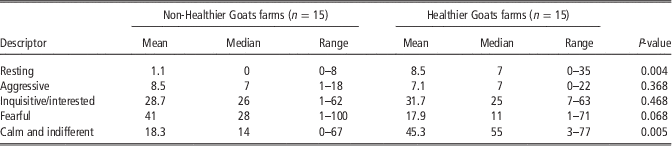
The mean (±s.d.) herd size was 107.5 (±51) goats in the HG group and 93.1 (±26) goats in the non-HG group. The means, medians and ranges of scores for the descriptors used in the QBA are presented for the two groups in Table 1, with P-values from Wilcoxon rank-sum tests. Two of the five behavioural expressions assessed by QBA had significantly different scores in HG herds, with goats on these farms scoring significantly higher on calm and indifferent and resting. Moreover, the goats on these farms had a tendency to score lower on fearful.
Means, medians and range of the behavioural descriptors used in qualitative behavioural assessments on 30 farms (15 non-Healthier Goats farms and 15 Healthier Goats farms), as scored on visual analogue scales from minimum (0) to maximum (100)

P-values are derived from two-sample Wilcoxon rank-sum tests.
The distributions of behavioural responses in the tests of human–animal relationships are presented in Table 2. This table also presents the odds ratio and P-values from the regression analyses. There were no significant differences between HG and non-HG farms in the handling test. However, our results indicate that goats in HG herds had a 0.5 times lower odds of scoring in a less positive category in the chin contact test, that is, they were less likely to attempt to avoid the observer’s approaching hand than goats in non-HG herds.
Percentages of scores in the categories of two tests of human–animal relationships; one handling test involving the stockperson, and a chin contact test involving the unfamiliar observer

OR=odds ratio.
For details about the tests, see Muri et al. (Reference Muri, Stubsjøen and Valle2013).
Association with Healthier Goats participation was assessed using robust clustered ordinal logistic regression with farm as cluster variable.
a The stockpeople’s behavioural style while approaching goats to mark them.
b The goats’ behavioural responses to the approaching stockperson.
c The goats’ response to the approaching hand of the observer. Positive=full contact; neutral=brief touch; negative=full avoidance.
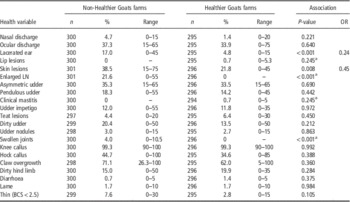
Table 3 presents the overall prevalence of the health parameters for the two groups of farms, and the range in herd-level prevalences within these groups. The table also shows the results of the robust clustered logistic regression analyses and the Fisher’s exact tests. Goats with swollen joints were registered on 8 (53%) of the 15 non-HG farms and enlarged or abscessed lymph nodes were observed on 14 of these farms (93%). Neither of these conditions was observed in HG herds. Animals on HG farms were significantly less likely to suffer from skin lesions and pinna-laceration, but there were no significant differences in the prevalence of other conditions. Mean chest girth (±s.d.) for non-HG herds was 92.3 cm (±6.0), which was significantly lower than in HG herds, where the mean (±s.d.) was 95.0 cm (±5.8) (P=0.02). Mean BCS was 2.7 for both groups of farms, and ranged from 2 to 4 and 2.25 to 3.25 on non-HG and HG farms, respectively.
Prevalence and herd-level range of health variables measured on 20 goats/farm, and the association with Healthier Goats, assessed by robust clustered logistic regression analyses with farm as cluster variable

OR=odds ratio; LN=lymph node; BCS=body condition score.
a P-value derived from Fisher’s exact test.
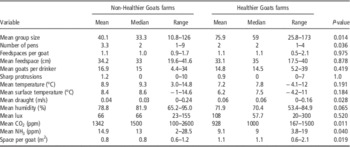
The resource-based measures are presented in Table 4, with means, medians, ranges and P-values derived from Wilcoxon rank-sum tests. On HG farms the goats were housed in significantly larger groups with more space per animal and lower gas concentrations.
Means, medians and range of resource-based measures at farm level on 30 farms (15 non-Healthier Goats farms and 15 Healthier Goats farms)

P-values are derived from two-sample Wilcoxon rank-sum tests.
Registered data from the GMRS are presented in Table 5, with means, medians, ranges and P-values derived from Wilcoxon rank-sum tests. The HG farms had significantly higher milk yields and lower somatic cell counts (SCCs), but culling rates were similar.
Means, medians and range of registered data at herd level on 28 farms (one missing in each group)

SCC=somatic cell count.
P-values are derived from two-sample Wilcoxon rank-sum tests.
Discussion
The study revealed that there were better scores for several animal-based and resource-based welfare indicators on farms that had completed the HG eradication programme, compared with those that had not started the eradication process yet. However, for most variables there was a large degree of overlap in scores between the HG and non-HG herds.
Validity and reliability
The external validity and statistical power would have been improved with a larger sample size. However, the study had to be limited to 30 herds due to financial restrictions, and the number of animals examined in each herd was limited to 20 to make the protocol feasible. The greater average HG herd size was caused by one particularly large farm, so overall, the mean herd size was close to the mean for GMRS herds, which was 92.6 goats in 2010 (TINE Rådgivning, 2011). The inclusion criteria were necessary to investigate associations with other data sources and may have reduced the external validity of the results, despite the high enrolment rate in GMRS and the reasonably high response rate for the questionnaire (54%).
The eradication process required substantial effort from the farmers; therefore it is not unlikely that some of the most motivated farmers enroled first, leaving less motived and well-organised farmers behind. However, it is known that some of the early enrolers in HG were among the worst affected farms, with severe reductions in productivity, high culling rates and deaths due to sickness and emaciation. Similarly, some of the late enrolers in the programme were among the largest and best managed herds, where the infections were considered less of a problem. There are also many other possible reasons why non-HG herds had not started the eradication at this stage of the programme, and we have not collected historical GMRS data or looked into the farmers’ decision-making in order to investigate the situation for the farms in this study.
The timing of the welfare assessments was chosen to visit all farms after (or close to the end of) lactation and before kidding, in order to compare them on the same terms. This only provides information about the welfare state at a single point in time, but at least some of the welfare indicators (e.g. BCS, claw overgrowth, fearfulness, etc.) are the results of conditions that the animals are exposed to over time.
Scoring the animal-based welfare measures, particularly the behavioural measures, involves some degree of subjective judgement and may therefore be prone to observer-bias. We attempted to minimise this through thorough training of the assessors and the provision of detailed guidance notes, describing all variables and cut-points between categories, and accompanied by illustrative colour photographs. As described in the study by Muri et al. (Reference Muri, Stubsjøen and Valle2013), screening of inter-observer reliability was performed, but was used for calibration of the observers and final adjustments of the protocol. Thus, a thorough evaluation of both inter- and intra-observer reliability of the final animal-based measures needs to be performed in a larger sample.
QBA and human–animal relationships
QBA is a whole-animal approach to behaviour assessment, and provides an interpretation of the meaning of the behaviour for the animals’ welfare state (Wemelsfelder and Lawrence, Reference Wemelsfelder and Lawrence2001). We used a preliminary version of QBA for goats, with just a few behavioural expressions, developed particularly for this study, and the results are therefore presented as individual variables rather than as component scores based on PCA. HG herds had higher scores of resting and calm and indifferent and a lower score of fearful. Assessing the animals’ reactions to other animals or familiar and unfamiliar humans can provide some information about their experiences of fear and stress (Webster, Reference Webster2005). There were no differences in the handling test involving the farmers, but goats on HG farms were significantly less fearful of an unfamiliar human in the chin contact test. Goats on HG farms are likely to be somewhat more exposed to dairy goat advisors and veterinary surgeons due to the post-eradication follow-up and possibly due to a higher motivation to treat sick animals, as suggested by increased veterinary costs following HG (Nagel-Alne et al., Reference Nagel-Alne, Asheim, Hardaker, Sølverød, Lindheim and Valle2014a) However, it seems unlikely that they are more habituated to unfamiliar humans in general, as strict limitation of human traffic in the goat housing is part of the bio-security measures following eradication. The behavioural differences may therefore be related to changes in management factors, particularly kid rearing, as the early establishment of positive human–animal relationships are known to have a lasting effect on goats’ temperament and behaviour (e.g. Lyons, Reference Lyons1989). Questions asked to the farmers about kid rearing (data not presented) did not reveal significant differences between the groups, but in-depth interviews may have elucidated the issue more. Genetic components are also known to account for individual differences in fearfulness (Boissy et al., Reference Boissy, Fisher, Bouix, Hinch and Le Neindre2005), but this seems an unlikely explanation as farmers will have little room to cull goats with undesirable temperament while rebuilding the herd the first few years after culling the old herd. Like the Norwegian goat population in general, the herds in this study were predominantly composed of the Norwegian dairy goat breed.
We propose that a contributing explanation for behavioural differences could be that improved general health combined with more space makes the goats more able to cope with their environment. Disease pathologies will have a negative impact on the animals’ ability to compete for resources (Algers, Reference Algers2004) and social avoidance is a well-documented sickness-driven behaviour in other species (Proudfoot et al., Reference Proudfoot, Weary and von Keyserlingk2012). Given the crowded conditions, particularly on the non-HG farms, the welfare consequences of disease may potentially be aggravated by an inability to avoid other animals.
Health
Although the aim of the study was not to examine the effectiveness of the eradication per se, the most common clinical signs of CLA and CAE were included as welfare indicators, as these diseases were still expected to be present in non-HG herds. It was according to our expectations that none of the examined goats on the HG farms had these clinical signs, as problems with re-infection following eradication are minor (Samarbeidsrådet for Helsetjenesten for geit, 2010). Because of the compulsory vaccination of goat kids with a paratuberculosis vaccine containing killed MAP bacteria (Gudair; CZ Veterinaria, Porriño, Spain) on non-HG farms we did not expect to find goats with signs of clinical paratuberculosis in any of the herds.
Although the prevalence of the most common CAE sign was low (4%, s.d.=4%), the sero-prevalence may be much higher, as only a minority of infected animals may develop clinical disease (Peterhans et al., Reference Peterhans, Greenland, Badiola, Harkiss, Bertoni, Amorena, Eliaszewicz, Juste, Krassnig, Lafont, Lenihan, Pétursson, Pritchard, Thorley, Vitu, Mornex and Pépin2004). In one study, enlarged carpal joints were observed in only 6% to 24% of the seropositive animals (Greenwood, Reference Greenwood1995). The low prevalence may also suggest that some of the non-HG farms either had relatively low levels of infection in the first place (and thus could afford to await enrolment), or that these farmers had become more aware of the negative effects of this disease (as a result of HG) and consequently culled clinical cases sooner. CAE causes pain and disability (Peterhans et al., Reference Peterhans, Greenland, Badiola, Harkiss, Bertoni, Amorena, Eliaszewicz, Juste, Krassnig, Lafont, Lenihan, Pétursson, Pritchard, Thorley, Vitu, Mornex and Pépin2004) and an aversion against getting onto the milking ramp (Mazurek et al., Reference Mazurek, Marie and Desor2007). It has also been suggested that CAE-positive goats may be more vulnerable to substandard management (Greenwood, Reference Greenwood1992 and Reference Greenwood1995). CAE-positive goats were more frequently found to be affected by other health issues, for example, inflammatory conditions of the eyes, periparturient udder oedema, mastitis and lacerations due to teat biting in one study (Greenwood, Reference Greenwood1995), but we did not observe higher prevalences of ocular discharge or udder health parameters on non-HG farms in this study.
Enlarged lymph nodes, the principal symptom of CLA, were observed on 22% (s.d.=12%) of the goats in non-HG herds. A preliminary study recently found that the presence of abscesses in goats’ lymph nodes was associated with reduced feeding activity and slightly lower BCS (Ferrante et al., Reference Ferrante, Battini, Caslini, Grosso, Mantove, Noé, Barbieri and Mattiello2012), but we did not observe significant difference in mean BCS or proportion of thin goats (BCS<2.5) between HG and non-HG herds.
The lack of differences in BCS is in contrast to expectations. However, the results are somewhat in agreement with a study by Greenwood (Reference Greenwood1995), where offspring of CAE-positive goats had lower birth weights and growth rates, while there were no significant differences in live weights and BCS for seropositive and seronegative lactating does. The metabolic demands caused by the significantly higher milk yields obtained in HG herds may also partly explain why mean BCS was not higher in this group. Slightly higher chest girths were, however, registered on HG farms. This may be attributable to improved feeding and other management factors that may have changed as a consequence of the attention these aspects have received in the HG programme. It is also likely that the difference could be related to health status, as all the diseases that are controlled through the programme are known to cause ill-thrift, weight loss and gradual emaciation.
A reduction in respiratory tract infections has been reported after the eradication process (Samarbeidsrådet for Helsetjenesten for geit, 2010). However, this study did not reveal any significant reductions in nasal and ocular discharge or number of coughs heard. The limited number of farms included in the study, combined with low prevalences may have reduced the ability to detect such effects of the programme.
The reasons for the reduction in skin lesions and pinna-lacerations due to torn out ear tags in HG herds are not obvious, but could be related to different behavioural expressions and temperament. Earlier work on the pooled data showed that both of these conditions were significantly associated with the QBA score of calm and indifferent (Muri et al., Reference Muri, Stubsjøen and Valle2013). A possible explanation for the reduction in skin lesions could therefore be that there are fewer traumatic injuries when goats are calmer. Skin lesions may also arise as a consequence of scratching related to ectoparasite infestations, and many HG farmers have reported that the eradication programme also eliminated lice (spp. Bovicola caprae and Linognatus stenopsis). Pediculosis was included as a parameter in the protocol, but unfortunately had to be discarded from the analyses following the detection of a strong observer effect.
Resources
Housing conditions are important determinants of animal welfare, as real improvements involves high costs, and the animals will therefore usually be exposed to the same housing environment throughout their lives (Waiblinger, Reference Waiblinger2009). When availability of resources is limited, low-ranking (subordinate) animals in particular might not be able to fulfil their needs for nutrients or resting, and thus be more at risk of poor health (Waiblinger, Reference Waiblinger2009). On HG farms, the goats were housed in fewer and larger pens with lower stocking densities. Reduced humidity and gas concentrations were also registered on these farms. These changes reflect the upgrading or building of new facilities that is frequently done before introduction of new, healthy stock. However, even on HG farms the average space allowance was below the recommended 1.5 m2 (Toussaint, Reference Toussaint1997). Research has shown that reduced space allowance for goats causes a reduction in lying time, particularly when space allowance is reduced from 1.5 to 1.0 m2/goat (Loretz et al., Reference Loretz, Wechsler, Hauser and Rüsch2004) in addition to increased aggression (Toussaint, Reference Toussaint1997). NH3-levels from 15 ppm, that is, close to the mean registered on the non-HG farms, have been shown to cause reduced feed intake, increased sneezing and panting in sheep (Phillips et al., Reference Phillips, Pines, Latter, Petherick, Norman and Gaughan2012), which suggests that the levels measured on many non-HG farms may constitute a welfare problem. However, we did not find evidence for more respiratory tract problems, like coughing or nasal discharge, on non-HG farms.
Registered data
The Nordic countries have national livestock databases comprising large amounts of information on, for example, survival, productivity and health, which could potentially be used to screen farms for certain welfare issues (e.g. de Vries et al., Reference De Vries, Bokkers, Dijkstra, van Schaik and de Boer2011). For goats, recorded production variables were found to be unrelated to other animal-based welfare indicators (Muri et al., Reference Muri, Stubsjøen and Valle2013), but we found significant differences in SCCs and milk yield between HG and non-HG herds in this study.
SCC was significantly higher in non-HG herds, despite no differences in udder health parameters. However, SCC is an unreliable indicator of sub-clinical mastitis in goats, as it also can be related to a number of non-infectious factors, such as lactation stage, parity, vaccinations, sudden dietary changes and stress (Bergonier et al., Reference Bergonier, de Crémoux, Rupp, Lagriffoul and Berthelot2003). Moreover, CAE-infection has been associated with higher SCC (Bergonier et al., Reference Bergonier, de Crémoux, Rupp, Lagriffoul and Berthelot2003). The diseases targeted by the programme are also known to impair milk yield, and beneficial effects of HG on productivity has been documented from a larger numbers of farms (Nagel-Alne et al., Reference Nagel-Alne, Krontveit, Bohlin, Valle, Skjerve and Sølverød2014b). Immune responses during infections may change the priority of nutrient partitioning from growth and production to host defence, which can have effects on milk yields (Colditz, Reference Colditz2002). This can be exacerbated by reduced feeding due to loss of appetite. Improved feeding and management following participation in the programme are probable contributing factors, as also suggested by Nagel-Alne et al. (Reference Nagel-Alne, Krontveit, Bohlin, Valle, Skjerve and Sølverød2014b), but we do not have details to investigate this. It is also beyond the scope of this study to discuss the multitude of factors that may be responsible for the differences in production data in HG and non-HG herds.
Conclusion
The HG disease eradication programme has been largely successful in combating CAE, CLA and Johne’s disease in the Norwegian dairy goat population. The negative impact these infections have on animal welfare is likely to fluctuate during the course of the diseases, but their elimination is in itself an obvious contribution to the improvement of animal welfare in HG herds. In addition, the HG farms had significant improvements for certain other welfare indicators based on health, behaviour, resources and productivity. Some improvements are probably influenced by factors yet to be precisely identified, for example, altered management, while some improvements are likely to be related to the health status of the animals.
The protocol was considered a useful tool to evaluate the welfare effects of the programme, but larger sample sizes would increase the precision of prevalence estimates for less common conditions, and increase the power to detect significant differences between the groups. Moreover, it would have been useful with information about the farmers’ decision-making in connection with HG.
Despite the obvious link between disease and suffering, animal welfare is rarely taken into account in the evaluation of disease control or eradication programmes. We therefore propose that this important aspect should receive more attention as a goal in its own right when disease control or eradication programmes are initiated, and that the merits of such programmes in terms of animal welfare should be evaluated using valid and reliable on-farm welfare assessment protocols.
Acknowledgements
The authors wish to thank all the farmers who kindly agreed to participate in this study. The authors would like to thank Professor Eystein Skjerve for statistical advice and for revising an earlier version of the manuscript, Liv Sølverød (Norwegian Goat Health Service) for valuable comments and Dag Lindheim (Healthier Goats) for providing data regarding the eradication status of potential participants. The authors also thank Hege Gaudernack Tønnesen and Angela Welcome for assistance. The study was funded by the Research Council of Norway (project no. 179745 NORDAM-SAM) and received further funding from TINE SA.
N. Leine was the project leader of the Healthier Goats programme from 2001 to 2008. He was engaged in this research due to his expertise in goat health and has contributed with valuable information about practical aspects of the programme, but independent of the ongoing work in Healthier Goats.
TINE SA is one of the collaborating parties in the Norwegian Goat Health Service and the Healthier Goats programme. However, all decisions regarding the presented research have been made independently by the authors.