Extracorporeal membrane oxygenation is a life-saving device that is increasingly used in areas such as heart and lung failures, post-operative cardiotomy, acute respiratory distress syndrome, e-CPR, and pulmonary embolism. In children with CHD, extracorporeal membrane oxygenation is used for cardiogenic shock or complications after post-cardiotomy. Reference Roeleveld and Mendonca1
Newborns are among the patient groups that benefit most from extracorporeal membrane oxygenation. In a report conducted by The Extracorporeal Life Support Organization (ELSO) in 2020 with data from 521 centres, and 154,106 runs, 69% survival and 54% discharge were found in all patient groups. 2 However, despite all its benefits, extracorporeal membrane oxygenation brings along many risks including infections, mechanical, haemorrhagic, renal, cardiovascular, pulmonary and metabolic risks. Reference Vogel, Lew, Kao and Lally3
Health care-associated infections continue to be the most important problem of ICUs. Patients receiving extracorporeal membrane oxygenation experience high rates of nosocomial infection which increases morbidity and mortality. In addition to the existing diseases in patients with CHD, the presence of immunodeficiency states makes the patients more susceptible to infection. Impairment of tissue perfusion after thrombosis and increased bleeding in patients with extracorporeal membrane oxygenation not only increases infections but also causes problems in treatment by preventing target tissue access. Reference Chauhan, Malik, Malik, Chauhan, Kiran and Bisoi4,Reference Biffi, Di Bella and Scaravilli5 Although there are studies showing that prolonged extracorporeal membrane oxygenation duration increases infection rates, it is not clear how long this period is in paediatric cardiovascular surgery (CVS) patients.
In this study, we investigate whether the duration of extracorporeal membrane oxygenation use and other factors are associated with increased nosocomial infections in patients with paediatric CVS surgery and extracorporeal membrane oxygenation implantation, and which pathogens play a role in these.
Materials and methods
Patients treated with an extracorporeal membrane oxygenation in paediatric cardiovascular surgery ICU between 2010 and 2020 were included in this retrospective study. Clinical and demographic data included documented gender, age, infection acquired during extracorporeal membrane oxygenation; pathogens, site of infection; time to infection; duration of extracorporeal membrane oxygenation (days), ICU and hospital stay (days); and in hospital mortality, primary cardiac disease, extracorporeal membrane oxygenation indication, mode of extracorporeal membrane oxygenation support (veno-venous [VV] or veno-arterial [VA]), in cannulation technique (percutaneous or surgical), laboratory-blood test values recorded closest to 7 am on each extracorporeal membrane oxygenation day, Vasoactive Inotrope Score were recorded. Hospital-acquired infections were determined using the Centre for Disease Control and National Hospital Acquired Infection Surveillance criteria. 6 We analysed the site of location and microbiological profile of infections occurring in these patients according to Center for Disease Control and National Healthcare Safety Network criteria. Site of infection was categorised as bloodstream, respiratory, urine, and surgical site infection. Extracorporeal membrane oxygenation-related infection was defined as an infection that began from 24 hours after initiation of extracorporeal membrane oxygenation support until 48 hours after the end of extracorporeal membrane oxygenation treatment.
Documented infection prior to or during the first 24 hours of extracorporeal membrane oxygenation was a positive bacterial, fungal, or viral culture for which the patient was being treated at the time of extracorporeal membrane oxygenation initiation or which was diagnosed during the first 24 hours of extracorporeal membrane oxygenation. Site of infection and causal organism were recorded for each infectious episode. Cultures from not sterile sites were performed in case of local clinical signs of infections. No antibacterial nor antifungal prophylaxis was administered. Indication for extracorporeal membrane oxygenation was categorised as respiratory and cardiac reasons. Mode of extracorporeal membrane oxygenation was veno-arterial or veno-venous recorded. The vasoactive inotropic score was calculated from the hourly dose of dopamine, dobutamine, epinephrine, milrinone, vasopressin, and norepinephrine administered at the time of extracorporeal membrane oxygenation initiation. Cannulation site was categorised as central or other site. Laboratory blood test values included haemogram, lactate, lactate dehydrogenase, and leukocyte count. Survival was evaluated at extracorporeal membrane oxygenation discontinuation and/or at ICU discharge. Death was attributed or not to infectious complications developed during extracorporeal membrane oxygenation, according to physician judgment.
The ethical approval was obtained by the scientific ethics committee of the Koşuyolu High Speciality Training and Research Hospital, Turkey. The registration number provided by the committee was 16–202.
Statistical analysis
Normality of continuous variables was assessed with histogram and Shapiro–Wilks’s test. Numerical variables were expressed as mean and standard deviation or as median and interquartile ranges (25th–75th) according to distribution of continuous data. Discrete data were shown as percentages and absolute numbers. For the continuous data comparison between two groups, we used unpaired t-test or Mann–Whitney-U test, and for the discrete data comparison, Chi-Square test was used.
The patient was grouped for assessment of demographic and clinic variables, according to infection presence. The continuous variables, which were assessed during admission, pre-extracorporeal membrane oxygenation and post-extracorporeal membrane oxygenation time were compared with repeated measure ANOVA test with Bonferroni correction. Besides, we performed ROC-curve analysis for extracorporeal membrane oxygenation duration to find optimal cut-off value infection positivity.
Outcome variable: Infection positivity
Univariable analysis screening method to select covariates for multivariable logistic regression was used for analysis. Besides, univariate analysis screening method was used to select covariates for multivariate Cox regression in the analysis of time to first infection positivity. Logistic regression expressed with odds ratio with confidence interval, also Cox regression expressed with Hazard ratio with confidence interval.
The variables p value was found to be lower than <0.10 in univariable regression analysis for predicting infection, were included in the multivariable regression models. For all statistical analyses, we used R-software v. 4.02 (Vienna, Austria).
Result
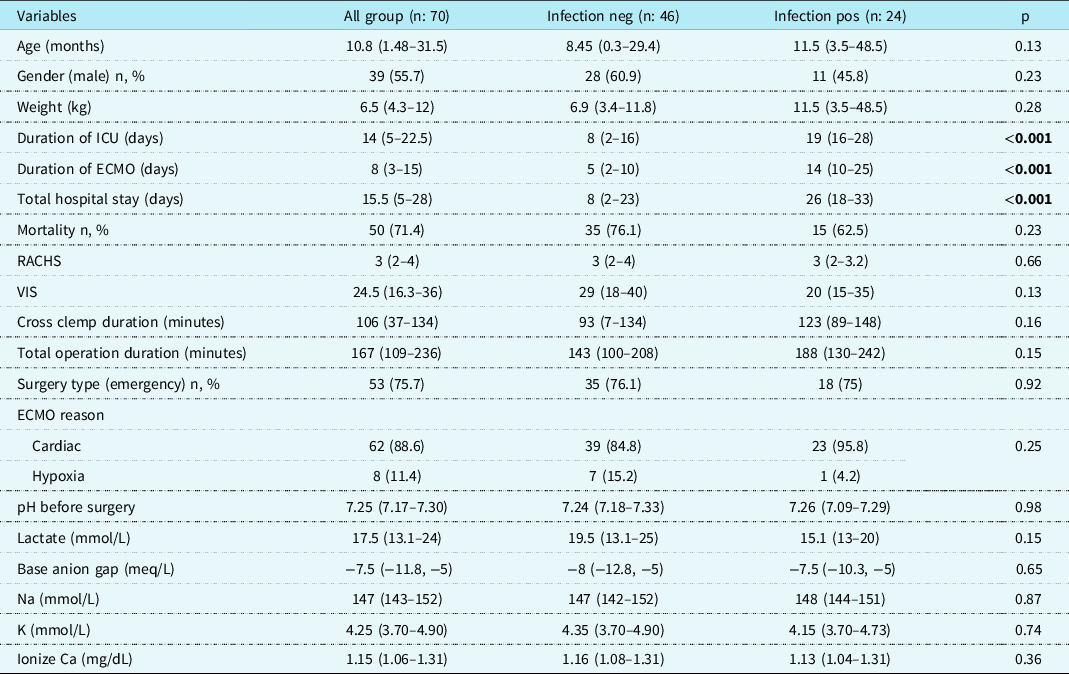
A total of 70 patients who undergone extracorporeal membrane oxygenation treatment after paediatric cardiovascular surgery were included in this retrospective study. The median age was 10.8 (1.48–31.5 IQR) months and 39 (55.7%) of the patients were male. In all group, the duration of extracorporeal membrane oxygenation was 8 (3–15 IQR) days, the hospital stay was 15.5 (5–28 IQR) days and the ICU stay was 14 (5–22.5 IQR) days. Demographic and clinical characteristics of the patients are shown in Table 1. The survival rate of the patients was 38.5% (n: 27). The duration of infection development of the patients after extracorporeal membrane oxygenation was found to be median 8 (3–15, 25–75 IQR) days in the whole group, and median 11 (3–16, 25–75 IQR) days in those who developed infection only. The reasons of extracorporeal membrane oxygenation implantations 88.6% (n: 62) cardiac and 11.4% (n: 8) hypoxic patients were fitted with extracorporeal membrane oxygenation, and 75.7% (n: 53) underwent emergency surgery. Duration of operation and cross-clamp times were 167 (109–236), 106 (37–134 IQR) minutes, respectively. Risk Adjustment in Congenital Heart Surgery (RACHS) was median 3 (2–4 IQR), The Vasoactive Inotropic Score was calculated as 24.5 (16.3–36 IQR). Pre-operative pH values of the patients were 7.25 (7.17–7.30 IQR), while lactate levels were 17.5 (13.1–24 IQR). Venovenous extracorporeal membrane oxygenation was used in only two patients and venoarterial was inserted in the remaining patients. The lactate levels before and after the introduction of extracorporeal membrane oxygenation are shown in Table 3. The lactate levels of both groups showed no significant difference.
Demographic and clinical characteristics of the patients with ECMO

Continuous variables given as median, interquartile range (25–75), categoric variables given as absolute number and percentage.
ECMO: extracorporeal membrane oxygenation; RACHS: Risk Adjustment in Congenital Heart Surgery; VIS: Vasoactive Inotrope Score.
Bold values represents statistical significance at p < 0.01.
When patients were divided into those with and without infection, duration of ICU was found to be 19 (16–28, IQR 25–75) days in patients with infection versus 8 (2–16, IQR 25–75; p: <0.001) days in patients without infection. Duration of extracorporeal membrane oxygenation support was found to be 14 (10–25, IQR 25–75) days in patients with infection versus 5 (2–10, IQR 25–75; p: <0.001) days in patients without infection and total hospital stay was 26 (18–33, IQR 25–75) days in patients with infection versus 8 (2–23, IQR 25–75) days in those without infection. In addition, there was no significant difference in gender, age, mortality, cross-clamp duration, total operation duration, surgery type. Pre-operative pH and lactate values were also not found to be significant in terms of infection. Other parameters are presented in Table 1.
Causal organisms
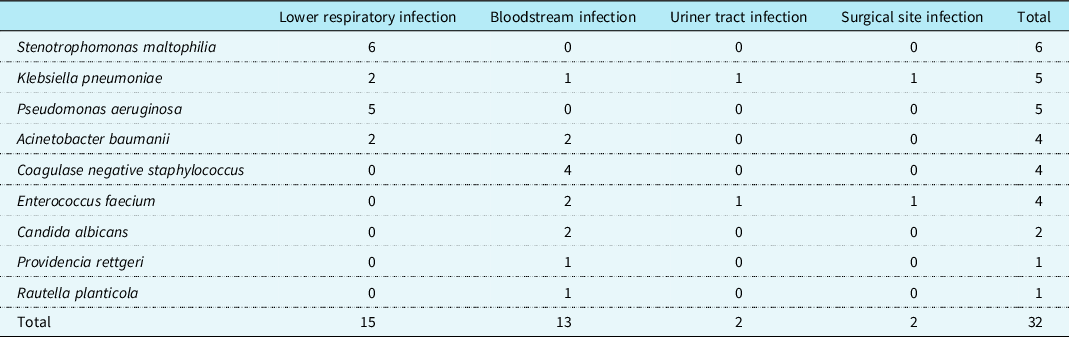
A total of 24 patients out of the 70 patients experienced 32 infectious episodes during extracorporeal membrane oxygenation support. Culture-positive infections were detected at a single site in 19 patients, and multiple sites in 5 patients. Eight patients have got multiple causal organisms. Lower respiratory tract infection was detected in 15 patients, bloodstream infection in 13 patients, surgical site infection in 3 patients, and urinary tract infection in 2 patients.The distribution of detected microorganisms is as follows. Stenotrophomonas maltophilia (n: 6) is most common, followed by Acinetobacter baumannii and Klebsiella pneumoniae (n: 5), Pseudomonas aeruginosa, Coagulase negative staphylococcus and Enterococcus faecium (n: 4), Candida albicans (n: 2), Providencia rettgeri ve Raoutella planticola (n: 1) (Table 2).
Distribution of microorganisms and site of infections

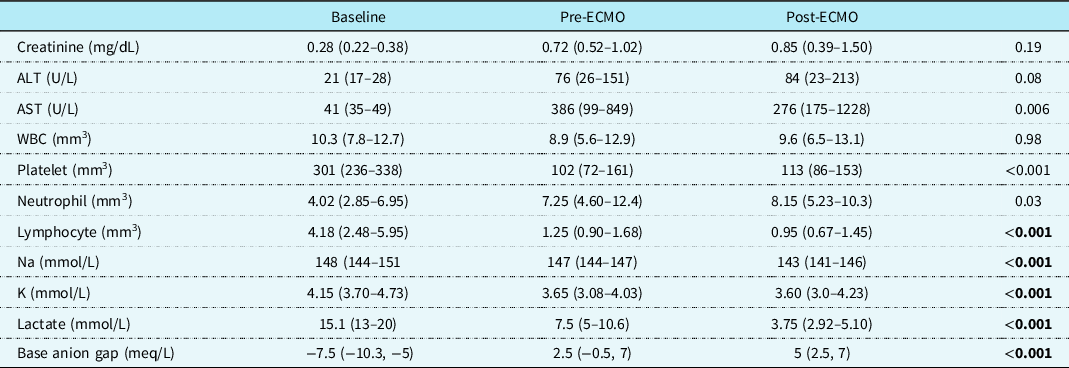
In the analysis made with repetitive ANOVA measurements, pre-operative and post-operative values were presented during hospitalisation, and were observed that lymphocyte, Na, K, and lactate values were found to be decreased and base anion gap was elevated (p < 0.001 for all). There was no statistically significant change in creatinine, ALT, and WBC values. Other findings are presented in Table 3.
Pre-operative and post-operative values during hospitalisation

ALT: alanine transaminase; AST: aspartate transaminase; WBC: white blood cells.
Bold values represents statistical significance at p < 0.01.
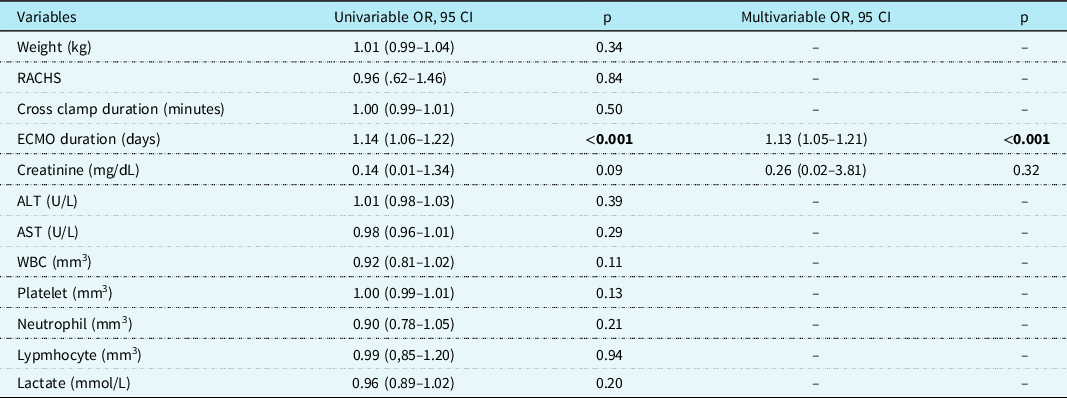
In predicting the occurrence of infection with univariable logistic regression analysis, extracorporeal membrane oxygenation duration was found to be [OR 1.14 (1.06–1.22), <0.001], while after adjusting in multivariable analysis, extracorporeal membrane oxygenation duration was found to be associated with the occurrence of infection [OR 1.13 (1.05–1.21), <0.001]. Other findings are presented in Table 4.
Univariable and multvariable logistic regression analysis

ALT: alanine transaminase; AST: aspartate transaminase; ECMO: extracorporeal membrane oxygenation; RACHS: Risk Adjustment in Congenital Heart Surgery; WBC: white blood cells.
Bold values represents statistical significance at p < 0.01.
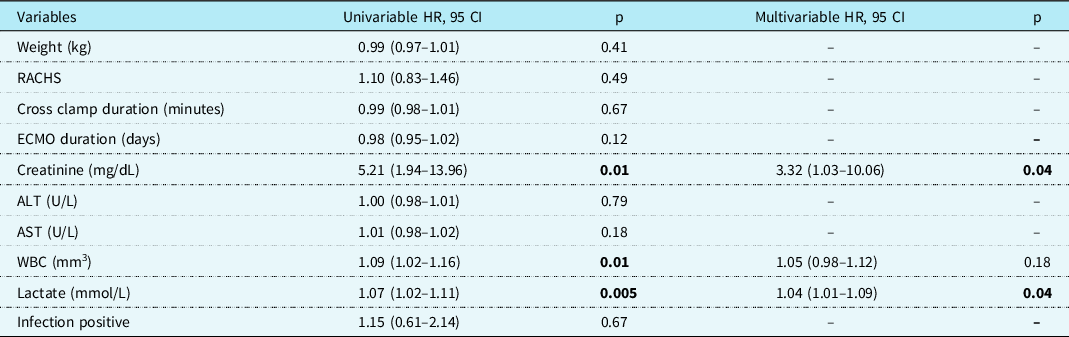
In predicting in time the first infection positivity occurrence with Cox regression analysis, extracorporeal membrane oxygenation duration was found to be [HR 1.06 (1.03–1.08), <0.001], and ALT was [HR 1.02 (1.01–1.03), 0.02] while after adjusting in multivariable analysis, only extracorporeal membrane oxygenation duration was found to be associated within time to first occurrence of intection positivity [HR 1.05 (1.03–1.09), <0.001]. Other findings are presented in Table 5.
Univariable and multvariable Cox regression analysis

ALT: alanine transaminase; AST: aspartate transaminase; ECMO: extracorporeal membrane oxygenation; RACHS: Risk Adjustment in Congenital Heart Surgery; WBC: white blood cells.
Bold values represents statistical significance at p < 0.01.
Receiver operating characteristics analysis was used for predicting infection rates with sensitivity 83.3%, specificity 69.6%, and area under curve value was determined as 0.823. Nine days of extracorporeal membrane oxygenation support was used as cut-off for the analysis.
Discussion
The main findings of our study first revealed that increasing duration of extracorporeal membrane oxygenation day was associated with increased infection rate. Second, our result demonstrated that the duration of extracorporeal membrane oxygenation over 9 days was associated increased infection rate. Third, our healthcare-associated infection rate was found to be 37.4%.
Prolonging the duration of all interventional devices increases the risk of infection, as well as increases the risk of infection in extracorporeal membrane oxygenation. Although it is known that the prolongation of the period increases the susceptibility to infection, the exact duration of this infection is not known. Studies demonstrating this duration have rarely been performed in patients undergoing paediatric cardiac surgery. In the studies, it was determined that the days of infection were between 4 and 14 days. Ayyıldız et al found that paediatric patients who developed an infection were infected on an average of 4 days. Reference Ayyıldız, Kasar and Ozturk7 Bizarro et al determined as 307.03 ± 245.94 hours in infected patients in all patient groups and as a result of extracorporeal membrane oxygenation support that lasted for 14 days, the infection rates increased to 30.6%. Reference Bizzarro, Conrad, Kaufman and Rycus8 Rodriguez et al and Santiago et al reported that infection rates increased after the 7th day of extracorporeal membrane oxygenation insertion. Reference Rodríguez, Villarroel and Meza9,Reference Santiago-Lozano, Barquín-Conde and Fuentes-Moreno10 In this study, the prolongation of the duration of intensive care and hospital stay, as well as the extracorporeal membrane oxygenation period, increased the susceptibility to infection. Cashen et al reported that the infection development time was detected as 5.2 days. Reference Cashen, Reeder and Dalton11 It has been determined that patients who exceed this period are at risk for infection. In this analysis, the patients with the highest risk of infection were determined as those who were hospitalised for 9 days or more.
In our study, the rate of patients with infection was found to be 37.4%. In the review published by Maclaren et al reported that infection values ranged between 15 and 42% in studies with single-centre paediatric patients, prolonging extracorporeal membrane oxygenation duration was associated with infection and mortality. Reference MacLaren, Schlapbach and Aiken12 Cashen et al in his study reported that the infection rate was found to be 16.6%. Reference Cashen, Reeder and Dalton11
Patients who are operated in paediatric CVD, have underlying diseases, are hospitalised in ICUs and are prone to infections. Patients on extracorporeal membrane oxygenation are more susceptible to infections for many reasons. Among these are alterations in the immune systems and multiple portals of entry within the extracorporeal membrane oxygenation circuit. In a study of the ELSO Registry published in 2011 which combined data from over 100 centres, 2418 (11.7%) of 20,741 patients of all ages were found to have acquired infection during extracorporeal membrane oxygenation. The incidence rate was 10.1/1000 extracorporeal membrane oxygenation days in neonates, 20.8/1000 days in paediatric patients, and 30.6/1000 days in adult patients. Reference Bizzarro, Conrad, Kaufman and Rycus8
Studies have shown that bloodstream infection rates are higher. Reference Ayyıldız, Kasar and Ozturk7,Reference Rodríguez, Villarroel and Meza9,Reference Castagnola, Gargiullo and Loy13 It can be thought that ECMO has a close relationship with blood circulation as the reason for this. In a study conducted in the paediatric patient group, the most frequent infection documented during ECMO was bloodstream infection (53%), followed by pneumonia (40%) and urinary tract infection (7%). Reference Castagnola, Gargiullo and Loy13 The respiratory tract is the most frequent site of acquired infections in our study and bloodstream infection was seen at a rate close to this. Similar to our study, respiratory tract infection was found to be high in some studies. Reference Cashen, Reeder and Dalton11,Reference Selçuk, Sargın and Baştopçu14 In the study including all patient groups, the respiratory tract is the most frequent site of acquired infections in both the paediatric and adult extracorporeal membrane oxygenation patients. Reference Selçuk, Sargın and Baştopçu14
Twelve different pathogens were isolated in a total of 13 isolates: gram-negative bacteria were the most common (54%), followed by fungi (23%) and gram-positive microorganisms (23%). The most frequently isolated pathogen was a fungus: Candida albicans was isolated in two episodes. Moreover, Staphylococcus aureus was the most frequent isolated gram-positive bacterium (67%). Reference Pieri, Greco and De Bonis15
In our study, Stenotrophomonas maltophilia is the most common pathogen in lower respiratory tract infection. Stenotrophomonas maltophilia occurs mostly after long-term and broad-spectrum antibiotic use. In order to prevent antibiotic stewardship, each hospital should determine the treatment for the causative agent, and the duration of antibiotic administration should not be extended. Some studies determined that candida is the most common causative agent. Fungus are related to the use of long and broad-spectrum antibiotics. According to the ELSO registry, coagulase-negative staphylococci (CoNS) are the most frequent causal infectious agent during extracorporeal membrane oxygenation, followed by Candida spp., Pseudomonas aeruginosa, Enterobacteriaceae, Staphylococcus aureus, and Enterococcus spp. Reference Bizzarro, Conrad, Kaufman and Rycus8 In the study reported by Rodriguez et al, the rate of patients with confirmed paediatric or suspected infection was 65%. They reported that, unlike our study, they found gram-positive infections more frequently. As in our study, they found that prolonging the extracorporeal membrane oxygenation period increased the infection rate. They also reported that mortality rates were high in patients with infection. Reference Rodríguez, Villarroel and Meza9
In addition, it is a difficult situation to review the mortality–infection relationship due to multifactorial reasons. Yu Jin stated in his study that extracorporeal membrane oxygenation is significant in the early mortality of paediatric CVC patients, in addition to nosocomial infections, thrombocytopenia, haemolysis, and neurological complications. While the rate of nosocomial infection in patients with mortality was 53.3%, it was reported that mortality was 25% in patients with survival. Reference Jin, Feng and Zhao16
Limitations
There are certain limitations to our study. The study was retrospective in design and holds the pertinent limitations in data collection. Most of our patients were under extracorporeal membrane oxygenation support for post-cardiotomy shock and our results could, therefore, differ from studies with patients with respiratory failure or other causes of cardiac failure. As the number of patients in this study was not adequate to perform a risk factor analysis, only associations were made between patient factors and infections without delineating risk factors. A prospective study or a multi-centre study with current data from the ELSO registry would help characterise the problem of extracorporeal membrane oxygenation-related infections better.
Conclusion
The aim of this study was to define the acquired infection and risk factors after cardiovascular surgery performed with extracorporeal membrane oxygenation, and the most common day after which infection develops. We showed that prolonged extracorporeal membrane oxygenation is associated with increased infection rates. Although extracorporeal membrane oxygenation is a life-saving treatment method, prolonged extracorporeal membrane oxygenation may increase the development of infectious complications and the associated mortality and morbidity of the patient. In addition, in the light of all this information, knowing the infection pathogen profile detected in the hospital should be kept in mind in terms of prophylaxis or empirical treatment. Establishing an extracorporeal membrane oxygenation team will be cost-effective as well as providing benefits by rapidly evaluating patients in selecting the appropriate patient for patients using extracorporeal membrane oxygenation due to high mortality and concomitant infections.
Data availability statement
Data sharing is not applicable to this article as no new data were created or analysed in this study.
Acknowledgements
No funding was obtained for this study.
Financial support
This research received no specific grant from any funding agency, commercial, or not-for-profit sectors.
Conflicts of interest
None.
Ethical standards
The ethical approval was obtained by the scientific ethics committee of the Koşuyolu High Speciality Training and Research Hospital, Turkey.
The registration number provided by the committee was 16–202. The study was conducted in accordance with the principles of the Declaration of Helsinki.
Patient consent statement
Consent was not obtained and waived.