Introduction
HIV/AIDS in Africa is associated with a range of socioeconomic, demographic, behavioural and biological risk factors. These risk factors include commercial sex, non-use of condoms, young age at first sexual intercourse, multiple sexual partners, age differences between sexual partners, untreated sexually transmitted infections (STIs), high viral load of infected partners and lack of male circumcision (Caldwell, Reference Caldwell2000; Auvert et al., Reference Auvert, Buvé, Ferry, Caraël, Morison and Lagarde2001; Shapiro, Reference Shapiro2002; Kelly et al., Reference Kelly, Gray, Sewankambo, Serwadda, Wabwire-Mangen, Lutalo and Wawer2003; Clark, Reference Clark2004; Bongaarts, Reference Bongaarts2007). All these factors can increase an individual's susceptibility to HIV. It was hypothesized by Kun (Reference Kun1997) and later by Brady (Reference Brady1999) that unlike male circumcision female genital cutting (FGC) can potentially increase the risk of HIV transmission through different mechanisms (Kun, Reference Kun1997; Brady, Reference Brady1999).
According to UNGASS (2008) the estimated prevalence of HIV infection among adults aged 15 to 49 years in Kenya is between 7.1% and 8.3%, with heterosexual transmission being the main route of HIV transmission. The prevalence of FGC is declining but still widespread in some communities in Kenya; in the 2003 Kenya Demographic and Health Survey (KDHS) the FGC prevalence was estimated to be 32% (CBS et al., 2004a; Skaine, Reference Skaine2005).
The practice of FGC is regarded as a fundamental violation of human rights (UNICEF, 2005) as it can increase health risks, some of which might have life-threatening consequences to women. A number of different short- and long-term negative health outcomes such as gynaecological and obstetric problems, haemorrhage, pain, keloid scars, genitor-urinary problems, reproductive tract infections and others have been attributed to FGC (Jones et al., Reference Jones, Diop, Askew and Kabore1999; Morison et al., Reference Morison, Scherf, Ekpo, Paine, West, Coleman and Walraven2001; Shell-Duncan, Reference Shell-Duncan2001; Okonofua et al., Reference Okonofua, Larsen, Oronsaye, Snow and Slanger2002). However, little is known about the potential association between FGC and HIV. The plausibility that FGC may increase susceptibility to HIV has been speculated by researchers, especially in the African context (Caldwell et al., Reference Caldwell, Orubuloye and Caldwell1997; Msuya et al., Reference Msuya, Mbizvo, Hussain, Sundby, Sam and Stray-Pedersen2002; Klouman et al., Reference Klouman, Manongi and Klepp2005; Pépin et al., Reference Pépin, Plamondon, Alves, Beaudet and Labbé2006; Brewer et al., Reference Brewer, Potterat, Roberts and Brody2007; Monjok et al., Reference Monjok, Essien and Holmes2007; Yount & Abraham, Reference Yount and Abraham2007). However, the evidence of an association between FGC and HIV is rather mixed.
Caldwell et al. (Reference Caldwell, Orubuloye and Caldwell1997) investigated a negative association between FGC and HIV, and hypothesized that FGC reduced the risk of acquiring HIV infection, but the association between the two was not established. The motivation for their study came from the established negative association between male circumcision and HIV. They used a mapping technique to examine major AIDS belts and lack of FGC to assess the association between FGC and HIV (Caldwell et al., Reference Caldwell, Orubuloye and Caldwell1997). This approach has limitations as, first, according to Caldwell et al. (Reference Caldwell, Orubuloye and Caldwell1997), anthropological data on male circumcision are better than FGC data and, secondly, because with this approach only community-level or aggregate associations can be identified while the more interesting individual-level association cannot be unpicked.
A direct positive association between FGC and HIV was found in two studies (Pépin et al., Reference Pépin, Plamondon, Alves, Beaudet and Labbé2006; Brewer et al., Reference Brewer, Potterat, Roberts and Brody2007). Brewer et al. (Reference Brewer, Potterat, Roberts and Brody2007) used nationally representative samples of Kenyan male and female virgins, Lesothoan male and Tanzanian male virgins drawn from the KDHS 2003, the Lesotho Demographic and Health Survey (LDHS) 2004 and the Tanzania AIDS Indicator Survey (TAIS) 2003–2004 data to investigate the non-sexual route of HIV transmission. Brewer et al. (Reference Brewer, Potterat, Roberts and Brody2007) found that circumcised virgins were more likely to be HIV positive. However, the association they found for adults was different: uncircumcised women and men were more likely to be HIV positive. Pépin et al. (Reference Pépin, Plamondon, Alves, Beaudet and Labbé2006) studied the association between FGC and HIV in Guinea-Bissau. The main limitation of this study was the use of a convenience sample for the analysis. Both studies suggest that the most plausible mechanism of HIV transmission for females was through the use of a non-sterilized ceremonial knife on a number of girls where one of the girls was infected with HIV through a non-sexual mechanism prior to the FGC procedure. Other studies that investigated the link between FGC and HIV have found no significant direct association between the two (Msuya et al., Reference Msuya, Mbizvo, Hussain, Sundby, Sam and Stray-Pedersen2002; Klouman et al., Reference Klouman, Manongi and Klepp2005). Msuya et al. (Reference Msuya, Mbizvo, Hussain, Sundby, Sam and Stray-Pedersen2002) studied the association between FGC and HIV as a part of their study in Tanzania. Pelvic examination of women was performed as part of the survey. This study was conducted in the three largest primary health care clinics and therefore was not nationally representative. Klouman et al. (Reference Klouman, Manongi and Klepp2005) in Tanzania conducted gynaecological examination of a subset of their sample as part of the survey; the sample was also not nationally representative. The results of Klouman et al. (Reference Klouman, Manongi and Klepp2005) were consistent with those reported by Msuya et al. (Reference Msuya, Mbizvo, Hussain, Sundby, Sam and Stray-Pedersen2002).
The Yount & Abraham (Reference Yount and Abraham2007) study used nationally representative 2003 Kenyan Demographic and Health Survey data and reported no direct, but an indirect association between FGC and HIV through a number of different pathways. These pathways of association included first sexual experience before the age of 20, first union with an older partner, and widowhood or divorce. Women who went through FGC had higher odds of being widowed or divorced, of being in a first union with an older partner, or of having first sexual intercourse before the age of 20 than women without FGC. Women who were widowed or divorced, who were in a first union with an older partner, or who had their first sexual intercourse at the age younger than 20 also had higher odds of being HIV positive (Yount & Abraham, Reference Yount and Abraham2007). A major limitation of this study, however, was that it did not take into account potential interaction effects that could influence the statistical association between FGC and HIV. The present study addresses this gap by conducting a detailed statistical exploration of the 2003 KDHS and disentangles the complex association between FGC and HIV by taking into account both the main and interaction effects of a range of individual characteristics of women.
Data and Methods
The KDHS 2003 data provide a unique opportunity to investigate the association between FGC and HIV as they allow the linking of HIV test results with a wide range of demographic, economic, social and behavioural characteristics of respondents, including women's FGC status.
The KDHS 2003 had a two-stage sample design. At the first stage, 400 clusters were sampled and during the second household stage, 8889 households were systematically selected. All women aged 15–49 years in these households were eligible for interviews in the survey. In addition, in every second household selected for the survey all women eligible for interviews were asked to give a finger-prick blood sample for HIV testing. A total of 4043 women were eligible for HIV testing, and 3273 of these women agreed to be tested for HIV (CBS et al., 2004b). Further details about the KDHS 2003 are available in CBS et al. (2004b). It was reported that the women who were not tested for HIV did not differ in a meaningful way from women who went through HIV testing (CBS et al., 2004b). However, Cheluget et al. (Reference Cheluget, Baltazar, Orege, Ibrahim, Marum and Stover2006, p. i22) argue that ‘difference could exist for those who were selected for the sample but could never be contacted’. Yount & Abraham (Reference Yount and Abraham2007, p. 84) suggested that eligible women who did not go through HIV testing ‘differed in some ways from those who agreed to be tested’. Women who had been tested were poorer, less educated, and lived in rural areas in the Nyanza, Western and Rift Valley regions; they were also likely to have had older first-union partners, were mostly restricted to single partners but also were more likely to be in unions with co-wives, had initiated sex earlier, and reported to have had an STI or ulcer in the year prior to the interview (Yount & Abraham, Reference Yount and Abraham2007). These differences will not introduce bias for the study if all these factors are controlled for in the model, although relationships might become slightly weaker. It is possible that the reason for not being tested for HIV might be that women knew that they were HIV positive, and this cannot be corrected by using HIV sample weights and, therefore, can influence the estimation of the HIV prevalence. However, this is unlikely to influence the study as the main interest of the study is to examine relationships, and not to estimate the prevalence of HIV in Kenya per se.
As the main research question is concerned with the association between HIV and FGC, only women who reported their FGC status and who had an HIV test result were considered in the present analysis. As a result of this, five women were excluded as their FGC status was not available and two women were excluded as they had indeterminate HIV test results, leading to a dataset of 3266 women respondents. The seven women excluded from the dataset during the data cleaning process will not have an effect on the results of the analysis as they represent a very small proportion of the total number of women in the final dataset.
The main research hypothesis of this study is that FGC increases the risk of HIV infection if HIV/AIDS is present in the community. Due to the fact that none of respondents from the North Eastern province were HIV positive, and therefore the population of interest does not exist within this sub-sample, it was decided to exclude the province (152 respondents) from the analysis. The North Eastern province is a very distinctive part of the country in many respects. In Kenya, the HIV epidemic is generalized, but in the North Eastern province none of the respondents tested positive, which means that HIV prevalence is very low in the province (CBS et al., 2004b). Non-response in the North Eastern province is similar to the non-response in the other parts of the country, therefore the low HIV prevalence is unlikely to be attributed to the issue of non-response (CBS et al., 2004b). Also, the North Eastern province is quite remote and sparsely populated and mostly inhabited by ethnic Somalis. Low mobility and low level of mixing with other ethnicities in this population may explain the very low rate of HIV in this region. After the exclusion of the North Eastern province, the final dataset thus comprise of 3114 women of reproductive age nested within 2372 households, further nested within 373 communities.
In Kenya, different ethnicities have different attitudes and practices towards FGC. Some ethnic groups do not practise FGC, whereas in some ethnic groups FGC prevalence is nearly universal (CBS et al., 2004a). The women in the original KDHS 2003 dataset belong to fifteen ethnicities. The prevalence of FGC varies considerably between ethnicities and ethnicity is the most decisive factor in determining FGC status (WHO, 2008). For the modelling purposes ethnic groups were combined into broader categories based on their similarities in attitudes towards FGC practices as it is not practical to include a variable with fifteen categories. Therefore, ethnic groups from the original ethnicity variable were combined on the basis of prevalence of FGC within different ethnicities, which was estimated from the complete KDHS 2003 women dataset using the sample weights. The new variable has three groups: low (includes ethnicities in which the prevalence of FGC is between 0 and 29%), medium (prevalence of FGC is between 30 and 69%) and high (prevalence of FGC is between 70 and 100%). A similar idea for categorization was used by Yount & Abraham (Reference Yount and Abraham2007); classification of ethnic groups by FGC prevalence with four different groups was introduced in that study: 0–24%, 25–49%, 50–74% and 75–100%.
The literature suggests that the age difference between younger women and older men is a factor that increases the risk of HIV for women (Kelly et al., Reference Kelly, Gray, Sewankambo, Serwadda, Wabwire-Mangen, Lutalo and Wawer2003; Luke, Reference Luke2003; Longfield et al., Reference Longfield, Glick, Waithaka and Berman2004); therefore a new dummy variable categorizing age difference between a woman and her first-union partner was created to contrast those women with older first-union partners against the remaining women. The KDHS 2003 data show that 58.6% of women reported having an older first-union partner and for about 30% of these women the first-union partner was at least 10 years older than them. Unfortunately, more detailed information about the age of women's first-union partners was not available in the original dataset.
A multilevel logistic regression model was used for the analysis (Goldstein, Reference Goldstein2003). The dependent variable was binary coded as 1 for women respondents who tested positive for HIV and 0 otherwise. The main predictor variable was FGC status with ‘yes’ answers coded as 1 and ‘no’ answers coded as 0. Multilevel modelling is appropriate when observations are not independent due to the natural structure that might exist within the population. If this hierarchical structure is not accounted for by the modelling approach, standard errors will be underestimated causing misleading results in the analysis, e.g. significance of the parameter estimates can be over-stated. Due to the survey's two-stage sample design reflecting local areas in the population there is a need to account for the hierarchical structure. The statistical package MLwiN version 2.02 (Rasbash et al., Reference Rasbash, Browne and Goldstein2003) was used for the multilevel modelling.
A non-automatic forward selection approach was taken for the multilevel logistic model selection process. The order of variable selection was directed by the existing literature on FGC and HIV/AIDS. The Wald test informed decisions regarding inclusion of terms, interactions, random intercepts and random slopes.
Results
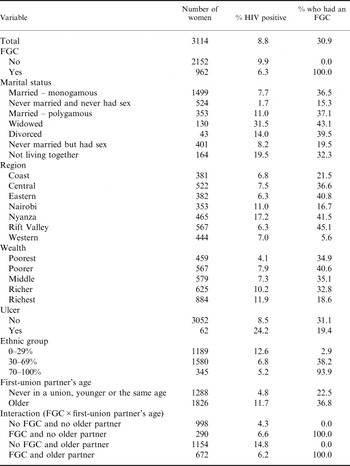
Table 1 presents the characteristics of respondents by HIV and FGC statuses. The results show that 8.8% of the respondents were HIV positive and 30.9% of the respondents reported they had had an FGC procedure. The respondents were evenly spread throughout the regions with the majority of them being married and belonging to ethnicities with low and medium FGC prevalence.
Selected characteristics of women respondents by HIV and FGC statuses, Kenya, 2003

Note: All the selected characteristics presented in the table were found to be significantly associated (p<0.05) with HIV status of women in the Kenyan context.
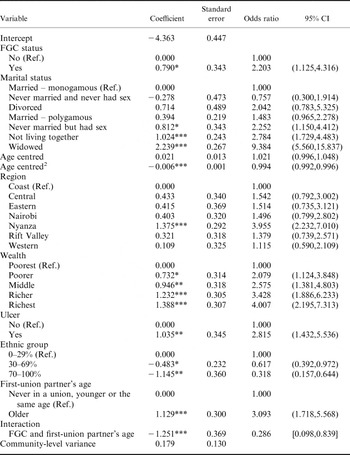
The association between FGC and HIV was examined using multilevel logistic regression models (see Table 2). The FGC status of women was the main explanatory variable of interest, so its potential interactions with other variables together with other interactions were tested for significance despite the fact that the FGC status was not found to be significant on its own (results are not shown separately). The results from Yount & Abraham (Reference Yount and Abraham2007), which showed an indirect association between FGC and HIV, also served as a motivation for testing interactions between FGC and other variables.
Results of the final multilevel logistic regression model

Note: The confidence interval (CI) for the interaction is calculated to adjust for 28 multiple comparisons using a Bonferroni correction (see Nickerson (Reference Nickerson1994) or standard regression text such as Draper & Smith (Reference Draper and Smith1998)).
*** p<0.001;
** p<0.01;
* p<0.05;
Ref., reference category.
Standard p-values suggested that two interactions (FGC status with the first-union partner's age and respondent's age with genital ulcer) were significant. These two interactions, together with a number of selected control variables such as respondents' age, marital status, age of the first-union partner, ethnicity grouped by FGC prevalence, region of residence, wealth status and whether they had a genital ulcer or not within the last 12 months prior to the survey, were included in the final multilevel logistic regression model. However, as a large number of potential interactions were explored when finding the two significant interactions, the 95% confidence intervals calculated for the interaction terms (see Table 2) were based on the simplified Bonferroni correction (see Nickerson, Reference Nickerson1994), which is expressed as 100×(1−0.05/q)%, where q is the number of potential interactions explored. This approach was taken to adjust the Type I error in relation to the significance of the interactions as with a standard p-value of 0.05 it is expected to find one in 20 significant interactions by chance. It was found that the second interaction term (respondent's age with genital ulcer) was not significant when the correction was applied but the interaction between FGC and first-union partner's age was found to be highly significant, even after the correction to calculation of 95% confidence intervals was used. Therefore, the actual final model included only one interaction between FGC and first-union partner's age and the second interaction was excluded from the model (and therefore not shown in Table 2).
The results suggest that a significant strong association between FGC status (in combination with a first-union partner's age) and HIV status does exist after controlling for a number of potential confounding factors, interaction effects and the hierarchical structure of the data. It was found that the community effect was not significant after controlling for other effects (see Table 2) and, therefore, is not discussed further. The results of this study suggest that in the presence of an interaction effect between FGC and first-union partner's age, FGC significantly increases the risk of HIV in the Kenyan context for women who have a younger or same-age first-union partner when compared with women who have a younger or same-age first-union partner but have not undergone an FGC procedure. However, the risk was lower for women who had FGC and an older first-union partner when compared with women without FGC but with an older first-union partner.
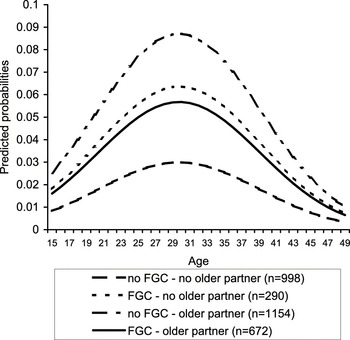
Figure 1 shows the predicted probabilities of being HIV positive by age of respondents, FGC status and age of the first-union partner. The probability of a woman being HIV positive peaks around the age of 29 for all four groups of women, and is lower at younger and older ages. Figure 1 demonstrates that women without FGC and without an older first-union partner have the lowest probability of being HIV positive at all ages in comparison with the other three groups of women and the probabilities do not differ much by age for this group. It also shows that both groups of women with FGC have much higher probabilities of being HIV positive at all ages when compared with women from the lowest risk group. For women with a younger or same-age first-union partner, the probability of being HIV positive is higher for those with FGC. However, for women with an older first-union partner the probability is lower for those women with FGC when compared with women without FGC. Women without FGC and with an older first-union partner have the highest probability of being HIV positive, when compared with the other three groups, with substantial differences in the predicted probabilities of being HIV positive by age. The literature suggests that the age difference between younger women and older men is a factor that increases the risk of HIV for women (Kelly et al., Reference Kelly, Gray, Sewankambo, Serwadda, Wabwire-Mangen, Lutalo and Wawer2003; Luke, Reference Luke2003; Longfield et al., Reference Longfield, Glick, Waithaka and Berman2004), therefore these results are also in agreement with the existing literature. However, the results of this study suggest that the risk is higher for women without FGC when compared with women with FGC (see Fig. 1). This finding contradicts the results reported by Yount & Abraham (Reference Yount and Abraham2007) that FGC and HIV are positively associated indirectly through having an older first-union partner.
Predicted probabilities of being HIV positive by age for four groups of women. The reference woman for this graph has the following characteristics: she is married in a monogamous union, lives in Nairobi, belongs to middle wealth index, and is from an ethnic group with medium FGC prevalence (30–69%).

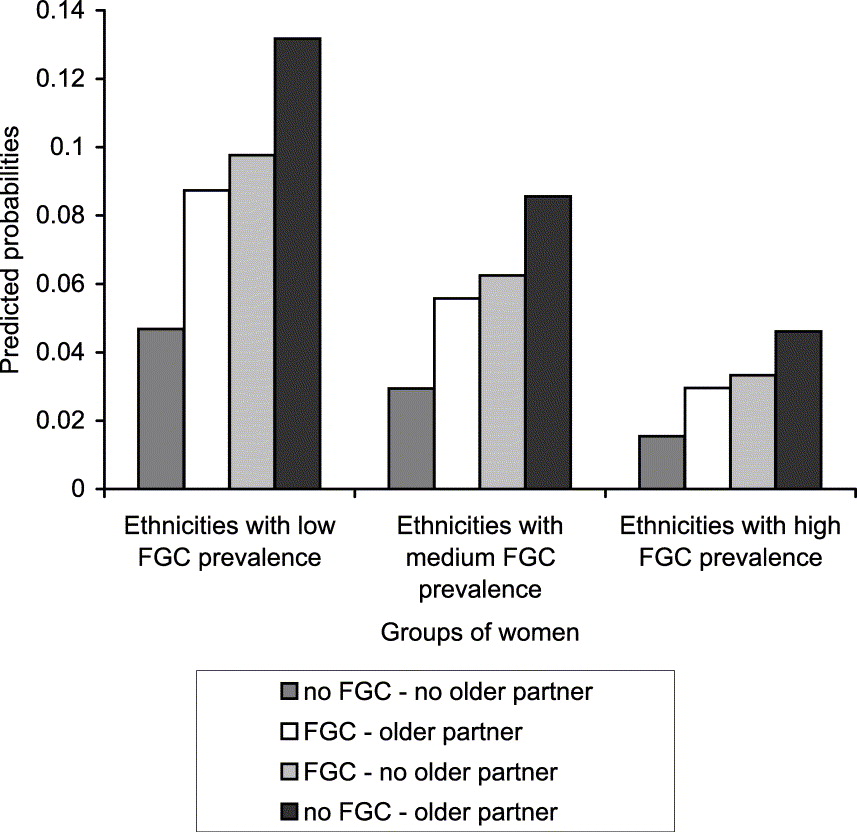
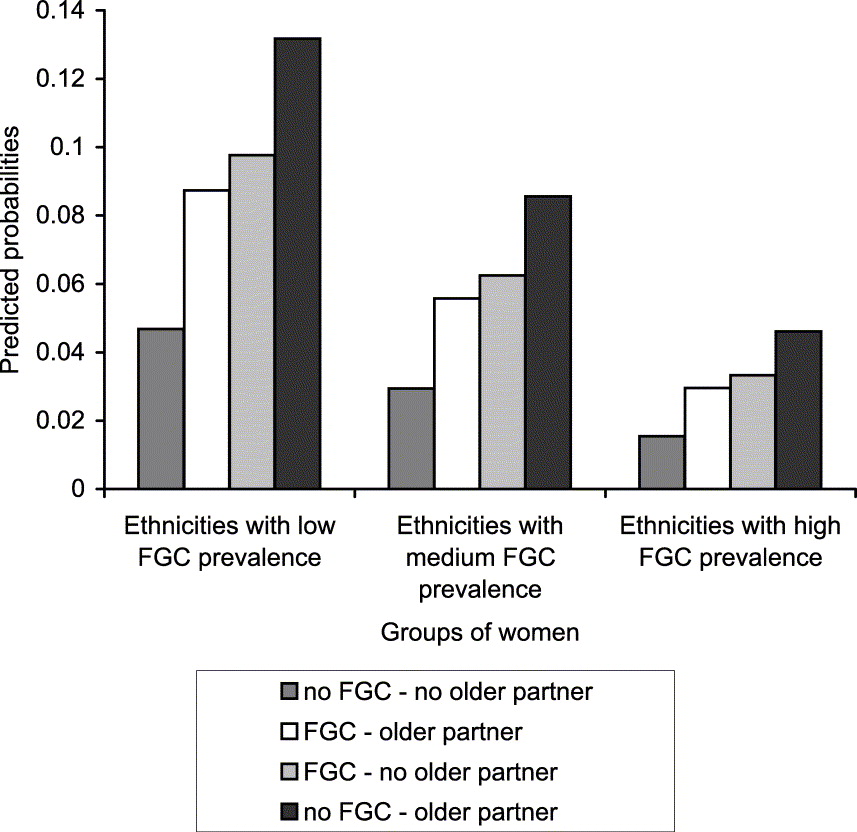
The findings of this study show significant difference in the odds of being HIV positive by grouped ethnicity. Women from the ethnic communities with low FGC prevalence had higher odds of being HIV positive than women from the communities with middle or high FGC prevalence (see Fig. 2). These findings again contrast with the findings of the Yount & Abraham (Reference Yount and Abraham2007) study. Their results showed that the ethnic groups that practise FGC minimally had lower odds of being HIV positive than members of other groups where FGC practise was more common (Yount & Abraham, Reference Yount and Abraham2007). Their finding is rather surprising after examining the results in the marginal data table, which suggest that more women from the 0–24% group were HIV positive in comparison with women from the 75–100% group (Yount & Abraham, Reference Yount and Abraham2007). Moreover, these results appear even more startling since the North Eastern province, where 100% of women had had FGC but none tested positively for HIV, was included in their analysis. The results from the current study can be explained by the fact that ethnicities that have high prevalence of FGC such as the Maasai and Somali, are relatively closed populations with low mobility and low mixing with other ethnic communities. HIV prevalence among Somali in the sample is very low (0.4%) and the majority of the Somali women in the sample live in provinces with relatively low HIV prevalence. The HIV prevalence rate among the Maasais in the sample is also relatively low (1.1%). The findings of this study clearly show that an individual woman's HIV risk decreases when she belongs to an ethnic group with a higher FGC prevalence (see Fig. 2) after controlling for other individual-level risk factors, including her own FGC status.
Predicted probabilities of being HIV positive by ethnicity groups for four groups of women. The reference woman for this graph has the following characteristics: she is 28 years old, married in a monogamous union, lives in Nairobi, and belongs to middle wealth index.
Other control variables such as age, marital status, region of residence, and wealth status showed results consistent with the existing literature (Bongaarts, Reference Bongaarts1996; Yount & Abraham, Reference Yount and Abraham2007). The study suggests that the probability of being HIV positive is the highest around 29 years of age, and the probability is lower at younger and older ages. In addition the results of this study suggest that there are significant differences in the odds of being HIV positive by wealth quintiles: the wealthier the quintile a woman belongs to the higher is the risk of HIV infection for her. This finding is consistent with Blatazar et al.'s (Reference Baltazar, Chakaya, Gatua, Korir, Kunyanga and Mansoer2005) findings. Yount & Abraham (Reference Yount and Abraham2007) reported a similar association and provided two plausible explanations for this: greater wealth may lead to risky behaviour through having more income and through adopting a more ‘modern’ style of life, and that richer women have higher chances of surviving longer with HIV due to the ability to access the life-prolonging antiretroviral therapy (ART) in comparison with poorer women.
The study suggests that there is no significant difference in the risk of HIV infection for women who are in monogamous and polygamous relations. The study results also suggest that women who have never been married but had sex, who are not living together with their partners and widowed are at higher risk of being HIV positive than women who are married or living together in monogamous unions. Increased risk of HIV infection for those who have never been married but had sex or not living together can be explained by the fact that they are not in stable relationships and might have had multiple sexual partners over time and, therefore, are at increased risk of acquiring HIV infection. Women who are widowed are at a higher risk of HIV infection in a sub-Saharan African context as it is likely that their husbands might have died from AIDS. It is important to mention that women who had never been married and never had sex, i.e. virgins, have lower odds of being HIV positive than married women but this difference is not significant, and this result suggests that the study has not found evidence for non-sexual mechanism of HIV transmission.
The results show that having a genital ulcer increases the odds of being HIV positive. This result is in agreement with the existing literature, which suggests that having a genital ulcer facilitates the transmission of the HIV virus (Bongaarts, Reference Bongaarts1996; Buvé et al., Reference Buvé, Caraël, Hayes, Auvert, Ferry and Robinson2001; Shapiro, Reference Shapiro2002).
Other variables initially considered in the model, such as respondents' education, working status, religion, FGC practice in the community, childhood residence, type of residence, age at first sexual intercourse, husband lives at home, current contraceptive use, number of unions, sex in exchange for money or gifts, condom use at the last sexual intercourse, number of sexual partners within the last 12 months, STIs in the last 12 months, and genital discharge within the last 12 months, were not significant and hence were excluded from the final model.
Discussion
The foregoing analyses of the KDHS data demonstrate clear evidence of a significant and strong association between HIV and FGC in the presence of an interaction effect with the age of the first-union partner. Although it is difficult to disentangle the causality, the findings show that FGC is significantly associated with an increased risk of HIV for women who reported having a younger or same-age first-union partner, whereas the risk of HIV infection is lower for women who have FGC and an older first-union partner when compared with women without FGC. As the association between HIV and FGC operates mainly through the interaction between FGC and the first-union partner's age, and as the direction of association is different for two different groups of women with and without an older first-union partner, the plausible mechanism of association is clearly through a behavioural pathway. This suggests that FGC is a marker of certain behaviours that operate in combination with other individual characteristics to predict the likelihood of HIV. Possible explanations include increasing urbanization of the Kenyan society and the changes in sexual and marital relationships influenced by modernization, but it is difficult to provide a definite explanation based on quantitative data and, hence, qualitative studies are needed to understand this effect better. However, it is important to highlight the existence of this behavioural association between FGC status with first-union partner's age and the risk of being HIV positive as other studies hypothesized or found evidence of biological mechanism of association between the two (Kun, Reference Kun1997; Brady, Reference Brady1999; Pépin et al., Reference Pépin, Plamondon, Alves, Beaudet and Labbé2006; Brewer et al., Reference Brewer, Potterat, Roberts and Brody2007). It is also important to explore all potential compositional aspects of the association between FGC and HIV in order to gain a better understanding of the pathways and relationships. The fact that the difference between the lowest risk group and the two groups with FGC does exist (see Fig. 1) suggests that FGC has an effect on the HIV status of women in the Kenyan context. As mentioned earlier, the main finding about the association between FGC and HIV through having an older first-union partner contradicts the findings of Yount & Abraham (Reference Yount and Abraham2007). However, this result is partially in agreement with the results of Brewer et al. (Reference Brewer, Potterat, Roberts and Brody2007), who found that uncircumcised women were more likely to be HIV positive than women with FGC. In this study this association holds only for women who reported having an older first-union partner but not for women who did not have an older first-union partner.
The other plausible mechanism of association between FGC and HIV has a biological nature. It was hypothesized that women with FGC might be more susceptible to HIV because they might suffer from open wounds, ulcers and sores at their genital areas, which can increase the susceptibility to HIV (Kun, Reference Kun1997; Brady, Reference Brady1999). The present study could not explore this hypothesis due to the lack of appropriate data.
Another important finding is the direction of the associations between HIV and FGC at the community level (see Fig. 2). The variable that represents grouped ethnicities by FGC prevalence is similar to a community-level variable due to the geographic clustering of the ethnicities and, therefore, will be referred to as a community-level variable. The negative association between HIV and FGC for ethnicities with high FGC prevalence might reflect the fact that certain cultural practices within the ethnicities protect their members against exposure to HIV. However, the positive association between HIV and FGC for women without an older first-union partner at the individual level suggests that FGC might be a marker of particular risky behaviours that become more pronounced when the woman is in a group with lower FGC prevalence and with higher HIV prevalence.
The present study has a number of limitations. Data on the types, severity and timing of the FGC procedure, as well as on mechanisms of HIV transmission, were unavailable. This information, if available, could have helped to conduct more detailed analysis and to investigate the association between different types of FGC and HIV status. The FGC status was based on self-reporting, which might not be as accurate a measure as a clinical examination (Snow, Reference Snow2001; Klouman et al., Reference Klouman, Manongi and Klepp2005; Yount & Abraham, Reference Yount and Abraham2007). All sexual and reproductive health variables were also self-reported and, therefore, can introduce bias as women might be either unwilling to report having STIs or genital ulcers, or they simply might be unaware that they have STIs (Yount & Abraham, Reference Yount and Abraham2007) as in many cases STIs in women are asymptomatic. The reported STIs prevalence in the past 12 month was very low (1.5%) and given the fact that sub-Saharan Africa has the highest prevalence of curable STIs in the world (WHO, 2001), the numbers are likely to be under-reported.
As with any retrospective survey data, recall bias is likely as women might have forgotten some of the details of events in relation to their sexual behaviour (Shell-Duncan, Reference Shell-Duncan2001). The findings of this study are representative for the geographical areas considered in the analysis and cannot be claimed to be nationally representative since the North Eastern province was not included in the analysis. Finally, the analysis could not establish any causal association between FGC and HIV because of the cross-sectional nature of the data. Moreover, given the complex nature of the behavioural pathways of association between FGC and HIV identified in Kenya, it cannot be easily generalized to other African countries where the socio-cultural contexts are distinct.
The results of this analysis are important as they suggest implications for both general policy as well as targeted interventions. The main finding from this study shows that existing programmes targeted towards the eradication of FGC alone might not be sufficient to reduce negative health outcomes for women since the final model demonstrates that the effect comes mainly through the behavioural pathway. Therefore, a more complex approach towards the design of interventions, with a specific emphasis on behavioural changes, is needed to take into the account the complexity of the issue. As there are a number of other factors that are associated with HIV infection (behavioural and reproductive health factors), appropriate policies and programmes can influence changes that would be beneficial for reducing the number of people infected with HIV. Treatment of STIs should become available as genital ulcers caused by STIs increase the risk of HIV and sub-Saharan Africa has the highest prevalence of curable STIs in the world (WHO, 2001). If these efforts are effective, the rate of HIV infection can be substantially reduced in Kenya, even in the situation where an HIV cure or vaccine is not yet available.
There are a number of ways in which future studies can expand or clarify the results of the current study. Firstly, it would be beneficial for further analysis to collect data on the types of sexual practices such as anal and dry sex. Previous studies have highlighted that these factors can potentially be associated with both FGC and HIV (Kun, Reference Kun1997; Baleta, Reference Baleta1998; Baldwin & Baldwin, Reference Baldwin and Baldwin2000; Brown & Brown, Reference Brown and Brown2000; Yount & Abraham, Reference Yount and Abraham2007). Secondly, clinical investigations can establish the type and severity of FGC, which can help to clarify the association between different types of FGC and HIV. Clinical examinations can also confirm the presence of STIs. The blood sample for HIV tests can also be used to conduct tests for other STIs such as syphilis and gonorrhoea. Thirdly, qualitative data can provide useful insights about sexual and marital behaviour in relation to FGC as well as on motivations for individual choice of partners, and might also help better explain the behavioural pathways of association between FGC and HIV. Finally, longitudinal or panel data are needed to establish the temporal order of events and achieve a better understanding of the mechanisms of associations between FGC and HIV.
Acknowledgments
Olga Maslovskaya is funded by the Economic and Social Research Council (ESRC 1+3 scholarship: PTA-031-2006-00185), which facilitated her contribution. The authors thank the editorial team and the anonymous referees for providing useful suggestions and comments. Also they thank Professor Peter W. F. Smith for his valuable advice. An earlier version of this paper has been presented at the Division of Social Statistics Applications and Policy Seminar Series (University of Southampton), at the 2008 Population Association of America (PAA) Conference and at the 2008 European Population Conference (EPC), and the authors are grateful for the useful comments received at these presentations.