INTRODUCTION
Most quantitative research related to the legacy of White settler racism focuses on “perceived Aboriginal deficits” (Walter and Andersen Reference Walter and Andersen2013, 26). For instance, on gaps between Indigenous peoples and settlers on social and economic outcomes such as employment, income, and incarceration rates. It is an important omission that very little quantitative research considers the legacy of White settler racism in terms of ongoing anti-Indigenous attitudes. Overt racism toward IndigenousFootnote 1 peoples—the belief in the intrinsic, biological inferiority of Indigenous peoples—helped motivate and justify the mass dispossession of Indigenous lands and attempted genocide of Indigenous peoples. Today, democratic norms prevent most settlers from openly endorsing the idea that Indigenous peoples are intrinsically inferior and should be eliminated. Democratic norms even prevent most settlers from openly admitting they dislike Indigenous peoples more than settlers. But how should subtler anti-Indigenous attitudes be measured? And what are the ongoing political consequences of anti-Indigenous attitudes?
In this article, I use original survey data and a novel scale measuring Indigenous resentment. The goals of this article are to introduce a theoretically-informed, quantitative measure of Indigenous resentment to the political science canon and to offer an empirical look at the political consequences of Indigenous resentment in settler-colonial states. The present work focuses on White settler attitudes in Western democracies such as United States, Canada, Australia, and New Zealand. However, the concept of Indigenous resentment likely has applications in other settler-colonial contexts. Settler-colonialism is a specific type of colonialism—political domination over a territory—that involves replacing colonized, Indigenous peoples with settlers from the dominating polity (Wolfe Reference Wolfe2006). Indigenous peoples refer to peoples who, “having a historical continuity with pre-invasion and pre-colonial societies developed on their territories, consider themselves distinct from other sectors of the societies now prevailing on those territories, or parts of them” (Martínez Cobo Reference Martínez Cobo1987).
In the “Theory and Literature” section, I draw on Indigenous political thought and settler-colonial theories to make the case that anti-Indigenous attitudes are distinct from Whites' other racial attitudes. I argue that mapping the psychological contours of hierarchical social relations in settler-colonial contexts requires recognizing the relationship between White racism and place (Coulthard Reference Coulthard2014; Razack Reference Razack2002; Simpson Reference Simpson2011; Wildcat et al. Reference Wildcat, McDonald, Irlbacher-Fox and Coulthard2014). Because “territoriality is settler colonialism's specific, irreducible element” (Wolfe Reference Wolfe2006, 388), any valid measure of anti-Indigenous attitudes should tap into struggles over land. I also consider existing efforts to quantitatively study anti-Indigenous attitudes. Drawing on my theoretical discussion, I outline the limitations of existing approaches. Although existing measures offer a useful starting point, they are insufficient insofar as they either tap into overtly hostile measures of anti-Indigenous attitudes (such as “old fashioned racism” or the affective component of prejudice), or they merely use measures of anti-Black attitudes—for instance, switching the word “Black” for “Native American” (Neblo Reference Neblo2009)—and thus fail to tap into distinct features characterizing Indigeneity and Indigenous-settler relations.
In this section, I explain that there are good reasons to suspect anti-Indigenous attitudes impact important policy outcomes. Just as anti-Black attitudes motivate White opposition to welfare (DeSante Reference DeSante2013; Gilens Reference Gilens1995; Reference Gilens1996), there is evidence that affective prejudice toward Indigenous peoples also motivates opposition to welfare (Harell, Soroka, and Ladner Reference Harell, Soroka and Ladner2014). Furthermore, given Indigenous peoples' relations to land, conflicts between Indigenous peoples and settlers often emerge in the context of settler efforts to expropriate and exploit natural resources on Indigenous territories. It also may be the case that White settlers' attitudes toward Indigenous peoples impact their attitudes toward resource extraction.
In the “Methods” section, I introduce the novel measure of Indigenous resentment. The concept of Indigenous resentment draws on the symbolic racism literature, particularly the literature on racial resentment (Enders and Scott Reference Enders and Scott2019; Kinder, Sanders, and Sanders Reference Kinder, Sanders and Sanders1996). However, the Indigenous resentment scale is unique in that it also taps into settlers' attitudes toward Indigenous land-claims, languages, and the belief that Indigenous peoples have unfair tax benefits; attitudes not normally associated with Black peoples in Anglo-settler colonies such as the United States, Canada, Australia, and New Zealand. In this section, I also outline my methodology, which involves estimating two important policy outcomes: attitudes toward redistribution (opposition to welfare) and attitudes toward resource extraction (building pipelines).
In the “Results” section, I offer an original analysis of the political consequences of Indigenous resentment. My analysis accomplishes two tasks: first, I show that Indigenous resentment predicts opposition to welfare and support for building pipelines. Second, I show that Indigenous resentment is a better predictor of support for these policies than a measure of explicit dislike that taps into the affective component of prejudice. Without controlling for Indigenous resentment, affective prejudice toward Indigenous peoples has a significant but small impact on opposition to welfare and does not significantly predict support for pipeline developments. Controlling for Indigenous resentment, affective prejudice does not significantly explain welfare attitudes or impact attitudes toward pipeline developments in the predicted direction.
My analysis demonstrates the usefulness of using a measure of Indigenous resentment—a more subtle and valid measure of anti-Indigenous attitudes—in political science research. I discuss the implications of my findings in the “Discussion” section, and conclude by outlining an agenda for future studies. I point to the potential for comparative work on anti-Indigenous attitudes both across Anglo-settler states and the global south, the intersection of anti-Indigenous and anti-immigrant attitudes, and to the potential contribution that studying settler-colonialism can make to our understanding of White in-group attitudes (c.f. Jardina Reference Jardina2019).
THEORY AND LITERATURE
Belief Systems in Settler Colonies
Indigeneity is defined by peoples' distinctive ties to specific territories that pre-date later colonization and settlement. In my present work, I focus on the experience of Indigenous peoples in the Anglo-settler colonies of the United States, Canada, Australia, and New Zealand, but my work likely has applications to other settler-colonial contexts. Settler colonization is the processes by which an imperial state takes over sovereignty by sending settlers to establish political control over territories and the populations inhabiting those territories (Veracini Reference Veracini2010; Wolfe Reference Wolfe2006). In Anglo-settler states, the belief systems of White racism and liberal colonialism played a central role in motivating and justifying processes of settler colonization.
White racism (which I also refer to as racism) refers to belief systems justifying White supremacy, or “the system of domination by which White people have historically ruled over and, in certain important ways, continue to rule over non-White people” (Mills Reference Mills2014, 1–2). White racism refers to the “common conceptual denominator” that ultimately signifies “global statuses of superiority and inferiority, privilege and subordination” (Mills Reference Mills2014, 21). As Mills (Reference Mills2014, 21) points out, these statuses have taken different forms—distinctions based on geography (European/non-European), religion (Christian/heathen), or level of cultural development (civilized/wild or savage)—but these distinctions all eventually coalesce “in the basic opposition of White versus non-White.”
Racism worked in conjunction with liberal colonialism to justify processes of colonization in Anglo-settler states. Liberal colonialism is an ideological framework characterized by commitment to private property, capitalism, and industry (Arneil Reference Arneil2017, 30). Liberal colonialism “constitutes citizens and civil society in explicit opposition to the idle, irrational, custom-bound ‘Indian’ who may be transformed into a citizen but only if he/she gives up his/her ‘customs’ or ‘ways’ and instead becomes industrious and rational” (Arneil Reference Arneil2012, 492). White racism and liberal colonialism were linked in that Indigenous peoples' purported wildness and inability to engage in “productive” activities—such as exploiting natural resources—were used to distinguish Indigenous peoples as inferior (non-White). Indigenous peoples' categorization as non-White thus excluded them from the basic moral obligations—treating others as ends in themselves (Kant Reference Kant2013)—that White people in democracies normally extend to one another.
During the initial settlement of Anglo-settler states, leading officials and writers were not shy about describing Indigenous peoples as unproductive and irrational savages and thus the expropriation of Indigenous land and elimination of Indigenous life as justified. U.S. President William Henry Harrison, when he was Governor of the Indiana Territory, clearly articulated the opposition of White versus not-White when, with respect to displacing Indigenous peoples, he rhetorically asked:
“Is one of the fairest portions of the globe to remain in a state of nature, the haunt of a few wretched savages, when it seems destined, by the Creator, to give support to a large population, and to be the seat of civilization, of science, and true religion?” (cited in Esarey Reference Esarey1915, 449)
In addition to displacement, assimilation was used as a tool to try and eliminate Indigenous peoples. A policy of “aggressive civilization” was developed during Ulysses S. Grant's post-Civil War administration, which included “industrial schools” to teach Indigenous children Christianity and prepare them for menial work (Smith Reference Smith2001). Inspired by American industrial schools, Canadian policy-makers dramatically expanded an already existing Indian residential school system, which involved incarcerating Indigenous children at boarding schools, often against the will of the children and their families. P. G. Anderson, Canada's Indian Affairs Superintendent, clearly articulated the motivating ideologies of liberal colonialism and White racism when he explained to the General Council of Indian Chiefs and Principle Men why their children would be removed from their families and sent to residential schools:
“You would not give up your idle roving habits, to enable your children to receive instruction. Therefore you remain poor, ignorant and miserable. It is found you cannot govern yourselves … It has therefore been determined, that your children shall be sent to schools, where they will forget their Indian habits and be instructed in all the necessary arts of civilized life, and become one with your White brethren” (quoted in Baldwin Reference Baldwin1846, 7).
In response to a report detailing the high morbidity rate of Indigenous children incarcerated in state institutions, Duncan Campbell Scott, the Superintendent of Canada's Indian Affairs, explicitly stated that the “policy of this Department … is geared towards a final solution of our Indian problem” (quoted in Talaga Reference Talaga2018). Canada's Indian residential school system resulted in the recorded deaths of 3,200 children, although actual numbers are likely higher (Truth and Reconciliation Commission of Canada 2015).
Today, democratic norms prevent most people from endorsing the idea that Indigenous peoples—or any peoples—are explicitly inferior and should be exterminated. But does the legacy of these belief systems manifest in subtler anti-Indigenous attitudes today? And what are the political consequences of anti-Indigenous attitudes?
Existing Research on Anti-Indigenous Attitudes
Measuring Anti-Indigenous Attitudes
Only a few researchers have tried to quantitatively study settler attitudes toward Indigenous peoples, and most have focused on overtly hostile measures of anti-Indigenous attitudes. For instance, scholars have adapted measures of “old fashioned racism” (or Jim Crow racism), which were originally developed to tap into the explicit belief in the inferiority of Black Americans and support for segregation (Henry and Sears Reference Henry and Sears2002). Measures of old fashioned racism include scales asking whether respondents endorse the idea that Indigenous peoples are alcoholics, on welfare, or are bad parents (Morrison et al. Reference Morrison, Morrison, Harriman, Jewell, Morrison and Morrison2008), and scales tapping into the belief that Indigenous peoples are lazy (Harell, Soroka, and Iyengar Reference Harell, Soroka and Iyengar2016), or are “a bunch of complainers” (Langford and Ponting Reference Langford and Rick Ponting1992). Walker (Reference Walker1994) developed an “Attitudes Toward Aborigines Scale” which includes a number of explicitly hostile indicators, including whether respondents endorse the statement: “I don't like Aborigines” (see also Pedersen and Walker Reference Pedersen and Walker1997). In a similar vein, researchers have studied the affective component of prejudice (Fiske Reference Fiske1998), relying on self-reported discomfort being around Indigenous peoples (Berry and Kalin Reference Berry and Kalin1995) or measures of explicit dislike, such as feeling thermometer ratings of Indigenous peoples and other group members (Donakowski and Esses Reference Donakowski and Esses1996; Harell, Soroka, and Ladner Reference Harell, Soroka and Ladner2014).
While it is interesting to study overt prejudice (including dislike, the affective component of prejudice (Fiske Reference Fiske1998)), social desirability prevents many respondents from openly admitting to prejudicial attitudes. As I will show, measures of affective prejudice are not as effective at discriminating between respondents with different attitudes since most respondents simply refuse to explicitly indicate aversions toward different social group members. As a result, more overt measures of prejudice, including explicit dislike, tend to underestimate the effect of anti-Indigenous attitudes on policy preferences.
Less work has considered subtler measures Footnote 2 of symbolic racism directed toward Indigenous peoples. By “symbolic racism” I am referring to the combination of negative affect and the belief that the target group violates cherished values of hard work and industry—what Americans call “conservative” values (Henry and Sears Reference Henry and Sears2002), but what others might call “liberal colonial values” (e.g., see Arneil Reference Arneil2012). Under the broader rubric of “symbolic racism” I include operationalizations of modern racism (McConahay Reference McConahay1986), symbolic racism (Sears Reference Sears, Katz and Taylor1988), subtle racism (Meertens and Pettigrew Reference Meertens and Pettigrew1997; Pettigrew and Meertens Reference Pettigrew and Meertens1995), and racial resentment (Enders Reference Enders2019; Enders and Scott Reference Enders and Scott2019; Kinder, Sanders, and Sanders Reference Kinder, Sanders and Sanders1996) (see Henry and Sears (Reference Henry and Sears2002) for an overview of this literature).
Existing efforts to study symbolic racism toward Indigenous peoples have relied directly on instruments designed to measure anti-Black attitudes. Some authors have used the Racial Resentment Scale items, replacing the word “Blacks” with “Native Americans” in the U.S. (Neblo Reference Neblo2009) or with “Aboriginals” in the Canadian context (Harell, Soroka, and Iyengar Reference Harell, Soroka and Iyengar2016). Others have used the Modern Racism Scale (Morrison et al. Reference Morrison, Morrison, Harriman, Jewell, Morrison and Morrison2008).
However, these tools were designed to tap into White attitudes toward Black Americans, and there are reasons to believe that White settlers' attitudes toward Indigenous peoples are distinct. Most importantly, none of the adapted measures of symbolic racism ask about land. As Dene scholar Coulthard (Reference Coulthard2014, 13) explains, processes of colonization (and decolonization) are “best understood as a struggle primarily inspired by and oriented around the question of land” (see also Green and Green Reference Green and Green2007; Simpson Reference Simpson2011; Singh Reference Singh2019; Wildcat et al. Reference Wildcat, McDonald, Irlbacher-Fox and Coulthard2014); any valid measure of settlers' attitudes toward Indigenous peoples must tap into conflicts over land.
Relatedly, treaties between settler governments and Indigenous peoples also mean that Indigenous peoples may enjoy rights—or there may be discourses that Indigenous peoples enjoy rights—that are distinct from settlers' rights with respect to things like taxation. As Dudas (Reference Dudas2005; Reference Dudas2008) explains, Indigenous treaty rights are often framed as contrary to the values of settler countries. In the United States, discourses at times present Indigenous treaty rights as being contrary to equal rights “in that they provide to their bearers advantages without regard to their efforts or their merits—the traditional markers by which individual success in America is legitimated” (Dudas Reference Dudas2008, 3–4). Indigenous treaty rights are consequently “interpreted as threats to the body politic” (Dudas Reference Dudas2008, 4). Indigenous peoples may also make demands that are rarely made by racial group members, including Black Americans, related to support for traditional languages.
The Political Consequences of Anti-Indigenous Attitudes
Another downside of existing research on anti-Indigenous attitudes—at least with respect to the study of politics—is that few of these studies consider the political consequences of anti-Indigenous attitudes (with the exception of Harell, Soroka, and Ladner (Reference Harell, Soroka and Ladner2014) and Harell, Soroka, and Iyengar (Reference Harell, Soroka and Iyengar2016)). Much of the pioneering work on anti-Indigenous attitudes has been done by psychologists interested in anti-Indigenous attitudes as an outcome or the effect of anti-Indigenous attitudes on outcomes such as classroom helping behaviors (Werhun and Penner Reference Werhun and Penner2010). In political science, Neblo (Reference Neblo2009) compares racial attitudes toward Black Americans and Indigenous peoples using the Racial Resentment Scale items (replacing the word “Blacks” with “Native Americans”) but does not discuss whether anti-Indigenous attitudes predict policy outcomes.
The main work on anti-Indigenous attitudes in political science has been conducted by Harell, Soroka, and Ladner (Reference Harell, Soroka and Ladner2014), who show that—just as anti-Black attitudes predict opposition to welfare (DeSante Reference DeSante2013; Gilens Reference Gilens1995; Reference Gilens1996)—negative affect toward Indigenous peoples predicts opposition to welfare.Footnote 3 In my present work, I replicate Harell, Soroka, and Ladner's (Reference Harell, Soroka and Ladner2014) main findings but also show that explicit dislike underestimates the effect of anti-Indigenous attitudes on opposition to welfare.
It is important to study the relationship between White racial attitudes and attitudes toward redistribution, particularly in settler-colonial contexts. The economic growth of settler-colonies and asymmetrical empowerment of White settlers was fueled by expropriating Indigenous lands and through the use of racialized unfree labor, including the enslavement of Black peoples and practices of indentured servitude and blackbirding that disproportionately impacted communities of color. Today, the fiction that hard work is rewarded by material success helps absolve White settlers from obligations to redistribute their accumulated economic and social capital. Furthermore, although redistribution is important for empowering Indigenous peoples, another policy area that distinctly impacts Indigenous peoples is resource extraction and development. There are strong theoretical reasons to suspect anti-Indigenous attitudes and resource development are related: recall, the devaluation of Indigenous peoples and their relations to land helped European settlers justify the expropriation and exploitation of Indigenous territories (Arneil Reference Arneil2012; Coulthard Reference Coulthard2014). As I show, Indigenous resentment significantly predicts support for new pipeline developments.
METHODS
Data and Analysis
Data was collected between March 2019 and May 2019. Respondents were recruited using Dynata's (formerly Survey Sampling International's) online panels. My sample is an (otherwise representative) sample of White, English-speaking Canadians (n = 1, 150). White, English-speaking Canadians constitute a numerical majority in Canada and have historically monopolized political power at the national level and so it is important to understand their racial attitudes. Missing values on the outcomes and primary independent variables were dropped through list-wise deletion (see Table S1). I used multiple imputation by chained equations using the MICE package in R to deal with missing data on socio-demographic control variables.Footnote 4
With respect to my analysis, for each outcome (opposition to welfare and support for pipelines), I estimate four OLS regression models.Footnote 5 For each outcome, I first estimate an omitted variable model that does not include any measure of anti-Indigenous attitudes but that does include basic covariates considered important in political science research. Second, I estimate an affective prejudice model that predicts the effect of affective prejudice (explicit dislike) toward Indigenous peoples on each outcome, controlling for covariates. Third, I estimate an Indigenous resentment model that predicts the effect of Indigenous resentment on each outcome, controlling for covariates. Finally, I estimate an Indigenous resentment and affective prejudice model with both the Indigenous resentment scale and the measure of affective prejudice. The goal is to demonstrate that anti-Indigenous attitudes are an important omitted variable in the study of political behavior in settler-colonial societies; and furthermore, that anti-Indigenous attitudes are best operationalized using a scale of Indigenous resentment (rather than a measure of affective prejudice).
Outcome Variables: Policy Preferences
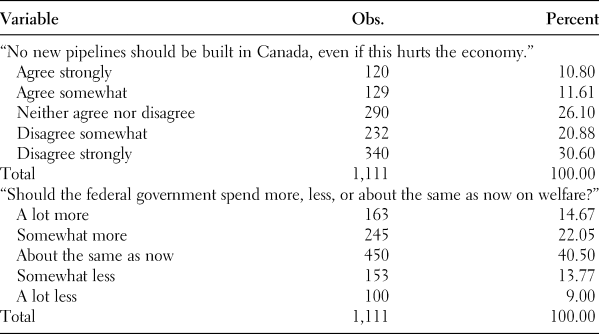
The first outcome of interest, opposition to welfare, is measured using a five-category item asking respondents to indicate if they think the government should spend more, the same, or less on welfare, coded so higher values indicate greater opposition to welfare spending. The second outcome of interest, support for pipeline development, is measured using a five-category item asking respondents to indicate their agreement with the statement that: “No new gas pipelines should be built in Canada, even if this hurts the economy.” The item is coded so higher values indicate more disagreement (more support for pipeline development). The outcome variables are rescaled to range from “0” to “1.” The distribution across the categories of the variables is presented in Table 1.
Outcome variable distributions

Independent Variables
Operationalizing Indigenous Resentment
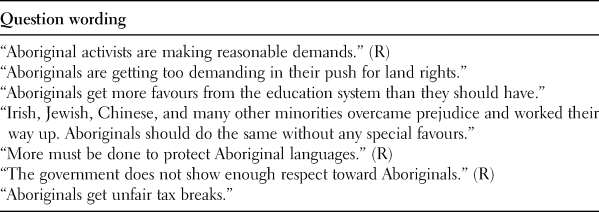
The main independent variable of interest is Indigenous resentment, measured by seven Likert-type questions tapping into anti-Indigenous attitudes (Table 2). The response options for each question range from “Disagree strongly,” “Disagree,” “Neither agree nor disagree,” “Agree,” to “Agree strongly” and are coded such that the higher values indicate greater resentment. Together these seven items comprise a highly reliable (α = .89) scale measuring Indigenous resentment.Footnote 6 Factor analysis and a scree test show that the scale is unidimensional (see SM, Figure S2).Footnote 7 Note also that the factor analysis results reveal that the item asking whether Indigenous peoples are “getting too demanding in their push for land rights” correlates most strongly underlying, latent factor (Beauvais Reference Beauvais2020). In other words, of the seven items tapping into the underlying factor, the feature measuring attitudes toward land claims is most strongly related to the underlying concept of Indigenous resentment. This reinforces the intuition that Indigenous resentment is a distinct expression of racial attitudes related to settler land expropriation and settler-Indigenous conflicts over land.
Indigenous resentment scale items

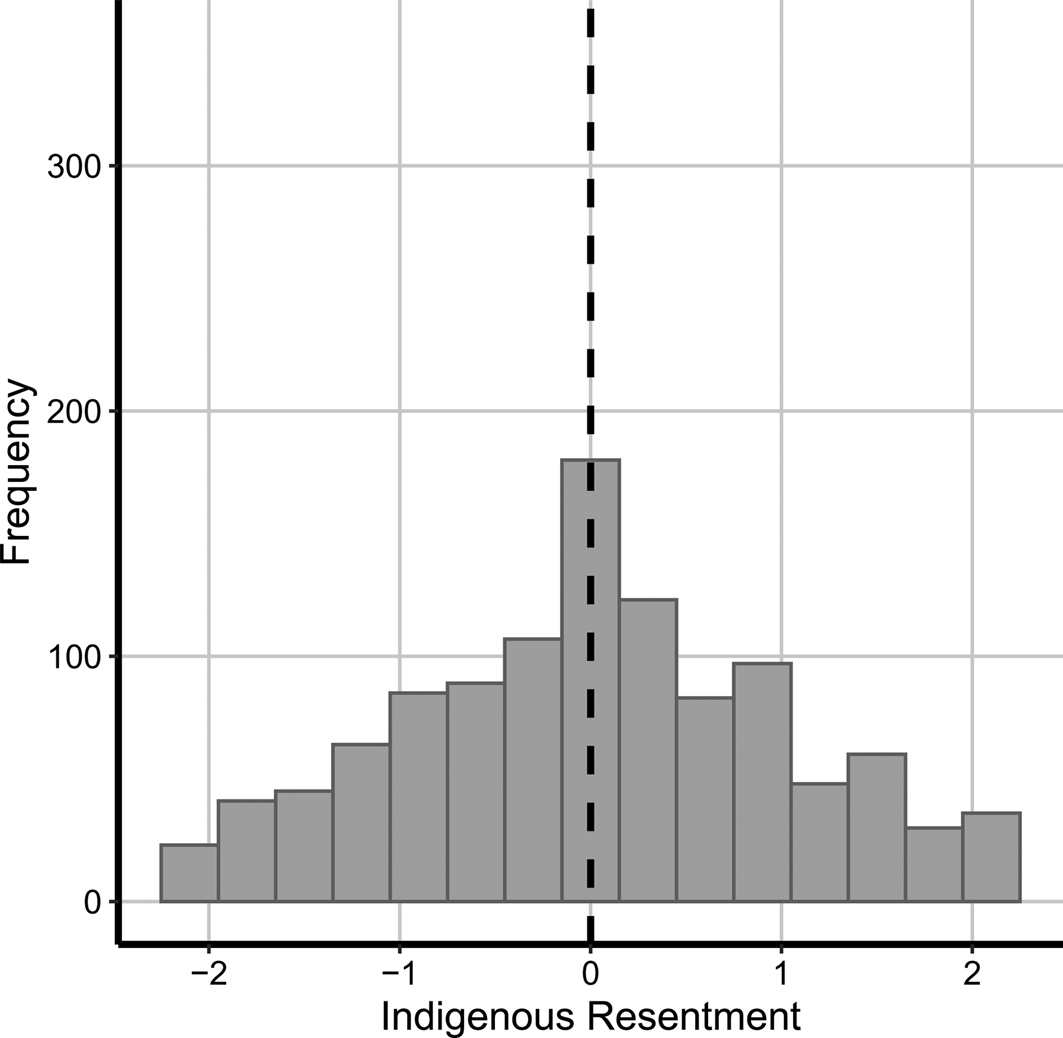
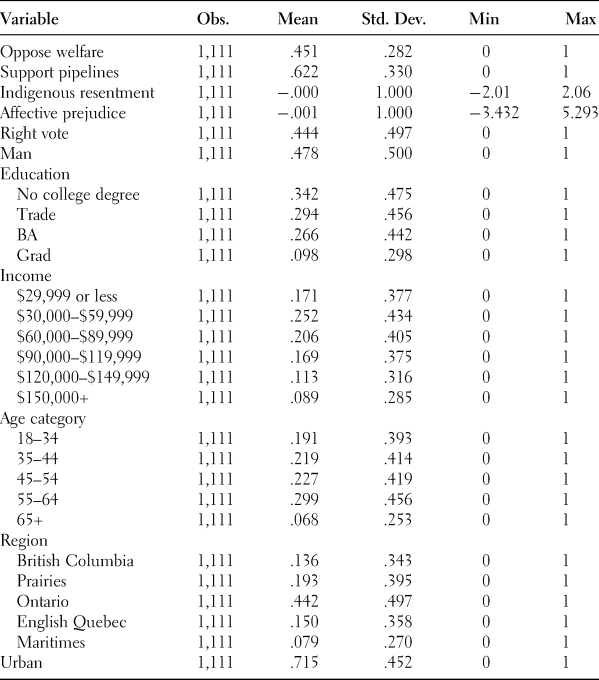
I constructed a summated rating scale of Indigenous resentment from the seven variables tapping into anti-Indigenous attitudes (Table 2). The Indigenous resentment scale was normalized using Z-score standardization (to have a mean of 0 and standard deviation of 1). The distribution of Indigenous resentment is presented in Figure 1. A note on terminology: although “Indigenous peoples” is used in scholarly circles, this term may be less familiar with non-academic audiences. In Australia and Canada, the term “Aboriginal” is more familiar in non-academic discourses, while in the United States, the term “Native American” is more familiar. In my survey, I asked the Canadian respondents about their attitudes toward “Aboriginals.” I define the term for respondents the first time it appears as including peoples of First Nation, Inuk (Inuit), or Métis descent.
Distribution of Indigenous resentment

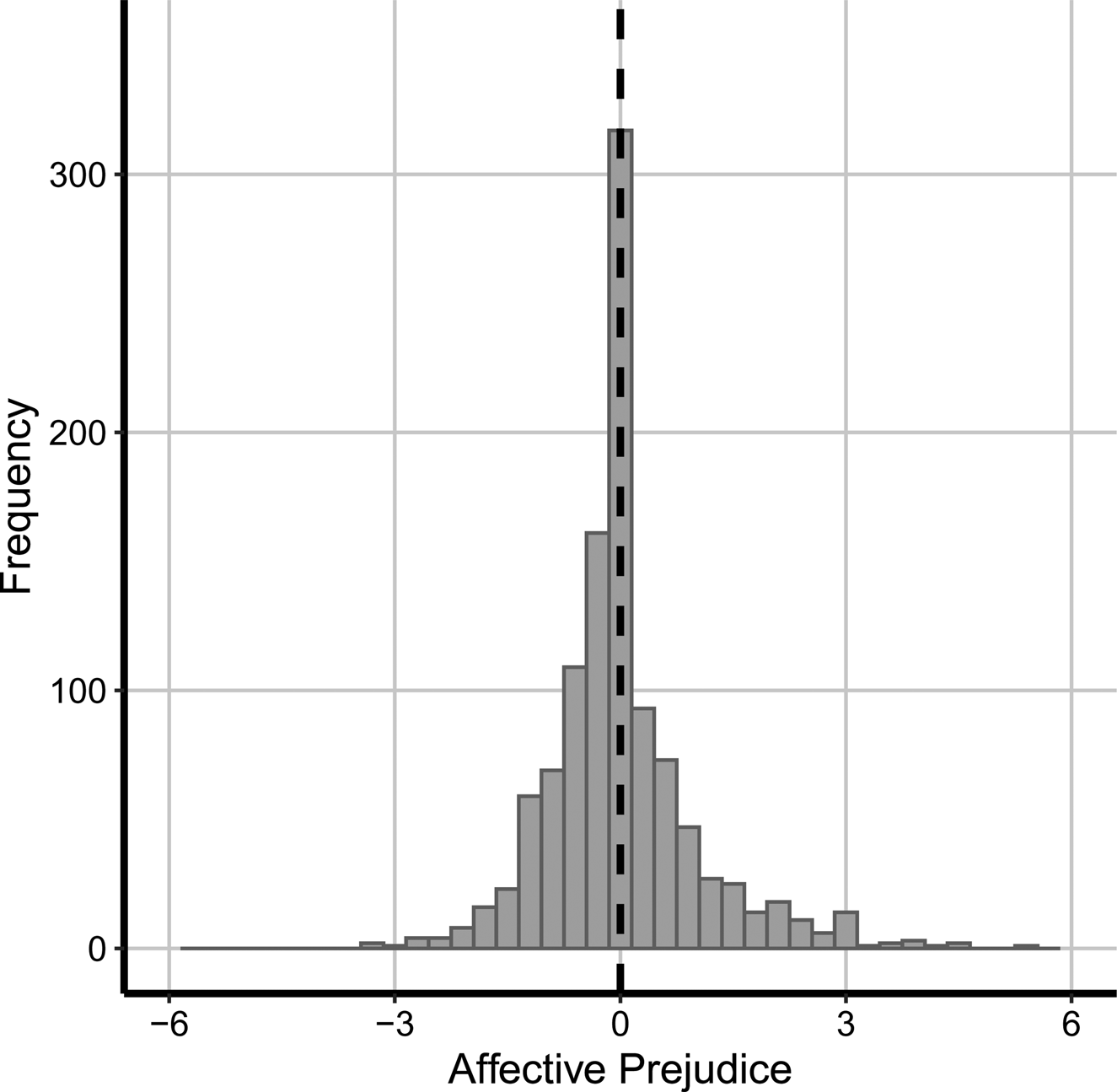
I also included a variable tapping into affective prejudice. Drawing on Fiske (Reference Fiske1998, 372) who defines “stereotypes as the cognitive component, prejudice as the affective aspect, and discrimination as the behavioral component of (group) category-based responses,” I use a measure of respondents' feelings toward different groups as a measure of affective prejudice. However, recognizing that the term “prejudice” is sometimes used to refer to stereotype-endorsement (which I am not measuring), I refer to this variable as “explicit dislike” or “affective prejudice” for clarity. The measure of affective prejudice was created by subtracting the difference of respondents' feelings toward Indigenous peoples from their average feelings toward a number of social group members (Aboriginals, Atheists, Blacks, Canadians, Christians, and immigrants). Feelings were measured by asking respondents how they feel about different groups, where zero means they really dislike the group and 100 means they really like the group. Note that the plurality of respondents refused to express prejudice for any groups; that is, a plurality of respondents gave all social groups the exact same rating on the feeling thermometers. Like with the Indigenous resentment scale, the affective prejudice scale was normalized using Z-score standardization (to have a mean of 0 and standard deviation of 1), for ease of comparison. The distribution of affective prejudice is presented in Figure 2.
Distribution of affective prejudice

Correlates of Indigenous Resentment
Respondent age is measured with a five-category variable (18–34, 35–44, 45–54, 55–64, and 65 years and older). The median Canadian age category (35–44 years) is the reference category in the regression models. Education is measured using a five-category variable: no degree (the reference category), trade school diploma, four-year university or college degree, and post-graduate or professional degree. Gender is a dummy variable indicating if a respondent self-identified as man (man = 1). Only four respondents indicated a non-binary identity, which is not a sufficient number of people to include as a separate category. As such, I included women and transgender/gender non-conforming respondents together in the reference category. Excluding transgender/gender non-conforming respondents from the analysis does not change the results and would represent an unnecessary exclusion. I consider five regions: British Columbia, the Prairies, Ontario, English-speaking Québec, and the Maritimes. In my analyses, Canada's most populous province, Ontario, is the reference category. Recall that my sample (and generalizations) is limited to English-speakers. This of course requires particular restraint when generalizing from Québec—a majority French-speaking region—since my findings only reflect the attitudes of English-speakers in Québec. I also include a dummy variable indicating whether or not the respondent lives in a metropolitan city (city = 1, else = 0).Footnote 8
Partisan politics is operationalized with a dummy variable indicating whether the respondents identified themselves as right-of-center party voters (Conservative Party or People's Party). The reference category includes all non-right party voters (voters who indicated they supported the Liberal Party, New Democratic Party, Green Party, other left parties, or were undecided). Canada's two major parties, the Liberals and Conservatives, are “big tent” parties that contain a great deal of ideological diversity. As such, I also include an 11-point measure of ideology, which asks respondents: “In political matters, people talk of ‘the left’ and ‘the right.’ How would you place your views on this scale, generally speaking?” (Left 0 … 10 Right). The results of a VIF test show that collinearity is not a problem (both the measure of right-party support and ideology can be included in the regression models).
Variable distributions

RESULTS
Opposition to Welfare
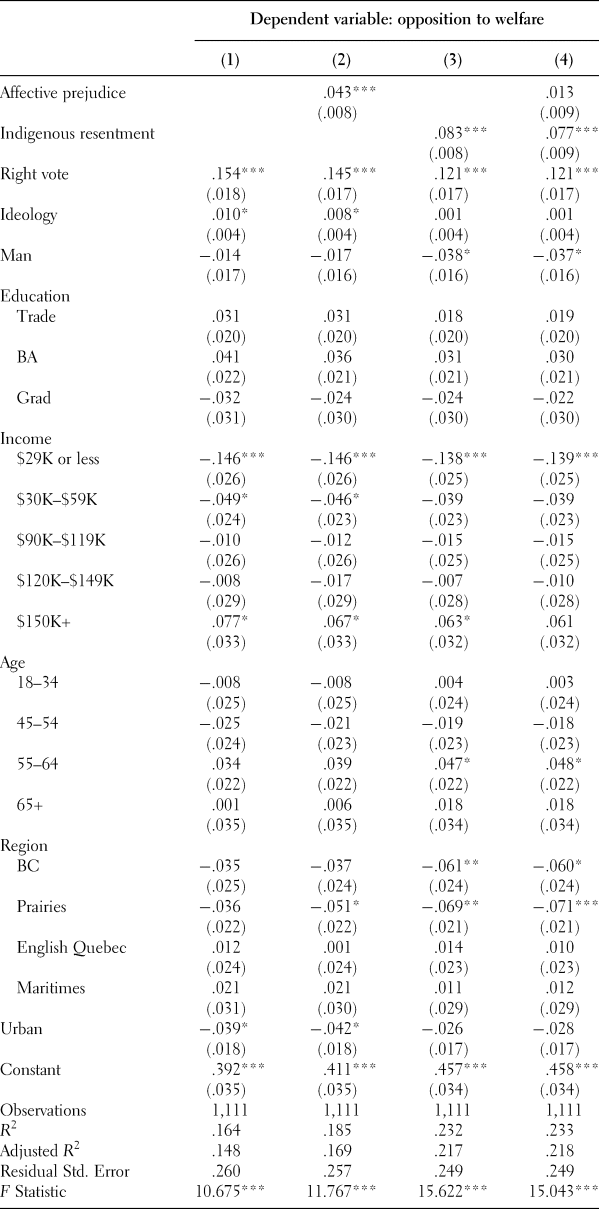
Congruent with existing literature, affective prejudice significantly predicts opposition to welfare (Table 4, Model 2). However, affective prejudice has a relatively small impact on the outcome. A one standard deviation increase in prejudice increases opposition to welfare by .04 on the measure of anti-welfare attitudes that ranges from 0 to 1. By contrast, a one standard deviation increase in Indigenous resentment increases opposition to welfare by .08 on the same scale (Table 4, Model 3). When including both affective prejudice and Indigenous resentment in the same model, only Indigenous resentment significantly predicts welfare attitudes (Table 4, Model 4). This reinforces the intuition that negative affect has little explanatory power relative to Indigenous resentment. ANOVA testing shows that Model 3, the Indigenous resentment model, improves over the simpler model; however, the more complex Model 4, which includes both affective prejudice and Indigenous resentment, is not significantly better at capturing the data than Model 3 (see the SM, Table S3).
OLS models predicting opposition to welfare

Note: *p < .05; **p < .01; ***p < .001.
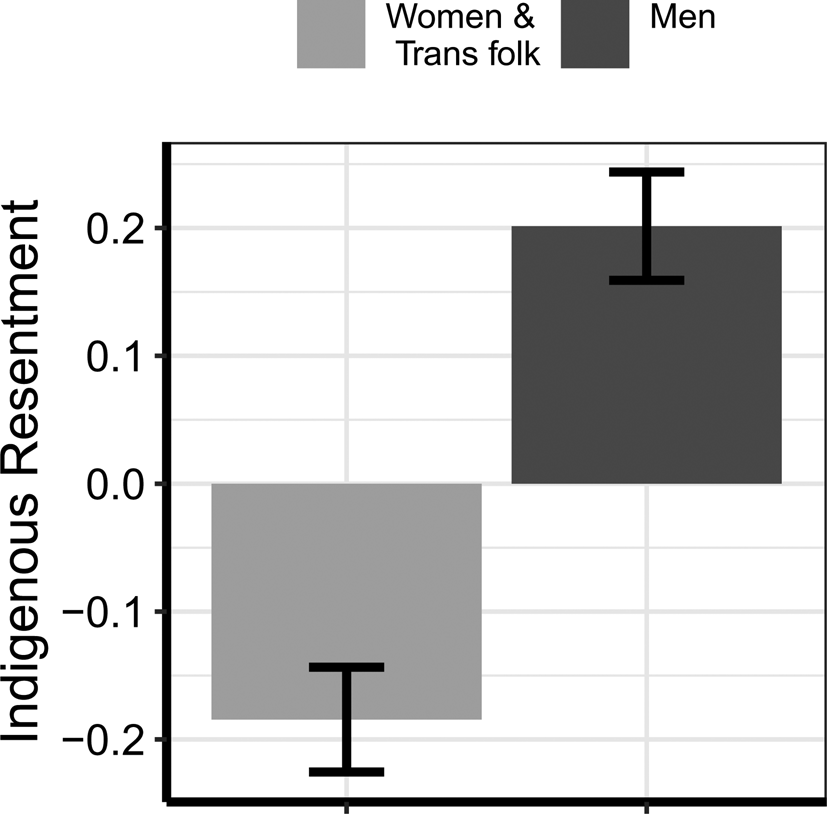
Comparing the omitted variable model (Table 4, Model 1) to the models that account for Indigenous resentment (Table 4, Model 3 or Model 4) offers important insight into the political consequences of Indigenous resentment. Comparing the models reveals that Indigenous resentment mediates the impact of gender and region in important ways. Without controlling for Indigenous resentment (the omitted variable model), it appears that gender has no impact on attitudes toward redistribution. In fact, men express significantly higher levels of resentment (see Figure 3) and Indigenous resentment increases opposition to welfare. Accounting for the confounding effect of Indigenous resentment reveals that men express significantly lower opposition to welfare than other Canadians.
Distribution of Indigenous resentment by gender

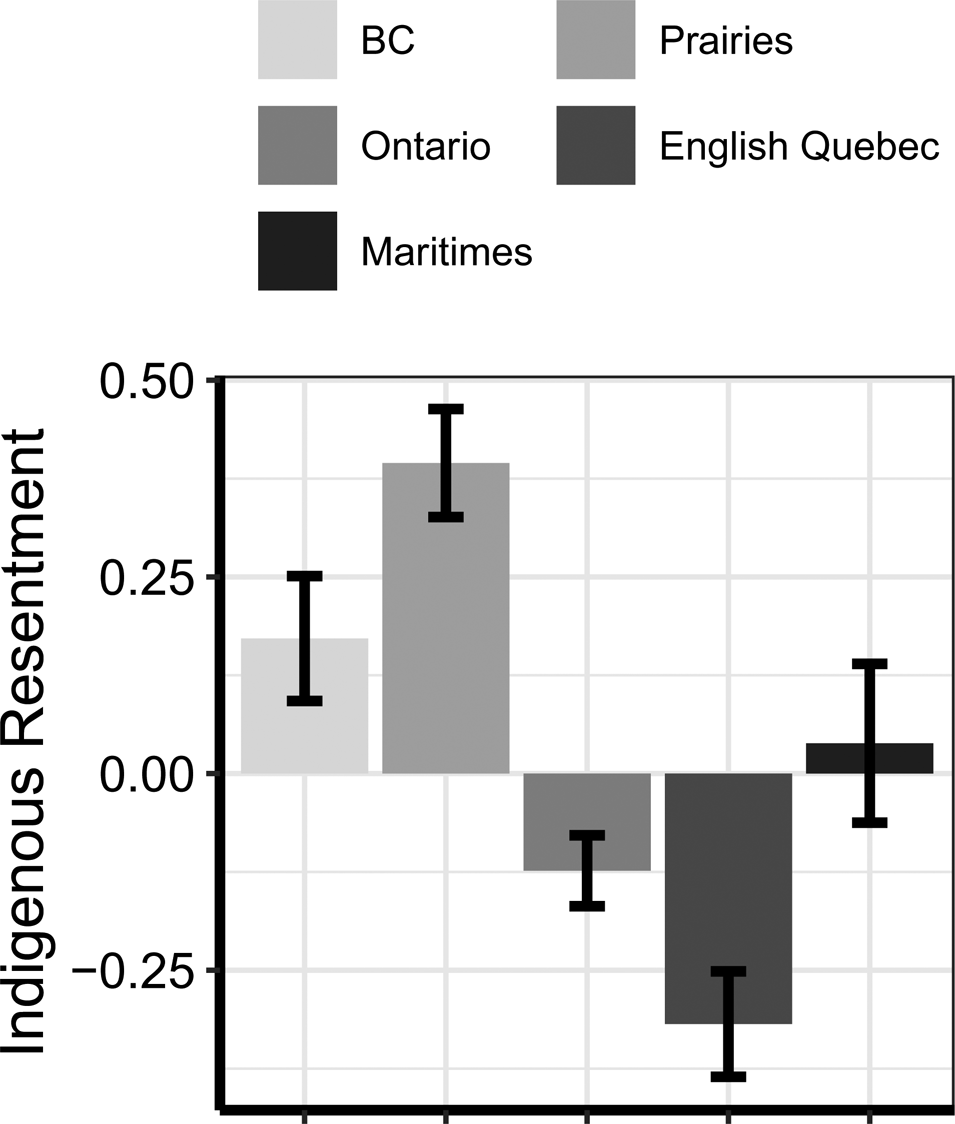
Similarly, without controlling for Indigenous resentment (the omitted variable model), it appears that region has little impact on attitudes toward redistribution. In fact, region is significantly related to the omitted variable, with residents of British Columbia and the Prairies expressing significantly higher levels of Indigenous resentment as compared to residents of Canada's most populous province, Ontario (see Figure 4). Controlling for the effect of the omitted Indigenous resentment variable (Table 4, Model 3 or Model 4), we can see that British Columbian and Prairie folk express significantly less opposition to welfare than Ontarians; that is, Western Canadians want more government spending on welfare than Ontarians. This is an interesting finding, especially given the recent dominance of right-of-center parties in the Prairies.
Distribution of Indigenous resentment by region

Support for Resource Extraction
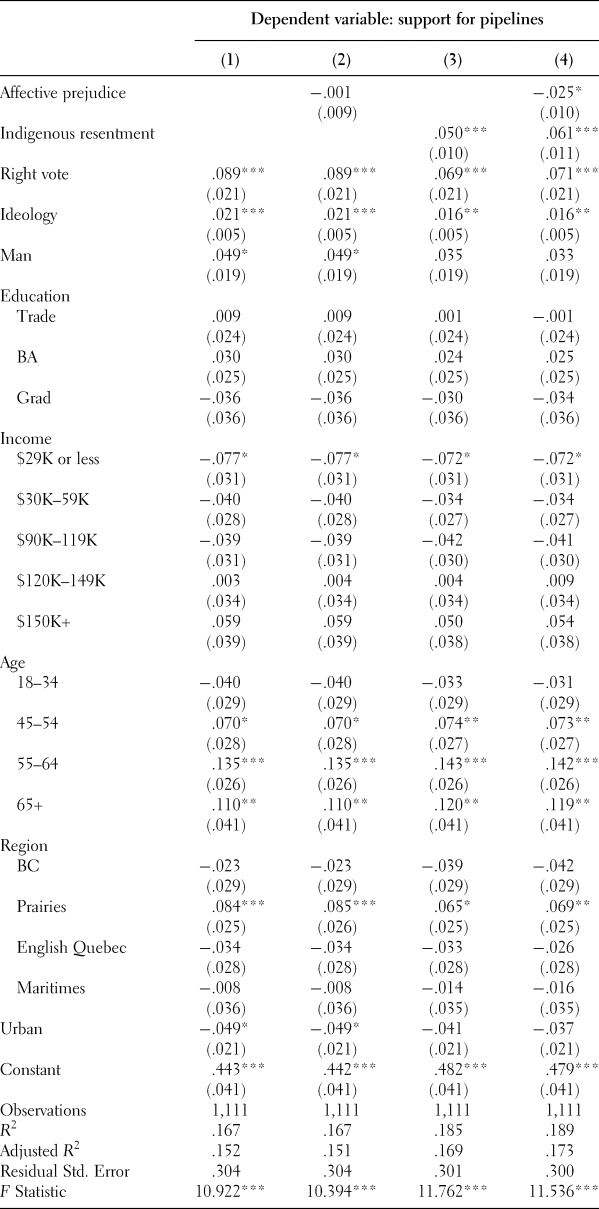
With respect to support for extracting natural resources, there is no evidence that affective prejudice predicts support for pipeline developments (Table 5, Model 2). By contrast, Indigenous resentment significantly increases support for pipelines. Increasing Indigenous resentment by one standard deviation increases support for pipelines by .05 points on the outcome measure which ranges from 0 to 1 (Table 5, Model 3). Although Indigenous resentment has a smaller effect on support for pipelines, ANOVA testing shows that Model 3, the Indigenous resentment model, is significantly better at capturing the data (see SM, Table S3). Controlling for both affective prejudice and Indigenous resentment in the same model hardly changes the impact of Indigenous resentment on pipeline support (Table 5, Model 4). In Model 4, affective prejudice appears to increase pipeline support. This is not due to collinearity but rather an unmodeled interaction between affective prejudice and income (Figure S3). This is a potentially interesting finding but not central to the aims of this present work; see the discussion in the Supplementary Materials for more details (Section S4). What matters for the present analysis is that—regardless of whether one controls for negative affect (or the interaction between affect and income)—Indigenous resentment always strongly predicts pipeline support.
OLS models predicting support for pipelines

Note:*p < .05; **p < .01; ***p < .001.
Comparing the omitted variable model (Table 5, Model 1) and the Indigenous resentment model (Table 5, Model 3) again reveals that Indigenous resentment mediates the impact of gender on support for pipelines. Without controlling for Indigenous resentment (the omitted variable model), it appears that men are more supportive of pipelines. In fact, men express significantly higher levels of resentment (see Figure 3) and Indigenous resentment increases support for pipelines. Accounting for the confounding effect of Indigenous resentment, we can see that men express similar levels of support for pipelines as the rest of Canadians.
DISCUSSION
In settler-colonial states, attitudes toward Indigenous peoples have important implications for policy preferences. For one thing, anti-Indigenous attitudes are clearly related to opposition to welfare. Including Indigenous resentment in a model estimating opposition to welfare significantly improves model fit. My work replicates existing research showing that affective prejudice helps explain White settlers' opposition to redistribution (Harell, Soroka, and Ladner Reference Harell, Soroka and Ladner2014). However, my work goes beyond existing studies by showing that affective prejudice is not the best way to identify the political consequences of anti-Indigenous attitudes. From a theoretical perspective, not all meaningful, negative outgroup attitudes are captured by measures of explicit dislike. For instance, settlers may not feel strong, explicit animosity but still hold subtler attitudes that are disempowering for Indigenous peoples—such as the belief that Indigenous peoples have gone too far in their push for land rights or do not deserve to have their languages protected. From a measurement perspective, measurement error—including social desirability bias—prevents measures of overt prejudice (including negative affect) from capturing sufficient variation in anti-Indigenous attitudes.
The tools we use impact our results and the conclusions we draw. Because affective prejudice underestimates the effect of anti-Indigenous attitudes on opposition to welfare, a researcher might be tempted to conclude that prejudice has a significant but not a substantive impact on redistributive attitudes. However, as my analysis shows, using the proper tool—the Indigenous resentment scale—reveals that, in fact, anti-Indigenous attitudes have a significant and substantive impact on redistributive attitudes.
My paper also shows that White settlers' attitudes are related to another important policy area that disproportionately impacts Indigenous peoples: exploiting natural resources. Indigenous resentment significantly increases support for building pipelines, even controlling for related covariates such as region, vote choice, and ideology. Including the Indigenous resentment scale in a model predicting pipeline support improves model fit, compared to the omitted variable model. Even when controlling for affective prejudice (and the interaction between affective prejudice and income (see SM, Figure S3 and Table S2)), Indigenous resentment significantly predicts pipeline support. This offers evidence for the argument made by many Indigenous scholars and activists that any real efforts to address climate change also require decolonization.
Our present analysis does suffer certain limitations. First and foremost, my study only includes Canadian respondents. My work likely extends—albeit to varying degrees—to other Anglo-colonial contexts such as the United States, Australia, and New Zealand. However, future comparative studies are needed to clarify the impact of anti-Indigenous attitudes on policy attitudes in other Anglo-settler democracies. It would also be interesting to compare anti-Indigenous attitudes in Anglo-settler democracies to settler societies in the global south. Second, my analysis is limited to English-speaking, White Canadian settlers. Future Canadian research should endeavor to include settlers of color and French-speakers.
Our present work is also potentially open to the criticisms leveled at measures of symbolic racism—notably racial resentment—in the U.S. context. According to critics of the racial resentment scale, responses to the items that comprise the scale reflect “principled conservatism” (conservative ideology) instead of racial prejudice (Sniderman and Tetlock Reference Sniderman and Tetlock1986). However, recent U.S. research empirically tests whether the racial resentment survey items exhibit differential item functioning and finds that, even correcting for the influence of conservative principles, the racial resentment scale significantly predicts attitudes toward government spending (Enders Reference Enders2019). In fact, Enders (Reference Enders2019) finds no statistically significant differences between the effects of the uncorrected or corrected scales on any outcomes, including spending preferences. There is little reason to be concerned that racial resentment is merely an expression of “principled conservatism.”
CONCLUSION
My analysis uses original survey data and a novel scale measuring Indigenous resentment to offer an empirical look at the political consequences of White settler attitudes toward Indigenous peoples. Drawing on Indigenous and settler-colonial theory, I make the case that a valid measure of anti-Indigenous attitudes must be attentive to the distinct contours of settler-Indigenous conflicts—particularly with respect to conflicts over land. My analysis demonstrates the usefulness of using a measure of Indigenous resentment—a more subtle and valid measure of anti-Indigenous attitudes—in political science research. I show that Indigenous resentment predicts important policy attitudes: opposition to welfare and support for extractive policies (building pipelines).
Furthermore, I show that Indigenous resentment is a better predictor of support for these policies than a measure of affective anti-Indigenous prejudice. Replicating existing findings, I show that anti-Indigenous prejudice has a significant but small impact on opposition to welfare; measures of negative affect underestimate the impact of anti-Indigenous attitudes on opposition to welfare. I also show that by itself, affective prejudice does not significantly predict support for pipeline developments (although accounting for the interaction between affective prejudice and income it does appear that, among the highest earning Canadians, dislike does predict pipeline support (Figure S3 and Table S2)).
Going forward, future studies should endeavor to study anti-Indigenous attitudes in other post-colonial contexts to compare differences across contexts, both comparing attitudes in Anglo-settler states and comparing attitudes in former colonies in the global south. It would also be interesting to study Indigenous resentment over time in Canada. Indigenous peoples are the fastest growing population in Canada, and overtime analyses of settler attitudes could help identify how changing demographics impact settlers' racial attitudes. In addition to studying Indigenous resentment (measured in this study as a White out-group attitude), it would be interesting to consider whether demographic changes stemming from growing Indigenous populations also activate the salience of White in-group attitudes, or White consciousness. U.S. research shows that when the proportion of White people in a population decreases due to immigration, White consciousness—White peoples' identification with their in-group—increases (Jardina Reference Jardina2019). Identifying whether demographic changes stemming from growing Indigenous populations also activate White consciousness would clarify whether it is immigration (an increasing foreign-born population) or race (an increasing non-White population) that activates White consciousness.
With respect to outgroup attitudes and policy preferences, it would also be interesting to study the intersection of Indigeneity and immigration. Since President Donald Trump took office in the United States, five out of the six children who died while they were in the custody of the Department of Homeland Security were Indigenous (Nolan Reference Nolan2019). Often, border agents only provide translations in Spanish—forgetting the existence of Indigenous peoples in the Americas is resulting in tragic consequences. The death of Indigenous children in the custody of Anglo-settler state institutions did not end with the closing of the last Indian residential school. My present work has focused on the political consequences of anti-Indigenous attitudes—both affective prejudice and Indigenous resentment—but future scholars might also consider the political consequences of non-attitudes toward Indigenous peoples (e.g., ambivalence, explicit lack of caring, lack of awareness, or endorsing the belief that Indigenous peoples or their cultures have “disappeared”).
Settler-colonialism is an important axis of inequality and should not be omitted from political science research. My work sets the groundwork for a new research agenda on White racial attitudes and political behavior in settler-colonial contexts. In particular, I hope to illustrate the value in turning our gaze away from a strict focus on the perceived deficits of Indigenous peoples (Walter and Andersen Reference Walter and Andersen2013). Instead, more attention should be paid to the attitudes of the settlers who imagined the Indian problem into existence and to the lasting impact that White settlers' racial attitudes have had—and continue to have—on politics in settler-colonial states.
ACKNOWLEDGMENTS
I would like to thank Archon Fung and the participants of the Ash Center Democracy Group for creating a stimulating and supportive community while I completed this project. I would also like to thank Dietlind Stolle and the Centre for the Study of Democratic Citizenship (CSDC), where I started this project. This paper draws on research supported by the Social Sciences and Humanities Research Council, a Henry “Hank” Heitowit Scholarship to attend the ICPSR Summer Program, and was partly funded by a CSDC Seed Grant. I would also like to thank the three anonymous reviewers for their helpful comments.
SUPPLEMENTARY MATERIAL
To view supplementary material for this article, please visit https://doi.org/10.1017/rep.2020.25.