


%20--%3e%3c!DOCTYPE%20svg%20PUBLIC%20'-//W3C//DTD%20SVG%201.0//EN'%20'http://www.w3.org/TR/2001/REC-SVG-20010904/DTD/svg10.dtd'%3e%3csvg%20version='1.0'%20id='Layer_1'%20xmlns='http://www.w3.org/2000/svg'%20xmlns:xlink='http://www.w3.org/1999/xlink'%20x='0px'%20y='0px'%20width='64px'%20height='64px'%20viewBox='5.5%20-3.5%2064%2064'%20enable-background='new%205.5%20-3.5%2064%2064'%20xml:space='preserve'%3e%3cg%3e%3ccircle%20fill='%23FFFFFF'%20fill-opacity='0'%20cx='37.785'%20cy='28.501'%20r='28.836'/%3e%3cpath%20fill='%23595959'%20d='M37.441-3.5c8.951,0,16.572,3.125,22.857,9.372c3.008,3.009,5.295,6.448,6.857,10.314%20c1.561,3.867,2.344,7.971,2.344,12.314c0,4.381-0.773,8.486-2.314,12.313c-1.543,3.828-3.82,7.21-6.828,10.143%20c-3.123,3.085-6.666,5.448-10.629,7.086c-3.961,1.638-8.057,2.457-12.285,2.457s-8.276-0.808-12.143-2.429%20c-3.866-1.618-7.333-3.961-10.4-7.027c-3.067-3.066-5.4-6.524-7-10.372S5.5,32.767,5.5,28.5c0-4.229,0.809-8.295,2.428-12.2%20c1.619-3.905,3.972-7.4,7.057-10.486C21.08-0.394,28.565-3.5,37.441-3.5z%20M37.557,2.272c-7.314,0-13.467,2.553-18.458,7.657%20c-2.515,2.553-4.448,5.419-5.8,8.6c-1.354,3.181-2.029,6.505-2.029,9.972c0,3.429,0.675,6.734,2.029,9.913%20c1.353,3.183,3.285,6.021,5.8,8.516c2.514,2.496,5.351,4.399,8.515,5.715c3.161,1.314,6.476,1.971,9.943,1.971%20c3.428,0,6.75-0.665,9.973-1.999c3.219-1.335,6.121-3.257,8.713-5.771c4.99-4.876,7.484-10.99,7.484-18.344%20c0-3.543-0.648-6.895-1.943-10.057c-1.293-3.162-3.18-5.98-5.654-8.458C50.984,4.844,44.795,2.272,37.557,2.272z%20M37.156,23.187%20l-4.287,2.229c-0.458-0.951-1.019-1.619-1.685-2c-0.667-0.38-1.286-0.571-1.858-0.571c-2.856,0-4.286,1.885-4.286,5.657%20c0,1.714,0.362,3.084,1.085,4.113c0.724,1.029,1.791,1.544,3.201,1.544c1.867,0,3.181-0.915,3.944-2.743l3.942,2%20c-0.838,1.563-2,2.791-3.486,3.686c-1.484,0.896-3.123,1.343-4.914,1.343c-2.857,0-5.163-0.875-6.915-2.629%20c-1.752-1.752-2.628-4.19-2.628-7.313c0-3.048,0.886-5.466,2.657-7.257c1.771-1.79,4.009-2.686,6.715-2.686%20C32.604,18.558,35.441,20.101,37.156,23.187z%20M55.613,23.187l-4.229,2.229c-0.457-0.951-1.02-1.619-1.686-2%20c-0.668-0.38-1.307-0.571-1.914-0.571c-2.857,0-4.287,1.885-4.287,5.657c0,1.714,0.363,3.084,1.086,4.113%20c0.723,1.029,1.789,1.544,3.201,1.544c1.865,0,3.18-0.915,3.941-2.743l4,2c-0.875,1.563-2.057,2.791-3.541,3.686%20c-1.486,0.896-3.105,1.343-4.857,1.343c-2.896,0-5.209-0.875-6.941-2.629c-1.736-1.752-2.602-4.19-2.602-7.313%20c0-3.048,0.885-5.466,2.658-7.257c1.77-1.79,4.008-2.686,6.713-2.686C51.117,18.558,53.938,20.101,55.613,23.187z'/%3e%3c/g%3e%3c/svg%3e)
%20--%3e%3c!DOCTYPE%20svg%20PUBLIC%20'-//W3C//DTD%20SVG%201.0//EN'%20'http://www.w3.org/TR/2001/REC-SVG-20010904/DTD/svg10.dtd'%3e%3csvg%20version='1.0'%20id='Layer_1'%20xmlns='http://www.w3.org/2000/svg'%20xmlns:xlink='http://www.w3.org/1999/xlink'%20x='0px'%20y='0px'%20width='64px'%20height='64px'%20viewBox='5.5%20-3.5%2064%2064'%20enable-background='new%205.5%20-3.5%2064%2064'%20xml:space='preserve'%3e%3cg%3e%3ccircle%20fill='%23FFFFFF'%20fill-opacity='0'%20cx='37.637'%20cy='28.806'%20r='28.276'/%3e%3cg%3e%3cpath%20fill='%23595959'%20d='M37.443-3.5c8.988,0,16.57,3.085,22.742,9.257C66.393,11.967,69.5,19.548,69.5,28.5c0,8.991-3.049,16.476-9.145,22.456%20C53.879,57.319,46.242,60.5,37.443,60.5c-8.649,0-16.153-3.144-22.514-9.43C8.644,44.784,5.5,37.262,5.5,28.5%20c0-8.761,3.144-16.342,9.429-22.742C21.101-0.415,28.604-3.5,37.443-3.5z%20M37.557,2.272c-7.276,0-13.428,2.553-18.457,7.657%20c-5.22,5.334-7.829,11.525-7.829,18.572c0,7.086,2.59,13.22,7.77,18.398c5.181,5.182,11.352,7.771,18.514,7.771%20c7.123,0,13.334-2.607,18.629-7.828c5.029-4.838,7.543-10.952,7.543-18.343c0-7.276-2.553-13.465-7.656-18.571%20C50.967,4.824,44.795,2.272,37.557,2.272z%20M46.129,20.557v13.085h-3.656v15.542h-9.944V33.643h-3.656V20.557%20c0-0.572,0.2-1.057,0.599-1.457c0.401-0.399,0.887-0.6,1.457-0.6h13.144c0.533,0,1.01,0.2,1.428,0.6%20C45.918,19.5,46.129,19.986,46.129,20.557z%20M33.042,12.329c0-3.008,1.485-4.514,4.458-4.514s4.457,1.504,4.457,4.514%20c0,2.971-1.486,4.457-4.457,4.457S33.042,15.3,33.042,12.329z'/%3e%3c/g%3e%3c/g%3e%3c/svg%3e)
%20--%3e%3c!DOCTYPE%20svg%20PUBLIC%20'-//W3C//DTD%20SVG%201.0//EN'%20'http://www.w3.org/TR/2001/REC-SVG-20010904/DTD/svg10.dtd'%3e%3csvg%20version='1.0'%20id='Layer_1'%20xmlns='http://www.w3.org/2000/svg'%20xmlns:xlink='http://www.w3.org/1999/xlink'%20x='0px'%20y='0px'%20width='64px'%20height='64px'%20viewBox='5.5%20-3.5%2064%2064'%20enable-background='new%205.5%20-3.5%2064%2064'%20xml:space='preserve'%3e%3cg%3e%3ccircle%20fill='%23FFFFFF'%20fill-opacity='0'%20cx='36.924'%20cy='28.403'%20r='28.895'/%3e%3cpath%20fill='%23595959'%20d='M37.442-3.5c8.99,0,16.571,3.085,22.743,9.256C66.393,11.928,69.5,19.509,69.5,28.5c0,8.992-3.048,16.476-9.145,22.458%20C53.88,57.32,46.241,60.5,37.442,60.5c-8.686,0-16.19-3.162-22.513-9.485C8.644,44.728,5.5,37.225,5.5,28.5%20c0-8.762,3.144-16.343,9.429-22.743C21.1-0.414,28.604-3.5,37.442-3.5z%20M12.7,19.872c-0.952,2.628-1.429,5.505-1.429,8.629%20c0,7.086,2.59,13.22,7.77,18.4c5.219,5.144,11.391,7.715,18.514,7.715c7.201,0,13.409-2.608,18.63-7.829%20c1.867-1.79,3.332-3.657,4.398-5.602l-12.056-5.371c-0.421,2.02-1.439,3.667-3.057,4.942c-1.622,1.276-3.535,2.011-5.744,2.2%20v4.915h-3.714v-4.915c-3.543-0.036-6.782-1.312-9.714-3.827l4.4-4.457c2.094,1.942,4.476,2.913,7.143,2.913%20c1.104,0,2.048-0.246,2.83-0.743c0.78-0.494,1.172-1.312,1.172-2.457c0-0.801-0.287-1.448-0.858-1.943l-3.085-1.315l-3.771-1.715%20l-5.086-2.229L12.7,19.872z%20M37.557,2.214c-7.276,0-13.428,2.571-18.457,7.714c-1.258,1.258-2.439,2.686-3.543,4.287L27.786,19.7%20c0.533-1.676,1.542-3.019,3.029-4.028c1.484-1.009,3.218-1.571,5.2-1.686V9.071h3.715v4.915c2.934,0.153,5.6,1.143,8,2.971%20l-4.172,4.286c-1.793-1.257-3.619-1.885-5.486-1.885c-0.991,0-1.876,0.191-2.656,0.571c-0.781,0.381-1.172,1.029-1.172,1.943%20c0,0.267,0.095,0.533,0.285,0.8l4.057,1.83l2.8,1.257l5.144,2.285l16.397,7.314c0.535-2.248,0.801-4.533,0.801-6.857%20c0-7.353-2.552-13.543-7.656-18.573C51.005,4.785,44.831,2.214,37.557,2.214z'/%3e%3c/g%3e%3c/svg%3e)
%20--%3e%3c!DOCTYPE%20svg%20PUBLIC%20'-//W3C//DTD%20SVG%201.0//EN'%20'http://www.w3.org/TR/2001/REC-SVG-20010904/DTD/svg10.dtd'%3e%3csvg%20version='1.0'%20id='Layer_1'%20xmlns='http://www.w3.org/2000/svg'%20xmlns:xlink='http://www.w3.org/1999/xlink'%20x='0px'%20y='0px'%20width='64px'%20height='64px'%20viewBox='5.5%20-3.5%2064%2064'%20enable-background='new%205.5%20-3.5%2064%2064'%20xml:space='preserve'%3e%3cg%3e%3ccircle%20fill='%23FFFFFF'%20fill-opacity='0'%20cx='36.944'%20cy='28.631'%20r='29.105'/%3e%3cg%3e%3cpath%20fill='%23595959'%20d='M37.443-3.5c8.951,0,16.531,3.105,22.742,9.315C66.393,11.987,69.5,19.548,69.5,28.5c0,8.954-3.049,16.457-9.145,22.514%20C53.918,57.338,46.279,60.5,37.443,60.5c-8.649,0-16.153-3.143-22.514-9.429C8.644,44.786,5.5,37.264,5.5,28.501%20c0-8.723,3.144-16.285,9.429-22.685C21.138-0.395,28.643-3.5,37.443-3.5z%20M37.557,2.272c-7.276,0-13.428,2.572-18.457,7.715%20c-5.22,5.296-7.829,11.467-7.829,18.513c0,7.125,2.59,13.257,7.77,18.4c5.181,5.182,11.352,7.771,18.514,7.771%20c7.123,0,13.334-2.609,18.629-7.828c5.029-4.876,7.543-10.99,7.543-18.343c0-7.313-2.553-13.485-7.656-18.513%20C51.004,4.842,44.832,2.272,37.557,2.272z%20M23.271,23.985c0.609-3.924,2.189-6.962,4.742-9.114%20c2.552-2.152,5.656-3.228,9.314-3.228c5.027,0,9.029,1.62,12,4.856c2.971,3.238,4.457,7.391,4.457,12.457%20c0,4.915-1.543,9-4.627,12.256c-3.088,3.256-7.086,4.886-12.002,4.886c-3.619,0-6.743-1.085-9.371-3.257%20c-2.629-2.172-4.209-5.257-4.743-9.257H31.1c0.19,3.886,2.533,5.829,7.029,5.829c2.246,0,4.057-0.972,5.428-2.914%20c1.373-1.942,2.059-4.534,2.059-7.771c0-3.391-0.629-5.971-1.885-7.743c-1.258-1.771-3.066-2.657-5.43-2.657%20c-4.268,0-6.667,1.885-7.2,5.656h2.343l-6.342,6.343l-6.343-6.343L23.271,23.985L23.271,23.985z'/%3e%3c/g%3e%3c/g%3e%3c/svg%3e)
Introduction
Antimicrobial resistance (AMR) is a growing global health threat, reducing the effectiveness of antibiotics and increasing morbidity, mortality, and healthcare costs. Reference Boucher, Talbot and Benjamin1,2 AMR occurs when microorganisms evolve to become resistant to antimicrobials that are normally effective and is driven by frequent and often inappropriate use of antimicrobials. AMR leads to harder-to-treat infections, significant clinical consequences for patients, and greater public health risks. The World Health Organisation (WHO) ranks AMR among the top ten threats to global health 2 and national strategies such as Ireland’s Third One Health National Action Plan on AMR (iNAP3) 2026–2030 identifies education as a central tool to improve awareness and antimicrobial stewardship (AMS) behaviors. 3
Efforts to combat AMR have included raising public awareness and knowledge about appropriate antibiotic use and the risks of antibiotics. 4 Within this context, university students represent a strategically important group: they are transitioning to independent healthcare decision-making, forming habits that can persist into adulthood, and are highly engaged with digital and academic networks that can amplify health campaigns. Reference Bosley, Henshall, Appleton and Jackson5 Ireland has one of the highest rates of participation in tertiary (higher) education in the European Union (EU), underscoring the potential impact of student-focused interventions. 6,7
Although international studies have explored student knowledge and behaviors related to AMR, Reference Ortega-Paredes, Larrea-Alvarez and Torres-Elizalde8–Reference Nogueira-Uzal, Zapata-Cachafeiro, Vázquez-Cancela, López-Durán, Herdeiro and Figueiras12 no systematic data are available from Ireland. Addressing this gap is important for tailoring national campaigns to local contexts and ensuring alignment with iNAP3 priorities. This study provides the first systematic analysis of Irish university students’ AMR knowledge, attitudes, and behaviors, identifying misconceptions, behavioral risks, and opportunities for targeted education.
Materials and methods
Study design and population
A cross-sectional anonymous online survey was distributed in 2022 to undergraduate students aged 18–25 years old at two Irish universities: Atlantic Technological University (ATU) and University College Cork (UCC). This study received ethical approval from the ATU Research Ethics Sub-Committee of Academic Council and the UCC Social Research Ethics Committee (Reference No. 2022–242). Students aged 18–25 years enrolled in undergraduate or postgraduate programs at UCC or ATU were eligible to participate. Students were excluded if they were outside this age range, not registered at either institution, or provided incomplete data.
Survey instrument
The questionnaire was adapted from the WHO’s Multi-Country Public Awareness Survey on AMR, 13 supplemented with questions from Eurobarometer AMR survey. 14 It consisted of five sections: demographics, medical history, knowledge (25 true/false items), attitudes (15 Likert items), behaviors, and sources of health information (eg, healthcare professionals, media, family and friends, and online resources). Gender was self-reported using the response options female, male, non-binary (ie, individuals whose gender identity is not exclusively male or female), and prefer not to say.
Data analysis
Data was analyzed using IBM SPSS Statistics version 29. Descriptive statistics including means, standard deviations, frequencies, and percentages, were computed to summarize participant characteristics and item responses. Chi-square tests of independence were conducted to examine associations between institutional site and categorical variables. However, given the relatively small numbers in some categories, these analyses may be underpowered, and results should be interpreted with caution.
Knowledge items (Q1–25; Table 2) were dichotomously scored as 1 (correct) or 0 (incorrect or unsure), yielding a total knowledge score of 0–25. Independent samples t-tests were used to compare age and overall knowledge scores between institutions. Where assumptions of homogeneity of variance were violated, Welch’s t-test was applied.
To explore the underlying structure of attitudes toward AMR, principal component analysis (PCA) with varimax rotation was conducted. PCA was used as an exploratory technique to identify underlying dimensions within attitudinal Likert survey items and to reduce correlated variables into interpretable components. Sampling adequacy was assessed using the Kaiser–Meyer–Olkin test and Bartlett’s test (KMO = 0.78; Bartlett’s test = χ 2 = 873.7, P < .001). Components with eigenvalues greater than 1 were retained, supported by inspection of the scree plot. These components explained 55.7% of the total variance. Items with rotated component loadings ≥0.40 were considered to load meaningfully on a component. The rotated loading matrix was examined for cross-loadings, and one item demonstrated loadings above 0.40 on two components; all loadings are presented in Supplementary Table S1.
Results
Participant characteristics
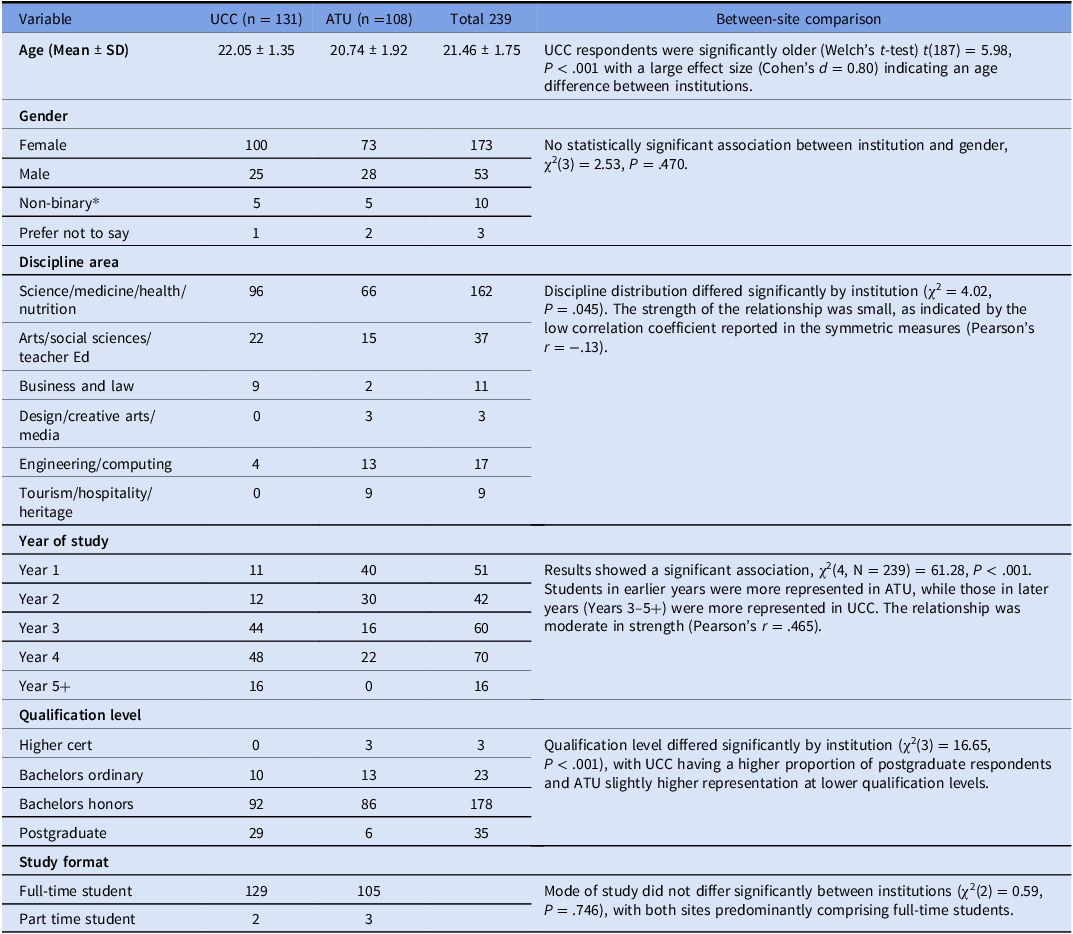
Of 283 responses received, 239 met inclusion criteria with 45% (n = 108) of respondents from ATU and 55% (n = 131) respondents from UCC. The sample was predominantly female (72% n = 173) and primarily comprised full-time undergraduate students (85% n = 203), with a mean age of 21.5 years old ± 1.75 years (95% CI = 21.2–21.7). The UCC and ATU samples differed significantly in age, year of study, qualification level, and discipline composition. UCC respondents were older, more advanced in their studies, and more likely to be postgraduate students, while ATU respondents were predominantly in earlier years and more diverse in discipline areas (Table 1).
Demographic characteristics of respondents from University College Cork (UCC; n = 131) and atlantic technological university (ATU; n = 108). Age differences were assessed using Welch’s t-test, and categorical variables using χ2 analyses. Significant differences were observed for age, discipline area, year of study, and qualification level, while no significant differences were found for gender or study format

Table 1. Long description
A table comparing demographic characteristics of respondents from University College Cork (UCC) and Atlantic Technological University (ATU). The table has 10 rows and 5 columns. Column headers are Variable, UCC (n = 131), ATU (n = 108), Total, and Between-site comparison. Row labels include Age (Mean ± SD), Gender, Discipline area, Year of study, Qualification level, and Study format. The table presents data on age, gender distribution, discipline areas, year of study, qualification levels, and study formats for respondents from UCC and ATU. Notable trends include significant age differences, with UCC respondents being older, and differences in discipline areas, year of study, and qualification levels. Gender distribution and study format did not show significant differences between the institutions.
* Non-binary refers to participants whose gender identity is not exclusively male or female.
Antibiotic use and misuse
Over half of students (57% n = 137) reported antibiotic use within the previous year. Only 19% (n = 45) of participants reported receiving diagnostic testing prior to antibiotic treatment; testing was more common for a urinary tract infection (UTI) and less common for a respiratory tract infection (RTI) (χ 2 = 126.836, P < .001). The majority of participants 87% (n = 209) completed their prescribed antibiotic course, while 11% (n = 26) did not complete antibiotic therapy. χ2 test results indicated no statistically significant association between institution and previous antibiotic use, χ 2(2) = 2.56, P = .278. The strength of the association was small, as reflected by the symmetric measure (Pearson’s r = −.10), suggesting no meaningful practical difference in antibiotic reuse behavior between UCC and ATU. Eighteen percent (n = 43) reported self-medication with leftover or non-prescribed antibiotics; 12% (n = 28) used antibiotics from their own previous prescriptions, and 6% (n = 15) obtained them from friends’ or family members’ prescriptions. Most antibiotics were obtained from general practitioners, 63% (n = 151), with a small number 4% (n = 9) reporting access from pharmacies without a prescription.
Information sources
Healthcare professionals were cited as the most trusted source of AMR information (99% n = 236) and the most common source 84% (n = 201). However, only 15% (n = 36) reported them as their most recent source of AMR information. School or university campaigns were the most frequent recent source reported by participants (38% n = 91). Awareness of national campaigns was low, with 27% (n = 64) recalling the Irish Health Service Executive “Resist campaign,” 18% (n = 43) recalling European Antibiotic Awareness Day campaigns, 14% (n = 34) recalling the Irish HSE Under the Weather campaign, and 3% (n = 6) familiar with the school e-Bug education initiatives.
Knowledge of antibiotics and AMR
Knowledge score was calculated as a percentage of correct responses across 25 true/false/don’t know items (Table 2). The mean knowledge score was 77.9% (SD = 17.8), indicating good AMR knowledge. A significant difference in knowledge score was found between ATU and UCC (U = 9,082, P < .001). Students from UCC recorded higher knowledge scores compared to those from ATU. Correlation analysis revealed a small but significant positive relationship between age and Knowledge Score (r = .184, P = .004). Students in health and science-related disciplines (M = 83.04, SD = 16.62) had significantly better knowledge than students in non-health disciplines (M = 65.35, SD = 18.68), F(1, 237) = 54.51, P < .001, with a large effect size (η2 = .187).
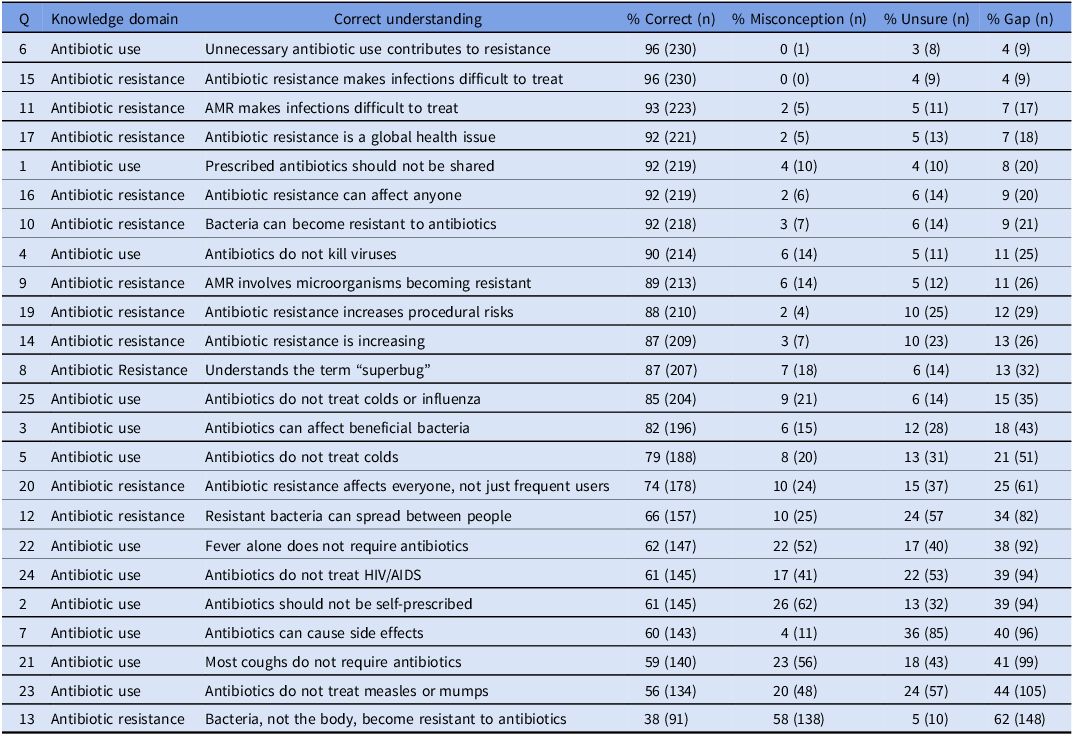
Knowledge and misconceptions about antibiotic use and resistance among respondents. This table summarizes participants’ understanding of antibiotic use and resistance, categorized into knowledge areas, interpretation of each statement, and the corresponding proportions of correct, misconception, and unsure responses. Knowledge gaps, defined as the combined proportion of misconception and unsure responses

Table 2. Long description
A table comparing participants’ understanding of antibiotic use and resistance. The table has 25 rows and 7 columns. Columns are labeled Q, Knowledge domain, Correct understanding, % Correct (n), % Misconception (n), % Unsure (n), and % Gap (n). Row 1: 6, Antibiotic use, Unnecessary antibiotic use contributes to resistance, 96, 230, 0, 1, 3, 8, 4, 9. Row 2: 15, Antibiotic resistance, Antibiotic resistance makes infections difficult to treat, 96, 230, 0, 0, 4, 9, 4, 9. Row 3: 11, Antibiotic resistance, AMR makes infections difficult to treat, 93, 223, 2, 5, 5, 11, 7, 17. Row 4: 17, Antibiotic resistance, Antibiotic resistance is a global health issue, 92, 221, 2, 5, 5, 13, 7, 18. Row 5: 1, Antibiotic use, Prescribed antibiotics should not be shared, 92, 219, 4, 10, 4, 10, 8, 20. Row 6: 16, Antibiotic resistance, Antibiotic resistance can affect anyone, 92, 219, 2, 6, 6, 14, 9, 20. Row 7: 10, Antibiotic resistance, Bacteria can become resistant to antibiotics, 92, 218, 3, 7, 6, 14, 9, 21. Row 8: 4, Antibiotic use, Antibiotics do not kill viruses, 90, 214, 6, 14, 5, 11, 11, 25. Row 9: 9, Antibiotic resistance, AMR involves microorganisms becoming resistant, 89, 213, 6, 14, 5, 12, 11, 26. Row 10: 19, Antibiotic resistance, Antibiotic resistance increases procedural risks, 88, 210, 2, 4, 10, 25, 12, 29. Row 11: 14, Antibiotic resistance, Antibiotic resistance is increasing, 87, 209, 3, 7, 10, 23, 13, 26. Row 12: 8, Antibiotic Resistance, Understands the term ‘superbug’, 87, 207, 7, 18, 6, 14, 13, 32. Row 13: 25, Antibiotic use, Antibiotics do not treat colds or influenza, 85, 204, 9, 21, 6, 14, 15, 35. Row 14: 3, Antibiotic use, Antibiotics can affect beneficial bacteria, 82, 196, 6, 15, 12, 28, 18, 43. Row 15: 5, Antibiotic use, Antibiotics do not treat colds, 79, 188, 8, 20, 13, 31, 21, 51. Row 16: 20, Antibiotic resistance, Antibiotic resistance affects everyone, not just frequent users, 74, 178, 10, 24, 15, 37, 25, 61. Row 17: 12, Antibiotic resistance, Resistant bacteria can spread between people, 66, 157, 10, 25, 24, 57, 34, 82. Row 18: 22, Antibiotic use, Fever alone does not require antibiotics, 62, 147, 22, 52, 17, 40, 38, 92. Row 19: 24, Antibiotic use, Antibiotics do not treat HIV/AIDS, 61, 145, 17, 41, 22, 53, 39, 94. Row 20: 2, Antibiotic use, Antibiotics should not be self-prescribed, 61, 145, 26, 62, 13, 32, 39, 94. Row 21: 7, Antibiotic use, Antibiotics can cause side effects, 60, 143, 4, 11, 36, 85, 40, 96. Row 22: 21, Antibiotic use, Most coughs do not require antibiotics, 59, 140, 23, 56, 18, 43, 41, 99. Row 23: 23, Antibiotic use, Antibiotics do not treat measles or mumps, 56, 134, 20, 48, 24, 57, 44, 105. Row 24: 13, Antibiotic resistance, Bacteria, not the body, become resistant to antibiotics, 38, 91, 58, 138, 5, 10, 62, 148.
Overall, respondents demonstrated high knowledge across core concepts related to antibiotic use and AMR. Awareness was strong regarding the consequences of unnecessary antibiotic use with 93% (n = 230) correctly identifying that misuse contributes to reduced effectiveness. Similarly, a high proportion recognized that AMR makes infections difficult or impossible to treat (96% n = 223) and that antibiotics should not be shared (92% n = 219) (Table 2).
Misconceptions were prominent regarding the microbiological basis of AMR; 58% (n = 138) incorrectly believed that the human body becomes resistant to antibiotics rather than resistance developing in bacteria. Misconceptions surrounding antibiotic self-prescription were evident with 26% (n = 62) indicating that it was appropriate to reuse leftover antibiotics or obtain antibiotics without medical consultation.
Substantial knowledge gaps were evident regarding antibiotic use for non-bacterial conditions, including fever (38% n = 92), HIV/AIDS (39% n = 94), coughs (41% n = 99), and viral illnesses such as measles or mumps (44% n = 105). Despite relatively high factual knowledge, persistent misconceptions may contribute to unsafe antibiotic practices, issues further reflected in the attitudinal components identified through PCA (see Table 2).
Attitudes toward AMR
Attitudes toward AMR were assessed using 15 Likert questions. Attitude items were scored on a sliding scale of most appropriate (+5) to least appropriate response (+1) with scoring range of 15–75.
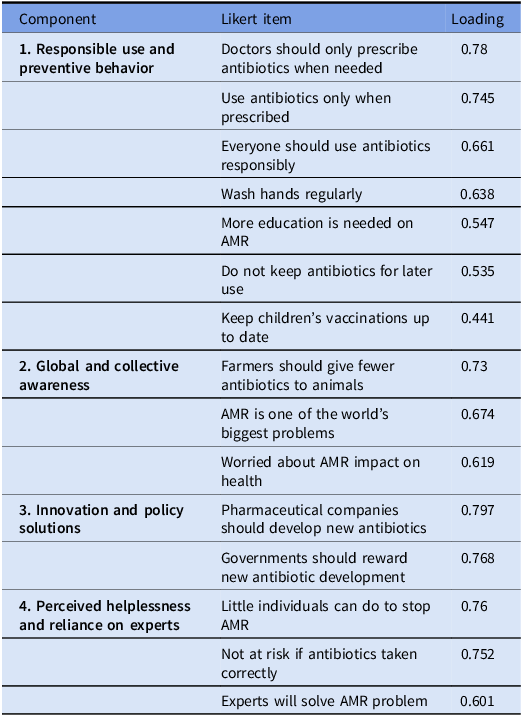
PCA was used to summarize the 15 Likert-scale attitude items into a smaller number of meaningful groups (components) based on how responses were related. This approach identified common patterns in attitudes toward antibiotic use and AMR and simplified the analysis by combining individual questions into broader attitude themes. Four components were extracted, accounting for 55.7% of the total variance in responses. These components represented distinct clusters of attitudes: component 1 (26.9%), responsible use and preventive behavior; component 2 (12.2%), global and collective awareness; component 3 (9.7%), innovation and policy solutions; and component 4 (6.8%), perceived helplessness and reliance on experts. These components reflect key dimensions shaping students’ perspectives on AMR.
Component 1: responsible use and preventive behavior
This component, accounting for the highest proportion of variance (26.9%), brings together a coherent set of beliefs and practices emphasizing personal responsibility in addressing AMR. This component reflects a broader public health literacy dimension, highlighting the awareness and acceptance of individual responsibility in managing antibiotic use and infection prevention. Moreover, it emphasizes the critical need for education, both at the consumer level and among healthcare providers, on appropriate prescribing practices and the dangers of AMR. Component 1 groups may benefit from reinforcement campaigns to support health behaviors that would contribute to reducing antibiotic use.
Component 2: global and collective awareness
This component (12.2%) highlights awareness of the global and collective nature of AMR, including concerns about antibiotic use in agriculture and its broader impact on public health. These findings suggest that educational and public health messaging should strengthen understanding of how individual antibiotic use, agricultural practices, and global AMR are interconnected. Component 2 reflects the potential to translate public concern into greater engagement with antimicrobial stewardship.
Component 3: innovation and policy solutions
This component (9.7%) reflects endorsement of systemic or institutional responses. This represents belief in top-down solutions, particularly innovation and policy-level action. Component 3 supports policy advocacy and innovation funding.
Component 4: perceived helplessness and reliance on experts
This final component (6.8%) captures internal beliefs about one’s own efficacy and reliance on external solutions. This dimension reflects a fatalistic or external locus of control, indicating reduced perceived individual responsibility and reliance on experts to address AMR. Component 4 may indicate the need to increase empowerment and self-efficacy in public messaging.
The PCA results revealed four distinct attitudinal dimensions. These findings suggest that while foundational knowledge exists, there is a clear opportunity for targeted educational and health communication interventions that reinforce personal accountability, deepen contextual understanding, and empower students to take informed action against AMR. Table 2 illustrates participants’ factual understanding of antibiotic use and resistance, showing high knowledge levels but persisting misconceptions regarding self-prescription, transmission, and the nature of resistance. Building on this, Table 3 explores the underlying attitudinal structure through PCA, identifying four components that characterize respondents’ beliefs and perceptions. Together, these analyses show that while factual knowledge is high, attitudinal factors, particularly low perceived personal risk and reliance on experts; may limit behavioral change.
Principal component analysis of attitudes toward antibiotic use and resistance. Four components were identified: (1) Responsible use and preventive behavior, (2) Global and collective awareness, (3) Innovation and policy solutions, and (4) Perceived helplessness and reliance on experts. Together, these components reflect differing levels of knowledge, responsibility, and perceived control in relation to antibiotic stewardship and resistance

Table 3. Long description
A table with four rows and three columns. The columns are labeled Component, Likert item, and Loading. The table lists four components: Responsible use and preventive behavior, Global and collective awareness, Innovation and policy solutions, and Perceived helplessness and reliance on experts. Each component has associated Likert items and their respective loadings. For example, the first component includes items like Doctors should only prescribe antibiotics when needed with a loading of 0.78, and Wash hands regularly with a loading of 0.638. The table provides a detailed breakdown of attitudes toward antibiotic use and resistance.
Discussion
This study examined knowledge, attitudes, and behaviors surrounding AMR among Irish university students, offering a systematic data set for this demographic. Despite relatively high knowledge scores, strong trust in healthcare professionals, and positive overall attitudes, significant gaps persisted in appropriate antibiotic use, risk perception, and awareness of public health campaigns. These findings inform targeted, evidence-based interventions supporting Ireland’s One Health National Action Plan on AMR (iNAP3). 3
Antibiotic use patterns and misuse
Approximately half of the students reported antibiotic use within the past year, consistent with rates observed among university students internationally. Reference Azim, Ifteakhar, Rahman and Sakib15,Reference Precha, Sukmai and Hengbaru16 Almost one in five had self-medicated using leftover or non-prescribed antibiotics, a pattern mirroring studies in higher education student populations Reference Leal, Mamani, Quach and Bedard10,Reference Shahpawee, Chaw, Muharram, Goh, Hussain and Ming17 . This inappropriate antibiotic use, both incomplete course adherence and reuse, reinforces the need for AMS interventions to address these issues in practice. Misuse was observed across both health-related and non-health-related disciplines, indicating that disciplinary education on AMR may not sufficiently shape behavior.
Fewer than one in five students reported undergoing diagnostic testing prior to receiving antibiotics, reinforcing persistent limitations in diagnostic investigations for managing infections in clinical practice. These findings highlight the need for multifaceted strategies that combine education with system-level reinforcement of evidence-based prescribing norms and easier access to diagnostic investigations in primary care settings.
Knowledge gaps and persistent misconceptions
Although overall knowledge of AMR was high (mean score: 77.9%), notable misconceptions persisted. Approximately one-third of respondents mistakenly believed that the human body (rather than bacteria) develops resistance. These misconceptions are not uncommon. Similar findings have been reported among students in other countries and persist even among students who report awareness of AMR, indicating that knowledge does not reliably translate into appropriate antibiotic use. Reference Shahpawee, Chaw, Muharram, Goh, Hussain and Ming17–Reference Hill21 Furthermore, most students believed antibiotics were appropriate for viral infections. These findings reflect ongoing confusion about appropriate antibiotic indications and a limited understanding of the bacterial-viral infection distinction. A recent systematic review evaluating public knowledge of antibiotic use and AMR identified similar gaps in knowledge, with only 42.1% (95% CI: 39.2–44.9) recognizing that antibiotics are ineffective against viral infections. Reference Shahpawee, Chaw, Muharram, Goh, Hussain and Ming17,Reference Auta, Adewuyi and Hedima22 Furthermore, a systematic review of healthcare professional and healthcare student knowledge, attitudes and practice regarding AMS and infection prevention reported significant gaps, with knowledge varying widely across professions, settings, and experience levels. Reference Ghosh, Adedunmola and Alkan23 The persistence of such misconceptions, even among students from science and health-related disciplines, reinforces the need for curriculum enhancement, particularly in microbiology and application of AMR and AMS principles in clinical practice.
Attitudes, knowledge, and the perception-action gap
PCA identified four underlying attitudinal dimensions: responsible use and preventive behavior, global and collective awareness, innovation and policy solutions, and perceived helplessness and reliance on experts. “Global and Collective Awareness,” captured strong recognition of AMR as a major global issue, paired with weak perception of personal susceptibility. This divergence reflects a perception-action gap supported by a systematic review of medical students, in which recognition of AMR as a major global health threat did not consistently translate into perceived personal responsibility or stewardship behaviors. Reference Nogueira-Uzal, Zapata-Cachafeiro, Vázquez-Cancela, López-Durán, Herdeiro and Figueiras12 This interpretation is further supported by recent evidence showing that inappropriate antibiotic use is more strongly associated with behavioral and attitudinal factors than with knowledge alone. Reference Marzi, Tunc, Donmez, Sener and Marzi24
Addressing this gap requires educational approaches that move beyond information provision toward activation of personal relevance and agency. Behavioral-science evidence suggests that interventions combining factual reinforcement with emotionally salient framing, such as peer narratives or interactive digital media, can transform abstract concern into personal motivation, heighten personal risk perception, and emphasize social accountability. Reference Hill21,Reference Scott-Dearing, Carter, Corley, Mathew and Darzi25,Reference Krockow, Jones, Tarrant, Mendelson and Flusberg26
Source credibility and public health campaigns
Healthcare professionals were the most trusted source of AMR information; however, only 16% of students identified them as their most recent source. This credibility-access gap indicates that although healthcare professionals remain highly trusted, traditional information channels are underutilized. Instead, students appear to seek updated information primarily from peers, academic environments, and digital networks. A similar pattern was noted by Sharma et al. (2025), who found that while healthcare professionals maintain strong credibility, students predominantly rely on peer networks for current knowledge. Reference Sharma, Chauhan and Ranjan27 The low recall of national and international public health initiatives such as European Antibiotic Awareness Day or e-Bug (3%–27%) echoes trends reported elsewhere and may reflect broader weaknesses in AMR risk communication, where abstract and conventional messaging limits memorability and engagement. Reference Krockow, Jones, Tarrant, Mendelson and Flusberg26,Reference Wiese-Posselt, Lam and Schroder28,Reference Min, Zhou and Sun29 These findings point to a pressing need to optimize public and patient engagement in AMR outreach to better engage populations through digital, peer-driven, and context-relevant channels. Reference Barello and Acampora30
Strengths, limitations, and future opportunities
A limitation of the study was that the sample was dominated by students from science and health-related disciplines which may limit generalizability of results to the broader university population. Students from non-health programs, who represent a key audience for public awareness efforts, were comparatively underrepresented. As data were self-reported, recall and social desirability bias may have influenced reporting of responses, a limitation also identified in studies of university students’ antibiotic use. Reference Hill21 Although the survey instrument was adapted from validated WHO and Eurobarometer tools, contextual differences may influence comparability with other studies. Nonetheless, the instrument provided a reliable framework for capturing key dimensions of AMR awareness and behavior within the Irish university context. The resulting data set provides a rich and in-depth overview of university student knowledge and attitudes toward antibiotic use and AMR. The findings reinforce strategic objectives by national and international AMR action plans to improve education and public awareness of AMR. 2,3 Tailored AMS campaigns for university students have the potential to contribute significantly to improving antimicrobial and infection health literacy in the population.
Conclusion
This study provides the first systematic assessment of AMR knowledge, attitudes, and behaviors among Irish university students. This study reveals that Irish university students possess high baseline awareness of AMR but retain notable misconceptions and inconsistent antibiotic practices. Consistent with prior research these findings indicate that factual knowledge alone is insufficient to promote responsible antibiotic behaviors without corresponding personal agency, revealing a complex interplay between awareness, perception, and practice. To close this gap, educational interventions must couple scientific knowledge with behavioral activation; making AMR personally relevant, emotionally engaging, and socially reinforced. The findings will inform key strategic objectives in national action plans to address public education and awareness of antibiotic use and AMR.
Supplementary material
The supplementary material for this article can be found at https://doi.org/10.1017/ash.2026.10836.
Acknowledgements
We thank the Health Service Executive AMRIC unit for their support and the participating students at ATU and UCC.
Financial support
Funding for this project was provided by the Health Service Executive AMRIC unit.
Competing interests
The authors declare no conflicts of interest.

 Open access

