Introduction
‘Men make their own history but they do not make it as they please; they do not make it under self-selected circumstances, but under circumstances existing already, given and transmitted from the past’ (Tucker, Reference Tucker1978: 595). Marx’s oft-cited observation raises a question still vital to international relations (IR) theory: Under what conditions can actors effect significant change in international politics? Structures might constrain agents, but entrepreneurs can remake and transform these structures, creating new institutions, contesting norms and values, and creating space for significant political change. Political scientists have already conducted excellent studies of entrepreneurship, ranging from analyses of human rights activism to European Union ‘supra-entrepreneurs’ to the creation of ‘foreign policy ideas’ in world politics.Footnote 1 Despite this, many of the key questions of entrepreneurship remain under-theorized (Finnemore and Sikkink, Reference Finnemore and Sikkink1998). Who is likely to succeed as a political entrepreneur? Are certain systems more conducive to change than others? And how is it that entrepreneurs produce structural change – what is the link between micro-action and macro-outcomes in international politics?
I argue that IR theorists could strengthen their answers to these questions by drawing from social network theory.Footnote 2 This approach conceives of networks – ties among actors – as the building blocks of political interaction. Networks are constraining, limiting actors’ material and cultural resources. But these networks are also enabling: they provide entrepreneurs with resources to remake structures, and produce political change. Using this basic framework, this paper argues that networks influence entrepreneurship in three ways. First, networks provide certain actors with resources to effect change. In particular, some actors – known as brokers – bridge ‘structural holes’ within networks: they are positioned as vital nodes in networks, creating links between actors that would otherwise remain unconnected. It is this network position, and not an actor’s attributes or interests, that enables entrepreneurial behavior (Burt, Reference Burt1980, Reference Burt2004, Reference Burt2005). Second, networks create the conditions for entrepreneurship. While certain networks are extremely stable, others contain contradictions that allow structural holes to emerge, and thus facilitate entrepreneurial behavior. Finally, when an entrepreneur’s ideas resonate, this leads to ‘switching effects’, structural mechanisms that make certain ties stronger and sever others.Footnote 3 It is this process of building, integrating, and destroying ties that lies at the heart of entrepreneurship. Switching processes alter network structures, leaving actors with a fundamentally different set of network ties, and changing the issues, institutions, and even actors involved in a political system.
Network theory thus provides IR theorists with an alternative account of political entrepreneurship, one designed to take both structure and agency seriously. To be clear, this paper does not provide a comprehensive literature review of network theory. As argued in detail below, network analysis is not a single theory; there are different variants, many of which are not covered in this essay. Moreover, the goal of this paper is theory development. I use network theory to deduce a series of conditions under which entrepreneurship is more or less likely; I do not provide an empirical test of a network approach. However, the paper does consistently use one example of entrepreneurship, asking how it was that Prussian leaders, particularly Bismarck, were able to introduce ideas of conservative nationalism in late-nineteenth century Europe. During this time period, other European actors – most notably Napoleon III – attempted to introduce similar ideas with limited success. If network theory can explain this variance, it can provide a powerful analysis of entrepreneurial success. Moreover, because Bismarck’s entrepreneurship constructed new national identities, the case is important to scholars interested in identity formation (Cederman, Reference Cederman2003).
The paper proceeds as follows. After defining political entrepreneurs, I provide an overview of social network theory. I then apply this framework to political entrepreneurs, asking how and under what conditions actors are able to transform international politics. The paper concludes with the implications of a network approach to international politics.
The significance of political entrepreneurs
I define political entrepreneurs broadly, as actors – who may be individuals, but can also be collective actors, such as institutions – who invent or deploy ideas and information to produce significant structural change.Footnote 4 Entrepreneurs are not simply ‘powerful’ actors, who effectively pursue their interests, or successful leaders who mobilize collective action. What distinguishes entrepreneurs is not their power or leadership ability per se, but their capacity to effect dramatic change in the political landscape. In Joseph Schumpeter’s classic formulation, an entrepreneur engages in ‘creative destruction’, using new ideas and technologies to tear down outmoded organizations while simultaneously laying the groundwork for new institutions.Footnote 5
The concept of entrepreneurs is ubiquitous in social theory. Some economic traditions place entrepreneurs at the center of economic change and growth in capitalist systems. In Schumpeter’s work, for example, entrepreneurs act as ‘heroic figures, uniquely possessing the will to introduce revolutionary “new combinations” – of products, production techniques, markets, supply sources, or organizational forms – that attack the very foundations of existing firms and destroy the prevailing equilibrium at rare and irregular intervals’ (Chiles et al., Reference Chiles, Bluedron and Gupta2007: 470). In sociology, particularly among scholars of organizational theory, entrepreneurs leverage ‘resources to create new institutions or to transform existing ones’ (Garud et al., Reference Garud, Hardy and Maguire2007: 957). In doing so, they ‘create a whole new system of meaning that ties the functioning of disparate institutions together’ (2007: 957).
International relations scholars from a variety of traditions have argued that political entrepreneurs are key to explaining change. Regime theorists, for example, argue that political entrepreneurs foster interstate cooperation. Oren Young (Reference Young1991: 281) states that entrepreneurial leadership ‘is a critical determinate of success or failure in the processes of institutional bargaining that dominate attempts to form international regimes…’.Footnote 6 Peter Haas (Reference Haas1989), likewise, argues that ecological organizations persuaded states to clean up the Mediterranean. Some realists contend that entrepreneurs can change fundamental elements of international structure. Kissinger states that Castlereagh and Palmerston determined the rise and fall of Concert of Europe politics, and Daniel Byman and Kenneth Pollack contend that Bismarck and Hitler were entrepreneurs who forced dramatic transformations in international politics.Footnote 7
Entrepreneurs also alter ideas and identities. Constructivists suggest entrepreneurs ‘are critical for norm emergence because they call attention to issues or even ‘create’ issues by using language that names, interprets and dramaticizes them’ (Finnemore and Sikkink, Reference Finnemore and Sikkink1998). Kathryn Sikkink, for example, posits entrepreneurs constructed and spread new human rights norms, and Martha Finnemore notes that entrepreneurs – namely bureaucrats – popularized norms of scientific research.Footnote 8 Jeff Checkel and Matthew Evangelista likewise propose that entrepreneurs introduced the ideas that promoted change within the Soviet Union, and the end of the Cold War.Footnote 9 Entrepreneurs can introduce norms that not only change behavior, but reconstitute identities as well. For instance, Fiona Adamson (Reference Adamson2005) argues that entrepreneurs mobilize identities across state boundaries, and in the process undermine the sovereign state.
The concept of entrepreneurs thus appears across disciplinary and theoretical divides. This is hardly surprising. Questions about entrepreneurship – when do they emerge, why are they capable of producing change – are intricately tied to core issues of agency and structure in social life. As William Sewell (Reference Sewell1992: 20) argues, while all individuals have the capacity for agency – ‘for desiring, for forming intentions, and for acting creatively’ – in practice, structures constrain agency, and actors vary greatly in the type and scope of their transformative powers. To study entrepreneurs is to ask how particular actors come to realize their capacity for radical transformation – why it is that some actors exhibit the power to effect change, while others only reproduce the structure around them.
A focus on entrepreneurs thus injects agency into IR theory. Neo-realists, with their focus on structural constraints, may accurately describe the dynamics of an anarchic system but cannot explain how such systems emerged in the first place or might be transformed in the future.Footnote 10 Similarly, despite their interest in individual choice and action – key components of agency – many rational choice theories are silent about how actors transform their environment, treating these questions as exogenous to their theories.Footnote 11 And while most constructivists place agency at the core of their social theory, many choose to explain how norms constrain agents, and not how agents create and transform norms.Footnote 12
Explaining who can create structural change, how, and under what conditions, contributes much to the agent–structure debate. Certainly, existing studies of entrepreneurship offer profound insights into entrepreneurs and change. Still, as these scholars themselves argue, key questions about entrepreneurship remain undertheorized. It is not clear under what conditions entrepreneurs are likely to emerge, or why some actors have more capacity to act as entrepreneurs than others. How it is that entrepreneurs’ actions lead to significant change is also problematic: more often than not, international outcomes cannot be reduced to intentions – we need to theorize how actors’ behavior translates into structural change.
It may seem counterintuitive, but a focus on actors may only get us so far in developing a theory of entrepreneurship. Ironically, to explain an entrepreneur’s agency, it is useful to reintroduce the concept of structure into entrepreneurial theory. In particular, social network theory explores how an actor’s structural position affects her capacity to create change.
Network theory and social construction: an overview
Like constructivism or rational choice approaches, social network analysis is not a single theory, but a set of theories that share fundamental assumptions.Footnote 13 As Mustafa Emirbayer and Jeff Goodwin (Reference Emirbayer and Goodwin1994: 1414) argue in their comprehensive review article, network theorists uniformly adopt an anti-categorical imperative that ‘rejects all attempts to explain human behavior or social processes solely in terms of the categorical attributes of actors, whether individual or collective’. Categorical theories look to actors’ attributes to explain social outcomes. Where rational choice theorists would look to actors’ interests and power to explain outcomes, constructivists use actors’ identity, norms, or ideology as the micro-foundation for social action.
In contrast, for network theorists it is not actors’ interests, power, or ideology, but the relations among actors that are causally significant. Following Charles Tilly (Reference Tilly1998a: 456), networks are ‘continuing series of transactions to which participants attach shared understandings, memories, forecasts, rights, and obligations’. Networks are a structural representation of relations among actors. Who the ‘actors’ are within any network is defined empirically: depending upon the subject being researched, they may be individuals, coalitions, institutions, or states.
Networks contain both social and cultural elements. An actor’s network represents concrete material transactions, which may be mapped out by tracing financial flows, diplomatic transactions, or kinship ties. Networks, however, are not reducible to their material properties: the transactions that constitute a network are imbued with shared understandings, symbols, and collective memories.Footnote 14 This culture is stored in different ways, and can be more or less institutionalized. One-time interactions between individuals may leave only a fleeting cognitive impression. A nation, however, stores its memories and symbols in schools, rituals, monuments, and archives.Footnote 15
Social life is filled with networks. The market, for instance, is a network of economic transactions. At the heart of a market are exchanges among individuals. More developed, a market includes constant and ‘thick’ transactions among actors, most notably firms; these transactions are often hierarchic, as the market tends towards oligarchy. Institutions such as trade organizations and centralized banks facilitate and formalize economic relations. And while the market’s discursive properties are often overlooked, the market’s most essential elements are cultural: money and credit, for instance, would be useless if they lacked the common and agreed upon value that makes it an effective exchange mechanism.Footnote 16
Networks define domestic and international politics as well. In domestic politics, actors operate within networks of coalitions, maintaining ties with political parties, interests groups, and institutions. And although it is common to portray international politics as anarchic, patterns of relations among states, institutions, and non-government organizations suggest network structures, be it the temporary ties that define alliance partners, or the more institutionalized relations at the core of the European Union. These political networks contain symbolic elements, cultural tropes that define appropriate behavior, preferences, and legitimate authority in domestic and international affairs.
The above discussion simply re-describes political systems as network-based; if this were the end of network analysis, it would hardly be of interest to political scientists. But as Knoke and Kuklinski (Reference Knoke and Kuklinski1982: 13) argue, ‘network analysis contains a further explicit premise of great consequence: The structure of relations among actors and the location of individual actors in the network have important behavioral, perceptual, and attitudinal consequences for both the individual units and for the system as a whole’. Over the last two decades, scholars have used network theory to identify unique causal processes, applying these insights to topics ranging from ethnic conflict to organizational innovation to renaissance politics.Footnote 17
Entrepreneurs have been of particular interest to network theorists, and the subsequent sections apply these studies to international politics. My discussion is particularly influenced by a specific variant of network theory, which I will call ‘structural hole’ theory.Footnote 18 First proposed by Ronald Burt, these theories posit that entrepreneurs gain their power through their unique position bridging structural holes in network structures.Footnote 19 These actors – known as ‘brokers’ – act as links between actors that would otherwise remain disconnected. In the following sections, I explain who brokers are, when they emerge, and why structural holes give them the power to affect significant structural change.
Who matters? Brokers as political entrepreneurs
In a theory of political entrepreneurship, not all actors are created equal. Throughout history, certain actors have seemed more capable of introducing new ideas, radically ‘reframing’ agendas, and even creating novel identities in international politics. To explain this variation, theorists have relied upon two mechanisms. First, some scholars argue that individual attributes determine an entrepreneur’s success or failure. Oran Young, for example, contends that some individuals are endowed with more charisma and imagination than others, enabling them to successfully introduce ideas and norms in international politics.Footnote 20 Similarly, Byman and Pollack (Reference Byman and Pollack2001) maintain that certain individuals exhibit exceptional political skill, so much so that they can alter the structure of international politics. Others hypothesize that individual knowledge is critical, arguing that individuals with expertise in specific issue areas are likely to make an impact. Scientists, for instance, were perfectly situated to promote environmental norms in international politics (Haas, Reference Haas1990).Footnote 21 Finally, for some, entrepreneurship is simply a matter of power: more powerful political actors can impose ideas, whereas the ideas of the weak fall by the wayside.
There are problems with reducing change to actors’ attributes, however. Analytically, it is difficult to separate an entrepreneur’s attributes from her actions: if a successful entrepreneur can only be identified after she has induced structural change, this is tautological. Moreover, these approaches suffer from empirical problems, as even the same actor can exhibit different degrees of entrepreneurship. For example, in the 1850s, Napoleon III was heralded as a diplomat and entrepreneur par excellence; by the 1860s, he could not bring European powers to the bargaining table. Finally, it is difficult for attribute-oriented approaches to produce a generalizable theory of entrepreneurs. While some attributes, like knowledge or expertise, can be generalized, many theories come close to being ‘great man’ approaches to international politics.
To rectify these problems, some IR theorists maintain that it is position, not personality, that creates political entrepreneurs: how actors are connected to others influences their ability to effect change. For example, Finnemore and Sikkink (Reference Finnemore and Sikkink1998: 14–16) argue that an entrepreneur’s ‘organizational platform’ increases chances for successful entrepreneurship. Likewise, Jeffrey Checkel and Thomas Risse-Kappen maintain that the liberal ideas that penetrated the Soviet Union in the 1980s were transmitted through domestic ties between entrepreneurs and the government, which facilitated significant ideational change.Footnote 22 Similarly, looking at the European Union, Andrew Moravcsik (Reference Moravcsik1999) argues that an ability of an actor to behave as a ‘policy entrepreneur’ depends upon his position within domestic and international coalitions, which create asymmetric advantages in information and ideas. A network approach complements these positional approaches. Network theorists hold that how actors are positioned in a network facilitates their ability to act as entrepreneurs. Because social and cultural ties provide power, information, and ideas, an actor’s ability to introduce new norms, manipulate symbols, and radically influence political outcomes, all depends on network position.
In particular, network theorists identify brokers as the actors most likely to act as political entrepreneurs.Footnote 23 As described above, brokers are actors who bridge structural holes in fragmented networks: they maintain ties with actors who would otherwise remain unconnected. In economics, a broker might be an actor with ties to different firms. In politics, a broker might be an actor who maintains ties with rival coalitions, domestic or international.Footnote 24 By bridging structural holes, brokers occupy central positions in a network structure, acting as nodes through which multiple transactions coalesce. According to structural hole theorists, these brokerage positions are key to explaining how and under what conditions entrepreneurship is possible. Entrepreneurial power is found, not in actor’s interests or attributes, but in her position.
In essence, then, with structural hole theory we are analyzing entrepreneurship – what is fundamentally an ‘agentic’ concept – with a theory that is profoundly structural, that sees entrepreneurial action as dependent on network position.Footnote 25 This might seem deeply problematic. After all, much of IR theory conceives of structure as opposed to agency: while structures constrain agency, and thus ensure continuity, agents (usually individuals) are responsible for change. To see entrepreneurship as a function of network position might seem bizarre: entrepreneurial behavior should be a negation, not a manifestation, of structural forces.
The network theory here, however, sees agency not as opposed to structure but as inhering within network structures. Actors do not inherently posses entrepreneurial agency – their agency is ‘embedded’ within networks (Sewell, Reference Sewell1992: 20).Footnote 26 As described above, network structures contain symbolic and material resources; it is only by drawing from these resources that entrepreneurship, and thus agency, are possible. While networks provide actors with material power, social ties and alliances, and discursive resources needed to produce dramatic change, at the same time entrepreneurs use these resources to reshape their own networks. Entrepreneurs can combine existing resources into entirely new ideas and rhetoric. As discussed in detail ahead, when these new ideas are introduced into networks, they resonate in often unpredictable ways, changing the existing network structure. As a consequence, entrepreneurs are agents who define issues, create norms, and at times, even introduce new identities into the international system (Mische and White, Reference Mische and White1998).
In a network theory of entrepreneurs, then, the key question is not when agency trumps structure; it is under what conditions networks enable entrepreneurial agency. To explain why brokerage positions facilitate entrepreneurship, three questions must be answered. First, under what conditions do brokers emerge? Are there certain network structures more conducive to entrepreneurial action than others? Second, why do brokers have the power to act as entrepreneurs? Why, in particular, are structural holes such a powerful precondition for entrepreneurial behavior? Finally, how do brokers change networks? As discussed in detail ahead, the story here is not one of structural determinism. Networks create the conditions for entrepreneurship, but they do not force any particular actor to behave as an entrepreneur. Instead, it is how brokers choose to use their resources that effect significant transformation.
Brokerage and networks: integration and fragmentation in international politics
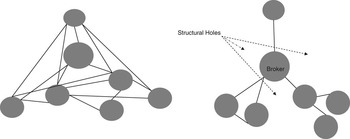
Not all network structures contain brokers. The more integrated a network structure is, the fewer brokers will exist. A network structure is integrated when social−cultural ties are dense, sustained, and relatively consistent among actors in the system. Socially, integrated structures exhibit a high volume of interactions among actors; these transactions are routine, and these interactions are institutionalized. Integrated networks are also culturally homogenous: transactions are imbued with similar story sets, consensual rules of interaction, and shared understandings. In an integrated network, then, there are few breaks, or structural holes – actors share a dense system of social and cultural relations – and few if any brokerage positions. In contrast, fragmented networks contain structural holes. While some relations are thick and institutionalized, other ties are ‘thin’, informal, and irregular. Fragmented networks exhibit breaks in cultural ties as well: the networks of fragmented systems are culturally differentiated, composed of discordant symbolic resources. Norms and rules are disputed, and actors attach different meanings to symbols and events. These social−cultural breaks create the conditions for brokers to emerge.
Figure 1 illustrates integrated (left) and fragmented (right) networks. As seen in this figure, the more integrated a network becomes, the fewer structural holes it possesses: most actors have dense connections with other actors within the network. In contrast, the more fragmented a network becomes, the more structural holes dominate. In this situation, we can identify brokers as critical nodes, bridging the otherwise unconnected elements within a framework.
Integrated and fragmented networks.

Certainly these network configurations are ideal-types. Empirically, most political systems will exhibit signs of integration and fragmentation, simultaneously; measures of network fragmentation are relative, not absolute. More importantly, integration and fragmentation are dynamic features of networks: structures can become integrated and fragmented over time. For example, fragmentation can occur when events weaken existing social ties or introduce ‘pairs of rules or norms that cannot both hold true at the same time’ (Bukovansky, Reference Bukovansky2002: 31). Fragmenting events may seem monumental, even to contemporaries within a network. For example, nobody doubted the importance of the Reformation in introducing new transnational religious identities, identities that undercut dynastic imperial ties (Nexon, Reference Nexon2009). But change need not be so epic: new ideas and social ties can be introduced through the normal course of political activity as well. Political compromises, for instance, are likely to enshrine disparate ideas, and institutions are path-dependent, containing historical traces of even the most discredited ideas. As Robert Lieberman (Reference Lieberman2002: 702) argues, ‘New policies, institutional arrangements, or ideological paradigms…do not replace the old but are layered atop prior patterns’.
To illustrate, it is useful to compare network structures in early and late nineteenth century Europe. From 1815 to about the Crimean War, European states were embedded in an integrated international network. Assembling in Vienna in the wake of the Napoleonic wars, the four major allied states – England, Austria, Russia, and Prussia – sought to establish a system more stable than that of the eighteenth century balance-of-power system. From an array of treaties came the Concert of Europe, a system of rules, norms and procedures whose effects would be felt for almost a full century.Footnote 27 There can be no doubt that the Concert created highly integrated networks, at least among the Great Powers. The Concert of Europe’s diplomatic networks were thick: the Congress of Vienna established routine diplomatic channels among actors, managed through regular congresses and explicit treaties.Footnote 28 Cultural ties were strong as well. As Schroeder (Reference Schroeder1992: 694) argues, European networks were built on a ‘mutual consensus on norms and rules, respect for law, and an overall balance among the various actors in terms of rights, security, status, claims, duties, and satisfactions…’.
In the years after the 1848 revolutions, however, Concert networks became increasingly fragmented. The Crimean War (1854–56), and the Franco–Austrian war of 1859, for example, undermined Concert relations. Domestic processes also fragmented networks: unification movements in the Italian and German territories undermined Concert relations, criticizing them as illegitimate and obsolete. In the wake of these pressures, social and cultural networks collapsed. Congress diplomacy waned, as actors eschewed these forums for unilateral action and bilateral treaties, and ties between liberal and conservative powers grew strained.
As networks fragmented, brokers emerged in European politics. In particular, both Napoleon III and Bismarck were brokers, spanning structural holes between liberal-nationalist and dynastic networks.Footnote 29 Historians and contemporaries note that in the mid-nineteenth century, there was no broker more powerful than Napoleon III. Louis Napoleon came to rule by plebiscite in December of 1848; on December 2, 1851, a coup dissolved the Corps Legislatif, placing him at the head of France. A year later, Napoleon proclaimed the Second Empire, giving himself the title of Napoleon III. The emperor maintained a vast and contradictory network, with ties spanning actors who were otherwise fragmented. In particular, as an ‘elected’ emperor, he proclaimed both popular support and dynastic legitimate right. Likewise, from the early 1860s onward, Prussian elites – Bismarck in particular – also claimed contradictory positions. The Hohenzollern dynasty was firmly embedded in dynastic political networks, as well as recognized as a Great Power operating within the boundaries of the Treaties of Vienna. But at the same time, actors within the Prussian monarchy held strong ties to the nationalist movement, ties Bismarck exploited to fulfill his program of a unified German state. Thus, the more fragmented the network structure became, the more brokerage positions emerged and, according to the argument here, the more chances for entrepreneurial action.
It may seem counterintuitive that an increase in structural holes would facilitate entrepreneurial action. Much of IR theory suggests the opposite: it is when structures are thin and fragmented – as they are under anarchy – that action is difficult; increased integration increases the possibility of collective action. It was increased social ties among European countries, Ernst Haas argued, that led to the creation of the European Union. Likewise, Jennifer Mitzen posits that the Concert’s integrated networks created an international ‘public sphere’, which facilitated communicative action and cooperation in nineteenth century European politics.Footnote 30 Indeed, there is disagreement among network theorists themselves as to how structural holes affect action. Following James Coleman (Reference Coleman1988, Reference Coleman1990), some network theorists argue that increased integration or ‘social cohesion’ creates an environment that promotes trust and cooperation among actors. When networks are integrated, actors can ‘trust each other to honor obligations, which diminishes the uncertainty of their exchanges and enhances their ability to cooperate in the pursuit of their interests’ (Gargiulo and Benassi, Reference Gargiulo and Benassi2000: 184). Structural holes, in this view, inhibit effective action: they increase uncertainty and complexity, and thus undermine cooperation.
It seems logical that dense social–cultural ties facilitate certain types of action. But while cooperation and persuasion might be easier, scholars from a variety of traditions argue integration can stifle entrepreneurship. In Schumpeter’s work, entrepreneurs thrive on disequilibrium: when contradictory ideas and technologies emerge in a capitalist society, entrepreneurs use these resources to destroy old institutions and create new ones (Schumpeter, 1934). In a similar model, Jeffrey Legro (Reference Legro2005) contends that World Wars I and II showed conclusively that American ideas were dysfunctional, creating space for a new internationalism to flourish in US foreign policy. Likewise, in her work on the French Revolution, Mlada Bukovansky (Reference Bukovansky2002: 32) argues that republicanism introduced systemic contradictions that undermined the dynastic state: ‘When cultural contradictions align with strategic conflicts in the form of hegemony and counterhegemony, the seeds of systemic change are produced’. Structural hole theory echoes these traditions. In integrated networks, actors operate within a set of homogenous norms, and are faced with identical social pressures that ‘points actors in consonant directions’ (Lieberman, Reference Lieberman2002: 704). Actors are thus unlikely to invent new ideas or introduce new information. In contrast, in fragmented networks, actors face friction, contradictions between different sets of social relations, institutions, and discursive elements. This friction creates room for strategic action, and even the invention of new ideas.
While these propositions might seem similar to the theories of Legro and Bukovanksy outlined above, there are important differences. Network theory abandons notions of ‘functionality’ and ‘disequilibrium’: entrepreneurs need not have access to more efficient or functional ideas in order to succeed. More importantly, network theorists are less interested in the presence of contradictions in a network, and more concerned with how particular actors are situated within these contradictions. Not every actor can exploit contradictions in fragmented networks. While events introduce contradictions, it is not ‘exogenous shocks’ but certain actors that serve as the motor of change. To return to the example above, seemingly exogenous shocks like the Crimean War and unification movements might have fragmented the Concert system, but this cannot explain the emergence of new ideas, particularly the introduction of conservative-national ideas in international politics. In order to do so, we must look beyond processes of integration and fragmentation to explain why certain actors – brokers – have the capacity to act as entrepreneurs.
The power of position: brokers and entrepreneurship
As argued earlier, while many political scientists point to an actor’s attributes to explain her effectiveness as an entrepreneur, network theorists rely on a positional account. A broker’s position bridging structural holes gives her the ability to act as an entrepreneur. Specifically, structural holes give brokers three distinct advantages over other actors in a network: they have more flexibility than other actors in a political network; they have the capacity to introduce new ideas; and they can ensure these ideas diffuse throughout fragmented network structures.
Brokers and strategic flexibility. First, brokers have more options than other actors, and thus more capacity to choose ideas and information strategically. From a network perspective, strategic flexibility is variable. In any set of networks, some actors will remain on the margins; having only weak ties and lacking cultural resources, these actors may attempt to introduce ideas, but do not have the capacity to induce political change. Politicians pursuing Italian Unification spoke as strongly for nationalist causes as did Napoleon III, but Napoleon’s position as both a democratic representative and a monarch afforded him influence the Italians lacked. Similarly, some actors are constrained in the ideas they may legitimately promote in international politics. Actors tied to one particular network lack flexibility – as discussed earlier, they can echo structure, but not change it, and thus have little chance at introducing new ideas or manipulating old ones.
In contrast, brokers have strategic flexibility in international politics. Situated at the interstices of networks, brokers can choose among norms and ideas. They can use this position to manipulate existing ideas and information. For example, brokers may act as effective mediators between groups, ensuring negotiated settlements that would be impossible without the broker. By holding a position between actors in multiple networks, a broker can use information and ideas that are acceptable to otherwise polarized antagonists. But brokers need not be honest or objective: access to multiple sources of information and ideas allows brokers to manipulate the actors around them.
For example, in the late 1850s, Napoleon III strategically used his brokerage position to mediate European conflicts. The fragmented networks of the late nineteenth century had left many European powers constrained. Indeed, without connecting social and cultural ties, many powers lacked the capacity to recognize certain ideas, or even the legitimacy of other states in the European system. In the Franco–Austrian war, for instance, Austria had consistently refused to cede any territory to Italy. It was not that Austria was unwilling to abandon its territorial claims; indeed it realized doing so was in its interest. Austria was concerned that if it recognized Italian nationalist claims, it would give legitimacy to ideas that inherently undermined its own dynastic claims (Clark, Reference Clark1934).
Napoleon, in contrast may have been a suspect dynast, but he was nonetheless a ‘legitimate’ Emperor and great power monarch. While territory could not be given to Italy, it could be given to Napoleon, who could then turn it over to Italy. Napoleon, for his part, was more than willing to act simultaneously as the liberator of the Italians and a monarch upholding the peace of Europe. He accepted Lombardy from the Austrians, and turned the province immediately over to the Italian nationalist leaders (Bush, Reference Bush1967). In sum, Napoleon’s position afforded him strategic flexibility in international politics.
Brokers and cultural invention. Second, brokers are more likely to develop novel ideas. Sociologists and economists have argued that actors tied to a single group are less likely to innovate: opinion and behavior are more homogenous within than between groups; in contrast, ‘people connected across groups are more familiar with alternative ways of thinking and behaving’ (Burt, Reference Burt2004: 349). Situated at the intersection of different, often contradictory social and cultural imperatives, brokers have more ‘options to select through and synthesize’ (2004: 350). In the space of these contradictions, actors can combine together divergent symbols and norms, and introduce novel ideas in international politics.
In essence, brokers have more capacity for cultural invention than other actors in international politics. The ideas brokers introduce are never entirely new. To produce change in a political system, brokers must invent ideas that resonate with an audience – the ideas must appear to have ‘pertinence, relevance, or significance’ with a targeted group (Kniss, Reference Kniss1996: 10).Footnote 31 Whether or not ideas resonate, in turn, is not so much a matter of content as context – it depends on whether or not entrepreneurs incorporate material found in existing networks. For instance, throughout history several acts of violence have been legitimated ‘in the name of God’. Which of these claims resonated cannot be deduced simply by noting the invocation of a divine being. Whether ‘in the name of God’ resonates depends upon the networks in which the claim is made. In European IR, up to at least the seventeenth century, most if not all political violence was legitimated in the name of God: confessional networks were the legitimate basis upon which to conduct political affairs. Not surprisingly, such claims resonated more in this network structure than they do in the post-Enlightenment West of today.
Networks thus determine which ideas resonate. As a result, some actors are less inventive than others: if actors can only draw from one network, then their ideas are unlikely to be anything new. Brokers, however, have access to multiple resonant tropes, and can culturally invent by combining together these myriad symbols, histories, and rhetoric into new ideas. In this way, brokers have a unique ability to invent entirely new ideas, yet ensure that they will still resonate with extant networks: because they combine existing symbols, the ideas are novel, but seem somewhat familiar at the same time.
For example, Napoleon III and Bismarck’s brokerage positions allowed them to combine conservative ideas with liberal nationalism. From a contemporary standpoint, it is hard to imagine how opposed these two ideas were in the nineteenth century. Both Austria and Russia, for example, decried nationalist principles as an attack on conservative legitimacy, calling for ‘the formation of a sort of moral coalition against revolutionary conspiracy, Ultra-Democracy, exaggerated nationalism’ and any other attempts to undermine dynastic rule.Footnote 32 Nationalist actors had absolutely no ties with conservative forces; they were definitively liberal actors, pressing not only for national integration, but for constitutional rule as well.Footnote 33
With access to both networks, however, Napoleon III and Bismarck could combine conservative and nationalist symbols, forging novel ideas about national identity. Historians have argued that Napoleon III created the prototype of conservative nationalism: he was the first to capture ‘nationalistic appeal and universal suffrage’, and marry them to conservative ideas of imperial rule (Pflanze, Reference Pflanze1955).Footnote 34 While the Emperor ‘was devoted to a principle that later would be called “self-determination of nations…” ’ his ideas also incorporated ‘balance of power and dynastic considerations’ (Bush, Reference Bush1967: 4). Neither Bismarck, nor most of the Prussian elite for that matter, were sincere nationalists. As Gerhard Ritter (Reference Ritter1950: 669) writes, ‘Bismarck had nothing to do with the nationalism of the nineteenth and twentieth centuries and its blind fanaticism’. But whatever the intent, his ideas were culturally inventive. By separating nationalism from liberal networks, and combining it with dynastic content, ‘conservatism, reason of state, and national sentiment were woven harmoniously together…’ (Pflanze, Reference Pflanze1955: 561).
Brokers and diffusion. Finally, brokers are effective entrepreneurs because they ensure ideas diffuse throughout networks. Brokers, as argued above, only emerge in fragmented networks, as bridges across structural holes. Without fragmentation, brokers are unlikely to have the flexibility or inventiveness to act as entrepreneurs in international politics. But while fragmentation might encourage ideational invention, it can simultaneously inhibit norm diffusion. At the most basic level, new ideas are transmitted through extant networks. Ideas cannot ‘float freely’; they flow through social ties, and without shared cultural resources, they are unlikely to resonate. If actors are unable to communicate, have no history of interaction, or hold disparate cultural tropes, this will create a firewall in the system. In contrast, if extant ties are thick, the idea will be contagious and spread throughout a political system (Nexon and Wright, Reference Nexon and Wright2007: 262).
A broker allows ideas to diffuse in fragmented networks. At the most basic level, the broker maintains social ties with disparate networks. While actors in different networks may not communicate with each other, ideas can flow from network to network through the brokerage position, ensuring the idea reaches several audiences. More importantly, brokers can bridge cultural fragmentation as well, by speaking multivocally across networks: brokers can use language that can be interpreted coherently from multiple perspectives simultaneously (Padgett and Ansell, Reference Padgett and Ansell1993: 1263). Ideas and symbols can have different meanings depending on who is listening, or more accurately, depending upon the network position of the audience. Because listeners occupy different structural positions, they interpret a broker’s ideas through divergent cultural lenses and histories. As a result, any symbol, word, or event can be read with contradictory, even mutually exclusive meanings.
Entrepreneurs thrive on multivocal language: the more multivocal the entrepreneur’s ideas, the more likely it will be accepted and adopted across fragmented networks.Footnote 35 John Padgett and Christopher Ansell (Reference Padgett and Ansell1993), for example, argue that it was multivocal language that allowed Cosimo de’ Medici to rise from defeat to hegemony in less than 40 years. As brokers situated in structural holes, the Medicis were veritable sphinxes in Florentine society, using seemingly ambiguous, ‘multivocal’ rhetoric to role up diverse social networks into a nascent centralized city-state. Embedded in multiple networks, the Medicis appeared inscrutable to their audience, and indeed most elites (mistakingly) thought the Medicis to be acting on their behalf.
Multivocality is not just ambiguity or misperception, and not every actor can use multivocal language. As Padgett and Ansell (Reference Padgett and Ansell1993: 1307) argue, ‘To act credibly in a multivocal fashion, one’s attributed interests must themselves be multivocal’. According to network theorists, brokers can speak multivocally because they are embedded in multiple networks. On the one hand, this gives a broker the authority to appeal to different meanings simultaneously: they have the legitimate access to these symbols. As argued by Bourdieu (Reference Bourdieu1994: 40) and others, not every actor has authority to deploy symbols; legitimate use of rhetoric depends on the actor’s position. On the other hand, a broker’s position affects interpretation of the ideas as well. Network theory suggests that audiences read brokers as acting in the audience’s interest. Whereas actors who attempt multivocal action without appropriate ties might be charged with deception or hypocrisy, an audience assumes that if an actor is in her same network, she will act in that network’s interest.
Both Napoleon III and Bismarck used multivocal strategies to speak across disparate audiences, persuading otherwise fragmented actors to respond to their claims. Napoleon III’s rhetoric was so multivocal, it earned him the nickname the ‘Sphinx of Europe’. As one Austrian diplomat remarked: ‘One is not the same time the Son of the Revolution and the equal and beloved brother of the legitimate monarchs, the nephew of the Conqueror Napoleon I and founder of an “empire which is peace”, the elect of the people and the hero…of a military conspiracy, one of the five guardians of the treaties which guarantee the existence of states and the Don Quixote of national principles which overthrow them. And yet Napoleon possessed something of each’.Footnote 36
Likewise, Bismarck deployed a multivocal strategy to justify his actions. On the one hand, Bismarck, as well as members of the Prussian monarchy and government expressed sympathy with the German nationalist movement. For example, in 1864, Wilhelm I legitimated his claims to occupy territory on behalf of the German nation; Bismarck used this same rhetoric strategically to appeal to nationalist networks at home and throughout the German Confederation. On the other hand, Bismarck simultaneously framed Prussia’s territorial revisions as attempts to uphold the Concert of Europe, and the broader principles of a European equilibrium on which it was based.Footnote 37 These ideas were deployed specifically to appeal to Europe’s conservative powers, Austria and Russia. In the end, this multivocal strategy would be critical in reconfiguring alliances and coalitions, both at home and abroad.
In sum, brokers have a unique capacity to act as entrepreneurs: a broker’s structural position gives her both the power and cultural resources to change political systems. Yet, position does not tell the whole story: there are cases of brokers who fail to exploit their power and successfully introduce new ideas in international politics. Despite similar brokerage positions, ultimately it was Bismarck and not Napoleon III who radically changed the international system, introducing ideas of ‘conservative nationalism’ that would bind together the nascent German state and influence Europe through at least World War I. Thus, while all brokers have a unique capacity to act as entrepreneurs, a positional picture is insufficient. Explaining why entrepreneurs succeed requires identifying not just who can make certain claims, but why certain claims resonate and transform political structures.
Building and breaking ties: how ideas ‘switch’ political networks
Using network theory, scholars can identify the conditions for both emergence of entrepreneurs and their success. A third theoretical question concerns the mechanisms of political change: how is it that entrepreneurs affect significant structural change? In IR, most scholars look to the individual level of analysis to explain entrepreneurial change. Rational choice theorists and realists often assume that entrepreneurs succeed when they introduce ideas and information that help others pursue their interests. Many constructivists use cognitive mechanisms to explain how entrepreneurs transform political systems: entrepreneurs persuade other actors to accept new ideas; eventually, these norms are internalized, leading to structural change.
In contrast to this emphasis on individual-level mechanisms, network theorists argue that entrepreneurs, by deploying inventive ideas, can produce autonomous and unanticipated structural effects in political networks. An entrepreneur’s actions, in particular, can have switching effects: depending on how an entrepreneur’s ideas resonate within a network of coalitions, they can make certain ties stronger by resonating with particular coalitions, and sever ties by appearing dissonant to others.Footnote 38 Once this switching process occurs, it alters political networks, and entrepreneurs produce different set of ties, changing actors, strategies, and issues.
In particular, network theorists have identified three switching mechanisms – mobilization, polarization, and yoking – that alter political networks, strengthening some ties, severing others, and even creating entirely new identities. First, under some conditions, a broker’s ideas lead to mobilization. When a broker’s ideas resonate within a network, they activate and strengthen ties between actors. For example, theorists such as Snow and McAdam show how mobilization facilitates social movements.Footnote 39 Similarly, Bismarck’s manipulation of the ‘political equilibrium’ idea mobilized unlikely alliances, persuading Britain and Russia that Prussian expansion was legitimate.Footnote 40
Mobilization is likely under three conditions. First, a broker’s idea must be culturally harmonious. As argued above, networks are not only material; they are imbued with different understandings, symbols, and collective memories, and ideas are far more likely to mobilize when they incorporate the cultural content shared within a political network.Footnote 41 Second, mobilization depends on degree centrality: the more dense, or numerous and stronger, the broker’s ties, the more likely ideas will activate ties.Footnote 42 Increased density, as argued by network theorists, creates social capital, trust, and generally increases an actor’s influence over her audience. Finally, a broker’s between-ness centrality in the network affects mobilization.Footnote 43 If an actor has exclusive ties with a network, it is more likely her ideas will transform the structure of the game; in contrast, if multiple brokers compete within a network, then countervailing appeals can undermine the ideas.
In addition to mobilization, theorists such as Tilly, McAdam, and Sydney Tarrow argue that entrepreneurs can polarize networks as well. When a broker’s ideas fail to resonate with a coalition, this destroys network ties, causing the ‘gravitation of previously uncommitted or moderate actors towards one, the other, or both extremes’ (McAdam et al., Reference McAdam, Tarrow and Tilly2001: 321). They use this approach to explain why some ethnic communities polarize and others do not. For example, rhetorical competition between communal identities in Switzerland so polarized ties that by 1845 conservative Catholics and liberals were facing a civil war (2001: 322). Similarly, after 1916, Sinn Fein’s revolutionary rhetoric appeared illegitimate to several audiences, and thus severed the party’s ties with British Liberals and moderate nationalists within Ireland (Goddard, Reference Goddard2006).
Not surprisingly, the conditions that produce polarization are practically the opposite of those that cause mobilization. First, a broker’s ideas will polarize networks if they are culturally dissonant. If a broker use unfamiliar or illegitimate cultural symbols the new norm will be unlikely to resonate and be accepted. Second, network sparity makes polarization more likely. When ties between a broker and other actors are few, sporadic, and informal, it is likely that dissonant ideas will undercut these ties.
At first glance, these two switching mechanisms may sound similar to basic coalition theory. Yet there are fundamental differences (Abbot, Reference Abbot1996: 879, 880). Whereas conventional coalition theories emphasize interests as the motor of political outcomes, network theory provides a structural explanation of how ideas change political interactions. Moreover, network theorists emphasize the transformative capacity of entrepreneurs. A third switching mechanism is identity creation, known in the sociological literature as yoking (1996: 879, 880). With yoking, a broker’s ideas do not simply resonate with existing actors. An entrepreneur’s idea provides a focal point around which new identities can form and coalesce: actors themselves can be created and transformed during the course of strategic interaction. For example, Tilly argues that claims can reconfigure social ties, demarcating new fault lines of ethnic identity and collective violence. Similarly, Nexon and Jackson propose that rhetorical performances both reproduce and change the boundaries of modern states.Footnote 44
Through yoking, entrepreneurs change political networks, creating new boundaries between self and other, and at the same time ‘producing, reproducing, or destroying the representations that make groups visible for themselves and for others’ (Bourdieu, Reference Bourdieu1994: 126). These identities are not produced by shifts in interests or beliefs (although certainly structural shifts affect cognitive processes); rather, yoking is possible under two structural conditions. First, the broker must be an identity bridge: the actor must have extremely strong ties to otherwise disparate elements, and thus be able to affect the identities of his audience. Without these strong ties, the broker will have little influence, and inventive ideas are likely to fall on deaf ears. But position is not enough: to achieve yoking, the content of the ideas must also be boundary-shifting, invoking a new basis of identity that destroys old boundaries and encapsulates multiple networks.
It is this combination of ideas and their switching effects that explains why Bismarck succeeded and Napoleon III failed in introducing conservative nationalism to Europe. In the 1860s, Napoleon III abandoned his multivocal strategy, which combined dynastic and nationalist elements, for purely nationalist rhetoric. In a speech to the Corps Législatif in Paris, he famously proclaimed ‘The Treaties of 1815 have ceased to exist’.Footnote 45 Not surprisingly, this rhetoric proved culturally dissonant to the conservative powers, so much so that it dramatically polarized network ties. While Napoleon III had long been a central mediator in Europe, his ties, relations, the Great Powers, were now all but severed.Footnote 46
In contrast, Prussian rhetoric – especially Bismarck’s but also the language of other Prussian elites – mobilized multiple networks in their favor.Footnote 47 Internationally, Bismarck’s rhetoric mobilized actors who might otherwise have opposed territorial revision. Britain and Russia’s failure to halt Prussia’s expansion into Denmark in 1864, for example, has long been noted as a classic case of ‘underbalancing’: why did these two great powers fail to intervene on Denmark’s side, and put a stop to the first stages of German Unification?Footnote 48 Explanations that focus on power and interests are unconvincing. Not only did Britain and Russia believe containing Prussia was in their interest, they had overwhelming power over Prussia, so much so that a threat to intervene could have prevented Prussian action.Footnote 49
What can explain these coalitions are the ideas used to justify Prussian expansion: Prussian rhetoric mobilized both Russia and Britain. Conservative Prussian rhetoric resonated with Russia, mobilizing that state. Indeed, it ensured Russia would not align with Denmark, even though they considered it in their strategic interest to do so.Footnote 50 Likewise, despite public outcry against Prussian expansion, Britain aligned itself with Prussia. With Bismarck arguing it only hoped to uphold Concert principles, Palmerston concluded the Prussians were acting legitimately, and England would not intervene to balance their intervention.Footnote 51
Perhaps most notably, Bismarck’s rhetoric produced domestic switching effects, yoking together nationalist and conservative networks into a powerful new German identity. National-Liberals in Prussia and throughout the Confederation had long considered the conservative Junker aristocracy, their sworn enemy: no imaginable ties could exist between these networks. Bismarck’s bridging position allowed him to strategically combine nationalist and conservative rhetoric that bridged the identities of these two groups. As Pflanze argues, ‘Bismarck’s synthesis became a revolutionary instrument’.Footnote 52 The boundaries of German nationalist identity literally shifted: conservatives now embraced a concept they once abhorred, while nationalists all but abandoned their liberal ideology. And ‘combined with the Prussian traditions of autocracy and militarism, German cultural and racial nationalism became the most potent threat to the stability of the European order which Western civilization had yet produced’ (Pflanze, Reference Pflanze1955: 565).
In sum, network theory emphasizes structural mechanisms in its theory of social construction. Such causal processes cannot be fully reduced to the actions of the individual; indeed, switching effects are often unintentional and unpredictable. While Bismarck’s brokerage position might have allowed him to introduce ideas of conservative nationalism, for example, the new identity this created would eventually turn against him. Indeed, it is by capturing these unintended consequences that network theory can capture how the micro-action of entrepreneurs translates into macro-outcomes. Construction is, in essence, a reconfiguration of social and cultural ties, which switches the rules, outcomes, and even the identities involved in the bargaining process.
Conclusion
I have argued that network theory produces powerful insights into entrepreneurs and international change. But whenever a ‘new approach’ is proposed, it is worth questioning the real value added – what does network theory tell IR scholars that they could not already discern from existing theories? This conclusion considers the substantive, methodological, and ontological implications of a network approach to entrepreneurial politics.
Substantive implications. An entrepreneur’s power to produce change comes from her position as a broker, a bridge between structural holes in networks. This conception of entrepreneurial power is unique, and enables network theory to produce novel hypotheses about entrepreneurs and political change. Some of network theory’s hypotheses compete with traditional accounts of entrepreneurs in international politics. As noted above, a network approach challenges those who reduce Bismarck’s entrepreneurial success to material power and interests. While Prussia’s accomplishments are considerable, this traditional account engages in retrospective history. By the 1870s, Prussia was a powerful actor and Bismarck an experienced diplomat. At the beginning of Prussia’s adventures in the 1860s, however, it was materially weak, both internationally and domestically, and Bismarck’s performance so abysmal it was assumed he would soon become a footnote to history.Footnote 53 From a network perspective, Prussia’s source of power was its position. Bismarck’s brokerage position gave the state access to multiple networks, which in turn allowed for strategic flexibility, the ability to invent new ideas, and the capacity to diffuse the ideas throughout political networks and induce political change (Barnett and Duvall, 2005).
Not all of network theory’s hypotheses about entrepreneurs compete with traditional accounts, however. Some complement existing explanations of entrepreneurs and international change. For example, as noted above, Moravscik argues that in most cases of international bargaining, actors have enough information to create effective institutions, and do not need an entrepreneur’s assistance. Successful policy entrepreneurship is likely only when actors face severe information asymmetries, and thus entrepreneurs must ‘intervene to overcome bias or inefficiency in the domestic and transnational coordination of information and ideas’ (Moravcsik, Reference Moravcsik1999: 283). Network theory would further specify Moravscik’s account, positing that brokers are better positioned to exploit these information asymmetries: brokers’ ties to several networks give these actors more information than other actors in the network, and thus more capacity to act as successful entrepreneurs. Likewise, network theory augments constructivist theories of entrepreneurship. Theorists such as Sikkink and Keck have proposed that an entrepreneur’s success depends on the content of the norm introduced.Footnote 54 Using network theory, constructivists could better specify the conditions under which the content of a norm matters. As argued here, while content is critical – an actor’s ideas must resonate if they are to be accepted throughout the network – whether or not a norm is salient depends as much on who is promoting it as the content of the norm itself.
Applications of network theory, thus, cross traditional theoretical boundaries. Indeed, network theory might be useful precisely because it is agnostic about several divisive issues in IR. The theory here does not mandate that action be strategic or norm-driven: a broker may act strategically, or her actions may follow a ‘logic of appropriateness’. It may be the case that IR theorists will find certain strands of network theory more appealing than others. While rationalists and realists might prefer approaches that emphasize the material ties among actors, constructivists will identify with ‘structural constructionist’ variations of network theory, which detail how discourse and ideas remake existing network structures (Emirbayer and Goodwin, Reference Emirbayer and Goodwin1994). In any case, network theory can produce novel explanations of entrepreneurial behavior and international politics.
Methodology and methods. Because the goal of this paper is theory development, the evidence used here is only illustrative. While this limitation is necessary, given the essay’s scope, it also raises some serious methodological questions regarding network theory. For instance, can network theory truly identify potential entrepreneurs ex ante? Would network theory identify Bismarck or Napoleon as entrepreneurs if they had not engaged in entrepreneurial behavior? Likewise, is the ‘fragmentation’ discussed in this paper really a network measure, or does it simply reflect the fact that entrepreneurs were active during the late nineteenth century? More generally, is network theory too complex to be tested empirically? There is much at stake in these critiques. If entrepreneurs cannot be identified apart from entrepreneurial behavior, then it falls victim to the same tautology that plagues other theories of entrepreneurs. If network theory is too complex, then researchers risk a ‘kitchen sink’ approach to history, and the theory itself will prove unfalsifiable.
There is no doubt that the methodological challenges confronting network theory are daunting – but no more so than those that confront traditional theories. IR scholars have long attempted to measure ‘intentions’ without much certainty about what is really in people’s heads, and have proposed concepts of ‘structure’ and ‘culture’ that fall prey to the same criticisms above. In other words, the obstacles network theorists face are not unfamiliar; they are endemic in social science. And like other approaches, network theorists must carefully develop stringent data collection and testing in order to avoid tautological and unfalsifiable theories.
In particular, identifying brokers will require moving away from conventional measures and data collection in international politics. Network theory relies not on traditional measures of material power, actor’s interests, or norms, but instead seeks to map network positions and structural holes. There are studies in IR that have already done this, and thus provide a template for developing rigorous research designs. Some scholars proceed qualitatively, using documentary evidence to map networks in precise detail. Nexon uses an extensive secondary literature to model European dynastic networks, and in his study of imperial rule, Paul MacDonald (Reference MacDonald2007) draws on primary documents – in particular colonial correspondence – to map concrete relations between core and periphery. Some quantitative studies use proxies to indicate relations. For example, Emilie Hafner-Burton and Alexander Montgomery (Reference Hafner-Burton and Montgomery2006) use intergovernmental organization membership as a proxy for relations among actors, using this membership data to map structural equivalence and prestige effects in the international system. In sum, while the challenges confronting a network approach might be daunting, the payoffs are new measures of power and influence, and new hypotheses about how position affects action in international politics.
Ontological: the agent−structure problem revisited (again). Finally, network theory has implications for how IR theorists address the agent−structure problem in IR. At the heart of entrepreneurial action is a paradox: if structures influence actors’ interests, even their identities, how then do actors introduce new ideas, and get others to adopt them (Garud et al., Reference Garud, Hardy and Maguire2007: 961)? As argued above, the answer network theory offers to this paradox is one of ‘embedded agency’: it sees agency as ‘not opposed to, but constituent, of structure’.Footnote 55 The possibility of agency inheres within structures: network structures provide actors with the resources to transform their own environment.
Certainly network theory is not the only way in which to conceptualize embedded agency. Anthony Giddens’ structuration theory, which Wendt invokes in his influential 1987 article, argues that structures ‘are both the medium and the outcome of the practices which constitute social systems’ – agency is conditioned by structure, even as agents reproduce and transform their environment.Footnote 56 Likewise, some IR theorists use Pierre Bourdieu’s concept of habitus to conceptualize embedded agency – actors may improvise, even act strategically, but they are constrained by structures instantiated in mental schema.Footnote 57 Network theory embraces this same ‘non-reductionist’ approach to agent−structure issues. Yet, unlike Giddens, network theorists suggest mapping out abstract structures as the concrete relations among actors. Likewise, unlike Bourdieu, network theorists propose that actors in particular positions can, if not escape ‘habitus’, at least take advantage of the friction inherent in contradictory networks.
While embedded agency might sound agreeable, there are costs to adopting this approach. Because it takes into account agency and structure, a network approach is less parsimonious than other theories of international politics. Because of this, some network theorists have returned to reductionism (Emirbayer and Goodwin, Reference Emirbayer and Goodwin1994). For example, some theorists do abandon agency, treating their actors as automatons responding to structural constraints. Similarly, there are theorists who examine only material attributes of networks, while others analyze cultural relations (1994). But while parsimony is tempting, reductionism would inhibit an analysis of entrepreneurs.Footnote 58 It is not just that structure and agency are both important; they are absolutely necessary to explain how entrepreneurs operate. Without an account of structure, there can be no understanding of how entrepreneurs emerge, and why some actors are better entrepreneurs than others. Without agency, the entire meaning of ‘entrepreneur’ disappears, and entrepreneurs become mere echoes of structural constraints.
Moreover, the way in which agency is conceived of here presents problems for prediction in the social sciences. Network position creates conditions of possibility for entrepreneurship: we can make generalizable propositions about when entrepreneurs are likely to emerge, and why some actors are likely to be more successful at entrepreneurship than others. But what this model cannot do is predict entrepreneurial behavior. Network position cannot pinpoint how a certain actor will behave in the face of contradictions, or why one actor will propose one cultural invention while another will create entirely different ideas (and some will fail to become entrepreneurs entirely). This limitation might seem daunting to those interested in predictive social science. Yet, at the same time, it is only by abandoning prediction that this structural model preserves agency – if networks could predict behavior, then we are back to automatons.
Furthermore, despite these obstacles, conceiving of entrepreneurs as embedded agents – as actors who wrench power from their positions – opens up a host of questions about entrepreneurs, networks, and international politics. Will globalization, for example, allow actors to formulate new identities, and reconfigure the nation−state? Are contemporary transnational religious figures likely to pose a challenge to a ‘liberal’ state system, just as the Reformation undermined the system of dynastic states (Nexon, Reference Nexon2009)? Have economic networks undermined ‘imperial’ entrepreneurs, or might the spread of economic ties facilitate expansion in international politics (MacDonald, Reference MacDonald2009)? By using network theory to elucidate the conditions of continuity and change, IR theorists could address these questions so central to transformations in international politics.
Acknowledgements
I thank Fiona Adamson, Janice Bially Mattern, Mlada Bukovansky, Consuelo Cruz, Morton Greve, Adam Lusk, Paul MacDonald, Daniel Nexon, Jennifer Mitzen, Craig Murphy, Patrick Jackson, Robert Jervis, Jack Snyder, Jens Steffek, Nina Tannenwald, Charles Tilly, Alex Wendt, three anonymous reviewers, and the editors of International Theory for helpful discussions about this paper.