Introduction
In 2006, ∼20% of Canadian breast cancer diagnoses occurred in women aged 20–49 years, and ∼10% died of this disease.1, 2 Breast cancer is the most common cancer in this age group and the most common cancer cause of death.1, 2 Women in this age group have unique physical, psychological, and social needs as a consequence of a cancer diagnosis and cancer therapies and therefore, special consideration into these needs is warranted.Reference Baucom, Porter, Kirby, Gremore and Keefe3
Cancer and cancer therapies can impair body image and sexual health due to changed anatomy, loss of function and poor cosmesis.Reference Baucom, Porter, Kirby, Gremore and Keefe3–Reference Brennan, French, Nehmat, Kirk and Boyages9 This is especially true for the young women with breast cancer.Reference Barni and Mondin5–Reference McKenney8 The psychological impact of body image and sexual concerns is greater in young women as opposed to older women.Reference Brennan, French, Nehmat, Kirk and Boyages9–Reference Spencer, Lehman, Wynings, Arena, Carver, Antoni, Derhagopian, Ironson and Love12 Treatment effects, particularly from chemotherapy, can produce reproductive and menopausal implications that are more pronounced in young women due to the fast-tracking of life and body cycles.Reference Baucom, Porter, Kirby, Gremore and Keefe3–Reference Schover11, Reference Ganz, Greendale, Petersen, Kahn and Bower13 This can result in poor emotional functioning in terms of how young women perceive themselves with regard to body image and sexuality.Reference Ganz, Greendale, Petersen, Kahn and Bower13
In order to assess and thus intervene appropriately, researchers and clinicians must be able to define what the term ‘young’ equates to in terms of women with breast cancer.Reference Dunn and Steginga14 This discussion paper will define ‘young’ in terms of the literature and will then identify needs of the young women with breast cancer in relation to body image and sexual concerns.
Young women with breast cancer report that body image and sexual concerns are often overlooked by health-care providers (HCPs).Reference Barni and Mondin5–Reference Ganz, Rowland, Desmond, Meyerowitz and Wyatt7 This could be due to a variety of reasons, namely; insufficient training, time, stereotypes, fears of being uncomfortable or causing the patient to be uncomfortable and creating alarm in the patient.Reference Carver, Pozo-Kaderman, Price, Noriega, Harris, Derhagopian, Robinson and Moffat16 Low levels of social well-being can result for the cancer patient from HCP's avoidance of sexual concerns and body image issues,Reference Ferrell, Dow, Leigh, Ly and Gulasekaram15 and therefore it is important that proper assessment skills, tools and education be available to the HCP to enable provision of support. For this reason, this discussion paper will explore and evaluate sexuality, sexual function and body image questionnaires and assessment tools in order to determine which tool is the best measure to identify patient-care needs so that appropriate interventions can be carried out.
The PLISSIT model (P = permission, L = limited information, SS = specific suggestions, IT = intensive therapy) is a comprehensive model for assessing and providing support for sexual problems.Reference Burton and Watson17, Reference Annon18 This model is based on the multi-disciplinary team providing assessment and interventions from the most minimally sexually trained HCP to the most advanced sexually trained HCP. This model will be used as the background in the discussion on assessment questionnaires and interventional strategies.
The need for suitable assessment tools which can lead to appropriate interventions such as referrals to counsellors and support groups is relevant in the author's area of work, the radiological sciences. This relevance in the radiological sciences, specifically radiation therapy, is because of the increasing number of young women with breast cancer presenting in the cancer clinic and the opportunity to assess that presents itself owing to the amount of time that radiation therapists spend with these patients.1, 2 In addition, owing to the time spent with these patients, radiation therapists are in an ideal position to make referrals to support groups and counselling services that are available. Therefore, interventions such as support groups and counselling services will be discussed that are available in the Fraser Valley Center (FVC) and surrounding area.
Discussion
The definition of ‘young’
In order to properly assess and provide relevant support, researchers and clinicians must know who their target population is.Reference Dunn and Steginga14 In the literature, a large age range is used to describe the term ‘young’ in terms of woman with breast cancer.Reference Northouse19 This term is used for women <45 years of age to women <64 years of age.Reference Northouse19, Reference Dow and Lafferty20 Cross study comparisons are difficult due to the different age ranges used in the literature to define ‘young’.Reference Northouse19 As a result it is important to provide a functional definition of ‘young’ as it relates to breast cancer survivors.Reference Dunn and Steginga14
Dunn and Steginga conducted a study to identify what defines ‘young’ and what were the main concerns for ‘young’ women with breast cancer. The researcher's recruited subjects by placing an article in a newsletter that was distributed to ∼90% of women who were treated for breast cancer, inviting ‘young’ women to partake in a study. The article did not indicate in any way what was considered ‘young’. All of the women who responded to the article were included in the study, regardless of their age. The only criteria for inclusion were identifying themselves as ‘young’ and having been treated for breast cancer.Reference Dunn and Steginga14
Twenty women attended focus groups, and four randomly selected women undertook in-depth interviews. The subjects were aged from 31 to 47 years (mean = 37 years). The women were provided with the following nine potential indicators for defining young in terms of breast cancer survivors: young children (not reached secondary school); child bearing age; not yet reached menopause; perception of being young; perceived by others as young; unmarried or not in a committed relationship; not financially secure; not currently with a permanent partner; and in a new relationship.Reference Dunn and Steginga14 From this list, subjects were to choose the four indicators that defined ‘young’ the best for the breast cancer survivor. The three most common indicators found were: the women were of child-bearing age; has young children at home (not reached secondary school); and not yet reached menopause.Reference Dunn and Steginga14
Women who have not yet reached menopause and have young children at home are easy to identify and conceptualise; however, being of child-bearing age depends more on how women see themselves and believes their own life stage as well as their reproductive capacity, which can be very different from woman to woman.Reference Dunn and Steginga14
This study is important in identifying that being ‘young’ is not an absolute, chronological age as many studies claim being ‘young’ is, but rather depends more on life stage and identifying oneself as being ‘young’.Reference Dunn and Steginga14 In addition, the method of recruiting breast cancer subjects based solely on one distinguishing themselves as young was an interesting approach that was highly relevant to the aims of the study, which was to develop a functional definition of the term ‘young’ in relation to women's perspective. This approach exemplified the justifications of the above conclusions based on how one defines themselves as ‘young’.
The limitations of this study is that the number of subjects included (23) was never justified by the authors. As a result, there is no way to determine whether this study had population validity in terms of the number of subjects utilised. It would be beneficial to repeat this study with more subjects in order to further assess what a variety of women believe ‘young’ means.
The implications for assessing and providing interventional strategies in appropriately identifying the ‘young’ woman with breast cancer will decrease the amount of women who may be ‘unnecessarily excluded’ because of out-of-date and arbitrary chronological cut-offs of defining young (ref. Reference Dunn and Steginga14, p. 143).
In order to assess, refer and provide appropriate interventions, it is important to identify who our patient population is.Reference Dunn and Steginga14, Reference Dow and Lafferty20 ‘Defining “young” as it applies to the experience of breast cancer is a key task that needs to precede development of supportive interventions for this group’ (ref. Reference Dunn and Steginga14, p.138). Oh et al. agree that consistency is needed in the definition of ‘young’, in order to more accurately compare data across physical and psychological aspects for this distinctive group.Reference Oh, Bonnen and Outlaw21
From this author's literature search it was found that although there is a plethora of studies researching ‘young’ women with breast cancer, there is a scarcity of studies that point out the importance of how the term ‘young’ is defined. Most studies either present an absolute age cut-off, or use some physical state such as pre-menopausal as the cut-off of defining ‘young’. As a result, this author found that Dunn and Steginga's study is a rare breed of research that signifies the importance of what age means to the individual woman suffering from breast cancer. This information can inform HCPs assessment of body image and sexual concerns of ‘young’ women with breast cancer by first inquiring and assessing whether the woman sees herself as young and having specific young women concerns. The assessment of sexuality and body image concerns will be discussed in the following segment.
Assessing needs
It is estimated that 25% of women treated for breast cancer suffer from sexual dysfunction.Reference Schover22 Assessing sexual needs of all cancer patients is important in providing appropriate intervention strategies.Reference Bruner and Boyd4, Reference Lamb23 Burton and Watson suggest that HCPs take a sexual history of all cancer patients soon after diagnosis. ‘This [sexual history] conveys to the patient that sex is an appropriate topic to bring up at future visits’ (ref. Reference Burton and Watson17, p. 61). The sexual history need not be long, but can be a brief assessment of current relationships, sexual status and sexual history.Reference Burton and Watson17 By simply bringing up sexuality, the HCP is giving the patient permission to speak openly about sexual issues and concerns.Reference Burton and Watson17, Reference Lamb23
In the radiological sciences and this author's experience, it would not be difficult to introduce the topic of sexuality in the new patient teaching and information session or to give out a simple sexual assessment questionnaire. This teaching session is done in a private room and should be open for discussion of any area, psychological or physical, that can result from a cancer diagnosis or cancer treatment. Limitations to this discussion, in this author's opinion would be cultural barriers where the topic of sexuality may be frowned upon; however, this does not negate radiation therapists simply stating that support is available with regard to sexual issues thus opening the door to possible future discussions. Another limitation in this author's area of work is the level of education and comfort radiation therapists have in dealing with sexual issues.
This leads to Annon's PLISSIT model, which is a simple assessment and intervention strategy that enables even those HCPs with limited sexual training to provide assessment and referrals of patients with sexual and body image concerns.Reference Burton and Watson17, Reference Annon18 The PLISSIT is an assessment model, not a questionnaire per se, but an instrument that guides open discussion of sexual concerns.
P = permission
The HCP encourages open discussion in terms of young women's sexual concerns and body image issues by providing a welcome environment to permit the patient to speak freely. The first step is recognizing that young women have unique concerns and recognizing that relevant information is required in terms of surgical, chemotherapy and radiation implications by the multi-professional team.Reference Barni and Mondin5, Reference McKenney8, Reference Connell, Patterson and Newman10, Reference Barton, Wildwerding, Carpenter and Loprinzi24
A proficient way for young women to know that it is acceptable and encourage them to discuss body image and sexual concerns is to provide the patients with assessment questionnaires.Reference Bruner and Boyd4, Reference Carver, Pozo-Kaderman, Price, Noriega, Harris, Derhagopian, Robinson and Moffat16
Sexuality and sexual function questionnaires
Bruner and Boyd reviewed four sexual assessment instruments: the Sexual Adjustment Questionnaire (SAQ); the Sexual Function After Gynecologic Illness Scale (SFAGIS); Watt's Sexual Functional Questionnaire (WSFQ); and the Sexual Behaviours Questionnaire (SBQ). These assessment instruments were chosen for review due to their relative shortness (50 questions or less), being specific to females or having a female version and used in the female cancer population.Reference Bruner and Boyd4
These questionnaires either assess sexual function or sexuality. Sexual function is a narrow assessment that focuses mainly on aspects of the sexual response cycle (i.e., desire, arousal, orgasm) or activity and satisfaction.Reference Bruner and Boyd4 Sexuality on the other hand utilises a biopsychosocial perspective that includes ‘sexual anatomy and physiology, sexual role function, sexual function, and body image’ (Bruner and Boyd, 1999, pg 439). Another factor that is involved in sexuality is the sexual partner.Reference Barton, Wildwerding, Carpenter and Loprinzi24 Relationship issues contribute to sexuality, including communication, status, sexual history, partner's sexual function, partner's perceptions, and relationship stresses.Reference Dow and Lafferty20
Assessing only sexual function can be viewed as a very masculine assessment, where arousal, desire, frequency and orgasm are the main features of sexuality. Whereas, female sexuality is more complex, where body image, self-esteem, female identity, communication and intimacy make up an important dimension to sexual health.Reference Lagana, McGarvey, Classen and Koopman25, Reference Wilmoth26
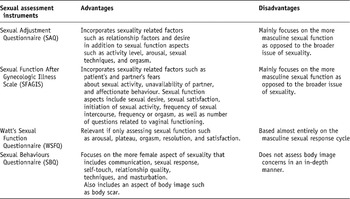
The SAQ, SFAGIS and WSFQ focus on the more narrow sexual function as opposed to the SBQ that assesses the broader issue of sexualityReference Bruner and Boyd4 (Table 1). The SBQ is divided into seven subscales: “communication, sexual response, self touch, relationship quality, techniques, body scar, and masturbation” (ref. Reference Bruner and Boyd4, p. 440). Communication with a sexual partner and relationship quality play a large role in the sexual health of females.Reference Bruner and Boyd4, Reference Chilman27 In addition, in this author's opinion, self touch and masturbation are important factors to consider in female sexuality in relation to how comfortable a woman is with her body and the ability to arouse herself.Reference Chilman27 The SBQ was the only questionnaire that incorporated body image in the items such as body scar. This is significant in that body image and sexuality are intimately linked in that body image is a major part of female sexuality.Reference Bruner and Boyd4,Reference Lamb23, Reference Barton, Wildwerding, Carpenter and Loprinzi24 Body image and sexuality make up an important part of feminine identity that correlate with sexual functioning.Reference Barton, Wildwerding, Carpenter and Loprinzi24, Reference Lagana, McGarvey, Classen and Koopman25
Four sexual assessment instruments and their relative advantages and disadvantages in relation to the young women with breast cancerReference Bruner and Boyd4

Source: From ref. Reference Bruner and Boyd4.
Bruner and Boyd found that the SFAGIS, WSFQ and SBQ all achieved reliability alphas >0.70 (ref. Reference Bruner and Boyd4). They found that the SAQ needs further psychometric testing with a larger sample size in order to achieve reliability.Reference Bruner and Boyd4 The SBQ was the only questionnaire to undergo content validity testing by using an Index of Content Validity and construct validity testing by using factor analysis.Reference Bruner and Boyd4
Bruner and Boyd gave two of the questionnaires to a focus group of nine women treated for breast or gynaecologic cancer. Seven of the subjects were between 35–49 years, treated for breast cancer. To limit overwhelming and confusing the subjects, the authors chose to give only two of the four aforementioned questionnaires.Reference Bruner and Boyd4 One questionnaire represented the most narrowly focused sexual function assessment and the other represented the broader assessment of sexuality.Reference Bruner and Boyd4 The two chosen were not named directly in the article, though the SBQ (with 49 items) is the most sexuality comprehensive questionnaire and the WSFQ (with 17 items) which is based mainly on the sexual response cycle (i.e., arousal, plateau and resolution)Reference Bruner and Boyd4 is the most narrow among the four questionnaires.
Most women chose the broader assessment of sexuality, with one woman voicing what most of the women thought, ‘The [shorter, generic] one doesn't say anything about me as a person. The [longer, more comprehensive, and cancer specific] one gives you more of who I am’ (ref. Reference Bruner and Boyd4, p. 444).
This study shows the many aspects of female sexuality and gives readers an insight into the questions women want to discuss and be informed about when it comes to sexual issues and cancer. Although this study yielded interesting and important data, it cannot be considered conclusive and cannot be generalized to larger populations due to the small amount of subjects used. In addition, this study only recruited subjects from one cancer centre, therefore making it difficult to generalize to other areas.
Although, the SBQ includes items associated with body image, namely scarring from cancer treatment, it is important to assess body image concerns in a more in-depth manner. Body image is a huge part of female sexuality and for the young woman suffering from breast cancer, the body, namely the breast is what is considerably altered or amputated. Wilmoth found that women's sense of self was changed due to ‘missing parts’.Reference Wilmoth26 For example a missing breast served as a visual reminder that the body had been altered.Reference Wilmoth26 This perception of altered self could be in part due to the fact that in Western cultures, breasts symbolize and define womanhood.Reference Baucom, Porter, Kirby, Gremore and Keefe3, Reference Wilmoth26 As a result, Ganze et al. found that two-thirds of breast cancer patients rated being unhappy with body image after treatment as the second most frequent symptom affecting quality of life.Reference Ganz, Rowland, Desmond, Meyerowitz and Wyatt7 This study also showed that women who had undergone lumpectomy had better body image perceptions than did women who had mastectomy followed by reconstruction. Women undergoing mastectomy alone had the most negative body image.Reference Ganz, Rowland, Desmond, Meyerowitz and Wyatt7
Body image concerns
Body image concerns especially affect younger women with breast cancer.Reference Ganz, Rowland, Desmond, Meyerowitz and Wyatt7, Reference Avis, Crawford and Manuel28 The reasons behind this have not been explored in-depth by studies; however, Baucom et al. postulate that in Western societies, youth and beauty go hand-in-hand and as a result, young women have more pressure to be attractive physically and sexually, therefore, when a breast or breasts are scarred or missing, the young women will be more negatively affected than her older counterpart.Reference Baucom, Porter, Kirby, Gremore and Keefe3, Reference Schover11
In addition to the actual appearance of the breast, younger women face bodily changes from the treatment of breast cancer, namely chemotherapy. Alkylating chemotherapy can cause menopause in the younger woman who has not reached menopause naturally and this premature menopause can be more symptomatic than natural menopause that occurs more gradually.Reference Baucom, Porter, Kirby, Gremore and Keefe3, Reference Schover11, Reference Ganz, Greendale, Petersen, Kahn and Bower13, Reference Ganz, Greendale, Peterson, Zibecchi, Kahn and Belin29 Menopausal symptoms include weight gain, hot flashes, fatigue, vaginal dryness, vaginal atrophy, dyspareunia and lowered libido.Reference Baucom, Porter, Kirby, Gremore and Keefe3, Reference Schover11, Reference Ganz, Greendale, Petersen, Kahn and Bower13, Reference Ganz, Greendale, Peterson, Zibecchi, Kahn and Belin29, Reference Wilmoth, Coleman, Smith and Davis30 All of these symptoms negatively affect sexuality and body image for the young woman with cancer.
In addition to chemotherapy producing menopausal symptoms, chemotherapy also causes hair loss, pallor and nausea and vomiting that can lower women's feeling of attractiveness.Reference Barton, Wildwerding, Carpenter and Loprinzi24
It is apparent that body image is an important and serious concern for women with breast cancer; however, body image concerns can be different to individual woman, depending on the importance of physical attractiveness.
Body image assessment tools
The Measure of Body Apperception (MBA) is an assessment tool devised by Carver et al. to assess whether women who are more invested in attractiveness are more negatively affected by breast cancer diagnosis than women who are less invested in viewing body image as a source of self worth.Reference Carver, Pozo-Kaderman, Price, Noriega, Harris, Derhagopian, Robinson and Moffat16
This study begins by distinguishing between body image and body image concerns. Body image is a perception of how one's body looks and does not imply how important body image is to the person.Reference Polivy31 Whereas concern over body image does imply how important body image is to the individual.Reference Carver, Pozo-Kaderman, Price, Noriega, Harris, Derhagopian, Robinson and Moffat16
The MBA has two parts: (1) concern about appearance and (2) concern about body integrity. Concern about appearance is based on the theme that feeling good about oneself is dependent on one's physical appearance. Whereas, concern about body integrity is based on the theme that feeling good about oneself is dependent on one's sense of body integrity, that is, keeping the body whole and intact, without alterations.Reference Carver, Pozo-Kaderman, Price, Noriega, Harris, Derhagopian, Robinson and Moffat16 Sixty-six women with early stage breast cancer aged 28–76 years participated in this study.
The MBA was given at 1 day before surgery and 1 year after surgery.Reference Carver, Pozo-Kaderman, Price, Noriega, Harris, Derhagopian, Robinson and Moffat16 Test–retest correlation of 0.75 was found on student samples prior to the MBA being administered to actual patients. However, when the MBA was given to actual breast cancer subjects, the test–retest correlation prior to surgery and 1 year after surgery was 0.67 for concern about appearance, but only 0.39 for concern about body integrity. The authors attribute this low retest reliability for concern about body integrity to women changing their views on body integrity as time after treatment increased. Some women became more concerned with body integrity, while others became less concerned over time.Reference Carver, Pozo-Kaderman, Price, Noriega, Harris, Derhagopian, Robinson and Moffat16
There was a large amount of time between the test and retest in this study so it is not surprising that women's views would change in relation to body integrity. It's surprising that low reliability was not found for concern about attractiveness as well, as women's views can change in a year's time.Reference Ganz, Rowland, Desmond, Meyerowitz and Wyatt7, Reference Brennan, French, Nehmat, Kirk and Boyages9, Reference Connell, Patterson and Newman10, Reference Bloom, Stewart, Johnston and Banks32 It might have been better to give the MBA to women in shorter increments of time (i.e., every 3 months) to see if there was any gradual change of view in terms of body integrity and appearance.
This study found that women who were more invested in body image and physical attractiveness reported higher levels of distress pre-surgery and 1 year after surgery than women who were less invested in body image.Reference Carver, Pozo-Kaderman, Price, Noriega, Harris, Derhagopian, Robinson and Moffat16 The researchers conclude that body image is not only about appearance but also about the perception of the proper functioning, feeling and intactness of the body.Reference Carver, Pozo-Kaderman, Price, Noriega, Harris, Derhagopian, Robinson and Moffat16 Thus, the young woman with breast cancer is not only faced with altered appearance, but also loss of function, and feelings of not being complete or intact as a result of surgery, chemotherapy and radiation treatments.
The MBA is an exploratory assessment tool that was designed for this study, and therefore has not undergone in-depth reliability and validity testing. More testing on more subjects in different settings needs to be done with the MBA in order to achieve population validity. The MBA is also a narrow assessment in that it does not use specifics in terms of body image issues and has very few items for women to choose from (eight in total). However the MBA can be used as tool to assess how much women who undergo breast cancer treatment are invested in body image in terms of appearance and body integrity and therefore be used to help implement appropriate psychological interventions to these women who will ultimately have a more distressing experience.
Body Image after Breast Cancer (BIBC) is another body image assessment tool that is a longer and more in-depth tool that acknowledges the multi-dimensional scope of body image. Unlike the MBA that only assesses the importance of body image and integrity to women with breast cancer, the BIBC considers the variability of treatment effects on body image.Reference Metcalfe, Esplen, Goel and Narod33–Reference Baxter, Goodwin, Devins, Toner, Dion, McGowan, McLeod and Bombardier35
Many questionnaires that are used in assessing psychological problems in terms of sexual function and body image are primarily generated by researchers with little or no input from the population that researchers are trying to assess.Reference Bruner and Boyd4, Reference Vogt, King and King36 In contrast, during the generation of the BIBC, women with breast cancer were included from the very beginning. Five hundred and seventy-five items were initially generated by interviews with 30 experts, 51 women with breast cancer and 4 spouses. The final number of items was reduced to 53 by an additional 473 women with breast cancer reviewing the items. As a result, the BIBC that is used to assess body image and acknowledges the multi-dimensional scope of all that encompasses body image was generated by women with breast cancer.Reference Baxter, Goodwin, Mcleod, Dion, Devins and Bombardier34, Reference Baxter, Goodwin, Devins, Toner, Dion, McGowan, McLeod and Bombardier35
The BIBC includes items that are based on 5-point Likert scales (1-strongly disagree, 5-strongly agree) and (1-never/almost never, 5-always/almost always). The BIBC measures:
“vulnerability (feelings of susceptibility of the body to illness and cancer, as well as feelings of invasion of the body and a loss of trust in the body as a healthy and functioning organism), body stigma (feelings of a need to keep the body hidden and to avoid physical intimacy), limitations (feelings about the competency and ability of the body), body concerns (feelings of satisfaction with general body shape and appearance), transparency (feelings about the obviousness of mastectomy-related changes to appearance), and arm concerns (concerns about arm symptoms and appearance) (ref. Reference Metcalfe, Esplen, Goel and Narod33, p. 16,17).
The BIBC is a very thorough and relevant assessment of body image issues as they pertain to the young woman with breast cancer.Reference Metcalfe, Esplen, Goel and Narod33–Reference Baxter, Goodwin, Devins, Toner, Dion, McGowan, McLeod and Bombardier35
It is apparent that body image and sexual function questionnaires can help in assessing patients needs.Reference Bruner and Boyd4, Reference Carver, Pozo-Kaderman, Price, Noriega, Harris, Derhagopian, Robinson and Moffat16 The following steps of the PLISSIT model will discuss when to give these questionnaires to patients, who should inform and assess patients, and finally discuss how to intervene when sexual and body image dysfunction are found.
LI = limited information
Radiation therapists, nurses and oncologists need to seek out information regarding body image and sexual issues as well as provide limited information as the first line of psychological intervention.Reference Bruner and Boyd4–Reference McKenney8, Reference Connell, Patterson and Newman10, Reference Schover11
Burton and Watson feel that on-going assessment throughout treatment is important and the sooner assessments are undertaken and information is given, the more open the patient will feel in discussing body image and sexual concerns.Reference Burton and Watson17
In Bruner and Boyd's study that reviewed four sexual assessment instruments, the timing of when the questionnaires were given was an important issue for the subjects. The married women in the group preferred to discuss sexuality issues between 6 months to a year after treatment, with one woman stating, “If I would have [received] this questionnaire soon after diagnosis, I probably would have thrown it away. I didn't care about this then. This was a life-and-death time, not a time to worry about pleasure” (ref. Reference Bruner and Boyd4, p. 444). However, the single women would have wanted to answer the questionnaires and discuss sexual issues as soon as treatment was finished.Reference Bruner and Boyd4
As a result, this shows the individuality of each patient that encounters breast cancer.37 It is important to be aware of the individuality of all patients and treat them as such.37 All patients have different needs and may require assessment and information at different times. Patient's perceptions of body image and sexual problems may also change over time. Bloom et al. found that women's perceptions of body image became more negative 6–7 months post diagnosis as opposed to shortly after diagnosis.Reference Bloom, Stewart, Johnston, Banks and Fobair38 However, if the HCP introduces these issues at different times during treatment and in follow-up, they can assess the level of comfort and disclosure by the patient and can therefore provide the patient with many opportunities to share information when the time is right for them.Reference Burton and Watson17 The United Kingdom's National Institute for Health and Clinical Excellence (NICE) recommends that assessments be undertaken a minimum of three times; around the time of diagnosis, before treatment begins and at the end of treatment.37
With the advent of multiple therapies for breast cancer patients, namely surgery, chemotherapy, hormone therapy and radiation therapy, many opportunities for HCPs to introduce sexual and body image issues are created. And, as a result any HCP that encounters the patient should be able to provide the patient with information regarding sexual and body image concerns, at least in terms of support groups and making appropriate referrals. However, a goal of the multi-disciplinary team should be to communicate with each other on assessments already performed and information given so that women do not have to be continually repeating themselves through all of the different phases of treatment.37
On the other hand with every treatment modality that the young woman faces comes potentially new concerns and effects to her sexuality and body image, therefore, at the beginning of each new treatment, information regarding the specific sexual or body image effects should be clearly given.
All HCPs should be able to provide limited information to the young woman with cancer and the PLISSIT model is a simple intervention that can be utilized and does not require specific training, especially in the P and LI levels.Reference Burton and Watson17, Reference Hughes39
Surgeons, medical oncologists, nurses, radiation oncologists and radiation therapists are all capable of providing limited information to young women with cancer. Limited information can be in the form of giving the patients some sort of assessment that is relevant and indicative of sexual and body image concerns, such as the ones mentioned above.Reference Bruner and Boyd4, Reference Carver, Pozo-Kaderman, Price, Noriega, Harris, Derhagopian, Robinson and Moffat16, Reference Burton and Watson17, Reference Bloom, Stewart, Johnston, Banks and Fobair38 Also all HCPs should be proficient in referring patients to specially trained therapists if there is assessed need by the patient.
Imparting information on resources available to patients is also a way that HCPs can provide limited information.Reference Burton and Watson17, Reference Bloom, Stewart, Johnston, Banks and Fobair38 Making the patient aware of effects on sexuality and body image is the first step in providing reassurance and a sense of normalcy to the young woman with breast cancer.Reference Bruner and Boyd4, Reference McKenney8, Reference Connell, Patterson and Newman10, Reference Schover11
Young women need to be assessed and information requirements addressed pertaining to each modality of treatment as they all have the potential to affect sexuality and body image in different ways. NICE has found that assessment and information gathering and giving by HCPs can be lacking.Reference Baxter, Goodwin, Devins, Toner, Dion, McGowan, McLeod and Bombardier35
Both the married and single subjects in Bruner and Boyd's study expressed that there was no discussion of sexual issues at any time during or after their cancer treatment.Reference Bruner and Boyd4 This exemplifies lack of information giving and thorough discussion on the part of many HCPs in terms of sexuality and sexual issues of the cancer patient.Reference Bruner and Boyd4, Reference Burton and Watson17, Reference Lagana, McGarvey, Classen and Koopman25
In relation to the 4-tier model of psychological support, patients and HCPs working at level 1 (minimal or no sexual training) highly value HCPs who are compassionate, empathetic and convey good communication skills that allow time to give out quality information on chemotherapy and radiation therapy.37 In this author's opinion, radiation therapists in particular are very caring and well-trained professionals who build up a strong and supportive relationship with their patients. However, many therapists are not specifically trained in sexual and body image dysfunction and as a result may not be asking the types of questions young female breast cancer patients need them to ask in order to feel permitted to speak and question openly. Due to the sensitive and sometimes embarrassing nature of sexual and body image concerns, many cancer patients are unwilling to speak up without prompting from the HCP.Reference Burton and Watson17
In addition, because of the radiation therapist not having specific training in sexual and body image dysfunctions, they may not be aware of the psychological impact these issues have on young women.
In order to assess, refer and intervene in sexual and body image concerns, level 1 HCPs need to be informed as to what relevant questions need to be asked and to lessen feelings of embarrassment. Training sessions should be held by specialists in sexual and body image areas to inform and educate HCPs who are working on the front line and see patients regularly.Reference Lagana, McGarvey, Classen and Koopman25, Reference Schover40
HCPs working at level 1 should be able to learn to ask about sexual and body image issues in order to make appropriate referrals. Simply by asking open-ended questions such as “how are things on the sexual side?, or people sometimes worry about how their partner will respond to them sexually after the operation, or some women are very distressed about their change in shape” (ref. Reference Burton and Watson17, pg 61) can allow for simple assessment that can lead to appropriate referrals, support groups available, and simply demystifying myths and giving truthful explanations.
SS = specific suggestions
Support groups and one-on-one counselling are vital for young women with breast cancer to regain emotional well-being.Reference Bloom, Stewart, Johnston, Banks and Fobair38, Reference Wong-Kim and Bloom41, Reference Fobair, Stewart, Chang, D'Onofrio, Banks and Bloom42 HCPs working at level 2 should be able to assess and problem solve with the patient. Referral to support groups and screening for more in-depth counselling requirements should occur at this level. Radiation therapists have the capacity to work at this level with education and support to enhance patient assessment. Radiation therapists that are educated and informed in regards to support groups available in their area are in a better position to pass this information on to their patients.
Support groups that are comprised of young women allow the young woman suffering from breast cancer to know she is not alone and that there are others out there that are sharing her experiences, providing feelings of normalcy and support.Reference Wong-Kim and Bloom41–Reference Marcus, Garrett, Cella, Wenzel, Brady, Crane, McClatchey, Kluhsman and Pate-Willig44 Support groups are available for attendance and on-line at FVC.Reference Stanton, Danoff-Burg, Cameron, Snider and Kirk43 A skills and support group for younger women living with cancer is a group comprised of pre-menopausal women or women who have school-aged children. This group is designed to discuss coping skills, sexual issues, body image, dating, dealing with young children, marital issues, physical well-being and managing career and family. The facilitator of this group is a psychologist whose main focus is young women with breast cancer.
The facilitator is aware of the importance of radiation therapists in the referral process, as a result of the day-to-day contact radiation therapists have with this patient cohort. The facilitator conducts periodic educational in-services with radiation therapists as well as sending periodic e-mail reminders of the availability of this service which enhances and increases the referrals made by radiation therapists to this important and relevant service.
In addition, an online skills and support group is a pilot study available to women who have finished cancer treatment and cannot attend support programs in person due to distance, time, and/or preference. This is a counsellor led chat room to enable young women with cancer to connect with other young women. Telephone, online and web based support groups are cost effective ways to provide continuing support to geographical distanced patients once they finish primary treatment.Reference Connell, Patterson and Newman10, Reference Marcus, Garrett, Cella, Wenzel, Brady, Crane, McClatchey, Kluhsman and Pate-Willig44, Reference Walsh, Manual and Avis45 This support group is important as cancer centres in Canada treat people from very far and remote Northern areas. In this author's clinic (FVC), information cards are available on every radiation treatment unit that treats breast cancer patients to remind patients and radiation therapists that this on-line support is available. However, there are limitations to this on-line support, such as lack of patient computer access or computer skill. In addition, in this author's experience, many Northern Canadian patients are of First Nation descent, thus cultural barriers may exist in terms of comfort level with support groups in general. Therefore it is important that researchers, facilitators and radiation therapists be cognizant of this fact and work to maintain and encourage that these resources are culturally diverse, welcoming and available to this patient population.
Support groups can enhance and increase young women's social network which can be a critical factor in emotional and physical well-being.Reference Bloom, Stewart, Johnston, Banks and Fobair38 As a result, all HCPs should be aware of the support and counselling programs available in their centre in order to refer and utilize their many benefits to the patient.
Another available program is the Look Good Feel Better program that is a 2 hour workshop to educate women on managing their appearance due to treatment related body image effects. Women are taught by trained cosmeticians about wigs, makeup, nail and skin care.46
These programs available at FVC are excellent programs geared towards helping young women with cancer. In addition, the author's clinic is fortunate to have many level 3 and 4 HCPs who are well-trained counsellors, psychologists and psychiatrists that are only a referral away in Patient and Family Counselling (PFC).47 Although information regarding this service is available to patients by way of new patient pamphlets given at the start of any cancer treatment, radiation therapists are encouraged to further discuss the availability and access ease of PFC during the new patient radiation therapy information session. In this author's experience, radiation therapists working in the author's clinic regularly refer to PFC, due to the knowledge of the many benefits of this service and ease of filling out a simple one page PFC referral form.
PFC are counselling services made available to patients, family, friends and carers.47 Many young women's concerns with the diagnosis of breast cancer are in regards to relationship difficulties.Reference Barni and Mondin5, Reference Avis, Crawford and Manuel28 Whether these difficulties were pre-existing or not, a cancer diagnosis seems to exacerbate the problems.Reference Barni and Mondin5, Reference Avis, Crawford and Manuel28 Therefore the clinics level 3 counsellors promote family counselling. They encourage patients to bring their husbands and family members to sessions with them and/or have sessions on their own. HCPs cannot forget the devastating impact a cancer diagnosis has on a young woman's husband and young children. As a result, HCPs should encourage and invite family to partake in the counselling sessions.Reference Fobair, Stewart, Chang, D'Onofrio, Banks and Bloom42, Reference Walsh, Manual and Avis45
However helpful level 3 counsellors are, some young women may require more in-depth, intensive therapy.
IT = intensive therapy
FVC is well equipped to provide support to young women at this level with the many specially trained psychologists and psychiatrists. In addition, the clinic has a level 4 gynaecologist and psychologist who work together to study women with sexual problems. They are working together to study the physical and psychological concerns and needs of all women with cancer. The gynaecologist can recommend and prescribe medications to help with sexual function problems.Reference Barton, Wildwerding, Carpenter and Loprinzi24, Reference Ganz, Greendale, Peterson, Zibecchi, Khan and Belin48 Both are highly trained in dealing with sexuality and sexual dysfunction and thus patients who are suffering can be referred to them for very specialised treatment. At this level of intervention, PFC counsellors are the HCPs who refer to those specifically trained in sexual interventions; however, radiation therapists can be the first line referral to PFC in the beginning stage of treatment.
Conclusion
Sexual and body image issues for young women with breast cancer are important psychological concerns that warrant appropriate assessment, sensitive discussion and suitable intervention by HCPs.Reference Bruner and Boyd4–Reference Anllo6, Reference McKenney8–Reference Schover11, Reference Dow and Lafferty20 A functional definition of ‘young’ is an important starting point in identifying those women most at risk for sexual and body image concerns as a result of breast cancer therapies. In addition, all HCPs who care for the young woman with cancer should be able to assess, refer and establish an open communication with patients to permit discussion of sexual and body image concerns.
This can be achieved by first administering sexuality questionnaires such as the SBQ which identifies female sexuality issues coupled with sensitive questioning and information giving to fulfil needs.Reference Bruner and Boyd4, Reference Carver, Pozo-Kaderman, Price, Noriega, Harris, Derhagopian, Robinson and Moffat16 In addition, body image concerns can be assessed through questionnaires such as the BIBC which acknowledges the multi-dimensional scope of body image. When assessments are undertaken appropriately, young women can get the help and support they need to improve psychological health.
This discussion paper exemplified Annon's PLISSIT model as a simple assessment and intervention strategy that enables all levels of HCPs to adequately assess and refer young women to suitable programs such as support groups and professionals available.
Appropriate interventions for the young women include: group support to alleviate feelings of isolation;Reference Wong-Kim and Bloom41, 47 increased social support from friends and family;Reference Fobair, Stewart, Chang, D'Onofrio, Banks and Bloom42, Reference Walsh, Manual and Avis45 increased professional support in order for patients to feel their needs are being met;Reference Wong-Kim and Bloom41, 47 and symptom management.Reference Barton, Wildwerding, Carpenter and Loprinzi24, Reference Ganz, Greendale, Peterson, Zibecchi, Khan and Belin48
In addition, the young women's family must be recognised and their needs acknowledged, therefore counselling and support groups should be open to family, friends and carers whose needs are just as important as the patient with cancer.Reference Fobair, Stewart, Chang, D'Onofrio, Banks and Bloom42, Reference Walsh, Manual and Avis45
Holistic interventions are important in addressing sexual and body image needs of young women with breast cancer, and the multi-disciplinary team should work together to accomplish this.Reference Lamb23 The multi-disciplinary team is important in providing continuous emotional assessment and support throughout the young woman's cancer journey by collaborating with each other to develop the best interventional strategies both to the young woman suffering from breast cancer and her family.