Introduction
Arsenic (As) is a solid, brittle metalloid which has both metallic and non-metallic properties. As is the 20th most common element in the Earth's crust with an average natural abundance of about 1.5-3 mg/kg (NRC, 2005). It can be found at low concentrations in almost every part of the environment, including food and water. As naturally occurs in over 200 different forms with approximately 60% as arsenates, 20% as sulphides and sulphur-salts, and remnant arsenites, oxides, silicates and in the elemental form (Mandal and Suzuki, Reference MANDAL and SUZUKI2002). Inorganic As is generally considered more toxic as compared to its organic form. Inorganic As can be found in water, which is the major route of its absorption by humans and animals (Shah et al., Reference SHAH, KAZI, ARAIN, JAMALI, AFRIDI, JALBANI, ABBAS and BAIG2009). A positive correlation between water solubility and toxicity of As compounds has been established, though this is not always the case.
The element is highly toxic, even at low concentrations in food and water, and its nutritional importance in poultry diets is still questionable. The mechanisms of As toxicity differ greatly among chemical species, although all appear to cause similar signs of poisoning (Eisler, Reference EISLER1988). Long-term exposure of humans to As from drinking-water and food can cause cancer and skin lesions and has been associated with cardiovascular disease and diabetes. In utero and early childhood exposure has been linked to negative impacts on cognitive development and increased deaths in young adults (WHO, 2017). Its physiological role in poultry has been confirmed, whereby As is vital for the formation of methionine metabolites, including cysteine. The aim of this review is to outline the facts pertaining to essentiality and toxicity of As in poultry nutrition with particular emphasis on its environmental distribution.
Distribution of arsenic in the environment
As is a widely found contaminant, which occurs both naturally and as a result of human activity. Most industrially produced As originates from agricultural products, such as insecticides, herbicides, fungicides, algaecides, wood preservatives and growth stimulators for plants and animals. The use of pesticides containing As as well as other chemical products in agriculture results accumulation in soil and plants and consequent levels of As in food and animal feed (Shah et al., Reference SHAH, KAZI, ARAIN, JAMALI, AFRIDI, JALBANI, ABBAS and BAIG2009; Mandal, Reference MANDAL2017). Animal enclosures are often constructed from wood treated with the preservative chromated copper arsenate (CCA). Although the risks were identified years ago, this wood preservative is still used in agricultural settings where animals are in contact with As residues and contaminated soil resulting from CCA wood enclosures (Gress et al., Reference GRESS, DA SILVA, DE OLIVIERA, ZHAO, ANDERSON, HEARD, STUCHAL and MA2016).
The application of animal manure to farm land is an important source of heavy metals. Organic As compounds have been used as additives in poultry feed for many years, thus imposing increased risk of its excretion in the manure and consequent deposition in the sediments and soil, where the organic form is transformed into inorganic water-soluble As that contaminates surface and underground waters. Once the excessive additives have been realised in the environment, As may compromise food safety and environmental quality (Li and Chen, Reference LI and CHEN2005). During 1990-2002 in China, As decreased in all animal manures, but during 1990-2008 it increased by 420% in pig manure, 200% in dairy manure, and even 1500% in poultry manure, which suggest that As was largely added to the feeds after 2002 (Wang et al., Reference WANG, DONG, YANG, TOOR and ZHANG2013).
As is found at low concentrations in almost every part of the environment including food and water. Resources are exposed to As by way of atmospheric emissions from smelters, coal-fired power plants, and herbicide sprays; from water contaminated by mine tailings, smelter wastes, and natural mineralisation; and from diet ingredients, especially from marine products. As concentrations are usually low (<1.0 mg/kg fresh weight) in most living organisms but are increased in marine organisms and plants and animals from areas that are naturally contaminated or are close to industrial manufacturers and agricultural users of As.
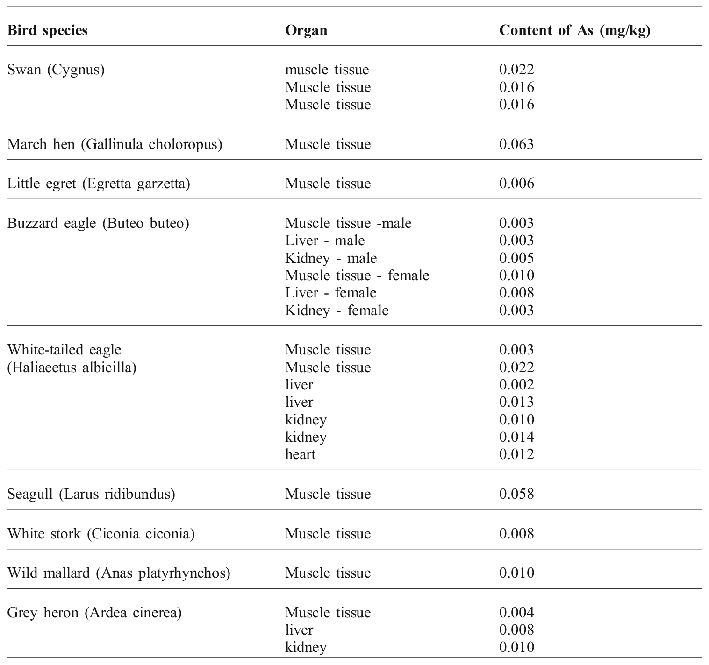
As is bioconcentrated by organisms, but is not biomagnified in the food chain (Eisler, Reference EISLER1988). Being widely distributed across the environment (soil, animal feed and water) its accumulation in avian tissues is likely (Desheng and Niya, Reference DESHENG and NIYA2006). Analysis reported by Mihaljev et al. (2013) confirmed apparent presence of As at detectable levels in all types of samples from wild birds. The content of As was examined in samples of muscle tissue, liver, kidneys and heart tissue obtained from the following: swan (Cygnus), march hen (Gallinula choloropus), little egret (Egretta garzetta), buzzard eagle (Buteo buteo), white-tailed eagle (Haliaeetus albicilla), seagull (Larus ridibundus), white stork (Ciconia ciconia), wild mallard (Anas platyrhynchos), grey heron (Ardea cinerea) (Table 1).
The content of As in various tissues of wild birds (Mihaljev et al., 2013).

Highest As contents have been established in meat from the marsh hen (0.063 mg/kg), seagull muscle tissue (0.058 mg/kg) as well as in the meat from swans (0.022 mg/kg) and white-tailed eagles (0.022 mg/kg).
There is a presence of As in all kinds of feedstuffs, and its concentrations depend on the type of the feed, conditions of crop growth and production technology (Živkov Baloš et al., Reference ŽIVKOV BALOŠ, MIHALJEV, ĆUPIĆ, VUKAŠINOVIĆ and VIDIĆ2007; Shah et al., Reference SHAH, KAZI, ARAIN, JAMALI, AFRIDI, JALBANI, ABBAS and BAIG2009). Application of pesticides and other chemical products used in agricultural production has resulted in the accumulation of As in the soil and plants, and its consequent presence in food and animal feed (Shah et al., Reference SHAH, KAZI, ARAIN, JAMALI, AFRIDI, JALBANI, ABBAS and BAIG2009). The highest concentrations of As are found in fishmeal and fish oil that reflects contamination in aquaculture diets, for which these are major ingredients (EFSA, 2005).
With an aim of obtaining information on the safety status of domestic raw materials and formulations for animal nutrition, Živkov Baloš et al. (Reference ŽIVKOV BALOŠ, MIHALJEV, ĆUPIĆ, VUKAŠINOVIĆ and VIDIĆ2007) investigated samples obtained from 20 factories and feed mills in the territory of Vojvodina Province. Out of the total number of samples (38), the amount of toxic elements was above the maximum permitted limits (MPL) according to the Regulations in eight samples, whereas in three out of 58 samples of ready-made formulations, the amount of toxic elements was above MPL. For ready-made formulations, the most common reason for such departure from the requirements set in the Regulation was excessive As content above MPL. According to the results of a trend analysis monitoring conducted in the Netherlands (Adams et al., Reference ADAMS, VAN DER FELS-KLERX and DE JONG2017), the recommendations are that monitoring for As, lead (Pb), cadmium (Cd) and mercury (Hg) should focus on feed material of mineral origin, feed material of marine origin (especially fish meal), seaweed and algae as well as feed additives belonging to the functional groups of trace elements (notably cupric sulphate, zinc oxide and manganese oxide), binders and anti-caking agents. Pètursdóttir et al. (Reference PÈTURSDÓTTIR, JÖRUNDSÓTTIR and GUNNLAUGSDÓTTIR2010) presented and evaluated results on total As concentration from over 100 samples of Icelandic fish meal made of capelin, blue herring or blue whiting. Total As concentration ranged from 2.2 to 16.2 mg/kg. The blue whiting meal has three times higher total As concentration. This phenomenon may be due to physiological differences in fish species, food source of the fish and could be dependent on the production process. The authors concluded that As concentrations were higher when fish were in poor condition, that is, after spawning, thus indicating a negative correlation between the level of body lipids and As contents.
Safety of drinking water is currently the crucial ecological issue. It has been estimated that food and water are responsible for as much as 99% of total As intake in humans. Being present in the soil, water, air, plans and living organisms, the occurrence of As in food is to be expected. The highest amounts in seafood are thought to occur because marine creatures ultimately feed on plankton (Jones, Reference JONES2007).
A positive correlation between water solubility and toxicity of As compounds has been found, although this is not always the case. Dietary supplementation of As is likely to play a more important role if the content of toxic metals in drinking water is low. It has been observed that experiments with laboratory animals exposed to low doses of As in drinking water often give false results. This is mainly due to ignoring the presence of As in animal feed, which is present as a contaminant, not as a feed supplement (Mitchell et al., Reference MITCHELL, FRISBE and SARKAR2011). This has been confirmed in a study reported by Desheng and Niya (Reference DESHENG and NIYA2006). Their experiment with Japanese quail fed a diet supplemented with 50 mg and 100 mg/kg 4-arsanilic acid and drinking water containing 0.008 mg/l of As revealed an uneven distribution of As in the tissues. As concentration in muscle tissue (drumstick meat, breast) was relatively low, not exceeding the limit of 0.64 mg/kg of dry matter, whereas content in liver, heart and kidneys was significantly higher, ranging from 0.81 to 2.82 mg/kg of dry matter and the highest amounts were recorded in the liver. As-concentration in tissues and organs increased with the level of arsenilic acid supplemented in the feed. The authors reported on As contents in tissues of quails from the control group, which consumer feed containing basal-natural level of As and water containing 0.008 mg/kg of As. Such findings strongly suggested that As accumulates in the tissues of birds, disregarding its concentration in feed and drinking water.
The effects of contaminated water on livestock production are difficult to estimate. The data from published literature offer limited information on the impact of water contaminants on reproductive performance and egg quality (Vodela et al., Reference VODELA, LENZ, RENDEN, MCELHENNEY and KEMPPAINEN1997). In a 42 day experiment, Živkov Baloš et al. (Reference ŽIVKOV BALOŠ, MIHALJEV, JAKŠIĆ, ĆUPIĆ and KAPETANOV2013) investigated the effects of naturally contaminated drinking water on the deposition of As in various organs and meat of broilers. The As in the examined drinking water samples (0.033±0.024 mg/l) was above the maximum permitted limit (0.01 mg/l). As content in complete feed samples ranged from <0.001 to 0.005 mg/kg, which was significantly lower than the MPL (2 mg/kg). Thus, As intake in feed was minimised, i.e. was in accordance with relevant nutritional recommendations. In all investigated tissue samples from birds in the experimental group, certain amounts of As were detected (breast meat 0.006-0.015 mg/kg; drumstick meat 0.007-0.017 mg/kg; liver 0.001-0.014 mg/kg; testicles 0.008-0.016 mg/kg); however, the levels were significantly lower than MPLs set by relevant regulations (0.1 mg/kg for meat and 0.5 mg/kg for offal). A previous investigation revealed that using drinking water with impermissible As content did not affect the safety of chicken meat for human consumption, with respect contamination in the meat. Of course, the period of animals’ exposure to elevated levels of As still remains an important issue for safety of meat and offal from older birds.
According to the National Academy of Sciences (1977), the content of As in chicken meat, as a common foodstuff, was 0.02 mg/kg of dry matter (Jones, Reference JONES2007). According to a study conducted in the U.S.A. during the period 1991-1996, the content of total As in muscle tissue of broilers was 0.030-0.086 mg/kg (Tao and Bolger, Reference TAO and BOLGER1999), whereas Dabeka et al. (Reference DABEKA, MCKENZIE, LACROIX, CLEROUX, BOWE and GRAHAM1993) reported As in chicken meat from Canada being 0.029 mg/kg. Experiments performed with broilers consuming water contaminated with a mixture of chemical components (As, cadmium, lead, benzene and trichloroethylene) at low (0.80, 1.3, 5.0, 6.7 and 0.65 mg/kg) and high concentrations (8.6, 13, 50, 67 and 6.5 mg/kg) revealed that As contents in bones, liver and kidneys were below the limit of detection, i.e. below 0.1 mg/kg (Vodela et al., Reference VODELA, LENZ, RENDEN, MCELHENNEY and KEMPPAINEN1997). When analysing the aforementioned results, it should be emphasised that application of As as a growth promoter has been approved in the USA and Canada until 2011.
Meat and offal from poultry are an important element of human diets, and consumption is increasing worldwide. Thus, the safety of animal feed and drinking water and technological conditions on poultry farms are important parameters when assessing the safety of poultry products.
Regulation and metabolism of As
The element is highly toxic even at extremely low concentrations in food and its importance in poultry nutrition is highly questionable. Absorption and retention of As varies depending on the form and amount consumed. Organic As compounds are considered less toxic than inorganic forms. However, more toxic As compounds are retained in body fluids to a greater extent and the process of their excretion is slower as compared with less toxic compounds. As from feed is more readily absorbed and excreted in the urine as compared with inorganic forms. In the urine As is excreted via the gallbladder, faeces and skin and a part of its incorporated into the feathers and claws (Jones, Reference JONES2007).
As is absorbed from the gut by a two-stage process. First, it is concentrated in mucosal cells and then, as binding sites become filled, it moves down the concentration gradient into the portal circulation. Upon ingestion, 60 to 90% of As is rapidly absorbed in the digestive system. The largest portion of inorganic As (>90%) is rapidly eliminated from the blood, somewhat lesser amounts are deposited in testicular, kidney and lung tissue and larger amount is metabolised in the liver. Though some As compounds are converted in testicular, kidney and lung tissue, the liver is considered the primary site of metabolism (Cohen et al., Reference COHEN, ARNOLD, ELDAN, LEWIS and BECK2006). Inorganic As III (arsenite) is even more readily absorbed than inorganic As V (arsenate), probably because of its greater water solubility. The metabolism and excretion of As varies significantly between species. Generally speaking, inorganic As is methylated through the series of sequential reduction and oxidative-methylation reactions. Once absorbed, inorganic As is reduced to arsenite by glutathione, and then methylated in the liver and testis by S-adesonsylmethionine. Arsenite is produced as a result of conversion of As III to As V in the gastrointestinal tract and may be the result of bacteria activity (Herbel et al., Reference HERBEL, BLUM, HOEFT, COHEN, ARNOLD, LISAK, STOLZ and OREMLAND2002). Arsenate is then methylated to monomethylarsonic acid (MMA), which is reduced to monomethylarsonous acid and rapidly methylated to dimethylarsinic acid (DMA). These metabolites are more readily excreted than inorganic As. Formation of DMA is usually the final step in the metabolism of As in humans and animals, and is the major form of As in urine (NRC, 2005). Other, minor, routes of excretion include faeces, perspiration, expired breath, as well as incorporation into skin, feathers and claws. Animal studies suggest that environmental As exposure is primarily a risk to the developing foetus as it is readily transferred from feed and water to the foetus and causes developmental toxicity, including malformations, retardation and death (Golub et al., Reference GOLUB, MACINTOSH and BAUMRIND1998).
As interacts with many other dietary factors, resulting in either increased or decreased toxicity. Selenium (Se) and As are antagonists in several animal species. As has been known to minimise the toxicity of inorganic selenium (Se) in rats, dogs, swine, cattle, and poultry (Eisler, Reference EISLER1988), and vitamin E offers protection against ovarian toxicity of sodium arsenite (Rana, Reference RANA2007). Kadirvel et al. (Reference KADIRVEL, SUNDARAM, MANI, SAMUEL, ELANGO and PANNEERSELVAM2007) suggested that alpha-tocopherol and ascorbic acid supplementation could improve inorganic As-induced molecular damage in rats. Ascorbic acid treatment in inorganic As treated rats increased excretion, and may provide a protective mechanism against oxidative stress and DNA damage (Rana, Reference RANA2007; Singh and Rana, Reference SINGH and RANA2007). Vitamin B12 and folic acid have a hepatoprotective role in As intoxicated rats. Folic acid can affect As methylation, and both folate deficiency and excess As induce foetal malformations in rats, thus a dietary deficiency of folate heightens toxicity (Chattopadhyay et al., Reference CHATTOPADHYAY, DEB and MAITI2012). Simultaneous administration of zinc (Zn) reduced the toxicity of chronic low-level exposures to inorganic As in drinking water, possibly by induction of metallothionein, a metal binding protein. Research suggested that a combination of Zn deficiency and As exposure has harmful effects on the developing embryo and may increase the risk for future chronic diseases like diabetes (Beaver et al., Reference BEAVER, TRUONG, BARTON, CHASE, GONNERMAN, WONG, TANGUAY and HO2017). Their investigation showed that exposure to As led to an increase in the tissue copper (Cu) levels in the kidneys of rats and guinea pigs (Hunder et al., Reference HUNDER, SCHAPER, ADEMUYIWA and ELSENHANS1999).
As is widely distributed in tissues and body fluids, especially in the skin, claws and feathers. Normal levels of As in feathers are less than 0.2 mg/kg (dry matter basis), whereas levels 3.0-5.0 mg/kg are considered high, and levels above 6.0 mg/kg feather (dry matter basis) are considered toxic. Normal values for liver and kidneys range between 0.01-0.25 mg/kg and 5-10 mg/kg tissue dry matter is considered toxic (Puls, Reference PULS1990).
Essentiality of As
As apparently behaves more like an environmental contaminant than as a nutritionally essential element (Eisler, Reference EISLER1988). In poultry, As affects the availability of methionine-derived unstable methyl groups. As can affect the methylation of genetically and metabolically important molecules, whereby function is highly influenced by methyl group incorporation. Nielsen (Reference NIELSEN1998) reported that recommended amounts of As in the feed for chickens and rats are more than 0.012 mg/kg yet less than 0.050 mg/kg feed. According to DeSesso et al. (Reference DESESSO, JACOBSON, SCIALLI, FARR and HOLSON1998), nutritional recommendations for As are 0.025-0.050 mg/kg feed. As deficiency is considered a rare condition, but, if present, might impair erythrocyte integrity (Puls, Reference PULS1990). A number of experiments involving simulation of lack of As in diverse animal species showed that As may have an essential function when present in ultra trace amounts (NRC, 2005). The most pronounced signs of apparent As deficiency in goats, pigs and rats include depressed growth and abnormal reproduction, characterised by impaired fertility and increased perinatal mortality. Other signs include decreased serum triglyceride levels and death caused by myocardial damage during lactation in goats, decreased hepatic S-adenosylmethionine and elevated S-adenosylhomocysteine contents in rats and hamsters (NRC, 2005). Apparent signs of As deficiency in goats and pigs fed diets containing less than 0.05 mg As/kg, are roughened hair, low growth rates, decreased haematocrit, increased fragility of red cells and an enlarged spleen (NAS, 1977). In these animals, reproductive performances were impaired, neonatal mortality was increased, while birth weight and weight gains were decreased. Such effects have not been observed in animals fed formulations containing 0.35 mg As/kg.
Sources of As in poultry diets
As is present in all kinds of animal feed, and its concentration is determined by feed type, conditions of plant growth and production technology (Živkov Baloš et al., Reference ŽIVKOV BALOŠ, MIHALJEV, ĆUPIĆ, VUKAŠINOVIĆ and VIDIĆ2007; Shah et al., Reference SHAH, KAZI, ARAIN, JAMALI, AFRIDI, JALBANI, ABBAS and BAIG2009). The largest amounts of As, in its less toxic forms, such as arsenocholine and arsenobetaine, are found in feed of marine origin such as fish meal (Jones, Reference JONES2007).
The toxicity of As varies across its different forms. Inorganic As is more toxic than its organic form. Trivalent As is generally more toxic than pentavalent As (Mandal, Reference MANDAL2017). Inorganic As compounds are found in water and are adsorbed in the body (Shah et al., Reference SHAH, KAZI, ARAIN, JAMALI, AFRIDI, JALBANI, ABBAS and BAIG2009). As toxicity is influenced by a range of factors, including animal species, age, gender and reproductive status. The toxic effects of As (arsenite) are potentiated by excess organosulphur compound, cadmium and lead (Eisler, Reference EISLER1988).
Younger individuals are more susceptible to As toxicity. Females are less susceptible, especially during pregnancy, which is associated with increased capacity for As metabolism and detoxication (Rana, Reference RANA2007). Feeding 40 mg/kg resulted in decreased egg production in poultry, while 50 mg/kg caused decreased feed consumption (Puls, Reference PULS1990). The lethal dose in domestic animals ranges from 1 to 25 mg/kg body weight as sodium arsenite, which is 3-10-fold more toxic then As trioxide (NRC, 2005).
Genotoxicity tests indicated the involvement of As in the process of chromosomal aberration and DNA repair inhibition (Schoen et al., Reference SCHOEN, BECK, SHARMA and DUBE2004). Because of its similar biochemical properties to phosphate, arsenate can replace the former in energy transfer phosphorylation reactions, resulting in the impairment of ATP synthesis. On the other hand, arsenite reacts with sulfhydryl groups and can induce structural modification in proteins leading to the inactivation of many enzymes (Mandal, Reference MANDAL2017; Ventura-Lima et al., Reference VENTURA-LIMA, REIS BOGO and MONSERRAT2011). As toxicity can lead to oxidative stress, and prolonged exposure to inorganic forms induces a range of toxic effects involving multiple organ systems (Rana, Reference RANA2007). As stimulates production of reactive oxygenic compounds, such as superoxide anion, hydroxyl and peroxyl radicals (Ventura-Lima et al., Reference VENTURA-LIMA, REIS BOGO and MONSERRAT2011). The reaction and interaction of these reactive radicals with target molecules results in oxidative stress, lipid peroxidation, DNA damage and the activation of signalling cascades associated with tumour development (Mandal, Reference MANDAL2017). As is a reproductive toxicant that induces malformations, especially for neural tube defects (Wang et al., Reference WANG, HOLLADAY, WOLF, AHMED and ROBERTSON2006).
Acute cases of As poisoning in animals ends in death associated with cardiovascular collapse. Apparent manifestations of acute intoxication include intense abdominal pain, vomiting, intensive salivation, watery diarrhoea, hypothermia, slackness, collapse and death (EFSA, 2005; NRC, 2005). Lethal doses of As trioxide range from 0.5 to 1 g/kg body weight for pigs and 10 to 45 g/kg body weight for horses. Lethal doses of sodium arsenite ranges from 0.05 to 0.25 g/kg body weight for pigs and 1 to 3 g/kg body weight for horses (EFSA, 2005). Median lethal dose (LD50) for goats is 125 mg/kg body weight (Biswas et al., Reference BISWAS, SARKAR, BHOWMIK, SAMANTA and BISWAS2000). Toxic dose of As pentoxide ranges between 40 and 50 mg/kg feed for poultry (Chiou et al., Reference CHIOU, CHEN and YU1997; Puls, Reference PULS1990). Toxic effects of As in poultry are manifested by a decrease in feed consumption, weight gain, egg production and neurological symptoms (Puls, Reference PULS1990).
The symptoms of chronic long-term exposure of low concentrations of As (arsenicosis) include skin decolouration, chronic indigestion and stomach cramps. Long-term effects may manifest as carcinoma of the skin, lungs, kidneys and liver as well as gangrene-like sores, as well as causing cancer (Mandal, Reference MANDAL2017). The symptoms of chronic exposure to As differ among individuals, populations and geographic regions, suggesting that there is no universal definition of symptoms associated with chronic poisoning (EFSA, 2005; Sharpe, Reference SHARPE2003). Moreover, some individuals can tolerate high doses of As which are fatal for others (Jones, Reference JONES2007).
Chronic oral As toxicosis in animals is seldom reported. The chronic form of toxicity includes depressed growth, feed efficiency, feed intake, and for some species, convulsions, uncoordinated gait, and decreased haemoglobin. Prenatal death, malformations and inhibited growth can result from chronic As exposure in hamsters, mice, and rats (NRC, 2005). Such effects are seen at doses causing maternal toxicity (including death) e.g. when As was administered intraperitoneally or intravenously (DeSesso, Reference DESESSO2001).
As, as well as other naturally occurring minerals, tends to circulate in the natural environment and humans and animals are always and unavoidably exposed to its effects (Roy and Saha, Reference ROY and SAHA2002). As a result of As presence in all living organisms, every organism from E. coli to man has developed detoxification pathways (Jones, Reference JONES2007). Hansen et al. (Reference HANSEN, RAAB, FRANCESCONI and FELDMAN2003) reported the absence of toxic manifestations in sheep that were fed marine algae and consumed about 35 mg organoarsenicals per day (NRC, 2005). Hunder et al. (Reference HUNDER, SCHAPER, ADEMUYIWA and ELSENHANS1999) compared three species, rats, mice and guinea pigs which exhibit quite different As metabolism, with respect to the arsenite-induced copper (Cu) accumulation. Three test diets were prepared containing 10, 30 and 60 mg As/kg of diet as sodium arsenite. Administration of As to rats affected neither feed intake nor body weight. Treatment of rats with dietary As resulted in a rise in the renal As and Cu content, which was seen at the highest dietary level (60 mg As/kg of diet) and was elevated seven fold. As treatment did not affect mice body weight and trace metal levels essentially. In contrast to rats and mice, body weights of the guinea pigs were affected by dietary As in a dose-dependent manner. Renal As and Cu levels consistently increased together with the length of the feeding trial and the dietary As level. The authors concluded that different As kinetics in guinea pigs and mice may be at least partially responsible for the differences in As distribution among the species.
As as a supplement in poultry feed
Due to effects that are similar to those of antibiotics, some organic As compounds are well established growth stimulators for poultry. Appropriate dosage of such compounds can improve growth rate and feed conversion as well as feather pigmentation in chicks and turkeys, and egg production in laying hens and Japanese quail (Desheng and Niya, Reference DESHENG and NIYA2006). Though their use was banned in Europe back in 1998 and in China in 2001, such compounds are still in use in some countries such as Australia, Argentina, Brazil, Canada, Chile, Mexico and Venezuela. Until 2011, such compounds were used in the USA, but only according to strictly defined formulations and dosage. Thus, arsenic acid was approved for use in the poultry industry as growth and feed conversion promoter and for improvement of pigmentation, but only at 0.005-0.01%. Nitrasone was administered for the prevention of blackhead disease at maximum dose up to 0.01875%, whereas Roxarsone (not allowed for use in feed formulations for laying hens) was used as growth, feed conversion and pigmentation promoter at maximum levels of 0.0025-0,005%. Roxarsone was used in some 70% of all grower and starter broiler formulations in the USA during the period 1995-2000. Some researchers suggested that this As compound is effective against intestinal parasites, coccidia and, possibly, salmonellosis (Jones, Reference JONES2007). However, the permitted dose of Roxarsone being 22.7 do 45.4 mg/kg of feed is associated with an As intake of 14.25 mg/kg of feed, which is mainly metabolised in the liver and excreted via faeces into the environment, where it has residual effects. Thus, As residues accumulated in broiler meat were more than 0.45 mg/kg, which consequently resulted in banning of Roxarsone supplementation in the USA. Another important reason for such an interdict was the excretion of substantial amount of As in faeces as well as its distribution in the soil via manure and consequent accumulation in ground and surface waters (Li and Chen, Reference LI and CHEN2005; Wang et al., Reference WANG, DONG, YANG, TOOR and ZHANG2013). It has been established that the ecological impact of manure fertilisers containing As is determined by the form of As present in the manure as well as by physical-chemical properties of the soil (D'Angelo et al., Reference D'ANGELO, ZEIGLER, GLENN BECK, GROVE and SIKORA2012; Rutherford et al., Reference RUTHERFORD, BEDNAR, GARBARINO, NEEDHAM, STAVER and WERSHAW2003).
Conclusions
As toxicity has been addressed in a range of research trials. Toxicity mechanisms of As and maximum tolerance levels in humans have been well established. However, As is relatively non-toxic for poultry, since the toxic concentration is about 500 to 1000 times greater than the concentrations in poultry feed. Human toxicoses associated with As poisoning have been widely reported, whereas data on chronic toxicity of As in animals, including poultry, are limited, as are data on the subclinical doses of this element in livestock feed. A range of interactions involving As contribute to complex situations which need further research, including dietary interactions of As from water and feed and their effects on poultry health, reproduction and safety of animal products for human consumption. At the same time, the importance of foodstuffs from animals in human nutrition indicates the considerable effects of As intake in humans. Although some poultry diet formulations are a potential source of harmful amounts of As, a combination of appropriate quality control programs, good production practices and adequate education of nutrition professionals can significantly reduce the risks of contamination. Control of the safety of drinking water and other segments of poultry production are similarly important.
Acknowledgments
The presented work is part of the research done in the project TR31084 granted by the Serbian Ministry of Education, Science and Technological Development.