Introduction
Elderly people have the highest suicide rates in almost every country, including the U.S.A. While depression, physical illness, and loss are known to precipitate suicidal behavior in the elderly (Heikkinen and Lonnqvist, Reference Heikkinen and Lonnqvist1995; Duberstein et al., Reference Duberstein, Conwell and Cox1998; Conwell et al., Reference Conwell, Duberstein and Caine2002; Luoma and Pearson, Reference Luoma and Pearson2002), only a minority of older people with these risk factors attempt or complete suicide. Thus, clinicians need a better understanding of what makes elderly people vulnerable to suicidal behavior in order to predict and prevent it.
Among other factors, social support networks have been suggested to have a buffering effect, protecting people from the impact of stressors (Sheldon Cohen, Reference Sheldon Cohen1983; Krause and Jay, Reference Krause and Jay1991). Elderly people who have limited social support appear to be at higher risk for suicidal ideation (Rowe et al., Reference Rowe, Conwell, Schulberg and Bruce2006; Raue et al., Reference Raue, Meyers, Rowe, Heo and Bruce2007) and death by suicide (Turvey et al., Reference Turvey2002; Duberstein et al., Reference Duberstein, Conwell, Conner, Eberly, Evinger and Caine2004b). Social networks are protective, but perhaps not for everyone. According to Joiner's interpersonal-psychological theory of suicide (Joiner, Reference Joiner and Joiner2005), lack of belonging, resulting from unpleasant, unstable, and distant relationships, is a key contributor to suicide. We have also observed that elders who attempt suicide perceive social problems as threatening (Gibbs et al., Reference Gibbs, Dombrovski, Morse, Siegle, Houck and Szanto2009). In our clinic, we have observed that many depressed older people who attempt or seriously contemplate suicide experience discord in their relationships, perceiving them as sources of stress rather than support. Earlier psychological autopsy studies have also found that discord in relationships affected many elderly suicide victims (Beautrais, Reference Beautrais2002; Duberstein et al., Reference Duberstein, Conwell, Conner, Eberly and Caine2004a; Harwood et al., Reference Harwood, Hawton, Hope, Harriss and Jacoby2006). To the extent that it is possible to generalize results obtained from those who died by suicide to suicide attempters, the results lend further weight to the idea that it is important to understand what factors affect the sense of social support in vulnerable depressed elders, potentially contributing to suicidal ideation and behavior.
To answer this question, we assessed perceived social support and chronic interpersonal difficulties in three groups: depressed elderly with and without suicide attempts or serious suicidal ideation and non-depressed elderly. We conceptualize chronic interpersonal difficulties as a marker of personality factors, which are likely to impact important relationships. Our focus on a very high-risk group of depressed elderly is consistent with the notion that these patients are most likely to possess vulnerabilities associated with suicide. In-person assessments allowed us to gather information on perceived social support and chronic interpersonal difficulties firsthand, eliminating the use of secondhand data inherent in psychological autopsy studies. We hypothesized that suicidal thoughts or attempts would be associated with lower perceived social support and higher levels of interpersonal discord, above and beyond the effects of depression. Finally, as elders with chronic interpersonal difficulties may strain their protective social networks, we hypothesized that low perceived social support would partly explain the relationship between interpersonal discord and suicide attempts or ideation.
Methods
All participants and their significant others provided written informed consent as required by the University of Pittsburgh Institutional Review Board. A total of 106 elderly persons aged 60 years and older with a Mini-mental State Examination (MMSE) score of 18 or more participated. Depressed patients were required to meet criteria for major depression, adjustment disorder with depressed mood, depression secondary to medical condition, or other depressive disorder not otherwise specified (NOS) using the Structured Clinical Interview of the Diagnostic and Statistical Manual of Mental Disorders, 4th edn Axis I Disorders (SCID/DSM-IV). We screened 290 patients for eligibility in the suicidal depressed or non-suicidal depressed groups; of those, 161 were ineligible, 42 refused to participate, and 87 gave consent and contributed to this analysis.
Suicidal depressed elderly
We recruited 29 suicidal participants from an inpatient psychogeriatric unit and a late-life depression clinic. Of these participants, 19 had attempted suicide, defined here as a self-injurious act with the intent to die (O'Carroll et al., Reference O'Carroll, Berman, Maris, Mosciki, Tanney and Silverman1996); 11/19 attempted suicide within a month of assessment, and 14/19, within a year; 11/19 made their first suicide attempt after the age of 60; 9/19 had made repeat attempts. Suicide attempt history was verified by a psychiatrist, using the interview, medical records, information from the treatment team, and information from family or friends. We excluded participants with significant discrepancies between these sources; for example, patients whose self-injurious act may have been the result of an accidental drug overdose were excluded. An additional 10 participants had experienced suicidal ideation with a specific plan to take their life, as recorded in items 4 and 12 of the Beck Suicidal Ideation Scale, and this ideation was severe enough to trigger an inpatient admission or increased level of care. Twenty-five suicidal participants were inpatients and four were outpatients.
Non-suicidal depressed elderly
In a similar fashion, we recruited 58 age-, gender- and education-equated depressed but non-suicidal participants. Non-suicidal depressed participants had never experienced suicidal ideation or made an attempt during any lifetime episodes of depression, as reflected in their worst lifetime and current scores on the Beck Scale of Suicidal Ideation.
Non-depressed elderly
We recruited 19 age-, gender-, and education-equated non-depressed comparison participants from university and community primary care practices. These participants had no lifetime history of any DSM-IV Axis I disorder, suicidal ideation or suicide attempt.
Exclusion criteria
We excluded elderly people with bipolar disorder, schizophrenia, schizoaffective disorder, and with sensory disorders that precluded cognitive testing. Although patients with dysthymia were included, no patients in the current sample had dysthymia without a current major depression diagnosis at the time of baseline assessment. Patients who had received electroconvulsive therapy in the previous six months and those with neurological disorders, such as stroke, epilepsy, known neurodegenerative disorders, and brain tumors, were also excluded, as these conditions interfered with cognitive testing results. Lifetime and current substance abuse or dependence were not grounds for exclusion.
Assessments
We assessed participants’ perceived levels of social support using the Interpersonal Support Evaluation List (ISEL), which includes four subscales (appraisal, belonging, self-esteem, and tangible support) and also provides an overall measure of support (Cohen et al., Reference Cohen, Mermelstein, Kamarck, Hoberman, Sarason and Sarason1985). The appraisal subscale of the ISEL is intended to measure the perceived availability of someone to talk to about one's problems; the belonging subscale measures the perceived availability of people with whom one can engage in social activities; the self-esteem subscale measures the positive comparison when measuring one's self against others; and the tangible subscale measures perceived availability of material aid, such as having someone to drive you to a doctor's appointment.
We used a shortened version of the Inventory of Interpersonal Problems (IIP), the IIP-15, to assess chronic interpersonal difficulties. The original scale was developed to identify chronic difficulties in interpersonal relationships and has been shortened for use as a screening measure for personality disorders (Morse and Pilkonis, Reference Morse and Pilkonis2007). These interpersonal difficulties represent one of the best markers of personality disorders, which play a role in maintaining or exacerbating affective symptoms and may be an important focus of clinical attention in elderly with depression and suicidal behavior. Subscales on the IIP-15 include measures of interpersonal sensitivity, interpersonal ambivalence, and aggression. Interpersonal sensitivity items reflect strong affectivity and reactivity in interpersonal settings. Interpersonal ambivalence items suggest a struggle against others and an inability to join collaboratively with others. Aggression items capture active hostile interpersonal content (Horowitz et al., Reference Horowitz, Rosenberg, Baer, Ureno and Villasenor1988).
Psychiatric diagnosis was made by trained study clinicians using the Structured Clinical Interview for DSM-IV Axis I Disorders – Patient Edition (SCID) (First et al., Reference First, Gibbon and Williams1995). SCID diagnoses were reviewed and verified with a minimum of two geriatric psychiatrists at consensus conferences. Depression severity was measured using the 16-item version of the 17-item Hamilton Rating Scale for Depression (HRSD) (Hamilton, Reference Hamilton1960) (we excluded the suicide item, which is collinear with group status). Burden of physical illness was assessed with the Cumulative Illness Rating Scale (CIRS) adapted for geriatrics (Miller et al., Reference Miller1992). Hopelessness was measured by the Beck Hopelessness Scale (Beck et al., Reference Beck, Kovacs and Weissman1975b), and current suicidal ideation, by the Beck Scale of Suicidal Ideation (Beck et al., Reference Beck, Kovacs and Weissman1979). Medical lethality of attempt was measured using Beck's Lethality Scale (LS) (Beck et al., Reference Beck, Beck and Kovacs1975a), completed by an interviewer based on clinical examination, medical records, and information from the treatment team. This scale measures the medical lethality of a suicide attempt for one of the eight possible methods (sedative drugs, non-sedative drugs and other substances, shooting, immolation, drowning, cutting, jumping, hanging) on a scale from 0 (no or minimal damage) to 8 (death). All depressed participants were asked to nominate a significant other. These significant others were then approached for informed consent. Interviews with significant others focused on details of suicidal behavior and psychiatric history.
Procedures
Study participants were assessed within two weeks of inpatient admission or at the beginning of treatment as outpatients at the clinic. Participants continued to receive psychotropic medications as clinically indicated. The study assessments, including SCID interviews, were administered by trained study clinicians, all of whom were required to complete regular inter-rater reliability testing. In cases of inpatient admission, extensive reviews were conducted of patients’ clinical charts to determine past history and severity of suicide attempts. Any discrepancies between medical records and patient-reported histories were clarified with significant others. Intra-class correlation coefficients measuring inter-rater reliability among our assessors were: 0.92 for HRSD, 0.94 for CIRS-G, and 0.96 for MMSE. SCID diagnoses were discussed at consensus case conferences which included at least two board-certified psychiatrists. In our “best estimate” process we used comprehensive data from all available sources (patient interviews, records, and collateral history from significant others).
Statistical analysis
We used SAS software version 9 (SAS Institute Inc., Cary, NC) for all analyses. Demographic and clinical measures were compared across the three groups using χ2 tests for categorical measures and analysis of variance (ANOVA) for continuous measures. Measures of perceived social support (ISEL) and chronic interpersonal difficulties (IIP) were analyzed across the three groups using ANOVA, co-varying for education. In the intervening variable analysis (Freedman and Schatzkin, Reference Freedman and Schatzkin1992) of the role of social support in the relationship between chronic interpersonal difficulties and suicidality, we performed ANOVA with the IIP score as the dependent variable and ISEL score as an independent variable, in addition to group. A diminished and non-significant effect size for the relationship between IIP score and group after the addition of the ISEL score to the model would signify that social support is a critical intervening variable.
Results
Group characteristics
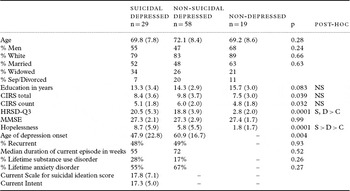
The three groups were similar in demographic characteristics and MMSE scores, although the burden of physical illness differed across groups, as non-depressed elders had lower levels of physical illness (omnibus ANOVA: p = 0.039; all post-hoc comparisons: not significant). Comorbid anxiety disorders and substance abuse/dependence were similarly prevalent in the two depressed groups. Suicidal depressed and non-suicidal depressed participants had similar levels of current depression severity, but suicidal elderly reported onset of depression at an earlier age (Table 1). Suicidal depressed elderly reported high levels of current suicidal ideation on the Beck Suicidal Ideation Scale (mean 17.8, SD = 7.1). For the 19 participants who had made a suicide attempt, mean medical lethality of the most recent attempt on the Beck Medical Lethality Scale was 4.2 (SD = 2) and respective mean suicide intent on the Beck Intent Scale was 17.3 (SD = 5), indicative of medically serious and determined suicide attempts.
Demographic and clinical characteristics by group

S = Suicidal depressed group; D = Non-suicidal depressed group; C = control, non-depressed
CIRS = Cumulative Illness Rating Scale; HRSD = Hamilton Rating Scale for Depression; MMSE = Mini-mental State Examination
NS = not significant
Perceived social support
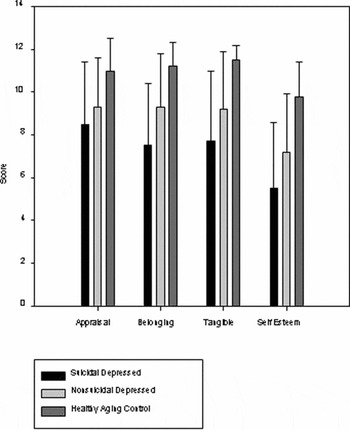
Suicidal depressed elderly reported the lowest levels of perceived overall social support as measured by the total ISEL score, followed by non-suicidal depressed elderly and non-depressed elderly (F[2, 99] = 15.93, p = 0.0001; post-hoc: suicidal depressed (S) < non-suicidal depressed (D) < non-depressed (C)) (Figure 1). Suicidal depressed elderly also reported the lowest levels of belonging (F[2, 99] = 9.94, p = 0.0001; post-hoc: S < D < C), tangible support (F[2, 99] = 9.28, p = 0.0002; post-hoc: S < D < C), and self-esteem (F[2, 99] = 12.96, p = 0.0001; post-hoc: S < D < C), as measured by the respective subscales of the ISEL. On the appraisal subscale, suicidal and non-suicidal depressed elderly had lower scores than non-depressed elderly (F[2, 99] = 6.66, p = 0.002; post-hoc: S,D < C), but the difference between the suicidal and non-suicidal depressed groups was not statistically significant.
Self-reported levels of perceived social support by group, as measured by Interpersonal Support Evaluation List subscores.
Lower scores indicate lower levels of perceived social support. Tukey post-hoc comparisons were used. Total ISEL score: F(2, 99) = 15.93, p = 0.0001. Appraisal: F(2, 99) = 6.66, p = 0.002. Belonging: F(2, 99) = 9.94, p = 0.0001. Tangible: F(2, 99) = 9.28, p = 0.0002. Self-esteem: F(2, 99) = 12.96, p = 0.0001.

Chronic interpersonal difficulties
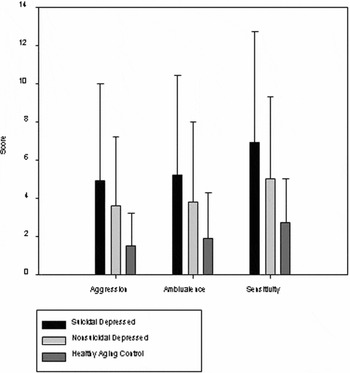
Suicidal depressed elderly reported significantly higher levels of chronic interpersonal difficulties as measured by the total IIP score when compared with non-depressed elderly (F[2, 93] = 4.26, p = 0.017; post-hoc: S > C) (Figure 2). This was also true for the aggression (F[2, 93] = 3.4, p = 0.038; post-hoc: S > C) and ambivalence (F[2, 93] = 3.59, p = 0.032; post-hoc: S > C) subscales of the IIP. The only subscale which did not show significant differences between the suicidal and non-depressed elderly groups was the sensitivity subscale (F[2, 93] = 2.76, p = 0.068). The level of chronic interpersonal difficulties in non-suicidal depressed participants was intermediate between the two other groups and did not significantly differ from them.
Self-reported levels of chronic interpersonal difficulties by group, as measured by Inventory of Interpersonal Problems subscores.
Lower scores indicate lower levels of chronic interpersonal difficulties. Tukey post-hoc comparisons were used. For IIP total score: F(2, 93) = 4.26, p = 0.017; Aggression: F(2, 93) = 3.4, p = 0.038; Ambivalence: F(2, 93) = 3.59, p = 0.032; Sensitivity: F(2, 93) = 2.76, p = 0.068.

Role of social support in the relationship between chronic interpersonal difficulties and suicide attempts/ideation
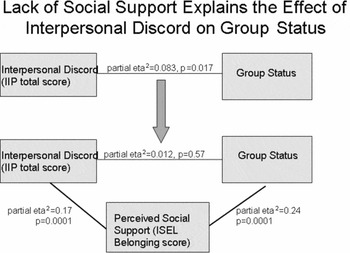
Lack of perceived social support was a significant intervening variable in the relationship between chronic interpersonal difficulties and suicidal behavior. When the ISEL total score (representing perceived social support) was entered into our general linear model, the relationship between IIP scores (representing chronic interpersonal difficulties) and group (suicidal, non-suicidal depressed, non-depressed) became weaker (partial η2 decreased from 0.10 to 0.008 and was no longer statistically significant (p = 0.68); Figure 3).
Illustration of how a lack of social support explains the effect of interpersonal discord on group status. Groups include suicidal depressed elderly, non-suicidal depressed elderly, or non-depressed elderly. IIP: Inventory of Interpersonal Problems; ISEL: Interpersonal Support Evaluation List.

Discussion
In our study, elderly people with suicide attempts and severe suicidal ideation reported low perceived social support, as manifested in the lack of a sense of belonging, tangible support, and self-esteem. They also reported more chronic interpersonal difficulties, particularly expressed in interpersonal aggression and ambivalence. The relationship between chronic interpersonal difficulties and suicidal behavior was partly explained by low perceived social support. These findings are consistent with the idea that depressed elderly who have difficulty dealing with rejection or criticism, struggle against others, and experience hostility in their relationships tend to feel a lack of social support, rendering them more likely to consider or attempt suicide.
Low perceived social support in late-life suicide
Old age is characterized by interpersonal losses and shrinking social networks, and psychological research suggests that those people who age successfully rely on self-regulation strategies and on smaller, closely knit social networks to deal with the sense that their life is limited (Lang and Carstensen, Reference Lang and Carstensen2002). Conversely, psychological autopsy studies implicate weak social supports and relationship problems in late-life suicide (Beautrais, Reference Beautrais2002; Duberstein et al., Reference Duberstein, Conwell, Conner, Eberly and Caine2004a; Duberstein et al., Reference Duberstein, Conwell, Conner, Eberly, Evinger and Caine2004b; Harwood et al., Reference Harwood, Hawton, Hope, Harriss and Jacoby2006). The perceived level of social support – the sense that one's needs are met and that one is needed – may be more important for psychological well-being than the objective availability of people in the social network (Sheldon Cohen, Reference Sheldon Cohen1983). Ideally, support is given unconditionally and no account is kept; however, in real life the quality of support is affected by the degree of dependency and interdependency between parties. This may be particularly true for frail elderly who become increasingly dependent on family and friends. For example, physical illness may suddenly increase demands for practical and emotional support, and chronic illness may exhaust support and put a constant strain on relationships. Another factor explaining low levels of perceived social support could be that long-standing depression erodes relationships, with guilt and worthlessness further distorting the perception of available support. Our finding of earlier depression onset in suicidal elderly, both in previous research (Szanto et al., Reference Szanto2007) and in this sample, are consistent with this notion.
Interpersonal difficulties and suggestions for further research in late-life suicide
Our findings suggest that a persistent pattern of poor interpersonal relationships, interpersonal sensitivity, struggle against others and hostility in relationships may be a key factor undermining perceived social support in elderly people at risk for suicide. Our research complements the findings of earlier psychological autopsy studies highlighting the contribution of conflict in important relationships to late-life suicidal behavior. In their psychological autopsy study of 100 suicides aged 60 and older, Harwood and colleagues found interpersonal problems – conflict being the most common – to be one of the three most frequent life problems associated with suicide, present in 55% of the cases and contributing to suicide in 31% (Harwood et al., Reference Harwood, Hawton, Hope, Harriss and Jacoby2006). Interestingly, however, interpersonal problems were no less frequent in matched controls, and no between-group differences were found. On the other hand, Duberstein and colleagues found that family discord was more common in 86 suicides aged 50 years and older than in matched controls – a difference that was no longer significant after accounting for current mental disorders (Duberstein et al., Reference Duberstein, Conwell, Conner, Eberly and Caine2004a). Thus, one may conclude from these studies that while older people who die by suicide often experience conflict in their relationships, the mere presence of conflict does not specifically predict suicide. In this context, our findings of increased chronic interpersonal difficulties in suicidal elderly suggest that an enduring sense of interpersonal ambivalence and vulnerability may not only precipitate conflict but also increase its emotional impact on vulnerable individuals.
The suggestion that a persistent pattern of poor interpersonal relationships may be a key factor undermining perceived social support in elderly at risk for suicide raises the question of what contributes to this persistent pattern in the first place. Difficulties in interpersonal relationships can reflect personality factors, although our findings do not directly link personality disorders to attempted or contemplated suicide. The literature is also not clear as to what particular personality profiles predispose elderly to suicidal behavior. Some studies link late-life suicide to emotional restriction and rigidity: low openness to experience has been found to be more common in elderly people who die by suicide than in mid-life suicide completers (Duberstein et al., Reference Duberstein, Conwell and Caine1994), and anxious and obsessional (anankastic) personality accentuation (Harwood et al., Reference Harwood, Hawton, Hope and Jacoby2001) has been associated with death by suicide in late life. On the other hand, lack of openness to experience was not related to attempted suicide in depressed older adults (Duberstein et al., Reference Duberstein, Conwell, Seidlitz, Denning, Cox and Caine2000) and was even found to be inversely associated with reported suicidal ideation (Heisel et al., Reference Heisel, Duberstein, Conner, Franus, Beckman and Conwell2006), indicating that risk factors for suicidal ideation, suicide attempts, and death by suicide may differ. The presence of a personality disorder has been associated with suicide attempts and death by suicide among older adults (Harwood et al., Reference Harwood, Hawton, Hope and Jacoby2001), although the prevalence of personality disorders among elders who attempt or die by suicide is lower than the figures reported for younger age groups (Appleby, Reference Appleby, Cooper, Amos and Faragher1999; Harwood et al., Reference Harwood, Hawton, Hope and Jacoby2001; Marttunen et al., Reference Marttunen, Henriksson, Aro, Heikkinen, Isometsä and Lönnqvist1995). A recent study of older adults with major depressive disorder found that dependent personality disorder in men and antisocial personality disorder in women increased the odds of suicide attempts, although borderline and narcissistic personality disorders were not assessed (Bolton et al., Reference Bolton, Belik, Enns, Cox and Sareen2008). In summary, while personality factors appear to play a role in late-life suicide, no firm conclusions can yet be drawn about traits or specific disorders that confer risk. This lack of agreement may indicate heterogeneity: it is possible that both emotionally restricted and emotionally unstable elderly are at risk. In this context, our data suggest that a dimensional assessment of personality and a focus on interpersonal function may help elucidate the pathways leading to late-life suicide.
Strengths and limitations
Our analyses benefited from a well-characterized clinical sample, which included elders with serious suicidal ideation and behavior. The inclusion of two control groups allowed us to account for the effects of depression. Our results were limited, however, by the relatively modest sample size and a cross-sectional, case-control design. Our cross-sectional design prevents us from drawing definitive conclusions about the relationship among chronic interpersonal difficulties, social support and suicidal behavior. In addition, it is possible that a fourth unmeasured (in this study) variable may account for interpersonal conflict, low social support and suicidality. For example, impulsivity and emotion regulation difficulties (Wilson et al., Reference Wilson, Fertuck, Kwitel, Stanley and Stanley2006; Reference Wilson, Stanley, Oquendo, Goldberg, Zalsman and Mann2007) have been associated with suicide in young adults and in mid-life, which may also undermine interpersonal relationships and limit social support. In addition, while we recruited every inpatient and outpatient who met the criteria for our study and agreed to participate, suicide attempters were over-represented on the inpatient unit, and so are over-represented in our sample as well. Since our observations are naturalistic, we cannot conclude that low perceived social support and chronic interpersonal difficulties play a causal role in the emergence of suicidal ideation and behavior. It is possible that both are related to a third causal factor, such as emotional dysregulation, or poor problem-solving. Further, this design did not allow us to examine whether low social support mediated the effects of chronic interpersonal difficulties on suicidal behavior. However, since such a relationship is psychologically plausible, we felt that the intervening variable analysis performed here was an important initial step in identifying such a relationship, to be tested further in longitudinal studies. The lack of a categorical assessment of DSM-IV or ICD-10 personality disorders did not allow us to further examine the correlates of chronic interpersonal difficulties. Next, although the severity of current depression was not different between the two depressed groups, longitudinal follow-up data are necessary to rule out a higher cumulative burden of depression in suicidal elderly people. Further, despite similar prevalence of substance use disorders in our depressed groups, we cannot rule out the possible effects of comorbid substance use disorders on the relationships of suicidal participants based on this relatively modest sample. We should also note that while our suicidal participants were predominantly inpatients, the non-suicidal depressed participants were mostly outpatients. We feel that such a difference is mostly due to current admission criteria established by U.S. third-party payers: suicidal ideation or attempt warrants admission, while serious depression by itself does not. Finally, it is unclear to what extent our findings generalize to older suicide victims.
Clinical implications
There are preliminary indications that direct support provided through a telephone-based service (de Leo et al., Reference de Leo, Dello Buono and Dwyer2002) or letters (Motto and Bostrom, Reference Motto and Bostrom2001) may reduce death by suicide. Our findings suggest that therapies that specifically target interpersonal conflict, for example interpersonal psychotherapy (Miller et al., Reference Miller, Frank, Cornes, Houck and Reynolds2003), have the potential to reduce suicide risk by enhancing the sense of social support. Our study also makes a case for involving family members in the treatment to improve communication, decrease cognitive distortions, and increase patients’ satisfaction with important relationships. Finally, our findings suggest that a history of interpersonal difficulties in a depressed older patient may be a predictor of suicidal behavior.
Case Vignettes
The first two case vignettes illustrate how chronic relationship difficulties may undermine perceived social support and precipitate suicidal behavior in the elderly. The third case vignette illustrates the protective effect of social support in an elderly patient with a similar severity of depression, in contrast to the first two cases.
1: Older woman with depression and suicide attempts
Mrs. A. is an 81 year-old widowed female with four past suicide attempts, three of which were by over-dose on medications. She has also been hospitalized three times with suicidal thoughts. Mrs. F said that her most recent suicide attempt was to get attention from her daughter, whom she felt was neglecting her. This daughter relates that Mrs. F often says unkind things to her family members, and seems uninterested in her grandchildren. Mrs. F is estranged from her other three children, and had a longstanding history of conflict with her husband before his death. Before her most recent suicide attempt, she also had an argument with the man she had been dating. (HAM-D: 20, ISEL Appraisal: 8, ISEL Belonging: 6, ISEL Tangible: 8, ISEL Self-esteem: 6)
2: Older man with depression and suicide attempts
Mr. B. is a 64-year-old married male with two past suicide attempts, one by electrocution and the other by shooting. His first attempt was in his 30s, when a woman he had been seeing left him; his second was in his 50s, when he and his wife were having marital problems and she walked out. Mr. B. has an extensive history of drug and alcohol dependence, and has been through several detoxification programs; his second suicide attempt was made after a night of drinking and cannabis use. He is also unable to work because of pain in his knees and back. Mr. B. has one biological daughter, with whom he has no contact. He lives with his wife, step-daughter, and step-grandson, and this living arrangement causes tension, as Mr. B. does not want his step-daughter living with them. Mr. B. believes that when his wife and step-daughter go out shopping together, they say bad things about him. (HAM-D: 34, ISEL Appraisal: 9, ISEL Belonging: 7, ISEL Tangible: 11, ISEL self-esteem: 5)
3 Older woman with depression and no history of suicidal behavior
Mrs. C. is a 74-year-old separated female, in her first lifetime episode of major depression. This episode began several years ago when she learned that one of her children had been murdered. Mrs. C.'s remaining children encouraged her to seek treatment, and have continued to be very supportive. Mrs. C. has always had a close relationship with her children. They help her to get out and socialize, arranging trips to New York City and taking her out to dinner on a regular basis. (HAM-D: 21, ISEL Appraisal: 12, ISEL Belonging: 9, ISEL Tangible: 9, ISEL self-esteem: 12)
Conflict of interest
None.
Description of authors’ roles
Katalin Szanto designed the study; Katalin Szanto and Alexandre Dombrovski collected the data; Alexandre Dombrovski, Katalin Szanto, Jennifer Morse and Patricia Houck planned the analyses; and Patricia R. Houck performed them. Katrin Harrison and Alexandre Dombrovski drafted the manuscript, and Katalin Szanto, Jennifer Morse, Maryann Schlernitzauer and Charles F. Reynolds edited the paper.
Acknowledgments
K. Szanto's NIMH career development award (MH070471) was the principal source of support for this work. Additional support was provided by P30 MH71944 (PI: C.F. Reynolds), the John A. Hartford Foundation and an NIMH career development award (MH086022; A.Y. Dombrovski), the American Foundation for Suicide Prevention (K. Szanto and A.Y. Dombrovski), and the UPMC Endowment in Geriatric Psychiatry (C.F. Reynolds).