INTRODUCTION
Rhizocephalan barnacles comprise approximately 260 marine and a few freshwater species and are endoparasites of other crustaceans, such as crabs and hermit crabs (Høeg & Lützen, Reference Høeg and Lützen1995). Adult rhizocephalans consist of an external reproductive portion (externa) and an internal trophic portion, referred to as the interna or root system. Although the externa is simplified and has no segmentation, they are recognized as Crustacea because of their planktonic larval stages (nauplii and cyprids). The rhizocephalan cyprids settle on their host and metamorphose to the endoparasitic adults.
Because many of the rhizocephalan hosts are benthic crustaceans and do not have long-range dispersal capabilities at the adult stage, the dispersal of rhizocephalans mainly occurs in their planktonic larval stage. The distribution of the host species is another limiting factor on the distribution range of the parasites, although the host specificity is not strict in some rhizocephalan species (Murphy & Goggin, Reference Murphy and Goggin2000; Gurney et al., Reference Gurney, Grewe and Thresher2006; Kuris et al., Reference Kuris, Goddard, Torchin, Murphy, Gurney and Lafferty2007; Yoshida et al., Reference Yoshida, Hirose and Hirose2014).
Oceanic islands have never been connected with other island groups and continents. Because many of the marine species around oceanic islands had to originally migrate from other islands and/or continents, the species richness in oceanic islands is often distinctly lower than the continental coast of similar latitudes (e.g. Roberts et al., Reference Roberts, McClean, Veron, Hawkings, Allen, McAllister, Mittermeier, Schueler, Spalding, Wells, Vynne and Werner2002; Robertson & Cramer, Reference Robertson and Cramer2009). For parasitic species, two conditions are necessary to establish a distribution on oceanic islands: long dispersal ability for both the parasite species; and any suitable host species. Therefore, on oceanic islands, the species richness of parasites on marine species is likely to be poor or the hosts are likely to be free from these parasites (Rohde, Reference Rohde1984, Reference Rohde2002), although little is known about the distribution of rhizocephalans in these locations.
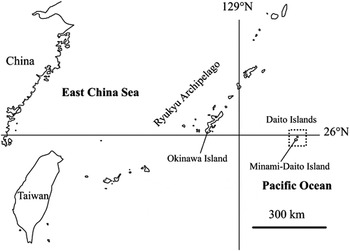
Minami-Daito (25°50′N 131°13′E) is an oceanic island located about 360 km east of Okinawa (a continental island), Ryukyu Archipelago, Japan. A remarkable contrast is observed between marine species on Okinawa and the Daito Islands. For example, coral species of Acropora and faviids are common on Okinawa but are not common on the Daito Islands while Astreopora colonies are not common on Okinawa Island but are rather abundant on the Daito Islands (Nonaka, Reference Nonaka2004). Fish fauna are also different between the two locations, with several species that are very rare or not recorded on Okinawa Island being common on the Daito Islands (e.g. Nonaka, Reference Nonaka2004; Koeda et al., Reference Koeda, Yoshino and Tachihara2013). The species richness of photosymbiotic didemnid (Ascidiacea) fauna is lower on Minami-Daito Island than on Okinawa (Hirose, Reference Hirose2014).
Rhizocephalans of the family Peltogastridae infest hermit crabs and some other anomurans. Four named peltogastrid species and four undescribed species have been recognized from Okinawa Island. To date, no records exist of rhizocephalan species and potential host hermit crabs from the Daito Islands. We collected eight species of hermit crabs from artificially hollowed tidal pools on Minami-Daito Island and found that one of the specimens was infested by a peltogastrid rhizocephalan. This is the first report of a peltogastrid from an oceanic island in the northern hemisphere.
MATERIALS AND METHODS
Hosts
Minami-Daito Island is located far east of Okinawa Island, Ryukyu Archipelago, Japan (Figure 1). Sampling was mainly undertaken in tidal pools (i.e. Shioya, Honba and Kaigunbo), because the coastline of the island is mostly cliffs. These tidal pools were hollowed artificially more than 30 years ago and utilized as swimming pools for local children. The maximum depths of each tidal pool were 1–3 m. We also surveyed the subtidal zone down to ~2 m at low tide off Yagimichi. Hermit crabs were located visually and collected by snorkelling. The gastropod shells of the hermit crabs were broken with a hammer to check for presence or absence of rhizocephalan externae on host abdomens. The rhizocephalan externa, including the shield and stalk, was removed from the host. The posterior part of an externa was preserved in 99.5% ethanol for DNA analysis, while the rest was preserved in Bouin's solution for morphological observation. Voucher specimens were deposited in the University Museum, Fujukan, University of the Ryukyus (RUMF). We also collected peltogastrids infesting hermit crabs Calcinus morgani and Calcinus vachoni from Sunabe, Okinawa Island (26°33.15′N 127°74.25′E) on 3 June 2012, for comparison with congeneric specimens.
Locations of Okinawa Island and Minami-Daito Island.

Morphological observation
The specimen fixed in Bouin's solution was placed in 70% ethanol. The posterior part (~1 mm) was dehydrated through an ethanol–xylene series and embedded in paraffin. Serial 10 µm thick sections were stained with Delafield's haematoxylin and eosin for light microscopy. The remaining externa, including the stalk and mantle aperture, was preserved in 70% ethanol, and external structures, such as the mantle aperture, were photographed. The terminology used in this study follows that of Høeg & Lützen (Reference Høeg and Lützen1985) and Høeg (Reference Høeg, Harrison and Humes1992).
DNA extraction, PCR amplification and sequencing
Tissue samples were preserved in ethanol at –30°C. Genomic DNA was extracted from externae using a DNeasy Tissue Kit (Qiagen, Limburg, The Netherlands) following the manufacturer's protocol. PCR amplification of the partial COI gene was performed using Ex Taq DNA Polymerase (Takara Bio Inc., Shiga, Otsu, Japan) and the primers crust-cox1f (Podsiadlowski & Bartolomaeus, Reference Podsiadlowski and Bartolomaeus2005) and HCO2198 (Folmer et al., Reference Folmer, Black, Hoeh, Lutz and Vrijenhoek1994) under the following conditions: 94°C for 5 min, followed by 35 cycles at 94°C for 30 s, 45°C for 30 s and 72°C for 2 min, with a final extension at 72°C for 7 min. PCR products were treated with ExoSAP-IT (GE Healthcare, Little Chalfont, Buckinghamshire, UK) prior to sequencing reactions. Sequencing reactions and sequencing were performed by Operon Bio Technology (Tokyo, Japan). The sequences were deposited in GenBank, the European Molecular Biology Laboratory (EMBL) and the DNA Data Bank of Japan (DDBJ) under Accession Numbers AB968035–968037.
Phylogenetic analysis
Initial alignments were performed using MUSCLE (Edgar, Reference Edgar2004). Pairwise base differences were calculated using PAUP*4.0 beta 10 (Swofford, Reference Swofford2003). The following analyses were performed on the aligned DNA sequences of the partial COI gene: phylogenetic analysis based on maximum likelihood (ML) using TREEFINDER (January 2008 version; Jobb, Reference Jobb2008); and maximum parsimony (MP) and neighbour-joining (NJ) using PAUP*4.0 beta10 (Swofford, Reference Swofford2003). To select an appropriate nucleotide substitution model, jModelTest 0.1.1 (Posada, Reference Posada2008) was used. The MP trees were examined using a heuristic approach with 100 random initial trees. Statistical support for the ML, MP and NJ trees was provided using a non-parametric bootstrap test with 1000 resampling events.
RESULTS
Individuals (N = 420) of nine species of hermit crabs were examined: Calcinus elegans (H. Milne Edwards, 1836) (N = 171, RUMF-ZC-03019); C. laevimanus (Randall, 1840) (N = 99, RUMF-ZC-03020); C. morgani Rahayu & Forest, 1999 (N = 86, RUMF-ZC-03021); C. vachoni Forest, 1958 (N = 49, RUMF-ZC-03022); C. guamensis Wooster, 1984 (N = 7, RUMF-ZC-03023); C. minutus Buitendijk, 1937 (N = 2, RUMF-ZC-03024); C. latens (Randall, 1840) (N = 1, RUMF-ZC-03025); Ciliopagurus strigatus (Herbst, 1804) (N = 5, RUMF-ZC-03026); and Dardanus guttatus (Olivier, 1811) (N = 1, RUMF-ZC-03027). One specimen of C. morgani bore the rhizocephalan externa of Dipterosaccus indicus Van Kampen & Boschma, Reference Van Kampen and Boschma1925, and its prevalence was 1.1%. Branchial bopyrids (RUMF-ZC-03028) were found on C. vachoni (one individual), with a prevalence of 2.0%. Species identification was not made for bopyrids in this study.
SYSTEMATICS
Superorder RHIZOCEPHALA Müller, 1862
Order KENTROGONIDA Delage, 1884
Family PELTOGASTRIDAE Lilljeborg, 1859
Genus Dipterosaccus Van Kampen & Boschma, Reference Van Kampen and Boschma1925
Dipterosaccus indicus Van Kampen & Boschma, Reference Van Kampen and Boschma1925
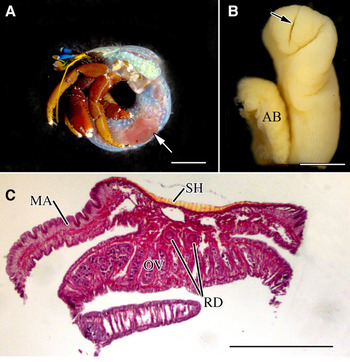
(Figure 2)
Dipterosaccus indicus: (A) host hermit crabs (Calcinus morgani) bearing externae (live specimen). White arrow indicates externa: (B) right side of externa in a fixed condition. Black arrow indicates mantle aperture opening; (C) cross-sections of externa. AB, a part of the abdomen of the host; MA, mantle; OV, ovary; RD, receptacle duct; SH, shield. Scale bars: A = 5 mm; B = 1 mm; C = 500 µm.

Dipterosaccus indicus: Boschma, Reference Boschma1931, p. 6; Van Baal, Reference Van Baal1937, p. 25; Boschma, Reference Boschma1955, p. 51, figures 1a–k, 2–5, 6c–j; Yoshida et al., Reference Yoshida, Hirose, Mok and Hirose2012, p. 1035, figures 2I–K; Yoshida et al., Reference Yoshida, Hirose and Hirose2013, p. 139–141, figures 2, 3, 7–13.
MATERIAL EXAMINED
Kaigunbo, Minami-Daito Island, 14 March 2013, subtidal, on Calcinus morgani male, shield length 5.0 mm, RUMF-ZC-03018, AB968035.
DESCRIPTION
Coloration in life
Externa pale red (Figure 2A).
External morphology
Externa irregularly elongated. Mantle aperture slightly projected toward stalk. Mantle aperture opening anteroposteriorly, slit-like in contracted specimen; length of mantle aperture 1.2 mm. Stalk width 0.92 mm (Figure 2B). Aperture wall thickness ~0.48 mm, with many wrinkles. Mantle with longitudinal wrinkles. Fusiform cuticular shield conspicuous, with growth rings and extending anteriorly and posteriorly from the stalk. Stalk containing ramifying chitinous structures.
Anatomy of externa
Mantle cavity filled without embryos. Mantle ~120 µm thick. Visceral mass extended laterally (Figure 2C). Two non-coiled receptacle ducts, spaced slightly apart from each other at ~40 µm.
REMARKS
The specimen examined was assigned to the genus Dipterosaccus, characterized by the visceral mass with lateral expansion. Two species belong to Dipterosaccus: D. indicus; and D. shiinoi Yoshida, Hirose & Hirose, Reference Yoshida, Hirose and Hirose2013. This specimen agrees well with D. indicus in the diagnostic aspects, such as the slit-like mantle aperture opening anteroposteriorly (Figure 2B). The mantle aperture opening is larger than the stalk width. Receptacle ducts were spaced slightly apart from each other, and this character state discriminated this specimen from D. shiinoi, in which the two receptacle ducts are attached laterally to each other.
MOLECULAR ANALYSES
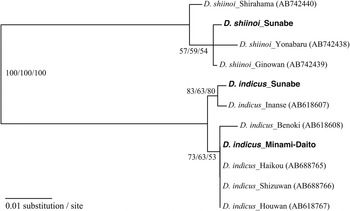
Phylogenetic analyses of the specimen were undertaken with eight haplotypes from two peltogastrid species, viz., D. indicus and D. shiinoi (Yoshida et al., Reference Yoshida, Osawa, Hirose and Hirose2011). We confined our analysis to a specific subset of 547 base pairs of the partial COI sequences. The aligned amino acid sequences contained no insertion/deletion. The partial COI sequence of D. indicus from Minami-Daito Island was identical to those from three sites in Taiwan: Kaoshiung (Shizuwan); and Kenting (Haikou and Houwan).
For data with all codon positions, the general time-reversible model with gamma distribution (GTR + G) was selected as the best model according to the Akaike information criterion. Therefore, we chose the GTR + G substitution model for the ML and NJ analyses. Figure 3 shows the un-rooted ML tree using this model. Because the topologies of the ML, MP and NJ phylogenetic trees were nearly identical, the latter three are not shown. The monophyly of each of D. indicus and D. shiinoi was supported by high bootstrap values.
Un-rooted maximum likelihood (ML) tree of partial mtCOI gene sequences of Dipterosaccis indicus and D. shiinoi. The GTR + G substitution model was used for the analysis. Bootstrap values higher than 50% are shown near the nodes for the ML, maximum parsimony and neighbour joining analyses. New sequences from this study are in bold.

DISCUSSION
Little is known about the rhizocephalans from oceanic islands, although some records exist from three areas in the tropical South Pacific. Sacculina carpiliae Guérin-Ganivet, 1911 was found to parasitize Lybia tessellate (Latreille, in Milbert, 1812) from the Gilbert Islands (Boschma, Reference Boschma1949). Sacculina inconstans Boschma, Reference Boschma1952 was found to parasitise Liomera bella from the Gilbert Islands (Boschma, Reference Boschma1952). Sacculina leptodiae Guérin-Ganivet, 1911 and Thompsonia sp. were found to parasitize Leptodius exaratus (H. Milne Edwards, 1834) and Alpheus malleodigitus (Spence Bate, 1888), respectively, from Fiji (Boschma, Reference Boschma1950). Temnascus foresti Boschma, Reference Boschma1951 parasitizing Calcinus spicatus Forest, 1951 has been described from the Gambier Islands (Boschma, Reference Boschma1951). The present record of Dipterosaccus indicus is the first record of a rhizocephalan from an oceanic island in the northern hemisphere.
The current specimen was identified as D. indicus based on the diagnostic characters of its external and internal morphologies. Molecular analyses based on a partial sequence of the COI gene were consistent with this identification. The specimen examined did not have any embryos in its mantle cavity. We assumed that the specimen had finished releasing larvae because numerous rings were on the cuticular shield (Figure 2C). In peltogastrid rhizocephalans, these rings on the shield are formed when the external cuticle is moulted (Lützen, Reference Lützen1987), and virgin externa have few rings and never moult until the male cyprid attach externa. This indicates that both males and females are distributed on Minami-Daito Island, and that the current specimen has released larvae several times.
Dipterosaccus indicus is known to infest some diogenid hermit crabs, mainly Calcinus species. This species was originally described from Atiationin Island (Indonesia) and recorded from Indonesia (Atiationin, Biak, Sula, Talaud and Tenimber Islands), Taiwan (Kenting) and the Ryukyu Islands (Okinawa Island and Irabu Island) (Van Kampen & Boschma, Reference Van Kampen and Boschma1925; Van Baal, Reference Van Baal1937; Boschma, Reference Boschma1955; Yoshida et al., Reference Yoshida, Hirose, Mok and Hirose2012, Reference Yoshida, Hirose and Hirose2013). Several host species are known for D. indicus, and the host on Minami-Daito Island, C. morgani, is the same as that in Taiwan and on Okinawa Island. Dipterosaccus indicus was monotypic for nearly 90 years, a second species, D. shiinoi, was recently described from the coasts of mainland Japan and the Ryukyu Islands (Yoshida et al., Reference Yoshida, Hirose and Hirose2013). The distribution ranges of the two species partly overlap on Okinawa Island. Calcinus vachoni is the only known host of D. shiinoi, and the prevalence of D. shiinoi is ~20% on Okinawa Island (Ryukyu Archipelago) and Shirahama (Kii Peninsula, mainland of Japan). In this study, we collected 49 individuals of C. vachoni, but we found no rhizocephalans on this species on Minami-Daito Island. The ability to disperse over long distances may be different between the two Dipterosaccus species. Høeg & Lützen (Reference Høeg and Lützen1985) reported a considerable difference in the duration of nauplius stage in two peltogastrid species; the duration is 10 days in Peltogaster paguri Rathke, 1842 and 15 days in Peltogasterella sulcata (Lilljeborg, 1859) at 10°C.
Two other peltogastrid rhizocephalans were recorded from Okinawa Island: Peltogaster postica Yoshida & Osawa, in Yoshida, Osawa, Hirose, & Hirose, Reference Yoshida, Osawa, Hirose and Hirose2011 on Pagurus minutus Hess, 1865; and Ommatogaster nana Yoshida & Osawa, in Yoshida, Osawa, Hirose, & Hirose, Reference Yoshida, Osawa, Hirose and Hirose2011 on Diogenes leptocerus Forest, 1956 (Yoshida et al., Reference Yoshida, Osawa, Hirose and Hirose2011). We did not collect either of these peltogastrids or their potential host hermit crabs from Minami-Daito Island. Although these hosts usually inhabit tidal flats at a river mouth on Okinawa Island, no tidal flats exist on Minami-Daito Island, and the coastline mostly consists of steep cliffs. The number of species may be limited by the lack of diversity in the structure and condition of the coastline, as well as the dispersal abilities of the peltogastrids and their hosts.
ACKNOWLEDGEMENTS
We thank Dr Jason Williams (Hofstra University) and an anonymous referee for reviewing this manuscript and providing useful comments on it. This study was supported by the International Research Hub Project for Climate Change and Coral Reef/Island Dynamics from University of the Ryukyus.