Introduction
Johann Frederich Horner, a Swiss ophthalmologist, was the first to describe Horner's syndrome, in 1869. It is characterised by a triad of miosis, ptosis and anhydrosis. Occasionally, the additional sign of enophthalmos is present.Reference Costello, Salmon, Milford and Pretorius1 Horner's syndrome is uncommon in all age groups but has been well documented following penetrating neck injuries. Its reported incidence in blunt trauma patients is only 0.08 per cent.Reference Starr, Shubert and Baumann2
Sexual asphyxia is a potentially fatal sexual paraphilia. It is known by other terms including hypoxyphilia, autoerotic asphyxia and asphyxiophilia.
Blunt carotid artery injury is becoming an increasingly recognised phenomenon caused by trauma to the neck region, which results in disruption of the intimal layer of the carotid artery and formation of a dissection, pseudoaneurysm, thrombosis or even a fistula.
Case report
A 54-year-old, previously fit and well woman presented to the accident and emergency department with a left Horner's syndrome. She also complained of a left-sided headache and pulsatile tinnitus with a similar onset time, but was otherwise well. She denied any trauma, neck stiffness, confusion or drowsy episodes. She had no past medical or surgical history. She had never smoked, and consumed 20–30 units of alcohol per week.
On examination, she was apyrexial with a blood pressure of 140/80 mmHg and a regular heart rate of 90 beats per minute. The chest was clear and the heart sounds normal. Full neurological examination was unremarkable, with no sensory or motor deficits and normal deep tendon reflexes. Cerebellar examination and all cranial nerve functions were normal, except for the third cranial nerve as described below.
Eye examination revealed a left upper eyelid droop of 2 mm compared with the right side. The left pupil was 3 mm in diameter, compared with 5 mm on the right. Eye movements and fundoscopy were normal, with 6/6 vision.
Neck auscultation revealed no carotid bruits.
An audiogram revealed symmetrical tracing on pure tone thresholds, and a normal tympanogram.
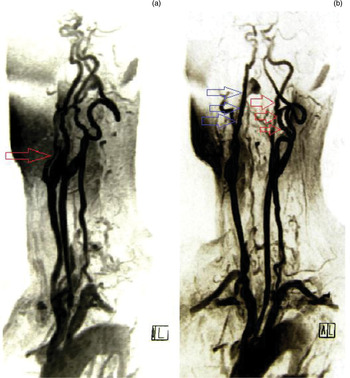
A chest X-ray, brain computed tomography (CT) scan, and neck and cervical spine magnetic resonance imaging (MRI) scans were normal. Following discussion with the radiologists, magnetic resonance angiography was undertaken, which showed narrowing of the left external carotid artery but no evidence of dissections, pseudoaneurysms, thromboses or fistulae in the internal or common carotid artery (Figure 1). Given the degree of injury to the external carotid, we concluded that some type of blunt injury to the carotid sheath or internal carotid artery must have occurred, even though there was no radiological evidence.
Magnetic resonance angiography images showing (a) narrowing of the left external carotid artery (arrow), and (b) evidence of luminal irregularity in the left internal carotid artery (red arrows) and right internal carotid artery (blue arrows).

At a follow-up clinic appointment, we revisited the patient's history in an attempt to identify any new information. She very reluctantly gave a history of sexual asphyxia, describing regular episodes during sexual intercourse with her husband during which she would ask him to strangle her with a handkerchief. This act did not occur every time they had intercourse. The last episode had been two weeks before she had presented to the accident and emergency department, and her symptoms had started the day after. The patient reported that her husband would cease to strangle her in this way once she had reached the peak of sexual arousal. She denied any black-outs during these acts, and also denied dysphagia, shortness of breath, upper or lower limb weakness, or visual disturbances.
We advised the patient that this practice was the most likely cause of her Horner's syndrome, and emphasised the dangers of such sexual practices, of which she was already well aware. As both the adults involved were fully competent and consenting, no further action was taken.
The patient was commenced on aspirin 150 mg once daily. She was followed up for nine months, with no symptom improvement or any other neurological sequelae.
Horner's syndrome
Horner's syndrome results from disruption of the sympathetic nervous supply to the eye and face.Reference Costello, Salmon, Milford and Pretorius1, Reference Starr, Shubert and Baumann2 The first order central fibres arise from the posterior hypothalamus and descend down the brainstem to terminate in the spinal cord between the eighth cervical and second thoracic vertebrae.Reference Costello, Salmon, Milford and Pretorius1, Reference Starr, Shubert and Baumann2 The second order pre-ganglionic neurons arise at the first thoracic vertebra and run near the apex of the lung to terminate in the superior cervical ganglion.Reference Costello, Salmon, Milford and Pretorius1 The superior cervical ganglion (extending from the first to the fourth cervical vertebrae) lies within the carotid sheath in the neck and gives out post-ganglionic fibres which ascend with the internal carotid artery into the skull to supply the dilator pupillae and smooth muscle component of the levator palpebrae superioris. The post-ganglionic fibres achieve this by following the trigeminal nerve (ophthalmic division) and abducens nerve into the orbit.Reference Costello, Salmon, Milford and Pretorius1 Other fibres leave the ganglion and follow the external carotid artery; these regulate the sweat glands and the vasomotor function of the face.Reference Costello, Salmon, Milford and Pretorius1
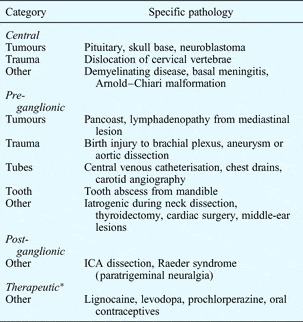
Table I summarises the aetiology of Horner's syndrome.Reference Fabian, Patton, Croce, Minard, Kudsk and Pritchard1,Reference Miller, Fabian, Bee, Timmons, Chamsuddin and Finkle3
Aetiology of horner's syndromeReference Costello, Salmon, Milford and Pretorius1, Reference Chan, Paine and O'Day3

* Can affect any part of the neural pathway. ICA = internal carotid artery
Blunt carotid artery injury
The most common mechanism of blunt carotid artery injury is a motor vehicle accident in which there is no apparent direct injury to the neck but the internal carotid artery is either stretched over the cervical vertebrae, compressed between the upper cervical vertebrae and the angle of the mandible, or impinged upon by the styloid process.Reference Fabian, Patton, Croce, Minard, Kudsk and Pritchard4–Reference Miller, Fabian, Bee, Timmons, Chamsuddin and Finkle7
There are five grades of carotid artery injury: I, indicating an irregular vessel wall or dissection with less than 25 per cent luminal stenosis; II, intraluminal thrombus or dissection with more than 25 per cent luminal stenosis; III, pseudoaneurysm; IV, occluded vessel; and V, transected vessel.Reference Cothren, Moore, Biffl, Ciesla, Ray and Johnson8
Patients admitted with blunt injuries to any part of their body have up to a 1 per cent chance of also having a blunt carotid artery injury, although the exact proportion varies between studies.Reference Cogbill, Moore, Meissner, Fischer, Hoyt and Morris6–Reference Cothren, Moore, Biffl, Ciesla, Ray and Johnson8 In Fabian and colleagues' study, the mortality rate of blunt carotid injury was 31 per cent, and more than three-quarters of deaths were directly related to strokes resulting from the carotid injury.Reference Fabian, Patton, Croce, Minard, Kudsk and Pritchard4
The most common situations prompting investigation for blunt carotid injury are development of neurological deficit after initial hospital admission, and neurological findings that do not correlate with normal CT and MRI results. In Cothren and colleagues' study, Horner's syndrome was the clinical prompt in 9 per cent of cases, and neck soft tissue injury in 14 per cent.Reference Cothren, Moore, Biffl, Ciesla, Ray and Johnson8
Angiography is the diagnostic investigation of choice for blunt carotid injury.Reference Fabian, Patton, Croce, Minard, Kudsk and Pritchard4, Reference Cothren, Moore, Biffl, Ciesla, Ray and Johnson8 The vast majority of these lesions occur in the internal carotid artery, and usually start with intimal disruption.
Sexual asphyxia
Sexual asphyxia is a paraphilia in which there is the desire for hypoxia-induced enhancement of sexual gratification and orgasm, attained by strangulation, smothering, chest compression and/or inhalation of volatile substances.
There is a lack of detailed insight into sexual asphyxia as individuals who practise it rarely seek help; most of what is known comes from cases in which there has been a resulting death.Reference Blanchard and Hucker9 The deceased usually has evidence of sexual activity and of a failed self-rescue mechanism in their self-induced hypoxia device.Reference Blanchard and Hucker9, Reference Byard, Hucker and Hazelwood10 These features help to differentiate such cases from attempted suicide or homicide.Reference Byard, Hucker and Hazelwood10 Sexual asphyxia is usually practised as a solitary activity in a confined, isolated place where techniques such as strangulation, suffocation and, most commonly, self-hanging are employed.Reference Byard, Hucker and Hazelwood10 Sexual asphyxia is also known to be practiced with partners.Reference Byard, Hucker and Hazelwood11 Women who carry out sexual asphyxia do not tend to use unusual devices or clothing during their practices, in contrast to men.Reference Byard, Hucker and Hazelwood10, Reference Hucker12 Individuals who practise it are usually aware of the risks, and use safety mechanisms to prevent accidental death. In most cases of sexual asphyxia deaths, family and friends are left in a shocked state as the deceased had led an otherwise completely normal life, with healthy relationships and committed partners.
The known prevalence of sexual asphyxia is based on mortality rates. In the United States, the annual male death rate from sexual asphyxia is 500–1000 cases.Reference Byard, Hucker and Hazelwood10 The vast majority of patients are men younger than 40 years old; it is rarely reported in women and has a less obvious presentation in this group.Reference Blanchard and Hucker9–Reference Byard, Hucker and Hazelwood11 Practising individuals tend to be articulate and willing to discuss their sexual lifestyle.
Treatment comprises a combination of cognitive behavioural therapy and medication such as amyl nitrite, which produces similar sensations of cerebral anoxia and gives sexual gratification with far fewer risks.
Discussion
One may imagine that a large amount of force would be required to disrupt the sympathetic chain from the internal carotid artery. However, Horner's syndrome has been reported following fairly low-velocity softball injuries to the neck.Reference Shievink, Atkinson, Bartleson and Whisnant5 Horner's syndrome occurs in blunt carotid artery injury when intimal damage stretches the sympathetic plexus and disrupts the superior sympathetic ganglion, which can result from minor trauma or repeated injury over a period of time, as in our case. Our patient's MRI angiography showed external carotid artery injury. The close proximity of the external carotid artery to the internal carotid artery would explain how the latter was also affected. Although it is recognised that blunt carotid injury can occur without any radiological signs, there is a rationale for screening high risk trauma patients for such an injury, as early diagnosis and treatment improves outcomes.Reference Starr, Shubert and Baumann2, Reference Fabian, Patton, Croce, Minard, Kudsk and Pritchard4
In patients with partial arterial disruption, the preferred treatment choice is anticoagulation for three to six months to diminish clot formation at the injury site and to minimise clot propagation, embolisation and resulting cerebral ischaemia. For most lesions, surgical and interventional radiological management carries a high risk of occlusion and ischaemic events, and the site of injury can be anatomically difficult to access.Reference Fabian, Patton, Croce, Minard, Kudsk and Pritchard4, Reference Cogbill, Moore, Meissner, Fischer, Hoyt and Morris6, Reference Cothren, Moore and Ray13 Heparin is the initial anticoagulant of choice, then continuation with warfarin. Antiplatelet drugs have also been used, especially when there is a contraindication to heparin. Regarding prognosis, patients with Horner's syndrome fall into the minor neurological deficit category, in which anticoagulation stops symptom deterioration but does not improve existing symptoms.Reference Fabian, Patton, Croce, Minard, Kudsk and Pritchard4 However, in patients in the major neurological deficit category (e.g. hemiparesis, hemiplegia and a Glasgow coma score of less than 8), approximately half experience symptom improvement.Reference Fabian, Patton, Croce, Minard, Kudsk and Pritchard4 Follow-up angiography is not always necessary, but has demonstrated natural repair of some lesions post-anticoagulation.
• Horner's syndrome requires thorough investigation
• In Horner's syndrome patients, blunt carotid injury may result from minor or repeated trauma, with or without radiological signs
• Anticoagulation is the treatment of choice for blunt carotid injury
Medical practitioners should have a high index of suspicion for blunt carotid injury in patients with Horner's syndrome and ipsilateral headache or neck pain, tinnitus, or symptoms consistent with cerebral ischaemia; these are all signs of internal carotid artery injury. A background of arterial disease should be suspected, and in young patients a careful history should be taken to exclude connective tissue disease or fibromuscular dysplasia.Reference Chan, Paine and O'Day3, Reference Shievink, Atkinson, Bartleson and Whisnant5