Evaluation of the right ventricle has long been the Holy Grail in adult and paediatric cardiology, mostly because of its complex morphological architecture, and the wide variability of physiological conditions in which it must function. The advent of cardiac magnetic resonance imaging has enabled clinicians to obtain specific qualitative and quantitative information about the right ventricle, thereby allowing further study of its role in normal and abnormal haemodynamic settings. The clinical significance of the data, and its impact on outcome, however, can be difficult to glean because of the different combinations of abnormal morphology and physiology associated with congenitally malformed hearts before and after intervention. In this brief review, we discuss the role of the diseased right ventricle in lesions such as tetralogy of Fallot, Ebstein’s malformation, those palliated by conversion to the Fontan circulation, and surgically and congenitally corrected transposition.
Right ventricular morphology
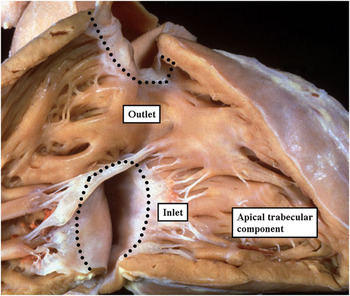
The right ventricle is composed of three anatomical and functional components. The inlet extends from the atrioventricular junction to the attachments of the tricuspid valvar tension apparatus, the apical component, with its coarse trabeculations, extends beyond the valvar attachments to the ventricular apex, and the outlet is the free-standing muscular infundibular sleeve supporting the pulmonary valvar leaflets at the ventriculo-arterial junction (Fig 1). Incomplete right ventricles, as seen in double inlet left ventricles or tricuspid atresia, lack the inlet component, but are still recognisable by their coarse apical trabeculations and delimiting coronary arteries, the latter supplying septal perforating branches. In pulmonary atresia with intact ventricular septum, mural hypertrophy can result in obliteration of the apical cavity followed by the outlet cavity, and, although all three components are present, the right ventricular cavity may be represented only by the inlet component.
The morphologically right ventricle extends from the atrioventricular to the ventriculo-arterial junctions, and can be divided into the inlet, apical trabecular, and outlet components.

The normal right ventricle is characterised by septal attachments of the leaflets of the tricuspid valve, a prominent septomarginal trabeculation, or septal band, reinforcing the septal surface, and a muscular infundibulum lifting the leaflets of the pulmonary valve away from the cardiac base. Little of the normal muscular septum separates the ventricular outlets. The small membranous component of the ventricular septum is crossed by the hinge of the septal leaflet of the tricuspid valve, thereby dividing it into atrioventricular and interventricular components.
The tricuspid valve has septal, antero-superior, and inferior leaflets, the septum being posterior when the right ventricle sits normally within the chest. The pulmonary valve also has three leaflets, with their basal parts supported by infundibular musculature, and the distal parts attached at the sinutubular junction. Defining the annulus can be problematic. Surgeons identify the semilunar hinges as the annulus, though the attachments form a crown shape and not a planar ring. Echocardiographers identify the basal attachments as the annulus, with no anatomical structure corresponding to this virtual ring. The true annulus, in the sense of a well-defined anatomical structure, is the anatomic ventriculo-arterial junction, which is crossed by the semilunar valvar hinges.
Some have suggested that the ventricular mass is arranged in a manner comparable with skeletal musculature, with myocytes organised as a unique myocardial band originating from the aorta and inserting into the pulmonary trunk.Reference Torrent-Guasp, Kocica and Corno1 This notion is not supported by anatomical evidence.Reference Anderson, Ho, Redmann, Sanchez-Quintana and Lunkenheimer2 All histological and anatomical investigations have shown that myocytes are aggregated together in a three-dimensional mesh supported by a fibrous tissue matrix, but with an obvious “grain” representing the long axis of the aggregates. In the normal right ventricle, this “grain” permits recognition of obliquely arranged and reciprocal endocardial and epicardial regions. In hearts with hypertrophied right ventricles, such as seen in tetralogy of Fallot, it is possible to recognise a middle circumferential region of aggregated myocytes.
Volume-loaded right ventricle after repair of tetralogy of Fallot
Late symptoms after repair of tetralogy of Fallot include reduced functional performance, arrhythmia, and sudden death. Poor outcome is associated with right ventricular dilation and failure, with pulmonary regurgitation being the most significant risk factor. Magnetic resonance imaging can assess the degree of pulmonary regurgitation by measuring right ventricular size and function, as well as the regurgitant fraction. Regurgitant volume, unlike regurgitant fraction, may be a more appropriate measure of pulmonary regurgitation, as it accounts for changes in right ventricular preload.Reference Wald, Redington and Pereira3
Excluding valvar dysfunction, the determinants of the severity of regurgitation include elevated afterload and right ventricular diastolic dysfunction. Increased airway pressure, which increases pulmonary vascular resistance, and simulated unilateral stenosis of the right and left pulmonary arteries exacerbate pulmonary regurgitation in symptomatic post-operative patients late after repair,Reference Chaturvedi, Kilner, White, Bishop, Szwarc and Redington4 suggesting the need for early aggressive treatment of residual pulmonary arterial stenosis. Right ventricular restrictive physiology, as evidenced by antegrade diastolic flow in the pulmonary trunk,Reference Redington, Penny, Rigby and Hayes5 is common after surgical repair, and is associated with less cardiomegaly and better exercise performance than is found in those with normal diastolic function.Reference Gatzoulis, Clark, Cullen, Newman and Redington6 Patients with right ventricular enlargement and QRS prolongation greater than or equal to 180 milliseconds on the electrocardiogram, nonetheless, are at increased risk for sustained ventricular tachycardia.Reference Gatzoulis, Till, Somerville and Redington7 In addition, depolarisation/repolarisation abnormalities increase the risk for ventricular tachycardia,Reference Gatzoulis, Till and Redington8 and are associated with abnormalities of right ventricular mural motion.Reference Vogel, Sponring, Cullen, Deanfield and Redington9 The most significant risk factors for ventricular tachycardia and sudden death include prolonged QRS, increased QRS rate of change, and pulmonary regurgitation, whereas tricuspid regurgitation and older age at repair increase the risk for atrial tachyarrhythmia and sudden death.Reference Gatzoulis, Balaji and Webber10
An unfavourable ventricular-ventricular interaction, with associated right and left ventricular dysfunction, has been described in older patients after repair.Reference Davlouros, Kilner and Hornung11 In addition, the combination of significant left ventricular systolic dysfunction and a QRS duration greater than or equal to 180 milliseconds is highly predictive of sudden death.Reference Ghai, Silversides, Harris, Webb, Siu and Therrien12 Dys-synchrony is also an important determinant of ventricular arrhythmia during exercise,Reference D’Andrea, Caso and Sarubbi13 and biventricular resynchronisation pacing has improved left ventricular function in a patient with severe biventricular dysfunction.Reference Kirsh, Stephenson and Redington14
The timing of replacement of the pulmonary valve has been a source of controversy. Recent guidelines list severe pulmonary regurgitation, symptoms, and decreased exercise tolerance as class I indications.Reference Warnes, Williams and Bashore15 Replacement of the valve has resulted in improved capacity to exercise,Reference Eyskens, Reybrouck and Bogaert16 decreased arrhythmic risk,Reference Therrien, Siu and Harris17 and decreased right ventricular volumes,Reference Therrien, Provost, Merchant, Williams, Colman and Webb18, Reference Oosterhof, van Straten and Vliegen19 though normalisation of volumes occurs only when the pre-replacement right ventricular end-diastolic volume is less than 150–170, and the end-systolic volume is less than 82–85 millilitres per metre squared.Reference Therrien, Provost, Merchant, Williams, Colman and Webb18–Reference Buechel, Dave and Kellenberger20
Right ventricle after balloon pulmonary valvotomy
Balloon valvotomy for valvar pulmonary stenosis may produce clinically significant problems, but current understanding of right ventricular dysfunction is based on patients with a transannular right ventricular outflow patch, or a dysfunctional right ventricular-to-pulmonary arterial conduit. In the patient with pulmonary regurgitation after balloon valvotomy, the right ventricle is entirely muscular, and contains no prosthetic tissue. It has not been exposed to cardiopulmonary bypass. There is usually no intracardiac shunt, nor additional volume load to the right ventricle. The pulmonary arteries and left ventricle are normal in morphology and calibre. Replacement of the pulmonary valve should be undertaken before the development of irreversible right ventricular dysfunction, recognising that there is no durable replacement currently available, and further intervention will likely be necessary.
Replacement after balloon pulmonary valvotomy is uncommon when compared with surgical procedures involving the right ventricular outflow tract. Transcatheter treatment of valvar pulmonary stenosis has been used for less than 30 years, and right ventricular dysfunction may still become a significant problem in the future. Patients with pulmonary regurgitation after balloon valvotomy may provide a non-surgical group for future study, and their right ventricles should be followed closely.
Dominant right ventricle after Fontan palliation
Many studies have suggested that the long-term outcome after Fontan palliation may not be as good for those patients with a dominant right ventricle compared with a dominant left ventricle. The Fontan circulation appears to increase the demand on the systemic ventricle by imposing a mismatch between contractility and arterial load.Reference Szabo and Bahrle21 Theoretical models predict a reduced ventricular end-systolic elastance, or contractility, associated with increased arterial elastance, or afterload, and ventricular mural stress,Reference Nogaki, Senzaki and Masutani22 a phenomenon that has been shown in animal models,Reference Szabo, Buhmann and Graf23 and in patients after the Fontan procedure.Reference Tanoue, Sese, Ueno, Joh and Hijii24 According to the law of Laplace, increased wall stress should result in acquisition of muscle mass and increased wall thickness, though this response may be impaired in patients with a dominant right ventricle, further increasing the ventricular wall stress in these patients.Reference Sano, Ogawa and Taniguchi25
Early experience with the Fontan operation suggests higher rates of mortality and complications in patients with a dominant right ventricle, presumably related to low cardiac output.Reference Matsuda, Kawashima and Kishimoto26 These patients show a lower ratio of ventricular mass to end-diastolic volume compared with those having normal cardiac output. Recent experience reveals similar rates for early and late mortality, Fontan takedown, circulatory failure, protein-losing enteropathy, and arrhythmia in patients with a dominant right ventricle compared with those having a dominant left ventricle.Reference Tweddell, Nersesian and Mussatto27 The Pediatric Heart Network multi-centre study reveals that, although systemic ventricular function may be depressed in those with dominant right ventricles, the ratio of mass to volume of the systemic ventricle, as well as peak systemic consumption of oxygen during exercise and anaerobic threshold, is similar to values achieved by those with dominant left ventricles.Reference Anderson, Sleeper and Mahony28
Systemic right ventricle in surgically and congenitally corrected transposition
In post-operative patients with concordant atrioventricular but discordant ventriculo-arterial connections, in other words transposition, after surgical correction at the atrial level, or in those with congenitally corrected transposition, the systemic right ventricle is at risk for long-term failure for several reasons. Unlike the left ventricle, which pumps blood into the systemic vascular bed with its high afterload, the right ventricle is designed to pump blood into the pulmonary vascular bed with its low afterload. The predominantly longitudinal orientation of the aggregated right ventricular cardiomyocytes is different from the predominantly circumferential orientation of the left ventricular myocytes. There is also unequal arterial perfusion, with one coronary artery supplying the right ventricle, and two supplying the left ventricle. Myocardial perfusion defects are common late after surgical correction at the atrial level, and correlate well with impaired biventricular function,Reference Lubiszewska, Gosiewska and Hoffman29 whereas coronary arterial flow reserve is decreased in patients with congenitally corrected transposition.Reference Hauser, Bengel and Hager30 In addition, cardiac magnetic resonance imaging in patients after surgical atrial redirection often reveals late enhancement with gadolinium, suggestive of myocardial fibrosis, and its extent correlates with age, ventricular function, prolonged QRS duration, arrhythmia, and syncope.Reference Babu-Narayan, Goktekin and Moon31
The pathophysiological mechanisms for long-term outcome appear to be different between the two groups of patients with systemic right ventricles. For example, the response to exercise in patients with congenitally corrected transposition involves an increase in heart rate and stroke volume, whereas patients after surgical atrial redirection respond only with increases in heart rate.Reference Winter, van der Plas, Bouma, Groenink, Bresser and Mulder32 In patients after surgical atrial redirection, late mortality is between 5% and 7%, and about four-fifths survive to 30 years of age.Reference Moons, Gewillig and Sluysmans33, Reference Dos, Teruel and Ferreira34 Ventricular systolic dysfunction occurs in less than one-tenth at mid-term follow-up,Reference Reich, Voriskova and Ruth35 though more than three-fifths of these patients have moderate-to-severe right ventricular systolic dysfunction 25 years after surgery.Reference Roos-Hesselink, Meijboom and Spitaels36 In this group, tricuspid regurgitation appears to be secondary to annular dilation from right ventricular failure.Reference Warnes37 In patients with congenitally corrected transposition, congestive cardiac failure is common after 40 years of age, and is strongly associated with tricuspid regurgitation.Reference Graham, Bernard and Mellen38 Almost three-quarters of these patients are still alive after 20 years, and tricuspid regurgitation is the only independent risk factor for death.Reference Prieto, Hordof, Secic, Rosenbaum and Gersony39 Here, tricuspid regurgitation is associated with right ventricular dilation and dysfunction. Whether it is a cause or an effect, however, remains controversial.
Right ventricle in Ebstein’s malformation
The essence of the lesion is failure of delamination of the septal and inferior leaflets of the tricuspid valve, with anterior and apical rotation of the functional orifice and valvar hinge points.Reference Seward40 Ventricular dysfunction is nearly universal, with significant dilation and dysfunction of the right-sided cardiac chambers. The left ventricle is often compressed by the dilated right side, and left ventricular systolic dysfunction can be present. Associated anomalies are common, and include defects of the oval fossa, accessory atrioventricular conduction pathways, and cardiomyopathy, mostly of the right ventricle. Less common anatomic features include right ventricular outflow obstruction or atresia, ventricular septal defect, mitral valvar prolapse, and left ventricular non-compaction.
Unlike the septal and inferior leaflets, which are displaced from the atrioventricular junction, the antero-superior leaflet is sail-like and redundant, and has multiple attachments to the ventricular myocardium. Significant tricuspid regurgitation, profound dilation of the right atrium, atrialisation of the inlet of the right ventricle, and muscular hypertrophy of the functional right ventricle are also common. Complications include progressive cardiomegaly secondary to right ventricular global dysfunction and tricuspid regurgitation, cyanosis and potential paradoxical embolic events secondary to atrial right-to-left shunting, exercise intolerance, and atrial arrhythmias secondary to atrial enlargement with or without accessory conduction pathways, most commonly due to Wolff–Parkinson–White syndrome.
The malformation, therefore, produces a spectrum of right cardiac pathology, with various presentations. Adults present with arrhythmias secondary to chronic right cardiac dilation, exertional cyanosis, or dyspnoea. Older children or adolescents present with a new murmur or exercise intolerance. Neonates usually have the most severe anatomical and functional variants and present with cyanosis or congestive cardiac failure secondary to high transitional pulmonary vascular resistance, significant tricuspid regurgitation, and right-to-left shunting across the oval fossa.Reference Yetman, Freedom and McCrindle41 Predictors of poor clinical outcome include foetal presentation, ventricular dysfunction, and chamber enlargement impairing both biventricular function and pulmonary mechanics.
Indications for surgery include exercise intolerance, right cardiac failure, right ventricular enlargement, cyanosis with exercise, new onset refractory arrhythmias, and compromised left ventricular function secondary to right cardiac dilation. Intervention should be performed before the onset of significant right ventricular dysfunction, particularly if reconstruction of the tricuspid valve is likely. Occasionally, a bidirectional cavopulmonary anastomosis is necessary to offload the dysfunctional right ventricle.Reference Quinonez, Dearani and Puga42 In a large series from the Mayo Clinic evaluating long-term outcomes after repair, early mortality was 6% in the entire cohort but decreased to 3% over the period from 2001 to 2006.Reference Brown, Dearani and Danielson43 Overall survival was 92% at 1 year, 85% at 10 years, and 71% at 20 years, whereas survival free of reoperation was 74% at 10 years and 46% at 20 years. Long-term functional status was excellent with 83% of patients in the first or second class of the functional classification of the New York Heart Association.
Conclusions
The fate of the right ventricle in patients with congenitally malformed hearts is dependent upon morphological and physiological variations specific to each lesion. The volume-loaded right ventricle after repair of tetralogy of Fallot, and possibly after balloon valvotomy for valvar pulmonary stenosis, is at risk for failure, primarily because of pulmonary regurgitation. Replacement of the pulmonary valve must be considered before the appearance of irreversible right ventricular dysfunction. Right ventricular problems after the Fontan palliation in patients with a dominant right ventricle are related to the mismatch between contractility and afterload, though recent studies do not show a significant difference in outcome between patients having dominant right and left ventricles. Late dysfunction of the systemic right ventricle is common in patients after surgical atrial redirection for transposition, and in those with congenitally corrected transposition, presumably because of morphologic differences between the right and left ventricles. The mechanism for long-term outcome may be different for the two groups, and tricuspid regurgitation is a significant risk factor for death in patients with congenitally corrected transposition. Right ventricular development is abnormal in Ebstein’s malformation of the tricuspid valve, and the atrialised and functional right ventricular segments are frequently dilated with significant dysfunction.