1. Introduction
Past and present societies world-wide have employed well over 100 distinct notational systems for representing natural numbers, some of which continue to play an indispensable role in intellectual and cultural development today. While an extensive anthropological and historical literature exists on numerical notations, philosophers and cognitive scientists have also turned their attention to them in recent years, refueling the debate on whether certain numerical notations are superior to others. All parties to this debate have used classificatory schemes, or typologies, to put some order into the plethora of different systems and to provide a systematic starting point for their discussion and appraisal.
Until the mid-twentieth century, the general consensus was that positional systems possessing a symbol for zero were almost a necessary condition for advanced mathematics, and scholars continued to concentrate on positionality in numeration into the late twentieth century, when Zhang and Norman developed a typology of numerical notations as part of a cognitive-science inspired argument for the superiority of the Indo-Arabic system (Zhang and Norman Reference Zhang and Norman1995).Footnote 1
However, scholars in an alternative current in studies of numeration have looked beyond positionality towards other aspects of numeration, and have questioned prior assumptions of the superiority of the Indo-Arabic numerals.Footnote 2 For instance, Stephen Chrisomalis has recently broken new ground with his comprehensive study of the world's numerical notations. He proposes a typology which he uses to show that the evolution of numeration is, perhaps surprisingly, not always in the direction of positional systems. He has also championed the insight that we will only arrive at a satisfactory understanding of the evolution of numeration once we shed the idea that one numerical notation might be “the overall best” and concentrate instead on the different contexts in which numerical notations are used and the differing purposes they are meant to serve. Furthermore, he has discovered many synchronic and diachronic patterns, generalities, and universals of historical numeration, and thereby significantly increased our understanding of the phenomenon (see Chrisomalis Reference Chrisomalis2003, Reference Chrisomalis2004, Reference Chrisomalis2006, Reference Chrisomalis, Robson and Stedall2009, and Reference Chrisomalis2010).Footnote 3
The typologies of Zhang & Norman and Chrisomalis are the two most recent and authoritative efforts in their two respective currents, and in the present paper we provide a general framework within which we can assess them relative to a list of desiderata. The framework can also be used to explore many of the combinatorially possible typologies for numerical notations, of which we endorse one that draws on ideas from both of Zhang & Norman and Chrisomalis. Our proposed typology takes as its starting point the principles by which each numerical notation represents multipliers (the principles of cumulation and cipherization) and bases (those of integration, parsing, and positionality). We argue with many different examples that this purely representational analysis provides a more fundamental and nuanced classification of numerical notations than both Zhang and Norman's partly dimensional analysis (so named because the most fundamental distinction is between systems of different dimensionalities) and Chrisomalis' partly aggregative analysis (so named because of the attention dedicated to how the values of individual signs are aggregated into the total value of numeral phrases). However, this is a critique only of the particular typologies put forward by Zhang & Norman and Chrisomalis, and not of their more general programs. Indeed, we contend that Chrisomalis' work gains clarity and force when presented in terms of the typology we propose, and we hope that our comments will also illuminate aspects of Zhang and Norman's work.
The purpose of section 2 is to lay down typographical conventions, clarify terminology, and explain some structural features of numerical notations. In section 3, we introduce the framework within which different typologies can be assessed relative to a list of desiderata. Sections 4, 5, and 6 use this framework to discuss the typologies proposed respectively by Zhang and Norman, Chrisomalis, and us. Finally, Appendix A contains a classification of over 100 distinct numerical notations according to our typology.
2. Preliminaries
We begin with a few words on the conventions and terminology used in this paper, of which much is adapted from Chrisomalis Reference Chrisomalis2003, 4–7; idem 2004, 38–9, 41–2; idem 2010, 3–5. The first distinction we need to draw is that between abstract numbers and symbolic representations of them. We shall represent abstract numbers with Indo-Arabic numerals in plain text. When discussing the symbols that are used by specific numerical notations to represent those abstract numbers, we shall print the symbols in plain text and omit the usual quotation marks around them to avoid clutter on the page. The sole exception is for Indo-Arabic symbols, which shall be printed in bold italics to distinguish them from abstract numbers.
Our second distinction concerns the various media through which numbers and quantities can be represented.Footnote 4 The lexicons of most natural languages contain words that refer to numbers. Examples of these lexical representations include terms such as “seven,” “sept,” “εϕτα,” “ ,” “семь,” and “siete” (English, French, Greek, Sino-Korean, Russian, and Spanish respectively for 7). Lexical representations of number can be either written or spoken, and they all rely on a natural language for their meaning. Alternatively, numbers can be represented by external notations. The majority of such notations are written, although notations also include devices such as abaci and Chinese counting rods.Footnote 5 Unlike lexical number representations, notations represent numbers without a necessary direct link to any specific natural language, which allows the notational system of a society to be learned even by those who do not speak the society's language.Footnote 6 This paper focuses exclusively on this second, notational type of number representation, and the terminology we introduce below is intended only for notations, not for lexical number-representations.Footnote 7
A numeral sign, or sign, is a single-symbol representation of a number. Signs include symbols such as  , 8,
 ,
 ,
 , and D (Chinese counting rod for 1, Indo-Arabic for 8, BabylonianFootnote 8 for 10, Aztec for 20, Greek alphabeticFootnote 9 for 90, and Roman for 500). Strings of one or more signs that represent a number when taken together are called numeral phrases, or simply phrases. Examples of numeral phrases are 83, 八 十 三, LXXXIII, πγ; 20, 二 十, XX, and κ (Indo-Arabic, Chinese, Roman, and Greek alphabetic for 83 and 20 respectively). Some strings of numeral signs, namely those which are not syntactically well-formed, are not numeral phrases. For instance, the strings IXILIXX, 十 千 七 萬, and μϕ
 , while partially intelligible, are not numeral phrases because they are not syntactically well-formed so as to unambiguously represent a particular number.
A systematically formed set of numeral phrases constitutes a numerical notation, or system. Although numerical notations may come to have a wide variety of functions and meanings attached to them, here we treat them first and foremost as representations of an initial sequence of natural numbers, and sometimes 0. Some are indefinitely extendable, whereas others have an upper bound on the numbers they can represent.Footnote 10
Some numerical notations, such as tallies, are no-base systems. However, most systems designate a base, a number b whose powers b0, b1, b2 . . . bn receive special significance, often in the form of their own signs, with the effect of collecting all previous lesser units into a new, greater unit (Chrisomalis Reference Chrisomalis2003, 5; idem 2004, 38–9; idem 2010, 4; Guitel Reference Guitel1966, 959). Such systems are called base systems. The term multiplier refers to the numbers reaching up to b-1 by which each power of the base is multiplied. Thus, base-10 systems have multipliers of 0 through 9, so that up to nine times each power of the base can be represented by a symbol or a combination of symbols. Likewise, base-20 systems have multipliers of 0 through 19, and base-60 systems have multipliers of 0 to 59.
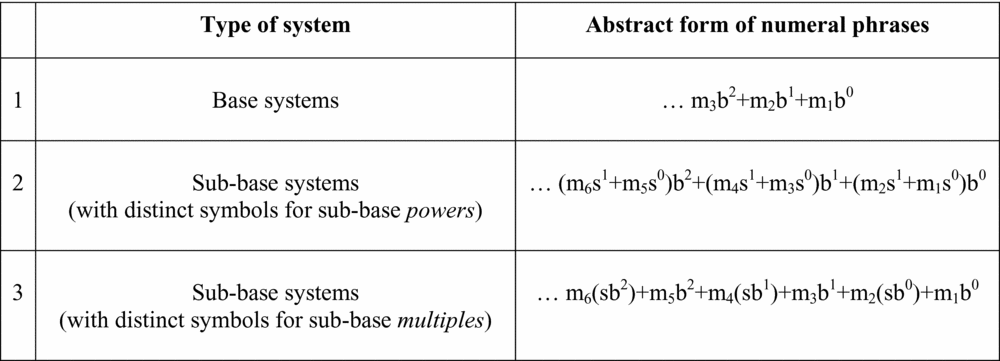
Among numerical notations that use a base, a substantial amount also use a sub-base s. These sub-base systems can be further divided into systems that give special significance to the powers s0 and s1 of the sub-base, and systems that give special significance to certain of its multiples with respect to the powers of the base, that is, sb0, sb1, sb2 . . ., sbn.
The former kind of sub-base system has multipliers that act only on the powers of the sub-base, rather than on the powers of the base. The value of these multipliers can reach up to s-1 when acting on s0, but only up to (b/s)-1 when acting on s1 (in all sub-base systems known to us, the sub-base s is a divisor of the base b). The Babylonian numeral phrase  (a base-60 sub-base-10 system) illustrates this; multipliers acting on s0, namely 1, are represented by the symbol
 , which can be repeated up to nine, or s-1 times. But multipliers acting on s1, namely 10, are represented by the symbol
 , which can be repeated only up to five times, since 60/10-1 = 5.
The latter kind of sub-base system has multipliers that act both on the powers of the base and on the specified multiples of the sub-base. These multipliers can reach values up to s-1 when they act on the powers of the base, and up to (b/s)-1 when they act on the multiples of the sub-base. The Roman numeral phrase CCCCLXXXXVIIII (a base-10 sub-base-5 system) illustrates this; the powers of the base b0, b1, and b2, namely 1, 10, and 100, are represented with symbols that can be repeated up to four, or s-1 times. But the multiples of the sub-base sb0 and sb1, namely 5 and 50, are represented by signs written at most once, since (10/5)-1 = 1.
Figure 1 shows the abstract form of numeral phrases in each of the three types of systems just discussed, with base systems in the first row and the two kinds of sub-base systems in the second and third rows. These abstract forms provide a uniform approach to analyzing most numerical notations, and for this reason can be used to classify them. Nonetheless, that most systems can be understood as embodying abstract forms does not imply that their users actually thought of them in this way. The forms are a convenient way of interpreting numerical notations, but in no way serve to define what counts as a numerical notation.
Abstract structural analysis of numerical notations. mi = value of multiplier i, b = value of base, s = value of sub-base. In first row base systems, multipliers act on each power of the base. In second row sub-base systems, multipliers act on the sub-base raised to the power of zero or one. The value of the parenthesized formula in turn acts as another multiplier on each power of the base. In third row sub-base systems, multipliers m1, m3, and m5 all act on each power of the base. Multipliers m2, m4, and m6, however, act on the parenthesized product that results from the sub-base being multiplied by each power of the base.
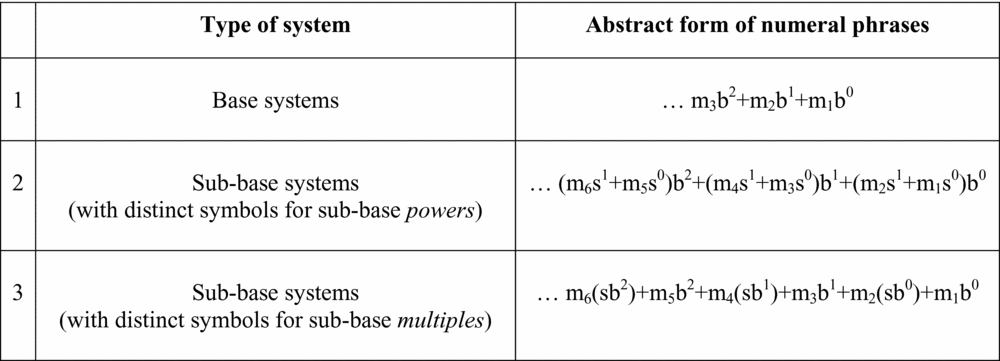
We shall speak of the bases and sub-bases of systems to include all of their relevant powers and multiples. For example, the bases of a base-10 system are 1 (100), 10 (101), 100 (102), 1000 (103), 10,000 (104), etc., and base-20 systems have bases of 1 (200), 20 (201), 400 (202), 8000 (203), etc. A base-10 sub-base-5 system, whose form is that shown in the second row of Figure 1, has bases and sub-bases of 1 (50×100), 5 (51×100), 10 (50×101), 50 (51×101), 100 (50×102), 500 (51×102), 1000 (50×103), 5000 (51×103), etc. Meanwhile, a system that is similar, but follows the schema shown in the third row of Figure 1, has bases and sub-bases of 1 (100), 5 (5×100), 10 (101), 50 (5×101), 100 (102), 500 (5×10²), 1000 (103), 5000 (5×10³), etc. Notice that although the values of the bases and sub-bases for systems adhering to the second and third forms are the same, their underlying organizational structures differ. Where no confusion results, we shall sometimes also use the term “bases” to include both bases and sub-bases.
3. Methodological considerations for typologies
Now that we have introduced and discussed useful concepts for analyzing numerical notations, we turn in this section to concepts for analyzing typologies. Sections 3.1 and 3.2 present the general framework and desiderata we have developed for comparing typologies and for assessing their relative merit. Although we only consider typologies for numerical notations, this framework can be applied to typologies of many other domains as well. It is furthermore useful not only for evaluating preexisting typologies, but also for exploring many combinatorially possible typologies.Footnote 11
3.1. A framework: the four components of a typology
In our framework, a typology consists of the following four components:
• the domain of objects it classifies,
• the aspects of the objects it uses to classify them,
• the ranking it gives to the relative importance of each aspect, and
• the purpose it serves.
Since we are dealing only with typologies for numerical notations in this paper, the domain to be classified consists of numerical notations and specific sub-sets of numerical notations.
The second component of a typology is the finite set of aspects that are used to classify the objects of its domain. From an abstract point of view, an aspect is a set of categories, and a category is a set of objects that share a specific property. For instance, all plane geometric shapes with three vertices fall by virtue of this shared property into the category “triangles,” all shapes with four vertices into the category “quadrangles,” and so forth. The set of categories “triangles,” “quadrangles,” “pentagons,” “hexagons,” etc. then constitutes an aspect we might call number of vertices. As another example, we might group shapes into the different categories “red,” “blue,” “yellow,” etc., depending on which of these properties each shape has. The set of these categories would then constitute the color aspect.Footnote 12
We now list various aspects that could be used for classifying numerical notations, distinguishing them by the different categories they contain.Footnote 13 Many of these aspects are taken from typologies that have been proposed in the literature, and we shall make brief references to the typologies of Zhang & Norman and Chrisomalis, although they will be discussed in greater detail in the next section.Footnote 14 For readers with a special interest in only certain sections of our discussions, aspects 1–4 are essential to Zhang and Norman's typology, aspects 5 and 9 to Chrisomalis', and aspects 6–8 to our typology. Aspects 10–23 are of independent interest, but are not essential to understanding our main arguments.
1) Dimensionality
The three categories of the dimensionality aspect are “no-base” systems, “base” systems, and “sub-base” systems. No-base systems have one dimension (1D), namely the correspondence they establish between numbers and physical objects. Base systems are two-dimensional (1×1D), the first dimension being the multiplier and the second the base. And sub-base systems are three-dimensional ((1×1)×1D).Footnote 15
2-3) Base and sub-base values Footnote 16
The particular base values and sub-base values are two further aspects of base and sub-base systems. To our knowledge, categories for extant base values are “2,” “10,” “20,” “60,” and “100,” and categories for extant sub-base values are “5” and “10.”
4) Dimensional representation
A typology can also distinguish between different kinds of dimensional representation, or different combinations of representational principles for multipliers, bases, and sub-bases. For Zhang and Norman, these representational principles are quantity (Q), shape (S), and position (P), and categories are specific combinations of these principles. For instance, no-base tally systems fall into the “Q” category, whereas systems whose multipliers are represented with quantity and whose bases are represented by separate shapes are comprised in the “Q×S” category. The “(Q×S)×P” category contains systems whose multipliers are represented by quantity, sub-bases by shape, and bases by position. The former categories are not subsets of the latter ones, but rather are independent of them. Thus, a system in the “(Q×S)×P” category does not also fall into the “Q” category, although its first, multiplier dimension is represented by quantity.
5) Intraexponential (IA) organization
Chrisomalis proposes that base and sub-base systems be classified by the number of numeral signs needed to represent each multiplier/base pair. He calls this aspect intraexponential (IA) organization because it classifies systems by how they are organized within each exponent of the base. (For instance, within the hundreds position of the Indo-Arabic system, there is but one numeral sign.) Chrisomalis employs the categories “cumulative” (describing systems that use many signs to represent the value of the multiplier/base pair), “multiplicative” (containing systems that use two separately written components—one for the multiplier and one for the base), and “ciphered” (for systems that use a single sign, or cipher, to represent the value of the multiplier/base pair).
6-7-8) Multiplier representation, base representation, and sub-base representation
Instead of analyzing the combined representational principles of systems as a whole or of multiplier/base pairs as in the previous two aspects, multipliers, bases, and sub-bases can also be considered in isolation. In the multiplier representation aspect, we can distinguish between “cumulative” representation (where n many instances of a numeral sign represent the multiplier n), and “ciphered” representation (which employs a single sign to represent the multiplier n).Footnote 17
One can distinguish between three principles by which bases are represented, and therefore between three categories under the base representation aspect. “Integrated” representation builds the representation of the base into the same symbol that also represents its multiplier (in a way “integrating” the two representations). “Parsed” representation represents the base in a written symbol distinct from that of its multiplier, somewhat like the IA organization “multiplicative” category. Finally, “positional” representation uses the position of the multiplier in the numeral phrase to represent the base on which it acts.
Sub-base representation has historically been either “integrated,” “parsed,” or “positional” in the same way that base representation has.
9) Interexponential (IE) organization
Chrisomalis classifies systems according to the operations necessary to obtain the total value of numeral phrases from the values of their constituent signs. This aspect is called interexponential (IE) organization because it deals with the aggregation of many multiplier/base pairs, or exponents. He gives two different categories for this aspect: “additive” and “positional.”Footnote 18 Systems belonging to the additive category need only addition to arrive at the total value of a phrase from the constituent values, whereas systems in the positional category also need multiplication, the value of the multiplicands being dependent on the position of their multipliers.
10-11) Extendibility and limit value
Some systems can only represent numbers up to a certain limit, while others are in principle indefinitely extendable. This gives rise to the aspect of extendibility, which contains the two categories “indefinitely extendable” and “non-indefinitely extendable.” In addition, the particular limit value of a system could be an aspect by which to classify it, with the specific categories depending on extant systems. For example, Chrisomalis categorizes systems which can represent numbers up to 999,999 into the “1,000,000” category, those which can represent numbers up to 99,999,999 into the “100,000,000” category, and so forth. Indefinitely extendable systems fall into the “no limit value” category.
12-13) Parsing presence and parsing value
As stated under aspect 7, “parsing” is the use of two distinct signs for the multiplier and the base, as contrasted with their “integration” into the same sign. While some systems are parsed throughout their range, some are integrated for representations of lesser numbers and become parsed only to represent greater numbers. For instance, Greek alphabetic numerals use parsing only in representations of numbers greater than 1000 – the number 3000 is thus represented as  γ with the representing 1000 and the γ representing 3. For representations of numbers less than 1000, the Greek system is integrated rather than parsed. As with the extendibility and limit value aspects, the binary “parsing” or “no parsing” aspect of parsing presence can be elaborated into a more fine-grained parsing value aspect. This fine grained aspect groups systems based on the value at which they begin to employ parsing.
14-15) Sign count and average length
The extant systems suggest categories for the sign count aspect, with different categories for systems with “one numeral sign” (such as tally systems), those with “ten numeral signs” (such as the Indo-Arabic system), and so on. Comparisons of the twenty-nine-sign Greek alphabetic system and the two-sign binary system used in computer science reveal a trade-off between a system's sign count and the length of its numeral phrases. Thus the categories for the separate aspect of average length of numeral phrasesFootnote 19 lie between, on the one hand, a tally system that uses a single sign and needs a numeral phrase of length n to represent the number n and, on the other hand, a hypothetical system that needs n-many signs because every number is represented by a different sign, but where the length of any numeral phrase is one (see also Chrisomalis Reference Chrisomalis2003, 558–9; idem 2010, 390–2). This is but a rough correlation, however. Abaci, for instance, can represent large numbers relatively concisely despite the fact that they have just one sign, namely a counter.
16-17) Purity and additional sign value
In structurally “pure” systems, the base and sub-base values along with the dimensional representation or multiplier, base, and sub-base representation aspects completely determine the sign count. However, some extant systems contain structural “impurities” in the form of theoretically redundant numeral signs. For example, although a pure base-100 sub-base-10 system does not need signs to directly represent 11–19 and 21–25, Āryabhaṭa's numerals have signs for these values. The binary aspect of purity records whether a system is “pure” or “impure” in this sense. Alternatively, the more fine-grained aspect of additional sign value contains categories that group systems by virtue of having redundant signs that represent the same numbers. One category would thus include all systems that have a redundant sign for only the number 20, while another category would include all the systems that have redundant signs for both 20 and 30, and so forth, with a distinct category for systems that do not have additional signs.
18-19) Chunking presence and chunking value
Systems sometimes chunk groups of numeral signs together in order to make long phrases easier to read. For instance, we use commas or periods to facilitate the reading of long Indo-Arabic numeral phrases such as 1,000,000, and many cumulative systems chunk signs for multipliers into groups of three or four to make counting them easier. The binary chunking presence aspect contains the categories of “chunked” and “not chunked.” Another more fine-grained aspect called chunking value might contain categories sorting systems not by whether or not they use chunking, but by the particular quantity of signs the system chunks together.
20-21) Symbol shape and font
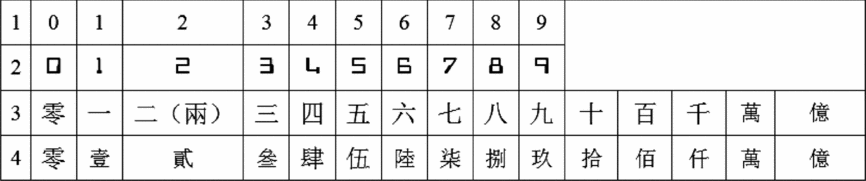
Symbol shape is another aspect by which systems can be classified. Symbol shape differentiates otherwise structurally identical systems from one another, so that it is the only aspect that differentiates the present day Indo-Arabic system, whose modern shapes developed in medieval Europe, from its Indic ancestor (see Chrisomalis Reference Chrisomalis2003, 1, 332–3; idem 2010, 22). Symbol shape is not only relevant for psychological and aesthetic considerations, but also plays a role in a system's legibility and the uses to which it can be put. Figure 2, for instance, illustrates shapes that have been adopted in financial contexts. At first sight, it seems that the Indo-Arabic financial numerals differ from regular Indo-Arabic numerals only in font, while the Chinese financial numerals possess a completely different symbol shape, whence the distinction between the symbol shape and font aspects.
The special shape and font of financial numerals. The first and third rows show regular numerals while the second and fourth rows show their financial counterparts.
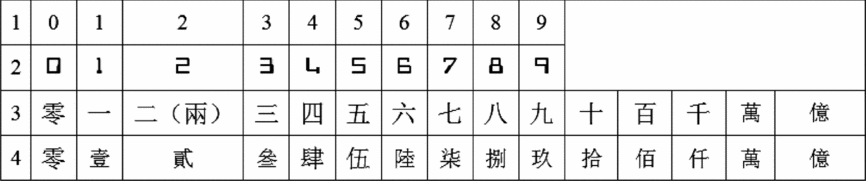
22-23) Ease of calculation and ease of mastery
Since one important use of numerals is to be the subject of calculation algorithms, scholars have worked on showing how to use different systems to carry out basic calculations. This suggests using the ease of calculation with a given system as a typological aspect, but it is very difficult to devise meaningful categories for it. One difficulty is in determining what kind of calculations are important – should systems be classified by how easily they lend themselves to addition, subtraction, multiplication, division, exponentiation, taking roots, or a combination of these, and for what range of values? There is the further difficulty of determining the medium of calculation – how should one compare the ease of calculation of a paper and pencil calculation using Indo-Arabic numerals with a computation carried out on an abacus and recorded with Roman numerals? The popularity of pen-and-paper calculation is a modern phenomenon and is not guaranteed to hold out against machine calculation, so there is no a priori reason to place emphasis on this particular means of calculating over the many others that exist (Chrisomalis Reference Chrisomalis2003, 616–17; idem 2010, 433). Furthermore, ease of computation depends not only on the structure of the system and the medium of computation, but also on which of various possible algorithms is used. Even if these difficulties could be overcome, this aspect often boils down to the training and familiarity of the reader with the systems in question; authors have too often neglected the fact that each of us has spent many years learning to use the Indo-Arabic system correctly, and have too often appealed to intuition rather than carrying out careful investigations.Footnote 20 Similarly, the aspect of ease of mastery of particular systems is difficult to assess and we are not aware of any comparative empirical studies to this effect.Footnote 21
The above list contains the aspects prominent in the literature on numerical notations; included are all the aspects used in the typologies we discuss below plus several additional ones. Nonetheless, we have omitted possible aspects such as basicness, that is, whether the system's numeral signs represent only bases, or other non-base numbers as well (Hollings Reference Hollings2009, 20), the color in which numerals are written, and others. Moreover, some of the aspects we have listed could be subdivided even further; ease of calculation could be divided into ease of addition, ease of subtraction, and so forth. However, the framework we propose can easily be extended to include additional aspects if the need arises.
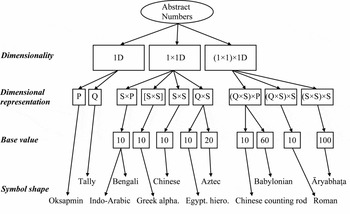
The third component of a typology is the particular ranking of importance it gives to each of its aspects. This determines to what extent the typology can be presented hierarchically. A completely hierarchical typology like Zhang and Norman's (Figure 4) gives each aspect a distinct rank of importance. The objects of the domain are first and foremost classified into the categories belonging to the most important aspect, then into the categories belonging to the second most important aspect, and so forth.
In contrast to hierarchical organization, an equal ranking of aspects yields a non-hierarchical typology, of which Chrisomalis' (Figure 10) and our typologies (Figures 12 and 14) are examples. A non-hierarchical typology can easily be converted into a hierarchical one by choosing a particular ranking of importance among the aspects, and the converse is also true. Finally, a typology can also be partially hierarchical, that is, ranking some aspects as more important than others, but also ranking certain other aspects as equally important as each other.
The fourth and final component of a typology is the purpose it is meant to serve. The main purpose of all the typologies we discuss here is to organize numerical notations by shared properties, with the goal of discovering patterns, generalizations, and even universals in the ways humans develop, perceive, and use numerical notations (although Zhang and Norman do this with specific attention to aspects relevant to calculation with each system).Footnote 22
Thus far, we have discussed the four components of a typology: its domain of objects, the aspects of the objects it uses to classify them, the ranking it gives of each aspect's importance, and its purpose. Characterizing typologies in terms of these four components allows us to compare them easily, because differences between typologies can be analyzed as differences either in domains, aspects, rankings, or purposes. If all four components are identical in two typologies, then the two are identical. And if two typologies differ, then this framework allows us to say whether this is due to their domains, aspects, rankings, or purposes. This allows for a much more nuanced comparison than simply judging typologies by the final groupings of objects they make. Our discussion below of Zhang and Norman's, Chrisomalis', and our own typologies will serve as an illustration of how to use this framework to conduct a careful comparison of typologies.
Another reason for developing this framework is that it can function as a “typology generator” of sorts. Given a list of possible aspects and rankings for a typology of a certain domain and with a certain purpose, all of the combinatorially possible typologies for the domain can be generated in a mechanical fashion. While we have not provided an exhaustive list of the aspects by which numerical notations could be sorted (in any case, there are in principle infinitely many of them), we believe that we have included the most relevant aspects for questions regarding the development, perception, and use of numerical notations. Thus, unless we have omitted pertinent aspects from our list, this framework can be used to generate most of the possibly relevant typologies of numerical notations. This allows for an evaluation of the typology we develop to take place not only against the several others already in existence, but also against a broad range of possible typologies.
3.2. Desiderata for typologies
Given the above framework for comparing different typologies, we now address the further question of how to assess their relative merit. According to Chrisomalis, a successful typology “organizes knowledge in a way that answers old questions and allows researchers to ask new ones” (Chrisomalis Reference Chrisomalis2004, 38). While we certainly agree with this, we also believe that there are more specific criteria by which the effectiveness of a typology can be evaluated, some of which are independent of its particular purpose. We introduce here some of these desiderata, which allow us to assess typologies systematically, rather than on an ad hoc basis. In this way, the strength of the criticisms we raise later rests on the strength of these fundamental principles rather than solely on our intuitions of which systems ought to be classified together. Desiderata 1–4 concern the internal consistency of the typology's structure, and desiderata 5–7 concern the relation of the first three components of a typology to its intended purpose.
1. Each aspect's categories should be disjoint, that is, no objects should fall into two or more categories of the same aspect.
2. Each aspect's categories should be exhaustive, that is, every object should fall into at least one category of each aspect.
3. Each aspect's categories should form a cohesive group, that is, the categories within each aspect should deal with the same kinds of properties. For example, a single aspect should not have categories dealing with color as well as with size.
4. Objects classified in a particular category should indeed have the property the category claims they have.
5. The domain of objects a typology classifies should be as relevant as possible for the stated purpose of the typology.
6. The aspects included in the typology should be as relevant as possible for the stated purpose of the typology.
7. The typology's rank of each aspect's importance should be as relevant as possible for the stated purpose of the typology.
We now move on to presenting and evaluating Zhang and Norman's, Chrisomalis' and our typologies with reference to the framework and desiderata we have just introduced.
4. Zhang and Norman's typology
4.1. Presentation
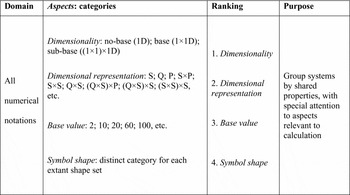
Zhang and Norman's hierarchical typology of numerical notations for cognitive science is shown in Figure 3 in terms of our framework.
Zhang and Norman's hierarchical typology as represented in our framework.Footnote 23

The domain of objects Zhang and Norman classify is the set of all numerical notations. They employ the aspects of dimensionality, dimensional representation, base value, and symbol shape in their typology (see section 3.1), and rank them in this same order. In this typology, then, systems are first classified according to whether they use no base (1D), one base (1×1D), or a base and a sub-base ((1×1)×1D). Since the second-highest ranked aspect is dimensional representation, systems are further sorted according to which combination of quantity (Q), shape (S), and position (P) they use to represent their dimensions. The value of the base is used to distinguish even further between systems that might share the same dimensionality and dimensional representation, and systems are finally sorted according to the shapes of the symbols they use. Figure 4 lays out the typology in a way that highlights its hierarchical nature.
Zhang and Norman's cognitive typology of numerical notations.Footnote 24

Let us illustrate how some sample numerical notations are classified according to this typology. The Oksapmin people of Papua New Guinea have a numerical notation that consists of pointing at different parts of the body. Pointing to the right thumb represents 1 whereas pointing to the right little finger represents 5. The numerals continue up the arm and to the face, where pointing to the right ear represents 12, the right eye 13, and the nose 14. One continues in this way until reaching a representation of 29 further along the left arm, and Saxe seems to say that greater numbers can be represented by looping back to the origin at the right thumb (Saxe Reference Saxe1981, 307). Since this system uses no base, it is one-dimensional (1D) according to Zhang and Norman. This one dimension is represented by the position of the pointing finger, thus placing it in the P category of the dimensional representation aspect.Footnote 25 Since a system with no base cannot have a base value, the only aspect left to note is the shape of symbols the Oksapmin use. The fact that the position of a finger represents a number differentiates this system from other structurally identical ones that use the position of a differently shaped object.
A tally system is dimensionally also a 1D system. However, since what matters for determining the value of a numeral phrase is the quantity of tallies rather than their position, it falls into the Q category of the dimensional representation aspect. Like the Oksapmin system, the tally system has no base value category. The tally system is structurally identical to a system that cumulates, say, tokens in a vessel rather than written tallies (see Schmandt-Besserat Reference Schmandt-Besserat1980, 371), but the two fall into different categories of the symbol shape aspect.
Both Indo-Arabic and Bengali numerals are base systems without sub-bases, and for this reason are classified in the 1×1D category of the dimensionality aspect. The multipliers are represented by the shape of the numeral signs, while the position of each multiplier represents the bases, causing both systems to fall into the S×P category of the dimensional representation aspect. The value of their bases is 10, placing them in that base value category. While both Indo-Arabic and Bengali numerals are identical with regard to the previous aspects, they use differently shaped numeral signs and therefore fall into different categories of the symbol shape aspect.
The Babylonian system is a sub-base system, making it dimensionally a (1×1)×1D system. The dimensional representation is by quantity for the multipliers, shape for the sub-base powers, and position for the base powers, placing the system in the (Q×S)×P category. The value of the base is 60, and the particular signs the system uses place it in a different symbol shape category from other systems to which it might be identical up to that point.
4.2. Discussion
4.2.1. Base and sub-base value
We now evaluate Zhang and Norman's typology using the desiderata we laid out in section 3.2. First, it is not obvious why the aspect of sub-base value is excluded while the aspect of base value is included. If the latter is relevant to their project, the former should prima facie also be relevant. This puts into question whether this typology satisfies Desideratum 6: The aspects included in the typology should be as relevant as possible for the stated purpose of the typology.
4.2.2. Dimensionality does not directly affect calculation algorithms
In keeping with the concern that Zhang and Norman's typology may not fulfill Desideratum 6, we also question their inclusion of dimensionality as an aspect. Zhang and Norman could justify the inclusion by arguing that the presence or absence of a sub-base in a system determines which algorithms can be used to calculate with it. Since algorithm choice affects the way particular systems lend themselves to calculation, dimensionality is a relevant aspect for the purpose of the typology.
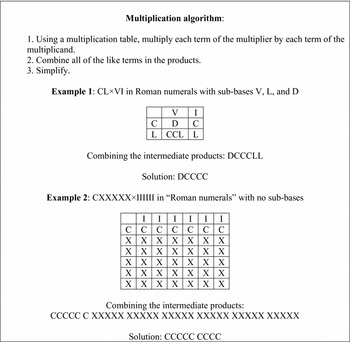
However, this is not always the case. Figure 5 shows two different kinds of “Roman numerals,” the former with sub-bases and the latter without. Despite this difference, the same algorithm can be used for multiplication in both systems. We conclude that Zhang and Norman's typology does not fulfill Desideratum 6, because a system's dimensionality is not immediately relevant to assessing the ease of calculating with it.
Identical multiplication algorithms despite differing dimensionalities.

4.2.3. Not all sub-base systems adhere to the same abstract form
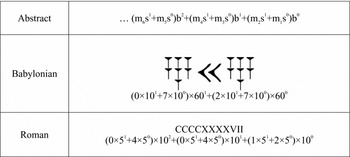
Another potential weakness in Zhang and Norman's classification is their identification of no-base, base, and sub-base systems with the respective abstract forms of 1D, 1×1D (from Figure 1, first row), and (1×1)×1D (from Figure 1, second row). By equating the two sets of concepts, they de facto claim that all sub-base systems adhere to the abstract form (1×1)×1D. Indeed, although the Babylonian and Roman numerals – both of which are sub-base systems – look radically different on the face of things, Zhang and Norman interpret them as both adhering to the abstract form (1×1)×1D, as shown in Figure 6.
Abstract form (from Figure 1, second row) and its Babylonian and Roman instantiations. mi = values of the different multipliers, b = value of the base, and s = value of the sub-base.

Let us explain how Zhang and Norman envision the Babylonian and Roman numeral phrases in Figure 6 to fit the abstract form presented there. In the (2×101 + 7 × 100) × 600 portion of the Babylonian numeral phrase, the 2 and the 7 are represented by the quantity of the rightmost two sets of tallies. The different shape of the tallies is what tells us that the middle multiplier acts on the sub-base 101 while the rightmost multiplier acts on the sub-base 100. 600 is represented by the fact that the two sets of multipliers are in the rightmost position of the numeral phrase. A similar analysis holds of the rest of the Babylonian phrase.
Zhang and Norman interpret the (1×51+2×50)×100 portion of the Roman phrase as follows: the 1 and the 2 are represented by the quantity of Vs and Is. The shape V does not directly represent 5. Rather, it stands for 51 within the limits of the base power 100. Similarly, the shape I does not directly represent 1, but stands for 50 within the limits of the base power 100.
The (0×51+4×50)×101 portion of the Roman phrase is analyzed in the same way. 0 and 4 are represented by the quantity, respectively, of Ls and Xs. The shape X does not directly represent 10, but rather stands for 50 within the limits of the base power 101, just as the shape L, were it present in the phrase, would stand not directly for 50, but for 51 within the limits of the base power 101. This analysis continues, with the shape C not directly representing 100, but standing for 50 within the limits of the base power 102.
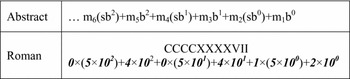
It should be evident from this explanation that the Babylonian numerals fit the abstract form in Figure 6 with significantly more ease than do the Roman numerals. Thus, while Roman numerals can be abstracted to fit the same form as Babylonian numerals, there are other abstract forms to which Roman numerals are an even closer fit. Since certain multiples (5, 50, and 500) of the Roman sub-base receive distinct symbols, the system adheres better to the form in the third row of Figure 1, shown again here in Figure 7.
Alternative abstract form (from Figure 1, third row) and its Roman instantiation.

Let us analyze the 1×(5×100)+2×100 portion of the Roman phrase – the same portion represented in the old abstract form as (1×51+2×50)×100 – in order to show that the Roman system fits this new abstract form much better than it does the form Zhang and Norman claim it exemplifies. The multipliers 1 and 2 are represented by the quantity of Vs and Is. The shape V stands directly for 5, or (5×100). The shape I stands directly for 1, or 100. If this seems to fit more directly here than it did to the abstract form of the Babylonian numerals, then the Roman numerals and Babylonian numerals do not necessarily best adhere to the same abstract form, despite both being sub-base systems. This in turn amounts to the claim that not all sub-base systems share the same abstract form and, more generally, that not all systems of the same dimensionality share the same abstract form. Therefore, by asserting that all sub-base systems share the abstract form (1×1)×1D, Zhang and Norman seemingly violate Desideratum 4: Objects classified in a particular category should indeed have the property the category claims they have.
4.2.4. Difficulties of identifying sub-base systems
Even if one did not equate dimensionality and abstract form, there would remain a problem with classifying systems by dimensionality. It is not always clear which systems have a sub-base and which do not, and this is sometimes no more than a matter of judgment. Take for example the numerals of the Texcocan Kingsborough Codex (Figure 8). Should each group indicated by a conjoining stroke be considered a single symbol for a sub-base of 5, or is there no sub-base and the conjoining strokes ought to be simply ignored?
Two different value 5 multipliers in the Texcocan Kingsborough Codex numerals.

The Iñupiaq systemFootnote 26 is another example of a borderline case. This system, which cumulates tallies to represent multipliers within a base-20 positional structure, can be analyzed in two ways. Both and
 are usually considered to stand for 1, and both
 and
 to stand for 5. On this way of seeing things, the system is a base-20 sub-base-5 system. But it would be equally valid to analyze
 as a further basic numeral sign standing for 2, and
 as a further basic numeral sign standing for 10. In this second analysis, the system is a base-20 sub-base-10 sub-base-5 sub-base-2 system. Which is the more accurate analysis depends on the judgment of whether or not
 is the same numeral-sign as
 , and by extension whether
 is simply a juxtaposition of two of the same numeral sign, or whether it is a numeral sign in itself. Similar comments apply for
 and
 . If they are the same signs, then there are no sub-bases of values 2 and 10. But if they are not the same signs, then there are additional sub-bases of values 2 and 10. Therefore, although the aspect of dimensionality suggests the categories of no-base, base, and sub-base systems (and perhaps even sub-sub-sub-base systems in the Iñupiaq case), deciding which systems fall into which categories is not always straightforward.
To the extent that this boils down to a subjective judgment, all typologies that use dimensionality and related aspects will struggle to satisfy Desideratum 4: Objects classified in a particular category should indeed have the property the category claims they have, because it is difficult to say with certainty if systems classified as sub-base systems are actually sub-base systems, or are merely base systems with suggestive chunking. However, this problem is exacerbated in Zhang and Norman's typology because it ranks the dimensionality aspect as the most important. For example, the typology risks putting the Kingsborough Codex numerals or the Iñupiaq system in radically differing categories, all depending on the outcome of a subjective judgment of their dimensionality. This seemingly violates Desideratum 7: The typology's rank of each aspect's importance should be as relevant as possible for the stated purpose of the typology. The gravity of the sub-base problem is reduced either in non-hierarchical typologies or in hierarchical typologies that place little or no importance on the aspect of dimensionality. So Zhang and Norman's typology stands alone in that the sub-base problem leads it to violate Desideratum 7.
4.2.5. Arithmetical operations
Chrisomalis has argued that Zhang and Norman do not adequately deal with systems' IE organization (the mechanism by which the constituent values of numeral phrases are combined into their total values) (Chrisomalis Reference Chrisomalis2004, 40). For instance, one arrives at the value of the numeral phrase 587 by taking the result of (5×100)+(8×10)+(7×1), and Zhang and Norman do not directly account for this.
Failing to account for IE organization would only violate Desideratum 6: The aspects included in the typology should be as relevant as possible for the stated purpose of the typology if IE organization were relevant for the ease of calculation with different systems and for understanding the way humans use numerical notations. However, it is not obvious that this is relevant to calculation, and we argue below in section 5.2 that it may not be relevant to most ways in which humans use numerals. Furthermore, it is possible to glean information on IE organization from Zhang and Norman's typology, despite its not explicitly stating it. Take, for instance, a (Q×S)×P system. It is clear that arriving at its total value involves counting up the signs of each multiplier (especially if the system is not chunked), taking the product of the multipliers and sub-bases, taking the product of the resulting values and the bases, and then adding them all up. As we discuss below in section 5.2, there are multiple different ways in which the process can be carried out for each system, of which this is but one. But the important point is that these processes are derivable simply from the classification of the system as (Q×S)×P, with the inclusion of the IE aspect not being necessary. Thus, Zhang and Norman's typology should not be overly criticized for failing to account for IE organization.
To conclude our analysis of Zhang and Norman's typology, desiderata 1, 2, 3, and 5 are satisfied. The categories are disjoint, exhaustive, and form a cohesive group, and the domain is relevant to the purpose of the typology. Desideratum 4 is not satisfied; as it is not clear that all systems of the same dimensionality adhere best to the same abstract form, some systems do not have one of the properties that their dimensionality category claims they have. Desiderata 6 and 7 also seem to go unsatisfied, as the aspects and rank of the typology are not optimal for its purpose; sub-base value should be included as a relevant aspect if base value is, or an argument should be given as to why it is not. Furthermore, dimensionality is not directly relevant as an aspect, and its high rank exacerbates the difficulties that arise from the problem of identifying sub-base systems.
5. Chrisomalis' typology
5.1. Presentation
Let us turn to Chrisomalis' typology, presented in Figure 9 in terms of our framework.
Chrisomalis' typology for numerical notations as represented in our framework.

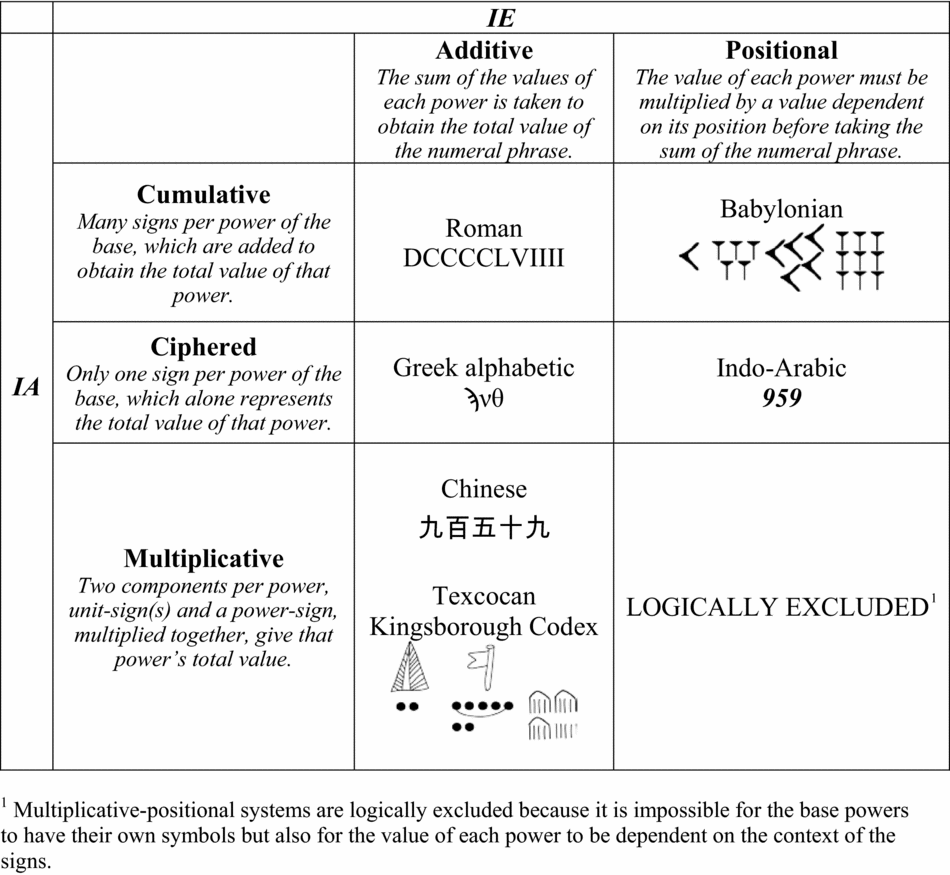
As explained in section 3.1, a system's IA organization determines how numeral signs are combined to symbolize the product of each multiplier/base pair. The IE organization, in contrast, is responsible for determining the total value of the numeral phrase by way of arithmetical operations that combine the constituent values given by the IA organization. For example, in a Roman numeral representation of 1432, the IA organization specifies that one M, four Cs, three Xs, and two Is are required to represent the values of each individual multiplier/base product: 1000, 400, 30, and 2. According to the IE structure of Roman numerals, addition is then used to aggregate the values obtained from the IA component. As another example, in Chinese numerals, the IA structure gives the signs  千 四 百 三 十 二, in that order, to represent the values of multiplier/base pairs. The IE organization is then responsible for aggregating the values represented by those signs, in this case using both multiplication and addition. Figure 10 shows Chrisomalis' typology, in which systems fall into final groups based on their combined IA and IE organizations (see Chrisomalis Reference Chrisomalis2003, 20–5; idem 2004, 41–4; idem 2010, 9–14).
Chrisomalis' two-aspect typology of numerical notations.Footnote 27

Again we shall use a few examples to illustrate this typology. Roman numerals are cumulative-additive. Many occurrences of signs are needed to represent the value of each multiplier/base pair, making the numerals IA cumulative. Once the signs are in place for a particular numeral phrase, the values of each power may simply be summed up to reach the total, so the system is IE additive.
The Greek alphabetic system is ciphered-additive. Only one sign is needed to represent the multiplier/base pair, meaning the system is IA ciphered. Once the signs are given, one need only add up the values they represent to arrive at the total value of the numeral phrase, placing the system in the IE additive category.
Chinese numerals are multiplicative-additive. They are IA multiplicative because two components, one each for the multiplier and the base, are needed to represent the value of each power. And they are supposedly IE additive because one need but sum up the values given by the signs to arrive at the total value of the numeral phrase (although this does not seem to be a completely accurate characterization, since a step of multiplication is required before addition can take place).
Babylonian numerals are cumulative-positional. They are IA cumulative since many signs are needed to represent the value of each multiplier/base pair. And they are IE positional since, once the signs are in place, one must multiply their values by a value dependent on their position, and then sum up those products to arrive at the total value of the numeral phrase.
Indo-Arabic numerals are ciphered-positional. Only one sign is needed to represent the total value of each multiplier/base pair, meaning that they are IA ciphered. Once the signs are given, one must multiply each sign's value by another value that depends on its position in the numeral phrase. One may then sum up those products to ascertain the value of the numeral phrase, and this makes the system IE positional.
5.2. Discussion
The list of desiderata presented above suggests some possible shortcomings of Chrisomalis' typology. We start by noting that Chrisomalis is unable to capture as large a domain of systems as Zhang and Norman; he excludes no-base systems because he considers tally systems to be “largely or entirely unstructured” (Chrisomalis Reference Chrisomalis2003, 5; idem 2004, 38; idem 2010, 3). The typology therefore falls short of being optimal with regard to Desideratum 5: The domain of objects a typology classifies should be as relevant as possible for the stated purpose of the typology, since, as we will argue, no-base systems are an important part of the pantheon of numerical notations.
Secondly, the multiplicative-additive category contains drastically differing systems. Both the Texcocan Kingsborough Codex numerals and Chinese numerals are multiplicative-additive, although the former system represents the multiplier n with n-many signs, whereas the latter system does so with only one sign. Perhaps, then, multiplicativity should be considered not as contrasting, but as complementary to cumulation and cipherization, so that there is room to distinguish between seemingly “cumulative-multiplicative” and “ciphered-multiplicative” systems. The typology we present below in section 6 will allow us to make precisely this distinction.
This weakness in Chrisomalis' multiplicative category can be put in terms of the desiderata. The putative difference between cumulative and multiplicative systems is that the former uses many signs per multiplier/base pair, whereas the latter uses two components. However, by this definition, a system can easily possess both properties. For instance, while the Texcocan Kingsborough Codex numerals use many signs per multiplier/base pair, they nonetheless use only two components, namely one component that represents the multipliers and one that represents the bases. Chrisomalis' typology thus goes against Desideratum 1: Each aspect's categories should be disjoint, as the “cumulative” and “multiplicative” categories are not disjoint.
Desideratum 3: Each aspect's categories should form a cohesive group, is also violated. Either the nature of the IA aspect is to evaluate the number of signs per multiplier/base pair, or it is to evaluate the number of components per pair. In the former case, the multiplicative category does not fit cohesively into the categories of the IA aspect. And in the latter case, the cumulative and ciphered categories do not fit cohesively into the set of IA categories.
Thirdly, it seems that positionality is not a property that is specifically involved in arriving at total values from constituent ones. We can think of it instead as providing the constituent values in the first place, since the position of a multiplier in the numeral phrase symbolizes the value of the base on which that multiplier acts. Positionality is thus a representational rather than an aggregative principle. If this is correct, the IE aspect violates Desideratum 3, since the “positional” category (which contains systems that represent constituent values in a certain way) does not form a cohesive group with the “additive” category (which contains systems that arrive at total values in a certain way).
The IE additive category also fails to satisfy Desideratum 4: Objects classified in a particular category should indeed have the property the category claims they have. As we pointed out above in relation to Chinese numerals, calling multiplicative systems “additive” is not a fully adequate description of the process by which they arrive at total values from their constituent parts; there is, after all, a step of multiplication at the start of the process. As another example of where systems might not have the property the IE categories claim they do, no category under the IE aspect mentions counting up the signs of cumulative multipliers, although this process is necessary when a non-chunked cumulative system expresses a very large multiplier. This also points to the fact that the IE categories do not exhaust the historically attested principles by which systems have combined constituent values into total values of numeral phrases, and this violates Desideratum 2: Each aspect's categories should be exhaustive.
Still on the subject of the IE aspect, if the purpose is to understand how humans arrive at an understanding of total value from the symbols on the page, then classifying systems according to the arithmetical operations they use to arrive at total values might border on oversimplification. There are multiple, differing ways to arrive at total values from constituent values in every system. For instance, in the Roman system, it is common to speak of simply adding up the values represented by each sign to arrive at a total value. But we could also speak of counting up the number of symbols of each shape, taking the product of their quantity and the base represented by their shape, and then adding together all of those products. That is to say, nothing in the numeral phrase XXIIII forces the interpretation 10+10+1+1+1+1; the interpretation (2×10)+(4×1) is also plausible. Because of the multiplicity of possible aggregative principles, it is problematic to speak of the Roman system – or any such system – as simply being “additive.”
Furthermore, it is Dehaene's view that numbers are represented in the developed human mind on a logarithmic number scale (Dehaene Reference Dehaene1997, 76–7).Footnote 28 On this view, understanding a quantity involves locating it on this mental number line, which may not be the same as “arriving at it” or “grasping its true value,” whatever these expressions mean. Dehaene's view illustrates that there is probably much more to “understanding” a number such as 2,401 than simply carrying out the arithmetical operation (2×1,000)+(4×100)+(0×10)+(1×1) in order to “arrive” at it. These arithmetical processes seem more relevant to learning a numerical notation for the first time than for using it proficiently on a day to day basis. On this count, the IE aspect might fail to fulfill Desideratum 6: The aspects included in the typology should be as relevant as possible for the stated purpose of the typology.
To conclude, Chrisomalis' typology satisfies Desideratum 7, as the typology's non-hierarchical structure is well in line with its purpose. The typology fails, however, to fulfill desiderata 1 through 6. The IA aspect's categories are not disjoint, and neither aspect's categories form a cohesive group. It is not clear that the objects that fall into certain categories, especially the “additive” category, actually have the property the category claims they do, and this also points to the fact that the categories are not exhaustive. It is not in line with the purpose of the typology to exclude no-base systems from the domain of analysis, and the inclusion of the IE aspect may not be relevant for the purpose of the typology.
6. A modified typology
6.1. Presentation
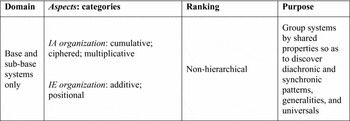
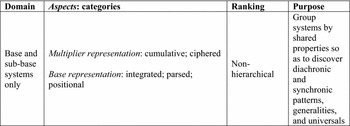
We now present a typology that is not prone to the criticisms we have leveled at the typologies discussed above. As our typology is a modified version of Chrisomalis', we retain much of his terminology while noting that changes in the meaning of certain terms cause each category to be defined quite differently from each category in Chrisomalis' typology. Figure 11 represents our typology in terms of our methodological framework.
A new two-aspect typology of numerical notations as represented in our framework.

This typology uses the two aspects of multiplier representation and base representation (see section 3.1). However, while both our and Chrisomalis' typologies use two aspects, multiplier representation and base representation do not correspond to Chrisomalis' IA and IE aspects. Rather, they are both in the general spirit of the IA aspect, since, when taken together, they classify systems according to how they represent the multiplier/base pair. Similarly, multiplier and base representation aspects are both generally in the spirit of Zhang and Norman's dimensional representation aspect. However, we propose separate categories for multiplier and base representation, whereas Zhang and Norman propose categories for different combinations of multiplier and base representations. Figure 12 presents our typology with some examples.
A new two-aspect typology of numerical notations.Footnote 29

As with the other typologies, we shall present some illustrative examples. Roman numerals are cumulative-integrated. The multipliers are cumulative because a tally system is used to represent them. For instance, the multiplier 4 in 400 is represented with the four signs CCCC. The bases are integrated because they are represented in the same symbol as the multiplier – each sign in the phrase CCCC is at the same time a part of the multiplier 4 and a symbol for the base 102.
Greek alphabetic numerals are ciphered-integrated. The multipliers are represented not using the tally system, but with a single symbol, or cipher. The bases are integrated because they are represented in the same symbol as the multiplier, as demonstrated by the single signs θ (9),  (90), and (900), which each contain complete information about both the multiplier 9 and the respective bases 100, 101, and 102.
The Texcocan Kingsborough Codex system is cumulative-parsed. The multipliers are represented cumulatively with a tally system, while the bases are expressed by separately written symbols.
Chinese numerals are ciphered-parsed, as a single sign represents each multiplier, and another, distinct sign represents each base power.
Babylonian numerals are cumulative-positional. The multipliers are expressed cumulatively using a tally system, while the bases are represented by the position of the multipliers.
Indo-Arabic numerals are ciphered-positional. The system is ciphered since single symbols represent the multipliers. And the bases are determined by the placement of those signs, meaning that the system is positional.
6.2. Discussion
This typology fully satisfies desiderata 1, 2, 3, 4, and 7. The categories within each aspect are disjoint, because a system cannot possibly fall into more than one category of the same aspect. They are also exhaustive, as there is no system that falls into no category of an aspect. All the categories of the multiplier representation aspect indeed represent principles by which multipliers can be represented, and similarly for the base representation categories; the categories thus form cohesive groups under the aspects to which they belong. The objects classified in each category all genuinely have the property the category claims they have, and the non-hierarchical nature of the typology seems in line with its purpose.
The typology we propose also allows us to draw some new distinctions between numerical notations. It highlights the difference between cumulative-parsed and ciphered-parsed systems, thereby drawing the distinction we previously said would have made a useful addition to Chrisomalis' typology. This distinction brings out the radical differences between, for instance, Chinese numerals and the Texcocan Kingsborough Codex numerals, both of which fall into the one “multiplicative-additive” category of Chrisomalis' typology.
The introduction of the multiplier and base representation aspects in the new typology also allows us to see exactly what parts of a numeral phrase are governed by the cumulative and positional principles. As discussed above in footnotes 17 and 18, where previous analyses would simply label either entire systems or entire multiplier/base pairs “cumulative” or “ciphered,” “positional” or “nonpositional,” this typology explicitly shows that it is specifically the multiplier that is represented cumulatively, and specifically the base that is represented by the position of the multiplier.
The new typology does not explicitly classify systems according to the arithmetic operations necessary to arrive at a “total value” from the values expressed by the signs, and the points raised in discussing Chrisomalis' IE aspect were meant to support the view that this is a positive development. Most importantly, it sharpens the distinction between, on the one hand, the way humans actually use numerals to understand numbers and, on the other hand, the abstract arithmetical relationships that hold between constituent and total values of numeral phrases. It also allows us to deal more accurately with positionality as a principle of base representation rather than as a principle of aggregation. In any case, one can easily infer from the new typology, as from Zhang and Norman's, which kinds of arithmetical relations hold between the values of individual signs and the total value of numeral phrases in each system. All systems require addition to arrive at their values, and parsed and positional systems also require some multiplication. Some cumulative systems, depending on whether or not they are chunked, might also require some initial counting or subitizing. Despite this characterization, we should not forget that there are multiple, differing ways by which to arrive arithmetically at total values of numeral phrases within each system.
As the above discussion of Figures 5 and 8 has shown, the fact that the new typology does not make the presence or absence of a sub-base a main criterion by which to sort systems is an advantage over Zhang and Norman's typology.
6.3. Refinements and additions
6.3.1. Sub-base representation and a ten-aspect typology
While it is preferable to avoid using sub-base presence as a main typological aspect, the new typology has the drawback of excluding the sub-base's representational principle from its analysis. The Babylonian system is an example of a failure of our typology to capture this interesting component of a system's representational principles. The new typology identifies the fact that Babylonian multipliers are represented cumulatively and that Babylonian base powers are represented positionally. But it does not account for the fact that the sub-base powers are seemingly integrated into the multipliers in the same way that main base powers are integrated into their multipliers in the Roman system. This is not to say that the Babylonian system has been misclassified in the new typology; since the new typology does not say anything about representations of sub-bases it cannot say anything false about them. But this does show that the typology does not capture everything of representational importance in every numerical notation.
In fact, the new typology, like the other two typologies we have considered thus far, fails to describe many aspects that might somehow be relevant to an investigation of numerical notations – one need only look at the framework's list of possible aspects in section 3.1 to realize this. And this might provide grounds on which to criticize the typology for violating Desideratum 6: The aspects included in the typology should be as relevant as possible for the stated purpose of the typology. However, since the purpose of this typology is not to provide detailed information on systems, but simply to group them into plausible categories that can be used to make general observations and to formulate universals, the exclusion of the aspect of sub-base representation, among others, does not constitute a major violation of the desideratum.
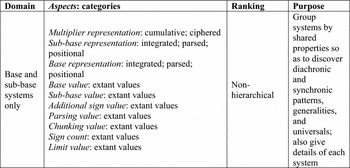
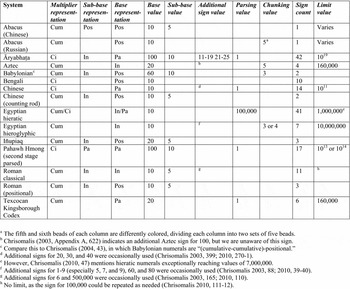
Nevertheless, once this typology has given the reader a familiarity with what we take to be the six main kinds of numerical notations, a more complete typology such as the one in Figures 13 and 14 can classify systems in a much more detailed manner. This typology has all the information of the two-aspect one, but describes eight additional aspects of numerical notations as well, of which the last seven are taken almost directly from Chrisomalis Reference Chrisomalis2003, Appendix A, 620. Our innovation, then, is the replacement of Chrisomalis' IA and IE organization aspects with our multiplier, sub-base, and base representation aspects.
A ten-aspect typology of numerical notations as represented in our framework.

A ten-aspect typology of numerical notations.

6.3.2. Including no-base systems in the ten-aspect typology
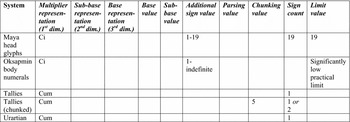
Our ten-aspect typology satisfies all of the desiderata except for Desideratum 5: The domain of objects a typology classifies should be as relevant as possible for the stated purpose of the typology. Specifically, the tally system, used nearly globally throughout history including today, is conspicuously not classifiable in the ten-aspect typology. Chrisomalis' definition of a numerical notation as necessarily having a base excludes it from his typology, and the two- and ten-aspect typologies we propose also seem designed only to classify systems with bases. Unlike Chrisomalis, we accept the tally system as a numerical notation. But we thus far have no good way of classifying it or, for that matter, any no-base system.Footnote 30
No-base systems are clearly numerical notations and deserve typological analysis. After all, they can represent the natural numbers with permanent written or external signs, and some are infinitely extendable – a property not even all base systems possess. One way of incorporating no-base systems into our typology is to interpret them as possessing the same “one dimension” (to borrow an idea from Zhang and Norman) that manifests itself as the multiplier in base systems. This reflects the fact that the cumulation of tallies is the representational principle for multipliers in many base systems such as the Roman, Texcocan, and Babylonian ones.
The result of applying this idea to our typology is shown in Figure 15, where we simply extend the ten-aspect typology of Figure 14 to include no-base systems. Were we to present it in terms of our framework, it would be identical with the original presentation of the ten-aspect typology save on two points. First, the domain would be expanded to include all numerical notations. And second, the names of the multiplier, sub-base, and base representation aspects would be enlarged to note that they are the first, second, and third dimensions of numeration, respectively. If this equating of no-base systems with the multipliers of base systems is accepted, then the typology in Figure 15 satisfies all of the desiderata.
Extending the ten-aspect typology from Figure 14 to include no-base systems.

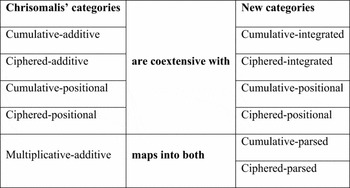
A mapping between Chrisomalis' and our newly proposed categories.

6.4. Patterns, generalities, and universals
Chrisomalis uses his typology to identify many patterns, generalities, and universals of numerical notations and the changes they undergo over time (Chrisomalis Reference Chrisomalis2003, chap. 11–12; idem 2004, 44–8; idem 2006, 391–6; idem 2010, chaps. 11–12). Although the categories of Chrisomalis' and our typologies are defined differently, adopting the new typology does not imply giving up Chrisomalis' work in this area. Rather, his work can simply be reformulated in terms of the new typology's categories. This is thanks to the fact that, despite being defined differently, four of the new typology's categories are coextensive with four of Chrisomalis'. The other two categories, the cumulative-parsed and ciphered-parsed categories, contain only numerical notations from Chrisomalis' multiplicative-additive category.
Consider Chrisomalis' following three claims along with their reformulations in terms of the new typology's categories, which are presented after them and marked with an asterisk.Footnote 31 We have chosen to highlight these three because they are the only ones in need of significant reworking. That is to say, the vast majority of Chrisomalis' work translates quite smoothly into the new typology. Out of the three claims we consider, the latter two are actually subject to fewer exceptions than Chrisomalis' original ones. And while two new exceptions arise to the first claim, they serve to illuminate the principle underlying the claim.
Chrisomalis' generalization I2: “No ciphered system has a sub-base” (Chrisomalis Reference Chrisomalis2003, 522; idem 2010, 368) is transformed in our typology to I2*: No ciphered system has a sub-base. We need only remember that Chrisomalis considers cipherization as a property of multiplier/base pairs, whereas we think of it as a property of multipliers. In addition to the question of whether the ciphered Maya head glyphs have a sub-base, two new anomalies arise in the new typology. Āryabhaṭa and Pahawh Hmong (second stage parsed) numerals are both base-100, sub-base-10, ciphered-parsed systems. This exception was not evident in Chrisomalis' typology, as “multiplicative” systems were not said to be “cumulative” or “ciphered.” However, this exception does a lot to explain the underlying cause of the generality. The reason that these are the only ciphered systems with a sub-base is that their main bases have the extraordinarily high value of 100, the highest historically attested base value we are aware of. Without a sub-base, a distinct sign would be required for every number up to 99 in order to complete the systems. The fact that these systems become an exception to I2* points to their incredible uniqueness rather than to the ill-founded nature of the generalization.
Chrisomalis' generalization T2: “Cumulative systems do not develop from noncumulative ancestors” (Chrisomalis Reference Chrisomalis2003, 547; idem 2010, 384) is transformed in our typology into T2*: No cumulative system develops from a ciphered ancestor. Again, we need only note that the terms “cumulative,” “non-cumulative,” and “ciphered” apply to multiplier/base pairs in Chrisomalis' claim, but only to multipliers in our reformulation. The only exception to this near-universal is the cumulative Iñupiaq system, which developed from the ciphered Indo-Arabic numerals.
In relation to this claim, Chrisomalis notes that it is also rare for cumulative systems to evolve into non-cumulative ones (Chrisomalis Reference Chrisomalis2003, 547). One of only three exceptions to this rule – the evolution of the Texcocan Kingsborough Codex numerals from the Aztec numerals – disappears in the new typology, as the Texcocan numerals are considered to be cumulative rather than multiplicative.
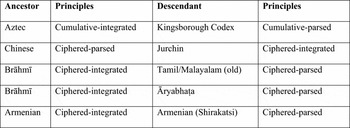
Chrisomalis' generalization T3: “The only transformation that involves both intra- and interexponential change is the invention of multiplicative-additive systems from ciphered-positional ones, and vice versa” (Chrisomalis Reference Chrisomalis2003, 547–8; idem 2010, 384) is transformed into our T3*: The representational principles for the multiplier and the base never transform simultaneously. While simultaneous IA and IE transformation is not equivalent to simultaneous multiplier and base representation principle transformation, the two are similar in that they are changes of two principles at once, and therefore of great magnitude. Out of the seven systems that underwent simultaneous IA and IE transformations as defined by Chrisomalis' typology, not a single one makes such a drastic simultaneous change in both multiplier and base representational principles in the new typology, as shown in Figure 17. This is due to the fact that Chrisomalis' IA multiplicative principle (with which his ciphered and parsed principles are mutually exclusive) maps onto the new typology's parsing principle (which works in tandem with our ciphered and parsed principles).
Events of simultaneous IA/IE transformation translated into the terminology of the new typology.

The new typology's distinction between the cumulation and cipherization of parsed systems risks unearthing instances of simultaneous transformation of multiplier and base representational principles that would not have been instances of Chrisomalis' simultaneous IA/IE transformation. However, out of the five potential cases for this, none turn out to be changes of this magnitude, as Figure 18 shows.
Potential cases of simultaneous transformation of multiplier/base representation.

In addition to simultaneous multiplier/base representation changes, the possibility for simultaneous transformations either of multiplier/sub-base representational principles or of base/sub-base representational principles also arises in our typology, due to our inclusion of the aspect of sub-base representation. It would be an interesting result if in the future such transformations were found to have occurred.
7. Conclusion
In order to systematically assess the typologies for numerical notations that have been put forward in the past, we have introduced a methodological framework in which each typology is characterized by its domain, a set of aspects that describe properties of the domain's objects in terms of categories, a ranking of the importance of these aspects, and an explicit statement of the purpose of the typology. The framework is a useful tool both for pinpointing the exact location of differences between typologies, and for mechanically generating a wide variety of combinatorially possible typologies. Using the framework's terminology, we have formulated seven general desiderata for typologies, and we have used them to evaluate in detail Zhang and Norman's partly dimensional analysis and Chrisomalis' partly aggregative analysis. Finally, in response to our evaluation, we have proposed a purely representational analysis in our new two-aspect typology, and a more detailed extension of it in the expanded-domain ten-aspect typology, that better satisfy the desiderata.
To qualify our claims, however, the conclusions we have drawn are disputable to the extent that our framework and list of desiderata – or our characterization of a typology in terms of them – are incomplete or too narrow. In any case, we believe that our framework is flexible enough to be extended appropriately if the need arises. Furthermore, we do not think that there is a “perfect” typology. Indeed, our aim has been to carefully consider the particular aims of each typology in our evaluations, and no typology can be optimal for every purpose. Nevertheless, insofar as the purpose of a typology is to group systems by shared properties so as to discover diachronic and synchronic patterns, generalities, and universals (and perhaps to also give a somewhat detailed description of each numerical notation), we maintain that adopting our typology lends clarity, universality, and force to much of the work already done on numerical notation. Therefore, while we have critiqued the specific typologies used by Zhang and Norman, and Chrisomalis, the replacement typology we propose is meant to complement their research programs.
To summarize some of our supporting points: regarding Zhang and Norman, dimensional analysis, or the initial sorting of no-base, base, and sub-base systems, raises difficulties despite its initial intuitive appeal. It is sometimes difficult to differentiate between base and sub-base systems (or, for that matter, sub-base and sub-sub-base systems), and dimensionality is not necessarily directly connected to a system's abstract form nor to its calculation algorithms.
Regarding Chrisomalis, the analysis of interexponential organization is posterior to and dependent on the representational principles for the multipliers, bases, and sub-bases, and there are not one but many ways of aggregating constituent values into the total value of a numeral phrase. Because of this, we favor typologies that concentrate on representational principles over typologies that focus on aggregative principles. This means that notions such as “additive” are unnecessary and burdensome in a vocabulary for analyzing numerical notations.
While it was originally Chrisomalis' innovation to concentrate on specific principles rather than on systems as a whole, we believe it is more fruitful to focus on multiplier, base, and sub-base representational principles than on the principles belonging to IA and IE organization. Another of our conclusions, then, has been to relegate claims about cipherization to the realm of multiplier representation and claims about positionality to the realm of base representation. Recognizing that these principles work neither on the level of the system as a whole nor on the level of multiplier/base pairs as a whole allows for more fine-tuned analyses.
We have proposed a strategy by which to integrate no-base systems into a broader typology of numerical notations, all without strictly dividing systems by dimensionality from the very start, which we have argued is problematic. We have also suggested ways of classifying systems by the representational principles of their sub-bases.
Finally, we would like to note that our framework and desiderata can be applied to any typology – not just those for numerical notations. Thus, we hope that this work will be a useful basis for discussing other kinds of typologies in the future.
Appendix A. The world's numerical notations
This appendix lists many of the world's numerical notations and their analysis in terms of our typology. In many cases we have placed a system in multiple categories of a single aspect (“. . ./. . .” in the table). This is not because families of multiple, differing systems are classified under one name, but because both principles are present in a single system, most often over different ranges. The only family of systems listed is the Indian/Southeast Asian family. All other entries are single systems. In some cases we have noted two differing but valid interpretations of a system (“. . .or. . .” in the table). Lastly, in some cases we have noted uncertainties or suggested tentative classifications (“(. . .?)” in the table). Substantial information on the systems can be found in Chrisomalis Reference Chrisomalis2003 and Reference Chrisomalis2010. Information on other typological aspects can be found in Chrisomalis Reference Chrisomalis2003, Appendix A, 620–26; idem 2004, Appendix A, 51–2, from which this table draws heavily.
Appendix

Acknowledgments
Earlier versions of this paper were presented at the annual meeting of the Canadian Society for the History and Philosophy of Mathematics on May 31, 2010, in Montreal and at the 7th annual meeting of the Society for Anthropological Sciences on February 19, 2011, in Charleston, South Carolina. Work on this paper was partially funded by the Social Sciences and Humanities Research Council of Canada (SSHRC). We gratefully acknowledge Andy Yu, Benedikt Löwe, Brendan Gillon, Hansjörg Neth, James T. Smith, John Justeson, Samuel Birnbaum, Sierra Robart, and two anonymous reviewers for their valuable comments on this paper. Some of the fonts used in this article are in the ALPHABETUM Unicode font for ancient scripts, designed by Juan-Jose Marcos.