Introduction
Dicamba is a synthetic auxin herbicide in the benzoic acid chemical family [WSSA Group 4 site of action (SOA)]. In the past 60 years, dicamba has been an important component of broadleaf weed management in corn, small grains, turfgrass, pasture, rangeland, conservation reserve programs, and non-cropland areas (Keelin and Abernathy Reference Mohseni-Moghadam, Wolfe, Dami and Doohan1988; Schroeder and Banks Reference Spandl, Rabaey, Kells and Gordon1989; Spandl et al. 1997; Wehtje Reference Wehtje2008). Through genetic engineering, soybeans have been transformed to tolerate preplant, PRE, and POST applications of dicamba (Behrens et al. Reference Behrens, Mutlu, Chakraborty, Dumitru, Jiang, Lavallee, Herman, Clemente and Weeks2007). This technology (Roundup Ready 2 Xtend,® Bayer Crop Science, Research Triangle Park, NC), fully available to farmers in 2017 [i.e., dicamba-resistant (DR) trait and labeled POST dicamba application], offers an additional POST option for controlling broadleaf weeds in soybean fields (Johnson et al. Reference Mohseni-Moghadam and Doohan2010; Vink et al. Reference Young, Farrell, Bradley, Latorre, Kruger, Barber, Norsworthy, Scott, Reynolds and Steckel2012).
Weed management has long been a major challenge in row crop production. A summary from 2007 to 2013 showed that soybean fields in North America with uncontrolled weeds had an average of 50% yield loss (Soltani et al. Reference Stubben and Milligan2017). Herbicide-resistant (HR) weeds have dramatically increased over the past 20 years, only adding to the challenge of implementing successful weed management (Heap Reference Heap2014). For example, populations of Palmer amaranth (Amaranthus palmeri S. Wats.) and waterhemp [Amaranthus tuberculatus (Moq.) Sauer] infesting soybean fields in Nebraska have evolved resistance to the SOAs of acetolactate synthase (ALS) inhibitors (Heap, Reference Heap2018a), enolpyruvylshikimate-3-phosphate synthase (EPSPS) inhibitors (Vieira et al. Reference Wehtje2017b), and protoporphyrinogen oxidase (PPO) inhibitors (Vieira et al. Reference Webster and MacDonald2017a). These three herbicide SOAs represent the available chemical options for POST control of Amaranthus species in glyphosate-resistant soybean (Roundup Ready®, Bayer Crop Science, Research Triangle Park, NC). Therefore, the complexity of Amaranthus management in soybean is likely to increase as additional populations become resistant as a result of the lack of effective POST herbicide options. As a result, dicamba use on DR soybean might be a valuable tool for managing HR Amaranthus and other troublesome broadleaf species that have evolved resistance to glyphosate in Nebraska, such as kochia [Kochia scoparia (L.) Schrad.], giant ragweed (Ambrosia trifida L.), common ragweed (Ambrosia artemisiifolia L.), and horseweed [Conyza canadensis (L.) Cronq.].
The adoption of DR soybean technology has raised concerns about the unintended off-target movement of dicamba onto sensitive vegetation via vapor and/or particle drift (Young et al. Reference Young, Farrell, Bradley, Latorre, Kruger, Barber, Norsworthy, Scott, Reynolds and Steckel2017). Dicamba has high vapor pressure (volatility), which could increase the chances for off-target movement via vapor drift under certain environmental conditions, including high temperature and low humidity (Behrens and Lueschen Reference Behrens and Lueschen1979; Egan and Mortensen Reference Egan and Mortensen2012). Off-target movement of dicamba via particle drift is more likely to occur from improper nozzle selection, high boom height, high spray pressure, and/or high wind speed at the time of application (Carlsen et al. Reference Carlsen, Spliid and Svensmark2006). Contamination could also result in off-target dicamba injury if spray tanks following dicamba application are not properly cleaned. The negative impact from micro-rates of dicamba is well documented in grape (Vitis vinifera L.) (Mohseni-Moghadam et al. Reference Rankins, Byrd, Mask, Barnett and Gerard2016), soybean (Auch and Arnold Reference Auch and Arnold1978; Griffin et al. Reference Hager2013), vegetables (Mohseni-Moghadam and Doohan Reference Perry, Ciliberto, Hennessy and Moschini2015), and cotton (Gossipium hirsutum L.) (Egan et al. Reference Egan, Barlow and Mortensen2014). Despite the newer dicamba formulations (Xtendimax,® Bayer Crop Science, Research Triangle Park, NC; FeXapan,® Corteva Agriscience, Wilmington, DE; and Engenia,® BASF, Research Triangle Park, NC) with reduced volatility and improved application equipment (e.g., large-droplet spray nozzles, automated spray controllers) (Alves et al. Reference Alves, Kruger, da Cunha, Vieira, Henry, Obradovic and Grujic2017; Egan and Mortensen Reference Egan and Mortensen2012), off-target movement and dicamba injury on sensitive vegetation was widely reported across the United States in 2017. It was estimated that 1.4 million ha of non-DR soybean across the United States showed symptoms of dicamba injury (Hager Reference Heap2017). However, it remains controversial whether this damage from off-target movement was primarily caused by physical particle drift, vapor drift, or tank contamination (Steckel et al. Reference Vieira, Oliveira, Giacomini, Arsenijevic, Tranel and Werle2017).
The total soybean production area in Nebraska in 2017 was estimated at 2.3 million ha (USDA 2017). The majority (more than 95%) of soybean hectares were planted with HR cultivars [e.g., glyphosate-, glyphosate plus dicamba-, or glufosinate-resistant (Liberty® Link, BASF, Research Triangle Park, NC)], with the remaining (less than 5% of total soybean hectares) hectares consisting of conventional (non-HR) and organic soybean cultivars. Nearly 200,000 ha of DR soybean were planted in Nebraska in 2017 (A.J. Jhala, personal communication). Therefore, it is essential to document the perceptions and experiences of Nebraska soybean farmers regarding the adoption of this new technology. The dicamba off-target movement was controversial in 2017, and a trending topic in 2018 across the United States.
Surveys are a useful method for obtaining knowledge or perception regarding a situation or issue and can assist with determining future decisions and directions (Givens et al. Reference Griffin, Bauerle, Stephenson, Miller and Boudreaux2009; Rankins et al. Reference Soltani, Dille, Burke, Everman, Vangessel, Davis and Sikkema2005; Webster and MacDonald Reference Webster and MacDonald2001). For example, a 2016 Missouri survey conducted by Bish and Bradley (Reference Bish and Bradley2017) showed that fewer than 82% and fewer than 50% of pesticide applicators were aware that temperature and vapor pressure, respectively, influence herbicide volatilization. These results indicate the importance of training for those who spray synthetic auxin herbicides. Therefore, the objective of this survey was to evaluate Nebraska farmers’ perspectives on use of dicamba and DR soybean technology during the 2017 growing season, the year when the technology became fully available to soybean farmers in the United States. The results from our survey will provide valuable information to support or assist with future regulatory, extension education, and management decisions regarding DR soybean and upcoming HR crop technologies.
Materials and Methods
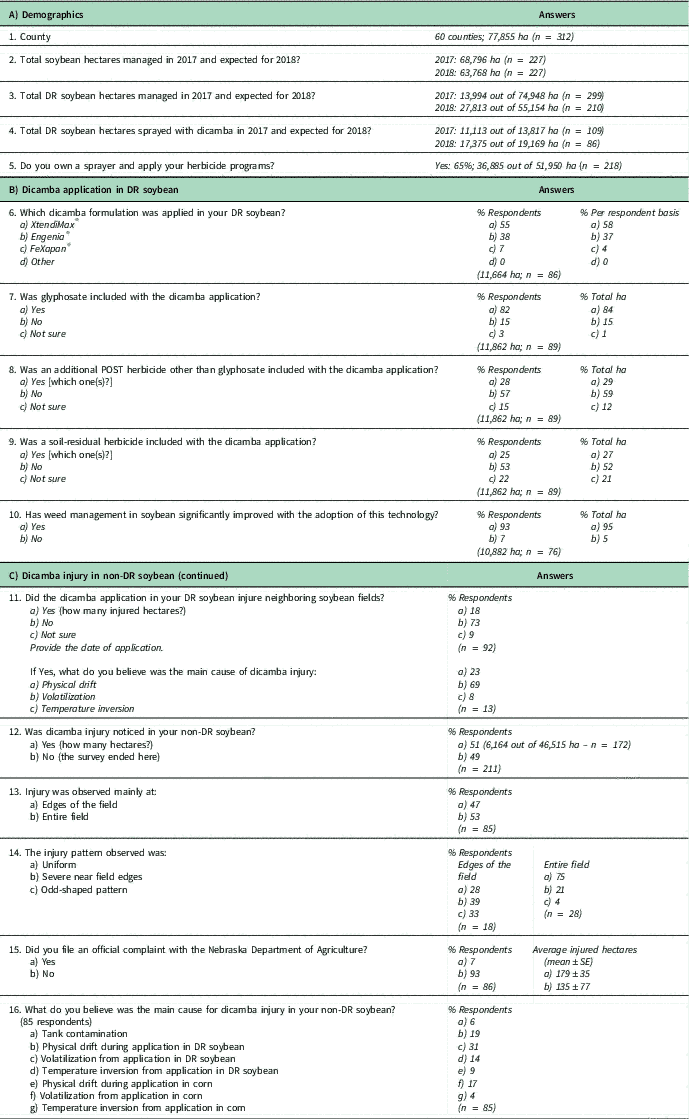
A survey was developed to understand Nebraska farmers’ experience and perspectives about the use of dicamba and DR soybean technology during the 2017 growing season (Table 1). To reach a uniform representation of soybean growers, the survey was conducted in two formats: (1) paper copies handed out during the 2017 Soybean Management Field Days (441 participants attended), representing four major soybean-growing areas in Nebraska (North Platte, Ord, Auburn, and Tekamah); and (2) online survey using SurveyMonkey (www.surveymonkey.com) linked to the University of Nebraska–Lincoln (UNL) CropWatch website (the central resource for UNL Extension information on crop production and pest management; www.cropwatch.unl.edu). The online survey was available from August 18 through September 18, 2017. For consistency in data entry, completed paper copies from the field days were entered into the online system. All results were exported from SurveyMonkey as a Microsoft Excel (Microsoft Office, Redmond, WA) file with the answers to each question in separate columns.
Adoption of dicamba-resistant (DR) soybean technology and dicamba off-target movement survey questionnaire conducted with Nebraska farmers in 2017 and summary of respondents’ answers. a ,b

a The survey was conducted in two formats: (1) paper copies handed out during 2017 Soybean Management Field Days, held at four major soybean-growing areas of Nebraska (August 08–11, 2017 at North Platte, Ord, Auburn, and Tekamah, respectively); and (2) online using SurveyMonkey (www.survemonkey.com) linked to the University of Nebraska–Lincoln (UNL) CropWatch website (the central resource for UNL Extension information on crop production and pest management; www.cropwatch.unl.edu).
b Abbreviations: DR, dicamba-resistant soybean (Xtend® technology, Bayer Crop Science, Research Triangle Park, NC); n = number of respondents.
The survey comprised three sections (Table 1). Questions (Q) in the first section focused on demographic information (Q1–5, Table 1A). The second section of the survey was designed to collect data from farmers who had adopted the DR soybean and sprayed dicamba during the 2017 growing season (Q6–10, Table 1B). The third section of the survey focused on off-target dicamba injury observed in non-DR soybean (Q11–16, Table 1C). Survey data were sorted and analyzed using the sort, filter, and count functions in Microsoft Excel. For most questions, results are presented in two fashions: (1) percent of respondents answering, and (2) percent number of hectares represented. The total number of respondents and hectares for all pertinent questions used for percent calculations are included in the results. Not every respondent answered every question. Therefore, results were only extracted from surveys where respondents answered all pertinent questions. For instance, when trying to estimate whether the number of DR soybean hectares was expected to increase in 2018, only answers from respondents who completely answered survey Q2 and Q3 were used (Table 1A). In addition, a logistic model was fit to the farmers’ responses to whether their application of dicamba on DR soybean resulted in off-target injury to non-DR soybean (Yes or No; binomial data) regressed on date of application. The likelihood of dicamba injury on non-DR soybean in 2017 was estimated using the popbio package in R statistical software using the logi.hist.plot function (Stubben and Milligan, Reference Vieira, Samuelson, Alves, Gaines, Werle and Kruger2007). The model’s probability of injury was expressed on the left y-axis, and the frequency of responses given the application time of year was presented on the right y-axis. Thirty complete responses were available to fit the model (Q11, Table 1C).
Results and Discussion
Demographics
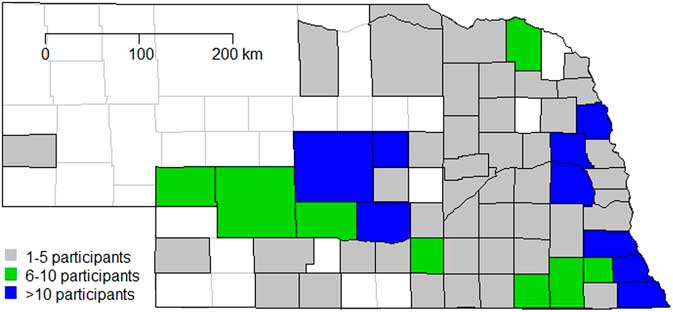
Survey results were obtained from 312 farmers from 60 Nebraska counties, representing a total of 77,855 ha of soybean grown in 2017 (Figure 1; Q1, Table 1A). Sixty-three percent of the responses representing 44,620 ha (57% of total hectares) were obtained during the Soybean Management Field Days. The remaining responses (43% of total hectares) were obtained from the online survey. According to the USDA (2017), approximately 2.3 million ha of soybean were planted in Nebraska in 2017; therefore, the results of this survey represent approximately 3.4% of the total soybean area planted in the state.
Nebraska counties represented in the survey. Different colors represent the number of answers obtained per county. The soybean production area of Nebraska is concentrated in the eastern, central, and southern parts of the state.

Two hundred twenty-seven respondents planted 68,796 ha of soybean in 2017 and expected to plant 63,768 ha in 2018, a 7% reduction in soybean hectares (includes DR and non-DR soybean) expected for 2018 when compared to 2017 (Q2, Table 1A). According to 299 respondents, 13,994 out of 74,948 soybean hectares were planted with DR soybean in 2017 (19% of total hectares; Q3, Table 1A). When evaluated on a per-respondent basis, DR soybeans were planted on 20% of hectares in 2017. According to 210 respondents, the number of DR soybean hectares would probably double in 2018 in Nebraska; 27,813 out of 55,154 ha were likely to be planted with DR soybean (50% of total hectares). On a per-respondent basis, farmers would probably plant 52% of their soybean hectares with DR soybean (ranging from 2.5% to 100%; data not shown). When asked about the number of DR soybean hectares treated with dicamba in 2017, 109 farmers indicated a total of 11,113 ha out of 13,817 ha treated (80% of total DR hectares; Q3 and Q4, Table 1A). On an average per-respondent basis, 73% of the DR hectares were treated. In total, 86 farmers indicated that 17,375 out of 19,169 DR ha would probably be sprayed with dicamba in 2018 (89% of total DR hectares) with an average of 88% DR hectares expected to be treated on a per-respondent basis. These results indicate that the number of soybean hectares planted with DR soybean and sprayed with dicamba would substantially increase in 2018.
Bayer Crop Science representatives anticipated nearly 16.2 million ha planted with DR soybean in 2018, which represents approximately half of the total soybean area in the United States. Historically, farmers have been more likely to adopt genetically engineered crops with HR traits compared to other technologies (e.g., insect- and disease-resistant traits) (Fernandez-Cornejo et al. Reference Givens, Shaw, Kruger, Johnson, Weller, Young, Wilson, Owen and Jordan2014; Perry et al. Reference Service2016; Service Reference Steckel, Bond, Ducar, York, Scott, Dotray, Barber and Bradley2007). HR traits have enhanced weed management strategies, offered economic savings, and increased crop yields (Duke Reference Duke2015). For example, GR crops were the most adopted technology in the history of modern agriculture, and glyphosate is often referred to as a “once-in-a-century herbicide” (Dill et al. Reference Dill, CaJacob and Padgette2008; Duke and Powles Reference Duke and Powles2008). Ten years after the introduction of GR soybean in 1996, over 95% of soybean hectares in the United States were treated with glyphosate (Benbrook Reference Benbrook2016; Bonny Reference Bonny2008). However, dicamba is not as versatile as glyphosate; it controls only broadleaf weed species and has greater potential for off-target movement. Therefore, the use of DR soybean might not be as widely adopted for the management of GR weeds. Additionally, dicamba will require farmers’ willingness to comply with strict application requirements and potential risks such as off-target movement and crop injury.
When asked, 65% of respondents reported that they own a sprayer and spray their own herbicides (Q5, Table 1A) (total responses = 218), which equates to 71% of hectares (out of a total of 51,950 ha) being sprayed by respondents themselves. Furthermore, out of 90 respondents, 71% reported that they own a sprayer and sprayed dicamba in DR soybean, representing 12,154 ha. The relatively high number of DR soybean hectares being sprayed by farmers highlights the importance of pesticide application training, particularly for the application of the new auxin formulations in DR soybean. Results from a survey conducted by Bish and Bradley (Reference Bish and Bradley2017) demonstrated the benefit of additional training for those spraying dicamba in DR soybean. Extensive applicator training was conducted in some states in 2017, including Alabama, Georgia, and North Carolina, where fewer complaints were filed (Steckel et al. Reference Vieira, Oliveira, Giacomini, Arsenijevic, Tranel and Werle2017). Following the high number of off-target dicamba injury issues during 2017, the United States Environmental Protection Agency declared the three new dicamba products approved for use in DR soybean as restricted-use pesticides and mandated training for growers wishing to purchase and spray these new products in the United States starting in 2018 (EPA 2017). Thus, dicamba labels have become more restrictive in an attempt to reduce off-target injury. Moreover, some states have imposed additional restrictions for application; for instance, in Minnesota, dicamba can only be sprayed before June 20 and if temperatures are below 29 C. In the state of Arkansas, no dicamba agricultural products can be applied from April 16 through October 31.
Dicamba Application in DR Soybean
Regarding dicamba formulation (Q6, Table 1B), 55%, 38%, and 7% of total hectares represented in the survey (11,664 ha; 86 respondents) were treated with XtendiMax®, Engenia®, and FeXapan®, respectively. On a per-respondent basis, 58%, 37%, and 5% of respondents used XtendiMax®, Engenia®, and FeXapan®, respectively. No farmer who responded to the survey indicated the use of a nonlabeled dicamba formulation (e.g., Banvel®; Arysta LifeScience, Cary, NC; Clarity®, BASF) on DR soybean in Nebraska during the 2017 growing season.
Responses from 89 farmers representing a total of 11,862 ha of DR soybean sprayed with dicamba were selected to investigate the frequency of tank-mix products used with dicamba in DR soybean. When asked whether glyphosate was tank-mixed with dicamba (Q7, Table 1B), 82%, 15%, and 3% of respondents reported yes, no, and not sure, respectively, which represented 84%, 15%, and 1% of total hectares. When asked whether a POST herbicide other than glyphosate was tank-mixed with dicamba (Q8, Table 1B), 28%, 57%, and 15% said Yes, No, and Not sure, respectively, which represented 29%, 59%, and 12% of total hectares. ACCase inhibitors (WSSA Group 1; e.g., clethodim) followed by PPO inhibitors (WSSA Group 14; e.g., fomesafen) were the primary herbicides used in tank mixtures with dicamba (data not shown). When asked whether an herbicide with soil residual activity was added to the tank mix with dicamba (Q9, Table 1B), 25%, 53%, and 22% of farmers reported Yes, No, and Not sure, respectively, which represented 27%, 52%, and 21% of total hectares. Long-chain fatty acid inhibitors (WSSA Group 15; e.g., acetochlor, S-metolachlor, and dimethenamid) were the predominant answer.
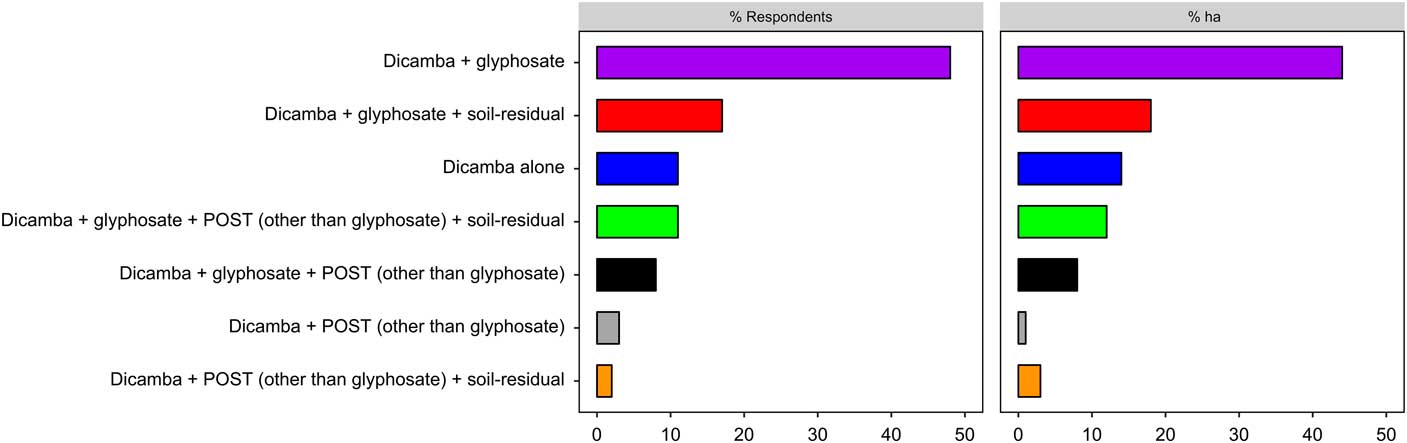
Complete responses (Q7–9; Table 1B) from 63 farmers representing a total of 9,098 ha of DR soybean indicated that nearly 60% of respondents used dicamba alone or glyphosate plus dicamba for POST weed control in DR soybean in 2017; the remaining 40% added an additional herbicide with an alternative SOA to the POST application (Figure 2). When asked whether the DR technology and dicamba application improved weed management in soybean (Q10, Table 1B), 93% of farmers responded Yes, representing 95% of total hectares surveyed (76 responses and a total of 10,882 ha of DR soybean sprayed with dicamba in 2017).
Herbicides tank-mixed with dicamba and sprayed in dicamba-resistant (DR) soybean in 2017 in Nebraska. Complete responses (Q7–9, Table 1) from 63 farmers representing a total of 9,098 ha of DR soybean sprayed with dicamba were used to generate this figure.

Results of the survey indicate high reliance on dicamba applied alone or in tank mixture with glyphosate for POST control of GR weeds (e.g., waterhemp, Palmer amaranth, horseweed, giant ragweed, and kochia; Figure 2). The high reliance on glyphosate applied POST for weed control in GR soybean, corn, and cotton over the last two decades resulted in the evolution of GR weeds in the United States (Heap Reference Heap2018b). DR soybean and cotton were developed as a way to provide an additional effective POST option to control GR weeds. As of 2017, 34 weeds had evolved resistance to synthetic auxin herbicides globally (Busi et al. Reference Busi, Goggin, Heap, Horak, Jugulam, Masters, Napier, Riar, Satchivi, Torra, Westra and Wright2018), including DR kochia, common lambsquarters (Chenopodium album L.), prickly lettuce (Lactuca serriola L.), and smooth pigweed (Amaranthus hybridus L.) (Heap Reference Keelin and Abernathy2018c). If farmers do not employ effective herbicide resistance management practices, it is likely that dicamba and DR soybean will quickly become an ineffective tool for managing HR weeds.
Dicamba Injury in Non-DR Soybean
When farmers were asked whether their 2017 dicamba application in DR soybean injured neighboring non-DR soybean fields (Q11, Table 1C), 18%, 73%, and 9% responded Yes, No, and Not sure, respectively (total of 92 respondents). Those who confirmed injury in non-DR soybean fields resulting from their dicamba application believed that the primary cause was volatilization (69%), physical drift (23%), and temperature inversion (in combination with volatilization or physical drift) (8%; total of 13 respondents).
Conversely, 51% of survey respondents observed dicamba injury in their non-DR soybean (total of 211 respondents; Q12, Table 1C). Respondents reported 6,164 out of a total of 46,515 ha of non-DR soybean were injured by dicamba (13% according to 172 respondents). Of those who observed dicamba injury in their non-DR soybean, 53% observed injury over the entire field, whereas 47% reported injury only on the edges of the field (total of 85 respondents; Q13, Table 1C). For those who observed injury on the edges of the fields, 28%, 39%, and 33% reported the injury pattern to be uniform, severe near the edge, and odd-shaped, respectively (18 respondents; Q14, Table 1C). Of those who observed injury throughout the entire field, 75%, 21%, and 4% reported the injury pattern to be uniform, severe near field edges, and odd-shaped, respectively (28 respondents). The primary suspected causes for uniform dicamba injury in an entire field are probably tank contamination, volatilization, and/or application during a temperature inversion. Physical drift during application would typically lead to higher levels of injury near the treated areas (e.g., parts of the field exposed to higher amounts of off-target spray particles).
Farmers who observed dicamba injury in non-DR soybean were asked whether they had filed an official complaint with the Nebraska Department of Agriculture (NDA; Q15, Table 1C); 7% responded Yes, and 93% reported No (86 respondents). The average injured area of those who filed an official complaint with the NDA was 179±35 ha (6 respondents), and the average injured area for those who did not was 135±77 ha (80 respondents). Therefore, there was no correlation between injured area and the likelihood of filing an official complaint. When asked what they believed to be the main cause of injury in their non-DR soybean (Q16, Table 1C), respondents reported: tank contamination (6%), physical drift from dicamba application in DR soybean (19%), volatilization from dicamba application in DR soybean (31%), temperature inversion following dicamba application in DR soybean (14%), physical drift from dicamba application in corn (9%), volatilization from dicamba application in corn (17%), and temperature inversion following dicamba application in corn (4%) as their believed cause for dicamba injury (total of 85 respondents). Although results indicate dicamba applications in DR soybean as a contributing factor to off-target injury, it is interesting to note that 30% of respondents believe that dicamba injury in non-DR soybean resulted from dicamba applications in corn. The widespread occurrence of GR common waterhemp and Palmer amaranth in Nebraska has resulted in farmers relying more on dicamba applied later in the season for POST control in corn (R. Werle, unpublished data). This change in use pattern of dicamba-based herbicides in corn for the aforementioned weed control in Nebraska and potential off-target dicamba movement from their applications must be further investigated.
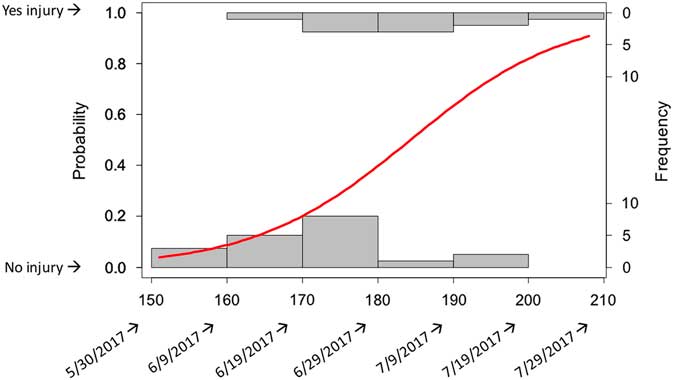
The likelihood of dicamba injury in non-DR soybean increased with late-season applications in 2017 (Q11, Table 1C; Figure 3). Dicamba applications in DR soybean made after late June/early July in 2017 were more likely (more than a 50% chance) to cause injury to adjacent non-DR soybean in Nebraska. We hypothesize that most late-season dicamba applications in 2017 were performed during less-than-ideal environmental conditions (e.g., higher wind speeds, temperature inversion, high temperatures). The current labels allow dicamba to be sprayed up to the R1 growth stage in DR soybean. Given this increased risk of off-target movement from late-season applications, farmers should consider using this herbicide early in the season as part of a preplant, PRE and/or early-POST program to minimize the risk for off-target movement. Moreover, neighboring non-DR soybean become more vulnerable to dicamba injury at the late vegetative to flowering stages. In a multi-location study by Griffin et al. (Reference Hager2013), soybean showed 2.5 times more sensitivity to dicamba micro-rates at the flowering stage than at the vegetative stage. According to a meta-analysis conducted by Egan et al. (Reference Egan, Barlow and Mortensen2014), dicamba physical particle drift (5.6 g ai ha–1) at the vegetative and flowering stages could cause 3.7% and 8.7% soybean yield loss, respectively, whereas Kniss (Reference Mueller2018) estimated that for 8% dicamba injury observed at the flowering stage (R1 and R2) in non-DR soybean, 2.5% yield loss is likely to occur. Therefore, avoiding dicamba application when soybean are at advanced growth stages may reduce the likelihood of damage (i.e., soybean yield loss) from off-target movement.
Likelihood (logistic model; red line) of dicamba off-target injury in non-dicamba-resistant (DR) soybean fields in response to dicamba application time (day of the year; x-axis) in DR soybean in 2017. Responses from 30 participants were available to fit the model (Q11, Table 1).

Survey responses mainly associated off-target dicamba movement with dicamba use in DR soybean but also indicated that dicamba applications in corn may have played a role. Thus, farmers should be mindful of nearby dicamba-susceptible crops when making any dicamba application. Results show that farmers need and are willing to adopt DR soybean technology and that the number of DR soybean hectares planted would significantly increase in 2018. According to our survey, most soybean hectares are sprayed by non-commercial applicators in Nebraska, highlighting the importance of state- or region-specific applicator training programs. In addition to concerns over off-target movement and injury, the adoption of resistance management strategies is critical to maintain dicamba as an effective tool for controlling troublesome GR weeds. Effective weed management is becoming more complicated, and the challenges related to dicamba in 2017 have only highlighted this reality. With the new stricter dicamba application requirements, increased training, and additional hectares to be planted with DR soybean, the hope is that off-target injury in non-DR soybean would decrease in 2018, though preliminary research suggests that the newer low-volatility restricted-use dicamba formulations can volatilize (Mueller, Reference Schroeder and Banks2017; Young, Reference Young, Farrell, Bradley, Latorre, Kruger, Barber, Norsworthy, Scott, Reynolds and Steckel2017). Also, late-season application with older formulations of dicamba in corn may also contribute to off-target movement and injury. Given these factors, the use of surveys to understand farmers’ experiences and perceptions is vital to assist scientists in developing research and education efforts so that farmers can more effectively utilize and protect the weed management tools available to them. Further surveys will also aid researchers, extension educators, industry, and policy makers in monitoring the status and impact of DR soybean technology in Nebraska and other geographies.
Acknowledgments
We would like to acknowledge Keith Glewen (UNL Extension Educator), Lisa Jasa (UNL CropWatch Editor), Gustavo Vieira (UNL Visiting Undergraduate Student), and Liberty Butts (UNL Research Technologist) for their assistance with the survey. A special thanks to all survey participants for their time answering the questions and providing valuable feedback.